
Please note: This blog post has drawn upon information from photographic and print resources whereby the names of managers and deceased persons from former orphanages, secure health institutions, and penal institutions may have been mentioned. Also, there are depictions of the recreational activities of such institutions described in this blog post.
Introduction:
The clock in the prison tower strikes the hour of midday. The prison brass band – a dozen trained prisoners – has fallen in on the grass plot in the central quadrangle. At a signal from the official in charge it bursts into an inspiring rendition of Off to Glory march. There may be dilletante criticism of the music’s aesthetic quality. There can be no doubt of its volume and its lilting spirit. (“A NEW PENTRIDGE.”, 1923)
In the previous post on bands in institutions, music was seen as a worthwhile recreational activity whereby listening to music or making music was very much encouraged. This post focuses on one of Australia’s unique bands which was established in Pentridge Prison.
Pentridge Prison really needs no introduction as an institution as innumerable stories have sprung from its bluestone walls. It was not a place that immediately springs to mind as a place for music-making. Yet that is exactly what happened in the early 1920s. Pentridge Prison became the institution that hosted the fourth prison band in the world.
Musical Reform:
Up until the early 1920s, Pentridge Prison was operated like many other prisons in Victoria under the governance of the Penal and Gaols Department. Reports on the on Victorian prisons from this time were not very informative and focused mainly on statistics – the reports of 1922 and 1923 being prime examples (Penal and Gaols Department, 1923, 1924). Conditions for the Victorian prisoners were hardly humane as prisons “had been designed to ensure prisoner separation” (Paterson, 1997, p. 134). However, as Paterson (1997) and Wilson (2014) identified in their respective research papers into the history of Victoria’s prison system, it is in the early 1920s when the Penal and Gaol Department, and Pentridge Prison, underwent a series of reforms. The key to these reforms was prisoner education and music-making was a strong part of this.
Efforts by people such as Mr. Gibson Young, an eminent Melbourne musician with strong managerial skills and an association with the brass band movement, sought to bring music into Pentridge through community singing. In 1921 he had the full intention of running community singing in the gaols.
Now that the Music Week organisation has been placed on a more or less permanent basis, my executive committee is anxious to do all in its power to bring the good tidings of music into every department of civic life, and realises that no better opportunity for upliftment exists than among the prisoners in our gaols. (Young, 1921)
The band:
While community singing was useful as an ad hoc form of recreation and a break in the prison routine, The new governor of the Pentridge in 1922, Major Walter Condor, had bigger ideas and he wanted to form a brass band. His plans were outlined at the of the Tattersalls Club in Melbourne where he was trying to solicit donations for three pianos at Pentridge (“PIANO FOR PENTRIDGE“, 1922). Major Condor, having previously overseen the A.I.F. camp at Langwarrin, had very firm ideas about making Pentridge a much more humane place for the prisoners and introducing educational reforms.
To the strains of “home, Sweet Home,” Victorian criminals may yet be welcomed back to the prisons after new convictions. The provision of music for prisoners is one of the ideals of the governor of Pentridge Major Condor, and he hopes for much from such an experiment in the reclamation of the State’s “Bad Hats.”
[…]
Major Condor said that one of the most humanising things was work, and next to that was music. (“PIANO FOR PENTRIDGE“, 1922)
Ten days later, Major Condor gained further support for a brass band at a conference of the National Federation at Ballarat where some delegates thought it was a very good idea. A Dr. Booth thought his “idea was a good one” and that “It was essential that the prisoners should not only have plenty of work to do, but the mind should be occupied after working hours.” (“A PRISONERS’ BAND.”, 1922). And so, the brass band at Pentridge was created.
At first the band was conducted by Mr. Gibson Young, and he had obviously used his contacts in the brass band movement to get the instruments and music that were needed – the Coburg Brass Band and Malvern Tramways Band were two bands that are mentioned as having donated these items (Cremona, 1923). Mr. Young, who was associated with the Malvern Tramways Band, had apparently “remarked that Major Condor might try to inveigle members of the Malvern Tramways Band into Pentridge to strengthen the personal of his band” (Cremona, 1923). One wonders what Mr. Harry Shugg, then conductor of the MTB, might have thought of this remark (if he knew about it).
An article published in The Herald newspaper in February 1923 gives us some insight into the way music has begun to transform life at Pentridge.
There are already 15 men in the band. Some of them have had experience in regimental bands, some of have been connected with various bands that are not known in Pentridge. Others have just “taken to music” as the best means of whiling away the time until they can know again outside of the walls. (“PRISON DE LUXE“, 1923)
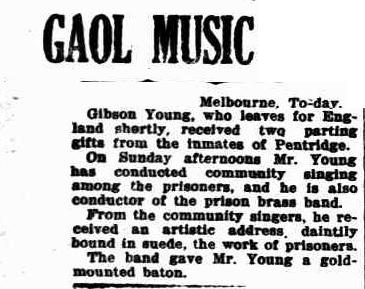
By April 1923, the work that was taking place at Pentridge was noticed by the Chief Secretary, a Mr. Baird who was most impressed with what he saw in the music-making and the effect it had on prisoners (“IMPROVEMENTS AT PENTRIDGE“, 1923). And some months later, Pentridge was a prison that was well on the way to reformation, all under the watch of Major Condor (“A NEW PENTRIDGE.”, 1923). Mr. Gibson Young, the bandmaster of the prison band and conductor of the community singing, left his position (and Australia) in September 1923 and was presented with a gold-mounted baton by the band (“GAOL MUSIC“, 1923).
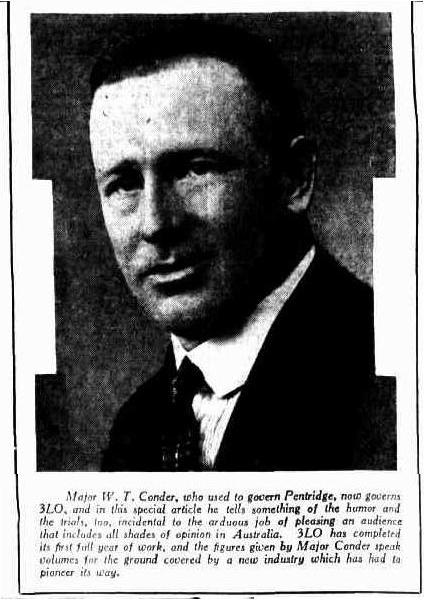
Major Condor left the prison in November 1923 to try a new career radio broadcasting (Thomas, 2006). While he had only been governor at Pentridge for eighteen months, he had overseen substantial reforms that benefited the prisoner population and facilities.
He gave the prisoners more healthful surroundings, brightened their quarters, permitted slight decorations of the cells, and with a colour scheme has banished gloom from the long corridors. He gave them a brass band, Saturday and Sunday concerts, taught them games, improved their methods of working at trades by installing electric machinery in the shops, and increased their self-respect. (“MR. CONDER.”, 1923).
On a slightly humorous note, a letter was published in the Labor Call newspaper apparently from a prisoner at Pentridge. In this letter, he provides his ‘opinion’ on the band.
Our brass (very brass) band keeps a fellow from getting the “blues,” except when they play “Home, sweet home.” We are going to petition against the tune, as it only applies to the “Gov.” himself – he has a good home here. (No. —, 1924)
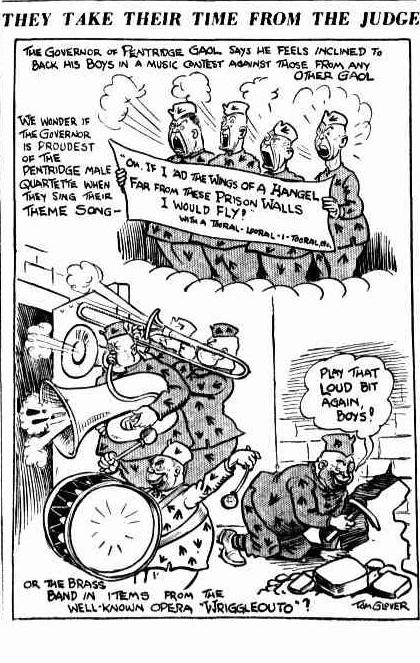
The band at Pentridge prison kept going from strength to strength at from these early years and were noted by all that saw them perform. They were, or course, part of a bigger picture of reform at the prison, and Pentridge was no longer seen as a dull institution (“AN HOUR IN PRISON.”, 1927). The band had established themselves quite a bit over the subsequent years, to the extent that the Governor of Pentridge at the time, Mr. J. Brown, thought that the prisoners at Pentridge led all other prisoners in Australia in their musical abilities – he wanted them to go up in musical competition with the prisoners at Goulburn prison.
Literally there is music in the air at Pentridge every day. An accomplished brass band of 26 instruments, led by Warder George Williams, plays marches and waltzes as the gangs go to and from their labours at the lunch hour. (“GAOL MUSIC DERBY“, 1935)
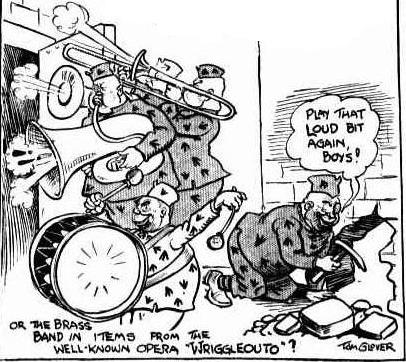
As can be seen in the cartoon below which was published in Sydney’s Sun newspaper, it seems that some in the New South Wales media took light of Governor Brown’s comments.
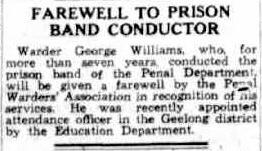
The Pentridge Brass Band lost the services of bandmaster Warder Williams in 1938 when he moved to Geelong to become an attendance officer for the Education Department (“FAREWELL TO PRISON BAND CONDUCTOR“, 1938). Depending on which source is accessed, he was the conductor of the band for seven to ten years.
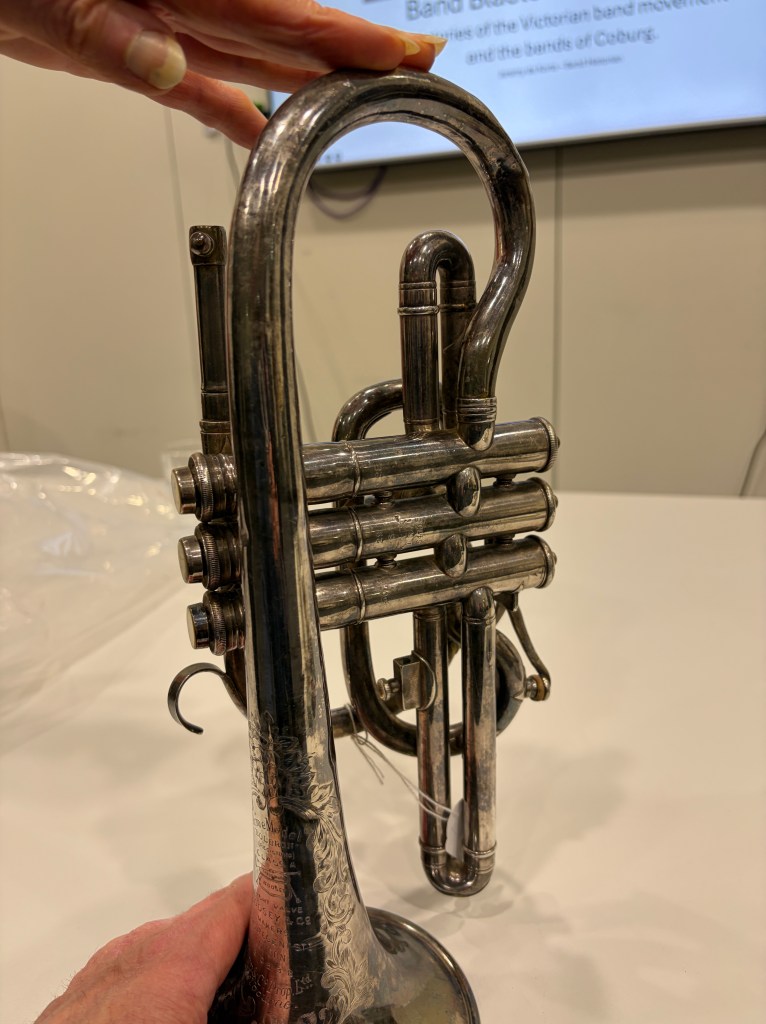
On a side note, when researching this post, this author learned that the Cornet used by Warder George Williams was donated to the Coburg Historical Society in 1988 (McKenna, 2022).
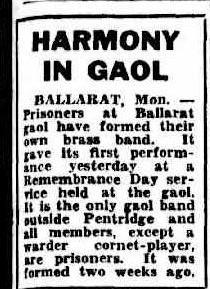
Evidently, the band was still in operation in the early 1950s as they were mentioned in an article published by The Herald newspaper about the new prison brass band which had been established in Ballarat Gaol (“HARMONY IN GAOL“, 1951). In 1954, the State Government spent £1,000 for a whole new set of instruments for the Pentridge Brass Band (“News of the Day“, 1954).
Conclusion:
It is unclear what happened to the Pentridge Prison Brass Band after the 1950s due to a scarcity of available records, and unfortunately, this author was unable to locate a picture of the band aside from the cartoon. However, it is evident that the band had a very positive effect on the prisoners and staff, and that it fitted into the reforms that swept over the Victorian prison system.
<- Part one: Band music in our institutions
References:
Conder, W. T. (1926, 06 February). One Year of Broadcasting. Herald (Melbourne, Vic. : 1861 – 1954), 17. http://nla.gov.au/nla.news-article244058874
Cremona. (1923, 02 April). MUSIC AND MUSICIANS : CURRENT GOSSIP. Herald (Melbourne, Vic. : 1861 – 1954), 6. http://nla.gov.au/nla.news-article243801873
de Korte, J. D. (2025). Coburg, Vic. : Merri-bek Libraries – Coburg : Coburg Historical Society presentation – Band Blasts From the Past – Cornet [Photograph]. [IMG_1483]. Jeremy de Korte, Newington, Victoria.
FAREWELL TO PRISON BAND CONDUCTOR. (1938, 17 January). Herald (Melbourne, Vic. : 1861 – 1954), 11. http://nla.gov.au/nla.news-article244947562
GAOL MUSIC. (1923, 22 September). Mirror (Perth, WA : 1921 – 1956), 2. http://nla.gov.au/nla.news-article77760324
GAOL MUSIC DERBY. (1935, 20 June). Telegraph (Brisbane, Qld. : 1872 – 1947), 15. http://nla.gov.au/nla.news-article182259204
Glover, T. (1935, 19 June). THEY TAKE THEIR TIME FROM THE JUDGE. Sun (Sydney, NSW : 1910 – 1954), 13. http://nla.gov.au/nla.news-article230252567
HARMONY IN GAOL. (1951, 12 November). Herald (Melbourne, Vic. : 1861 – 1954), 5. http://nla.gov.au/nla.news-article247850691
AN HOUR IN PRISON : VISIT TO PENTRIDGE. : Where Gloom is Dispelled. (1927, 14 December). Recorder (Port Pirie, SA : 1919 – 1954), 1. http://nla.gov.au/nla.news-article96058047
IMPROVEMENTS AT PENTRIDGE : FOURTH PRISON BAND IN WORLD. (1923, 23 April). Ballarat Star (Vic. : 1865 – 1924), 8. http://nla.gov.au/nla.news-article213810752
McKenna, T. (2022). Pentridge Prison Brass Band. In Jeremy de Korte (Ed.), ([Email from Tim McKenna, (then) Secretary Coburg Historical Society to Jeremy de Korte regarding brass band related items in the collection of the CHS] ed.).
MR. CONDER : CONTROL OF PENTRIDGE GAOL : FAREWELL BY PRISONERS. (1923, 07 November). Northern Star (Lismore, NSW : 1876 – 1954), 3. http://nla.gov.au/nla.news-article93506230
News of the Day. (1954, 11 December). Age (Melbourne, Vic. : 1854 – 1954), 2. http://nla.gov.au/nla.news-article205727521
No. —. (1924, 24 December). LIFE IN GAOL. Labor Call (Melbourne, Vic. : 1906 – 1953), 11. http://nla.gov.au/nla.news-article250083988
Paterson, W. C. (1997). Victoria’s prison policy 1851-1992: from hulks to unit management (Publication Number 21156) [PhD, University of Tasmania, School of Government]. Hobart, Tasmania. https://doi.org/10.25959/23244737
Penal and Gaols Department. (1923). Penal Establishments, Gaols, and Reformatory Prisons : Report and Statistical Tables for the year 1922 [Parliamentary Report](No. 25. – [1s] – 16851). Parliament of Victoria. https://pov.ent.sirsidynix.net.au/client/en_GB/parl_paper/search/detailnonmodal/ent:$002f$002fSD_ILS$002f0$002fSD_ILS:29444/one
Penal and Gaols Department. (1924). Penal Establishments, Gaols, and Reformatory Prisons : Report and Statistical Tables for the year 1923 [Parliamentary Report](No. 26 — [9D.] — 15596). Parliament of Victoria. https://pov.ent.sirsidynix.net.au/client/en_GB/parl_paper/search/detailnonmodal/ent:$002f$002fSD_ILS$002f0$002fSD_ILS:29247/one
PIANO FOR PENTRIDGE : PRISON CHIEF WANTS BAND ALSO. (1922, 05 September). Recorder (Port Pirie, SA : 1919 – 1954), 3. http://nla.gov.au/nla.news-article102724367
PRISON DE LUXE : PENTRIDGE MADE PLEASANT : Band Music, Electric Light. (1923, 27 February). Herald (Melbourne, Vic. : 1861 – 1954), 12. http://nla.gov.au/nla.news-article243791944
A PRISONERS’ BAND. (1922, 15 September). Daily Mail (Brisbane, Qld. : 1903; 1916 – 1926), 8. http://nla.gov.au/nla.news-article213217073
Thomas, A. (2006). Conder, Walter Tasman (1888-1974) [published first in hardcopy 1981]. In Australian Dictionary of Biography. Retrieved 27 October 2022, from https://adb.anu.edu.au/biography/conder-walter-tasman-5747
Wilson, R. (2014). Joseph Akeroyd: rediscovering a prison reformer (Publication Number 9921863848301341) [PhD, RMIT University, School of Management, College of Business]. Melbourne, Victoria. https://doi.org/10.25439/rmt.27580911
Young, G. (1921, 25 November). Pentridge Music. Herald (Melbourne, Vic. : 1861 – 1954), 8. http://nla.gov.au/nla.news-article242631362

