
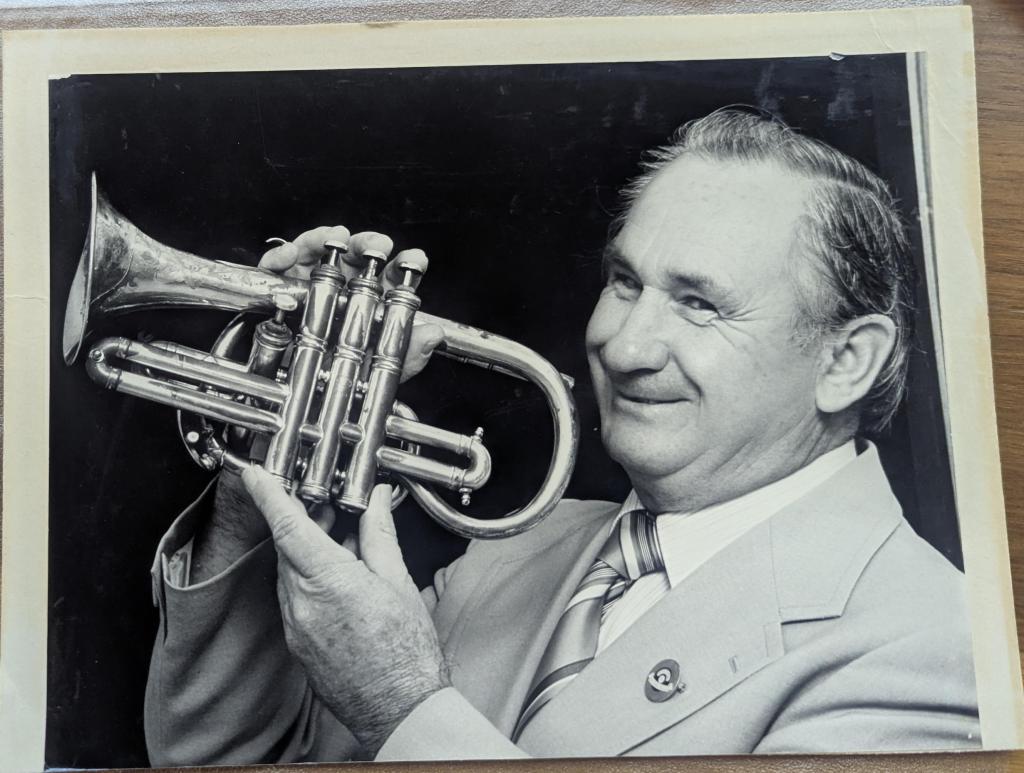
The history and the heritage of the Australian band movement is well worth preserving and it most certainly should be. (Greaves, 1988)
Introduction:
When the opportunity arises, I like to visit other libraries, archives, and historical societies in my pursuit of band history. Not that there is a hierarchy of collections, but I like to think that all is valuable, and they contribute to a broader history. After many years of documenting this material, one observation I can make is that the history of the band movement in Australia is highly fragmented. From private collections – and I am one who maintains a private collection – to bands, and historical societies, right up to our National Library of Australia (NLA). It is all connected in some way. The challenge is to put it all together in a meaningful narrative.
So, it was with some enthusiasm on my part to visit the National Library on a recent visit to Canberra. I feel I have made good use of the services that the NLA offers during the past years, mainly by using the Trove Archive which connects historical items from across Australia. There are many historical band stories that can be found just by following the newspaper articles of the day and it has been evident that our bands have largely had similar experiences. My posts on this blog, hopefully reflect this.
This post, however, is not a story as such. This post is about the Jack Greaves Brass and Military Band Collection of band ephemera which is housed at the National Library of Australia in Canberra. Through this post I will try to make sense of what I viewed as a collector of band ephemera and band historian.
Jack Greaves:
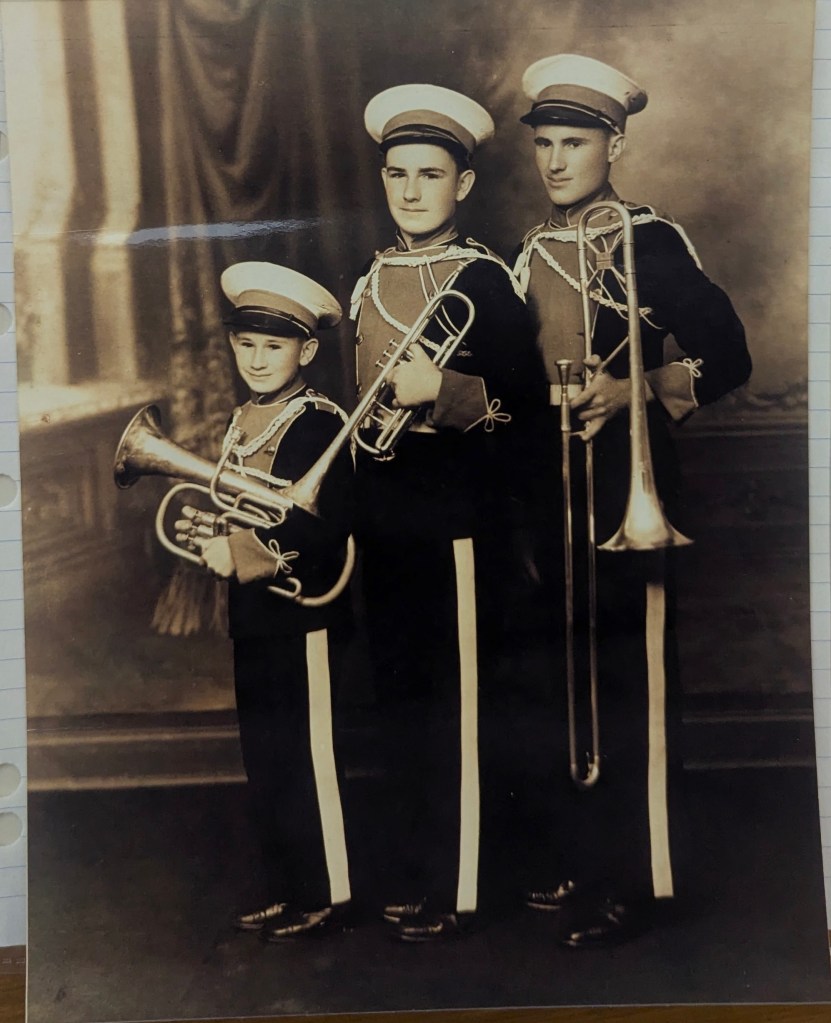
Admittedly, I don’t know much about Jack Greaves aside from his reputation, his collection, and his output of work. However, with the benefit of a biography in one of his books, we can see how his life in the band movement progressed.
Jack began his involvement with brass bands in 1937 as a member of the Young Australia League Band in Sydney. When that group disbanded soon after the start of World War Two, he joined St George District Boys’ Band and joined St John Ambulance Brigade Band, then under the control of Charles Bignall, in 1943 and was principal horn when they won the B Grade Australian Championship in 1948.
Though Jack ceased playing soon after, his interest in brass bands has never diminished. In particular, he has a profound interest in researching band history, collecting sound recordings and general band memorabilia. (Greaves & Earl, 2001)
The National Library of Australia provides us with some further detail about Greaves in the brief biography on the catalogue entries.
Greaves published a number of books including Legends in Brass: Australian brass band achievers of the 20th century (with Chris Earl, 2001), and A musical mission of Empire: the story of the Australian Newcastle Steelworks Band (2005), and compiled a recording of historical brass band performances titled The great bands of Australia (1996). (Greaves, 2009a, 2009b)
Below is a photograph of the then Young Australia League Band from 1935, two years before Jack joined the band.
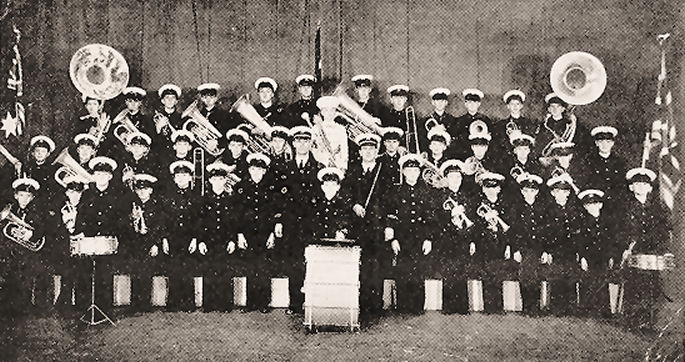
As the biography noted, Greaves did join other bands after his time with the YAL Band. One of the bands he joined as a young musician was the St George District Boys’ Band and he can be viewed in a couple of photographs resplendent in their band uniform. Here we see Jack in the front ranks of the band to the left of the Drum Major, holding a tenor horn.
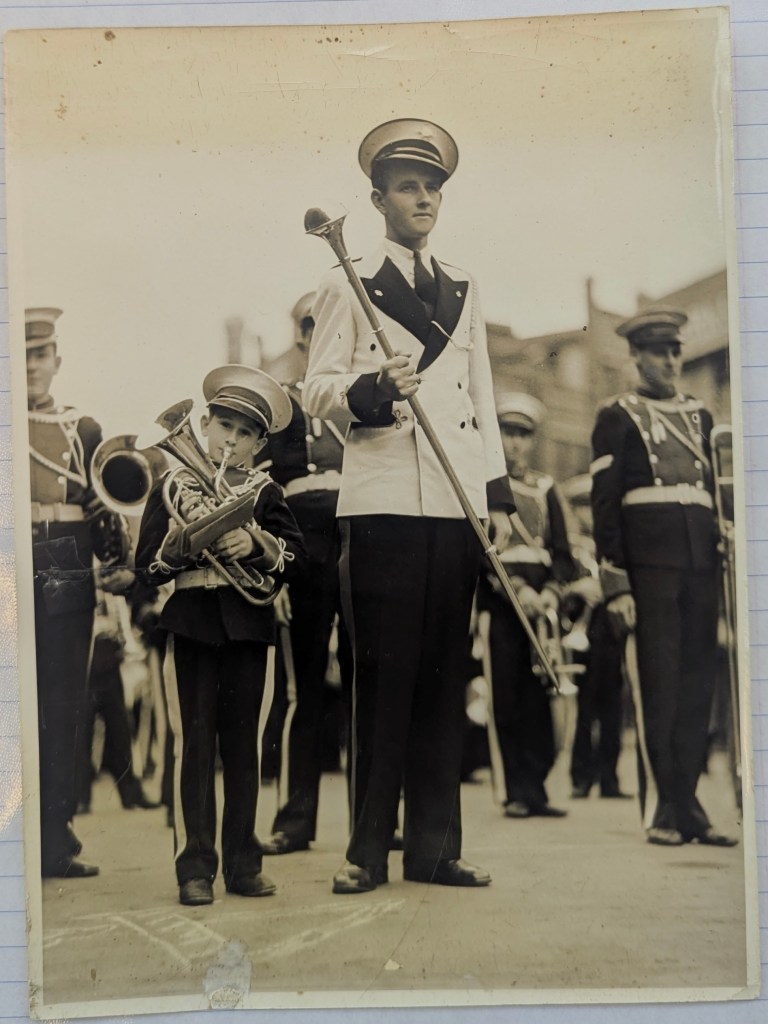
Interestingly, this is one photograph of Jack Greaves that does have context. The photograph was taken in May 1939 just when the band was about to step off in the May Day Parade. This photograph appeared in The Sun newspaper on the 1st of May 1939.
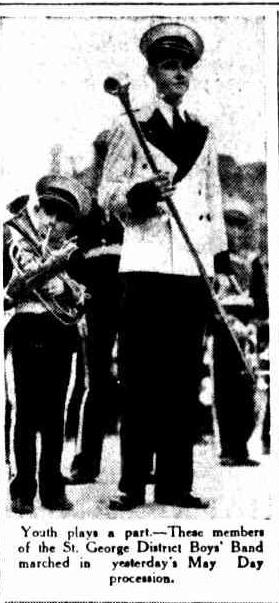
01/04/1939, p. 3
The information in Greaves’s biography from the NLA does provide details of significant years and information about his publications. He was, to all intents and purposes, one of the first people to research band history with dedicated passion, energy and accuracy. In times past there have been others, and I refer to Cecil Mullen as a case in point. With regards to Mullen, as I basically outlined in my post about him, he was very much the commentator and opinionated at that (de Korte, 2020). But he also worked to provide some valuable statistics, even if other passages of writing in the booklet were questionable (de Korte, 2020). Jack does say in correspondence with Ballarat band identity Bob Pattie that Mullen was “not entirely reliable” in his booklet Mullen’s Bandsmen of South Street, and in his subsequent article, “Brass bands have played a prominent part in the history of Victoria” published in The Victorian Historical Magazine (Greaves, 2003a; Mullen, 1951, 1965).
I have copies of the 1938 Bandsman’s Year Book & Mullen’s South Street book. I agree that the latter is not entirely reliable, nor is his other account of band history published in the Victoria Historical Magazine c1965. (Greaves, 2003a)
Personally, I do think that the program notes and information booklet written by Greaves for the double-CDs of historical Australian band recordings, The Great Bands of Australia, is a much more informative history of the Australian band movement (Greaves, 1996). The band historians I know who are active in this modern era also share a dedication for accuracy, no doubt helped by greater access to information and a desire to maintain the history of the movement and individual bands.
Ever the passionate writer and researcher, Greaves did provide some reasoning as to why he wanted to preserve all this band history. Writing in a contributed article published in the 1988 Australian Bicentennial Band Championships program, he introduces the room that he had set up (at the Nationals venue) with band memorabilia, and also writes,
Regrettably, the story of the community band movement in Australia has never been fully documented. The work performed and the achievements gained by many of this country’s leading conductors and their bands or by the pioneers of the movement during the 19th century is not widely known by present day band people. (Greaves, 1988)
Clearly, he wanted to do something about this. One might call it a passion project. He did eventually write a book published in 2001 highlighting the achievements these said pioneers. If he were alive today, he would probably be pleased that people such as John Whiteoak, Mark Pinner, Veronica Boulton, and the many band members who write up individual band histories have done something. And yet, even now, the band movement is an area of Australian musical life that does warrant more study and research (in my opinion).
Greaves passed away in 2009, and his collection was donated to the NLA for safekeeping and for research purposes. It is this collection that holds a fascination for me and other band historians.
The Collection:
If one were to look up the NLA catalogue details of the Jack Greaves collection there would be two entries – one for 10 boxes and one for a further 73 boxes (Greaves, 2009a, 2009b). And there is no denying that the collection is a treasure trove of historical band ephemera. I would surmise that there is not a collection quite like it anywhere in Australia. The fact that we can view this at one of our cultural institutions is of great help to historians and musicologists.
The other aspect that is obvious is that Greaves had been collecting band related material for much of his life. In one of his letters to Bob Pattie, he admits as much about his collection of historical recordings.
I started collecting band records back in 1943 and have an extensive collection of what is now referred as “vintage recordings”. (Greaves, 2003a)
Given that Jack appears as a young band member in photographs from 1939, to admit that he has been collecting recordings since 1943 is quite remarkable.
Previous to this letter, Greaves had actually penned an article which he contributed to the 1975 National Band Championship program on his hobby of collecting band recordings.
As a bandsman; I can think of no better hobby than collecting gramophone records, for not only do these provide unlimited hours of pleasurable listening but if the collection includes the older style 78 rpm discs it is somewhat possible to follow the history of the band movement over the past seventy odd years. (Greaves, 1975)
He goes on in this article to talk about all the fascinating recordings he has collected over the years, including what must be some incredibly rare recordings. Tenacious is a word I would use to describe his pursuit of these recordings. Thankfully, we can actually hear most of them on the double-CD set that he produced (Greaves, 1996).
Mentioned in the biography about Greaves in his first book is a note about one of the positions he held as the Historical Research Officer for the Band Association of New South Wales, which he commenced in 1985 (Greaves & Earl, 2001). This gave him an opportunity to put the call out for any kind of historical band material to be part of a wide-ranging collection. In the same article that was published in the 1988 Nationals program he wrote,
The Band Association of N.S.W. is well aware of this and is currently endorsing a state wide search to locate and where possible acquire items of historical interest. These include photographs, contest and concert programmes, newspaper cuttings and scrap books, contest medals, trophies and shields, music by Australian composers, antique instruments and equipment, uniforms, badges and regalia, and so on. (Greaves, 1988)
With regards to the band ephemera itself, which comprises of concert posters and programs, tour information, photographs, competition programs, and anything else printed on paper related to bands, Greaves was a collector of it all. Seventy-three boxes plus an additional ten is an amount to get though. On my visit I booked ahead to look through the set of ten boxes as knew I had limited time. Obviously, I do not know the machinations of the Band Association of New South Wales back then. But it seems that whether Greaves was collecting for himself or BANSW, this collection was combined and provided to the NLA when Greaves passed away.
This is not the first time I had viewed the collection, that was about four or five years ago. My aim in this latest visit was not only to view the collection but to understand where it had come from.
On a first impression it might seem that Greaves had collected whatever he could find that was band related, and that would be an easy assumption. No, Greaves set out to collect historical band material in a way so that future researchers could find things easily and use the material to further our own understanding of where the Australian band movement had come from and where it was going. Greaves (or the NLA) has carefully assessed each item and placed it in an order that is logical, as each box carries a ‘theme’ of sorts, whether that be competition programs from individual states, overseas ephemera, and the multitude of individual bands. Some resources have more value than others. For example, the scrapbook of photographs, programs, and member biographies of the Australian Commonwealth Band are well-worth a look – this scrapbook is a perfect example of the way Greaves went about his detailed research (a digital version of the scrapbook can be viewed on Trove via this link) (Greaves, 2009a).
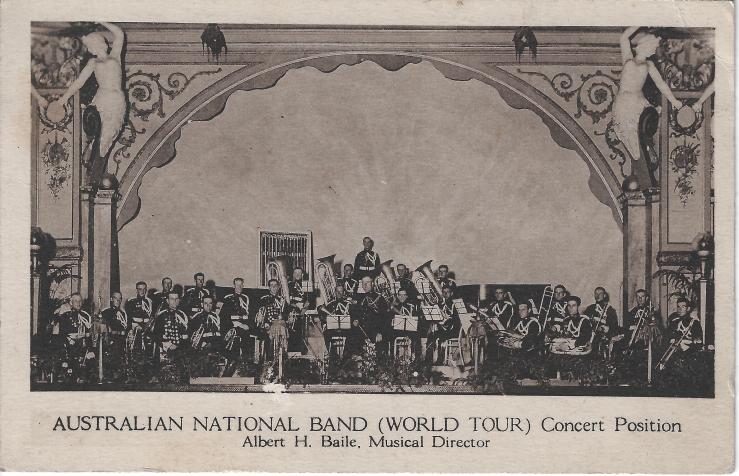
Albert H. Baile, Musical Director, 1926. (Source: Jeremy de Korte Collection
If I have any observations of Greaves’s collection, it is that it is very New South Wales centric. Understandably, this was because Greaves was based in that state and had reasonably easy access to material from NSW bands. This is not to say he did not collect material from other states, Aotearoa New Zealand and the United Kingdom as he felt that it was all part of a much larger picture. Greaves could see the connections and worked to highlight them. It is an Australian band movement after all, and Greaves collected from, and communicated with people from different states.
From parts of the collection is the interpretation and written work. Greaves used his material to produce some valuable band history which goes a long way to help our understanding of this unique history.
The output:
Greaves’s output of work on band history was steady over the years and covered everything from books to articles to entries in historical newsletters. He also was also quite generous with his time as he evidently corresponded with other bands people from around Australia. When reading his work, one cannot help but notice the detail – it is one of the hallmarks of his research.
It is hard to find some of Greaves’s work when undertaking regular searches through Google, but it can be found. I discovered some articles of his in National Band Championship programs, of which digital copies can be found in the Archives section of the National Band Council of Australia website. The earliest of these was in the 1969 program where he wrote an article on the famous Ballarat band composer Frank Wright who’s work “Purcellian Suite” was the D Grade test piece for that year (Greaves, 1969). In 1975, as mentioned, he wrote a long article about his hobby of collecting vintage records and in the 1988 program he wrote about collecting and preserving band historical items (Greaves, 1975, 1988). The 2003 National Band Championships program also contained an article by Greaves on the early bands of Newcastle – perhaps a precursor to his book on the Newcastle Steel Works Band and its trip to England (Greaves, 2003c).
We cannot discount the other historical research Greaves contributed. Bob Pattie was kind enough to post one of Greaves newsletter articles on the life of champion cornetist and conductor, Charles Smith in a 2022 Facebook post (Pattie, 2022). It is also noted in one of the books when Greaves was associated with BANSW he “contributed regular feature articles for their publications” (Greaves & Earl, 2001, p. 4).
It is, however, the books and double-CD set that Greaves is most known for. The CDs were produced in 1996 in conjunction with the Sound Heritage Association Canberra using recordings collected by Greaves. They provide us with recordings of bands from times past, and Greaves wrote the information booklet which is a valuable historical document in itself (Greaves, 1996; Greaves & Earl, 2001).
The two books are also worthwhile contributions to the history of the Australian band movement. Written in conjunction with Chris Earl, Legends in Brass : Australian Brass Band Achievers of the 20th Century (2001) takes us through the biographies of twenty of Australia’s legendary bands people, with the addition of five other sections of Australian brass band history (Greaves & Earl, 2001). This book is not a definitive history, nor does it mention all of the famous bands people who have been a part of this movement. What it does do is provide us with the lives and times of possibly the most influential bands people – those that were performers, composers, conductors, and adjudicators, often at the same time. Greaves & Earl also delve into the histories of women in our band movement, the famous South Street competitions, and our own National Band Championships. Geoffrey Brand wrote the foreword to this book and gives it high praise for its content, but it is some of his remarks that promote this book as an integral interpretation of band history.
Legends in Brass by Jack Greaves and Chris Earl is exactly aimed for all who will enjoy reading about Australian Brass Band Achievers of the 20th Century, offering the opportunity to fill in many details of those who were – and in a few cases still are – standard setters in brass band deeds as composers, conductors and instrumentalists” (Brand, 2001, p. 1).
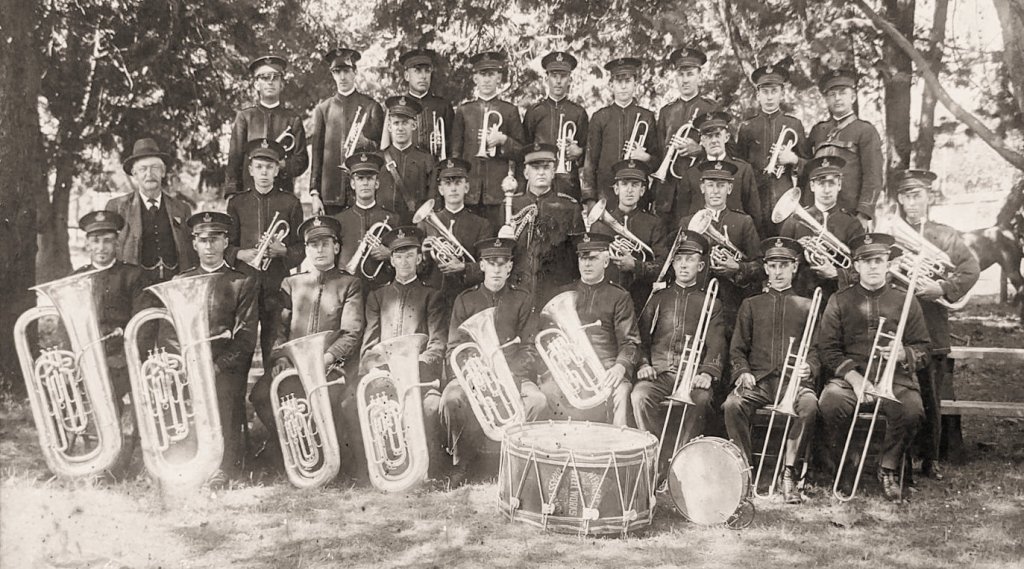
Greaves’s second book was much more thematic as he provides a comprehensive history and story of the Newcastle Steel Works Band and their exploits in England (Greaves, 2005). Here, this book, A musical mission of empire : The story of the Newcastle Steelworks Band shows Greaves at his best historical research and writing. The book was obviously his last major work, and historically, it fits into a time period where the top bands – such as Collingwood Citizens’ and Malvern Tramways, as well as Newcastle – were great rivals and their playing set the musical world abuzz. It is also a book that is still referenced in other material such as blog posts published by Hunter Living Histories, Chris Helm, and in my own posts (de Korte, 2024a, 2024b; Helme, 2017; Special Collections, 2024). The book can still be found, but copies are getting scarcer with the passage of time. With this book it is obvious that Greaves drew upon the resources in his collections with photographs, programs, newspaper cuttings, competition results and even recordings.
Was Greaves working on any other projects? There is material that exists that indicates this was the case. However, time was obviously a factor and Greaves passed away in 2009 leaving later projects unfinished. In extracts from letters to Bob Pattie he wrote,
I am working on several projects at the present time one of which is the compilation of complete details of all the contests held at Ballarat from 1900 – say 1951. The South Street Society, I understand, has never published such a record which I think is very remiss of them. They are such an important part of Australian band history and should be available. (Greaves, 2002)
And in a later letter,
I am enclosing results of Ballarat A grade 1919, 1920, 1921, 1911, 1912, and 1915 also B grade 1912 which involves Ballarat City (E.T. Code) and Warrnambool (Percy Code). These are copies of my drafts for a forthcoming reference book which will contain South Street results from 1900-1951. […] I look forward to completing this in the not too distant future. (Greaves, 2003a)
No doubt a grand project and one that I think Greaves was very keen to do given his criticism of Mullen’s work and his mission to make band history more accessible. What would he have thought of the current South Street online results database and the archival database provided by the National Band Council of Australia? Different times, different methods of researching.
Greaves proved through his output of work that history had meaning and that all the material he had collected could be interpreted and used to inform the reader and draw them in. His detailed works shone light on aspects of band history that might have become lost or forgotten.
Conclusion:
I think, in the near future, I would like to revisit the Jack Greaves Collection again and maybe look through the larger part of the collection – not entirely due to interest in material related to the Malvern Tramways Band (Stonnington City Brass). It is a collection that can draw you in as each piece of paper has meaning and a story. Historically, the collection shows us what musical times were like over a large part of the 20th Century as localities across Australia hosted competitions and contests.
For myself as a band historian, the collection gives me inspiration, even if I started my collection journey later in life. Greaves shows how collection and output are interlinked. I can only hope to produce work that is as expansive as a whole book. One of these days…
Remember that band history is all around us. As important and large as the Greaves Collection is, it shows the collection efforts and priorities of Greaves. Whereas there is always much more to be discovered. In our band rooms, in op shops, in libraries and archives, in historical societies, placed in parks and gardens, or out on the main streets of towns. But the Greaves Collection shows us what can be done when band history is collected over many years and concentrated in one place. Thank you, Jack.
Acknowledgements:
This is a very different post to the work I have previously written, and I do have thank some people for assistance. The first group of people are the Special Collection Librarians at the National Library of Australia. They are dedicated to helping people access collections of archival material and helping with research questions. For myself they were quite happy to chat about my work and provide me with some guidance on where my work could take me. The librarians were also kind enough to introduce me to another brass band researcher who just happened to be in the NLA Special Collections room that day, Gypsy Cook. It was great to meet Gypsy, and I appreciate her insight and knowledge about the Jack Greaves Collection and band journals. Her knowledge of band history and willingness to supply some photographs of Jack is greatly appreciated, and I wish her well in her own work.
References:
Brand, G. (2001). Foreword. In Legends in brass : Australian brass band achievers of the 20th century (pp. 1). Muso’s Media.
de Korte, J. D. (2020, 06 March). Cecil Clarence Mullen: Enthusiastic commentator, historian and statistician of brass and military bands. Band Blasts from the Past: Anecdotes, Stories and Personalities. https://bandblastsfromthepast.blog/2020/03/06/cecil-clarence-mullen-enthusiastic-commentator-historian-and-statistician-of-brass-and-military-bands/
de Korte, J. D. (2024a, 05 October). Band performances and the historical curiosities of formations: squares, circles, and everything in between. Band Blasts from the Past: Anecdotes, Stories and Personalities. https://bandblastsfromthepast.blog/2024/10/05/band-performances-and-the-historical-curiosities-of-formations-squares-circles-and-everything-in-between/
de Korte, J. D. (2024b, 28 February). Hype versus reality: why the Malvern Tramways Band never travelled to the United Kingdom. Band Blasts from the Past: Anecdotes, Stories and Personalities. https://bandblastsfromthepast.blog/2024/02/28/hype-versus-reality-why-the-malvern-tramways-band-never-travelled-to-the-united-kingdom/
Greaves Brothers : Jack, Bill, Jim : In uniform of St George District Boys’ Band [This photograph of the original photograph was supplied by Gypsy Cook]. (c1940). [Black & White Photograph]. [PXL_20260313_022324041.MP].
Greaves, J. (1969). Some Notes About the Composter of “Purcellian Suite” : “D” Grade Test. In Australian Brass Band Championships : Presented by Tasmanian Bands League : Member of National Band Council (pp. 41). Tasmanian Bands League.
Greaves, J. (1975). The fascinating hobby of vintage record collecting. In National Band Championships : Sydney 28-31 March 1975 (pp. 38–39). Band Association of New South Wales.
Greaves, J. (1988). Preserving our Heritage. In Australian Bicentennial Band Championships : Bankstown Town Hall, Sydney : Easter – 30th March to 3rd April : presented by : The Band Association of New South Wales (pp. 76). Band Association of New South Wales.
Greaves, J. (1996). The Great Bands of Australia [booklet] [2 sound discs (CD) : digital ; 4 3/4 in. + 1 booklet]. Sydney, N.S.W., Sound Heritage Association Ltd. https://catalogue.nla.gov.au/catalog/2372005
Greaves, J. (2002). [Letter from Jack Greaves to Bob Pattie regarding the Ballarat band history book, and future projects]. In Jack Greaves Correspondence (pp. 2–3). Harden, N.S.W.: Bob Pattie Collection.
Greaves, J. (2003a). [Letter from Jack Greaves to Bob Pattie regarding draft material regarding a reference book of South Street results that was being worked on, and other Ballarat band history]. In Jack Greaves Correspondence (pp. 18–19). Harden, N.S.W.: Bob Pattie Collection.
Greaves, J. (2003b). [Letter from Jack Greaves to Bob Pattie regarding vintage recordings and various aspects of Ballarat band history]. In Jack Greaves Correspondence (pp. 88). Harden, N.S.W.: Bob Pattie Collection.
Greaves, J. (2003c). A tribute to the earlier bands of Newcastle. In Australian National Band Championships Newcastle New South Wales : Proudly hosted by Band Association of New South Wales Inc. : April 17th – 21st, 2003 (pp. 29–32). Band Association of New South Wales.
Greaves, J. (2005). A musical mission of Empire : the story of the Australian Newcastle Steelworks Band. Peters 4 Printing.
Greaves, J. (2009a). [Ephemera from the Jack Greaves Brass and Military Band Collection : ephemera material collected by the National Library of Australia]. In Jack Greaves Brass and Military Band Collection ([1857-2008] 8 Boxes. 2 boxes 39 x 60 x 11 cm and 71 x 47 x 6 cm. ed., Vol. Australian ephemera collection (Formed)): National Library of Australia.
Greaves, J. (2009b). Papers of Jack Greaves, 1857-2008 [Manuscript]. In Jack Greaves Brass and Military Band Collection ([1857-2008] 13.0 m. (73 boxes) + 4 fol. boxes + 1 oversize item ed.): National Library of Australia.
Greaves, J., & Earl, C. (2001). Legends in brass : Australian brass band achievers of the 20th century [Book]. Muso’s Media.
Helme, C. (2017, 23 September). The Newcastle Steelworks Band from Australia and its 1924 visit to the UK. Chris Helme : Sunday Bandstand,229. http://www.chrishelme-brighouse.org.uk/index.php/sunday-bandstand/bandstand-memories/item/229-the-newcastle-steelworks-band-from-australia-and-its-1924-visit-to-the-uk
Jack Greaves with Drum Major [This photograph of the original photograph was supplied by Gypsy Cook]. (1939). [Black & White Photograph]. [PXL_20260220_024935999.MP].
Jack Greaves with pre-WWI cornet [This photograph of the original photograph was supplied by Gypsy Cook]. (n.d.). [Black & White Photograph]. [PXL_20260220_025534333.MP].
Mullen, C. C. (1951). Mullen’s Bandsmen of South Street (1900-1951). Horticultural Press.
Mullen, C. C. (1965). Brass bands have played a prominent part in the history of Victoria. The Victorian Historical Magazine, XXXVI(1), 30–47.
Newcastle Steel Works Band. (1922). [Photograph]. [phot20975]. The Internet Bandsman Everything Within, Vintage Brass Band Pictures – Australia. http://www.ibew.org.uk/vbbp-oz.html
Pattie, R. (2022, 04 February). The late Jack Greaves a noted brass band historian wrote this profile on the late Charles Smith and sent it to me. I have posted it previously but some may have missed it so here it is again. [Facebook Post]. Facebook. Retrieved 07 April 2026 from https://www.facebook.com/jeanette.pattie/photos/the-late-jack-greaves-a-noted-brass-band-historian-wrote-this-profile-on-the-lat/10210381905020134/
Photogelatine Engraving Company Co. Ltd. (1926). Australian National Band (World Tour) Concert Position : Albert H. Baile, Musical Director [Postcard]. Photogelatine Engraving Company Co. Ltd., Ottawa, Canada.
Special Collections. (2024, 26 July). Celebrating the Centenary of the 1924 Overseas Tour of the BHP Newcastle Steel Works Band. Hunter Living Histories. https://hunterlivinghistories.com/2024/07/26/bhp-band-centenary/
Young Australia League Band. (1935). [Photograph]. [phot7310]. The Internet Bandsman Everything Within, Vintage Brass Band Pictures – Australia. http://www.ibew.org.uk/vbbp-oz.html
Youth plays a part. (1939, 01 May 1939). Sun (Sydney, NSW : 1910 – 1954), 3. http://nla.gov.au/nla.news-article230883195

