

Introduction:
To view the early history of bands in this country would be to see a history that is based around brass bands. This was no accident as much of the brass band culture was imported into the Antipodes by early settlers from the United Kingdom (Bythell, 2000). However, in amongst this brass band culture, there were a few oddities in the form of military bands – bands that included woodwinds. They were a rarity, but they certainly existed. One of the most famous groups was the A.B.C. Military Band which was only in operation from 1930 – 1951. This ensemble built an enviable reputation for their playing, sound, and demeanor.
Military bands were not new ensembles in Australia, certainly not in name. But the A.B.C. Military Band accomplished much more than previous ensembles, no doubt partly due to the broadcasting resources of the A.B.C.’s radio network. Also, it provided many musicians with a unique employment opportunity, guidance by the best wind band conductors that could be found, and a large following through Australia.
This post will delve into the short history of the band with material mainly found through the Trove archive and will highlight some of the more interesting stories of this ensemble. Depending on which history is read, most will say the band started in 1933 however this isn’t the case as it essentially started in 1930. There are only limited photos of the band that seem to exist which are displayed with this post.
Unfortunately, the band is no longer part of the musical landscape, so we have only articles and photos that preserve the memory. And as will be seen, in the end, the ensemble was closed due to reasons that are only too familiar today.
1930-1933: Starting a band:
To start this small history, we need to see what the A.B.C. was doing regarding the running and broadcasting of its own ensembles. From using the Trove archive, we can find that in-house ensembles were barely getting started if they existed at all. Interestingly there was one that stood out. In 1929 the Table Talk newspaper published an article on the famous conductor Percy Code, who was an eminent bandsman and composer (Gibbney, 1981). Percy, in amongst his other musical activities, was the conductor of the 3LO Orchestra which was labeled as being the “National Broadcasting Orchestra” – the A.B.C., at the insistence of the Government, had taken over several radio services and when taking over 3LO had gained an orchestra as well! (Bradish, 1929). Unfortunately, this article is the only mention of such an orchestra although 3LO broadcast many forms of music during this time, including brass bands (“3LO.,” 1929).
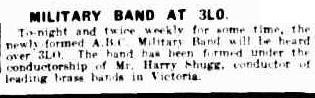
Articles first started appearing mentioning a newly formed A.B.C Military Band in 1930. And interestingly at the time, there appears to have been two A.B.C. Military Bands that were formed – one in Melbourne and one in Sydney (Ariel, 1933). Although, just about all of the articles only provided details on when the band could be heard on the radio (“MILITARY BAND AT 3LO.,” 1930). What we do know is that the great Harry Shugg who was the famed conductor of the Malvern Tramways Band, was the first conductor of the A.B.C. (Melbourne) Military Band and Jack Pheloung, who was the renowned conductor of the Manly Municipal Band was the first conductor of the A.B.C. (Sydney) Military Band (Ariel, 1933; “CONDUCTOR AT 18.,” 1931). Both conductors of their respective A.B.C. Bands held their positions until 1933 which is when a single A.B.C. Military Band was reformed with different priorities and a new conductor. The postcard at the start of this post shows Harry Shugg in front of the A.B.C. (Melbourne) Military Band in what looks like a recording studio.

1933 – 1934: Guest Conductor, Capt. Adkins:
This time period was perhaps the most interesting for the A.B.C. Military Band with superb guest conductors, a new focus on musicality and National tours (Ken, 2012). In November 1933 the A.B.C. assembled 40 musicians from around Australia to form a new Military Band, which, according to the article, was only supposed to be engaged for 10 weeks (“A.B.C. MILITARY BAND.,” 1933). They were initially conducted by their deputy conductor, Mr. R. McAnally (another prominent bandsman), until the guest conductor Capt. H. E. Adkins, the then Director of the Royal Military School of Music, Kneller Hall, commenced his position (“A.B.C. MILITARY BAND.,” 1933).
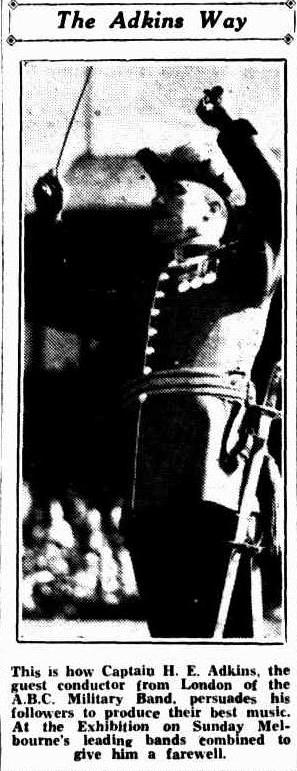
Capt. Adkins arrived in Australia in December 1933 and immediately started conducting the band. He apparently had trepidations over what he was about to do but was quickly won over after his first rehearsal with the ensemble (“A.B.C. BAND,” 1933). When speaking at a club in Sydney about his initial experiences with the band, he said that while on his way out from England, “I had a feeling of anxiety, but it disappeared after our first practice yesterday. I was very agreeably surprised, and in a few months’ time the band will be the equal of any in the world” (“A.B.C. BAND,” 1933). The band commenced touring around Australia and the choice of Capt. Adkins as Guest Conductor won praise in many places. The Evening News from Rockhampton was one newspaper that published an enthusiastic article by stating at one point that Capt. Adkins , “…is recognized as the world’s greatest authority on woodwind instruments” (“A.B.C. National Military Band.,” 1934). Likewise, a reporter with the pseudonym of “G.K.M.” writing for the Weekly Times newspaper congratulated the A.B.C. and noted that Capt. Adkins “…is setting a new standard for Australian bandsmen.” (G.K.M., 1934). A month later the Weekly Times published a picture of Capt. Adkins at his farewell from Australia (“The Adkins Way,” 1934).
A later article from 1941, published in the Portland Guardian after Capt. Adkins had left the band (and Australia), followed through on some of memories and anecdotes of his tenure in front of the band. We see a bandsman who was brought out to bring an ensemble up to a very fine standard of playing – and that’s exactly what he did!
Cleve Martin, now deputy-conductor, and E Flat clarinetist under Adkins, is one who remembers the swaggering, lovable, downright English band-leader.
“Take this so-and-so stand away, I never use the thing”
That first remark from Captain Adkins was typical of his downright ‘take no nonsense’ style,” says Cleve Martin. It was a blitz beginning with the Empire’s No. 1 bandsman, but the players soon became used to his roars and worked hard to give him the precision that he sought.
“The musical monologue is my method of conducting,” Adkins explained to the boys. “I’ll talk to you all the time during rehearsal and in public performances.
(“STARS OF THE RADIO,” 1941)
There was much more that Adkins did for the band and much more on how he acted in front of band members and audience. Firm, but fair would probably be an accurate way to describe his mannerisms, without being too over the top:
He could become personal, although never malicious. To a drummer : “I love every hair on your bald head, but when I say roll on the drums – roll!!!”
(“STARS OF THE RADIO,” 1941)
He was truly loyal to this band, so much so that he could not say goodbye to them in person when it was time to go.
His comradeship with the National Military Band was staunch. Beneath the brusque sergeant-major manner was a soft nature. He demanded the best possible playing, but also worked himself, and was deeply appreciative of the band’s response. He expressed his attitude in a farewell wire to the band : “Sorry I failed to see you off. At the last moment I realised I could not face it.” At the hotel that night, someone noticed that he was on the verge of tears.
(“STARS OF THE RADIO,” 1941)
Having finished his guest appointment, Capt. Adkins returned home to England and Stephen Yorke resumed his direction of the band.

1934 – 1951: Concerts, the War and the final years:
As with any organization of its size, the A.B.C. was not immune to industrial trouble and in the middle part of 1934, there was a court case over the rate of pay for the Military Band musicians (“IN THE LAW COURTS,” 1934). Stephen Yorke had taken over as conductor by this time and was asked to give evidence in court. The crux of the issue was over which players in the band deserved extra remuneration as the court had decided that the band was like an orchestra with actual principal players. Mr. Yorke apparently stated that any player in the band could be considered a principal player as they all played some kind of solo part – but he didn’t have knowledge of the industrial award that distinguished between “leaders” and “principals” (“IN THE LAW COURTS,” 1934). Whereas the Musicians’ Union countered that the principal players should be the first player of any class of instrument, and any single players of an instrument (“IN THE LAW COURTS,” 1934). Capt. Adkins in his treatise had said that “the oboe was essentially a solo and color instrument. Therefore an oboe player must be called upon at times to perform work comparable to that of a principal.” (“IN THE LAW COURTS,” 1934). The final decision was that the commission followed the argument put forward by the Musicians’ Union where the principal players were the first players of a group of instruments and any player of single instruments were considered to be the principals (“IN THE LAW COURTS,” 1934).
In the year of 1936, we see the band, under the baton of Stephen Yorke, continue their series of broadcasts, concerts and other engagements around Australia. Under Mr. Yorke, the reviews indicate that the quality and standard have not diminished, and they are receiving rave reviews (“A.B.C. Military Band.,” 1936). Unfortunately, the A.B.C. raised the ire of some listeners who wanted more brass band music to be played, and berated the A.B.C. for putting on the wrong kind of music –they expressed support for regular performances of the military band as well (“A.B.C. Neglects the Bands.,” 1938).
The Second World War started in 1939 and the A.B.C. Military Band was there to lift the spirits of Australians over the radio with patriotic music As can be seen in the article here published by the Shepparton Advertiser, it enthusiastically endorses the music played by the band on the radio (“NATIONAL MILITARY BAND SESSIONS,” 1941).

As with most other organizations war hit home with the sad passing of an ex-member of the band at Tobruk. The Smith’s Weekly newspaper in October 1941 published an obituary for Clarinetist John Smith, and highlighted his musical excellence:
A brilliant young musician, he took two scholarships at the Sydney Conservatorium for clarinet playing, and was considered one of the finest artists on that instrument in Australia.
Graduating from the Conservatorium, he went straight into the A.B.C. Military Band. At the time of his enlistment he was a member of a leading Sydney theatre orchestra.
About 12 months ago he went overseas with a battalion of Pioneers, and served throughout the Middle East.
He wrote to a friend in the A.B.C. Military Band:
“My work in field stretcher-bearing which is the fate of all good bandsmen. It has proved quite interesting, though sometimes hard to take. It has given me the opportunity of witnessing some examples of sheer braver and doggedness that other chaps probably never see.”
(“Ex-A.B.C. Musician Killed At Tobruk,” 1941)
Sadly, it was through doing this job that Smith lost his life.
After the conclusion of hostilities, we see the band resume its normal activities of performances and broadcasts which continued through the rest of the 1940’s (“A.B.C. BAND CONCERT,” 1946; “A.B.C. BAND RECITAL,” 1948). Stephen Yorke was still the conductor of the band.
As another measure of the quality of musicians that were associated with the band, one of them was Tuba player Cliff Goodchild. Cliff’s first real musical position was with the A.B.C. Military Band and after the band ended he gained a position with the Sydney Symphony, a position he held for 36 years (Veitch, 2008). He was also a consummate bandsman and over his lifetime held positions as “Secretary of the National Band Council of Australia, President of the Band Association of NSW, founder and co-organiser of the NSW School Bands Festival and formed a number of bands, including the Waverly Bondi Beach Brass Band and the Sydney Brass” (Veitch, 2008).
Funding cuts brought about by Australian Federal Government in 1951 leave the A.B.C. no choice but to close the band (“A.B.C. Band’s Farewell,” 1951). This was a bitter end to a no doubt special period in Australian ensembles where we had a band that was excellent in its playing and revered throughout Australia. At the final concert in Sydney, conductor Stephen Yorke thanked the band and the audiences for their appreciation of the ensemble (“A.B.C. Band’s Farewell,” 1951).

Conclusion:
By all accounts this was a truly remarkable band; the finest musicians from all over Australia brought together under various conductors and being boosted to higher and higher levels. A band that all Australians supported and were proud of. We see the high praise given to the conductors and musicians and with the broadcasting resources of the A.B.C., the sound of the band is heard Australia-wide. From reading the articles of the time, we just have to wonder why they would cut such a fine ensemble? But as we know, governments change and priorities change. Who knows what the band could have become had the Federal government of the day not enforced funding cuts?
References:
3LO : St. Augustine’s Band. (1929, 05 October). Advertiser (Adelaide, SA : 1889 – 1931), 10. http://nla.gov.au/nla.news-article29626577
The Adkins Way. (1934, 03 March). Weekly Times (Melbourne, Vic. : 1869 – 1954), 8. http://nla.gov.au/nla.news-article223202315
Ariel. (1933, 01 September). FROM The LIGHTER-SIDE LAYER. Sun (Sydney, NSW : 1910 – 1954), 11. http://nla.gov.au/nla.news-article229153763
A.B.C. BAND : Visiting Conductor’s Praise. (1933, 16 December). Argus (Melbourne, Vic. : 1848 – 1957), 12. http://nla.gov.au/nla.news-article11721475
A.B.C. BAND CONCERT. (1946, 02 June). Sun (Sydney, NSW : 1910 – 1954), 5. http://nla.gov.au/nla.news-article229456055
A.B.C. BAND RECITAL. (1948, 30 May). Truth (Sydney, NSW : 1894 – 1954), 7. http://nla.gov.au/nla.news-article169373651
A.B.C. Band’s Farewell. (1951, 15 October). Age (Melbourne, Vic. : 1854 – 1954), 3. http://nla.gov.au/nla.news-article205334832
A.B.C. Military Band. (1936, 17 August). Age (Melbourne, Vic. : 1854 – 1954), p. 10. Retrieved from http://nla.gov.au/nla.news-article204916718
A.B.C. Military Band – Conductor: Harry Shugg. (1930?). [Postcard : L13.8cm – W8.8cm]. [0016]. Victorian Collections, Victorian Bands’ League. https://victoriancollections.net.au/items/5b39988221ea6d0008c461a6
A.B.C. MILITARY BAND : Forty Players Selected. (1933, 14 November). Age (Melbourne, Vic. : 1854 – 1954), 12. http://nla.gov.au/nla.news-article203351163
A.B.C. National Military Band. (1934, 16 January 1934). Evening News (Rockhampton, Qld. : 1924 – 1941), 9. http://nla.gov.au/nla.news-article201261855
A.B.C. Neglects the Bands. (1938, 02 May). Age (Melbourne, Vic. : 1854 – 1954), 10. http://nla.gov.au/nla.news-article206948874
Australian National Maritime Museum. (2006, 29 August). ABC Military Band playing with ABC commentator on a vessel, 1933-1951 [Photograph ]. flickr. Retrieved 08 July 2018 from https://www.flickr.com/photos/anmm_thecommons/8525965007/
Bradish, C. R. (1929, 05 September). Prominent Personalities : PERCY CODE | CONDUCTOR OF NATIONAL BROADCASTING ORCHESTRA. Table Talk (Melbourne, Vic. : 1885 – 1939), 13. http://nla.gov.au/nla.news-article146712994
Bythell, D. (2000). The Brass Band in the Antipodes : The Transplantation of British Popular Culture. In T. Herbert (Ed.), The British brass band : a musical and social history (pp. 217-244). Clarendon Press ; New York : Oxford University Press.
CONDUCTOR AT 18 : Harry Shugg’s Career. : PROMINENT BANDSMAN. (1931, 01 January). Advocate (Burnie, Tas. : 1890 – 1954), 6. http://nla.gov.au/nla.news-article67694778
Ex-A.B.C. Musician Killed At Tobruk. (1941, 11 October). Smith’s Weekly (Sydney, NSW : 1919 – 1950), 2. http://nla.gov.au/nla.news-article234602068
G.K.M. (1934, 17 February). New Standard in Band Music. Weekly Times (Melbourne, Vic. : 1869 – 1954), 22. http://nla.gov.au/nla.news-article223199691
Gibbney, H. J. (1981). Code, Edward Percival (1888-1953). National Centre of Biography, Australian National University. Retrieved 5707 from https://adb.anu.edu.au/biography/code-edward-percival-5707
IN THE LAW COURTS : A.B.C. Military Band : Extra Pay for Principals. : Court Decides Who They Are. (1934, 11 July). Age (Melbourne, Vic. : 1854 – 1954), 12. http://nla.gov.au/nla.news-article205536311
Ken. (2012, 20 August). The 6WF Story – Part 2 of 3 : The Australian Broadcasting Commission. Western Australian Television History (WA TV History). http://watvhistory.com/2012/08/the-6wf-story-part-2-of-3/
MILITARY BAND AT 3LO. (1930, 29 October). Argus (Melbourne, Vic. : 1848 – 1957), 15. http://nla.gov.au/nla.news-article4214065
NATIONAL MILITARY BAND SESSIONS. (1941, 27 January). Shepparton Advertiser (Vic. : 1914 – 1953), 4. http://nla.gov.au/nla.news-article175188421
STARS OF THE RADIO : Founder of the National Military Band : Picturesque Major Adkins. (1941, 27 November). Portland Guardian (Vic. : 1876 – 1953), 1. http://nla.gov.au/nla.news-article64402540
Veitch, H. (2008, 02 August). Bold as brass in pushing the bands : Cliff Goodchild, 1926-2008. The Sydney Morning Herald. https://www.smh.com.au/national/bold-as-brass-in-pushing-the-bands-20080802-gdsoq6.html



 Band Blasts from the Past