

Please note: This blog post has drawn upon information from photographic and print resources whereby the names of managers and deceased persons from former orphanages, secure health institutions, and penal institutions may have been mentioned. Also, there are depictions of the recreational activities of such institutions described in this blog post.
Introduction:
…undoubtedly music had a fundamental relationship to humanity. It softened and soothed the hardness and harshness of life.
(Hotson in “Sunday Night Meeting AT THE SOCIALIST HALL,” 1920)
If there is one aspect of our band movement that has stood the test of time it is a willingness to play for all and encourage participation in music making. One might say it goes with the territory. However, our bands are special groups, and at times, they have performed for people who are in life situations where they are separated from general society. It was judged at the time, rightly or wrongly, that this was necessitated, but it is not for this post to comment on the why. It is the purpose of this post to highlight where band music has made a difference to the lives of the people within various institutions.
Let us turn back time to the early 1900s where we will find that the description, function, and language of these institutions is very different to what we know now. It was not uncommon to read early newspapers and reports which mention Prisons and Orphanages, but also Lunatic Asylums, Benevolent Asylums, and Colonies. It was also not uncommon in the newspapers to label anyone who was resident at these institutes as inmates – even hospitals. The language of this post will draw upon the language of the time with its early usage and naming conventions, even if we are uncomfortable with this language in our own time.
Music had a role to play in such institutes, not only for listening but also for making and participating. In the early 1900s, much thinking was being given to the humane way in which the people in the institutes could be treated and kept occupied, and music was a key activity. We can view this as early forms of music therapy and there were some very forward-thinking people who made sure that music, partly through bands, became a staple part of the institutional routines.
At the start of this post is an early photograph of the (R.V.I.B.) Royal Victorian Institute for the Blind Brass Band from approximately 1890 which clearly displays how a meaningful activity such as a band was accessible. This post will firstly show how bands made a difference through performances as many different institutions invited bands to come and play for their residents. The next sections will highlight bands that were set up in institutes such as Orphanagesand special institutes. Continuing in part two is a post on the brass band that was formed at Pentridge Prison. This post will not be able to cover all forms of music making. However, it will show how pervasive our band music was and how music was a pastime with a purpose.
Listening to music:
The institutions:
Several bands including the State Public Service Band, the Essendon and Moonee Ponds Salvation Army Band, and several other concert parties have kindly given concerts during this year. These entertainments are very much appreciated and do much towards relieving the monotony of the patients’ lives.
(Adey in Victoria. Lunacy Department, 1927b, p. 19)
There was no shortage of thanks given to bands for the work they did in these years, this mention by Mr. John K. Adey, then Medical Superintendent of the Hospital for the Insane, Sunbury being just one of them. Aside from the two bands that are mentioned above, several other bands gave their services to the various Victorian Lunacy Department institutions including the Victorian Police Band, the Northcote Band (who visited the Hospital for the Insane, Ararat in 1925), the Beechworth Town Band, and the Essendon City Band (Victoria. Lunacy Department, 1914, 1927a, 1928).

This is just one series of examples noting bands visiting asylums, but why were they there? Firstly, these asylums were not pleasant places to be in, and too often we dwell on the negativity surrounding them, articles in the modern media being a prime example of focusing of the negativity of old asylums (Kamm, 2018; Pike, 2015). This perception of negativity is a holdover from the early part of last century where the public knew very little about what went on inside these asylums because they were, essentially isolated. As Ann Hardy (2019) notes in her blog post about perceptions and lost voices of the asylum,
Asylums were considered as having unsuitable management, and not providing adequate care, and being isolated only fuelled negative ideas about them and further pushed institutions and inmates out of societies view.
(Hardy, 2019)
Research by Dolly MacKinnon, however, shows that some social practices permeated the operations of asylums. In a journal article about musical concerts in Queensland asylums, she wrote,
The insane were kept out of the public eye, yet the social and cultural values and practices of the times provided the filter through which appropriate musical recreation and employment were determined.”
(MacKinnon, 2000, p. 43)
In a later article she challenges the perceptions of the asylum.
Stereotypical views of asylums or mental hospitals do not conjure up images of recreation and entertainment, but rather places of isolation, gendered confinement, and boredom. Yet within the surviving Australian institutional records (from 1860 to 1945) it is clear that medical and lay staff, patients, and volunteers went to great lengths to provide entertainment and recreation of asylum inmates.
(MacKinnon, 2009, p. 128)
She further writes that,
…between the 1860s and circa 1945 the provision of recreation for Australian psychiatric inmates came from three main sources; paid professional groups, volunteers (from both inside and outside the asylum), and the asylum band. Asylums made continuous and strenuous efforts to include the community in many of these activities. Those that did volunteer were publicly thanked in their efforts by the medical staff.
[…]
Recreation was one of the few asylum activities that attempted, albeit in a highly regulated way, to encourage patients to respond and interact in appropriate ways in a social, physical, as well as an emotional sense.”
(MacKinnon, 2009, p. 134 & 145)
The presence and performances of bands in these kinds of institutions was very important to the well-being of patients and staff.
The bands:
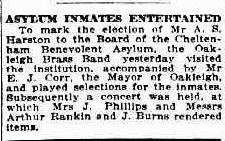
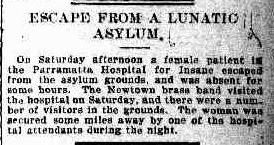
It was not uncommon for bands of this time to go and support these institutions either through their playing at the institution or by raising money through other means. We can see this through articles published in the newspapers of the day and the reports that were submitted to the government of the day. An article published in an August 1904 issue of the Daily Telegraph newspaper from Sydney tells us that the Newtown Brass Band played at the Parramatta Hospital for the Insane and there were a number of visitors in the grounds to listen to them – although one the inmates escaped during the performance. (“ESCAPE FROM A LUNATIC ASYLUM.,” 1904). The Oakleigh Brass Band from Melbourne were quite active in this area of performance and the Talbot Colony for Epileptics and the Cheltenham Benevolent Asylum were two of the beneficiaries of their visits (“ASYLUM INMATES ENTERTAINED,” 1917; “Talbot Colony for Epileptics,” 1914).
General Hospitals also hosted performances of brass bands as they sought to bring some music and entertainment before their patients and staff. The Lakes Creek Brass Band (pictured below) was booked to play at the Rockhampton General Hospital at various times during 1914 (“THE LAKE’S CHEEK BRASS BAND.,” 1914). Likewise, the Darwin Brass Band paid a surprise visit to the Darwin Hospital to play a selection of music at Christmas time, a performance that was very much appreciated by the audience and communicated to the band by the Matron in charge (“XMAS AT THE HOSPITAL.,” 1920).

As well as boasting their own significant music program which once included a brass band, the Royal Victorian Institute for the Blind also hosted performances by various musical groups. The employees of the Melbourne and Metropolitan Tramways Board generously gave their time to provide some entertainment for the Institute and part of this entertainment included items played by the Malvern Tramways Band (“TRAMWAYS ENTERTAIN BLIND FOLK.,” 1925). Likewise, in later years, the bands of the Victoria Police (pipe and brass) also gave their time to play for the R.V.I.B. (“Police help for Blind Institute,” 1947).
Of course, the band movement in Australia was not alone in the way they provided music for these institutions. The band movement in Aotearoa New Zealand was similarly engaged in doing the same kinds of performances. For example, in the Te Waipounamu South Island city of Christchurch, on the Sunday before Christmas each year all the bands in the city would turn out to perform at various institutions and hospitals (“BANDS’ VISITING DAY,” 1938).

And as mentioned, the bands turned out for charitable events to aid in the care of the infirm. In one instance, the newly-formed Richmond Boys’ Band was featured in an article published by the Richmond Guardian newspaper when they assisted at an event to provide support for the Blind Soldiers’ Fund (“Richmond Boys’ Brass Band,” 1918).
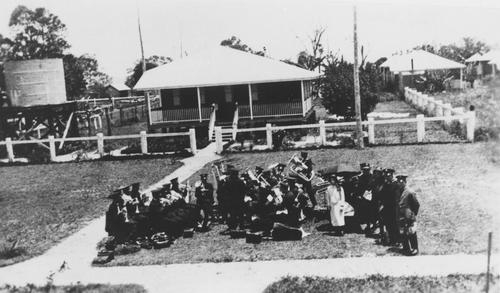
The work of the Salvation Army bands should also be noted as they were also very active in this area of performance. Below is a photo of a Salvation Army Band visiting the Peel Island Lazaret which was a facility to house Queensland sufferers of Leprosy.
There was no doubt that the bands were busy in this area of performance, and full credit to the work that they did.
Music-making:

While the workings of the Lunatic Asylums were virtually unknown to the public at the time, the same could not be said for other institutions such as the Blind Institutes and the Orphanages. And both mentioned types of institutions promoted their musical activities to the extent that the bands attached to them had excellent reputations. The musicians that both programs produced were very good and in Victoria for example, while some former R.V.I.B. musicians did display their talents outside the Institute, the Orphanages were better known for producing some of Australia’s finest brass musicians. This section will briefly examine the music-making at both forms of institutions.
The Royal Victorian Institute for the Blind:

Music-making at the R.V.I.B. was an activity that was immersed in the daily routines of the students, and this involved singing, piano, organ, a string orchestra, and a brass band. A first mention of a brass band at the R.V.I.B. is made in an article published by The Age newspaper as far back as 1874 where they played “The Standard Bearer March with excellent precision and time” (“DEAF AND DUMB INSTITUTE AND BLIND ASYLUM.,” 1874).
It appears that the Institute’s musicians were sent out to tour and raise funds as soon as they could do so. Judith Buckrich, in her book on the history of the R.V.I.B, details some of the tours of the musicians, and even in the earlier years, the touring was quite extensive. From an Institution that started in 1866, to have musical groups sent to various places in Victoria by 1877 was a remarkable achievement.
The Asylum’s musicians and singers were often on the road. In 1877, the choir gave concerts in Taradale, Kyneton, Castlemaine, Sandhurst, Eaglehawk, Echuca, Maryborough, Chinaman’s Flat, Stawell, Ararat, Beaufort, Learmonth and Ballarat. The band performed in Emerald Hill, Eltham, Dandenong, Footscray, Berwick and other places. They earned £827 for the Asylum.
(Buckrich, 2004, p. 36)
Reflecting on music-making at the Institute as a whole, some writers asserted that the musicians at the R.V.I.B were performing at a higher standard than amateurs. A writer under the pseudonym of ‘Assistant Needlewoman’ wrote an expansive article for the Argus newspaper in June 1886 in which she meticulously detailed the workings of the Institute (Assistant Needlewoman, 1886). She offered this considered opinion of the musical skills of the students.
While the musical world of Melbourne is divided as to whether there shall be a chair of music, a conservatoire, or whether, as would be best, we should be content for the present with a grand orchestra, the material for which is almost ready to hand, the claims of this well-known and deserving institutions are entirely overlooked. With one conscientious and painstaking music teacher, upon whom is laid the Herculean task of giving instruction in piano, organ, and solo-singing, the pupils of the Blind Asylum have already done enough to show that they are worthy of the best professional training to be had.
(Assistant Needlewoman, 1886)
The article by ‘Assistant Needlewoman’ correlates with the history detailed by Buckrich as in 1888, there are some detailed accounts of how many students are involved in music-making.
Members of the choir and band numbered twenty-nine, and some students were members of both. Eighteen students were being taught the piano and two, the organ. Many concerts have been given during the year and this activity had earned the institution the tidy sum of £480 after expenses. It seems that the choir and band now enjoyed free travel on the railways.
(Buckrich, 2004, p. 50)
Four years after the article penned by ‘Assistant Needlewoman’, a writer with the pseudonym of ‘Benvolio’ visited the R.V.I.B. and was most impressed with what he saw during his visit – “All will agree that the Victorian Asylum and School for the Blind is one of the most humane establishments in the colony…” (Benvolio, 1890). He wrote an article for the Illustrated Sydney News newspaper which was just as detailed as the article written by four years earlier. Benvolio’s remarks on the music program provide us with some additional insight.
…in most cases, they find outside employment, either at their trades or in teaching music, for which most of them display a wonderful aptitude, one of the former pupils being a very successful teacher in one of the suburbs, and at present bandmaster of the Asylum, which boasts a very efficient brass band and string band, besides a senior and junior choir, and several very capable solo vocalists and pianists, to say nothing of the more advanced pupils referred to, whose performances on the organ are astonishing.
(Benvolio, 1890)
As mentioned, musical groups such as the choir and string orchestra frequently went on tour and we can see that in some Victorian and Tasmanian towns, the visits were precluded by letters in the local newspapers explaining the charitable situation of the Institute (Hogarth, 1897; Winkelman, 1897). The R.V.I.B. was always in need of funds and “one sources of funding that remained reliable was the concerts given by its various bands, orchestras and choirs.” (Buckrich, 2004, p. 58). While the R.V.I.B. groups were in the towns, they were assisted by many of the town’s folk – and the local bands. In two instances, the Ulverston Brass Band and the Rutherglen Brass Band were thanked for their help (Hogarth, 1900; “Victorian Institute for the Blind.,” 1893).
In the early 1890s we can see that the list of engagements for the band was not so much in towns and tours, but for specific events. The “Royal Agricultural Society Annual Show”, “Roman Catholic Bazzaar, Albert Park”, “Miss Turner Grammar School Sports”, and the “Caulfield Grammar School Sports” are just some of the engagements the band performed at during 1892 (Buckrich, 2004, pp. 58-59).
The work of the R.V.I.B. was expanded during the First World War to help returned soldiers who had become vision impaired and blind, and the choir and band “gave several concerts at the Base Hospital, as well as the Soldiers’ Lounge in St Kilda, to assist the Red Cross with funds” (Buckrich, 2004, p. 82). It is unclear as to the official status of the band in future years after the early 1900s. However, the music department is still an integral part of the Institute.
Seventy-three students received instruction in music during 1922 – mainly in pianoforte, violin. Class and solo singing, flute, cornet and other band instruments, harmony, counterpoint, and the art of teaching.
(Buckrich, 2004, p. 95)
The Orphanages:

Admittedly, there is so much material on the exploits of the many Orphanage bands that they warrant a whole post just to unravel the fine work they did with their bands. And unfortunately, this post will gloss over most of the achievements of these groups. However, they do fit into this context of this post as the bands were set up to provide a musical activity to the routines of Orphanage boys and girls. The newspaper photo above of the Largs Bay Orphanage Band shows an Orphanage band that was unique in Australia as all the band members were female – this band was also mentioned in a previous post (de Korte, 2018).
Orphanage bands in Australia were a copy of practices in England where the teaching of music in boys’ institutions was commonplace (Sheldon, 2009). There was, however, a major difference to the outcomes of this musical education between the two countries. Boys who were trained as musicians in English institutions readily found themselves recruited into the bands of the British Army and Navy (Sheldon, 2009). Whereas the musicians that graduated from the Orphanage bands in Australia found themselves positions in the wider band movement. Sheldon (2009) identified some benefits to music education in British institutions which were applicable to Australian Orphanages.
The evidence from the boys’ letters shows that they valued the intrinsic benefits of belonging to the band and learning an instrument. For some poor boys, musical education offered a relief from the rigours of institutional care in circumstances where there were few pleasures on offer.
(p. 747)
We know that Orphanage bands in Australia have had a long and distinguished history, as well as enviable reputations. The St. Augustine’s Band from Geelong is probably the most famous of them all, and it is mentioned that by 1898 they were already putting the call out for a new set of instruments (“ST. AUGUSTINE’S ORPHANAGE BAND.,” 1898). St. Augustine’s went on to win many competitions at South Street in Ballarat and toured extensively – in one instance, in 1906 they won the A Grade Championships at South Street (Royal South Street Society, 1906). The band at St. Vincent’s de Paul in Melbourne was no less famous than their counterpart in Geelong and in 1921 they gained the services of Mr. Leslie Hoffman, a graduate of the St. Augustine’s Band, as their conductor (“St. Vincent’s Bandmaster,” 1921). The Minton Boys’ Home Band in Frankston gained the services of another champion Geelong bandsman, Mr. Harry Shugg, when he became their instructor in 1928 (“BOYS’ BAND.,” 1928; Davies, 2005). In Ballarat the boys at St. Joseph’s Orphanage Band were conducted by the very famous Frank Wright (pictured below) (St Joseph’s Orphanage Brass Band, 1924, 1924).


With so much talent from the Australian band movement involved in the music education areas of the Orphanages, it is no wonder that the bands did as well as they did. As well as being an activity to occupy the minds of the Orphanage boys and girls, it also gave them a sense of purpose and achievement.

Conclusion:
There were many different types of music-making in these institutions, some which was kept hidden and others that were very much out in the open. However, whatever the type of institution, the singular aim was to improve the mind with wholesome activities. Music was the perfect activity, and bands were the outcome. This was music therapy at its best.
Part two: Pentridge Prison – the fourth prison band in the world ->
References:
Assistant Needlewoman. (1886, 26 June). AMONG THE BLIND: THE VICTORIAN ASYLUM AND SCHOOL. Argus (Melbourne, Vic. : 1848 – 1957), 4. http://nla.gov.au/nla.news-article6099966
ASYLUM INMATES ENTERTAINED. (1917, 05 February). Herald (Melbourne, Vic. : 1861 – 1954), 6. http://nla.gov.au/nla.news-article242459034
BANDS’ VISITING DAY. (1938, 19 December). Press,13. https://paperspast.natlib.govt.nz/newspapers/CHP19381219.2.115
Benvolio. (1890, 02 August). MELBOURNE INSTITUTIONS: THE VICTORIAN ASYLUM AND SCHOOL FOR THE BLIND. Illustrated Sydney News (NSW : 1881 – 1894), 9. http://nla.gov.au/nla.news-article63615405
BOYS’ BAND. (1928, 20 April 1928). Frankston and Somerville Standard (Vic. : 1921 – 1939), 4. http://nla.gov.au/nla.news-article74994629
Buckrich, J. R. (2004). Lighthouse on the boulevard : a history of the Royal Victorian Institute for the Blind, 1866-2004. Australian Scholarly Publishing.
CONCERT BY WESTMEAD ORPHANAGE BOYS’ BAND. (1936, 30 October). Southern Cross (Adelaide, SA : 1889 – 1954), 10. http://nla.gov.au/nla.news-article167081032
Davies, S. A. (2005). One thousand white onions : a history of caring for children from 1865. Menzies.
de Korte, J. D. (2018, 22 April). Early female brass bands in Australia: they were rare but they made their mark. Band Blasts from the Past : Anecdotes, Stories and Personalities. https://bandblastsfromthepast.blog/2018/04/22/early-female-brass-bands-in-australia-they-were-rare-but-they-made-their-mark/
DEAF AND DUMB INSTITUTE AND BLIND ASYLUM. (1874, 18 December). Age (Melbourne, Vic. : 1854 – 1954), 3. http://nla.gov.au/nla.news-article201534539
ESCAPE FROM A LUNATIC ASYLUM. (1904, 15 August). Daily Telegraph (Sydney, NSW : 1883 – 1930), 7. http://nla.gov.au/nla.news-article236885955
Group of men wearing band uniforms and holding their brass instruments, R.V.I.B. [picture]. (1890). [negative : glass 16.3 x 21.4 cm. (full plate)]. [cr001189]. State Library Victoria, RVIB collection of glass negatives. http://handle.slv.vic.gov.au/10381/32332
Hardy, A. (2019). “Islands of the Insane” – our records, perceptions and the lost voices from the ‘asylum’. Hunter Living Histories : University of Newcastle. https://hunterlivinghistories.com/2019/10/16/islands-insane/
Hogarth, J. T. (1897, 05 April). ROYAL VICTORIAN INSTITUTE FOR THE BLIND : To the Editor. Ballarat Star (Vic. : 1865 – 1924), 1. http://nla.gov.au/nla.news-article210364264
Hogarth, J. T. (1900, 22 May). ROYAL VICTORIAN INSTITUTE FOR THE BLIND : To the Editor. Rutherglen Sun and Chiltern Valley Advertiser (Vic. : 1886 – 1957), 3. http://nla.gov.au/nla.news-article268489459
Kamm, R. (2018, 28 February). Life inside Victoria’s 19th-Century ‘Lunatic’ asylums. Vice Media Group. Retrieved 13 September 2020 from https://www.vice.com/en_au/article/vbpqwj/life-inside-victorias-19th-century-lunatic-asylums
THE LAKE’S CHEEK BRASS BAND. (1914, 27 February). Morning Bulletin (Rockhampton, Qld. : 1878 – 1954), 6. http://nla.gov.au/nla.news-article53319792
Lake’s Creek Brass Band, Rockhampton. (1909). [Photograph]. [phot20842]. The Internet Bandsman Everything Within, Vintage Brass Band Pictures – Australia. http://www.ibew.org.uk/vbbp-oz.html
MacKinnon, D. (2000). ‘A captive audience:’ Musical concerts in Queensland mental instituions c.1870-c.1930. Context: A Journal of Music Reseach, Spring(19), 43-56. https://cpb-ap-se2.wpmucdn.com/blogs.unimelb.edu.au/dist/6/184/files/2017/01/19-5-A-captive-audience-172c2wo.pdf
MacKinnon, D. (2009). Divine Service, Music, Sport, and Recreation as Medicinal in Australian Asylums 1860s-1945. Health and History, 11(1), 128-148. https://www.jstor.org/stable/20534507
MUSIC AID TO RECRUITING. (1940, 06 June). Herald (Melbourne, Vic. : 1861 – 1954), 7. http://nla.gov.au/nla.news-article243225676
Pike, B. (2015, 03 March). Sydney’s shameful asylums: The silent houses of pain where inmates were chained and sadists regned. The Daily Telegraph. https://www.dailytelegraph.com.au/news/sydneys-shameful-asylums-the-silent-houses-of-pain-where-inmates-were-chained-and-sadists-reigned/news-story/b4205dc9a17e8ee0763711d93d720d04
Police help for Blind Institute. (1947, 13 September). Argus (Melbourne, Vic. : 1848 – 1957), 7. http://nla.gov.au/nla.news-article22507332
Richmond Boys’ Brass Band to Make Debut at Racecourse Carnival for Blind Soldiers—Amazing Growth of Notable Movement that will Bring Fame to This District. (1918, 12 January). Richmond Guardian (Vic. : 1917 – 1918), 2. http://nla.gov.au/nla.news-article93811136
Royal South Street Society. (1906). 1906-11-04 Band Contests : Held at the City Oval Royal South Street Society Results Database. https://results.royalsouthstreet.com.au/results/1906-11-04-band-contests
Royal Victorian Institute for the Blind. (1900). Lantern Slide – School Orchestra, Royal Victorian Institute for the Blind, circa 1900 [Lantern Slide, Standard (3¼ in. x 3¼ in.), Black & White]. [MM 95962]. Museum Victoria Collections, Royal Victorian Institute for the Blind Collection. https://collections.museumsvictoria.com.au/items/1390549
Salvation Army brass band visiting Peel Island Lazaret during 1920s. (2007). [copy print : b&w]. [74802]. John Oxley Library, State Library of Queensland, Brisbane, Queensland. https://hdl.handle.net/10462/deriv/208680
Sheldon, N. (2009). The musical careers of the poor: the role of music as a vocational training for boys in British care institutions 1870–1918. History of Education, 38(6), 747-759. https://doi.org/10.1080/00467600903305590
St Joseph’s Orphanage Brass Band, 1924. (1924). [Photograph]. [11049]. Federation University Australia Historical Collection, Victorian Collections. https://victoriancollections.net.au/items/502db00e2162ef0f4c4ac157
ST. AUGUSTINE’S ORPHANAGE BAND. (1898, 01 March). Geelong Advertiser (Vic. : 1859 – 1929), 1. http://nla.gov.au/nla.news-article150368016
St. Augustine’s Orphanage Band : Champions of Australia. (1907). [Postcard]. Geelong, Victoria.
St. Vincent’s Bandmaster : Mr. Hoffman Returns to Melbourne. (1921, 13 January). Advocate (Melbourne, Vic. : 1868 – 1954), 11. http://nla.gov.au/nla.news-article171054534
Sunday Night Meeting AT THE SOCIALIST HALL : MUSICAL DEMONSTRATION : LECTURETTE BY MISS KATHLEEN HOTSON : PENTRIDGE JAIL METHODS CONDEMNED. (1920, 18 November). Socialist (Melbourne, Vic. : 1906 – 1923), 1. http://nla.gov.au/nla.news-article240692618
Talbot Colony for Epileptics : Visit by Oakleigh Brass Band. (1914, 24 January). Oakleigh and Caulfield Times Mulgrave and Ferntree Gully Guardian (Vic. : 1914 – 1918), 4. http://nla.gov.au/nla.news-article88807177
TRAMWAYS ENTERTAIN BLIND FOLK. (1925, 29 May). Prahran Telegraph (Vic. : 1889 – 1930), 3. http://nla.gov.au/nla.news-article165137965
Victoria. Lunacy Department. (1914). Hospitals for the insane : report of the Inspector-General of the Insane for the year ended 31st December 1913 [Parliamentary Report](25). Parliament of Victoria. https://pov.ent.sirsidynix.net.au/client/en_GB/parl_paper/search/detailnonmodal/ent:$002f$002fSD_ILS$002f0$002fSD_ILS:25004/one
Victoria. Lunacy Department. (1927a). Hospitals for the insane : report of the Inspector-General of the Insane for the year ended 31st December 1925 [Parliamentary Report](11). Parliament of Victoria. https://pov.ent.sirsidynix.net.au/client/en_GB/parl_paper/search/detailnonmodal/ent:$002f$002fSD_ILS$002f0$002fSD_ILS:25149/one
Victoria. Lunacy Department. (1927b). Hospitals for the insane : report of the Inspector-General of the Insane for the year ended 31st December 1926 [Parliamentary Report](37). Parliament of Victoria. https://pov.ent.sirsidynix.net.au/client/en_GB/parl_paper/search/detailnonmodal/ent:$002f$002fSD_ILS$002f0$002fSD_ILS:25005/one
Victoria. Lunacy Department. (1928). Hospitals for the insane : report of the Inspector-General of the Insane for the year ended 31st December 1927 [Parliamentary Report](41). Parliament of Victoria. https://pov.ent.sirsidynix.net.au/client/en_GB/parl_paper/search/detailnonmodal/ent:$002f$002fSD_ILS$002f0$002fSD_ILS:28338/one
Victorian Institute for the Blind. (1893, 27 January). Coastal News and North Western Advertiser (Ulverstone, Tas. : 1890 – 1893), 3. http://nla.gov.au/nla.news-article216216052
Winkelman, H. G. A. (1897, 25 November). THE VICTORIAN INSTITUTE FOR THE BLIND—VISIT OF THE BAND AND CHOIR. Bairnsdale Advertiser and Tambo and Omeo Chronicle (Vic. : 1882 – 1918), 3. http://nla.gov.au/nla.news-article86326868
XMAS AT THE HOSPITAL. (1920, 28 December). Northern Territory Times and Gazette (Darwin, NT : 1873 – 1927), 3. http://nla.gov.au/nla.news-article3303945
YOUNG MUSICIANS. (1922, 11 November). Chronicle (Adelaide, SA : 1895 – 1954), 29. http://nla.gov.au/nla.news-article87519427

 Band Blasts from the Past
[…] musician, he had kept up numerous activities while associated with the MTB. And as we found in a previous post, one of these appointments was directing the brass band and community singing at Pentridge Prison, […]
LikeLike
[…] musician, he had kept up numerous activities while associated with the MTB. And as we found in a previous post, one of these appointments was directing the brass band and community singing at Pentridge Prison, […]
LikeLike
[…] <- Part one: Band music in our institutions […]
LikeLike