Brass bands of the New South Wales Central West: Part 1: Bands for every town

19280000_Orange-District-band
Orange District Band, 1928. (source: Central West Libraries)

Introduction:

Nearly every small town in New South Wales can speak of their own band, and why should a town with the population of Condobolin be so far behind the time?

(Band Enthusiast, 1902)

This question was asked in a letter to the Lachlander and Condobolin and Western Districts Recorder newspaper in January 1902.  The person who wrote the letter under a pseudonym, “Band Enthusiast” asked a worthy question as to why his town had not caught up with the times and started their own band.  Condobolin is a town located in the Central West region of New South Wales and at this time, they were lagging other towns in the region.  By the time 1902 has ticked around, some towns in the Central West have already had bands for the best part of a decade.  Condobolin was feeling left out and wanted a band to boost civic pride and give townsfolk something else to do.

There is always a bigger picture and if we were to examine layers of history, patterns of immigration and the development of towns, agriculture, and industry, we would find that the bands of the Central West were very much products of their location and people – and there were many of them.  For the purposes of this post, the focus will be on a large regional block of New South Wales; Lithgow and Bathurst in the east, Condobolin and Lake Cargelligo in the west, Mudgee, Galong Wellington & Tottenham in the north and Oberon, Blaney, Cowra, Grenfell, and Forbes in the south with many localities big and small in between.  It is just over 400km from Lithgow to Lake Cargelligo and from North to South around 200km.  As you can see from the brief list of towns, there are some famous places, some of which are etched into Australian psyche and history. The middle line of Central West can be drawn through the towns of Lithgow, Bathurst, Orange, Parkes, and Condobolin.  Below this introduction is a Google map of this area.

For the sake of brevity with reading and writing, this blog topic in two parts.  Part 1 focuses on a little history of the N.S.W. Central West and stories of the individual bands.  Part 2 focuses on the various iterations of the Western Band Association and regional competitions.  Given that there were twenty-eight bands that have existed in the Central West, this provides us with a rich history of music-making.  Much like a previous post on the bands surrounding Canberra, this post is a result of a visit to Orange in October 2019 where various resources were accessed thanks to the assistance of the excellent librarians at Orange Library.  They pointed out several features of their own town related to brass bands, and I was naturally curious about the other bands in the region.  The Trove archive has also provided an amount of information.

One might say the development of bands in this region is very typical when compared to other parts of Australia, and to some extents this is correct.  Well-might every town in the Central West have a band or want a band.  They were community groups to be proud of.

The Central West:

To provide some context to the bands in this region, it is important to appreciate the history of the region.  Early settlers travelled various locations, mainly to farm sheep on the vast plains although some towns were originally settlements to house convicts (Blainey, 2001; Kass, 2003).  The main impetus to population growth was the discovery of various minerals across the region namely gold, copper, shale, limestone, and coal and most of the miners originated from Wales and Cornwall (Kass, 2003; Payton, 2005).  With greater migration came town services and recreation as well as transport links – roads and railways.  Kass (2003) wrote of the migration, “These new people left their mark.  Sometimes, particular ethnic practices of skills affected the area” (p. 16).

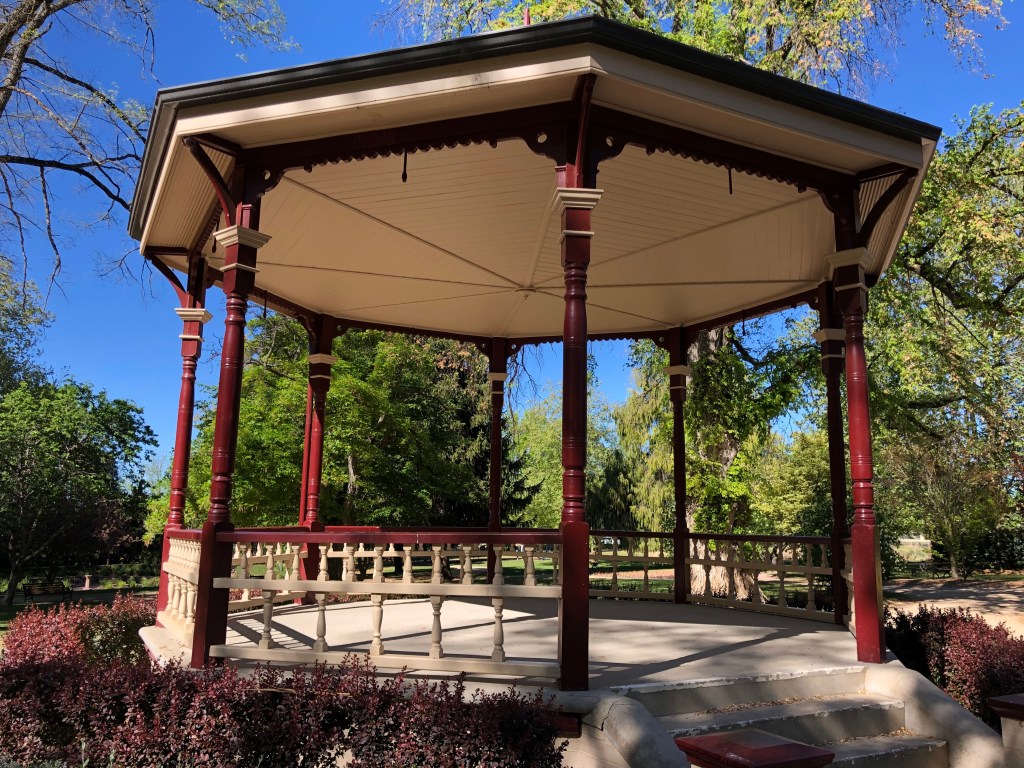
Naturally, some towns grew bigger than others due to their location on major transport routes, the success of the mines or agriculture.  Some towns like Hill End dwindled due to the exhaustion of mines (“Hill End,” 2004; Hodge, 2013).  Others, like Bathurst, were regional centres in their own right – Bathurst, in particular, is one of the first towns established after the crossing of the Blue Mountains (Blainey, 2001).  European influences on some towns are obvious.  Below are some pictures of two bandstands in Orange located in parks at either end of the town centre.

20191019-9.30_Orange_Robertson-Park-Bandstand1
Robertson Park Bandstand, Orange (Photo taken in October 2019 by Jeremy de Korte)
Robertson Park Bandstand – Plaque (photo taken October 2019 by Jeremy de Korte)
20191020-9.32_Orange_Cook-Park3_Bandstand1
Cook Park Bandstand, Orange (Photo taken in October 2019 by Jeremy de Korte)
Cook Park Bandstand – Plaque (photo taken October 2019 by Jeremy de Korte)

The history of this region is fascinating, and it is through the development of these industries and towns that gives rise to brass bands, an amount of which are still in existence.  These famous towns are historic.  The bands themselves developed reputations that extended far beyond this region.

British Influences:

If we consider that the main immigration of the time was from Britain where brass bands had already taken hold in certain areas, it stands to reason the ethnic practices that Kass mentions would include certain kinds of music-making.  Bythell (2000) tells us that this was no accident,

The successful transplantation of the brass band to the colonies in the late nineteenth century should not surprise us, given the importance of ordinary, wage-earning immigrants from Britain in building-up Australasia’s population and developing its communities and institutions.  The contribution of British-born bandsmen to Australian banding is particularly noticeable in mining areas whose counterparts in ‘the Old Country’ were major centres of the movement.

(p. 227)

More specifically and related to the regional area, Payton (2005) states that “Brass bands were popular among the Cornish at Hill End, Bathurst and elsewhere…” (p. 234).  The link between mining and brass bands cannot be understated, and the names of some of the early bands reflected this origin.  This was very much a transplanting of culture, and the Central West became blessed with several brass bands.

Where bands were formed:

00000000_Parkes-Town-Band_phot6375
Parkes Town Band (Source: IBEW)

In most of the major towns, they could boast one band although some had two or three.  In the smaller towns, they could claim one band.  As is the case with some of these activities, some bands folded or merged.  In 1908 for example, the Parkes Brass Band merged with the nearby Parkesborough Brass Band to become a single entity (“Parkes Brass Band.,” 1908).  Below is a table showing a list of locations where brass bands were mentioned, most of which were in existence in the early 1900s.  Today, a number of bands remain in the major towns and these are highlighted by links – interestingly, some of the bands that exist today in this region are now concert bands.

BathurstBimbiBlayneyCanowindra
CondobolinCowraCudalCumnock
EugowraForbesGrenfellGulgong
Hartley ValeHill EndKandosLithgow
MillthorpeMolongMudgeeOberon
OrangeParkesPeak HillPortland
Stuart TownTullibigealWellingtonYeoval
(source of table data: Trove archive)

There was no doubting the enthusiasm, civic pride and motives of the early townsfolk when it came to starting brass bands.  However, it was not only townsfolk who started bands.  Robert Bartlett (2018) wrote in his book Orange and District: A History in Pictures. 2 that “…a volunteer band attached to the Volunteer Military Corps in Orange was established about 1874” and that “The Orange Town Band was formed in the late 1880s” (p. 48).  Here, this is an example of two bands that had existed in the town in relatively early times.  The Orange Town Band was afflicted with a few stops and starts in its early years, however, it still exists to this day (Bartlett, 2018).

It is interesting to see how local newspapers reported on proposals to start bands or reported on bands already in existence.  For example, a correspondent writing for the Peak Hill Express newspaper in August 1902 says of the newly formed Yeoval band,

One would scarcely think of hard times and drought at the small township of Yeoval, since the local Brass Band has commenced practice.  The Bandmaster, (Mr. Kennerson) came yesterday from Eugowra to give his pupils their first lesson.  I am afraid (although I should be very sorry to dishearten our amateurs), that some time will lapse before the Yeoval Brass Band will appear in a contest or even turn out a few professional players.

(“YEOVAL.,” 1902)

The optimism is admirable given that Yeoval was a small township located inland from the main road linking the major towns of Molong and Wellington.

Expressions of enthusiasm for staring a brass band in the town of Cudal, located on a road from Orange to Forbes was all very well.  But this enthusiasm was tempered by a pragmatic question over instruments, as written in an article from March 1902 in the Leader newspaper,

Cudal boys intend on starting a brass band.  Why not?  Mr. Walter Carter, who has been considerable time in the band at Wellington, and who is settling in town, will act as instructor and also conductor.  The trouble is, where are the instruments coming from?  Perhaps some person who is interested will push the thing ahead.

(“CUDAL.,” 1902)

This is, of course, another aspect of starting a brass band, finding the right people to start them and instruct pupils.  In the town of Cumnock, located near the towns of Yeoval and Molong, they found a person willing to start a band.  A local and popular factor manager, Mr R. E. Higgins pushed an effort to start a band and it seems he was successful (“CUMNOCK.,” 1904).  The Cumnock Brass Band was still in existence in 1927 (“CUMNOCK.,” 1927).

The township of Kandos, located south-east of Mudgee, provides an interesting example of how to start a band properly.  Aside from the fact that got started much later than other towns, an article published in the Lithgow Mercury in March 1918 tells us much.  It seems their town band was going to be supported financially by the N.S.W. Cement Co., so all they really needed from potential musicians was “determination and enthusiasm” (“KANDOS.,” 1918).  And they really wanted a band for the town,

As a town band is a means of pleasurable entertainment, a welcome relaxation from the workers’ daily round and common task that appeals more than any other, the committee confidently look to the citizens of our model township for aid and support, financial and other ways.  Meanwhile, a goodly number of names of intending members with more or less experience has been booked, and quite an encouraging number of names of intending pupils have likewise been handed in.

(“KANDOS.,” 1918)

Nine years later we find that the Kandos Town Band is thriving.  In the September 26th issue of The Australasian Band and Orchestral News, an article about the happenings of brass bands in New South Wales is published and there is a small paragraph on the Kandos Town Band:

Kandos Town Band has emerged from its winter seclusion and rendered a fine programme on Sunday, September 11 under the baton of Bandmaster Julius.  The band has always had strong financial support and its efforts are always appreciated.

(“New South Wales,” 1927, p. 23)

Then, of course, are the times when bands have, for whatever reason, gone into recess and then reformed.  Such was the case of the Oberon Brass Band in 1936 when a tiny article published in the Sydney Morning Herald makes mention of the reformation of this band (“OBERON BAND RE-FORMED.,” 1936).

20191019-10.46_Orange_Band-Hall1
The old Orange City Band Hall (Photo taken in October 2019 by Jeremy de Korte)

Some of the brass bands mentioned above were in smaller towns and faced challenges that did not really affect bands in bigger locations, though that did not stop these towns trying to start them.  We know that bands in some of the bigger centres of “Bathurst, Wellington, Orange, Blaney, and Lithgow” were in existence by the early 1890s (“Western Brass Band Union.,” 1893).  The Orange City Band, as we can see above in the photo, was lucky enough to have its own band hall.   The band in the tiny town of Yeoval might have aspired of entering competitions but for the bands in bigger towns with more resources, this was a reality.  It was seen in an earlier post how the Bathurst District Brass Band travelled all the way to Ballarat to compete in the first South Street band sections in 1900 and gained high praise for their playing (“THE CONTEST.,” 1900; Nedwell & Hill, 1900; “To-Day’s Telegrams.,” 1900).  For many other bands in this region, travel to neighbouring towns or to Sydney for competitions became routine, no doubt helped by the early railways.  The nature of competing and competitions for these bigger bands will be examined in Part 2 of this blog post.

Challenges laid bare:

19230425_Grenfell-Town-District-Band_phot7150
Grenfell Town & District Band, ANZAC Day 1923 (Source: IBEW)

Operating a band was not an easy task.  And the early newspapers show numerous instances of where the local band put out a call for help.  Most of the assistance was to be in the form of small concerts or other events that would provide funds for a band.  In September 1900, a tiny article published in the Wellington Times newspaper asks the townspeople of Stuart Town to support their band,

At a public meeting held at Stuart Town on the 17th instant (Mr. A. G. Coleman in the chair) it was decided to hold a concert and social at Boehme’s Hall, on November 9, for the purpose of putting the funds of the Stuart Town brass band on a sound financial basis.  Tickets for the concert will be 2s and s, and for the social 3s and 2s.  Mr. Howard Warn is the hon. Sec.

(“The Stuart Town Band.,” 1900)

Then there was the distinct challenge of gaining and retaining members of the band which was either overcome…or not. The McPhail and Peak Hill District Band was one ensemble that managed to turn things around with an effective recruitment campaign.  Through an article published in the Peak Hill Express newspaper from December 1905, we see why there was a loss of initial membership and how they are progressing,

For some time past McPhail and Peak Hill District Band has not been heard so frequently as in the past, for the reason that the members being miners, were mostly out of the district.  As a result, the Band has had to recruit, and this being done, with some £30 worth of instruments, the Band is on the up grade again, and during the coming year will be heard to advantage.  The members have some really fine instruments, and everything points to a bright future.

(“McPhail and Peak Hill District Band.,” 1905)

One can sense the inherent frustration of a Mr W. H. Gray, committee member of the Grenfell Town Band through a supplementary report published in the Grenfell Record and Lachlan District Advertiser newspaper in August 1931 regarding some issues surrounding his band.  Firstly, Mr Gray has tried to justify the music library and choices of music for performances by stating,

In the first place the library referred to is an extremely important factor in the make-up of the band, and comprises all the music as used by them, and the same as in a reading library, there are good, band and indifferent pieces, and it requires a great deal of time to look through a quantity of music and make a selection of numbers that will be interesting to players to practice, and which will also please the majority of the listening public. […] Of course, there are numbers that will be uninteresting to the musically uneducated, but if we were to confine ourselves to the class of music that would appeal to that that type of listener we would get nowhere.  And so it is necessary to have an assortment that will appeal to the highbrow as well as the lowbrow, if I may be permitted to use that term.

(Gray in “TOWN BAND,” 1931)

Mr. Gray went on to making other forthright comments in his report of which are quoted here.

Most of them think the instrument has only to be blown into and it will play itself

[…]

A lot of programmes could be much improved if I could get fuller rehearsals.  A lot to poor and bad spots in a performance are caused by members who only come along to rehearsal occasionally, and are not entirely familiar with the programme, and are not competent enough to read at sight, make mistakes which disconcert the rest of the players.

[…]

In a small town like this there is not the same chance or privilege to get a better combination, as there is only a certain percentage or average of all who take up the study of music who ever amount to much, and distance from other places are a bar to attracting other players here.

[…]

I would now like to appeal to the public for support.  We have to be continually adding to our library, instruments have to be kept in repair, and band room rent and lighting to be paid.  The bandsmen give a great deal of their time.  Of course it is looked upon as a recreation, but it is not always so, as duties often interfere with other plans, so that a band call is sometimes a sacrifice to the men.  […] You will now see it takes a certain definite amount of money to run a band, also a certain amount of sacrifice on behalf of the bandsmen, and as I hope the band gives a lot of pleasure to people that in the future better monetary support will be given that will enable us to continue and improve on the work already done.

(Gray in “TOWN BAND,” 1931)

This article was as informative as it was fascinating.  We see here a committee member who has outlined several frustrations yet still asks the public for support, as well as asking his bandsmen to give a greater effort.  The challenge of being in a smaller town without ready access to a pool of musicians and other resources is not unique.  To have laid it all out in a local newspaper to this extent is certainly brave – one wonders the comments he received from his bandsmen who might have read this.

Conductors and bandsmen:

00000000_Bathurst-Town-Band_phot18345
Bathurst Town Band (Source: IBEW)

It has been mentioned at times in this post certain names of people who were influences on their local bands.  Again, this is nothing new when compared to other bands in Australia – this was a time of the journeyman band member who frequently changed towns and bands.  To keep up retention for any length of time was a major challenge.  Yet there were some remarkable stories of longevity, and the lengths towns went to honour their brass band people.

The year is 1920 and, in an article, published in January of that year in the Bathurst Times newspaper, news breaks of a possible transfer of the conductor of the Bathurst District Band, a Mr Samuel Lewins, to somewhere else in N.S.W. because of employment.  This was a conductor who had been at the helm of the band for a considerable length of time,

Mr. Verbrugghen, the conductor of the State Orchestra, has been telling the public that he success of the orchestra is due to its conductor.  By the same line of reasoning the success of the Bathurst District Band is due to its bandmaster.  Is proof wanted?  It can be found in the fact that during the thirty-three years the band has been going it has had hundreds of members, but only one conductor.

(“BRASS BANDS,” 1920)

Rightly, or wrongly, there were fears the band would collapse if the conductor left the band,

Now there is a rift looming.  Bathurst is likely to lose Mr. Lewins, and in losing him the city is in danger of losing the District Band as we now know it.

This is how maters stand.  Mr. Lewins is an officer in the Railway service.  He is reaching the retiring age, and when that time comes (as will be in about two years), he proposes to remove to Sydney or some other centre.  Is Bathurst going to allow him to go without making an effort to keep him?

[…]

What will Bathurst do?  Will it get busy during the two years yet to go, and arrange to keep the District Band and its conductor, or will it sit down and allow matters to drift?  Two years is not a long time.  Some towns have been trying for a dozen years to get a man with the brass band knowledge of Mr. Lewins and with equal worth as a citizen, but have failed.  Bathurst has the musician man and the citizen, and should see that he is kept here.

(“BRASS BANDS,” 1920)

The story of Mr Lewins at the helm of the Bathurst District Band does not end here.  In 1926 we find that he is still conducting and as a measure of appreciation, the townsfolk honour Mr Lewins with a plaque as a testimonial to his now forty years as conductor of the band (“THE LEWINS’ TESTIMONIAL,” 1926; “MR. S. LEWINS’ TESTIMONIAL,” 1925).  Mr Lewins kept conducting the band for another twelve years until 1938.  In 1936 he was further honoured for conducting the band for fifty years with the erecting of commemorative gates at Machattie Park (“LEWINS COMMEMORATIVE GATES,” 1936).  In 1938, having achieved the record as the “oldest bandmaster in the Commonwealth”, is suffering from ill health and has had to retire from leading the Bathurst District Band – by all accounts, this is an astonishing record (“MR. S. LEWINS,” 1938).  Two years after his retirement at the age of 78, Mr Lewins passes away with tributes flowing from band people all around Australia (“MR. SAMUEL LEWINS,” 1940).  For a brief time afterwards, the band is conducted by one of his sons and soon after Mr Harold Walmsley takes over as conductor of this band and the Bathurst Boys’ Band (“BATHURST AND ITS BANDS,” 1941).

Samuel Lewins was but one of many remarkable musicians that have called the Central West their home and the legacy of these musicians lives on.  One must recognize that every musician made a contribution to their bands, and in some cases to Australia as euphonium player and conductor of the Orange Town Band, Herbert Rockliff did in the AIF (Orange City Council, 2015).  To my knowledge, not one band conductor has come close to the Lewins record yet.

Bands of the Central West:

To reiterate a point, the development and running of bands in the Central West were no less compared to other bands around Australia.  In fact, it was fairly typical – challenges were commonplace.  However, to have so many bands in the one region did bring out the best of bandsmen and they did their best to keep bands operating.  Perhaps circumstance was unkind to some of them – they were tied to their towns and if the towns dwindled the bands folded.  But for the most part, at least in some of the bigger towns, their legacy lives on.

19110000_Peak-Hill-Band_phot9371
Peak Hill Band, 1911 (Source: IBEW)

Part 2: Association and competition ->

References:

Band Enthusiast. (1902, 17 January). Brass Band for Condobolin – Views of an Experienced Bandsman. Lachlander and Condobolin and Western Districts Recorder (NSW : 1899 – 1952), 5. http://nla.gov.au/nla.news-article213298751

Bartlett, R. (2018). Orange and district : a history in pictures. 2. Robert Bartlett. 

BATHURST AND ITS BANDS : Mr. Walmsley’s View. (1941, 30 September). National Advocate (Bathurst, NSW : 1889 – 1954), 5. http://nla.gov.au/nla.news-article160522981

Bathurst Town Band. (n.d.). [Photograph]. [phot18345]. The Internet Bandsman Everything Within, Vintage Brass Band Pictures : Australia. http://www.ibew.org.uk/vbbp-oz.html

Blainey, G. (2001). The tyranny of distance : how distance shaped Australia’s history (Rev. ed.). Macmillan. 

BRASS BANDS : The People’s Music. : The District Band Conductor. (1920, 08 January). Bathurst Times (NSW : 1909 – 1925), 2. http://nla.gov.au/nla.news-article111547245

Bythell, D. (2000). The Brass Band in the Antipodes : The Transplantation of British Popular Culture. In T. Herbert (Ed.), The British brass band : a musical and social history (pp. 217-244). Clarendon Press ; New York : Oxford University Press. 

THE CONTEST. (1900, 08 October). Ballarat Star (Vic. : 1865 – 1924), 1. http://nla.gov.au/nla.news-article206978024

CUDAL. (1902, 08 March). Leader (Orange, NSW : 1899 – 1945), 3. http://nla.gov.au/nla.news-article252290799

CUMNOCK. (1904, 13 February). Molong Express and Western District Advertiser (NSW : 1887 – 1954), 7. http://nla.gov.au/nla.news-article139537587

CUMNOCK. (1927, 08 January). Molong Express and Western District Advertiser (NSW : 1887 – 1954), 11. http://nla.gov.au/nla.news-article139984068

de Korte, J. D. (2018, 08 July). The unique position the Canberra City Band holds within the bands of the Southern Tablelands of NSW. Band Blasts from the Past : Anecdotes, Stories and Personalities. https://bandblastsfromthepast.blog/2018/07/01/the-unique-position-the-canberra-city-band-holds-within-the-bands-of-the-southern-tablelands-of-nsw/

de Korte, J. D. (2018, 22 December). The first South Street band contest in October, 1900. Band Blasts from the Past : Anecdotes, Stories and Personalities. https://bandblastsfromthepast.blog/2018/12/22/the-first-south-street-band-contest-in-october-1900/

de Korte, J. D. (2019a). Orange, N.S.W. : Cook Park : Bandstand [Photograph]. [IMG_4472]. Jeremy de Korte, Sydney, N.S.W. 

de Korte, J. D. (2019b). Orange, N.S.W. : Cook Park : Bandstand – Plaque [Photograph]. [IMG_4473]. Jeremy de Korte, Sydney, N.S.W. 

de Korte, J. D. (2019c). Orange, N.S.W. : Old Orange City Band Hall, 1888 [Photograph]. [IMG_4453]. Jeremy de Korte, Sydney, N.S.W. 

de Korte, J. D. (2019d). Orange, N.S.W. : Robertson Park : Bandstand [Photograph]. [IMG_4443]. Jeremy de Korte, Sydney, N.S.W.

de Korte, J. D. (2019). Orange, N.S.W. : Robertson Park : Bandstand – Plaque [Photograph]. [IMG_4444]. Jeremy de Korte, Sydney, N.S.W. 

Grenfell Town & District Band : ANZAC Day 1923. (1923). [Photograph]. [phot7150]. The Internet Bandsman Everything Within, Vintage Brass Band Pictures : Australia. http://www.ibew.org.uk/vbbp-oz.html

Hill End. (2004, 08 February). Sydney Morning Herald. https://www.smh.com.au/lifestyle/hill-end-20040208-gdkq2n.html

Hodge, B. (2013). Hill End & Tamboroora – a brief history. Hill End & Tamboroora Gathering Group. Retrieved 31 October 2019 from https://www.heatgg.org.au/hill-end-story/brief-history/

KANDOS : Brass Band Proposals : (From our Correspondent). (1918, 27 March). Lithgow Mercury (NSW : 1898 – 1954), 1. http://nla.gov.au/nla.news-article218467481

Kass, T. (2003). A thematic history of the Central West : comprising the NSW historical regions of Lachlan and Central Tablelands. NSW Heritage Office. https://www.environment.nsw.gov.au/resources/heritagebranch/heritage/thematichistorycentralwest.pdf 

LEWINS COMMEMORATIVE GATES. (1936, 17 July). National Advocate (Bathurst, NSW : 1889 – 1954), 2. http://nla.gov.au/nla.news-article160530723

THE LEWINS’ TESTIMONIAL. (1926, 09 February). National Advocate (Bathurst, NSW : 1889 – 1954), 2. http://nla.gov.au/nla.news-article161492356

McPhail and Peak Hill District Band. (1905, 15 December). Peak Hill Express (NSW : 1902 – 1952), 9. http://nla.gov.au/nla.news-article107246068

MR. S. LEWINS : Retirement Reported. (1938, 12 August). National Advocate (Bathurst, NSW : 1889 – 1954), 1. http://nla.gov.au/nla.news-article160909451

MR. S. LEWINS’ TESTIMONIAL. (1925, 29 December). National Advocate (Bathurst, NSW : 1889 – 1954), 2. http://nla.gov.au/nla.news-article161496572

MR. SAMUEL LEWINS : Death Yesterday. (1940, 24 May). National Advocate (Bathurst, NSW : 1889 – 1954), 2. http://nla.gov.au/nla.news-article160642933

Nedwell, J. W., & Hill, W. D. (1900, 22 October). CORRESPONDENCE : Soldiers’ Statue Fund at Ballarat. National Advocate (Bathurst, NSW : 1889 – 1954), 2. http://nla.gov.au/nla.news-article156776396

New South Wales. (1927). The Australasian Band and Orchestral News, XXIII(1), 23 & 25. 

OBERON BAND RE-FORMED. (1936, 07 November). Sydney Morning Herald (NSW : 1842 – 1954), 14. http://nla.gov.au/nla.news-article17286874

Orange City Council. (2015, 01 February). Herbert Rockliff. Orange City Council. Retrieved 19 October 2019 from http://www.centenaryww1orange.com.au/service-men-and-women/herbert-rockliff/

Orange District Band. (1928). [Photograph]. Central West Libraries, Orange, N.S.W. 

Parkes Brass Band. (1908, 17 April). Western Champion (Parkes, NSW : 1898 – 1934), 16. http://nla.gov.au/nla.news-article111917460

Parkes Town Band. (n.d.). [Photograph]. [phot6375]. The Internet Bandsman Everything Within, Vintage Brass Band Pictures : Australia. http://www.ibew.org.uk/vbbp-oz.html

Payton, P. (2005). The Cornish overseas : a history of Cornwall’s ‘great emigration’ (Rev. and updated ed.). University of Exeter Press. 

Peak Hill Band. (1911). [Photograph]. [phot9371]. The Internet Bandsman Everything Within, Vintage Brass Band Pictures : Australia. http://www.ibew.org.uk/vbbp-oz.html

The Stuart Town Band. (1900, 20 September). Wellington Times (NSW : 1899 – 1954), 2. http://nla.gov.au/nla.news-article139003931

To-Day’s Telegrams : THE BATHURST BAND IN MELBOURNE. (1900, 04 October). Bathurst Free Press and Mining Journal (NSW : 1851 – 1904), 3. http://nla.gov.au/nla.news-article63874689

TOWN BAND : Grenfell Band. (1931, 17 August). Grenfell Record and Lachlan District Advertiser (NSW : 1876 – 1951), 4. http://nla.gov.au/nla.news-article112830663

Western Brass Band Union. (1893, 02 November). National Advocate (Bathurst, NSW : 1889 – 1954), 2. http://nla.gov.au/nla.news-article156684544

YEOVAL. (1902, 22 August). Peak Hill Express (NSW : 1902 – 1952), 2. http://nla.gov.au/nla.news-article107245170
Trans-continental connections: the brass bands of Broken Hill and Kalgoorlie

Introduction:

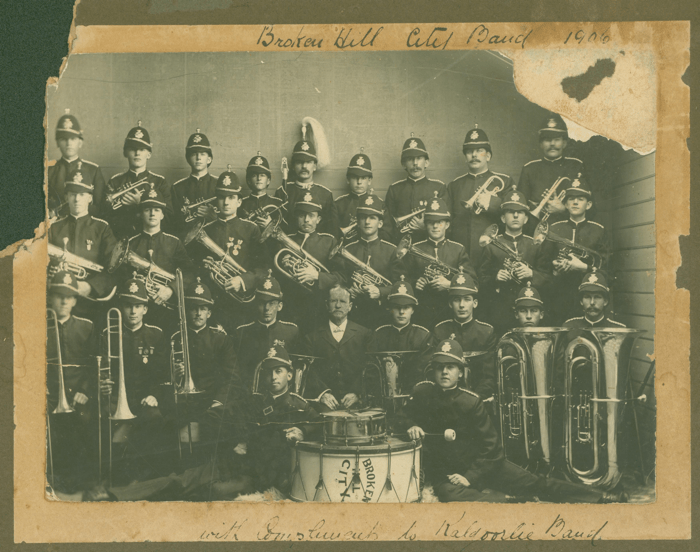
Above is an intriguing photo.  This photo of the Broken Hill City Band dated 1906 starts a story through the message that is penned around the edges; “Broken Hill City Band 1906 with compliments to Kalgoorlie Band”.  Knowing the geography of Australia as we do, the towns of Broken Hill and Kalgoorlie are very far apart.  Yet as we also know, during these times brass bands toured fair distances to participate in competitions and performances.  It was no different for these two bands.  They did meet, twice in five years.

The photo above is held in the archives of the Victorian Bands’ League, so we wonder why it is still in Victoria. That story cannot be told due to a lack of information.  However, we do know when and where the two bands met, and the first meeting was in Victoria at the famous South Street Competition.  The fact that they were both at South Street in 1906 reflects a ‘can do’ attitude from both bands, as well as many others.  The travel was long and expensive, but the lure of rewards beckoned. Such was the case when the bands met again in 1911, the next time in Kalgoorlie.

Hence this post covers the years of 1906 and 1911, two different times.  We can marvel at the travel that was undertaken and the other ‘little’ stories surrounding the trips.  The central theme of this post, however, is the fact that these bands met and seemingly formed a mutual respect and friendship through music, geography, and circumstance.

The early bands of Broken Hill and Kalgoorlie:

Aside from the distance from each other, the establishment of both Broken Hill and Kalgoorlie followed relatively similar paths.  Both are remote mining towns that experienced rapid population growth with the discovery of minerals – “silver, lead and zinc” in Broken Hill in 1883 and gold in Kalgoorlie in 1893 (Frost, Malam, Williams, & Malarz, 2014, p. 39).  With increased population came increased services and demand for transport links, most importantly the early railways (Frost et al., 2014).  Interestingly, a rail link from Broken Hill to Adelaide was built before Broken Hill was linked to Sydney and over in Kalgoorlie-Boulder, rail links were built to the south coast at Esperance and west to Perth (Frost et al., 2014).  With the development of these important centres, and the influx of people came the establishment of early brass bands (Farrant, 1989).

Briefly, the bands of Broken Hill and Kalgoorlie started with years of each other with bands in Kalgoorlie-Boulder commencing in 1895 and consolidating themselves a few years later – by 1900 there were two bands in Boulder and one band in Kalgoorlie (Farrant, 1989; Goldfields Brass Band, 2004).  The remaining band in Kalgoorlie, the Goldfields Brass Band can trace its lineage back to the Boulder Brass Band having been gifted a store of music and instruments in 1963 (Goldfields Brass Band, 2004).  The Kalgoorlie brass bands had a healthy respect and support of each other, and in the early years were boosted by the talents of the five McMahon brothers who arrived in Kalgoorlie-Boulder in 1900 (Farrant, 1989; Greaves & Earl, 2001).  Over the coming years, the famous Cornetist and Conductor Hugh McMahon and his brother Henry (Harry) took their bands all the way to Ballarat to compete at the South Street competitions with varying degrees of success (Greaves & Earl, 2001).

A similar development of brass bands occurred in Broken Hill where a band was established in 1899 as the “Bermingham’s Band…with J. J. Bermingham and his 9 sons comprising the majority of the membership” (Barrier Industrial Unions (BIU) Brass Band, 2019).  The band expanded its membership and was renamed the Broken Hill City Band a year later – the current Barrier Industrial Unions (BIU) Brass Band is a direct descendant of this early band (Barrier Industrial Unions (BIU) Brass Band, 2019).  The townsfolk and band members of Broken Hill, like Kalgoorlie, appreciated music and visits from other brass bands were well-attended (“THE AUSTRAL BRASS BAND.,” 1906).

1906: The South Street Competition, Ballarat:

The year is 1906 and from across Australia, brass bands have once again made their way to the South Street competition.  Since the commencement of brass band and brass solo/ensemble sections at South Street in 1900, this section of the competition continues to grow.  In 1906 these thirteen listed bands participated in the A and B grade sections with many bands participating in both grades, and many other musicians competing in the solo and ensemble sections:

(Vic.) Ararat Model (B Grade)
(Vic.) City of Ballarat (A & B Grades)
(Vic.) Bairnsdale Municipal (A & B Grades)
(NSW) Broken Hill City Band (A & B Grades)
(Vic.) Collingwood Citizens’ Band (A & B Grades)
(Vic.) Daylesford Citizens (B Grade)
(Vic.) Eaglehawk Borough (B Grade)
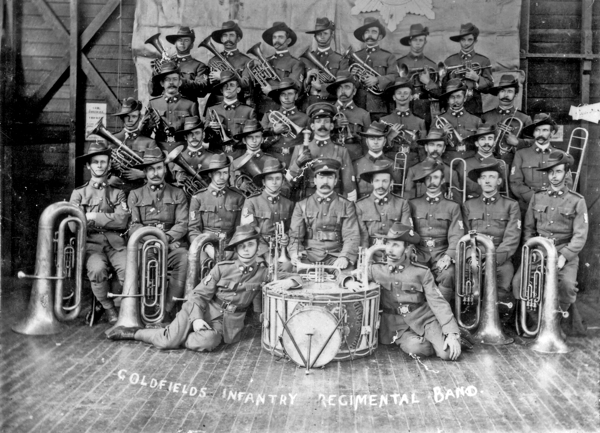
(WA) Kalgoorlie and Goldfields Infantry and Regimental Band (A Grade)
(Vic.) Maldon Miners (B Grade (Withdrew from A Grade))
(Vic.) Prout’s Ballarat Brass Band (A & B Grades)
(Vic.) Richmond City Band (A & B Grades)
(Vic.) St. Augustine’s Orphanage Band (A Grade)
(Tas.) Ulverstone Rangers (A & B Grades)

(Mullen, 1951; “No title,” 1906; Royal South Street Society, 1906c)
19050000_Goldfields-Regimntal_008561d
Goldfields Infantry Regimental Band 1905 (Source: State Library of Western Australia: Government Photographer Collection: 008561D)

Considering the travel methods of the day, to attract this many bands with three of them travelling from other colonies is quite remarkable.  Such was the lure of the South Street competition.  For the Kalgoorlie Regimental band, they were travelling paths set down by the Boulder City Band and the Boulder A.W.A Mines Band before them as they participated South Street in 1902, 1903 and 1905 and achieved excellent placings (Farrant, 1989; Greaves & Earl, 2001).  Travel for Kalgoorlie bands to get to South Street involved a train, a ship and another train and tours often lasted for six weeks (Farrant, 1989).  The distance for the Broken Hill band was not quite as long but involved a roundabout way of travel as the band took a train to Adelaide and then another train from Adelaide to Ballarat (“BALLARAT EISTEDDFOD.,” 1906a).

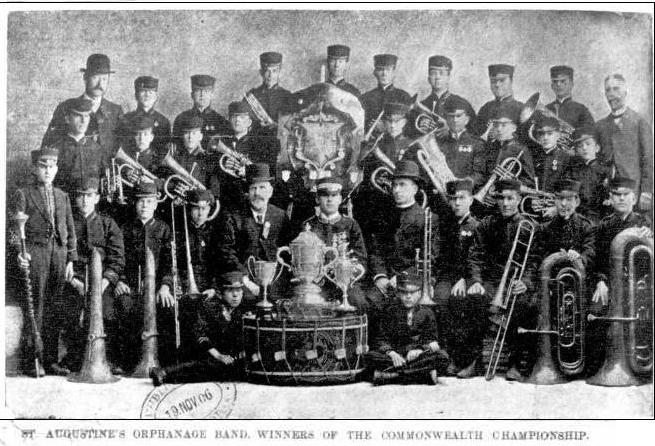
The details of the 1906 South Street competition were notable for several reasons.  Much of this was due to the performance of the legendary St. Augustine’s Orphanage Band from Geelong who, despite their youth, managed to win all of the A Grade sections and carry off the Sutton Shield & Cup and the Boosey Cup (“The Ballarat Band Contests.,” 1906; “BALLARAT EISTEDDFOD.,” 1906b).  By all accounts the quality of their performance and subsequent win were undisputed. However, there was a degree of controversy about this competition and some felt results underneath St. Augustine’s were unjustified.

19061117_Advocate_Ballarat-Competion
Advocate, 17/11/1906, p. 14

Some of the controversies were pinned to the choice of the adjudicator.  Unlike previous years when the band sections were adjudicated by eminent brass band authorities such as James Ord Hume, Captain W. G. Bentley, and Albert Wade, the 1906 competition was adjudicated by a Professor Frederick W. Beard LRAM of Birmingham (Greaves, 1996). Professor Beard, “did not pretend to be a brass band expert” but apparently “had a thorough knowledge of orchestral work and he knew enough about brass instruments to qualify for the position he undertook…” (“BALLARAT EISTEDDFOD.,” 1906b).  Such a decision did not go down well with some bands. Upon the return of the Kalgoorlie band back home, their President, Mr Eli Shaw read out a resolution of the Richmond City Band at the welcome home reception which stated,

That this band respectfully declines to enter or compete at any band contest unless a practical brass band conductor, or conductors, be appointed as judge, the definition of ‘practical’ being an approved registered conductor, who has piloted bands to victory in large contests, and that copies of this resolution be forwarded to all secretaries of all registered bands in Victoria asking them to adopt the same, and forward on to secretary of Victorian Band Association, Ballarat.

(“KALGOORLIE BRASS BAND.,” 1906)

Such was the ill-feeling from one band who participated in this competition.

For the Broken Hill City Band, the results simply did not go their way in the A grade or B grade sections except for winning the third prize for discipline behind the Bairnsdale & Eaglehawk bands (Royal South Street Society, 1906c).  However, their playing was judged by others to be excellent and it was felt that their placings were not deserved (“BALLARAT BAND CONTESTS.,” 1906).

The experiences of the Broken Hill Bands and the Kalgoorlie band were somewhat linked and for the Kalgoorlie band, some felt they had been treated extremely unfairly by the Victorian Band Association (V.B.A.) and the adjudication.  It was not until the Kalgoorlie Band arrived in Ballarat that they found out they had been unexpectedly regraded from B grade to A grade on account of the V.B.A. wrongly assuming the status of some of their members (“KALGOORLIE BRASS BAND.,” 1906).  Apparently, the V.B.A. told Kalgoorlie they had sixteen members who had played with the A.W.A Band and the Boulder City Band in previous years, of which the Kalgoorlie Band “proved” that these sixteen “had never played before in a contest” (“KALGOORLIE BRASS BAND.,” 1906).  If we are to believe this account, it would seem the V.B.A., which was the band association overseeing the registrations, had made a grievous mistake somewhere.

There were also the woes of adjudication which upset many in the band community.  At the same reception where Mr Eli Shaw read out the resolution by the Richmond City Band, he also read out letters of support from the Broken Hill band and the Hobart band.  Perhaps, this letter is somehow tied into the photo at the head of this post, but we may never know this for sure.  The letter, written by the bandmaster of Broken Hill, was printed in an article published by the Kalgoorlie Western Argus upon the return of the band back home:

Permit me and the members of the Broken Hill City Band to offer you and the talented members of your Kalgoorlie Band our sincerest sympathy in the position in which an utterly outrageous adjudication has placed you at this Ballarat contest.  It is the consensus of opinion amongst all whom we have met, and are disinterestedly capable of giving a sound musical judgement, that your rendering of the test and choice, especially the latter, was a real musical treat, and that the judge, in awarding such an absurdly low number of points, insulted the musical intelligence of hundreds, who, I am sure, are infinitely more capable of giving a fair judgement than he did.  Allow me once more to offer you our sincere sympathy, and we hope that this perverted judgement will not prevent us from hearing your magnificent band many times again here.

(“KALGOORLIE BRASS BAND.,” 1906)

The sentiments of the bandmaster of the Hobart band were very similar – a grave injustice had been done, not only on this band but the whole community of bands.

The Kalgoorlie band did what they could under the circumstances and obviously drew praise for their playing.  Upon the completion of the Ballarat contest, they travelled to Bendigo to present a concert and were awarded a civic reception upon their arrival, and received an excellent review of their performance (“KALGOORLIE REGIMENTAL BAND.,” 1906).  From Bendigo, they travelled home and Kalgoorlie gave them a hero’s welcome upon their return with a reception attended by the other bands in the region, local politicians and the Mayor (“KALGOORLIE BRASS BAND.,” 1906).

Aside from the results in the band sections, competition results in the solo and ensemble sections were a consolation for both the Broken Hill and Kalgoorlie bands.  All sections had a number of entries and included musicians from bands that were not in the main band sections (Royal South Street Society, 1906a, 1906b).  It would have been pleasing for the Royal South Street Society to have so many entries.

1911: The Kalgoorlie Eisteddfod:

The Kalgoorlie Eisteddfod was obviously a much smaller event than South Street, yet it seemed to generate similar excitement and interest from participants and audience.  So much so that several public authorities, the Eisteddfod and the West Australian Band Association made sure that visiting bands were treated to the finest hospitality. The 1911 Eisteddfod was notable for the participation of the Albany Brass Band and the Broken Hill City Band who travelled to Kalgoorlie to compete against the three Kalgoorlie-Boulder bands.

In August 1911 the Broken Hill City Band commenced a long journey to Kalgoorlie.  The Trans-Continental Railway was yet to be built, so the band took the train to Adelaide where they presented a concert on the 18th of August before taking a ship to Albany (“BROKEN HILL BAND.,” 1911a).  There was a huge amount of interest generated by the arrival of these two bands in Kalgoorlie.  On the 25th of August, both the Albany and Broken Hill bands arrived in Kalgoorlie, and their travel movements were reported on by the Kalgoorlie Miner newspaper – of which also highlighted an example of the hospitality they were being awarded,

The Broken Hill men got off the Karoola at Albany, and special carriages were provided for both the Barrier and Albany men through to the goldfields.  At Northam the carriages were shunted off, and later attached to the express, so that there was no confusion caused in regard to transhipping baggage, etc.  The Albany men gave a concert at Northam while waiting for the express, and realised a fair profit.

(“KALGOORLIE EISTEDOFOD,” 1911)

…and remarking on uniforms,

The green and gold uniforms of the players from Broken Hill are particularly effective, and in mufti they wear green hat bands and gold lettering; also badges of green and gold. The Albany attire is of blue, with red facings and badges of the same colours.

(“KALGOORLIE EISTEDOFOD,” 1911)

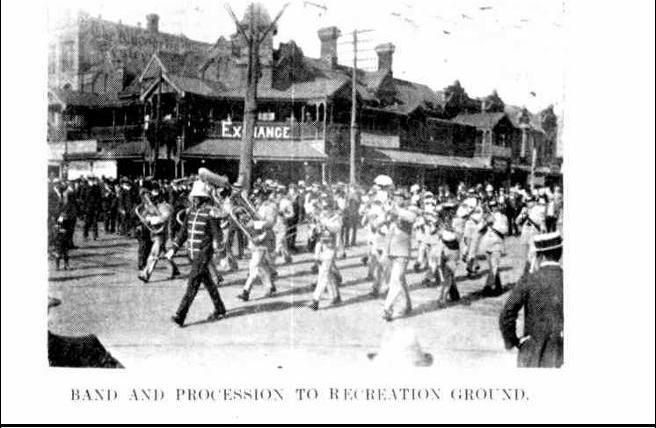
Both bands were received at the Kalgoorlie station by a plethora of officials and townsfolk and the railway station reception also included a small combination of the three Kalgoorlie-Boulder bands playing music.  After this welcome, both bands formed up and marched to the Eisteddfod office and then after more speeches, marched to their hotel (“KALGOORLIE EISTEDOFOD,” 1911).

Fortunately, the article in the Kalgoorlie Miner newspaper also published the names of the bandsmen from both bands so we have this piece of history on record:

P. Pfitzner, conductor
W. May, professional cornet
H. Mitchell, solo cornet
A. Hendy, solo cornet
J. Shannon, repiano cornet
S, Phillips, flugel horn
E. Holland, second cornet
H. Halse, third cornet
W. Keays, soprano cornet
E. W. Barwick, solo horn
R. Rawle, second horn
John Richards, first horn
W. Partington, baritone
O. Hannett, baritone
D. Hopkins, euphonium
R. Ramsay, euphonium
C. Thomas, trombone
Stan Phillips, trombone
J. Martin, bass trombone
J. Bartley, BBb bass
W. Head, BBb bass
O. Berriman, Eb bass
S. Goldring, Eb bass
C. Kumm, bass drum
R. Gummow, side drum
M. Williams, side drum
Mr. J. Doherty, is the drum major, Mr. J. Mitchell is the manager, and Mr. W. W. Barwick the secretary.

(“KALGOORLIE EISTEDOFOD,” 1911)

A day later both bands were getting into their practice on the city oval which was reported on by the Kalgoorlie Miner.  The welcoming ceremonies were not over.  After their afternoon practice on the oval, both bands marched to the town hall to be received by the mayor and councillors who awarded them another civic reception (“KALGOORLIE EISTEDDFOD,” 1911).  Toasts were given all around and it appears the Mayor of Kalgoorlie had spent some years in Broken Hill, so he was familiar with the town and mines.  The camaraderie was evident as was the hospitality.  Mr J. Mitchell, secretary of the Broken Hill band said as much in his response to the welcome.

…he appreciated the kindness that had been shown them, especially by the energetic committee and secretary, who had secured free railway passes for them, otherwise Broken Hill Band could hardly have taken the trip.

(“KALGOORLIE EISTEDDFOD,” 1911)

A few days later the Broken Hill band presented a concert in Kalgoorlie’s Victoria Park which was well-attended by the townsfolk.  As a measure of support, the band received £32 in total from contributions which obviously helped with some expenses – the trip was estimated to cost £400 (“BROKEN HILL BAND.,” 1911b).  The band was said to have performed with “good quality of tone, excellent balance, and intelligence in interpretation” which was high praise for the visiting ensemble (“BROKEN HILL BAND.,” 1911b).  No doubt a good review for the band to have!  Interest in the bands had not waned and was carried through to the Eisteddfod proper.  Certainly, the enthusiasm from the townspeople and friendship of the local bands between each other attracted the notice of local commentators (“KALGOORLIE BAND COMPETITIONS,” 1911).

19111010_Kalgoorlie-Western-Argus_Competition-Broken-Hill-March
Kalgoorlie Western Argus, 10/10/1911, p. 21

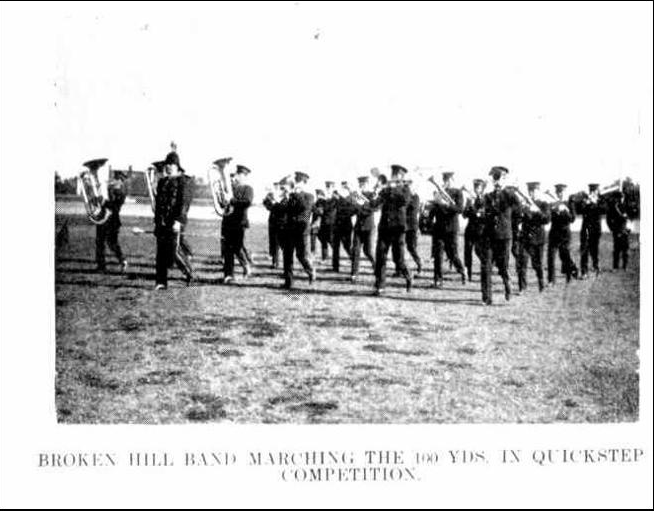
The band sections of the Eisteddfod commenced in the first week of September and were adjudicated by Mr Charles Allison who also did his bit by leading the combined bands on a street march and conducting them on the oval (“KALGOORLIE BAND COMPETITIONS.,” 1911).  The sight of the three Kalgoorlie-Boulder bands combined with the bands of Broken Hill and Albany would have been quite spectacular.  Over the coming days, all bands competed in a variety of band and solo/ensemble sections and results were mixed between them – the Kalgoorlie Band won the overall championships however the Broken Hill band won the Street March section (“BAND CONTESTS,” 1911; “STREET MARCHING COMPETITION,” 1911).

19111010_Kalgoorlie-Western-Argus_Competition-Massed-Bands
Kalgoorlie Western Argus, 10/10/1911, p. 21
19111010_Kalgoorlie-Western-Argus_Competition-Procession
Kalgoorlie Western Argus, 10/10/1911, p. 21

By all accounts, this was a very good band contest with little reported controversy and where all bandsmen exhibited the best of behaviour towards each other.  Indeed, even during the contest, social nights were encouraged and the Kalgoorlie-Boulder bands made sure the visiting bands were very welcome (“VISITING BRASS BANDS.,” 1911).  This hospitality was not lost on the visiting bands and in an article published on the 9th of September in the Truth newspaper we read that,

The visiting bandsmen, however, express their intense appreciation of the kindness and courtesy extended to them on all hands.  The Chamber of Mines, the School of Mines, the brewery manager, the Race Club, secretaries, the manager of the power house, and others did their best to make the Albany and Broken Hill men enjoy themselves.

(“Kalgoorlie Band Contests.,” 1911)

According to an account by a member of the Broken Hill band who documented the whole trip, and which was published in the Barrier Miner newspaper, the Broken Hill band commenced then commenced a long trip home – a train to Perth, a ship to Adelaide and another train to Broken Hill.  The band arrived back in Broken Hill on September 17th and despite some results not going their way, they acquitted themselves well and certainly enjoyed the trip west (“THE BROKEN HILL BAND.,” 1911).

Conclusion:

What is evident here through these ‘little stories’ is just one example from many of the connections and friendships that were made between early brass bands.  There is probably much more that can be written on this topic.  However, one must admire the fact that these bands traversed vast distances and in doing so gave themselves chances that they otherwise would not have had.  The fact that the Broken Hill and Kalgoorlie bands came from towns that developed around mining obviously helped the friendships that developed.

I have formed no doubt through the research for this post that these two bands gained valuable experiences from their trips.  Competitions aside, it was the camaraderie of early bands people and the connections that were formed that made the trips even more worthwhile.

References:

THE AUSTRAL BRASS BAND. (1906, 08 February). Barrier Miner (Broken Hill, NSW : 1888 – 1954), 3. http://nla.gov.au/nla.news-article44491455

BALLARAT BAND CONTESTS. (1906, 03 December). Barrier Miner (Broken Hill, NSW : 1888 – 1954), 3. http://nla.gov.au/nla.news-article44520304

The Ballarat Band Contests : The Championship of the Commonwealth Won by St. Augustine’s Band : The Boys Carry off All the First-Class Prizes : An Unprecedented Feat. (1906, 17 November). Advocate (Melbourne, Vic. : 1868 – 1954), 14. http://nla.gov.au/nla.news-article170199282

BALLARAT EISTEDDFOD. (1906a, 29 October). Evening News (Sydney, NSW : 1869 – 1931), 2. http://nla.gov.au/nla.news-article115677274

BALLARAT EISTEDDFOD : Brass Band Section : Victories of the Orphans : St. Augustine’s Wins the Double. (1906b, 08 November). Evening News (Sydney, NSW : 1869 – 1931), 2. http://nla.gov.au/nla.news-article115680908

BAND CONTESTS : Championship won by Kalgoorlie. (1911, 04 September). Evening Star (Boulder, WA : 1898 – 1921), 3. http://nla.gov.au/nla.news-article204606679

Barrier Industrial Unions (BIU) Brass Band. (2019). History. Barrier Industrial Unions (BIU) Brass Band. Retrieved 03 September 2019 from https://biuband.com.au/history/

BROKEN HILL BAND. (1911a, 19 August). Register (Adelaide, SA : 1901 – 1929), 13. http://nla.gov.au/nla.news-article58436856

BROKEN HILL BAND. (1911b, 28 August). Kalgoorlie Miner (WA : 1895 – 1950), 6. http://nla.gov.au/nla.news-article91317321

THE BROKEN HILL BAND : Its West Australian Trip. : (By a Member). (1911, 20 September). Barrier Miner (Broken Hill, NSW : 1888 – 1954), 5. http://nla.gov.au/nla.news-article45165481

Broken Hill City Band. (1906). [Rectangular black and white photograph mounted on card : L21.6cm – W16.5cm]. [0006]. Victorian Collections, Victorian Bands’ League. https://victoriancollections.net.au/items/5b59a68021ea690d805b060c

Eastern Goldfields Historical Society Inc. (2019). Kalgoorlie : City of Kalgoorlie-Boulder. Eastern Goldfields Historical Society Inc. Retrieved 03 September 2019 from https://kalgoorliehistory.org.au/towns/Kalgoorlie

Farrant, J. E. (1989). Boulder bands win at Ballarat, 1904/1905. Studies in Western Australian History, 10(April [Celebrations in Western Australian history / Layman, Lenore & Stannage, Tom (eds.)]), 107-113. https://search.informit.org/documentSummary;dn=890911633;res=IELAPA 

Frost, G., Malam, K., Williams, L., & Malarz, A. (2014). The evolution of Australian towns [Research Report](136). T. Department of Infrastructure, Regional Development and Communication. https://www.bitre.gov.au/publications/2014/report_136.aspx

Goldfields Brass Band. (2004). History. Goldfields Brass Band. Retrieved 03 September 2019 from https://www.goldfieldsbrassband.org.au/history.php

Government Photographer. (1905). Goldfields Infantry Regimental Band [1 photographic print, mounted : b&w ; 10 x 12 cm.]. [008561d]. State Library of Western Australia, Government Photographer collection ; 816B/E/6541. https://encore.slwa.wa.gov.au/iii/encore/record/C__Rb2088645

Greaves, J. (1996). The great bands of Australia [sound recording] [2 sound discs (CD)]. Australia, Sound Heritage Association. 

Greaves, J., & Earl, C. (2001). Legends in brass : Australian brass band achievers of the 20th century. Muso’s Media. 

KALGOORLIE BAND COMPETITIONS : Notes by an Observer. (1911, 29 August). Kalgoorlie Miner (WA : 1895 – 1950), 2. http://nla.gov.au/nla.news-article91315285

KALGOORLIE BAND COMPETITIONS : Street Marching Contest : Won by Broken Hill Band. (1911, 13 September). Barrier Miner (Broken Hill, NSW : 1888 – 1954), 8. http://nla.gov.au/nla.news-article45164623

Kalgoorlie Band Contests : The Quickstep. (1911, 09 September). Truth (Perth, WA : 1903 – 1931), 6. http://nla.gov.au/nla.news-article208697815

KALGOORLIE BRASS BAND : Civic Reception. The Band’s Troubles. (1906, 11 December). Kalgoorlie Western Argus (WA : 1896 – 1916), 12. http://nla.gov.au/nla.news-article33083145

KALGOORLIE EISTEDDFOD : Brass Band Competitions : Visitors’ Movements. (1911, 26 August). Kalgoorlie Miner (WA : 1895 – 1950), 2. http://nla.gov.au/nla.news-article91321579

KALGOORLIE EISTEDDOFOD : Brass Band Competitions : Broken Hill and Albany Players : Reception Arrangements. (1911, 25 August). Kalgoorlie Miner (WA : 1895 – 1950), 2. http://nla.gov.au/nla.news-article91326006

KALGOORLIE REGIMENTAL BAND. (1906, 06 November). Bendigo Independent (Vic. : 1891 – 1918), 3. http://nla.gov.au/nla.news-article227751661

Mullen, C. C. (1951). Mullen’s Bandsmen of South Street (1900-1951). Horticultural Press. 

No title. (1906, 29 October). Ballarat Star (Vic. : 1865 – 1924), 2. http://nla.gov.au/nla.news-article210688939

Royal South Street Society. (1906a, 30 October). 1906-10-30 Brass Solo Contests. Royal South Street Society. Retrieved 26 August 2019 from https://results.royalsouthstreet.com.au/results/1906-10-30-brass-solo-contests

Royal South Street Society. (1906, 31 October). 1906-10-31 Brass Solo Contests. Royal South Street Society. Retrieved 26 August  2019 from https://results.royalsouthstreet.com.au/results/1906-10-31-brass-solo-contests

Royal South Street Society. (1906, 04 November). 1906-11-04 Band Contests. Royal South Street Society. Retrieved 26 August 2019 from https://results.royalsouthstreet.com.au/results/1906-11-04-band-contests

Scott, R. V. (1911, 10 October). KALGOORLIE BRASS BAND COMPETITIONS AND EISTEDDFOD. Kalgoorlie Western Argus (WA : 1896 – 1916), 21. http://nla.gov.au/nla.news-article33398332

STREET MARCHING COMPETITION : Won by Broken Hill. (1911, 04 September). Kalgoorlie Miner (WA : 1895 – 1950), 4. http://nla.gov.au/nla.news-article91325887

VISITING BRASS BANDS : Smoke Social in Kalgoorlie. (1911, 05 September). Kalgoorlie Western Argus (WA : 1896 – 1916), 10. http://nla.gov.au/nla.news-article33396714

The poetry of brass bands

Introduction:

While undertaking research for my blog posts thus far I have come across all manner of writing describing brass bands, their members and competitions.  Much of the writing is very useful in finding the “little stories” behind people, places and events.  Occasionally I have come across some oddities in the mix and this post is going to highlight an aspect of writing; poetry.

In this context of brass band history, penning up a poem about musicians, bands and competitions might seem very colloquial.  And in some respects, it is.  One only has to look at the style of writing and while the poems might not have won any literature awards, they were helpful in bringing to life some little stories in a unique style.

Below are just three of these brass band poems.  I have not been actively searching for these.  However, if while searching for material on other topics and they appeared, I have made a note of them for the novelty.  These are defiantly the needles in haystacks!  Two of the poems were published in local newspapers by writers using pseudonyms while the third poem was composed by brass band writer C. C. Mullen in his rare book, Mullen’s Bandsmen of South Street (1900 – 1951).

I am quite sure there are other brass band poems in other newspaper articles so this post might be expanded in the future.  Please enjoy the language and stories that are being told here and remember that they were for another time.  Perhaps this blend of artforms might be used again one day.

“A Welcome” by ‘Bannerman’ (1918):

Herald, 23/10/1920, p. 4

One of the first blog posts in Band Blasts from The Past was about the famous Cornetist and Conductor William Ryder who travelled to Australia in 1910 with the renowned Besses O’ Th’ Barn Band (de Korte, 2018).  Just eight years later, after stints with bands in Victoria and New South Wales, he arrived in Maryborough, Queensland to take the reins of the Maryborough Naval Band and we found that an enterprising contributor, under the pseudonym of ‘Bannerman’, had penned a poem to welcome him to town.  No doubt this would have been perceived as a very friendly gesture, and it gave the town some insight into the prowess and reputation of Ryder as a musician.  This poem was published in the Maryborough Chronicle, Wide Bay and Burnett Advertiser on Wednesday, 8thMay, 1918.

A WELCOME

Here’s a hearty welcome “Billy”,
To our pleasant country town,
And may Fortune every lead you,
And misfortune never frown.
We are pleased to have you with us,
And we hope you long may stay
To encourage local talent
In the latest style and way.

When you played the “solo cornet”
With the finest in the land,
You were classed as England’s champion
In the famous “Besses Band.”
And here in fair Australia
You can show us all the way
As the Champion of the Champions
From the South to old Wide Bay.

“Because” we all remember
When you played it at New Year,
When the silvery notes were finished
How the crowd did clap and cheer.
May our town and climate suit you,
May your notes prove ever true.
Here’s good-luck to wife and kiddies,
And long life and health to you.

(Bannerman, 1918, p. 6)

“Back to South Street” by Cecil Clarence Mullen (1951):

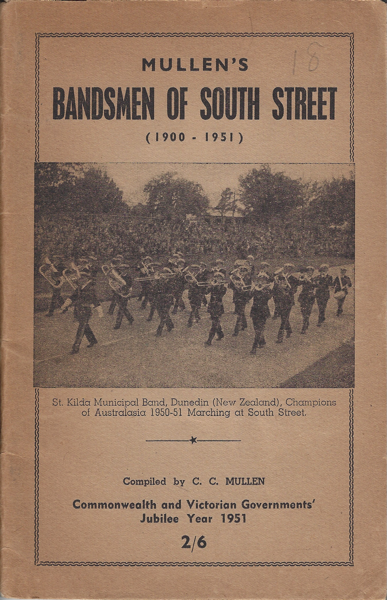
There is one brass band musician and writer among many who is significant to early Victorian brass band history, Cecil Clarence Mullen (C. C. Mullen).  His writing might be rare and hard to find now, however, being a band journal representative he had a unique insight into the workings of brass bands and was associated with many famous bands, conductors and administrators (Mullen, 1951).

It is in his little book, Mullen’s Bandsmen of South Street (1900 – 1951) that we find his poem, “Back to South Street”. In this piece of writing Mullen has cleverly highlighted the nostalgia of the South Street event while noting many of the famous names of bands and bandsmen.  It is a worthwhile poem to read for the sake of history.

19510000_Mullen
Front Cover Mullen’s Bandsmen of South Street (1900-1951) (Source: Jeremy de Korte Personal Collection)

BACK TO SOUTH STREET

Just let me go back to South Street
For a week with the famous bands,
And take with me others who would compete
In Australia’s Golden City of renown.

Just let me alight at the station
With cornet, trombone and drum,
And meet bandsmen from all over the Nation,
To whom South Street once more come.

Just let me line up in the station yard
And play through Handel’s “Hallelujah Chorus,”
Or “The Heavens Are Telling” by Haydn – just as hard,
As bands played in the days before us.

Just let me march along Sturt Street
With gay crowds lining the way,
With step by step and beat by beat,
Is South Street just the same to-day?

Just let me see who is judging again,
Is it Stead or Bentley with ears for tune?
Short, Beswick, Sutton or Morgan – men of fame,
Or King of them all – J. Ord Hume.

Just let me go through Inspection
As we did when we dressed with much care;
With the gayest uniform in our section,
That made all our rivals stare.

Just let me compete in the solos again
From the grand old Coliseum stage,
With “Adelaide” or “Gipsy’s Warning” – or “Pretty Jane,”
“Zelda” and “Miranda” of a later age.

Just let me mount he platform
And play through “Beethoven’s Works.”
Or any Alexander Owen’s selections
That South Street bands would not shirk.

Just let me play through the Test piece,
Be it “Mercandante.” “Mozart” or “Liszt,”
“Wagner,” “Chopin” of “Meyerbeer,”
The tests that were tests on our lips.

Just let me march in the Quickstep
With Ord Hume’s “B.B. and C.F.”
“The Challenge,” “Cossack” or “Ravenswood”
Or was the “Twentieth Century” the best?

Just let me see the others swing past,
Code’s, Prout’s, Rozelle and Boulder.
Wanganui, Newcastle and Bathurst Brass,
Great names that come dear to the older.

Just let me see those fine Geelong bands,
St. Augustine’s, Municipal and Harbour Trust.
Also Collingwood, Malvern, Richmond, Prahran,
Perth City – all great power among us.

Just let me see Geelong Town again
With Sharpe Brearley at the head of affairs.
They ranked with Prout’s in quickstep fame,
First in marching honours was often theirs.

Just let me see the giants of the baton,
Riley, Code, Bulch and Prout,
McMahon, Barkel, Jones and Hoffman.
Many, alas, have gone out.

Just let me see others again,
Partington, Shugg, Johnston, Bowden.
Men who kept time in South Street’s fame;
Wade and Baile must be among them.

Just let me think if I missed any,
Yes, there was Davison, Niven, Lewins – any more!
Hopkins, Ryder, Billy May among many,
Not forgetting Frank Wright and J. Booth Gore.

Just let me see the best of officials
And critics like Davey, Gartrell and Hellings,
Humphreys and Boyce – Kings of staff and whistle,
May march us again – well, there’s no telling.

So to-day just let me go back to South Street,
Most famous contest in the land,
Where many old timers I will heartily greet,
And yarn over years that were so grand.

(Mullen, 1951, pp. 2-3)

“Dungog Brass Band” by ‘Mad Mick” (1954):

19120000_Dungog-BB_phot16862
Dungog Brass Band, 1912 (Source: IBEW)

Above is a picture of the Dungog Brass Band from around 1912 and unfortunately, this is one of the only pictures I could find of them.  However, some thirty years later this prose was published in the Dungog Chronicle : Dungog and Gloucester Advertiser newspaper by a member of the band writing under the pseudonym of ‘Mad Mick”.  One may wince at some of the language, but this was the 1950s.

From reading the poem it appears that ‘Mick’ is a third cornet player.  This poem is quite good in describing who the band is, what it does and where it goes, but the prose hints at some problems like attendance issues.  We can appreciate that this was a local town band, and this was the way they did things. I think every band has a ‘Mick’ in their midst and we can thank him for highlighting the Dungog Brass Band in the way that he did.

DUNGOG BRASS BAND

I’ve heard it said that Old King Cole was happy, gay and free,
And he liked music sweet and low, played by his fiddlers three,
But in Dungog we’re luckier than King Cole in his day,
We have a band of 25 with band-master, Bob Gray;
And of this band we all feel proud, a mighty job they do,
They play in aid of charities, and spastic kiddies too.
Some Saturdays they entertain at each and every pub,
They finish off the evening playing at the Bowling Club.

Now I would like to tell you all the names of those who play,
And how old Bob the baton waves, and gets them on their way;
Soprano cornet heads the list and that’s I. Kennedy.
That solo cornet it is played by little Johnny Lee;
Keith Kennedy is downstairs for he is baritone,
And forwards, backwards, goes Stan Leayr upon the old trombone;
Now solo tenor horn Barry Schofield plays alone,
Toot! Toot! Toot! Toot! Don Redman goes upon his saxophone.

First tenor horn’s Wal Arnold, third cornet Mick Neilson,
Johnny Schofield’s second cornet, Hector Robson the side drum;
Ken Wade with his euphonium, gets down to bottom D,
While second solo tenor horn is little Barry Lee;
Then there’s E bass Freddy Schofield and Ted Mathews is the same,
And there’s one more solo cornet, Artie Redman is his name;
The secretary is Jack Kerr, he’s also big bass drum,
While tenor horn number three is played by “Butch” Neilson.

There’s only six more instruments and players for to pen,
For to conclude the roll call of Bob and his merry men;
And Bob calls them “some-timers,” they don’t attend a lot,
Sometimes they’re there for practice and sometimes they are not.
There’s the E bass and the B bass, and repiano cornet too,
And they’re played by Tommy Ferris and Keith Lean and Shelton, Blue,
Well now I’ve two trombonists whose attendances are poor
And they are “Sambo” Neilson and offsider Dennis Moore.

Well, those are all the players who go to make this band,
But there are two more people who lend a helping hand;
First of them the Drum Major, he makes them look so fine,
And that of course is Perry, Bill, he sees they march in line.
Then last of all is Paddy with collection box in hand,
You’ll always find him snooping round somewhere behind the band,
He sticks his box beneath your nose and thinks he’s doing right.
No wonder folks have christened him the “great Australian bite!”
P.S. – Sorry folks I missed one out, it’s Ray Monaghan I’m sure,
He plays quite well, but still in all, attendances are poor.

(Mad Mick, 1954, p. 3)

…and something from me:

In concluding this next blog post in Band Blasts From the Past,
Some tales of bands and bands people, but they won’t be the last.
For as we know from history, stories wait until they’re found,
Of the many tales of bands people who were there to make a sound.

References:

Bannerman. (1918, 08 May). A WELCOME. Maryborough Chronicle, Wide Bay and Burnett Advertiser (Qld. : 1860 – 1947), 6. http://nla.gov.au/nla.news-article151083205

de Korte, J. D. (2018, 02 March). William Ryder: The first conductor of the Prahran & Malvern Tramways Employees Band. Band Blasts from the Past : Anecdotes, Stories and Personalities. https://bandblastsfromthepast.blog/2018/03/02/william-ryder-the-first-conductor-of-the-prahran-malvern-tramways-employees-band/

Dungog Brass Band. (1912). [Photograph]. [phot16862]. The Internet Bandsman Everything Within, Vintage Brass Band Pictures : Australia. http://www.ibew.org.uk/vbbp-oz.html

Mad Mick. (1954, 29 September). DUNGOG BRASS BAND (By ‘Mad Mick). Dungog Chronicle : Durham and Gloucester Advertiser (NSW : 1894 – 1954), 3. http://nla.gov.au/nla.news-article140539879

Mullen, C. C. (1951). Mullen’s Bandsmen of South Street (1900-1951). Horticultural Press. 

Quickstep. (1920, 23 October). Bandsmen’s Gossip : Celebrated Conductor. Herald (Melbourne, Vic. : 1861 – 1954), 4. http://nla.gov.au/nla.news-article242245731

Trans-Tasman connections: the lure of competition and performance. Part Two – Australian Bands in New Zealand.

Introduction:

In comparison to the first part of this series of posts, the Australian bands were not quite as proactive as crossing the Tasman as their New Zealand counterparts.  When the Australian bands did go to New Zealand, they tended to do very well in competition and performances gained rave reviews.  This part of the post will detail the trips that four Australian bands made to New Zealand between 1900-1940.

1907: Newcastle City Band – Christchurch International Exhibition Contest:

19070213_New-Zealand-Mail_Newcastle-Picture
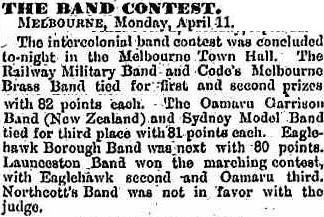
1907, Newcastle City Band visiting New Zealand. New Zealand Mail, 13/02/1907 (Source: PapersPast)

It took a little bit longer for Australian bands to start reciprocal visits to New Zealand and in 1907 the then champion Newcastle City Band traveled to Christchurch via Wellington to participate in the International Exhibition Contest (“NEWCASTLE CITY BAND.,” 1907).  By all accounts, this was a huge event with no less than twenty-nine bands participating (Newcomb, 1980).  Also in attendance at the Exhibition was the world-famous Besses O’ Th’ Barn Band from England who performed to great acclaim (Newcomb, 1980).  Code’s Melbourne band was also intending to take part in the event however they did not end up going due to some of their bandsmen being unable to take time off work (Trombone, 1907).

The Newcastle Band achieved a very credible third placing against some top-ranking New Zealand bands and some of their soloists also achieved good placings (“BAND CONTEST,” 1907).  However, soon after the contest finished, questions were being asked over the judging with Newcastle and others feeling that Newcastle should have been placed higher.  In an article published in the Wanganui Herald newspaper, a Mr. Edgar Nicholas from Ballarat who was visiting was asked about the adjudicating at the contest by Lieutenant Bentley, formerly of England.  Mr. Nicholas said in his interview that,

I have been at all the band contests in Ballarat, where the principal bands in Australia compete.  We had had Messrs Ord-Hume, Wade, and Beard from England, but, speaking generally, Mr. Bentley has given equal satisfaction in Ballarat with these gentlemen”.

(“THE JUDGING AT THE CONTEST,” 1907)

Speaking pragmatically in the interview, Mr. Nicholas noted that an adjudicator sometimes fails to please everyone given that Mr. Bentley had to judge 30 bands.  Also, as Mr. Nicholas suggests, some bands may not have been at their best given the late hours that some of them competed (“THE JUDGING AT THE CONTEST,” 1907).  Mr. Nicholas kept drawing comparisons with the Ballarat South St. Eisteddfod, the first being that that in the case of large sections, Ballarat employed up to three judges and that in Australia there were separate gradings which, at the time, were not used in New Zealand (“THE JUDGING AT THE CONTEST,” 1907).

One Newcastle bandsman was quite firm in his comments which were published in a Newcastle Morning Herald and Miners’ Advocate newspaper article,

When our band-master tells us we played well I am satisfied.  He tells us often enough when we don’t play well; but we never played better than in the competition.”

(“THE CITY BAND.,” 1907).

Aside from this issue over the placings, most accounts note that the Newcastle City Band had an enjoyable trip and were welcomed in various locations.  On the ship home, they played for an appreciative audience and were welcomed home with a civic reception (“THE CITY BAND.,” 1907).

Band:Own Choice:Test:Total:
Wanganui Garrison158147305
Kaikorai Brass158145303
Newcastle City156146302
(source of table data (Newcomb, 1980, p. 40))

1923: Redfern Municipal Band – South Island Brass Band Association Contest, Dunedin:

Some sixteen years after the first Australian band traveled to New Zealand, it took until 1923 for the next Australian band to arrive.  The Redfern Municipal Band, conducted by Mr. W. Partington, was a formidable band at the time and they undertook a short tour through the South Island of New Zealand on their way from Wellington to Dunedin.  Upon arriving in Wellington, along with a contingent of N.S.W. Bowlers, they were given a large civic reception by the Mayor (“BOWLERS AND BANDSMEN,” 1923).  The arrival of Redfern had generated an amount of excitement throughout New Zealand, suffice to say that their conductor Mr. W. Partington had conducted one of their own champion bands, The Wanganui Garrison Band for a while (“ENTERPRISING BAND,” 1923; Newcomb, 1980) – the band from Redfern was not unknown in New Zealand.

Redfern Municipal was ultimately triumphant in Dunedin by winning the A Grade section and Aggregate.  This was no easy feat given that a number of New Zealand’s A grade bands were in the section, including Mr. Partington’s former band, Wanganui.  Newcomb (1980) wrote of Redfern and the A Grade contest,

In Dunedin, it competed against seven of New Zealand’s top A grade bands.  After a week of intensive rehearsal in the “Edinburgh of the South” Redfern was rewarded for its painstaking efforts when it took out the A grade title 12 points ahead of Invercargill’s Hiberian Band. The 1st Canterbury Mounted Regiment Band was third.

The talking point of the contest was the poor performance of the Wanganui Garrison Band, under Mr. J. Crichton.  The veteran Wanganui conductor’s ambition was to thrash the Redferners…”

(p. 44)

Of course the triumph was noted in Australian and New Zealand newspapers, and rightly so, it was a great win for the Redfern band (“BAND CONTEST,” 1923; “REDFERN BAND,” 1923).  However, the backstory of the two conductors was intriguing and written up as part of an article published by the NZ Truth newspaper:

There is an interesting story (perhaps) behind the crossing of the Redferners.  Bandmaster Partington was over here for a while, and had charge of the Wanganui Band.  Within a very short period of training under his baton he made champions of them, winning the N.Z. honors last year.  Then there arose a controversy between Partington, of Aussieland and Jim Crichton, of Wanganui, the ex-bootshopman who knocked off trade to become a musician, undergoing a special course of study in London for the purpose of pursuing his brass-bound hobby.  He told P. that if he (C.) had the Woolston Band under his baton for a month he could beat anything that P. could bring against it.  There was such a heated argument that it was leading to something like a £1000 wager.  But P. left for Aussieland again, and took charge of the Redferners.  Now the question is: Did he bring the Sydneysiders over to compete against anything that Jim Crichton had under his wing? Well, Jim took the Wanganui cracks down to Dunedin to play against their old leader – and Wanganui was nowhere in the final!

(“Brass Bands and Bandsmen,” 1923)

When returning to Australia, there was a snippet of thought that the Redfern Band might head to England to compete (“REDFERN BAND,” 1923).  However, this evidently did not eventuate.  Their conductor, Mr. Partington, went on to other activities and formed a representative band that travelled Australia with the aim of heading to England.  But as detailed in a previous post, that tour ended up running out of money upon arrival in Perth.

1925: Malvern Tramways Band – New Zealand National Band Championship, Auckland:

19250305_Auckland-Weekly-News_MalvernTB_
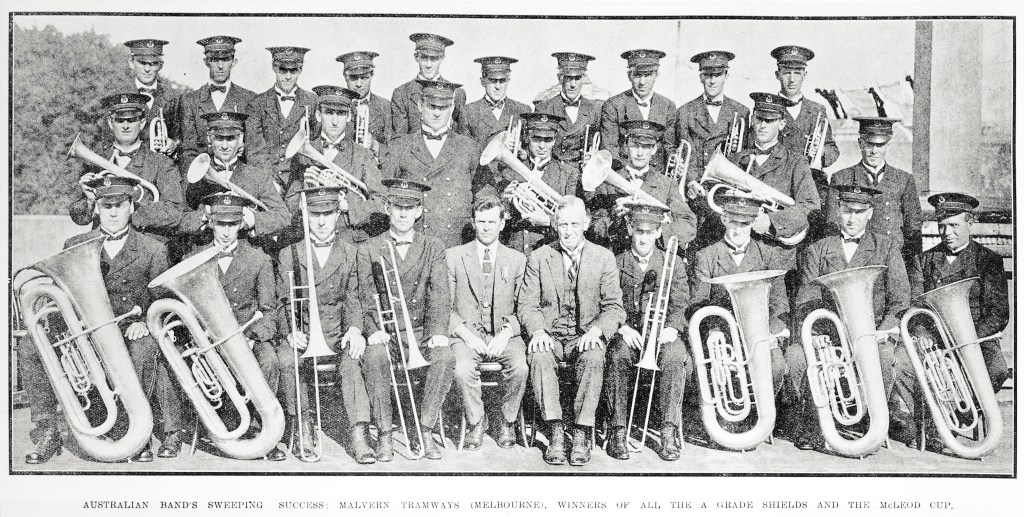
Malvern Tramways Band, Auckland. Auckland Weekly News, 2/03/1925, p. 46. (Source: Auckland Libraries Heritage Collections: AWNS-19250305-46-1)

Just two years later, another crack Australian band made the trip to New Zealand to compete.  The Malvern Tramways Band was renowned throughout Australia as one of the elite bands of the Commonwealth having won numerous competitions by this time.  So much so that the Malvern Band, like many others, tried to get to England however they too were unable to raise sufficient funds.  To compensate, they did arrive in New Zealand early in 1925 to commence a six-week tour culminating in the championships in Auckland (“Malvern Tramways Band,” 1925d).

The reputation of Malvern preceded them to New Zealand and all manner of hospitality was afforded for the band including, special observation cars on trains, reduced rail fares and free travel on New Zealand trams! (“MALVERN TRAMWAYS BAND,” 1925b).  They sailed from Melbourne to Invercargill and from there travelled up to Auckland giving concerts in all the major towns on the way (“MALVERN TRAMWAYS BAND,” 1925a).  By late February they had reached Auckland and commenced competing in the band sections and solo sections.  In competition, the Malvern Tramways band was formidable and they won just about every section except for the Quickstep where they achieved third place (“MALVERN TRAMWAYS BAND.,” 1925b; “MALVERN WINS A GRADE TEST,” 1925).  Newcomb (1980) wrote of the contest:

After many years of bickering, common sense prevailed when the North and South Island associations joined forces to stage the 1925 national contest in Auckland.

It was made doubly interesting by the presence of the Malvern Tramways Band from Australia under the conductorship of Mr. Harry Shugg.

New Zealand’s top A grade bands proved no match for the highly fancied Australian combination which won both tests, the hymn and the championship aggregate.

(p. 45)

After this astounding success in New Zealand, the Malvern Tramways Band sailed for Sydney where they performed their competition repertoire in concert to rave reviews (“MALVERN TRAMWAYS BAND,” 1925c).  Traveling back to Melbourne, the success of their New Zealand venture was written up a couple of months later by the local Prahran Telegraph newspaper (“MALVERN TRAMWAYS BAND.,” 1925a).

1936: Cairns Citizens’ Band – New Zealand National Band Championships, New Plymouth:

19351123_Evening-Post_Cairns-Band
Cairns Citizens’ (31st Battalion) Band. Evening Post, 23/11/1935. (Source: PapersPast)

In October 1935, the Cairns Post newspaper published the news that the Cairns Citizens’ (31st Battalion) Band would compete at the 1936 New Zealand Band Championships in New Plymouth (“MAKING HISTORY.,” 1935).  Conducted by James Crompton, a person that was not unfamiliar to the New Zealand brass bands, the band was nominally the first band from Queensland to compete in New Zealand and the first from Australian Military Forces (“MAKING HISTORY.,” 1935).

The Cairns Citizens’ Band won the New Zealand Championship that year, although they did not win the Test selection.  However, their aggregate points were enough that they could win the championship (“Cairns Band.,” 1936; Newcomb, 1980).  The New Zealand press was also impressed by the standards set in New Plymouth and an article published in the Evening Post newspaper praised the marching – the Cairns Citizens’ Band achieved 2nd place in the marching section (“GOOD MARCHING,” 1936).

Conclusion:

There was a similarity of experiences for bands crossing to either side of the Tasman; with civic receptions, a very interested and informed public and commentary from the newspapers.  The excitement generated by viewing a visiting band was also interesting to note – and there were plenty of other articles that were written about bands (but too many to list in these posts)!  It was interesting to note just how close the Australian and New Zealand brass band movements were in terms of standards and rules, so much so that any band crossing the Tasman could expect near similar conditions of competition.  The best bands of each country could match the other and in the spirit of competition, this was plain to see.

It is the collegial nature of band movements that enabled these visits to happen and to this day, the friendly rivalries remain, and visits continue to take place.  Kudos to the bands that made these early trips as they set a foundation for other bands to build on.

<- Part One – New Zealand Bands in Australia

References:

Auckland Weekly News. (1925). AUSTRALIAN BAND’S SWEEPING SUCCESS : MALVERN TRAMWYS (MELBOURNE), WINNERS OF ALL THE A GRADE SHIELDS AND THE McLED CUP. In Auckland Weekly News (AWNS-19250305-46-01 ed., pp. 46). Auckland, N.Z. https://kura.aucklandlibraries.govt.nz/digital/collection/photos/id/244635/rec/1 Ngā Pātaka Kōrero o Tâmaki Makaurau / Auckland Libraries Heritage Collections.

AUSTRALIAN BAND FOR NEW ZEALAND CONTEST. (1935, 23 November). Evening Post. https://paperspast.natlib.govt.nz/newspapers/EP19351123.2.26.1

BAND CONTEST : Redfern Win The Aggregate : Wellington Watersiders Third. (1923, 24 February). Evening Post. https://paperspast.natlib.govt.nz/newspapers/EP19230224.2.68

BAND CONTEST : Winners of Competitions. (1907, 16 February). New Zealand Times. https://paperspast.natlib.govt.nz/newspapers/NZTIM19070216.2.61

BOWLERS AND BANDSMEN. (1923, 08 February). Evening Post. https://paperspast.natlib.govt.nz/newspapers/EP19230208.2.25

Brass Bands and Bandsmen. (1923, 03 March). NZ Truth. https://paperspast.natlib.govt.nz/newspapers/NZTR19230303.2.2.4

Cairns Band : Wins Championship. (1936, 02 March). Daily Mercury (Mackay, Qld. : 1906 – 1954), 6. http://nla.gov.au/nla.news-article172909750

THE CITY BAND. (1907, 27 February). Newcastle Morning Herald and Miners’ Advocate (NSW : 1876 – 1954), 5. http://nla.gov.au/nla.news-article136605589

ENTERPRISING BAND : Sydney Competition Band Likely to Visit Wanganui. (1923, 12 January). Hawera & Normanby Star. https://paperspast.natlib.govt.nz/newspapers/HNS19230112.2.17

GOOD MARCHING : Port Nicholson Band : Recent National Contest. (1936, 09 March). Evening Post. https://paperspast.natlib.govt.nz/newspapers/EP19360309.2.25

THE JUDGING AT THE CONTEST. (1907, 15 February). Wanganui Herald. https://paperspast.natlib.govt.nz/newspapers/WH19070215.2.32

MAKING HISTORY : Band For New Zealand : Cairns to Cross Tasman. (1935, 02 October). Cairns Post (Qld. : 1909 – 1954), 5. http://nla.gov.au/nla.news-article41708070

MALVERN TRAMWAYS BAND. (1925a, 20 February). New Zealand Herald. https://paperspast.natlib.govt.nz/newspapers/NZH19250220.2.132

MALVERN TRAMWAYS BAND. (1925b, 20 January). Herald (Melbourne, Vic. : 1861 – 1954), 16. http://nla.gov.au/nla.news-article243874312

MALVERN TRAMWAYS BAND. (1925c, 10 March). Sydney Morning Herald (NSW : 1842 – 1954), 10. http://nla.gov.au/nla.news-article16207234

Malvern Tramways Band : Leaves for New Zealand. (1925d, 13 February). Prahran Telegraph (Vic. : 1889 – 1930), 8. http://nla.gov.au/nla.news-article165132427

MALVERN TRAMWAYS BAND : Recent New Zealand Tour : Success in Competitions. (1925a, 22 May). Prahran Telegraph (Vic. : 1889 – 1930), 6. http://nla.gov.au/nla.news-article165141099

MALVERN TRAMWAYS BAND : Wins Championship of New Zealand. (1925b, 06 March). Prahran Telegraph (Vic. : 1889 – 1930), 7. http://nla.gov.au/nla.news-article165137387

MALVERN WIN A GRADE TEST. (1925, 27 February). Evening Post. https://paperspast.natlib.govt.nz/newspapers/EP19250227.2.83.1

New Zealand International Exhibition. (1907, 12 February). Star, 3. https://paperspast.natlib.govt.nz/newspapers/TS19070212.2.57.2

The Newcastle (N.S.W.) City Brass Band; Champion Band of Australia, At Present Visiting New Zealand. (1907, 13 February). New Zealand Mail. https://paperspast.natlib.govt.nz/newspapers/NZMAIL19070213.2.235.6

NEWCASTLE CITY BAND : Going to New Zealand. (1907, 29 January). Newcastle Morning Herald and Miners’ Advocate (NSW : 1876 – 1954), 5. http://nla.gov.au/nla.news-article136608558

Newcomb, S. P. (1980). Challenging brass : 100 years of brass band contests in New Zealand, 1880-1980. Powerbrass Music for the Brass Band Association of New Zealand. 

REDFERN BAND : New Zealand Triumph. (1923, 09 March). Evening News (Sydney, NSW : 1869 – 1931) ,8. http://nla.gov.au/nla.news-article118834570

Trombone. (1907, 09 February). The Exhibition : The Band Contests. Lyttelton Times. https://paperspast.natlib.govt.nz/newspapers/LT19070209.2.71

Trans-Tasman connections: the lure of competition and performance. Part One – New Zealand Bands in Australia.

GLNZ Series
Wanganui Garrison Band being welcomed in Melbourne. Auckland Weekly News, 10/11/1910. (Source: Auckland Libraries Heritage Collections: AWNS-19101110-4-5)

Introduction:

It would be fair to say that the relationship between Australia and New Zealand, as countries and peoples, has been one of mutual respect, partnership, shared development, and healthy competitiveness.  This has been evident in many instances and has also been evident in the brass band movement.  So much so that over the years from just before 1900 up to 1950, bands regularly crossed the Tasman Sea with the aim of touring, performance, and participating in respective championships.

Travel was not always an easy task and was certainly expensive.  Yet in these early days of ships and trains, bands managed this and for the most part, were met with civic welcomes and hospitality wherever they went.  There were also times when eminent bandsmen also traveled to ply their services as adjudicators, conductors or band coaches.  This allowed a flow of new ideas, expertise and criticism that certainly helped the band movements of both countries.

As far as the information allows it, we will see who went where and when.  It has been interesting to read the perspectives of media from both Australia and New Zealand through using the resources of the Trove archive and DigitalNZ / PapersPast – media of the day reported on everything.  Also, the results database of the Royal South Street Society, the Brass Band Results website (UK) and history books regarding the band history of New Zealand have been very helpful.

For the sake of brevity, this post has been divided into two parts and the details of visits are in basic chronological order.  Part one is about the bands from New Zealand that traveled to Australia and part two highlights four of the Australian bands that went to New Zealand.  There are some fascinating stories to come out of these trips and one can appreciate the initiative.  I hope people enjoy reading both posts.

1897-1899: Invercargill Garrison Band, Oamaru Garrison Band & Wellington Garrison Band – Melbourne & Bathurst:

In the few years preceding 1900, Australia received visits from three New Zealand bands in relatively quick succession; the Invercargill Garrison Band in 1897, the Oamaru Garrison band in 1898 and the Wellington Garrison Band in 1899 (Newcomb, 1980).  In 1897 the Invercargill Garrison Band visited Melbourne to compete in the Druid’s Gala Contest in Melbourne and gained a credible forth placing out of the eleven bands that competed (“VICTORIA.,” 1897).  The next year, and in the same contest, the Oamaru Garrison Band visited and was higher placed although there’s some historical conjecture over the scores with an article in the Bendigo Independent newspaper reporting a tied third place other reports saying they achieved second placings in some sections (“THE BAND CONTEST.,” 1898; Newcomb, 1980).

The Bendigo Independent, 12/04/1898, p. 3

In 1899, the Wellington Garrison Band sailed to Australia and after a brief stop in Sydney, they traveled to Bathurst to compete in the Intercolonial Band Contest.  They immediately set the tone of their visit and marched from the railway station to the hotel followed by enthusiastic crowds (“The Wellington Garrison Band.,” 1899).  However, despite being a champion New Zealand band, they were brought undone in Bathurst by the deportment of their bandsmen.  It was widely reported in New Zealand and Australian press that the reason they lost points in the marching was because of  “nine of the bandsmen being unshaved” (“UNSHAVEN BANDSMEN,” 1899).  Apparently Wellington band “forgot” the regulations on shaving and were subsequently placed fifth in the marching even though their playing matched the Code’s Melbourne Band (“Bathurst Band Contest.,” 1899).  This being said, they redeemed themselves by winning the bulk of the solo contests in Bathurst (“BAND CONTEST.,” 1899).

1908 & 1921: Kaikorai Band – South Street Eisteddfod, Ballarat:

Colonist, 14/01/1908, p. 3

Early in 1908, a tiny snippet of news was printed by newspapers across New Zealand; the Kaikorai Band from Dunedin was intending to compete at the Ballarat South Street Eisteddfod in October – as seen here in this advertisement published by the Colonist newspaper (“Kaikorai Band,” 1908).  The Kaikorai band was another one of New Zealand’s top bands at the time and obviously felt that they could take on the best of Australian brass bands (Newcomb, 1980). However, things did not go quite to plan on the day and Newcomb (1980) outlined one the main reasons:

Everything went wrong after one of the band’s top soloists, Billy Flea, cracked his lip.  The Flugel Horn solo had to be taken by Jim Pearson.  Though Billy was a strong player, Jim was the reverse.  As a result, another soloist, who was in the habit of relying on the finish of the Flugel solo to dovetail his entry, simply didn’t hear Jim, so never got started!

Conductor Laidlaw was so taken aback that his baton simply froze.  Some of the bandsmen maintained that the Scots conductor turned a shade of green! It was to his credit, however, that after the initial shock he pulled the band together.

(p. 40)

This, of course, was reflected in the comments on their playing, an account that was published in the Otago Witness newspaper (“Kaikorai Band at Ballarat,” 1908). However, the Kaikorai Band did achieve one triumph when they won the discipline prize for their marching.

(Royal South Street Society, 1908a, 1908b)

In 1921 the Kaikorai Band returned to South Street to compete, however on this occasion they did not go as well as Australian bands had developed quite a bit in preceding years and Kaikorai was no match for them (Newcomb, 1980).  The only success on this occasion occurred in the Septette section where their group achieved first place.

(Royal South Street Society, 1921a, 1921b)

1910: Wanganui Garrison Band – South Street Eisteddfod, Ballarat:

Two years after the Kaikorai band visited South Street, another one of New Zealand’s top bands, the famous Wanganui Garrison Band made the trip.  Conducted by Mr. James Chrichton for 21 years and succeeded by Mr. Alfred Wade in 1908, the band had built up an enviable contesting record and in 1910 they made the trip to Australia to compete (Newcomb, 1980; Zealley & Ord Hume, 1926).

Needless to say, the Wanganui Garrison Band was very successful at South Street and won both the Quickstep and Test sections over the Collingwood Citizens’ Band and both Ballarat bands – Prout’s and City (“THE GRAND BAND CONTESTS,” 1910).  As well as this superb win in the band contest, Wanganui also had many soloists and ensemble enter various sections, and they were similarly successful with many of them gaining places.

(Royal South Street Society, 1910a, 1910b, 1910c, 1910d)

When Wanganui returned to Melbourne, they were given a rapturous welcome by the Lord Mayor and the Agent for New Zealand (pictured at the start of this post) (“THE WANGANUI BAND.,” 1910).  After leaving Melbourne they traveled to Albury where they were given another civic reception (“WANGANUI BAND,” 1910).  From Albury, they traveled to Sydney to take a ship back to Auckland where they were greeted with a huge celebration by proud New Zealanders (“VICTORY OF THE WANGANUI BAND,” 1910).

1920: 2ndSouth Canterbury (Timaru) Regimental Band – South Street Eisteddfod, Ballarat:

19131121_Invercargill_Timaru-Regimental
Band of 2nd, South Canterbury, Regiment, Timaru (Source: Early New Zealand Photographers)

After the First World War ended and bands were gradually getting back to normal activities, the South Street Eisteddfod resumed and the 2nd South Canterbury Regimental Band, also known as the Timaru Regimental Band, ventured to Australia to compete in the 1920 contests.  Despite them being a national champion band in New Zealand, at least before the war, their results in Ballarat were not that spectacular (Newcomb, 1980).  That being said, the A Grade section did include Malvern Tramways Band, Ipswich Vice-Regal Band, South Sydney and the City of Ballarat – Timaru came up against some of the best in Australia at the time.  Timaru Regimental did have some success in the Trombone Trio and placings in other solo sections so their experience of South Street was somewhat worthwhile (“SOUTH STREET BAND CONTESTS.,” 1920).

(Royal South Street Society, 1920a, 1920b, 1920c)

1934: Woolston Band – South Street “Centenary” Brass Band Contest, Ballarat:

In 1934 in the midst of a depression, the Woolston Band from Christchurch managed to find enough funds to make the trip to Ballarat with the aim of competing in the 1934 South Street “Centenary” Brass Band Contests – the name given as it was Victoria’s Centenary year since it became a separate colony.  This was an auspicious event as it was attended by the Duke of Gloucester and the Band of His Majesty’s Grenadier Guards.

By all accounts they acquitted themselves very well and up against some of Australia’s best bands, they achieved second place.  They did have some setbacks though.  Newcomb (1980) writes of Woolston’s effort:

The Woolston Band may well have won the contest had it not drawn the dreaded No. 1 position in the second test piece.  Bad weather resulted in a last-minute decision to stage the event indoors, and when the band started its performance it became evident that the standard seating formation did not conform with the acoustics of the hall.

After the contest, the adjudicator, Mr. Stephen York, told Mr. Estell the Woolston Band had not scored well because it was not properly balanced.  Moreover, to add to the band’s misfortune, five members were suffering from influenza.

(p. 47)

The standard of competition was very high and this was noted by the press that attended the event (“BRILLIANT PLAYING,” 1934).  The winning band was the famed Melbourne Fire Brigade Band.

(Royal South Street Society, 1934)

19341101-19341103_South-Street-Centenary-Contest_p3-p4
Programme, South Street “Centenary” : Brass Band Contest : A, B, C and D Grades, pg. 3-4. (Souce: Victorian Collections: Victorian Bands’ League Archives)

1947: Wellington Waterside Workers Silver Band / Auckland Junior Waterside Workers Band – Australian Band Championships, Newcastle:

After the cessation of the Second World War, band competitions resumed in New Zealand and Australia and in 1947 the Australian Band Championships were held in Newcastle, N.S.W.  Two New Zealand Bands made the trip to Newcastle that year with the Wellington band competing in A grade and the Auckland band competing in B grade.  On this occasion, both bands did not receive a civic welcome to Newcastle but instead were awarded a function put on by the Newcastle Waterside Workers’ Social Committee (“Waterside Bands To Be Welcomed,” 1947).

Out of these two bands, the Wellington Waterside Band was the only one to gain a placing by achieving 3rd place however their soloists won most sections (Newcomb, 1980).  The Auckland Junior band did not gain any placing and the A Grade championship was won by the Melbourne Fire Brigade Band (“FIREMEN SCORE IN BAND CONTEST,” 1947).  Both Waterside bands performed at other events during their stay which helped contribute money to various waterside workers’ benefit funds (“New Zealand Bands Guest Artists,” 1947).

1949: St. Kilda Municipal Band – South Street Eisteddfod, Ballarat:

In 1949 the St. Kilda Municipal Band from Dunedin, elated by their success at the Auckland NZ Band Championships this same year, decided to come to Ballarat and compete for the Australian championship as well (Newcomb, 1980).  Make the trip they did, and doing things differently to other New Zealand bands that had previously traveled to Australia, instead of taking a ship, they flew! (“NZ BAND WILL FLY HERE,” 1949).

To have a New Zealand band of this caliber at South Street was a major drawcard and they convincingly won or came 2nd in every section that they participated in (“NZ band has a big day at Ballarat,” 1949).  The section included bands from Ballarat and the famous Brisbane Excelsior Band.

(Royal South Street Society, 1949a, 1949b)

Conclusion:

In concluding part one of this series of posts, one must admire the drive and determination of the New Zealand bands.  Success was never a guarantee; however, it was shown that the best New Zealand bands were certainly a match for the crack Australian bands (and vice versa).  Having bands visit from New Zealand was also a major drawcard to competitions for the visiting public.

In part two of this series, we can see how the Australian bands fared in New Zealand.

Part Two – Australian Bands in New Zealand ->

References:

THE BAND CONTEST. (1898, 12 April). Bendigo Independent (Vic. : 1891 – 1918), 3. http://nla.gov.au/nla.news-article184290848

BAND CONTEST. (1899, 11 November). Australian Star (Sydney, NSW : 1887 – 1909), 5. http://nla.gov.au/nla.news-article228744480

Bathurst Band Contest : Complaints from New Zealand. (1899, 17 November). Bathurst Free Press and Mining Journal (NSW : 1851 – 1904), 2. http://nla.gov.au/nla.news-article63910068

BRILLIANT PLAYING : Ballarat Band Contest. (1934, 05 November). Evening Post. https://paperspast.natlib.govt.nz/newspapers/EP19341105.2.61

Early Canterbury Photography. (2014, March). McKesch, Henry John. Early New Zealand Photographers and their successors. http://canterburyphotography.blogspot.com/2014/03/mckesch-henry-john.html

FIREMEN SCORE IN BAND CONTEST. (1947, 22 September). Newcastle Morning Herald and Miners’ Advocate (NSW : 1876 – 1954), 2. http://nla.gov.au/nla.news-article134239668

THE GRAND BAND CONTESTS : Close of South-St Competitions. (1910, 24 October). Ballarat Star (Vic. : 1865 – 1924), 1. http://nla.gov.au/nla.news-article216382480

Kaikorai Band. (1908, 14 January). Colonist, 3. https://paperspast.natlib.govt.nz/newspapers/TC19080114.2.24.1

Kaikorai Band at Ballarat. (1908, 11 November). Otago Witness. https://paperspast.natlib.govt.nz/newspapers/OW19081111.2.151

N. Z. Govt., & Auckland Weekly News. (1910). THE WANGANUI GARRISON BAND IN MELBOURNE. In Auckland Weekly News (pp. 4). Auckland, N.Z. https://kura.aucklandlibraries.govt.nz/digital/collection/photos/id/194687/rec/33 Ngā Pātaka Kōrero o Tâmaki Makaurau / Auckland Libraries Heritage Collections.

New Zealand Bands Guest Artists. (1947, 19 September). Newcastle Morning Herald and Miners’ Advocate (NSW : 1876 – 1954), 6. http://nla.gov.au/nla.news-article134230123

Newcomb, S. P. (1980). Challenging brass : 100 years of brass band contests in New Zealand, 1880-1980. Powerbrass Music for the Brass Band Association of New Zealand. 

NZ band has big day at Ballarat. (1949, 31 October). Argus (Melbourne, Vic. : 1848 – 1957), 12. http://nla.gov.au/nla.news-article22788890

NZ BAND WILL FLY HERE. (1949, 27 August). Herald (Melbourne, Vic. : 1861 – 1954), 8. http://nla.gov.au/nla.news-article243675387

Royal South Street Society. (1908a, 21 October). 1908-10-21 Brass Solo Contests. Royal South Street Society. Retrieved 20 July 2019 from https://results.royalsouthstreet.com.au/results/1908-10-21-brass-solo-contests

Royal South Street Society. (1908, 24 October). 1908-10-24 Brass Band Contests. Royal South Street Society. Retrieved 20 July 2019 from https://results.royalsouthstreet.com.au/results/1908-10-24-brass-band-contests

Royal South Street Society. (1910a, 17 October). 1910-10-17 Brass Solo Contests. Royal South Street Society. Retrieved 20 July from https://results.royalsouthstreet.com.au/results/1910-10-17-brass-band-contests

Royal South Street Society. (1910b, 18 October). 1910-10-18 Brass Solo Contests. Royal South Street Society. Retrieved 20 July from https://results.royalsouthstreet.com.au/results/1910-10-18-brass-band-contests

Royal South Street Society. (1910c, 19 October). 1910-10-19 Brass Solo Contests. Royal South Street Society. Retrieved 20 July 2019 from https://results.royalsouthstreet.com.au/results/1910-10-19-brass-band-contests

Royal South Street Society. (1910d, 20 October). 1910-10-20 Brass Band Contests. Royal South Street Society. Retrieved 20 July 2019 from https://results.royalsouthstreet.com.au/results/1910-10-20-brass-band-contests

Royal South Street Society. (1920, 18 October). 1920-10-18 Brass Solo Contests. Royal South Street Society. Retrieved 20 July 2019 from https://results.royalsouthstreet.com.au/results/1920-10-18-brass-solo-contests

Royal South Street Society. (1920b, 20 October). 1920-10-20 Brass Solo Contests. Royal South Street Society. Retrieved 20 July 2019 from https://results.royalsouthstreet.com.au/results/1920-10-20-brass-solo-contests

Royal South Street Society. (1920c, 23 October). 1920-10-23 Brass Band Contests. Royal South Street Society. Retrieved 20 July 2019 from https://results.royalsouthstreet.com.au/results/1920-10-23-brass-band-contests

Royal South Street Society. (1921a, 19 October). 1921-10-19 Brass Solo Contests. Royal South Street Society. Retrieved 20 July 2019 from https://results.royalsouthstreet.com.au/results/1921-10-19-brass-solo-contests

Royal South Street Society. (1921b, 22 October). 1921-10-22 Brass Band Contests. Royal South Street Society. Retrieved 20 July 2019 from https://results.royalsouthstreet.com.au/results/1921-10-22-brass-band-contests

Royal South Street Society. (1934a, 01 November). 1934-11-01 Brass Band Contests. Royal South Street Society. Retrieved 20 July 2019 from https://results.royalsouthstreet.com.au/results/1934-11-01-brass-band-contests

Royal South Street Society. (1934). South Street “Centenary” : Brass Band Contest : A, B, C and D Grades  [Programme]. Royal South Street Society. https://victoriancollections.net.au/items/5d425e0c21ea6b1a84382033 

Royal South Street Society. (1949a, 28 October). 1949-10-28 Brass Band Contests. Royal South Street Society. Retrieved 20 July 2019 from https://results.royalsouthstreet.com.au/results/1949-10-28-victorian-brass-band-championship

Royal South Street Society. (1949b, 29 Ocotober). 1949-10-29 Brass Band Contests. Royal South Street Society. Retrieved 20 July 2019 from https://results.royalsouthstreet.com.au/results/1949-10-29-victorian-brass-band-championship

SOUTH STREET BAND CONTESTS. (1920, 25 October). Argus (Melbourne, Vic. : 1848 – 1957), 3. http://nla.gov.au/nla.news-article4575694

UNSHAVEN BANDSMEN. (1899, 10 November). Hawke’s Bay Herald. https://paperspast.natlib.govt.nz/newspapers/HBH18991110.2.22.1

VICTORIA : Intercolonial Band Contest. (1897, 22 April). Express and Telegraph (Adelaide, SA : 1867 – 1922), 4. http://nla.gov.au/nla.news-article209088576

VICTORY OF THE WANGANUI BAND : Magnificent Performance : Only Three off Possible in “Own Choice”. (1910, 03 November). New Zealand Times. https://paperspast.natlib.govt.nz/newspapers/NZTIM19101103.2.14

WANGANUI BAND : A Civic Reception. (1910, 29 October). Border Morning Mail and Riverina Times (Albury, NSW : 1903 – 1920), 5. http://nla.gov.au/nla.news-article111390543

THE WANGANUI BAND : Mayoral Reception in Melbourne. (1910, 27 October). Ballarat Star (Vic. : 1865 – 1924), 1. http://nla.gov.au/nla.news-article216382888

Waterside Bands To Be Welcomed. (1947, 11 September). Newcastle Sun (NSW : 1918 – 1954), 2. http://nla.gov.au/nla.news-article157898304

The Wellington Garrison Band. (1899, 07 November). National Advocate (Bathurst, NSW : 1889 – 1954), 2. http://nla.gov.au/nla.news-article156812212

Zealley, A. E., & Ord Hume, J. (1926). Famous Bands of the British Empire : Brief Historical Records of the recognized leading Military Bands and Brass Bands in the Empire. J. P. Hull.