Band performances and the historical curiosities of formations: squares, circles, and everything in between 

Collingwood Citizens’ Band rehearsing in a quarry, 1906 (Source: IBEW: phot19034)

Introduction:

The Prahran City Band, under the veteran conductor, E. T. Code, next took the stand.  This band showed a wise departure in abandoning the old-fashioned circle and forming in a half-moon, and consequently, every man was facing his leader, and no one was nearer the judge than his neighbour.  This method is an improvement and should be adopted by all bandsmen, and a better balance of tone will be accomplished. (“BRASS BAND CONTESTS.,” 1911)

So said a knowledgeable observer from Bendigo who was visiting the Ballarat and listening to the 1911 Royal South Street Eisteddfod band sections.  Obviously, he noticed a distinct difference in the sound of the Prahran City Band as opposed to bands that mounted the platform and stood in a circle with the conductor in the middle.  Granted, this was in 1911, so the wording is interesting.  Bands standing in circles for certain performances was the status quo then. Old fashioned? Possibly.  However, as with anything in the band movement, any significant change took time, and Australian bands generally followed developments from England. Is it ironic that the status quo was shaken up by an Australian brass band visiting England? There is more to that story.

Playing within the confines of band rotundas and on the elevated platforms used at band contests meant that bands performed in all sorts of shapes – circles, squares, the half-moon (thanks to Prahran City Band), and other formations.  As a historical curiosity in the band movement, these formations bring the question of why because even though some unusual formations are necessary in modern times, in general, brass bands now perform in a generic formation wherever possible.

This post is about band formations mainly in outdoor settings, although some might say this applies to indoor performances as well.  Unfortunately, there is a lack of written information about the specifics of early brass band formations for performances – no one has written a manual (apart from marching).  Much of what can be discussed comes from the anecdotal evidence of photographs and the odd review of contests.  The assumption then can be made that when bands formed up on elevated platforms and in band rotundas, formations were dictated by the platform’s shape and the conductor’s discretion.

Elevation:

One common element that has stood the test of time is the elevation of a musical ensemble for performances.  A stage or platform tends to mean that bands (and orchestras, choirs, etc.) are better heard and seen by the audience.  The Kalgoorlie Miner newspaper noted as such when reviewing a performance by the A.W.A. Brass Band in September 1903 prior to this band making the long journey to compete in Ballarat.

The advantages of an elevated position for band performers in submitting their programmes to the judgement of the public was made abundantly manifest at the Boulder Recreation Reserve last night when the various items in the bill were given from a temporary rotunda or covered-in platform, erected by the Boulder Orchestral society, to facilitate the object of the gathering last evening, and also for use when the members of that particular organisation take up the running in the absence of local bands at the Ballarat competitions.  The players were not hemmed in and incommoded by spectators, and the music was conveyed with better effect. (“THE A.W.A. BRASS BAND.,” 1903)

Bands had also noted the advantages of band rotundas and bandstands, and the visit of the Besses o’ th’ Barn Band to Victoria was a catalyst for further work (de Korte, 2021).  According to an article published in The Age newspaper in October 1907, Code’s Brass Band lamented the lack of facilities for performances.

It was mentioned that the great enthusiasm aroused by the playing of the Besses o’ th’ Barn Band should have the effect of showing the authorities that good band music is appreciated by the general public, and drawing their attention to the lack of facilities in Melbourne for bands to give open air performances.  What is badly needed is the erection of suitable rotundas or band stands in public parks and reserves.  At present when a band gives an open air performance, an unsightly temporary stand must be erected, or they must play standing on the grass, a proceeding not at all satisfactory either to the musicians or their audiences. (“CODE’S BRASS BAND.,” 1907)

Band Rotundas:

Band rotundas, by nature of design, were largely elevated structures, some more than others.  Rotundas are also a classic example of where the structure somewhat dictated how a band was arranged.  Older band rotundas in Australia were often designed in an octagon with the central performance area occupied with a ring of music stands and space for the conductor in the middle.  Whenever a rotunda was opened in a locality, it was a special occasion as it meant the local band had a proper performance space, as this article published in The Daily Telegraph newspaper about the new structure constructed by the Newtown Brass Band shows.

A desire having been expressed that it should give more frequent public performances, arrangements have been made for it to play every week in one of the local parks – Victoria Park, Marrickville, and Erskineville.  Hitherto the band has suffered under a great disadvantage when playing in the open by not having a proper stand.  The result was that the players were liable to be encroached upon by the crowd, causing much inconvenience, whilst the music was not heard at its best. The attempts to get a stand provided for them having failed, the members, who included several tradesmen, set about constructing one of their own.  They did all the work themselves, the only cost being that of the materials.  They have succeeded in producing a structure admirably adapted for its purpose.  It is octagonal in shape and will accommodate about 40 performers.  It can be taken to pieces without much trouble, and removed on one day, the work of fixing it up occupying only about a quarter of an hour.  There is an outer platform, on which the players will stand, uprights carrying supports for the music, whilst the conductor, from a smaller stand in the centre, has everything under his control. (“NEWTOWN BRASS BAND.,” 1904)

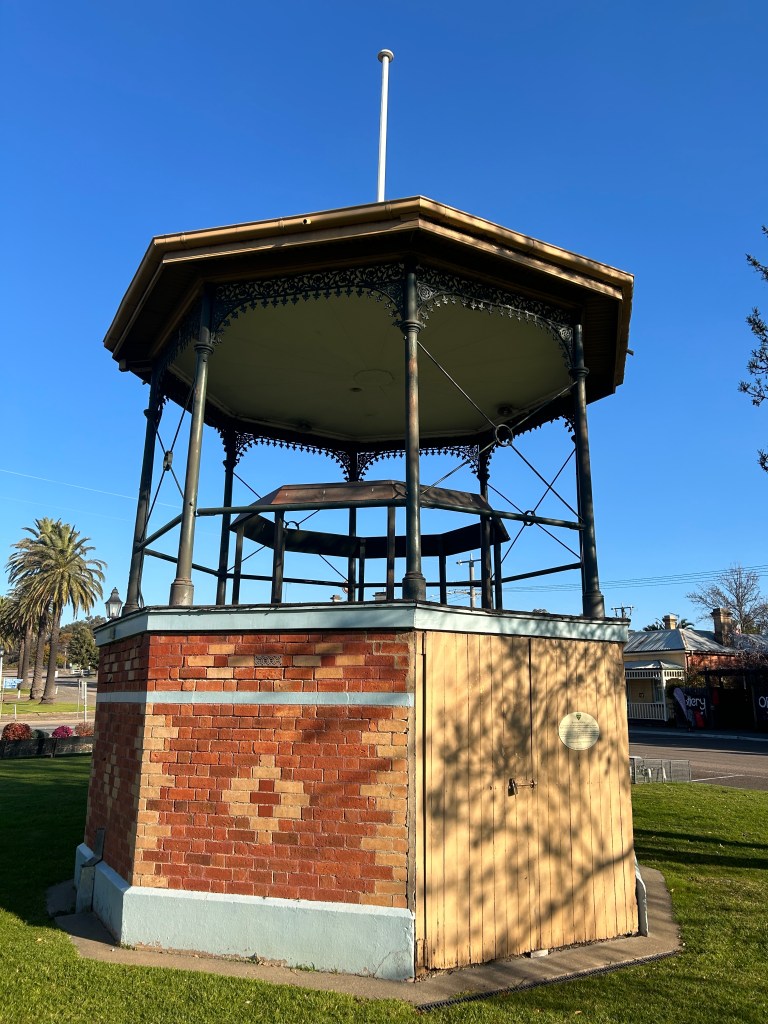
The band rotunda at Rushworth in northern Victoria is an example of this style of design.  Below is a postcard dating from 1907 and a later photograph of the rotunda – thankfully, the ring of music stands has not been removed over a century later (de Korte, 2024c).
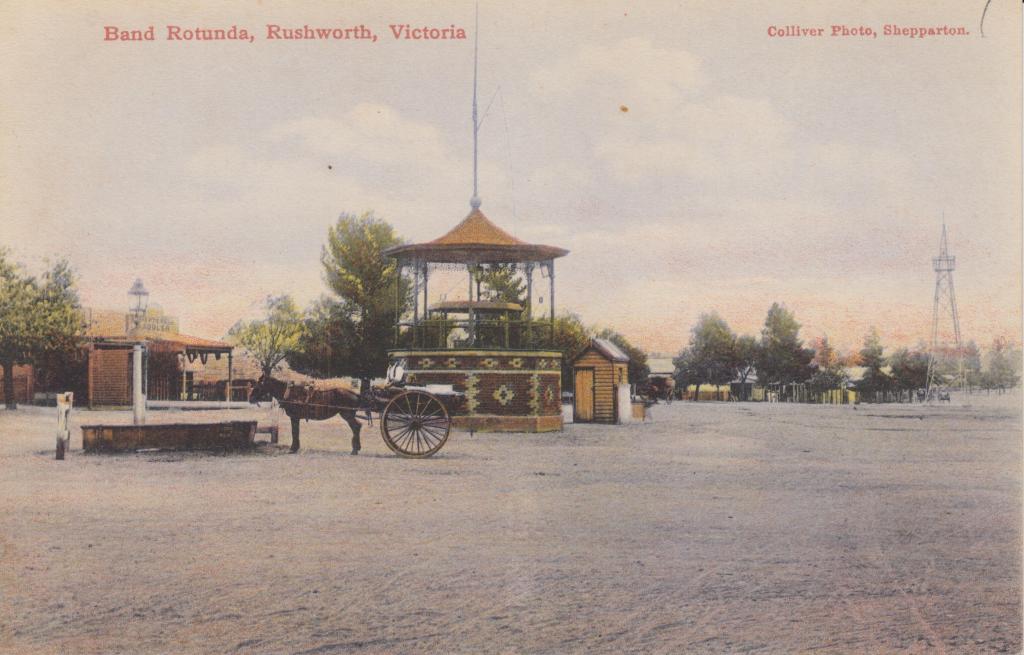
Postcard: Band Rotunda, Rushworth, Victoria, 1907. (Source: Jeremy de Korte Collection)
Photograph: Queen Jubilee Band Rotunda.
(The photograph was taken by Jeremy de Korte, 26/05/2024)

It can be seen that this particular rotunda is a bit on the small size, and when visiting the town, this author was told by townspeople that the current Rushworth and District Concert Band does not play up on this rotunda at present due to space constraints.  As with any structure of this type, they are of all different sizes and designs.  Images of band rotundas from all over Australia can be viewed on the companion blog, Australian Band Stands: Iconic structures in towns and cities.

What a band might have experienced when playing on a rotunda like this can be viewed below where we can see the New South Wales Artillery Band playing at the Hyde Park Rotunda.  The band members can just be seen standing around the edges of the rotunda facing inwards towards the conductor.
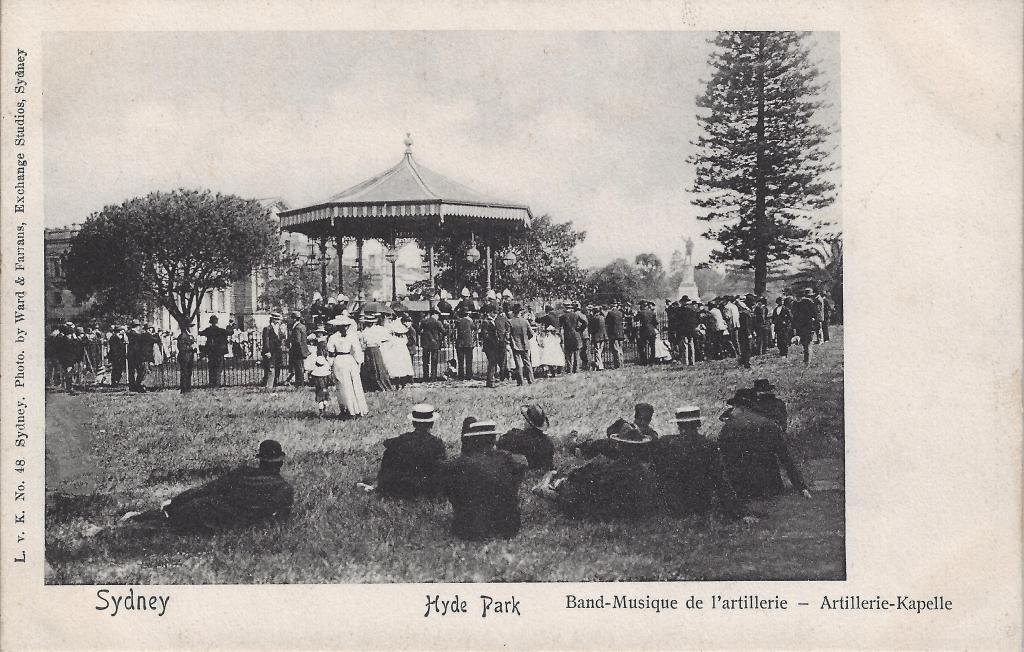
Postcard: Sydney : Hyde Park : Band-Musique de l’artillerie – Artillerie-Kapelle, (date unknown). (Source: Jeremy de Korte Collection)

Platforms:

Bands playing on temporary platforms was quite common, and again, still is to a certain extent.  Like playing on rotundas, platforms tended to dictate the shape in which a band performed.  Circles and rectangles tended to be the norm, but as the Prahan City Band demonstrated, other formations were used (“BRASS BAND CONTESTS.,” 1911).  Perhaps the Collingwood Citizens’ Band, seen in the photograph at the head of this post, was rehearsing in a circle in preparation for a contest.

Thankfully, there are some newspaper articles and photographs that show bands performing on an elevated platform at a contest.  The series of photographs below taken at the Inverell (N.S.W.) Musical Festival in 1907 and published in The Sydney Mail and New South Wales Advertiser newspaper is a perfect example. As we can see, the bands are on the platform formed up in a circle.  The temporary platform is in full view, and when each band is getting their photograph taken, the next band is taking their turn on the platform.  The photographs are displayed here separately, and the photograph of the massed bands has also been included.
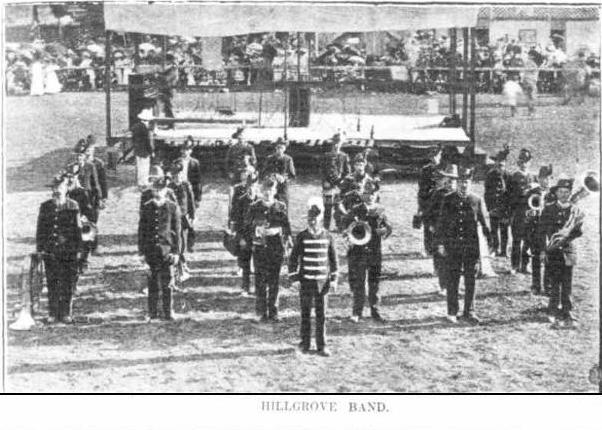
Hillgrove Brass Band – Inverell Musical Festival.
The Sydney Mail and New South Wales Advertiser, 10/04/1907, p. 925
Narrabri Enterprise Band – Inverell Musical Festival.
The Sydney Mail and New South Wales Advertiser, 10/04/1907, p. 925
Emmaville Miners’ Brass Band – Inverell Musical Festival.
The Sydney Mail and New South Wales Advertiser, 10/04/1907, p. 925
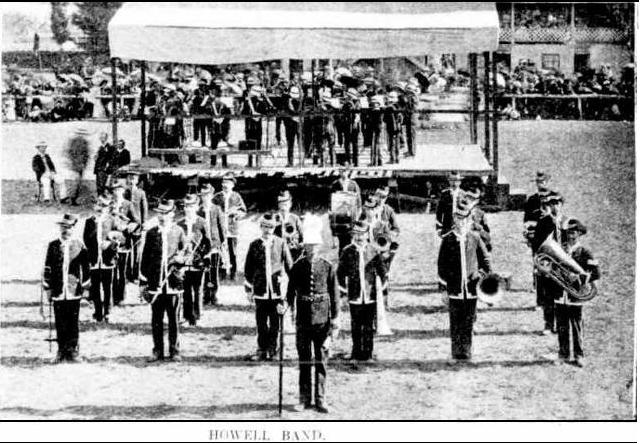
Howell Brass Band – Inverell Musical Festival.
The Sydney Mail and New South Wales Advertiser, 10/04/1907, p. 925
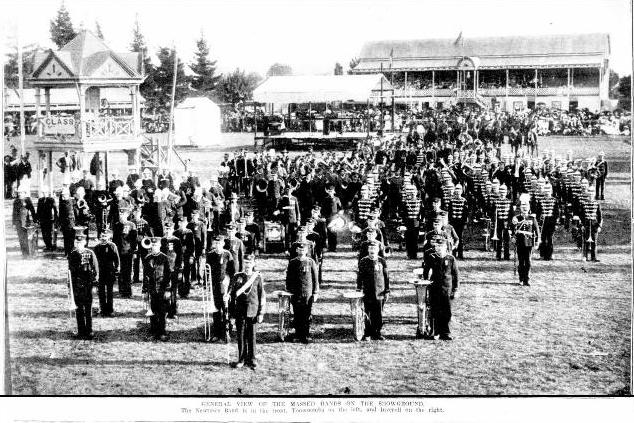
Massed Bands – Toowoomba Australis (left), Newtown Brass Band (front), Inverell Austral Band (right)  – Inverell Musical Festival.
The Sydney Mail and New South Wales Advertiser, 10/04/1907, p. 925

Likewise, the 1911 Kalgoorlie Brass Band Competitions and Eisteddfod was well-documented by photographer Mr. R. Vere Scott, and his photos were published in the Kalgoorlie Western Argus newspaper (Scott, 1911b).  On a side note, this contest was notable as it not only included some Western Australian bands but also the Broken Hill Band, which made the long journey to Kalgoorlie, as can be read about in a previous post (de Korte, 2019).  One of the photographs that Mr. Scott took was of the Boulder City Band taking their turn on the contest platform on the main oval (Scott, 1911a).  From looking at this photograph, one wonders how much the audience heard as the band members were all facing the conductor in the middle, and only some of the band members were likely to be pointing their instruments at the audience in the stands.

Boulder City Band – Kalgoorlie Brass Band Competitions and Eisteddfod.  Kalgoorlie Western Argus, 10/10/1911, p. 21

Elevating an ensemble was important enough for the musicians and the audience.  Yet there was the issue of sound production as well.  It could be assumed that it was possibly easier to hear a band playing on rotunda due to the roof reflecting sound outwards.  But what about a band playing in a shape on a platform?  How much of that was heard? Would it be better for a whole band to project outwards, generally in one direction?

1924, the year formations changed:

Band competing at Crystal Palace National Contest 1902.
(Source: IBEW – the History of Brass Bands blog)

Much happened in 1924.  The Malvern Tramways Band did not travel to the United Kingdom to compete in the famous English band competitions, as they were widely expected to do (de Korte, 2024a).  However, the Newcastle Steel Works Band did travel to England and caused a stir when they got there, mainly for the fact that they won two of the major championships and came third in another major championship (Greaves, 2005).  This was in addition to the numerous concerts and other events the band played at to earn some money during the tour – the trip was very expensive (Bythell, 1994; Helme, 2017).

While the Newcastle band astonished the English band aficionados with their playing, they did something else that changed the band world forever; they went on stage at the Belle Vue contest in Manchester – their second contest of the tour – and sat in a concert formation (Greaves, 1996).

Now, admittedly, the band had sat in concert formations at previous concerts in England, but this was the first time the band had sat in this formation at a contest.

Although they had already sat in formation at previous contests, the audience at the King’s Hall were still taken aback when the Newcastle Steel Works players arrived on stage – each carrying a wooden chair.  They then proceeded to sit in the now ‘traditional’ formation before Albert Baile took the stage. (Mutum, 2024)

The Australian band historian Jack Greaves (1996) provides us with a more detailed description of the event and the implications of what Newcastle set in motion.

The year 1924 also saw the introduction by the Australian visitors of a new innovation at the Belle Vue contest.  Up till then, it was customary for bandsmen to stand in a circle on the contest platform during the entire rendition of the test selection.  Tradition was broken by the visitors, however, for when their turn to play came, each man carried on to the platform his own chair and the band then arranged itself into a horseshoe formation.  As they were the second last band to play, it meant that each bandsman had the responsibility of retaining possession of his own chair for most of the day, which also meant carrying it about with him wherever he went.  From then on, all bands at Belle Vue have played seated.” (pp. 49-50)

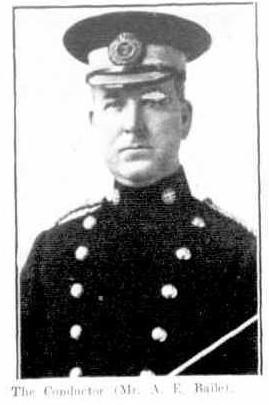
There is no record as to which Newcastle band member thought up the new formation, although one would suspect that Conductor Albert Baile was the instigator.  Various accounts, however, do mention the band being coached by conductors James Ord Hume and William Rimmer prior to the Belle Vue contest – did they also have an influence? (Bythell, 1994; Greaves, 2005).  Interestingly, the hall at the time was one of those arenas where the audience could watch the band from all four sides, so having a band perform on chairs in a concert formation must have been a novelty for them (Helme, 2017).  One of the reasons (nominally the weakest reason) the English commentators used to justify Newcastle’s win was the different seating formation (Bythell, 1994). 

So yes, it did take an Australian band visiting England to change the seating formation of brass bands.  Below are photographs of the Newcastle Steel Works Band and their conductor Albert Baile upon their return to Australia in 1925 as published by The Observer newspaper.

Newcastle Steel Works Band. Observer, 10/01/1925, p. 34
Albert Baile. Observer, 10/01/1925, p. 34

Conclusion:

What is evident from this little story is that evolution in the band world takes time and can happen quite suddenly.  This was not a movement that did not copy developments in the orchestral world where orchestras had been sitting in a concert formation for centuries.  As can be seen in the photographs from England and Australia, playing on an elevated platform was part of the performance practice.  Playing in a shape with the conductor in the middle, which was a part of contests for the best part of three decades was something that could have been changed quite easily.  However, for some reason, it was accepted musical practice for the benefit of the conductor, and possibly an adjudicator, but not for an audience sitting at a distance.

We can thank the innovations of the Newcastle Steelworks Band a century ago for changing the playing formations.  What they did went from novelty to accepted practice very quickly. 

References:

Band Contest, Yallourn. (n.d.). [Photograph]. [phot8000]. The Internet Bandsman Everything Within, Vintage Brass Band Pictures – Australia. http://www.ibew.org.uk/vbbp-oz.html

BRASS BAND CONTESTS : THE BALLARAT COMPETITIONS : A BENDIGONIAN’S IMPRESSIONS. (1911, 31 October). Bendigo Independent (Vic. : 1891 – 1918), 3. http://nla.gov.au/nla.news-article226819795

Bythell, D. (1994). Class, community, and culture: The case of the brass band in Newcastle. Labour History(67), 144-155. http://www.jstor.org/stable/27509281 

CODE’S BRASS BAND. (1907, 11 October). Age (Melbourne, Vic. : 1854 – 1954), 9. http://nla.gov.au/nla.news-article204997427

Collingwood Citizens’ Band rehearsing in a quarry. (1906). [Photograph]. [phot19034]. The Internet Bandsman Everything Within, Vintage Brass Band Pictures – Australia. http://www.ibew.org.uk/vbbp-oz.html

Colliver Photo. (1907). Band Rotunda, Rushworth, Victoria [Postcard]. [194458]. W. T. Pater, Printers and Stationers, Shepparton, Victoria; Melbourne, Victoria. 

de Korte, J. D. (2019, 06 September). Trans-continental connections: the brass bands of Broken Hill and Kalgoorlie. Band Blasts from the Past: Anecdotes, Stories and Personalities. https://bandblastsfromthepast.blog/2019/09/06/trans-continental-connections-the-brass-bands-of-broken-hill-and-kalgoorlie/

de Korte, J. D. (2021, 16 February). Influences from Britain: James Ord Hume and “The Besses Effect”. Band Blasts from the Past: Anecdotes, Stories and Personalities. https://bandblastsfromthepast.blog/2021/02/16/influences-from-britain-james-ord-hume-and-the-besses-effect/

de Korte, J. D. (2024a, 28 February). Hype versus reality: why the Malvern Tramways Band never travelled to the United Kingdom. Band Blasts from the Past: Anecdotes, Stories and Personalities. https://bandblastsfromthepast.blog/2024/02/28/hype-versus-reality-why-the-malvern-tramways-band-never-travelled-to-the-united-kingdom/

de Korte, J. D. (2024b). Rushworth, Vic. : Queen Victoria Jubilee Band Rotunda [Photograph]. [IMG_9916]. Jeremy de Korte, Newington, Victoria. 

de Korte, J. D. (2024c, 11 April). Rushworth, Victoria – Queen Victoria Jubilee Band Rotunda. Australian Band Stands: Iconic structures in towns and cities. https://australianbandstands.blog/2024/04/11/rushworth-victoria-band-rotunda/

Greaves, J. (1996). The Great Bands of Australia [booklet] [2 sound discs (CD) : digital ; 4 3/4 in. + 1 booklet]. Sydney, N.S.W., Sound Heritage Association Ltd. https://catalogue.nla.gov.au/catalog/2372005

Greaves, J. (2005). A musical mission of Empire : the story of the Australian Newcastle Steelworks Band. Peters 4 Printing. https://catalogue.nla.gov.au/catalog/3640204 

Helme, C. (2017, 23 September). The Newcastle Steelworks Band from Australia and its 1924 visit to the UK. Chris Helme : Sunday Bandstand, 229. http://www.chrishelme-brighouse.org.uk/index.php/sunday-bandstand/bandstand-memories/item/229-the-newcastle-steelworks-band-from-australia-and-its-1924-visit-to-the-uk

Holman, G. (2020, 15 April). The Crystal Palace and bands. IBEW – the History of Brass Bands. https://ibewbrass.wordpress.com/2020/04/15/the-crystal-palace-and-bands/

MUSICAL FESTIVAL AT INVERELL. (1907, 10 April). Sydney Mail and New South Wales Advertiser (NSW : 1871 – 1912), 925. http://nla.gov.au/nla.news-article165387808

Mutum, T. (2024, 30 August). The day the Open changed forever. 4barsrest, 2067. https://4barsrest.com/articles/2024/2067.asp

NEWTOWN BRASS BAND : OPENING OF A NEW BAND STAND. (1904, 22 April). Daily Telegraph (Sydney, NSW : 1883 – 1930), 3. http://nla.gov.au/nla.news-article237811793

RETURN OF THE CHAMPION NEWCASTLE STEEL WORKS BAND. (1925, 10 January). Observer (Adelaide, SA : 1905 – 1931), 34. http://nla.gov.au/nla.news-article166315185

Scott, R. V. (1911a, 10 October). BOULDER CITY BAND. Kalgoorlie Western Argus (WA : 1896 – 1916), 21. http://nla.gov.au/nla.news-article33398332

Scott, R. V. (1911b, 10 October). KALGOORLIE BRASS BAND COMPETITIONS AND EISTEDDFOD. Kalgoorlie Western Argus (WA : 1896 – 1916), 21. http://nla.gov.au/nla.news-article33398332

THE A.W.A. BRASS BAND. (1903, 28 September). Kalgoorlie Miner (WA : 1895 – 1954), 6. http://nla.gov.au/nla.news-article88873523

Ward & Farrans Exchange Studios. (n.d.). Sydney : Hyde Park : Band-Musique de l’artillerie – Artillerie-Kapelle [Postcard]. [No. 48]. L. v. K., Sydney, N.S.W. 
Trans-continental connections: the brass bands of Broken Hill and Kalgoorlie

Introduction:

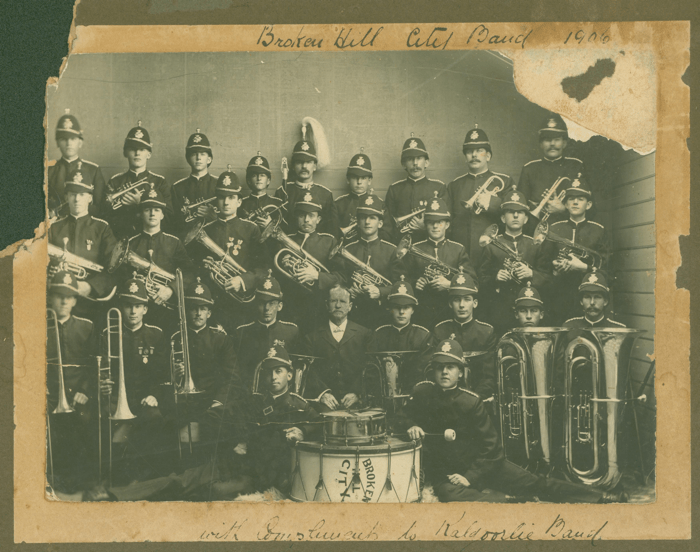
Above is an intriguing photo.  This photo of the Broken Hill City Band dated 1906 starts a story through the message that is penned around the edges; “Broken Hill City Band 1906 with compliments to Kalgoorlie Band”.  Knowing the geography of Australia as we do, the towns of Broken Hill and Kalgoorlie are very far apart.  Yet as we also know, during these times brass bands toured fair distances to participate in competitions and performances.  It was no different for these two bands.  They did meet, twice in five years.

The photo above is held in the archives of the Victorian Bands’ League, so we wonder why it is still in Victoria. That story cannot be told due to a lack of information.  However, we do know when and where the two bands met, and the first meeting was in Victoria at the famous South Street Competition.  The fact that they were both at South Street in 1906 reflects a ‘can do’ attitude from both bands, as well as many others.  The travel was long and expensive, but the lure of rewards beckoned. Such was the case when the bands met again in 1911, the next time in Kalgoorlie.

Hence this post covers the years of 1906 and 1911, two different times.  We can marvel at the travel that was undertaken and the other ‘little’ stories surrounding the trips.  The central theme of this post, however, is the fact that these bands met and seemingly formed a mutual respect and friendship through music, geography, and circumstance.

The early bands of Broken Hill and Kalgoorlie:

Aside from the distance from each other, the establishment of both Broken Hill and Kalgoorlie followed relatively similar paths.  Both are remote mining towns that experienced rapid population growth with the discovery of minerals – “silver, lead and zinc” in Broken Hill in 1883 and gold in Kalgoorlie in 1893 (Frost, Malam, Williams, & Malarz, 2014, p. 39).  With increased population came increased services and demand for transport links, most importantly the early railways (Frost et al., 2014).  Interestingly, a rail link from Broken Hill to Adelaide was built before Broken Hill was linked to Sydney and over in Kalgoorlie-Boulder, rail links were built to the south coast at Esperance and west to Perth (Frost et al., 2014).  With the development of these important centres, and the influx of people came the establishment of early brass bands (Farrant, 1989).

Briefly, the bands of Broken Hill and Kalgoorlie started with years of each other with bands in Kalgoorlie-Boulder commencing in 1895 and consolidating themselves a few years later – by 1900 there were two bands in Boulder and one band in Kalgoorlie (Farrant, 1989; Goldfields Brass Band, 2004).  The remaining band in Kalgoorlie, the Goldfields Brass Band can trace its lineage back to the Boulder Brass Band having been gifted a store of music and instruments in 1963 (Goldfields Brass Band, 2004).  The Kalgoorlie brass bands had a healthy respect and support of each other, and in the early years were boosted by the talents of the five McMahon brothers who arrived in Kalgoorlie-Boulder in 1900 (Farrant, 1989; Greaves & Earl, 2001).  Over the coming years, the famous Cornetist and Conductor Hugh McMahon and his brother Henry (Harry) took their bands all the way to Ballarat to compete at the South Street competitions with varying degrees of success (Greaves & Earl, 2001).

A similar development of brass bands occurred in Broken Hill where a band was established in 1899 as the “Bermingham’s Band…with J. J. Bermingham and his 9 sons comprising the majority of the membership” (Barrier Industrial Unions (BIU) Brass Band, 2019).  The band expanded its membership and was renamed the Broken Hill City Band a year later – the current Barrier Industrial Unions (BIU) Brass Band is a direct descendant of this early band (Barrier Industrial Unions (BIU) Brass Band, 2019).  The townsfolk and band members of Broken Hill, like Kalgoorlie, appreciated music and visits from other brass bands were well-attended (“THE AUSTRAL BRASS BAND.,” 1906).

1906: The South Street Competition, Ballarat:

The year is 1906 and from across Australia, brass bands have once again made their way to the South Street competition.  Since the commencement of brass band and brass solo/ensemble sections at South Street in 1900, this section of the competition continues to grow.  In 1906 these thirteen listed bands participated in the A and B grade sections with many bands participating in both grades, and many other musicians competing in the solo and ensemble sections:

(Vic.) Ararat Model (B Grade)
(Vic.) City of Ballarat (A & B Grades)
(Vic.) Bairnsdale Municipal (A & B Grades)
(NSW) Broken Hill City Band (A & B Grades)
(Vic.) Collingwood Citizens’ Band (A & B Grades)
(Vic.) Daylesford Citizens (B Grade)
(Vic.) Eaglehawk Borough (B Grade)
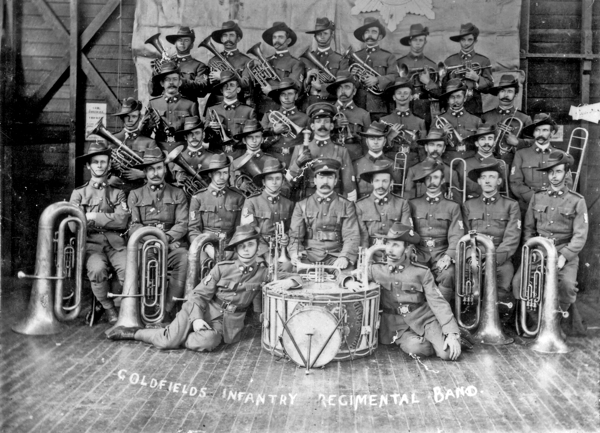
(WA) Kalgoorlie and Goldfields Infantry and Regimental Band (A Grade)
(Vic.) Maldon Miners (B Grade (Withdrew from A Grade))
(Vic.) Prout’s Ballarat Brass Band (A & B Grades)
(Vic.) Richmond City Band (A & B Grades)
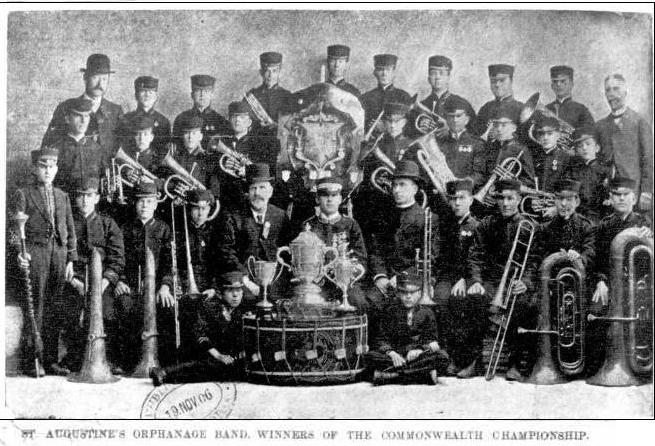
(Vic.) St. Augustine’s Orphanage Band (A Grade)
(Tas.) Ulverstone Rangers (A & B Grades)

(Mullen, 1951; “No title,” 1906; Royal South Street Society, 1906c)
19050000_Goldfields-Regimntal_008561d
Goldfields Infantry Regimental Band 1905 (Source: State Library of Western Australia: Government Photographer Collection: 008561D)

Considering the travel methods of the day, to attract this many bands with three of them travelling from other colonies is quite remarkable.  Such was the lure of the South Street competition.  For the Kalgoorlie Regimental band, they were travelling paths set down by the Boulder City Band and the Boulder A.W.A Mines Band before them as they participated South Street in 1902, 1903 and 1905 and achieved excellent placings (Farrant, 1989; Greaves & Earl, 2001).  Travel for Kalgoorlie bands to get to South Street involved a train, a ship and another train and tours often lasted for six weeks (Farrant, 1989).  The distance for the Broken Hill band was not quite as long but involved a roundabout way of travel as the band took a train to Adelaide and then another train from Adelaide to Ballarat (“BALLARAT EISTEDDFOD.,” 1906a).

The details of the 1906 South Street competition were notable for several reasons.  Much of this was due to the performance of the legendary St. Augustine’s Orphanage Band from Geelong who, despite their youth, managed to win all of the A Grade sections and carry off the Sutton Shield & Cup and the Boosey Cup (“The Ballarat Band Contests.,” 1906; “BALLARAT EISTEDDFOD.,” 1906b).  By all accounts the quality of their performance and subsequent win were undisputed. However, there was a degree of controversy about this competition and some felt results underneath St. Augustine’s were unjustified.

19061117_Advocate_Ballarat-Competion
Advocate, 17/11/1906, p. 14

Some of the controversies were pinned to the choice of the adjudicator.  Unlike previous years when the band sections were adjudicated by eminent brass band authorities such as James Ord Hume, Captain W. G. Bentley, and Albert Wade, the 1906 competition was adjudicated by a Professor Frederick W. Beard LRAM of Birmingham (Greaves, 1996). Professor Beard, “did not pretend to be a brass band expert” but apparently “had a thorough knowledge of orchestral work and he knew enough about brass instruments to qualify for the position he undertook…” (“BALLARAT EISTEDDFOD.,” 1906b).  Such a decision did not go down well with some bands. Upon the return of the Kalgoorlie band back home, their President, Mr Eli Shaw read out a resolution of the Richmond City Band at the welcome home reception which stated,

That this band respectfully declines to enter or compete at any band contest unless a practical brass band conductor, or conductors, be appointed as judge, the definition of ‘practical’ being an approved registered conductor, who has piloted bands to victory in large contests, and that copies of this resolution be forwarded to all secretaries of all registered bands in Victoria asking them to adopt the same, and forward on to secretary of Victorian Band Association, Ballarat.

(“KALGOORLIE BRASS BAND.,” 1906)

Such was the ill-feeling from one band who participated in this competition.

For the Broken Hill City Band, the results simply did not go their way in the A grade or B grade sections except for winning the third prize for discipline behind the Bairnsdale & Eaglehawk bands (Royal South Street Society, 1906c).  However, their playing was judged by others to be excellent and it was felt that their placings were not deserved (“BALLARAT BAND CONTESTS.,” 1906).

The experiences of the Broken Hill Bands and the Kalgoorlie band were somewhat linked and for the Kalgoorlie band, some felt they had been treated extremely unfairly by the Victorian Band Association (V.B.A.) and the adjudication.  It was not until the Kalgoorlie Band arrived in Ballarat that they found out they had been unexpectedly regraded from B grade to A grade on account of the V.B.A. wrongly assuming the status of some of their members (“KALGOORLIE BRASS BAND.,” 1906).  Apparently, the V.B.A. told Kalgoorlie they had sixteen members who had played with the A.W.A Band and the Boulder City Band in previous years, of which the Kalgoorlie Band “proved” that these sixteen “had never played before in a contest” (“KALGOORLIE BRASS BAND.,” 1906).  If we are to believe this account, it would seem the V.B.A., which was the band association overseeing the registrations, had made a grievous mistake somewhere.

There were also the woes of adjudication which upset many in the band community.  At the same reception where Mr Eli Shaw read out the resolution by the Richmond City Band, he also read out letters of support from the Broken Hill band and the Hobart band.  Perhaps, this letter is somehow tied into the photo at the head of this post, but we may never know this for sure.  The letter, written by the bandmaster of Broken Hill, was printed in an article published by the Kalgoorlie Western Argus upon the return of the band back home:

Permit me and the members of the Broken Hill City Band to offer you and the talented members of your Kalgoorlie Band our sincerest sympathy in the position in which an utterly outrageous adjudication has placed you at this Ballarat contest.  It is the consensus of opinion amongst all whom we have met, and are disinterestedly capable of giving a sound musical judgement, that your rendering of the test and choice, especially the latter, was a real musical treat, and that the judge, in awarding such an absurdly low number of points, insulted the musical intelligence of hundreds, who, I am sure, are infinitely more capable of giving a fair judgement than he did.  Allow me once more to offer you our sincere sympathy, and we hope that this perverted judgement will not prevent us from hearing your magnificent band many times again here.

(“KALGOORLIE BRASS BAND.,” 1906)

The sentiments of the bandmaster of the Hobart band were very similar – a grave injustice had been done, not only on this band but the whole community of bands.

The Kalgoorlie band did what they could under the circumstances and obviously drew praise for their playing.  Upon the completion of the Ballarat contest, they travelled to Bendigo to present a concert and were awarded a civic reception upon their arrival, and received an excellent review of their performance (“KALGOORLIE REGIMENTAL BAND.,” 1906).  From Bendigo, they travelled home and Kalgoorlie gave them a hero’s welcome upon their return with a reception attended by the other bands in the region, local politicians and the Mayor (“KALGOORLIE BRASS BAND.,” 1906).

Aside from the results in the band sections, competition results in the solo and ensemble sections were a consolation for both the Broken Hill and Kalgoorlie bands.  All sections had a number of entries and included musicians from bands that were not in the main band sections (Royal South Street Society, 1906a, 1906b).  It would have been pleasing for the Royal South Street Society to have so many entries.

1911: The Kalgoorlie Eisteddfod:

The Kalgoorlie Eisteddfod was obviously a much smaller event than South Street, yet it seemed to generate similar excitement and interest from participants and audience.  So much so that several public authorities, the Eisteddfod and the West Australian Band Association made sure that visiting bands were treated to the finest hospitality. The 1911 Eisteddfod was notable for the participation of the Albany Brass Band and the Broken Hill City Band who travelled to Kalgoorlie to compete against the three Kalgoorlie-Boulder bands.

In August 1911 the Broken Hill City Band commenced a long journey to Kalgoorlie.  The Trans-Continental Railway was yet to be built, so the band took the train to Adelaide where they presented a concert on the 18th of August before taking a ship to Albany (“BROKEN HILL BAND.,” 1911a).  There was a huge amount of interest generated by the arrival of these two bands in Kalgoorlie.  On the 25th of August, both the Albany and Broken Hill bands arrived in Kalgoorlie, and their travel movements were reported on by the Kalgoorlie Miner newspaper – of which also highlighted an example of the hospitality they were being awarded,

The Broken Hill men got off the Karoola at Albany, and special carriages were provided for both the Barrier and Albany men through to the goldfields.  At Northam the carriages were shunted off, and later attached to the express, so that there was no confusion caused in regard to transhipping baggage, etc.  The Albany men gave a concert at Northam while waiting for the express, and realised a fair profit.

(“KALGOORLIE EISTEDOFOD,” 1911)

…and remarking on uniforms,

The green and gold uniforms of the players from Broken Hill are particularly effective, and in mufti they wear green hat bands and gold lettering; also badges of green and gold. The Albany attire is of blue, with red facings and badges of the same colours.

(“KALGOORLIE EISTEDOFOD,” 1911)

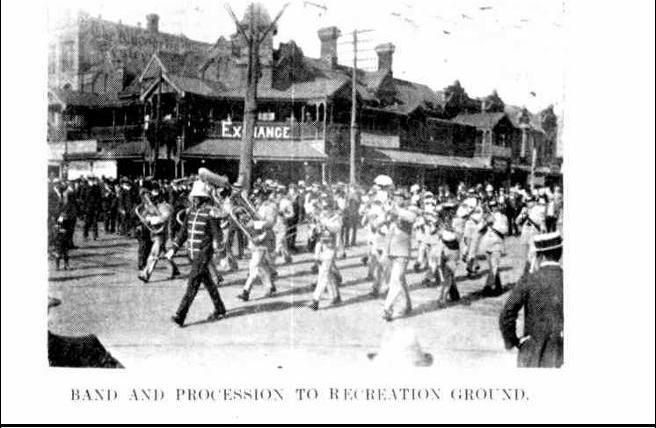
Both bands were received at the Kalgoorlie station by a plethora of officials and townsfolk and the railway station reception also included a small combination of the three Kalgoorlie-Boulder bands playing music.  After this welcome, both bands formed up and marched to the Eisteddfod office and then after more speeches, marched to their hotel (“KALGOORLIE EISTEDOFOD,” 1911).

Fortunately, the article in the Kalgoorlie Miner newspaper also published the names of the bandsmen from both bands so we have this piece of history on record:

P. Pfitzner, conductor
W. May, professional cornet
H. Mitchell, solo cornet
A. Hendy, solo cornet
J. Shannon, repiano cornet
S, Phillips, flugel horn
E. Holland, second cornet
H. Halse, third cornet
W. Keays, soprano cornet
E. W. Barwick, solo horn
R. Rawle, second horn
John Richards, first horn
W. Partington, baritone
O. Hannett, baritone
D. Hopkins, euphonium
R. Ramsay, euphonium
C. Thomas, trombone
Stan Phillips, trombone
J. Martin, bass trombone
J. Bartley, BBb bass
W. Head, BBb bass
O. Berriman, Eb bass
S. Goldring, Eb bass
C. Kumm, bass drum
R. Gummow, side drum
M. Williams, side drum
Mr. J. Doherty, is the drum major, Mr. J. Mitchell is the manager, and Mr. W. W. Barwick the secretary.

(“KALGOORLIE EISTEDOFOD,” 1911)

A day later both bands were getting into their practice on the city oval which was reported on by the Kalgoorlie Miner.  The welcoming ceremonies were not over.  After their afternoon practice on the oval, both bands marched to the town hall to be received by the mayor and councillors who awarded them another civic reception (“KALGOORLIE EISTEDDFOD,” 1911).  Toasts were given all around and it appears the Mayor of Kalgoorlie had spent some years in Broken Hill, so he was familiar with the town and mines.  The camaraderie was evident as was the hospitality.  Mr J. Mitchell, secretary of the Broken Hill band said as much in his response to the welcome.

…he appreciated the kindness that had been shown them, especially by the energetic committee and secretary, who had secured free railway passes for them, otherwise Broken Hill Band could hardly have taken the trip.

(“KALGOORLIE EISTEDDFOD,” 1911)

A few days later the Broken Hill band presented a concert in Kalgoorlie’s Victoria Park which was well-attended by the townsfolk.  As a measure of support, the band received £32 in total from contributions which obviously helped with some expenses – the trip was estimated to cost £400 (“BROKEN HILL BAND.,” 1911b).  The band was said to have performed with “good quality of tone, excellent balance, and intelligence in interpretation” which was high praise for the visiting ensemble (“BROKEN HILL BAND.,” 1911b).  No doubt a good review for the band to have!  Interest in the bands had not waned and was carried through to the Eisteddfod proper.  Certainly, the enthusiasm from the townspeople and friendship of the local bands between each other attracted the notice of local commentators (“KALGOORLIE BAND COMPETITIONS,” 1911).

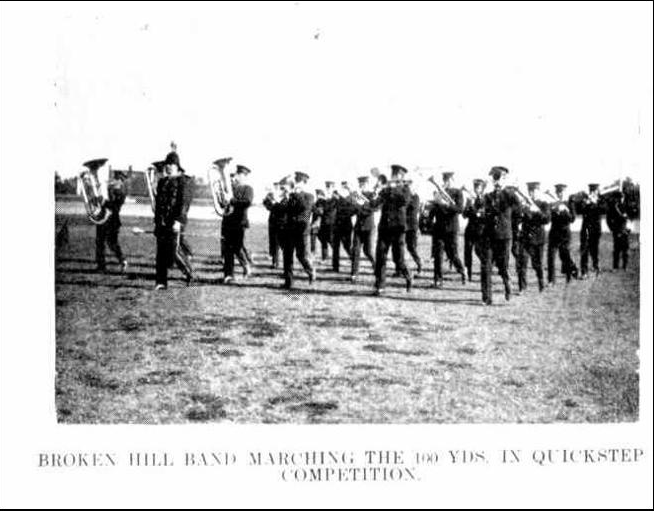
19111010_Kalgoorlie-Western-Argus_Competition-Broken-Hill-March
Kalgoorlie Western Argus, 10/10/1911, p. 21

The band sections of the Eisteddfod commenced in the first week of September and were adjudicated by Mr Charles Allison who also did his bit by leading the combined bands on a street march and conducting them on the oval (“KALGOORLIE BAND COMPETITIONS.,” 1911).  The sight of the three Kalgoorlie-Boulder bands combined with the bands of Broken Hill and Albany would have been quite spectacular.  Over the coming days, all bands competed in a variety of band and solo/ensemble sections and results were mixed between them – the Kalgoorlie Band won the overall championships however the Broken Hill band won the Street March section (“BAND CONTESTS,” 1911; “STREET MARCHING COMPETITION,” 1911).

19111010_Kalgoorlie-Western-Argus_Competition-Massed-Bands
Kalgoorlie Western Argus, 10/10/1911, p. 21
19111010_Kalgoorlie-Western-Argus_Competition-Procession
Kalgoorlie Western Argus, 10/10/1911, p. 21

By all accounts, this was a very good band contest with little reported controversy and where all bandsmen exhibited the best of behaviour towards each other.  Indeed, even during the contest, social nights were encouraged and the Kalgoorlie-Boulder bands made sure the visiting bands were very welcome (“VISITING BRASS BANDS.,” 1911).  This hospitality was not lost on the visiting bands and in an article published on the 9th of September in the Truth newspaper we read that,

The visiting bandsmen, however, express their intense appreciation of the kindness and courtesy extended to them on all hands.  The Chamber of Mines, the School of Mines, the brewery manager, the Race Club, secretaries, the manager of the power house, and others did their best to make the Albany and Broken Hill men enjoy themselves.

(“Kalgoorlie Band Contests.,” 1911)

According to an account by a member of the Broken Hill band who documented the whole trip, and which was published in the Barrier Miner newspaper, the Broken Hill band commenced then commenced a long trip home – a train to Perth, a ship to Adelaide and another train to Broken Hill.  The band arrived back in Broken Hill on September 17th and despite some results not going their way, they acquitted themselves well and certainly enjoyed the trip west (“THE BROKEN HILL BAND.,” 1911).

Conclusion:

What is evident here through these ‘little stories’ is just one example from many of the connections and friendships that were made between early brass bands.  There is probably much more that can be written on this topic.  However, one must admire the fact that these bands traversed vast distances and in doing so gave themselves chances that they otherwise would not have had.  The fact that the Broken Hill and Kalgoorlie bands came from towns that developed around mining obviously helped the friendships that developed.

I have formed no doubt through the research for this post that these two bands gained valuable experiences from their trips.  Competitions aside, it was the camaraderie of early bands people and the connections that were formed that made the trips even more worthwhile.

References:

THE AUSTRAL BRASS BAND. (1906, 08 February). Barrier Miner (Broken Hill, NSW : 1888 – 1954), 3. http://nla.gov.au/nla.news-article44491455

BALLARAT BAND CONTESTS. (1906, 03 December). Barrier Miner (Broken Hill, NSW : 1888 – 1954), 3. http://nla.gov.au/nla.news-article44520304

The Ballarat Band Contests : The Championship of the Commonwealth Won by St. Augustine’s Band : The Boys Carry off All the First-Class Prizes : An Unprecedented Feat. (1906, 17 November). Advocate (Melbourne, Vic. : 1868 – 1954), 14. http://nla.gov.au/nla.news-article170199282

BALLARAT EISTEDDFOD. (1906a, 29 October). Evening News (Sydney, NSW : 1869 – 1931), 2. http://nla.gov.au/nla.news-article115677274

BALLARAT EISTEDDFOD : Brass Band Section : Victories of the Orphans : St. Augustine’s Wins the Double. (1906b, 08 November). Evening News (Sydney, NSW : 1869 – 1931), 2. http://nla.gov.au/nla.news-article115680908

BAND CONTESTS : Championship won by Kalgoorlie. (1911, 04 September). Evening Star (Boulder, WA : 1898 – 1921), 3. http://nla.gov.au/nla.news-article204606679

Barrier Industrial Unions (BIU) Brass Band. (2019). History. Barrier Industrial Unions (BIU) Brass Band. Retrieved 03 September 2019 from https://biuband.com.au/history/

BROKEN HILL BAND. (1911a, 19 August). Register (Adelaide, SA : 1901 – 1929), 13. http://nla.gov.au/nla.news-article58436856

BROKEN HILL BAND. (1911b, 28 August). Kalgoorlie Miner (WA : 1895 – 1950), 6. http://nla.gov.au/nla.news-article91317321

THE BROKEN HILL BAND : Its West Australian Trip. : (By a Member). (1911, 20 September). Barrier Miner (Broken Hill, NSW : 1888 – 1954), 5. http://nla.gov.au/nla.news-article45165481

Broken Hill City Band. (1906). [Rectangular black and white photograph mounted on card : L21.6cm – W16.5cm]. [0006]. Victorian Collections, Victorian Bands’ League. https://victoriancollections.net.au/items/5b59a68021ea690d805b060c

Eastern Goldfields Historical Society Inc. (2019). Kalgoorlie : City of Kalgoorlie-Boulder. Eastern Goldfields Historical Society Inc. Retrieved 03 September 2019 from https://kalgoorliehistory.org.au/towns/Kalgoorlie

Farrant, J. E. (1989). Boulder bands win at Ballarat, 1904/1905. Studies in Western Australian History, 10(April [Celebrations in Western Australian history / Layman, Lenore & Stannage, Tom (eds.)]), 107-113. https://search.informit.org/documentSummary;dn=890911633;res=IELAPA 

Frost, G., Malam, K., Williams, L., & Malarz, A. (2014). The evolution of Australian towns [Research Report](136). T. Department of Infrastructure, Regional Development and Communication. https://www.bitre.gov.au/publications/2014/report_136.aspx

Goldfields Brass Band. (2004). History. Goldfields Brass Band. Retrieved 03 September 2019 from https://www.goldfieldsbrassband.org.au/history.php

Government Photographer. (1905). Goldfields Infantry Regimental Band [1 photographic print, mounted : b&w ; 10 x 12 cm.]. [008561d]. State Library of Western Australia, Government Photographer collection ; 816B/E/6541. https://encore.slwa.wa.gov.au/iii/encore/record/C__Rb2088645

Greaves, J. (1996). The great bands of Australia [sound recording] [2 sound discs (CD)]. Australia, Sound Heritage Association. 

Greaves, J., & Earl, C. (2001). Legends in brass : Australian brass band achievers of the 20th century. Muso’s Media. 

KALGOORLIE BAND COMPETITIONS : Notes by an Observer. (1911, 29 August). Kalgoorlie Miner (WA : 1895 – 1950), 2. http://nla.gov.au/nla.news-article91315285

KALGOORLIE BAND COMPETITIONS : Street Marching Contest : Won by Broken Hill Band. (1911, 13 September). Barrier Miner (Broken Hill, NSW : 1888 – 1954), 8. http://nla.gov.au/nla.news-article45164623

Kalgoorlie Band Contests : The Quickstep. (1911, 09 September). Truth (Perth, WA : 1903 – 1931), 6. http://nla.gov.au/nla.news-article208697815

KALGOORLIE BRASS BAND : Civic Reception. The Band’s Troubles. (1906, 11 December). Kalgoorlie Western Argus (WA : 1896 – 1916), 12. http://nla.gov.au/nla.news-article33083145

KALGOORLIE EISTEDDFOD : Brass Band Competitions : Visitors’ Movements. (1911, 26 August). Kalgoorlie Miner (WA : 1895 – 1950), 2. http://nla.gov.au/nla.news-article91321579

KALGOORLIE EISTEDDOFOD : Brass Band Competitions : Broken Hill and Albany Players : Reception Arrangements. (1911, 25 August). Kalgoorlie Miner (WA : 1895 – 1950), 2. http://nla.gov.au/nla.news-article91326006

KALGOORLIE REGIMENTAL BAND. (1906, 06 November). Bendigo Independent (Vic. : 1891 – 1918), 3. http://nla.gov.au/nla.news-article227751661

Mullen, C. C. (1951). Mullen’s Bandsmen of South Street (1900-1951). Horticultural Press. 

No title. (1906, 29 October). Ballarat Star (Vic. : 1865 – 1924), 2. http://nla.gov.au/nla.news-article210688939

Royal South Street Society. (1906a, 30 October). 1906-10-30 Brass Solo Contests. Royal South Street Society. Retrieved 26 August 2019 from https://results.royalsouthstreet.com.au/results/1906-10-30-brass-solo-contests

Royal South Street Society. (1906, 31 October). 1906-10-31 Brass Solo Contests. Royal South Street Society. Retrieved 26 August  2019 from https://results.royalsouthstreet.com.au/results/1906-10-31-brass-solo-contests

Royal South Street Society. (1906, 04 November). 1906-11-04 Band Contests. Royal South Street Society. Retrieved 26 August 2019 from https://results.royalsouthstreet.com.au/results/1906-11-04-band-contests

Scott, R. V. (1911, 10 October). KALGOORLIE BRASS BAND COMPETITIONS AND EISTEDDFOD. Kalgoorlie Western Argus (WA : 1896 – 1916), 21. http://nla.gov.au/nla.news-article33398332

STREET MARCHING COMPETITION : Won by Broken Hill. (1911, 04 September). Kalgoorlie Miner (WA : 1895 – 1950), 4. http://nla.gov.au/nla.news-article91325887

VISITING BRASS BANDS : Smoke Social in Kalgoorlie. (1911, 05 September). Kalgoorlie Western Argus (WA : 1896 – 1916), 10. http://nla.gov.au/nla.news-article33396714