
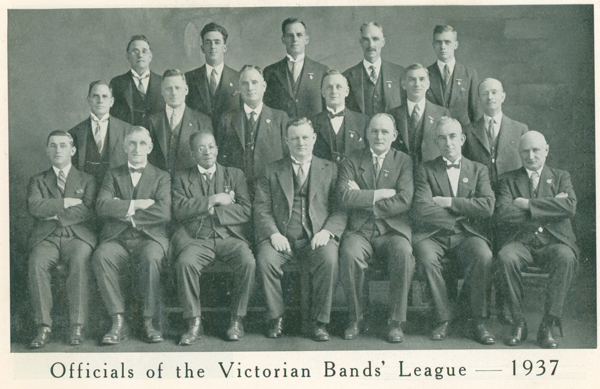
Introduction:
Although the history and reputation of Victorian banding lies partly with individual bands, the history of the associations that they formed shows Victorian banding in a different light. This post is focused on a period from 1901 to 1933, where, during the development of the various associations and leagues lies a somewhat rancorous battle for the heart and soul of Victorian bands of which was covered in the newspapers of the day and laid out in detail.
The focus of this post is the general history of the Victorian Bands’ Association (V.B.A.) from 1901-1933 and the official formation of the Victorian Bands’ League (V.B.L.) in 1931. Tied into this is the history of various early geographical groupings of bands and the eventual move to form much larger associations. However, with association came division and as will be shown the seeds of division started much earlier than 1931. This is a tale of the Victorian band movment that is probably not well known to most Victorian bands people.
My curiosity has been growing over time as I wondered why there were no records that existed prior to 1931. I knew that the headquarters of the V.B.A. had been in Ballarat, yet whatever records that may have existed were not provided to the V.B.L. When researching for this post the reasons became obvious – they were two entirely separate organisations that wanted little to do with each other.
The research for this article has been informed by involved searching through the Trove archive with the aim of building a chronology of articles and events. With this searching has come some revelations as to the Victorian band movement in the 1900s. This history is important to the band community as it highlights what once was, and how the administrations operated.
1900 – 1920: The V.B.A. and other associations:
(Photograph taken in November 2022 by Jeremy de Korte)
The first seeds of a State association were sown in 1901 when delegates from Geelong and Ballarat brass bands decide to form a “Ballarat and Geelong District Band Association” with the rules of the new association to be presented to a conference of bands at the next South Street competition (“BAND ASSOCIATION.,” 1901). Here we have an association that had been set up based on a small geography, but most importantly developed ties to the South Street competitions which became increasingly important to the band community (Royal South Street Society, 2016). It should be noted that there was already a Geelong Band Association in existence, although this small association broke up after 1908 (“BAND ASSOCIATION.,” 1908). In 1907 it becomes obvious that the V.B.A. is expanding as they had a meeting in Bendigo where discussion took place about lobbying the council to let them use a reserve to hold a band competition with the aim of attracting bands from across Australia (“BANDS ASSOCIATION.,” 1907). This is one of the earliest reports of the V.B.A. promoting competitions in regional areas.
Within other geographical regions, distinct band associations started around the same time although not all of them affiliated with the newly formed V.B.A. In the Melbourne area, a new association called the “Melbourne and Metropolitan Band Association” (M.M.B.A.) was formed in 1906 (or 1907) by twenty-five bands (“MELBOURNE AND METROPOLITAN BAND ASSOCIATION.,” 1907). This new association formed their own rules and constitution with the encouragement of the V.B.A., of which a representative attended the meeting. It is not until a meeting in 1908 that the M.M.B.A. discusses aligning with the V.B.A. and a committee of five is set up to investigate this (“MELBOURNE AND METROPOLITAN BAND ASSOCIATION.,” 1908). In contrast, a new Gippsland Band Association (G.B.A.) started in 1908 and emphatically ruled out associating with the association in Ballarat (“GIPPSLAND BAND ASSOCIATION.,” 1908). It should be noted that while Gippsland bands did eventually join with State band associations, the G.B.A. was still going in 1947 and possibly longer (“Gippsland Bands’ Association,” 1947).
Despite the seemingly good running of the association there are some indications that some bands wanted the headquarters moved from Ballarat for various reasons. In 1917, a letter was sent to the Bendigo Citizens’ Band by the Metropolitan Bands Association proposing a shift of the next meeting of the V.B.A. to Melbourne. This letter was read out at a meeting of the Bendigo Citizens’ Band and the responses were detailed by the Bendigo Independent newspaper in an article.
Correspondence from the Metropolitan Band Association was read, requesting the bands’ support in having the meeting of the Victorian Band Association held in the metropolis instead of at Ballarat. Several members spoke in favour of the Victorian Bands’ Association meeting being continued in Ballarat, as it was only another move to have everything of any importance held in the metropolis. The secretary (Mr. E. K. Varcoe) in commenting on the matter, said it clearly showed that centralisation was at the back of the suggestion, and Melbourne desired everything in Melbourne with the exception of the mice plague…
(“BENDIGO CITIZENS’ BAND.,” 1917)
Obviously, there were a few choice words used at this meeting (by 1917 standards).
The letter was countersigned by representatives of the Fitzroy, South Melbourne, Collingwood, Brunswick, Malvern and St Kilda brass bands and it was sent to all country bands affiliated with the V.B.A. at the time. The Bendigo Citizens’ Band did end up sending a representative to a meeting in Melbourne. Subsequently, in a vote on the matter at a later V.B.A. meeting, the motion to move the V.B.A. headquarters to Melbourne was defeated 23 to 6 (“BANDS’ ASSOCIATION.,” 1917).

1920 – 1929: Division – the first V.B.L.:
If the V.B.A. felt that issues of division from the late 1910s had been placated, the early 1920s showed them otherwise. The Melbourne and Metropolitan Band Association was still in existence and were running their own contests, within the oversight of the V.B.A. In February 1920 they held a series of contests at the Melbourne Cricket Ground (MCG) in conjunction with the R.S.S.I.L.A., Vic. Branch with entries received from 30 bands – one highlight was a challenge contest between the Hawthorn City Band and the Collingwood Citizens’ Band (“METROPOLITAN BAND CONTEST.,” 1920).
Over the next few years however, the V.B.A. found itself dealing with a rival Victorian band association, the Victorian Bands’ League which was formed by a grouping of disgruntled metropolitan bands and apparently some country bands. At a meeting held on the 23rd of May 1921, the new chair of the (first) V.B.L., a Mr. H. G. Johnson stated that,
…one of the objects of the new league was the control of band contests, also the fostering of a better feeling among bands and bandsmen.
(“VICTORIAN BAND LEAGUE.,” 1921)
…and further in this article we see some further reasoning as to why representatives of these bands had met.
Several speakers expressed dissatisfaction with the way in which the affairs of bands and band contests were at presented being controlled by the Victorian Bands’ Association in Ballarat. Band matters generally could be better managed by having headquarters of the controlling body in Melbourne.
(“VICTORIAN BAND LEAGUE.,” 1921)
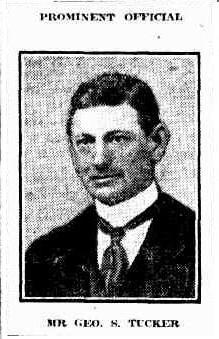
One of the main driving forces behind the new V.B.L. was an official of the M.M.B.A, Mr George S. Tucker. Born in the town of Victorian town of St. Arnaud before moving to Melbourne, he was the son of a bandsman and at the age of eight, joined the Malvern Town Band, then the St. Kilda City Brass Band under conductor Mr. F. C. Johnston, and found his niche in the administrative work of the band movement (Quickstep, 1921). A weekly column in the Herald newspaper from April 1921 penned by “Quickstep” provides an outline of his band career, but it is the opening paragraph that really introduces Mr. Tucker.
The foremost figure in the band world at present moment is George S. Tucker, the hon. secretary of the Melbourne and Metropolitan Band Association. A firm and fearless official, a keen debater, and an acknowledged authority on contesting and administrative matters, he has held office for a record term. Melbourne is recognized as a centre of advanced thought in regard to band politics, and the formation of a new controlling body to be knowns as the Victorian Band League is now receiving attention of the bands. Mr Tucker has been entrusted with the organisation of this new venture.
(Quickstep, 1921)
Perhaps the new league was a little overzealous in the way it announced itself. It is all very well stating that a meeting had been attended by several bands, but it might have helped if the new V.B.L. had sought assurances from the bands themselves that they would be affiliating with the new body. This was revealed at a meeting of the V.B.A. held in June 1921.
A letter was received from the St. Kilda Band Association stating that at a meeting of delegates from several bands in Melbourne in May it was decided to form a new league, and it was opined that this would prove to be a very successful body. It was stated that the Geelong and Coburg bands had agreed to join.
A delegate stated that as far as Geelong and Coburg bands were concerned both had notified their intention of sticking to the V.B.A. The Malvern Band – which band had a delegate at the meeting – said that he was surprised to find himself elected to the league without authority. They were also sticking to the V.B.A.
(“VICTORIAN BAND ASSOCIATION,” 1921)
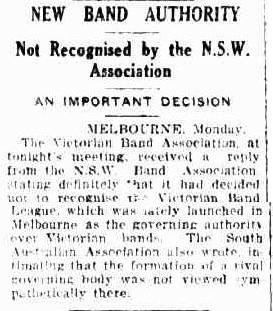
As well as this, State associations were nominally affiliated with each other and almost as soon as the new league was announced in May, the Band Association of N.S.W. and the South Australian Band Association wrote to the V.B.A. expressing their continued affiliation and refusal to recognize the new V.B.L. (“NEW BAND AUTHORITY,” 1921). Letters were also received from the Tasmanian Band Association and West Australian Band Association, although W.A.B.A. asked for further information and expressed an opinion that “there was no need for a second body” (“VICTORIAN BAND ASSOCIATION,” 1921).
Nevertheless, the fledging V.B.L. was not to be put off and in early August they announced that they would be holding a massed bands event for a hospital charity at the Exhibition Oval involving 250 bandsmen (“MASSED BANDS PERFORMANCE.,” 1921). Bands were given permission to march from Prince’s Bridge and the Collingwood Band was to march from Collingwood. The massed band was conducted by Mr. F. C. Johnston who was titled as “the Victorian Band League conductor” (“MASSED BANDS PERFORMANCE.,” 1921).

Early in 1922 we can see that the new V.B.L. is holding meetings at a favourite haunt in the form of a café located at the corner of Swanston Street & Queen’s Walk. At a meeting in January, plans were put in place for another “massed bands display on February 12, in aid of the Homeopathic Hospital”. (“BANDSMEN’S GOSSIP,” 1922). Furthermore, it also appears that some bands were reluctant to join the new League, probably because South Street regarded the V.B.A. as the governing body. This statement from the meeting is telling.
Collingwood Citizens’ Band is now affiliated and it is to be hoped that other “A” grade bands will follow.
(“BANDSMEN’S GOSSIP,” 1922)
A meeting of the associations took place in June 1922 when a delegation from the V.B.L., including Mr. Tucker, travelled to Ballarat to meet with the V.B.A. to see if a workable solution to governing and/or amalgamation could be found. The opening paragraph of an article published by the Ballarat Star newspaper provided some background, of which an excerpt is below.
The V.B.L. was originally the Metropolitan Band Association, but enlarged its title and scope in the hope of getting control of brass bands in Victoria. Evidently this ambition has not been realised, as last night the V.B.L. came with a humble request for authority under the V.B.A. constitution to perform certain local functions while subject to the authority and endorsement of the V.B.A.
(“BAND CONTROL,” 1922)
It is clear in this long article that relations between the V.B.A. and the M.M.B.A. had not been as good as they could be with Mr. H. A. Farrell, President of the V.B.L. calling the bickering between the two associations, at times, “childish” (“BAND CONTROL,” 1922). This article reported in detail the proceedings of this meeting, and for the sake of brevity, will not be fully covered in this post. The discussion was amicable, but the differences were not fully resolved. The main issue was how to manage any confusion between the two associations regarding the running of contests and player registrations (“BAND CONTROL,” 1922). The V.B.A. promised to take this request to a full meeting of the Executive where the answer came in August – the V.B.A. rejected the proposal of admitting the V.B.L. into some form of relationship (“BANDSMEN’S DIFFERENCES,” 1922).

Whatever relationship the two associations had, soured considerably in 1923 when the V.B.L. held a contest in South Melbourne over Easter. Eight bands took part in this contest, these being; “South Richmond, South Melbourne, Nunawading, Preston, Moorabbin, Deep Rock, Caulfield District, and Socialists.” (“EASTER BAND CONTESTS,” 1923). Action from the V.B.A. was swift and punitive in the form of disqualifications and fines. Two bands, Preston Citizens’ Band and the Socialist Party Band were fined £5/5/ and “their bandmasters, conductors, and players be disqualified for three years…” (“CONTROL OF BANDS.,” 1923). Additionally, Mr. James Scarff (Adjudicator) who was registered with the Malvern Tramways Band and Mr. Ivan Hutchinson (Official) of the Footscray Municipal Band were also fined “and disqualified from membership of any associated band for three years…” (“CONTROL OF BANDS.,” 1923).
This action by the V.B.A. obviously did not sit well with the V.B.L. or any of the bands that participated in this contest and a few days later Mr. Henry Hellinger, Bandmaster and Conductor of the Preston Citizens’ Band wrote a scathing letter to the Herald newspaper regarding this punitive action by the V.B.A. – he was not impressed as shown by the middle paragraph of his letter.
In the first place, both of these bands are members of the Victorian Band League, and as such, the interference in their private business by any other association becomes a piece of intolerant impertinence. The Victorian Band League, in organising this contest, open only to members of the Band League, have done something that the so-called Victorian Band Association has never done during its existence. Furthermore, the V.B.A. has never organised a contest. Its headquarters are in a country centre, and it can never be a great success, as the bands connected with it have no direct representation no matter what part of the State the band hails from.
(Hellinger, 1923)
The V.B.L. also acted against the V.B.A. in the form of a resolution which was carried in their June meeting.
At the last meeting of the Victorian Band League a resolution was carried as under: – “That in view of the drastic, and also unconstitutional attitude adopted by the Victorian Band Association with regard to bands and officials who took part in our recent contest held at South Melbourne in future no band affiliated with the Victorian Band League will take part or assist in any way any performance, & c., or assist or organised by any band affiliated with the Victorian Band Association.
(“A BANDS DISPUTE.,” 1923)
The animosity displayed by both associations was hardly conductive to the good administration of bands in Victoria. It might be fair to say that neither association helped themselves here and festering problems did not seem to go away. Early in 1924 it was reported that band secretaries and band members complained that the V.B.A. was not treating competitors at Ballarat and elsewhere fairly and that there was a “movement to reorganise the Victorian Band League.” – of which a special meeting was called of metropolitan bands (“BANDSMEN’S DISCORD,” 1924).
Later in 1924, a much more serious issue occupied a meeting of the V.B.A. in Ballarat when a number of Melbourne based bands wanted to set up a branch of the V.B.A. in Melbourne with the power to conduct the affairs of the V.B.A. as they saw fit (“METROPOLITAN BANDS’ PROPOSAL,” 1924). It seems that the bands listed in this move were not affiliated with the first Victorian Bands’ League, but they did express similar issues and complaints. Now, the V.B.A. was up against the metropolitan bands on two fronts.
A proposal from a number of Metropolitan bands that they should be allowed to form a branch of the Victorian Band Association in Melbourne, which came before the association at its meeting last night, was viewed with suspicion by many of the delegates, who saw in it an attempt to shift the centre of government to the metropolis. The subject was debated at considerable length.
The president (Mr E. Ballhausen) reported that Messrs Frank Johnston (Collingwood bandmaster), Ben J. Warr and Hanson had waited on the executive of the association, with a view to having steps taken to form a branch of the association in Melbourne. The secretary read letters in support of this request from the Kingsville-Yarraville, Footscray, Coburg, Prahran City, Hawthorn City, Turner’s Brunswick, Collingwood, St. Vincent de Paul, Brunswick City, St Kilda City, Newport Workshops, Malvern Tramways and Richmond District Bands. It was suggested by a committee of the bands interested that the branch should be known as the Metropolitan branch of the Victorian Band Association, the branch to consist of all bands within a radius of 25 miles of the G.P.O., Melbourne affiliated with the V.B.A.; the branch to have power to conduct all association business of the branch according to the constitution and rules of the association.
(“METROPOLITAN BANDS’ PROPOSAL,” 1924)
Some of the delegates at the meeting were suspicious of the metropolitan bands’ intentions. A Mr. Hewett of the Soldiers’ Band was quoted as saying,
…the move was only the thin edge of the wedge to shift the headquarters of the association to Melbourne. Some of the bands concerned were sympathetic with the Metropolitan Band League.
(“METROPOLITAN BANDS PROPOSAL,” 1924)
Well-might the V.B.A. be annoyed at repeated requests by the metropolitan bands to run themselves and move the headquarters, but the V.B.A. still held sway over the administration of bands in Victoria. Harking back to the events of 1923, the V.B.A. saw fit to rectify some decisions relating to the South Melbourne contest at their July meeting.
“The following disqualifications were removed and the players given permission to play with bands as follows: – Ivan Hutchinson (Footscray City); F. L. Ellis (Malvern Tramways); Theo. Parrell (Brunswick City). These three players were formerly members of the Socialist Party Band, which was disqualified for playing at Victorian Band League contest.”
(“VICTORIAN BAND ASSOCIATION,” 1924)
As can be seen in these years of the 1920s, there were attempts to move the headquarters of the Victorian Band movement from Ballarat to Melbourne, but these repeated attempts were thwarted by the V.B.A. The ideal aim of each association was to foster cooperation to further the aims of banding, as well as competition, however none of the associations behaved in an admirable fashion. The political infighting can only be described as difficult, along with a whole host of other words. What is interesting is the inherent divide between metropolitan and country bands with the metropolitan bands, of which were mostly “A” grade and powerful, trying to exert influence over the direction of the V.B.A. Perhaps the V.B.A. was ill-prepared to deal with another attempt, as will be seen in the early 1930s.
1930 – 1935: Changeover – the second V.B.L.:

(Photograph taken in November 2022 by Jeremy de Korte)
The early 1930’s saw the greatest upheaval in the governing structure of Victorian bands with another formation of the V.B.L. and the demise of the V.B.A. The Royal South Street Society had worked closely with the V.B.A. for many years, and in the early years of the V.B.A. other State band associations had affiliated with the them (“BAND ASSOCIATION.,” 1902; “BAND ASSOCIATION.,” 1904; Royal South Street Society, 2016). The coming years would highlight just how fickle this support for the V.B.A. would become as the latest iteration of the V.B.L. rapidly established itself.
In 1930 the V.B.A. was still holding a regular schedule of meetings in Ballarat attended by delegates representing bands from across the State. An article published in The Age newspaper makes mention of a proposal to divide the Victorian band movement into districts administered by the V.B.A. (“VICTORIAN BANDS.,” 1930). This proposal was to be discussed at the next V.B.A. State conference but there is no indication as to whether this proposal was enacted.

Just over a year later in April 1931, news broke of a new organisation to be formed called the Victorian Bands’ League. This new league was to be formed by many metropolitan bands who were agitating to have the headquarters of the Victorian band movement in Melbourne. The Argus newspaper was one of the first to break the news and reported on the meeting and listed all the metropolitan bands who that sent representatives.
At a meeting attended by representatives of 28 metropolitan bands last night, it is decided that a new organisation to be known as the Victorian Bands’ League should be formed. Delegates from Collingwood Citizens, Malvern Tramways, Brunswick City, Coburg City, Prahran City, Richmond City, Footscray City, Essendon Citizens, Heidelberg Municipal, Mentone Citizens, Fitzroy Municipal, Jolimont Workshops, St Kilda City, Kew District, Northcote Citizens, Williamstown City, Sunshine District, Caulfield District, Metropolitan Fire Brigade and Ringwood bands stated that those bands would join the new league. Delegates from the Hawthorn City, Kingsville and Yarraville, St. Vincent de Paul’s, Oakleigh City, Kensington, Preston City, Returned Soldiers and Reservoir bands state that the subject would be discussed officially by the committees. It is understood however that within the next few days these bands will signify their intention to associate themselves with the new league.
(“VICTORIAN BANDS LEAGUE.,” 1931)
A subsequent meeting of the V.B.A. in May 1931 acknowledged the formation of the new league, but was buoyed by the support of band associations from Queensland, South Australia, New South Wales and Tasmania (“VICTORIAN BAND ASSOCIATION.,” 1931). The official decision of this V.B.A. meeting was to treat the new league with “indifference” (“INTERSTATE BANDS TURN DOWN NEW LEAGUE,” 1931).
The V.B.L., in a proactive move, sent its officers into country areas to meet with district bands. In June they headed to the Goulburn Valley region and met with representatives from the Shepparton, Kyabram and other bands and in July travelled to Bendigo to attend a conference of Bendigo bands (“NEW BAND LEAGUE.,” 1931; “VICTORIAN BANDS,” 1931). The V.B.L. had simple, but effective messages for these country networks; that the VBA wasn’t functioning properly for Victorian banding and the VBL wanted to set up district associations and competitions. The result of these meetings was that the Goulburn Valley bands were enthused by the new league and apparently bands attending the Bendigo conference promised that they would affiliate with the V.B.L.
In August, the V.B.L .had its first substantial endorsement when S.A.B.A. broke away from its affiliation with the V.B.A. and decided to endorse the V.B.L. (“CONTROL OF BRASS BANDS,” 1931). It’s interesting to note that only a few months earlier in May, S.A.B.A. had apparently indicated that it still supported the V.B.A.
The V.B.L. showed off its strength in September 1931 when it organised a massed bands event held at the M.C.G. The Sporting Globe newspaper published an article highlighting how this event was to be undertaken.
Under the auspices of the newly-formed Victorian Bands’ League, a concert will be given at the Melbourne Cricket Ground tomorrow by 30 massed bands, which will march through the city, starting at 2.15.
An interesting feature will be the presence of bands from Mildura, Warracknabeal, Warrnambool, Yallourn, Trafalgar and Korumburra, which are paying their own travelling expenses to Melbourne.
Not for many years has such a gathering of bandsmen been held in Melbourne. More than 700 bandsmen will take part in the recital of which a Fox Movie-Tone film will be taken.
(“Bands League,” 1931)
In October the V.B.L. gained the affiliation of the South Street Society who were going to resume band competitions in 1932 under the auspices of the V.B.L. (“VICTORIAN BANDS’ LEAGUE.,” 1931).
Obviously the VBL had been busy since it was formed in April and such expansion and activity had not gone unnoticed by the V.B.A., of which had initially shown indifference to the VBL. At a Ballarat conference called by the V.B.A. in November and attended by representatives of fourteen bands, consideration was given to the developments of the new league, however the V.B.A. did not consider it to be a real threat to its survival (“BAND CONFERENCE.,” 1931). A final resolution of the meeting was “to wait upon the mayor and councillors of Ballarat and the South street society with the object of bringing about unity in the band movement, the governing centre to be in Ballarat” (“BAND CONFERENCE.,” 1931).
Coming into 1932 with the VBL firmly entrenched in the Victorian band movement and the V.B.A. fighting for survival, there was no slowing in the activities of the V.B.L. In January the V.B.L. staged another massed band event at the M.C.G. This event was reported on by a newspaper from Tasmania of which praised the V.B.L. for its initiative, and lambasted the V.B.A. for “failing to co-operate new League” (“Victorian Bands,” 1932). The V.B.A. in the meantime continued to hold meetings of its remaining affiliated bands and tried to emphasise that their best interests did not lie in the V.B.L. with its perceived “centralisation movement” (“COUNTRY BANDS’ WELFARE.,” 1932). By August the V.B.A. had lost the affiliation of the two Ballarat bands which were forced to affiliate with the V.B.L. due to the South Street Society band competition being run by the VBL (“SOUTH-ST. BAND CONTEST.,” 1932).
In 1933 we see the last meetings, and demise of the V.B.A. with reports noting the affiliation of most other State band organisations with the V.B.L. (“BAND UNITY MOVE,” 1933). At a final meeting in July 1933, the V.B.A. reports that it “will shortly consider its future policy” and that “since April, the association has not received any registrations of bands” (“VICTORIAN BAND ASSOCIATION.,” 1933). After these articles, there are no other reports on the activities of the V.B.A. with reports on banding activities focused on the V.B.L.
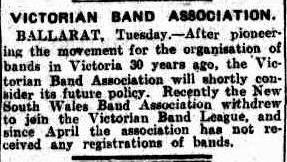
We can see in this picture of another massed bands’ event published in The Age newspaper, and from a pamphlet published by the V.B.L. just how big these events were (“MASSED BANDS’ PERFORMANCE.,” 1933; Sullivan, 1933). . The V.B.L. had come unto its own.

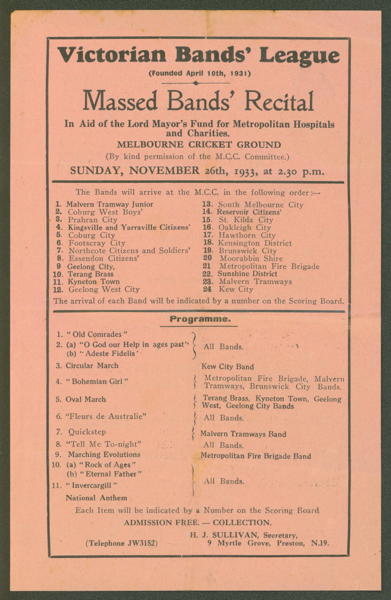
(source: Victorian Bands’ League Archive)
Conclusion:
Such was the state of the Victorian band movement over a period of just over 30 years. This was not just a story on the V.B.A. and the V.B.L., it is a story on the loyalties of the band movement, and the politics. The repeated actions of the metropolitan bands, although questionable at times, eventually brought unity to the movement and a new energy. Perhaps the V.B.A. did not have that same drive or had become too complacent with belief in its own longevity. There are probably many questions still to be asked and hopefully, further details will come to light.
References:
BAND ASSOCIATION. (1901, 02 September). Ballarat Star (Vic. : 1865 – 1924), 6. http://nla.gov.au/nla.news-article207506823
BAND ASSOCIATION. (1902, 02 September). Sydney Morning Herald (NSW : 1842 – 1954), 7. http://nla.gov.au/nla.news-article28243339
BAND ASSOCIATION. (1904, 21 September). Express and Telegraph (Adelaide, SA : 1867 – 1922), 1. http://nla.gov.au/nla.news-article210537933
BAND ASSOCIATION. (1908, 16 July). Geelong Advertiser (Vic. : 1859 – 1929), 2. http://nla.gov.au/nla.news-article148551800
BAND CONFERENCE : The Victorian Association : Its Future Discussed. (1931, 09 November). Age (Melbourne, Vic. : 1854 – 1954), 10. http://nla.gov.au/nla.news-article203727703
BAND CONTROL : VICTORIAN LEAGUE MAKES REQUEST : DESIRES AFFILIATION AS LESSER BODY. (1922, 20 June). Ballarat Star (Vic. : 1865 – 1924), 1-2. http://nla.gov.au/nla.news-article213033941
BAND UNITY MOVE : States Link With Victorian League. (1933, 29 May). Herald (Melbourne, Vic. : 1861 – 1954), 10. http://nla.gov.au/nla.news-article243112744
BANDS ASSOCIATION. (1907, 09 May). Bendigo Independent (Vic. : 1891 – 1918), 3. http://nla.gov.au/nla.news-article226707129
A BANDS DISPUTE. (1923, 05 June). Age (Melbourne, Vic. : 1854 – 1954), 6. http://nla.gov.au/nla.news-article204069486
Bands League : Big Concert Tomorrow. (1931, 26 September). Sporting Globe (Melbourne, Vic. : 1922 – 1954), 6. http://nla.gov.au/nla.news-article182546316
BANDS’ ASSOCIATION. (1917, 22 November). Warrnambool Standard (Vic. : 1914 – 1918), 3. http://nla.gov.au/nla.news-article73972158
The Bandsman’s year book and official programme of the Australian Championship Band Contest. (1938). (Band Association of New South Wales, Ed.). Band Association of New South Wales.
BANDSMEN’S DIFFERENCES. (1922, 23 August). Herald (Melbourne, Vic. : 1861 – 1954), 6. http://nla.gov.au/nla.news-article243651715
BANDSMEN’S DISCORD. (1924, 29 January). Herald (Melbourne, Vic. : 1861 – 1954), 12. http://nla.gov.au/nla.news-article243752239
BANDSMEN’S GOSSIP. (1922, 21 January). Herald (Melbourne, Vic. : 1861 – 1954), 19. http://nla.gov.au/nla.news-article243644473
BENDIGO CITIZENS’ BAND : Headquarters of Band Association. (1917, 07 August). Bendigo Independent (Vic. : 1891 – 1918), 3. http://nla.gov.au/nla.news-article219852652
CONTROL OF BANDS : Disqualification and Fines. (1923, 22 May). Argus (Melbourne, Vic. : 1848 – 1957), 11. http://nla.gov.au/nla.news-article2006296
CONTROL OF BRASS BANDS : The Rival Organisations. (1931, 13 August). Age (Melbourne, Vic. : 1854 – 1954), 9. http://nla.gov.au/nla.news-article203035478
COUNTRY BANDS’ WELFARE. (1932, 15 January). Horsham Times (Vic. : 1882 – 1954), 2. http://nla.gov.au/nla.news-article72597114
de Korte, J. D. (2022a). Malvern, Vic. : Northbrook Stables : VBA Emblem – 1922 Victorian Bands’ Association Certificate (Awarded to the Malvern Municipal & Tramways Band at Ballarat) [Photograph]. [IMG_8078]. Jeremy de Korte, Newington, Victoria.
de Korte, J. D. (2022b). Malvern, Vic. : Northbrook Stables : VBL Emblem – 1935 Victorian Bands’ League Certificate (Awarded to the Malvern Municipal & Tramways Junior Band at the Melbourne Centenary Championships, Melbourne) [Photograph]. [IMG_8080]. Jeremy de Korte, Newington, Victoria.
EASTER BAND CONTESTS : On South Melbourne C.G. (1923, 07 April). Record (Emerald Hill, Vic. : 1881 – 1954), 4. http://nla.gov.au/nla.news-article162535321
GIPPSLAND BAND ASSOCIATION. (1908, 26 March). Bairnsdale Advertiser and Tambo and Omeo Chronicle (Vic. : 1882 – 1918), 2. http://nla.gov.au/nla.news-article85231381
Gippsland Bands’ Association. (1947, 27 November). Gippsland Times (Vic. : 1861 – 1954), 1. http://nla.gov.au/nla.news-article63262669
Hellinger, H. (1923, 26 May). BAND DISCORD : Case for the League. Herald (Melbourne, Vic. : 1861 – 1954), 5. http://nla.gov.au/nla.news-article244028675
ININTERSTATE BANDS TURN DOWN NEW LEAGUE. (1931, 19 May). Herald (Melbourne, Vic. : 1861 – 1954), 4. http://nla.gov.au/nla.news-article242780150
MASSED BANDS PERFORMANCE. (1921, 10 August). Argus (Melbourne, Vic. : 1848 – 1957), 7. http://nla.gov.au/nla.news-article4677374
MASSED BANDS’ PERFORMANCE. (1933, 25 September). Age (Melbourne, Vic. : 1854 – 1954),13. http://nla.gov.au/nla.news-article205107273
MASSED BANDS’ PERFORMANCE. (1933, 25 September). Age (Melbourne, Vic. : 1854 – 1954), 13. http://nla.gov.au/nla.news-article205107273
MELBOURNE AND METROPOLITAN BAND ASSOCIATION. (1907, 12 July). Reporter (Box Hill, Vic. : 1889 – 1918), 6. http://nla.gov.au/nla.news-article92814950
MELBOURNE AND METROPOLITAN BAND ASSOCIATION. (1908, 15 July). Age (Melbourne, Vic. : 1854 – 1954), 9. http://nla.gov.au/nla.news-article197340110
METROPOLITAN BAND CONTEST. (1920, 06 February). Age (Melbourne, Vic. : 1854 – 1954), 9. http://nla.gov.au/nla.news-article202972992
METROPOLITAN BANDS’ PROPOSAL : Thin Edge of Wedge Suspected : VICTORIAN BAND ASSOCIATION DISCUSION. (1924, 17 June). Ballarat Star (Vic. : 1865 – 1924), 6. http://nla.gov.au/nla.news-article214259035
NEW BAND AUTHORITY : Not Recognised by the N.S.W. Association : An Important Decision. (1921, 17 May). Sunraysia Daily (Mildura, Vic. : 1920 – 1933), 4. http://nla.gov.au/nla.news-article258604675
NEW BAND LEAGUE : Support at Bendigo. (1931, 20 July). Argus (Melbourne, Vic. : 1848 – 1957), 9. http://nla.gov.au/nla.news-article4383879
Quickstep. (1921, 23 April). BANDSMEN’S GOSSIP : Achievements and Ideals. Herald (Melbourne, Vic. : 1861 – 1954), 17. http://nla.gov.au/nla.news-article242492106
Royal South Street Society. (2016). Our Disciplines. Royal South Street Society: 125+ years of pure performance gold. Retrieved 14 March 2018 from http://125.royalsouthstreet.com.au/disciplines/
SOUTH-ST. BAND CONTEST : Two Ballarat Bands Join Victorian League. (1932, 16 August). Age (Melbourne, Vic. : 1854 – 1954), 10. http://nla.gov.au/nla.news-article203800235
Sullivan, H. J. (1933). Massed Bands’ Recital : In Aid of the Lord Mayor’s Fund for Metropolitan Hostpitals and Children. In S9 – Programs (Flyer/Pamphlet/Programme ed.). Preston, Victoria: Victorian Bands’ League Archive.
VICTORIAN BAND ASSOCIATION. (1931, 19 May). Age (Melbourne, Vic. : 1854 – 1954), 10. http://nla.gov.au/nla.news-article205850303
VICTORIAN BAND ASSOCIATION. (1933, 05 July). Age (Melbourne, Vic. : 1854 – 1954), 14. http://nla.gov.au/nla.news-article204377301
VICTORIAN BAND ASSOCIATION : ANNUAL MEETING : ELECTION OF OFFICERS. (1924, 22 July). Ballarat Star (Vic. : 1865 – 1924), 6. http://nla.gov.au/nla.news-article213532801
VICTORIAN BAND LEAGUE. (1921, 01 June). Age (Melbourne, Vic. : 1854 – 1954), 13. http://nla.gov.au/nla.news-article203967014
Victorian Bands : A Great Demonstration. (1932, 09 January). Voice (Hobart, Tas. : 1931 – 1953), 8. http://nla.gov.au/nla.news-article218850147
VICTORIAN BANDS : New League’s Activities. (1931, 29 June). Shepparton Advertiser (Vic. : 1914 – 1953), 3. http://nla.gov.au/nla.news-article186773875
VICTORIAN BANDS: Proposed State Districts. (1930, 18 March). Age (Melbourne, Vic. : 1854 – 1954), 11. http://nla.gov.au/nla.news-article202255339
VICTORIAN BANDS LEAGUE : New Organisation Proposed : Metropolitan Control Wanted. (1931, 11 April). Argus (Melbourne, Vic. : 1848 – 1957),14. http://nla.gov.au/nla.news-article4378405
VICTORIAN BANDS’ LEAGUE. (1931, 06 October). Argus (Melbourne, Vic. : 1848 – 1957), 8. http://nla.gov.au/nla.news-article4430001
Victorian Bands’ League. (1933). Massed Bands’ Recital : In Aid of the Lord Mayor’s Fund for Metropolitan Hostpitals and Children [Flyer/Pamphlet/Programme]. Victorian Collections, Victorian Bands’ League. https://victoriancollections.net.au/items/5b6a683c21ea691478cf383e




 Band Blasts from the Past