Trans-Tasman connections: the lure of competition and performance. Part Two – Australian Bands in New Zealand.

Introduction:

In comparison to the first part of this series of posts, the Australian bands were not quite as proactive as crossing the Tasman as their New Zealand counterparts.  When the Australian bands did go to New Zealand, they tended to do very well in competition and performances gained rave reviews.  This part of the post will detail the trips that four Australian bands made to New Zealand between 1900-1940.

1907: Newcastle City Band – Christchurch International Exhibition Contest:
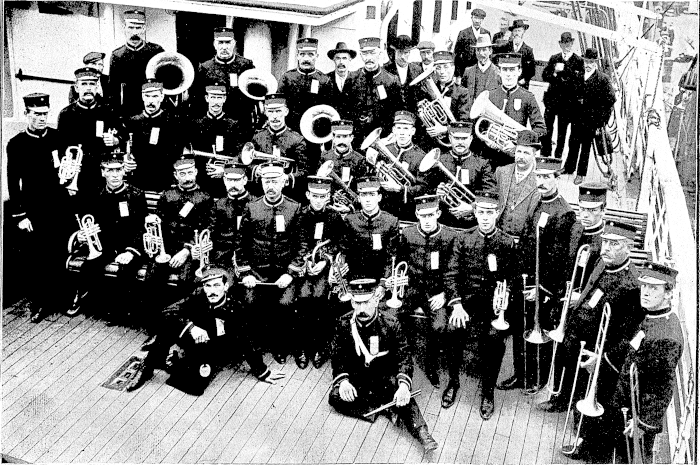
19070213_New-Zealand-Mail_Newcastle-Picture
1907, Newcastle City Band visiting New Zealand. New Zealand Mail, 13/02/1907 (Source: PapersPast)

It took a little bit longer for Australian bands to start reciprocal visits to New Zealand and in 1907 the then champion Newcastle City Band traveled to Christchurch via Wellington to participate in the International Exhibition Contest (“NEWCASTLE CITY BAND.,” 1907).  By all accounts, this was a huge event with no less than twenty-nine bands participating (Newcomb, 1980).  Also in attendance at the Exhibition was the world-famous Besses O’ Th’ Barn Band from England who performed to great acclaim (Newcomb, 1980).  Code’s Melbourne band was also intending to take part in the event however they did not end up going due to some of their bandsmen being unable to take time off work (Trombone, 1907).

The Newcastle Band achieved a very credible third placing against some top-ranking New Zealand bands and some of their soloists also achieved good placings (“BAND CONTEST,” 1907).  However, soon after the contest finished, questions were being asked over the judging with Newcastle and others feeling that Newcastle should have been placed higher.  In an article published in the Wanganui Herald newspaper, a Mr. Edgar Nicholas from Ballarat who was visiting was asked about the adjudicating at the contest by Lieutenant Bentley, formerly of England.  Mr. Nicholas said in his interview that,

I have been at all the band contests in Ballarat, where the principal bands in Australia compete.  We had had Messrs Ord-Hume, Wade, and Beard from England, but, speaking generally, Mr. Bentley has given equal satisfaction in Ballarat with these gentlemen”.

(“THE JUDGING AT THE CONTEST,” 1907)

Speaking pragmatically in the interview, Mr. Nicholas noted that an adjudicator sometimes fails to please everyone given that Mr. Bentley had to judge 30 bands.  Also, as Mr. Nicholas suggests, some bands may not have been at their best given the late hours that some of them competed (“THE JUDGING AT THE CONTEST,” 1907).  Mr. Nicholas kept drawing comparisons with the Ballarat South St. Eisteddfod, the first being that that in the case of large sections, Ballarat employed up to three judges and that in Australia there were separate gradings which, at the time, were not used in New Zealand (“THE JUDGING AT THE CONTEST,” 1907).

One Newcastle bandsman was quite firm in his comments which were published in a Newcastle Morning Herald and Miners’ Advocate newspaper article,

When our band-master tells us we played well I am satisfied.  He tells us often enough when we don’t play well; but we never played better than in the competition.”

(“THE CITY BAND.,” 1907).

Aside from this issue over the placings, most accounts note that the Newcastle City Band had an enjoyable trip and were welcomed in various locations.  On the ship home, they played for an appreciative audience and were welcomed home with a civic reception (“THE CITY BAND.,” 1907).

Band:Own Choice:Test:Total:
Wanganui Garrison158147305
Kaikorai Brass158145303
Newcastle City156146302
(source of table data (Newcomb, 1980, p. 40))

1923: Redfern Municipal Band – South Island Brass Band Association Contest, Dunedin:

Some sixteen years after the first Australian band traveled to New Zealand, it took until 1923 for the next Australian band to arrive.  The Redfern Municipal Band, conducted by Mr. W. Partington, was a formidable band at the time and they undertook a short tour through the South Island of New Zealand on their way from Wellington to Dunedin.  Upon arriving in Wellington, along with a contingent of N.S.W. Bowlers, they were given a large civic reception by the Mayor (“BOWLERS AND BANDSMEN,” 1923).  The arrival of Redfern had generated an amount of excitement throughout New Zealand, suffice to say that their conductor Mr. W. Partington had conducted one of their own champion bands, The Wanganui Garrison Band for a while (“ENTERPRISING BAND,” 1923; Newcomb, 1980) – the band from Redfern was not unknown in New Zealand.

Redfern Municipal was ultimately triumphant in Dunedin by winning the A Grade section and Aggregate.  This was no easy feat given that a number of New Zealand’s A grade bands were in the section, including Mr. Partington’s former band, Wanganui.  Newcomb (1980) wrote of Redfern and the A Grade contest,

In Dunedin, it competed against seven of New Zealand’s top A grade bands.  After a week of intensive rehearsal in the “Edinburgh of the South” Redfern was rewarded for its painstaking efforts when it took out the A grade title 12 points ahead of Invercargill’s Hiberian Band. The 1st Canterbury Mounted Regiment Band was third.

The talking point of the contest was the poor performance of the Wanganui Garrison Band, under Mr. J. Crichton.  The veteran Wanganui conductor’s ambition was to thrash the Redferners…”

(p. 44)

Of course the triumph was noted in Australian and New Zealand newspapers, and rightly so, it was a great win for the Redfern band (“BAND CONTEST,” 1923; “REDFERN BAND,” 1923).  However, the backstory of the two conductors was intriguing and written up as part of an article published by the NZ Truth newspaper:

There is an interesting story (perhaps) behind the crossing of the Redferners.  Bandmaster Partington was over here for a while, and had charge of the Wanganui Band.  Within a very short period of training under his baton he made champions of them, winning the N.Z. honors last year.  Then there arose a controversy between Partington, of Aussieland and Jim Crichton, of Wanganui, the ex-bootshopman who knocked off trade to become a musician, undergoing a special course of study in London for the purpose of pursuing his brass-bound hobby.  He told P. that if he (C.) had the Woolston Band under his baton for a month he could beat anything that P. could bring against it.  There was such a heated argument that it was leading to something like a £1000 wager.  But P. left for Aussieland again, and took charge of the Redferners.  Now the question is: Did he bring the Sydneysiders over to compete against anything that Jim Crichton had under his wing? Well, Jim took the Wanganui cracks down to Dunedin to play against their old leader – and Wanganui was nowhere in the final!

(“Brass Bands and Bandsmen,” 1923)

When returning to Australia, there was a snippet of thought that the Redfern Band might head to England to compete (“REDFERN BAND,” 1923).  However, this evidently did not eventuate.  Their conductor, Mr. Partington, went on to other activities and formed a representative band that travelled Australia with the aim of heading to England.  But as detailed in a previous post, that tour ended up running out of money upon arrival in Perth.

1925: Malvern Tramways Band – New Zealand National Band Championship, Auckland:
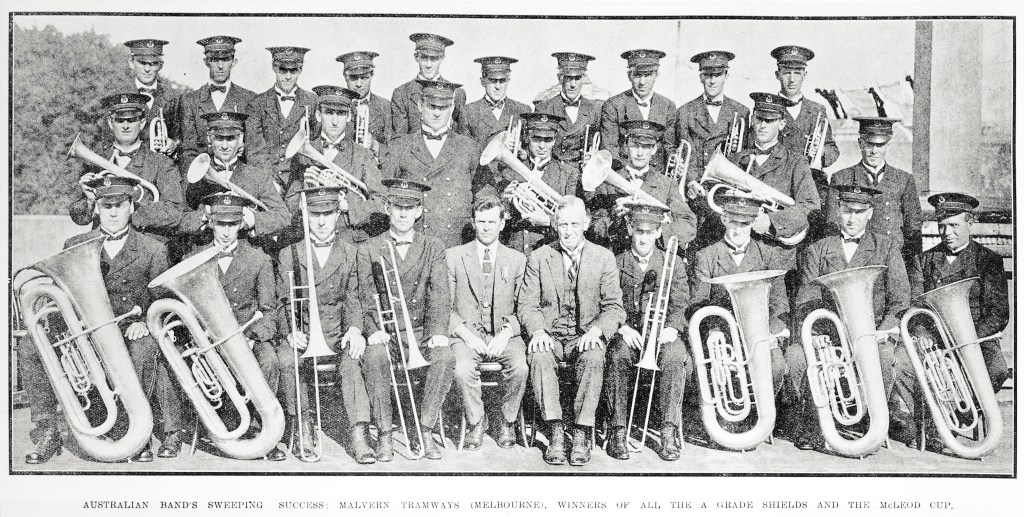
19250305_Auckland-Weekly-News_MalvernTB_
Malvern Tramways Band, Auckland. Auckland Weekly News, 2/03/1925, p. 46. (Source: Auckland Libraries Heritage Collections: AWNS-19250305-46-1)

Just two years later, another crack Australian band made the trip to New Zealand to compete.  The Malvern Tramways Band was renowned throughout Australia as one of the elite bands of the Commonwealth having won numerous competitions by this time.  So much so that the Malvern Band, like many others, tried to get to England however they too were unable to raise sufficient funds.  To compensate, they did arrive in New Zealand early in 1925 to commence a six-week tour culminating in the championships in Auckland (“Malvern Tramways Band,” 1925d).

The reputation of Malvern preceded them to New Zealand and all manner of hospitality was afforded for the band including, special observation cars on trains, reduced rail fares and free travel on New Zealand trams! (“MALVERN TRAMWAYS BAND,” 1925b).  They sailed from Melbourne to Invercargill and from there travelled up to Auckland giving concerts in all the major towns on the way (“MALVERN TRAMWAYS BAND,” 1925a).  By late February they had reached Auckland and commenced competing in the band sections and solo sections.  In competition, the Malvern Tramways band was formidable and they won just about every section except for the Quickstep where they achieved third place (“MALVERN TRAMWAYS BAND.,” 1925b; “MALVERN WINS A GRADE TEST,” 1925).  Newcomb (1980) wrote of the contest:

After many years of bickering, common sense prevailed when the North and South Island associations joined forces to stage the 1925 national contest in Auckland.

It was made doubly interesting by the presence of the Malvern Tramways Band from Australia under the conductorship of Mr. Harry Shugg.

New Zealand’s top A grade bands proved no match for the highly fancied Australian combination which won both tests, the hymn and the championship aggregate.

(p. 45)

After this astounding success in New Zealand, the Malvern Tramways Band sailed for Sydney where they performed their competition repertoire in concert to rave reviews (“MALVERN TRAMWAYS BAND,” 1925c).  Traveling back to Melbourne, the success of their New Zealand venture was written up a couple of months later by the local Prahran Telegraph newspaper (“MALVERN TRAMWAYS BAND.,” 1925a).

1936: Cairns Citizens’ Band – New Zealand National Band Championships, New Plymouth:
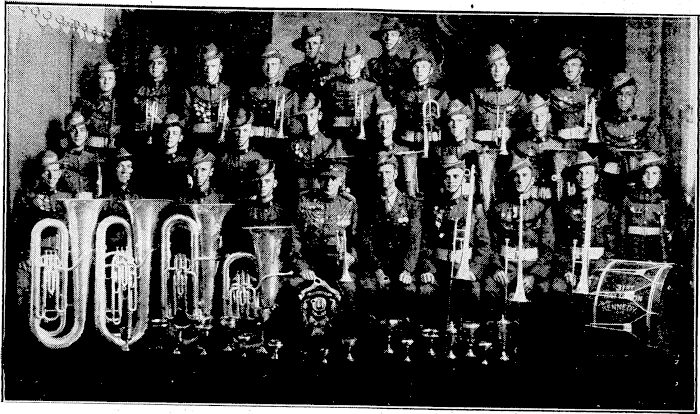
19351123_Evening-Post_Cairns-Band
Cairns Citizens’ (31st Battalion) Band. Evening Post, 23/11/1935. (Source: PapersPast)

In October 1935, the Cairns Post newspaper published the news that the Cairns Citizens’ (31st Battalion) Band would compete at the 1936 New Zealand Band Championships in New Plymouth (“MAKING HISTORY.,” 1935).  Conducted by James Crompton, a person that was not unfamiliar to the New Zealand brass bands, the band was nominally the first band from Queensland to compete in New Zealand and the first from Australian Military Forces (“MAKING HISTORY.,” 1935).

The Cairns Citizens’ Band won the New Zealand Championship that year, although they did not win the Test selection.  However, their aggregate points were enough that they could win the championship (“Cairns Band.,” 1936; Newcomb, 1980).  The New Zealand press was also impressed by the standards set in New Plymouth and an article published in the Evening Post newspaper praised the marching – the Cairns Citizens’ Band achieved 2nd place in the marching section (“GOOD MARCHING,” 1936).

Conclusion:

There was a similarity of experiences for bands crossing to either side of the Tasman; with civic receptions, a very interested and informed public and commentary from the newspapers.  The excitement generated by viewing a visiting band was also interesting to note – and there were plenty of other articles that were written about bands (but too many to list in these posts)!  It was interesting to note just how close the Australian and New Zealand brass band movements were in terms of standards and rules, so much so that any band crossing the Tasman could expect near similar conditions of competition.  The best bands of each country could match the other and in the spirit of competition, this was plain to see.

It is the collegial nature of band movements that enabled these visits to happen and to this day, the friendly rivalries remain, and visits continue to take place.  Kudos to the bands that made these early trips as they set a foundation for other bands to build on.

<- Part One – New Zealand Bands in Australia

References:

Auckland Weekly News. (1925). AUSTRALIAN BAND’S SWEEPING SUCCESS : MALVERN TRAMWYS (MELBOURNE), WINNERS OF ALL THE A GRADE SHIELDS AND THE McLED CUP. In Auckland Weekly News (AWNS-19250305-46-01 ed., pp. 46). Auckland, N.Z. https://kura.aucklandlibraries.govt.nz/digital/collection/photos/id/244635/rec/1 Ngā Pātaka Kōrero o Tâmaki Makaurau / Auckland Libraries Heritage Collections.

AUSTRALIAN BAND FOR NEW ZEALAND CONTEST. (1935, 23 November). Evening Post. https://paperspast.natlib.govt.nz/newspapers/EP19351123.2.26.1

BAND CONTEST : Redfern Win The Aggregate : Wellington Watersiders Third. (1923, 24 February). Evening Post. https://paperspast.natlib.govt.nz/newspapers/EP19230224.2.68

BAND CONTEST : Winners of Competitions. (1907, 16 February). New Zealand Times. https://paperspast.natlib.govt.nz/newspapers/NZTIM19070216.2.61

BOWLERS AND BANDSMEN. (1923, 08 February). Evening Post. https://paperspast.natlib.govt.nz/newspapers/EP19230208.2.25

Brass Bands and Bandsmen. (1923, 03 March). NZ Truth. https://paperspast.natlib.govt.nz/newspapers/NZTR19230303.2.2.4

Cairns Band : Wins Championship. (1936, 02 March). Daily Mercury (Mackay, Qld. : 1906 – 1954), 6. http://nla.gov.au/nla.news-article172909750

THE CITY BAND. (1907, 27 February). Newcastle Morning Herald and Miners’ Advocate (NSW : 1876 – 1954), 5. http://nla.gov.au/nla.news-article136605589

ENTERPRISING BAND : Sydney Competition Band Likely to Visit Wanganui. (1923, 12 January). Hawera & Normanby Star. https://paperspast.natlib.govt.nz/newspapers/HNS19230112.2.17

GOOD MARCHING : Port Nicholson Band : Recent National Contest. (1936, 09 March). Evening Post. https://paperspast.natlib.govt.nz/newspapers/EP19360309.2.25

THE JUDGING AT THE CONTEST. (1907, 15 February). Wanganui Herald. https://paperspast.natlib.govt.nz/newspapers/WH19070215.2.32

MAKING HISTORY : Band For New Zealand : Cairns to Cross Tasman. (1935, 02 October). Cairns Post (Qld. : 1909 – 1954), 5. http://nla.gov.au/nla.news-article41708070

MALVERN TRAMWAYS BAND. (1925a, 20 February). New Zealand Herald. https://paperspast.natlib.govt.nz/newspapers/NZH19250220.2.132

MALVERN TRAMWAYS BAND. (1925b, 20 January). Herald (Melbourne, Vic. : 1861 – 1954), 16. http://nla.gov.au/nla.news-article243874312

MALVERN TRAMWAYS BAND. (1925c, 10 March). Sydney Morning Herald (NSW : 1842 – 1954), 10. http://nla.gov.au/nla.news-article16207234

Malvern Tramways Band : Leaves for New Zealand. (1925d, 13 February). Prahran Telegraph (Vic. : 1889 – 1930), 8. http://nla.gov.au/nla.news-article165132427

MALVERN TRAMWAYS BAND : Recent New Zealand Tour : Success in Competitions. (1925a, 22 May). Prahran Telegraph (Vic. : 1889 – 1930), 6. http://nla.gov.au/nla.news-article165141099

MALVERN TRAMWAYS BAND : Wins Championship of New Zealand. (1925b, 06 March). Prahran Telegraph (Vic. : 1889 – 1930), 7. http://nla.gov.au/nla.news-article165137387

MALVERN WIN A GRADE TEST. (1925, 27 February). Evening Post. https://paperspast.natlib.govt.nz/newspapers/EP19250227.2.83.1

New Zealand International Exhibition. (1907, 12 February). Star, 3. https://paperspast.natlib.govt.nz/newspapers/TS19070212.2.57.2

The Newcastle (N.S.W.) City Brass Band; Champion Band of Australia, At Present Visiting New Zealand. (1907, 13 February). New Zealand Mail. https://paperspast.natlib.govt.nz/newspapers/NZMAIL19070213.2.235.6

NEWCASTLE CITY BAND : Going to New Zealand. (1907, 29 January). Newcastle Morning Herald and Miners’ Advocate (NSW : 1876 – 1954), 5. http://nla.gov.au/nla.news-article136608558

Newcomb, S. P. (1980). Challenging brass : 100 years of brass band contests in New Zealand, 1880-1980. Powerbrass Music for the Brass Band Association of New Zealand. 

REDFERN BAND : New Zealand Triumph. (1923, 09 March). Evening News (Sydney, NSW : 1869 – 1931) ,8. http://nla.gov.au/nla.news-article118834570

Trombone. (1907, 09 February). The Exhibition : The Band Contests. Lyttelton Times. https://paperspast.natlib.govt.nz/newspapers/LT19070209.2.71

Trans-Tasman connections: the lure of competition and performance. Part One – New Zealand Bands in Australia.

GLNZ Series
Wanganui Garrison Band being welcomed in Melbourne. Auckland Weekly News, 10/11/1910. (Source: Auckland Libraries Heritage Collections: AWNS-19101110-4-5)

Introduction:

It would be fair to say that the relationship between Australia and New Zealand, as countries and peoples, has been one of mutual respect, partnership, shared development, and healthy competitiveness.  This has been evident in many instances and has also been evident in the brass band movement.  So much so that over the years from just before 1900 up to 1950, bands regularly crossed the Tasman Sea with the aim of touring, performance, and participating in respective championships.

Travel was not always an easy task and was certainly expensive.  Yet in these early days of ships and trains, bands managed this and for the most part, were met with civic welcomes and hospitality wherever they went.  There were also times when eminent bandsmen also traveled to ply their services as adjudicators, conductors or band coaches.  This allowed a flow of new ideas, expertise and criticism that certainly helped the band movements of both countries.

As far as the information allows it, we will see who went where and when.  It has been interesting to read the perspectives of media from both Australia and New Zealand through using the resources of the Trove archive and DigitalNZ / PapersPast – media of the day reported on everything.  Also, the results database of the Royal South Street Society, the Brass Band Results website (UK) and history books regarding the band history of New Zealand have been very helpful.

For the sake of brevity, this post has been divided into two parts and the details of visits are in basic chronological order.  Part one is about the bands from New Zealand that traveled to Australia and part two highlights four of the Australian bands that went to New Zealand.  There are some fascinating stories to come out of these trips and one can appreciate the initiative.  I hope people enjoy reading both posts.

1897-1899: Invercargill Garrison Band, Oamaru Garrison Band & Wellington Garrison Band – Melbourne & Bathurst:

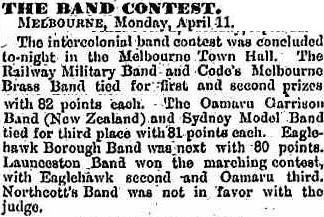
In the few years preceding 1900, Australia received visits from three New Zealand bands in relatively quick succession; the Invercargill Garrison Band in 1897, the Oamaru Garrison band in 1898 and the Wellington Garrison Band in 1899 (Newcomb, 1980).  In 1897 the Invercargill Garrison Band visited Melbourne to compete in the Druid’s Gala Contest in Melbourne and gained a credible forth placing out of the eleven bands that competed (“VICTORIA.,” 1897).  The next year, and in the same contest, the Oamaru Garrison Band visited and was higher placed although there’s some historical conjecture over the scores with an article in the Bendigo Independent newspaper reporting a tied third place other reports saying they achieved second placings in some sections (“THE BAND CONTEST.,” 1898; Newcomb, 1980).

The Bendigo Independent, 12/04/1898, p. 3

In 1899, the Wellington Garrison Band sailed to Australia and after a brief stop in Sydney, they traveled to Bathurst to compete in the Intercolonial Band Contest.  They immediately set the tone of their visit and marched from the railway station to the hotel followed by enthusiastic crowds (“The Wellington Garrison Band.,” 1899).  However, despite being a champion New Zealand band, they were brought undone in Bathurst by the deportment of their bandsmen.  It was widely reported in New Zealand and Australian press that the reason they lost points in the marching was because of  “nine of the bandsmen being unshaved” (“UNSHAVEN BANDSMEN,” 1899).  Apparently Wellington band “forgot” the regulations on shaving and were subsequently placed fifth in the marching even though their playing matched the Code’s Melbourne Band (“Bathurst Band Contest.,” 1899).  This being said, they redeemed themselves by winning the bulk of the solo contests in Bathurst (“BAND CONTEST.,” 1899).

1908 & 1921: Kaikorai Band – South Street Eisteddfod, Ballarat:

Colonist, 14/01/1908, p. 3

Early in 1908, a tiny snippet of news was printed by newspapers across New Zealand; the Kaikorai Band from Dunedin was intending to compete at the Ballarat South Street Eisteddfod in October – as seen here in this advertisement published by the Colonist newspaper (“Kaikorai Band,” 1908).  The Kaikorai band was another one of New Zealand’s top bands at the time and obviously felt that they could take on the best of Australian brass bands (Newcomb, 1980). However, things did not go quite to plan on the day and Newcomb (1980) outlined one the main reasons:

Everything went wrong after one of the band’s top soloists, Billy Flea, cracked his lip.  The Flugel Horn solo had to be taken by Jim Pearson.  Though Billy was a strong player, Jim was the reverse.  As a result, another soloist, who was in the habit of relying on the finish of the Flugel solo to dovetail his entry, simply didn’t hear Jim, so never got started!

Conductor Laidlaw was so taken aback that his baton simply froze.  Some of the bandsmen maintained that the Scots conductor turned a shade of green! It was to his credit, however, that after the initial shock he pulled the band together.

(p. 40)

This, of course, was reflected in the comments on their playing, an account that was published in the Otago Witness newspaper (“Kaikorai Band at Ballarat,” 1908). However, the Kaikorai Band did achieve one triumph when they won the discipline prize for their marching.

(Royal South Street Society, 1908a, 1908b)

In 1921 the Kaikorai Band returned to South Street to compete, however on this occasion they did not go as well as Australian bands had developed quite a bit in preceding years and Kaikorai was no match for them (Newcomb, 1980).  The only success on this occasion occurred in the Septette section where their group achieved first place.

(Royal South Street Society, 1921a, 1921b)

1910: Wanganui Garrison Band – South Street Eisteddfod, Ballarat:

Two years after the Kaikorai band visited South Street, another one of New Zealand’s top bands, the famous Wanganui Garrison Band made the trip.  Conducted by Mr. James Chrichton for 21 years and succeeded by Mr. Alfred Wade in 1908, the band had built up an enviable contesting record and in 1910 they made the trip to Australia to compete (Newcomb, 1980; Zealley & Ord Hume, 1926).

Needless to say, the Wanganui Garrison Band was very successful at South Street and won both the Quickstep and Test sections over the Collingwood Citizens’ Band and both Ballarat bands – Prout’s and City (“THE GRAND BAND CONTESTS,” 1910).  As well as this superb win in the band contest, Wanganui also had many soloists and ensemble enter various sections, and they were similarly successful with many of them gaining places.

(Royal South Street Society, 1910a, 1910b, 1910c, 1910d)

When Wanganui returned to Melbourne, they were given a rapturous welcome by the Lord Mayor and the Agent for New Zealand (pictured at the start of this post) (“THE WANGANUI BAND.,” 1910).  After leaving Melbourne they traveled to Albury where they were given another civic reception (“WANGANUI BAND,” 1910).  From Albury, they traveled to Sydney to take a ship back to Auckland where they were greeted with a huge celebration by proud New Zealanders (“VICTORY OF THE WANGANUI BAND,” 1910).

1920: 2ndSouth Canterbury (Timaru) Regimental Band – South Street Eisteddfod, Ballarat:

19131121_Invercargill_Timaru-Regimental
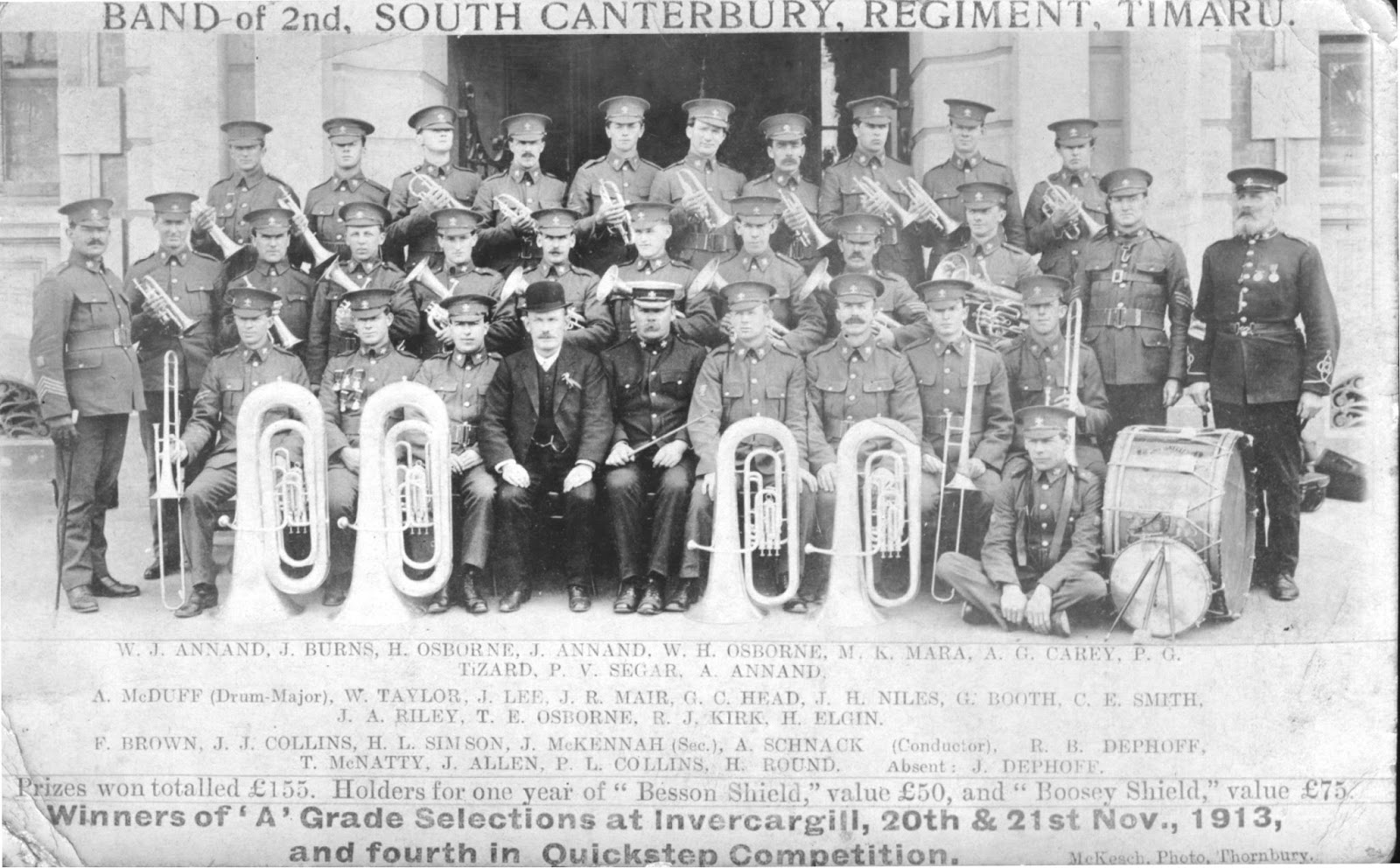
Band of 2nd, South Canterbury, Regiment, Timaru (Source: Early New Zealand Photographers)

After the First World War ended and bands were gradually getting back to normal activities, the South Street Eisteddfod resumed and the 2nd South Canterbury Regimental Band, also known as the Timaru Regimental Band, ventured to Australia to compete in the 1920 contests.  Despite them being a national champion band in New Zealand, at least before the war, their results in Ballarat were not that spectacular (Newcomb, 1980).  That being said, the A Grade section did include Malvern Tramways Band, Ipswich Vice-Regal Band, South Sydney and the City of Ballarat – Timaru came up against some of the best in Australia at the time.  Timaru Regimental did have some success in the Trombone Trio and placings in other solo sections so their experience of South Street was somewhat worthwhile (“SOUTH STREET BAND CONTESTS.,” 1920).

(Royal South Street Society, 1920a, 1920b, 1920c)

1934: Woolston Band – South Street “Centenary” Brass Band Contest, Ballarat:

In 1934 in the midst of a depression, the Woolston Band from Christchurch managed to find enough funds to make the trip to Ballarat with the aim of competing in the 1934 South Street “Centenary” Brass Band Contests – the name given as it was Victoria’s Centenary year since it became a separate colony.  This was an auspicious event as it was attended by the Duke of Gloucester and the Band of His Majesty’s Grenadier Guards.

By all accounts they acquitted themselves very well and up against some of Australia’s best bands, they achieved second place.  They did have some setbacks though.  Newcomb (1980) writes of Woolston’s effort:

The Woolston Band may well have won the contest had it not drawn the dreaded No. 1 position in the second test piece.  Bad weather resulted in a last-minute decision to stage the event indoors, and when the band started its performance it became evident that the standard seating formation did not conform with the acoustics of the hall.

After the contest, the adjudicator, Mr. Stephen York, told Mr. Estell the Woolston Band had not scored well because it was not properly balanced.  Moreover, to add to the band’s misfortune, five members were suffering from influenza.

(p. 47)

The standard of competition was very high and this was noted by the press that attended the event (“BRILLIANT PLAYING,” 1934).  The winning band was the famed Melbourne Fire Brigade Band.

(Royal South Street Society, 1934)

19341101-19341103_South-Street-Centenary-Contest_p3-p4
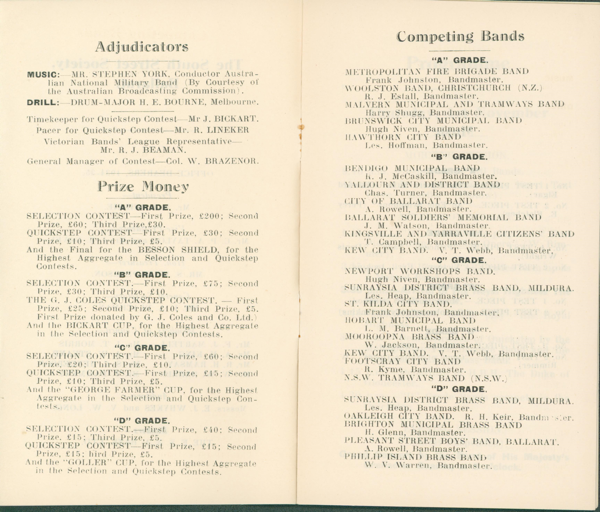
Programme, South Street “Centenary” : Brass Band Contest : A, B, C and D Grades, pg. 3-4. (Souce: Victorian Collections: Victorian Bands’ League Archives)

1947: Wellington Waterside Workers Silver Band / Auckland Junior Waterside Workers Band – Australian Band Championships, Newcastle:

After the cessation of the Second World War, band competitions resumed in New Zealand and Australia and in 1947 the Australian Band Championships were held in Newcastle, N.S.W.  Two New Zealand Bands made the trip to Newcastle that year with the Wellington band competing in A grade and the Auckland band competing in B grade.  On this occasion, both bands did not receive a civic welcome to Newcastle but instead were awarded a function put on by the Newcastle Waterside Workers’ Social Committee (“Waterside Bands To Be Welcomed,” 1947).

Out of these two bands, the Wellington Waterside Band was the only one to gain a placing by achieving 3rd place however their soloists won most sections (Newcomb, 1980).  The Auckland Junior band did not gain any placing and the A Grade championship was won by the Melbourne Fire Brigade Band (“FIREMEN SCORE IN BAND CONTEST,” 1947).  Both Waterside bands performed at other events during their stay which helped contribute money to various waterside workers’ benefit funds (“New Zealand Bands Guest Artists,” 1947).

1949: St. Kilda Municipal Band – South Street Eisteddfod, Ballarat:

In 1949 the St. Kilda Municipal Band from Dunedin, elated by their success at the Auckland NZ Band Championships this same year, decided to come to Ballarat and compete for the Australian championship as well (Newcomb, 1980).  Make the trip they did, and doing things differently to other New Zealand bands that had previously traveled to Australia, instead of taking a ship, they flew! (“NZ BAND WILL FLY HERE,” 1949).

To have a New Zealand band of this caliber at South Street was a major drawcard and they convincingly won or came 2nd in every section that they participated in (“NZ band has a big day at Ballarat,” 1949).  The section included bands from Ballarat and the famous Brisbane Excelsior Band.

(Royal South Street Society, 1949a, 1949b)

Conclusion:

In concluding part one of this series of posts, one must admire the drive and determination of the New Zealand bands.  Success was never a guarantee; however, it was shown that the best New Zealand bands were certainly a match for the crack Australian bands (and vice versa).  Having bands visit from New Zealand was also a major drawcard to competitions for the visiting public.

In part two of this series, we can see how the Australian bands fared in New Zealand.

Part Two – Australian Bands in New Zealand ->

References:

THE BAND CONTEST. (1898, 12 April). Bendigo Independent (Vic. : 1891 – 1918), 3. http://nla.gov.au/nla.news-article184290848

BAND CONTEST. (1899, 11 November). Australian Star (Sydney, NSW : 1887 – 1909), 5. http://nla.gov.au/nla.news-article228744480

Bathurst Band Contest : Complaints from New Zealand. (1899, 17 November). Bathurst Free Press and Mining Journal (NSW : 1851 – 1904), 2. http://nla.gov.au/nla.news-article63910068

BRILLIANT PLAYING : Ballarat Band Contest. (1934, 05 November). Evening Post. https://paperspast.natlib.govt.nz/newspapers/EP19341105.2.61

Early Canterbury Photography. (2014, March). McKesch, Henry John. Early New Zealand Photographers and their successors. http://canterburyphotography.blogspot.com/2014/03/mckesch-henry-john.html

FIREMEN SCORE IN BAND CONTEST. (1947, 22 September). Newcastle Morning Herald and Miners’ Advocate (NSW : 1876 – 1954), 2. http://nla.gov.au/nla.news-article134239668

THE GRAND BAND CONTESTS : Close of South-St Competitions. (1910, 24 October). Ballarat Star (Vic. : 1865 – 1924), 1. http://nla.gov.au/nla.news-article216382480

Kaikorai Band. (1908, 14 January). Colonist, 3. https://paperspast.natlib.govt.nz/newspapers/TC19080114.2.24.1

Kaikorai Band at Ballarat. (1908, 11 November). Otago Witness. https://paperspast.natlib.govt.nz/newspapers/OW19081111.2.151

N. Z. Govt., & Auckland Weekly News. (1910). THE WANGANUI GARRISON BAND IN MELBOURNE. In Auckland Weekly News (pp. 4). Auckland, N.Z. https://kura.aucklandlibraries.govt.nz/digital/collection/photos/id/194687/rec/33 Ngā Pātaka Kōrero o Tâmaki Makaurau / Auckland Libraries Heritage Collections.

New Zealand Bands Guest Artists. (1947, 19 September). Newcastle Morning Herald and Miners’ Advocate (NSW : 1876 – 1954), 6. http://nla.gov.au/nla.news-article134230123

Newcomb, S. P. (1980). Challenging brass : 100 years of brass band contests in New Zealand, 1880-1980. Powerbrass Music for the Brass Band Association of New Zealand. 

NZ band has big day at Ballarat. (1949, 31 October). Argus (Melbourne, Vic. : 1848 – 1957), 12. http://nla.gov.au/nla.news-article22788890

NZ BAND WILL FLY HERE. (1949, 27 August). Herald (Melbourne, Vic. : 1861 – 1954), 8. http://nla.gov.au/nla.news-article243675387

Royal South Street Society. (1908a, 21 October). 1908-10-21 Brass Solo Contests. Royal South Street Society. Retrieved 20 July 2019 from https://results.royalsouthstreet.com.au/results/1908-10-21-brass-solo-contests

Royal South Street Society. (1908, 24 October). 1908-10-24 Brass Band Contests. Royal South Street Society. Retrieved 20 July 2019 from https://results.royalsouthstreet.com.au/results/1908-10-24-brass-band-contests

Royal South Street Society. (1910a, 17 October). 1910-10-17 Brass Solo Contests. Royal South Street Society. Retrieved 20 July from https://results.royalsouthstreet.com.au/results/1910-10-17-brass-band-contests

Royal South Street Society. (1910b, 18 October). 1910-10-18 Brass Solo Contests. Royal South Street Society. Retrieved 20 July from https://results.royalsouthstreet.com.au/results/1910-10-18-brass-band-contests

Royal South Street Society. (1910c, 19 October). 1910-10-19 Brass Solo Contests. Royal South Street Society. Retrieved 20 July 2019 from https://results.royalsouthstreet.com.au/results/1910-10-19-brass-band-contests

Royal South Street Society. (1910d, 20 October). 1910-10-20 Brass Band Contests. Royal South Street Society. Retrieved 20 July 2019 from https://results.royalsouthstreet.com.au/results/1910-10-20-brass-band-contests

Royal South Street Society. (1920, 18 October). 1920-10-18 Brass Solo Contests. Royal South Street Society. Retrieved 20 July 2019 from https://results.royalsouthstreet.com.au/results/1920-10-18-brass-solo-contests

Royal South Street Society. (1920b, 20 October). 1920-10-20 Brass Solo Contests. Royal South Street Society. Retrieved 20 July 2019 from https://results.royalsouthstreet.com.au/results/1920-10-20-brass-solo-contests

Royal South Street Society. (1920c, 23 October). 1920-10-23 Brass Band Contests. Royal South Street Society. Retrieved 20 July 2019 from https://results.royalsouthstreet.com.au/results/1920-10-23-brass-band-contests

Royal South Street Society. (1921a, 19 October). 1921-10-19 Brass Solo Contests. Royal South Street Society. Retrieved 20 July 2019 from https://results.royalsouthstreet.com.au/results/1921-10-19-brass-solo-contests

Royal South Street Society. (1921b, 22 October). 1921-10-22 Brass Band Contests. Royal South Street Society. Retrieved 20 July 2019 from https://results.royalsouthstreet.com.au/results/1921-10-22-brass-band-contests

Royal South Street Society. (1934a, 01 November). 1934-11-01 Brass Band Contests. Royal South Street Society. Retrieved 20 July 2019 from https://results.royalsouthstreet.com.au/results/1934-11-01-brass-band-contests

Royal South Street Society. (1934). South Street “Centenary” : Brass Band Contest : A, B, C and D Grades  [Programme]. Royal South Street Society. https://victoriancollections.net.au/items/5d425e0c21ea6b1a84382033 

Royal South Street Society. (1949a, 28 October). 1949-10-28 Brass Band Contests. Royal South Street Society. Retrieved 20 July 2019 from https://results.royalsouthstreet.com.au/results/1949-10-28-victorian-brass-band-championship

Royal South Street Society. (1949b, 29 Ocotober). 1949-10-29 Brass Band Contests. Royal South Street Society. Retrieved 20 July 2019 from https://results.royalsouthstreet.com.au/results/1949-10-29-victorian-brass-band-championship

SOUTH STREET BAND CONTESTS. (1920, 25 October). Argus (Melbourne, Vic. : 1848 – 1957), 3. http://nla.gov.au/nla.news-article4575694

UNSHAVEN BANDSMEN. (1899, 10 November). Hawke’s Bay Herald. https://paperspast.natlib.govt.nz/newspapers/HBH18991110.2.22.1

VICTORIA : Intercolonial Band Contest. (1897, 22 April). Express and Telegraph (Adelaide, SA : 1867 – 1922), 4. http://nla.gov.au/nla.news-article209088576

VICTORY OF THE WANGANUI BAND : Magnificent Performance : Only Three off Possible in “Own Choice”. (1910, 03 November). New Zealand Times. https://paperspast.natlib.govt.nz/newspapers/NZTIM19101103.2.14

WANGANUI BAND : A Civic Reception. (1910, 29 October). Border Morning Mail and Riverina Times (Albury, NSW : 1903 – 1920), 5. http://nla.gov.au/nla.news-article111390543

THE WANGANUI BAND : Mayoral Reception in Melbourne. (1910, 27 October). Ballarat Star (Vic. : 1865 – 1924), 1. http://nla.gov.au/nla.news-article216382888

Waterside Bands To Be Welcomed. (1947, 11 September). Newcastle Sun (NSW : 1918 – 1954), 2. http://nla.gov.au/nla.news-article157898304

The Wellington Garrison Band. (1899, 07 November). National Advocate (Bathurst, NSW : 1889 – 1954), 2. http://nla.gov.au/nla.news-article156812212

Zealley, A. E., & Ord Hume, J. (1926). Famous Bands of the British Empire : Brief Historical Records of the recognized leading Military Bands and Brass Bands in the Empire. J. P. Hull. 

Finding National consensus: how State band associations started working with each other

19230205_Daily-Mail_Aus-Band-Committee
Daily Mail, 5/02/1923, p. 3

Introduction:

For nearly as long as we have had formal brass bands in Australia, we have had band associations.  These early groupings were either large or small where affiliated bands worked with each other.  Except for perhaps in Victoria where, as we found in a previous post, they experienced some major upheaval just thirty years after the first band association came into being.  However, the collegial atmosphere brass bands led to associations that tried to foster common aims and ideals.

One core function of a band association was the formulation of rules of competition and association.  It would be fair to say that some of these rules were contentious back then (even as they are sometimes now).  This being said, the function of competition rules was to make sure that every competing ensemble was on a level playing field with other bands. There were the odd protests, of course, this goes without saying.  Generally, the judgment of State associations held when questioned. However, with all States creating rules of competition, when it came to bands wanting to compete in other States, this undoubtedly caused problems at times.  The States then tried to start working with one another to bring some uniformity in rules for competitions that attracted interstate entrants.

Hence the subject of this post. This is an examination of how the State band associations tried to put aside their differences and work with each other.  This post is not a synthesis of the different State competition rules.  As will be seen, uniformity was not an easy process and some iterations of a National Council did not last long.  Undoubtedly the War years intervened in the activities of bands, so a working National Council was further fragmented and delayed.  When reading this post, people might get a sense of déjà vu, however, this will be open to individual interpretation.  This is just another of those fascinating stories that add further history to the activities of Australian bands and bandsmen.

The early years, 1900 – 1930:

The current iteration of our ‘National Band Council of Australia” (N.B.C.A.) dates back to 1930s and their competition result archive and history reflects this (National Band Council of Australia, 2024a, 2024b).  However, efforts by the State associations to work together and hold National competitions predate this by at least three decades. 

The first State band association to form in Australia was the Band Association of New South Wales (B.A.N.S.W.) in 1895 and they staged their first interstate band competition in Sydney, 1896 (Greaves, 1996).  This was followed by the Victorian Bands’ Association (V.B.A.) in 1901 with other State association forming soon after (Greaves, 1996).  With each State association now assuming responsibility for running competitions, there were a number of rule differences for bands to negotiate, especially if they competed in interstate events.

In October 1903, prior to the Royal South Street band competitions, the Victorian Bands’ Association (V.B.A.) held their 2nd Annual General Meeting, and it is within the report presented by President Mr. Frederick Sutton and Secretary Mr. W. H. Betters that we see the first indications of State band associations wanting to work together to hold Australian band championships (“VICTORIAN BAND ASSOCIATION,” 1903).  The relevant parts of this report read as follows:

In connection with contest work your executive devised a scheme whereby the vexed question of the band championships of Australia have been determined upon conditions that should be satisfactory to all.  The basis of the championships, as you are already aware, was placed before the Band Association of New South Wales and met with its approval, so that the first and second-class Australian band championships are now strictly under the joint control of the two associations.  An agreement was effected with the New South Wales Association whereby our association, being the founders of the project, should have the right to introduce the first-class championship contest of Australia this year (1903).  The promoters of the South street contests, Ballarat, applied for the privilege of holding, for determination at their competitions, the first-class championship for this year, and your delegates granted the application.

[…]

It was satisfactory to notice that the New South Wales and Victorian Associations had mutually agreed upon a championship being established on a legislative and businesslike basis, a matter in which the Victorian Association had taken the initiative.

(Sutton and Betters in “VICTORIAN BAND ASSOCIATION,” 1903)

A report of the 1903 Royal South Street Band Sections published by The Argus newspaper confirms that this championship was the first given the status of an Australian championship.

By arrangement of the Victorian and New South Wales Band Associations, the first-prize taker in the principal event at this gathering will secure the championship of the Commonwealth.

 (“SOUTH-STREET COMPETITIONS.,” 1903)

The Newcastle City Band from New South Wales was the winner of the Royal South Street competition in 1903. (Royal South Street Society, 1903)

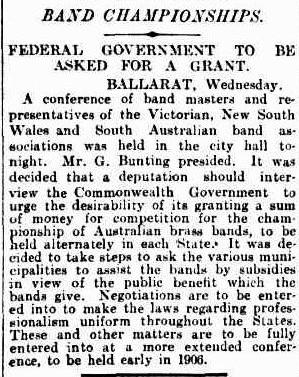
Of course, this initiative did not end here.  During the 1905 South Street contests, another conference of band representatives took place.  However, this time, they included representatives from South Australia.  As can be seen in the article below, the aim of this conference was to approach the Commonwealth Government for a grant to hold Australian championships alternating between various States, and to bring about uniformity in rules (“BAND CHAMPIONSHIPS.,” 1905).  These early conferences, while well-meaning, did become a repetitive process with no real resolutions.

The Age, 26/10/1905, p. 6

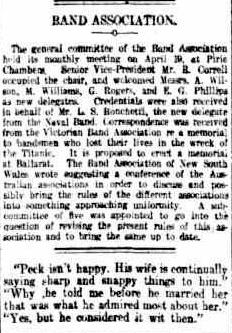
In general, these State band associations affiliated with each other and recognized each other’s rules and processes.  And it was not uncommon for letters and other correspondence from State associations to be presented at various meetings.  A decade on from the 1903 competitions in Ballarat, and eight years on from the 1905 conference in Ballarat, the South Australian Band Association (S.A.B.A.) received a letter from B.A.N.S.W. “suggesting a conference of the Australian associations in order to discuss and possibly bring the rules of the different associations into something approaching uniformity.” (“BAND ASSOCIATION.,” 1913).

The Register, 24/04/1913, p. 4

Notwithstanding the disruption of the First World War on Australian society in general, once this had finished the associations carried on with their activities.  It is in the year of 1921 where we see the next mention of a National Council being formed through an article published in the The Argus newspaper reporting on a conference held in Ballarat.  A summary of the article tells us that:

  • An Australian Band Council has been formed
  • “Only one association from each state is to be recognized.”
  • An order of States has been decided as to who will host the next championships.

(“INTERSTATE BAND CONFERENCE.,” 1921)

Slightly more detail on this 1921 Ballarat conference was provided by the Northern Star newspaper brass band correspondent, ‘Drummer Boy’ where he has noted that, in addition to only one association being recognized in each State, “only players of bands affiliated with that association will be permitted to play in contests in other States.” (Drummer Boy, 1921).  There was also another discussion on how many professional musicians could play in each band, with the recognition that brass bands were essentially amateur groups. The next conference was to be held in Brisbane (Drummer Boy, 1921).

There may or may not be a connection, but a picture of an “Australian Band Committee” was published by the Daily Mail in 1923 (pictured at the head of this post) (“AUSTRALIAN BAND COMMITTEE.,” 1923).  Perhaps this is a result of the aforementioned Brisbane conference although, at this stage, the connection is unclear.

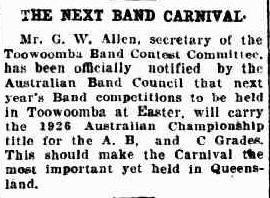
Toowoomba Chronicle and Darling Downs Gazette, 28/05/1925, p. 4

While there had been championships held in various States billed as interstate band contests, they were essentially conducted by the respective State association under their own rules. However, the formation of an Australian Band Council meant that championships could now be held under National rules and patronage.  In 1925 we see how this is affected through a tiny article published in the Toowoomba Chronicle where the 1926 Toowoomba competitions “at Easter will carry the 1926 Australian Championship title for the A, B, and C Grades” (“THE NEXT BAND CARNIVAL.,” 1925).  This is an important step in banding competitions as it is now evident that the States had actually agreed on common rules and a national committee had given patronage to a competition.  This recognition was not forgotten by local brass bands.  In 1927, the Victorian Band Association (V.B.A.) upheld a protest brought about by one band, which was written up in an article published by The Age newspaper:

Malvern Tramways Band complained that two other bands in Melbourne were claiming themselves to be Australian champions, and a ruling was sought.  It was set out that the title of the Australian championship was legitimately held to belong to Malvern Tramways Band by reason of its success in winning the Australian championship contest at Toowoomba, Q. last Easter. The association secretary (Mr. W. Martin) stated that he had replied that the Queensland Band Association had the right to grant the championship in 1926, and by its success at the Toowoomba contest Malvern Tramways Band was thereby the possessor of the title.  The matter was one in which the band itself could take what action it considered advisable.”

(“Victorian Band Association.,” 1927)

On a side note and somewhat related, this was a perfect case of when a State association proved to be effective on one ruling but failed to uphold another ruling.  The two other bands that Malvern Tramways was referring to in their protest were their two main crosstown rivals: Brunswick City Municipal Band and Collingwood Citizens’ Band. In the latter part of 1927, these two bands held a “challenge contest’ at the Exhibition Building with adjudicators “P. Jones, P. Code & R. McAnally” presiding (“CHALLENGE BAND CONTEST.,” 1927).  Interestingly, the presenters of this contest declared that “This contest…will decide which is the best brass band in Australia” (“CHALLENGE BAND CONTEST.,” 1927).  Needless to say the Victorian Bands’ Association was not pleased about this contest and they tried to disqualify both Brunswick and Collingwood – which brought about a response from Brunswick accusing the V.B.A. of over-stepping itself as the current VBA rules “do not provide for a challenge contest” (“BEST BAND DISCORD,” 1927).  The challenge contest still went ahead with Collingwood winning by two points (Greaves, 1996).

The 1930’s:

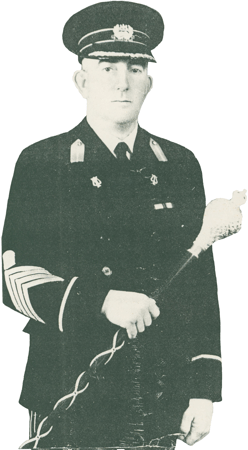
1937. Lieut. K. G. Kennedy. The well-known Drum-Major and Adjudicator, also President of the Australian Bands’ Council. (Source: Victorian Bands’ League Archives)

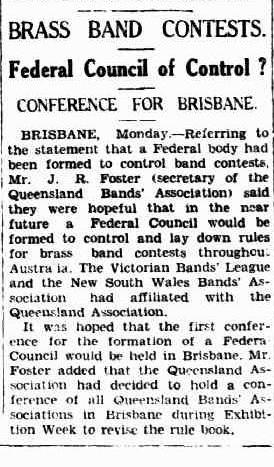
If the preceding two decades could be regarded as tentative, the next two decades where the National Council was reformed could be regarded as consolidation.  In 1931 a new Victorian Bands’ League was formed by a large group of Melbourne metropolitan bands and every other band in the State rapidly affiliated.  This led to the demise of the VBA and we see in a Herald article from 1933, the other State associations recognized the VBL as the single association for bands in Victoria and they sent through their affiliations with the new league (“BAND UNITY MOVE,” 1933).  In the same article, Mr. H. G. Sullivan, Secretary of the VBL “said he wanted to see the formation of an Australian Band Council to unify band contests throughout Australia” (“BAND UNITY MOVE,” 1933).  This move was also welcomed in other States.  The Secretary of the Queensland Band Association (Q.B.A.) Mr. J. R. Foster, “said they were hopeful that in the near future a Federal Council would be formed to control and lay down rules for brass band contests throughout Australia.” (“BRASS BAND CONTESTS.,” 1933).

19330627_Toowoomba-Chronicle_Band-Council-Control
Toowoomba Chronicle and Darling Downs Gazette, 27/06/1933, p. 4

A clue as to why the National Council was resurrected at this time lies in a long newspaper article from 1934 published in the Central Queensland Herald newspaper in which Mr. Foster, was interviewed.  He provided some enlightening history:

“Years ago the whole of the State Band Associations throughout Australia were controlled by a Central Australian Band Conference, but since 1918 this body has not functioned although several attempts were made to revive the Council” said Mr. Foster yesterday.

“Last year, through the efforts of the Q.B.A., negotiations were made between New South Wales and the Victorian Bands’ League to hold a conference representing all States to endeavour to formulate a set of rules applicable to band contests throughout the Commonwealth.”

“The conference, which will be held in Sydney, will commence on April 9 and all States except Western Australia have expressed their intention of being represented.”

“Included in the agenda will be a suggestion from Queensland that every effort will be made to establish an Australian school for band music on the same lines as Knellar Hall in England.”

“If this could be achieved it would be of inestimable help to building band-masters to study the theory of music and up to date band training methods”

“At present time all State Associations are affiliated, but it is felt that the establishment of a uniform set of contesting conditions will further cement the co-operation already existing amongst the State Associations.”

(“HALL OF BAND MUSIC,” 1934)

The history of the current NBCA notes that its official formation was on the 13th of April 1934 which correlates with these events. (National Band Council of Australia, 2024b).  A small publication comprising of a constitution, contest rules and quickstep & marching regulations was also published for the Australian Band Council at this time (Australian Band Council, 1934)

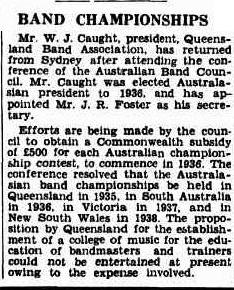
No doubt this is an interesting set of developments and hopeful proposals.  Evidently, the State associations were quite collegial in the way they were now operating.  It seems, however, that “The proposition by Queensland for the establishment for a college of music for the education of bandmasters and trainers could not be entertained at present owing to the expense involved.” (“BAND CHAMPIONSHIPS,” 1934).  This being said, an order of National championships was decided – “Queensland in 1935, in South Australia in 1936, in Victoria in 1937, and in New South Wales in 1938.” (“BAND CHAMPIONSHIPS,” 1934).

Courier-Mail, 23/0

We also see evidence from this conference on just how difficult it was to achieve unity in rules.  Mr. Dall, then Secretary of S.A.B.A. and the South Australian representative at the conference, was quoted in an article published in the Advertiser newspaper on the 30thof April:

“If such conferences are continued they will be of tremendous benefit to contesting bands in Australia.  We found it difficult to frame rules owing to the different conditions operating in the various States.  In framing a set of rules to apply to all States without seriously affecting any State’s present rules, we found it necessary to compromise on several items so that they would be applicable to all States.”

“If the conferences can be continued there is no doubt that in the near future a set of rules will be framed that will be entirely satisfactory to all bands throughout the Commonwealth.  With this object in view we framed a set of rules for two years trial.”

(“BAND CHAMPIONSHIPS HERE IN 1936,” 1934)

The next biennial conference of the Australian Band Council was held in Brisbane during May 1936.  The Courier-Mail reported on some resolutions which included making Melbourne the national headquarters in future and that all future conferences would be held in Melbourne (“AUSTRALIAN BAND COUNCIL,” 1936).  “Mr. H. J. Sullivan, secretary of the Victorian Bands’ League, who is the Victoria delegate to the council, was appointed permanent Federal secretary of the council.” (“AUSTRALIAN BAND COUNCIL,” 1936).

Courier-Mail, 1/05/1936, p. 18

Evidently, a new President of the Australian Band Council was elected as seen by the picture which was published by the Australasian Bandsman newspaper in 1937 (“Lieut. K. G. Kennedy,” 1937).

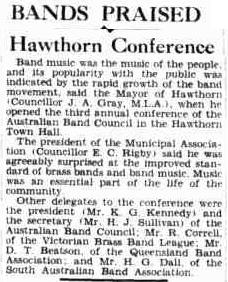
Numerous rule changes were reported on before the commencement of the 1938 conference in Melbourne by the brass band correspondent to the Advertiser newspaper, colloquially known as ‘Baton’. He wrote a very detailed overview of the rule proposals which, unfortunately, cannot be listed here due to brevity.  However, the rule proposals covered areas such as registration, marching and the quickstep competition (Baton, 1938).  The conference, held at Hawthorn Town Hall in suburban Melbourne was a success and the Mayor of Hawthorn gave the conference, and brass bands full praise (“BANDS PRAISED,” 1938).

The Argus, 1/08/1938, p. 2

In 1939 the National Championships were held in Bundaberg, QLD over Easter and we see some reporting of new rules that were decided upon at the Melbourne conference.  The Cairns Post, while highlighting the local brass band that was to take part, also reported that:

Rule nine of the Contest Rules governing all future championship contests now reads:- “(a) The Australian championship shall be competed for annually at a time and place to be decided by the Council, and shall be for “A” grade only”

“(b) State championships shall be held at such time and place as may be decided by the governing body.”

(“BAND CHAMPIONSHIP.,” 1939)
Badge: 1939 Australian Championship Band Contest, Bundaberg
(Source: Jeremy de Korte Collection)

Such are the vagaries of the rules. It was at this time however when the world was again plunged into War and there was a suspension of a majority of band contests.  We next see articles relating to the National band council appear again in the middle to late 1940s.

The 1940s & 1950s:

It appears that the Australian Band Council was quiet during the Second World War years, which was understandable and certainly there is not much evidence to suggest that National competitions took place.  This is not to say there were not local and State competitions during this time, at least in Victoria (Victorian Bands’ League, 1939).  However, as shown by these same records, a competition was held in Frankston, Vic. in late 1945 and early 1946 which was called an “Australian Championship” (Victorian Bands’ League, 1939, p. 34).  While it was called as such, the only bands that participated came from Victoria.

Coming into the 1950s we again see the ideals of the Australian Band Council being reiterated in local newspapers. Published in 1952, an article in the Mudgee Guardian tries to explain what the A.B.C. actually is and what it does:

“While the N.S.W. Band Association controls Band matters within that State, the Australian Band Council is the governing body for Band matters throughout the Commonwealth, and has jurisdiction within each State.

The objects of the A.B.C. are similar to the N.S.W.B.A. that is to say: To ensure that Band contests, solo and part competitions shall be conducted throughout Australia under a uniform set of rules: to deal with any appeals which may be made to the Council by any affiliated State governing body in respect of any action taken under any rule of the Council: to promote a general love and knowledge of Band music and good fellowship amongst Bandsmen: and to promote and assist in the promotion of, and to control Band contests.”

(“BAND SERIES No. 6.,” 1952)

The article then proceeded to highlight other aims and ideals.

Unfortunately, the exact date of a name change to the National Band Council of Australia is unclear.  However, as mentioned, the N.B.C.A. website has published National results dating back 1935 (National Band Council of Australia, 2024a).

19550113_Central-QLD-Herald_ABC-President
Central Queensland Herald, 13/01/1955, p. 17

Conclusion:

The history of the National Council is unique as there were a special set of circumstances needed to make sure it formed and succeeded.  The various starts had similar aims and ideals with the uniformity of rules being first and foremost.  Collegiality was emphasized despite the difficulty in creating a uniform set of rules and procedures.  The interactions between different State associations are clearly highlighted in this regard.  It seems that the State associations tried to make this work with the best of intentions and that is something to be admired.  Certainly, the legacy is still seen today with the continued existence of a National Band Council of Australia and the National band championships which are held each year in a different State.

References:

AUSTRALIAN BAND COMMITTEE. (1923, 05 February). Daily Mail (Brisbane, Qld. : 1903 – 1926), 3. http://nla.gov.au/nla.news-article218974562

Australian Band Council. (1934). Australian Band Council : Constitution : Contest Rules : Quickstep Regulations and Instructions  [Constitution]. Oxford Press. 

AUSTRALIAN BAND COUNCIL : Future Conferences in Melbourne. (1936, 01 May). Courier-Mail (Brisbane, Qld. : 1933 – 1954), 18. http://nla.gov.au/nla.news-article38467409

BAND ASSOCIATION. (1913, 24 April). Register (Adelaide, SA : 1901 – 1929), 4. http://nla.gov.au/nla.news-article59254032

BAND CHAMPIONSHIP : For Australian Title : Cairns Participation. (1939, 25 February). Cairns Post (Qld. : 1909 – 1954), 8. http://nla.gov.au/nla.news-article42169758

BAND CHAMPIONSHIPS. (1934, 23 April). Courier-Mail (Brisbane, Qld. : 1933 – 1954), 16. http://nla.gov.au/nla.news-article1192269

BAND CHAMPIONSHIPS : FEDERAL GOVERNMENT TO BE ASKED FOR GRANT. (1905, 26 October). Age (Melbourne, Vic. : 1854 – 1954), 6. http://nla.gov.au/nla.news-article199409235

BAND CHAMPIONSHIPS HERE IN 1936 : Conference Frames Rules for Two Years’ Trial. (1934, 30 April). Advertiser (Adelaide, SA : 1931 – 1954), 12. http://nla.gov.au/nla.news-article74095881

Band President. (1955, 13 January). Central Queensland Herald (Rockhampton, Qld. : 1930 – 1956), 17. http://nla.gov.au/nla.news-article75434128

BAND SERIES No. 6 : Band Council. (1952, 13 October). Mudgee Guardian and North-Western Representative (NSW : 1890 – 1954), 7. http://nla.gov.au/nla.news-article156439664

BAND UNITY MOVE : States Link With Victorian League. (1933, 29 May). Herald (Melbourne, Vic. : 1861 – 1954), 10. http://nla.gov.au/nla.news-article243112744

BANDS PRAISED : Hawthorn Conference. (1938, 01 August). Argus (Melbourne, Vic. : 1848 – 1957), 2. http://nla.gov.au/nla.news-article12454503

Baton. (1938, 14 July). BANDS AND BANDSMEN : Plans for Band Council Conference. Advertiser (Adelaide, SA : 1931 – 1954), 11. http://nla.gov.au/nla.news-article35597004

BEST BAND DISCORD : Brunswick-Collingwood Contest to Go On. (1927, 23 June). Herald (Melbourne, Vic. : 1861 – 1954), 23. http://nla.gov.au/nla.news-article243967808

BRASS BAND CONTESTS : Federal Council of Control? : Conference for Brisbane. (1933, 27 June). Toowoomba Chronicle and Darling Downs Gazette (Qld. : 1922 – 1933), 4. http://nla.gov.au/nla.news-article254338919

CHALLENGE BAND CONTEST. (1927, 02 August). Corowa Free Press (NSW : 1875 – 1954), 3. http://nla.gov.au/nla.news-article236067765

de Korte, J. D. (2018, 15 March). The politics of affiliation: The Victorian Bands’ Association to the Victorian Bands’ League. Band Blasts from the Past : Anecdotes, Stories and Personalities. https://bandblastsfromthepast.blog/2018/03/15/the-politics-of-affiliation-victorian-bands-association-to-the-victorian-bands-league/

de Korte, J. D. (2022). Newington, Vic. : 1939 Australian Championship Band Contest – Bundaberg [Photograph of tin badge]. [IMG_8028]. Jeremy de Korte, Newington, Victoria. 

Drummer Boy. (1921, 05 November). BANDS AND BANDSMEN. Northern Star (Lismore, NSW : 1876 – 1954), 9. http://nla.gov.au/nla.news-article93081749

Greaves, J. (1996). The great bands of Australia [sound recording] [2 sound discs (CD)]. Australia, Sound Heritage Association. 

HALL OF BAND MUSIC : Australian Proposal. (1934, 05 April). Central Queensland Herald (Rockhampton, Qld. : 1930 – 1956), 8. http://nla.gov.au/nla.news-article70310251

INTERSTATE BAND CONFERENCE. (1921, 27 October). Argus (Melbourne, Vic. : 1848 – 1957), 4. http://nla.gov.au/nla.news-article4629185

Lieut. K. G. Kennedy. (1937, 26 June). Australasian Bandsman

National Band Council of Australia. (2024a). Contest Results: Results from the Australian National Band Championships, 1935 to present. National Band Council of Australia. Retrieved 13 April 2024 from https://nbca.asn.au/archives/results

National Band Council of Australia. (2024b). History of the NBCA. National Band Council of Australia. Retrieved 13 April 2024 from https://nbca.asn.au/about/history

THE NEXT BAND CARNIVAL. (1925, 28 May). Toowoomba Chronicle and Darling Downs Gazette (Qld. : 1922 – 1933), 4. http://nla.gov.au/nla.news-article253924392

Royal South Street Society. (1903). 1903-10-31 Brass Band Contests : Held at City Oval [Eisteddfod Results]. Royal South Street Society Results Database. https://results.royalsouthstreet.com.au/results/1903-10-31-brass-band-contests

SOUTH-STREET COMPETITIONS : CHAMPIONSHIP BRASS BAND CONTESTS. (1903, 30 October). Argus (Melbourne, Vic. : 1848 – 1957), 8. http://nla.gov.au/nla.news-article10579779 

Victorian Band Association : Claim to Australian Championship. (1927, 22 February). Age (Melbourne, Vic. : 1854 – 1954), 9. http://nla.gov.au/nla.news-article204193668

VICTORIAN BAND ASSOCIATION : SECOND ANNUAL MEETING. (1903, 20 October). Ballarat Star (Vic. : 1865 – 1924), 6. http://nla.gov.au/nla.news-article208159835

Victorian Bands’ League. (1939). Notebook – Victorian Bands’ League Contest Records (1939 – 1950)  [Notebook]. Victorian Collections. https://victoriancollections.net.au/items/5b7ce49921ea6916bcdba41c