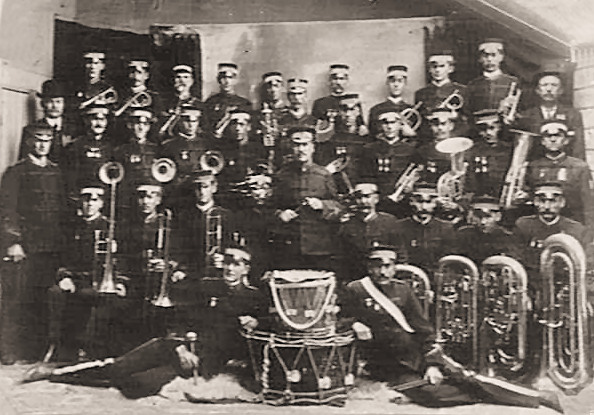
The poetry of brass bands

Introduction:

While undertaking research for my blog posts thus far I have come across all manner of writing describing brass bands, their members and competitions.  Much of the writing is very useful in finding the “little stories” behind people, places and events.  Occasionally I have come across some oddities in the mix and this post is going to highlight an aspect of writing; poetry.

In this context of brass band history, penning up a poem about musicians, bands and competitions might seem very colloquial.  And in some respects, it is.  One only has to look at the style of writing and while the poems might not have won any literature awards, they were helpful in bringing to life some little stories in a unique style.

Below are just three of these brass band poems.  I have not been actively searching for these.  However, if while searching for material on other topics and they appeared, I have made a note of them for the novelty.  These are defiantly the needles in haystacks!  Two of the poems were published in local newspapers by writers using pseudonyms while the third poem was composed by brass band writer C. C. Mullen in his rare book, Mullen’s Bandsmen of South Street (1900 – 1951).

I am quite sure there are other brass band poems in other newspaper articles so this post might be expanded in the future.  Please enjoy the language and stories that are being told here and remember that they were for another time.  Perhaps this blend of artforms might be used again one day.

“A Welcome” by ‘Bannerman’ (1918):

Herald, 23/10/1920, p. 4

One of the first blog posts in Band Blasts from The Past was about the famous Cornetist and Conductor William Ryder who travelled to Australia in 1910 with the renowned Besses O’ Th’ Barn Band (de Korte, 2018).  Just eight years later, after stints with bands in Victoria and New South Wales, he arrived in Maryborough, Queensland to take the reins of the Maryborough Naval Band and we found that an enterprising contributor, under the pseudonym of ‘Bannerman’, had penned a poem to welcome him to town.  No doubt this would have been perceived as a very friendly gesture, and it gave the town some insight into the prowess and reputation of Ryder as a musician.  This poem was published in the Maryborough Chronicle, Wide Bay and Burnett Advertiser on Wednesday, 8thMay, 1918.

A WELCOME

Here’s a hearty welcome “Billy”,
To our pleasant country town,
And may Fortune every lead you,
And misfortune never frown.
We are pleased to have you with us,
And we hope you long may stay
To encourage local talent
In the latest style and way.

When you played the “solo cornet”
With the finest in the land,
You were classed as England’s champion
In the famous “Besses Band.”
And here in fair Australia
You can show us all the way
As the Champion of the Champions
From the South to old Wide Bay.

“Because” we all remember
When you played it at New Year,
When the silvery notes were finished
How the crowd did clap and cheer.
May our town and climate suit you,
May your notes prove ever true.
Here’s good-luck to wife and kiddies,
And long life and health to you.

(Bannerman, 1918, p. 6)

“Back to South Street” by Cecil Clarence Mullen (1951):

There is one brass band musician and writer among many who is significant to early Victorian brass band history, Cecil Clarence Mullen (C. C. Mullen).  His writing might be rare and hard to find now, however, being a band journal representative he had a unique insight into the workings of brass bands and was associated with many famous bands, conductors and administrators (Mullen, 1951).

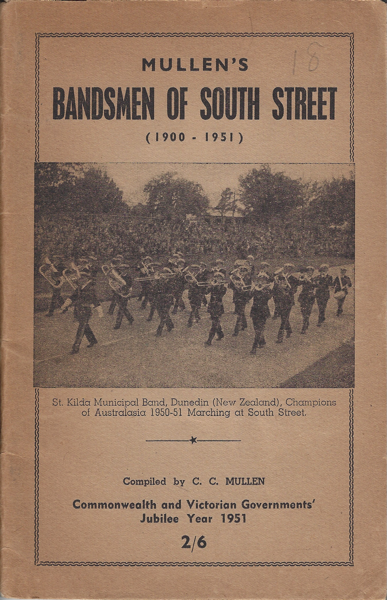
It is in his little book, Mullen’s Bandsmen of South Street (1900 – 1951) that we find his poem, “Back to South Street”. In this piece of writing Mullen has cleverly highlighted the nostalgia of the South Street event while noting many of the famous names of bands and bandsmen.  It is a worthwhile poem to read for the sake of history.
19510000_Mullen
Front Cover Mullen’s Bandsmen of South Street (1900-1951) (Source: Jeremy de Korte Personal Collection)

BACK TO SOUTH STREET

Just let me go back to South Street
For a week with the famous bands,
And take with me others who would compete
In Australia’s Golden City of renown.

Just let me alight at the station
With cornet, trombone and drum,
And meet bandsmen from all over the Nation,
To whom South Street once more come.

Just let me line up in the station yard
And play through Handel’s “Hallelujah Chorus,”
Or “The Heavens Are Telling” by Haydn – just as hard,
As bands played in the days before us.

Just let me march along Sturt Street
With gay crowds lining the way,
With step by step and beat by beat,
Is South Street just the same to-day?

Just let me see who is judging again,
Is it Stead or Bentley with ears for tune?
Short, Beswick, Sutton or Morgan – men of fame,
Or King of them all – J. Ord Hume.

Just let me go through Inspection
As we did when we dressed with much care;
With the gayest uniform in our section,
That made all our rivals stare.

Just let me compete in the solos again
From the grand old Coliseum stage,
With “Adelaide” or “Gipsy’s Warning” – or “Pretty Jane,”
“Zelda” and “Miranda” of a later age.

Just let me mount he platform
And play through “Beethoven’s Works.”
Or any Alexander Owen’s selections
That South Street bands would not shirk.

Just let me play through the Test piece,
Be it “Mercandante.” “Mozart” or “Liszt,”
“Wagner,” “Chopin” of “Meyerbeer,”
The tests that were tests on our lips.

Just let me march in the Quickstep
With Ord Hume’s “B.B. and C.F.”
“The Challenge,” “Cossack” or “Ravenswood”
Or was the “Twentieth Century” the best?

Just let me see the others swing past,
Code’s, Prout’s, Rozelle and Boulder.
Wanganui, Newcastle and Bathurst Brass,
Great names that come dear to the older.

Just let me see those fine Geelong bands,
St. Augustine’s, Municipal and Harbour Trust.
Also Collingwood, Malvern, Richmond, Prahran,
Perth City – all great power among us.

Just let me see Geelong Town again
With Sharpe Brearley at the head of affairs.
They ranked with Prout’s in quickstep fame,
First in marching honours was often theirs.

Just let me see the giants of the baton,
Riley, Code, Bulch and Prout,
McMahon, Barkel, Jones and Hoffman.
Many, alas, have gone out.

Just let me see others again,
Partington, Shugg, Johnston, Bowden.
Men who kept time in South Street’s fame;
Wade and Baile must be among them.

Just let me think if I missed any,
Yes, there was Davison, Niven, Lewins – any more!
Hopkins, Ryder, Billy May among many,
Not forgetting Frank Wright and J. Booth Gore.

Just let me see the best of officials
And critics like Davey, Gartrell and Hellings,
Humphreys and Boyce – Kings of staff and whistle,
May march us again – well, there’s no telling.

So to-day just let me go back to South Street,
Most famous contest in the land,
Where many old timers I will heartily greet,
And yarn over years that were so grand.

(Mullen, 1951, pp. 2-3)

“Dungog Brass Band” by ‘Mad Mick” (1954):

19120000_Dungog-BB_phot16862
Dungog Brass Band, 1912 (Source: IBEW)

Above is a picture of the Dungog Brass Band from around 1912 and unfortunately, this is one of the only pictures I could find of them.  However, some thirty years later this prose was published in the Dungog Chronicle : Dungog and Gloucester Advertiser newspaper by a member of the band writing under the pseudonym of ‘Mad Mick”.  One may wince at some of the language, but this was the 1950s.

From reading the poem it appears that ‘Mick’ is a third cornet player.  This poem is quite good in describing who the band is, what it does and where it goes, but the prose hints at some problems like attendance issues.  We can appreciate that this was a local town band, and this was the way they did things. I think every band has a ‘Mick’ in their midst and we can thank him for highlighting the Dungog Brass Band in the way that he did.

DUNGOG BRASS BAND

I’ve heard it said that Old King Cole was happy, gay and free,
And he liked music sweet and low, played by his fiddlers three,
But in Dungog we’re luckier than King Cole in his day,
We have a band of 25 with band-master, Bob Gray;
And of this band we all feel proud, a mighty job they do,
They play in aid of charities, and spastic kiddies too.
Some Saturdays they entertain at each and every pub,
They finish off the evening playing at the Bowling Club.

Now I would like to tell you all the names of those who play,
And how old Bob the baton waves, and gets them on their way;
Soprano cornet heads the list and that’s I. Kennedy.
That solo cornet it is played by little Johnny Lee;
Keith Kennedy is downstairs for he is baritone,
And forwards, backwards, goes Stan Leayr upon the old trombone;
Now solo tenor horn Barry Schofield plays alone,
Toot! Toot! Toot! Toot! Don Redman goes upon his saxophone.

First tenor horn’s Wal Arnold, third cornet Mick Neilson,
Johnny Schofield’s second cornet, Hector Robson the side drum;
Ken Wade with his euphonium, gets down to bottom D,
While second solo tenor horn is little Barry Lee;
Then there’s E bass Freddy Schofield and Ted Mathews is the same,
And there’s one more solo cornet, Artie Redman is his name;
The secretary is Jack Kerr, he’s also big bass drum,
While tenor horn number three is played by “Butch” Neilson.

There’s only six more instruments and players for to pen,
For to conclude the roll call of Bob and his merry men;
And Bob calls them “some-timers,” they don’t attend a lot,
Sometimes they’re there for practice and sometimes they are not.
There’s the E bass and the B bass, and repiano cornet too,
And they’re played by Tommy Ferris and Keith Lean and Shelton, Blue,
Well now I’ve two trombonists whose attendances are poor
And they are “Sambo” Neilson and offsider Dennis Moore.

Well, those are all the players who go to make this band,
But there are two more people who lend a helping hand;
First of them the Drum Major, he makes them look so fine,
And that of course is Perry, Bill, he sees they march in line.
Then last of all is Paddy with collection box in hand,
You’ll always find him snooping round somewhere behind the band,
He sticks his box beneath your nose and thinks he’s doing right.
No wonder folks have christened him the “great Australian bite!”
P.S. – Sorry folks I missed one out, it’s Ray Monaghan I’m sure,
He plays quite well, but still in all, attendances are poor.

(Mad Mick, 1954, p. 3)

…and something from me:

In concluding this next blog post in Band Blasts From the Past,
Some tales of bands and bands people, but they won’t be the last.
For as we know from history, stories wait until they’re found,
Of the many tales of bands people who were there to make a sound.

References:

Bannerman. (1918, 08 May). A WELCOME. Maryborough Chronicle, Wide Bay and Burnett Advertiser (Qld. : 1860 – 1947), 6. http://nla.gov.au/nla.news-article151083205

de Korte, J. D. (2018, 02 March). William Ryder: The first conductor of the Prahran & Malvern Tramways Employees Band. Band Blasts from the Past : Anecdotes, Stories and Personalities. https://bandblastsfromthepast.blog/2018/03/02/william-ryder-the-first-conductor-of-the-prahran-malvern-tramways-employees-band/

Dungog Brass Band. (1912). [Photograph]. [phot16862]. The Internet Bandsman Everything Within, Vintage Brass Band Pictures : Australia. http://www.ibew.org.uk/vbbp-oz.html

Mad Mick. (1954, 29 September). DUNGOG BRASS BAND (By ‘Mad Mick). Dungog Chronicle : Durham and Gloucester Advertiser (NSW : 1894 – 1954), 3. http://nla.gov.au/nla.news-article140539879

Mullen, C. C. (1951). Mullen’s Bandsmen of South Street (1900-1951). Horticultural Press. 

Quickstep. (1920, 23 October). Bandsmen’s Gossip : Celebrated Conductor. Herald (Melbourne, Vic. : 1861 – 1954), 4. http://nla.gov.au/nla.news-article242245731
International band tours of the early 1900s: bringing music to Australia

Introduction:

It is a massive undertaking to take any musical group on tour which stands true even today.  But let’s examine these undertakings from another time.  When we look back at the grand tours of brass and military bands in the early 1900s, we can only marvel at the schedules they set for themselves, the places they visited, and the effect they had on local populations.  Australians it seemed had an insatiable appetite for viewing the best in the business and visiting bands were not disappointed when they toured here.

Visiting bands did not come all the way to Australia just to return home again.  Often, Australia was just one stop on a world tour.  From reading the Trove archive we can see that the movements of the bands in foreign countries was eagerly reported on because Australians knew they were next to see them.  And when the bands did arrive in Australia, each concert was widely advertised.

This was a great age of band movements in Australia and around the World.  It must have been quite a sight too when each band was alighting from ships and trains which were eagerly awaited on by an adoring crowd.  Parades of massed bands, dinners, receptions, concerts, photographs, articles and other events all greeted visiting bands when they stepped upon our shores. Thankfully our libraries hold some ephemera and newspaper articles from those tours, so we can imagine just what it would have been like.

This post will highlight some of the visiting band tours and will see that some bands had vast reputations which preceded them. However, the famous bands were not the only groups to visit.  This post will not cover all tours or bands.  Undoubtedly there might have been other bands that visited that are buried in time (more stories to uncover).  However, for the bands that did visit, their tours last in memories, and even in some of the local bands that were beneficiaries of the expertise of visiting bandsmen.  There are some fascinating stories that surround these tours.

Besses o’ th’ Barn Band travels around the world, twice:

18900000-19200000_Tour_Besses_Card
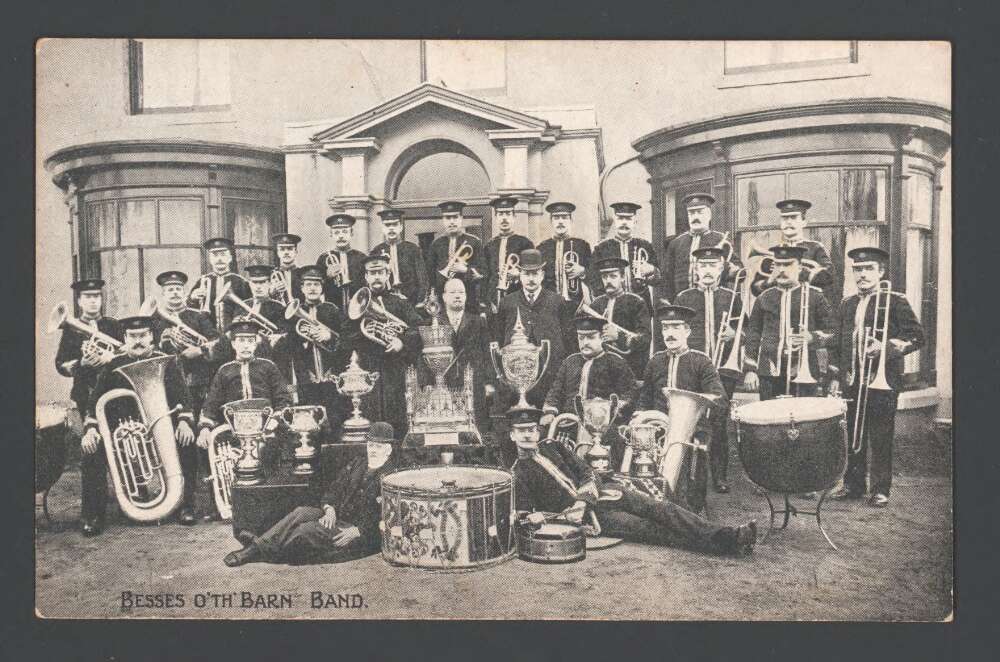
Postcard: Besses o’ th’ Barn Band, 1907 (Source: National Library of Australia: David Elliot theatrical postcard collection: nla.obj-145704095)

The reputation of this unique brass band is well-deserved. Besses o’ the’ Barn Band from the Manchester area, England is one of the oldest brass bands in the world and has been an ensemble of excellence since its establishment in 1818 (Besses o’ th’ Barn Band, 2018a).  So it was with a great deal of excitement the world over (and from the band itself) when Besses commenced its first world tour in 1906 (Besses o’ th’ Barn Band, 2018b).  This first tour took them to “North America, Canada, Hawaii, Fiji, South Africa, New Zealand, and Australia.” (Besses o’ th’ Barn Band, 2018b).  For each performance they attracted vast audiences and it is written in their history that their visit to Melbourne was most notable with no less than “twenty-two of Australia’s finest brass bands” (Besses o’ th’ Barn Band, 2018b) preceding them in a parade along Collins St.  This must have been quite the spectacle and sound!  Before they arrived in Melbourne they had been in Sydney and an article from The Sydney Morning Herald in 1907 gave an enthusiastic review of their performances (“BESSES O’ THE BARN” BAND,” 1907).  In July 1907 the Argus newspaper published an article which gives us an amount of detail about the parade and the massed bands that led it:

Immediately they alighted from the Sydney express the visiting bandsmen stepped across the platform into the railway yard and as they did twenty-two bands, under the conductorship of Mr. E. T. Code, commenced to play an inspiring march.  Each man in those twenty-two bands contributed his full share to the volume of sound the like of which has rarely been heard in Melbourne. […] A procession was formed and heralded by the twenty-two local bands, the Besses o’ th’ Barn Band were drive up Collins Street in two drags.  The street was crowded with citizens whose curiosity had prompted them to see the famous bandsmen at first opportunity.

[…]

The bands which took part in the ceremony of welcome were as follows: St Kilda City, Prahran City, Code’s Melbourne Band, South Richmond Citizens, Collingwood Citizens’, Richmond City, Malvern City, Williamstown Premier, Footscray City, Stender’s, Doncaster, South Melbourne City, Brighton City, Brunswick City, Warneeke’s, Bootmakers, Camberwell, Box Hill, Fitzroy Military, Clifton Hill, Fitzroy Citizen’s, Kyneton City, St Vincent de Paul Orphanage, St. Arnaud, Castlemaine, Maryborough, and Ballarat bands were also represented.

(“BESSES O’ TH’ BARN BAND.,” 1907)

Regarding the huge crowds, an 1907 article in the Quiz newspaper from Adelaide which reported on the progress of the Besses tour thus far, noted that 70,000 people lined the parade route in Melbourne, which is a staggering amount of people for this kind of event (“Besses o’ th’ Barn Band,” 1907).  Such was the popularity and reputation of this ensemble.

Besses o’ th’ Barn Band welcoming parade turning from Collins Street to Swanston Street, Melbourne, July 1907. The massed bands are led by Edward Code. (Source: Manchester Digital Music Archive: 13953)

However, Besses did not finish touring after this first monumental effort.  Not one year after they had arrived back in England, the band embarked on another world tour (“BESSES O’ TH’ BARN BAND,” 1909).  As noted in their band history (2018b), “Both trips lasted an incredible eighteen months.” (Besses o’ th’ Barn Band) which was a very long time for bandsmen to be away from home. Needless to say, Besses had not lost any popularity on their next world tour and again drew large crowds wherever they went.

Interestingly it was on their second tour where there were some changes in the Besses personnel due to one bandsman staying on in one city, and another bandsman joining them on their tour.  In a previous post, we can read the story of Besses Lead Cornetist William Ryder who absconded from the tour in Melbourne and joined the Wests Theatre Company before becoming the first conductor of the Prahran & Malvern Tramways Employees Band in 1911 (de Korte, 2018; Stonnington City Brass, 2018).  This being done, it appears that Besses invited one of our most famous bandsmen, Percy Code to join them on the rest of the tour (Bradish, 1929; Gibbney, 1981).  The conductor of Besses during this world tour was Mr. Christopher Smith and after the tour ended he was secured by the Adelaide Tramways Band for his services in 1911 (Seymour, 1994).

Postcard: Besses o’ th’ Barn Band, 1906 (Source: Jeremy de Korte personal collection)

There is no doubt that Besses left their mark on Australian banding and were adored by audiences.  Certainly, in the succeeding years, many fine Australian bands dominated the landscape and as we saw some ex-Besses musicians now called Australia home.  Besses was one of the first bands to include Australia in their tour, but they were not the last.  Next to tour was the famous Sousa Band from the USA!

Sousa heads South:

18900000-19200000_Tour_Sousa-Card
Postcard: Australia welcoming the Sousa Band (Source: National Library of Australia: David Elliot theatrical postcard collection: nla.obj-145695597)

The band of John Phillip Sousa was no less famous than the Besses band, although much bigger with sixty musicians and some additional soloists in their touring party.  They toured Australia and New Zealand from May 12th to August 23rd, 1911 and like the Besses band generated huge excitement wherever they went (Lovrien, 2012).  In fact, the excitement had started brewing before they had even arrived with newspapers reporting expected arrival dates and schedules (“SOUSA’S BAND.,” 1911).  As with the Besses tour that had just finished, the Sousa band was feted with ceremony, functions, awards, parades and large audiences – upon arriving in Sydney there was a grand parade featuring twenty NSW brass bands (“SOUSA AND HIS BAND,” 1911).

Inevitably, given the timing of the Sousa tour to the previous Besses tour, questions were asked as to which the finer band was.  In an article from May 1911, the World’s News newspaper sought to answer this question from a reader (“Sousa’s Band,” 1911).  The article reported on the differences between both bands and diplomatically opens the article by declaring that: “Comparisons are odious in connection with bands, as well as with politics” (“Sousa’s Band,” 1911).  However, it came down to the fact that one was a brass band as opposed to a military-style band and one band was much bigger than the other.  Musically, they were both very fine ensembles.

The Sousa band was a very different ensemble and they enthralled Australian audiences.  However, there is no real indication that the Sousa band had an influence on Australian bandsmen, and if they did, it was not reported.  One could assume the reason was that Australian bands, which were mostly brass at the time, were very much tied to the band tradition of England, not the USA.

Postcard: Sousa Band at the Glacarium, Melbourne, 1911 (Source: Jeremy de Korte personal collection)

From Australia, the Sousa Band traveled to New Zealand where they again delighted audiences and received rave reviews (White, 2018).  And after this swing through the Southern Hemisphere, they returned to the mainland USA via a visit to Hawaii (Lovrien, 2012).

The Sousa tour, despite the number of places that they visited and the largeness of the audiences, did not generate a huge financial windfall and it was very expensive to take the band around the world (Lovrien, 2012).  However, in 1913 a court case was heard regarding the profits from the Australian leg of the Sousa tour.  From the brief flurry of newspaper articles that were written at the time, it appears that a series of contracts were entered into by the promoter of the tour, Mr. Branscombe with a Mr. Quinlan, and later a Mr. Singer over £30,000 in profits (“SOUSA’S BAND IN AUSTRALIA,” 1913).  It is interesting that this case was heard two years after the tour had finished, and that these profits were not intended for the Sousa band itself.

Bythell (2000), writing on the band tours and exchanges between countries during this time says that “…the logistics and high costs or international tours and exchanges made them exceptional” (p. 229).  Certainly, it was noted in the New Zealand article on the Sousa visit that the tour (through Aus. & NZ) was costing “over £2,000 per week” (White, 2018).  Given the logistics of moving a sixty-piece band plus soloists around Australia and New Zealand, this figure is hardly surprising.

Despite this, the Sousa tour appears to have been a success for the band and audiences as Sousa was a renowned conductor and composer.  The time frame between this tour and the previous Besses tour had not dimmed the enthusiasm of the Australian public in wanting to see these kinds of entertainments.  The Sousa band did not disappoint.

The visit of a Belgian Band during the First World War:

Postcard: Belgian National Band, 1915 (Source: Jeremy de Korte personal collection)

The Besses and Sousa bands were undoubtedly famous, but that did not stop other promoters searching for bands that might tour, which is exactly what happened during the early stages of the First World War.  In 1915, a band from Belgium visited the country and apparently went on tour through Australia and New Zealand. (“MUSIC.,” 1915).  A paragraph in a Leader newspaper article from May 1915 provides some detail on this band, but the band had no name – they were simply known as the Belgian Band:

A Belgian Band comprising some of the finest instrumentalists in Belgium, has been engaged by J. and N. Tait for a tour of Australia and New Zealand, commencing in June. […] After considerable trouble, many cables and much correspondence, the band has at last been got together, and will prove on its arrival one of the finest aggregations of talent that have yet visited Australia.  The band comprises of 28 instrumentalists, recruited from the foremost bands of Brussels, Antwerp and Ostend, and augmented by half a dozen English players, and will be conducted by the brilliant M. Phillipe Meny, a remarkable musician, whose reputation is not only Belgian, but European.

(“MUSIC.,” 1915)

The reaction of the Australian press to this visit was understandable.  A number of articles expressed admiration that the musicians had actually left Belgium, while also expressing sympathy and solidarity with the Belgian people under German occupation.  An example of this kind of article was from the Daily News in Perth (“THE BELGIAN BAND.,” 1915).  Notwithstanding the circumstances of this visit, the band drew the interest of an Australian public and received good reviews for their performances (“Visit of Belgian Band,” 1915).  In an act of decency, the band promoters donated all profits to “…the Belgian Relief Fund and the Wounded Soldiers Fund” (“BELGIAN BAND VISITS AUSTRALIA.,” 1915).

First came the Royal Marines, then came the Guards:

After the war, visits from overseas bands resumed quite early on with a visit from the Royal Marine Band, H.M.S. “Renown”.  This band was brought to Australia by J. and N. Tait, the same promoters who engaged the Belgian Band in 1915 (“RENOWN BAND.,” 1920).  The Royal Marines actually visited twice; their first visit was in 1920 and they followed up with another visit in 1927.  The concerts of 1920 received some very favorable reviews with one article printed in the Argus praising the sound and playing of this ensemble, and making a comparison of conducting styles with the great Sousa (“Concert by Renown Band.,” 1920).  On the second tour, a concert in Melbourne was presented as a massed bands concert in combination with the “Returned Sailors and Soldiers Memorial  Band” and the “Victorian Railways Military Band” with the Lord Mayor’s Hospital Appeal Fund the beneficiary of the proceeds from the concert (“FOR MAYOR’S FUND,” 1927).

19270508_Massed-Mil-Bands_Green-Mill_FC
Programme (front cover), featuring: Royal Marines Band H.M.S. “Renown”, Victorian Returned Sailors and Soldiers Memorial Band & Victorian Railways Military Band. (Source: Victorian Collections : Victorian Bands’ League)

In 1934 the Band of the Grenadier Guards visited Melbourne as part of the Centenary of Victoria celebrations, with a subsequent tour of Australia as well.  There was some initial confusion as to which Guards band was going to visit with the Grenadier Guards, Coldstream Guards and Welsh Guards being mentioned in some press (“GUARDS’ BAND VISIT.,” 1933).  It seems there was also some objection to the tour on the part of the Musicians’ Union. A letter to The Herald in September 1933 berated the Union for their stance with the writer stating that “Their visit will be education and beneficial to our unemployed musicians.” (Musician, 1933).  A visit to Australia by a band of this caliber was beneficial to all who witnessed them (not just unemployed musicians).  The band made a special appearance at the South Street competition of 1934 with a concert presented to an appreciative audience which included the Duke of Gloucester who was also visiting Australia (“South-street Band Contests.,” 1934).

19341101-19341103_South-Street-Centenary-Contest_p6
1934 South Street “Centenary” Brass Band Contest program, p. 6 (Source: Victorian Collections: Victorian Bands’ League)

These two British military bands were highly regarded, and it appears that their tours were more genuine with concerts in combination with Australian ensembles and presenting inspirational performances.  There was no comparison with the previous tours of Besses and Sousa as these were again, very different groups.  However, Australians were no less enthusiastic about the visits of these bands and made them feel very welcome.

Conclusion:

What we have seen here is only a small sample of the bands that visited Australia within a shorter time frame.  Each group was very different, yet they elicited an amount of excitement from the Australian audiences, bandsmen and public authorities.  Yes, they were expensive undertakings.  But musically they were invaluable.  This truly was a great age of banding.

References:

Australia extends the glad hand of welcome to Sousa and his band. (1910). [1 postcard : col. ; 9.6 x 13.9 cm.]. [nla.obj-145695597]. National Library of Australia, David Elliott theatrical postcard collection. https://nla.gov.au/nla.obj-145695597/view

THE BELGIAN BAND. (1915, 24 May). Daily News (Perth, WA : 1882 – 1950), 7. http://nla.gov.au/nla.news-article81173645

BELGIAN BAND VISITS AUSTRALIA. (1915, 20 June). Sunday Times (Sydney, NSW : 1895 – 1930), 6. http://nla.gov.au/nla.news-article120796314

Besses o’ th’ Barn Band. (1907). [Photograph]. [13953]. Manchester Digital Music Archive. https://www.mdmarchive.co.uk/artefact/13953/BESSES_O’_TH’_BARN_BAND_PHOTOGRAPH_1907

Besses o’ th’ Barn Band. (1907). [Postcard]. [nla.obj-145704095]. National Library of Australia, David Elliott theatrical postcard collection. https://nla.gov.au/nla.obj-145704095/view

Besses o’ th’ Barn Band. (1907, 09 August). Quiz (Adelaide, SA : 1900 – 1909), 8. http://nla.gov.au/nla.news-article166338966

BESSES O’ TH’ BARN BAND. (1909, 04 November). Table Talk (Melbourne, Vic. : 1885 – 1939), 13. http://nla.gov.au/nla.news-article145853191

Besses o’ th’ Barn Band. (2018a). A Glorious Past. Besses o’ th’ Barn Band. Retrieved 04 October 2018 from http://www.besses.co.uk/about/blasts-o-th-past/history-of-besses

Besses o’ th’ Barn Band. (2018). From Whitefield to Wellington. Besses o’ th’ Barn Band. Retrieved 04 October 2018 from http://www.besses.co.uk/about/blasts-o-th-past/history-of-besses?showall=&start=1

BESSES O’ TH’ BARN BAND : WELCOME TO MELBOURNE. (1907, 29 July). Argus (Melbourne, Vic. : 1848 – 1957), 7. http://nla.gov.au/nla.news-article10125983

“BESSES O’ THE BARN” BAND. (1907, 15 May). Sydney Morning Herald (NSW : 1842 – 1954), 13. http://nla.gov.au/nla.news-article14867586

Bradish, C. R. (1929, 05 September). Prominent Personalities : PERCY CODE | CONDUCTOR OF NATIONAL BROADCASTING ORCHESTRA. Table Talk (Melbourne, Vic. : 1885 – 1939), 13. http://nla.gov.au/nla.news-article146712994

Bythell, D. (2000). The Brass Band in the Antipodes : The Transplantation of British Popular Culture. In T. Herbert (Ed.), The British brass band : a musical and social history (pp. 217-244). Clarendon Press ; New York : Oxford University Press. 

Concert by Renown Band. (1920, 04 June). Argus (Melbourne, Vic. : 1848 – 1957), 9. http://nla.gov.au/nla.news-article1708206

de Korte, J. D. (2018, 02 March). William Ryder: The first conductor of the Prahran & Malvern Tramways Employees Band. Band Blasts from the Past : Anecdotes, Stories and Personalities. https://bandblastsfromthepast.blog/2018/03/02/william-ryder-the-first-conductor-of-the-prahran-malvern-tramways-employees-band/

FOR MAYOR’S FUND : Renown Band Concert. (1927, 06 May). Herald (Melbourne, Vic. : 1861 – 1954), 19. http://nla.gov.au/nla.news-article243915027

Gibbney, H. J. (1981). Code, Edward Percival (1888-1953). In Australian Dictionary of Biography. Retrieved 20 April 2018, from https://adb.anu.edu.au/biography/code-edward-percival-5707

Glanville Hicks, E. (1927). MASSED MILITARY BANDS : (Including Band of H.M.S. “RENOWN”) : GRAND RECITAL  [Programme]. City of Melbourne. https://victoriancollections.net.au/items/5caad8b321ea6703e46303f4 

GUARDS’ BAND VISIT : Centenary Tour Almost Certain. (1933, 10 October). Age (Melbourne, Vic. : 1854 – 1954), 8. http://nla.gov.au/nla.news-article205104515

Lovrien, D. (2012, 13 June). The Sousa Band 1910-11 World Tour. John Philip Sousa. https://sousamusic.com/sousa-band-1910-11-world-tour/

MUSIC. (1915, 15 May). Leader (Melbourne, Vic. : 1862 – 1918), 35. http://nla.gov.au/nla.news-article91368715

Musician. (1933, 11 September). GUARDS’ BAND VISIT. Herald (Melbourne, Vic. : 1861 – 1954), 6. http://nla.gov.au/nla.news-article243423748

RENOWN BAND. (1920, 05 July). Register (Adelaide, SA : 1901 – 1929), 5. http://nla.gov.au/nla.news-article62924146

Royal South Street Society. (1934). South Street “Centenary” : Brass Band Contest : A, B, C and D Grades  [Programme]. Royal South Street Society. https://victoriancollections.net.au/items/5d425e0c21ea6b1a84382033 

Seymour, C. (1994). Adelaide’s Tramway Band. Trolley Wire, 35(4), 3-10. https://www.sydneytramwaymuseum.com.au/members.old/Trolley_Wire/259%20-%20Trolley%20Wire%20-%20Nov%201994.pdf 

SOUSA AND HIS BAND. (1911, 14 May). Sunday Times (Sydney, NSW : 1895 – 1930), 2. http://nla.gov.au/nla.news-article120777076

Sousa Band – Immense Audience, Glacarium, Melbourne. (1911). [Postcard]. Sousa Band, Melbourne, Victoria. 

SOUSA’S BAND. (1911, 09 February). Argus (Melbourne, Vic. : 1848 – 1957), 7. http://nla.gov.au/nla.news-article10877792

SOUSA’S BAND IN AUSTRALIA : Question of profits : Writ for £7926. (1913, 01 October). Age (Melbourne, Vic. : 1854 – 1954), 8. http://nla.gov.au/nla.news-article196234795

Sousa’s Band : An interesting question asked by readers. (1911, 13 May). World’s News (Sydney, NSW : 1901 – 1955), 18. http://nla.gov.au/nla.news-article128266800

South-street Band Contests. (1934, 02 November). Age (Melbourne, Vic. : 1854 – 1954), 16. http://nla.gov.au/nla.news-article205082990

Stonnington City Brass. (2018). Band History. Stonnington City Brass. Retrieved 13 May 2018 from https://www.stonningtoncitybrass.org.au/history.html

Visit of Belgian Band : An enjoyable concert. (1915, 10 August). Queensland Times (Ipswich, Qld. : 1909 – 1954),7. http://nla.gov.au/nla.news-article121995771

Walmsley Bolton. (1915). The Great Belgian National Band. Conductor – – Mons Jules Ardenois (of Antwerp) [Postcard]. Walmsley Bolton, Nottingham, U.K. 

White, T. (2018, 13 July). Memory Lane: A famous musician brings his band to town. Manawatū Standard. https://www.stuff.co.nz/manawatu-standard/lifestyle/105412732/memory-lane-a-famous-musician-brings-his-band-to-town

Former brass bands of the City of Yarra: A brief history.

This post was originally written as a local history project for Yarra Libraries, October 2017.

Introduction:

Around the City of Yarra are dotted many reminders of bygone days.  Given the history of the area, this is perhaps not surprising.  However, when looking at some buildings sets the mind to wondering if they were ever used and by whom.  This is the case with the many bandstands in public gardens in the City of Yarra.  Logic would dictate that if a bandstand had been built, then there must have been a band to play on it.  Delving into various histories and newspaper articles of the area would indicate that this was the case; that there were once brass bands located in the various suburbs.  Yet they are not here now and there is little physical evidence to indicate they existed aside from written articles and other histories.

For just over fifty years the brass bands served the suburbs of the City of Yarra and this post will provide a brief history of bands located in Collingwood, Fitzroy and Richmond.  They existed in a time when there was little recorded or broadcast music and the local population went and saw their bands play on a regular basis.  As one Collingwood resident remembers,

They used to have a bandstand there in the Darling Gardens.  They’ve since built a new one of the same design.  They used to have bands there every Sunday and we would sit in the Gardens.  Sometimes the Salvos, sometimes the municipal band.

(Collingwood History Committee, Carringbush Regional Library, & Collingwood Council, 1994, p. 38)

The bands were engaged with their communities and were always out and about performing, marching and competing.  They were also at the behest of their Local Councils who at times supported the bands, but at other times tried to influence other outcomes.  As will be seen, other external factors also had affected the running of the bands. However, the fact the bands existed is exciting enough and their stories deserve to be heard.

00000000_Ballarat_Band-Contest-Oval
Marching contest in Ballarat. Date and bands unknown. (Source: IBEW)

The Collingwood Citizens’ Band:

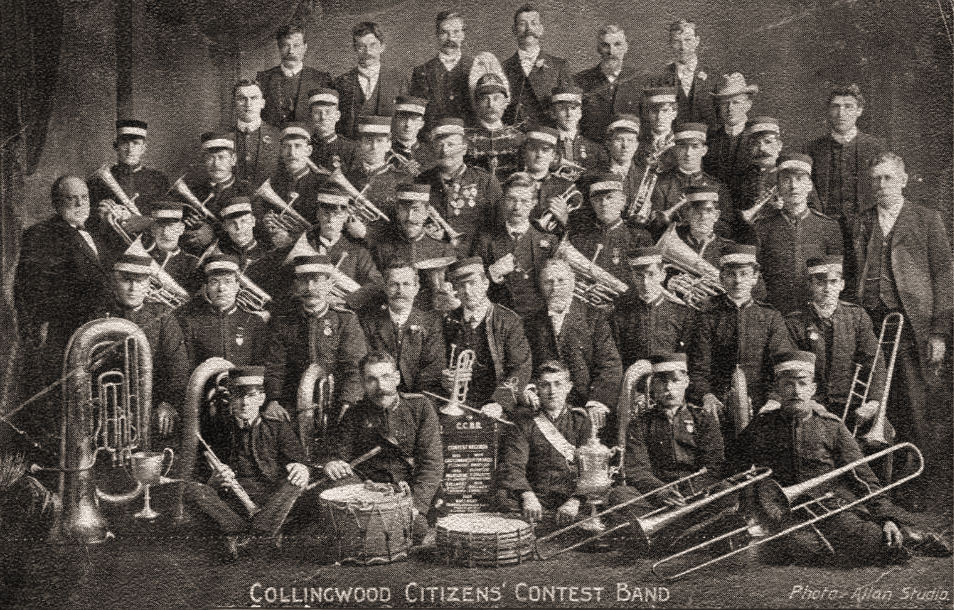
Out of the three main bands that once existed in the City of Yarra area the Collingwood Citizens’ Band is the most renowned due to its many successes in Australian and local band championships (Royal South Street Society, 2017).  This success was mainly due to the prowess of the band under their famous conductor, Mr. Francis Charles Johnston who was known as “Massa” Johnston for most of his conducting career (Rasmussen, 2005).

We first hear of a band in Collingwood with an article from 1901 which outlined the professions of bandsmen outside of the banding lives (this article also included a band that had Fitzroy in its name) (“SIM’S FITZROY MILITARY BAND.,” 1901).  The band mentioned in the article is the Collingwood Imperial Band and it is not until 1904 where a series of public meetings were held with the aim of forming a new citizens band.  From the articles of the time, the Collingwood Imperial Band agreed to merge with the new Citizens’ Band and thus the Collingwood Citizens’ Band was officially born (“COLLINGWOOD CITIZENS BAND,” 1904).  The Collingwood Council, which facilitated the meetings, also wanted to form a juvenile band however it is not clear whether this band was ever started.

19110000_Collingwood_Citizens-Band
The Collingwood Citizens’ Contest Band. Possibly in 1911 (source: IBEW)

From an article published in 1915 by the Bendigo Independent newspaper, we can finally see list of the Collingwood Citizens’ Band competition successes up until this date (“THE COLLINGWOOD BAND.,” 1915).  Here we see a band that has been crowned champion band many times over, mainly from participating in the Royal South Street events.  The cups and shield evident in the photo certainly reflect this.  This competition success continued for many years and decades, no doubt helped by the influence of conductor Massa Johnston, who also conducted many other bands at the time to competition success (Rasmussen, 2005).

Collingwood Citizens’ Band had a fine reputation.  They used to practice every Sunday morning at Collingwood Football ground.  We could hear them quite clearly.  They had tremendous volume.  They sometimes used to march. (Collingwood History Committee et al., 1994, p. 38)

(Collingwood History Committee et al, 1994, p. 38)

There are numerous articles dating from the 1930s and 1940s which shows the band performing in many concerts, parades, and other events.  They also competed in competitions interstate and around Victoria, and because of their reputation, they were invited guests at other band events.  The Royal South Street Society did not run a band contest every year so Collingwood participated in other events.  In the early 1950s their conductor Francis “Massa” Johnston passed away and the band played at his funeral (“Tribute to Bandsman,” 1954).  This perhaps sounded a death knell for the Collingwood Citizens’ Band and it is not long after this date that we see no more articles about their activities.  It is unclear as to which year the band officially ended.

Collingwood Citizens’ Band were a remarkably stable ensemble for their time, especially when compared to neighboring bands.  They had an enviable contesting record and were the pride of the municipality. Their history is well noted, and it is hoped that we might see some of the physical artifacts come to light.

The Fitzroy Bands:

18850408_Sportsman_CityFitzBrassBand
Sportsman, 8/04/1885, pg. 4

Of the three bands that were located in the City of Yarra area, the Fitzroy bands were probably the most unstable and it is sometimes hard to tell where one ensemble ended and another one began!  We first see mention of a band in Fitzroy in 1885 where there is an article detailing the results of an intra-band sports day (“CITY OF FITZROY BRASS BAND.,” 1885).  As mentioned in the history of the Collingwood band, another article details the professions of bandsmen although this article makes mention of the Sim’s Fitzroy Military Band – perhaps this was a private ensemble, but this is the first and only mention of this particular band.  In 1906 a letter is written to the editor of the Fitzroy City Press advocating a new ensemble that is hoped will emulate the success of the neighboring Collingwood brass band (“FITZROY CITIZENS’ CONTEST BAND,” 1906).  Certainly, in the coming years, the Fitzroy Citizens’ Band did taste competition success, and in 1915 competed against the bands of Collingwood and Richmond in several sections (Royal South Street Society, 1915).

00000000_North-Fitzroy_Band
The North Fitzroy Brass Band, date unknown (Source: IBEW)

Other bands were evident in Fitzroy such as the North Fitzroy Band however it is unclear as to their fate.  Of interest is that in 1911 a public meeting was held where it was decided to ‘help’ form the current Fitzroy City Band into the Fitzroy City Citizens’ Band (“FITZROY CITIZENS’ BAND,” 1911).  Hence the confusion over timelines and history when bands reportedly kept changing their names.  In 1925 the Fitzroy City Council, in all its wisdom, accepts the services of the ‘Turners’ Brunswick Band’ and this ensemble become the new ‘Fitzroy Municipal Band’ (“SUBURBAN ACTIVITIES.,” 1925).  Why the council would accept the services of a neighboring private brass band is unknown, however the consequences are that the existing Fitzroy Citizens’ Band and the new ensemble agree to absorb the members of the rival band, depending on the council decision – the council agreed to the Turner proposal (“SUBURBAN ACTIVITIES.,” 1925).

In 1937 the local council provides money to the Fitzroy Municipal Band for the purchase of new uniforms with the tender for manufacture passed opened to local traders (“New Uniforms for Band.,” 1937).  Over the coming years, it is unclear what happens to the Fitzroy Municipal Band although it can be assumed that the Second World War intervened and the band went into recess.  Of interest is that in 1941 there was a meeting held about establishing a boys’ band in Fitzroy, and perhaps a junior choir (“BOYS’ BAND FOR FITZROY,” 1941).  There is no evidence to suggest this ensemble was ever started. Progressing to 1945 we see that a new Fitzroy Brass Band has been formed and is already doing performances – this new band was formed at the insistence of the local council (“NEWS FROM THE SUBURBS,” 1945). Four years later in 1949, we see possibly the last mention of the Fitzroy Brass band with a photo of their conductor playing the trombone at an event in Elsternwick (“Two Kinds of Band Music,” 1949).  There is no indication of when the Fitzroy Brass Band ceased to be active.

The Richmond Bands:

The story of the Richmond City Band is well-known due to the excellent research undertaken by the Richmond & Burnley Historical Society.  Like the Collingwood Citizens’ Band, the Richmond Band also competed on a regular basis and won many prizes.  While Richmond didn’t last as long as the Collingwood or the Fitzroy bands, the Richmond Band earned a reputation for being a fine ensemble (Langdon, 2014).

19060000_Richmond_City-Band
The Richmond City Band. The photo was taken at the 1906 South Street Ballarat Competition. (source: State Library Victoria: a04257)

As with most municipalities, there were often many brass bands that were formed, but not many survived.  In 1905, we see the Richmond City Band in “conflict” with the neighboring, and newly formed South Richmond Band over some event; this required council mediation to resolve (“RIVAL BRASS BANDS.,” 1905).  Coming to 1916 we see the Richmond City Band gaining the use of a new band room which was located behind the Richmond Town Hall (“Richmond City Band,” 1916).  Unlike other neighbouring areas, Richmond was lucky enough to have a boys’ band formed and this band gained success at the South Street competitions (“Richmond Boys’ Band.,” 1918; “Richmond Boys’ Band Making Fine Progress.,” 1918; Royal South Street Society, 2017).  This Richmond Boys’ Band also traveled and are noted as having marched in an Armistice Day parade in Nar Nar Goon in 1918 (Heather, 2016).

Sadly, the Richmond City Band fell victim to events outside their control.  In 1926 a fire destroyed their band hall and they lost instruments, uniforms and sheet music (“FIRE AT RICHMOND.,” 1926; Langdon, 2014).  This, and the fact that many band members were being employed in other musical endeavors plus a council wanting four local bands to merge meant that the Richmond City Band days were numbered.  In the 1930s the band ceased running in its current form (Langdon, 2014).

Conclusion:

If we are to take anything from the stories of these three bands it is that history is fickle and fragmented.  There is much that we don’t know.  The bands were very much part of the society of their time and while the local populace displayed pride in their bands, this often did not extend to local government.  I’m sure that if the bands had survived to this day, as quite a number of Melbourne’s brass bands have done, then they would be thriving with new musical energy.

References:

Allan Studio. (1911?). Collingwood Citizens’ Contest Band [Photograph]. [phot15975]. The Internet Bandsman Everything Within, Vintage Brass Band Pictures : Australia. http://www.ibew.org.uk/vbbp-oz.html

Band contest, City Oval, Ballarat. (n.d.). [Photograph]. [phot7343]. The Internet Bandsman Everything Within, Vintage Brass Band Pictures : Australia. http://www.ibew.org.uk/vbbp-oz.html

BOYS’ BAND FOR FITZROY. (1941, 18 February). Age (Melbourne, Vic. : 1854 – 1954), 10. http://nla.gov.au/nla.news-article205297038

CITY OF FITZROY BRASS BAND. (1885, 08 April). Sportsman (Melbourne, Vic. : 1882 – 1904), 4. http://nla.gov.au/nla.news-article229822096

THE COLLINGWOOD BAND. (1915, 04 January). Bendigo Independent (Vic. : 1891 – 1918), 2. http://nla.gov.au/nla.news-article219867088

COLLINGWOOD CITIZENS’ BAND. (1904, 13 February). Age (Melbourne, Vic. : 1854 – 1954), 10. http://nla.gov.au/nla.news-article197229077

Collingwood History Committee, Carringbush Regional Library, & Collingwood Council. (1994). In those days : Collingwood remembered : memories of Collingwood residents / interviewed by the Collingwood History Committee (3rd ed.). Carringbush Regional Library in association with the City of Collingwood. 

FIRE AT RICHMOND. (1926, 27 February). Argus (Melbourne, Vic. : 1848 – 1957), 29. http://nla.gov.au/nla.news-article3736962

FITZROY CITIZENS’ BAND. (1911, 17 July). Age (Melbourne, Vic. : 1854 – 1954), 9. http://nla.gov.au/nla.news-article196208248

FITZROY CITIZENS’ CONTEST BAND. (1906, 17 August). Fitzroy City Press (Vic. : 1881 – 1920), 3. http://nla.gov.au/nla.news-article65662507

Heather. (2016, 08 November). Celebrating the Armistice at Nar Nar Goon in 1918. Casey-Cardinia: Commemorating the Great War: 1914-1918. http://caseycardinia1914-1918.blogspot.com/2016/11/celebrating-armistice-at-nar-nar-goon.html

Langdon, D. (2014). Brass bands. Richmond & Burnley Historical Society Newsletter, 31(5), 2 & 4-6.

New Uniforms for Band. (1937, 10 March). Age (Melbourne, Vic. : 1854 – 1954), 16. http://nla.gov.au/nla.news-article205600050

NEWS FROM THE SUBURBS. (1945, 15 February). Age (Melbourne, Vic. : 1854 – 1954), 5. http://nla.gov.au/nla.news-article206859489

North Fitzroy Band, Melbourne. (n.d.). [Photograph]. [phot2121]. The Internet Bandsman Everything Within, Vintage Brass Band Pictures : Australia. http://www.ibew.org.uk/vbbp-oz.html

Rasmussen, C. (2005). Johnston, Francis Charles (Massa) (1880-1953). In Australian Dictionary of Biography. Retrieved 12 October 2017, from https://adb.anu.edu.au/biography/johnston-francis-charles-massa-13009

Richmond Boys’ Band. (1918, 23 February). Richmond Guardian (Vic. : 1917 – 1918), 3. http://nla.gov.au/nla.news-article93810988

Richmond Boys’ Band Making Fine Progress—May Develop into Military Brass Band with over 100 Performers. (1918, 06 July). Richmond Guardian (Vic. : 1917 – 1918), 2. http://nla.gov.au/nla.news-article93811606

Richmond City Band. (1916, 07 October). Richmond Australian (Vic. : 1914 – 1916), 2. http://nla.gov.au/nla.news-article119691234

Richmond City Band. Ballarat Compts 1906. (1906). [postcard : printed, b&w]. [a04257]. State Library Victoria, J. D. Meade postcard collection. https://www.slv.vic.gov.au/pictoria/gid/slv-pic-aab44040

RIVAL BRASS BANDS. (1905, 24 October). Age (Melbourne, Vic. : 1854 – 1954), 6. http://nla.gov.au/nla.news-article199417022

Royal South Street Society. (1915, 23 October). 1915-10-23 Brass Band Contests. Royal South Street Society. Retrieved 13 October 2017 from https://results.royalsouthstreet.com.au/results/1915-10-23-brass-band-contests

Royal South Street Society. (2017). Results. Royal South Street Society (1891-2016). Retrieved 13 October 2017 from https://results.royalsouthstreet.com.au

SIM’S FITZROY MILITARY BAND. (1901, 18 April). Tocsin (Melbourne, Vic. : 1897 – 1906), 5. http://nla.gov.au/nla.news-article197522624

SUBURBAN ACTIVITIES. (1925, 30 June). Argus (Melbourne, Vic. : 1848 – 1957), 17. http://nla.gov.au/nla.news-article2132043

Tribute to Bandsman. (1954, 18 January). Age (Melbourne, Vic. : 1854 – 1954),4. http://nla.gov.au/nla.news-article206089857

Two Kinds of Band Music. (1949, 14 November). Age (Melbourne, Vic. : 1854 – 1954), 4. http://nla.gov.au/nla.news-article189488717