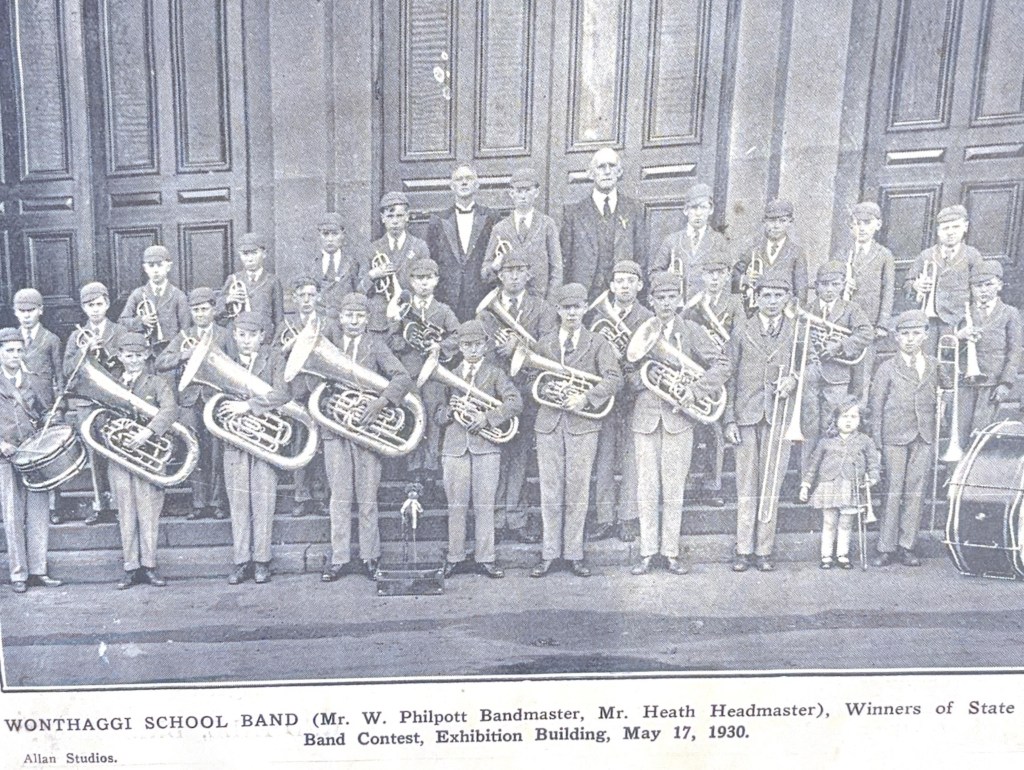
Figure 1: The Australasian Band and Orchestra News, 26/05/1930, Front Cover
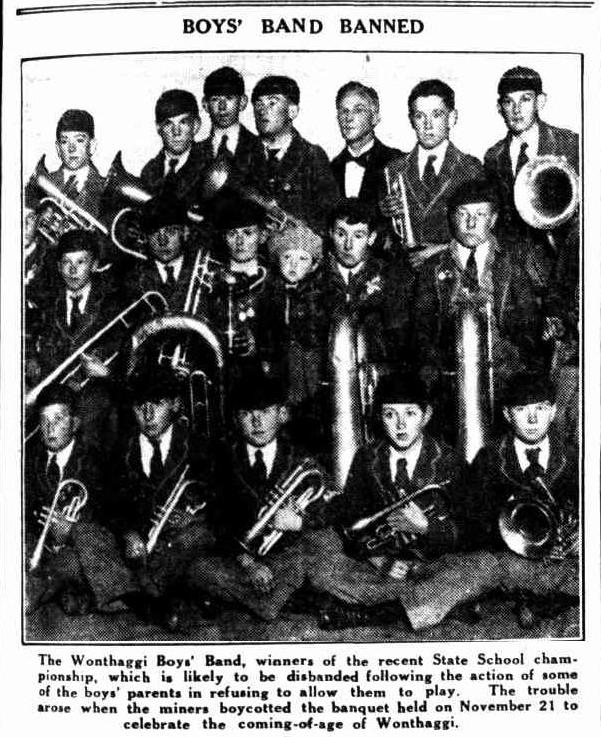
Wonthaggi also has a mascot of whom the boys are very proud. She is little Margaret Philpott aged three years and three months. (“TINY GIRL MASCOT FOR BOYS’ BAND“, 1930)
Introduction:
It is the 17th of May 1930, and the Exhibition Building in Melbourne is a hive of activity as the Victorian State School Band Association holds the first of many annual band contests. Nine state school bands from across Melbourne, and one country representative from Wonthaggi, have come to compete and to show the rapid progress state school bands have made in the past few years from inception.
Wonthaggi State School Band did themselves proud that day by winning this inaugural contest against some other highly fancied school bands. But the back stories before and after this win are many. One of which being the story behind the mascot of the band, three-year-old Margaret Philpott, who is pictured with the band holding a tiny trombone.
The photo above did intrigue me when I first viewed it several years ago and I had been sporadically searching for the name of the small girl with a trombone. Upon finding the name very recently, this made the photo even more special, and it adds a layer of context to the story.
This post is an addendum to a previous post outlining the development and legacy of Victorian state school bands, and many of the parts of this story mirror the earlier post. So, it is interesting to unpick this on a local level as the school band from Wonthaggi is a perfect example of how a school band fared in its early years. It is, perhaps, no accident that the Wonthaggi band was as good as it was due to good fortune and strong leadership – and an inspiring mascot.
Philpott’s and brass bands:
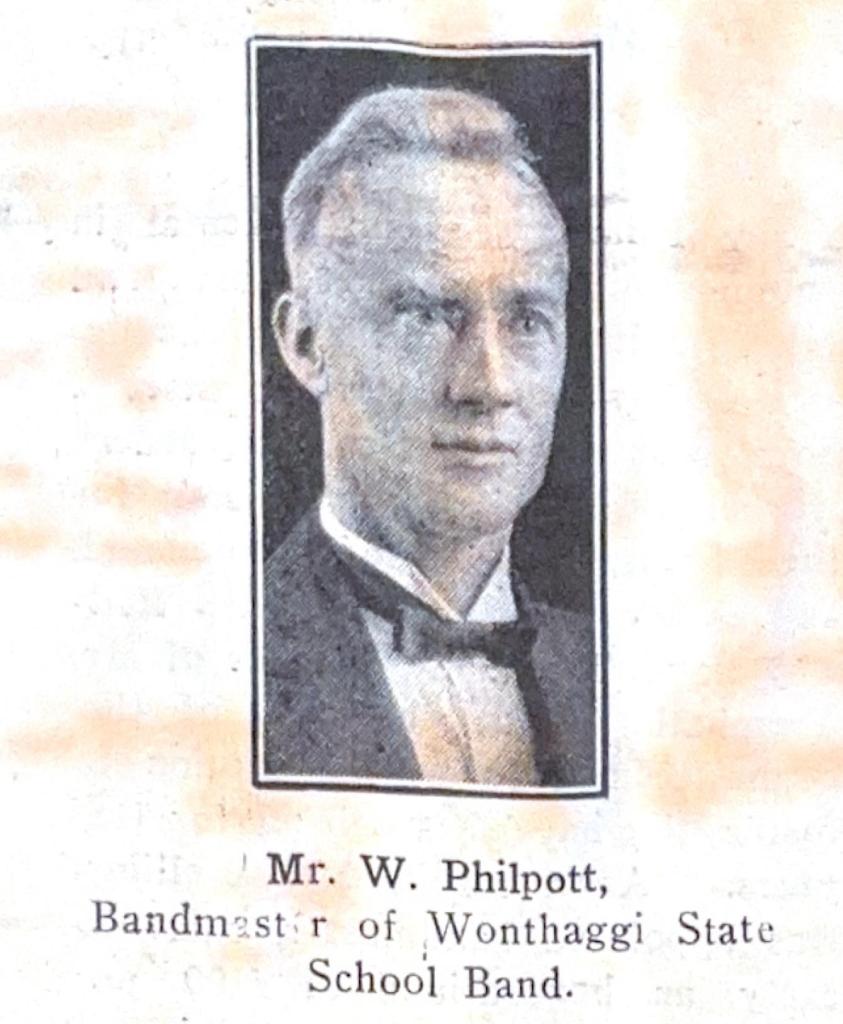
Figure 2: The Australasian Band and Orchestra News, 26/05/1930
The name says it all really. Margaret Philpott may not have realised this at the age of three, but her name carries a legacy of brass band musicianship. Her father and grandfather, both named William, were highly regarded brass musicians and conductors. Her father, William ‘Bill’ Philpott was the ultimate journeyman bandsman. By 1922 W. Philpott had played in or conducted:
1899 Lismore Band (N.S.W.) conducted by his father, William George Philpott
Appointed Bandmaster of the Brighton Town Band (Vic.) which had recently amalgamated with the Elsternwick Band
Solo cornetist with the Prahran City Band under Edward Code and Solo Cornet with the St. Kilda Band
Engaged to play solo cornet for the Wellington Garrison Band (N.Z.)
Appointed bandmaster of the Coraki Band (N.S.W.) in 1908 while playing with the Lismore band
1911 Appointed conductor of the Wagga Wagga Brass Band (N.S.W.)
1918 played Soprano Cornet with the St. Augustine’s Band (Vic.) and Professional Cornet with the Ballarat City Band
1921 Appointed conductor of the Young Brass Band (N.S.W.)
W. Philpott continued on his journeyman ways when he moved to Wonthaggi in 1928 to take up a position of conductor of the Wonthaggi Union Band, and soon after the Wonthaggi State School Band (“THE LOSS OF OUR BANDMASTER.”, 1928; “YOUNG’S BANDMASTER.”, 1928). By all accounts, the bands that William had been associated with by this time were very grateful for his tutelage and his knowledge – and his success in competition – so they were sorry to see him go. Wonthaggi offered much opportunity and under the leadership of William, the Wonthaggi Union Band and later the Wonthaggi State School Band both had success – the school band achieved second place in the 1929 Royal South Street contest (Royal South Street Society, 1929; “SCHOOL BANDS’ CONTESTS.”, 1930).
Of course, William did not stop at Wonthaggi, he still had many years of conducting ahead of him, and his band journey continued:
The Gillies Bequest and the Wonthaggi State School Band:
As previously outlined in the post on school bands in Victoria, the support from the Gillies Bequest was a catalyst for the setting up of school bands across Victoria (de Korte, 2018; “MUSIC AND READING ALOUD.”, 1925). The establishment of school bands was a great success. At the presentation of trophies for the 1930 State School Band Association contest (which Wonthaggi won), Mr. Hansen, then Director of Education, outlined just how many bands there were.
There are now in State schools twenty brass and eight drum-and-fife bands. The recent and rapid growth of them was due largely to the activities of Mr. A. B. Lane, president of the band association. Of the bequest made by the late William Gillies, out of whose love of music and study the contests were inaugurated, £3750 had already been set aside. (“SCHOOL BANDS’ CONTESTS.”, 1930)
At this time, not only were school bands forming at a rapid rate, but the expertise of some very fine conductors was also available. Frank “Massa” Johnston of Melbourne Fire Brigade and Footscray City Band fame conducted the Hyde Street/Footscray School Band and Northcote Central State School Band, Mr. H. Hellings conducted West Preston, and Mr. W. Philpott conducted Wonthaggi (Allan Studio, 1930; “Footscray State School Band”, 1930; “Northcote Central State School Band”, 1928; Stevens, 1930).
With conducting pedigrees like this, and support from school communities and the Gillies Bequest, it is no wonder that school bands began to thrive and succeed. The Wonthaggi school band was very lucky to share Mr. Philpott with the Wonthaggi Union Band.
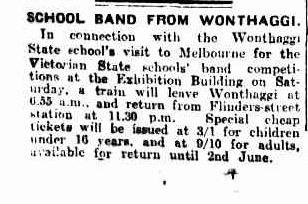
The State School Band Competition was a big day for Wonthaggi, and the other bands of course, not just because of the travel to and from Melbourne. Mr. Philpott, the Headmaster, band, parents and supporters, and little Margaret Philpott, made the journey to the contest at the Exhibition Buildings. Seven days before the contest, Mr. L. Jabara of Wonthaggi gave a gold cup to the Wonthaggi Headmaster, Mr. Heath, “to be presented to the winners of the State school band competition” (“WONTHAGGI.”, 1930a) which was also taken with the group. In the end it was the remarkable success of Wonthaggi that was the story of the day. Comments from adjudicator Mr. Harry Shugg gave high praise to the Wonthaggi Band:
The adjudicator (Mr. Harry Shugg), commenting upon the performances, expressed surprise that the players, whose average age did not exceed 12½ years, had so done so well within such a short period. He thought it especially true of the bass soloists. The Wonthaggi band astounded him, and shamed many of the adult bands in Victoria. (“SCHOOL BANDS’ CONTESTS.“, 1930)
The band deserved all the accolades that were given to them, and the school was very proud of their achievements.
In recognition of winning all the cups and the honor of winning the championship at the State school band contest in Melbourne the teachers of the Wonthaggi State school entertained the members of the band at a dinner. After playing for the sisters of St. Joseph’s and the scholars at St. Joseph’s school the band boys were entertained at afternoon tea. Arrangements have been made by the school master (Mr. H. T. Heath) for the championship State school boys to play at 3LO and 3AR. The band will also play on the M.C.G. ground on Saturday. (“WONTHAGGI.“, 1930b)
The Wonthaggi community was no less appreciative of Mr. Philpott’s dedication to the school band, and in July 1930 presented him with a gift.
In appreciation of his tutoring of the school boys’ band, which won every event at a recent band contest in Melbourne. Mr. W. Philpott was presented with a wallet of notes at the Union Hall on Wednesday night. The band is to take part in another contest in Melbourne on 23rd instant, and will also compete at South-street in October. A school choir, which will also take part in the competitions at South-street has been formed with Mr, Philpott as conductor. (“WONTHAGGI.“, 1930c)
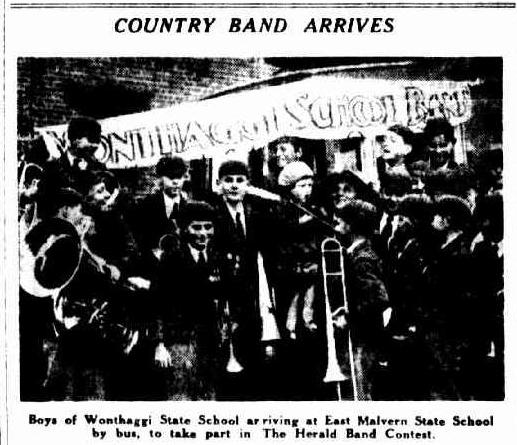
As for little Magaret Philpott, she was as much a part of the band as the bigger boys with their instruments. Not much is said about her, but she is visible in some further photos, such as this one published in The Herald newspaper showing the boys arriving at the East Malvern State School in preparation for another contest. Margaret, sporting a beret, can be seen right in the middle of the photo.
While the Wonthaggi State School band had numerous successes, and many engagements during 1930, they were not immune to events happening around them. Wonthaggi was home to the State Coal Mine which supported the Wonthaggi Union Band, also conducted by Mr. Philpott. Many of the mine workers were parents of children at the school, and in the 1930s there were disputes with the State Government which came to a head when a government delegation was to visit the town. The Union band subsequently refused to play, and banned Mr. Philpott from conducting the school band when the delegation visited (“NO MINERS’ BAND FOR WONTHAGGI VISITORS“, 1930). The caption on the photo below, published in The Weekly Times newspaper, provides some more reasoning.
And again, here is another photo showing Margaret Philpott sitting among the boys of the band.
There are not many other mentions of the Wonthaggi State School Band after 1930 in the newspapers, and due to the transient nature of Mr. Philpott’s band career, he was not there to continue it through, although the political and industrial undercurrents did affect life in town. We can at least, view the successes of the school band for what they were at the time; remarkable and very worthy.
Conclusion:
When William Philpott and family arrived in Wonthaggi in 1928, they could not have known what kind of influence they would eventually have. Through Mr. Philpott, the town and school had musical expertise, with his sons they had solid musicians, and with little Margaret the school band had their own mascot – and she had her own tiny trombone. Who knows what the Wonthaggi school band might have become if circumstances had been different? This was only one Victorian school band among many, and they set the early standards.
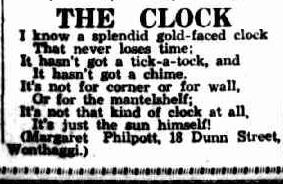
As for Margaret Philpott, she may not have followed her brothers into brass music, but she was a creative type. To finish this post, here is a poem that she wrote that was published in The Sun News-Pictorial newspaper, supplementary section in August 1936. Simply titled ‘The Clock’:
The author would like to thank members of the Young & District Family History Group for assistance in researching the Philpott family during their time in Young, and for providing further reading on the Young Town Band that mentions William J. Philpott.
References:
Allan Studio. (1930). Wonthaggi State School Band (Mr. W. Philpott Bandmaster, Mr. Heath Headmaster). Winners of State School Band Contest. Exhibition Building, May 17, 1930 [Digital scan of front cover photograph]. The Australasian Band and Orchestra News, XXV(9), Front Cover.
APPOINTMENT OF BANDMASTER : Mr. W. J. PHILPOTT SELECTED. : Salary £130 Per Annum. (1940, 19 October). Williamstown Chronicle (Vic. : 1856 – 1954), 8. http://nla.gov.au/nla.news-article70695595
BANDS IN VICTORIA : High Musical Standard : Is Public Appreciating Lacking? (1937, 07 December). Age (Melbourne, Vic. : 1854 – 1954), 10. http://nla.gov.au/nla.news-article205550598
BENALLA’S NEW BANDMASTER : MR. W. J. PHILPOTT OF WONTHAGGI APPOINTED. (1934, 03 August). North Eastern Ensign (Benalla, Vic. : 1872 – 1938), 3. http://nla.gov.au/nla.news-article70790349
Footscray (Vic.) State School Band : Mr. Ellingsen, Headmaster, Mr. F. Johnston, Bandmaster. (1930). [Digital scan of front cover photograph]. The Australasian Band and Orchestra News, XXV(6), Front Cover.
Hansen, M. P. (1932). Thoughts that breathe. Robertson & Mullens.
Lawson-Black, P. (2010). Bold as brass : the story of Stonnington City Brass then and now. Pat Lawson-Black, Stonnington City Brass.
NO MINERS’ BAND FOR WONTHAGGI VISITORS : Quarrel With Ministry : PARLIAMENTARY PARTY THERE TOMORROW. (1930, 20 November). Herald (Melbourne, Vic. : 1861 – 1954), 4. http://nla.gov.au/nla.news-article242933719
Northcote Central State School Band : Mr. J. Bromilow, Head Teacher; Mr. F. Johnston, Bandmaster; Major Trengrove, Secretary. (1928). [Digital scan of front cover photograph]. The Australasian Band and Orchestra News, XXIV(3), Front Cover.
Stevens, C. (1930). Preston West State School Band [Digital scan of front cover photograph]. The Australasian Band and Orchestra News, XXV(11), Front Cover.
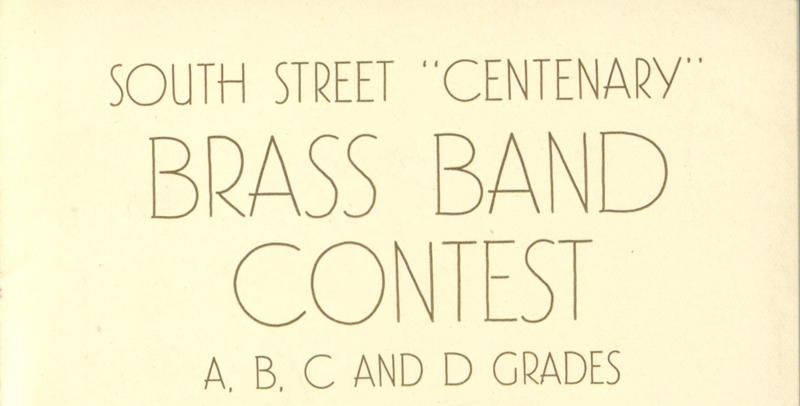
Programme: South Street “Centenary” Brass Band Contest, 1934, part of the front cover. (Source: Victorian Collections: Victorian Bands’ League Archives)
An international band contest may be a feature of the Centenary celebrations. An effort will be made to include one in the 1934 Eisteddfod and Band Contest at Ballarat.
The Grand National Eisteddfod of Australasia has promised its enthusiastic support of the celebrations. Bands contests were resumed last year at the Ballarat competitions after a lapse of eight years, and they proved successful. (“Band Contest For Centenary,” 1933)
Introduction:
The year is 1934 and in Ballarat on the 1st of November, the Royal South Street Eisteddfod band sections are getting underway again. Except this year is a bit different. It is the year of the Victorian and Melbourne Centenary and across Victoria, celebrations and other events are in full swing. The South Street band sections were part of these grand festivities, and all efforts were made to attract bands from across Australia and New Zealand. In addition, the band contest was honoured by the presence of Prince Henry, Duke of Gloucester and The Band of HM Grenadier Guards. The Royal South Street Society band contest, while being the most prestigious, attracted the most attention in the wider band movement. For the bands themselves, there were lots of other events and band contests they were involved in.
Planning for the 1934 Ballarat band contest was extensive and as shown by the quote at the head of this post, the ideas started over eighteen months earlier. Even if the idealism of the organisers was led astray at times. They thought big, but had to accept that economic conditions were not the best as Australia was coming out of the Great Depression. To put on a band contest befitting a visit of royalty was the utmost challenge. Not to mention the scheduling given the extensive touring of the Grenadier Guards Band and the Duke.
With the cooperation many different parties, somehow, everything worked out. This post is mainly about the 1934 South Street band contest, ninety years to the day.
The Centenary:
Officially, the Victorian and Melbourne centenaries marked two historical events; the landing of the Henty family in Portland 1834, and John Batman’s grand pronouncement in 1835 that the Port Philip bay area with the Yarra River at its head would be “the place for a Village” (McCubbin, 2008). However, like any celebration of this nature, there was some curious disagreement over the dates, especially from interstate commentators. An article published in The Adelaide Chronicle newspaper in April 1934 questioned the historical accuracy of the centenary. The article suggested that 1934 was too early as Victoria was officially proclaimed an independent colony in 1851 (“Victoria’s Centenary,” 1934). Or maybe, as the article also suggested, the centenary was thirty-two years too late as 1802 was the year surveyors from New South Wales first explored the country in the vicinity of Port Phillip Bay (“Victoria’s Centenary,” 1934). And there were plenty of other historical events connected with Victoria before 1834 that could have been commemorated. The Victorian Government was probably well aware of these dates and as an article published in The Record newspaper proclaimed:
And now after warring factions have harmonised, the official foundation of Victoria is given as November 19, 1834, when the “Thistle” anchored in Portland Bay: and the centenary of this event is to be taken as the starting point of our Centenary celebrations. (“Victoria’s Centenary.,” 1933)
Nowadays Victoria celebrates an event on the 1st of July each year which marks the day Victoria was officially proclaimed an independent colony from New South Wales (Brown, 2015). Melbourne Day is also recognized on the 30th of August each year which commemorates “the anniversary of the first European settlement in 1835” (Melbourne Day, 2024).
Confusing, isn’t it…
Prince Henry, Duke of Gloucester:
As early as 1932 if newspaper reports are anything to go by, negotiations were underway to bring a member of the Royal Family to Victoria for the Centenary commemorations in 1934. The Scrutineer and Berrima District Press newspaper was one of these and they published a tiny article on the 6th of November 1932.
Victoria’s Centenary will probably be celebrated from October, 1934, to February, 1935. Negotiations are in progress for a Royal visit, and it is almost certain that the British Fleet, which was to have visited Australia in 1933, will postpone the visit to coincide with the celebrations. (“Victoria’s Centenary,” 1932)
By early May 1933, the progress of the negotiations was evident to the extent that it was confirmed a member of the Royal Family would visit in 1934. But which one? The Victorian government initiated the negotiations; however, Canberra was also involved and any Royal that visited would be taken to the national capital as well, and to various places in Australia and New Zealand. Speculation as to which Royal it might be was rife, and as reported by The Herald and several other newspapers, the Royal family member was going to be the Earl of Athlone, the brother of the Queen, or the Duke of Gloucester, the King’s third son (“CENTENARY PLANS TAKE SHAPE,” 1933).
In February 1934, the proposed Royal was mentioned in various newspapers as Prince George and the Royal South Street Society immediately sought to secure a visit to Ballarat by the Prince on the 1st of November so that he could open the famous band sections (“CENTENARY BAND CONTEST,” 1934). The RSSS was concerned that the Prince, according to a tentative itinerary, might be in New South Wales while the contest was taking place.
However, even with the best of plans, circumstances can change overnight, and by May 1934, news broke about a change of Royal, but this did not substantially alter the planning of a Royal visit.
It was announced, in the week-end, that, owing to the strain of the South African tour, Prince George would be unable to fulfil the engagement to come to Australia for the Melbourne Centenary celebrations. Prince Henry, Duke of Gloucester, is to take his place.
The least robust member of the Royal family, Prince George felt the strain of his South African tour before it was finished. It was far heavier than had been expected, and his letters home indicated that he was feeling tired, although delighted at the cordiality of his reception everywhere.
It was consequently considered unwise for a young man of Prince George’s temperament, which is rather highly strung, to undertake a second tour, especially as the Australasian programme was longer and more arduous than the African.
[…]
The Duke of Gloucester is the only one of the King’s sons who has not yet toured the Empire. He fulfilled his duties during his visit to Japan so well that it was felt that he should be given the opportunity to visit Australia, where he would be likely to find so much congenial to his temperament. (“Duke of Gloucester to Come Here for Centenary Celebrations,” 1934)
With a member of a Royal family confirmed, and in all likelihood, the Duke of Gloucester would be in Ballarat on the 1st of November, planning for other parts of the Centenary celebrations and the band contest continued (“CENTENARY BAND CONTEST.,” 1934).
H.R.H. Prince Henry, Duke of Gloucester. Sunraysia Daily, 31/10/1934, p. 21
The Duke arrived in Australia in early October and visited Perth, then Adelaide on his way to Melbourne, travelling aboard H.M.S. Sussex which was escorted by elements of the Australian naval fleet (“DEPARTURE OF H.M.S. SUSSEX.,” 1934). Prince Henry disembarked in Melbourne on the 18th of October and was afforded all the military and civic pageantry that Victoria could muster at the time. Below is a short film clip of his arrival and speech on the steps of the Victorian Parliament.
The Band of HM Grenadier Guards:
Programme: Front Cover – The Band of His Majesty’s Grenadier Guards : By Special Permission of the King, 1934. (Source: Jeremy de Korte Collection)
If the experiences of bringing a member of the Royal family to Ballarat was anything to go by, then securing a visit by one of the finest military bands in the world (at that time) was no less stressful and speculative. Given the planning of the Centenary celebrations were well-underway in 1933, this is when newspapers started reporting that an English military band would be visiting as part of the festivities. The Argus newspaper published a lengthy article in September 1933 that mentioned the Coldstream Guards, and that Victorian band musicians would be eager to hear them play, and be inspired (“COLDSTREAM GUARDS BAND,” 1933). As mentioned in a previous post about this tour, only the Musicians’ Union raised objections to the tour of an English band, a position that was berated by a letter writer to The Herald newspaper (de Korte, 2018b; Musician, 1933). In October, The Age newspaper was a little more speculative – given there are multiple guards’ bands, this article mentioned the bands of the Coldstream Guards, Welsh Guards, or Grenadier Guards as possibilities of touring (“GUARDS’ BAND VISIT.,” 1933).
It was quite a bit later, June 1934, that the Grenadier Guards Band was strongly expected to be the English military band visiting for the Centenary, and that their tour, estimated to cost £10,000 pounds, would also take in provincial towns (“FAMOUS BAND EXPECTED,” 1934). In August, this tour was very much confirmed – one could appreciate the formality of the article published in The Age newspaper.
By special permission of the King, the band of Grenadier Guards is to give a season in Melbourne under the auspices of the Commonwealth and New Zealand Governments and the Centenary Celebrations Council, and Messrs. J. and N. Tait have been entrusted with the management of the tour. The opening concert will be given in the Town Hall on Saturday, 20th October. The band is the premier band of the United Kingdom, and negotiations for this visit have been carried through the Commonwealth High Commissioner in London with the British Government. The band has no fewer than twenty different programmes. Their uniforms of scarlet, blue and gold, with bearskin busbies, should make a fine spectacle. (“Grenadier Guards’ Band.,” 1934)
The Grenadier Guards band duly arrived in Melbourne on the 20th of October and were given a civic reception at the town hall, and a parade up Collins Street led by the Melbourne Fire Brigade Band (“GRENADIER GUARDS BAND HAS WONDERFUL WELCOME.,” 1934). The picture below published in The Age newspaper showing the proceedings, and part of the crowd of 100,000, says it all.
After their welcome in Melbourne and opening concert, the Band of the Grenadier Guards commenced on a country tour of Victoria, such was the interest in their visit – their first tour concert was in Wangaratta on the 22nd of October (“GRENADIER GUARDS BAND.,” 1934). By no coincidence at all, many of the places the band visited intersected with visits of the Duke of Gloucester, including Ballarat on the 1st of November.
Of interest is the back cover of the programme used for this visit which advertises Boosey & Hawkes instruments, and the Australian music retailers that sold them – with a picture of H.M.S. Sussex which was transporting Prince Henry to Australia (Kingtson, 1934).
Programme: Back Cover – The Band of His Majesty’s Grenadier Guards : By Special Permission of the King, 1934. (Source: Jeremy de Korte Collection)
Two of the puzzle pieces for the Royal South Street band contest were now in place. But we must not forget the brass bands that were travelling to South Street for the contest.
Attracting the bands:
It would not be a band contest without the bands, and the Royal South Street Society, conscious of the significance of the 1934 contest, wanted to put on a good show. At the head of this post was the idea that the band contest could be an international contest with the finest bands from around the world travelling to Ballarat to participate (“Band Contest For Centenary,” 1933). Alas, bringing international bands was not to be. Australia was just coming out of the Great Depression and economic conditions were not the best and attracting international bands was probably deemed too expensive (de Korte, 2020). Nevertheless, in June 1933 the Lord Mayor of Melbourne gave his blessing to the band contest in Ballarat, stating,
Ballarat is looked upon as the venue for brass band contests, and I can assure you that during the centenary celebrations it will be recognised as such” said the Lord Mayor of Melbourne (Councillor H. Gengoult Smith) in speaking at a civic welcome at the city hall yesterday. […] In recognition of what Ballarat, through the South Street Society, had done for the encouragement of brass band music, he would give his assurance that the finals of the centenary band contest would be held in Ballarat. (“CENTENARY BAND CONTEST.,” 1933)
The Mayor of Ballarat, Cr. A. J. Darling expressed confidence in January 1934 that arrangements for the official opening of the Centenary band contest were well-underway, as well as confirmation that a member of the Royal family would be attending (“CENTENARY BAND CONTEST.,” 1934). With the Royal South Street Society and the newly formed Victorian Bands’ League working on the particulars of the contest, there was no need to think this was not the case. And in April came the details of the prize money that was on offer, and the announcement that “Mr. Stephen Yorke, conductor of the Australian national military band, will adjudicate.” (“CENTENARY BAND CONTESTS.,” 1934). On a side note, the A.B.C. Military Band was undertaking its own national tour in 1934 – it was a great year to listen to top bands in Australia (de Korte, 2018a).
Individual bands were also starting to make plans to visit Ballarat for the contest. We see that in April, the Mildura Municipal Band (also known as the Sunraysia District Brass Band) announced plans to visit Ballarat to listen to the A grade sections, and then proceed to Melbourne to present a concert in conjunction with the Essendon City Band (“CENTENARY BAND CONTESTS,” 1934). However, their ideas must have changed as they ended up participating in the contest in the C and D grade sections, and achieving equal first prize with the Pleasant Street Boys’ Band in the D grade (Royal South Street Society, 1934c).
Interest in competing was also expressed by bands in New Zealand as the Woolston Brass Band announced its intention to come to Ballarat for the centenary contest (“NEW ZEALAND BAND TO VISIT MELBOURNE.,” 1933). An article published in the Dominion newspaper by the writer, ‘Kneller Hall’, speculated that the Port Nicholson Silver Band was preparing to travel to Ballarat to compete, while also confirming that the famous Woolston Brass Band was going to make the trip over the Tasman (Kneller Hall, 1934). In the end, only one band from New Zealand ended up attending, Woolston, and they were given a civic welcome when they arrived in Ballarat (“BALLARAT AND DISTRICT,” 1934; “PROVINCIAL CITIES AND TOWNS.,” 1934a).
With bands arriving in Ballarat, the Duke of Gloucester travelling down by train from Mildura, and the Band of the Grenadier Guards arriving from Bendigo, all was now in place for the opening of the Royal South Street band sections on the 1st of November (“GRENADIER GUARDS BAND.,” 1934; “Sunraysia, Land of Sunshine Greets The Duke,” 1934). Twenty-two bands from Victoria, Tasmania, New South Wales, and New Zealand had entered the South Street contests this year and the list of bands and bandmasters in the official souvenir programme can be viewed below (Royal South Street Society, 1934e).
Programme: South Street “Centenary” Brass Band Contest, 1934, p. 4. (Source: Victorian Collections: Victorian Bands’ League Archives)
To have twenty-two bands enter in 1934 was not bad considering that the early thirties were times of upheaval for the Victorian band movement and society in general. In 1931, the Victorian Bands’ League was established having superseded the Victorian Bands’ Association, the Australian economy was recovering after the Great Depression, and the band sections at Royal South Street had resumed in 1932 after an eight year hiatus (de Korte, 2018c, 2020; Royal South Street Society, 1979).
However, it would have been pleasing to see bands from a wide variety of areas coming to South Street. We know that for some bands, like the Phillip Island Brass Band, that they did a considerable amount of fundraising to attend (de Korte, 2019). The line up for bands for the A Grade section represented the best of A grade bands that Victoria had in the day, and having the Woolston Brass Band from Christchurch, N.Z. made the section even more top notch.
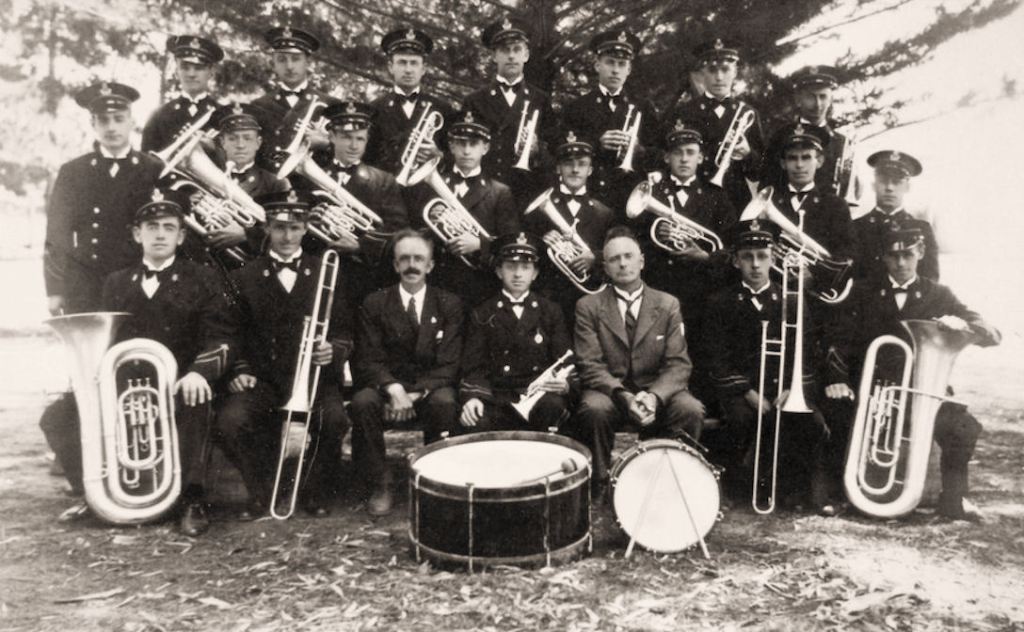
Photograph: Phillip Island Brass Band, 1932. (Source: IBEW)
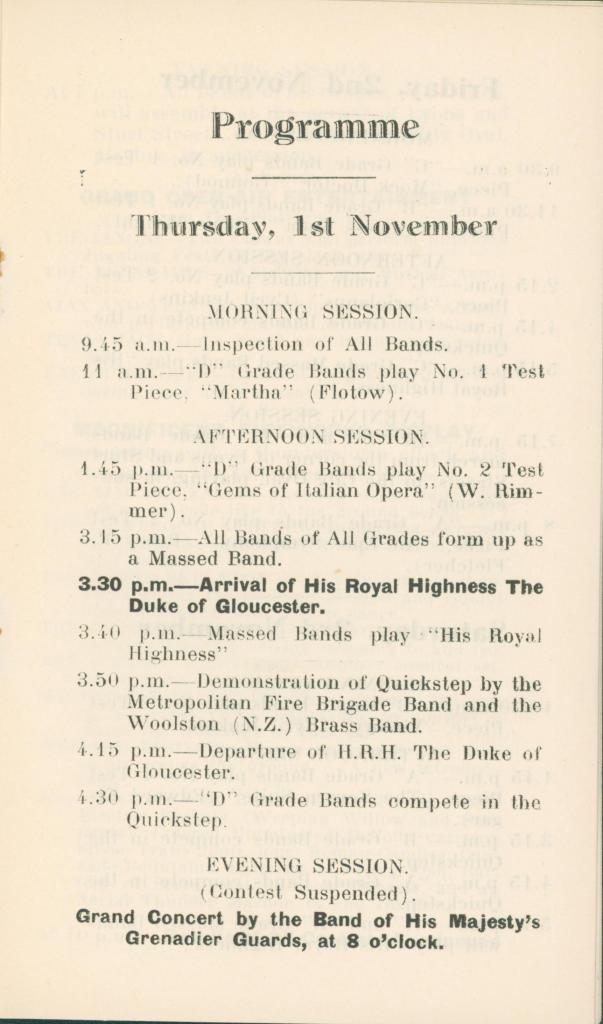
The opening day of the band contest was a spectacular affair with the Royal South Street Society having programmed all events down to the minute. According to various newspaper articles, 10,000 people attended the opening day at Ballarat’s City Oval, no doubt drawn to the fact that the Duke of Gloucester would be there to officially open the contest. The souvenir programme outlined the proceedings of the day as can be seen below.
Programme: South Street “Centenary” Brass Band Contest, 1934, p. 6. (Source: Victorian Collections: Victorian Bands’ League Archives)
In superb weather, everything proceeded to plan, and the bands did their best to produce a ceremony befitting the occasion (“BAND CONTESTS,” 1934). There was a massed band performance, a demonstration of the quickstep, and the Woolston Brass Band even performed a haka for the Duke after the march past of the bands (“DUKE AT BALLARAT,” 1934). That night, the Band of HM Grenadier Guards performed in a concert which would have inspired the bandsmen and audience (Royal South Street Society, 1934e).
Results for the contests were announced on Saturday 3rd of November with another 10,000 people attending to find out the placings. The full results will not be detailed in this post due to space, but they can be found on the RSSS results database via these links:
The Solo contests were held a day before the band sections on the 31st of October. The results of these can be found on the RSSS database via the link:
By all accounts, the standard of playing across all sections was brilliant and the adjudicator was very impressed. The A Grade section in particular was a very hard fought affair, but in the end, the Melbourne Fire Brigade Band won the Besson Shield for the third year in a row (Royal South Street Society, 1934a). The Woolston Brass Band from N.Z. suffered some misfortune when one of their cornet players became ill – the other A Grade bands offered them a choice of cornet players to help out – however, they decided to proceed down a player and were happy to achieve third place (“BRILLIANT PLAYING,” 1934; “PROVINCIAL CITIES AND TOWNS.,” 1934b).
The Duke of Gloucester and the Band of the Grenadier Guards did not stay long in Ballarat as they kept up a tight schedule of touring around Victoria and eventually New Zealand. For the bands themselves there were good stories of their visits to Ballarat. The Yallourn and District Band from Gippsland was one band that was very proud of their efforts in the B Grade section where they achieved second place behind the City of Ballarat Band (“YALLOURN NEWS,” 1934). Of interest is that in early 1935, three cornet players from Victorian bands, including cornetist Jack Allan of the City of Ballarat Band, were offered places in the Band of the Grenadier Guards (“Ballarat Bandsman Invited To Join Grenadier Guards,” 1935). It is unclear whether they took up that offer.
The 1934 South Street contest was no doubt an important part of Victoria’s Centenary celebrations, but it was not the only part. There were other important events taking place.
Events after South Street:
11th of November, 1934: Dedication of the Shrine of Remembrance, Melbourne:
Postcard: The National War Memorial of Victoria. Aerial View of Dedication Ceremony, 11/11/1934. (Source: Jeremy de Korte Collection)
For the Duke of Gloucester, he kept up a busy schedule around Victoria. However, his most important engagement was the dedication of Melbourne’s newly completed Shrine of Remembrance. This was a very special occasion which was attended by thousands of veterans, people, and important dignitaries. Bands and other musicians also played an important role, and at the dedication, several Australian Army buglers sounded the Last Post standing behind Royal Australian Navy drummers.
Portland Centenary Band Contest:
The town of Portland in the far south-west of Victoria had an important part to play in Victoria’s centenary celebrations. In turn, they staged their own band contest, albeit on a much smaller scale than the South Street contests which had concluded only two weeks earlier (“BAND CONTESTS.,” 1934). The Portland contest was only attended by bands from Hamilton, Heywood and Mt. Gambier, and there was a pipe band contest held at the same time. The Portland contest was won by the band from Mt. Gambier and the adjudicator was Mr. Percy Jones (“Band Contest Won By Mount Gambier,” 1934).
Melbourne Centenary Band Championship, King’s Birthday weekend, June 1935:
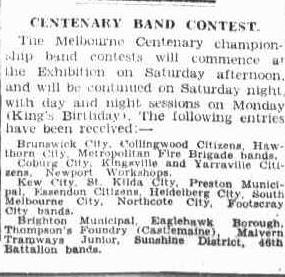
The Victorian centenary celebrations stretched into 1935, and a Melbourne Centenary Band Championship was held at the Exhibition Buildings under the auspices of the Victorian Bands’ League. Like the South Street contests, this was another great event for bands, and twenty-one bands participated, as listed in the article below.
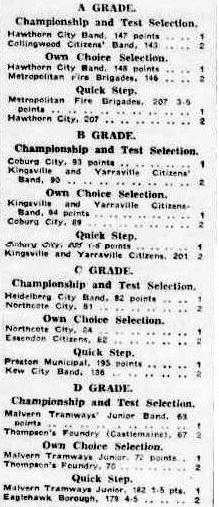
The main attraction of this event was a grand parade from Alexandra Avenue to the Exhibition Buildings and quickstep display on the Exhibition oval (“CENTENARY BAND CONTESTS,” 1935). Again, the A Grade section continued the rivalries between Hawthorn, Melbourne Fire Brigade, Brunswick and Collingwood bands, with Hawthorn taking out the A Grade title (“CENTENARY GALA WEEK.,” 1935). Another celebrated win was that of the Malvern Junior Tramways Band when they won their third D Grade title in a row.
What an intense period of activity for bands! It is times like these that our bands came to the fore with all the ceremonial and contest activity, as well as local celebrations. No doubt the communities appreciated the efforts and the entertainment. Having a visiting band of the calibre of the Band of the Grenadier Guards made the Centenary celebrations even more special, and it was noted at the time that they were inspiring to local musicians. The prevailing feeling when all was done was one of accomplishment, not just from the cooperation that made this all happen, but from all that understood the significance of the events. It is not every day that a world-class military band and a Duke visits a band contest.
Duke of Gloucester to Come Here for Centenary Celebrations : AFRICAN TOUR TIRED PRINCE GEORGE. (1934, 05 May). Weekly Times (Melbourne, Vic. : 1869 – 1954), 5. http://nla.gov.au/nla.news-article223836381
Kingtson, C. (Ed.). (1934). Grenadier Guards Band : Australia and New Zealand 1934-5 : By Special Permission of His Majesty the King : Official Souvenir : Tour under the Auspices of the Commonwealth Government and the New Zealand Government : In associaion with the Cenenary Celebrations Council of Victoria [Printed programme]. Grenadier Guards Band.
McCubbin, M. (2008). Centenary. In eMelbourne: the city past & present (pp. EM00316b). https://www.emelbourne.net.au/biogs/EM00316b.htm: The University of Melbourne, School of Historical & Philosophical Studies.
Melbourne Day. (2024). More marvellous than ever: FAQs: What is Melbourne Day? Melbourne Day: 30th August. Retrieved 26 October 2024 from https://www.melbourneday.com.au/about.html
Mildura & District Band, 1930s. (1930). [Photograph]. [phot6314]. The Internet Bandsman Everything Within, Vintage Brass Band Pictures – Australia. http://www.ibew.org.uk/vbbp-oz.html
Phillip Island Brass Band, 1932. (1932). [Photograph]. [phot16005]. The Internet Bandsman Everything Within, Vintage Brass Band Pictures – Australia. http://www.ibew.org.uk/vbbp-oz.html
Pleasant Street School Band, Ballarat, 1933. (1933). [Photograph]. [phot20817]. The Internet Bandsman Everything Within, Vintage Brass Band Pictures – Australia. http://www.ibew.org.uk/vbbp-oz.html
Royal South Street Society. (1934e). [South Street “Centenary” : Brass Band Contest : A, B, C and D Grades]. In S09 – Programs (Printed programme ed., pp. 14). Ballarat, Victoria https://victoriancollections.net.au/items/5d425e0c21ea6b1a84382033: Victorian Bands’ League Archive.
Royal South Street Society. (1979). Royal South Street Society : The First One Hundred Years. Royal South Street Society.
ShrineMelbourne. (2013, 09 January). The Dedication of the Shrine of Remembrance – Remembrance Day 11 November 1934 [Video (Film Clip)]. YouTube. Retrieved 26 October 2024 from https://www.youtube.com/watch?v=jHcaXEpVdRA
Sunraysia, Land of Sunshine Greets The Duke : Prince Henry Is Our First Royal Guest. (1934, 31 October). Sunraysia Daily (Mildura, Vic. : 1920 – 1950), 21. http://nla.gov.au/nla.news-article265829018
The Shrine of Remembrance Trustees. (1934). The National War Memorial of Victoria : Aerial View of Dedication Ceremony [Postcard]. [No. 3]. The Shrine of Remembrance Trustees, Great Britain.
It is a massive undertaking to take any musical group on tour which stands true even today. But let’s examine these undertakings from another time. When we look back at the grand tours of brass and military bands in the early 1900s, we can only marvel at the schedules they set for themselves, the places they visited, and the effect they had on local populations. Australians it seemed had an insatiable appetite for viewing the best in the business and visiting bands were not disappointed when they toured here.
Visiting bands did not come all the way to Australia just to return home again. Often, Australia was just one stop on a world tour. From reading the Trove archive we can see that the movements of the bands in foreign countries was eagerly reported on because Australians knew they were next to see them. And when the bands did arrive in Australia, each concert was widely advertised.
This was a great age of band movements in Australia and around the World. It must have been quite a sight too when each band was alighting from ships and trains which were eagerly awaited on by an adoring crowd. Parades of massed bands, dinners, receptions, concerts, photographs, articles and other events all greeted visiting bands when they stepped upon our shores. Thankfully our libraries hold some ephemera and newspaper articles from those tours, so we can imagine just what it would have been like.
This post will highlight some of the visiting band tours and will see that some bands had vast reputations which preceded them. However, the famous bands were not the only groups to visit. This post will not cover all tours or bands. Undoubtedly there might have been other bands that visited that are buried in time (more stories to uncover). However, for the bands that did visit, their tours last in memories, and even in some of the local bands that were beneficiaries of the expertise of visiting bandsmen. There are some fascinating stories that surround these tours.
Besses o’ th’ Barn Band travels around the world, twice:
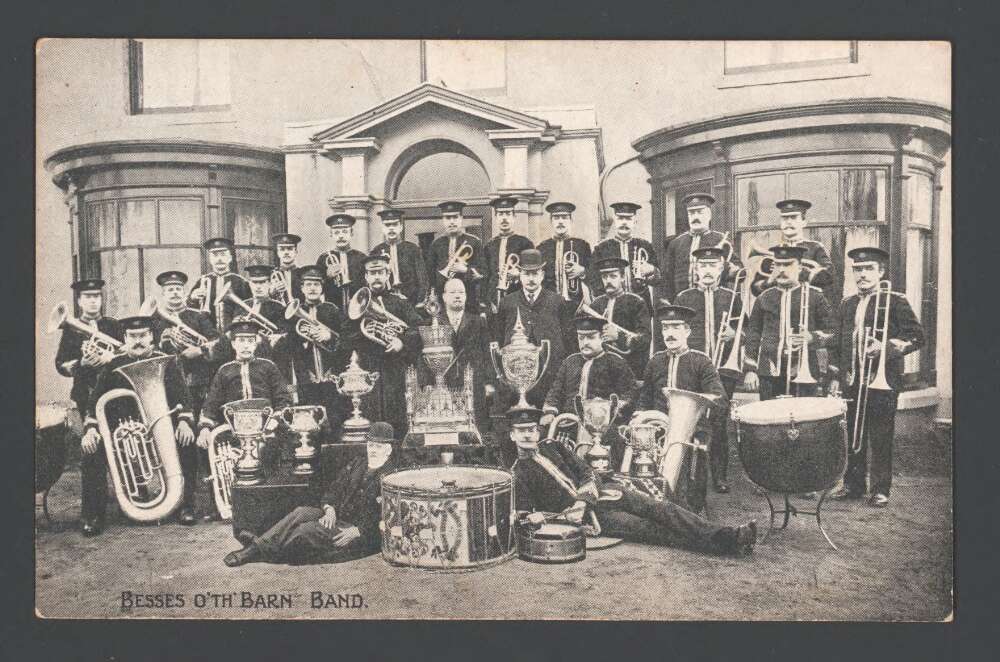
Postcard: Besses o’ th’ Barn Band, 1907 (Source: National Library of Australia: David Elliot theatrical postcard collection: nla.obj-145704095)
The reputation of this unique brass band is well-deserved. Besses o’ the’ Barn Band from the Manchester area, England is one of the oldest brass bands in the world and has been an ensemble of excellence since its establishment in 1818 (Besses o’ th’ Barn Band, 2018a). So it was with a great deal of excitement the world over (and from the band itself) when Besses commenced its first world tour in 1906 (Besses o’ th’ Barn Band, 2018b). This first tour took them to “North America, Canada, Hawaii, Fiji, South Africa, New Zealand, and Australia.” (Besses o’ th’ Barn Band, 2018b). For each performance they attracted vast audiences and it is written in their history that their visit to Melbourne was most notable with no less than “twenty-two of Australia’s finest brass bands” (Besses o’ th’ Barn Band, 2018b) preceding them in a parade along Collins St. This must have been quite the spectacle and sound! Before they arrived in Melbourne they had been in Sydney and an article from The Sydney Morning Herald in 1907 gave an enthusiastic review of their performances (“BESSES O’ THE BARN” BAND,” 1907). In July 1907 the Argus newspaper published an article which gives us an amount of detail about the parade and the massed bands that led it:
Immediately they alighted from the Sydney express the visiting bandsmen stepped across the platform into the railway yard and as they did twenty-two bands, under the conductorship of Mr. E. T. Code, commenced to play an inspiring march. Each man in those twenty-two bands contributed his full share to the volume of sound the like of which has rarely been heard in Melbourne. […] A procession was formed and heralded by the twenty-two local bands, the Besses o’ th’ Barn Band were drive up Collins Street in two drags. The street was crowded with citizens whose curiosity had prompted them to see the famous bandsmen at first opportunity.
[…]
The bands which took part in the ceremony of welcome were as follows: St Kilda City, Prahran City, Code’s Melbourne Band, South Richmond Citizens, Collingwood Citizens’, Richmond City, Malvern City, Williamstown Premier, Footscray City, Stender’s, Doncaster, South Melbourne City, Brighton City, Brunswick City, Warneeke’s, Bootmakers, Camberwell, Box Hill, Fitzroy Military, Clifton Hill, Fitzroy Citizen’s, Kyneton City, St Vincent de Paul Orphanage, St. Arnaud, Castlemaine, Maryborough, and Ballarat bands were also represented.
Regarding the huge crowds, an 1907 article in the Quiz newspaper from Adelaide which reported on the progress of the Besses tour thus far, noted that 70,000 people lined the parade route in Melbourne, which is a staggering amount of people for this kind of event (“Besses o’ th’ Barn Band,” 1907). Such was the popularity and reputation of this ensemble.
Besses o’ th’ Barn Band welcoming parade turning from Collins Street to Swanston Street, Melbourne, July 1907. The massed bands are led by Edward Code. (Source: Manchester Digital Music Archive: 13953)
However, Besses did not finish touring after this first monumental effort. Not one year after they had arrived back in England, the band embarked on another world tour (“BESSES O’ TH’ BARN BAND,” 1909). As noted in their band history (2018b), “Both trips lasted an incredible eighteen months.” (Besses o’ th’ Barn Band) which was a very long time for bandsmen to be away from home. Needless to say, Besses had not lost any popularity on their next world tour and again drew large crowds wherever they went.
Interestingly it was on their second tour where there were some changes in the Besses personnel due to one bandsman staying on in one city, and another bandsman joining them on their tour. In a previous post, we can read the story of Besses Lead Cornetist William Ryder who absconded from the tour in Melbourne and joined the Wests Theatre Company before becoming the first conductor of the Prahran & Malvern Tramways Employees Band in 1911 (de Korte, 2018; Stonnington City Brass, 2018). This being done, it appears that Besses invited one of our most famous bandsmen, Percy Code to join them on the rest of the tour (Bradish, 1929; Gibbney, 1981). The conductor of Besses during this world tour was Mr. Christopher Smith and after the tour ended he was secured by the Adelaide Tramways Band for his services in 1911 (Seymour, 1994).
Postcard: Besses o’ th’ Barn Band, 1906 (Source: Jeremy de Korte personal collection)
There is no doubt that Besses left their mark on Australian banding and were adored by audiences. Certainly, in the succeeding years, many fine Australian bands dominated the landscape and as we saw some ex-Besses musicians now called Australia home. Besses was one of the first bands to include Australia in their tour, but they were not the last. Next to tour was the famous Sousa Band from the USA!
Sousa heads South:
Postcard: Australia welcoming the Sousa Band (Source: National Library of Australia: David Elliot theatrical postcard collection: nla.obj-145695597)
The band of John Phillip Sousa was no less famous than the Besses band, although much bigger with sixty musicians and some additional soloists in their touring party. They toured Australia and New Zealand from May 12th to August 23rd, 1911 and like the Besses band generated huge excitement wherever they went (Lovrien, 2012). In fact, the excitement had started brewing before they had even arrived with newspapers reporting expected arrival dates and schedules (“SOUSA’S BAND.,” 1911). As with the Besses tour that had just finished, the Sousa band was feted with ceremony, functions, awards, parades and large audiences – upon arriving in Sydney there was a grand parade featuring twenty NSW brass bands (“SOUSA AND HIS BAND,” 1911).
Inevitably, given the timing of the Sousa tour to the previous Besses tour, questions were asked as to which the finer band was. In an article from May 1911, the World’s News newspaper sought to answer this question from a reader (“Sousa’s Band,” 1911). The article reported on the differences between both bands and diplomatically opens the article by declaring that: “Comparisons are odious in connection with bands, as well as with politics” (“Sousa’s Band,” 1911). However, it came down to the fact that one was a brass band as opposed to a military-style band and one band was much bigger than the other. Musically, they were both very fine ensembles.
The Sousa band was a very different ensemble and they enthralled Australian audiences. However, there is no real indication that the Sousa band had an influence on Australian bandsmen, and if they did, it was not reported. One could assume the reason was that Australian bands, which were mostly brass at the time, were very much tied to the band tradition of England, not the USA.
Postcard: Sousa Band at the Glacarium, Melbourne, 1911 (Source: Jeremy de Korte personal collection)
From Australia, the Sousa Band traveled to New Zealand where they again delighted audiences and received rave reviews (White, 2018). And after this swing through the Southern Hemisphere, they returned to the mainland USA via a visit to Hawaii (Lovrien, 2012).
The Sousa tour, despite the number of places that they visited and the largeness of the audiences, did not generate a huge financial windfall and it was very expensive to take the band around the world (Lovrien, 2012). However, in 1913 a court case was heard regarding the profits from the Australian leg of the Sousa tour. From the brief flurry of newspaper articles that were written at the time, it appears that a series of contracts were entered into by the promoter of the tour, Mr. Branscombe with a Mr. Quinlan, and later a Mr. Singer over £30,000 in profits (“SOUSA’S BAND IN AUSTRALIA,” 1913). It is interesting that this case was heard two years after the tour had finished, and that these profits were not intended for the Sousa band itself.
Bythell (2000), writing on the band tours and exchanges between countries during this time says that “…the logistics and high costs or international tours and exchanges made them exceptional” (p. 229). Certainly, it was noted in the New Zealand article on the Sousa visit that the tour (through Aus. & NZ) was costing “over £2,000 per week” (White, 2018). Given the logistics of moving a sixty-piece band plus soloists around Australia and New Zealand, this figure is hardly surprising.
Despite this, the Sousa tour appears to have been a success for the band and audiences as Sousa was a renowned conductor and composer. The time frame between this tour and the previous Besses tour had not dimmed the enthusiasm of the Australian public in wanting to see these kinds of entertainments. The Sousa band did not disappoint.
The visit of a Belgian Band during the First World War:
Postcard: Belgian National Band, 1915 (Source: Jeremy de Korte personal collection)
The Besses and Sousa bands were undoubtedly famous, but that did not stop other promoters searching for bands that might tour, which is exactly what happened during the early stages of the First World War. In 1915, a band from Belgium visited the country and apparently went on tour through Australia and New Zealand. (“MUSIC.,” 1915). A paragraph in a Leader newspaper article from May 1915 provides some detail on this band, but the band had no name – they were simply known as the Belgian Band:
A Belgian Band comprising some of the finest instrumentalists in Belgium, has been engaged by J. and N. Tait for a tour of Australia and New Zealand, commencing in June. […] After considerable trouble, many cables and much correspondence, the band has at last been got together, and will prove on its arrival one of the finest aggregations of talent that have yet visited Australia. The band comprises of 28 instrumentalists, recruited from the foremost bands of Brussels, Antwerp and Ostend, and augmented by half a dozen English players, and will be conducted by the brilliant M. Phillipe Meny, a remarkable musician, whose reputation is not only Belgian, but European.
The reaction of the Australian press to this visit was understandable. A number of articles expressed admiration that the musicians had actually left Belgium, while also expressing sympathy and solidarity with the Belgian people under German occupation. An example of this kind of article was from the Daily News in Perth (“THE BELGIAN BAND.,” 1915). Notwithstanding the circumstances of this visit, the band drew the interest of an Australian public and received good reviews for their performances (“Visit of Belgian Band,” 1915). In an act of decency, the band promoters donated all profits to “…the Belgian Relief Fund and the Wounded Soldiers Fund” (“BELGIAN BAND VISITS AUSTRALIA.,” 1915).
First came the Royal Marines, then came the Guards:
After the war, visits from overseas bands resumed quite early on with a visit from the Royal Marine Band, H.M.S. “Renown”. This band was brought to Australia by J. and N. Tait, the same promoters who engaged the Belgian Band in 1915 (“RENOWN BAND.,” 1920). The Royal Marines actually visited twice; their first visit was in 1920 and they followed up with another visit in 1927. The concerts of 1920 received some very favorable reviews with one article printed in the Argus praising the sound and playing of this ensemble, and making a comparison of conducting styles with the great Sousa (“Concert by Renown Band.,” 1920). On the second tour, a concert in Melbourne was presented as a massed bands concert in combination with the “Returned Sailors and Soldiers Memorial Band” and the “Victorian Railways Military Band” with the Lord Mayor’s Hospital Appeal Fund the beneficiary of the proceeds from the concert (“FOR MAYOR’S FUND,” 1927).
Programme (front cover), featuring: Royal Marines Band H.M.S. “Renown”, Victorian Returned Sailors and Soldiers Memorial Band & Victorian Railways Military Band. (Source: Victorian Collections : Victorian Bands’ League)
In 1934 the Band of the Grenadier Guards visited Melbourne as part of the Centenary of Victoria celebrations, with a subsequent tour of Australia as well. There was some initial confusion as to which Guards band was going to visit with the Grenadier Guards, Coldstream Guards and Welsh Guards being mentioned in some press (“GUARDS’ BAND VISIT.,” 1933). It seems there was also some objection to the tour on the part of the Musicians’ Union. A letter to The Herald in September 1933 berated the Union for their stance with the writer stating that “Their visit will be education and beneficial to our unemployed musicians.” (Musician, 1933). A visit to Australia by a band of this caliber was beneficial to all who witnessed them (not just unemployed musicians). The band made a special appearance at the South Street competition of 1934 with a concert presented to an appreciative audience which included the Duke of Gloucester who was also visiting Australia (“South-street Band Contests.,” 1934).
These two British military bands were highly regarded, and it appears that their tours were more genuine with concerts in combination with Australian ensembles and presenting inspirational performances. There was no comparison with the previous tours of Besses and Sousa as these were again, very different groups. However, Australians were no less enthusiastic about the visits of these bands and made them feel very welcome.
Conclusion:
What we have seen here is only a small sample of the bands that visited Australia within a shorter time frame. Each group was very different, yet they elicited an amount of excitement from the Australian audiences, bandsmen and public authorities. Yes, they were expensive undertakings. But musically they were invaluable. This truly was a great age of banding.
References:
Australia extends the glad hand of welcome to Sousa and his band. (1910). [1 postcard : col. ; 9.6 x 13.9 cm.]. [nla.obj-145695597]. National Library of Australia, David Elliott theatrical postcard collection. https://nla.gov.au/nla.obj-145695597/view
Besses o’ th’ Barn Band. (1907). [Postcard]. [nla.obj-145704095]. National Library of Australia, David Elliott theatrical postcard collection. https://nla.gov.au/nla.obj-145704095/view
Bradish, C. R. (1929, 05 September). Prominent Personalities : PERCY CODE | CONDUCTOR OF NATIONAL BROADCASTING ORCHESTRA. Table Talk (Melbourne, Vic. : 1885 – 1939), 13. http://nla.gov.au/nla.news-article146712994
Bythell, D. (2000). The Brass Band in the Antipodes : The Transplantation of British Popular Culture. In T. Herbert (Ed.), The British brass band : a musical and social history (pp. 217-244). Clarendon Press ; New York : Oxford University Press.







 Band Blasts from the Past