Australian bands, gramophones and wireless: adapting to new technology

19290722_Argus_Wireless-Broadcast
The Argus, 22/07/1929, p. 18

Introduction:

The Old Town Band
(Written for “The Land”)

The band was the life of the old town
The zest of its great events
When the great Pooh-Bah himself came down,
Or the prize merinos brought renown
Or the circus raised its tents.

There was music in the trombone
A martial note in the drum
And the boom of the bass was on its own
In the days before the gramophone
Ere the wireless craze had come.

Those were the day when the township band
Filled a place in pioneer life:
Cheered the struggle with virgin land
And gave the old battlers a helping hand
When droughts or plagues were rife.

Today the baton is laid aside
And the bandsmen rest in their graves:
They played their way o’er the great divide,
And are bandsmen now on the other side
In paradisian naves

And o’er the earth in tones forlorn
The saxophone raises its call.
The engines start their shrieks at dawn
The gramophone laughs the band to scorn,
And the wireless mocks them all.

(Excerpts from “The Old Town Band”, James, 1929)

So wrote Mr. A. A. James in 1929 for The Land newspaper in response to an article published in the Riverine Grazier which lamented the fact that the town of Hay in Southern New South Wales had lost its town band.  His prose was published in several other country newspapers at the time, as many town bands faced the same challenges.  Mr James singles out the gramophones and wireless as contributing factors, but was he right in suggesting so?  Was this new technology which proliferated during the early 1900s detrimental to our bands? It depends on the perception of the history at the time.  And thankfully, there is much history to examine.

In this post, the effects of new broadcasting technology on Australian bands will be looked at.  The early 1900s were a period of rapid technological change and our bands were nominally affected by these changes.  Throughout this early time from 1900 – 1950, and Mr James’s poem sits roughly in the middle, a new life of music and entertainment was brought into the homes of Australians – enthusiastically so.  With this adoption of gramophones and wireless sets came the start of commentary and opinions from citizens which were written up in the newspapers.  Radio program notes published in newspapers became essential reading.

Through this all we find the relationships between audience and bands being rapidly changed.  Perhaps this is the deeper meaning of Mr James’s poem – he identified that people were more enamoured with sounds coming out of a box of wires than live instruments and musicians.  Both sides of this issue will be explored as some bands took advantage of the radio and found new audiences, while other bands could not compete.

Early transmissions:

Live performance was very much the norm of Australian brass bands in the early 1900s and engagement with audience was centred around this type of performing.   As well as this, the popularity of brass bands was obvious through their music and the crowds that they attracted.  Reports of 70,000 people cramming the streets of Melbourne to see the famous Besses o’ th’ Barn Band in a parade and 20,000-30,000 people watching the South Street marching sections were not uncommon (“Besses o’ th’ Barn Band,” 1907; Greaves, 1996).  Later in the 1920s there are stories about 5,000 people attending community song nights in local gardens, as was the case at Central Park in Malvern where the Malvern Tramways performed every week (Young, 1923).

In amongst the many accounts on live performances are a couple of unique stories.  In an earlier post regarding bands on Australian islands, the remarkable story of a performance by the Kingscote Brass Band (Kangaroo Island) was highlighted.  On the 20th of November 1906, the band performed a lunchtime concert which was transmitted via telephone to lighthouses at either end of Kangaroo Island – one seventy miles to the West of Kingscote and the other thirty miles to the East (“MUSIC FOR WATCHERS BY THE SEA.,” 1906).  According to the article in the Register, the concert was “very much appreciated” by both lighthouse keepers (“MUSIC FOR WATCHERS BY THE SEA.,” 1906).

However, this was not the first brass band concert broadcast via telephone in Australia.  According to an article published in the Rockhampton Morning Bulletin, this took place in the preceding century, although the exact date is unclear.

A band conducted by Mr Edward Brown was practising at the old fire brigade station […] when the late Messrs Harry Batchelor and W. Pummell, compositors of the “Morning Bulletin” suggested that the playing be put “over the phone”.  Mr Rosenads, then in charge of the Rockhampton Telephone Exchange, agreed to the proposal.  There was a function at the School of Arts that night and the band was heard there “by quite a few who took turns at the earphone”.  Later the band was playing outside the Oddfellows Hall in Denham Street and by means of a “link-up” was heard at Mount Morgan.  “And very well, too” said Mr Brown.

(“Band Music “Broadcast” Here Last Century,” 1945)

No doubt transmitting a performance via telephone would have seemed innovative and inventive, especially in these early times.  However, these were extremely rare and were not substitutes for live performances, they were mainly done out of opportunity – a way to see whether it could be done.  The major changes that were taking place were the recordings of bands on gramophone records, and the beginnings of radio broadcasts.

The band movement is cautious:

In Australia, the pace of change from predominantly live music to a mix of live music, recorded music and broadcast music took place within the space of a couple of decades.  There were many commentators at the time who saw fit to try to warn of a decline of community bands and one or two had their voices repeated through many regional newspapers.  One of them was a Mr Will Lewis formerly of the Toowoomba Municipal Band who expressed a pessimistic attitude:

He was of the opinion that the day of the amateur brass band was waning, and gave as a reason the fact that the gramophone, by which one could hear the world’s greatest bands and orchestras – jazz and otherwise, was creating serious inroads upon the brass band, and further, that the advent of the radio was also having much to do with the decline of brass band popularity.  Even band contests were becoming less popular every year – at least with the general public – and the wireless and the gramophone were the two disturbing elements.  Bandsmen, naturally, would be the last persons to recognize this serious fact.”

(““DAY OF AMATEUR BRASS BANDS WANING.”,” 1927)

Some might consider Mr Lewis to be alarmist, he could not predict the future, but he was commentating on the present.  For the brass bands it was a time of upheaval and some of them were rightfully concerned.  It could be said that many bands went defunct at this time due to the technological change however it is hard to document this at this time of writing.

The worry of band people was not helped by this small snippet of news in 1930 about the Royal Melbourne Show dropping the brass bands in favour of recorded music being played through loud speakers – and saving £140.00 (“MELBOURNE SHOW.,” 1930).

19300409_Brisbane-Courier_Melb-Show
The Brisbane Courier, 09/04/1930, p. 24

In 1938 a passionate call to old times was made by the Committee of the Sunshine Brass Band, based in western Melbourne.  While the crux of the article published in the Sunshine Advocate was to solicit funds and support, they also lamented the fact that times had changed, and that local brass bands were victims of change.  Below are some excerpts from the article:

Most old-established customs and usages have felt the influence of modern times, and not the least of these are district brass bands, which have had to fight against canned music retailed hourly over the wireless.  Gramophone recordings of the world’s best bands are sandwiched in between talks and appeals to buy somebody’s pills to improve health.

[…]

The older generation was a music loving people.  The possession of a piano was a hall-mark of respectability, and the education of the children was not considered complete unless music was included in the curriculum.

[…]

To hear a local band in the gardens on a Sunday afternoon and a warm evening were events that were looked forward to by the older generation.  They were delightful times, and people held communion with one another to the strains of pleasant and beautiful music, which acted as a tonic to their nervous system.

The Sunshine band committee realises that a return to the customs of other days is due, and propose to play near the railway station on warm Sunday evenings.

(“Sunshine Band Needs More Public Support,” 1938)

This article was interesting in its sentiment and information.  We have here a brass band from the Melbourne environs trying to bring back former times through playing quality live music in a local place.  By this time however, music broadcasts were well and truly accepted so their words might have struck some memories amongst parts of the population. They were telling it as they saw it.

A similar sentiment to Mr. Lewis and Mr. James was also expressed in 1938 in an article published in the Sydney Mail by a contributor with the initials of W. P. T.  This article was more of a reminiscence of times gone by and he mentions several brass bands.  The opening of his article reads:

The brass band of the small country towns plays a very important part in the social life of the country, although such bands are not nearly as common as they were before the days of radio.

(W. P. T., 1938)

It is an interesting observation to make and clearly some connection had been made in the minds of people that radios were somewhat to blame for the demise of smaller bands.

The other side to these views is that several bands had begun exploring what the new technology could do for them from the very beginning.

The band movement adapts:

In 1996, noted band historian Jack Greaves assisted in the compilation of several old recordings into a two-CD set titled “The Great Bands of Australia” (Greaves, 1996).  This CD set is remarkable not only for the breadth of recorded music from full band works, marches and solo items, performed by a large selection of famous Australian bands.  From reading a catalogue entry of this work (linked), we can see that the recordings date back to 1912.  Some of the music can still be heard thanks to the work of the National Library of Australia and the National Film and Sound Archive (NFSA).  Below is a link to one recording which is on the NFSA website:

The Newcastle Steelworks Band (1924) playing the “Honest Toil March” by William Rimmer

The gramophone meant that people could acquire recordings of music groups and play them in their own homes at a time of their choosing.  They did not have to go out to concerts or community events, or the band competitions.  It was one cause of alarm for the band movement, but some bands obviously saw fit to record their work and bring their playing to new audiences.  Recordings by many of the top bands of the day still exist and enthusiasts have made digital copies of old recordings.

Aside from the gramophone, the utilisation of the radio probably brought about the greatest change to society and to the band movement.  Referred to early as the wireless, Australia followed developments out of America and the United Kingdom and set up its own network of stations.  It is in the early 1920s when this was happening.

19230800_Box-Hill-Band_Radio-Studio
Newspaper unknown at the time of writing (Source: Box Hill Historical Society)

The year is 1923 and in the Melbourne suburb of Box Hill the first transmission of a live brass band over the wireless took place on the 1st of August (Elsum, 1924).  The picture above is reputed to be the Box Hill Brass Band sitting in the home of Mr H. Beattie, a wireless enthusiast who resided in Box Hill.  However, in some newspapers the band that participated in the first transmission was named as the Nunawading District Brass Band (“NUNAWADING BRASS BAND,” 1923).  This conjecture can be easily explained as Nunawading and Box Hill are near neighbouring suburbs and the then Parish of Nunawading encompassed Box Hill.  (The Box Hill Historical Society shares my confusion as the newspapers were not forthcoming as to the true identity of the band that was actually broadcast (Harris, 2020)).  Despite the confusion in the newspapers, the fact remains that a brass band of the local area had their music transmitted via wireless.

This first transmission was actually a modulation test and the band was heard over all of Melbourne, parts of Victoria, and even interstate!  Much of the article published in the local Reporter newspaper listed the locations where the transmission was heard and the praise that was given:

For the next few days letters arrived from all points of the compass congratulating Mr Beattie and the Band, and expressing appreciation also of a speech by Cr. W. Young.  From Footscray to Armadale, from Sandringham to Camberwell, Essendon, Hawksburn, and wherever else in the metropolitan district, receiving stations listened in, the unanimous opinion expressed that it “was the best music ever heard by wireless”.  Wonthaggi sent a tribute, and the amateurs of Ararat wrote “Encore, we want more”, while far away Terang announced that the enthusiastic listeners in there were delighted.  The most interesting letter came from Strathfield, Sydney, 592 miles from the spot the Band played, stating that a number of visitors sat around a three-valve set with a loud speaker, and heard the performance from start to finish, announcing the strength and modulation to be perfect, and stating that after the Band had concluded with the National Anthem, local transmitters around Sydney could be heard enthusiastically discussing the test.

(“NUNAWADING BRASS BAND,” 1923)

An achievement indeed!  Although this achievement had to be defended.  In early 1924, the Vice-President of the Nunawading District Brass Band, a Mr. W. M. R. Elsum wrote a letter to the Argus newspaper disputing that the Newcastle Steelworks Band was the first full band to have broadcasted a concert via wireless (Elsum, 1924).

Once people in Australia realised that music of this nature could be transmitted successfully, there was no stopping the progress – it is to say, in colloquial terms, the horse had well and truly bolted!  Radio stations and transmitters were set up all over the country and within years, much of the population could listen to a variety of programs (““Listening In”,” 1923).  The Queensland Government for example, started setting up a State based broadcasting service in 1925 (“STATE RADIO.,” 1925).  In New South Wales, innovation in programming was highlighted with the organising of a Radio Eisteddfod by the New South Wales Broadcasting Company which involved a section for brass bands (“RADIO EISTEDDFOD.,” 1928).  Although, the articles of the day were not clear as to who competed and if brass bands made it to the finals.

For the brass bands, radio stations seized upon them as a ready-made musical item and for some of the bands it led to new popularity – some, because radio stations were tending to use the same top-quality brass bands over and over again.  Additionally, as explored in a previous post, in 1930 the A.B.C. Military Band was established (“MILITARY BAND AT 3LO.,” 1930).  Initially conducted by Harry Shugg, it was further strengthened in 1933 and quickly became a stalwart of A.B.C. radio programming alongside the brass bands (“A BRASS BAND RECITAL.,” 1940; “Radio Programmes,” 1939).

S6.2_20180609_19310000_ABC-Military-Band_Postcard
1930 Postcard of the A.B.C. Military Band in a studio, conducted by Mr Harry Shugg. (Source: Victorian Collections: Victorian Bands’ League)

The Advertiser newspaper in Adelaide noted that “Brass band concerts have been remarkably popular” and one of the brass bands that station 5CL presented was “Holden’s Silver Band” (“5CL FEATURES,” 1930).  A highlight in Victoria of station 3LO’s programming was the “State Schools’ Brass Band contest, which was won by Wonthaggi.”  (Armadale came second and Princess Hill was third with Northcote awarded an honourable mention) – a contest which was adjudicated by the famous Percy Code (“RADIO SHOW.,” 1930).

Of course, like the concerts mentioned earlier in the post that were broadcast via telephone, there were other broadcasts that could be classed as novelty events.  In November 1932, thirty members of the Young Australia League band were taken up in the “Southern Cross” aircraft flown by Charles Kingsford-Smith where they were to “broadcast music at a height of 5000ft” (“MUSIC IN THE AIR,” 1932).

Now that radio broadcasting was fully entrenched and brass bands were a seemingly popular item, there were times when radio through it would be in the best interest of the band movement to have their events transmitted to the world.  The Victorian Centenary celebrations of 1934 were a case in point.  The Herald newspaper took aim at the Victorian Bands’ League for not being ambitious enough with their proposed event:

From the point of view of broadcasting, it is regrettable that the Victorian Bands’ League does not see its way to conduct at the Centenary celebration its proposed international brass band championship.  This would have been an event of exceptional interest, extending to distant peoples who know little of Australia and its progress.  More than that, good band music will be an influence joyous and vital.  If an international contest cannot be arranged it should be possible to provide an Imperial one.

(“Broadcasting And Brass Bands,” 1933)

Through better technology and transmission, Australia was also exposed to performances from around the world.   Perhaps one of the more unusual concerts that was received was in 1935 when the Imperial Ethiopian Brass Band was heard via short-wave radio in Brisbane (“IMPERIAL ETHIOPIAN BRASS BAND,” 1935).  The transmission was reported to have been heard with “remarkable clarity” (“IMPERIAL ETHIOPIAN BRASS BAND,” 1935).  Over in Western Australia, the Kalgoorlie Brass Band conducted by Mr. Ted McMahon made history in 1937 when it was broadcast and relayed nationally through stations 6GF, 6WF and 6WA as part of a program to highlight local artists (“Kalgoorlie Band For National Broadcast,” 1937).

These formative years of radio shaped the way Australians heard and digested music.  Clearly the brass bands were a useful addition to radio programs, and they presented some quality music.  Obviously, some bands, namely country bands, had been left out of this success.  What were the feelings of the listeners?

Too many bands or not enough bands?:

As mentioned, the first wireless transmission of a brass band took place in 1923 so another part of this story is the opinions of listeners, and there were many opinions.  Most accounts were diplomatic about the popularity of brass bands, but some listeners and commentators asked whether there were too many bands, or could the broadcasters play more bands.  Opinions were divided; Australians clearly had their choices.

As early as 1925 letters were seen in newspapers criticising the musical choices of radio stations.  Some of the language was blunt as this letter signed by “Condensor” and published in the Herald shows:

Sir,  – We quite agree with your correspondent “Radio” who complains of the number of brass bands broadcast from 3LG.  Night after night we have to put our phones down, sick and tired of brass.  Surely one night a week is enough to satisfy anyone.

(Condensor, 1925)

Interestingly we also see opinions from commentators.  A Mr Robert McCall, writing for the Australian Women’s Weekly column, “Music Radio” asks a question at the head of one his columns, “Band Music On the Air Will it be Overdone?” (McCall, 1933).  He asked the question because of a decision by the A.B.C.:

Is the Australian Broadcasting Commission overdoing band programmes?  Next week there will be bands on the air on six nights – one night the popular brass ensemble from the Malvern Tramways and on five the newly-formed A.B.C. Military Band.

(McCall, 1933)

He went on to write:

Bands, both brass and military, always have been popular in Australia and the commission will find a vast and most receptive audience for its several months season by the band conducted by Captain Adkins from Kneller Hall.

[…]

The bands’ programmes are sure to stimulate the already widespread interest in band work, but I feel that their greatest service should lie in lifting the usual band repertoire out of the ruck of the commonplace.  It is about time that such hardy perennials as “Zampa,” “Poet and Peasant,” “Light Cavalry,” and those ill-sounding selections from grand and light operas were given a rest.

[…]

At the same time it should not be forgotten that in recent years some of the most important composers of the day have been seized with the possibilities of bands.  Men such as Holst and Elgar have written compositions specially for them.  Nor are these works complex and unlistenable.

Band music gives pleasure to thousands.  It can still do so, and yet be artistic and original.

(McCall, 1933)

McCall provides an interesting opinion.  It seems he was not against the idea of bands being programmed six nights in a row.  Rather, he was taking the view of a music critic and expressing concern that the usual repertoire played by bands per se was not palatable to the ordinary listener.

To counter some of the detractors, there were always people who liked the regularity of brass and military bands on the radio.  The target of their letter writing was the radio stations themselves and certain listeners scolded the A.B.C. in particular for altering the programming of regular band programs (Breynard, 1934; Mounsey, 1939).  One of the stronger responses came from Mr J. L. C. White, then Secretary of the Victorian Bands’ League of which his words were quoted in an article published in The Argus newspaper in March 1951:

Victoria’s 3,500 registered brass bandsmen and their fans were receiving no encouragement from the A.B.C. or commercial broadcasting stations, Mr. J. L. C. white said yesterday.

[…]

He was commenting on a letter to The Argus pointing out that packed houses for the Black Watch band had proved that good bands were still popular.

The letter asked why radio listeners were not given more band music.

Mr. White said: “A poll would show that 90% of radio listeners enjoy band music.”

“More bands than ever are being formed now, and their music is as popular as ever.”

(“He wants more band music broadcast,” 1951)

It is of course some months after this article was published that the A.B.C. Military Band was made redundant in October 1951 (“A.B.C. Band’s Farewell,” 1951).

After these formative times, the status quo of brass bands had changed.  Live performances continued, but radio and recording also occupied the bands.  Some bands found a new market by producing small recordings of marches for use in schools and marching groups of with three such recordings are cited with details of the recordings linked here (Malvern Municipal Band, 1958, 1970; Preston Municipal Brass Band, 1956).

Conclusion:

In the course of these years it is possible to follow divergent streams of opinion.  Firstly, there were the bands who were concerned by the impact of new technology and were worried about the erosion of their traditional ways of doing things.  Then there were the bands that embraced recording and broadcasting.  And of course, the second divergent opinion was evident regarding the content of radio programs and programming.  It was not exactly win-win situations for everyone.  Strength of feeling in the band movement was strong.

It is doubtful to see whether the same debate would take place nowadays regarding new technology.  There was a time past in the early days of the internet when community bands could not see the use of a website or email.  It would seem that history keeps repeating itself whenever there is a new technological development.

To finish this post, it would be remiss not to end with another old recording.  Here is a YouTube with the Newcastle Steelworks Band of 1924 playing the piece “Zelda” by Percy Code with famous Cornetist Arthur Stender as the soloist (Vintage Sounds & Code, 2019).

References:

5CL FEATURES : Brass Band Concert. (1930, 23 August). Advertiser (Adelaide, SA : 1889 – 1931), 9. http://nla.gov.au/nla.news-article30503444

A.B.C. Band’s Farewell. (1951, 15 October). Age (Melbourne, Vic. : 1854 – 1954), 3. http://nla.gov.au/nla.news-article205334832

A.B.C. Military Band – Conductor: Harry Shugg. (1930). [Postcard : L13.8cm – W8.8cm]. [0016]. Victorian Collections, Victorian Bands’ League. https://victoriancollections.net.au/items/5b39988221ea6d0008c461a6

Band Music “Broadcast” Here Last Century. (1945, 16 October). Morning Bulletin (Rockhampton, Qld. : 1878 – 1954), 5. http://nla.gov.au/nla.news-article56391096

Besses o’ th’ Barn Band. (1907, 09 August). Quiz (Adelaide, SA : 1900 – 1909), 8. http://nla.gov.au/nla.news-article166338966

A BRASS BAND RECITAL. (1940, 28 May). Macleay Argus (Kempsey, NSW : 1885 – 1907; 1909 – 1910; 1912 – 1913; 1915 – 1916; 1918 – 1954), 6. http://nla.gov.au/nla.news-article234489582

Breynard, S. (1934, 10 August). RADIO SERVICES : Brass Band Music : To the Editor. Advertiser (Adelaide, SA : 1931 – 1954), 24. http://nla.gov.au/nla.news-article74106904

Broadcasting And Brass Bands. (1933, 21 February). Herald (Melbourne, Vic. : 1861 – 1954), 6. http://nla.gov.au/nla.news-article243056460

Condensor. (1925, 27 August). TOO MUCH BRASS. Herald (Melbourne, Vic. : 1861 – 1954), 8. http://nla.gov.au/nla.news-article243624609

“DAY OF AMATEUR BRASS BANDS WANING.”. (1927, 14 September). Casino and Kyogle Courier and North Coast Advertiser (NSW : 1904 – 1932), 2. http://nla.gov.au/nla.news-article233826047

Elsum, W. M. H. (1924, 23 February). BROADCASTING BY WIRELESS : To the Editor of the Argus. Argus (Melbourne, Vic. : 1848 – 1957), 20. http://nla.gov.au/nla.news-article1934742

Greaves, J. (1996). The great bands of Australia [sound recording] [2 sound discs (CD)]. Australia, Sound Heritage Association. 

Harris, H. (2020). Re: Brass band 1st radio broadcast. In J. D. de Korte (Ed.).

He wants more band music broadcast. (1951, 13 March). Argus (Melbourne, Vic. : 1848 – 1957), 9. http://nla.gov.au/nla.news-article23036508

IMPERIAL ETHIOPIAN BRASS BAND : Heard by Short Wave Wireless. (1935, 29 November). Courier-Mail (Brisbane, Qld. : 1933 – 1954), 14. http://nla.gov.au/nla.news-article35923328

James, A. A. (1929, 25 January). The Old Town Band : (Written for “The Land”). Land (Sydney, NSW : 1911 – 1954), 2. http://nla.gov.au/nla.news-article117237132

Kalgoorlie Band For National Broadcast. (1937, 16 July). Kalgoorlie Miner (WA : 1895 – 1954), 4. http://nla.gov.au/nla.news-article87578534

“Listening In” : The Wonders of Wireless. (1923, 04 September). Horsham Times (Vic. : 1882 – 1954), 8. http://nla.gov.au/nla.news-article72734927

Malvern Municipal Band. (1958). On One Fine Day [Vinyl, LP, 10”]. W & G Distributing Co. Pty. Ltd. https://www.discogs.com/Malvern-Municipal-Band-Under-The-Direction-Of-Bandmaster-WJ-Philpott-One-Fine-Day/release/8933573 

Malvern Municipal Band. (1970). On Marching with Malvern [Vinyl, LP, Album]. W & G Distributing Co. Pty. Ltd. https://www.discogs.com/Malvern-Municipal-Band-Marching-With-Malvern/release/11048679 

McCall, R. (1933, 23 December). MUSIC RADIO : Band Music on the Air : Will it be Overdone? Australian Women’s Weekly (1933 – 1982), 16. http://nla.gov.au/nla.news-article51189093

MELBOURNE SHOW : Brass Bands to be Superseded. (1930, 09 April). Brisbane Courier (Qld. : 1864 – 1933), 24. http://nla.gov.au/nla.news-article21518117

MILITARY BAND AT 3LO. (1930, 29 October). Argus (Melbourne, Vic. : 1848 – 1957), 15. http://nla.gov.au/nla.news-article4214065

Mounsey, T. B. (1939, 20 December). Brass Band Broadcasting. Age (Melbourne, Vic. : 1854 – 1954), 10. http://nla.gov.au/nla.news-article205593992

MUSIC FOR WATCHERS BY THE SEA. (1906, 21 November). Register (Adelaide, SA : 1901 – 1929), 7. http://nla.gov.au/nla.news-article56693536

MUSIC IN THE AIR : Y.A.L. Band at 5000ft. Will Broadcast. (1932, 19 November). Sun (Sydney, NSW : 1910 – 1954), 3. http://nla.gov.au/nla.news-article230575146

Newcastle Steelworks Band. (1924). Honest Toil March [This 1924 gramophone recording of W Rimmer’s ‘Honest Toil March’ is performed by the Australian Newcastle Steelworks Band.]. Aeolian Company. https://aso.gov.au/titles/music/honest-toil-march/clip1/

NUNAWADING BRASS BAND : Unique Wireless Demonstration. (1923, 10 August). Reporter (Box Hill, Vic. : 1889 – 1925), 5. http://nla.gov.au/nla.news-article257201010

Preston Municipal Brass Band. (1956). On Under the Baton [Vinyl, LP, 10”, Album]. Cyril Stevens Recording Studios Pty. Ltd. https://www.discogs.com/Preston-Municipal-Brass-Band-Conducted-By-Charles-Smith-Under-The-Baton/release/4595545 

RADIO EISTEDDFOD. (1928, 05 October). Macleay Argus (Kempsey, NSW : 1885 – 1907; 1909 – 1910; 1912 – 1913; 1915 – 1916; 1918 – 1954), 9. http://nla.gov.au/nla.news-article234464548

Radio Programmes : A.B.C. Highlights for Next Week : Brass Band Recitals. (1939, 03 February). Nambucca and Bellinger News (NSW : 1911 – 1945), 4. http://nla.gov.au/nla.news-article214648292

RADIO SHOW : Schools’ Band Competition. (1930, 25 July). Age (Melbourne, Vic. : 1854 – 1954), 11. http://nla.gov.au/nla.news-article202468625

STATE RADIO : World Range : Erecting the Station. (1925, 21 January). Townsville Daily Bulletin (Qld. : 1907 – 1954), 12. http://nla.gov.au/nla.news-article61570872

Sunshine Band Needs More Public Support : Committee’s Plan to Stimulate Interest. (1938, 21 January). Sunshine Advocate (Vic. : 1924 – 1954), 4. http://nla.gov.au/nla.news-article75199111

Vintage Sounds. (2019, 25 October). Australian Newcastle Steelworks Band – Zelda (Percy Code) (1924) [Video (Recording)]. YouTube. Retrieved 27 April 2020 from https://www.youtube.com/watch?v=6Fn8VgZK9Yc

W. P. T. (1938, 28 December). Brass Bands of the Bush. Sydney Mail (NSW : 1912 – 1938), 2. http://nla.gov.au/nla.news-article166525297

WIRELESS BROADCASTING : New Service Begins. (1929, 22 July). Argus (Melbourne, Vic. : 1848 – 1957), 18. http://nla.gov.au/nla.news-article4023301

Young, G. (1923). The Malvern Tramways Band : An Appreciation. In Community singing : St. Kilda Esplanade every Wednesday evening : words of songs & program (pp. 24). Malvern Tramways Band. 
Australian society and brass bands: The Pneumonic Influenza pandemic of 1919

19190624_AIF_VAD-Band_phot16531
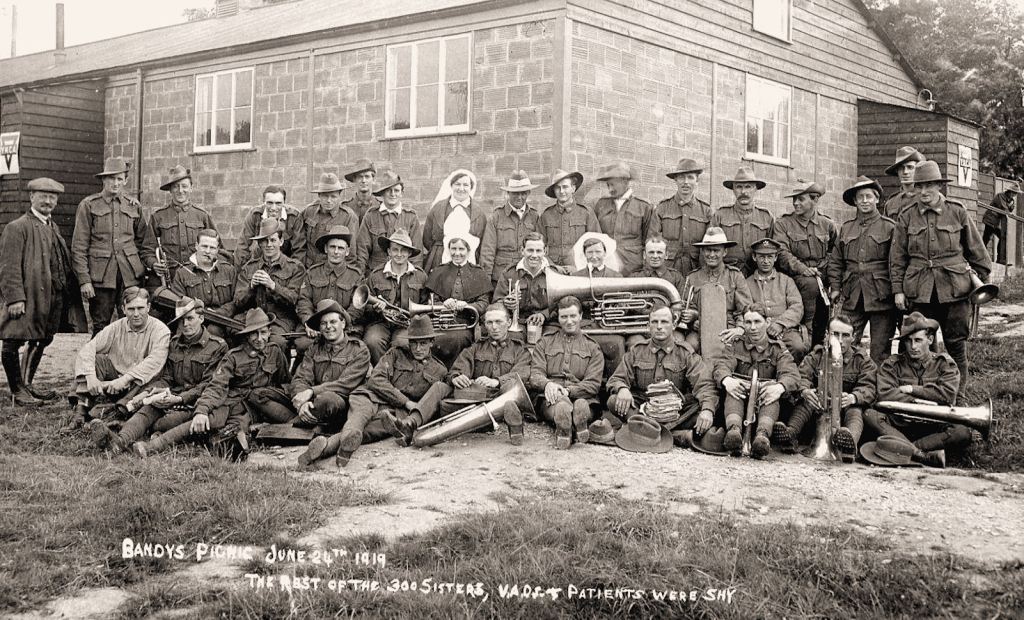
Bandys Picnic June 24th 1919. Photo was taken at an Australian camp in England. (Source: IBEW)

Introduction:

Early in 1918 it began to be whispered that a new plague, the first pandemic scourge of the present world war, had made such inroads upon the German military machine, as well upon the “home front” behind, that the Western offensive had to be postponed until the worst of it was over.  The end of the third week in March saw this point reached, and the onslaught began.

(Hirshberg, 1919)

So wrote M.D. Leonard Keene Hirshberg in an article for the Australasian newspaper in March 1919.  The years of 1918, 1919 and 1920 were tumultuous times for society with the end of the First World War, the return of service men and women to homelands, and this horrific pandemic.  This influenza touched every corner of the globe and has been noted in medical and social history.

This post will be about some of the local responses to the pandemic and the effect it had on the nations brass bands as they were nominally affected by what was going on around them.  There were several ways the bands were affected, some through loss of members, others through loss of rehearsal spaces and performances, and other bands sought to keep up morale by continuing as best they could under the circumstances.  Pandemic rules and responses from national, state, and local government meant that the bands had to adapt to an ever-changing situation.

Some might consider that there are parallels between this time and ours with many of our community bands in enforced recess.  However, as they were back then, the bands were resilient enough to survive and continue to make music.  I personally give my respect to all Australian bands and band members who are in recess due to the COVID-19 pandemic – this post is dedicated to you all.

The “Spanish” Influenza:

For want of a more accurate name this modern plague, the like of which has not been experienced by humanity for 400 years, has commonly been called Spanish influenza.  Yet it did not originate in Spain, nor was it exactly the grippe or influenza of other days.

(Hirshberg, 1919)

To provide some context, a little history of the influenza must be explored.  Hirshberg was right, the influenza did not originate in Spain.  It was given this name as the then King of Spain was one of the more high-profile sufferers of this pandemic (he survived) (McQueen, 1976).  Most accounts tell of a milder influenza originating in the USA and American troops bringing this form over to Europe in 1918, which then mutated and rapidly spread around the world (McQueen, 1976).  This “Spanish” Influenza is reputed to have killed more than 50 million people around the globe (National Museum Australia, 2020).

Australia must face the fact that the scourge which has taken so heavy a toll from the rest of the world has invaded her own frontiers.

(“Influenza,” 1919)

Australian troops that were demobilising and convalescing in Britain were hard hit, as were troopships (McQueen, 1976).  Australia was forewarned and enacted various quarantine measures in late 1918.  Despite this, the influenza did arrive in Australia with returning troops and “40 per cent of the population fell ill and around 15,000 died.” (National Museum Australia, 2020).  While countries such as New Zealand and South Africa sustained heavy loses, Australia appears to have got off lightly in comparison.  What made this influenza so dangerous was that it was indiscriminate and affected age groups beyond the usual sufferers of influenza with young adults being particularly affected (National Museum Australia, 2020).

Victoria has today been declared an ‘infected’ state on account of the presence of pneumonic influenza which appears to be spreading fairly rapidly.

(Vosti cited in Frost, 2012, p. 104)

The first case of this influenza in Australia was recorded in January 1919 in Melbourne (National Museum Australia, 2020).  Around Australia, Federal cooperation was fragmented and States closed their borders, set up quarantine stations, camps and emergency hospitals, and imposed social restrictions (McQueen, 1976).  Times of infection varied depending on location and travel.  While much of Eastern Australia faced the influenza from early 1919, the first case did not appear in Perth until June 1919 (National Museum Australia, 2020).  By the end of 1919, this influenza pandemic had largely abated (National Museum Australia, 2020).

The bands are affected:

19180000_St-Arnaud_Soldiers-Parade_3361762672_o
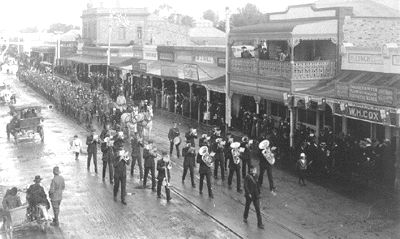
Band leading a Returned Soldiers’ march at St Arnaud in 1918 (Source: HistoryInPhotos)

Society is the big picture; brass bands are a microcosm of society.  And as mentioned in the opening of this post, brass bands were affected in several ways.  To start with we can look to New Zealand which suffered through the influenza pandemic at a slightly earlier time frame than Australia, and their brass bands were similarly affected.  In November 1918, a Mr Cyril Warin died at the Auxiliary Hospital in Warkworth, aged 19.  He was noted as being “very musical, and was a member of the local brass band” (“Mr. Cyril Carson Warin,” 1918).  A champion drummer of New Zealand and member of the Masterton Brass Band, Mr John Page died in December 1918 (The Referee Special, 1918).  However, in more positive news for one NZ brass band, the Kaitangata Brass Band “obtained permission from the Health authorities to resume their musical practices, which were suspended during the epidemic” (“Kaitangata News,” 1918).

In Australia, local bands started experiencing the impacts soon after the first cases of the influenza appeared.  The Boolaroo Brass Band was to have held a sports carnival in aid of the band in February, only to have it cancelled – this was a decision of their committee (“BOOLAROO.,” 1919).  However, the Boolaroo Brass Band did participate in the welcoming home of a local soldier from France in this week of February (“BOOLAROO.,” 1919).  Further south in Tasmania, the Stanley Brass Band found itself without a rehearsal room as their building at the showgrounds was taken over by the council for a hospital (“Local and General.,” 1919).  All was not completely lost as the local council arranged for the band to rehearse in the local school (“Local and General.,” 1919).

Newcastle Morning Herald and Miners’ Advocate, 14/02/1919, p. 5

The Ipswich Brass Band had the distinct misfortune to be south of the Queensland border in New South Wales when the State border was closed.  They were interred with many other Queenslanders in a temporary quarantine station set up on the Tenterfield showgrounds.  However, they put their time to good use presented some impromptu concerts to entertain the other internees (“INFLUENZA.,” 1919).

An interesting discussion took place amongst the Richmond City Council (Melbourne, Vic.) in March 1919 over the activities of two of the local bands and proximity to the local hospital, which was no doubt treating influenza patients.  Initially, the council had declined an application from the Richmond Juvenile Brass Band for the use of the City Reserve, similar to an application, which was also declined, made two weeks earlier by the Richmond City Band (“City Reserve Not Available,” 1919).  The reason for both applications being declined by council was the “assembling of a large number of persons” (“City Reserve Not Available,” 1919).  The second part of this issue was the proximity of the local hospital to the reserve, and the city band room.  One councillor argued that patients “would be disturbed by the band performance” while another councillor took the position that the sounds of the band would be appreciated (“City Reserve Not Available,” 1919).  The refusal of applications for use of the reserve was upheld by the council.

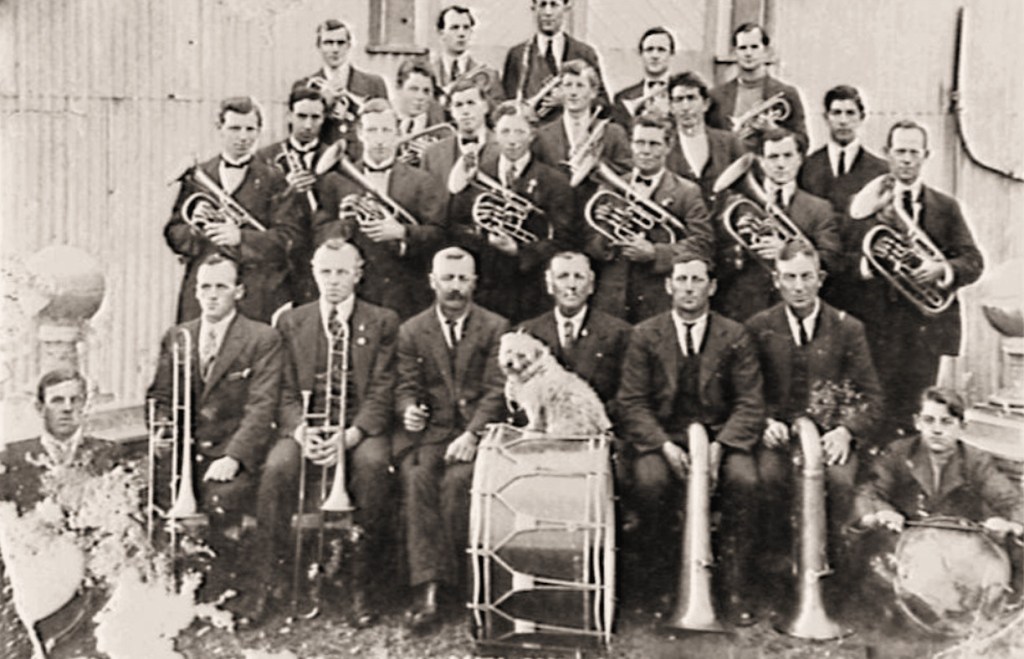
00000000_Dapto-Brass-Band_phot11479
Dapto Brass Band (date unknown). (Source: IBEW)

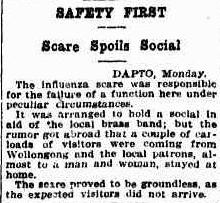
In April 1919, the activities of one local band was disrupted with the Dapto Brass Band being the victim of an unfortunate set of circumstances.  It must be noted that safety was important however, the loss of a function to aid the band (as detailed in the article below), would have hurt the band financially (“SAFETY FIRST,” 1919).

19190419_Sun_Dapto-BB_Flu-Scare
The Sun, 15/04/1919, p. 5

By the death of the late Frank W. Haase (Vice-President and late Organising Secretary), the Band Association of New South Wales has lost and esteemed officer and valuable worker, and the community at large a good citizen.  A victim of the deadly pneumonic influenza his demise was sudden, many in fact, not knowing of it till some days after.”

(Atkins, 1919)

Sadly, the bands, as in society, felt the loss of their members due to the influenza.  In May 1919 the President of the Stawell Brass Band, a Mr David John Thomas, passed away due to influenza (“STAWELL.,” 1919).  The obituary tells of a man that was embedded in his community and participated in a wide variety of activities.  Likewise, the passing of Mr. R. L. Tulloch of Morwell from influenza was also keenly felt by the town.  He was only 26, a father of three young children, a fit gentleman who also participated in a range of activities including being a member of the Morwell Brass Band (“Influenza Victim.,” 1919).

19190510_Ballarat-Star_Stawell-Obiturary
Ballarat Star, 10/05/1919, p. 6

Influenza very prevalent in Moonee Ponds and Ascot Vale though mostly in a mild form.

(Vosti cited in Frost, 2012, p. 127)

For other bands, the times were tough as detailed in some reports presented at Annual General Meetings.  The Taree Civilian Band, while surviving through enforced recess, found itself without a bandmaster as he had taken up an appointment as bandmaster of the Port Kembla Brass Band (they soon appointed a new bandmaster) (“Taree Civilian Band.,” 1919).  In the AGM report, the secretary Mr. F. W. Barnett also makes mention of the effects of the influenza where he noted,

Owing to the unfortunate outbreak of influenza the band has been in enforced recess for the last couple of months, but notwithstanding this Mr Drake was able to get a scratch band together for the Peace Day celebrations on July 19.  The band has now resumed regular practice and will be before the public in the near future.

(“Taree Civilian Band.,” 1919)

The Franklin Brass Band had faced similar difficulties throughout this time period and said as much in their annual general meeting report.  This meeting, which was the first since they reformed after a five-year recess, told of the difficulties brought on by the great war and the influenza epidemic (“FRANKLIN BRASS BAND,” 1919).  To the band’s credit, the retiring secretary of the band had worked hard to reduce the debt from five years ago despite the “stressing times” (“FRANKLIN BRASS BAND,” 1919).

00000000_Franklin-Brass-Band_phot17032
Franklin Brass Band (Date unknown). (Source: IBEW)

The ‘flu has kept bands back.

The epidemic is passing in New South Wales, New Zealand and Victoria.

Ere long Queensland will be free, and all other States and their banding will go ahead.

Bands will do well to keep preparing for peace celebrations.

(“Short Notes and Personals,” 1919)

With life gradually returning to normal by the end of 1919, the effects of the epidemic were still being felt and in early 1920 we find little stories of bands being called upon to provide their services.  In the tiny town of Westonia, located halfway between Perth and Kalgoorlie, the local band was called upon to help commemorate “the unveiling of two tablets over the graves of W. Lockie and Vic Fuhrman (victims of the recent influenza epidemic)” (“‘LEST WE FORGET.’,” 1920).   Both men had returned from active service in the First World War.

Conclusion:

It has been interesting documenting some of the little band stories from 1919 as there were a variety of ways in which bands reacted to the rapidly changing circumstances.  At times the circumstances were beyond their control, however, this did not stop them trying to carry on their operations as normal.  If there is anything to be learnt from 1919 is that bands, for the most part, survived and thrived.

19190000_Riggs-Brass-Band-Gawler_photo821
Rigg’s Brass Band Gawler, 1919 leading a parade of returning servicemen. (Source: IBEW)

References:

Atkins, W. D. (1919). The Late Frank W. Haase, A Tribute [Obituary]. The Australasian Bandsman, 32(10), 3-4. 

Bandy’s Picnic June 24th 1919 : The best of the 300 Sisters, V.A.D.’s, Patients were shy. (1919). [Photograph]. [phot16531]. The Internet Bandsman Everything Within, Vintage Brass Band Pictures : Australia. http://www.ibew.org.uk/vbbp-oz.html

BOOLAROO. (1919, 14 February). Newcastle Morning Herald and Miners’ Advocate (NSW : 1876 – 1954), 5. http://nla.gov.au/nla.news-article139644485

City Reserve Not Available for Band Performances — Would Music be Soothing to Sufferers in Hospital? (1919, 01 March). Richmond Guardian (Vic. : 1907 – 1920), 2. http://nla.gov.au/nla.news-article255877197

Dapto Brass Band. (n.d.). [Photograph]. [phot11479]. The Internet Bandsman Everything Within, Vintage Brass Band Pictures : Australia. http://www.ibew.org.uk/vbbp-oz.html

FRANKLIN BRASS BAND. (1919, 09 December). Huon Times (Franklin, Tas. : 1910 – 1933), 3. http://nla.gov.au/nla.news-article140944253

Franklin Brass Band. (n.d.). [Photograph]. [phot17032]. The Internet Bandsman Everything Within, Vintage Brass Band Pictures : Australia. http://www.ibew.org.uk/vbbp-oz.html

Frost, L. (2012). Bandsman Vosti’s Diaries : war and peace in Essendon, 1917-1920. Lenore Frost. 

Hirshberg, L. K. (1919, 29 March). “SPANISH” INFLUENZA. Australasian (Melbourne, Vic. : 1864 – 1946), 32. http://nla.gov.au/nla.news-article140221010

HistoryInPhotos. (2009, 16 March). Band leading a Returned Soldiers march at St Arnaud in 1918 [Photograph]. flickr. Retrieved 20 January 2020 from https://www.flickr.com/photos/historyinphotos/3361762672/in/album-72157613028413958/

Influenza. (1919, 28 January). Sydney Morning Herald (NSW : 1842 – 1954), 6. http://nla.gov.au/nla.news-article15822176

INFLUENZA : Seven Deaths To-day : Another Victim in Sydney – Case from Argyllshire. (1919, 12 February). Telegraph (Brisbane, Qld. : 1872 – 1947), 2. http://nla.gov.au/nla.news-article176303325

Influenza Victim. (1919, 01 August). Morwell Advertiser (Morwell, Vic. : 1888 – 1954), 3. http://nla.gov.au/nla.news-article65922832

Kaitangata News. (1918, 13 December). Clutha Leader, 3. https://paperspast.natlib.govt.nz/newspapers/CL19181213.2.7

‘LEST WE FORGET.’ : Unveiling Ceremony by the R.S.A. (1920, 07 February 1920). Westonian (WA : 1915 – 1920), 2. http://nla.gov.au/nla.news-article212529404

Local and General : Bandroom Wanted. (1919, 19 February). Circular Head Chronicle (Stanley, Tas. : 1906 – 1954), 2. http://nla.gov.au/nla.news-article162263034

McQueen, H. (1976). The ‘Spanish’ Influenza Pandemic in Australia, 1918-19. In J. I. Roe (Ed.), Social policy in Australia : some perspectives, 1901-1975 (pp. 131-147). Cassell Australia. 

Mr. Cyril Carson Warin. (1918, 27 November). Rodney and Otamatea Times, Waitemata and Kaipara Gazette, 5. https://paperspast.natlib.govt.nz/newspapers/ROTWKG19181127.2.14.6

National Museum Australia. (2020). 1919: Influenza pandemic reaches Australia. National Museum Australia. Retrieved 15 May 2020 from https://www.nma.gov.au/defining-moments/resources/influenza-pandemic

Rigg’s Brass Band Gawler. (1919). [Photograph]. [photo821]. The Internet Bandsman Everything Within, Vintage Brass Band Pictures : Australia. http://www.ibew.org.uk/vbbp-oz.html

SAFETY FIRST : Scare Spoils Social. (1919, 15 April). Sun (Sydney, NSW : 1910 – 1954), 5. http://nla.gov.au/nla.news-article221450689

Short Notes and Personals. (1919). The Australasian Bandsman, 32(10), 2-3. 

STAWELL : Obituary. (1919, 10 May). Ballarat Star (Vic. : 1865 – 1924), 6. http://nla.gov.au/nla.news-article212640834

Taree Civilian Band. (1919, 02 August). Northern Champion (Taree, NSW : 1913 – 1954), 3. http://nla.gov.au/nla.news-article157096567

The Referee Special. (1918, 18 December). INFLUENZA : Heavy Losses Sustained in Sport and Stage. Referee (Sydney, NSW : 1886 – 1939), 7. http://nla.gov.au/nla.news-article120312959

Drummers and drums: perceptions of percussion in early Australian bands

19280000_Concord-Citizens_phot16030
Concord Citizens’ Band 1928 (Source: IBEW)

Introduction:

It ain’t the blaring cornets,
Nor the fussy old bassoon
(Though of course I’m always willin’
To admit they helps the toon.)
Nor yet it ain’t the piccolo what makes your heart go thumpin’
Nor yet it ain’t the croonin’ flutes what sets your pulse a jumpin’:-
It’s the drums!
It’s the drums what makes the band

(Dean in Quickstep, 1921)

When reading and researching material related to old bands, it would be fair to say most of it relates to brass playing musicians in bands.  Of which some have been explored in previous posts on this blog.  However, what of the other musicians in the band, the percussionists and the instruments that they used?  It was a matter of how many mentions could be found.  To adapt an analogy; stories on brass bands are haystacks, stories on band percussionists are definitely needles.

It is very rare to find a photo of an old brass band that does not have the drums of the band featured prominently in the formation.  The photo above of the Concord Citizens’ Band from 1928 shows as much with the drums “posed” and the band crest visible on the bass drum.  The photo was picked at random.  The information it conveys is very typical of band photos in general (especially in the early years).  Photos aside, the sound of a band on parade, then and now, is very much defined by the beat of a bass drum and the patterns of a snare.  Mr Dean in his little ditty above alludes to this!

This post will examine three aspects of percussion in early Australian brass bands starting with some writing on percussion in general.  There are some articles on the drums themselves which was interesting to find, and included is a story on one of the many famous band drummers.  Admittedly there is a vested interest in this topic as I am a percussionist in a local brass band and a community concert band.  This post is dedicated to all those musicians who have made the percussion section their home.

Drumming:

We can see from early photos that percussion in Australian brass bands was limited to a side drum or two, and a bass drum.  This is no fault of the band; rather, it is the limit of the music that was written and what percussion was called for.  Bands did not see fit to expand the percussion section until music called for those instruments and it is only in later years that the range of percussion in a band was expanded to include more orchestral percussion instruments.

It was interesting then to read various mentions of side drums and bass drums (and drummers) in relation to brass bands. The main source of commentary comes from adjudicator comments in band competitions.  Thankfully, the newspapers of the day generally published full adjudicator comments so we can build a picture of their thinking.  Drums had a role to play in band music and some adjudicators comments were specifically directed to that role.

This being said, the number of comments on the drums varied.  Some adjudicators made a point of mentioning the drums in every section, others were more reserved and only mentioned them when they felt they needed to mention them.  One example of a reserved comment comes from the adjudicator of the 1928 Queensland Brass Band Championship Contests which was held over Easter in Townsville.  The article in the Townsville Daily Bulletin summarised the comments, but buried in this we find a succinct mention about the drums of the Brisbane Federal Band when performing their A Grade Oval March, “Red Gauntlett”:

The winning band, Brisbane Federal, made a fine, smart opening, cornets and drums being good.

(“THE BAND CONTEST.,” 1928)

That’s basically all that was said about the drums, which is perhaps understandable. If the adjudicator felt there was something notable, he probably would have said so.

As a complete contrast, we have the comments from Captain Harry Shugg at the 1936 Renmark Centenary Bands Contests where he gave a remark on the drums for every band.  And even when a band was unfortunate enough not to have a side drum like the Loxton Brass Band as these excerpts from the comments show:

(Selection): Tempo di Marcia: No side drum.  Third cornet does not balance.  Side drum much missed.

[…]

(Quickstep): MUSIC – “Victoria”.  No side drum.

(“Bands Contests Adjudicators’ Comment,” 1936, p. 4)

The selection that all bands played was “Songs of Homeland”.

For the most part, Capt. Shugg was firm, but encouraging to all bands as it was a D Grade contest, and this included remarks on the drumming.  For the seven bands that competed, of which came from the towns of Renmark, Moonta, Loxton, Nuriootpa, Waikerie, Mildura and Berri, all of them received some comment on the drums, especially in the Quickstep sections.  Capt. Shugg knew that drums help set the mood of the march so phrases like, “Good beat off by drums” and “Good drums; band begins with smart and crisp style” (“Bands Contests Adjudicators’ Comment,” 1936) were given to two of the bands.  However, if something was very wrong, Capt. Shugg made a mention of it, of which the Berri Brass Band found out in their playing of the march “The Australasian”,

Poor toned bass drum.  Tone of the band a little noisy, cornet’s in particular; side drum much too heavy in P. passages; does not vary tone at all

(“Bands Contests Adjudicators’ Comment,” 1936, p. 4)

Harry Shugg was a perfectionist, he was conductor of the Malvern Tramways Band at the time!

Perhaps the most interesting comments on drums in bands came from a Mr R. S. Kitson who adjudicated the 1933 Adelaide Royal Show Contest.  On a night that was notable for the pouring rain which affected many performances, a comment was made on the use of the bass drum in one of the sections:

Referring to the use of drums in operatic selections, Mr. Kitson said, “The use of the bass drum in operatic selections, especially in ‘lento’ passages, and on such a night, is not advisable.  Brass band arrangements are principally made from orchestral scores, and the kettle drum part is allotted to the bass drum in brass bands.  The bass drum cannot be tuned as a kettle drum, and therefore, except in martial movements, is quite of place.

(Allegro, 1933)

Then we have the writing of Cecil Clarence Mullen, of whom his work was reviewed in a previous post.  In a section of his booklet, Mullen’s Bandsmen of South Street (1900-1951) he took aim at bandmasters for not training their bass drummers properly (Mullen, 1951).  We know from the analysis of his work that Mullen was opinionated and a commentator.  In summary, Mullen was of the opinion that some bass drummers did not know how to read their parts properly, that some conductors did not teach the drum parts properly (or did not care enough), and that some bass drummers used “two sticks on the march” (Mullen, 1951, p. 8) – that is a questionable opinion!

It was not just bandmasters that drew the ire of Mullen, he had criticism for adjudicators as well,

Adjudicators are also open to criticism in not pointing out these faults to bands when doing the quickstep.  The average judge is quick to rush in with his “Out of tune at bar 20” but how many band judges have we known who have written in their notes that “Bass drummer is not playing his part correctly”.

(Mullen, 1951, p. 8)

The opinions of Mullen aside, we can see that the playing of drums was noted in aspects of competition, and performances in general.  To finish this section, here is an excerpt from the first paragraph of a 1914 article published by the Cootamundra Herald regarding the newly formed Stockinbingal Brass Band:

The music loving people of Stockinbingal decided that an up-to-date and progressive town like theirs should not be without its town band; and last Sunday morning late slumberous were aroused by the blast and blare of brass to the accompaniment of the thunderous boom of a drum.

(“STOCKINBINGAL BRASS BAND,” 1914)

The drums are always noted on these occasions!

Drums:

Regarding the instruments themselves, they were a source of pride to a band, and also triggered memories as well.  Often featuring prominently in photos, the drums were sometimes centred, sometimes at the side, sometimes used as a table for trophies.  And it is easy enough to spot the drummers of the band as they would be holding their sticks (and not holding brass instruments!).

Above is a picture of the Kew City Band taken in approximately 1915 when the band was on tour to Northern Tasmania.  While the band is not sitting down in a formation, they have made an effort to place their bass drum and side drum. The band crest is clearly visible on the bass drum where, despite the photo being in black and white, there is a clear distinction in some of the colours.  Fortunately, in a very rare newspaper article from 1910, there is a full description of how the bass drum was painted and what colours were originally used.

The amplification of the arms of the borough of Kew on the shell of the band’s bass drum is an artistic painting from the brush of a local artist Mr. W. D. Wentworth.  […] Two blues have, for many years, been the sporting colours of Kew and royal blue was accordingly adopted as the grounding colour, with linings of light blue.  The arms of the borough of Kew consist of a shield containing six wheat sheaves, and surrounded by the royal arms.  In a scroll at the bottom of the shield is contained the motto of the municipality, “Cresco”.  The body of the shield is in light blue, with gold outline, artistically shaded, and the artistic representation of the golden corn is richly effective.  The artists has discarded any assistance from transfers, and the whole production, with the royal arms in minutest detail, are in brushwork.  Notwithstanding that winter time is, as a rule, a dull period with bands, the Kew organisation keeps in symphony with the borough motto, ‘To Grow’.

(“Kew Brass Band.,” 1910)

This was a very detailed description and there is much to suggest that the bass drum in the picture is the same one that is described here.  The band would have been very proud to parade with this drum.

Not all music involved drums and we can find examples where drummers displayed not only a talent for playing their instruments but also making them.  In 1914, the drummer of the Australian Light Horse Band, a Mr E. Fowler, constructed his own set of tubular bells out of “brass piping cut to various lengths, suspended within an oak encasement, and tuned to concert pitch” (“A DRUMMER’S INGENUITY,” 1914).  The article displayed below from the Goulburn Evening Penny Post also tells us how the said drummer practises on his instrument and that it will be “a most useful addition to the band’s equipment” (“A DRUMMER’S INGENUITY,” 1914).

19140214_Goulburn-Penny-Post_Drummer
Goulburn Evening Penny Post, 14/02/1914, p. 2

We know that bands come and go over the years and in 1937 it was the discovery of the old side drum of the Diamond Creek Brass Band at the local school that triggered some memories.

Memories of the times when Diamond Creek echoed to the lilting strains of its own uniformed brass band marching along the streets were revived this week when it became known that the original side-drum of many years ago is now being used at the school.

For years, the drum and a ‘cello have lain in dust at the school.  Other instruments are to be found stacked away in the hall.  The school committee had a new skin fitted to the drum.

(“DIAMOND CREEK BRASS BAND,” 1937)

Drums and percussion are like many instruments, they provide meaning to organisations and people – they become a part of the musical family.  It is fortunate that we have these windows on the details and memories of these instruments here.

Drummers:

He could become personal, although never malicious.  To a drummer: “I love every hair on your bald head, but when I say roll on the drums — roll!!!

(Cleve Martin detailing the words of Major Adkins to a drummer of the A.B.C. Military Band during rehearsal in “STARS OF THE RADIO,” 1941)

There were many individual drummers who were recognized over the early years for their talent and as such, took up regular engagements with brass bands.  This section will highlight one of these drummers who was renowned throughout Victoria at the time, and also show where drummers were similarly recognized.  To end this section will be some lists reproduced from Mullen’s booklet listing famous side and bass drummers.

19121214_Malvern-Standard_Brassey-Allen-Scott
Malvern Standard, 14/12/1912, p. 4

When researching for this post, there was a drummer who kept standing out, Harold Brassey Allen (“A Famous Drummer Boy,” 1912; Quickstep, 1921).  In his later years, he was famous enough to be written about in one of the weekly Herald columns penned by the colloquial, ‘Quickstep’.  In summary, Brassey Allen was recognized for his talent very early in his musical career.  In the picture here we see him in his early years, dressed in full Scottish regalia, with side drum.  Brassey was no ordinary drummer and displayed a versatility that saw him perform with pipe bands, drum & fife bands, and brass bands (Quickstep, 1921).

Brassey had already been playing side drum for a number of years with the Armadale State School Cadet unit when he joined the South Melbourne District Band in 1910 (Quickstep, 1921).  Upon leaving the South Melbourne District Band a few years later, he joined the Prahran City Band under Mr E. T. Code and five years later joined the Malvern Tramways Band of which his talent was brought to the fore through his xylophone solos and drumming (Quickstep, 1921).  He was also recognized early at the South Street contests for his talent, winning his first prizes at the age of 13 although South Street never had any formal competitions for drummers.  Brassey, and his brothers, were all superb musicians Brassey and his brother Arthur are listed in the Mullen pages below (Mullen, 1951; Quickstep, 1921).

19210917_Herald_Quickstep-Brassey-Allen
Herald, 17/09/1921, p. 5

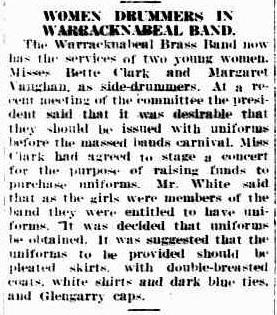
Drummers were recognized for other reasons as we see in this bold move, for 1941, the Warracknabeal Brass Band admitted two female side-drummers into the band, Misses Bette Clark and Margaret Vaughan (“WOMEN DRUMMERS IN WARRACKNABEAL BAND.,” 1941).  As we can see, The Horsham Times certainly gave the information in the headline, but most of the article was not about their ability as drummers.  Rather, it was about the fundraising for their uniforms and what kinds of uniforms they were going to wear!  No doubt the inclusion of two female side-drummers in a rural brass band was due to the Second World War which was raging at the time.

The Horsham Times, 18/02/1941, p. 2

Below are Mullen’s lists of famous side-drummers and bass drummers who have appeared with bands competing at the South Street competitions.  Given that Mullen’s lists only go to 1951, there were likely to be several more famous drummers after this time.  However, once again we can thank Mullen for his effort in compiling these lists of names.

19510000_Mullens-South-Street_p53-54-BD
Excerpts from pp. 53-54, “Mullen’s Bandsmen of South Street (1900-1951), Noted Bass Drummers. (Source: Jeremy de Korte’s Personal Collection)
19510000_Mullens-South-Street_p54-56-SD
Excerpts from pp. 54-56, “Mullen’s Bandsmen of South Street (1900-1951), Side Drummers and Kettle Drums. (Source: Jeremy de Korte’s Personal Collection)

Conclusion:

The early bands clearly valued their drummers and drums and people took notice of them.  We have seen how bands were marked up or down for the quality of the drumming in their playing, and where bandmasters were criticised for not teaching their drummers the correct parts.  We have seen where the instruments themselves had meaning to bands and also where the drummers developed their own substantial reputations.

The percussion section of a band is always a special place to be and no doubt the early drummers thrived in the band environments.  We say thank you to these drummers for their work which set the scene for future percussionists in community bands.

References:

Allegro. (1933, 21 September). BANDS AND BANDSMEN : Show Contest Marred by Heavy Rain. Advertiser (Adelaide, SA : 1931 – 1954), 8. http://nla.gov.au/nla.news-article47003081

THE BAND CONTEST : Adjudicator’s Comments. (1928, 11 April). Townsville Daily Bulletin (Qld. : 1907 – 1954), 11. http://nla.gov.au/nla.news-article61026813

Bands Contests Adjudicators’ Comments : COMPLIMENTARY REFERENCES TO PLAYING THROUGHOUT : Decidedly High for D Grade, Says Capt. Shugg. (1936, 29 October). Murray Pioneer and Australian River Record (Renmark, SA : 1913 – 1942), 4-5. http://nla.gov.au/nla.news-article109291574

Concord Citizens’ Band. (1928). [Photograph]. [phot16030]. The Internet Bandsman Everything Within, Vintage Brass Band Pictures : Australia. http://www.ibew.org.uk/vbbp-oz.html

DIAMOND CREEK BRASS BAND : School Drum Revives Memories. (1937, 12 November). Advertiser (Hurstbridge, Vic. : 1922 – 1939), 9. http://nla.gov.au/nla.news-article56846146

A DRUMMER’S INGENUITY. (1914, 14 February). Goulburn Evening Penny Post (NSW : 1881 – 1940), 2. http://nla.gov.au/nla.news-article98833598

A Famous Drummer Boy—Master Harold Brassey Allen. (1912, 14 December). Malvern Standard (Vic. : 1906 – 1931), 4. http://nla.gov.au/nla.news-article66391732

Kew Brass Band. (1910, 22 July). Reporter (Box Hill, Vic. : 1889 – 1925), 4. http://nla.gov.au/nla.news-article89698715

Mullen, C. C. (1951). Mullen’s Bandsmen of South Street (1900-1951). Horticultural Press. 

Osborne, B. (1915?). Kew Band [Photograph mounted on card of the Kew Band while on tour in Tasmania]. [2016.0088]. Victorian Collections, Kew Historical Society Inc. https://victoriancollections.net.au/items/58269a46d0cdd11284b9d7ac

Quickstep. (1921, 17 September). BANDSMEN’S GOSSIP : The Art of Drumming. Herald (Melbourne, Vic. : 1861 – 1954), 5. http://nla.gov.au/nla.news-article242423372

STARS OF THE RADIO : Founder of the National Military Band : Picturesque Major Adkins. (1941, 27 November). Portland Guardian (Vic. : 1876 – 1953), 1. http://nla.gov.au/nla.news-article64402540

STOCKINBINGAL BRASS BAND. (1914, 09 January). Cootamundra Herald (NSW : 1877 – 1954), 5. http://nla.gov.au/nla.news-article139522962

WOMEN DRUMMERS IN WARRACKNABEAL BAND. (1941, 18 February). Horsham Times (Vic. : 1882 – 1954), 2. http://nla.gov.au/nla.news-article72689341

Brass bands and Christmas cheer: compliments of the season

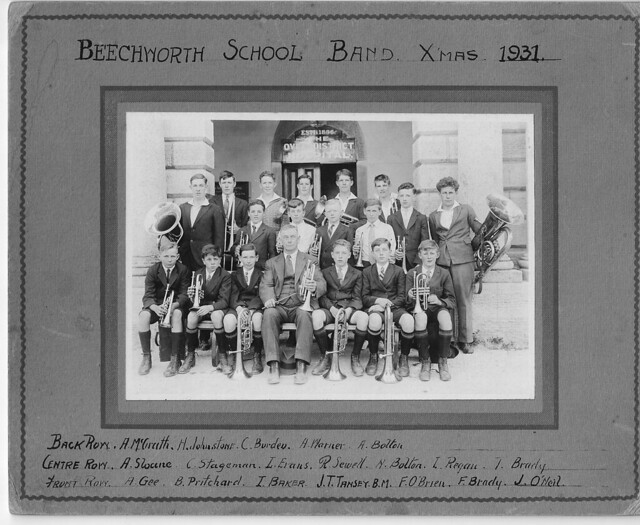
19310000_Beechworth-School-Band_Xmas
Beechworth School Band. Xmas 1931 (Source: HistoryInPhotos)

Introduction:

Bands and Christmas.  There are probably not too many bands people out there who have not participated in several Christmas engagements and will probably do many more in the future. They are one of the staples in the band calendar alongside the usual parades, concerts, ANZAC commemorations, community events, etc.  It is a time where bands can get out and about and present the music of the season to their communities.

Let us go back to times past in the period from 1900-1950 where bands were the entertainment and very much embedded in their local communities.  There are lots of little stories out there.  This post will highlight some of the different stories from around Australia involving bands at Christmas time and no doubt some readers will get a sense of déjà vu.  The times may have changed but the engagements have not!

Gifts and platitudes, carols, charity, concerts and competitions, townsfolk and tourists, and bands and band people.  The compliments of the season from yesteryear.

The days before Christmas:

Christmas Eve and Day are of course the focus of all festivities, however, in the days leading up to Christmas, brass bands were always part of the events.  For some bands, it was an achievement to even get this far, especially in the early years when they battled fluctuating membership and commitment.

In December 1905, the McPhail and Peak Hill District Band, located in the New South Wales Central West was one band that getting ready for some Christmas events.  The band intended on following through on time-honoured tradition of playing Christmas carols to the local town as the brass bands did back in England (Etheridge, 2017; “McPhail and Peak Hill District Band.,” 1905).  In an article published in the Peak Hill Express newspaper, we see a band confident that it would play in the right spirit for the season,

The Band intends, with their many friends, to follow up the old time-honoured custom of playing and singing during Xmas.

[…]

During the week our programme will be mapped out and advertised in next issue of the Express.  Mr. J. S. Christophers assures the writer that the Band, as the old Band on 1903, are of the right mettle, and will not shirk any duty that they may be called upon to perform for the cause of charity.  With a useful lamp, their present needs will be met, and during Xmas week a big effort will be put forth with that end in view. 

(“McPhail and Peak Hill District Band.,” 1905)

Christmas Eve:

Aside from Christmas Day itself, we can see that lots of bands were out and about on Christmas Eve, often at late hours, to add to the festivities of the night…or to entertain late-night shoppers.  A variety of events took place on Christmas Eve in those early years and there are lots of little stories to hear about.  Thankfully, some articles were more detailed than others and we can see what the bands played, where they played and how the public responded.

When reading the old articles, it was evident that sometimes it was not about the band per se, but about the Christmas festivals themselves of which the local band took part.  However, when bands did get a mention in the local papers, their efforts were very much appreciated as they helped to give atmosphere to the festivities.  In the year of 1912, we find that the whole area surrounding Alexandra and Yea, Victoria is attracting a number of tourists who have taken the opportunity to relax in various towns and go fishing in the Goulburn River (“Christmas and New Year’s Eves,” 1913).  The local newspaper reported on the various events in early January and the Alexandra Fire Brigade Band received praise for their playing in the street,

A new and pleasing departure in the Christmas Eve celebrations this year was the appearance of the Fire Brigade Brass Band in the street.  As soon as they could get together, for some of the members detained in the stores till after 11pm, the crowd gathered around them.  From 11 o’clock till midnight the band rendered the following programme :-

Quick march, Ringwood, by J. Sandegren
Valsette, Nada (T. E. Bulch)
Euphonium solo, Asleep in the Deep (W. Petrie)
Schottische, Daphne (Wright and Round)
Selection, Welsh Songs (G. A. Frost)
Quick march, Torchlight Parade (T. E. Bulch)
Cornet solo, Alice, Where Art Thou (J. Ascher)
Fantasia, Christmas Greetings (T. L. Hellings)

Carols after 12pm – Hark the Herald Angels Sing ; Christians Awake ; Sandon ; Adeste Fidelis ; Arizona ; Home Sweet Home ; National Anthem.

The effect was very pleasing, and gave a good finish to a very festive night.

(“Christmas and New Year’s Eves,” 1913)

Some towns were doing it harder than others around Christmas time and in the towns of the Shepparton area of Victoria they were afflicted by drought in 1915.  But in the spirit of the Christmas season, the townsfolk seemed to forget their hardship and came together to celebrate the season.  It is in the town of Rushworth that we find the local brass band has come out to play,

On the closing of the business places at Rushworth the members of the local brass band assembled at the rotunda and, under Bandmaster Williams, rendered a capital programme of music appropriate to the occasion.  Then, later they divided into two parties and set out on their respective rounds of carolling.  The financial result (£22 odd) was excellent, and again was previous records well maintained.”

(“THE XMAS SEASON.,” 1915)
1907 Postcard: Band Rotunda, Rushworth, Victoria (source: Jeremy de Korte Collection)

Likewise, on Christmas Eve in the Victorian township of Coleraine, the streets were full of people, shopkeepers were keeping up a good trade, and the music was provided by the Coleraine Brass band of which the local newspaper diplomatically noted was “showing distinct improvement” (“Coleraine Albion,” 1915).

Brass bands have always been altruistic in Australia and were ready to assist for the sake of charity.  They were also ready to provide good cheer to those in need and in Darwin at Christmas Eve 1920, the Darwin Brass Band went and played at the Darwin Hospital,

On Christmas Eve the Darwin Brass Band under Bandmaster W. Nuttall, paid a surprise visit and rendered a very fine selection of cheery music, which the aged and sick thoroughly enjoyed.  The Matron, in a few well-chosen words on behalf o the staff and patients, thanked them for their kindness and they departed for the town with mutual good wishes and greetings from all sides.

(“XMAS AT THE HOSPITAL.,” 1920)

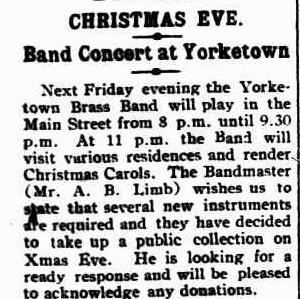
Far south of Darwin in the South Australian township of Yorketown located on the Yorke Peninsula, the local brass band had announced it was going to present a program of music in the street of town (“CHRISTMAS EVE.,” 1920).  As we can see in the article published in the Pioneer newspaper, their Christmas Eve program was quite long with one session of playing from “8p.m. until 9.30p.m.” and then “At 11pm the Band will visit various residences and render Christmas Carols.” (“CHRISTMAS EVE.,” 1920).  This was also supposed to be a beneficial exercise for the band as well; they were taking up a collection for new instruments.

The Pioneer, 18/12/1920, p. 3

Then we have performances from bands on Christmas Even where the performance was their first-ever performance!  In an article published in the Rockhampton Evening News January 1934, we find that the Springsure Brass Band held their first public outing on the night of Christmas Eve, 1933 (“SPRINGSURE BAND DEBUT,” 1934).  Springsure is a township located inland from Rockhampton and Gladstone and we can in the article a fair degree of pride in this new band.  Full congratulation was given to the musicians on the progress made in their playing.

The Evening News, 3/01/1934, p. 5

In 1946 the Port Fairy Brass Band went out and about playing Christmas carols around town on Christmas Eve and earned praise wherever they played (“CHRISTMAS CAROLS.,” 1946).  This was no less remarkable given the year when they played – one year after World War Two ended – and this was noted by the Mayor in the article,

The Mayor said he was pleased to welcome to his house, one of the best institutions in the town.  What surprised him was that in spite of the war, and the number of members who enlisted, the band seemed to be as strong as ever.  He did not know exactly the reason of their success, unless, it was the strong personality of their bandmaster.

(“CHRISTMAS CAROLS.,” 1946)

Christmas Day and Night:

It was an early start for one band on Christmas Day, evidently, it was a very committed ensemble!  So much so that on Christmas Day 1922 in the New South Wales South-West Slopes town of Tumut, the brass band was up and about at 4.30 in the morning,

On Xmas morning at 4.30 the Tumut Brass Band conveyed in Messrs Barker and Son’s motor bus, did a tour, commencing in the main street, and visiting every portion of the town and suburbs where there was any population, completing their self-imposed and laudable undertaking at 8.30.  The music supplied by them was of a particularly enjoyable nature, and Mr Pitcher (bandmaster) and his body of performers numbering about 20 deserve the highest of congratulations for the treat afforded by them.

(“Christmas,” 1922)

While the Tumut Brass Band were out and about in the morning, we can see some bands presented pleasing programs on Christmas night.  The Clare Brass Band was to present a program of old English carols at 8.15pm on Christmas night and it was expected there was going to be a large audience, as there had been the night before when a local choir sang at the local rotunda (“CHRISTMAS CAROLS ON BAIN ROTUNDA.,” 1932).

Then there are the very big Christmas events of which Adelaide staged one on Christmas night in 1935.  Presented in by The Mail newspaper and involving the South Australian Choral Association and the S.A. Bands’ Association, this appeared to be a massive musical undertaking by including a massed choir and a massed brass band.  After many months of rehearsal, this event was to be presented at the Wayville Showgrounds and it is one of the early times where an event like this was conceived of in Australia (““Music in the Air” On Xmas Night,” 1935).

On Christmas Night in 1949, the Bathurst District Band was to present a very big concert involving thirty-five of their band members from both the senior band and their Boys’ Band (“XMAS BAND RECITAL,” 1949).  The program of music for this concert was going to include the obligatory carols and a number of other items.  The band was hoping that an attendance record would be broken (“XMAS BAND RECITAL,” 1949).

Boxing Day:

00000000_Wandiligong-BB_phot13253
Wandiligong Brass Band (Source: IBEW)

Not to be left out of the Christmas festivities were the bands that were part of events on Boxing Day.  In an article published by the Myrtleford Mail and Whorouly Witness newspaper, it was reported that the “Bright Xmas Carnival” was the place to be on Boxing Day in 1917,

From early morning buggies and coaches brought big crowds into town, and the special train from Wangaratta was splendidly patronised and also conveyed quite a number of horses and competitors, assuring the social and financial success of the meeting.

(“Bright Xmas Carnival.,” 1917)

The Wandiligong Brass Band was not forgotten and was said to have given “a fine programme of music both on the ground and before the performance at night” (“Bright Xmas Carnival.,” 1917).

Gifts and giving:

When researching for this post, it was also evident that band-related gifts and platitudes were exchanged of which here are two examples (there were probably more).  On the 16th December 1921 the conductor of the Malvern Tramways Band, Mr Harry Shugg gave a postcard picturing his prize-winning band to a Mr W. Boina with a short message wishing him the “Compliments of the Season” and as can be seen on the back of the postcard below, in brackets, “(Winners South St 1921)” (Muntz Studio, 1921).  No doubt Harry Shugg was very pleased with his band – and rightly so.

19211216_Malvern-Tramways-Band_Postcard
Postcard, Malvern Tramways Band, 1921 (front) (Source: Victorian Collections: Victorian Bands’ League Library & Archive)
19211216_Malvern-Tramways-Band_Postcard-Back
Postcard, Malvern Tramways Band, 1921. Handwriting by Mr Harry Shugg (back) (Source: Victorian Collections: Victorian Bands’ League Library & Archive)

For Christmas 1927, the members of the Cleve Brass Band gave their conductor, Mr W. Gillings, an aneroid barometer “suitably inscribed” as a gift in thanks for all the work he had done for the band (“Cleve Brass Band.,” 1928).  This was a wonderful token of appreciation and one which the conductor would no doubt have treasured.

Thinking of home at Christmas time:

We know that music can invoke all kinds of emotions and at Christmas time this feeling is no less poignant.  There were some who were away from their hometowns at Christmas in faraway places.  Published in the Carcoar Chronicle on Friday 19th of February 1915 was a letter from a local man, Mr Jack (John) Collyer who had enlisted in the Australian Expeditionary Forces and was then stationed in Egypt.  While he wrote extensively of his Christmas Day experiences in the Army camp, he made special mention of a brass band who reminded him of home,

I woke at 5 a.m. to hear splendid music, a brass band playing Xmas carols, a hundred yards away from my tent.  Talk about thrill – it was glorious.  I lay awake listening to the grand strains of ‘Hark, the Herald Angels Sing,’ and others and my mind wandered to Mudgee”

(“XMAS IN EGYPT.,” 1915)

Conclusion:

Music is synonymous at Christmas time and as we have seen, the many brass bands were in their element by eliciting town pride and enlivening the festivities.  These little stories were some of many, there were too many to list such is the activity of Australian bands at this time of year.  As I said at the beginning of the post, the times may have changed but the engagements have not!

I’d like to thank all the people who have read posts from Band Blasts From the Past over the past year and I hope you have found the posts informative.  I’d like to take this opportunity to wish my readers the compliments of the season, and I hope the coming year, and decade, is a safe, healthy and prosperous one. 

Jeremy de Korte (22/12/2019)

(Updated, 04/12/2023)

References:

BrightBright Xmas Carnival. (1917, 04 January). Myrtleford Mail and Whorouly Witness (Vic. : 1914 – 1918), 3. http://nla.gov.au/nla.news-article138709194

Christmas. (1922, 29 December). Tumut and Adelong Times (NSW : 1864 – 1867; 1899 – 1950), 2. http://nla.gov.au/nla.news-article139029474

Christmas and New Year’s Eves : The Tourists. (1913, 03 January). Alexandra and Yea Standard and Yarck, Gobur, Thornton and Acheron Express (Vic. : 1908 – 1949), 2. http://nla.gov.au/nla.news-article61188518

CHRISTMAS CAROLS. (1946, 28 December). Port Fairy Gazette (Vic. : 1914 – 1918), 2. http://nla.gov.au/nla.news-article88009047

CHRISTMAS CAROLS ON BAIN ROTUNDA : Clare Brass Band to Play Old English Carols on Xmas Night. (1932, 23 December). Northern Argus (Clare, SA : 1869 – 1954), 5. http://nla.gov.au/nla.news-article97616336

CHRISTMAS EVE : Band concert at Yorketown. (1920, 18 December). Pioneer (Yorketown, SA : 1898 – 1954), 3. http://nla.gov.au/nla.news-article199107675

Cleve Brass Band. (1928, 13 January). Eyre’s Peninsula Tribune (Cowell, SA : 1910 – 1950), 3. http://nla.gov.au/nla.news-article219285198

Coleraine Albion. (1915, 30 December). Coleraine Albion and Western Advertiser (Vic. : 1902; 1914 – 1918), 2. http://nla.gov.au/nla.news-article119606385

Colliver Photo. (1907). Band Rotunda, Rushworth, Victoria [Postcard]. [194458]. W. T. Pater, Printers and Stationers, Melbourne, Victoria. 

HistoryInPhotos. (2009, 21 February). The School Band at Beechworth, Vic, in 1931 [Photograph]. flickr. Retrieved 11 November 2019 from https://www.flickr.com/photos/26421213@N08/3295771357

McPhail and Peak Hill District Band. (1905, 15 December). Peak Hill Express (NSW : 1902 – 1952), 9. http://nla.gov.au/nla.news-article107246068

Muntz Studio. (1921). Malvern Tramways Band, 1921 [Postcard : L12.5cm – W8.2cm]. Victorian Bands’ League, Victoria Collections. https://victoriancollections.net.au/items/5b1ccc9521ea69132c023cd5

“Music in the Air” On Xmas Night : Big Wayville Festival. (1935, 14 December). Mail (Adelaide, SA : 1912 – 1954), 10. http://nla.gov.au/nla.news-article55719008

SPRINGSURE BAND DEBUT : Big Event of Xmas. (1934, 03 January). Evening News (Rockhampton, Qld. : 1924 – 1941), 5. http://nla.gov.au/nla.news-article201260331

Wandiligong Brass Band. (n.d.). [Photograph]. [phot13253]. The Internet Bandsman Everything Within, Vintage Brass Band Pictures : Australia. http://www.ibew.org.uk/vbbp-oz.html

XMAS AT THE HOSPITAL. (1920, 28 December). Northern Territory Times and Gazette (Darwin, NT : 1873 – 1927), 3. http://nla.gov.au/nla.news-article3303945

XMAS BAND RECITAL. (1949, 23 December). National Advocate (Bathurst, NSW : 1889 – 1954), 2. http://nla.gov.au/nla.news-article161655263

XMAS IN EGYPT : Some Interesting News. (1915, 19 February). Carcoar Chronicle (NSW : 1878 – 1943), 2. http://nla.gov.au/nla.news-article103560632

THE XMAS SEASON. (1915, 01 January). Murchison Advertiser and Murchison, Toolamba, Mooroopna and Dargalong Express (Vic. : 1914 – 1918), 3. http://nla.gov.au/nla.news-article130086316

Trans-continental connections: the brass bands of Broken Hill and Kalgoorlie

Introduction:

Above is an intriguing photo.  This photo of the Broken Hill City Band dated 1906 starts a story through the message that is penned around the edges; “Broken Hill City Band 1906 with compliments to Kalgoorlie Band”.  Knowing the geography of Australia as we do, the towns of Broken Hill and Kalgoorlie are very far apart.  Yet as we also know, during these times brass bands toured fair distances to participate in competitions and performances.  It was no different for these two bands.  They did meet, twice in five years.

The photo above is held in the archives of the Victorian Bands’ League, so we wonder why it is still in Victoria. That story cannot be told due to a lack of information.  However, we do know when and where the two bands met, and the first meeting was in Victoria at the famous South Street Competition.  The fact that they were both at South Street in 1906 reflects a ‘can do’ attitude from both bands, as well as many others.  The travel was long and expensive, but the lure of rewards beckoned. Such was the case when the bands met again in 1911, the next time in Kalgoorlie.

Hence this post covers the years of 1906 and 1911, two different times.  We can marvel at the travel that was undertaken and the other ‘little’ stories surrounding the trips.  The central theme of this post, however, is the fact that these bands met and seemingly formed a mutual respect and friendship through music, geography, and circumstance.

The early bands of Broken Hill and Kalgoorlie:

Aside from the distance from each other, the establishment of both Broken Hill and Kalgoorlie followed relatively similar paths.  Both are remote mining towns that experienced rapid population growth with the discovery of minerals – “silver, lead and zinc” in Broken Hill in 1883 and gold in Kalgoorlie in 1893 (Frost, Malam, Williams, & Malarz, 2014, p. 39).  With increased population came increased services and demand for transport links, most importantly the early railways (Frost et al., 2014).  Interestingly, a rail link from Broken Hill to Adelaide was built before Broken Hill was linked to Sydney and over in Kalgoorlie-Boulder, rail links were built to the south coast at Esperance and west to Perth (Frost et al., 2014).  With the development of these important centres, and the influx of people came the establishment of early brass bands (Farrant, 1989).

Briefly, the bands of Broken Hill and Kalgoorlie started with years of each other with bands in Kalgoorlie-Boulder commencing in 1895 and consolidating themselves a few years later – by 1900 there were two bands in Boulder and one band in Kalgoorlie (Farrant, 1989; Goldfields Brass Band, 2004).  The remaining band in Kalgoorlie, the Goldfields Brass Band can trace its lineage back to the Boulder Brass Band having been gifted a store of music and instruments in 1963 (Goldfields Brass Band, 2004).  The Kalgoorlie brass bands had a healthy respect and support of each other, and in the early years were boosted by the talents of the five McMahon brothers who arrived in Kalgoorlie-Boulder in 1900 (Farrant, 1989; Greaves & Earl, 2001).  Over the coming years, the famous Cornetist and Conductor Hugh McMahon and his brother Henry (Harry) took their bands all the way to Ballarat to compete at the South Street competitions with varying degrees of success (Greaves & Earl, 2001).

A similar development of brass bands occurred in Broken Hill where a band was established in 1899 as the “Bermingham’s Band…with J. J. Bermingham and his 9 sons comprising the majority of the membership” (Barrier Industrial Unions (BIU) Brass Band, 2019).  The band expanded its membership and was renamed the Broken Hill City Band a year later – the current Barrier Industrial Unions (BIU) Brass Band is a direct descendant of this early band (Barrier Industrial Unions (BIU) Brass Band, 2019).  The townsfolk and band members of Broken Hill, like Kalgoorlie, appreciated music and visits from other brass bands were well-attended (“THE AUSTRAL BRASS BAND.,” 1906).

1906: The South Street Competition, Ballarat:

The year is 1906 and from across Australia, brass bands have once again made their way to the South Street competition.  Since the commencement of brass band and brass solo/ensemble sections at South Street in 1900, this section of the competition continues to grow.  In 1906 these thirteen listed bands participated in the A and B grade sections with many bands participating in both grades, and many other musicians competing in the solo and ensemble sections:

(Vic.) Ararat Model (B Grade)
(Vic.) City of Ballarat (A & B Grades)
(Vic.) Bairnsdale Municipal (A & B Grades)
(NSW) Broken Hill City Band (A & B Grades)
(Vic.) Collingwood Citizens’ Band (A & B Grades)
(Vic.) Daylesford Citizens (B Grade)
(Vic.) Eaglehawk Borough (B Grade)
(WA) Kalgoorlie and Goldfields Infantry and Regimental Band (A Grade)
(Vic.) Maldon Miners (B Grade (Withdrew from A Grade))
(Vic.) Prout’s Ballarat Brass Band (A & B Grades)
(Vic.) Richmond City Band (A & B Grades)
(Vic.) St. Augustine’s Orphanage Band (A Grade)
(Tas.) Ulverstone Rangers (A & B Grades)

(Mullen, 1951; “No title,” 1906; Royal South Street Society, 1906c)
19050000_Goldfields-Regimntal_008561d
Goldfields Infantry Regimental Band 1905 (Source: State Library of Western Australia: Government Photographer Collection: 008561D)

Considering the travel methods of the day, to attract this many bands with three of them travelling from other colonies is quite remarkable.  Such was the lure of the South Street competition.  For the Kalgoorlie Regimental band, they were travelling paths set down by the Boulder City Band and the Boulder A.W.A Mines Band before them as they participated South Street in 1902, 1903 and 1905 and achieved excellent placings (Farrant, 1989; Greaves & Earl, 2001).  Travel for Kalgoorlie bands to get to South Street involved a train, a ship and another train and tours often lasted for six weeks (Farrant, 1989).  The distance for the Broken Hill band was not quite as long but involved a roundabout way of travel as the band took a train to Adelaide and then another train from Adelaide to Ballarat (“BALLARAT EISTEDDFOD.,” 1906a).

The details of the 1906 South Street competition were notable for several reasons.  Much of this was due to the performance of the legendary St. Augustine’s Orphanage Band from Geelong who, despite their youth, managed to win all of the A Grade sections and carry off the Sutton Shield & Cup and the Boosey Cup (“The Ballarat Band Contests.,” 1906; “BALLARAT EISTEDDFOD.,” 1906b).  By all accounts the quality of their performance and subsequent win were undisputed. However, there was a degree of controversy about this competition and some felt results underneath St. Augustine’s were unjustified.

19061117_Advocate_Ballarat-Competion
Advocate, 17/11/1906, p. 14

Some of the controversies were pinned to the choice of the adjudicator.  Unlike previous years when the band sections were adjudicated by eminent brass band authorities such as James Ord Hume, Captain W. G. Bentley, and Albert Wade, the 1906 competition was adjudicated by a Professor Frederick W. Beard LRAM of Birmingham (Greaves, 1996). Professor Beard, “did not pretend to be a brass band expert” but apparently “had a thorough knowledge of orchestral work and he knew enough about brass instruments to qualify for the position he undertook…” (“BALLARAT EISTEDDFOD.,” 1906b).  Such a decision did not go down well with some bands. Upon the return of the Kalgoorlie band back home, their President, Mr Eli Shaw read out a resolution of the Richmond City Band at the welcome home reception which stated,

That this band respectfully declines to enter or compete at any band contest unless a practical brass band conductor, or conductors, be appointed as judge, the definition of ‘practical’ being an approved registered conductor, who has piloted bands to victory in large contests, and that copies of this resolution be forwarded to all secretaries of all registered bands in Victoria asking them to adopt the same, and forward on to secretary of Victorian Band Association, Ballarat.

(“KALGOORLIE BRASS BAND.,” 1906)

Such was the ill-feeling from one band who participated in this competition.

For the Broken Hill City Band, the results simply did not go their way in the A grade or B grade sections except for winning the third prize for discipline behind the Bairnsdale & Eaglehawk bands (Royal South Street Society, 1906c).  However, their playing was judged by others to be excellent and it was felt that their placings were not deserved (“BALLARAT BAND CONTESTS.,” 1906).

The experiences of the Broken Hill Bands and the Kalgoorlie band were somewhat linked and for the Kalgoorlie band, some felt they had been treated extremely unfairly by the Victorian Band Association (V.B.A.) and the adjudication.  It was not until the Kalgoorlie Band arrived in Ballarat that they found out they had been unexpectedly regraded from B grade to A grade on account of the V.B.A. wrongly assuming the status of some of their members (“KALGOORLIE BRASS BAND.,” 1906).  Apparently, the V.B.A. told Kalgoorlie they had sixteen members who had played with the A.W.A Band and the Boulder City Band in previous years, of which the Kalgoorlie Band “proved” that these sixteen “had never played before in a contest” (“KALGOORLIE BRASS BAND.,” 1906).  If we are to believe this account, it would seem the V.B.A., which was the band association overseeing the registrations, had made a grievous mistake somewhere.

There were also the woes of adjudication which upset many in the band community.  At the same reception where Mr Eli Shaw read out the resolution by the Richmond City Band, he also read out letters of support from the Broken Hill band and the Hobart band.  Perhaps, this letter is somehow tied into the photo at the head of this post, but we may never know this for sure.  The letter, written by the bandmaster of Broken Hill, was printed in an article published by the Kalgoorlie Western Argus upon the return of the band back home:

Permit me and the members of the Broken Hill City Band to offer you and the talented members of your Kalgoorlie Band our sincerest sympathy in the position in which an utterly outrageous adjudication has placed you at this Ballarat contest.  It is the consensus of opinion amongst all whom we have met, and are disinterestedly capable of giving a sound musical judgement, that your rendering of the test and choice, especially the latter, was a real musical treat, and that the judge, in awarding such an absurdly low number of points, insulted the musical intelligence of hundreds, who, I am sure, are infinitely more capable of giving a fair judgement than he did.  Allow me once more to offer you our sincere sympathy, and we hope that this perverted judgement will not prevent us from hearing your magnificent band many times again here.

(“KALGOORLIE BRASS BAND.,” 1906)

The sentiments of the bandmaster of the Hobart band were very similar – a grave injustice had been done, not only on this band but the whole community of bands.

The Kalgoorlie band did what they could under the circumstances and obviously drew praise for their playing.  Upon the completion of the Ballarat contest, they travelled to Bendigo to present a concert and were awarded a civic reception upon their arrival, and received an excellent review of their performance (“KALGOORLIE REGIMENTAL BAND.,” 1906).  From Bendigo, they travelled home and Kalgoorlie gave them a hero’s welcome upon their return with a reception attended by the other bands in the region, local politicians and the Mayor (“KALGOORLIE BRASS BAND.,” 1906).

Aside from the results in the band sections, competition results in the solo and ensemble sections were a consolation for both the Broken Hill and Kalgoorlie bands.  All sections had a number of entries and included musicians from bands that were not in the main band sections (Royal South Street Society, 1906a, 1906b).  It would have been pleasing for the Royal South Street Society to have so many entries.

1911: The Kalgoorlie Eisteddfod:

The Kalgoorlie Eisteddfod was obviously a much smaller event than South Street, yet it seemed to generate similar excitement and interest from participants and audience.  So much so that several public authorities, the Eisteddfod and the West Australian Band Association made sure that visiting bands were treated to the finest hospitality. The 1911 Eisteddfod was notable for the participation of the Albany Brass Band and the Broken Hill City Band who travelled to Kalgoorlie to compete against the three Kalgoorlie-Boulder bands.

In August 1911 the Broken Hill City Band commenced a long journey to Kalgoorlie.  The Trans-Continental Railway was yet to be built, so the band took the train to Adelaide where they presented a concert on the 18th of August before taking a ship to Albany (“BROKEN HILL BAND.,” 1911a).  There was a huge amount of interest generated by the arrival of these two bands in Kalgoorlie.  On the 25th of August, both the Albany and Broken Hill bands arrived in Kalgoorlie, and their travel movements were reported on by the Kalgoorlie Miner newspaper – of which also highlighted an example of the hospitality they were being awarded,

The Broken Hill men got off the Karoola at Albany, and special carriages were provided for both the Barrier and Albany men through to the goldfields.  At Northam the carriages were shunted off, and later attached to the express, so that there was no confusion caused in regard to transhipping baggage, etc.  The Albany men gave a concert at Northam while waiting for the express, and realised a fair profit.

(“KALGOORLIE EISTEDOFOD,” 1911)

…and remarking on uniforms,

The green and gold uniforms of the players from Broken Hill are particularly effective, and in mufti they wear green hat bands and gold lettering; also badges of green and gold. The Albany attire is of blue, with red facings and badges of the same colours.

(“KALGOORLIE EISTEDOFOD,” 1911)

Both bands were received at the Kalgoorlie station by a plethora of officials and townsfolk and the railway station reception also included a small combination of the three Kalgoorlie-Boulder bands playing music.  After this welcome, both bands formed up and marched to the Eisteddfod office and then after more speeches, marched to their hotel (“KALGOORLIE EISTEDOFOD,” 1911).

Fortunately, the article in the Kalgoorlie Miner newspaper also published the names of the bandsmen from both bands so we have this piece of history on record:

P. Pfitzner, conductor
W. May, professional cornet
H. Mitchell, solo cornet
A. Hendy, solo cornet
J. Shannon, repiano cornet
S, Phillips, flugel horn
E. Holland, second cornet
H. Halse, third cornet
W. Keays, soprano cornet
E. W. Barwick, solo horn
R. Rawle, second horn
John Richards, first horn
W. Partington, baritone
O. Hannett, baritone
D. Hopkins, euphonium
R. Ramsay, euphonium
C. Thomas, trombone
Stan Phillips, trombone
J. Martin, bass trombone
J. Bartley, BBb bass
W. Head, BBb bass
O. Berriman, Eb bass
S. Goldring, Eb bass
C. Kumm, bass drum
R. Gummow, side drum
M. Williams, side drum
Mr. J. Doherty, is the drum major, Mr. J. Mitchell is the manager, and Mr. W. W. Barwick the secretary.

(“KALGOORLIE EISTEDOFOD,” 1911)

A day later both bands were getting into their practice on the city oval which was reported on by the Kalgoorlie Miner.  The welcoming ceremonies were not over.  After their afternoon practice on the oval, both bands marched to the town hall to be received by the mayor and councillors who awarded them another civic reception (“KALGOORLIE EISTEDDFOD,” 1911).  Toasts were given all around and it appears the Mayor of Kalgoorlie had spent some years in Broken Hill, so he was familiar with the town and mines.  The camaraderie was evident as was the hospitality.  Mr J. Mitchell, secretary of the Broken Hill band said as much in his response to the welcome.

…he appreciated the kindness that had been shown them, especially by the energetic committee and secretary, who had secured free railway passes for them, otherwise Broken Hill Band could hardly have taken the trip.

(“KALGOORLIE EISTEDDFOD,” 1911)

A few days later the Broken Hill band presented a concert in Kalgoorlie’s Victoria Park which was well-attended by the townsfolk.  As a measure of support, the band received £32 in total from contributions which obviously helped with some expenses – the trip was estimated to cost £400 (“BROKEN HILL BAND.,” 1911b).  The band was said to have performed with “good quality of tone, excellent balance, and intelligence in interpretation” which was high praise for the visiting ensemble (“BROKEN HILL BAND.,” 1911b).  No doubt a good review for the band to have!  Interest in the bands had not waned and was carried through to the Eisteddfod proper.  Certainly, the enthusiasm from the townspeople and friendship of the local bands between each other attracted the notice of local commentators (“KALGOORLIE BAND COMPETITIONS,” 1911).

19111010_Kalgoorlie-Western-Argus_Competition-Broken-Hill-March
Kalgoorlie Western Argus, 10/10/1911, p. 21

The band sections of the Eisteddfod commenced in the first week of September and were adjudicated by Mr Charles Allison who also did his bit by leading the combined bands on a street march and conducting them on the oval (“KALGOORLIE BAND COMPETITIONS.,” 1911).  The sight of the three Kalgoorlie-Boulder bands combined with the bands of Broken Hill and Albany would have been quite spectacular.  Over the coming days, all bands competed in a variety of band and solo/ensemble sections and results were mixed between them – the Kalgoorlie Band won the overall championships however the Broken Hill band won the Street March section (“BAND CONTESTS,” 1911; “STREET MARCHING COMPETITION,” 1911).

19111010_Kalgoorlie-Western-Argus_Competition-Massed-Bands
Kalgoorlie Western Argus, 10/10/1911, p. 21
19111010_Kalgoorlie-Western-Argus_Competition-Procession
Kalgoorlie Western Argus, 10/10/1911, p. 21

By all accounts, this was a very good band contest with little reported controversy and where all bandsmen exhibited the best of behaviour towards each other.  Indeed, even during the contest, social nights were encouraged and the Kalgoorlie-Boulder bands made sure the visiting bands were very welcome (“VISITING BRASS BANDS.,” 1911).  This hospitality was not lost on the visiting bands and in an article published on the 9th of September in the Truth newspaper we read that,

The visiting bandsmen, however, express their intense appreciation of the kindness and courtesy extended to them on all hands.  The Chamber of Mines, the School of Mines, the brewery manager, the Race Club, secretaries, the manager of the power house, and others did their best to make the Albany and Broken Hill men enjoy themselves.

(“Kalgoorlie Band Contests.,” 1911)

According to an account by a member of the Broken Hill band who documented the whole trip, and which was published in the Barrier Miner newspaper, the Broken Hill band commenced then commenced a long trip home – a train to Perth, a ship to Adelaide and another train to Broken Hill.  The band arrived back in Broken Hill on September 17th and despite some results not going their way, they acquitted themselves well and certainly enjoyed the trip west (“THE BROKEN HILL BAND.,” 1911).

Conclusion:

What is evident here through these ‘little stories’ is just one example from many of the connections and friendships that were made between early brass bands.  There is probably much more that can be written on this topic.  However, one must admire the fact that these bands traversed vast distances and in doing so gave themselves chances that they otherwise would not have had.  The fact that the Broken Hill and Kalgoorlie bands came from towns that developed around mining obviously helped the friendships that developed.

I have formed no doubt through the research for this post that these two bands gained valuable experiences from their trips.  Competitions aside, it was the camaraderie of early bands people and the connections that were formed that made the trips even more worthwhile.

References:

THE AUSTRAL BRASS BAND. (1906, 08 February). Barrier Miner (Broken Hill, NSW : 1888 – 1954), 3. http://nla.gov.au/nla.news-article44491455

BALLARAT BAND CONTESTS. (1906, 03 December). Barrier Miner (Broken Hill, NSW : 1888 – 1954), 3. http://nla.gov.au/nla.news-article44520304

The Ballarat Band Contests : The Championship of the Commonwealth Won by St. Augustine’s Band : The Boys Carry off All the First-Class Prizes : An Unprecedented Feat. (1906, 17 November). Advocate (Melbourne, Vic. : 1868 – 1954), 14. http://nla.gov.au/nla.news-article170199282

BALLARAT EISTEDDFOD. (1906a, 29 October). Evening News (Sydney, NSW : 1869 – 1931), 2. http://nla.gov.au/nla.news-article115677274

BALLARAT EISTEDDFOD : Brass Band Section : Victories of the Orphans : St. Augustine’s Wins the Double. (1906b, 08 November). Evening News (Sydney, NSW : 1869 – 1931), 2. http://nla.gov.au/nla.news-article115680908

BAND CONTESTS : Championship won by Kalgoorlie. (1911, 04 September). Evening Star (Boulder, WA : 1898 – 1921), 3. http://nla.gov.au/nla.news-article204606679

Barrier Industrial Unions (BIU) Brass Band. (2019). History. Barrier Industrial Unions (BIU) Brass Band. Retrieved 03 September 2019 from https://biuband.com.au/history/

BROKEN HILL BAND. (1911a, 19 August). Register (Adelaide, SA : 1901 – 1929), 13. http://nla.gov.au/nla.news-article58436856

BROKEN HILL BAND. (1911b, 28 August). Kalgoorlie Miner (WA : 1895 – 1950), 6. http://nla.gov.au/nla.news-article91317321

THE BROKEN HILL BAND : Its West Australian Trip. : (By a Member). (1911, 20 September). Barrier Miner (Broken Hill, NSW : 1888 – 1954), 5. http://nla.gov.au/nla.news-article45165481

Broken Hill City Band. (1906). [Rectangular black and white photograph mounted on card : L21.6cm – W16.5cm]. [0006]. Victorian Collections, Victorian Bands’ League. https://victoriancollections.net.au/items/5b59a68021ea690d805b060c

Eastern Goldfields Historical Society Inc. (2019). Kalgoorlie : City of Kalgoorlie-Boulder. Eastern Goldfields Historical Society Inc. Retrieved 03 September 2019 from https://kalgoorliehistory.org.au/towns/Kalgoorlie

Farrant, J. E. (1989). Boulder bands win at Ballarat, 1904/1905. Studies in Western Australian History, 10(April [Celebrations in Western Australian history / Layman, Lenore & Stannage, Tom (eds.)]), 107-113. https://search.informit.org/documentSummary;dn=890911633;res=IELAPA 

Frost, G., Malam, K., Williams, L., & Malarz, A. (2014). The evolution of Australian towns [Research Report](136). T. Department of Infrastructure, Regional Development and Communication. https://www.bitre.gov.au/publications/2014/report_136.aspx

Goldfields Brass Band. (2004). History. Goldfields Brass Band. Retrieved 03 September 2019 from https://www.goldfieldsbrassband.org.au/history.php

Government Photographer. (1905). Goldfields Infantry Regimental Band [1 photographic print, mounted : b&w ; 10 x 12 cm.]. [008561d]. State Library of Western Australia, Government Photographer collection ; 816B/E/6541. https://encore.slwa.wa.gov.au/iii/encore/record/C__Rb2088645

Greaves, J. (1996). The great bands of Australia [sound recording] [2 sound discs (CD)]. Australia, Sound Heritage Association. 

Greaves, J., & Earl, C. (2001). Legends in brass : Australian brass band achievers of the 20th century. Muso’s Media. 

KALGOORLIE BAND COMPETITIONS : Notes by an Observer. (1911, 29 August). Kalgoorlie Miner (WA : 1895 – 1950), 2. http://nla.gov.au/nla.news-article91315285

KALGOORLIE BAND COMPETITIONS : Street Marching Contest : Won by Broken Hill Band. (1911, 13 September). Barrier Miner (Broken Hill, NSW : 1888 – 1954), 8. http://nla.gov.au/nla.news-article45164623

Kalgoorlie Band Contests : The Quickstep. (1911, 09 September). Truth (Perth, WA : 1903 – 1931), 6. http://nla.gov.au/nla.news-article208697815

KALGOORLIE BRASS BAND : Civic Reception. The Band’s Troubles. (1906, 11 December). Kalgoorlie Western Argus (WA : 1896 – 1916), 12. http://nla.gov.au/nla.news-article33083145

KALGOORLIE EISTEDDFOD : Brass Band Competitions : Visitors’ Movements. (1911, 26 August). Kalgoorlie Miner (WA : 1895 – 1950), 2. http://nla.gov.au/nla.news-article91321579

KALGOORLIE EISTEDDOFOD : Brass Band Competitions : Broken Hill and Albany Players : Reception Arrangements. (1911, 25 August). Kalgoorlie Miner (WA : 1895 – 1950), 2. http://nla.gov.au/nla.news-article91326006

KALGOORLIE REGIMENTAL BAND. (1906, 06 November). Bendigo Independent (Vic. : 1891 – 1918), 3. http://nla.gov.au/nla.news-article227751661

Mullen, C. C. (1951). Mullen’s Bandsmen of South Street (1900-1951). Horticultural Press. 

No title. (1906, 29 October). Ballarat Star (Vic. : 1865 – 1924), 2. http://nla.gov.au/nla.news-article210688939

Royal South Street Society. (1906a, 30 October). 1906-10-30 Brass Solo Contests. Royal South Street Society. Retrieved 26 August 2019 from https://results.royalsouthstreet.com.au/results/1906-10-30-brass-solo-contests

Royal South Street Society. (1906, 31 October). 1906-10-31 Brass Solo Contests. Royal South Street Society. Retrieved 26 August  2019 from https://results.royalsouthstreet.com.au/results/1906-10-31-brass-solo-contests

Royal South Street Society. (1906, 04 November). 1906-11-04 Band Contests. Royal South Street Society. Retrieved 26 August 2019 from https://results.royalsouthstreet.com.au/results/1906-11-04-band-contests

Scott, R. V. (1911, 10 October). KALGOORLIE BRASS BAND COMPETITIONS AND EISTEDDFOD. Kalgoorlie Western Argus (WA : 1896 – 1916), 21. http://nla.gov.au/nla.news-article33398332

STREET MARCHING COMPETITION : Won by Broken Hill. (1911, 04 September). Kalgoorlie Miner (WA : 1895 – 1950), 4. http://nla.gov.au/nla.news-article91325887

VISITING BRASS BANDS : Smoke Social in Kalgoorlie. (1911, 05 September). Kalgoorlie Western Argus (WA : 1896 – 1916), 10. http://nla.gov.au/nla.news-article33396714