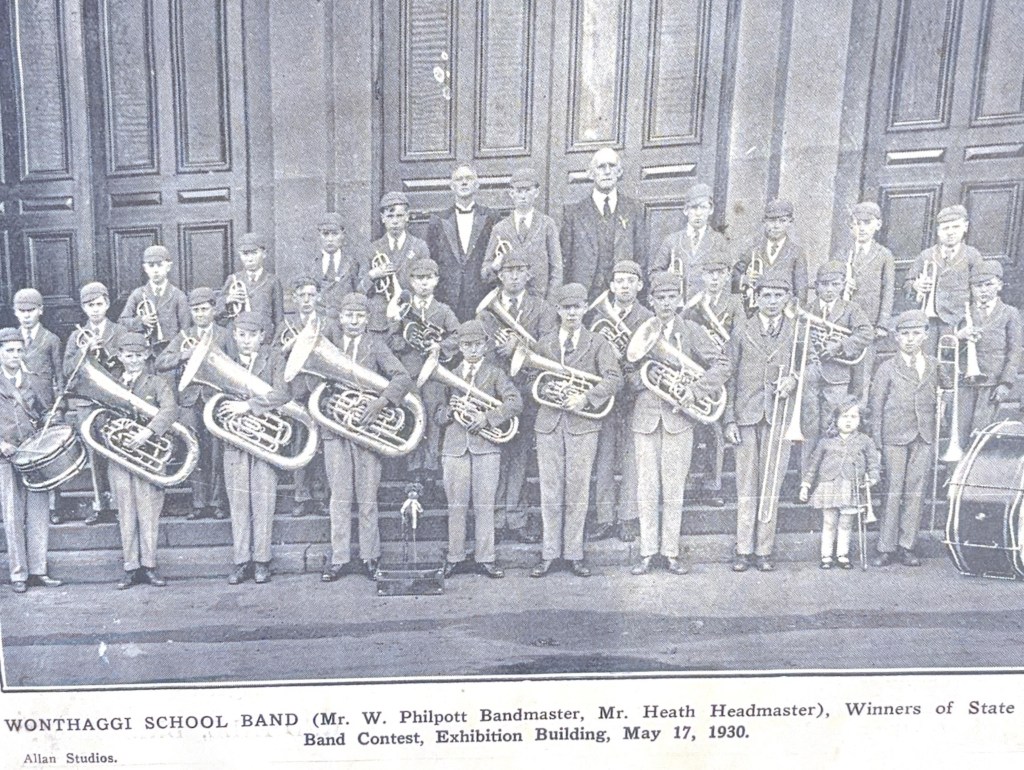
A little girl with a tiny trombone: one inspiration for a school band from Wonthaggi

Figure 1: The Australasian Band and Orchestra News, 26/05/1930, Front Cover

Wonthaggi also has a mascot of whom the boys are very proud. She is little Margaret Philpott aged three years and three months. (“TINY GIRL MASCOT FOR BOYS’ BAND“, 1930)

Introduction:

It is the 17th of May 1930, and the Exhibition Building in Melbourne is a hive of activity as the Victorian State School Band Association holds the first of many annual band contests.  Nine state school bands from across Melbourne, and one country representative from Wonthaggi, have come to compete and to show the rapid progress state school bands have made in the past few years from inception.

Wonthaggi State School Band did themselves proud that day by winning this inaugural contest against some other highly fancied school bands.  But the back stories before and after this win are many.  One of which being the story behind the mascot of the band, three-year-old Margaret Philpott, who is pictured with the band holding a tiny trombone.

The photo above did intrigue me when I first viewed it several years ago and I had been sporadically searching for the name of the small girl with a trombone.  Upon finding the name very recently, this made the photo even more special, and it adds a layer of context to the story.

This post is an addendum to a previous post outlining the development and legacy of Victorian state school bands, and many of the parts of this story mirror the earlier post.  So, it is interesting to unpick this on a local level as the school band from Wonthaggi is a perfect example of how a school band fared in its early years.  It is, perhaps, no accident that the Wonthaggi band was as good as it was due to good fortune and strong leadership – and an inspiring mascot.

Philpott’s and brass bands:
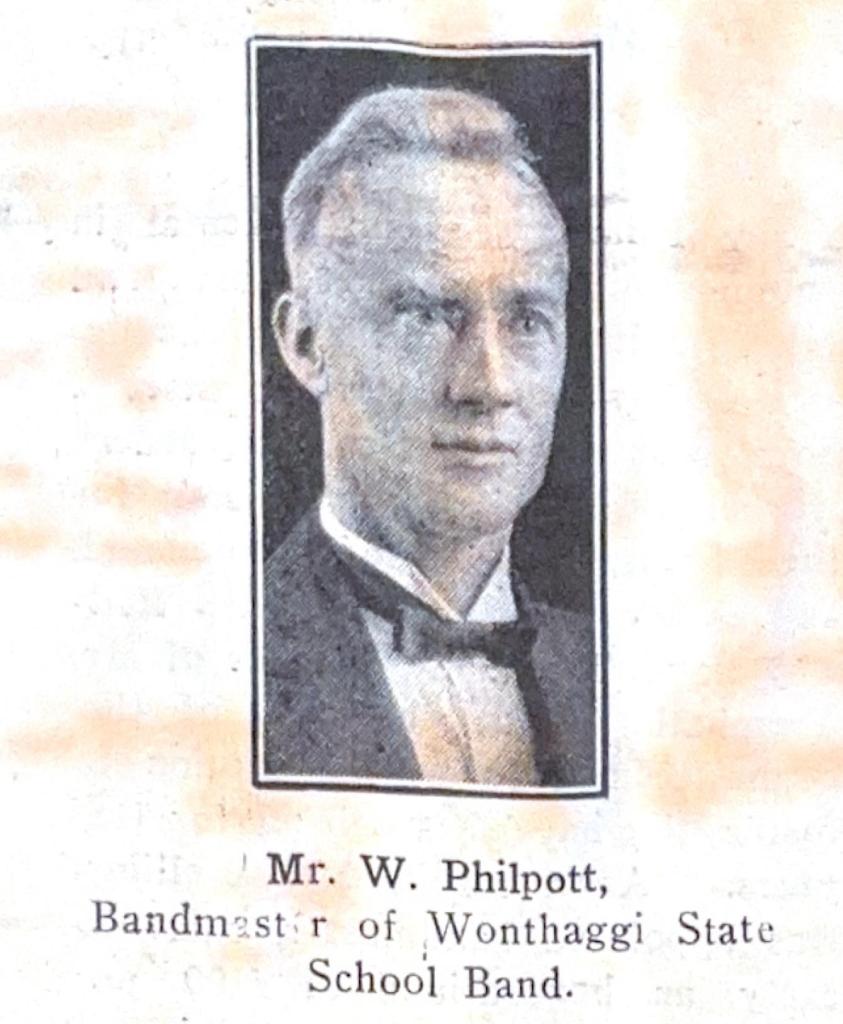
Figure 2: The Australasian Band and Orchestra News, 26/05/1930

The name says it all really.  Margaret Philpott may not have realised this at the age of three, but her name carries a legacy of brass band musicianship.  Her father and grandfather, both named William, were highly regarded brass musicians and conductors.  Her father, William ‘Bill’ Philpott was the ultimate journeyman bandsman.  By 1922 W. Philpott had played in or conducted:

  • 1899 Lismore Band (N.S.W.) conducted by his father, William George Philpott
  • Appointed Bandmaster of the Brighton Town Band (Vic.) which had recently amalgamated with the Elsternwick Band
  • Solo cornetist with the Prahran City Band under Edward Code and Solo Cornet with the St. Kilda Band
  • Engaged to play solo cornet for the Wellington Garrison Band (N.Z.)
  • Appointed bandmaster of the Coraki Band (N.S.W.) in 1908 while playing with the Lismore band
  • 1911 Appointed conductor of the Wagga Wagga Brass Band (N.S.W.)
  • 1918 played Soprano Cornet with the St. Augustine’s Band (Vic.) and Professional Cornet with the Ballarat City Band
  • 1921 Appointed conductor of the Young Brass Band (N.S.W.)

(Points summarised from “YOUNG’S BANDMASTER“, 1922)

W. Philpott continued on his journeyman ways when he moved to Wonthaggi in 1928 to take up a position of conductor of the Wonthaggi Union Band, and soon after the Wonthaggi State School Band (“THE LOSS OF OUR BANDMASTER.”, 1928;  “YOUNG’S BANDMASTER.”, 1928).  By all accounts, the bands that William had been associated with by this time were very grateful for his tutelage and his knowledge – and his success in competition – so they were sorry to see him go.  Wonthaggi offered much opportunity and under the leadership of William, the Wonthaggi Union Band and later the Wonthaggi State School Band both had success – the school band achieved second place in the 1929 Royal South Street contest (Royal South Street Society, 1929;  “SCHOOL BANDS’ CONTESTS.”, 1930).

Of course, William did not stop at Wonthaggi, he still had many years of conducting ahead of him, and his band journey continued:

The Gillies Bequest and the Wonthaggi State School Band:

As previously outlined in the post on school bands in Victoria, the support from the Gillies Bequest was a catalyst for the setting up of school bands across Victoria (de Korte, 2018;  “MUSIC AND READING ALOUD.”, 1925).  The establishment of school bands was a great success. At the presentation of trophies for the 1930 State School Band Association contest (which Wonthaggi won), Mr. Hansen, then Director of Education, outlined just how many bands there were.

There are now in State schools twenty brass and eight drum-and-fife bands.  The recent and rapid growth of them was due largely to the activities of Mr. A. B. Lane, president of the band association.  Of the bequest made by the late William Gillies, out of whose love of music and study the contests were inaugurated, £3750 had already been set aside. (“SCHOOL BANDS’ CONTESTS.”, 1930)

For perspective, the number of school bands grew rapidly in Victoria.  By 1932 there were “31 brass bands, 9 orchestras, 13 fife bands and 23 violin classes” (Hansen, 1932, p. 79) and by 1937, the number of school brass bands had risen to fifty (“BANDS IN VICTORIA“, 1937).  At the 1930 contest, as mentioned, there were ten school bands from “Albert Park, Ascot Vale West, Armadale, Coburg, Coburg West, Footscray, Northcote, Preston West, Princes Hill and Wonthaggi” (“BAND MUSIC IN SCHOOLS.”, 1930). 

At this time, not only were school bands forming at a rapid rate, but the expertise of some very fine conductors was also available.  Frank “Massa” Johnston of Melbourne Fire Brigade and Footscray City Band fame conducted the Hyde Street/Footscray School Band and Northcote Central State School Band, Mr. H. Hellings conducted West Preston, and Mr. W. Philpott conducted Wonthaggi (Allan Studio, 1930;  “Footscray State School Band”, 1930;  “Northcote Central State School Band”, 1928; Stevens, 1930).

With conducting pedigrees like this, and support from school communities and the Gillies Bequest, it is no wonder that school bands began to thrive and succeed.  The Wonthaggi school band was very lucky to share Mr. Philpott with the Wonthaggi Union Band.

A year of successes:
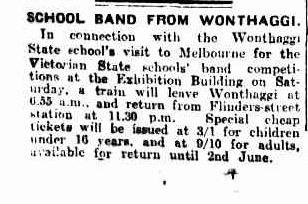
Figure 3: The Age, 14/05/30, p. 18

The State School Band Competition was a big day for Wonthaggi, and the other bands of course, not just because of the travel to and from Melbourne.  Mr. Philpott, the Headmaster, band, parents and supporters, and little Margaret Philpott, made the journey to the contest at the Exhibition Buildings.  Seven days before the contest, Mr. L. Jabara of Wonthaggi gave a gold cup to the Wonthaggi Headmaster, Mr. Heath, “to be presented to the winners of the State school band competition” (“WONTHAGGI.”, 1930a) which was also taken with the group.  In the end it was the remarkable success of Wonthaggi that was the story of the day. Comments from adjudicator Mr. Harry Shugg gave high praise to the Wonthaggi Band:

The adjudicator (Mr. Harry Shugg), commenting upon the performances, expressed surprise that the players, whose average age did not exceed 12½ years, had so done so well within such a short period.  He thought it especially true of the bass soloists. The Wonthaggi band astounded him, and shamed many of the adult bands in Victoria. (“SCHOOL BANDS’ CONTESTS.“, 1930)

The top three placings were as follows:

March:Hymn:National Air:Grand Aggregate:
Wonthaggi1111
Princes Hill2322
Footscray3233
Table 1:  (Placings found in “SCHOOL BANDS’ CONTESTS.“, 1930)

The band deserved all the accolades that were given to them, and the school was very proud of their achievements.

In recognition of winning all the cups and the honor of winning the championship at the State school band contest in Melbourne the teachers of the Wonthaggi State school entertained the members of the band at a dinner.  After playing for the sisters of St. Joseph’s and the scholars at St. Joseph’s school the band boys were entertained at afternoon tea.  Arrangements have been made by the school master (Mr. H. T. Heath) for the championship State school boys to play at 3LO and 3AR.  The band will also play on the M.C.G. ground on Saturday. (“WONTHAGGI.“, 1930b)

The Wonthaggi community was no less appreciative of Mr. Philpott’s dedication to the school band, and in July 1930 presented him with a gift.

In appreciation of his tutoring of the school boys’ band, which won every event at a recent band contest in Melbourne.  Mr. W. Philpott was presented with a wallet of notes at the Union Hall on Wednesday night.  The band is to take part in another contest in Melbourne on 23rd instant, and will also compete at South-street in October.  A school choir, which will also take part in the competitions at South-street has been formed with Mr, Philpott as conductor. (“WONTHAGGI.“, 1930c)

As for little Magaret Philpott, she was as much a part of the band as the bigger boys with their instruments.  Not much is said about her, but she is visible in some further photos, such as this one published in The Herald newspaper showing the boys arriving at the East Malvern State School in preparation for another contest.  Margaret, sporting a beret, can be seen right in the middle of the photo.
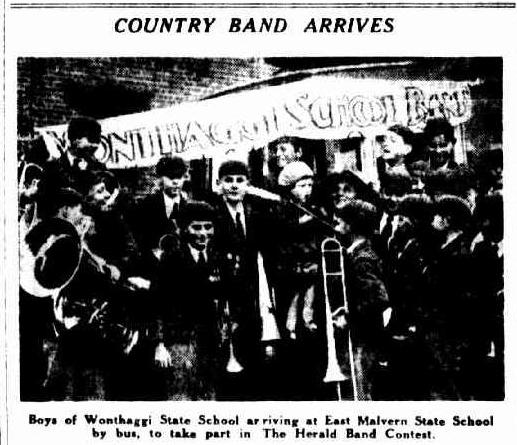
Figure 4: The Herald, 24/07/1930, p. 20
Figure 5: The Herald, 25/07/1930, p. 20

While the Wonthaggi State School band had numerous successes, and many engagements during 1930, they were not immune to events happening around them.  Wonthaggi was home to the State Coal Mine which supported the Wonthaggi Union Band, also conducted by Mr. Philpott.  Many of the mine workers were parents of children at the school, and in the 1930s there were disputes with the State Government which came to a head when a government delegation was to visit the town.  The Union band subsequently refused to play, and banned Mr. Philpott from conducting the school band when the delegation visited (“NO MINERS’ BAND FOR WONTHAGGI VISITORS“, 1930).  The caption on the photo below, published in The Weekly Times newspaper, provides some more reasoning.
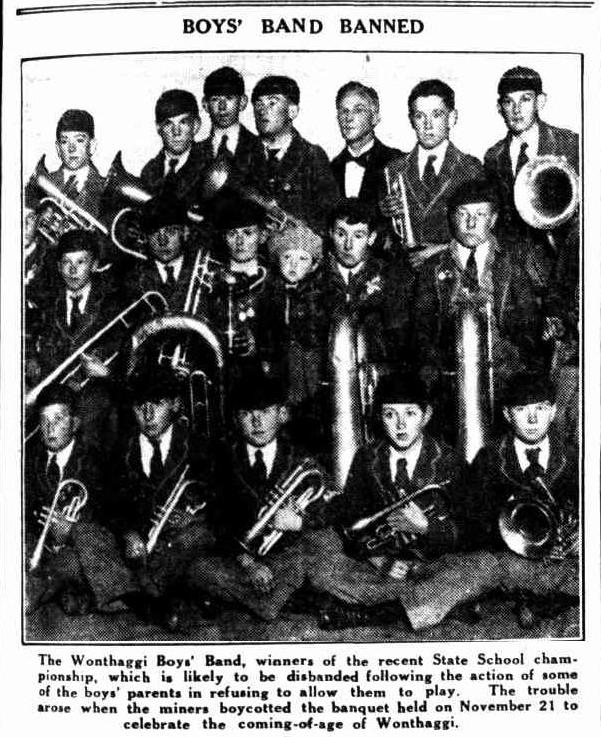
Figure 6: Weekly Times, 29/11/1930, p. 7

And again, here is another photo showing Margaret Philpott sitting among the boys of the band.

There are not many other mentions of the Wonthaggi State School Band after 1930 in the newspapers, and due to the transient nature of Mr. Philpott’s band career, he was not there to continue it through, although the political and industrial undercurrents did affect life in town.  We can at least, view the successes of the school band for what they were at the time; remarkable and very worthy.

Conclusion:

When William Philpott and family arrived in Wonthaggi in 1928, they could not have known what kind of influence they would eventually have.  Through Mr. Philpott, the town and school had musical expertise, with his sons they had solid musicians, and with little Margaret the school band had their own mascot – and she had her own tiny trombone.  Who knows what the Wonthaggi school band might have become if circumstances had been different?  This was only one Victorian school band among many, and they set the early standards.

As for Margaret Philpott, she may not have followed her brothers into brass music, but she was a creative type.  To finish this post, here is a poem that she wrote that was published in The Sun News-Pictorial newspaper, supplementary section in August 1936. Simply titled ‘The Clock’:
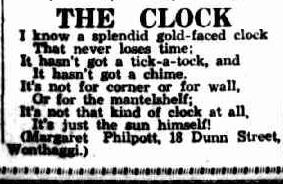
Figure 7: Sun News-Pictorial, 29/08/1936, p. ‘S3’

With thanks:

The author would like to thank members of the Young & District Family History Group for assistance in researching the Philpott family during their time in Young, and for providing further reading on the Young Town Band that mentions William J. Philpott.

References:

Allan Studio. (1930). Wonthaggi State School Band (Mr. W. Philpott Bandmaster, Mr. Heath Headmaster). Winners of State School Band Contest. Exhibition Building, May 17, 1930 [Digital scan of front cover photograph]. The Australasian Band and Orchestra News, XXV(9), Front Cover. 

APPOINTMENT OF BANDMASTER : Mr. W. J. PHILPOTT SELECTED. : Salary £130 Per Annum. (1940, 19 October). Williamstown Chronicle (Vic. : 1856 – 1954), 8. http://nla.gov.au/nla.news-article70695595

BAND MUSIC IN SCHOOLS: First Contest To-day. (1930, 17 May). Argus (Melbourne, Vic. : 1848 – 1957), 27. http://nla.gov.au/nla.news-article4087822

BANDMASTER RESIGNS : Goes Back to Wonthaggi. (1936, 31 January). Benalla Standard (Vic. : 1901 – 1940), 1. http://nla.gov.au/nla.news-article269674064

BANDS IN VICTORIA : High Musical Standard : Is Public Appreciating Lacking? (1937, 07 December). Age (Melbourne, Vic. : 1854 – 1954), 10. http://nla.gov.au/nla.news-article205550598

BENALLA’S NEW BANDMASTER : MR. W. J. PHILPOTT OF WONTHAGGI APPOINTED. (1934, 03 August). North Eastern Ensign (Benalla, Vic. : 1872 – 1938), 3. http://nla.gov.au/nla.news-article70790349

BOYS’ BAND BANNED. (1930, 29 November). Weekly Times (Melbourne, Vic. : 1869 – 1954), 7. http://nla.gov.au/nla.news-article224921183

COUNTRY BAND ARRIVES. (1930, 24 July). Herald (Melbourne, Vic. : 1861 – 1954), 20. http://nla.gov.au/nla.news-article242810008

de Korte, J. D. (2018, 08 April). Victorian State school brass bands: their legacy lives on. Band Blasts from the Past: Anecdotes, Stories and Personalities. https://bandblastsfromthepast.blog/2018/04/08/victorian-state-school-brass-bands-their-legacy-lives-on/

Footscray (Vic.) State School Band : Mr. Ellingsen, Headmaster, Mr. F. Johnston, Bandmaster. (1930). [Digital scan of front cover photograph]. The Australasian Band and Orchestra News, XXV(6), Front Cover.

Hansen, M. P. (1932). Thoughts that breathe. Robertson & Mullens. 

Lawson-Black, P. (2010). Bold as brass : the story of Stonnington City Brass then and now. Pat Lawson-Black, Stonnington City Brass. 

THE LOSS OF OUR BANDMASTER. (1928, 13 April). Young Chronicle (NSW : 1902 – 1910; 1913 – 1915; 1924 – 1934; 1936 – 1940), 2. http://nla.gov.au/nla.news-article234313241

Mr. W. Philpott. (1930). [Digital Scan of photograph]. The Australasian Band and Orchestra News, XXV(9).

MUSIC AND READING ALOUD : Object of Large Bequest. (1925, 01 June). Argus (Melbourne, Vic. : 1848 – 1957), 10. http://nla.gov.au/nla.news-article2122525

NO MINERS’ BAND FOR WONTHAGGI VISITORS : Quarrel With Ministry : PARLIAMENTARY PARTY THERE TOMORROW. (1930, 20 November). Herald (Melbourne, Vic. : 1861 – 1954), 4. http://nla.gov.au/nla.news-article242933719

Northcote Central State School Band : Mr. J. Bromilow, Head Teacher; Mr. F. Johnston, Bandmaster; Major Trengrove, Secretary. (1928). [Digital scan of front cover photograph]. The Australasian Band and Orchestra News, XXIV(3), Front Cover. 

Philpott, M. (1936, 29 August). THE CLOCK. Sun News-Pictorial (Melbourne, Vic. : 1922 – 1954; 1956), ‘S3’. http://nla.gov.au/nla.news-article277568115

Royal South Street Society. (1929, 05 October). 1929-10-05 Orchestral : Held in the Coliseum. Royal South Street Society. Retrieved 10 July 2026 from https://results.royalsouthstreet.com.au/results/1929-10-05-orchestral

SCHOOL BAND FROM WONTHAGGI. (1930, 14 May). Age (Melbourne, Vic. : 1854 – 1954), 18. http://nla.gov.au/nla.news-article203073779

SCHOOL BANDS’ CONTESTS : Wonthaggi’s Fine Performance. (1930, 19 May). Age (Melbourne, Vic. : 1854 – 1954), 11. http://nla.gov.au/nla.news-article203075313

Snowy Alps: Championship Golf: Band Boys’ Cup. (1930, 25 July). Herald (Melbourne, Vic. : 1861 – 1954), 20. http://nla.gov.au/nla.news-article242802853

Stevens, C. (1930). Preston West State School Band [Digital scan of front cover photograph]. The Australasian Band and Orchestra News, XXV(11), Front Cover. 

STH. MELBOURNE CITY BAND : Valedictory Of Old Conductor. (1938, 08 January). Record (Emerald Hill, Vic. : 1881 – 1957), 5. http://nla.gov.au/nla.news-article164490205

TINY GIRL MASCOT FOR BOYS’ BAND : Wonthaggi Competitors In Herald Contest. (1930, 19 July). Herald (Melbourne, Vic. : 1861 – 1954), 4. http://nla.gov.au/nla.news-article242814169

WONTHAGGI. (1930a, 10 May). Age (Melbourne, Vic. : 1854 – 1954), 17. http://nla.gov.au/nla.news-article203073601

WONTHAGGI. (1930b, 12 June). Age (Melbourne, Vic. : 1854 – 1954), 6. http://nla.gov.au/nla.news-article203086469

WONTHAGGI. (1930c, 11 July). Age (Melbourne, Vic. : 1854 – 1954), 12. http://nla.gov.au/nla.news-article202459763

YOUNG’S BANDMASTER. (1928, 05 April). Grenfell Record and Lachlan District Advertiser (NSW : 1876 – 1951), 3. http://nla.gov.au/nla.news-article115900873

YOUNG’S BANDMASTER : Mr W. J. Philpott. (1922, 04 February). Young Witness (NSW : 1915 – 1923), 4. http://nla.gov.au/nla.news-article113649653


Australian bands, gramophones and wireless: adapting to new technology

19290722_Argus_Wireless-Broadcast
The Argus, 22/07/1929, p. 18

Introduction:

The Old Town Band
(Written for “The Land”)

The band was the life of the old town
The zest of its great events
When the great Pooh-Bah himself came down,
Or the prize merinos brought renown
Or the circus raised its tents.

There was music in the trombone
A martial note in the drum
And the boom of the bass was on its own
In the days before the gramophone
Ere the wireless craze had come.

Those were the day when the township band
Filled a place in pioneer life:
Cheered the struggle with virgin land
And gave the old battlers a helping hand
When droughts or plagues were rife.

Today the baton is laid aside
And the bandsmen rest in their graves:
They played their way o’er the great divide,
And are bandsmen now on the other side
In paradisian naves

And o’er the earth in tones forlorn
The saxophone raises its call.
The engines start their shrieks at dawn
The gramophone laughs the band to scorn,
And the wireless mocks them all.

(Excerpts from “The Old Town Band”, James, 1929)

So wrote Mr. A. A. James in 1929 for The Land newspaper in response to an article published in the Riverine Grazier which lamented the fact that the town of Hay in Southern New South Wales had lost its town band.  His prose was published in several other country newspapers at the time, as many town bands faced the same challenges.  Mr James singles out the gramophones and wireless as contributing factors, but was he right in suggesting so?  Was this new technology which proliferated during the early 1900s detrimental to our bands? It depends on the perception of the history at the time.  And thankfully, there is much history to examine.

In this post, the effects of new broadcasting technology on Australian bands will be looked at.  The early 1900s were a period of rapid technological change and our bands were nominally affected by these changes.  Throughout this early time from 1900 – 1950, and Mr James’s poem sits roughly in the middle, a new life of music and entertainment was brought into the homes of Australians – enthusiastically so.  With this adoption of gramophones and wireless sets came the start of commentary and opinions from citizens which were written up in the newspapers.  Radio program notes published in newspapers became essential reading.

Through this all we find the relationships between audience and bands being rapidly changed.  Perhaps this is the deeper meaning of Mr James’s poem – he identified that people were more enamoured with sounds coming out of a box of wires than live instruments and musicians.  Both sides of this issue will be explored as some bands took advantage of the radio and found new audiences, while other bands could not compete.

Early transmissions:

Live performance was very much the norm of Australian brass bands in the early 1900s and engagement with audience was centred around this type of performing.   As well as this, the popularity of brass bands was obvious through their music and the crowds that they attracted.  Reports of 70,000 people cramming the streets of Melbourne to see the famous Besses o’ th’ Barn Band in a parade and 20,000-30,000 people watching the South Street marching sections were not uncommon (“Besses o’ th’ Barn Band,” 1907; Greaves, 1996).  Later in the 1920s there are stories about 5,000 people attending community song nights in local gardens, as was the case at Central Park in Malvern where the Malvern Tramways performed every week (Young, 1923).

In amongst the many accounts on live performances are a couple of unique stories.  In an earlier post regarding bands on Australian islands, the remarkable story of a performance by the Kingscote Brass Band (Kangaroo Island) was highlighted.  On the 20th of November 1906, the band performed a lunchtime concert which was transmitted via telephone to lighthouses at either end of Kangaroo Island – one seventy miles to the West of Kingscote and the other thirty miles to the East (“MUSIC FOR WATCHERS BY THE SEA.,” 1906).  According to the article in the Register, the concert was “very much appreciated” by both lighthouse keepers (“MUSIC FOR WATCHERS BY THE SEA.,” 1906).

However, this was not the first brass band concert broadcast via telephone in Australia.  According to an article published in the Rockhampton Morning Bulletin, this took place in the preceding century, although the exact date is unclear.

A band conducted by Mr Edward Brown was practising at the old fire brigade station […] when the late Messrs Harry Batchelor and W. Pummell, compositors of the “Morning Bulletin” suggested that the playing be put “over the phone”.  Mr Rosenads, then in charge of the Rockhampton Telephone Exchange, agreed to the proposal.  There was a function at the School of Arts that night and the band was heard there “by quite a few who took turns at the earphone”.  Later the band was playing outside the Oddfellows Hall in Denham Street and by means of a “link-up” was heard at Mount Morgan.  “And very well, too” said Mr Brown.

(“Band Music “Broadcast” Here Last Century,” 1945)

No doubt transmitting a performance via telephone would have seemed innovative and inventive, especially in these early times.  However, these were extremely rare and were not substitutes for live performances, they were mainly done out of opportunity – a way to see whether it could be done.  The major changes that were taking place were the recordings of bands on gramophone records, and the beginnings of radio broadcasts.

The band movement is cautious:

In Australia, the pace of change from predominantly live music to a mix of live music, recorded music and broadcast music took place within the space of a couple of decades.  There were many commentators at the time who saw fit to try to warn of a decline of community bands and one or two had their voices repeated through many regional newspapers.  One of them was a Mr Will Lewis formerly of the Toowoomba Municipal Band who expressed a pessimistic attitude:

He was of the opinion that the day of the amateur brass band was waning, and gave as a reason the fact that the gramophone, by which one could hear the world’s greatest bands and orchestras – jazz and otherwise, was creating serious inroads upon the brass band, and further, that the advent of the radio was also having much to do with the decline of brass band popularity.  Even band contests were becoming less popular every year – at least with the general public – and the wireless and the gramophone were the two disturbing elements.  Bandsmen, naturally, would be the last persons to recognize this serious fact.”

(““DAY OF AMATEUR BRASS BANDS WANING.”,” 1927)

Some might consider Mr Lewis to be alarmist, he could not predict the future, but he was commentating on the present.  For the brass bands it was a time of upheaval and some of them were rightfully concerned.  It could be said that many bands went defunct at this time due to the technological change however it is hard to document this at this time of writing.

The worry of band people was not helped by this small snippet of news in 1930 about the Royal Melbourne Show dropping the brass bands in favour of recorded music being played through loud speakers – and saving £140.00 (“MELBOURNE SHOW.,” 1930).

19300409_Brisbane-Courier_Melb-Show
The Brisbane Courier, 09/04/1930, p. 24

In 1938 a passionate call to old times was made by the Committee of the Sunshine Brass Band, based in western Melbourne.  While the crux of the article published in the Sunshine Advocate was to solicit funds and support, they also lamented the fact that times had changed, and that local brass bands were victims of change.  Below are some excerpts from the article:

Most old-established customs and usages have felt the influence of modern times, and not the least of these are district brass bands, which have had to fight against canned music retailed hourly over the wireless.  Gramophone recordings of the world’s best bands are sandwiched in between talks and appeals to buy somebody’s pills to improve health.

[…]

The older generation was a music loving people.  The possession of a piano was a hall-mark of respectability, and the education of the children was not considered complete unless music was included in the curriculum.

[…]

To hear a local band in the gardens on a Sunday afternoon and a warm evening were events that were looked forward to by the older generation.  They were delightful times, and people held communion with one another to the strains of pleasant and beautiful music, which acted as a tonic to their nervous system.

The Sunshine band committee realises that a return to the customs of other days is due, and propose to play near the railway station on warm Sunday evenings.

(“Sunshine Band Needs More Public Support,” 1938)

This article was interesting in its sentiment and information.  We have here a brass band from the Melbourne environs trying to bring back former times through playing quality live music in a local place.  By this time however, music broadcasts were well and truly accepted so their words might have struck some memories amongst parts of the population. They were telling it as they saw it.

A similar sentiment to Mr. Lewis and Mr. James was also expressed in 1938 in an article published in the Sydney Mail by a contributor with the initials of W. P. T.  This article was more of a reminiscence of times gone by and he mentions several brass bands.  The opening of his article reads:

The brass band of the small country towns plays a very important part in the social life of the country, although such bands are not nearly as common as they were before the days of radio.

(W. P. T., 1938)

It is an interesting observation to make and clearly some connection had been made in the minds of people that radios were somewhat to blame for the demise of smaller bands.

The other side to these views is that several bands had begun exploring what the new technology could do for them from the very beginning.

The band movement adapts:

In 1996, noted band historian Jack Greaves assisted in the compilation of several old recordings into a two-CD set titled “The Great Bands of Australia” (Greaves, 1996).  This CD set is remarkable not only for the breadth of recorded music from full band works, marches and solo items, performed by a large selection of famous Australian bands.  From reading a catalogue entry of this work (linked), we can see that the recordings date back to 1912.  Some of the music can still be heard thanks to the work of the National Library of Australia and the National Film and Sound Archive (NFSA).  Below is a link to one recording which is on the NFSA website:

The Newcastle Steelworks Band (1924) playing the “Honest Toil March” by William Rimmer

The gramophone meant that people could acquire recordings of music groups and play them in their own homes at a time of their choosing.  They did not have to go out to concerts or community events, or the band competitions.  It was one cause of alarm for the band movement, but some bands obviously saw fit to record their work and bring their playing to new audiences.  Recordings by many of the top bands of the day still exist and enthusiasts have made digital copies of old recordings.

Aside from the gramophone, the utilisation of the radio probably brought about the greatest change to society and to the band movement.  Referred to early as the wireless, Australia followed developments out of America and the United Kingdom and set up its own network of stations.  It is in the early 1920s when this was happening.

19230800_Box-Hill-Band_Radio-Studio
Newspaper unknown at the time of writing (Source: Box Hill Historical Society)

The year is 1923 and in the Melbourne suburb of Box Hill the first transmission of a live brass band over the wireless took place on the 1st of August (Elsum, 1924).  The picture above is reputed to be the Box Hill Brass Band sitting in the home of Mr H. Beattie, a wireless enthusiast who resided in Box Hill.  However, in some newspapers the band that participated in the first transmission was named as the Nunawading District Brass Band (“NUNAWADING BRASS BAND,” 1923).  This conjecture can be easily explained as Nunawading and Box Hill are near neighbouring suburbs and the then Parish of Nunawading encompassed Box Hill.  (The Box Hill Historical Society shares my confusion as the newspapers were not forthcoming as to the true identity of the band that was actually broadcast (Harris, 2020)).  Despite the confusion in the newspapers, the fact remains that a brass band of the local area had their music transmitted via wireless.

This first transmission was actually a modulation test and the band was heard over all of Melbourne, parts of Victoria, and even interstate!  Much of the article published in the local Reporter newspaper listed the locations where the transmission was heard and the praise that was given:

For the next few days letters arrived from all points of the compass congratulating Mr Beattie and the Band, and expressing appreciation also of a speech by Cr. W. Young.  From Footscray to Armadale, from Sandringham to Camberwell, Essendon, Hawksburn, and wherever else in the metropolitan district, receiving stations listened in, the unanimous opinion expressed that it “was the best music ever heard by wireless”.  Wonthaggi sent a tribute, and the amateurs of Ararat wrote “Encore, we want more”, while far away Terang announced that the enthusiastic listeners in there were delighted.  The most interesting letter came from Strathfield, Sydney, 592 miles from the spot the Band played, stating that a number of visitors sat around a three-valve set with a loud speaker, and heard the performance from start to finish, announcing the strength and modulation to be perfect, and stating that after the Band had concluded with the National Anthem, local transmitters around Sydney could be heard enthusiastically discussing the test.

(“NUNAWADING BRASS BAND,” 1923)

An achievement indeed!  Although this achievement had to be defended.  In early 1924, the Vice-President of the Nunawading District Brass Band, a Mr. W. M. R. Elsum wrote a letter to the Argus newspaper disputing that the Newcastle Steelworks Band was the first full band to have broadcasted a concert via wireless (Elsum, 1924).

Once people in Australia realised that music of this nature could be transmitted successfully, there was no stopping the progress – it is to say, in colloquial terms, the horse had well and truly bolted!  Radio stations and transmitters were set up all over the country and within years, much of the population could listen to a variety of programs (““Listening In”,” 1923).  The Queensland Government for example, started setting up a State based broadcasting service in 1925 (“STATE RADIO.,” 1925).  In New South Wales, innovation in programming was highlighted with the organising of a Radio Eisteddfod by the New South Wales Broadcasting Company which involved a section for brass bands (“RADIO EISTEDDFOD.,” 1928).  Although, the articles of the day were not clear as to who competed and if brass bands made it to the finals.

For the brass bands, radio stations seized upon them as a ready-made musical item and for some of the bands it led to new popularity – some, because radio stations were tending to use the same top-quality brass bands over and over again.  Additionally, as explored in a previous post, in 1930 the A.B.C. Military Band was established (“MILITARY BAND AT 3LO.,” 1930).  Initially conducted by Harry Shugg, it was further strengthened in 1933 and quickly became a stalwart of A.B.C. radio programming alongside the brass bands (“A BRASS BAND RECITAL.,” 1940; “Radio Programmes,” 1939).

S6.2_20180609_19310000_ABC-Military-Band_Postcard
1930 Postcard of the A.B.C. Military Band in a studio, conducted by Mr Harry Shugg. (Source: Victorian Collections: Victorian Bands’ League)

The Advertiser newspaper in Adelaide noted that “Brass band concerts have been remarkably popular” and one of the brass bands that station 5CL presented was “Holden’s Silver Band” (“5CL FEATURES,” 1930).  A highlight in Victoria of station 3LO’s programming was the “State Schools’ Brass Band contest, which was won by Wonthaggi.”  (Armadale came second and Princess Hill was third with Northcote awarded an honourable mention) – a contest which was adjudicated by the famous Percy Code (“RADIO SHOW.,” 1930).

Of course, like the concerts mentioned earlier in the post that were broadcast via telephone, there were other broadcasts that could be classed as novelty events.  In November 1932, thirty members of the Young Australia League band were taken up in the “Southern Cross” aircraft flown by Charles Kingsford-Smith where they were to “broadcast music at a height of 5000ft” (“MUSIC IN THE AIR,” 1932).

Now that radio broadcasting was fully entrenched and brass bands were a seemingly popular item, there were times when radio through it would be in the best interest of the band movement to have their events transmitted to the world.  The Victorian Centenary celebrations of 1934 were a case in point.  The Herald newspaper took aim at the Victorian Bands’ League for not being ambitious enough with their proposed event:

From the point of view of broadcasting, it is regrettable that the Victorian Bands’ League does not see its way to conduct at the Centenary celebration its proposed international brass band championship.  This would have been an event of exceptional interest, extending to distant peoples who know little of Australia and its progress.  More than that, good band music will be an influence joyous and vital.  If an international contest cannot be arranged it should be possible to provide an Imperial one.

(“Broadcasting And Brass Bands,” 1933)

Through better technology and transmission, Australia was also exposed to performances from around the world.   Perhaps one of the more unusual concerts that was received was in 1935 when the Imperial Ethiopian Brass Band was heard via short-wave radio in Brisbane (“IMPERIAL ETHIOPIAN BRASS BAND,” 1935).  The transmission was reported to have been heard with “remarkable clarity” (“IMPERIAL ETHIOPIAN BRASS BAND,” 1935).  Over in Western Australia, the Kalgoorlie Brass Band conducted by Mr. Ted McMahon made history in 1937 when it was broadcast and relayed nationally through stations 6GF, 6WF and 6WA as part of a program to highlight local artists (“Kalgoorlie Band For National Broadcast,” 1937).

These formative years of radio shaped the way Australians heard and digested music.  Clearly the brass bands were a useful addition to radio programs, and they presented some quality music.  Obviously, some bands, namely country bands, had been left out of this success.  What were the feelings of the listeners?

Too many bands or not enough bands?:

As mentioned, the first wireless transmission of a brass band took place in 1923 so another part of this story is the opinions of listeners, and there were many opinions.  Most accounts were diplomatic about the popularity of brass bands, but some listeners and commentators asked whether there were too many bands, or could the broadcasters play more bands.  Opinions were divided; Australians clearly had their choices.

As early as 1925 letters were seen in newspapers criticising the musical choices of radio stations.  Some of the language was blunt as this letter signed by “Condensor” and published in the Herald shows:

Sir,  – We quite agree with your correspondent “Radio” who complains of the number of brass bands broadcast from 3LG.  Night after night we have to put our phones down, sick and tired of brass.  Surely one night a week is enough to satisfy anyone.

(Condensor, 1925)

Interestingly we also see opinions from commentators.  A Mr Robert McCall, writing for the Australian Women’s Weekly column, “Music Radio” asks a question at the head of one his columns, “Band Music On the Air Will it be Overdone?” (McCall, 1933).  He asked the question because of a decision by the A.B.C.:

Is the Australian Broadcasting Commission overdoing band programmes?  Next week there will be bands on the air on six nights – one night the popular brass ensemble from the Malvern Tramways and on five the newly-formed A.B.C. Military Band.

(McCall, 1933)

He went on to write:

Bands, both brass and military, always have been popular in Australia and the commission will find a vast and most receptive audience for its several months season by the band conducted by Captain Adkins from Kneller Hall.

[…]

The bands’ programmes are sure to stimulate the already widespread interest in band work, but I feel that their greatest service should lie in lifting the usual band repertoire out of the ruck of the commonplace.  It is about time that such hardy perennials as “Zampa,” “Poet and Peasant,” “Light Cavalry,” and those ill-sounding selections from grand and light operas were given a rest.

[…]

At the same time it should not be forgotten that in recent years some of the most important composers of the day have been seized with the possibilities of bands.  Men such as Holst and Elgar have written compositions specially for them.  Nor are these works complex and unlistenable.

Band music gives pleasure to thousands.  It can still do so, and yet be artistic and original.

(McCall, 1933)

McCall provides an interesting opinion.  It seems he was not against the idea of bands being programmed six nights in a row.  Rather, he was taking the view of a music critic and expressing concern that the usual repertoire played by bands per se was not palatable to the ordinary listener.

To counter some of the detractors, there were always people who liked the regularity of brass and military bands on the radio.  The target of their letter writing was the radio stations themselves and certain listeners scolded the A.B.C. in particular for altering the programming of regular band programs (Breynard, 1934; Mounsey, 1939).  One of the stronger responses came from Mr J. L. C. White, then Secretary of the Victorian Bands’ League of which his words were quoted in an article published in The Argus newspaper in March 1951:

Victoria’s 3,500 registered brass bandsmen and their fans were receiving no encouragement from the A.B.C. or commercial broadcasting stations, Mr. J. L. C. white said yesterday.

[…]

He was commenting on a letter to The Argus pointing out that packed houses for the Black Watch band had proved that good bands were still popular.

The letter asked why radio listeners were not given more band music.

Mr. White said: “A poll would show that 90% of radio listeners enjoy band music.”

“More bands than ever are being formed now, and their music is as popular as ever.”

(“He wants more band music broadcast,” 1951)

It is of course some months after this article was published that the A.B.C. Military Band was made redundant in October 1951 (“A.B.C. Band’s Farewell,” 1951).

After these formative times, the status quo of brass bands had changed.  Live performances continued, but radio and recording also occupied the bands.  Some bands found a new market by producing small recordings of marches for use in schools and marching groups of with three such recordings are cited with details of the recordings linked here (Malvern Municipal Band, 1958, 1970; Preston Municipal Brass Band, 1956).

Conclusion:

In the course of these years it is possible to follow divergent streams of opinion.  Firstly, there were the bands who were concerned by the impact of new technology and were worried about the erosion of their traditional ways of doing things.  Then there were the bands that embraced recording and broadcasting.  And of course, the second divergent opinion was evident regarding the content of radio programs and programming.  It was not exactly win-win situations for everyone.  Strength of feeling in the band movement was strong.

It is doubtful to see whether the same debate would take place nowadays regarding new technology.  There was a time past in the early days of the internet when community bands could not see the use of a website or email.  It would seem that history keeps repeating itself whenever there is a new technological development.

To finish this post, it would be remiss not to end with another old recording.  Here is a YouTube with the Newcastle Steelworks Band of 1924 playing the piece “Zelda” by Percy Code with famous Cornetist Arthur Stender as the soloist (Vintage Sounds & Code, 2019).

References:

5CL FEATURES : Brass Band Concert. (1930, 23 August). Advertiser (Adelaide, SA : 1889 – 1931), 9. http://nla.gov.au/nla.news-article30503444

A.B.C. Band’s Farewell. (1951, 15 October). Age (Melbourne, Vic. : 1854 – 1954), 3. http://nla.gov.au/nla.news-article205334832

A.B.C. Military Band – Conductor: Harry Shugg. (1930). [Postcard : L13.8cm – W8.8cm]. [0016]. Victorian Collections, Victorian Bands’ League. https://victoriancollections.net.au/items/5b39988221ea6d0008c461a6

Band Music “Broadcast” Here Last Century. (1945, 16 October). Morning Bulletin (Rockhampton, Qld. : 1878 – 1954), 5. http://nla.gov.au/nla.news-article56391096

Besses o’ th’ Barn Band. (1907, 09 August). Quiz (Adelaide, SA : 1900 – 1909), 8. http://nla.gov.au/nla.news-article166338966

A BRASS BAND RECITAL. (1940, 28 May). Macleay Argus (Kempsey, NSW : 1885 – 1907; 1909 – 1910; 1912 – 1913; 1915 – 1916; 1918 – 1954), 6. http://nla.gov.au/nla.news-article234489582

Breynard, S. (1934, 10 August). RADIO SERVICES : Brass Band Music : To the Editor. Advertiser (Adelaide, SA : 1931 – 1954), 24. http://nla.gov.au/nla.news-article74106904

Broadcasting And Brass Bands. (1933, 21 February). Herald (Melbourne, Vic. : 1861 – 1954), 6. http://nla.gov.au/nla.news-article243056460

Condensor. (1925, 27 August). TOO MUCH BRASS. Herald (Melbourne, Vic. : 1861 – 1954), 8. http://nla.gov.au/nla.news-article243624609

“DAY OF AMATEUR BRASS BANDS WANING.”. (1927, 14 September). Casino and Kyogle Courier and North Coast Advertiser (NSW : 1904 – 1932), 2. http://nla.gov.au/nla.news-article233826047

Elsum, W. M. H. (1924, 23 February). BROADCASTING BY WIRELESS : To the Editor of the Argus. Argus (Melbourne, Vic. : 1848 – 1957), 20. http://nla.gov.au/nla.news-article1934742

Greaves, J. (1996). The great bands of Australia [sound recording] [2 sound discs (CD)]. Australia, Sound Heritage Association. 

Harris, H. (2020). Re: Brass band 1st radio broadcast. In J. D. de Korte (Ed.).

He wants more band music broadcast. (1951, 13 March). Argus (Melbourne, Vic. : 1848 – 1957), 9. http://nla.gov.au/nla.news-article23036508

IMPERIAL ETHIOPIAN BRASS BAND : Heard by Short Wave Wireless. (1935, 29 November). Courier-Mail (Brisbane, Qld. : 1933 – 1954), 14. http://nla.gov.au/nla.news-article35923328

James, A. A. (1929, 25 January). The Old Town Band : (Written for “The Land”). Land (Sydney, NSW : 1911 – 1954), 2. http://nla.gov.au/nla.news-article117237132

Kalgoorlie Band For National Broadcast. (1937, 16 July). Kalgoorlie Miner (WA : 1895 – 1954), 4. http://nla.gov.au/nla.news-article87578534

“Listening In” : The Wonders of Wireless. (1923, 04 September). Horsham Times (Vic. : 1882 – 1954), 8. http://nla.gov.au/nla.news-article72734927

Malvern Municipal Band. (1958). On One Fine Day [Vinyl, LP, 10”]. W & G Distributing Co. Pty. Ltd. https://www.discogs.com/Malvern-Municipal-Band-Under-The-Direction-Of-Bandmaster-WJ-Philpott-One-Fine-Day/release/8933573 

Malvern Municipal Band. (1970). On Marching with Malvern [Vinyl, LP, Album]. W & G Distributing Co. Pty. Ltd. https://www.discogs.com/Malvern-Municipal-Band-Marching-With-Malvern/release/11048679 

McCall, R. (1933, 23 December). MUSIC RADIO : Band Music on the Air : Will it be Overdone? Australian Women’s Weekly (1933 – 1982), 16. http://nla.gov.au/nla.news-article51189093

MELBOURNE SHOW : Brass Bands to be Superseded. (1930, 09 April). Brisbane Courier (Qld. : 1864 – 1933), 24. http://nla.gov.au/nla.news-article21518117

MILITARY BAND AT 3LO. (1930, 29 October). Argus (Melbourne, Vic. : 1848 – 1957), 15. http://nla.gov.au/nla.news-article4214065

Mounsey, T. B. (1939, 20 December). Brass Band Broadcasting. Age (Melbourne, Vic. : 1854 – 1954), 10. http://nla.gov.au/nla.news-article205593992

MUSIC FOR WATCHERS BY THE SEA. (1906, 21 November). Register (Adelaide, SA : 1901 – 1929), 7. http://nla.gov.au/nla.news-article56693536

MUSIC IN THE AIR : Y.A.L. Band at 5000ft. Will Broadcast. (1932, 19 November). Sun (Sydney, NSW : 1910 – 1954), 3. http://nla.gov.au/nla.news-article230575146

Newcastle Steelworks Band. (1924). Honest Toil March [This 1924 gramophone recording of W Rimmer’s ‘Honest Toil March’ is performed by the Australian Newcastle Steelworks Band.]. Aeolian Company. https://aso.gov.au/titles/music/honest-toil-march/clip1/

NUNAWADING BRASS BAND : Unique Wireless Demonstration. (1923, 10 August). Reporter (Box Hill, Vic. : 1889 – 1925), 5. http://nla.gov.au/nla.news-article257201010

Preston Municipal Brass Band. (1956). On Under the Baton [Vinyl, LP, 10”, Album]. Cyril Stevens Recording Studios Pty. Ltd. https://www.discogs.com/Preston-Municipal-Brass-Band-Conducted-By-Charles-Smith-Under-The-Baton/release/4595545 

RADIO EISTEDDFOD. (1928, 05 October). Macleay Argus (Kempsey, NSW : 1885 – 1907; 1909 – 1910; 1912 – 1913; 1915 – 1916; 1918 – 1954), 9. http://nla.gov.au/nla.news-article234464548

Radio Programmes : A.B.C. Highlights for Next Week : Brass Band Recitals. (1939, 03 February). Nambucca and Bellinger News (NSW : 1911 – 1945), 4. http://nla.gov.au/nla.news-article214648292

RADIO SHOW : Schools’ Band Competition. (1930, 25 July). Age (Melbourne, Vic. : 1854 – 1954), 11. http://nla.gov.au/nla.news-article202468625

STATE RADIO : World Range : Erecting the Station. (1925, 21 January). Townsville Daily Bulletin (Qld. : 1907 – 1954), 12. http://nla.gov.au/nla.news-article61570872

Sunshine Band Needs More Public Support : Committee’s Plan to Stimulate Interest. (1938, 21 January). Sunshine Advocate (Vic. : 1924 – 1954), 4. http://nla.gov.au/nla.news-article75199111

Vintage Sounds. (2019, 25 October). Australian Newcastle Steelworks Band – Zelda (Percy Code) (1924) [Video (Recording)]. YouTube. Retrieved 27 April 2020 from https://www.youtube.com/watch?v=6Fn8VgZK9Yc

W. P. T. (1938, 28 December). Brass Bands of the Bush. Sydney Mail (NSW : 1912 – 1938), 2. http://nla.gov.au/nla.news-article166525297

WIRELESS BROADCASTING : New Service Begins. (1929, 22 July). Argus (Melbourne, Vic. : 1848 – 1957), 18. http://nla.gov.au/nla.news-article4023301

Young, G. (1923). The Malvern Tramways Band : An Appreciation. In Community singing : St. Kilda Esplanade every Wednesday evening : words of songs & program (pp. 24). Malvern Tramways Band. 

Cecil Clarence Mullen: Enthusiastic commentator, historian and statistician of brass and military bands

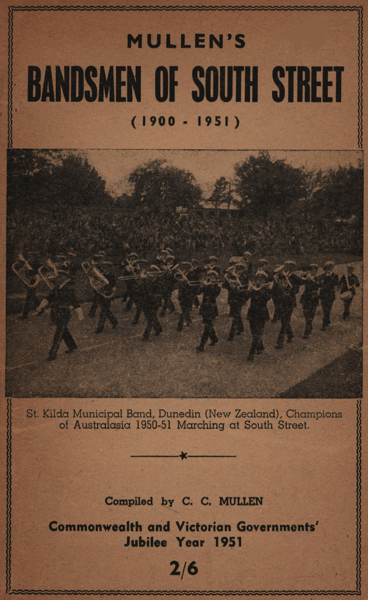
19510000_Mullens-South-Street_p0-FC
Front Cover, Mullen’s Bandsmen of South Street (1900-1951)”. (source: Jeremy de Korte’s personal collection)

Introduction:

There has always been an ecosphere of activity surrounding brass bands, then and now ranging from retail to journalism, and people who take a general interest in day-to-day activities.  This level of interest varies among people, and especially in the bands of old, there was an amount of engagement in these ensembles.  One only has to read past newspapers as a measure of this engagement.  Most readers of this blog know I dwell in the Trove archive to find information for these posts; it is through these newspaper articles that the life and atmosphere of these bands can be fully appreciated.

This post is different from previous posts where the focus is not on bands per se, but on a bands person who described himself as very involved in the brass band movement, Cecil Clarence Mullen.  I am very thankful to have been gifted one of his rare booklets, Mullen’s Bandsmen of South Street (1900-1951).  He wrote another article on the history of Victorian bands in 1965 for The Victorian Historical Magazine.  However, there is more to explore in his writing, including some of the opinions on the band movement and the work he did as a brass band statistician.

Mullen had a role to play documenting the band history of Victoria and it is unfortunate that his work is not well known.  We will see where Mullen’s work was at its most valuable, but also where some of his work could be questioned – this post will be taking a subjective view of some of his writing and opinions.  It must be recognised that at the time, Mullen did not have the information resources at his disposal like we do now.  However, what he did do was make an effort to record and compile results in a way that was unique.

C. C. Mullen (1895-1983):

It was difficult to build a full picture of Mullen’s life as some resources were not comprehensive.  Through the research of State records (Public Records Office Victoria and Births, Deaths and Marriages Victoria), it is found that he was born in 1895 and initially lived in the Melbourne suburb of Richmond.  For much of his further life, he lived in the nearby suburb of Abbotsford and was still residing in that suburb when he died in 1983 at the age of 88 (Mullen, 1983).  As for employment, it is listed in some records that he worked as a Clerk at the Argus newspaper and various other local newspapers (Ruddell, 2010)

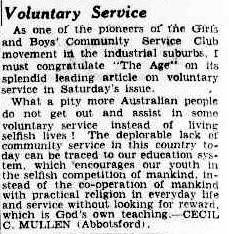
Mullen’s amateur interests were extensive and varied including music, sports, local history and it seems youth and education as well (Ruddell, 2010).  He was complimented on his work with local youth groups of which he made every effort to prepare youth for further work and education (“Richmond Boys’ Club,” 1932).  It is through further research in the Trove archive that we see a fuller picture of Mullen’s mindset as he was an avid contributor of letters to the newspapers.  He wrote on all sorts of topics; youth, education, transport, parks, library opening hours, manners at the opera, sports, politics, etc (Mullen, 1937, 1946, 1947, 1952a).  The articles displayed below are only a tiny sample of his letter output.

19371217_Argus_Mullen-Sport-Schools
Argus, 17/12/1937, p. 10
19401607_TheAge_Mullen_Volunteers
The Age, 10/07/1940, p. 6
19471218_Herald_Mullen-School-Holidays
Herald, 18/12/1947, p. 15
19520103_Argus_Mullen-Letter
Argus, 03/01/1952, p. 6

Regarding his letter writing, it seems he did not write to the papers on one of his favourite topics, brass bands, except for one instance when he requested photos of the Kalgoorlie brass bands for his brass band history collection (Mullen, 1951a).  It is also in this letter that we see that Mullen has described himself as a “statistician and historian of brass and military bands” (Mullen, 1951a).

19510113_Kalgoorlie-Miner_Mullen-Letter
Kalgoorlie Miner, 13/01/1951, p. 2

This post will not dwell on Mullen’s interests in other subjects however they do provide some clues as to how Mullen went about doing things, and what his personal attitudes were like.  He gives the impression of being an egalitarian person and was a firm advocate for youth groups (Mullen, 1952b).  He did not like some of the aspects of competition, taking aim through one of his letters at “the selfish competition of mankind, instead of the co-operation of mankind” (Mullen, 1940).  In another one of the newspaper letters he advocates for the abolition of school sports, and in his booklet, he advocates for the abolition of grades in band contests (Mullen, 1937, 1951b).  In saying so, Mullen still supported the aims of the Royal South Street Society band competition sections and sponsored trophies for “Best Drummer” in 1958, another trophy in 1959, and a trophy in 1964 for “Bandmaster showing Best Deportment” (Royal South Street Society, 1958, 1959, 1964).   As for his historical work, we will examine his band history research in the next sections, however, it should be noted that there is an amount of conjecture over the accuracy of his sports history writing and statistics (Hay, 2010).

An enthusiastic commentator is probably an apt description of Mullen given his penchant for writing on all manner of subjects.  His band history work is what provides the most interest (for this post) and we will see a person who clearly enjoyed his statistics.

C. C. Mullen: Historian of Brass & Military Bands:

There is no doubt, through reading his works, that Mullen was an enthusiastic advocate, documenter and historian of brass and military bands.   Both his main works on the subject, his booklet and his later article attest to this.  This section will review his booklet first, then his article from 1965.

1951: “Mullen’s Bandsmen of South Street (1900-1951)”:

The first impression that is given about the booklet is that he clearly wrote this booklet as an outlet for his interest in brass bands and musicians. The aim of this booklet, as Mullen notes in the preface, was to publish

…for the first time in the history of brass bands in this country, a condensed history of bands and players who have taken part in most important annual band competitions in Australasia – that of South Street, Ballarat, Victoria.

(Mullen, 1951b, p. 1)

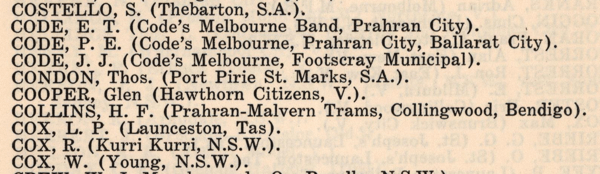
With this aim, he achieved his goal and the book contains the names of musicians, the bands they were associated with, and which instruments they played.  Below is small except from one of the lists which makes up many of the pages of this booklet.:

19510000_Mullens-South-Street_p15
Excerpt from p. 15, Mullen’s Bandsmen of South Street (1900-1951)”, Bb Cornets. (source: Jeremy de Korte’s personal collection)

In the preface, Mullen outlines his life in the brass band movement.  In summary he:

  • was a pupil of Edward Code,
  • apparently knew all the famous bandmasters of the day,
  • was embedded in the administration of the early Victorian Bands’ Association, and later the Victorian Bands’ League,
  • was a contributor of articles to all the famous band magazines (Mullen, 1951b).

He notes that the famous Bandmaster Edward Code was a great influence on his early life and that he felt honoured as a former pupil to have published this booklet (Mullen, 1951b).  Interestingly, both Edward Code and Mullen are buried in the same cemetery in Melbourne, the Coburg Pine Ridge Cemetery in Melbourne’s north – although 65 years apart.

Mullen was not afraid of expressing his opinions on bands and the administration of bands.  On page four of his booklet is a one-page treatise on the importance of brass bands to the community, with a paragraph (below) on his thoughts of bands in schools (Mullen, 1951b).  A previous post has touched on the historical discrepancies with the starting of school bands in Victoria and Mullen adds his own discrepancy when he declares “I had the first band in Victoria composed of schoolboys” (Mullen, 1951b, p. 4).  When reading this paragraph, it brings to mind a piece of writing in one of the old brass band magazines where the writer had some choice words for the headmasters of the day about not starting bands (“THE EDITOR’S BATON,” 1929).  Perhaps it was Mullen himself who wrote the article in this 1929 issue of The Australasian Band and Orchestra News, but we may never know for sure.

19510000_Mullens-South-Street_p4
Excerpt from p. 4, Mullen’s Bandsmen of South Street (1900-1951)”. (source: Jeremy de Korte’s personal collection)

In finishing his one-page treatise on the importance of brass bands, Mullen laments that the State and National controlling bodies have not done enough to promote bands.  He states,

It is up to our band controlling bodies and the Australian Band Council to take this matter up seriously and see that more cannot be done to keep the importance of brass bands before the people of Australia.

(Mullen, 1951b, p. 4)

The main aim of this booklet, as mentioned, was to document the prize-winning brass band musicians and bands who had participated in the South Street competitions over a number of years.  Two pages of the booklet are devoted to a poem Mullen wrote on South Street.  Another section of the book was written by a contributor, “Baton” who wrote a history of the band sections at South Street (Baton, 1951).  This contribution is comprehensive and valuable and adds to the existing histories of the band sections at South Street.

Mullen also wrote other small sections in the starting pages and ending pages of the booklet, where, we still see that he is using the booklet to express his own opinions – which is understandable.  Some section headings in the starting pages are telling;

  • “Test Selections need revising” (he felt that operatic works instead of technical works made better test pieces),
  • “Band grading should be abolished” (he felt the grading system had outgrown its usefulness)
  • “Bad drumming of class marches” (Apparently Bandmasters were not teaching or paying attention to the drummers about learning their parts properly) (Mullen, 1951b, pp. 6-8)

In the later pages of the booklet, Mullen provides some useful historical information on the South Street competitions, South Street judges, how Britain developed band music in Australia,  the Quickstep section and the formation of the Victorian Bands’ League (Mullen, 1951b).  Still, he is wanting to express his opinions in these pages and makes comment on how “Grand Opera assists bandsmen” (Mullen, 1951b, p. 61).  Mullen, as we’ve seen, is also a great advocate for the young and has used a section to advocate for young band conductors.  Also, in another section, while he congratulates young soloists for participating in South Street, he also took aim at their onstage deportment – Mullen obviously did not like young soloists who sat down while playing and he gave a serve to bandmasters “who encourage this sort of thing” (Mullen, 1951b, p. 62).

In one of the final sections of the booklet titled “High Cost of Running Brass Bands” (Mullen, 1951b, p. 62), we read that he is trying to advocate for more monetary support for the brass band movement.  He levels criticism at various entities such as the Federal Government on tariffs on musical instruments, the State Government on the money being spent on the upcoming Olympic Games, and the Australian Band Council for not talking to governments on behalf of brass bands (Mullen, 1951b).  Mullen takes a singularly myopic viewpoint, well-meaning, but possibly futile.  Of course, this is all in relation to his support for young musicians and their access to instruments and the expense of obtaining such instruments.  He laments that,

Unfortunately Australia is so “sports minded” that it is a much easier proposition to conduct a boy’s cricket or football team than to form a junior band and give youngsters the chance of a musical education or at least a musical mind.

(Mullen, 1951b, p. 62)

Meaning, that if all things were ideal in Mullen’s viewpoint, money would be better spent on the brass band movement.

Would it not be a good investment for the future education of this country for our Governments to spend something on band music in order to help Australia to have a cultured mind – something she lacks at present.

(Mullen, 1951b, p. 62)

In this section about the monetary challenges faced by brass bands and lack of support, Mullen has managed to draw in his other points of interest in sports, politics/government and education of youth!

In finishing a review of Mullen’s written paragraphs and opinions in this booklet, it is as has been mentioned; he used this booklet to express is many opinions, ideas and advocacy. His writing was well-meaning, but one wonders how much effect it had on the powers that be?  I personally feel that the lists of bandsmen, instruments and bands provide much more historical interest and meaning in this booklet.

1965: “Brass Bands have played a prominent part in the History of Victoria”:

In 1965, fourteen years later after publishing his booklet, Mullen published another article in The Victorian Historical Magazine with the above title.  Mullen is aged 70 in 1965 and his wealth of historical knowledge about the brass band movement is evident in this article.  The richness of historical information about bands, conductors, adjudicators, the South Street competitions and Victorian musical life can be fully appreciated here – possibly more so than his previous booklet which contained a limited range of historical writing (Mullen, 1951b, 1965).

Mullen provides an amount of context in this article.  To build the narrative, he starts off with the large and then brings focus.  In the opening paragraphs, this means tracing brass instruments from biblical times to the development of bands in England and then to Victoria with a focus on immigration (Mullen, 1965).  In this article, Mullen also draws in some historical information about Victorian bands and events, and he has quoted large parts of various band magazines.  For example, the next section after the introduction is about bands playing at the Eureka Rebellion of which he used information from “The Australian Bandsman.  26th October 1923” (Mullen, 1965, p. 31).  This section on the Eureka Rebellion is useful as it focuses on the band history of Ballarat – which became home to the famous Royal South Street band competitions.

Progressing through the article, we can see that Mullen provides lots of detail throughout various sections while continuing his historical narrative.  When reading, there is an impressive list of bands, bandsmen, competitions and little stories to be discovered.  He has written a section on the “Famous Band Families” such as “James Scarff, Samuel Lewins and Thomas E. Bulch” and the “Codes” – brothers “Edward, John, Alfred and William” and sons of Edward, “Percy” and brother “Samuel” (Mullen, 1965, pp. 36-39).  The South Street band competitions were a subject that had a special interest to Mullen and he devoted another whole section to them, again, listing memorable bands, bandsmen and adjudicators (Mullen, 1965).

In the later writing of this article, there were some notable historical events that Mullen mentions such as the early tours of Besses o’ the’ Barn Band and the Sousa Band, the formation of the Victorian Bands’ League, the impact of the World Wars on local bands, radio broadcasting and in the band world, the activities of the ABC Military Band (Mullen, 1965).  The final section of the article gives praise to the Victorian brass bands for maintaining a high standard of playing, although Mullen attributes this to,

…bandmasters setting a fine example in teaching young players a love for classical works of the of the great composers relating to Grand Opera, Ballet, Symphonies, Oratorio, Sacred and Religious works, and good songs that have been set to music.

(Mullen, 1965, p. 46)

In other words, music that was not originally written for brass bands.

Mullen was ever fond of lists (which will be evident further in this post), and in this final section he has listed a number of notable brass band conductors, in addition to others previously named in his article such as “Harry Shugg” (Geelong Harbour Trust, Malvern Tramways & City of Ballarat) (Mullen, 1965, pp. 11, 43).  (The list below has been ordered into a bulleted list which is different from how it is presented in the article):

(Mullen, 1965, pp. 9-11, 47)

If there is one criticism of this article it is the way that Mullen has finished it, there is no real conclusion.  It just…ends.  Mullen leaves the article hanging by making mention of the most recent overseas visit of an international military band (prior to the publication of this article) in 1965).  The final paragraph reads:

The most recent visit of an overseas musical combination to Victoria was that of Her Majesty’s Scots Guards, under Captain James Howe, in March 1964, when it played at the Moomba Carnival in Melbourne.

(Mullen, 1965, p. 47)

It is admirable that Mullen wrote an article such as this given that lack of historical writing on the band movement in Victoria as a whole.  What this article does do is create many links between bands, bandsmen and historical context, which is no doubt due to Mullen’s interests in these subject areas.  We should thank Mullen; despite this article being written fifty-five years ago to this date, it is still relevant and serves as a useful guide to much of the band movement history in Victoria.

C. C. Mullen: Statistician:

Returning to Mullen’s publication on brass bands, Mullen’s Bandsmen of South Street (1900-1951), we will see what can be considered to be the real historical value of this booklet, the lists of names and bands.  Mullen was meticulous in the way he compiled his lists.  No doubt he had access to the names and competition wins through his work at the newspapers, but to compile the lists covering fifty-one years is quite remarkable.  All of the bandsmen and bands can be cross-referenced with the Royal South Street results database (Mullen, 1951b; Royal South Street Society, 2020).

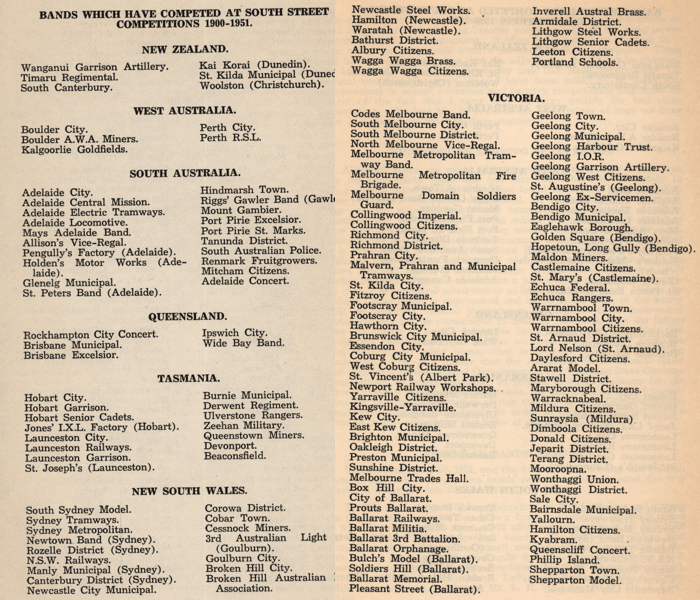
A small excerpt of one of the lists has been displayed earlier in this post.  The way Mullen has compiled these lists is quite logical.  He has started with all the conductors and then listed all the prize winners for every instrument of a brass band.  Interestingly, although South Street never held any solo competitions for Side or Bass Drummers, Mullen lists the bandsmen he considers notable on these instruments.  In the closing pages of the statistics, he lists all of the bands from every State and New Zealand that have participated in South Street over the time frame of this booklet (Mullen, 1951b).  Below are samples of some of the lists, and they are fairly self-explanatory.

19510000_Mullens-South-Street_p19
Excerpt from p. 19, Mullen’s Bandsmen of South Street (1900-1951)”, Bb Cornets. (source: Jeremy de Korte’s personal collection)
19510000_Mullens-South-Street_p41
Excerpt from p. 15, Mullen’s Bandsmen of South Street (1900-1951)”, “Bass (G) Trombone”. (source: Jeremy de Korte’s personal collection)
19510000_Mullens-South-Street_p63-64
Pages 63-64, Mullen’s Bandsmen of South Street (1900-1951)”, “Bands which have competed at South Street Competitions 1900-1951”. (source: Jeremy de Korte’s personal collection)

As we can see above, Mullen clearly had an eye for statistical detail.  No doubt he felt he was doing the band movement service by publishing all of this, and to some extent he was.  This is the only booklet of its kind to emerge from this era.  Nowadays we can access all of these results through the South Street results database and find names in the Trove archive.  Mullen did not have these electronic means, and even though the lists do not include the competition scores and rankings of bandsmen, the lists are still very informative.  Another reason to thank Mullen for his work.

Conclusion:

Mullen has made a great contribution to the history of the band movement in Victoria through his own personal interest, dedication, and knowledge.  In the absence of any other work of this nature, both his booklet and later article provide an overall picture of the band movement.  Yes, his opinions were controversial when viewed in a new light.  However, I feel he meant well, and I also feel that Mullen’s work on the history of the band movement needs to be more widely known.

References:

Baton. (1951). South Street band competitions have achieved world wide fame. In Mullen’s Bandsmen of South Street (1900-1951) (pp. 5-6). Horticultural Press. 

THE EDITOR’S BATON: Bringing up the boy to the band. (1929). The Australasian Band and Orchestra News, XXV(2), 1 & 3.

Hay, R. (2010). Cec Mullen, Tom Willis and the search for early Geelong football. The Yorker, Spring(42), 3-5. 

Mullen, C. C. (1937, 17 December). Sport in Schools. Argus (Melbourne, Vic. : 1848 – 1957), 10. http://nla.gov.au/nla.news-article11133645

Mullen, C. C. (1940, 16 July). Voluntary Service. Age (Melbourne, Vic. : 1854 – 1954), 6. http://nla.gov.au/nla.news-article204409992

Mullen, C. C. (1946, 08 January). NORTHERN TRAMWAY ROUTES. Argus (Melbourne, Vic. : 1848 – 1957), 5. http://nla.gov.au/nla.news-article22221100

Mullen, C. C. (1947, 18 December). School Holidays. Herald (Melbourne, Vic. : 1861 – 1954), 15. http://nla.gov.au/nla.news-article243844022

Mullen, C. C. (1951a, 13 January). Goldfields Brass Bands : To the Editor. Kalgoorlie Miner (WA : 1895 – 1954), 2. http://nla.gov.au/nla.news-article256809482

Mullen, C. C. (1951b). Mullen’s Bandsmen of South Street (1900-1951). Horticultural Press. 

Mullen, C. C. (1952a, 03 January). LETTERS (in a nutshell) : Too old. Argus (Melbourne, Vic. : 1848 – 1957), 6. http://nla.gov.au/nla.news-article23155399

Mullen, C. C. (1952b, 03 January). Youth in the Wrong Jobs. Age (Melbourne, Vic. : 1854 – 1954), 2. http://nla.gov.au/nla.news-article204978021

Mullen, C. C. (1965). Brass bands have played a prominent part in the history of Victoria. The Victorian Historical Magazine, XXXVI(1), 30-47. 

Mullen, C. C. (1983). This is the last will and testament of me…. In Wills and Probates (Vol. VPRS7591/P9 Unit 22). North Melbourne, Victoria: Public Record Office Victoria.

Richmond Boys’ Club : Fine Work by C. C. Mullen. (1932, 17 December). Sporting Globe (Melbourne, Vic. : 1922 – 1954), 4. http://nla.gov.au/nla.news-article189122433

Royal South Street Society. (1958, 25 October). 1958-10-25 Brass Band Contests. Royal South Street Society. Retrieved 27 January 2020 from https://results.royalsouthstreet.com.au/results/1958-10-25-brass-band-contests

Royal South Street Society. (1959, 23 October). 1959-10-23 Brass Band Contests. Royal South Street Society. Retrieved 27 January 2020 from https://results.royalsouthstreet.com.au/results/1959-10-23-brass-band-contests

Royal South Street Society. (1964, 24 October). 1964-10-24 Victorian Brass Band Championship. Royal South Street Society. Retrieved 27 January 2020 from https://results.royalsouthstreet.com.au/results/1964-10-24-victorian-brass-band-championship

Royal South Street Society. (2017). Results. Royal South Street Society (1891-2016). Retrieved 13 October 2017 from https://results.royalsouthstreet.com.au

Ruddell, T. (2010). Introducing Cec Mullen: pioneer sports historian. The Yorker, Spring(42), 2.