Portrait of Braidwood Brass Band, 1914 (Source: National Library of Australia: nla.obj-137072166)
Introduction:
Canberra is a unique city as it was fully planned and designed wholly to house the seat of Federal Government in Australia. By Australian standards, it is also a very young city having only been in existence just over a century. It stands to reason that any artistic groups that are located in Canberra are also very young.
Having visited Canberra recently, I did some thinking about the other bands that most likely existed in towns around Canberra, and then it was a matter of finding them. After visiting local libraries, it surprised me that there is not more history on these groups. However, some historical snippets clearly exist. It is a matter of putting them all into place.
The purpose of this post is not to redo the history of the Canberra City Band as there is already an excellent history of the band, Mr. Chifley’s Baby: The Canberra City Band written by William Hoffman OAM and John Sharpe. Rather, this post will provide an overall view of banding in this area of New South Wales and the ACT with the aim of showing the development of the Canberra City Band in context. Around Canberra in the local towns and regional centers, there were a number of brass bands, so the cultural knowledge of brass banding was already in place when the building of Canberra commenced. Interestingly, only some of the other bands seem to have the longevity that the Canberra City Band now holds – perhaps this is a benefit of starting at a later date…?
The Southern Tablelands:
Within this region, as can be seen by the map below, there is the typical layout of country Australia with regional centers, rural towns, and other localities. And then there is Canberra, the seat of the Federal Government and a city in its own right. Quite a few of these towns are famous having gained their reputations for being railway towns, centers of Shires, being near stunning natural geography, or sitting on transport routes and rivers. Nowadays with the main highways bypassing these towns, they are still famous for historical architecture, arts, museums…the list goes on. The railways had their part to play with many towns located on the Main South railway from Sydney – Melbourne via Goulburn and Yass. Or they were located on the line from Goulburn to Bombala that went via Bungendore and Queanbeyan. The only working part of this line is now from Goulburn – Canberra (Gee, 2017). With this proximity to transport, people traveled, and news spread. As populations grew, so did the services and with these settlements came local brass bands.
To place a geographical boundary on this post, the focus stretches from the tiny locality of Nimmitabel in the south to Goulburn and Yass in the north and from Braidwood in the east with Canberra roughly in the center.
The bands start up:
Unfortunately, there are no definitive dates on when some of the band started but we can have a general idea when searching the Trove archive. What is evident, and interesting, is that many local bands appear to have started in the late 1800s. In local papers we see little items about performances and meetings – this gives a general clue. In 1887, the Goulburn Evening Penny Post reports on the second performance of the Gunning Town Band where they marched through town to their band room at the railway station (“GUNNING.,” 1887). The correspondent also notes that any future performances of the band “will tend to greatly relieve the dull monotony of things in general” (“GUNNING.,” 1887). Also in 1887, the first pictures of local town bands start to appear as shown below by this early photo of the Yass Town Band.
Yass Town Band, 1887 (Source: National Library of Australia: nla.obj-140366586)
A report from 1890 in the Goulburn Herald newspaper makes mention of a Goulburn Model Brass Band however no less than six years later a new brass band is formed called the Goulburn District Brass Band (“Goulburn Model Brass Band.,” 1890; “NEW BAND.,” 1896). This new Goulburn band, and another band called the Our Boys Band were noted for playing Christmas Carols around town a years later (“Goulburn Brass Bands.,” 1897). Further south in the town of Queanbeyan, a Goulburn musician by the name of Harry White was reported to be wanting to start a brass band in the town in 1892 (“Brass Band for Queanbeyan.,” 1892). Evidently, when musicians travelled, their services were sought after and in some cases their reputations preceded them.
Coming into the new century there are a few more reports of activities of other local bands. We see there has been a social event to aid the Queanbeyan Fire Brigade Band in 1902 and in 1904 the Bungendore Brass band has been out and about (“BUNGENDORE,” 1904; “Social.,” 1902). 1904 was obviously a good year for bands as a correspondent reported on the creation of a Nimitybelle District Brass Band (“NIMITYBELLE DISTRICT BRASS BAND.,” 1904). The town of Nimmitabel (as it is now known) lies to the south of Cooma on the road to Bombala and although the band was not very big, it obviously elicited a sense of town pride. The picture below shows the Nimitybelle District Brass Band in 1910. Of interest is an article from 1904 reporting on efforts to hold a band contest in Goulburn with the endorsement of the NSW Band Association (“BAND AND MUSICAL CONTESTS.,” 1904). From reading the article we can see that it was going to be a very proper contest with test pieces, a set march, and monetary prizes.
Nimitybelle District Brass Band, 1910 (Source: Monaro Pioneers: 201910)
The bands of the region acted as formally as possible as these rules from the Bungendore Brass Band tell us (“BUNGENDORE BAND RULES.,” 1912). However, it seems that something had happened to the nearby Queanbeyan Band as they had to hold a meeting to try to get it restarted in 1914 (“QUEANBEYAN BRASS BAND RESUSCITATED.,” 1914). This meeting had a successful outcome regarding the reformation of the Queanbeyan Brass Band and as can be read, a new bandmaster was appointed, and old instruments and musicians called back into rehearsals.
In 1913 the construction of Canberra commenced which meant that towns on the railway line became very busy places handling the transhipment of materials and workers (Gee, 2017; Hoffmann OAM & Sharpe, 2013). And while the other brass bands in many little towns and regional centres had already established themselves, Canberra’s band was about to get started.
First Bungendore Brass Band, 1904 (Source: Canberra and District Historical Society: 14872)
Canberra City Band:
It was not until 1925 that we first see a report outlining the formation of a brass band in Canberra with a set of instruments donated by the Lord Mayor of Melbourne (“CANBERRA’S FIRST BRASS BAND.,” 1925). The reason for forming a band was mainly out of concern for the welfare of the workers, and to give them something to do in their down time (Hoffmann OAM & Sharpe, 2013). Indeed, as Hoffman OAM & Sharpe write of the first musicians,
The strength of the brass band movement throughout Australia at that time meant there was no difficulty in finding sufficient players of reasonable competence among the workmen in the city. Rehearsals were held in the Acton Community Hall.
(Hoffmann OAM & Sharpe, 2013, p. 3)
In a sense, the reasoning for forming a band is not at all different from the many industry bands that have been created for the benefit of workers. Some months after the first article was written, the Canberra Community News published an article on the progress of the new band.
The Band has commenced practice, and residents at Acton, it is understood, live only for Monday and Wednesday evenings, when Bandmaster McGuiness knocks the Band into shape with a view to its first public appearance, which is fixed for an early date. Mac. is indeed zealous in the Band rooms, and is so intensely interested that it requires all the persuasive powers of Bob Ellis and others to inveigle him into the ‘bus at the end of the evening. Transportation to and from practices organised by the Commission is working satisfactorily. It is some undertaking to assemble 20 bandsmen from the scattered suburbs of the City.
It should be noted that in the early days of Canberra, the Federal Commission ran buses to and from various activities so that residents and workers could travel easily (Ling, 2013).
A year later in 1926 the Canberra City Band gained a committee of management to steer the band and it’s written that the band has already presented a number of performances (“CANBERRA BRASS BAND’S CAREER.,” 1926). However, as can be seen in the article, the band had just appointed its second Bandmaster in just its second year of operation (“CANBERRA BRASS BAND’S CAREER.,” 1926). It should be noted that in the band’s first eleven years of operation before it went into recess in 1937, the band went through six Bandmasters (Hoffmann OAM & Sharpe, 2013).
Unlike many of the other brass bands around the region, of which the history is harder to find, the Canberra City Band came out of recess in 1947 with William Hoffman OAM as its conductor, of whom conducted the band until 1976 (Hoffmann OAM & Sharpe, 2013). The Canberra City Band survives to this day as a highly successful ensemble.
Conclusion:
The development of the Canberra City Band could be described as fortunate timing or circumstance. Either way, the city Commissioners recognised that there was a place for a band in Canberra and took advantage of the fact that a culture of brass bands was well-established in many other parts of Australia. As well as this there was the wider development of brass bands in the towns around Canberra in the preceding years which no doubt helped contribute to the development of musicians and conductors. History will tell that the region had a strong banding culture and it is through the early photos and articles that we can see the musical and community life of the region as it once was.
Joe Lyon, Canberra City Band Drummer from 1925 – 1937 (Source: Canberra and District Historical Society: 13842)
If we were to undertake an examination of all the aspects that make community bands what they are, and look back over a century, we would probably find that there is much that is similar. In fact, there is not much that has changed at all, except that bands are increasingly adapting to changes in technology when it comes to obtaining the necessities. Our methods of finding sheet music have focused on online searches – we can listen to the music and make discerning choices and music can be purchased, downloaded, and printed within hours. Regarding instruments, some bands still maintain stocks although many musicians own their own. Where technology has not really intruded is around uniforms, except for the manufacturing. This is the concern of band committees who must ensure they have the necessary items for a band while maintaining a workable budget.
Change is inevitable. One wonders what the bands of old would have made of all the choice we have now.
This post will display advertisements from various firms advertising their products. They were published in a 1919 edition of the Australian Band News and this style of advertisement was quite common. Again, this kind of advertising would be very familiar to the modern bands’ person. Although this kind of banding news is not so common currently, we do have advertising in programs for the National Band Championships for example.
The purpose of this post will be to look back in history and view this from a different light where technology was very different, retailers were somewhat aggressive in the way they did things, and an amount of items were supplied in bulk. There will be issues of competition between local manufacturers and big retailers who supplied imports. We shall see how bands enlisted a whole town to fund them to buy new uniforms as these were a measure of the band and town pride. Regarding sheet music, the bands couldn’t buy just one piece as an amount of music was published in albums. Bands were much more numerous back then and retailers had to keep up with demand.
There is no definitive list of just how many bands were started. However, through running searches in the Trove archive one can see that there was any number of bands. It is not an accident that there were initially so many; Australia (and New Zealand) were mainly settled by immigrants from the United Kingdom these immigrants brought the brass band culture with them (Bythell, 2000). Indeed, as Bythell (2000) writes,
Whether large of small, these new urban communities in the antipodes quickly replicated both the physical forms and social institutions familiar in Victorian and Edwardian Britain. It is not surprising that so quintessentially Victorian an institution as the brass band should have been prominent among them.
(p. 218)
For some, this might be a trip down memory lane. For others, seeing the old advertisements might bring a sense of wonder. Whatever you might think, the necessities were as important back then as they are now.
(Source: Australian Band News, 12(10), 26/06/1919, p. 4)
Instruments to play:
Queensland Times, Ipswich Herald and General Advertiser, 01/07/1905, p. 11
A band is not a band without instruments and in the early 1900s, many new bands were busy equipping themselves with whole sets of instruments. With the bands came the industry to support them with many music retailers as they realized that the bands were business opportunities (Evans, 2013). As can be seen below in this 1896 advertisement found in the Sydney Morning Herald, there are a number of retailers listed, including a manufacturer who was based in Australia, John York Jnr. (“Advertising,” 1896). Some music retailers enlisted the services of prominent musicians to endorse instruments – and listing the prizes that were won using a particular brand of instruments was a common selling point (Besson, 1919b; Boosey and Co.s, 1919; Myers, 2000). The music retailers worked to build relationships with bands and representatives traveled all over Australia to sell their wares. John York Jnr was one of them and his efforts did not go unnoticed. In 1902 the newly-formed Crokl Brass Band accepted 13 York instruments out of the 15 he sent up to them, although many members of the new band had their own instruments (“Crokl Brass Band.,” 1902). Likewise, the Palings firm, who operated out of Sydney, were famous for supplying whole sets of instruments and the products they sold were enthusiastically written up in various newspapers (“BAND INSTRUMENTS.,” 1889; “BOOSEY’S BAND INSTRUMENTS.,” 1905; “PIANOS & MUSICAL INSTRUMENTS,” 1904). Although, as is seen here, the Queensland Times article from 1905 was more enthused about the presentation of the catalog!
Palings and Allan’s were the agents for many of the brands of brass instruments that were sold in Australia in the early 1900s and beyond. Instruments from the famous British firms of “Boosey, Hawkes, Besson, and Higham” were imported as their factories were “capable of mass production” (Myers, 2000, p. 176). As such, they could be sold at reasonable prices in Australia which matched those from the British markets (Herbert, 2000). Through some research by Evans (2013) into the history of John York Jnr, we can see that Boosey Cornets sold by Palings in 1904 were “approximately £8” each (p. 74). Such was the prices of instruments in these times. Unfortunately, the importation of cheap British made instruments put John York Jnr out of business. Despite York producing instruments of high quality – he was trained at the Higham factory in Manchester – he couldn’t compete with the bigger music retailers (Evans, 2013). Bands made choices according to their requirements and Boosey’s and Besson’s were generally the instruments of choice.
It was not just the local town bands that were benefiting from the business of Palings. In 1914 the 13th Battalion Band, which was still in Sydney at the time, became the beneficiary of a whole set of instruments acquired from Palings by a Miss Margaret Harris and then sent to the Army camp at Rosehill (“BAND INSTRUMENTS.,” 1914). Such donations were not uncommon, and many Battalion bands benefited from individuals donating instruments (“15th BATTALION BAND FUND.,” 1914).
Coming into the 1930s we see that supplying bands with instruments is still a good business for some retailers, in particular, the Palings firm who now had multiple outlets up and down the Eastern coastline. A display of instruments by the Palings Brisbane shop at the Maryborough Band Contest in 1932 was enthusiastically written up in a Maryborough Chronical article (“BAND INSTRUMENTS.,” 1932). Regarding the sales of instruments, bands basically went with the retailer that offered the best prices. In 1932 the Lismore Brass Band was trying to acquire some second-hand instruments for loan through the Defence Force, Allan’s and Palings (“CITIZENS’ BAND,” 1932). From the article, it seems the terms offered by Allans were rejected and the offer from Palings was examined further. The Woodburn Brass Band accepted an offer from Palings in 1932 for a whole new set of instruments as did the Narrabri Band in 1934 (“NEW INSTRUMENTS,” 1932; “NEW INSTRUMENTS,” 1934). However, things did not always go to plan as the Taree Citizens’ Band found out in 1936 when being unable to afford repayments to Palings, found that their instruments were due to be repossessed (“BAND INSTRUMENTS,” 1936). Such is business!
Palings and Allan’s were obviously very helpful to the early brass bands with their sponsorship of competitions and the advertisements swayed some bands to seek them out. No matter how we might view their business tactics, one cannot discount the fact that in the early days, the instruments were supplied when the bands needed them.
(Source: Australian Band News, 12(10), 26/06/1919, p. 18)
Music to read:
(Source: Australian Band News, 12(10), 26/06/1919, p. 15)
In some respects, the supply of band music was very much linked to that of instruments as the bigger retailers also supplied sheet music to bands. This was also the time of some very famous brass band composers such as Thomas Edward Bulch who not only conducted bands but wrote for them as well (Friends of the Wizard and Typhoon, 2016b; Pattie, 2010). Not much is written about the publishing of band music in newspapers, but there were numerous advertisements for sheet music in publications such as The Australian Band News. To the right, and below these paragraphs are some advertisements from 1919 for sheet music, albums of band music and instruments tutors.
In addition to bands obtaining music from albums (or march cards), there were some people within bands who wrote and/or arranged their own music. Certainly, Thomas Bulch was one of them, and his advertisement is below. Bulch conducted his own band in Ballarat for a number of years – the “Bulch’s Model Brass Band” (Pattie, 2010, pp. 5-12) which later became the Ballarat City Band. He also wrote an amount of music, sometimes under his own name, but also using pseudonyms (Friends of the Wizard and Typhoon, 2016b). Bulch worked for himself but at times also worked for Allan’s and Palings as an editor and contributor of music. A list of his compositions compiled by the excellent Friends of the Wizard and Typhoon website can be found here (Friends of the Wizard and Typhoon, 2016a). In a similar way, Robert McAnally, the second conductor of the Malvern and Prahran Tramways Employees Band, also penned up numerous arrangements of existing orchestral works which the current iteration of the band still holds in its library (Stonnington City Brass, 2018).
It is fortunate that many bands are able to play this older music today as much of it has survived in band libraries. And that there are old catalogs to look at and admire. The composers and publishers have left the current bands a legacy of music to keep hold of and hopefully play again.
(Source: Australian Band News, 12(10), 26/06/1919, p. 16)
(Source: Australian Band News, 12(10), 26/06/1919, p. 9)
Uniforms to wear:
There is no doubt that the old bands wore their uniforms with pride and much has been written about these bands obtaining new uniforms. From the metropolitan bands to tiny country bands, in the early decades of the 1900s, supplying a band with a uniform drew the interest of whole towns and local councils. A look through photos on The Internet Bandsman Everything Within website shows a huge variety of uniforms and their changes over the years (The Internet Bandsman, n.d.). Being a properly dressed band is one tradition that modern bands adhere to.
There is a common thread of funding running through articles on bands and uniforms. In 1905 a bizarre was to be held in the Corowa School of Arts with the aim of funding new uniforms for the Corowa Band (“BRASS BAND UNIFORM.,” 1905). Over in Western Australia, the Katanning Brass Band accepted tenders for their uniforms in 1922 and in 1927 the nearby Gnowangerup District Brass Band decided to look at obtaining uniforms (“Gnowangerup District Brass Band.,” 1927; “Katanning Brass Band,” 1922). The Carnegie Junior Brass Band in Melbourne also decided to raise funds for uniforms by holding a bazaar while the Fitzroy City Council, in a show of support for their local band, calls for tenders for new uniforms (“Carnegie Junior Brass Band.,” 1936; “New Uniforms for Band.,” 1937). Meanwhile, the Salvation Army, as can be seen by the advertisement below, offers its tailoring services to create uniforms for any band that wanted them.
Uniforms were a whole different kind of necessity yet brought about great pride to the bands and their towns. It’s no wonder that whole communities supported their bands with these important items.
(Source: Australian Band News, 12(10), 26/06/1919, p. 1)
Conclusion:
There is probably much more to be explored regarding instruments, sheet music and uniforms as researching each item brings up more stories. They are part of a much larger story of the band movement in this country, uniquely so. The fact that the purchase of instruments and production of uniforms made the local papers tells us that the bands (and local communities) saw these as important and newsworthy. It is important that we recognise the lengths that bands went to obtain what they needed.
(Source: Australian Band News, 12(10), 26/06/1919, p. 5)
Bulch & Co. (1919). Bulch’s Brass Band Journal [Advertisement]. The Australian Band News, 12(10), 9.
Bythell, D. (2000). The Brass Band in the Antipodes : The Transplantation of British Popular Culture. In T. Herbert (Ed.), The British brass band : a musical and social history (pp. 217-244). Clarendon Press ; New York : Oxford University Press.
Crokl Brass Band. (1902, 23 JuCrokl Brass Band. (1902, 23 July). Manning River Times and Advocate for the Northern Coast Districts of New South Wales (Taree, NSW : 1898 – 1954), 2. http://nla.gov.au/nla.news-article172469392
Evans, A. (2013). Playing on: John York and the Sydney Brass Musical Instrument Factor. Sydney Journal, 4(1), 66-85.
Herbert, T. (2000). Appendix 1 : Prices of Brass Band Instruments Extracted from Manufacturers’ Advertising Material. In T. Herbert (Ed.), The British brass band : a musical and social history (pp. 306-311). Clarendon Press ; New York : Oxford University Press.
Lyons. (1919). Brass Band Instrument Repairing [Advertisement]. The Australian Band News, 12(10), 5.
Myers, A. (2000). Instruments and Instrumentation of British Brass Bands. In T. Herbert (Ed.), The British brass band : a musical and social history (pp. 155-186). Clarendon Press ; New York : Oxford University Press.
NEW INSTRUMENTS : For Narrabri Band : Palings Make Offer. (1934, 26 July). North Western Courier (Narrabri, NSW : 1913 – 1955), 1. http://nla.gov.au/nla.news-article133254083
Pattie, R. (2010). The history of the City of Ballarat Municipal Brass Band 1900-2010 : one hundred and ten years of music to the citizens of Ballarat (Rev. ed.). City of Ballarat Municipal Brass Band.
PIANOS & MUSICAL INSTRUMENTS : Messrs. W. H. Paling and Co., LTD. (1904, 14 December). Newcastle Morning Herald and Miners’ Advocate (NSW : 1876 – 1954), 7. http://nla.gov.au/nla.news-article136387117
The Internet Bandsman. (n.d.). Vintage Brass Band Pictures : Australia. The Internet Bandsman Everything Within. Retrieved 30 April 2018 from http://www.ibew.org.uk/vbbp-oz.htm
The Salvation Army. (1919). The Salvation Army Tailoring Department [Advertisement]. The Australian Band News, 12(10), 1.
If one were to read various articles or histories of brass bands or view photos from a period from 1900-1950s, they would notice an almost total lack of material relating to women playing brass instruments. This is not to say that women were not involved in brass banding with the many women’s’ auxiliaries supporting bands. However, when women did play brass instruments it was reported very differently to male brass bands. It did not help matters that some articles from newspapers were patronizing in tone and that female brass bands when they were formed, were treated as a novelty – until they started playing!
It was a different time, and in the period from 1900 to the 1950s society was in almost constant upheaval with two world wars and the Great Depression to contend with. However, people craved things that were familiar to them so in some cases where male brass bands were not available, a female brass band was formed. The Salvation Army was at the forefront of female brass bands but even their bands were treated as a novelty. What is evident from the research is that there were pockets where female brass bands were welcomed, but in other quarters attitudes were hard to shake.
This is an aspect of Australian band history that is probably not well known, however, it is important to recognize the fact that while female brass bands were rare, they certainly made their mark and paved the way for more females to join bands in the latter half of the last century. The story here will cover some of the more notable female brass bands that were formed, and some personalities. Yes, there was some underlying sexism, and this will be touched on – we wonder at these attitudes today. These historical pictures and articles tell an amazing story of life and from this, we can see the achievements of female band musicians.
Unfortunately, there appears to be no definitive list of female brass bands in Australia. However, due to the rarity of female brass bands, others have attempted to create a listing and the list by Gavin Holman has included the more notable Australian female bands (Holman, 2018). Hopefully soon, a more substantial list will be produced.
Photograph of the Streaky Bay Ladies’ Brass Band, 1933 (source: State Library of South Australia: PRG+1555/2/1)
The Salvation Army has always been well-known for the quality and musical standard of their brass bands, and this reputation has stretched back for many decades. So it was near the start of the 1900’s that the Salvation Army, having run male brass bands for many years, started a female brass band and it is from this decision that the Daily Telegraph publishes an article in 1905 with a patronizing headline (“AN AMAZON BRASS BAND.,” 1905). This is but one early example where the formation of a female brass band is treated as a novelty, despite being formed by the Salvation Army. As can be read in the article, part of it focuses on the uniforms the members will be wearing, but nothing on the women playing instruments.
This band was taken on tour and is used as a demonstration band in various towns and cities. On the 8th of February 1906, the Barrier Miner newspaper covers the visit of the “Austral Brass Band” to town and the article is a perfect display of attitude giving way to admiration (“THE AUSTRAL BRASS BAND.,” 1906). As the reporter has written,
Some curiosity has been aroused by the advent in Broken Hill of a ladies’ brass band having for its name “The Austral” and being comprised of 21 lady performers dressed in Salvation Army costume. As these bandswomen took the tram to the southern suburb last night, many observers speculated on what their bright faces must suffer when puffed up at the end of a bass instrument or when trying to sustain a long passage on the cornet. … From the opening number it was easy to see that the Austral Band is one that is worth listening to. The bandswomen do not stand when rendering a selection, but are seated in four rows, and seem to exert themselves no more than is absolutely necessary. The effect of the music in the piano passages is much sweeter and less masculine than a men’s band, while the forte portions of the selections are surprising in their volume of sound. The attention to time and harmony which was evinced in last night’s performance discloses the long training which the Austral Band must have been through under a good master.”
Very much an article of two halves and the language is varied. Unfortunately, the perception that females should not be playing brass instruments due to the aesthetics of playing is one that is published occasionally, as will be seen in a later article.
Salvation Army “Austral Lasses” Band, 1906 (Source: IBEW)
The Salvation Army did not give up in its operation of female brass bands. The photograph below shows the Melbourne Ladies’ Salvation Army Band in 1945.
Melbourne Ladies’ Salvation Army Band, 1945 (Source: IBEW)
Around the States, but mainly in South Australia:
The formation of female brass bands was not consistent across Australia and it is evident that in some States the idea of female brass bands was not supported. Nevertheless, it is interesting to note where they formed (and which bands they were). Holman (2018) has listed these bands as having existed in the time period from 1900-1950:
New South Wales:
Queensland:
South Australia:
Silver City Ladies’ Brass Band
Brisbane Ladies Coronation Brass Band
Burra Cheer-up Girls Brass Band
Sydney Ladies Brass Band
Clare Girls’ Band
Largs Orphanage Girls’ Brass Band
Streaky Bay Ladies’ Brass Band
(p. 71-73)
As can be seen, by this list, South Australia had a number of female brass bands during this time and as Holman has written that this was mainly due to bandsmen enlisting in the armed services for WWI, and the women stepped forward to form bands (Holman, 2018). Certainly, this was the case for the bands from the towns of Burra and Clare (Sara, 2014). The Streaky Bay Ladies’ Brass Band was formed in 1919 and built themselves up over many years (“A LADIES’ BRASS BAND.,” 1919). The Largs Orphanage Girls’ Brass Band is interesting as it was obviously formed in the same manner as other orphanage bands, although by looking at the photo in their article they included woodwinds as well (“WEEK’S PICTURES,” 1923). The playing from this orphanage band was well regarded and appreciated (“THE BRIGHTON CONTINENTAL.,” 1922). The photos below attest to the presentation and demeanor of these ensembles.
Both New South Wales and Queensland had female bands, but these were formed much later than the bands in South Australia, although obviously, the Salvation Army female band is an exception. The Silver City Ladies’ Brass Band was formed in Broken Hill in 1940 and the Brisbane Ladies band was formed around the same time (“Concert To Mark Formation Of Women’s Brass Band In City,” 1940; Holman, 2018). On a side note, it is the idea of a female band forming in Brisbane that brought out another bout of sexist (and instrumentalist?) behavior in the media with the publication of a letter in a local newspaper in 1934 (Incredulous, 1934). As can be read in the letter, the language says it all and mirrors that of the writing from 1906 – old attitudes don’t seem to go away. In later years, as mentioned in a previous blog post, a girls’ brass band was started at Balranald High School and a picture of them is in this article from 1949 (de Korte, 2018; “GIRLS and a BRASS BAND,” 1949).
The story of the Sydney Ladies’ Brass band will be brought up later in this post as it has a special story which is interlinked with a story from Victoria.
Victoria has long been regarded as a centre of bands however when it came to female bands there was a distinct lack numbers. But all was not lost as it appears that in Victoria, one of the earliest female brass bands in Australia was formed. Pictured above is the female brass band that was formed for a performance at the 1907 ‘Women at Work’ exhibition (“LITERATURE,” 1907). This band was made up of female music students who attended the Melbourne Conservatorium and Melba Conservatorium and were believed to be mostly singers and pianists. Training in the art of playing brass instruments was undertaken over many months (“Ladies’ Brass Band,” 1907). A further article was published in the Weekly Times newspaper which pictured each musician individually (“THE LADIES BRASS BAND IN CONNECTION WITH THE FORTHCOMING EXHIBITION,” 1907).
Further research shows that there was a proposal for starting a female brass band in 1937, which is late compared to development of more female brass bands in South Australia (“LADIES’ BAND PROPOSED,” 1937). One could perhaps view this as bandsmen conservatism. However, in amongst this came the remarkable story of Hilda Tansey who eventually became Australia’s first recognised female band conductor (Bound for Australia, 2014).
The cited blog post outlines much of Hilda’s life in brass banding. In summary, Hilda learned brass from her father and traveled with her father around Victoria (Bound for Australia, 2014). Her father (who was a noted bandsman in his own right) eventually became the bandmaster of the Traralgon Brass Band and it is here where we first see a picture of Hilda with her Tenor Horn sitting in amongst the other band members (see below) (Bound for Australia, 2014). This was obviously an extreme rarity in Victorian banding to have a young female playing brass in a proper brass band. Yet soon after this photo was taken, Hilda is listed as a member of the Traralgon soloists that were entered in the A.N.A competition (Melbourne) in 1917 (“Bandsmen to Compete at A.N.A Competitions.,” 1917). Hilda’s career in bands progressed from this time.
The Sydney Ladies’ band deserves special mention for being the most well-known of all female brass bands in Australia, and even more so after Hilda was appointed conductor in 1934 (Bound for Australia, 2014; Holman, 2018). Again, much has been written about the Sydney Ladies’ Band by Holman and the Bound for Australia blog post, so this is a summary of the life of the band. The band was formed in 1930 but had early financial difficulties however Hilda and other ladies took it over in 1934 and had the debt repaid through member contributions, paid engagements and social functions (Holman, 2018).
The band was quite busy in Sydney and participated in numerous parades and other events (Bound for Australia, 2014). In 1936 the band broke even more ground by becoming the first female brass band to enter the City of Sydney Interstate Band Contest in the Open D Grade section against eight male brass bands (“WOMEN’S BAND,” 1936). During the years of WW2 the band was involved in entertaining troops at various camps, however, later in the war years “the R.S.L. refused to let the band march on ANZAC Day 1945, and this was a contributing factor to the members’ decision to disband.” (Holman, 2018, p. 73). As for Hilda Tansey, she kept up with her brass band activities and is seen in a picture from the 1960s playing with the Randwick District Town Band (Bound for Australia, 2015). A further blog post on the demeanour of brass band members makes mention of the unique behaviour expectations that governed the Sydney Ladies’ Band (de Korte, 2021).
Sydney Ladies’ Band, 1934 (Source: State Library Victoria: pi007746)
Family & Soloists:
Postcard: Miss Ruby Correct, 1909 (Source: Jeremy de Korte Collection)
It would be remiss to forget some of our many other female brass musicians from this early era as they too made small contributions to the band movement. One such musician was Miss Ruby Corrick, a member of the famous “Marvellous Corricks” family entertainment group which consisted of seven siblings and parents of which all were superb musicians (Lewis, 2007). The Corrick family hailed from New Zealand and travelled widely with their musical shows, including all around Australia. Miss Ruby played the Cornet and Mellophone and although she never competed in brass band competitions, in some quarters she was regarded as a “champion” of her instrument (“Miss Ruby Corrick,” 1907). This is not to say she did not have some exposure to brass bands. In 1906 she appeared in a concert with the Broken Hill A.N.A. brass band as a soloist and in a duet accompanied by the band (“BAND CONCERTS.,” 1906).
Conclusion:
Against some odds, there were female brass bands in Australia and these bands, for the brief time they were in existence, made their mark and gained favorable reputations. It is unfortunate these bands did not survive; however, it is shown that their legacy lives on. Who is to say if they were ahead of their time as some bands were started out of a social necessity, whereas other bands were started as recreation and training for women and girls.
We can look back at those times and wonder what it was like and thankfully there are the articles and photos that allow us to do that. We can also look back and wonder at the attitudes and language from some quarters where they felt that women should not play brass instruments due to aesthetics! Nevertheless, where there was a will, there was a way as Hilda Tansey clearly demonstrated with the Sydney Ladies’ Band.
I hope that the history of female brass bands becomes better known in Australia instead of the patchwork of little histories. In amongst all the other histories of banding in this country, this is one of the special stories.
Bound for Australia. (2014, 29 November). Hilda and the Sydney Ladies’ Brass Band. Bound for Australia: Stories from the families of those brave ancestors who made the sea voyage to Australia. https://boundforoz.wordpress.com/2014/11/29/1779/
Brisbane Ladies Coronation Brass and Reed Band. (1940). [Photograph]. [phot15753]. The Internet Bandsman Everything Within, Vintage Brass Band Pictures : Australia. http://www.ibew.org.uk/vbbp-oz.html
Burra Cheer-up Ladies Band. (1918). [Photograph]. [phot16239]. The Internet Bandsman Everything Within, Vintage Brass Band Pictures : Australia. http://www.ibew.org.uk/vbbp-oz.html
Clare Girls’ Band. (1914). [Photograph]. [phot3428]. The Internet Bandsman Everything Within, Vintage Brass Band Pictures : Australia. http://www.ibew.org.uk/vbbp-oz.html
Concert To Mark Formation Of Women’s Brass Band In City. (1940, 08 March). Barrier Miner (Broken Hill, NSW : 1888 – 1954), 2. http://nla.gov.au/nla.news-article48343327
THE LADIES BRASS BAND IN CONNECTION WITH THE FORTHCOMING EXHIBITION. (1907, 14 September). Weekly Times (Melbourne, Vic. : 1869 – 1954), 28. http://nla.gov.au/nla.news-article221263851
Melbourne Ladies’ Salvation Army Band. (1945). [Photograph]. [phot16298]. The Internet Bandsman Everything Within, Vintage Brass Band Pictures : Australia. http://www.ibew.org.uk/vbbp-oz.html
Miss Ruby Corrick : Champion Lady Cornet Soloist, With “The Corricks”. (1907, 16 April). Kalgoorlie Western Argus (WA : 1896 – 1916), 26. http://nla.gov.au/nla.news-article33087937
Salvation Army “Austral Lasses” Band. (1906). [Photograph]. [phot1877]. The Internet Bandsman Everything Within, Vintage Brass Band Pictures : Australia. http://www.ibew.org.uk/vbbp-oz.html
Silver City Ladies’ Band. (1940). [Photograph]. [phot9302]. The Internet Bandsman Everything Within, Vintage Brass Band Pictures : Australia. http://www.ibew.org.uk/vbbp-oz.html
Sydney Ladies’ Brass Band [picture]. (1934). [1 photographic print on cardboard mount : gelatin silver, hand col. ; 30 x 40 cm.]. [pi007746]. State Library Victoria, Tansey family collection. http://handle.slv.vic.gov.au/10381/336537
Collingwood Technical School Band, 1944 (Source: IBEW)
Introduction:
The formation of bands in State schools, involving part-reading and real ensemble as distinct from a squad of youngsters all playing the single melodic line, affords the boys – and would also afford the girls – an excellent opportunity for a musical education. As they advance in their studies the boys are in all probability invited to practise with the senior bands in their districts. They become bandsmen; they find good occupation in their leisure, their minds are disciplined, and everyone knows that the good bandsman is never a bad citizen.
(“THE EDITOR’S BATON,” 1929, p. 1)
…as stated by the Editor of The Australasian Band and Orchestra News in 1929. The Editor was undoubtedly writing from his point in time. However, the story of Victorian State school bands starts well-before this time and continued on to form a much greater legacy. To understand this story will put the Editor’s words into context. The formation of school brass bands was as much about education as it was about banding and music.
Like their community band counterparts, some Victorian school bands developed remarkable reputations and were involved in occasional controversy. We can see this not only through the newspaper articles of the day but also writings in books from eminent educationalists. Perhaps we can also view their formation as ‘being in the right place and the right time’ as there was a bit of good-luck that led to their widespread creation. Who knows what might have happened if all the pieces of the puzzle had not fallen in place together?
This post will present a brief history of the Victorian State school brass bands as a whole, rather than telling the history of each individual band. The history will show how some of the greatest brass band personalities of the day were involved in training the young and what banding did for some schools. It can also be shown how the reputation of Victorian school bands spread beyond the State and there are even some interesting stories of school brass bands in other states. It is important we recognize the contribution of school brass bands within the fabric of brass banding in this country.
History can be fickle and to try to pin down a definitive start date of school brass bands is difficult, if not impossible. It must be recognized that communication was somewhat difficult in the early 20thCentury across Victoria and news of the efforts of one town might not get heard of in another town. This being said, the schools were not the first institutions to start younger brass bands. Two Orphanages, St Augustine’s in Geelong and St Vincent de Paul in South Melbourne both started brass bands. These brass bands were started in the middle to late 1800s and developed fine reputations as well as achieving ongoing competition success – the St Augustine’s Band was already asking for support for a new set of instruments in 1898 (“ST. AUGUSTINE’S ORPHANAGE BAND.,” 1898). In 1918 a different kind of boys band was started in Richmond and for its short existence became a local, if not very large institution (“Richmond Boys’ Brass Band,” 1918).
The first instances of school brass bands being started come from country areas. In 1913, a meeting was held in the town of Berringa which is south of Ballarat with the aim of forming a school brass band, which they did using the instruments from the defunct Berringa Brass Band (“BERRINGA.,” 1914; “BERRINGA,” 1913). A year later another school brass band was started in Bairnsdale in East Gippsland where they made the claim of being the first in Australia (“State School Band.,” 1914). These were not exactly auspicious starts to school brass bands in Victoria (or Australia) and it wasn’t until the mid-1920’s when a true school brass band movement was started.
The Gillies Bequest:
In 1925, a bequest to the value of £10,000 was made to the Education Department of Victoria from the estate of the late William Gillies (Hansen, 1932). This amount of money was to be dedicated to achieving three purposes:
The encouragement of instrumental music in schools, leading, it was hoped, to the increase of village bands and family orchestras.
The encouragement of the art of reading aloud – with special emphasis on reading aloud in the family circle.
The encouragement of nature study, again with the object of making home life, especially in the country, more attractive.
The Gillies Bequest, as a perpetual fund, was gratefully received by the Education Department and a plan to implement the will was undertaken with teaching representatives (“MUSIC AND READING.,” 1925).
In terms of providing money for instrumental music, the interest arising from the Gillies Bequest was invaluable at the time (and in subsequent years). It is from this time that the formation of school brass bands (drum & fife bands and school “orchestras”) gathers pace. A picture of the newly formed Northcote Central State School band appeared in The Argus newspaper in August 1926 – and here we see one of these historical discrepancies as it probably was not the first school band (“FIRST STATE SCHOOL BAND AT PRACTICE.,” 1926). In 1928 there is even more activity with the formation of the very famous Hyde Street school band, the West Preston School Band and discussions are held regarding the formation of a band for the Prahran Technical School (Hyde Street Youth Band, 2015; “Junior Brass Band for Prahran.,” 1928; “WEST PRESTON SCHOOL BAND.,” 1928). Unfortunately, it is unclear just how many bands are formed during this initial time.
The formation of school brass bands drew some interest from the wider band movement hence the editorial in The Australasian Band and Orchestra News in 1929. It is easy to see where the Editor is coming from; he writes as an observer and passionate advocate for brass bands and training the young. However, the language is opinionated and somewhat inflammatory and, in some cases, he misrepresents the facts. Part of the opening paragraph is a perfect example:
Signs have not been wanting that the promulgation of the brass bands movement in the State schools of New South Wales, Victoria, and elsewhere in Australia is rather resented by some of the headmasters and passively regarded by many of the others. Various complaints have come from certain localities in which suggestions for State schools bands, made in zealous good faith by bandmasters willing to do the lion’s share of the work, have been coldly shouldered off by the men who should have been first to welcome them.
(“THE EDITOR’S BATON,” 1929, p. 1)
Probably not the best idea to insult school headmasters if you want them to build band programs in their schools. The Editor goes on in his editorial to wax lyrical about the problems of headmasters – this takes up much of the first page (“THE EDITOR’S BATON,” 1929). In fact, much of the article is about criticizing the educational ideas and conduct of headmasters, but his concerns about schools finding bandmasters are misplaced. For example, the first bandmaster of the Northcote Central School brass band and the Hyde Street band is none other than Frank “Massa” Johnson, the famous band conductor who was in charge of many other famous bands in Melbourne. (Rasmussen, 2005). The first conductor of the West Preston school band is the bandmaster of the local Preston band (“WEST PRESTON SCHOOL BAND.,” 1928). So not only did the school bands form, they were run by the best bandmasters in the business!
In the next decades, the number and reputation of the school bands expanded, and the first competitions were undertaken. In 1930, the very first competition was held between State school bands in the Exhibition Buildings which involved bands from “Albert Park, Ascot Vale West, Armadale, Coburg East, Coburg West, Footscray, Northcote, Preston West, Princes Hill, and Wonthaggi” (“BAND MUSIC IN SCHOOLS.,” 1930). The contest was attended by the Minister for Education and Director of Education, Mr M. P. H.ansen (“BAND MUSIC IN SCHOOLS.,” 1930). In another boost to the status of the school brass bands, the adjudicator at the next South Street Eisteddfod was a very famous bandsman from England, a Dr Cyril Jenkins who was visiting Australia at the time and commented on the quality of the school bands (“JUDGE PRAISES SCHOOL BRASS BAND.,” 1930; see also “NOTED MUSICIAN.,” 1931).
In 1932 a book was published by the then Director of Education, Mr M. P. Hansen titled Thoughts that Breathe. In this wide-ranging and progressive book (for its time), Mr. Hansen covers all manner of educational theory including advocating for more clubs and associations in schools, of which he devotes a whole chapter to this subject (Hansen, 1932). More importantly, Mr. Hansen comes across as a strong and measured advocate for school music programs and he details, as a result of the Gillies Bequest, just how far Victorian ensemble programs have grown. By 1932 in Victorian schools there are, “31 brass bands, 9 orchestras, 13 fife bands and 23 violin classes” (Hansen, 1932, p. 79). This is quite remarkable growth. By 1937 the number of school brass bands has apparently risen to 50 in Victoria and 20 in New South Wales (“BANDS IN VICTORIA,” 1937).
The reputation of school bands is also growing during this time and in 1936 the Princes Hill school band goes on a tour to Adelaide (“PRINCES HILL STATE SCHOOL.,” 1936). The touring band is greeted with much interest and the bandmaster of Princes Hill was invited to speak on the benefits of forming school brass bands, which, Adelaide apparently didn’t have at the time (“SCHOOL BANDS IN ADELAIDE,” 1936). Reputations are also growing through competition success. The Hyde Street school band in particular is noted for a runs of multiple competition successes from 1931 – 1966 (“AROUND THE SCHOOLS: THE ARGUS JUNIOR,” 1947; Hyde Street Youth Band, 2015). The school brass bands had their own association running competitions – the Victorian State Schools Band Association and competitions specific sections for school bands were run at the South Street Eisteddfod in Ballarat (Royal South Street Society, 2017). In one instance, a competition was run at the Zoo (“SCHOOL BAND CONTEST,” 1939).
School brass band competitions, like those in the senior band world, were not always without controversy and in a noted competition in 1950 a protest was registered by the Hyde Street school band against the band from East Kew alleging that East Kew Victorian Bands’ League registered musicians in their group (“School to lose band award?,” 1950). Obviously, there was this stigma, and the perception that school-age musicians who also played in VBL bands were of a higher standard.
The musicians of the state school bands progressed on their instruments and many of them joined community bands in their localities. As detailed in an article from 1937,
The Department of Education is utilising a substantial portion of the income from this bequest for the promotion of school boy bands, and these are already becoming first-class recruiting grounds for senior bands. Footscray City Band at present includes in its membership 22 former players of the Hyde-street (Footscray) school, which has been champion school band for several years past. Recently a band has been formed at East Kew (the East Kew Junior Band) to enable boys from the East Kew school band to continue their musical activities after leaving school. It is composed almost wholly of boys from the school band.
Unfortunately, in some areas, the local band ceased to operate, but this sometimes proved a benefit to local schools who were the beneficiaries of their instruments. Such is the case in Cranbourne where in 1940 where the local band ceased to function and handed all of its instruments to the local school and scout group (“Cranbourne,” 1940).
Where were the girls?
When reading about the school bands in past years, the perception, especially in Victoria, is that the school brass bands were only for boys. Certainly, there was no written rule stopping girls from joining but it must be assumed that educationally, it was not something that girls should do, or could possibly be interested in. This was a situation that didn’t change for many years in Victoria. However, over the border in New South Wales, it was very different. We see in an article in 1949 that the Balranald School Band not only had girls participating, but they were regarded as very good musicians too (“GIRLS and a BRASS BAND,” 1949). This might be a rare example, but it shows the different attitudes on display at the time. The issue of gender and instruments is an interesting issue to explore – but might be for another post.
The bands in later years:
Things always change and in the world of school brass bands, this was no different. We know that some school bands survived or evolved. The Hyde Street school band evolved to become Hyde Street Youth Band and out of all the school bands, this one was the only band to survive as a brass band (Hyde Street Youth Band, 2015). Other school music programs evolved to set up new ensembles such as concert bands which included woodwind instruments. It must be assumed that some bands just ceased to exist, and the only memories are from photographs and old school records. There were so many school bands in the 1930’s and 1940’s – it would be interesting to know what happened to some of them.
Conclusion:
The story and history of school bands is fascinating and could probably be better explored through the research of additional records. This being said, the newspapers of the day did detail an amount of history and it’s quite fascinating to see what the bands achieved. Certainly, there were a foundation for senior bands in their local areas and local bandmasters were involved. They were a product of their time and their legacy won’t be forgotten.
AROUND THE SCHOOLS : THE ARGUS JUNIOR State School Band Champions. (1947, 23 September). Argus (Melbourne, Vic. : 1848 – 1957), 6. http://nla.gov.au/nla.news-article22509356
Beechworth School Brass Band. (1931). [Photograph]. [phot9055]. The Internet Bandsman Everything Within, Vintage Brass Band Pictures : Australia. http://www.ibew.org.uk/vbbp-oz.html
Collingwood Technical School Band. (1944). [Photograph]. [phot16017]. The Internet Bandsman Everything Within, Vintage Brass Band Pictures : Australia. http://www.ibew.org.uk/vbbp-oz.html
Cranbourne : Exit Cranboure’s Brass Band : State School and Scouts benefit from sale of instruments. (1940, 10 July). Dandenong Journal (Vic. : 1927 – 1954), 9. http://nla.gov.au/nla.news-article216062113
THE EDITOR’S BATON: Bringing up the boy to the band. (1929). The Australasian Band and Orchestra News, XXV(2), 1 & 3.
Hansen, M. P. (1932). Thoughts that breathe. Robertson & Mullens.
Hyde Street Youth Band. (2015). History : Where did we come from? Hyde Street Youth Band : Established 1928. Retrieved 08 April 2018 from https://hsyb.org.au/about/history-2/
MUSIC AND READING : Bequest for Encouragement : Department’s Grateful Acceptance. (1925, 02 June). Argus (Melbourne, Vic. : 1848 – 1957), 19. http://nla.gov.au/nla.news-article2122677
Northcote School Band, Melbourne. (1937). [Photograph]. [phot9041]. The Internet Bandsman Everything Within, Vintage Brass Band Pictures : Australia. http://www.ibew.org.uk/vbbp-oz.html
NOTED MUSICIAN : Views on Australian choirs : Dr. Cyril Jenkins’s Visit. (1931, 20 January). Sydney Morning Herald (NSW : 1842 – 1954), 8. http://nla.gov.au/nla.news-article16747310
Richmond Boys’ Brass Band to Make Debut at Racecourse Carnival for Blind Soldiers—Amazing Growth of Notable Movement that will Bring Fame to This District. (1918, 12 January). Richmond Guardian (Vic. : 1917 – 1918), 2. http://nla.gov.au/nla.news-article93811136
Source: The Bandsman’s Year Book and Official Programme of the Australian Championship Band Contest. 1938, pg. 50
Introduction:
Although the history and reputation of Victorian banding lies partly with individual bands, the history of the associations that they formed shows Victorian banding in a different light. This post is focused on a period from 1901 to 1933, where, during the development of the various associations and leagues lies a somewhat rancorous battle for the heart and soul of Victorian bands of which was covered in the newspapers of the day and laid out in detail.
The focus of this post is the general history of the Victorian Bands’ Association (V.B.A.) from 1901-1933 and the official formation of the Victorian Bands’ League (V.B.L.) in 1931. Tied into this is the history of various early geographical groupings of bands and the eventual move to form much larger associations. However, with association came division and as will be shown the seeds of division started much earlier than 1931. This is a tale of the Victorian band movment that is probably not well known to most Victorian bands people.
My curiosity has been growing over time as I wondered why there were no records that existed prior to 1931. I knew that the headquarters of the V.B.A. had been in Ballarat, yet whatever records that may have existed were not provided to the V.B.L. When researching for this post the reasons became obvious – they were two entirely separate organisations that wanted little to do with each other.
The research for this article has been informed by involved searching through the Trove archive with the aim of building a chronology of articles and events. With this searching has come some revelations as to the Victorian band movement in the 1900s. This history is important to the band community as it highlights what once was, and how the administrations operated.
1900 – 1920: The V.B.A. and other associations:
1922 Victorian Bands’ Association emblem. (Photograph taken in November 2022 by Jeremy de Korte)
The first seeds of a State association were sown in 1901 when delegates from Geelong and Ballarat brass bands decide to form a “Ballarat and Geelong District Band Association” with the rules of the new association to be presented to a conference of bands at the next South Street competition (“BAND ASSOCIATION.,” 1901). Here we have an association that had been set up based on a small geography, but most importantly developed ties to the South Street competitions which became increasingly important to the band community (Royal South Street Society, 2016). It should be noted that there was already a Geelong Band Association in existence, although this small association broke up after 1908 (“BAND ASSOCIATION.,” 1908). In 1907 it becomes obvious that the V.B.A. is expanding as they had a meeting in Bendigo where discussion took place about lobbying the council to let them use a reserve to hold a band competition with the aim of attracting bands from across Australia (“BANDS ASSOCIATION.,” 1907). This is one of the earliest reports of the V.B.A. promoting competitions in regional areas.
Within other geographical regions, distinct band associations started around the same time although not all of them affiliated with the newly formed V.B.A. In the Melbourne area, a new association called the “Melbourne and Metropolitan Band Association” (M.M.B.A.) was formed in 1906 (or 1907) by twenty-five bands (“MELBOURNE AND METROPOLITAN BAND ASSOCIATION.,” 1907). This new association formed their own rules and constitution with the encouragement of the V.B.A., of which a representative attended the meeting. It is not until a meeting in 1908 that the M.M.B.A. discusses aligning with the V.B.A. and a committee of five is set up to investigate this (“MELBOURNE AND METROPOLITAN BAND ASSOCIATION.,” 1908). In contrast, a new Gippsland Band Association (G.B.A.) started in 1908 and emphatically ruled out associating with the association in Ballarat (“GIPPSLAND BAND ASSOCIATION.,” 1908). It should be noted that while Gippsland bands did eventually join with State band associations, the G.B.A. was still going in 1947 and possibly longer (“Gippsland Bands’ Association,” 1947).
Despite the seemingly good running of the association there are some indications that some bands wanted the headquarters moved from Ballarat for various reasons. In 1917, a letter was sent to the Bendigo Citizens’ Band by the Metropolitan Bands Association proposing a shift of the next meeting of the V.B.A. to Melbourne. This letter was read out at a meeting of the Bendigo Citizens’ Band and the responses were detailed by the Bendigo Independent newspaper in an article.
Correspondence from the Metropolitan Band Association was read, requesting the bands’ support in having the meeting of the Victorian Band Association held in the metropolis instead of at Ballarat. Several members spoke in favour of the Victorian Bands’ Association meeting being continued in Ballarat, as it was only another move to have everything of any importance held in the metropolis. The secretary (Mr. E. K. Varcoe) in commenting on the matter, said it clearly showed that centralisation was at the back of the suggestion, and Melbourne desired everything in Melbourne with the exception of the mice plague…
Obviously, there were a few choice words used at this meeting (by 1917 standards).
The letter was countersigned by representatives of the Fitzroy, South Melbourne, Collingwood, Brunswick, Malvern and St Kilda brass bands and it was sent to all country bands affiliated with the V.B.A. at the time. The Bendigo Citizens’ Band did end up sending a representative to a meeting in Melbourne. Subsequently, in a vote on the matter at a later V.B.A. meeting, the motion to move the V.B.A. headquarters to Melbourne was defeated 23 to 6 (“BANDS’ ASSOCIATION.,” 1917).
If the V.B.A. felt that issues of division from the late 1910s had been placated, the early 1920s showed them otherwise. The Melbourne and Metropolitan Band Association was still in existence and were running their own contests, within the oversight of the V.B.A. In February 1920 they held a series of contests at the Melbourne Cricket Ground (MCG) in conjunction with the R.S.S.I.L.A., Vic. Branch with entries received from 30 bands – one highlight was a challenge contest between the Hawthorn City Band and the Collingwood Citizens’ Band (“METROPOLITAN BAND CONTEST.,” 1920).
Over the next few years however, the V.B.A. found itself dealing with a rival Victorian band association, the Victorian Bands’ League which was formed by a grouping of disgruntled metropolitan bands and apparently some country bands. At a meeting held on the 23rd of May 1921, the new chair of the (first) V.B.L., a Mr. H. G. Johnson stated that,
…one of the objects of the new league was the control of band contests, also the fostering of a better feeling among bands and bandsmen.
…and further in this article we see some further reasoning as to why representatives of these bands had met.
Several speakers expressed dissatisfaction with the way in which the affairs of bands and band contests were at presented being controlled by the Victorian Bands’ Association in Ballarat. Band matters generally could be better managed by having headquarters of the controlling body in Melbourne.
One of the main driving forces behind the new V.B.L. was an official of the M.M.B.A, Mr George S. Tucker. Born in the town of Victorian town of St. Arnaud before moving to Melbourne, he was the son of a bandsman and at the age of eight, joined the Malvern Town Band, then the St. Kilda City Brass Band under conductor Mr. F. C. Johnston, and found his niche in the administrative work of the band movement (Quickstep, 1921). A weekly column in the Herald newspaper from April 1921 penned by “Quickstep” provides an outline of his band career, but it is the opening paragraph that really introduces Mr. Tucker.
The foremost figure in the band world at present moment is George S. Tucker, the hon. secretary of the Melbourne and Metropolitan Band Association. A firm and fearless official, a keen debater, and an acknowledged authority on contesting and administrative matters, he has held office for a record term. Melbourne is recognized as a centre of advanced thought in regard to band politics, and the formation of a new controlling body to be knowns as the Victorian Band League is now receiving attention of the bands. Mr Tucker has been entrusted with the organisation of this new venture.
Perhaps the new league was a little overzealous in the way it announced itself. It is all very well stating that a meeting had been attended by several bands, but it might have helped if the new V.B.L. had sought assurances from the bands themselves that they would be affiliating with the new body. This was revealed at a meeting of the V.B.A. held in June 1921.
A letter was received from the St. Kilda Band Association stating that at a meeting of delegates from several bands in Melbourne in May it was decided to form a new league, and it was opined that this would prove to be a very successful body. It was stated that the Geelong and Coburg bands had agreed to join.
A delegate stated that as far as Geelong and Coburg bands were concerned both had notified their intention of sticking to the V.B.A. The Malvern Band – which band had a delegate at the meeting – said that he was surprised to find himself elected to the league without authority. They were also sticking to the V.B.A.
Nevertheless, the fledging V.B.L. was not to be put off and in early August they announced that they would be holding a massed bands event for a hospital charity at the Exhibition Oval involving 250 bandsmen (“MASSED BANDS PERFORMANCE.,” 1921). Bands were given permission to march from Prince’s Bridge and the Collingwood Band was to march from Collingwood. The massed band was conducted by Mr. F. C. Johnston who was titled as “the Victorian Band League conductor” (“MASSED BANDS PERFORMANCE.,” 1921).
Early in 1922 we can see that the new V.B.L. is holding meetings at a favourite haunt in the form of a café located at the corner of Swanston Street & Queen’s Walk. At a meeting in January, plans were put in place for another “massed bands display on February 12, in aid of the Homeopathic Hospital”. (“BANDSMEN’S GOSSIP,” 1922). Furthermore, it also appears that some bands were reluctant to join the new League, probably because South Street regarded the V.B.A. as the governing body. This statement from the meeting is telling.
Collingwood Citizens’ Band is now affiliated and it is to be hoped that other “A” grade bands will follow.
A meeting of the associations took place in June 1922 when a delegation from the V.B.L., including Mr. Tucker, travelled to Ballarat to meet with the V.B.A. to see if a workable solution to governing and/or amalgamation could be found. The opening paragraph of an article published by the Ballarat Star newspaper provided some background, of which an excerpt is below.
The V.B.L. was originally the Metropolitan Band Association, but enlarged its title and scope in the hope of getting control of brass bands in Victoria. Evidently this ambition has not been realised, as last night the V.B.L. came with a humble request for authority under the V.B.A. constitution to perform certain local functions while subject to the authority and endorsement of the V.B.A.
It is clear in this long article that relations between the V.B.A. and the M.M.B.A. had not been as good as they could be with Mr. H. A. Farrell, President of the V.B.L. calling the bickering between the two associations, at times, “childish” (“BAND CONTROL,” 1922). This article reported in detail the proceedings of this meeting, and for the sake of brevity, will not be fully covered in this post. The discussion was amicable, but the differences were not fully resolved. The main issue was how to manage any confusion between the two associations regarding the running of contests and player registrations (“BAND CONTROL,” 1922). The V.B.A. promised to take this request to a full meeting of the Executive where the answer came in August – the V.B.A. rejected the proposal of admitting the V.B.L. into some form of relationship (“BANDSMEN’S DIFFERENCES,” 1922).
Whatever relationship the two associations had, soured considerably in 1923 when the V.B.L. held a contest in South Melbourne over Easter. Eight bands took part in this contest, these being; “South Richmond, South Melbourne, Nunawading, Preston, Moorabbin, Deep Rock, Caulfield District, and Socialists.” (“EASTER BAND CONTESTS,” 1923). Action from the V.B.A. was swift and punitive in the form of disqualifications and fines. Two bands, Preston Citizens’ Band and the Socialist Party Band were fined £5/5/ and “their bandmasters, conductors, and players be disqualified for three years…” (“CONTROL OF BANDS.,” 1923). Additionally, Mr. James Scarff (Adjudicator) who was registered with the Malvern Tramways Band and Mr. Ivan Hutchinson (Official) of the Footscray Municipal Band were also fined “and disqualified from membership of any associated band for three years…” (“CONTROL OF BANDS.,” 1923).
This action by the V.B.A. obviously did not sit well with the V.B.L. or any of the bands that participated in this contest and a few days later Mr. Henry Hellinger, Bandmaster and Conductor of the Preston Citizens’ Band wrote a scathing letter to the Herald newspaper regarding this punitive action by the V.B.A. – he was not impressed as shown by the middle paragraph of his letter.
In the first place, both of these bands are members of the Victorian Band League, and as such, the interference in their private business by any other association becomes a piece of intolerant impertinence. The Victorian Band League, in organising this contest, open only to members of the Band League, have done something that the so-called Victorian Band Association has never done during its existence. Furthermore, the V.B.A. has never organised a contest. Its headquarters are in a country centre, and it can never be a great success, as the bands connected with it have no direct representation no matter what part of the State the band hails from.
The V.B.L. also acted against the V.B.A. in the form of a resolution which was carried in their June meeting.
At the last meeting of the Victorian Band League a resolution was carried as under: – “That in view of the drastic, and also unconstitutional attitude adopted by the Victorian Band Association with regard to bands and officials who took part in our recent contest held at South Melbourne in future no band affiliated with the Victorian Band League will take part or assist in any way any performance, & c., or assist or organised by any band affiliated with the Victorian Band Association.
The animosity displayed by both associations was hardly conductive to the good administration of bands in Victoria. It might be fair to say that neither association helped themselves here and festering problems did not seem to go away. Early in 1924 it was reported that band secretaries and band members complained that the V.B.A. was not treating competitors at Ballarat and elsewhere fairly and that there was a “movement to reorganise the Victorian Band League.” – of which a special meeting was called of metropolitan bands (“BANDSMEN’S DISCORD,” 1924).
Later in 1924, a much more serious issue occupied a meeting of the V.B.A. in Ballarat when a number of Melbourne based bands wanted to set up a branch of the V.B.A. in Melbourne with the power to conduct the affairs of the V.B.A. as they saw fit (“METROPOLITAN BANDS’ PROPOSAL,” 1924). It seems that the bands listed in this move were not affiliated with the first Victorian Bands’ League, but they did express similar issues and complaints. Now, the V.B.A. was up against the metropolitan bands on two fronts.
A proposal from a number of Metropolitan bands that they should be allowed to form a branch of the Victorian Band Association in Melbourne, which came before the association at its meeting last night, was viewed with suspicion by many of the delegates, who saw in it an attempt to shift the centre of government to the metropolis. The subject was debated at considerable length.
The president (Mr E. Ballhausen) reported that Messrs Frank Johnston (Collingwood bandmaster), Ben J. Warr and Hanson had waited on the executive of the association, with a view to having steps taken to form a branch of the association in Melbourne. The secretary read letters in support of this request from the Kingsville-Yarraville, Footscray, Coburg, Prahran City, Hawthorn City, Turner’s Brunswick, Collingwood, St. Vincent de Paul, Brunswick City, St Kilda City, Newport Workshops, Malvern Tramways and Richmond District Bands. It was suggested by a committee of the bands interested that the branch should be known as the Metropolitan branch of the Victorian Band Association, the branch to consist of all bands within a radius of 25 miles of the G.P.O., Melbourne affiliated with the V.B.A.; the branch to have power to conduct all association business of the branch according to the constitution and rules of the association.
Some of the delegates at the meeting were suspicious of the metropolitan bands’ intentions. A Mr. Hewett of the Soldiers’ Band was quoted as saying,
…the move was only the thin edge of the wedge to shift the headquarters of the association to Melbourne. Some of the bands concerned were sympathetic with the Metropolitan Band League.
Well-might the V.B.A. be annoyed at repeated requests by the metropolitan bands to run themselves and move the headquarters, but the V.B.A. still held sway over the administration of bands in Victoria. Harking back to the events of 1923, the V.B.A. saw fit to rectify some decisions relating to the South Melbourne contest at their July meeting.
“The following disqualifications were removed and the players given permission to play with bands as follows: – Ivan Hutchinson (Footscray City); F. L. Ellis (Malvern Tramways); Theo. Parrell (Brunswick City). These three players were formerly members of the Socialist Party Band, which was disqualified for playing at Victorian Band League contest.”
(“VICTORIAN BAND ASSOCIATION,” 1924)
As can be seen in these years of the 1920s, there were attempts to move the headquarters of the Victorian Band movement from Ballarat to Melbourne, but these repeated attempts were thwarted by the V.B.A. The ideal aim of each association was to foster cooperation to further the aims of banding, as well as competition, however none of the associations behaved in an admirable fashion. The political infighting can only be described as difficult, along with a whole host of other words. What is interesting is the inherent divide between metropolitan and country bands with the metropolitan bands, of which were mostly “A” grade and powerful, trying to exert influence over the direction of the V.B.A. Perhaps the V.B.A. was ill-prepared to deal with another attempt, as will be seen in the early 1930s.
1930 – 1935: Changeover – the second V.B.L.:
1935 Victorian Bands’ League emblem. (Photograph taken in November 2022 by Jeremy de Korte)
The early 1930’s saw the greatest upheaval in the governing structure of Victorian bands with another formation of the V.B.L. and the demise of the V.B.A. The Royal South Street Society had worked closely with the V.B.A. for many years, and in the early years of the V.B.A. other State band associations had affiliated with the them (“BAND ASSOCIATION.,” 1902; “BAND ASSOCIATION.,” 1904; Royal South Street Society, 2016). The coming years would highlight just how fickle this support for the V.B.A. would become as the latest iteration of the V.B.L. rapidly established itself.
In 1930 the V.B.A. was still holding a regular schedule of meetings in Ballarat attended by delegates representing bands from across the State. An article published in The Age newspaper makes mention of a proposal to divide the Victorian band movement into districts administered by the V.B.A. (“VICTORIAN BANDS.,” 1930). This proposal was to be discussed at the next V.B.A. State conference but there is no indication as to whether this proposal was enacted.
Just over a year later in April 1931, news broke of a new organisation to be formed called the Victorian Bands’ League. This new league was to be formed by many metropolitan bands who were agitating to have the headquarters of the Victorian band movement in Melbourne. The Argus newspaper was one of the first to break the news and reported on the meeting and listed all the metropolitan bands who that sent representatives.
At a meeting attended by representatives of 28 metropolitan bands last night, it is decided that a new organisation to be known as the Victorian Bands’ League should be formed. Delegates from Collingwood Citizens, Malvern Tramways, Brunswick City, Coburg City, Prahran City, Richmond City, Footscray City, Essendon Citizens, Heidelberg Municipal, Mentone Citizens, Fitzroy Municipal, Jolimont Workshops, St Kilda City, Kew District, Northcote Citizens, Williamstown City, Sunshine District, Caulfield District, Metropolitan Fire Brigade and Ringwood bands stated that those bands would join the new league. Delegates from the Hawthorn City, Kingsville and Yarraville, St. Vincent de Paul’s, Oakleigh City, Kensington, Preston City, Returned Soldiers and Reservoir bands state that the subject would be discussed officially by the committees. It is understood however that within the next few days these bands will signify their intention to associate themselves with the new league.
The V.B.L., in a proactive move, sent its officers into country areas to meet with district bands. In June they headed to the Goulburn Valley region and met with representatives from the Shepparton, Kyabram and other bands and in July travelled to Bendigo to attend a conference of Bendigo bands (“NEW BAND LEAGUE.,” 1931; “VICTORIAN BANDS,” 1931). The V.B.L. had simple, but effective messages for these country networks; that the VBA wasn’t functioning properly for Victorian banding and the VBL wanted to set up district associations and competitions. The result of these meetings was that the Goulburn Valley bands were enthused by the new league and apparently bands attending the Bendigo conference promised that they would affiliate with the V.B.L.
In August, the V.B.L .had its first substantial endorsement when S.A.B.A. broke away from its affiliation with the V.B.A. and decided to endorse the V.B.L. (“CONTROL OF BRASS BANDS,” 1931). It’s interesting to note that only a few months earlier in May, S.A.B.A. had apparently indicated that it still supported the V.B.A.
The V.B.L. showed off its strength in September 1931 when it organised a massed bands event held at the M.C.G. The Sporting Globe newspaper published an article highlighting how this event was to be undertaken.
Under the auspices of the newly-formed Victorian Bands’ League, a concert will be given at the Melbourne Cricket Ground tomorrow by 30 massed bands, which will march through the city, starting at 2.15.
An interesting feature will be the presence of bands from Mildura, Warracknabeal, Warrnambool, Yallourn, Trafalgar and Korumburra, which are paying their own travelling expenses to Melbourne.
Not for many years has such a gathering of bandsmen been held in Melbourne. More than 700 bandsmen will take part in the recital of which a Fox Movie-Tone film will be taken.
In October the V.B.L. gained the affiliation of the South Street Society who were going to resume band competitions in 1932 under the auspices of the V.B.L. (“VICTORIAN BANDS’ LEAGUE.,” 1931).
Obviously the VBL had been busy since it was formed in April and such expansion and activity had not gone unnoticed by the V.B.A., of which had initially shown indifference to the VBL. At a Ballarat conference called by the V.B.A. in November and attended by representatives of fourteen bands, consideration was given to the developments of the new league, however the V.B.A. did not consider it to be a real threat to its survival (“BAND CONFERENCE.,” 1931). A final resolution of the meeting was “to wait upon the mayor and councillors of Ballarat and the South street society with the object of bringing about unity in the band movement, the governing centre to be in Ballarat” (“BAND CONFERENCE.,” 1931).
Coming into 1932 with the VBL firmly entrenched in the Victorian band movement and the V.B.A. fighting for survival, there was no slowing in the activities of the V.B.L. In January the V.B.L. staged another massed band event at the M.C.G. This event was reported on by a newspaper from Tasmania of which praised the V.B.L. for its initiative, and lambasted the V.B.A. for “failing to co-operate new League” (“Victorian Bands,” 1932). The V.B.A. in the meantime continued to hold meetings of its remaining affiliated bands and tried to emphasise that their best interests did not lie in the V.B.L. with its perceived “centralisation movement” (“COUNTRY BANDS’ WELFARE.,” 1932). By August the V.B.A. had lost the affiliation of the two Ballarat bands which were forced to affiliate with the V.B.L. due to the South Street Society band competition being run by the VBL (“SOUTH-ST. BAND CONTEST.,” 1932).
In 1933 we see the last meetings, and demise of the V.B.A. with reports noting the affiliation of most other State band organisations with the V.B.L. (“BAND UNITY MOVE,” 1933). At a final meeting in July 1933, the V.B.A. reports that it “will shortly consider its future policy” and that “since April, the association has not received any registrations of bands” (“VICTORIAN BAND ASSOCIATION.,” 1933). After these articles, there are no other reports on the activities of the V.B.A. with reports on banding activities focused on the V.B.L.
The Age, 5/07/1933, pg. 14
We can see in this picture of another massed bands’ event published in The Age newspaper, and from a pamphlet published by the V.B.L. just how big these events were (“MASSED BANDS’ PERFORMANCE.,” 1933; Sullivan, 1933). . The V.B.L. had come unto its own.
Such was the state of the Victorian band movement over a period of just over 30 years. This was not just a story on the V.B.A. and the V.B.L., it is a story on the loyalties of the band movement, and the politics. The repeated actions of the metropolitan bands, although questionable at times, eventually brought unity to the movement and a new energy. Perhaps the V.B.A. did not have that same drive or had become too complacent with belief in its own longevity. There are probably many questions still to be asked and hopefully, further details will come to light.
BAND CONFERENCE : The Victorian Association : Its Future Discussed. (1931, 09 November). Age (Melbourne, Vic. : 1854 – 1954), 10. http://nla.gov.au/nla.news-article203727703
BAND CONTROL : VICTORIAN LEAGUE MAKES REQUEST : DESIRES AFFILIATION AS LESSER BODY. (1922, 20 June). Ballarat Star (Vic. : 1865 – 1924), 1-2. http://nla.gov.au/nla.news-article213033941
The Bandsman’s year book and official programme of the Australian Championship Band Contest. (1938). (Band Association of New South Wales, Ed.). Band Association of New South Wales.
de Korte, J. D. (2022a). Malvern, Vic. : Northbrook Stables : VBA Emblem – 1922 Victorian Bands’ Association Certificate (Awarded to the Malvern Municipal & Tramways Band at Ballarat) [Photograph]. [IMG_8078]. Jeremy de Korte, Newington, Victoria.
de Korte, J. D. (2022b). Malvern, Vic. : Northbrook Stables : VBL Emblem – 1935 Victorian Bands’ League Certificate (Awarded to the Malvern Municipal & Tramways Junior Band at the Melbourne Centenary Championships, Melbourne) [Photograph]. [IMG_8080]. Jeremy de Korte, Newington, Victoria.
METROPOLITAN BANDS’ PROPOSAL : Thin Edge of Wedge Suspected : VICTORIAN BAND ASSOCIATION DISCUSION. (1924, 17 June). Ballarat Star (Vic. : 1865 – 1924), 6. http://nla.gov.au/nla.news-article214259035
NEW BAND AUTHORITY : Not Recognised by the N.S.W. Association : An Important Decision. (1921, 17 May). Sunraysia Daily (Mildura, Vic. : 1920 – 1933), 4. http://nla.gov.au/nla.news-article258604675
Royal South Street Society. (2016). Our Disciplines. Royal South Street Society: 125+ years of pure performance gold. Retrieved 14 March 2018 from http://125.royalsouthstreet.com.au/disciplines/
Sullivan, H. J. (1933). Massed Bands’ Recital : In Aid of the Lord Mayor’s Fund for Metropolitan Hostpitals and Children. In S9 – Programs (Flyer/Pamphlet/Programme ed.). Preston, Victoria: Victorian Bands’ League Archive.
Victorian Bands’ League. (1933). Massed Bands’ Recital : In Aid of the Lord Mayor’s Fund for Metropolitan Hostpitals and Children [Flyer/Pamphlet/Programme]. Victorian Collections, Victorian Bands’ League. https://victoriancollections.net.au/items/5b6a683c21ea691478cf383e


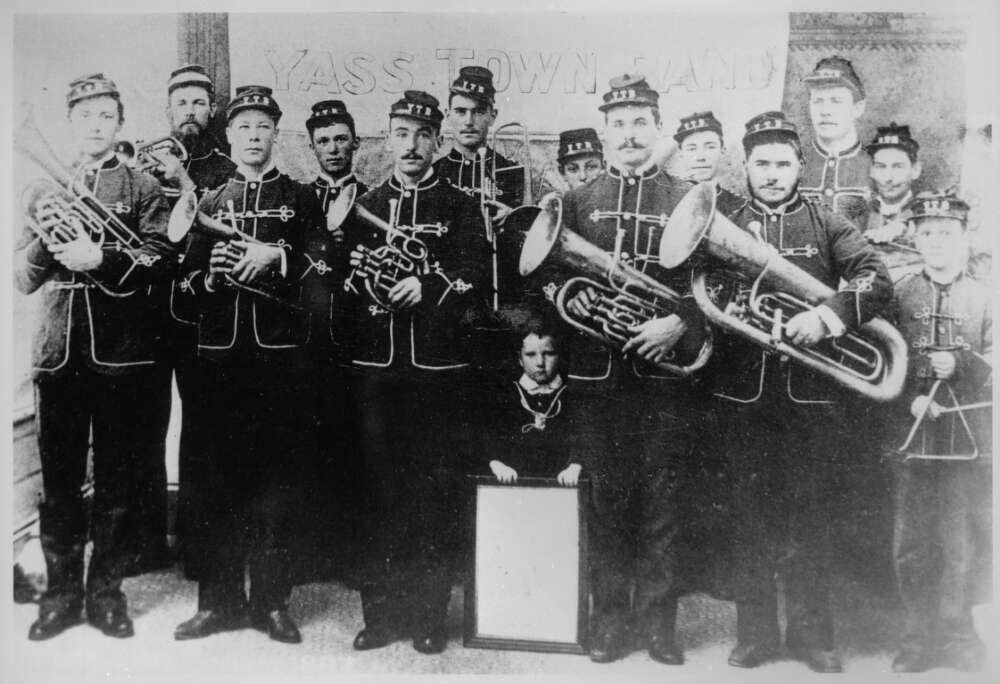


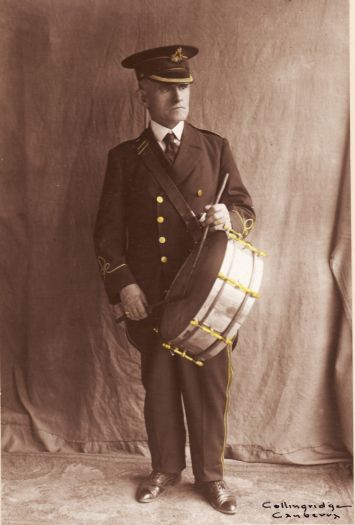


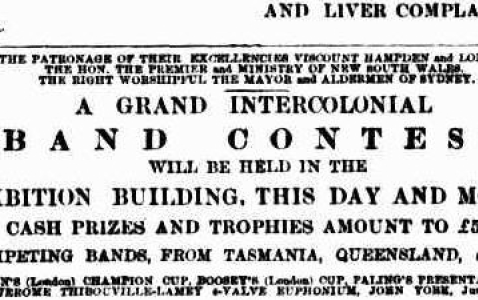
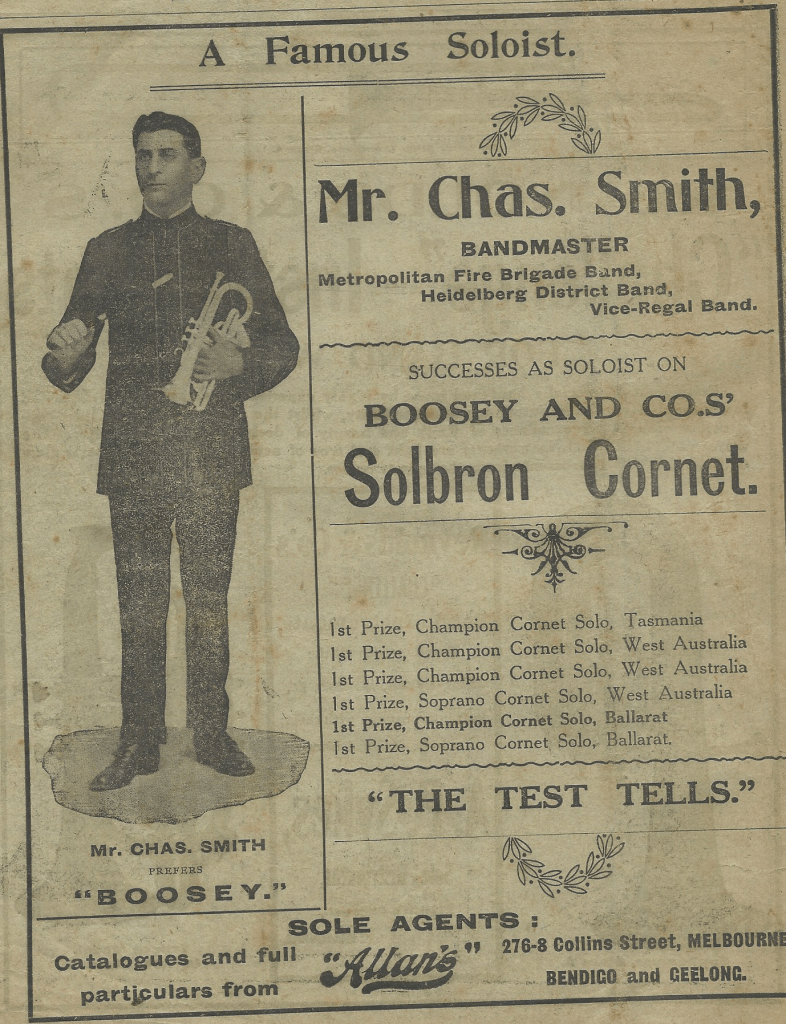
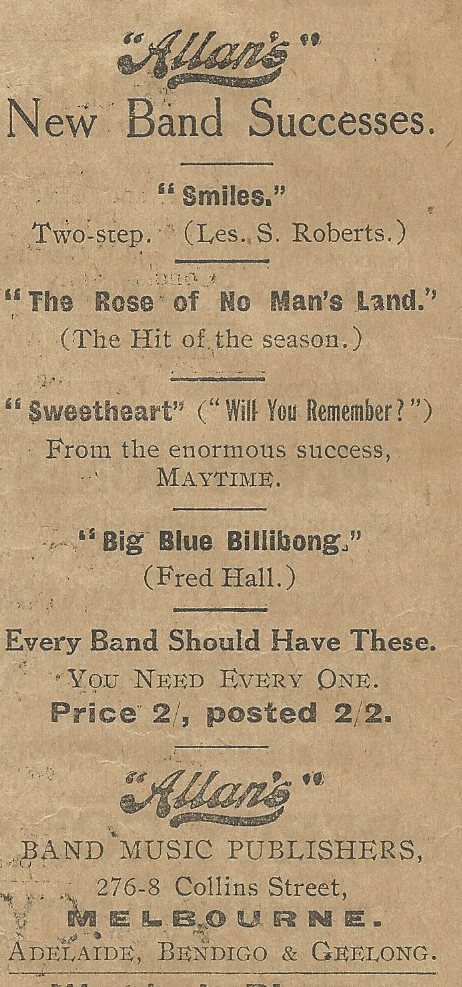
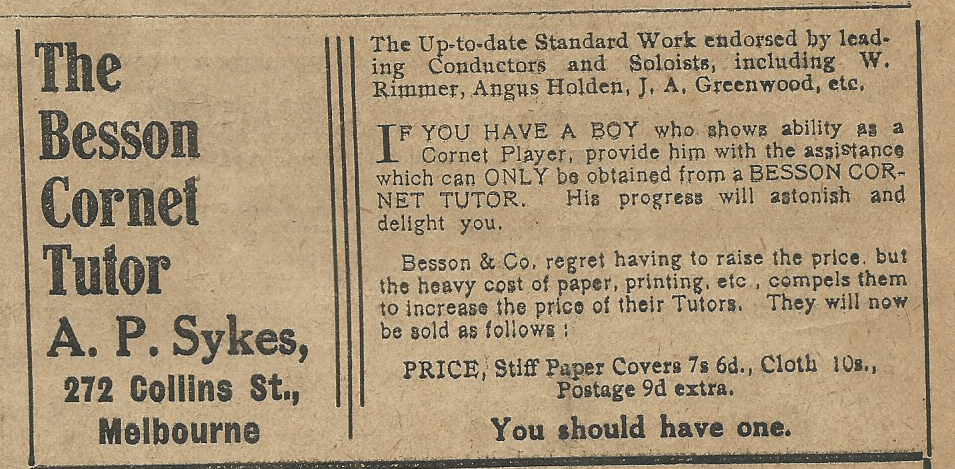


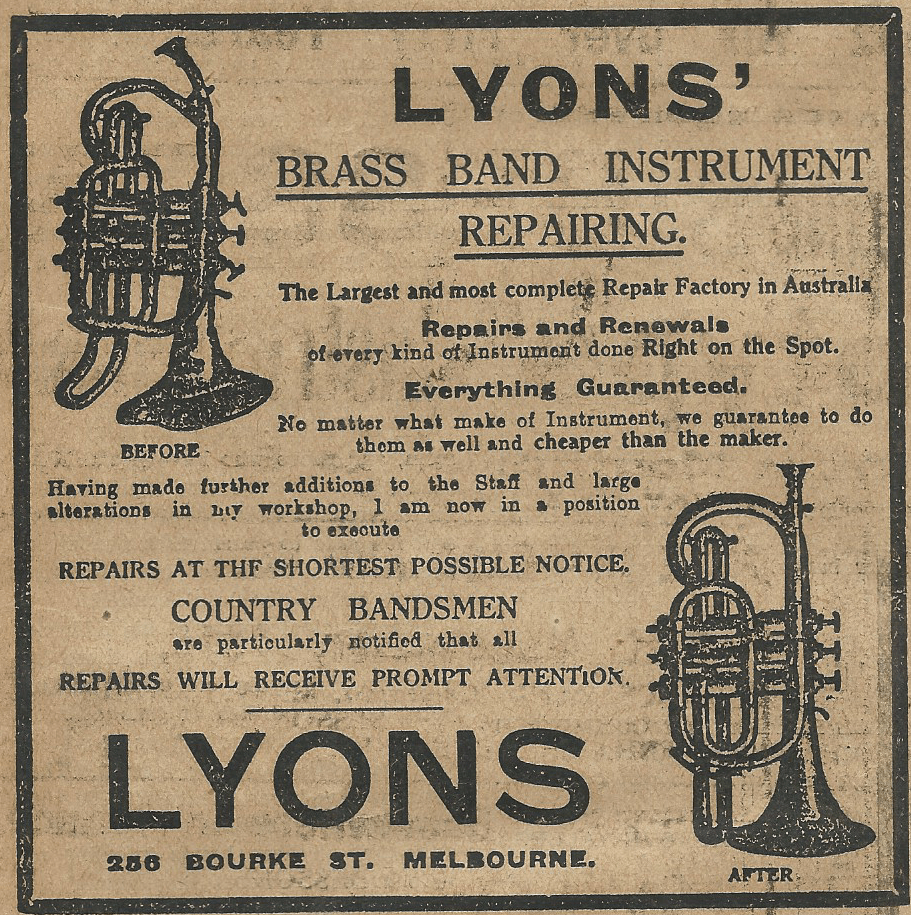


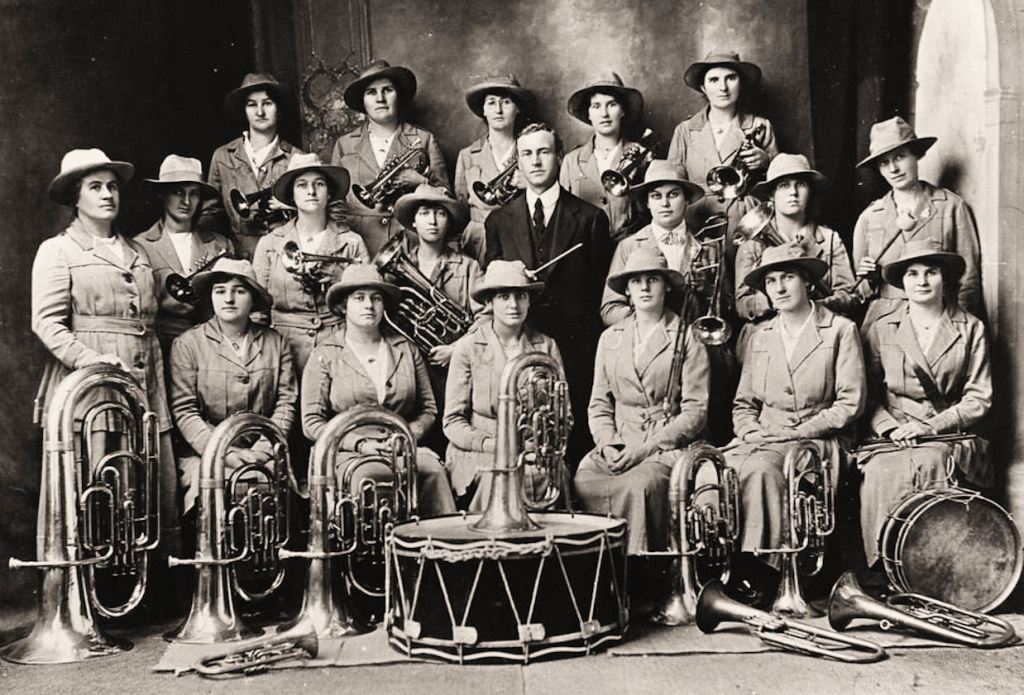

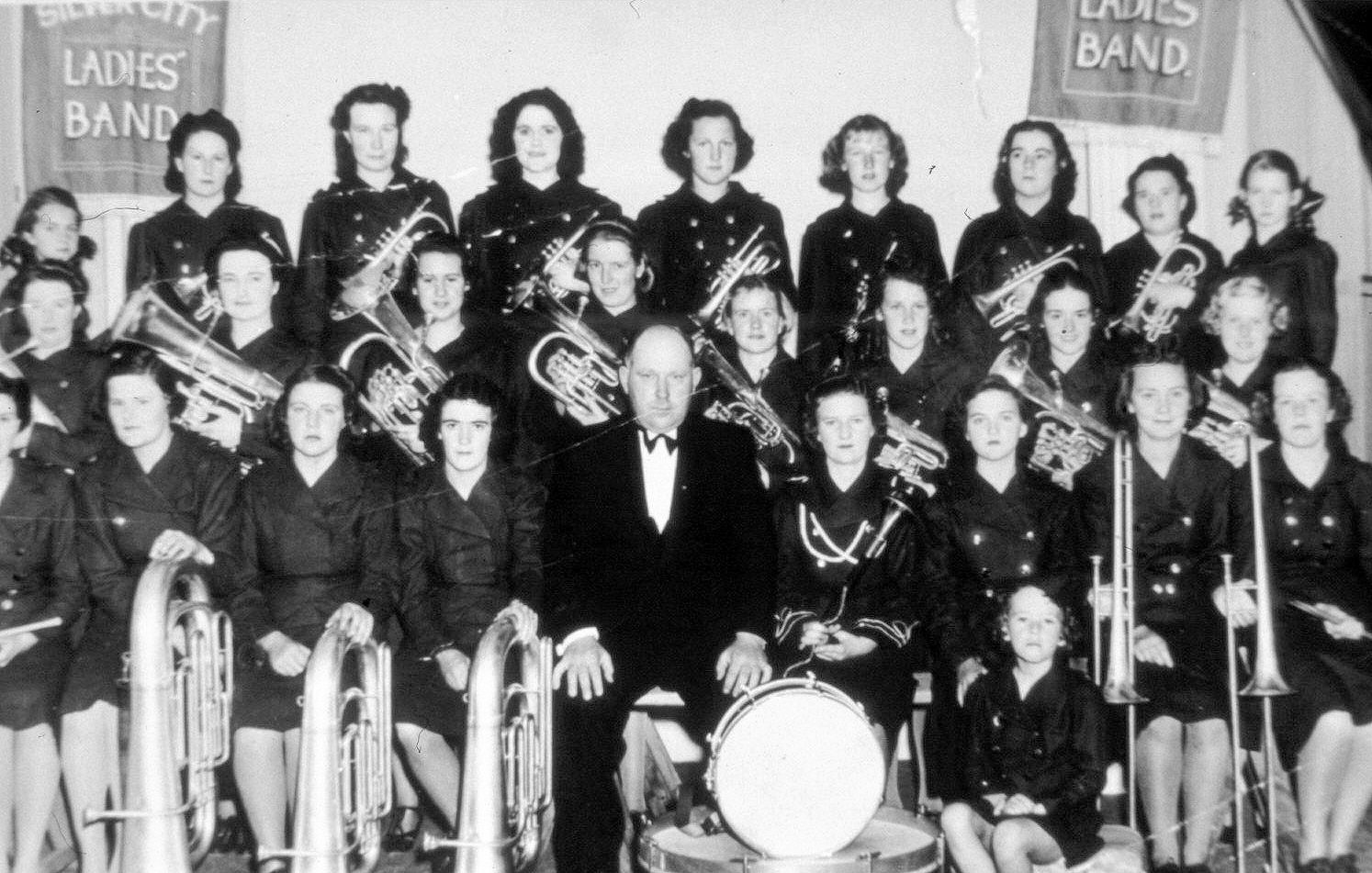


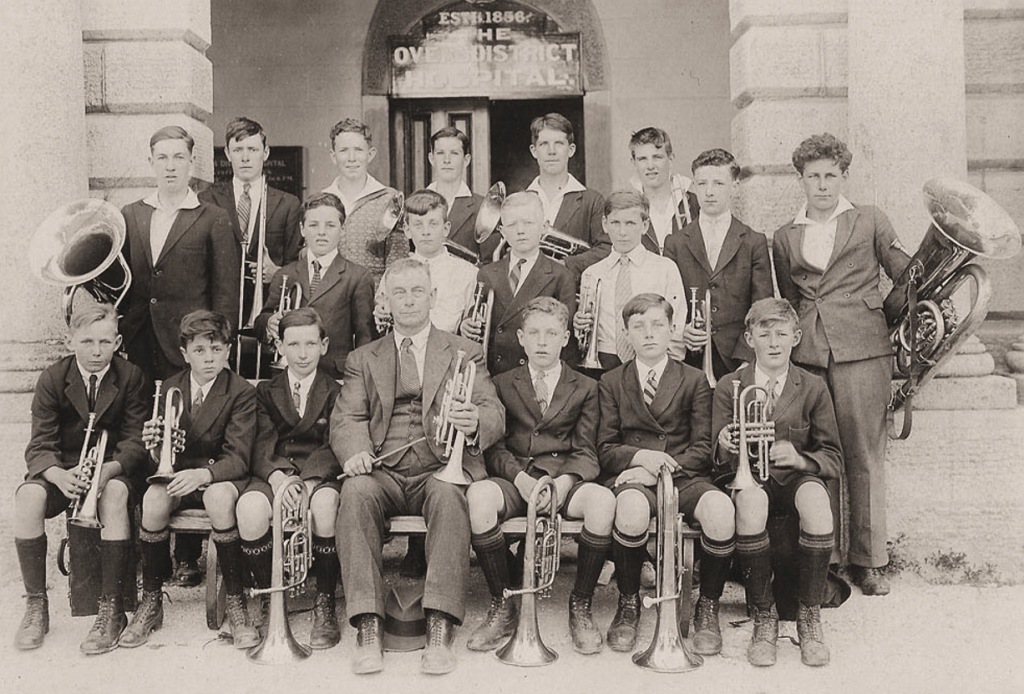


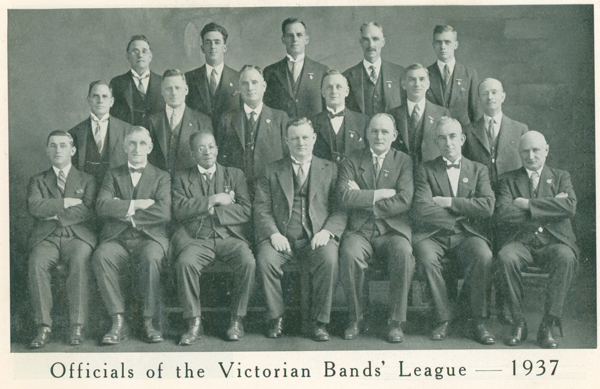
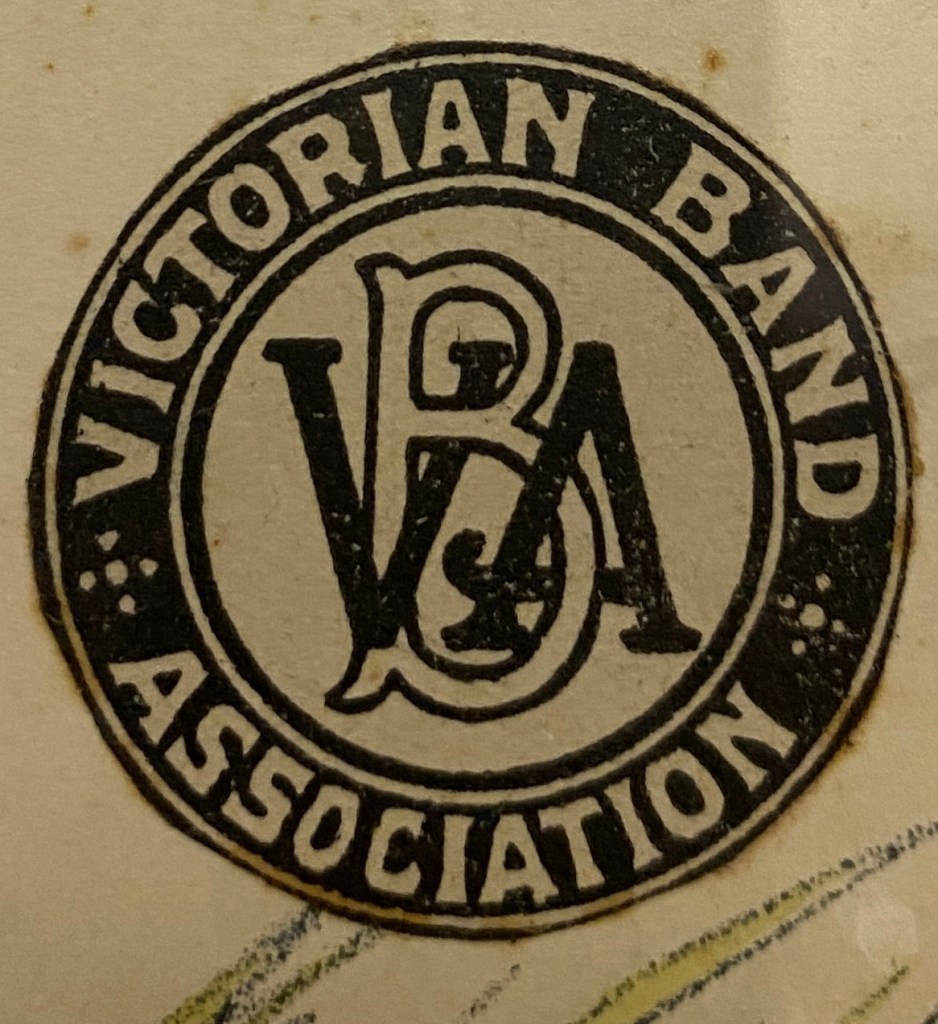

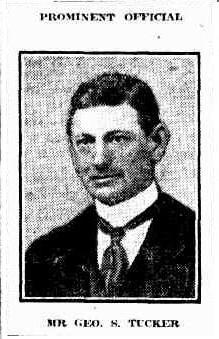
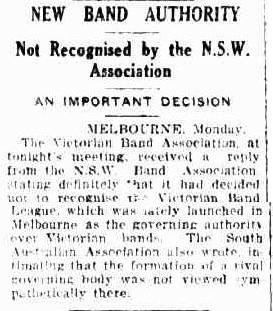


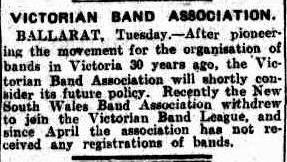

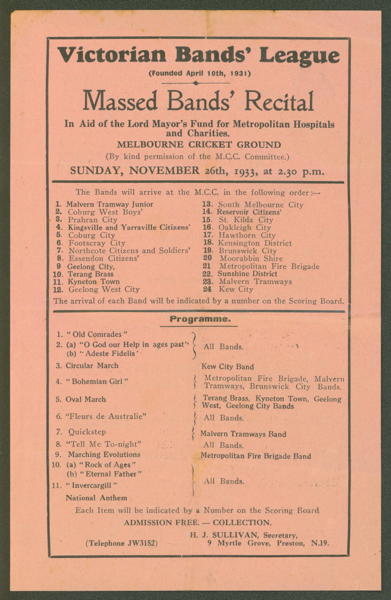
 Band Blasts from the Past