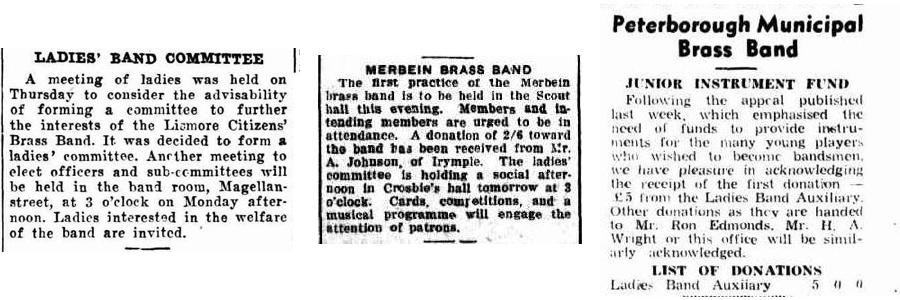
Invaluable support: the activities of the brass band ladies’ committee

Figure 1: Northern Star, 26/07/1930, p. 8; Sunraysia Daily, 26/07/1932, p. 1;
Times and Northern Advertiser, 13/09/1946, p. 2

Introduction:

It would be a difficult matter to adequately express the appreciation we have for the efforts of our ladies’ committee.  Their help, both financially and socially, places us under a debt of deep gratitude.  It was mutually agreed that their fund should be transferred to the band’s account, and they handed over £25 /9.  The ladies also donated £20 to the building fund, and there was another gift of £4 4/ – a total of £49 13/.  The ladies should be proud of this work.

(“EXCELSIOR BAND ACTIVITIES,” 1936)

So stated Mr. A. E. Sanders, then Secretary of the Port Pirie (S.A.) based B.H.A.S. Excelsior Band. And rightly so, it was a substantial amount of money for those times to be provided to the band.  Bands all over Australia, since they began, were always in need of funds, and they worked hard to provide for themselves.  However, here we have a group, the ladies’ committee, who were not playing members of the band, but an associated entity, nonetheless.  There were many of these ladies’ committees, or auxiliaries – the naming is interchangeable – associated with brass bands across the nation during a good seventy year of the last century.  This post focuses on the important fundraising and social activities they undertook.

These ladies’ committees should not be viewed purely through gendered glasses as they were set up in different times.  In the history of our band movement, we know that while there were early female brass bands, it was largely a male orientated activity.  But there is a wealth of evidence that shows the womenfolk were very supportive of the band movement, not only actively listening to the bands, but also providing material support, which they were very good at doing.  In fact, we could view the ladies’ committee as a kind of club as the women involved not only supported the band, but being part of a committee was a social activity as well.

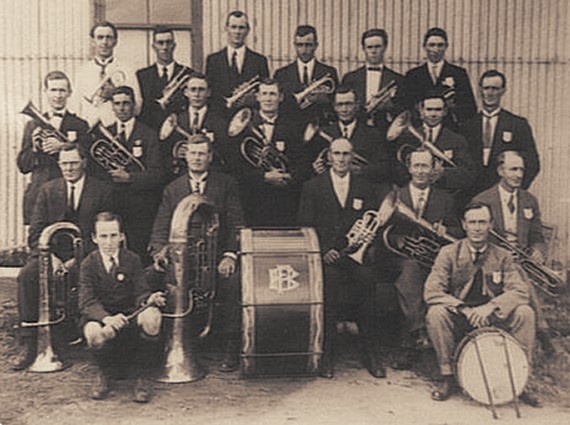
In this post, we will find that the ladies’ committees involved themselves in a range of activities to support their brass bands, and that their support was integral and deserved much thanks.  The evidence of their activities comes from the newspaper articles of the day and reports of annual general meetings – like the one provided by the B.H.A.S. Excelsior Band.  What we do not have is pictures of these fine folk.  Photographs of bands are easy to find. Finding pictures of their supporters is much more difficult.  Nevertheless, this post will highlight a measure of support for bands that is perhaps underrated and lost to time.  It is important to acknowledge the work of these women.

Seeing a need:

As detailed in a previous posts, bands were in need of some essentials in order to function – instruments, sheet music, and uniforms (de Korte, 2018b).  We must not forget places to rehearse as well (de Korte, 2020b).  All these things came with costs attached and while bands were reasonably good at dealing with local councils to obtain funds, more money was always needed and welcomed.  Such was the perilous state of some band finances that they could not survive monetary shocks or social upheaval (de Korte, 2020a, 2020c).  So having varied sources of funding was always going to be of benefit.

Let us work with a theory through this post, and the evidence will become clear, that the bands of this time that had two committees worked quite effectively.  For the simple fact that a band committee, which, due to the time, was male and they largely focused on the running of the band.  Having a ladies’ committee that focused on fundraising and social events meant that the time and energy of the band committee was somewhat freed up. 

The need was clearly there; it was just a matter of forming ladies’ committees who were enthusiastic about supporting the brass band.  According to a letter writer who wrote to the Glengarry, Toongabbie and Cowwarr Journal newspaper in 1925, ladies were quite fond of music, especially that of a brass band (A Member’s Wife, 1925).

Bands and their ladies:

There is no definitive time as to when the earliest brass band ladies’ committee started but newspaper articles provide us with indicative dates.  In an article published by the Sydney Morning Herald newspaper in July 1899, we find that the Newtown Brass Band of Sydney was the benefit of a ball “arranged and carried out by a committee of ladies of which Mrs. W. Rigg was the hon. Secretary, and Mrs. Trindall the hon. Treasurer” (“NEWTOWN BRASS BAND.,” 1899) with the aim of providing funds for the band to obtain new uniforms.  Admittedly. The Newtown Brass Band was already well supported by the local community – Dr. Trindall was the MC for this event and Mr. Rigg M.L.A. “made a few remarks” in support of the band (“NEWTOWN BRASS BAND.,” 1899).

For the newly formed Quairading Brass Band located in the town of Quairading, east of Perth, a ladies’ auxiliary was formed not long after the band came into existence in 1919.  And as reported in the Eastern Districts Chronicle newspaper, this auxiliary applied themselves to arranging the concerts with great success (“District News,” 1919).

The Essendon City Band, based in the north west suburbs of Melbourne, had quite the proactive band committee, and reported as such at the 1922 annual general meeting by the then (retiring) secretary, Mr. W. H. Gore, jun. (“ESSENDON CITY BAND,” 1922).  However, it was Mr. Gore’s wife, Mrs. Gore who took some initiative to help the band.

On August 22, Mrs. Gore proposed a gift sale to raise funds.  The proposal was adopted, and a ladies committee formed.  In the short time available the sum of £78 10s 6d was raised (including £9 proceeds of house party organised by Mr. Skehan), and £6 17s was also donated from R.S.S.I.L.A.  Mrs. Gore reported that in moving amongst the people she found that the upmost good-will existed towards the band, and the citizens generally were appreciative of its work in the district.  Some of the public bodies were endeavouring to make arrangements to work conjointly with the band in promoting the social life of the community, and it remained for the committee to make the best and most equitable arrangements possible.

 (“ESSENDON CITY BAND,” 1922)
Figure 2: Essendon Gazette and Keilor, Bulla and Broadmeadows Reporter, 07/12/1922, p. 1

The South Caulfield Brass Band located in the east of Melbourne, decided to form a ladies’ committee to help put on a concert at the Caulfield Town Hall in September 1927 as the band needed to pay off the debt on instruments (“South Caulfield Brass Band.,” 1927).  Their invitation to interested parties, which was detailed in an article published by The Prahran Telegraph newspaper, was welcoming.

Any lady interested in the work of the band is requested to communicate with the secretary, if desirous of assisting.

(“South Caulfield Brass Band.,” 1927)

The South Caulfield Brass Band was not the only band to form a ladies’ committee for help with special events.  In the same year, the Healesville Brass Band also formed a ladies’ committee, and they were much more organised as they voted in office bearers – “President, Mrs. Verity; vice-president Mrs. Hal Brown; secretary and treasurer, Mrs. R. Coates.” (“HEALESVILLE BRASS BAND.,” 1927).  This committee was quite firm in their fundraising aims:

The main objects of the ladies’ committee is to provide members of the band with suitable uniforms and to purchase new instruments.  It is confidently expected that the ladies of the district will support the band to their utmost ability.

(“HEALESVILLE BRASS BAND.,” 1927)

Sometimes, the main objectives to starting a ladies’ committee were a bit more open ended.  The Lismore Citizens’ Brass Band, as can be read in the article below, held a meeting to “consider the advisability of forming a committee to further the interests” of the band – with the end result of forming a ladies’ committee (“LADIES’ BAND COMMITTEE,” 1930).
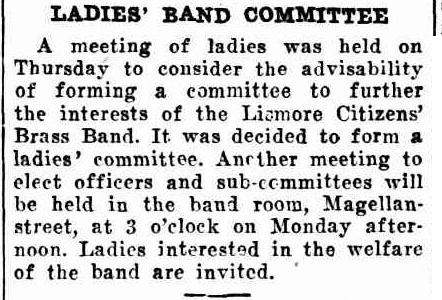
Figure 3: The Northern Star, 26/07/1930, p. 8

In the town of Merbein, located in the far north west of Victoria, the newly reconstituted Merbein Brass Band was the recipient of an equally enthusiastic ladies’ social committee that   immediately decided to hold a “social, in aid of band funds” (“BRASS BAND LADIES’ COMMITTEE,” 1932).  The social was to consist of “Cards, competitions, and a musical programme” to “engage the attention of patrons” (“MERBEIN BRASS BAND,” 1932).  This would have been a successful event given that way the town swung behind their band.
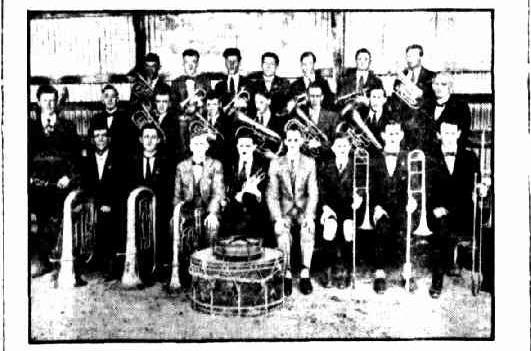
Figure 4: Merbein Public Brass Band-August 1926. Sunraysia Daily, 07/09/1926, p. 1

Support for the brass bands often came from people who held important positions in towns.  Such was the case in Shepparton, Victoria, where the then Lady Mayoress, Mrs. D. Summers invited interested women to be part of a new ladies’’ auxiliary and presided over the meeting – the ladies’ auxiliary was to take the place of the existing social committee of the Shepparton Brass Band (“SHEPPARTON BRASS BAND,” 1935).  Within one month of starting, in November 1935 this new auxiliary got to work almost immediately to raise funds in order to provide 27 uniforms for the band (“BAND UNIFORMS,” 1935b).  For the Shepparton Brass Band, there was a sense of urgency to provide the uniforms.  In January 1936 they were to host a meeting of all the bands from the Goulburn Valley and it was important that the Shepparton Brass Band looked as good as possible (“BAND UNIFORMS,” 1935a).  The new ladies’ auxiliary, and the band itself had their work cut out for them soliciting the support of the townsfolk.

The middle years of last century brought about upheaval with the advent of the Second World War, but for the bands, they recognized that additional help was needed to operate.  And they continued to form ladies’ committees to help the bands.  Mr. W. J. Moore, then secretary of the Berry Brass Band outlined in his report at the 1937 Annual General Meeting of the band how new committees would assist the band.

We would like to recommend the formation of a Citizens’ Committee, and also a Ladies’ Auxiliary, in the near future.  What can be done by such adjuncts is shown in Casino, where there is a juvenile band of 63 performers, and 25 clamouring for admission.  We must get the people of Berry interested in their band.  With the formation of theory classes at regular intervals, and the hearty co-operation of the general public, the band should flourish and provide a never-failing source of enjoyment to those who appreciated the inspiring strains of outdoor music.

(Moore in “Berry Brass Band,” 1937)

Some very worthwhile aims for the then Berry Brass Band to achieve.

Another band based in the Riverina region of New South Wales voted at their meeting in 1940 to form a ladies’ auxiliary, but it was only mentioned in the minutes with no clear goal as to what this auxiliary should aim for.

It was moved by Mr. McLay and seconded by Mr. Turner, that the lady supporters of the band be given the authority to form a committee to be known as the Narrandera Citizens’ Brass Band Women’s Auxiliary.

(“Citizens’ Band,” 1940)

The newly inaugurated ladies’ auxiliary of the Norseman Brass Band in Western Australia formed post WWII and found their work in supporting the band as well as providing a social group for lady supporters of the band, thus providing two avenues of connection (“Norseman Brass Band Ladies Aux. Formed,” 1949).

This is only a small sample of little stories relating to the formation of ladies’ committees across the Australian band movement.  For the various reasons they were formed, the fact that these committees were comprised of volunteers who gave their time for the band and social connection was the most important aspect of all.

The many ways to raise funds:

Figure 5: Members of the Casterton Vice Regal Band Ladies’ Auxiliary preparing supper at the CVRB “Belle of Belles Ball”. Weekly Times, 20/09/1950, p. 20

Balls, socials, bazaars, carnivals, baby competitions, singing competitions, cake stalls, and assisting at concerts…if there was any way to raise funds for brass bands, the ladies’ committees were on to them.  And they had a good time doing it too as the committees, as mentioned, functioned as a kind of social club.  The takings from such events were not insignificant, and the funds were much appreciated by the bands.

Some of the events that were held have already been detailed in this post as ladies’ committees were initially formed to fund specific items for the band – instruments and uniforms were particularly important. All things considered, most of the events were held just to raise additional funds which the bands used at their will. 

The ladies committee of the Port Pirie Proprietary Brass Band held a very successful social event at Port Pirie’s International Hall in March 1906.  Not only were 90 people present and £21 raised, but the ladies’ committee also presented something very special to the band.

The chief event of the evening came as a great surprise to all in the shape of a very handsome drum major’s staff, being presented to the Band by Mesdames J. Holwell and C. Langford on behalf of the Ladies’ Committee.

[…]

The Chairman in a very neat speech called upon Mr Fred Lewsey as an old supporter of the Band to make the presentation on behalf of the ladies, to the band, through their Conductor and Bandmaster, Mr. Thos Morgan.  Both gentlemen thanked the donors for the valuable and handsome present,  and expressed the hope that wherever the staff was carried it would be the means of bringing good luck and victories to the Proprietary Band.

The Bandmaster then called on Mr Tom Everon, drum-major of the Band, to accept the present custodian.  Mr Everon, in responding, said it gave him the greatest pleasure of his life in having an opportunity of thanking the donors for their useful and ornamental gift, especially as the donors were ladies.”

(“The Proprietary Brass Band.,” 1906)

Running social events was a popular activity for ladies’ committees and this is evident through a range of newspaper articles which detailed what went on.  Despite World War One being underway, the Lakes Creek Brass Band Ladies’ Committee of Rockhampton held a coin social at the local Masonic Hall.  Several activities were on offer including dancing, a progressive euchre tournament, open air games, a waltzing competition, a find-your-partner competition, and musical items were provided by the band and vocalists (“LAKE’S CREEK BRASS BAND.,” 1917).

Like the Lakes Creek Brass Band Ladies’ Committee social that took place in 1917, several years later the ladies’ committee of the Bacchus Marsh Brass Band also ran a very successful social event.  In front of 80 people, musical items were presented by soloists from the band – including a mouth-organ duet – and vocal and other items were part of the entertainment (“BACCHUS MARSH BRASS BAND.,” 1934).  The obligatory thanks were provided by members of the band.

The boys voted the ladies “Jolly Good Fellows” at the close of the very enjoyable function, for they provided the good things that appeal to the boys and incidentally to grownups as well.

(“BACCHUS MARSH BRASS BAND.,” 1934)

In the early years of World War Two, any pleasant activity must have been a welcome distraction.  For the ladies committee of the Clare Brass Band, one activity was a singing competition which was held in the home of Miss M. Rowley in October 1941 (“Clare Brass Band.,” 1941).  It was not a small affair as fifty ladies attended the afternoon, and twelve of them participated in the competition where variety on order.  Some ladies presented tap dancing, others played the piano, and there was singing – “which caused much fun” (“Clare Brass Band.,” 1941).  Takings were a bit on the small side at “£1/3/6”, but no doubt appreciated by the band (“Clare Brass Band.,” 1941).
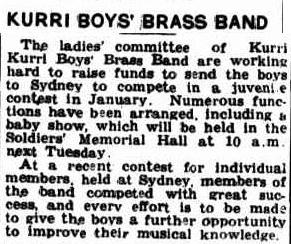
Figure 6: Cessnock Eagle and South Maitland Recorder, 04/12/1942, p. 3

The Kurri Kurri Boys’ Brass Band were very lucky to have a ladies’ committee helping them with fundraising.  Being the proactive band that they were and having the opportunity to enter band competitions on a regular basis, adequate funds were essential.  Kudos to the ladies’ committee of the band for arranging various functions, including the mentioned “baby show” (“KURRI BOYS’ BRASS BAND,” 1942).  For the record, a tiny snippet of news published in the Cessnock Eagle and South Maitland Recorder newspaper noted that the boys travelled to Sydney on the 22nd of January 1943 to compete in a competition (“PERSONAL,” 1943).  Obviously, the latest rounds of fundraising were successful in meeting goals.

In April 1950, the Clare Brass Band was in recess “due to a shortage of bandsmen”, but that did not stop their very proactive ladies’ committee from raising funds in the hope the band would become active again (“Clare Brass Band,” 1950).  They held a social afternoon that month with a variety of entertainments including “competitions, elocutionary items, songs and games” (“Clare Brass Band,” 1950).  It was noted in this article published in The Northern Argus newspaper that the Clare Brass Band Ladies’ Committee was quite proactive in what they did and how much in funds they had raised.

The ladies committee have £105 in the bank, proceeds from the social afternoons.  Many food parcels have been sent overseas, and appreciative letters have been received from the recipients.

Mrs. Shashall, President, and Mrs. H. J. Aitken, Mrs.  M. Kain, and Mrs. R. McEvoy, vice-presidents, thanked and expressed their appreciation for past help, and hoped in the near future the ladies would support their local band which is an acquisition to any town.

(“Clare Brass Band,” 1950)

On a side note, the Clare Municipal Brass Band reformed (and renamed) in 1951, then went into recess by the end of 1952, before being reformed again in November 1954 (“Clare Municipal Brass Band Reformed,” 1954; Tilbrook, 1954; “YOUNG RIDERS—AND THE BIG BRASS,” 1952).  The photograph below shows the Clare Municipal Brass Band as it was in 1952.  No doubt the ladies’ committee of the band would have been pleased to see the band reformed and know that their extensive fundraising activities helped.

Figure 7: The News, 06/08/1952, p. 12

The Horsham Brass Band Ladies’ Auxiliary was also active in the early 1950s.  As the article below shows, they held a cake  and produce stall, with the proceeds being £6 with further events planned in the lead up to Christmas (“CAKE STALL FOR BAND,” 1953).  Even small amounts of fundraising were useful for the band.

Figure 8: The Horsham Times, 04/11/1953, p. 3

With the varied forms of fundraising, the ladies’ committees contributed much to their bands as well as contributing to their localities as well.  With this help came much thanks, as was evident in these articles.  Funds for bands was an ongoing concern, and the more help that was provided, the better.

A long-standing anachonism:

It is not the greatest measurement but judging by the numbers of newspaper articles that mentioned ladies’ committees in the 1950s and 1960s, there seems to be a reduction in the numbers throughout this time.  History will tell us that from the 1950s, females started joining brass bands in greater numbers as playing band members so perhaps, this also influenced the makeup of band committees (de Korte, 2018a).  However, social factors could also be at play as society in general changed.  For example, the King Island Municipal Band noted in 1968 that the loss of their ladies’ committee was due to the lady that ran it leaving the island (On the Beat, 1968).  Change in the band movement can sometimes be gradual as new ideas take hold.

Conclusion:

This author has often heard of bands being described as a family or a community.  The stories here demonstrate that all people involved – players and helpers – are important.  The bands and their committees were wholly responsible for creating a community that supported the band.  And in times past, that support was much needed.  The ladies that volunteered to organise, run cake stalls, dances, obtained uniforms, and undertook innumerable other supporting roles did so with an enthusiasm that made a real difference. Who knows how many bands would have faltered over time had it not been for that little bit of extra support provided by a hard-working ladies’ committee?

References:

A Member’s Wife. (1925, 30 March). Coursing Club and Ladies : AND A BRASS BAND, TOO! Journal : Glengarry, Toongabbie and Cowwarr Journal (Traralgon, Vic. : 1923 – 1929), 1. http://nla.gov.au/nla.news-article274569550

BACCHUS MARSH BRASS BAND. (1934, 28 July). Melton Express (Vic. : 1915 – 1943), 3. http://nla.gov.au/nla.news-article254741515

BAND UNIFORMS : Appeal by Auxiliary. (1935a, 23 November). Shepparton Advertiser (Vic. : 1887 – 1953), 2. http://nla.gov.au/nla.news-article175424913

BAND UNIFORMS : LADIES’ AUXILIARY ACTIVE : CONCERT AND FAIR. (1935b, 15 November). Shepparton Advertiser (Vic. : 1887 – 1953),b1. http://nla.gov.au/nla.news-article175424344

Belle of Belles Chosen At Casterton. (1950, 20 September). Weekly Times (Melbourne, Vic. : 1869 – 1954), 20. http://nla.gov.au/nla.news-article224922352

Berry Brass Band : Annual Meeting. (1937, 23 September). South Coast Register (Berry, NSW : 1926; 1929 – 1931; 1933 – 1948), 1. http://nla.gov.au/nla.news-article284207960

BRASS BAND LADIES’ COMMITTEE. (1932, 19 July). Sunraysia Daily (Mildura, Vic. : 1920 – 1956), 1. http://nla.gov.au/nla.news-article265797449

CAKE STALL FOR BAND. (1953, 04 November). Horsham Times (Vic. : 1882 – 1954), 3. http://nla.gov.au/nla.news-article72774559

Citizens’ Band : Meeting of Committee. (1940, 16 February). Narandera Argus and Riverina Advertiser (NSW : 1893 – 1953), 6. http://nla.gov.au/nla.news-article130478489

Clare Brass Band. (1941, 17 October). Blyth Agriculturist (SA : 1908 – 1954), 4. http://nla.gov.au/nla.news-article222446550

Clare Brass Band. (1950, 05 April). Northern Argus (Clare, SA : 1869 – 1954), 9. http://nla.gov.au/nla.news-article97823288

Clare Municipal Brass Band Reformed. (1954, 24 November). Northern Argus (Clare, SA : 1869 – 1954), 8. http://nla.gov.au/nla.news-article97827526

de Korte, J. D. (2018a, 22 April). Early female brass bands in Australia: they were rare but they made their mark. Band Blasts from the Past: Anecdotes, Stories and Personalities. https://bandblastsfromthepast.blog/2018/04/22/early-female-brass-bands-in-australia-they-were-rare-but-they-made-their-mark/

de Korte, J. D. (2018b, 08 July). Instruments, sheet music and uniforms: how the bands of old obtained the essentials. Band Blasts from the Past: Anecdotes, Stories and Personalities. https://bandblastsfromthepast.blog/2018/05/13/instruments-sheet-music-and-uniforms-how-the-bands-of-old-obtained-the-essentials/

de Korte, J. D. (2020a, 04 June). Australian society and brass bands: The Pneumonic Influenza pandemic of 1919. Band Blasts from the Past: Anecdotes, Stories and Personalities. https://bandblastsfromthepast.blog/2020/06/04/australian-society-and-brass-bands-the-pneumonic-influenza-pandemic-of-1919/

de Korte, J. D. (2020b, 01 September 2020). A room to call their own: the space and place for bands. Band Blasts from the Past: Anecdotes, Stories and Personalities. https://bandblastsfromthepast.blog/2020/09/01/a-room-to-call-their-own-the-space-and-place-for-bands/

de Korte, J. D. (2020c, 18 October). Testing times: the resilience of Australian bands during the Great Depression. Band Blasts from the Past: Anecdotes, Stories and Personalities. https://bandblastsfromthepast.blog/2020/10/18/testing-times-the-resilience-of-australian-bands-during-the-great-depression/

District News : QUAIRADING : Brass Band. (1919, 10 October). Eastern Districts Chronicle (York, WA : 1877 – 1927), 2. http://nla.gov.au/nla.news-article148580826

ESSENDON CITY BAND : ANNUAL MEETING HELD : Year of Pronounced Activity. (1922, 07 December). Essendon Gazette and Keilor, Bulla and Broadmeadows Reporter (Moonee Ponds, Vic. : 1905 – 1924), 1. http://nla.gov.au/nla.news-article283500348

EXCELSIOR BAND ACTIVITIES : How Public Supports Music : Seventeen Concerts Bring £19 to Funds. (1936, 21 February). Recorder (Port Pirie, SA : 1919 – 1954), 1. http://nla.gov.au/nla.news-article95923315

HEALESVILLE BRASS BAND : LADIES COMMITTEE. (1927, 10 December). Healesville and Yarra Glen Guardian (Vic. : 1900 – 1942), 3. http://nla.gov.au/nla.news-article60293633

KURRI BOYS’ BRASS BAND. (1942, 04 December). Cessnock Eagle and South Maitland Recorder (NSW : 1913 – 1954), 3. http://nla.gov.au/nla.news-article99933708

LADIES’ BAND COMMITTEE. (1930, 26 July). Northern Star (Lismore, NSW : 1876 – 1954), 8. http://nla.gov.au/nla.news-article94144077

LAKE’S CREEK BRASS BAND. (1917, 03 November). Morning Bulletin (Rockhampton, Qld. : 1878 – 1954), 4. http://nla.gov.au/nla.news-article53831976

MERBEIN BRASS BAND. (1932, 26 July). Sunraysia Daily (Mildura, Vic. : 1920 – 1956), 1. http://nla.gov.au/nla.news-article265800182

NEWTOWN BRASS BAND. (1899, 24 July). Sydney Morning Herald (NSW : 1842 – 1954), 3. http://nla.gov.au/nla.news-article14228752

Nice, A. C. (1926, 07 September). MERBEIN PUBLIC BRASS BAND—August, 1926. Sunraysia Daily (Mildura, Vic. : 1920 – 1956), 1. http://nla.gov.au/nla.news-article258720934

Norseman Brass Band Ladies Aux. Formed. (1949, 09 June). Norseman-Esperance News (WA : 1936 – 1954), 2. http://nla.gov.au/nla.news-article258610441

On the Beat. (1968, 03 September). BAND HAS NOT BEEN INACTIVE. King Island News (Currie, King Island : 1912 – 1986, 2. http://nla.gov.au/nla.news-article264727496

PERSONAL. (1943, 22 January). Cessnock Eagle and South Maitland Recorder (NSW : 1913 – 1954), 3. http://nla.gov.au/nla.news-article100051247

Peterborough Municipal Brass Band : JUNIOR INSTRUMENT FUND. (1946, 13 September). Times and Northern Advertiser, Peterborough, South Australia (SA : 1919 – 1950), 2. http://nla.gov.au/nla.news-article124976509

The Proprietary Brass Band. (1906, 28 March). Port Pirie Recorder and North Western Mail (SA : 1898 – 1918), 4. http://nla.gov.au/nla.news-article95249731

SHEPPARTON BRASS BAND : Ladies Auxiliary Suggested. (1935, 03 October). Shepparton Advertiser (Vic. : 1887 – 1953), 1. http://nla.gov.au/nla.news-article175421706

South Caulfield Brass Band. (1927, 15 July). Prahran Telegraph (Vic. : 1889 – 1930), 4. http://nla.gov.au/nla.news-article165185419

Tilbrook, I. T. (1954, 10 November). CLARE MUNICIPAL BRASS BAND TO BE RE-ORGANISED : CONDUCTOR REQUIRED : (To the Editor). Northern Argus (Clare, SA : 1869 – 1954), 10. http://nla.gov.au/nla.news-article97827167

YOUNG RIDERS—AND THE BIG BRASS. (1952, 06 August). News (Adelaide, SA : 1923 – 1954), 12. http://nla.gov.au/nla.news-article130812675

Testing times: the resilience of Australian bands during the Great Depression

165x215mm
A large room of tables stocked with fruit and vegetables with a brass band in the centre of the crowd. (Source: State Library of Western Australia: 8292B/A/6851-1)

Introduction:

From conversations I have had with bandmasters in Australia it would appear that the bands generally have been very hard hit by the depression, but I have been struck by the fine spirit and courage shown generally by them in these passing troubles.  Undoubtedly brighter times are coming, and they will be rewarded for the admirable attitude they have taken right through.

(Adkins, 1934)

The years from 1900-1950 are filled with historical events that caused great upheavals in society across the globe. Australia was similarly affected, and nominally our bands as well.  It was not all doom and gloom for bands as this time is one that I personally regard as a golden period.  However, when society experienced hardship, our bands did as well.  The Great Depression from 1929-1939 is just one of those events that was global, but it was felt right down to the tiniest country town.  As for our bands, numerous articles published in newspapers tell of struggle and hope.  The words from Capt. H. E. Adkins, quoted above, then conductor of the A.B.C. Military Band attest to this.

In a previous post the impact of the “Spanish” Influenza on our bands was examined.  Australian society could not have predicted that a decade later they would again be thrust into convulsions not because of a health crisis, but an economic crisis.  Australian bands that existed at the time relied heavily on local council support and the goodwill of subscriptions from the general public.  The money was necessary to keep them going and keep them supplied.  Yet, as can be seen, there were some bands that were formed during this time.  Music, it seems, was a way in which people could forget their struggles and enjoy some community.

This post will obviously highlight some of the struggles that were experienced by bands and band associations during this time; unfortunately, this is unavoidable.  It is also necessary to provide context.  This post will also highlight the resilience of our bands during this time.  Many survived in the most trying of circumstances.  They also kept up a regular pattern of concerts, parades, contests, and other events and in one instance, they also gave their support to the desperate of society. 

The Great Depression is but one event in history, as is the Coronavirus pandemic of today that is again impacting our many bands.  Resilience is a common term that defines the bands of the time.

The Great Depression in Australia: a brief history:

The headlines on an article published in the Sydney Morning Herald on October 26th, 1929, did not mince words: “Wild Selling. New York Panic. Profits Wiped Out. £80,000,000 Slump.”  – the stock market in New York had crashed on October 24th and this sent the economy into a tailspin (“WILD SELLING,” 1929).  The crash on October 24th, 1929, has been well-documented and for much of the world, this had profound consequences.  However, there had been economic troubles in Australia leading up to this event during the 1920s and this led to a decade of financial hardship for all:

As for many other countries, the 1920s were a decade of mixed blessings for Australia.  State governments continued to borrow to finance important public works projects, but underlying problems remained.  Post-war inflation in 1919 and 1920 was followed by a recession.  Unemployment hovered at around 10 per cent during the 1920s.  Loan funds from London dried up after 1927, limiting debt-financed public works.

(Eklund, 2008)

The early years of the Great Depression were very hard in Australia with major unemployment, collapse of the wool and wheat prices, social unrest, displacement of people and governmental problems (Eklund, 2008; National Museum Australia, 2020).  Williamson (2009) tells us “it was the working classes and those who became unemployed who bore the greatest brunt of the Depression.” and that “Losing a job broke the work and leisure routines of an individual’s life, and the victim further lost the company of workmates.” (from Electronic Article).

From 1930 a form of welfare assistance was given to needy households and was either in the form of “sustenance”, “the dole” or “rations” which was “barely enough to survive” (Hutchens, 2020).  This later evolved into other forms of basic work on designated projects for governments and local councils.  In 1932, 60,000 Australians – men, women and children, were dependent on this scheme and unemployment hit a peak of 32% (National Museum Australia, 2020).  A small song sung by the unemployed and children basically summed up the situation that thousands found themselves in:

“We’re on the Susso now,
We can’t afford a cow.
We pay no rent,
We live in a tent.
We’re on the Susso now.”

(Hutchens, 2020; McAnulty, 2017; National Museum Australia, 2020)

The immediate effect of such large job losses and unemployment led to mainly men wandering the country in searching for work (Eklund, 2008).  As well as this, those that remained in work faced cuts to wages and underemployment, which added to the social problems.  Many who had lived reasonable well in the 1920s found themselves in employment situations that they had not previously encountered (Eklund, 2008). 

By the later parts of the 1930s, economic conditions gradually improved although unemployment was still a major problem (“Australia’s Rise From Depression,” 1936).  Recovery was slow, and then tempered by the advent of the Second World War – the next global period of strife.

Finances and Administration:

How did Australian bands weather this economic storm, and what do the available records tell us?  The Annual General Meetings of individual bands and associations provide snippets of information as to how they fared, and thankfully these meetings were detailed in local newspapers.  The Hills Central Brass Band from South Australia held an Annual General Meeting in March 1930, the early years of the Depression.  In their reports the band said they were faring well and had accrued a small credit.  A paragraph from the article that was published in the Mount Barker Courier and Onkaparinga and Gumeracha Advertiser newspaper provides an insight into their awareness of the economic situation.

The chairman, in moving the adoption of the report and balance sheet referred to the excellence of the report.  Mr. Duffield had made a very capable secretary, and took a keen interest in the band.  The report was the best they had had.  With regard to the financial position of the band the speaker though it was highly satisfactory, considering the present depression.

(“HILLS CENTRAL BRASS BAND.,” 1930)

The Devonport Brass Band from Tasmania took an insular view of the conditions when they held their meeting in March 1931 insofar as the rest of Australia was having problems, but their band was proceeding as best they could.  Their acknowledgement of the present conditions opened the report of the AGM as detailed in an article published by The Advocate newspaper.

The report of the year’s working of the Devonport Brass Band at the annual meeting this evening will reveal that there is little sign of the depression so far as the fortunes of this organisation are concerned.

(“DEVONPORT.,” 1931)
Peterborough Federal Band, 1924 (source: IBEW))

Back to South Australia, at an Annual General Meeting of the Peterborough Federal Band held in July 1931, the financials were outlined, and credit was given to the secretary of the band for his sound management of the finances during the previous year.

The secretary’s annual report disclosed a very active and successful year, whilst the balance sheet showed the Band to be on a sound footing; two years ago the overdraft was in close proximity to £200, last year it had been reduced to £14/6/5, and this year closed with a credit balance of £15/0/3, the receipts being £116/19/1 and the expenditure £87/12/5; this in face of the terrible depression that has existed, is a wonderful achievement, and reflects great credit upon the secretary (Mr. W. H. Kaehne), whose sole aim has been a credit balance, and he is to be highly complimented on reaching his objective.

(“Peterborough Federal Band,” 1931)

In these early years of the depression, it is obvious that bands were well aware of the prevailing economic conditions.  However, it was not just individual bands that were taking notice, the band associations were as well.  In May 1932 the Queensland Band Association held their Annual General Meeting and mention of the depression was made in the annual report.

Fees received for registration for the year totalled £119 18s 6d., as against £106 8s 6d. in the previous year. The 1933 contests would be held at Mackay.  Notwithstanding the prevailing depression the association had held its own financially and closed a successful year with a credit balance of £91 11s 4d. compared with £105 16s 1d. last year.

(“BAND ASSOCIATION,” 1932)

Unfortunately, some bands inevitably ran into trouble during this period and either went into recess or disbanded.  Finances were certainly a factor in this, but loss of members was another – which will be explored in the next section.  In 1932 the Yeppoon Brass Band, located in North Queensland, announced that it would go into recess due to lack of funds and members (“INTO RECESS,” 1932).  However, in a generous move, the band allowed remaining members to keep their instruments while in recess.  The Franklin Harbour Band from the Eyre Peninsula in South Australia lamented its struggles in an article published by the Eyre’s Peninsula Tribune newspaper in November 1936. 

… at present one of the depression periods is being experienced and unless a revival of interest by the young men of the town and district is evinced, there is a possibility of the band after 25 years of continuous existence, sinking into oblivion.

(“FRANKLIN HARBOUR BAND.,” 1936)
Franklin Harbour Brass Band (date unknown) (source: IBEW)

The Gawler Brass Band was another that faced growing troubles and in 1938 announced that it was disbanding due money being owed to the local council – they owed £100 for instruments – and lack of members as they had gone from 24 players to 12 (“Gawler Brass Band May Not Continue,” 1936).

The Mail, 18/07/1936, p, 2

This call for more support was a common one from bands and associations as their finances dwindled and membership became problematic. The then Secretary of the Tasmanian Band Association, a Mr W. H. Gray was one who called for more support in a long letter published in The Mercury newspaper in January 1932 (Gray, 1932).  The letter is interesting given that Mr Gray makes no mention of the Depression while calling for more support for the bands – the subject of the letter is mainly about bands playing in certain parks from which they gain revenue.  However, one cannot help but feel that the impact of the Depression was implied when Mr Gray writes in his letter,

The bands are prepared to carry on provided the necessary public support is forthcoming, but many of them are doomed to early extinction if that support is not more liberal from now on.  The Sunday evening concerts provide a most pleasant hour, and are a wonderful tonic and inspiration for the following week’s worries and cares.

(Gray, 1932)

Of course, there were always some who resented that brass bands were getting any form of support at all, which was perhaps understandable. One person from regional South Australia wrote a pointed letter to the Advertiser and Register newspaper complaining that the Government was not doing enough to help primary producers and instead found some money to fund an Institute in Waikerie and buy instruments for the Waikerie Brass Band (to the value of £350) (Rogers, 1931).

Waikerie Brass Band, 1930s (Source: State Library South Australia: B 34089)

There are still more stories to be found regarding the experiences of bands in the Great Depression and thankfully, some are brought to light through community newspapers.  For example, two stories about the Walcha Brass Band, published in the Walcha News newspaper (Walsh, 2019a, 2019b).  The Walcha Brass Band suffered through the 1930s due to the impacts of the Depression but recovered soon after the cessation of the Second World War and survived until 1969 when it disbanded  (Walsh, 2019b).

If this small sample of AGM’s are to go by it is evident that bands were fully aware of the impacts of the depression.  Which made them all the more pleased to find they were riding the economic impacts as best they could. 

Employ a Bandsman:

Every band wants to retain their members as best they can.  This was no different for the bands during the Depression years where, as it was mentioned, people had to leave their localities to find work elsewhere.  Again, the fact that bands were losing members due to Depression conditions, factors that were really beyond their control, sometimes had a detrimental effect on the bands.  One strategy that bands used was to try to find employment for bandsmen in their own localities and on occasion implored local businesses to help them.  This was not an easy thing for bands to ask.

Freeling Brass Band (date unknown) (source: IBEW)

In 1931 the loss of members from the Freeling Model Brass Band from South Australia was noted as a significant factor affecting the survival of the band.  We can see in an article published in The Bunyip newspaper just how dire the circumstance of the band was in 1931.

The secretary (Mr. E. L. Anders) read the report and balance sheet on the year’s work.  He stated that the Band were in a financial position, but were unfortunate in losing eight playing members during the year; some having left the district through unemployment.  […] He also stressed the point, that little or no interest was shown by the playing members and the support from the public was very scanty.  This let the band down badly, and if not more support was forthcoming, the band would have to go into recess for a short period. […] A lengthy discussion arose, and for a time it was hard to distinguish what was being said.  It was proposed that the band go into recess.  After order was restored, it was proposed and seconded that the band carry on. 

(“FREELING MODEL BRASS BAND.,” 1931)

The Muswellbrook Brass Band, located in the Newcastle area of New South Wales, recognized that they might lose two members due employment issues and they made a request to the public in their March committee meeting.  This request was detailed in the local Muswellbrook Chronicle newspaper.

Employment Sought for Members.

Reference was made to the possibility of losing two valuable members of the Band owing to their inability to obtain employment in the town.  The hope was expressed that this matter would come under the notice of the general public, and that anyone in the position to offer employment would communicate with Mr. Wallace (hon. Secretary). 

(“MUSWELLBROOK BRASS BAND.,” 1935)

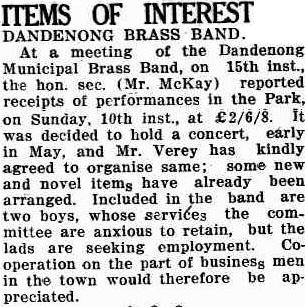
Similarly, in the same year, the Dandenong Brass Band from Victoria (as can be seen in the article below) also put out a plea to try to find employment for two of their members.

Dandenong Journal, 21/03/1935, p. 5

The Waratah Brass Band from Tasmania and the Port Adelaide Municipal Band were other bands that noted the loss of members due to employment issues (“WARATAH.,” 1935; “YOUR LOCAL BAND NEEDS SUPPORT!,” 1938).  It was a circumstance that many bands found themselves in during these years.

Port Adelaide Municipal Band (Source: The Citizen, 30/11/1938, p. 7)

Finding themselves in a slightly different situation, in 1937 a brass band located in Canberra was “disbanded as a protest against the refusal of the Department of Interior to guarantee all members permanent employment.”  (“BAND IS NOT TO PLAY,” 1937).  They were to play at an Armistice Service at Parliament House which forced the Department of Interior to hire a Sydney based band (“BAND IS NOT TO PLAY,” 1937).  However, in trying to defend this decision, the Secretary of the Department, Mr. Carrodus did say…

…that at least half of the members of the band had been given departmental jobs, but because of the stringent observance of the Returned Soldiers’ Preference Act it would be impossible to absorb them all.”

(“BAND IS NOT TO PLAY,” 1937)

It is hard to read of these circumstances and not feel saddened about the state some of these bands.  They were trying to exist in a time of history where outside forces were affecting how they operated; membership and commitment being a major part of those factors. No doubt they were doing the best they could under the circumstances.

The bands played on:

Brass band marching on Anzac Day, Sydney, 1930 (Source: National Library of Australia: 14446)

Music has always been known as a great reliever to troubles and during this time our brass bands rose to the challenge, not only for the good of the band and band members but also for the public and other causes.  In fact, some commentators suggested that there was no need for music making to stop.  In 1931 a Dr A. E. Floyd wrote in an article published in the Australasian newspaper,

The effect of the present financial stringency on every man’s music and musical progress need not be unmitigatedly bad; indeed it may be easily, with a little forethought, be decidedly good. 

(Floyd, 1931)

Admittedly, the context of Dr. Floyd’s article was more on making music in the home environment.  However, there is no doubt that his thoughts were cross-applicable to playing in ensembles outside of the home as well – his encouragement was for people to keep making music no matter the circumstances for health reasons.

For our bands it was a little more difficult as engagements slowed and money was scarce.  The bigger bands, often based in metropolitan centres were luckier than most as they could keep up with a regular pattern of performances, parades and competitions.  Indeed, the Victorian Bands’ League presented some very impressive massed band events during this time including one in 1937 that involved six hundred bandsmen! (“BIG BANDS DISPLAY,” 1937).  In Sydney, a grand competition was held in 1938 which drew together bands from across Australia (Bandsman’s year book, 1938).  While in the regional town of Wellington in New South Wales, their first competition in twenty five years was labelled a “Tremendous and Outstanding Success” by the Wellington Times newspaper (“WELLINGTON BAND CONTEST.,” 1932).

Music for a cause:

The brass bands also did their bit for charitable causes and lent their services to help the needy.  For the bands, this was not a new style of engagement as over time they were regularly engaged in helping raise money for charity – the Victorian Bands’ League massed bands event in 1937 raised money for charity.  However, during the Great Depression this was giving a new meaning and we find the bands involved in some distinct social causes as well.

We can see that bands were an uplifting presence.  In North Queensland the Mirani Brass Band helped to lift spirits during a harvest thanksgiving event and the band was noted for their playing – practices had lifted after harvest when more members were available (“DISTRICT NEWS.,” 1930).  While over in Western Australia, the Merredin Brass Band joined other local organisations in an engagement that raised money for the needy in the district (Branson, 1931).  The Matron of the Clare Hospital located in South Australia wrote an appreciative letter to the Blyth Agriculturist newspaper to thank the “generosity of the general public” and the Clare Brass Band was given a special mention for raising money for a new dressing table in the Isolation section (Pattullo, 1934).

The thanks went both ways.  In April 1930 a letter was published in the Burra Record newspaper co-written by the President, Bandmaster and Secretary of the Spalding Brass Band thanking a Mr. P. Clark of Burra for financing a trip and engaging them to play (Hewish et al., 1930).  No doubt the band was grateful for these kinds of opportunities.

Burra Record, 16/04/1930, p. 3

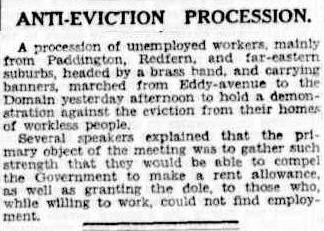
We can also see mentions of brass bands leading marches and demonstrations, which is perhaps understandable.  Many brass bands were supported by industry at this time and no doubt some of the workers were affected by the conditions around them.  Mention was made of a brass band leading an Anti-Eviction procession in Sydney in 1933 and in Newcastle, a brass band headed up 600 unemployed from the “West Wallsend District” who marched on the town hall in 1935 (“ANTI-EVICTION PROCESSION.,” 1933; “UNEMPLOYED,” 1935).

Sydney Morning Herald, 14/08/1933, p. 10

Resilience:

We have already seen that some of the effects of the Great Depression on brass bands led to them going into recess or suffering financial and membership difficulties.  We have also seen that bands kept up their activities as best they could.  They were resilient in the face of adversity.  And if it was one activity that brought people together, it was the brass band.  In this decade, some bands even started up again.

In the township of Leeton, located in the Riverina district of New South Wales, a long letter was published in the Murrumbidgee Irrigator newspaper written by a contributor with the colloquial name of “Has Been”.  In 1932 the Leeton Band resumed practicing and this writer waxed lyrical on how much this band would mean to the town.

Sir,- I notice by your advertising that the Leeton Band is commencing its practices again, which means that we are again to have the pleasure of hearing band music.  This, I am sure, will be very pleasing to quite a number of people in our town and district, for the band is a decided acquisition to any town, no matter how small.

(“Has Been”, 1932)

Of course, there was a trade-off to reforming the band and “Has Been” wrote an appeal to the townsfolk to look for employment opportunities for bandsmen.

Might I add another word to the employers of labour, whether it be shop, farms or factory, when in need of a man, give the band secretary a chance to supply you with a bandsman.  If there is not a man in town suitable for the job, ask the band secretary to see what he can do.  The band secretary, being a life man, would, no doubt insert an advert in the city papers, worded something like this: “Wanted – A mechanic (or whatever the position was that had to be filled), good man only; must be bandsman (cornet player preferred) – Apply Secty Leeton District Band.

(“Has Been”, 1932)

“Has Been” was probably working a bit ahead of himself but the initiative was warranted given the difficult times – and many other bands were trying the same initiative.

The Tully Brass Band from North Queensland was perhaps one of the luckier ensembles as six years prior to 1933, residents of the town subscribed to the band and £400 had been spent on instruments (“TO BE RE-FORMED,” 1933).  When the band was reformed in 1933 those instruments were still available, so the band was able to restart almost immediately.  We can see in the photo below what the band was like in the 1930s.  

Tully Brass Band marching. ca. 1930s (Source: State Library of Queensland: 33123)

To be resilient a band had to be able to handle the circumstances as best they could and gathering public and council support was a chief aim.  When these pieces fell into place, bands could survive reasonably comfortably despite the outside circumstances.  For bands to restart during this time was an additional challenge which some of them managed with success.

Conclusion:

Coming out of the 1920s where the world seemed to be recovering only to plunge into another crisis must have been a major shock.  For bands, this meant a greater focus on administration especially finances, engagements, and membership.  Some aspects were simply out of their control such as the movement of members due to employment – as enjoyable as playing in a band might be, the outside need was to find a job.  It was admirable that many bands sought to find work for their members and themselves become a social service.

No doubt the work the bands were doing was appreciated by their communities either through live performance or over the wireless.  Music is uplifting.  Music could help people forget about their predicaments, if only for a short time.  The bands did their best.

References:

“Has Been”. (1932, 26 February). REFORMING THE BAND : (To the Editor). Murrumbidgee Irrigator (Leeton, NSW : 1915 – 1954), 3. http://nla.gov.au/nla.news-article155893074

Adkins, H. E. (1934, 10 January). Britain’s Big Brass Bands. Courier-Mail (Brisbane, Qld. : 1933 – 1954), 10. http://nla.gov.au/nla.news-article1158876

ANTI-EVICTION PROCESSION. (1933, 14 August). Sydney Morning Herald (NSW : 1842 – 1954), 10. http://nla.gov.au/nla.news-article16998155

Australia’s Rise From Depression : Story Told By Figures. (1936, 15 February). Northern Producer and Morawa and District Advertiser (WA : 1930 – 1947), 4. http://nla.gov.au/nla.news-article257624349

BAND ASSOCIATION : The Annual Report. (1932, 12 May). Telegraph (Brisbane, Qld. : 1872 – 1947), 13. http://nla.gov.au/nla.news-article180704011

BAND IS NOT TO PLAY : Demand Permanent Jobs. (1937, 11 November). Labor Daily (Sydney, NSW : 1924 – 1938), 6. http://nla.gov.au/nla.news-article237760894

The Bandsman’s year book and official programme of the Australian Championship Band Contest. (1938). (Band Association of New South Wales, Ed.). Band Association of New South Wales. 

BIG BANDS DISPLAY : 600 Players. (1937, 25 September). Sporting Globe (Melbourne, Vic. : 1922 – 1954), 7. http://nla.gov.au/nla.news-article180841683

Branson, I. N. (1931, 28 April). The Meldrum Benefit. Wheatbelt Wheatsheaf and Dampier Advocate (Merredin, WA : 1930 – 1939), 1. http://nla.gov.au/nla.news-article251755519

DEVONPORT. (1931, 31 March). Advocate (Burnie, Tas. : 1890 – 1954), 4. http://nla.gov.au/nla.news-article67710241

DISTRICT NEWS : Mirani : (From our Correspondent). (1930, 23 December). Daily Mercury (Mackay, Qld. : 1906 – 1954), 6. http://nla.gov.au/nla.news-article170235248

Eklund, E. (2008). 10 June 1931. In M. Crotty & D. A. Roberts (Eds.), Turning Points in Australian History (pp. 48-61). University of New South Wales Press Ltd. 

Floyd, A. E. (1931, 03 January). MUSIC : Need the Depression Stifle Music? Australasian (Melbourne, Vic. : 1864 – 1946), 15. http://nla.gov.au/nla.news-article141416272

Franklin Harbour Brass Band. (n.d.). [Photograph]. [phot3437]. The Internet Bandsman Everything Within, Vintage Brass Band Pictures : Australia. http://www.ibew.org.uk/vbbp-oz.html

FRANKLIN HARBOUR BAND. (1936, 26 November). Eyre’s Peninsula Tribune (Cowell, SA : 1910 – 1950), 2. http://nla.gov.au/nla.news-article219473615

Freeling Brass Band. (n.d.). [Photograph]. [phot15438]. The Internet Bandsman Everything Within, Vintage Brass Band Pictures : Australia. http://www.ibew.org.uk/vbbp-oz.html

FREELING MODEL BRASS BAND. (1931, 19 June). Bunyip (Gawler, SA : 1863 – 1954), 6. http://nla.gov.au/nla.news-article96642544

Gawler Brass Band May Not Continue. (1936, 18 July). Mail (Adelaide, SA : 1912 – 1954), 2. http://nla.gov.au/nla.news-article55830899

Gray, W. H. (1932, 09 January). BAND CONCERTS : Appeals for More Liberal Support : To the Editor of “The Mercury.”. Mercury (Hobart, Tas. : 1860 – 1954), 9. http://nla.gov.au/nla.news-article29939058

Hewish, P. A., Carlson, A. C., & Mannion, F. J. (1930, 16 April). SPALDING’S BRASS BAND APPRECIATION : (To the Editor). Burra Record (SA : 1878 – 1954), 3. http://nla.gov.au/nla.news-article37488195

HILLS CENTRAL BRASS BAND. (1930, 21 March). Mount Barker Courier and Onkaparinga and Gumeracha Advertiser (SA : 1880 – 1954), 5. http://nla.gov.au/nla.news-article147845925

Hutchens, G. (2020, 29 March). The lessons of our past and our neighbours’ present could guide Australia’s economic response to coronavirus. ABC News. Retrieved 02 October 2020 from https://www.abc.net.au/news/2020-03-29/australias-history-of-economic-support-coronavirus-covid-19/12100194

Illustrations Ltd. (1932). Large group of people in shed near tables full of vegetables and fruit [picture] [1 negative : glass, b&w ; 17 x 22 cm.]. [101841PD]. State Library of Western Australia, Illustrations Ltd collection ; 8292B/A/6851-1. https://encore.slwa.wa.gov.au/iii/encore/record/C__Rb2649568

INTO RECESS : Yeppoon Brass Band. (1932, 26 April). Morning Bulletin (Rockhampton, Qld. : 1878 – 1954), 1. http://nla.gov.au/nla.news-article54737835

ITEMS OF INTEREST : Dandenong Brass Band. (1935, 21 March). Dandenong Journal (Vic. : 1927 – 1954), 5. http://nla.gov.au/nla.news-article213964037

McAnulty, H. (2017, 13 January). History Talking: Surviving life in the dole-drums of the Depression. Central Western Daily. https://www.centralwesterndaily.com.au/story/4403111/history-talking-surviving-life-in-the-dole-drums-of-the-depression/

MUSWELLBROOK BRASS BAND : Committee Meeting. (1935, 01 March). Muswellbrook Chronicle (NSW : 1898 – 1955), 1. http://nla.gov.au/nla.news-article107669487

National Museum Australia. (2020, 15 April ). 1932: Height of the Great Depression, with 32 per cent unemployment. National Museum Australia. Retrieved 26 September 2020 from https://www.nma.gov.au/defining-moments/resources/great-depression

Pattullo, B. (1934, 12 January). THE CLARE AND DISTRICT HOSPITAL : | To the Editor |. Blyth Agriculturist (SA : 1908 – 1954), 2. http://nla.gov.au/nla.news-article217990434

Peterborough Federal Band. (1924). [Photograph]. [phot6378]. The Internet Bandsman Everything Within, Vintage Brass Band Pictures : Australia. http://www.ibew.org.uk/vbbp-oz.html

Peterborough Federal Band : Annual General Meeting. (1931, 17 July). Times and Northern Advertiser, Peterborough, South Australia (SA : 1919 – 1950), 4. http://nla.gov.au/nla.news-article110542695

Pohjanpalo, J. (1930). Brass band marching on Anzac Day, Sydney, 1930 [1 negative : nitrate, black and white]. [nla.obj-15268053]. National Library of Australia, Jorma Pohjanpalo collection of photographs of Sydney and Queensland, 1928-1931. http://nla.gov.au/nla.obj-152628053

Rogers, G. S. (1931, 15 April). POINTS FROM LETTERS : Brass Bands or Primary Production. Advertiser and Register (Adelaide, SA : 1931), 12. http://nla.gov.au/nla.news-article45760607

TO BE RE-FORMED : Tully Brass Band. (1933, 13 May). Cairns Post (Qld. : 1909 – 1954), 6. http://nla.gov.au/nla.news-article41214410

UNEMPLOYED : Meet Shire Council : MANY DEMANDS : 600 March from West Wallsend : Strikers State Their Case. (1935, 12 July). Newcastle Morning Herald and Miners’ Advocate (NSW : 1876 – 1954), 11. http://nla.gov.au/nla.news-article138136031

Unidentified. (1933). Marching brass band, Tully, ca. 1930s [photographic print : black & white , ca. 1930s.]. [33123]. Brisbane John Oxley Library, State Library of Queensland, OneSearch. https://hdl.handle.net/10462/deriv/192004

Waikerie Brass Band. (1930). [Photograph]. State Library South Australia, Waikerie Collection. https://collections.slsa.sa.gov.au/resource/B+34089

Walsh, B. (2019a, 27 February). Walcha History: Band stands and delivers for Premier. Walcha News. https://www.walchanewsonline.com.au/story/5922107/walcha-band-stands-and-delivers-for-premier/

Walsh, B. (2019b, 13 March). Walcha History: Walcha Town Band’s final years. Walcha News. https://www.walchanewsonline.com.au/story/5947106/walcha-town-bands-final-hurrah/

WARATAH : The Band. (1935, 16 November). Advocate (Burnie, Tas. : 1890 – 1954), 10. http://nla.gov.au/nla.news-article86569751

WELLINGTON BAND CONTEST : THE FIRST FOR 25 YEARS : A Tremendous and Outstanding Success. : UNBOUNDED ENTHUSIASM. (1932, 04 January). Wellington Times (NSW : 1899 – 1954), 6. http://nla.gov.au/nla.news-article143246369

WILD SELLING : New York Panic : PROFITS WIPED OUT : £80,000,000 Slump. (1929, 26 October). Sydney Morning Herald (NSW : 1842 – 1954), 17. http://nla.gov.au/nla.news-article16596498

Williamson, A. (2009). The Cud on History — Looking Back on The Great Depression in Australia [Electronic Magazine Article]. The Cud: Entertain a new perspective: chew the cud. Retrieved 26 September 2020, from http://thecud.com.au/live/content/cud-history-—-looking-back-great-depression-australia

YOUR LOCAL BAND NEEDS SUPPORT! : A Short History. (1938, 30 November). Citizen (Port Adelaide, SA : 1938-1940), 7. http://nla.gov.au/nla.news-article236745262

Brass bands and Christmas cheer: compliments of the season

19310000_Beechworth-School-Band_Xmas
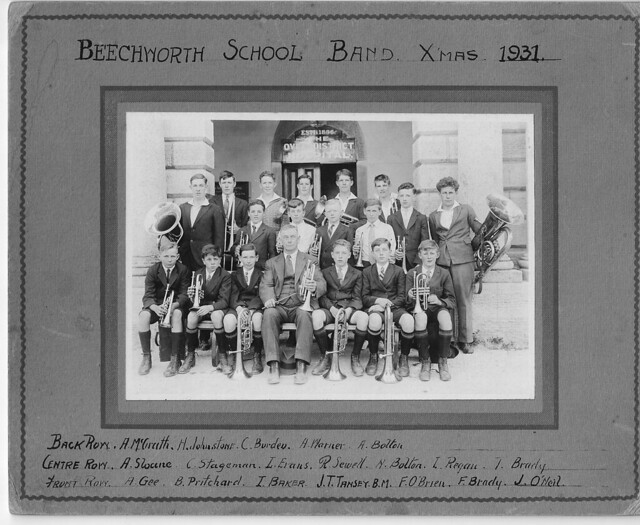
Beechworth School Band. Xmas 1931 (Source: HistoryInPhotos)

Introduction:

Bands and Christmas.  There are probably not too many bands people out there who have not participated in several Christmas engagements and will probably do many more in the future. They are one of the staples in the band calendar alongside the usual parades, concerts, ANZAC commemorations, community events, etc.  It is a time where bands can get out and about and present the music of the season to their communities.

Let us go back to times past in the period from 1900-1950 where bands were the entertainment and very much embedded in their local communities.  There are lots of little stories out there.  This post will highlight some of the different stories from around Australia involving bands at Christmas time and no doubt some readers will get a sense of déjà vu.  The times may have changed but the engagements have not!

Gifts and platitudes, carols, charity, concerts and competitions, townsfolk and tourists, and bands and band people.  The compliments of the season from yesteryear.

The days before Christmas:

Christmas Eve and Day are of course the focus of all festivities, however, in the days leading up to Christmas, brass bands were always part of the events.  For some bands, it was an achievement to even get this far, especially in the early years when they battled fluctuating membership and commitment.

In December 1905, the McPhail and Peak Hill District Band, located in the New South Wales Central West was one band that getting ready for some Christmas events.  The band intended on following through on time-honoured tradition of playing Christmas carols to the local town as the brass bands did back in England (Etheridge, 2017; “McPhail and Peak Hill District Band.,” 1905).  In an article published in the Peak Hill Express newspaper, we see a band confident that it would play in the right spirit for the season,

The Band intends, with their many friends, to follow up the old time-honoured custom of playing and singing during Xmas.

[…]

During the week our programme will be mapped out and advertised in next issue of the Express.  Mr. J. S. Christophers assures the writer that the Band, as the old Band on 1903, are of the right mettle, and will not shirk any duty that they may be called upon to perform for the cause of charity.  With a useful lamp, their present needs will be met, and during Xmas week a big effort will be put forth with that end in view. 

(“McPhail and Peak Hill District Band.,” 1905)

Christmas Eve:

Aside from Christmas Day itself, we can see that lots of bands were out and about on Christmas Eve, often at late hours, to add to the festivities of the night…or to entertain late-night shoppers.  A variety of events took place on Christmas Eve in those early years and there are lots of little stories to hear about.  Thankfully, some articles were more detailed than others and we can see what the bands played, where they played and how the public responded.

When reading the old articles, it was evident that sometimes it was not about the band per se, but about the Christmas festivals themselves of which the local band took part.  However, when bands did get a mention in the local papers, their efforts were very much appreciated as they helped to give atmosphere to the festivities.  In the year of 1912, we find that the whole area surrounding Alexandra and Yea, Victoria is attracting a number of tourists who have taken the opportunity to relax in various towns and go fishing in the Goulburn River (“Christmas and New Year’s Eves,” 1913).  The local newspaper reported on the various events in early January and the Alexandra Fire Brigade Band received praise for their playing in the street,

A new and pleasing departure in the Christmas Eve celebrations this year was the appearance of the Fire Brigade Brass Band in the street.  As soon as they could get together, for some of the members detained in the stores till after 11pm, the crowd gathered around them.  From 11 o’clock till midnight the band rendered the following programme :-

Quick march, Ringwood, by J. Sandegren
Valsette, Nada (T. E. Bulch)
Euphonium solo, Asleep in the Deep (W. Petrie)
Schottische, Daphne (Wright and Round)
Selection, Welsh Songs (G. A. Frost)
Quick march, Torchlight Parade (T. E. Bulch)
Cornet solo, Alice, Where Art Thou (J. Ascher)
Fantasia, Christmas Greetings (T. L. Hellings)

Carols after 12pm – Hark the Herald Angels Sing ; Christians Awake ; Sandon ; Adeste Fidelis ; Arizona ; Home Sweet Home ; National Anthem.

The effect was very pleasing, and gave a good finish to a very festive night.

(“Christmas and New Year’s Eves,” 1913)

Some towns were doing it harder than others around Christmas time and in the towns of the Shepparton area of Victoria they were afflicted by drought in 1915.  But in the spirit of the Christmas season, the townsfolk seemed to forget their hardship and came together to celebrate the season.  It is in the town of Rushworth that we find the local brass band has come out to play,

On the closing of the business places at Rushworth the members of the local brass band assembled at the rotunda and, under Bandmaster Williams, rendered a capital programme of music appropriate to the occasion.  Then, later they divided into two parties and set out on their respective rounds of carolling.  The financial result (£22 odd) was excellent, and again was previous records well maintained.”

(“THE XMAS SEASON.,” 1915)
1907 Postcard: Band Rotunda, Rushworth, Victoria (source: Jeremy de Korte Collection)

Likewise, on Christmas Eve in the Victorian township of Coleraine, the streets were full of people, shopkeepers were keeping up a good trade, and the music was provided by the Coleraine Brass band of which the local newspaper diplomatically noted was “showing distinct improvement” (“Coleraine Albion,” 1915).

Brass bands have always been altruistic in Australia and were ready to assist for the sake of charity.  They were also ready to provide good cheer to those in need and in Darwin at Christmas Eve 1920, the Darwin Brass Band went and played at the Darwin Hospital,

On Christmas Eve the Darwin Brass Band under Bandmaster W. Nuttall, paid a surprise visit and rendered a very fine selection of cheery music, which the aged and sick thoroughly enjoyed.  The Matron, in a few well-chosen words on behalf o the staff and patients, thanked them for their kindness and they departed for the town with mutual good wishes and greetings from all sides.

(“XMAS AT THE HOSPITAL.,” 1920)

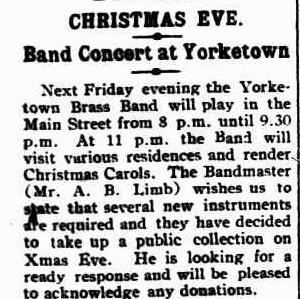
Far south of Darwin in the South Australian township of Yorketown located on the Yorke Peninsula, the local brass band had announced it was going to present a program of music in the street of town (“CHRISTMAS EVE.,” 1920).  As we can see in the article published in the Pioneer newspaper, their Christmas Eve program was quite long with one session of playing from “8p.m. until 9.30p.m.” and then “At 11pm the Band will visit various residences and render Christmas Carols.” (“CHRISTMAS EVE.,” 1920).  This was also supposed to be a beneficial exercise for the band as well; they were taking up a collection for new instruments.

The Pioneer, 18/12/1920, p. 3

Then we have performances from bands on Christmas Even where the performance was their first-ever performance!  In an article published in the Rockhampton Evening News January 1934, we find that the Springsure Brass Band held their first public outing on the night of Christmas Eve, 1933 (“SPRINGSURE BAND DEBUT,” 1934).  Springsure is a township located inland from Rockhampton and Gladstone and we can in the article a fair degree of pride in this new band.  Full congratulation was given to the musicians on the progress made in their playing.

The Evening News, 3/01/1934, p. 5

In 1946 the Port Fairy Brass Band went out and about playing Christmas carols around town on Christmas Eve and earned praise wherever they played (“CHRISTMAS CAROLS.,” 1946).  This was no less remarkable given the year when they played – one year after World War Two ended – and this was noted by the Mayor in the article,

The Mayor said he was pleased to welcome to his house, one of the best institutions in the town.  What surprised him was that in spite of the war, and the number of members who enlisted, the band seemed to be as strong as ever.  He did not know exactly the reason of their success, unless, it was the strong personality of their bandmaster.

(“CHRISTMAS CAROLS.,” 1946)

Christmas Day and Night:

It was an early start for one band on Christmas Day, evidently, it was a very committed ensemble!  So much so that on Christmas Day 1922 in the New South Wales South-West Slopes town of Tumut, the brass band was up and about at 4.30 in the morning,

On Xmas morning at 4.30 the Tumut Brass Band conveyed in Messrs Barker and Son’s motor bus, did a tour, commencing in the main street, and visiting every portion of the town and suburbs where there was any population, completing their self-imposed and laudable undertaking at 8.30.  The music supplied by them was of a particularly enjoyable nature, and Mr Pitcher (bandmaster) and his body of performers numbering about 20 deserve the highest of congratulations for the treat afforded by them.

(“Christmas,” 1922)

While the Tumut Brass Band were out and about in the morning, we can see some bands presented pleasing programs on Christmas night.  The Clare Brass Band was to present a program of old English carols at 8.15pm on Christmas night and it was expected there was going to be a large audience, as there had been the night before when a local choir sang at the local rotunda (“CHRISTMAS CAROLS ON BAIN ROTUNDA.,” 1932).

Then there are the very big Christmas events of which Adelaide staged one on Christmas night in 1935.  Presented in by The Mail newspaper and involving the South Australian Choral Association and the S.A. Bands’ Association, this appeared to be a massive musical undertaking by including a massed choir and a massed brass band.  After many months of rehearsal, this event was to be presented at the Wayville Showgrounds and it is one of the early times where an event like this was conceived of in Australia (““Music in the Air” On Xmas Night,” 1935).

On Christmas Night in 1949, the Bathurst District Band was to present a very big concert involving thirty-five of their band members from both the senior band and their Boys’ Band (“XMAS BAND RECITAL,” 1949).  The program of music for this concert was going to include the obligatory carols and a number of other items.  The band was hoping that an attendance record would be broken (“XMAS BAND RECITAL,” 1949).

Boxing Day:

00000000_Wandiligong-BB_phot13253
Wandiligong Brass Band (Source: IBEW)

Not to be left out of the Christmas festivities were the bands that were part of events on Boxing Day.  In an article published by the Myrtleford Mail and Whorouly Witness newspaper, it was reported that the “Bright Xmas Carnival” was the place to be on Boxing Day in 1917,

From early morning buggies and coaches brought big crowds into town, and the special train from Wangaratta was splendidly patronised and also conveyed quite a number of horses and competitors, assuring the social and financial success of the meeting.

(“Bright Xmas Carnival.,” 1917)

The Wandiligong Brass Band was not forgotten and was said to have given “a fine programme of music both on the ground and before the performance at night” (“Bright Xmas Carnival.,” 1917).

Gifts and giving:

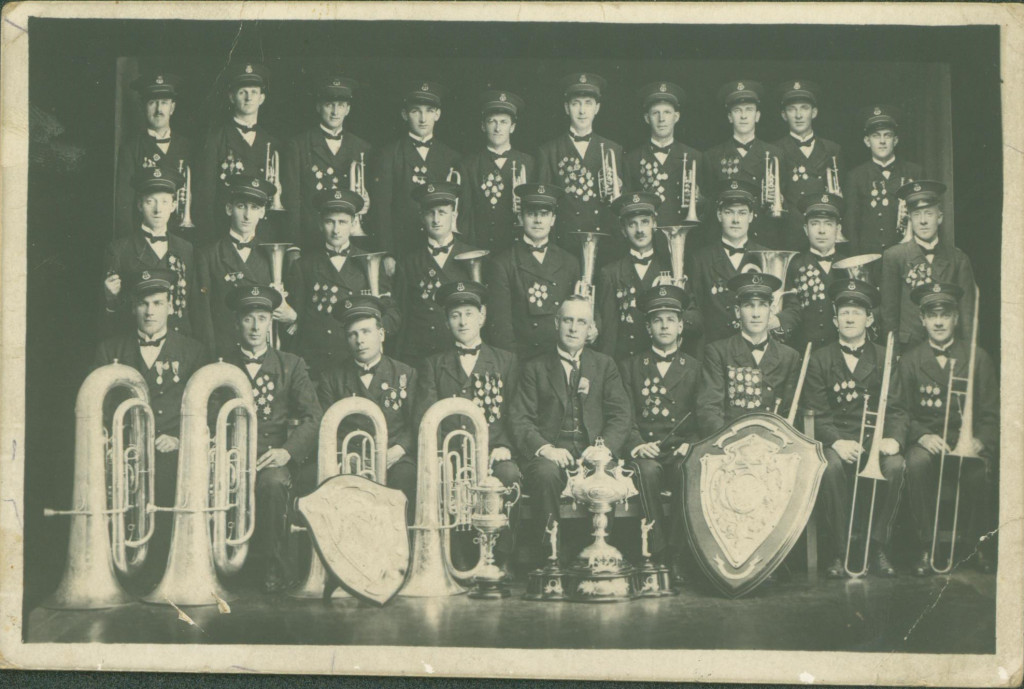
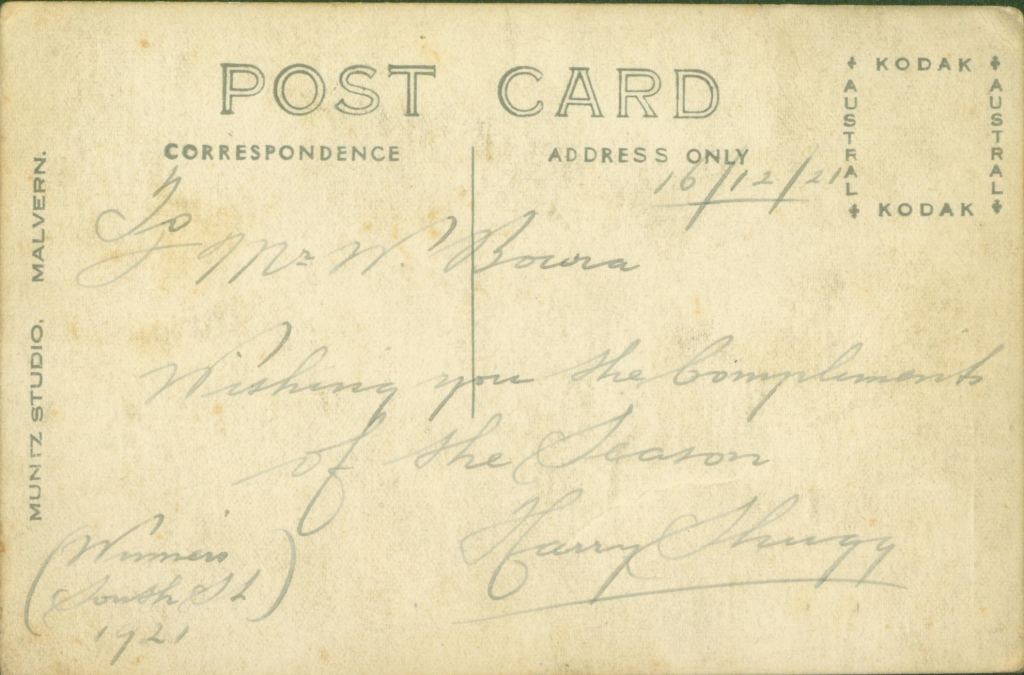
When researching for this post, it was also evident that band-related gifts and platitudes were exchanged of which here are two examples (there were probably more).  On the 16th December 1921 the conductor of the Malvern Tramways Band, Mr Harry Shugg gave a postcard picturing his prize-winning band to a Mr W. Boina with a short message wishing him the “Compliments of the Season” and as can be seen on the back of the postcard below, in brackets, “(Winners South St 1921)” (Muntz Studio, 1921).  No doubt Harry Shugg was very pleased with his band – and rightly so.

19211216_Malvern-Tramways-Band_Postcard
Postcard, Malvern Tramways Band, 1921 (front) (Source: Victorian Collections: Victorian Bands’ League Library & Archive)
19211216_Malvern-Tramways-Band_Postcard-Back
Postcard, Malvern Tramways Band, 1921. Handwriting by Mr Harry Shugg (back) (Source: Victorian Collections: Victorian Bands’ League Library & Archive)

For Christmas 1927, the members of the Cleve Brass Band gave their conductor, Mr W. Gillings, an aneroid barometer “suitably inscribed” as a gift in thanks for all the work he had done for the band (“Cleve Brass Band.,” 1928).  This was a wonderful token of appreciation and one which the conductor would no doubt have treasured.

Thinking of home at Christmas time:

We know that music can invoke all kinds of emotions and at Christmas time this feeling is no less poignant.  There were some who were away from their hometowns at Christmas in faraway places.  Published in the Carcoar Chronicle on Friday 19th of February 1915 was a letter from a local man, Mr Jack (John) Collyer who had enlisted in the Australian Expeditionary Forces and was then stationed in Egypt.  While he wrote extensively of his Christmas Day experiences in the Army camp, he made special mention of a brass band who reminded him of home,

I woke at 5 a.m. to hear splendid music, a brass band playing Xmas carols, a hundred yards away from my tent.  Talk about thrill – it was glorious.  I lay awake listening to the grand strains of ‘Hark, the Herald Angels Sing,’ and others and my mind wandered to Mudgee”

(“XMAS IN EGYPT.,” 1915)

Conclusion:

Music is synonymous at Christmas time and as we have seen, the many brass bands were in their element by eliciting town pride and enlivening the festivities.  These little stories were some of many, there were too many to list such is the activity of Australian bands at this time of year.  As I said at the beginning of the post, the times may have changed but the engagements have not!

I’d like to thank all the people who have read posts from Band Blasts From the Past over the past year and I hope you have found the posts informative.  I’d like to take this opportunity to wish my readers the compliments of the season, and I hope the coming year, and decade, is a safe, healthy and prosperous one. 

Jeremy de Korte (22/12/2019)

(Updated, 04/12/2023)

References:

BrightBright Xmas Carnival. (1917, 04 January). Myrtleford Mail and Whorouly Witness (Vic. : 1914 – 1918), 3. http://nla.gov.au/nla.news-article138709194

Christmas. (1922, 29 December). Tumut and Adelong Times (NSW : 1864 – 1867; 1899 – 1950), 2. http://nla.gov.au/nla.news-article139029474

Christmas and New Year’s Eves : The Tourists. (1913, 03 January). Alexandra and Yea Standard and Yarck, Gobur, Thornton and Acheron Express (Vic. : 1908 – 1949), 2. http://nla.gov.au/nla.news-article61188518

CHRISTMAS CAROLS. (1946, 28 December). Port Fairy Gazette (Vic. : 1914 – 1918), 2. http://nla.gov.au/nla.news-article88009047

CHRISTMAS CAROLS ON BAIN ROTUNDA : Clare Brass Band to Play Old English Carols on Xmas Night. (1932, 23 December). Northern Argus (Clare, SA : 1869 – 1954), 5. http://nla.gov.au/nla.news-article97616336

CHRISTMAS EVE : Band concert at Yorketown. (1920, 18 December). Pioneer (Yorketown, SA : 1898 – 1954), 3. http://nla.gov.au/nla.news-article199107675

Cleve Brass Band. (1928, 13 January). Eyre’s Peninsula Tribune (Cowell, SA : 1910 – 1950), 3. http://nla.gov.au/nla.news-article219285198

Coleraine Albion. (1915, 30 December). Coleraine Albion and Western Advertiser (Vic. : 1902; 1914 – 1918), 2. http://nla.gov.au/nla.news-article119606385

Colliver Photo. (1907). Band Rotunda, Rushworth, Victoria [Postcard]. [194458]. W. T. Pater, Printers and Stationers, Melbourne, Victoria. 

HistoryInPhotos. (2009, 21 February). The School Band at Beechworth, Vic, in 1931 [Photograph]. flickr. Retrieved 11 November 2019 from https://www.flickr.com/photos/26421213@N08/3295771357

McPhail and Peak Hill District Band. (1905, 15 December). Peak Hill Express (NSW : 1902 – 1952), 9. http://nla.gov.au/nla.news-article107246068

Muntz Studio. (1921). Malvern Tramways Band, 1921 [Postcard : L12.5cm – W8.2cm]. Victorian Bands’ League, Victoria Collections. https://victoriancollections.net.au/items/5b1ccc9521ea69132c023cd5

“Music in the Air” On Xmas Night : Big Wayville Festival. (1935, 14 December). Mail (Adelaide, SA : 1912 – 1954), 10. http://nla.gov.au/nla.news-article55719008

SPRINGSURE BAND DEBUT : Big Event of Xmas. (1934, 03 January). Evening News (Rockhampton, Qld. : 1924 – 1941), 5. http://nla.gov.au/nla.news-article201260331

Wandiligong Brass Band. (n.d.). [Photograph]. [phot13253]. The Internet Bandsman Everything Within, Vintage Brass Band Pictures : Australia. http://www.ibew.org.uk/vbbp-oz.html

XMAS AT THE HOSPITAL. (1920, 28 December). Northern Territory Times and Gazette (Darwin, NT : 1873 – 1927), 3. http://nla.gov.au/nla.news-article3303945

XMAS BAND RECITAL. (1949, 23 December). National Advocate (Bathurst, NSW : 1889 – 1954), 2. http://nla.gov.au/nla.news-article161655263

XMAS IN EGYPT : Some Interesting News. (1915, 19 February). Carcoar Chronicle (NSW : 1878 – 1943), 2. http://nla.gov.au/nla.news-article103560632

THE XMAS SEASON. (1915, 01 January). Murchison Advertiser and Murchison, Toolamba, Mooroopna and Dargalong Express (Vic. : 1914 – 1918), 3. http://nla.gov.au/nla.news-article130086316