Trans-continental connections: the brass bands of Broken Hill and Kalgoorlie

Introduction:

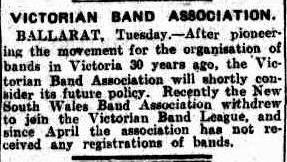
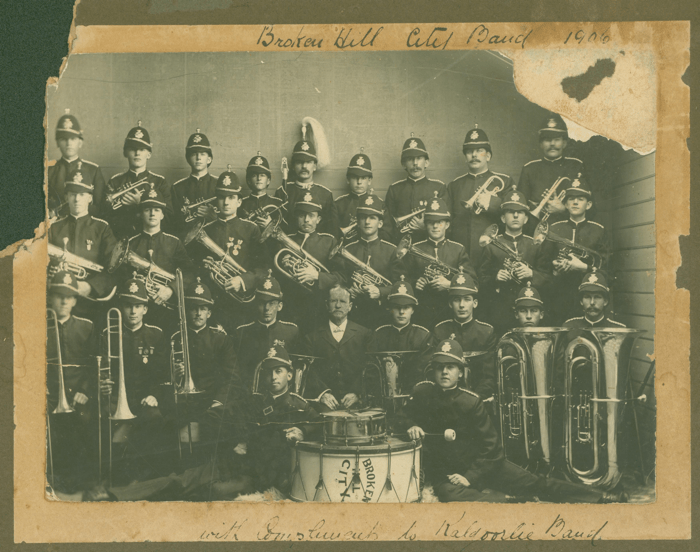
Above is an intriguing photo.  This photo of the Broken Hill City Band dated 1906 starts a story through the message that is penned around the edges; “Broken Hill City Band 1906 with compliments to Kalgoorlie Band”.  Knowing the geography of Australia as we do, the towns of Broken Hill and Kalgoorlie are very far apart.  Yet as we also know, during these times brass bands toured fair distances to participate in competitions and performances.  It was no different for these two bands.  They did meet, twice in five years.

The photo above is held in the archives of the Victorian Bands’ League, so we wonder why it is still in Victoria. That story cannot be told due to a lack of information.  However, we do know when and where the two bands met, and the first meeting was in Victoria at the famous South Street Competition.  The fact that they were both at South Street in 1906 reflects a ‘can do’ attitude from both bands, as well as many others.  The travel was long and expensive, but the lure of rewards beckoned. Such was the case when the bands met again in 1911, the next time in Kalgoorlie.

Hence this post covers the years of 1906 and 1911, two different times.  We can marvel at the travel that was undertaken and the other ‘little’ stories surrounding the trips.  The central theme of this post, however, is the fact that these bands met and seemingly formed a mutual respect and friendship through music, geography, and circumstance.

The early bands of Broken Hill and Kalgoorlie:

Aside from the distance from each other, the establishment of both Broken Hill and Kalgoorlie followed relatively similar paths.  Both are remote mining towns that experienced rapid population growth with the discovery of minerals – “silver, lead and zinc” in Broken Hill in 1883 and gold in Kalgoorlie in 1893 (Frost, Malam, Williams, & Malarz, 2014, p. 39).  With increased population came increased services and demand for transport links, most importantly the early railways (Frost et al., 2014).  Interestingly, a rail link from Broken Hill to Adelaide was built before Broken Hill was linked to Sydney and over in Kalgoorlie-Boulder, rail links were built to the south coast at Esperance and west to Perth (Frost et al., 2014).  With the development of these important centres, and the influx of people came the establishment of early brass bands (Farrant, 1989).

Briefly, the bands of Broken Hill and Kalgoorlie started with years of each other with bands in Kalgoorlie-Boulder commencing in 1895 and consolidating themselves a few years later – by 1900 there were two bands in Boulder and one band in Kalgoorlie (Farrant, 1989; Goldfields Brass Band, 2004).  The remaining band in Kalgoorlie, the Goldfields Brass Band can trace its lineage back to the Boulder Brass Band having been gifted a store of music and instruments in 1963 (Goldfields Brass Band, 2004).  The Kalgoorlie brass bands had a healthy respect and support of each other, and in the early years were boosted by the talents of the five McMahon brothers who arrived in Kalgoorlie-Boulder in 1900 (Farrant, 1989; Greaves & Earl, 2001).  Over the coming years, the famous Cornetist and Conductor Hugh McMahon and his brother Henry (Harry) took their bands all the way to Ballarat to compete at the South Street competitions with varying degrees of success (Greaves & Earl, 2001).

A similar development of brass bands occurred in Broken Hill where a band was established in 1899 as the “Bermingham’s Band…with J. J. Bermingham and his 9 sons comprising the majority of the membership” (Barrier Industrial Unions (BIU) Brass Band, 2019).  The band expanded its membership and was renamed the Broken Hill City Band a year later – the current Barrier Industrial Unions (BIU) Brass Band is a direct descendant of this early band (Barrier Industrial Unions (BIU) Brass Band, 2019).  The townsfolk and band members of Broken Hill, like Kalgoorlie, appreciated music and visits from other brass bands were well-attended (“THE AUSTRAL BRASS BAND.,” 1906).

1906: The South Street Competition, Ballarat:

The year is 1906 and from across Australia, brass bands have once again made their way to the South Street competition.  Since the commencement of brass band and brass solo/ensemble sections at South Street in 1900, this section of the competition continues to grow.  In 1906 these thirteen listed bands participated in the A and B grade sections with many bands participating in both grades, and many other musicians competing in the solo and ensemble sections:

(Vic.) Ararat Model (B Grade)
(Vic.) City of Ballarat (A & B Grades)
(Vic.) Bairnsdale Municipal (A & B Grades)
(NSW) Broken Hill City Band (A & B Grades)
(Vic.) Collingwood Citizens’ Band (A & B Grades)
(Vic.) Daylesford Citizens (B Grade)
(Vic.) Eaglehawk Borough (B Grade)
(WA) Kalgoorlie and Goldfields Infantry and Regimental Band (A Grade)
(Vic.) Maldon Miners (B Grade (Withdrew from A Grade))
(Vic.) Prout’s Ballarat Brass Band (A & B Grades)
(Vic.) Richmond City Band (A & B Grades)
(Vic.) St. Augustine’s Orphanage Band (A Grade)
(Tas.) Ulverstone Rangers (A & B Grades)
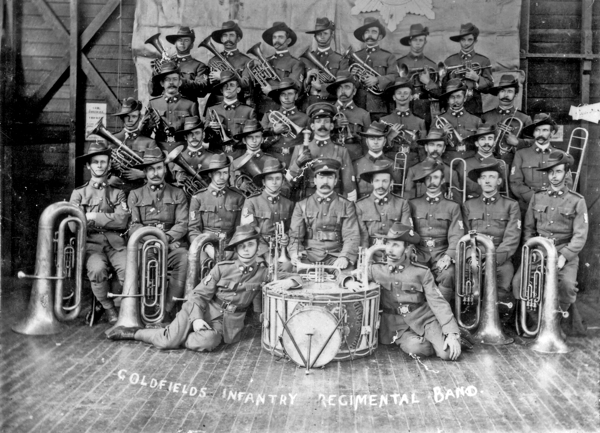
(Mullen, 1951; “No title,” 1906; Royal South Street Society, 1906c)
19050000_Goldfields-Regimntal_008561d
Goldfields Infantry Regimental Band 1905 (Source: State Library of Western Australia: Government Photographer Collection: 008561D)

Considering the travel methods of the day, to attract this many bands with three of them travelling from other colonies is quite remarkable.  Such was the lure of the South Street competition.  For the Kalgoorlie Regimental band, they were travelling paths set down by the Boulder City Band and the Boulder A.W.A Mines Band before them as they participated South Street in 1902, 1903 and 1905 and achieved excellent placings (Farrant, 1989; Greaves & Earl, 2001).  Travel for Kalgoorlie bands to get to South Street involved a train, a ship and another train and tours often lasted for six weeks (Farrant, 1989).  The distance for the Broken Hill band was not quite as long but involved a roundabout way of travel as the band took a train to Adelaide and then another train from Adelaide to Ballarat (“BALLARAT EISTEDDFOD.,” 1906a).

The details of the 1906 South Street competition were notable for several reasons.  Much of this was due to the performance of the legendary St. Augustine’s Orphanage Band from Geelong who, despite their youth, managed to win all of the A Grade sections and carry off the Sutton Shield & Cup and the Boosey Cup (“The Ballarat Band Contests.,” 1906; “BALLARAT EISTEDDFOD.,” 1906b).  By all accounts the quality of their performance and subsequent win were undisputed. However, there was a degree of controversy about this competition and some felt results underneath St. Augustine’s were unjustified.
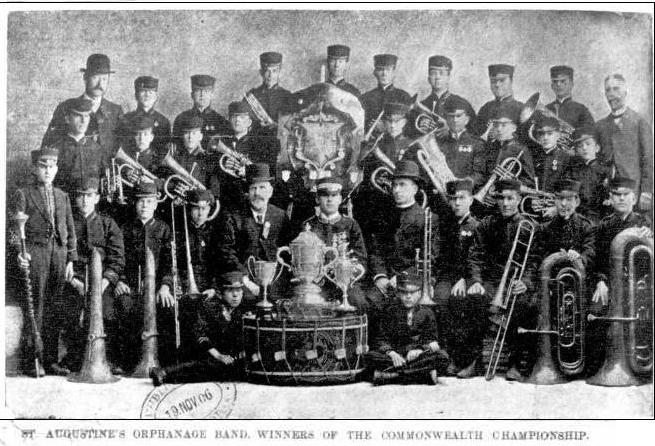
19061117_Advocate_Ballarat-Competion
Advocate, 17/11/1906, p. 14

Some of the controversies were pinned to the choice of the adjudicator.  Unlike previous years when the band sections were adjudicated by eminent brass band authorities such as James Ord Hume, Captain W. G. Bentley, and Albert Wade, the 1906 competition was adjudicated by a Professor Frederick W. Beard LRAM of Birmingham (Greaves, 1996). Professor Beard, “did not pretend to be a brass band expert” but apparently “had a thorough knowledge of orchestral work and he knew enough about brass instruments to qualify for the position he undertook…” (“BALLARAT EISTEDDFOD.,” 1906b).  Such a decision did not go down well with some bands. Upon the return of the Kalgoorlie band back home, their President, Mr Eli Shaw read out a resolution of the Richmond City Band at the welcome home reception which stated,

That this band respectfully declines to enter or compete at any band contest unless a practical brass band conductor, or conductors, be appointed as judge, the definition of ‘practical’ being an approved registered conductor, who has piloted bands to victory in large contests, and that copies of this resolution be forwarded to all secretaries of all registered bands in Victoria asking them to adopt the same, and forward on to secretary of Victorian Band Association, Ballarat.

(“KALGOORLIE BRASS BAND.,” 1906)

Such was the ill-feeling from one band who participated in this competition.

For the Broken Hill City Band, the results simply did not go their way in the A grade or B grade sections except for winning the third prize for discipline behind the Bairnsdale & Eaglehawk bands (Royal South Street Society, 1906c).  However, their playing was judged by others to be excellent and it was felt that their placings were not deserved (“BALLARAT BAND CONTESTS.,” 1906).

The experiences of the Broken Hill Bands and the Kalgoorlie band were somewhat linked and for the Kalgoorlie band, some felt they had been treated extremely unfairly by the Victorian Band Association (V.B.A.) and the adjudication.  It was not until the Kalgoorlie Band arrived in Ballarat that they found out they had been unexpectedly regraded from B grade to A grade on account of the V.B.A. wrongly assuming the status of some of their members (“KALGOORLIE BRASS BAND.,” 1906).  Apparently, the V.B.A. told Kalgoorlie they had sixteen members who had played with the A.W.A Band and the Boulder City Band in previous years, of which the Kalgoorlie Band “proved” that these sixteen “had never played before in a contest” (“KALGOORLIE BRASS BAND.,” 1906).  If we are to believe this account, it would seem the V.B.A., which was the band association overseeing the registrations, had made a grievous mistake somewhere.

There were also the woes of adjudication which upset many in the band community.  At the same reception where Mr Eli Shaw read out the resolution by the Richmond City Band, he also read out letters of support from the Broken Hill band and the Hobart band.  Perhaps, this letter is somehow tied into the photo at the head of this post, but we may never know this for sure.  The letter, written by the bandmaster of Broken Hill, was printed in an article published by the Kalgoorlie Western Argus upon the return of the band back home:

Permit me and the members of the Broken Hill City Band to offer you and the talented members of your Kalgoorlie Band our sincerest sympathy in the position in which an utterly outrageous adjudication has placed you at this Ballarat contest.  It is the consensus of opinion amongst all whom we have met, and are disinterestedly capable of giving a sound musical judgement, that your rendering of the test and choice, especially the latter, was a real musical treat, and that the judge, in awarding such an absurdly low number of points, insulted the musical intelligence of hundreds, who, I am sure, are infinitely more capable of giving a fair judgement than he did.  Allow me once more to offer you our sincere sympathy, and we hope that this perverted judgement will not prevent us from hearing your magnificent band many times again here.

(“KALGOORLIE BRASS BAND.,” 1906)

The sentiments of the bandmaster of the Hobart band were very similar – a grave injustice had been done, not only on this band but the whole community of bands.

The Kalgoorlie band did what they could under the circumstances and obviously drew praise for their playing.  Upon the completion of the Ballarat contest, they travelled to Bendigo to present a concert and were awarded a civic reception upon their arrival, and received an excellent review of their performance (“KALGOORLIE REGIMENTAL BAND.,” 1906).  From Bendigo, they travelled home and Kalgoorlie gave them a hero’s welcome upon their return with a reception attended by the other bands in the region, local politicians and the Mayor (“KALGOORLIE BRASS BAND.,” 1906).

Aside from the results in the band sections, competition results in the solo and ensemble sections were a consolation for both the Broken Hill and Kalgoorlie bands.  All sections had a number of entries and included musicians from bands that were not in the main band sections (Royal South Street Society, 1906a, 1906b).  It would have been pleasing for the Royal South Street Society to have so many entries.

1911: The Kalgoorlie Eisteddfod:

The Kalgoorlie Eisteddfod was obviously a much smaller event than South Street, yet it seemed to generate similar excitement and interest from participants and audience.  So much so that several public authorities, the Eisteddfod and the West Australian Band Association made sure that visiting bands were treated to the finest hospitality. The 1911 Eisteddfod was notable for the participation of the Albany Brass Band and the Broken Hill City Band who travelled to Kalgoorlie to compete against the three Kalgoorlie-Boulder bands.

In August 1911 the Broken Hill City Band commenced a long journey to Kalgoorlie.  The Trans-Continental Railway was yet to be built, so the band took the train to Adelaide where they presented a concert on the 18th of August before taking a ship to Albany (“BROKEN HILL BAND.,” 1911a).  There was a huge amount of interest generated by the arrival of these two bands in Kalgoorlie.  On the 25th of August, both the Albany and Broken Hill bands arrived in Kalgoorlie, and their travel movements were reported on by the Kalgoorlie Miner newspaper – of which also highlighted an example of the hospitality they were being awarded,

The Broken Hill men got off the Karoola at Albany, and special carriages were provided for both the Barrier and Albany men through to the goldfields.  At Northam the carriages were shunted off, and later attached to the express, so that there was no confusion caused in regard to transhipping baggage, etc.  The Albany men gave a concert at Northam while waiting for the express, and realised a fair profit.

(“KALGOORLIE EISTEDOFOD,” 1911)

…and remarking on uniforms,

The green and gold uniforms of the players from Broken Hill are particularly effective, and in mufti they wear green hat bands and gold lettering; also badges of green and gold. The Albany attire is of blue, with red facings and badges of the same colours.

(“KALGOORLIE EISTEDOFOD,” 1911)

Both bands were received at the Kalgoorlie station by a plethora of officials and townsfolk and the railway station reception also included a small combination of the three Kalgoorlie-Boulder bands playing music.  After this welcome, both bands formed up and marched to the Eisteddfod office and then after more speeches, marched to their hotel (“KALGOORLIE EISTEDOFOD,” 1911).

Fortunately, the article in the Kalgoorlie Miner newspaper also published the names of the bandsmen from both bands so we have this piece of history on record:

P. Pfitzner, conductor
W. May, professional cornet
H. Mitchell, solo cornet
A. Hendy, solo cornet
J. Shannon, repiano cornet
S, Phillips, flugel horn
E. Holland, second cornet
H. Halse, third cornet
W. Keays, soprano cornet
E. W. Barwick, solo horn
R. Rawle, second horn
John Richards, first horn
W. Partington, baritone
O. Hannett, baritone
D. Hopkins, euphonium
R. Ramsay, euphonium
C. Thomas, trombone
Stan Phillips, trombone
J. Martin, bass trombone
J. Bartley, BBb bass
W. Head, BBb bass
O. Berriman, Eb bass
S. Goldring, Eb bass
C. Kumm, bass drum
R. Gummow, side drum
M. Williams, side drum
Mr. J. Doherty, is the drum major, Mr. J. Mitchell is the manager, and Mr. W. W. Barwick the secretary.

(“KALGOORLIE EISTEDOFOD,” 1911)

A day later both bands were getting into their practice on the city oval which was reported on by the Kalgoorlie Miner.  The welcoming ceremonies were not over.  After their afternoon practice on the oval, both bands marched to the town hall to be received by the mayor and councillors who awarded them another civic reception (“KALGOORLIE EISTEDDFOD,” 1911).  Toasts were given all around and it appears the Mayor of Kalgoorlie had spent some years in Broken Hill, so he was familiar with the town and mines.  The camaraderie was evident as was the hospitality.  Mr J. Mitchell, secretary of the Broken Hill band said as much in his response to the welcome.

…he appreciated the kindness that had been shown them, especially by the energetic committee and secretary, who had secured free railway passes for them, otherwise Broken Hill Band could hardly have taken the trip.

(“KALGOORLIE EISTEDDFOD,” 1911)

A few days later the Broken Hill band presented a concert in Kalgoorlie’s Victoria Park which was well-attended by the townsfolk.  As a measure of support, the band received £32 in total from contributions which obviously helped with some expenses – the trip was estimated to cost £400 (“BROKEN HILL BAND.,” 1911b).  The band was said to have performed with “good quality of tone, excellent balance, and intelligence in interpretation” which was high praise for the visiting ensemble (“BROKEN HILL BAND.,” 1911b).  No doubt a good review for the band to have!  Interest in the bands had not waned and was carried through to the Eisteddfod proper.  Certainly, the enthusiasm from the townspeople and friendship of the local bands between each other attracted the notice of local commentators (“KALGOORLIE BAND COMPETITIONS,” 1911).
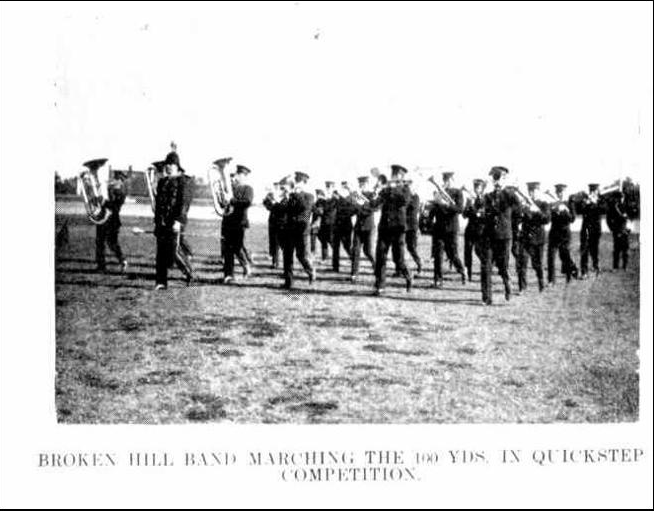
19111010_Kalgoorlie-Western-Argus_Competition-Broken-Hill-March
Kalgoorlie Western Argus, 10/10/1911, p. 21

The band sections of the Eisteddfod commenced in the first week of September and were adjudicated by Mr Charles Allison who also did his bit by leading the combined bands on a street march and conducting them on the oval (“KALGOORLIE BAND COMPETITIONS.,” 1911).  The sight of the three Kalgoorlie-Boulder bands combined with the bands of Broken Hill and Albany would have been quite spectacular.  Over the coming days, all bands competed in a variety of band and solo/ensemble sections and results were mixed between them – the Kalgoorlie Band won the overall championships however the Broken Hill band won the Street March section (“BAND CONTESTS,” 1911; “STREET MARCHING COMPETITION,” 1911).

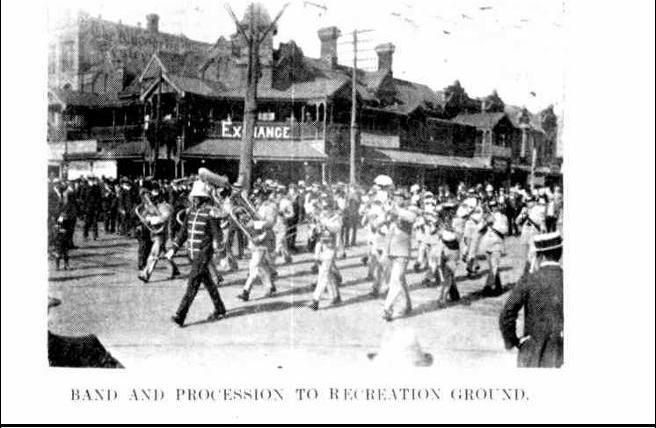
19111010_Kalgoorlie-Western-Argus_Competition-Massed-Bands
Kalgoorlie Western Argus, 10/10/1911, p. 21
19111010_Kalgoorlie-Western-Argus_Competition-Procession
Kalgoorlie Western Argus, 10/10/1911, p. 21

By all accounts, this was a very good band contest with little reported controversy and where all bandsmen exhibited the best of behaviour towards each other.  Indeed, even during the contest, social nights were encouraged and the Kalgoorlie-Boulder bands made sure the visiting bands were very welcome (“VISITING BRASS BANDS.,” 1911).  This hospitality was not lost on the visiting bands and in an article published on the 9th of September in the Truth newspaper we read that,

The visiting bandsmen, however, express their intense appreciation of the kindness and courtesy extended to them on all hands.  The Chamber of Mines, the School of Mines, the brewery manager, the Race Club, secretaries, the manager of the power house, and others did their best to make the Albany and Broken Hill men enjoy themselves.

(“Kalgoorlie Band Contests.,” 1911)

According to an account by a member of the Broken Hill band who documented the whole trip, and which was published in the Barrier Miner newspaper, the Broken Hill band commenced then commenced a long trip home – a train to Perth, a ship to Adelaide and another train to Broken Hill.  The band arrived back in Broken Hill on September 17th and despite some results not going their way, they acquitted themselves well and certainly enjoyed the trip west (“THE BROKEN HILL BAND.,” 1911).

Conclusion:

What is evident here through these ‘little stories’ is just one example from many of the connections and friendships that were made between early brass bands.  There is probably much more that can be written on this topic.  However, one must admire the fact that these bands traversed vast distances and in doing so gave themselves chances that they otherwise would not have had.  The fact that the Broken Hill and Kalgoorlie bands came from towns that developed around mining obviously helped the friendships that developed.

I have formed no doubt through the research for this post that these two bands gained valuable experiences from their trips.  Competitions aside, it was the camaraderie of early bands people and the connections that were formed that made the trips even more worthwhile.

References:

THE AUSTRAL BRASS BAND. (1906, 08 February). Barrier Miner (Broken Hill, NSW : 1888 – 1954), 3. http://nla.gov.au/nla.news-article44491455

BALLARAT BAND CONTESTS. (1906, 03 December). Barrier Miner (Broken Hill, NSW : 1888 – 1954), 3. http://nla.gov.au/nla.news-article44520304

The Ballarat Band Contests : The Championship of the Commonwealth Won by St. Augustine’s Band : The Boys Carry off All the First-Class Prizes : An Unprecedented Feat. (1906, 17 November). Advocate (Melbourne, Vic. : 1868 – 1954), 14. http://nla.gov.au/nla.news-article170199282

BALLARAT EISTEDDFOD. (1906a, 29 October). Evening News (Sydney, NSW : 1869 – 1931), 2. http://nla.gov.au/nla.news-article115677274

BALLARAT EISTEDDFOD : Brass Band Section : Victories of the Orphans : St. Augustine’s Wins the Double. (1906b, 08 November). Evening News (Sydney, NSW : 1869 – 1931), 2. http://nla.gov.au/nla.news-article115680908

BAND CONTESTS : Championship won by Kalgoorlie. (1911, 04 September). Evening Star (Boulder, WA : 1898 – 1921), 3. http://nla.gov.au/nla.news-article204606679

Barrier Industrial Unions (BIU) Brass Band. (2019). History. Barrier Industrial Unions (BIU) Brass Band. Retrieved 03 September 2019 from https://biuband.com.au/history/

BROKEN HILL BAND. (1911a, 19 August). Register (Adelaide, SA : 1901 – 1929), 13. http://nla.gov.au/nla.news-article58436856

BROKEN HILL BAND. (1911b, 28 August). Kalgoorlie Miner (WA : 1895 – 1950), 6. http://nla.gov.au/nla.news-article91317321

THE BROKEN HILL BAND : Its West Australian Trip. : (By a Member). (1911, 20 September). Barrier Miner (Broken Hill, NSW : 1888 – 1954), 5. http://nla.gov.au/nla.news-article45165481

Broken Hill City Band. (1906). [Rectangular black and white photograph mounted on card : L21.6cm – W16.5cm]. [0006]. Victorian Collections, Victorian Bands’ League. https://victoriancollections.net.au/items/5b59a68021ea690d805b060c

Eastern Goldfields Historical Society Inc. (2019). Kalgoorlie : City of Kalgoorlie-Boulder. Eastern Goldfields Historical Society Inc. Retrieved 03 September 2019 from https://kalgoorliehistory.org.au/towns/Kalgoorlie

Farrant, J. E. (1989). Boulder bands win at Ballarat, 1904/1905. Studies in Western Australian History, 10(April [Celebrations in Western Australian history / Layman, Lenore & Stannage, Tom (eds.)]), 107-113. https://search.informit.org/documentSummary;dn=890911633;res=IELAPA 

Frost, G., Malam, K., Williams, L., & Malarz, A. (2014). The evolution of Australian towns [Research Report](136). T. Department of Infrastructure, Regional Development and Communication. https://www.bitre.gov.au/publications/2014/report_136.aspx

Goldfields Brass Band. (2004). History. Goldfields Brass Band. Retrieved 03 September 2019 from https://www.goldfieldsbrassband.org.au/history.php

Government Photographer. (1905). Goldfields Infantry Regimental Band [1 photographic print, mounted : b&w ; 10 x 12 cm.]. [008561d]. State Library of Western Australia, Government Photographer collection ; 816B/E/6541. https://encore.slwa.wa.gov.au/iii/encore/record/C__Rb2088645

Greaves, J. (1996). The great bands of Australia [sound recording] [2 sound discs (CD)]. Australia, Sound Heritage Association. 

Greaves, J., & Earl, C. (2001). Legends in brass : Australian brass band achievers of the 20th century. Muso’s Media. 

KALGOORLIE BAND COMPETITIONS : Notes by an Observer. (1911, 29 August). Kalgoorlie Miner (WA : 1895 – 1950), 2. http://nla.gov.au/nla.news-article91315285

KALGOORLIE BAND COMPETITIONS : Street Marching Contest : Won by Broken Hill Band. (1911, 13 September). Barrier Miner (Broken Hill, NSW : 1888 – 1954), 8. http://nla.gov.au/nla.news-article45164623

Kalgoorlie Band Contests : The Quickstep. (1911, 09 September). Truth (Perth, WA : 1903 – 1931), 6. http://nla.gov.au/nla.news-article208697815

KALGOORLIE BRASS BAND : Civic Reception. The Band’s Troubles. (1906, 11 December). Kalgoorlie Western Argus (WA : 1896 – 1916), 12. http://nla.gov.au/nla.news-article33083145

KALGOORLIE EISTEDDFOD : Brass Band Competitions : Visitors’ Movements. (1911, 26 August). Kalgoorlie Miner (WA : 1895 – 1950), 2. http://nla.gov.au/nla.news-article91321579

KALGOORLIE EISTEDDOFOD : Brass Band Competitions : Broken Hill and Albany Players : Reception Arrangements. (1911, 25 August). Kalgoorlie Miner (WA : 1895 – 1950), 2. http://nla.gov.au/nla.news-article91326006

KALGOORLIE REGIMENTAL BAND. (1906, 06 November). Bendigo Independent (Vic. : 1891 – 1918), 3. http://nla.gov.au/nla.news-article227751661

Mullen, C. C. (1951). Mullen’s Bandsmen of South Street (1900-1951). Horticultural Press. 

No title. (1906, 29 October). Ballarat Star (Vic. : 1865 – 1924), 2. http://nla.gov.au/nla.news-article210688939

Royal South Street Society. (1906a, 30 October). 1906-10-30 Brass Solo Contests. Royal South Street Society. Retrieved 26 August 2019 from https://results.royalsouthstreet.com.au/results/1906-10-30-brass-solo-contests

Royal South Street Society. (1906, 31 October). 1906-10-31 Brass Solo Contests. Royal South Street Society. Retrieved 26 August  2019 from https://results.royalsouthstreet.com.au/results/1906-10-31-brass-solo-contests

Royal South Street Society. (1906, 04 November). 1906-11-04 Band Contests. Royal South Street Society. Retrieved 26 August 2019 from https://results.royalsouthstreet.com.au/results/1906-11-04-band-contests

Scott, R. V. (1911, 10 October). KALGOORLIE BRASS BAND COMPETITIONS AND EISTEDDFOD. Kalgoorlie Western Argus (WA : 1896 – 1916), 21. http://nla.gov.au/nla.news-article33398332

STREET MARCHING COMPETITION : Won by Broken Hill. (1911, 04 September). Kalgoorlie Miner (WA : 1895 – 1950), 4. http://nla.gov.au/nla.news-article91325887

VISITING BRASS BANDS : Smoke Social in Kalgoorlie. (1911, 05 September). Kalgoorlie Western Argus (WA : 1896 – 1916), 10. http://nla.gov.au/nla.news-article33396714

The poetry of brass bands

Introduction:

While undertaking research for my blog posts thus far I have come across all manner of writing describing brass bands, their members and competitions.  Much of the writing is very useful in finding the “little stories” behind people, places and events.  Occasionally I have come across some oddities in the mix and this post is going to highlight an aspect of writing; poetry.

In this context of brass band history, penning up a poem about musicians, bands and competitions might seem very colloquial.  And in some respects, it is.  One only has to look at the style of writing and while the poems might not have won any literature awards, they were helpful in bringing to life some little stories in a unique style.

Below are just three of these brass band poems.  I have not been actively searching for these.  However, if while searching for material on other topics and they appeared, I have made a note of them for the novelty.  These are defiantly the needles in haystacks!  Two of the poems were published in local newspapers by writers using pseudonyms while the third poem was composed by brass band writer C. C. Mullen in his rare book, Mullen’s Bandsmen of South Street (1900 – 1951).

I am quite sure there are other brass band poems in other newspaper articles so this post might be expanded in the future.  Please enjoy the language and stories that are being told here and remember that they were for another time.  Perhaps this blend of artforms might be used again one day.

“A Welcome” by ‘Bannerman’ (1918):

Herald, 23/10/1920, p. 4

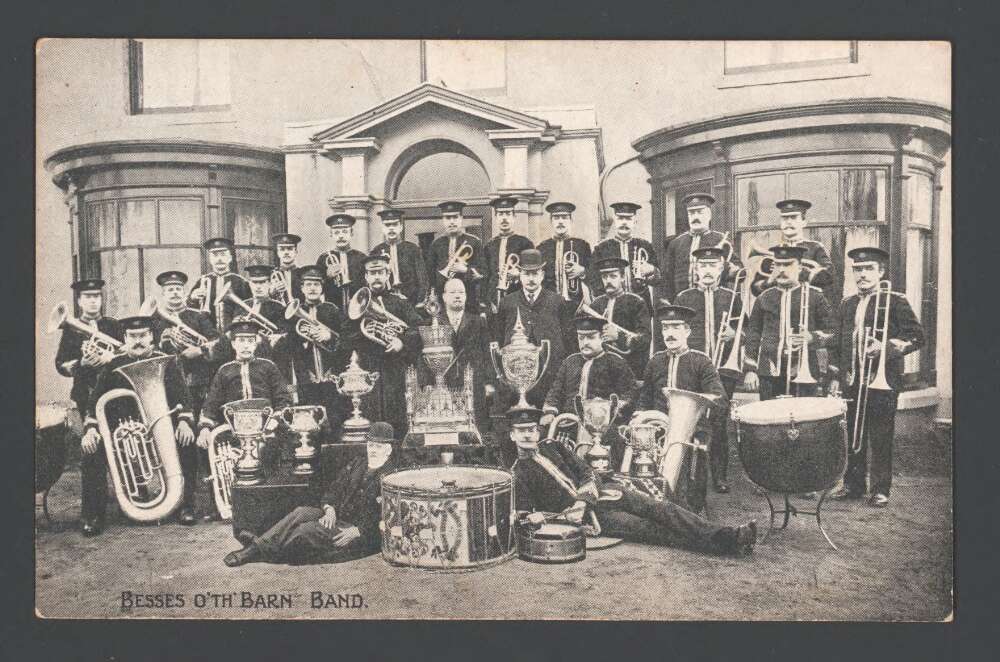
One of the first blog posts in Band Blasts from The Past was about the famous Cornetist and Conductor William Ryder who travelled to Australia in 1910 with the renowned Besses O’ Th’ Barn Band (de Korte, 2018).  Just eight years later, after stints with bands in Victoria and New South Wales, he arrived in Maryborough, Queensland to take the reins of the Maryborough Naval Band and we found that an enterprising contributor, under the pseudonym of ‘Bannerman’, had penned a poem to welcome him to town.  No doubt this would have been perceived as a very friendly gesture, and it gave the town some insight into the prowess and reputation of Ryder as a musician.  This poem was published in the Maryborough Chronicle, Wide Bay and Burnett Advertiser on Wednesday, 8thMay, 1918.

A WELCOME

Here’s a hearty welcome “Billy”,
To our pleasant country town,
And may Fortune every lead you,
And misfortune never frown.
We are pleased to have you with us,
And we hope you long may stay
To encourage local talent
In the latest style and way.

When you played the “solo cornet”
With the finest in the land,
You were classed as England’s champion
In the famous “Besses Band.”
And here in fair Australia
You can show us all the way
As the Champion of the Champions
From the South to old Wide Bay.

“Because” we all remember
When you played it at New Year,
When the silvery notes were finished
How the crowd did clap and cheer.
May our town and climate suit you,
May your notes prove ever true.
Here’s good-luck to wife and kiddies,
And long life and health to you.

(Bannerman, 1918, p. 6)

“Back to South Street” by Cecil Clarence Mullen (1951):

There is one brass band musician and writer among many who is significant to early Victorian brass band history, Cecil Clarence Mullen (C. C. Mullen).  His writing might be rare and hard to find now, however, being a band journal representative he had a unique insight into the workings of brass bands and was associated with many famous bands, conductors and administrators (Mullen, 1951).

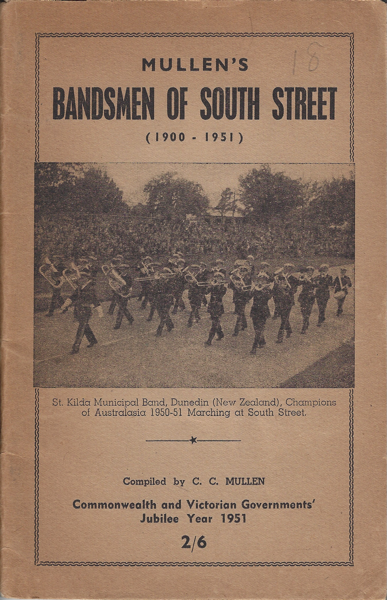
It is in his little book, Mullen’s Bandsmen of South Street (1900 – 1951) that we find his poem, “Back to South Street”. In this piece of writing Mullen has cleverly highlighted the nostalgia of the South Street event while noting many of the famous names of bands and bandsmen.  It is a worthwhile poem to read for the sake of history.

19510000_Mullen
Front Cover Mullen’s Bandsmen of South Street (1900-1951) (Source: Jeremy de Korte Personal Collection)

BACK TO SOUTH STREET

Just let me go back to South Street
For a week with the famous bands,
And take with me others who would compete
In Australia’s Golden City of renown.

Just let me alight at the station
With cornet, trombone and drum,
And meet bandsmen from all over the Nation,
To whom South Street once more come.

Just let me line up in the station yard
And play through Handel’s “Hallelujah Chorus,”
Or “The Heavens Are Telling” by Haydn – just as hard,
As bands played in the days before us.

Just let me march along Sturt Street
With gay crowds lining the way,
With step by step and beat by beat,
Is South Street just the same to-day?

Just let me see who is judging again,
Is it Stead or Bentley with ears for tune?
Short, Beswick, Sutton or Morgan – men of fame,
Or King of them all – J. Ord Hume.

Just let me go through Inspection
As we did when we dressed with much care;
With the gayest uniform in our section,
That made all our rivals stare.

Just let me compete in the solos again
From the grand old Coliseum stage,
With “Adelaide” or “Gipsy’s Warning” – or “Pretty Jane,”
“Zelda” and “Miranda” of a later age.

Just let me mount he platform
And play through “Beethoven’s Works.”
Or any Alexander Owen’s selections
That South Street bands would not shirk.

Just let me play through the Test piece,
Be it “Mercandante.” “Mozart” or “Liszt,”
“Wagner,” “Chopin” of “Meyerbeer,”
The tests that were tests on our lips.

Just let me march in the Quickstep
With Ord Hume’s “B.B. and C.F.”
“The Challenge,” “Cossack” or “Ravenswood”
Or was the “Twentieth Century” the best?

Just let me see the others swing past,
Code’s, Prout’s, Rozelle and Boulder.
Wanganui, Newcastle and Bathurst Brass,
Great names that come dear to the older.

Just let me see those fine Geelong bands,
St. Augustine’s, Municipal and Harbour Trust.
Also Collingwood, Malvern, Richmond, Prahran,
Perth City – all great power among us.

Just let me see Geelong Town again
With Sharpe Brearley at the head of affairs.
They ranked with Prout’s in quickstep fame,
First in marching honours was often theirs.

Just let me see the giants of the baton,
Riley, Code, Bulch and Prout,
McMahon, Barkel, Jones and Hoffman.
Many, alas, have gone out.

Just let me see others again,
Partington, Shugg, Johnston, Bowden.
Men who kept time in South Street’s fame;
Wade and Baile must be among them.

Just let me think if I missed any,
Yes, there was Davison, Niven, Lewins – any more!
Hopkins, Ryder, Billy May among many,
Not forgetting Frank Wright and J. Booth Gore.

Just let me see the best of officials
And critics like Davey, Gartrell and Hellings,
Humphreys and Boyce – Kings of staff and whistle,
May march us again – well, there’s no telling.

So to-day just let me go back to South Street,
Most famous contest in the land,
Where many old timers I will heartily greet,
And yarn over years that were so grand.

(Mullen, 1951, pp. 2-3)

“Dungog Brass Band” by ‘Mad Mick” (1954):

19120000_Dungog-BB_phot16862
Dungog Brass Band, 1912 (Source: IBEW)

Above is a picture of the Dungog Brass Band from around 1912 and unfortunately, this is one of the only pictures I could find of them.  However, some thirty years later this prose was published in the Dungog Chronicle : Dungog and Gloucester Advertiser newspaper by a member of the band writing under the pseudonym of ‘Mad Mick”.  One may wince at some of the language, but this was the 1950s.

From reading the poem it appears that ‘Mick’ is a third cornet player.  This poem is quite good in describing who the band is, what it does and where it goes, but the prose hints at some problems like attendance issues.  We can appreciate that this was a local town band, and this was the way they did things. I think every band has a ‘Mick’ in their midst and we can thank him for highlighting the Dungog Brass Band in the way that he did.

DUNGOG BRASS BAND

I’ve heard it said that Old King Cole was happy, gay and free,
And he liked music sweet and low, played by his fiddlers three,
But in Dungog we’re luckier than King Cole in his day,
We have a band of 25 with band-master, Bob Gray;
And of this band we all feel proud, a mighty job they do,
They play in aid of charities, and spastic kiddies too.
Some Saturdays they entertain at each and every pub,
They finish off the evening playing at the Bowling Club.

Now I would like to tell you all the names of those who play,
And how old Bob the baton waves, and gets them on their way;
Soprano cornet heads the list and that’s I. Kennedy.
That solo cornet it is played by little Johnny Lee;
Keith Kennedy is downstairs for he is baritone,
And forwards, backwards, goes Stan Leayr upon the old trombone;
Now solo tenor horn Barry Schofield plays alone,
Toot! Toot! Toot! Toot! Don Redman goes upon his saxophone.

First tenor horn’s Wal Arnold, third cornet Mick Neilson,
Johnny Schofield’s second cornet, Hector Robson the side drum;
Ken Wade with his euphonium, gets down to bottom D,
While second solo tenor horn is little Barry Lee;
Then there’s E bass Freddy Schofield and Ted Mathews is the same,
And there’s one more solo cornet, Artie Redman is his name;
The secretary is Jack Kerr, he’s also big bass drum,
While tenor horn number three is played by “Butch” Neilson.

There’s only six more instruments and players for to pen,
For to conclude the roll call of Bob and his merry men;
And Bob calls them “some-timers,” they don’t attend a lot,
Sometimes they’re there for practice and sometimes they are not.
There’s the E bass and the B bass, and repiano cornet too,
And they’re played by Tommy Ferris and Keith Lean and Shelton, Blue,
Well now I’ve two trombonists whose attendances are poor
And they are “Sambo” Neilson and offsider Dennis Moore.

Well, those are all the players who go to make this band,
But there are two more people who lend a helping hand;
First of them the Drum Major, he makes them look so fine,
And that of course is Perry, Bill, he sees they march in line.
Then last of all is Paddy with collection box in hand,
You’ll always find him snooping round somewhere behind the band,
He sticks his box beneath your nose and thinks he’s doing right.
No wonder folks have christened him the “great Australian bite!”
P.S. – Sorry folks I missed one out, it’s Ray Monaghan I’m sure,
He plays quite well, but still in all, attendances are poor.

(Mad Mick, 1954, p. 3)

…and something from me:

In concluding this next blog post in Band Blasts From the Past,
Some tales of bands and bands people, but they won’t be the last.
For as we know from history, stories wait until they’re found,
Of the many tales of bands people who were there to make a sound.

References:

Bannerman. (1918, 08 May). A WELCOME. Maryborough Chronicle, Wide Bay and Burnett Advertiser (Qld. : 1860 – 1947), 6. http://nla.gov.au/nla.news-article151083205

de Korte, J. D. (2018, 02 March). William Ryder: The first conductor of the Prahran & Malvern Tramways Employees Band. Band Blasts from the Past : Anecdotes, Stories and Personalities. https://bandblastsfromthepast.blog/2018/03/02/william-ryder-the-first-conductor-of-the-prahran-malvern-tramways-employees-band/

Dungog Brass Band. (1912). [Photograph]. [phot16862]. The Internet Bandsman Everything Within, Vintage Brass Band Pictures : Australia. http://www.ibew.org.uk/vbbp-oz.html

Mad Mick. (1954, 29 September). DUNGOG BRASS BAND (By ‘Mad Mick). Dungog Chronicle : Durham and Gloucester Advertiser (NSW : 1894 – 1954), 3. http://nla.gov.au/nla.news-article140539879

Mullen, C. C. (1951). Mullen’s Bandsmen of South Street (1900-1951). Horticultural Press. 

Quickstep. (1920, 23 October). Bandsmen’s Gossip : Celebrated Conductor. Herald (Melbourne, Vic. : 1861 – 1954), 4. http://nla.gov.au/nla.news-article242245731

Finding National consensus: how State band associations started working with each other

19230205_Daily-Mail_Aus-Band-Committee
Daily Mail, 5/02/1923, p. 3

Introduction:

For nearly as long as we have had formal brass bands in Australia, we have had band associations.  These early groupings were either large or small where affiliated bands worked with each other.  Except for perhaps in Victoria where, as we found in a previous post, they experienced some major upheaval just thirty years after the first band association came into being.  However, the collegial atmosphere brass bands led to associations that tried to foster common aims and ideals.

One core function of a band association was the formulation of rules of competition and association.  It would be fair to say that some of these rules were contentious back then (even as they are sometimes now).  This being said, the function of competition rules was to make sure that every competing ensemble was on a level playing field with other bands. There were the odd protests, of course, this goes without saying.  Generally, the judgment of State associations held when questioned. However, with all States creating rules of competition, when it came to bands wanting to compete in other States, this undoubtedly caused problems at times.  The States then tried to start working with one another to bring some uniformity in rules for competitions that attracted interstate entrants.

Hence the subject of this post. This is an examination of how the State band associations tried to put aside their differences and work with each other.  This post is not a synthesis of the different State competition rules.  As will be seen, uniformity was not an easy process and some iterations of a National Council did not last long.  Undoubtedly the War years intervened in the activities of bands, so a working National Council was further fragmented and delayed.  When reading this post, people might get a sense of déjà vu, however, this will be open to individual interpretation.  This is just another of those fascinating stories that add further history to the activities of Australian bands and bandsmen.

The early years, 1900 – 1930:

The current iteration of our ‘National Band Council of Australia” (N.B.C.A.) dates back to 1930s and their competition result archive and history reflects this (National Band Council of Australia, 2024a, 2024b).  However, efforts by the State associations to work together and hold National competitions predate this by at least three decades. 

The first State band association to form in Australia was the Band Association of New South Wales (B.A.N.S.W.) in 1895 and they staged their first interstate band competition in Sydney, 1896 (Greaves, 1996).  This was followed by the Victorian Bands’ Association (V.B.A.) in 1901 with other State association forming soon after (Greaves, 1996).  With each State association now assuming responsibility for running competitions, there were a number of rule differences for bands to negotiate, especially if they competed in interstate events.

In October 1903, prior to the Royal South Street band competitions, the Victorian Bands’ Association (V.B.A.) held their 2nd Annual General Meeting, and it is within the report presented by President Mr. Frederick Sutton and Secretary Mr. W. H. Betters that we see the first indications of State band associations wanting to work together to hold Australian band championships (“VICTORIAN BAND ASSOCIATION,” 1903).  The relevant parts of this report read as follows:

In connection with contest work your executive devised a scheme whereby the vexed question of the band championships of Australia have been determined upon conditions that should be satisfactory to all.  The basis of the championships, as you are already aware, was placed before the Band Association of New South Wales and met with its approval, so that the first and second-class Australian band championships are now strictly under the joint control of the two associations.  An agreement was effected with the New South Wales Association whereby our association, being the founders of the project, should have the right to introduce the first-class championship contest of Australia this year (1903).  The promoters of the South street contests, Ballarat, applied for the privilege of holding, for determination at their competitions, the first-class championship for this year, and your delegates granted the application.

[…]

It was satisfactory to notice that the New South Wales and Victorian Associations had mutually agreed upon a championship being established on a legislative and businesslike basis, a matter in which the Victorian Association had taken the initiative.

(Sutton and Betters in “VICTORIAN BAND ASSOCIATION,” 1903)

A report of the 1903 Royal South Street Band Sections published by The Argus newspaper confirms that this championship was the first given the status of an Australian championship.

By arrangement of the Victorian and New South Wales Band Associations, the first-prize taker in the principal event at this gathering will secure the championship of the Commonwealth.

 (“SOUTH-STREET COMPETITIONS.,” 1903)

The Newcastle City Band from New South Wales was the winner of the Royal South Street competition in 1903. (Royal South Street Society, 1903)

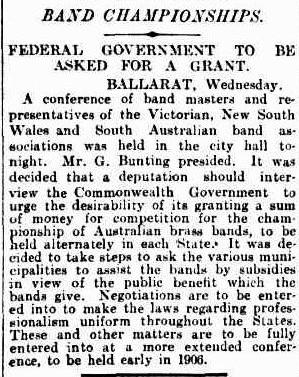
Of course, this initiative did not end here.  During the 1905 South Street contests, another conference of band representatives took place.  However, this time, they included representatives from South Australia.  As can be seen in the article below, the aim of this conference was to approach the Commonwealth Government for a grant to hold Australian championships alternating between various States, and to bring about uniformity in rules (“BAND CHAMPIONSHIPS.,” 1905).  These early conferences, while well-meaning, did become a repetitive process with no real resolutions.

The Age, 26/10/1905, p. 6

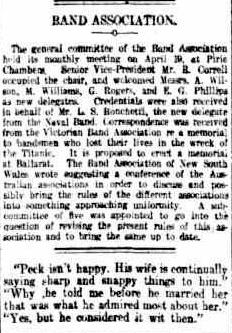
In general, these State band associations affiliated with each other and recognized each other’s rules and processes.  And it was not uncommon for letters and other correspondence from State associations to be presented at various meetings.  A decade on from the 1903 competitions in Ballarat, and eight years on from the 1905 conference in Ballarat, the South Australian Band Association (S.A.B.A.) received a letter from B.A.N.S.W. “suggesting a conference of the Australian associations in order to discuss and possibly bring the rules of the different associations into something approaching uniformity.” (“BAND ASSOCIATION.,” 1913).

The Register, 24/04/1913, p. 4

Notwithstanding the disruption of the First World War on Australian society in general, once this had finished the associations carried on with their activities.  It is in the year of 1921 where we see the next mention of a National Council being formed through an article published in the The Argus newspaper reporting on a conference held in Ballarat.  A summary of the article tells us that:

  • An Australian Band Council has been formed
  • “Only one association from each state is to be recognized.”
  • An order of States has been decided as to who will host the next championships.

(“INTERSTATE BAND CONFERENCE.,” 1921)

Slightly more detail on this 1921 Ballarat conference was provided by the Northern Star newspaper brass band correspondent, ‘Drummer Boy’ where he has noted that, in addition to only one association being recognized in each State, “only players of bands affiliated with that association will be permitted to play in contests in other States.” (Drummer Boy, 1921).  There was also another discussion on how many professional musicians could play in each band, with the recognition that brass bands were essentially amateur groups. The next conference was to be held in Brisbane (Drummer Boy, 1921).

There may or may not be a connection, but a picture of an “Australian Band Committee” was published by the Daily Mail in 1923 (pictured at the head of this post) (“AUSTRALIAN BAND COMMITTEE.,” 1923).  Perhaps this is a result of the aforementioned Brisbane conference although, at this stage, the connection is unclear.

Toowoomba Chronicle and Darling Downs Gazette, 28/05/1925, p. 4

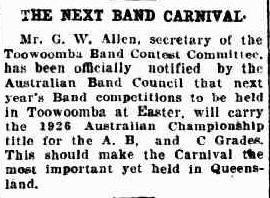
While there had been championships held in various States billed as interstate band contests, they were essentially conducted by the respective State association under their own rules. However, the formation of an Australian Band Council meant that championships could now be held under National rules and patronage.  In 1925 we see how this is affected through a tiny article published in the Toowoomba Chronicle where the 1926 Toowoomba competitions “at Easter will carry the 1926 Australian Championship title for the A, B, and C Grades” (“THE NEXT BAND CARNIVAL.,” 1925).  This is an important step in banding competitions as it is now evident that the States had actually agreed on common rules and a national committee had given patronage to a competition.  This recognition was not forgotten by local brass bands.  In 1927, the Victorian Band Association (V.B.A.) upheld a protest brought about by one band, which was written up in an article published by The Age newspaper:

Malvern Tramways Band complained that two other bands in Melbourne were claiming themselves to be Australian champions, and a ruling was sought.  It was set out that the title of the Australian championship was legitimately held to belong to Malvern Tramways Band by reason of its success in winning the Australian championship contest at Toowoomba, Q. last Easter. The association secretary (Mr. W. Martin) stated that he had replied that the Queensland Band Association had the right to grant the championship in 1926, and by its success at the Toowoomba contest Malvern Tramways Band was thereby the possessor of the title.  The matter was one in which the band itself could take what action it considered advisable.”

(“Victorian Band Association.,” 1927)

On a side note and somewhat related, this was a perfect case of when a State association proved to be effective on one ruling but failed to uphold another ruling.  The two other bands that Malvern Tramways was referring to in their protest were their two main crosstown rivals: Brunswick City Municipal Band and Collingwood Citizens’ Band. In the latter part of 1927, these two bands held a “challenge contest’ at the Exhibition Building with adjudicators “P. Jones, P. Code & R. McAnally” presiding (“CHALLENGE BAND CONTEST.,” 1927).  Interestingly, the presenters of this contest declared that “This contest…will decide which is the best brass band in Australia” (“CHALLENGE BAND CONTEST.,” 1927).  Needless to say the Victorian Bands’ Association was not pleased about this contest and they tried to disqualify both Brunswick and Collingwood – which brought about a response from Brunswick accusing the V.B.A. of over-stepping itself as the current VBA rules “do not provide for a challenge contest” (“BEST BAND DISCORD,” 1927).  The challenge contest still went ahead with Collingwood winning by two points (Greaves, 1996).

The 1930’s:

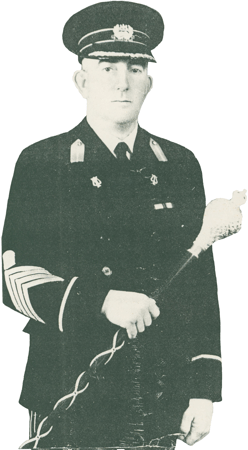
1937. Lieut. K. G. Kennedy. The well-known Drum-Major and Adjudicator, also President of the Australian Bands’ Council. (Source: Victorian Bands’ League Archives)

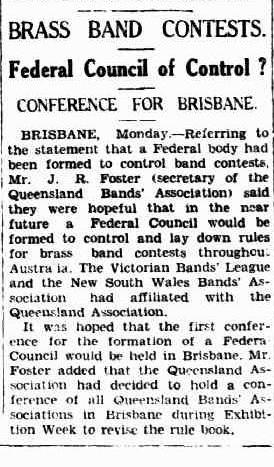
If the preceding two decades could be regarded as tentative, the next two decades where the National Council was reformed could be regarded as consolidation.  In 1931 a new Victorian Bands’ League was formed by a large group of Melbourne metropolitan bands and every other band in the State rapidly affiliated.  This led to the demise of the VBA and we see in a Herald article from 1933, the other State associations recognized the VBL as the single association for bands in Victoria and they sent through their affiliations with the new league (“BAND UNITY MOVE,” 1933).  In the same article, Mr. H. G. Sullivan, Secretary of the VBL “said he wanted to see the formation of an Australian Band Council to unify band contests throughout Australia” (“BAND UNITY MOVE,” 1933).  This move was also welcomed in other States.  The Secretary of the Queensland Band Association (Q.B.A.) Mr. J. R. Foster, “said they were hopeful that in the near future a Federal Council would be formed to control and lay down rules for brass band contests throughout Australia.” (“BRASS BAND CONTESTS.,” 1933).

19330627_Toowoomba-Chronicle_Band-Council-Control
Toowoomba Chronicle and Darling Downs Gazette, 27/06/1933, p. 4

A clue as to why the National Council was resurrected at this time lies in a long newspaper article from 1934 published in the Central Queensland Herald newspaper in which Mr. Foster, was interviewed.  He provided some enlightening history:

“Years ago the whole of the State Band Associations throughout Australia were controlled by a Central Australian Band Conference, but since 1918 this body has not functioned although several attempts were made to revive the Council” said Mr. Foster yesterday.

“Last year, through the efforts of the Q.B.A., negotiations were made between New South Wales and the Victorian Bands’ League to hold a conference representing all States to endeavour to formulate a set of rules applicable to band contests throughout the Commonwealth.”

“The conference, which will be held in Sydney, will commence on April 9 and all States except Western Australia have expressed their intention of being represented.”

“Included in the agenda will be a suggestion from Queensland that every effort will be made to establish an Australian school for band music on the same lines as Knellar Hall in England.”

“If this could be achieved it would be of inestimable help to building band-masters to study the theory of music and up to date band training methods”

“At present time all State Associations are affiliated, but it is felt that the establishment of a uniform set of contesting conditions will further cement the co-operation already existing amongst the State Associations.”

(“HALL OF BAND MUSIC,” 1934)

The history of the current NBCA notes that its official formation was on the 13th of April 1934 which correlates with these events. (National Band Council of Australia, 2024b).  A small publication comprising of a constitution, contest rules and quickstep & marching regulations was also published for the Australian Band Council at this time (Australian Band Council, 1934)

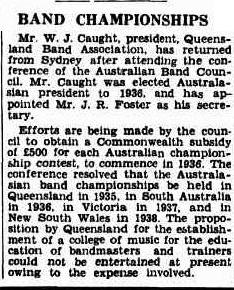
No doubt this is an interesting set of developments and hopeful proposals.  Evidently, the State associations were quite collegial in the way they were now operating.  It seems, however, that “The proposition by Queensland for the establishment for a college of music for the education of bandmasters and trainers could not be entertained at present owing to the expense involved.” (“BAND CHAMPIONSHIPS,” 1934).  This being said, an order of National championships was decided – “Queensland in 1935, in South Australia in 1936, in Victoria in 1937, and in New South Wales in 1938.” (“BAND CHAMPIONSHIPS,” 1934).

Courier-Mail, 23/0

We also see evidence from this conference on just how difficult it was to achieve unity in rules.  Mr. Dall, then Secretary of S.A.B.A. and the South Australian representative at the conference, was quoted in an article published in the Advertiser newspaper on the 30thof April:

“If such conferences are continued they will be of tremendous benefit to contesting bands in Australia.  We found it difficult to frame rules owing to the different conditions operating in the various States.  In framing a set of rules to apply to all States without seriously affecting any State’s present rules, we found it necessary to compromise on several items so that they would be applicable to all States.”

“If the conferences can be continued there is no doubt that in the near future a set of rules will be framed that will be entirely satisfactory to all bands throughout the Commonwealth.  With this object in view we framed a set of rules for two years trial.”

(“BAND CHAMPIONSHIPS HERE IN 1936,” 1934)

The next biennial conference of the Australian Band Council was held in Brisbane during May 1936.  The Courier-Mail reported on some resolutions which included making Melbourne the national headquarters in future and that all future conferences would be held in Melbourne (“AUSTRALIAN BAND COUNCIL,” 1936).  “Mr. H. J. Sullivan, secretary of the Victorian Bands’ League, who is the Victoria delegate to the council, was appointed permanent Federal secretary of the council.” (“AUSTRALIAN BAND COUNCIL,” 1936).

Courier-Mail, 1/05/1936, p. 18

Evidently, a new President of the Australian Band Council was elected as seen by the picture which was published by the Australasian Bandsman newspaper in 1937 (“Lieut. K. G. Kennedy,” 1937).

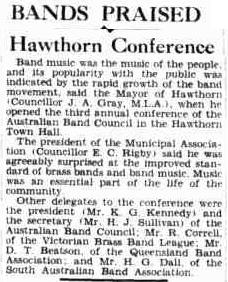
Numerous rule changes were reported on before the commencement of the 1938 conference in Melbourne by the brass band correspondent to the Advertiser newspaper, colloquially known as ‘Baton’. He wrote a very detailed overview of the rule proposals which, unfortunately, cannot be listed here due to brevity.  However, the rule proposals covered areas such as registration, marching and the quickstep competition (Baton, 1938).  The conference, held at Hawthorn Town Hall in suburban Melbourne was a success and the Mayor of Hawthorn gave the conference, and brass bands full praise (“BANDS PRAISED,” 1938).

The Argus, 1/08/1938, p. 2

In 1939 the National Championships were held in Bundaberg, QLD over Easter and we see some reporting of new rules that were decided upon at the Melbourne conference.  The Cairns Post, while highlighting the local brass band that was to take part, also reported that:

Rule nine of the Contest Rules governing all future championship contests now reads:- “(a) The Australian championship shall be competed for annually at a time and place to be decided by the Council, and shall be for “A” grade only”

“(b) State championships shall be held at such time and place as may be decided by the governing body.”

(“BAND CHAMPIONSHIP.,” 1939)
Badge: 1939 Australian Championship Band Contest, Bundaberg
(Source: Jeremy de Korte Collection)

Such are the vagaries of the rules. It was at this time however when the world was again plunged into War and there was a suspension of a majority of band contests.  We next see articles relating to the National band council appear again in the middle to late 1940s.

The 1940s & 1950s:

It appears that the Australian Band Council was quiet during the Second World War years, which was understandable and certainly there is not much evidence to suggest that National competitions took place.  This is not to say there were not local and State competitions during this time, at least in Victoria (Victorian Bands’ League, 1939).  However, as shown by these same records, a competition was held in Frankston, Vic. in late 1945 and early 1946 which was called an “Australian Championship” (Victorian Bands’ League, 1939, p. 34).  While it was called as such, the only bands that participated came from Victoria.

Coming into the 1950s we again see the ideals of the Australian Band Council being reiterated in local newspapers. Published in 1952, an article in the Mudgee Guardian tries to explain what the A.B.C. actually is and what it does:

“While the N.S.W. Band Association controls Band matters within that State, the Australian Band Council is the governing body for Band matters throughout the Commonwealth, and has jurisdiction within each State.

The objects of the A.B.C. are similar to the N.S.W.B.A. that is to say: To ensure that Band contests, solo and part competitions shall be conducted throughout Australia under a uniform set of rules: to deal with any appeals which may be made to the Council by any affiliated State governing body in respect of any action taken under any rule of the Council: to promote a general love and knowledge of Band music and good fellowship amongst Bandsmen: and to promote and assist in the promotion of, and to control Band contests.”

(“BAND SERIES No. 6.,” 1952)

The article then proceeded to highlight other aims and ideals.

Unfortunately, the exact date of a name change to the National Band Council of Australia is unclear.  However, as mentioned, the N.B.C.A. website has published National results dating back 1935 (National Band Council of Australia, 2024a).

19550113_Central-QLD-Herald_ABC-President
Central Queensland Herald, 13/01/1955, p. 17

Conclusion:

The history of the National Council is unique as there were a special set of circumstances needed to make sure it formed and succeeded.  The various starts had similar aims and ideals with the uniformity of rules being first and foremost.  Collegiality was emphasized despite the difficulty in creating a uniform set of rules and procedures.  The interactions between different State associations are clearly highlighted in this regard.  It seems that the State associations tried to make this work with the best of intentions and that is something to be admired.  Certainly, the legacy is still seen today with the continued existence of a National Band Council of Australia and the National band championships which are held each year in a different State.

References:

AUSTRALIAN BAND COMMITTEE. (1923, 05 February). Daily Mail (Brisbane, Qld. : 1903 – 1926), 3. http://nla.gov.au/nla.news-article218974562

Australian Band Council. (1934). Australian Band Council : Constitution : Contest Rules : Quickstep Regulations and Instructions  [Constitution]. Oxford Press. 

AUSTRALIAN BAND COUNCIL : Future Conferences in Melbourne. (1936, 01 May). Courier-Mail (Brisbane, Qld. : 1933 – 1954), 18. http://nla.gov.au/nla.news-article38467409

BAND ASSOCIATION. (1913, 24 April). Register (Adelaide, SA : 1901 – 1929), 4. http://nla.gov.au/nla.news-article59254032

BAND CHAMPIONSHIP : For Australian Title : Cairns Participation. (1939, 25 February). Cairns Post (Qld. : 1909 – 1954), 8. http://nla.gov.au/nla.news-article42169758

BAND CHAMPIONSHIPS. (1934, 23 April). Courier-Mail (Brisbane, Qld. : 1933 – 1954), 16. http://nla.gov.au/nla.news-article1192269

BAND CHAMPIONSHIPS : FEDERAL GOVERNMENT TO BE ASKED FOR GRANT. (1905, 26 October). Age (Melbourne, Vic. : 1854 – 1954), 6. http://nla.gov.au/nla.news-article199409235

BAND CHAMPIONSHIPS HERE IN 1936 : Conference Frames Rules for Two Years’ Trial. (1934, 30 April). Advertiser (Adelaide, SA : 1931 – 1954), 12. http://nla.gov.au/nla.news-article74095881

Band President. (1955, 13 January). Central Queensland Herald (Rockhampton, Qld. : 1930 – 1956), 17. http://nla.gov.au/nla.news-article75434128

BAND SERIES No. 6 : Band Council. (1952, 13 October). Mudgee Guardian and North-Western Representative (NSW : 1890 – 1954), 7. http://nla.gov.au/nla.news-article156439664

BAND UNITY MOVE : States Link With Victorian League. (1933, 29 May). Herald (Melbourne, Vic. : 1861 – 1954), 10. http://nla.gov.au/nla.news-article243112744

BANDS PRAISED : Hawthorn Conference. (1938, 01 August). Argus (Melbourne, Vic. : 1848 – 1957), 2. http://nla.gov.au/nla.news-article12454503

Baton. (1938, 14 July). BANDS AND BANDSMEN : Plans for Band Council Conference. Advertiser (Adelaide, SA : 1931 – 1954), 11. http://nla.gov.au/nla.news-article35597004

BEST BAND DISCORD : Brunswick-Collingwood Contest to Go On. (1927, 23 June). Herald (Melbourne, Vic. : 1861 – 1954), 23. http://nla.gov.au/nla.news-article243967808

BRASS BAND CONTESTS : Federal Council of Control? : Conference for Brisbane. (1933, 27 June). Toowoomba Chronicle and Darling Downs Gazette (Qld. : 1922 – 1933), 4. http://nla.gov.au/nla.news-article254338919

CHALLENGE BAND CONTEST. (1927, 02 August). Corowa Free Press (NSW : 1875 – 1954), 3. http://nla.gov.au/nla.news-article236067765

de Korte, J. D. (2018, 15 March). The politics of affiliation: The Victorian Bands’ Association to the Victorian Bands’ League. Band Blasts from the Past : Anecdotes, Stories and Personalities. https://bandblastsfromthepast.blog/2018/03/15/the-politics-of-affiliation-victorian-bands-association-to-the-victorian-bands-league/

de Korte, J. D. (2022). Newington, Vic. : 1939 Australian Championship Band Contest – Bundaberg [Photograph of tin badge]. [IMG_8028]. Jeremy de Korte, Newington, Victoria. 

Drummer Boy. (1921, 05 November). BANDS AND BANDSMEN. Northern Star (Lismore, NSW : 1876 – 1954), 9. http://nla.gov.au/nla.news-article93081749

Greaves, J. (1996). The great bands of Australia [sound recording] [2 sound discs (CD)]. Australia, Sound Heritage Association. 

HALL OF BAND MUSIC : Australian Proposal. (1934, 05 April). Central Queensland Herald (Rockhampton, Qld. : 1930 – 1956), 8. http://nla.gov.au/nla.news-article70310251

INTERSTATE BAND CONFERENCE. (1921, 27 October). Argus (Melbourne, Vic. : 1848 – 1957), 4. http://nla.gov.au/nla.news-article4629185

Lieut. K. G. Kennedy. (1937, 26 June). Australasian Bandsman

National Band Council of Australia. (2024a). Contest Results: Results from the Australian National Band Championships, 1935 to present. National Band Council of Australia. Retrieved 13 April 2024 from https://nbca.asn.au/archives/results

National Band Council of Australia. (2024b). History of the NBCA. National Band Council of Australia. Retrieved 13 April 2024 from https://nbca.asn.au/about/history

THE NEXT BAND CARNIVAL. (1925, 28 May). Toowoomba Chronicle and Darling Downs Gazette (Qld. : 1922 – 1933), 4. http://nla.gov.au/nla.news-article253924392

Royal South Street Society. (1903). 1903-10-31 Brass Band Contests : Held at City Oval [Eisteddfod Results]. Royal South Street Society Results Database. https://results.royalsouthstreet.com.au/results/1903-10-31-brass-band-contests

SOUTH-STREET COMPETITIONS : CHAMPIONSHIP BRASS BAND CONTESTS. (1903, 30 October). Argus (Melbourne, Vic. : 1848 – 1957), 8. http://nla.gov.au/nla.news-article10579779 

Victorian Band Association : Claim to Australian Championship. (1927, 22 February). Age (Melbourne, Vic. : 1854 – 1954), 9. http://nla.gov.au/nla.news-article204193668

VICTORIAN BAND ASSOCIATION : SECOND ANNUAL MEETING. (1903, 20 October). Ballarat Star (Vic. : 1865 – 1924), 6. http://nla.gov.au/nla.news-article208159835

Victorian Bands’ League. (1939). Notebook – Victorian Bands’ League Contest Records (1939 – 1950)  [Notebook]. Victorian Collections. https://victoriancollections.net.au/items/5b7ce49921ea6916bcdba41c 

International band tours of the early 1900s: bringing music to Australia

Introduction:

It is a massive undertaking to take any musical group on tour which stands true even today.  But let’s examine these undertakings from another time.  When we look back at the grand tours of brass and military bands in the early 1900s, we can only marvel at the schedules they set for themselves, the places they visited, and the effect they had on local populations.  Australians it seemed had an insatiable appetite for viewing the best in the business and visiting bands were not disappointed when they toured here.

Visiting bands did not come all the way to Australia just to return home again.  Often, Australia was just one stop on a world tour.  From reading the Trove archive we can see that the movements of the bands in foreign countries was eagerly reported on because Australians knew they were next to see them.  And when the bands did arrive in Australia, each concert was widely advertised.

This was a great age of band movements in Australia and around the World.  It must have been quite a sight too when each band was alighting from ships and trains which were eagerly awaited on by an adoring crowd.  Parades of massed bands, dinners, receptions, concerts, photographs, articles and other events all greeted visiting bands when they stepped upon our shores. Thankfully our libraries hold some ephemera and newspaper articles from those tours, so we can imagine just what it would have been like.

This post will highlight some of the visiting band tours and will see that some bands had vast reputations which preceded them. However, the famous bands were not the only groups to visit.  This post will not cover all tours or bands.  Undoubtedly there might have been other bands that visited that are buried in time (more stories to uncover).  However, for the bands that did visit, their tours last in memories, and even in some of the local bands that were beneficiaries of the expertise of visiting bandsmen.  There are some fascinating stories that surround these tours.

Besses o’ th’ Barn Band travels around the world, twice:

18900000-19200000_Tour_Besses_Card
Postcard: Besses o’ th’ Barn Band, 1907 (Source: National Library of Australia: David Elliot theatrical postcard collection: nla.obj-145704095)

The reputation of this unique brass band is well-deserved. Besses o’ the’ Barn Band from the Manchester area, England is one of the oldest brass bands in the world and has been an ensemble of excellence since its establishment in 1818 (Besses o’ th’ Barn Band, 2018a).  So it was with a great deal of excitement the world over (and from the band itself) when Besses commenced its first world tour in 1906 (Besses o’ th’ Barn Band, 2018b).  This first tour took them to “North America, Canada, Hawaii, Fiji, South Africa, New Zealand, and Australia.” (Besses o’ th’ Barn Band, 2018b).  For each performance they attracted vast audiences and it is written in their history that their visit to Melbourne was most notable with no less than “twenty-two of Australia’s finest brass bands” (Besses o’ th’ Barn Band, 2018b) preceding them in a parade along Collins St.  This must have been quite the spectacle and sound!  Before they arrived in Melbourne they had been in Sydney and an article from The Sydney Morning Herald in 1907 gave an enthusiastic review of their performances (“BESSES O’ THE BARN” BAND,” 1907).  In July 1907 the Argus newspaper published an article which gives us an amount of detail about the parade and the massed bands that led it:

Immediately they alighted from the Sydney express the visiting bandsmen stepped across the platform into the railway yard and as they did twenty-two bands, under the conductorship of Mr. E. T. Code, commenced to play an inspiring march.  Each man in those twenty-two bands contributed his full share to the volume of sound the like of which has rarely been heard in Melbourne. […] A procession was formed and heralded by the twenty-two local bands, the Besses o’ th’ Barn Band were drive up Collins Street in two drags.  The street was crowded with citizens whose curiosity had prompted them to see the famous bandsmen at first opportunity.

[…]

The bands which took part in the ceremony of welcome were as follows: St Kilda City, Prahran City, Code’s Melbourne Band, South Richmond Citizens, Collingwood Citizens’, Richmond City, Malvern City, Williamstown Premier, Footscray City, Stender’s, Doncaster, South Melbourne City, Brighton City, Brunswick City, Warneeke’s, Bootmakers, Camberwell, Box Hill, Fitzroy Military, Clifton Hill, Fitzroy Citizen’s, Kyneton City, St Vincent de Paul Orphanage, St. Arnaud, Castlemaine, Maryborough, and Ballarat bands were also represented.

(“BESSES O’ TH’ BARN BAND.,” 1907)

Regarding the huge crowds, an 1907 article in the Quiz newspaper from Adelaide which reported on the progress of the Besses tour thus far, noted that 70,000 people lined the parade route in Melbourne, which is a staggering amount of people for this kind of event (“Besses o’ th’ Barn Band,” 1907).  Such was the popularity and reputation of this ensemble.

Besses o’ th’ Barn Band welcoming parade turning from Collins Street to Swanston Street, Melbourne, July 1907. The massed bands are led by Edward Code. (Source: Manchester Digital Music Archive: 13953)

However, Besses did not finish touring after this first monumental effort.  Not one year after they had arrived back in England, the band embarked on another world tour (“BESSES O’ TH’ BARN BAND,” 1909).  As noted in their band history (2018b), “Both trips lasted an incredible eighteen months.” (Besses o’ th’ Barn Band) which was a very long time for bandsmen to be away from home. Needless to say, Besses had not lost any popularity on their next world tour and again drew large crowds wherever they went.

Interestingly it was on their second tour where there were some changes in the Besses personnel due to one bandsman staying on in one city, and another bandsman joining them on their tour.  In a previous post, we can read the story of Besses Lead Cornetist William Ryder who absconded from the tour in Melbourne and joined the Wests Theatre Company before becoming the first conductor of the Prahran & Malvern Tramways Employees Band in 1911 (de Korte, 2018; Stonnington City Brass, 2018).  This being done, it appears that Besses invited one of our most famous bandsmen, Percy Code to join them on the rest of the tour (Bradish, 1929; Gibbney, 1981).  The conductor of Besses during this world tour was Mr. Christopher Smith and after the tour ended he was secured by the Adelaide Tramways Band for his services in 1911 (Seymour, 1994).

Postcard: Besses o’ th’ Barn Band, 1906 (Source: Jeremy de Korte personal collection)

There is no doubt that Besses left their mark on Australian banding and were adored by audiences.  Certainly, in the succeeding years, many fine Australian bands dominated the landscape and as we saw some ex-Besses musicians now called Australia home.  Besses was one of the first bands to include Australia in their tour, but they were not the last.  Next to tour was the famous Sousa Band from the USA!

Sousa heads South:

18900000-19200000_Tour_Sousa-Card
Postcard: Australia welcoming the Sousa Band (Source: National Library of Australia: David Elliot theatrical postcard collection: nla.obj-145695597)

The band of John Phillip Sousa was no less famous than the Besses band, although much bigger with sixty musicians and some additional soloists in their touring party.  They toured Australia and New Zealand from May 12th to August 23rd, 1911 and like the Besses band generated huge excitement wherever they went (Lovrien, 2012).  In fact, the excitement had started brewing before they had even arrived with newspapers reporting expected arrival dates and schedules (“SOUSA’S BAND.,” 1911).  As with the Besses tour that had just finished, the Sousa band was feted with ceremony, functions, awards, parades and large audiences – upon arriving in Sydney there was a grand parade featuring twenty NSW brass bands (“SOUSA AND HIS BAND,” 1911).

Inevitably, given the timing of the Sousa tour to the previous Besses tour, questions were asked as to which the finer band was.  In an article from May 1911, the World’s News newspaper sought to answer this question from a reader (“Sousa’s Band,” 1911).  The article reported on the differences between both bands and diplomatically opens the article by declaring that: “Comparisons are odious in connection with bands, as well as with politics” (“Sousa’s Band,” 1911).  However, it came down to the fact that one was a brass band as opposed to a military-style band and one band was much bigger than the other.  Musically, they were both very fine ensembles.

The Sousa band was a very different ensemble and they enthralled Australian audiences.  However, there is no real indication that the Sousa band had an influence on Australian bandsmen, and if they did, it was not reported.  One could assume the reason was that Australian bands, which were mostly brass at the time, were very much tied to the band tradition of England, not the USA.

Postcard: Sousa Band at the Glacarium, Melbourne, 1911 (Source: Jeremy de Korte personal collection)

From Australia, the Sousa Band traveled to New Zealand where they again delighted audiences and received rave reviews (White, 2018).  And after this swing through the Southern Hemisphere, they returned to the mainland USA via a visit to Hawaii (Lovrien, 2012).

The Sousa tour, despite the number of places that they visited and the largeness of the audiences, did not generate a huge financial windfall and it was very expensive to take the band around the world (Lovrien, 2012).  However, in 1913 a court case was heard regarding the profits from the Australian leg of the Sousa tour.  From the brief flurry of newspaper articles that were written at the time, it appears that a series of contracts were entered into by the promoter of the tour, Mr. Branscombe with a Mr. Quinlan, and later a Mr. Singer over £30,000 in profits (“SOUSA’S BAND IN AUSTRALIA,” 1913).  It is interesting that this case was heard two years after the tour had finished, and that these profits were not intended for the Sousa band itself.

Bythell (2000), writing on the band tours and exchanges between countries during this time says that “…the logistics and high costs or international tours and exchanges made them exceptional” (p. 229).  Certainly, it was noted in the New Zealand article on the Sousa visit that the tour (through Aus. & NZ) was costing “over £2,000 per week” (White, 2018).  Given the logistics of moving a sixty-piece band plus soloists around Australia and New Zealand, this figure is hardly surprising.

Despite this, the Sousa tour appears to have been a success for the band and audiences as Sousa was a renowned conductor and composer.  The time frame between this tour and the previous Besses tour had not dimmed the enthusiasm of the Australian public in wanting to see these kinds of entertainments.  The Sousa band did not disappoint.

The visit of a Belgian Band during the First World War:

Postcard: Belgian National Band, 1915 (Source: Jeremy de Korte personal collection)

The Besses and Sousa bands were undoubtedly famous, but that did not stop other promoters searching for bands that might tour, which is exactly what happened during the early stages of the First World War.  In 1915, a band from Belgium visited the country and apparently went on tour through Australia and New Zealand. (“MUSIC.,” 1915).  A paragraph in a Leader newspaper article from May 1915 provides some detail on this band, but the band had no name – they were simply known as the Belgian Band:

A Belgian Band comprising some of the finest instrumentalists in Belgium, has been engaged by J. and N. Tait for a tour of Australia and New Zealand, commencing in June. […] After considerable trouble, many cables and much correspondence, the band has at last been got together, and will prove on its arrival one of the finest aggregations of talent that have yet visited Australia.  The band comprises of 28 instrumentalists, recruited from the foremost bands of Brussels, Antwerp and Ostend, and augmented by half a dozen English players, and will be conducted by the brilliant M. Phillipe Meny, a remarkable musician, whose reputation is not only Belgian, but European.

(“MUSIC.,” 1915)

The reaction of the Australian press to this visit was understandable.  A number of articles expressed admiration that the musicians had actually left Belgium, while also expressing sympathy and solidarity with the Belgian people under German occupation.  An example of this kind of article was from the Daily News in Perth (“THE BELGIAN BAND.,” 1915).  Notwithstanding the circumstances of this visit, the band drew the interest of an Australian public and received good reviews for their performances (“Visit of Belgian Band,” 1915).  In an act of decency, the band promoters donated all profits to “…the Belgian Relief Fund and the Wounded Soldiers Fund” (“BELGIAN BAND VISITS AUSTRALIA.,” 1915).

First came the Royal Marines, then came the Guards:

After the war, visits from overseas bands resumed quite early on with a visit from the Royal Marine Band, H.M.S. “Renown”.  This band was brought to Australia by J. and N. Tait, the same promoters who engaged the Belgian Band in 1915 (“RENOWN BAND.,” 1920).  The Royal Marines actually visited twice; their first visit was in 1920 and they followed up with another visit in 1927.  The concerts of 1920 received some very favorable reviews with one article printed in the Argus praising the sound and playing of this ensemble, and making a comparison of conducting styles with the great Sousa (“Concert by Renown Band.,” 1920).  On the second tour, a concert in Melbourne was presented as a massed bands concert in combination with the “Returned Sailors and Soldiers Memorial  Band” and the “Victorian Railways Military Band” with the Lord Mayor’s Hospital Appeal Fund the beneficiary of the proceeds from the concert (“FOR MAYOR’S FUND,” 1927).

19270508_Massed-Mil-Bands_Green-Mill_FC
Programme (front cover), featuring: Royal Marines Band H.M.S. “Renown”, Victorian Returned Sailors and Soldiers Memorial Band & Victorian Railways Military Band. (Source: Victorian Collections : Victorian Bands’ League)

In 1934 the Band of the Grenadier Guards visited Melbourne as part of the Centenary of Victoria celebrations, with a subsequent tour of Australia as well.  There was some initial confusion as to which Guards band was going to visit with the Grenadier Guards, Coldstream Guards and Welsh Guards being mentioned in some press (“GUARDS’ BAND VISIT.,” 1933).  It seems there was also some objection to the tour on the part of the Musicians’ Union. A letter to The Herald in September 1933 berated the Union for their stance with the writer stating that “Their visit will be education and beneficial to our unemployed musicians.” (Musician, 1933).  A visit to Australia by a band of this caliber was beneficial to all who witnessed them (not just unemployed musicians).  The band made a special appearance at the South Street competition of 1934 with a concert presented to an appreciative audience which included the Duke of Gloucester who was also visiting Australia (“South-street Band Contests.,” 1934).

19341101-19341103_South-Street-Centenary-Contest_p6
1934 South Street “Centenary” Brass Band Contest program, p. 6 (Source: Victorian Collections: Victorian Bands’ League)

These two British military bands were highly regarded, and it appears that their tours were more genuine with concerts in combination with Australian ensembles and presenting inspirational performances.  There was no comparison with the previous tours of Besses and Sousa as these were again, very different groups.  However, Australians were no less enthusiastic about the visits of these bands and made them feel very welcome.

Conclusion:

What we have seen here is only a small sample of the bands that visited Australia within a shorter time frame.  Each group was very different, yet they elicited an amount of excitement from the Australian audiences, bandsmen and public authorities.  Yes, they were expensive undertakings.  But musically they were invaluable.  This truly was a great age of banding.

References:

Australia extends the glad hand of welcome to Sousa and his band. (1910). [1 postcard : col. ; 9.6 x 13.9 cm.]. [nla.obj-145695597]. National Library of Australia, David Elliott theatrical postcard collection. https://nla.gov.au/nla.obj-145695597/view

THE BELGIAN BAND. (1915, 24 May). Daily News (Perth, WA : 1882 – 1950), 7. http://nla.gov.au/nla.news-article81173645

BELGIAN BAND VISITS AUSTRALIA. (1915, 20 June). Sunday Times (Sydney, NSW : 1895 – 1930), 6. http://nla.gov.au/nla.news-article120796314

Besses o’ th’ Barn Band. (1907). [Photograph]. [13953]. Manchester Digital Music Archive. https://www.mdmarchive.co.uk/artefact/13953/BESSES_O’_TH’_BARN_BAND_PHOTOGRAPH_1907

Besses o’ th’ Barn Band. (1907). [Postcard]. [nla.obj-145704095]. National Library of Australia, David Elliott theatrical postcard collection. https://nla.gov.au/nla.obj-145704095/view

Besses o’ th’ Barn Band. (1907, 09 August). Quiz (Adelaide, SA : 1900 – 1909), 8. http://nla.gov.au/nla.news-article166338966

BESSES O’ TH’ BARN BAND. (1909, 04 November). Table Talk (Melbourne, Vic. : 1885 – 1939), 13. http://nla.gov.au/nla.news-article145853191

Besses o’ th’ Barn Band. (2018a). A Glorious Past. Besses o’ th’ Barn Band. Retrieved 04 October 2018 from http://www.besses.co.uk/about/blasts-o-th-past/history-of-besses

Besses o’ th’ Barn Band. (2018). From Whitefield to Wellington. Besses o’ th’ Barn Band. Retrieved 04 October 2018 from http://www.besses.co.uk/about/blasts-o-th-past/history-of-besses?showall=&start=1

BESSES O’ TH’ BARN BAND : WELCOME TO MELBOURNE. (1907, 29 July). Argus (Melbourne, Vic. : 1848 – 1957), 7. http://nla.gov.au/nla.news-article10125983

“BESSES O’ THE BARN” BAND. (1907, 15 May). Sydney Morning Herald (NSW : 1842 – 1954), 13. http://nla.gov.au/nla.news-article14867586

Bradish, C. R. (1929, 05 September). Prominent Personalities : PERCY CODE | CONDUCTOR OF NATIONAL BROADCASTING ORCHESTRA. Table Talk (Melbourne, Vic. : 1885 – 1939), 13. http://nla.gov.au/nla.news-article146712994

Bythell, D. (2000). The Brass Band in the Antipodes : The Transplantation of British Popular Culture. In T. Herbert (Ed.), The British brass band : a musical and social history (pp. 217-244). Clarendon Press ; New York : Oxford University Press. 

Concert by Renown Band. (1920, 04 June). Argus (Melbourne, Vic. : 1848 – 1957), 9. http://nla.gov.au/nla.news-article1708206

de Korte, J. D. (2018, 02 March). William Ryder: The first conductor of the Prahran & Malvern Tramways Employees Band. Band Blasts from the Past : Anecdotes, Stories and Personalities. https://bandblastsfromthepast.blog/2018/03/02/william-ryder-the-first-conductor-of-the-prahran-malvern-tramways-employees-band/

FOR MAYOR’S FUND : Renown Band Concert. (1927, 06 May). Herald (Melbourne, Vic. : 1861 – 1954), 19. http://nla.gov.au/nla.news-article243915027

Gibbney, H. J. (1981). Code, Edward Percival (1888-1953). In Australian Dictionary of Biography. Retrieved 20 April 2018, from https://adb.anu.edu.au/biography/code-edward-percival-5707

Glanville Hicks, E. (1927). MASSED MILITARY BANDS : (Including Band of H.M.S. “RENOWN”) : GRAND RECITAL  [Programme]. City of Melbourne. https://victoriancollections.net.au/items/5caad8b321ea6703e46303f4 

GUARDS’ BAND VISIT : Centenary Tour Almost Certain. (1933, 10 October). Age (Melbourne, Vic. : 1854 – 1954), 8. http://nla.gov.au/nla.news-article205104515

Lovrien, D. (2012, 13 June). The Sousa Band 1910-11 World Tour. John Philip Sousa. https://sousamusic.com/sousa-band-1910-11-world-tour/

MUSIC. (1915, 15 May). Leader (Melbourne, Vic. : 1862 – 1918), 35. http://nla.gov.au/nla.news-article91368715

Musician. (1933, 11 September). GUARDS’ BAND VISIT. Herald (Melbourne, Vic. : 1861 – 1954), 6. http://nla.gov.au/nla.news-article243423748

RENOWN BAND. (1920, 05 July). Register (Adelaide, SA : 1901 – 1929), 5. http://nla.gov.au/nla.news-article62924146

Royal South Street Society. (1934). South Street “Centenary” : Brass Band Contest : A, B, C and D Grades  [Programme]. Royal South Street Society. https://victoriancollections.net.au/items/5d425e0c21ea6b1a84382033 

Seymour, C. (1994). Adelaide’s Tramway Band. Trolley Wire, 35(4), 3-10. https://www.sydneytramwaymuseum.com.au/members.old/Trolley_Wire/259%20-%20Trolley%20Wire%20-%20Nov%201994.pdf 

SOUSA AND HIS BAND. (1911, 14 May). Sunday Times (Sydney, NSW : 1895 – 1930), 2. http://nla.gov.au/nla.news-article120777076

Sousa Band – Immense Audience, Glacarium, Melbourne. (1911). [Postcard]. Sousa Band, Melbourne, Victoria. 

SOUSA’S BAND. (1911, 09 February). Argus (Melbourne, Vic. : 1848 – 1957), 7. http://nla.gov.au/nla.news-article10877792

SOUSA’S BAND IN AUSTRALIA : Question of profits : Writ for £7926. (1913, 01 October). Age (Melbourne, Vic. : 1854 – 1954), 8. http://nla.gov.au/nla.news-article196234795

Sousa’s Band : An interesting question asked by readers. (1911, 13 May). World’s News (Sydney, NSW : 1901 – 1955), 18. http://nla.gov.au/nla.news-article128266800

South-street Band Contests. (1934, 02 November). Age (Melbourne, Vic. : 1854 – 1954), 16. http://nla.gov.au/nla.news-article205082990

Stonnington City Brass. (2018). Band History. Stonnington City Brass. Retrieved 13 May 2018 from https://www.stonningtoncitybrass.org.au/history.html

Visit of Belgian Band : An enjoyable concert. (1915, 10 August). Queensland Times (Ipswich, Qld. : 1909 – 1954),7. http://nla.gov.au/nla.news-article121995771

Walmsley Bolton. (1915). The Great Belgian National Band. Conductor – – Mons Jules Ardenois (of Antwerp) [Postcard]. Walmsley Bolton, Nottingham, U.K. 

White, T. (2018, 13 July). Memory Lane: A famous musician brings his band to town. Manawatū Standard. https://www.stuff.co.nz/manawatu-standard/lifestyle/105412732/memory-lane-a-famous-musician-brings-his-band-to-town

The politics of affiliation: Victorian Bands’ Association to the Victorian Bands’ League

19380000-19370000_VBL-Officials_pg50
Source: The Bandsman’s Year Book and Official Programme of the Australian Championship Band Contest. 1938, pg. 50

Introduction:

Although the history and reputation of Victorian banding lies partly with individual bands, the history of the associations that they formed shows Victorian banding in a different light.  This post is focused on a period from 1901 to 1933, where, during the development of the various associations and leagues lies a somewhat rancorous battle for the heart and soul of Victorian bands of which was covered in the newspapers of the day and laid out in detail.   

The focus of this post is the general history of the Victorian Bands’ Association (V.B.A.) from 1901-1933 and the official formation of the Victorian Bands’ League (V.B.L.) in 1931.  Tied into this is the history of various early geographical groupings of bands and the eventual move to form much larger associations.  However, with association came division and as will be shown the seeds of division started much earlier than 1931.  This is a tale of the Victorian band movment that is probably not well known to most Victorian bands people.  

My curiosity has been growing over time as I wondered why there were no records that existed prior to 1931.  I knew that the headquarters of the V.B.A. had been in Ballarat, yet whatever records that may have existed were not provided to the V.B.L.  When researching for this post the reasons became obvious – they were two entirely separate organisations that wanted little to do with each other.

The research for this article has been informed by involved searching through the Trove archive with the aim of building a chronology of articles and events.  With this searching has come some revelations as to the Victorian band movement in the 1900s. This history is important to the band community as it highlights what once was, and how the administrations operated.

1900 – 1920: The V.B.A. and other associations:

1922 Victorian Bands’ Association emblem.
(Photograph taken in November 2022 by Jeremy de Korte)

The first seeds of a State association were sown in 1901 when delegates from Geelong and Ballarat brass bands decide to form a “Ballarat and Geelong District Band Association” with the rules of the new association to be presented to a conference of bands at the next South Street competition (“BAND ASSOCIATION.,” 1901).  Here we have an association that had been set up based on a small geography, but most importantly developed ties to the South Street competitions which became increasingly important to the band community (Royal South Street Society, 2016).  It should be noted that there was already a Geelong Band Association in existence, although this small association broke up after 1908 (“BAND ASSOCIATION.,” 1908).  In 1907 it becomes obvious that the V.B.A. is expanding as they had a meeting in Bendigo where discussion took place about lobbying the council to let them use a reserve to hold a band competition with the aim of attracting bands from across Australia (“BANDS ASSOCIATION.,” 1907).  This is one of the earliest reports of the V.B.A. promoting competitions in regional areas.

Within other geographical regions, distinct band associations started around the same time although not all of them affiliated with the newly formed V.B.A. In the Melbourne area, a new association called the “Melbourne and Metropolitan Band Association” (M.M.B.A.) was formed in 1906 (or 1907) by twenty-five bands (“MELBOURNE AND METROPOLITAN BAND ASSOCIATION.,” 1907).  This new association formed their own rules and constitution with the encouragement of the V.B.A., of which a representative attended the meeting.  It is not until a meeting in 1908 that the M.M.B.A. discusses aligning with the V.B.A. and a committee of five is set up to investigate this (“MELBOURNE AND METROPOLITAN BAND ASSOCIATION.,” 1908).  In contrast, a new Gippsland Band Association (G.B.A.) started in 1908 and emphatically ruled out associating with the association in Ballarat (“GIPPSLAND BAND ASSOCIATION.,” 1908).  It should be noted that while Gippsland bands did eventually join with State band associations, the G.B.A. was still going in 1947 and possibly longer (“Gippsland Bands’ Association,” 1947).

Despite the seemingly good running of the association there are some indications that some bands wanted the headquarters moved from Ballarat for various reasons.  In 1917, a letter was sent to the Bendigo Citizens’ Band by the Metropolitan Bands Association proposing a shift of the next meeting of the V.B.A. to Melbourne.  This letter was read out at a meeting of the Bendigo Citizens’ Band and the responses were detailed by the Bendigo Independent newspaper in an article.

Correspondence from the Metropolitan Band Association was read, requesting the bands’ support in having the meeting of the Victorian Band Association held in the metropolis instead of at Ballarat.  Several members spoke in favour of the Victorian Bands’ Association meeting being continued in Ballarat, as it was only another move to have everything of any importance held in the metropolis.  The secretary (Mr. E. K. Varcoe) in commenting on the matter, said it clearly showed that centralisation was at the back of the suggestion, and Melbourne desired everything in Melbourne with the exception of the mice plague… 

(“BENDIGO CITIZENS’ BAND.,” 1917)

Obviously, there were a few choice words used at this meeting (by 1917 standards).

The letter was countersigned by representatives of the Fitzroy, South Melbourne, Collingwood, Brunswick, Malvern and St Kilda brass bands and it was sent to all country bands affiliated with the V.B.A. at the time.  The Bendigo Citizens’ Band did end up sending a representative to a meeting in Melbourne.  Subsequently, in a vote on the matter at a later V.B.A. meeting, the motion to move the V.B.A. headquarters to Melbourne was defeated 23 to 6 (“BANDS’ ASSOCIATION.,” 1917). 

Warrnambool Standard, 22/11/1917. p. 3

1920 – 1929: Division – the first V.B.L.:  

If the V.B.A. felt that issues of division from the late 1910s had been placated, the early 1920s showed them otherwise.  The Melbourne and Metropolitan Band Association was still in existence and were running their own contests, within the oversight of the V.B.A.  In February 1920 they held a series of contests at the Melbourne Cricket Ground (MCG) in conjunction with the R.S.S.I.L.A., Vic. Branch with entries received from 30 bands – one highlight was a challenge contest between the Hawthorn City Band and the Collingwood Citizens’ Band (“METROPOLITAN BAND CONTEST.,” 1920).

Over the next few years however, the V.B.A. found itself dealing with a rival Victorian band association, the Victorian Bands’ League which was formed by a grouping of disgruntled metropolitan bands and apparently some country bands.  At a meeting held on the 23rd of May 1921, the new chair of the (first) V.B.L., a Mr. H. G. Johnson stated that,

…one of the objects of the new league was the control of band contests, also the fostering of a better feeling among bands and bandsmen. 

(“VICTORIAN BAND LEAGUE.,” 1921)

…and further in this article we see some further reasoning as to why representatives of these bands had met.

Several speakers expressed dissatisfaction with the way in which the affairs of bands and band contests were at presented being controlled by the Victorian Bands’ Association in Ballarat.  Band matters generally could be better managed by having headquarters of the controlling body in Melbourne. 

(“VICTORIAN BAND LEAGUE.,” 1921)
Herald, 23/04/1921, p. 17

One of the main driving forces behind the new V.B.L. was an official of the M.M.B.A, Mr George S. Tucker.  Born in the town of Victorian town of St. Arnaud before moving to Melbourne, he was the son of a bandsman and at the age of eight, joined the Malvern Town Band, then the St. Kilda City Brass Band under conductor Mr. F. C. Johnston, and found his niche in the administrative work of the band movement (Quickstep, 1921).  A weekly column in the Herald newspaper from April 1921 penned by “Quickstep” provides an outline of his band career, but it is the opening paragraph that really introduces Mr. Tucker.

The foremost figure in the band world at present moment is George S. Tucker, the hon. secretary of the Melbourne and Metropolitan Band Association.  A firm and fearless official, a keen debater, and an acknowledged authority on contesting and administrative matters, he has held office for a record term.  Melbourne is recognized as a centre of advanced thought in regard to band politics, and the formation of a new controlling body to be knowns as the Victorian Band League is now receiving attention of the bands.  Mr Tucker has been entrusted with the organisation of this new venture. 

(Quickstep, 1921)

Perhaps the new league was a little overzealous in the way it announced itself.  It is all very well stating that a meeting had been attended by several bands, but it might have helped if the new V.B.L. had sought assurances from the bands themselves that they would be affiliating with the new body.  This was revealed at a meeting of the V.B.A. held in June 1921.  

A letter was received from the St. Kilda Band Association stating that at a meeting of delegates from several bands in Melbourne in May it was decided to form a new league, and it was opined that this would prove to be a very successful body.  It was stated that the Geelong and Coburg bands had agreed to join.

A delegate stated that as far as Geelong and Coburg bands were concerned both had notified their intention of sticking to the V.B.A.  The Malvern Band – which band had a delegate at the meeting – said that he was surprised to find himself elected to the league without authority.  They were also sticking to the V.B.A.

(“VICTORIAN BAND ASSOCIATION,” 1921)

As well as this, State associations were nominally affiliated with each other and almost as soon as the new league was announced in May, the Band Association of N.S.W. and the South Australian Band Association wrote to the V.B.A. expressing their continued affiliation and refusal to recognize the new V.B.L. (“NEW BAND AUTHORITY,” 1921).  Letters were also received from the Tasmanian Band Association and West Australian Band Association, although W.A.B.A. asked for further information and expressed an opinion that “there was no need for a second body” (“VICTORIAN BAND ASSOCIATION,” 1921).

Sunraysia Daily, 17/05/1921, p. 4

Nevertheless, the fledging V.B.L. was not to be put off and in early August they announced that they would be holding a massed bands event for a hospital charity at the Exhibition Oval involving 250 bandsmen (“MASSED BANDS PERFORMANCE.,” 1921).  Bands were given permission to march from Prince’s Bridge and the Collingwood Band was to march from Collingwood.  The massed band was conducted by Mr. F. C. Johnston who was titled as “the Victorian Band League conductor” (“MASSED BANDS PERFORMANCE.,” 1921).

Argus, 10/08/1921, p. 7

Early in 1922 we can see that the new V.B.L. is holding meetings at a favourite haunt in the form of a café located at the corner of Swanston Street & Queen’s Walk.  At a meeting in January, plans were put in place for another “massed bands display on February 12, in aid of the Homeopathic Hospital”. (“BANDSMEN’S GOSSIP,” 1922).  Furthermore, it also appears that some bands were reluctant to join the new League, probably because South Street regarded the V.B.A. as the governing body. This statement from the meeting is telling.

Collingwood Citizens’ Band is now affiliated and it is to be hoped that other “A” grade bands will follow. 

(“BANDSMEN’S GOSSIP,” 1922)

A meeting of the associations took place in June 1922 when a delegation from the V.B.L., including Mr. Tucker, travelled to Ballarat to meet with the V.B.A. to see if a workable solution to governing and/or amalgamation could be found.  The opening paragraph of an article published by the Ballarat Star newspaper provided some background, of which an excerpt is below.

The V.B.L. was originally the Metropolitan Band Association, but enlarged its title and scope in the hope of getting control of brass bands in Victoria.  Evidently this ambition has not been realised, as last night the V.B.L. came with a humble request for authority under the V.B.A. constitution to perform certain local functions while subject to the authority and endorsement of the V.B.A.

(“BAND CONTROL,” 1922)

It is clear in this long article that relations between the V.B.A. and the M.M.B.A. had not been as good as they could be with Mr. H. A. Farrell, President of the V.B.L. calling the bickering between the two associations, at times, “childish” (“BAND CONTROL,” 1922).  This article reported in detail the proceedings of this meeting, and for the sake of brevity, will not be fully covered in this post.  The discussion was amicable, but the differences were not fully resolved. The main issue was how to manage any confusion between the two associations regarding the running of contests and player registrations (“BAND CONTROL,” 1922).  The V.B.A. promised to take this request to a full meeting of the Executive where the answer came in August – the V.B.A. rejected the proposal of admitting the V.B.L. into some form of relationship (“BANDSMEN’S DIFFERENCES,” 1922).

The Herald, 23/08/1922, p. 6

Whatever relationship the two associations had, soured considerably in 1923 when the V.B.L. held a contest in South Melbourne over Easter.  Eight bands took part in this contest, these being; “South Richmond, South Melbourne, Nunawading, Preston, Moorabbin, Deep Rock, Caulfield District, and Socialists.” (“EASTER BAND CONTESTS,” 1923).  Action from the V.B.A. was swift and punitive in the form of disqualifications and fines.  Two bands, Preston Citizens’ Band and the Socialist Party Band were fined £5/5/ and “their bandmasters, conductors, and players be disqualified for three years…” (“CONTROL OF BANDS.,” 1923).  Additionally, Mr. James Scarff (Adjudicator) who was registered with the Malvern Tramways Band and Mr. Ivan Hutchinson (Official) of the Footscray Municipal Band were also fined “and disqualified from membership of any associated band for three years…” (“CONTROL OF BANDS.,” 1923).

This action by the V.B.A. obviously did not sit well with the V.B.L. or any of the bands that participated in this contest and a few days later Mr. Henry Hellinger, Bandmaster and Conductor of the Preston Citizens’ Band wrote a scathing letter to the Herald newspaper regarding this punitive action by the V.B.A. – he was not impressed as shown by the middle paragraph of his letter.

In the first place, both of these bands are members of the Victorian Band League, and as such, the interference in their private business by any other association becomes a piece of intolerant impertinence.  The Victorian Band League, in organising this contest, open only to members of the Band League, have done something that the so-called Victorian Band Association has never done during its existence.  Furthermore, the V.B.A. has never organised a contest.  Its headquarters are in a country centre, and it can never be a great success, as the bands connected with it have no direct representation no matter what part of the State the band hails from. 

(Hellinger, 1923)

The V.B.L. also acted against the V.B.A. in the form of a resolution which was carried in their June meeting.

At the last meeting of the Victorian Band League a resolution was carried as under: – “That in view of the drastic, and also unconstitutional attitude adopted by the Victorian Band Association with regard to bands and officials who took part in our recent contest held at South Melbourne in future no band affiliated with the Victorian Band League will take part or assist in any way any performance, & c., or assist or organised by any band affiliated with the Victorian Band Association.

(“A BANDS DISPUTE.,” 1923)

The animosity displayed by both associations was hardly conductive to the good administration of bands in Victoria.  It might be fair to say that neither association helped themselves here and festering problems did not seem to go away. Early in 1924 it was reported that band secretaries and band members complained that the V.B.A. was not treating competitors at Ballarat and elsewhere fairly and that there was a “movement to reorganise the Victorian Band League.”  – of which a special meeting was called of metropolitan bands (“BANDSMEN’S DISCORD,” 1924).

Later in 1924, a much more serious issue occupied a meeting of the V.B.A. in Ballarat when a number of Melbourne based bands wanted to set up a branch of the V.B.A. in Melbourne with the power to conduct the affairs of the V.B.A. as they saw fit (“METROPOLITAN BANDS’ PROPOSAL,” 1924).  It seems that the bands listed in this move were not affiliated with the first Victorian Bands’ League, but they did express similar issues and complaints.  Now, the V.B.A. was up against the metropolitan bands on two fronts.

A proposal from a number of Metropolitan bands that they should be allowed to form a branch of the Victorian Band Association in Melbourne, which came before the association at its meeting last night, was viewed with suspicion by many of the delegates, who saw in it an attempt to shift the centre of government to the metropolis. The subject was debated at considerable length.

The president (Mr E. Ballhausen) reported that Messrs Frank Johnston (Collingwood bandmaster), Ben J. Warr and Hanson had waited on the executive of the association, with a view to having steps taken to form a branch of the association in Melbourne.  The secretary read letters in support of this request from the Kingsville-Yarraville, Footscray, Coburg, Prahran City, Hawthorn City, Turner’s Brunswick, Collingwood, St. Vincent de Paul, Brunswick City, St Kilda City, Newport Workshops, Malvern Tramways and Richmond District Bands. It was suggested by a committee of the bands interested that the branch should be known as the Metropolitan branch of the Victorian Band Association, the branch to consist of all bands within a radius of 25 miles of the G.P.O., Melbourne affiliated with the V.B.A.; the branch to have power to conduct all association business of the branch  according to the constitution and rules of the association.

(“METROPOLITAN BANDS’ PROPOSAL,” 1924)

Some of the delegates at the meeting were suspicious of the metropolitan bands’ intentions.  A Mr. Hewett of the Soldiers’ Band was quoted as saying, 

…the move was only the thin edge of the wedge to shift the headquarters of the association to Melbourne.  Some of the bands concerned were sympathetic with the Metropolitan Band League.  

(“METROPOLITAN BANDS PROPOSAL,” 1924)

Well-might the V.B.A. be annoyed at repeated requests by the metropolitan bands to run themselves and move the headquarters, but the V.B.A. still held sway over the administration of bands in Victoria.  Harking back to the events of 1923, the V.B.A. saw fit to rectify some decisions relating to the South Melbourne contest at their July meeting.

“The following disqualifications were removed and the players given permission to play with bands as follows: – Ivan Hutchinson (Footscray City); F. L. Ellis (Malvern Tramways); Theo. Parrell (Brunswick City).  These three players were formerly members of the Socialist Party Band, which was disqualified for playing at  Victorian Band League contest.”

(“VICTORIAN BAND ASSOCIATION,” 1924)

As can be seen in these years of the 1920s, there were attempts to move the headquarters of the Victorian Band movement from Ballarat to Melbourne, but these repeated attempts were thwarted by the V.B.A.  The ideal aim of each association was to foster cooperation to further the aims of banding, as well as competition, however none of the associations behaved in an admirable fashion.  The political infighting can only be described as difficult, along with a whole host of other words.  What is interesting is the inherent divide between metropolitan and country bands with the metropolitan bands, of which were mostly “A” grade and powerful, trying to exert influence over the direction of the V.B.A.  Perhaps the V.B.A. was ill-prepared to deal with another attempt, as will be seen in the early 1930s.

1930 – 1935: Changeover – the second V.B.L.:

1935 Victorian Bands’ League emblem.
(Photograph taken in November 2022 by Jeremy de Korte)

The early 1930’s saw the greatest upheaval in the governing structure of Victorian bands with another formation of the V.B.L. and the demise of the V.B.A.  The Royal South Street Society had worked closely with the V.B.A. for many years, and in the early years of the V.B.A. other State band associations had affiliated with the them (“BAND ASSOCIATION.,” 1902; “BAND ASSOCIATION.,” 1904; Royal South Street Society, 2016).  The coming years would highlight just how fickle this support for the V.B.A. would become as the latest iteration of the V.B.L. rapidly established itself.

In 1930 the V.B.A. was still holding a regular schedule of meetings in Ballarat attended by delegates representing bands from across the State.  An article published in The Age newspaper makes mention of a proposal to divide the Victorian band movement into districts administered by the V.B.A. (“VICTORIAN BANDS.,” 1930).  This proposal was to be discussed at the next V.B.A. State conference but there is no indication as to whether this proposal was enacted.

The Age, 18/03/1930, p. 11

Just over a year later in April 1931, news broke of a new organisation to be formed called the Victorian Bands’ League.  This new league was to be formed by many metropolitan bands who were agitating to have the headquarters of the Victorian band movement in Melbourne.  The Argus newspaper was one of the first to break the news and reported on the meeting and listed all the metropolitan bands who that sent representatives.

At a meeting attended by representatives of 28 metropolitan bands last night, it is decided that a new organisation to be known as the Victorian Bands’ League should be formed.  Delegates from Collingwood Citizens, Malvern Tramways, Brunswick City, Coburg City, Prahran City, Richmond City, Footscray City, Essendon Citizens, Heidelberg Municipal, Mentone Citizens, Fitzroy Municipal, Jolimont Workshops, St Kilda City, Kew District, Northcote Citizens, Williamstown City, Sunshine District, Caulfield District, Metropolitan Fire Brigade and Ringwood bands stated that those bands would join the new league.  Delegates from the Hawthorn City, Kingsville and Yarraville, St. Vincent de Paul’s, Oakleigh City, Kensington, Preston City, Returned Soldiers and Reservoir bands state that the subject would be discussed officially by the committees.  It is understood however that within the next few days these bands will signify their intention to associate themselves with the new league.

(“VICTORIAN BANDS LEAGUE.,” 1931)

A subsequent meeting of the V.B.A. in May 1931 acknowledged the formation of the new league, but was buoyed by the support of band associations from Queensland, South Australia, New South Wales and Tasmania (“VICTORIAN BAND ASSOCIATION.,” 1931).  The official decision of this V.B.A. meeting was to treat the new league with “indifference” (“INTERSTATE BANDS TURN DOWN NEW LEAGUE,” 1931).

The V.B.L., in a proactive move, sent its officers into country areas to meet with district bands.  In June they headed to the Goulburn Valley region and met with representatives from the Shepparton, Kyabram and other bands and in July travelled to Bendigo to attend a conference of Bendigo bands (“NEW BAND LEAGUE.,” 1931; “VICTORIAN BANDS,” 1931).  The V.B.L. had simple, but effective messages for these country networks; that the VBA wasn’t functioning properly for Victorian banding and the VBL wanted to set up district associations and competitions.  The result of these meetings was that the Goulburn Valley bands were enthused by the new league and apparently bands attending the Bendigo conference promised that they would affiliate with the V.B.L. 

In August, the V.B.L .had its first substantial endorsement when S.A.B.A. broke away from its affiliation with the V.B.A. and decided to endorse the V.B.L. (“CONTROL OF BRASS BANDS,” 1931).  It’s interesting to note that only a few months earlier in May, S.A.B.A. had apparently indicated that it still supported the V.B.A.

The V.B.L. showed off its strength in September 1931 when it organised a massed bands event held at the M.C.G.  The Sporting Globe newspaper published an article highlighting how this event was to be undertaken.

Under the auspices of the newly-formed Victorian Bands’ League, a concert will be given at the Melbourne Cricket Ground tomorrow by 30 massed bands, which will march through the city, starting at 2.15.

An interesting feature will be the presence of bands from Mildura, Warracknabeal, Warrnambool, Yallourn, Trafalgar and Korumburra, which are paying their own travelling expenses to Melbourne.

Not for many years has such a gathering of bandsmen been held in Melbourne.  More than 700 bandsmen will take part in the recital of which a Fox Movie-Tone film will be taken.  

(“Bands League,” 1931)

In October the V.B.L. gained the affiliation of the South Street Society who were going to resume band competitions in 1932 under the auspices of the V.B.L. (“VICTORIAN BANDS’ LEAGUE.,” 1931).

Obviously the VBL had been busy since it was formed in April and such expansion and activity had not gone unnoticed by the V.B.A., of which had initially shown indifference to the VBL.  At a Ballarat conference called by the V.B.A. in November and attended by representatives of fourteen bands, consideration was given to the developments of the new league, however the V.B.A. did not consider it to be a real threat to its survival (“BAND CONFERENCE.,” 1931).  A final resolution of the meeting was “to wait upon the mayor and councillors of Ballarat and the South street society with the object of bringing about unity in the band movement, the governing centre to be in Ballarat” (“BAND CONFERENCE.,” 1931).

Coming into 1932 with the VBL firmly entrenched in the Victorian band movement and the V.B.A. fighting for survival, there was no slowing in the activities of the V.B.L.  In January the V.B.L. staged another massed band event at the M.C.G.  This event was reported on by a newspaper from Tasmania of which praised the V.B.L. for its initiative, and lambasted the V.B.A. for “failing to co-operate new League” (“Victorian Bands,” 1932).   The V.B.A. in the meantime continued to hold meetings of its remaining affiliated bands and tried to emphasise that their best interests did not lie in the V.B.L. with its perceived “centralisation movement” (“COUNTRY BANDS’ WELFARE.,” 1932).  By August the V.B.A. had lost the affiliation of the two Ballarat bands which were forced to affiliate with the V.B.L. due to the South Street Society band competition being run by the VBL (“SOUTH-ST. BAND CONTEST.,” 1932).

In 1933 we see the last meetings, and demise of the V.B.A. with reports noting the affiliation of most other State band organisations with the V.B.L. (“BAND UNITY MOVE,” 1933).  At a final meeting in July 1933, the V.B.A. reports that it “will shortly consider its future policy” and that “since April, the association has not received any registrations of bands” (“VICTORIAN BAND ASSOCIATION.,” 1933).  After these articles, there are no other reports on the activities of the V.B.A. with reports on banding activities focused on the V.B.L.

19330705_TheAge_VBA-Future
The Age, 5/07/1933, pg. 14

We can see in this picture of another massed bands’ event published in The Age newspaper, and from a pamphlet published by the V.B.L. just how big these events were (“MASSED BANDS’ PERFORMANCE.,” 1933; Sullivan, 1933).  .  The V.B.L. had come unto its own. 

The Age, 25/09/1933, p. 13
Pamphlet: 1933 Victorian Bands’ League: Massed Bands’ Recital
(source: Victorian Bands’ League Archive)

Conclusion:

Such was the state of the Victorian band movement over a period of just over 30 years.  This was not just a story on the V.B.A. and the V.B.L., it is a story on the loyalties of the band movement, and the politics.  The repeated actions of the metropolitan bands, although questionable at times, eventually brought unity to the movement and a new energy.  Perhaps the V.B.A. did not have that same drive or had become too complacent with belief in its own longevity.  There are probably many questions still to be asked and hopefully, further details will come to light.

References:

BAND ASSOCIATION. (1901, 02 September). Ballarat Star (Vic. : 1865 – 1924), 6. http://nla.gov.au/nla.news-article207506823

BAND ASSOCIATION. (1902, 02 September). Sydney Morning Herald (NSW : 1842 – 1954), 7. http://nla.gov.au/nla.news-article28243339

BAND ASSOCIATION. (1904, 21 September). Express and Telegraph (Adelaide, SA : 1867 – 1922), 1. http://nla.gov.au/nla.news-article210537933

BAND ASSOCIATION. (1908, 16 July). Geelong Advertiser (Vic. : 1859 – 1929), 2. http://nla.gov.au/nla.news-article148551800

BAND CONFERENCE : The Victorian Association : Its Future Discussed. (1931, 09 November). Age (Melbourne, Vic. : 1854 – 1954), 10. http://nla.gov.au/nla.news-article203727703

BAND CONTROL : VICTORIAN LEAGUE MAKES REQUEST : DESIRES AFFILIATION AS LESSER BODY. (1922, 20 June). Ballarat Star (Vic. : 1865 – 1924), 1-2. http://nla.gov.au/nla.news-article213033941

BAND UNITY MOVE : States Link With Victorian League. (1933, 29 May). Herald (Melbourne, Vic. : 1861 – 1954), 10. http://nla.gov.au/nla.news-article243112744

BANDS ASSOCIATION. (1907, 09 May). Bendigo Independent (Vic. : 1891 – 1918), 3. http://nla.gov.au/nla.news-article226707129

A BANDS DISPUTE. (1923, 05 June). Age (Melbourne, Vic. : 1854 – 1954), 6. http://nla.gov.au/nla.news-article204069486

Bands League : Big Concert Tomorrow. (1931, 26 September). Sporting Globe (Melbourne, Vic. : 1922 – 1954), 6. http://nla.gov.au/nla.news-article182546316

BANDS’ ASSOCIATION. (1917, 22 November). Warrnambool Standard (Vic. : 1914 – 1918), 3. http://nla.gov.au/nla.news-article73972158

The Bandsman’s year book and official programme of the Australian Championship Band Contest. (1938). (Band Association of New South Wales, Ed.). Band Association of New South Wales. 

BANDSMEN’S DIFFERENCES. (1922, 23 August). Herald (Melbourne, Vic. : 1861 – 1954), 6. http://nla.gov.au/nla.news-article243651715

BANDSMEN’S DISCORD. (1924, 29 January). Herald (Melbourne, Vic. : 1861 – 1954), 12. http://nla.gov.au/nla.news-article243752239

BANDSMEN’S GOSSIP. (1922, 21 January). Herald (Melbourne, Vic. : 1861 – 1954), 19. http://nla.gov.au/nla.news-article243644473

BENDIGO CITIZENS’ BAND : Headquarters of Band Association. (1917, 07 August). Bendigo Independent (Vic. : 1891 – 1918), 3. http://nla.gov.au/nla.news-article219852652

CONTROL OF BANDS : Disqualification and Fines. (1923, 22 May). Argus (Melbourne, Vic. : 1848 – 1957), 11. http://nla.gov.au/nla.news-article2006296

CONTROL OF BRASS BANDS : The Rival Organisations. (1931, 13 August). Age (Melbourne, Vic. : 1854 – 1954), 9. http://nla.gov.au/nla.news-article203035478

COUNTRY BANDS’ WELFARE. (1932, 15 January). Horsham Times (Vic. : 1882 – 1954), 2. http://nla.gov.au/nla.news-article72597114

de Korte, J. D. (2022a). Malvern, Vic. : Northbrook Stables : VBA Emblem – 1922 Victorian Bands’ Association Certificate (Awarded to the Malvern Municipal & Tramways Band at Ballarat) [Photograph]. [IMG_8078]. Jeremy de Korte, Newington, Victoria. 

de Korte, J. D. (2022b). Malvern, Vic. : Northbrook Stables : VBL Emblem – 1935 Victorian Bands’ League Certificate (Awarded to the Malvern Municipal & Tramways Junior Band at the Melbourne Centenary Championships, Melbourne) [Photograph]. [IMG_8080]. Jeremy de Korte, Newington, Victoria. 

EASTER BAND CONTESTS : On South Melbourne C.G. (1923, 07 April). Record (Emerald Hill, Vic. : 1881 – 1954), 4. http://nla.gov.au/nla.news-article162535321

GIPPSLAND BAND ASSOCIATION. (1908, 26 March). Bairnsdale Advertiser and Tambo and Omeo Chronicle (Vic. : 1882 – 1918), 2. http://nla.gov.au/nla.news-article85231381

Gippsland Bands’ Association. (1947, 27 November). Gippsland Times (Vic. : 1861 – 1954), 1. http://nla.gov.au/nla.news-article63262669

Hellinger, H. (1923, 26 May). BAND DISCORD : Case for the League. Herald (Melbourne, Vic. : 1861 – 1954), 5. http://nla.gov.au/nla.news-article244028675

ININTERSTATE BANDS TURN DOWN NEW LEAGUE. (1931, 19 May). Herald (Melbourne, Vic. : 1861 – 1954), 4. http://nla.gov.au/nla.news-article242780150

MASSED BANDS PERFORMANCE. (1921, 10 August). Argus (Melbourne, Vic. : 1848 – 1957), 7. http://nla.gov.au/nla.news-article4677374

MASSED BANDS’ PERFORMANCE. (1933, 25 September). Age (Melbourne, Vic. : 1854 – 1954),13. http://nla.gov.au/nla.news-article205107273

MASSED BANDS’ PERFORMANCE. (1933, 25 September). Age (Melbourne, Vic. : 1854 – 1954), 13. http://nla.gov.au/nla.news-article205107273

MELBOURNE AND METROPOLITAN BAND ASSOCIATION. (1907, 12 July). Reporter (Box Hill, Vic. : 1889 – 1918), 6. http://nla.gov.au/nla.news-article92814950

MELBOURNE AND METROPOLITAN BAND ASSOCIATION. (1908, 15 July). Age (Melbourne, Vic. : 1854 – 1954), 9. http://nla.gov.au/nla.news-article197340110

METROPOLITAN BAND CONTEST. (1920, 06 February). Age (Melbourne, Vic. : 1854 – 1954), 9. http://nla.gov.au/nla.news-article202972992

METROPOLITAN BANDS’ PROPOSAL : Thin Edge of Wedge Suspected : VICTORIAN BAND ASSOCIATION DISCUSION. (1924, 17 June). Ballarat Star (Vic. : 1865 – 1924), 6. http://nla.gov.au/nla.news-article214259035

NEW BAND AUTHORITY : Not Recognised by the N.S.W. Association : An Important Decision. (1921, 17 May). Sunraysia Daily (Mildura, Vic. : 1920 – 1933), 4. http://nla.gov.au/nla.news-article258604675

NEW BAND LEAGUE : Support at Bendigo. (1931, 20 July). Argus (Melbourne, Vic. : 1848 – 1957), 9. http://nla.gov.au/nla.news-article4383879

Quickstep. (1921, 23 April). BANDSMEN’S GOSSIP : Achievements and Ideals. Herald (Melbourne, Vic. : 1861 – 1954), 17. http://nla.gov.au/nla.news-article242492106

Royal South Street Society. (2016). Our Disciplines. Royal South Street Society: 125+ years of pure performance gold. Retrieved 14 March 2018 from http://125.royalsouthstreet.com.au/disciplines/

SOUTH-ST. BAND CONTEST : Two Ballarat Bands Join Victorian League. (1932, 16 August). Age (Melbourne, Vic. : 1854 – 1954), 10. http://nla.gov.au/nla.news-article203800235

Sullivan, H. J. (1933). Massed Bands’ Recital : In Aid of the Lord Mayor’s Fund for Metropolitan Hostpitals and Children. In S9 – Programs (Flyer/Pamphlet/Programme ed.). Preston, Victoria: Victorian Bands’ League Archive.

VICTORIAN BAND ASSOCIATION. (1931, 19 May). Age (Melbourne, Vic. : 1854 – 1954), 10. http://nla.gov.au/nla.news-article205850303

VICTORIAN BAND ASSOCIATION. (1933, 05 July). Age (Melbourne, Vic. : 1854 – 1954), 14. http://nla.gov.au/nla.news-article204377301

VICTORIAN BAND ASSOCIATION : ANNUAL MEETING : ELECTION OF OFFICERS. (1924, 22 July). Ballarat Star (Vic. : 1865 – 1924), 6. http://nla.gov.au/nla.news-article213532801

VICTORIAN BAND LEAGUE. (1921, 01 June). Age (Melbourne, Vic. : 1854 – 1954), 13. http://nla.gov.au/nla.news-article203967014

Victorian Bands : A Great Demonstration. (1932, 09 January). Voice (Hobart, Tas. : 1931 – 1953), 8. http://nla.gov.au/nla.news-article218850147

VICTORIAN BANDS : New League’s Activities. (1931, 29 June). Shepparton Advertiser (Vic. : 1914 – 1953), 3. http://nla.gov.au/nla.news-article186773875

VICTORIAN BANDS: Proposed State Districts. (1930, 18 March). Age (Melbourne, Vic. : 1854 – 1954), 11. http://nla.gov.au/nla.news-article202255339

VICTORIAN BANDS LEAGUE : New Organisation Proposed : Metropolitan Control Wanted. (1931, 11 April). Argus (Melbourne, Vic. : 1848 – 1957),14. http://nla.gov.au/nla.news-article4378405

VICTORIAN BANDS’ LEAGUE. (1931, 06 October). Argus (Melbourne, Vic. : 1848 – 1957), 8. http://nla.gov.au/nla.news-article4430001

Victorian Bands’ League. (1933). Massed Bands’ Recital : In Aid of the Lord Mayor’s Fund for Metropolitan Hostpitals and Children [Flyer/Pamphlet/Programme]. Victorian Collections, Victorian Bands’ League. https://victoriancollections.net.au/items/5b6a683c21ea691478cf383e

SaveSaveSaveSave