For bands and for community: admire the rotunda

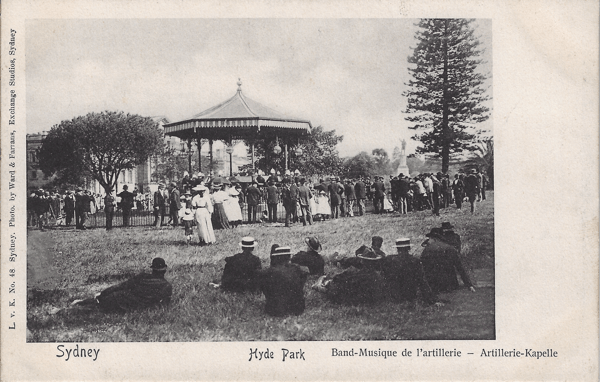
Postcard: Artillery Band playing at the Band Rotunda, Hyde Park, Sydney. (Date unknown) (Source: Jeremy de Korte collection)

Introduction:

They stand in parks and gardens throughout Australia as monuments to public entertainment before the days of broadcasting music through the wireless.  A source of civic pride, they are of a distinct purpose, yet cover a very wide variety of design and architecture.  They were built as memorials to musicians, royalty and service personnel, for bands and bandmasters, and also for the towns.  If there is one structure that provides a perfect linkage between a locality, people and a band it would have to be the band rotunda.

Nowadays, as it was when they were first built, we take pride in their aesthetic appeal.  They may not be used as performance platforms anymore as the bands they once served are no longer in operation.  Nevertheless, they still stand, often painted in heritage colours and with plaques on the sides we can learn of the story a rotunda.  A source of fascination for many.

The band rotundas have been a focus for academic and local studies over time as they can help tell parts of the history of architecture and music in this country.  This post is not seeking to replicate the valuable work that has already been completed in documenting band rotundas.  However, there are numerous little stories that can be told, and this post will seek to complement previous work, as well as display numerous photographs.

At the head of this post is a postcard showing an Artillery Band playing at the Hyde Park band rotunda with people watching around the sides, obviously appreciating the playing.  This idyllic scene could have been repeated anywhere when bands played at the local rotunda.  Suffice to say, with growing preservation and appreciation of these structures, as well as the building of new rotundas, music is being heard once again; the old is back in fashion.

History not forgotten:
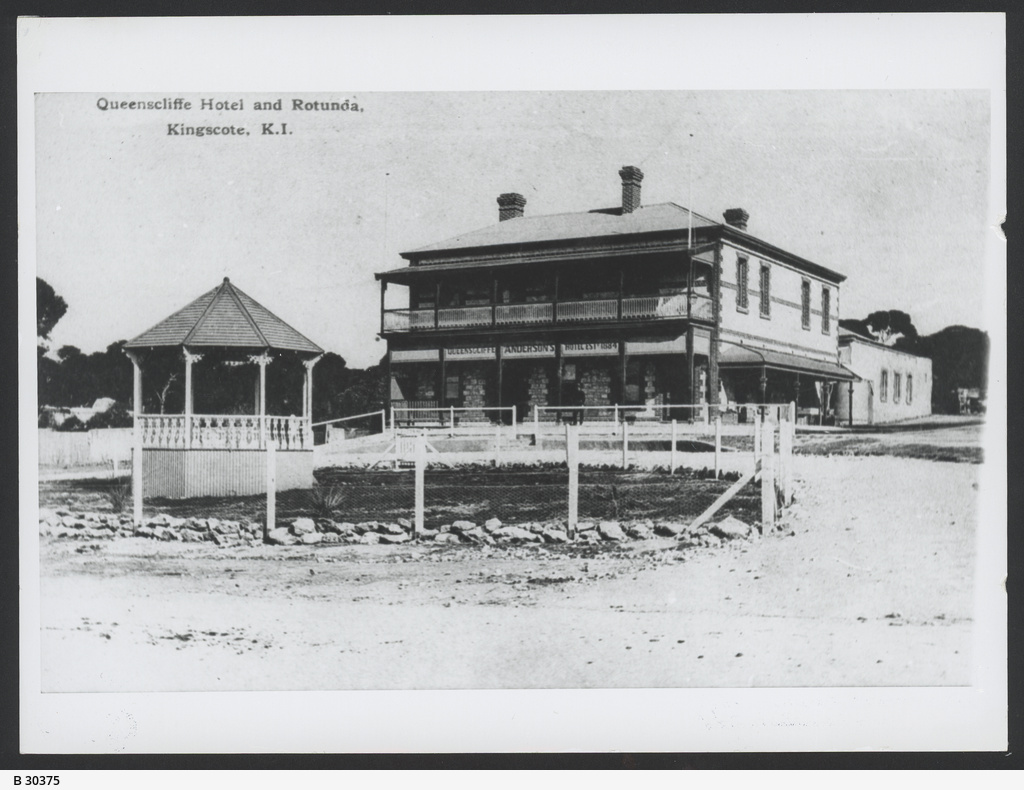
Queenscliffe Hotel and Rotunda, Kingscote, Kangaroo Island (Source: State Library of South Australia: B+30375)

Much has been written and studied about band rotundas in Australia, and all of it is worthwhile information.  The rotundas are the subject of many photos and postcards, and, as mentioned, they have also informed some of the history of architecture.  There are too many rotundas in Australia for this post and other writing to do them all justice, which is unfortunate.  Regarding academic study, Tracy Videon documented the history of rotundas in Victoria for her Master of Arts thesis (Videon, 1996).  This thesis has been cited in other heritage studies by local councils, for example, the Shire of Mount Alexander (Jacobs et al., 2004/2012).  

Interest in the rotundas has also been displayed periodically on social media with the advantage of having other like-minded people post and link their own stories.  In 2017, Michael Mathers posted on Facebook about the rotunda in Kew that he used to play at with the Kew Band and invited responses from other people (Mathers, 2017).  I have also posted on Facebook regarding band rotundas through displaying parts of my historical collection of postcards – one post relating to the postcard of the Artillery Band at Hyde Park, Sydney (de Korte, 2020c).  Through communication with band historians on Facebook, other resources have come to light such as the book, ‘Band Rotundas South Australia’ written by Brenton Brockhouse, historian of the Campbelltown City Band in Adelaide where he documented all the band rotundas in South Australia (Brockhouse, 2016).

Postcard: Main Street Gardens and Band Rotunda, Bairnsdale, Victoria (Date unknown) (Source: Jeremy de Korte collection)

Perhaps the most important resource that has been created about band rotundas in recent years is the book, ‘Pavilions in Parks : Bandstands and Rotundas Around Australia’ by Allison Rose with photographs by Belinda Brown.  This book is very useful as it details the architecture and design of each rotunda and highlights the history and civic pride (Rose, 2017).  It is understandable that Rose could not cover every rotunda in Australia.  However, she does tell us how she made choices by saying that each rotunda in her book was “chosen for architectural, historical or social significance” (Rose, 2017, p. 5).  Importantly she also states that the word “Bandstand” is used to describe its “major function” but is also known as a “rotunda, pavilion or, in earlier times, kiosk or orchestra.” (Rose, 2017, p. 5).  

In terms of the history of this building type, Rose informs us that its history is long and examples can be found in classical Greece, 7th Century Persia and 16th & 17th Century India (Rose, 2017).  The designs of these early structures were replicated in England in the 1800s and from this came the development of bandstands which were used for musical performances (Rose, 2017).  And as Rose (2017) tells us, the location and function of a bandstand was important.

A bandstand in the park had a useful social purpose.  It brought music to many people who would have no other opportunity to hear it, it was a way to meet old friends and for the young to find new friends

(p. 7)

In Australia, the custom of the time was to follow the traditions and architecture of the British homeland and to this end, they proliferated across the country.  As in England, the purpose of these rotundas was the same and they also gave new opportunities for people to hear music.

The concert in the town bandstand was often the only opportunity for people to hear live music as well as to socialise.

(Rose, 2017, p. 12)

Regarding building materials, many rotundas were built using cast iron columns and lacework which later evolved into timber features (Rose, 2017).  They were mainly built up until the First World War and in between wars, the building of bandstands “almost came to a halt” (Rose, 2017, p. 16).

After the Second World War, the building of outdoor performance spaces was dominated by concrete “sound shells” of which some were “well-designed, but others were extremely ugly” (Rose, 2017, p. 16).  Thankfully, Rose details in her history that the appreciation of rotundas was noted in the 1980s and many rotundas were saved from demolition, and in many localities, they have found new uses for them.

Today, there is interest in bandstands for their practical uses as well as their decorative function and towns and suburbs are building new bandstands.  Some are in Federation style, others provide a more contemporary home for today’s musical events…

(Rose, 2017, p. 16)

We are lucky that so many rotundas have been preserved for the current generations to enjoy.

Bands and Rotundas:
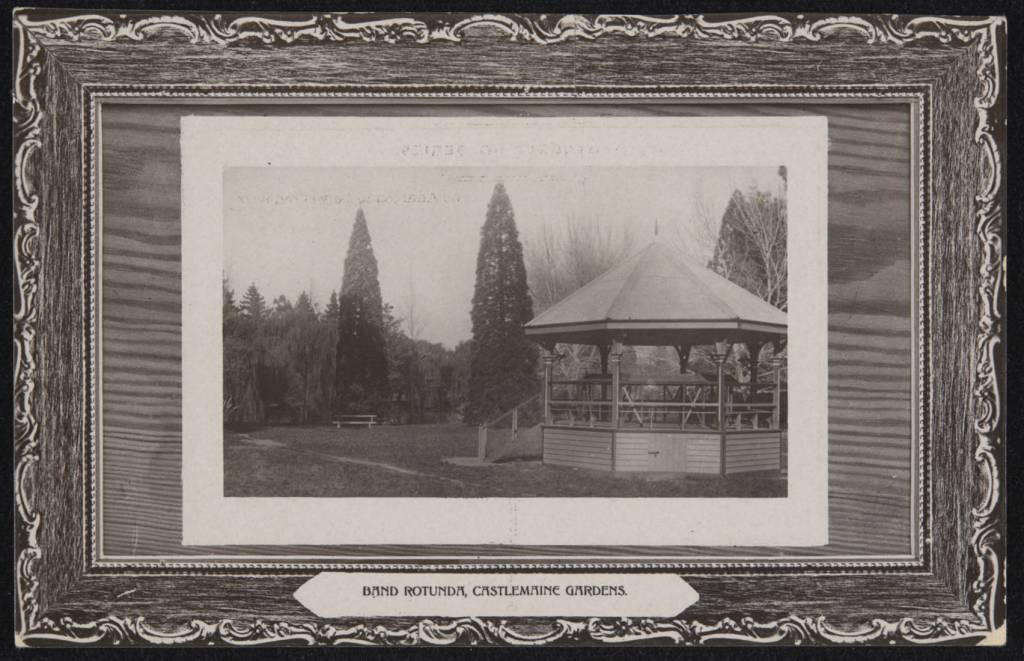
Postcard: Band Rotunda, Castlemaine Gardens (Source: National Museum of Australia: 140044)

There is a synonymous relationship between bands, rotundas and local communities.  A locality expresses pride through a band, but the band needs a place to perform on a regular basis.  A rotunda is then built for the benefit of the town band and the community and the rotunda becomes focal point for the community.  There is more to this of course and with each rotunda that has been built and survives, “each has a story to tell.” (Rose, 2017, p. 5).  

A letter written by a person with a pseudonym “A Lover of Music” was published in the Mount Alexander Mail newspaper on the 23rd of January 1893 to berate the local council over the lack of a permanent rotunda in Castlemaine.  

Sir, – I have often wondered that Castlemaine has been so long without a suitable place for the band to perform in.  I can’t understand why the Council have not sufficient enterprise to erect a “rotunda” in the Botanical Gardens.  Every concert in the Gardens necessitates the erection of a temporary platform.  It has struck me that as our worthy Mayor is a Welshman – and, of course, fond of music – it would be a graceful act on his part to have erected a rotunda worthy of our town and of the band, and to present it to the Council. […] I trust that the Mayor and Councillors will see that very soon our splendid band will have a proper place to perform in.  My main object in mentioning this matter is to show my appreciation of the band.

(A Lover of Music, 1893)

It took another five years, but finally in 1898 a band rotunda was built in the Castlemaine Botanical Gardens where it was opened by the Mayor with a concert presented by the Thompson’s Foundry Band (“CASTLEMAINE.,” 1898).  A rotunda still exists in the gardens to this day.

In 1909, a rotunda that was described as “commodious and ornate” was opened in the town of Nhill in Western Victoria by the Mayor and some local parliamentarians (“NHILL.,” 1909).  The Nhill Town Band was said to be in “high feather” about the new rotunda and during the concert, some bandsmen also demonstrated how civic minded they were by leaving the bandstand to help with a nearby house fire (“NHILL.,” 1909).  The Nhill band rotunda is very much a civic landmark and was refurbished in 2018 by the local council (Hindmarsh Shire Council, 2018).

Some rotundas were not built by the local councils or bands and it is interesting to find an example of a rotunda that was built by a private company for the use of the local band and the town.  The Portland Brass Band from New South Wales was the beneficiary of this investment when the local cement company, which supported the band as well, built a band rotunda in Portland.

The band rotunda, recently erected by the cement company for the use of the band, was officially opened on Saturday night by Dr. A. Scheidel, the managing director.  Mr. J. Saville, the works manager, was also present.  The bandsmen were in uniform, and when all were assembled, the doctor switched on the light and addressed the bandsmen.  He said that the rotunda had been erected by the company as an appreciation of their efforts.  He hoped that they would see that no injury would be done to the building, and looked to the townspeople generally to assist with that object.

(“BAND ROTUNDA FOR PORTLAND.,” 1910)

This article, which was published in the Lithgow Mercury newspaper, also provided an excellent description of this newly built structure.

The bandstand is a very neat structure, octagonal in shape.  It is nicely painted in two shades of green, relieved with white.  It is lit with eleven incandescent electric lights of sixteen candle power each.  Eight of these are arranged round the sides, while a group of three is suspended from the centre of the ceiling.  When lit up, it presented a very brilliant appearance.

(“BAND ROTUNDA FOR PORTLAND.,” 1910)

A photograph of the original rotunda can be found on the Facebook page of the Lithgow & District Family History Society Inc. (2015).  In 2017 a new rotunda was opened in Portland where the local parliamentarian is quoted in an article published by the Lithgow Mercury newspaper.

The rotunda is a reflection of the past, of Portland’s history with the original structure providing a backdrop for many events and occasions when the community came together to enjoy music by the local band.

I have no doubt the new rotunda will provide a great place for the local band to again deliver some fantastic events to the residents of Portland.  It will enhance the landscape of the surrounding park, provide a comfortable place to sit, relax and enjoy music from a band or perhaps even a string quartet.

(Toole in “Portland’s bandstand rotunda is officially opened for all.“, 2017)

These sentiments sound very familiar to those of times past.

Commemorative rotundas:

Sydney Morning Herald, 17/05/1924, p. 13

Often, rotundas were built to serve a commemorative function in addition to their stated purpose.  We can see an example above in this rotunda from Wollongong which was built to commemorate the landing of “Bass and Flinders in 1796” (“MEMORIAL TO NAVIGATORS.,” 1924).  This of course is a commemoration to a very old event; however other rotundas were built to commemorate much more recent events.

In 1917, an article published in the Pinnaroo and Border Times agitated for a rotunda to be built in town which would benefit the town band (“Band Rotunda Wanted.,” 1917).  The writer of this article is very eloquent in his words, and ties in town support for the Pinaroo Brass Band as a key element in wanting a rotunda for them to perform in. 

The town owes a duty to these unselfish bands of musicians who give their services gratis and pay fees for the privilege of doing so.  No complaint emanates from the members on this score, but that they are entitled to practical help – which may be given by a strong roll of honorary membership – cannot be refuted.  An opportunity now presents itself of showing this appreciation by inaugurating a movement for a rotunda which many country towns possess.  Not only would a rotunda facilitate and render more comfortable outdoor playing, but the music could be heard to a greater advantage, and the building, if artistically designed, would be a welcome ornament to the Show ground or any other favourable site. 

(“Band Rotunda Wanted.,” 1917)

The Pinnaroo Band Rotunda was eventually built in 1922 to commemorate people of the district that saw service during World War One  (Virtual War Memorial Australia, n.d.).  In 1935 it was renovated and extensive repainting was undertaken, as well as other sundry repairs in the vicinity (“BAND ROTUNDA RENOVATED,” 1935).  The band rotunda still stands to this day.

Band rotunda, Maryborough, Victoria. Photograph taken by Jeremy de Korte, September 2020.

The band rotunda at Maryborough in Victoria is another interesting example.  This structure was built in 1904 and as the plaque below reads, this was built to commemorate Maryborough’s Golden Jubilee.  As a band rotunda, this is one of the more ornate examples that exist.
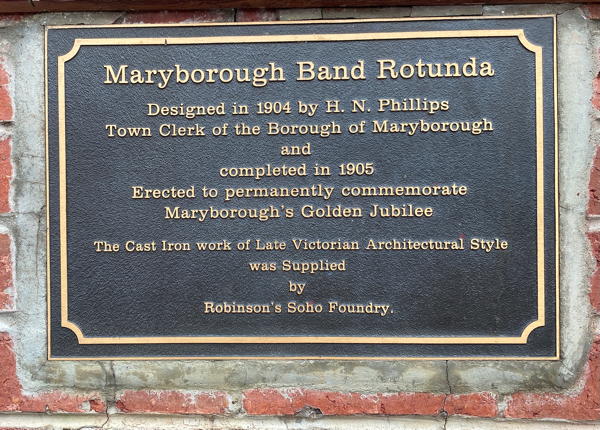
Band rotunda plaque, Maryborough, Victoria. Photograph taken by Jeremy de Korte, September 2020.

In the township of Merbien, a little way west of Mildura in the far North-West of Victoria, a band rotunda was built to commemorate King George V who died in 1936.  The postcard below shows us what it was like in its early days, and the events of when it was opened in 1937 were documented in an article published by the Argus newspaper.

…To-day the third day of the jubilee celebrations was a quiet day for Mildura, but Merbien was the centre of intense activity.  A dense crowd gathered in Kenny Park for the unveiling of the King George V. Memorial by the Postmaster-General Senator McLachlan.

[…]

Senator McLachlan said it was a tribute to the people of Merbien that they had erected such a fine memorial to a King whose influence was for righteousness and peace. 

(“MEMORIAL TO KING GEORGE,” 1937)
Postcard: Band Rotunda, Merbien, Victoria, 1937. (Source: Jeremy de Korte collection)
Bathurst Times, 13/09/1915, p. 2

One of the more famous band rotundas that was built to commemorate an event is the Titanic Memorial Band rotunda in Ballarat.  Allison Rose has documented this rotunda in her book, and this rotunda is the focus of a commemorative event each year.  The opening of this rotunda was noted all over Australia, especially because the costs of erecting this structure was due to bandsmen from all over the country contributing a subscription (“Local and General.,” 1915).  The Evening Echo newspaper from Ballarat described the opening of the memorial in an article published in October 1915.

This memorial has been built to commemorate the heroic bandsmen of the White Star liner Titanic (45,000 tons), which met her doom by striking an iceberg in the Atlantic two years ago.

It is on record that the ships band mustered on deck and played “Nearer My God to Thee,” and then went down with the ship, all of them being lost.  When the news of their sublime courage reached Australia the idea immediately occurred to some one that the bandsmen of Australia should place on permanent record their appreciation and it was suggested that I should take the form of a memorial bandstand.

(“TITANIC MEMORIAL.,” 1915)
Titanic Memorial Bandstand, Ballarat, Victoria. Photograph taken by Jeremy de Korte, June 2019

It is no accident that this memorial bandstand was erected in Ballarat as it was, by this time, regarded as one of the band centres of Australia thanks to the South Street events (Rose, 2017).  Indeed, when this memorial was opened in October 1915, the South Street events were well-underway and there was no shortage of bands in town to combine in a massed band conducted by Albert Wade  (“TITANIC MEMORIAL.,” 1915).  Interestingly, as Rose (2017) tells us, 

It is unique among the bandstands of Australia in being a memorial to the Titanic bandsmen.  The citizens of Broken Hill attempted to build such a bandstand, but they could not raise sufficient funds by public subscription.  With the money raised they had to settle for a broken column memorial that now stands in Sturt Park in Broken Hill.

(p. 80)
Titanic Memorial Bandstand commemorative stone, Ballarat, Victoria. Photograph taken by Jeremy de Korte, June 2019

Proposals, building and public opinion:
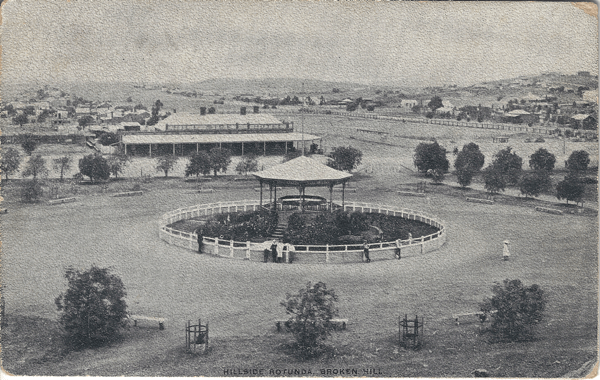
Postcard: Hillside Rotunda, Broken Hill, N.S.W. (Date unknown) (Source: Jeremy de Korte collection)

In the early years when building band rotundas was a fashionable thing to do, many proposals were submitted to local councils, and some were for alterations to existing precincts.   Civic pride accounted for the fact that many proposals were accepted – although there were some who objected.  Finding an objectionable letter to any rotunda was rare.  In 1907 a Mr Angove of Albany, Western Australia expressed surprise that the local council was going ahead with the building of a rotunda in Lawley Park (Angove, 1907).  His letter, published in the Albany Advertiser newspaper, mainly raised the question of expense, of why the council was diverting funds to a rotunda instead of other “urgent works” (Angove, 1907).  An understandable attitude at the time.

Proposals for band rotundas, as has been seen earlier in this post, mainly appealed to the goodwill of councils and the public, and drew in the needs of the local bands as well.  For example, we can see in articles regarding proposals in Dandenong, Victoria, and Wallaroo, South Australia that detail how this kind of appeal was expressed (“A Band Rotunda Proposed.,” 1917; “WALLAROO ROTUNDA.,” 1925).

Input from bandsmen was also noted in the early newspapers, as they had more of a vested interest. “A Bandsman” from Scottsdale, Tasmania, wrote a letter to the North-Eastern Advertiser newspaper in November 1919 to complain about the proposed site of the new rotunda – (in summary) it was going to be too close to other buildings and out of sight – why not place it in a park? (A Bandsman, 1919).  Likewise, “Carbolic” wrote to his local newspaper to congratulate the Glenelg Town Band on their recent performance, but advocated for the moving of the band rotunda to a more suitable location because of acoustics – there were nearby walls that affected the sound projection (Carbolic, 1918).

Maintenance was another issue (and an ongoing issue).  While some were proactive about maintaining rotundas, it seems that some were not so proactive.  In Broken Hill, a Mr H. R. Boyce wrote to the Barrier Miner newspaper to complain about creepers that were growing over the rotunda in the Central reserve (Boyce, 1923).  The rotunda in Healesville faced a different maintenance issue in 1941 when lightning struck the rotunda which shattered a flagpole (“BAND ROTUNDA STRUCK BY LIGHTNING,” 1941).  And in 1950 we find that the Brisbane City Council was unable to maintain rotundas to a satisfactory standard due to a lack of materials and labour (“CAN’T REPAIR BANDSTANDS,” 1950).

The Argus, 16/01/1941, p. 5

To finish this section, there were two pictures from newspaper articles that caught my attention.  The first is a picture published in the Daily Telegraph newspaper in 1910 that shows a proposal to surround the band rotunda in Hyde Park with an amphitheatre.
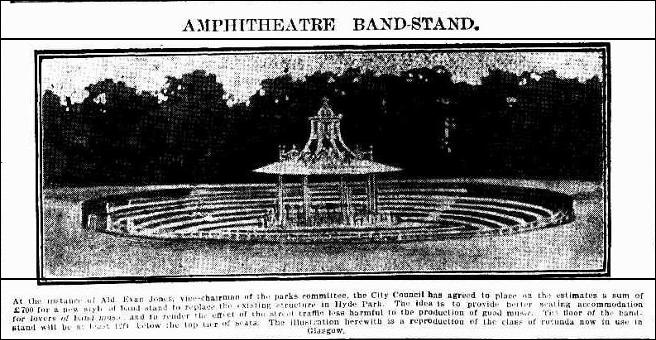
Daily Telegraph, 26/11/1910, p. 15

This second picture shows the laying of the foundation stone for a new rotunda in Mount Gambier, no doubt a special occasion.

Border Watch, 26/10/1933, p. 1

Conclusion:

These are special buildings.  They are unique buildings.  And they provide life for so many bands, people and localities.  It is a shame that so many rotundas have been removed, but equally, it is worthwhile to see how many remain and are preserved as icons to a community.  Each rotunda has a story to tell and the stories are interlinked with towns, suburbs and bands across Australia. 
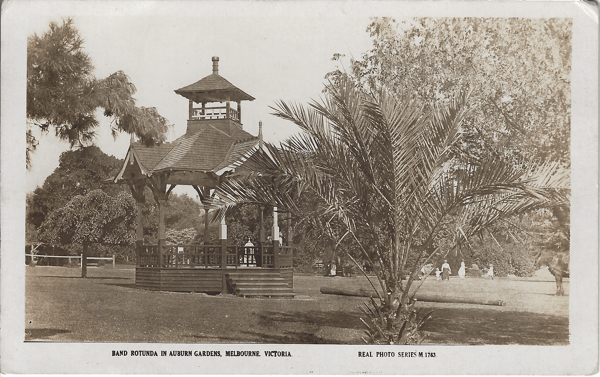
Postcard: Band Rotunda, Auburn Gardens, Victoria (Date unknown) (Source: Jeremy de Korte collection)

References:

A Bandsman. (1919, 11 November). Band Rotunda : (To the Editor.). North-Eastern Advertiser (Scottsdale, Tas. : 1909 – 1954), 3. http://nla.gov.au/nla.news-article151262612

A Lover of Music. (1893, 23 January). CORRESPONDENCE : A BAND ROTUNDA. Mount Alexander Mail (Vic. : 1854 – 1917), 2. http://nla.gov.au/nla.news-article198699429

AMPHITHEATRE BAND-STAND. (1910, 26 November). Daily Telegraph (Sydney, NSW : 1883 – 1930), 15. http://nla.gov.au/nla.news-article238664637

Angove, W. H. (1907, 02 November). Lawley Park Rotunda : [To the Editor.]. Albany Advertiser (WA : 1897 – 1954), 3. http://nla.gov.au/nla.news-article69959867

BAND ROTUNDA FOR PORTLAND. (1910, 24 August). Lithgow Mercury (NSW : 1898 – 1954), 2. http://nla.gov.au/nla.news-article218492203

A Band Rotunda Proposed. (1917, 18 October). South Bourke and Mornington Journal (Richmond, Vic. : 1877 – 1920; 1926 – 1927), 3. http://nla.gov.au/nla.news-article66192904

BAND ROTUNDA RENOVATED. (1935, 17 May). Pinnaroo and Border Times (SA : 1911 – 1954), 1. http://nla.gov.au/nla.news-article189641733

BAND ROTUNDA STRUCK BY LIGHTNING. (1941, 16 January). Argus (Melbourne, Vic. : 1848 – 1957), 5. http://nla.gov.au/nla.news-article8171730

Band Rotunda Wanted. (1917, 10 August). Pinnaroo and Border Times (SA : 1911 – 1954), 2. http://nla.gov.au/nla.news-article188360174

Band Rotunda, Castlemaine Gardens. (n.d.). [Postcard]. [Josef Lebovic Gallery collection no. 1]. Ward, Lock and Co Ltd, London and Melbourne. National Museum of Australia http://collectionsearch.nma.gov.au/object/140044

BANDSTAND BUILDING UNDER WAY AT VANSITTART PARK. (1933, 26 October). Border Watch (Mount Gambier, SA : 1861 – 1954), 1. http://nla.gov.au/nla.news-article77944349

Boyce, H. R. (1923, 31 October). THE ROTUNDA FOLIAGE : To the Editor. Barrier Miner (Broken Hill, NSW : 1888 – 1954), 3. http://nla.gov.au/nla.news-article45624435

Brockhouse, B. (2016). Band Rotundas South Australia. Albumworks. https://my.album.works/2AhNhAf 

Brokenshire, J. (n.d.). Hillside Rotunda, Broken Hill [Postcard]. Joseph Brokenshire, Broken Hill, N.S.W. 

Bulmer, H. D. (n.d.). Main Street Gardens and Band Rotunda, Bairnsdale [Postcard]. Bulmer’s, Bairnsdale, Victoria. 

CAN’T REPAIR BANDSTANDS. (1950, 30 August). Courier-Mail (Brisbane, Qld. : 1933 – 1954), 5. http://nla.gov.au/nla.news-article49731125

Carbolic. (1918, 22 August). BAND AND BANDSTANDS : To the Editor. Glenelg Guardian (SA : 1914 – 1936), 1. http://nla.gov.au/nla.news-article214715457

CASTLEMAINE. (1898, 23 November). Argus (Melbourne, Vic. : 1848 – 1957), 6. http://nla.gov.au/nla.news-article9861653

de Korte, J. D. (2019a). Ballarat Central, Vic. : Titanic Memorial Bandstand – Memorial Stone [Photograph]. Jeremy de Korte, Malvern, Victoria. 

de Korte, J. D. (2019b). Ballarat Central, Vic. : Titanic Memorial Bandstand [Photograph]. Jeremy de Korte, Malvern, Victoria. 

de Korte, J. D. (2020a). Maryborough, Vic. : Princes Park : Band Rotunda [Photograph]. [IMG_5902]. Jeremy de Korte, Redan, Victoria. 

de Korte, J. D. (2020b). Maryborough, Vic. : Princes Park : Band Rotunda – Plaque [Photograph]. [IMG_5903]. Jeremy de Korte, Redan, Victoria. 

de Korte, J. D. (2020c, 12 August). These are the latest additions to the historical band postcard collection that I’ve been putting together. The first one is of a Military Band playing at the bandstand in Hyde Park, Sydney. Unfortunately, the band and year are unknown but the scene it creates could probably be replicated around any bandstand… [Post]. Facebook. Retrieved 29 November 2020 from https://www.facebook.com/groups/145016798904992/permalink/4120772517996047

Hindmarsh Shire Council. (2018). Goldsworthy Park, Nhill [Newsletter]. Monthly Newsletter (October), 3. https://www.hindmarsh.vic.gov.au/content/images/what’s%20on/Monthly%20Newsletter/2018/Monthly%20Newsletter-Hindmarsh%20Shire%20Council-%20October%202018.pdf

Jacobs, W., Taylor, P., Ballinger, R., Johnson, V., & Rowe, D. (2004/2012). Shire of Mount Alexander : Heritage Study of the Shire of Newstead : STAGE 2 : Section 3 : Heritage Citations: Volume 3 : Newstead [Report](6205). (Heritage Studies, Issue. Shire of Mount Alexander. https://www.mountalexander.vic.gov.au/Page/Download.aspx?c=6205

Local and General : Titanic Memorial. (1915, 13 September). Bathurst Times (NSW : 1909 – 1925), 2. http://nla.gov.au/nla.news-article111229166

Mathers, M. (2017, 12 August). Most of us have (or had) a local Band Rotunda. Do you have a photo of it (the older the better) ? This is the one in Kew, Melbourne (a band with which I used to be a player). Upload yours [Post]. Facebook. Retrieved 29 November 2020 from https://www.facebook.com/groups/472757142742103/permalink/1844534445564359

MEMORIAL TO KING GEORGE : Merbein Ceremony. (1937, 11 August). Argus (Melbourne, Vic. : 1848 – 1957), 7. http://nla.gov.au/nla.news-article11116265

MEMORIAL TO NAVIGATORS. (1924, 17 May). Sydney Morning Herald (NSW : 1842 – 1954), 13. http://nla.gov.au/nla.news-article28072947

NHILL : NEW BAND ROTUNDA. (1909, 05 October). Ballarat Star (Vic. : 1865 – 1924), 6. http://nla.gov.au/nla.news-article218793589

Portland’s bandstand rotunda is officially opened for all. (2017, 11 December). Lithgow Mercury . https://www.lithgowmercury.com.au/story/5111856/portlands-bandstand-rotunda-is-officially-opened-for-all/

Queenscliffe Hotel Kingscote. (1900). [Photograph]. [B+30375]. State Library of South Australia, Kingscote Collection. https://collections.slsa.sa.gov.au/resource/B+30375

Rose, A. (2017). Pavilions in parks : bandstands and rotundas around Australia . Halstead Press.

Tellefson. (1937). Band Rotunda Merbein [Postcard]. [Tellefson Series 4]. Tellefson.

TITANIC MEMORIAL. (1915, 22 October). Evening Echo (Ballarat, Vic. : 1914 – 1918), 4. http://nla.gov.au/nla.news-article241689331

Valentine & Sons Publishing Co. Ltd. (1924). Band Rotunda in Auburn Gardens, Melbourne, Victoria [Postcard]. [Real Photo Series M.1763]. Valentine & Sons Publishing Co. Ltd., Melbourne, Sydney & Brisbane. 

Videon, T. (1996). “And the band played on …” band rotundas of Victoria (Publication Number 9924382201751) [MArts, Monash University, Faculty of Arts, Department of History]. Clayton, Victoria. https://monash.hosted.exlibrisgroup.com/MON:au_everything:catau21172148940001751

Virtual War Memorial Australia. (n.d.). Pinaroo Sodiers Memorial Band Rotunda . Virtual War Memorial Australia. Retrieved 30 November 2020 from https://vwma.org.au/explore/memorials/684

WALLAROO ROTUNDA : Proposition by Town Band. (1925, 09 September). Kadina and Wallaroo Times (SA : 1888 – 1954), 2. http://nla.gov.au/nla.news-article124763086

Ward & Farrans. (n.d.). Sydney – Hyde Park (Band-Musique de l’artillerie) (Artillerie-Kapelle) [Postcard]. [L. v. K. No. 48]. Exchange Studios, Sydney, N.S.W. 

Testing times: the resilience of Australian bands during the Great Depression

165x215mm
A large room of tables stocked with fruit and vegetables with a brass band in the centre of the crowd. (Source: State Library of Western Australia: 8292B/A/6851-1)

Introduction:

From conversations I have had with bandmasters in Australia it would appear that the bands generally have been very hard hit by the depression, but I have been struck by the fine spirit and courage shown generally by them in these passing troubles.  Undoubtedly brighter times are coming, and they will be rewarded for the admirable attitude they have taken right through.

(Adkins, 1934)

The years from 1900-1950 are filled with historical events that caused great upheavals in society across the globe. Australia was similarly affected, and nominally our bands as well.  It was not all doom and gloom for bands as this time is one that I personally regard as a golden period.  However, when society experienced hardship, our bands did as well.  The Great Depression from 1929-1939 is just one of those events that was global, but it was felt right down to the tiniest country town.  As for our bands, numerous articles published in newspapers tell of struggle and hope.  The words from Capt. H. E. Adkins, quoted above, then conductor of the A.B.C. Military Band attest to this.

In a previous post the impact of the “Spanish” Influenza on our bands was examined.  Australian society could not have predicted that a decade later they would again be thrust into convulsions not because of a health crisis, but an economic crisis.  Australian bands that existed at the time relied heavily on local council support and the goodwill of subscriptions from the general public.  The money was necessary to keep them going and keep them supplied.  Yet, as can be seen, there were some bands that were formed during this time.  Music, it seems, was a way in which people could forget their struggles and enjoy some community.

This post will obviously highlight some of the struggles that were experienced by bands and band associations during this time; unfortunately, this is unavoidable.  It is also necessary to provide context.  This post will also highlight the resilience of our bands during this time.  Many survived in the most trying of circumstances.  They also kept up a regular pattern of concerts, parades, contests, and other events and in one instance, they also gave their support to the desperate of society. 

The Great Depression is but one event in history, as is the Coronavirus pandemic of today that is again impacting our many bands.  Resilience is a common term that defines the bands of the time.

The Great Depression in Australia: a brief history:

The headlines on an article published in the Sydney Morning Herald on October 26th, 1929, did not mince words: “Wild Selling. New York Panic. Profits Wiped Out. £80,000,000 Slump.”  – the stock market in New York had crashed on October 24th and this sent the economy into a tailspin (“WILD SELLING,” 1929).  The crash on October 24th, 1929, has been well-documented and for much of the world, this had profound consequences.  However, there had been economic troubles in Australia leading up to this event during the 1920s and this led to a decade of financial hardship for all:

As for many other countries, the 1920s were a decade of mixed blessings for Australia.  State governments continued to borrow to finance important public works projects, but underlying problems remained.  Post-war inflation in 1919 and 1920 was followed by a recession.  Unemployment hovered at around 10 per cent during the 1920s.  Loan funds from London dried up after 1927, limiting debt-financed public works.

(Eklund, 2008)

The early years of the Great Depression were very hard in Australia with major unemployment, collapse of the wool and wheat prices, social unrest, displacement of people and governmental problems (Eklund, 2008; National Museum Australia, 2020).  Williamson (2009) tells us “it was the working classes and those who became unemployed who bore the greatest brunt of the Depression.” and that “Losing a job broke the work and leisure routines of an individual’s life, and the victim further lost the company of workmates.” (from Electronic Article).

From 1930 a form of welfare assistance was given to needy households and was either in the form of “sustenance”, “the dole” or “rations” which was “barely enough to survive” (Hutchens, 2020).  This later evolved into other forms of basic work on designated projects for governments and local councils.  In 1932, 60,000 Australians – men, women and children, were dependent on this scheme and unemployment hit a peak of 32% (National Museum Australia, 2020).  A small song sung by the unemployed and children basically summed up the situation that thousands found themselves in:

“We’re on the Susso now,
We can’t afford a cow.
We pay no rent,
We live in a tent.
We’re on the Susso now.”

(Hutchens, 2020; McAnulty, 2017; National Museum Australia, 2020)

The immediate effect of such large job losses and unemployment led to mainly men wandering the country in searching for work (Eklund, 2008).  As well as this, those that remained in work faced cuts to wages and underemployment, which added to the social problems.  Many who had lived reasonable well in the 1920s found themselves in employment situations that they had not previously encountered (Eklund, 2008). 

By the later parts of the 1930s, economic conditions gradually improved although unemployment was still a major problem (“Australia’s Rise From Depression,” 1936).  Recovery was slow, and then tempered by the advent of the Second World War – the next global period of strife.

Finances and Administration:

How did Australian bands weather this economic storm, and what do the available records tell us?  The Annual General Meetings of individual bands and associations provide snippets of information as to how they fared, and thankfully these meetings were detailed in local newspapers.  The Hills Central Brass Band from South Australia held an Annual General Meeting in March 1930, the early years of the Depression.  In their reports the band said they were faring well and had accrued a small credit.  A paragraph from the article that was published in the Mount Barker Courier and Onkaparinga and Gumeracha Advertiser newspaper provides an insight into their awareness of the economic situation.

The chairman, in moving the adoption of the report and balance sheet referred to the excellence of the report.  Mr. Duffield had made a very capable secretary, and took a keen interest in the band.  The report was the best they had had.  With regard to the financial position of the band the speaker though it was highly satisfactory, considering the present depression.

(“HILLS CENTRAL BRASS BAND.,” 1930)

The Devonport Brass Band from Tasmania took an insular view of the conditions when they held their meeting in March 1931 insofar as the rest of Australia was having problems, but their band was proceeding as best they could.  Their acknowledgement of the present conditions opened the report of the AGM as detailed in an article published by The Advocate newspaper.

The report of the year’s working of the Devonport Brass Band at the annual meeting this evening will reveal that there is little sign of the depression so far as the fortunes of this organisation are concerned.

(“DEVONPORT.,” 1931)
Peterborough Federal Band, 1924 (source: IBEW))

Back to South Australia, at an Annual General Meeting of the Peterborough Federal Band held in July 1931, the financials were outlined, and credit was given to the secretary of the band for his sound management of the finances during the previous year.

The secretary’s annual report disclosed a very active and successful year, whilst the balance sheet showed the Band to be on a sound footing; two years ago the overdraft was in close proximity to £200, last year it had been reduced to £14/6/5, and this year closed with a credit balance of £15/0/3, the receipts being £116/19/1 and the expenditure £87/12/5; this in face of the terrible depression that has existed, is a wonderful achievement, and reflects great credit upon the secretary (Mr. W. H. Kaehne), whose sole aim has been a credit balance, and he is to be highly complimented on reaching his objective.

(“Peterborough Federal Band,” 1931)

In these early years of the depression, it is obvious that bands were well aware of the prevailing economic conditions.  However, it was not just individual bands that were taking notice, the band associations were as well.  In May 1932 the Queensland Band Association held their Annual General Meeting and mention of the depression was made in the annual report.

Fees received for registration for the year totalled £119 18s 6d., as against £106 8s 6d. in the previous year. The 1933 contests would be held at Mackay.  Notwithstanding the prevailing depression the association had held its own financially and closed a successful year with a credit balance of £91 11s 4d. compared with £105 16s 1d. last year.

(“BAND ASSOCIATION,” 1932)

Unfortunately, some bands inevitably ran into trouble during this period and either went into recess or disbanded.  Finances were certainly a factor in this, but loss of members was another – which will be explored in the next section.  In 1932 the Yeppoon Brass Band, located in North Queensland, announced that it would go into recess due to lack of funds and members (“INTO RECESS,” 1932).  However, in a generous move, the band allowed remaining members to keep their instruments while in recess.  The Franklin Harbour Band from the Eyre Peninsula in South Australia lamented its struggles in an article published by the Eyre’s Peninsula Tribune newspaper in November 1936. 

… at present one of the depression periods is being experienced and unless a revival of interest by the young men of the town and district is evinced, there is a possibility of the band after 25 years of continuous existence, sinking into oblivion.

(“FRANKLIN HARBOUR BAND.,” 1936)
Franklin Harbour Brass Band (date unknown) (source: IBEW)

The Gawler Brass Band was another that faced growing troubles and in 1938 announced that it was disbanding due money being owed to the local council – they owed £100 for instruments – and lack of members as they had gone from 24 players to 12 (“Gawler Brass Band May Not Continue,” 1936).

The Mail, 18/07/1936, p, 2

This call for more support was a common one from bands and associations as their finances dwindled and membership became problematic. The then Secretary of the Tasmanian Band Association, a Mr W. H. Gray was one who called for more support in a long letter published in The Mercury newspaper in January 1932 (Gray, 1932).  The letter is interesting given that Mr Gray makes no mention of the Depression while calling for more support for the bands – the subject of the letter is mainly about bands playing in certain parks from which they gain revenue.  However, one cannot help but feel that the impact of the Depression was implied when Mr Gray writes in his letter,

The bands are prepared to carry on provided the necessary public support is forthcoming, but many of them are doomed to early extinction if that support is not more liberal from now on.  The Sunday evening concerts provide a most pleasant hour, and are a wonderful tonic and inspiration for the following week’s worries and cares.

(Gray, 1932)

Of course, there were always some who resented that brass bands were getting any form of support at all, which was perhaps understandable. One person from regional South Australia wrote a pointed letter to the Advertiser and Register newspaper complaining that the Government was not doing enough to help primary producers and instead found some money to fund an Institute in Waikerie and buy instruments for the Waikerie Brass Band (to the value of £350) (Rogers, 1931).

Waikerie Brass Band, 1930s (Source: State Library South Australia: B 34089)

There are still more stories to be found regarding the experiences of bands in the Great Depression and thankfully, some are brought to light through community newspapers.  For example, two stories about the Walcha Brass Band, published in the Walcha News newspaper (Walsh, 2019a, 2019b).  The Walcha Brass Band suffered through the 1930s due to the impacts of the Depression but recovered soon after the cessation of the Second World War and survived until 1969 when it disbanded  (Walsh, 2019b).

If this small sample of AGM’s are to go by it is evident that bands were fully aware of the impacts of the depression.  Which made them all the more pleased to find they were riding the economic impacts as best they could. 

Employ a Bandsman:

Every band wants to retain their members as best they can.  This was no different for the bands during the Depression years where, as it was mentioned, people had to leave their localities to find work elsewhere.  Again, the fact that bands were losing members due to Depression conditions, factors that were really beyond their control, sometimes had a detrimental effect on the bands.  One strategy that bands used was to try to find employment for bandsmen in their own localities and on occasion implored local businesses to help them.  This was not an easy thing for bands to ask.

Freeling Brass Band (date unknown) (source: IBEW)

In 1931 the loss of members from the Freeling Model Brass Band from South Australia was noted as a significant factor affecting the survival of the band.  We can see in an article published in The Bunyip newspaper just how dire the circumstance of the band was in 1931.

The secretary (Mr. E. L. Anders) read the report and balance sheet on the year’s work.  He stated that the Band were in a financial position, but were unfortunate in losing eight playing members during the year; some having left the district through unemployment.  […] He also stressed the point, that little or no interest was shown by the playing members and the support from the public was very scanty.  This let the band down badly, and if not more support was forthcoming, the band would have to go into recess for a short period. […] A lengthy discussion arose, and for a time it was hard to distinguish what was being said.  It was proposed that the band go into recess.  After order was restored, it was proposed and seconded that the band carry on. 

(“FREELING MODEL BRASS BAND.,” 1931)

The Muswellbrook Brass Band, located in the Newcastle area of New South Wales, recognized that they might lose two members due employment issues and they made a request to the public in their March committee meeting.  This request was detailed in the local Muswellbrook Chronicle newspaper.

Employment Sought for Members.

Reference was made to the possibility of losing two valuable members of the Band owing to their inability to obtain employment in the town.  The hope was expressed that this matter would come under the notice of the general public, and that anyone in the position to offer employment would communicate with Mr. Wallace (hon. Secretary). 

(“MUSWELLBROOK BRASS BAND.,” 1935)

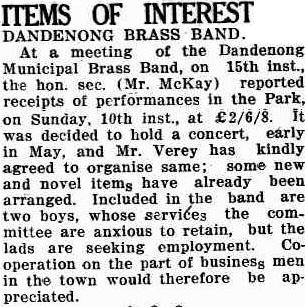
Similarly, in the same year, the Dandenong Brass Band from Victoria (as can be seen in the article below) also put out a plea to try to find employment for two of their members.

Dandenong Journal, 21/03/1935, p. 5

The Waratah Brass Band from Tasmania and the Port Adelaide Municipal Band were other bands that noted the loss of members due to employment issues (“WARATAH.,” 1935; “YOUR LOCAL BAND NEEDS SUPPORT!,” 1938).  It was a circumstance that many bands found themselves in during these years.

Port Adelaide Municipal Band (Source: The Citizen, 30/11/1938, p. 7)

Finding themselves in a slightly different situation, in 1937 a brass band located in Canberra was “disbanded as a protest against the refusal of the Department of Interior to guarantee all members permanent employment.”  (“BAND IS NOT TO PLAY,” 1937).  They were to play at an Armistice Service at Parliament House which forced the Department of Interior to hire a Sydney based band (“BAND IS NOT TO PLAY,” 1937).  However, in trying to defend this decision, the Secretary of the Department, Mr. Carrodus did say…

…that at least half of the members of the band had been given departmental jobs, but because of the stringent observance of the Returned Soldiers’ Preference Act it would be impossible to absorb them all.”

(“BAND IS NOT TO PLAY,” 1937)

It is hard to read of these circumstances and not feel saddened about the state some of these bands.  They were trying to exist in a time of history where outside forces were affecting how they operated; membership and commitment being a major part of those factors. No doubt they were doing the best they could under the circumstances.

The bands played on:

Brass band marching on Anzac Day, Sydney, 1930 (Source: National Library of Australia: 14446)

Music has always been known as a great reliever to troubles and during this time our brass bands rose to the challenge, not only for the good of the band and band members but also for the public and other causes.  In fact, some commentators suggested that there was no need for music making to stop.  In 1931 a Dr A. E. Floyd wrote in an article published in the Australasian newspaper,

The effect of the present financial stringency on every man’s music and musical progress need not be unmitigatedly bad; indeed it may be easily, with a little forethought, be decidedly good. 

(Floyd, 1931)

Admittedly, the context of Dr. Floyd’s article was more on making music in the home environment.  However, there is no doubt that his thoughts were cross-applicable to playing in ensembles outside of the home as well – his encouragement was for people to keep making music no matter the circumstances for health reasons.

For our bands it was a little more difficult as engagements slowed and money was scarce.  The bigger bands, often based in metropolitan centres were luckier than most as they could keep up with a regular pattern of performances, parades and competitions.  Indeed, the Victorian Bands’ League presented some very impressive massed band events during this time including one in 1937 that involved six hundred bandsmen! (“BIG BANDS DISPLAY,” 1937).  In Sydney, a grand competition was held in 1938 which drew together bands from across Australia (Bandsman’s year book, 1938).  While in the regional town of Wellington in New South Wales, their first competition in twenty five years was labelled a “Tremendous and Outstanding Success” by the Wellington Times newspaper (“WELLINGTON BAND CONTEST.,” 1932).

Music for a cause:

The brass bands also did their bit for charitable causes and lent their services to help the needy.  For the bands, this was not a new style of engagement as over time they were regularly engaged in helping raise money for charity – the Victorian Bands’ League massed bands event in 1937 raised money for charity.  However, during the Great Depression this was giving a new meaning and we find the bands involved in some distinct social causes as well.

We can see that bands were an uplifting presence.  In North Queensland the Mirani Brass Band helped to lift spirits during a harvest thanksgiving event and the band was noted for their playing – practices had lifted after harvest when more members were available (“DISTRICT NEWS.,” 1930).  While over in Western Australia, the Merredin Brass Band joined other local organisations in an engagement that raised money for the needy in the district (Branson, 1931).  The Matron of the Clare Hospital located in South Australia wrote an appreciative letter to the Blyth Agriculturist newspaper to thank the “generosity of the general public” and the Clare Brass Band was given a special mention for raising money for a new dressing table in the Isolation section (Pattullo, 1934).

The thanks went both ways.  In April 1930 a letter was published in the Burra Record newspaper co-written by the President, Bandmaster and Secretary of the Spalding Brass Band thanking a Mr. P. Clark of Burra for financing a trip and engaging them to play (Hewish et al., 1930).  No doubt the band was grateful for these kinds of opportunities.

Burra Record, 16/04/1930, p. 3

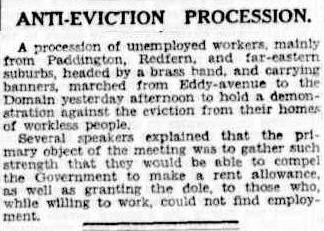
We can also see mentions of brass bands leading marches and demonstrations, which is perhaps understandable.  Many brass bands were supported by industry at this time and no doubt some of the workers were affected by the conditions around them.  Mention was made of a brass band leading an Anti-Eviction procession in Sydney in 1933 and in Newcastle, a brass band headed up 600 unemployed from the “West Wallsend District” who marched on the town hall in 1935 (“ANTI-EVICTION PROCESSION.,” 1933; “UNEMPLOYED,” 1935).

Sydney Morning Herald, 14/08/1933, p. 10

Resilience:

We have already seen that some of the effects of the Great Depression on brass bands led to them going into recess or suffering financial and membership difficulties.  We have also seen that bands kept up their activities as best they could.  They were resilient in the face of adversity.  And if it was one activity that brought people together, it was the brass band.  In this decade, some bands even started up again.

In the township of Leeton, located in the Riverina district of New South Wales, a long letter was published in the Murrumbidgee Irrigator newspaper written by a contributor with the colloquial name of “Has Been”.  In 1932 the Leeton Band resumed practicing and this writer waxed lyrical on how much this band would mean to the town.

Sir,- I notice by your advertising that the Leeton Band is commencing its practices again, which means that we are again to have the pleasure of hearing band music.  This, I am sure, will be very pleasing to quite a number of people in our town and district, for the band is a decided acquisition to any town, no matter how small.

(“Has Been”, 1932)

Of course, there was a trade-off to reforming the band and “Has Been” wrote an appeal to the townsfolk to look for employment opportunities for bandsmen.

Might I add another word to the employers of labour, whether it be shop, farms or factory, when in need of a man, give the band secretary a chance to supply you with a bandsman.  If there is not a man in town suitable for the job, ask the band secretary to see what he can do.  The band secretary, being a life man, would, no doubt insert an advert in the city papers, worded something like this: “Wanted – A mechanic (or whatever the position was that had to be filled), good man only; must be bandsman (cornet player preferred) – Apply Secty Leeton District Band.

(“Has Been”, 1932)

“Has Been” was probably working a bit ahead of himself but the initiative was warranted given the difficult times – and many other bands were trying the same initiative.

The Tully Brass Band from North Queensland was perhaps one of the luckier ensembles as six years prior to 1933, residents of the town subscribed to the band and £400 had been spent on instruments (“TO BE RE-FORMED,” 1933).  When the band was reformed in 1933 those instruments were still available, so the band was able to restart almost immediately.  We can see in the photo below what the band was like in the 1930s.  

Tully Brass Band marching. ca. 1930s (Source: State Library of Queensland: 33123)

To be resilient a band had to be able to handle the circumstances as best they could and gathering public and council support was a chief aim.  When these pieces fell into place, bands could survive reasonably comfortably despite the outside circumstances.  For bands to restart during this time was an additional challenge which some of them managed with success.

Conclusion:

Coming out of the 1920s where the world seemed to be recovering only to plunge into another crisis must have been a major shock.  For bands, this meant a greater focus on administration especially finances, engagements, and membership.  Some aspects were simply out of their control such as the movement of members due to employment – as enjoyable as playing in a band might be, the outside need was to find a job.  It was admirable that many bands sought to find work for their members and themselves become a social service.

No doubt the work the bands were doing was appreciated by their communities either through live performance or over the wireless.  Music is uplifting.  Music could help people forget about their predicaments, if only for a short time.  The bands did their best.

References:

“Has Been”. (1932, 26 February). REFORMING THE BAND : (To the Editor). Murrumbidgee Irrigator (Leeton, NSW : 1915 – 1954), 3. http://nla.gov.au/nla.news-article155893074

Adkins, H. E. (1934, 10 January). Britain’s Big Brass Bands. Courier-Mail (Brisbane, Qld. : 1933 – 1954), 10. http://nla.gov.au/nla.news-article1158876

ANTI-EVICTION PROCESSION. (1933, 14 August). Sydney Morning Herald (NSW : 1842 – 1954), 10. http://nla.gov.au/nla.news-article16998155

Australia’s Rise From Depression : Story Told By Figures. (1936, 15 February). Northern Producer and Morawa and District Advertiser (WA : 1930 – 1947), 4. http://nla.gov.au/nla.news-article257624349

BAND ASSOCIATION : The Annual Report. (1932, 12 May). Telegraph (Brisbane, Qld. : 1872 – 1947), 13. http://nla.gov.au/nla.news-article180704011

BAND IS NOT TO PLAY : Demand Permanent Jobs. (1937, 11 November). Labor Daily (Sydney, NSW : 1924 – 1938), 6. http://nla.gov.au/nla.news-article237760894

The Bandsman’s year book and official programme of the Australian Championship Band Contest. (1938). (Band Association of New South Wales, Ed.). Band Association of New South Wales. 

BIG BANDS DISPLAY : 600 Players. (1937, 25 September). Sporting Globe (Melbourne, Vic. : 1922 – 1954), 7. http://nla.gov.au/nla.news-article180841683

Branson, I. N. (1931, 28 April). The Meldrum Benefit. Wheatbelt Wheatsheaf and Dampier Advocate (Merredin, WA : 1930 – 1939), 1. http://nla.gov.au/nla.news-article251755519

DEVONPORT. (1931, 31 March). Advocate (Burnie, Tas. : 1890 – 1954), 4. http://nla.gov.au/nla.news-article67710241

DISTRICT NEWS : Mirani : (From our Correspondent). (1930, 23 December). Daily Mercury (Mackay, Qld. : 1906 – 1954), 6. http://nla.gov.au/nla.news-article170235248

Eklund, E. (2008). 10 June 1931. In M. Crotty & D. A. Roberts (Eds.), Turning Points in Australian History (pp. 48-61). University of New South Wales Press Ltd. 

Floyd, A. E. (1931, 03 January). MUSIC : Need the Depression Stifle Music? Australasian (Melbourne, Vic. : 1864 – 1946), 15. http://nla.gov.au/nla.news-article141416272

Franklin Harbour Brass Band. (n.d.). [Photograph]. [phot3437]. The Internet Bandsman Everything Within, Vintage Brass Band Pictures : Australia. http://www.ibew.org.uk/vbbp-oz.html

FRANKLIN HARBOUR BAND. (1936, 26 November). Eyre’s Peninsula Tribune (Cowell, SA : 1910 – 1950), 2. http://nla.gov.au/nla.news-article219473615

Freeling Brass Band. (n.d.). [Photograph]. [phot15438]. The Internet Bandsman Everything Within, Vintage Brass Band Pictures : Australia. http://www.ibew.org.uk/vbbp-oz.html

FREELING MODEL BRASS BAND. (1931, 19 June). Bunyip (Gawler, SA : 1863 – 1954), 6. http://nla.gov.au/nla.news-article96642544

Gawler Brass Band May Not Continue. (1936, 18 July). Mail (Adelaide, SA : 1912 – 1954), 2. http://nla.gov.au/nla.news-article55830899

Gray, W. H. (1932, 09 January). BAND CONCERTS : Appeals for More Liberal Support : To the Editor of “The Mercury.”. Mercury (Hobart, Tas. : 1860 – 1954), 9. http://nla.gov.au/nla.news-article29939058

Hewish, P. A., Carlson, A. C., & Mannion, F. J. (1930, 16 April). SPALDING’S BRASS BAND APPRECIATION : (To the Editor). Burra Record (SA : 1878 – 1954), 3. http://nla.gov.au/nla.news-article37488195

HILLS CENTRAL BRASS BAND. (1930, 21 March). Mount Barker Courier and Onkaparinga and Gumeracha Advertiser (SA : 1880 – 1954), 5. http://nla.gov.au/nla.news-article147845925

Hutchens, G. (2020, 29 March). The lessons of our past and our neighbours’ present could guide Australia’s economic response to coronavirus. ABC News. Retrieved 02 October 2020 from https://www.abc.net.au/news/2020-03-29/australias-history-of-economic-support-coronavirus-covid-19/12100194

Illustrations Ltd. (1932). Large group of people in shed near tables full of vegetables and fruit [picture] [1 negative : glass, b&w ; 17 x 22 cm.]. [101841PD]. State Library of Western Australia, Illustrations Ltd collection ; 8292B/A/6851-1. https://encore.slwa.wa.gov.au/iii/encore/record/C__Rb2649568

INTO RECESS : Yeppoon Brass Band. (1932, 26 April). Morning Bulletin (Rockhampton, Qld. : 1878 – 1954), 1. http://nla.gov.au/nla.news-article54737835

ITEMS OF INTEREST : Dandenong Brass Band. (1935, 21 March). Dandenong Journal (Vic. : 1927 – 1954), 5. http://nla.gov.au/nla.news-article213964037

McAnulty, H. (2017, 13 January). History Talking: Surviving life in the dole-drums of the Depression. Central Western Daily. https://www.centralwesterndaily.com.au/story/4403111/history-talking-surviving-life-in-the-dole-drums-of-the-depression/

MUSWELLBROOK BRASS BAND : Committee Meeting. (1935, 01 March). Muswellbrook Chronicle (NSW : 1898 – 1955), 1. http://nla.gov.au/nla.news-article107669487

National Museum Australia. (2020, 15 April ). 1932: Height of the Great Depression, with 32 per cent unemployment. National Museum Australia. Retrieved 26 September 2020 from https://www.nma.gov.au/defining-moments/resources/great-depression

Pattullo, B. (1934, 12 January). THE CLARE AND DISTRICT HOSPITAL : | To the Editor |. Blyth Agriculturist (SA : 1908 – 1954), 2. http://nla.gov.au/nla.news-article217990434

Peterborough Federal Band. (1924). [Photograph]. [phot6378]. The Internet Bandsman Everything Within, Vintage Brass Band Pictures : Australia. http://www.ibew.org.uk/vbbp-oz.html

Peterborough Federal Band : Annual General Meeting. (1931, 17 July). Times and Northern Advertiser, Peterborough, South Australia (SA : 1919 – 1950), 4. http://nla.gov.au/nla.news-article110542695

Pohjanpalo, J. (1930). Brass band marching on Anzac Day, Sydney, 1930 [1 negative : nitrate, black and white]. [nla.obj-15268053]. National Library of Australia, Jorma Pohjanpalo collection of photographs of Sydney and Queensland, 1928-1931. http://nla.gov.au/nla.obj-152628053

Rogers, G. S. (1931, 15 April). POINTS FROM LETTERS : Brass Bands or Primary Production. Advertiser and Register (Adelaide, SA : 1931), 12. http://nla.gov.au/nla.news-article45760607

TO BE RE-FORMED : Tully Brass Band. (1933, 13 May). Cairns Post (Qld. : 1909 – 1954), 6. http://nla.gov.au/nla.news-article41214410

UNEMPLOYED : Meet Shire Council : MANY DEMANDS : 600 March from West Wallsend : Strikers State Their Case. (1935, 12 July). Newcastle Morning Herald and Miners’ Advocate (NSW : 1876 – 1954), 11. http://nla.gov.au/nla.news-article138136031

Unidentified. (1933). Marching brass band, Tully, ca. 1930s [photographic print : black & white , ca. 1930s.]. [33123]. Brisbane John Oxley Library, State Library of Queensland, OneSearch. https://hdl.handle.net/10462/deriv/192004

Waikerie Brass Band. (1930). [Photograph]. State Library South Australia, Waikerie Collection. https://collections.slsa.sa.gov.au/resource/B+34089

Walsh, B. (2019a, 27 February). Walcha History: Band stands and delivers for Premier. Walcha News. https://www.walchanewsonline.com.au/story/5922107/walcha-band-stands-and-delivers-for-premier/

Walsh, B. (2019b, 13 March). Walcha History: Walcha Town Band’s final years. Walcha News. https://www.walchanewsonline.com.au/story/5947106/walcha-town-bands-final-hurrah/

WARATAH : The Band. (1935, 16 November). Advocate (Burnie, Tas. : 1890 – 1954), 10. http://nla.gov.au/nla.news-article86569751

WELLINGTON BAND CONTEST : THE FIRST FOR 25 YEARS : A Tremendous and Outstanding Success. : UNBOUNDED ENTHUSIASM. (1932, 04 January). Wellington Times (NSW : 1899 – 1954), 6. http://nla.gov.au/nla.news-article143246369

WILD SELLING : New York Panic : PROFITS WIPED OUT : £80,000,000 Slump. (1929, 26 October). Sydney Morning Herald (NSW : 1842 – 1954), 17. http://nla.gov.au/nla.news-article16596498

Williamson, A. (2009). The Cud on History — Looking Back on The Great Depression in Australia [Electronic Magazine Article]. The Cud: Entertain a new perspective: chew the cud. Retrieved 26 September 2020, from http://thecud.com.au/live/content/cud-history-—-looking-back-great-depression-australia

YOUR LOCAL BAND NEEDS SUPPORT! : A Short History. (1938, 30 November). Citizen (Port Adelaide, SA : 1938-1940), 7. http://nla.gov.au/nla.news-article236745262

Australian bands, gramophones and wireless: adapting to new technology

19290722_Argus_Wireless-Broadcast
The Argus, 22/07/1929, p. 18

Introduction:

The Old Town Band
(Written for “The Land”)

The band was the life of the old town
The zest of its great events
When the great Pooh-Bah himself came down,
Or the prize merinos brought renown
Or the circus raised its tents.

There was music in the trombone
A martial note in the drum
And the boom of the bass was on its own
In the days before the gramophone
Ere the wireless craze had come.

Those were the day when the township band
Filled a place in pioneer life:
Cheered the struggle with virgin land
And gave the old battlers a helping hand
When droughts or plagues were rife.

Today the baton is laid aside
And the bandsmen rest in their graves:
They played their way o’er the great divide,
And are bandsmen now on the other side
In paradisian naves

And o’er the earth in tones forlorn
The saxophone raises its call.
The engines start their shrieks at dawn
The gramophone laughs the band to scorn,
And the wireless mocks them all.

(Excerpts from “The Old Town Band”, James, 1929)

So wrote Mr. A. A. James in 1929 for The Land newspaper in response to an article published in the Riverine Grazier which lamented the fact that the town of Hay in Southern New South Wales had lost its town band.  His prose was published in several other country newspapers at the time, as many town bands faced the same challenges.  Mr James singles out the gramophones and wireless as contributing factors, but was he right in suggesting so?  Was this new technology which proliferated during the early 1900s detrimental to our bands? It depends on the perception of the history at the time.  And thankfully, there is much history to examine.

In this post, the effects of new broadcasting technology on Australian bands will be looked at.  The early 1900s were a period of rapid technological change and our bands were nominally affected by these changes.  Throughout this early time from 1900 – 1950, and Mr James’s poem sits roughly in the middle, a new life of music and entertainment was brought into the homes of Australians – enthusiastically so.  With this adoption of gramophones and wireless sets came the start of commentary and opinions from citizens which were written up in the newspapers.  Radio program notes published in newspapers became essential reading.

Through this all we find the relationships between audience and bands being rapidly changed.  Perhaps this is the deeper meaning of Mr James’s poem – he identified that people were more enamoured with sounds coming out of a box of wires than live instruments and musicians.  Both sides of this issue will be explored as some bands took advantage of the radio and found new audiences, while other bands could not compete.

Early transmissions:

Live performance was very much the norm of Australian brass bands in the early 1900s and engagement with audience was centred around this type of performing.   As well as this, the popularity of brass bands was obvious through their music and the crowds that they attracted.  Reports of 70,000 people cramming the streets of Melbourne to see the famous Besses o’ th’ Barn Band in a parade and 20,000-30,000 people watching the South Street marching sections were not uncommon (“Besses o’ th’ Barn Band,” 1907; Greaves, 1996).  Later in the 1920s there are stories about 5,000 people attending community song nights in local gardens, as was the case at Central Park in Malvern where the Malvern Tramways performed every week (Young, 1923).

In amongst the many accounts on live performances are a couple of unique stories.  In an earlier post regarding bands on Australian islands, the remarkable story of a performance by the Kingscote Brass Band (Kangaroo Island) was highlighted.  On the 20th of November 1906, the band performed a lunchtime concert which was transmitted via telephone to lighthouses at either end of Kangaroo Island – one seventy miles to the West of Kingscote and the other thirty miles to the East (“MUSIC FOR WATCHERS BY THE SEA.,” 1906).  According to the article in the Register, the concert was “very much appreciated” by both lighthouse keepers (“MUSIC FOR WATCHERS BY THE SEA.,” 1906).

However, this was not the first brass band concert broadcast via telephone in Australia.  According to an article published in the Rockhampton Morning Bulletin, this took place in the preceding century, although the exact date is unclear.

A band conducted by Mr Edward Brown was practising at the old fire brigade station […] when the late Messrs Harry Batchelor and W. Pummell, compositors of the “Morning Bulletin” suggested that the playing be put “over the phone”.  Mr Rosenads, then in charge of the Rockhampton Telephone Exchange, agreed to the proposal.  There was a function at the School of Arts that night and the band was heard there “by quite a few who took turns at the earphone”.  Later the band was playing outside the Oddfellows Hall in Denham Street and by means of a “link-up” was heard at Mount Morgan.  “And very well, too” said Mr Brown.

(“Band Music “Broadcast” Here Last Century,” 1945)

No doubt transmitting a performance via telephone would have seemed innovative and inventive, especially in these early times.  However, these were extremely rare and were not substitutes for live performances, they were mainly done out of opportunity – a way to see whether it could be done.  The major changes that were taking place were the recordings of bands on gramophone records, and the beginnings of radio broadcasts.

The band movement is cautious:

In Australia, the pace of change from predominantly live music to a mix of live music, recorded music and broadcast music took place within the space of a couple of decades.  There were many commentators at the time who saw fit to try to warn of a decline of community bands and one or two had their voices repeated through many regional newspapers.  One of them was a Mr Will Lewis formerly of the Toowoomba Municipal Band who expressed a pessimistic attitude:

He was of the opinion that the day of the amateur brass band was waning, and gave as a reason the fact that the gramophone, by which one could hear the world’s greatest bands and orchestras – jazz and otherwise, was creating serious inroads upon the brass band, and further, that the advent of the radio was also having much to do with the decline of brass band popularity.  Even band contests were becoming less popular every year – at least with the general public – and the wireless and the gramophone were the two disturbing elements.  Bandsmen, naturally, would be the last persons to recognize this serious fact.”

(““DAY OF AMATEUR BRASS BANDS WANING.”,” 1927)

Some might consider Mr Lewis to be alarmist, he could not predict the future, but he was commentating on the present.  For the brass bands it was a time of upheaval and some of them were rightfully concerned.  It could be said that many bands went defunct at this time due to the technological change however it is hard to document this at this time of writing.

The worry of band people was not helped by this small snippet of news in 1930 about the Royal Melbourne Show dropping the brass bands in favour of recorded music being played through loud speakers – and saving £140.00 (“MELBOURNE SHOW.,” 1930).

19300409_Brisbane-Courier_Melb-Show
The Brisbane Courier, 09/04/1930, p. 24

In 1938 a passionate call to old times was made by the Committee of the Sunshine Brass Band, based in western Melbourne.  While the crux of the article published in the Sunshine Advocate was to solicit funds and support, they also lamented the fact that times had changed, and that local brass bands were victims of change.  Below are some excerpts from the article:

Most old-established customs and usages have felt the influence of modern times, and not the least of these are district brass bands, which have had to fight against canned music retailed hourly over the wireless.  Gramophone recordings of the world’s best bands are sandwiched in between talks and appeals to buy somebody’s pills to improve health.

[…]

The older generation was a music loving people.  The possession of a piano was a hall-mark of respectability, and the education of the children was not considered complete unless music was included in the curriculum.

[…]

To hear a local band in the gardens on a Sunday afternoon and a warm evening were events that were looked forward to by the older generation.  They were delightful times, and people held communion with one another to the strains of pleasant and beautiful music, which acted as a tonic to their nervous system.

The Sunshine band committee realises that a return to the customs of other days is due, and propose to play near the railway station on warm Sunday evenings.

(“Sunshine Band Needs More Public Support,” 1938)

This article was interesting in its sentiment and information.  We have here a brass band from the Melbourne environs trying to bring back former times through playing quality live music in a local place.  By this time however, music broadcasts were well and truly accepted so their words might have struck some memories amongst parts of the population. They were telling it as they saw it.

A similar sentiment to Mr. Lewis and Mr. James was also expressed in 1938 in an article published in the Sydney Mail by a contributor with the initials of W. P. T.  This article was more of a reminiscence of times gone by and he mentions several brass bands.  The opening of his article reads:

The brass band of the small country towns plays a very important part in the social life of the country, although such bands are not nearly as common as they were before the days of radio.

(W. P. T., 1938)

It is an interesting observation to make and clearly some connection had been made in the minds of people that radios were somewhat to blame for the demise of smaller bands.

The other side to these views is that several bands had begun exploring what the new technology could do for them from the very beginning.

The band movement adapts:

In 1996, noted band historian Jack Greaves assisted in the compilation of several old recordings into a two-CD set titled “The Great Bands of Australia” (Greaves, 1996).  This CD set is remarkable not only for the breadth of recorded music from full band works, marches and solo items, performed by a large selection of famous Australian bands.  From reading a catalogue entry of this work (linked), we can see that the recordings date back to 1912.  Some of the music can still be heard thanks to the work of the National Library of Australia and the National Film and Sound Archive (NFSA).  Below is a link to one recording which is on the NFSA website:

The Newcastle Steelworks Band (1924) playing the “Honest Toil March” by William Rimmer

The gramophone meant that people could acquire recordings of music groups and play them in their own homes at a time of their choosing.  They did not have to go out to concerts or community events, or the band competitions.  It was one cause of alarm for the band movement, but some bands obviously saw fit to record their work and bring their playing to new audiences.  Recordings by many of the top bands of the day still exist and enthusiasts have made digital copies of old recordings.

Aside from the gramophone, the utilisation of the radio probably brought about the greatest change to society and to the band movement.  Referred to early as the wireless, Australia followed developments out of America and the United Kingdom and set up its own network of stations.  It is in the early 1920s when this was happening.

19230800_Box-Hill-Band_Radio-Studio
Newspaper unknown at the time of writing (Source: Box Hill Historical Society)

The year is 1923 and in the Melbourne suburb of Box Hill the first transmission of a live brass band over the wireless took place on the 1st of August (Elsum, 1924).  The picture above is reputed to be the Box Hill Brass Band sitting in the home of Mr H. Beattie, a wireless enthusiast who resided in Box Hill.  However, in some newspapers the band that participated in the first transmission was named as the Nunawading District Brass Band (“NUNAWADING BRASS BAND,” 1923).  This conjecture can be easily explained as Nunawading and Box Hill are near neighbouring suburbs and the then Parish of Nunawading encompassed Box Hill.  (The Box Hill Historical Society shares my confusion as the newspapers were not forthcoming as to the true identity of the band that was actually broadcast (Harris, 2020)).  Despite the confusion in the newspapers, the fact remains that a brass band of the local area had their music transmitted via wireless.

This first transmission was actually a modulation test and the band was heard over all of Melbourne, parts of Victoria, and even interstate!  Much of the article published in the local Reporter newspaper listed the locations where the transmission was heard and the praise that was given:

For the next few days letters arrived from all points of the compass congratulating Mr Beattie and the Band, and expressing appreciation also of a speech by Cr. W. Young.  From Footscray to Armadale, from Sandringham to Camberwell, Essendon, Hawksburn, and wherever else in the metropolitan district, receiving stations listened in, the unanimous opinion expressed that it “was the best music ever heard by wireless”.  Wonthaggi sent a tribute, and the amateurs of Ararat wrote “Encore, we want more”, while far away Terang announced that the enthusiastic listeners in there were delighted.  The most interesting letter came from Strathfield, Sydney, 592 miles from the spot the Band played, stating that a number of visitors sat around a three-valve set with a loud speaker, and heard the performance from start to finish, announcing the strength and modulation to be perfect, and stating that after the Band had concluded with the National Anthem, local transmitters around Sydney could be heard enthusiastically discussing the test.

(“NUNAWADING BRASS BAND,” 1923)

An achievement indeed!  Although this achievement had to be defended.  In early 1924, the Vice-President of the Nunawading District Brass Band, a Mr. W. M. R. Elsum wrote a letter to the Argus newspaper disputing that the Newcastle Steelworks Band was the first full band to have broadcasted a concert via wireless (Elsum, 1924).

Once people in Australia realised that music of this nature could be transmitted successfully, there was no stopping the progress – it is to say, in colloquial terms, the horse had well and truly bolted!  Radio stations and transmitters were set up all over the country and within years, much of the population could listen to a variety of programs (““Listening In”,” 1923).  The Queensland Government for example, started setting up a State based broadcasting service in 1925 (“STATE RADIO.,” 1925).  In New South Wales, innovation in programming was highlighted with the organising of a Radio Eisteddfod by the New South Wales Broadcasting Company which involved a section for brass bands (“RADIO EISTEDDFOD.,” 1928).  Although, the articles of the day were not clear as to who competed and if brass bands made it to the finals.

For the brass bands, radio stations seized upon them as a ready-made musical item and for some of the bands it led to new popularity – some, because radio stations were tending to use the same top-quality brass bands over and over again.  Additionally, as explored in a previous post, in 1930 the A.B.C. Military Band was established (“MILITARY BAND AT 3LO.,” 1930).  Initially conducted by Harry Shugg, it was further strengthened in 1933 and quickly became a stalwart of A.B.C. radio programming alongside the brass bands (“A BRASS BAND RECITAL.,” 1940; “Radio Programmes,” 1939).

S6.2_20180609_19310000_ABC-Military-Band_Postcard
1930 Postcard of the A.B.C. Military Band in a studio, conducted by Mr Harry Shugg. (Source: Victorian Collections: Victorian Bands’ League)

The Advertiser newspaper in Adelaide noted that “Brass band concerts have been remarkably popular” and one of the brass bands that station 5CL presented was “Holden’s Silver Band” (“5CL FEATURES,” 1930).  A highlight in Victoria of station 3LO’s programming was the “State Schools’ Brass Band contest, which was won by Wonthaggi.”  (Armadale came second and Princess Hill was third with Northcote awarded an honourable mention) – a contest which was adjudicated by the famous Percy Code (“RADIO SHOW.,” 1930).

Of course, like the concerts mentioned earlier in the post that were broadcast via telephone, there were other broadcasts that could be classed as novelty events.  In November 1932, thirty members of the Young Australia League band were taken up in the “Southern Cross” aircraft flown by Charles Kingsford-Smith where they were to “broadcast music at a height of 5000ft” (“MUSIC IN THE AIR,” 1932).

Now that radio broadcasting was fully entrenched and brass bands were a seemingly popular item, there were times when radio through it would be in the best interest of the band movement to have their events transmitted to the world.  The Victorian Centenary celebrations of 1934 were a case in point.  The Herald newspaper took aim at the Victorian Bands’ League for not being ambitious enough with their proposed event:

From the point of view of broadcasting, it is regrettable that the Victorian Bands’ League does not see its way to conduct at the Centenary celebration its proposed international brass band championship.  This would have been an event of exceptional interest, extending to distant peoples who know little of Australia and its progress.  More than that, good band music will be an influence joyous and vital.  If an international contest cannot be arranged it should be possible to provide an Imperial one.

(“Broadcasting And Brass Bands,” 1933)

Through better technology and transmission, Australia was also exposed to performances from around the world.   Perhaps one of the more unusual concerts that was received was in 1935 when the Imperial Ethiopian Brass Band was heard via short-wave radio in Brisbane (“IMPERIAL ETHIOPIAN BRASS BAND,” 1935).  The transmission was reported to have been heard with “remarkable clarity” (“IMPERIAL ETHIOPIAN BRASS BAND,” 1935).  Over in Western Australia, the Kalgoorlie Brass Band conducted by Mr. Ted McMahon made history in 1937 when it was broadcast and relayed nationally through stations 6GF, 6WF and 6WA as part of a program to highlight local artists (“Kalgoorlie Band For National Broadcast,” 1937).

These formative years of radio shaped the way Australians heard and digested music.  Clearly the brass bands were a useful addition to radio programs, and they presented some quality music.  Obviously, some bands, namely country bands, had been left out of this success.  What were the feelings of the listeners?

Too many bands or not enough bands?:

As mentioned, the first wireless transmission of a brass band took place in 1923 so another part of this story is the opinions of listeners, and there were many opinions.  Most accounts were diplomatic about the popularity of brass bands, but some listeners and commentators asked whether there were too many bands, or could the broadcasters play more bands.  Opinions were divided; Australians clearly had their choices.

As early as 1925 letters were seen in newspapers criticising the musical choices of radio stations.  Some of the language was blunt as this letter signed by “Condensor” and published in the Herald shows:

Sir,  – We quite agree with your correspondent “Radio” who complains of the number of brass bands broadcast from 3LG.  Night after night we have to put our phones down, sick and tired of brass.  Surely one night a week is enough to satisfy anyone.

(Condensor, 1925)

Interestingly we also see opinions from commentators.  A Mr Robert McCall, writing for the Australian Women’s Weekly column, “Music Radio” asks a question at the head of one his columns, “Band Music On the Air Will it be Overdone?” (McCall, 1933).  He asked the question because of a decision by the A.B.C.:

Is the Australian Broadcasting Commission overdoing band programmes?  Next week there will be bands on the air on six nights – one night the popular brass ensemble from the Malvern Tramways and on five the newly-formed A.B.C. Military Band.

(McCall, 1933)

He went on to write:

Bands, both brass and military, always have been popular in Australia and the commission will find a vast and most receptive audience for its several months season by the band conducted by Captain Adkins from Kneller Hall.

[…]

The bands’ programmes are sure to stimulate the already widespread interest in band work, but I feel that their greatest service should lie in lifting the usual band repertoire out of the ruck of the commonplace.  It is about time that such hardy perennials as “Zampa,” “Poet and Peasant,” “Light Cavalry,” and those ill-sounding selections from grand and light operas were given a rest.

[…]

At the same time it should not be forgotten that in recent years some of the most important composers of the day have been seized with the possibilities of bands.  Men such as Holst and Elgar have written compositions specially for them.  Nor are these works complex and unlistenable.

Band music gives pleasure to thousands.  It can still do so, and yet be artistic and original.

(McCall, 1933)

McCall provides an interesting opinion.  It seems he was not against the idea of bands being programmed six nights in a row.  Rather, he was taking the view of a music critic and expressing concern that the usual repertoire played by bands per se was not palatable to the ordinary listener.

To counter some of the detractors, there were always people who liked the regularity of brass and military bands on the radio.  The target of their letter writing was the radio stations themselves and certain listeners scolded the A.B.C. in particular for altering the programming of regular band programs (Breynard, 1934; Mounsey, 1939).  One of the stronger responses came from Mr J. L. C. White, then Secretary of the Victorian Bands’ League of which his words were quoted in an article published in The Argus newspaper in March 1951:

Victoria’s 3,500 registered brass bandsmen and their fans were receiving no encouragement from the A.B.C. or commercial broadcasting stations, Mr. J. L. C. white said yesterday.

[…]

He was commenting on a letter to The Argus pointing out that packed houses for the Black Watch band had proved that good bands were still popular.

The letter asked why radio listeners were not given more band music.

Mr. White said: “A poll would show that 90% of radio listeners enjoy band music.”

“More bands than ever are being formed now, and their music is as popular as ever.”

(“He wants more band music broadcast,” 1951)

It is of course some months after this article was published that the A.B.C. Military Band was made redundant in October 1951 (“A.B.C. Band’s Farewell,” 1951).

After these formative times, the status quo of brass bands had changed.  Live performances continued, but radio and recording also occupied the bands.  Some bands found a new market by producing small recordings of marches for use in schools and marching groups of with three such recordings are cited with details of the recordings linked here (Malvern Municipal Band, 1958, 1970; Preston Municipal Brass Band, 1956).

Conclusion:

In the course of these years it is possible to follow divergent streams of opinion.  Firstly, there were the bands who were concerned by the impact of new technology and were worried about the erosion of their traditional ways of doing things.  Then there were the bands that embraced recording and broadcasting.  And of course, the second divergent opinion was evident regarding the content of radio programs and programming.  It was not exactly win-win situations for everyone.  Strength of feeling in the band movement was strong.

It is doubtful to see whether the same debate would take place nowadays regarding new technology.  There was a time past in the early days of the internet when community bands could not see the use of a website or email.  It would seem that history keeps repeating itself whenever there is a new technological development.

To finish this post, it would be remiss not to end with another old recording.  Here is a YouTube with the Newcastle Steelworks Band of 1924 playing the piece “Zelda” by Percy Code with famous Cornetist Arthur Stender as the soloist (Vintage Sounds & Code, 2019).

References:

5CL FEATURES : Brass Band Concert. (1930, 23 August). Advertiser (Adelaide, SA : 1889 – 1931), 9. http://nla.gov.au/nla.news-article30503444

A.B.C. Band’s Farewell. (1951, 15 October). Age (Melbourne, Vic. : 1854 – 1954), 3. http://nla.gov.au/nla.news-article205334832

A.B.C. Military Band – Conductor: Harry Shugg. (1930). [Postcard : L13.8cm – W8.8cm]. [0016]. Victorian Collections, Victorian Bands’ League. https://victoriancollections.net.au/items/5b39988221ea6d0008c461a6

Band Music “Broadcast” Here Last Century. (1945, 16 October). Morning Bulletin (Rockhampton, Qld. : 1878 – 1954), 5. http://nla.gov.au/nla.news-article56391096

Besses o’ th’ Barn Band. (1907, 09 August). Quiz (Adelaide, SA : 1900 – 1909), 8. http://nla.gov.au/nla.news-article166338966

A BRASS BAND RECITAL. (1940, 28 May). Macleay Argus (Kempsey, NSW : 1885 – 1907; 1909 – 1910; 1912 – 1913; 1915 – 1916; 1918 – 1954), 6. http://nla.gov.au/nla.news-article234489582

Breynard, S. (1934, 10 August). RADIO SERVICES : Brass Band Music : To the Editor. Advertiser (Adelaide, SA : 1931 – 1954), 24. http://nla.gov.au/nla.news-article74106904

Broadcasting And Brass Bands. (1933, 21 February). Herald (Melbourne, Vic. : 1861 – 1954), 6. http://nla.gov.au/nla.news-article243056460

Condensor. (1925, 27 August). TOO MUCH BRASS. Herald (Melbourne, Vic. : 1861 – 1954), 8. http://nla.gov.au/nla.news-article243624609

“DAY OF AMATEUR BRASS BANDS WANING.”. (1927, 14 September). Casino and Kyogle Courier and North Coast Advertiser (NSW : 1904 – 1932), 2. http://nla.gov.au/nla.news-article233826047

Elsum, W. M. H. (1924, 23 February). BROADCASTING BY WIRELESS : To the Editor of the Argus. Argus (Melbourne, Vic. : 1848 – 1957), 20. http://nla.gov.au/nla.news-article1934742

Greaves, J. (1996). The great bands of Australia [sound recording] [2 sound discs (CD)]. Australia, Sound Heritage Association. 

Harris, H. (2020). Re: Brass band 1st radio broadcast. In J. D. de Korte (Ed.).

He wants more band music broadcast. (1951, 13 March). Argus (Melbourne, Vic. : 1848 – 1957), 9. http://nla.gov.au/nla.news-article23036508

IMPERIAL ETHIOPIAN BRASS BAND : Heard by Short Wave Wireless. (1935, 29 November). Courier-Mail (Brisbane, Qld. : 1933 – 1954), 14. http://nla.gov.au/nla.news-article35923328

James, A. A. (1929, 25 January). The Old Town Band : (Written for “The Land”). Land (Sydney, NSW : 1911 – 1954), 2. http://nla.gov.au/nla.news-article117237132

Kalgoorlie Band For National Broadcast. (1937, 16 July). Kalgoorlie Miner (WA : 1895 – 1954), 4. http://nla.gov.au/nla.news-article87578534

“Listening In” : The Wonders of Wireless. (1923, 04 September). Horsham Times (Vic. : 1882 – 1954), 8. http://nla.gov.au/nla.news-article72734927

Malvern Municipal Band. (1958). On One Fine Day [Vinyl, LP, 10”]. W & G Distributing Co. Pty. Ltd. https://www.discogs.com/Malvern-Municipal-Band-Under-The-Direction-Of-Bandmaster-WJ-Philpott-One-Fine-Day/release/8933573 

Malvern Municipal Band. (1970). On Marching with Malvern [Vinyl, LP, Album]. W & G Distributing Co. Pty. Ltd. https://www.discogs.com/Malvern-Municipal-Band-Marching-With-Malvern/release/11048679 

McCall, R. (1933, 23 December). MUSIC RADIO : Band Music on the Air : Will it be Overdone? Australian Women’s Weekly (1933 – 1982), 16. http://nla.gov.au/nla.news-article51189093

MELBOURNE SHOW : Brass Bands to be Superseded. (1930, 09 April). Brisbane Courier (Qld. : 1864 – 1933), 24. http://nla.gov.au/nla.news-article21518117

MILITARY BAND AT 3LO. (1930, 29 October). Argus (Melbourne, Vic. : 1848 – 1957), 15. http://nla.gov.au/nla.news-article4214065

Mounsey, T. B. (1939, 20 December). Brass Band Broadcasting. Age (Melbourne, Vic. : 1854 – 1954), 10. http://nla.gov.au/nla.news-article205593992

MUSIC FOR WATCHERS BY THE SEA. (1906, 21 November). Register (Adelaide, SA : 1901 – 1929), 7. http://nla.gov.au/nla.news-article56693536

MUSIC IN THE AIR : Y.A.L. Band at 5000ft. Will Broadcast. (1932, 19 November). Sun (Sydney, NSW : 1910 – 1954), 3. http://nla.gov.au/nla.news-article230575146

Newcastle Steelworks Band. (1924). Honest Toil March [This 1924 gramophone recording of W Rimmer’s ‘Honest Toil March’ is performed by the Australian Newcastle Steelworks Band.]. Aeolian Company. https://aso.gov.au/titles/music/honest-toil-march/clip1/

NUNAWADING BRASS BAND : Unique Wireless Demonstration. (1923, 10 August). Reporter (Box Hill, Vic. : 1889 – 1925), 5. http://nla.gov.au/nla.news-article257201010

Preston Municipal Brass Band. (1956). On Under the Baton [Vinyl, LP, 10”, Album]. Cyril Stevens Recording Studios Pty. Ltd. https://www.discogs.com/Preston-Municipal-Brass-Band-Conducted-By-Charles-Smith-Under-The-Baton/release/4595545 

RADIO EISTEDDFOD. (1928, 05 October). Macleay Argus (Kempsey, NSW : 1885 – 1907; 1909 – 1910; 1912 – 1913; 1915 – 1916; 1918 – 1954), 9. http://nla.gov.au/nla.news-article234464548

Radio Programmes : A.B.C. Highlights for Next Week : Brass Band Recitals. (1939, 03 February). Nambucca and Bellinger News (NSW : 1911 – 1945), 4. http://nla.gov.au/nla.news-article214648292

RADIO SHOW : Schools’ Band Competition. (1930, 25 July). Age (Melbourne, Vic. : 1854 – 1954), 11. http://nla.gov.au/nla.news-article202468625

STATE RADIO : World Range : Erecting the Station. (1925, 21 January). Townsville Daily Bulletin (Qld. : 1907 – 1954), 12. http://nla.gov.au/nla.news-article61570872

Sunshine Band Needs More Public Support : Committee’s Plan to Stimulate Interest. (1938, 21 January). Sunshine Advocate (Vic. : 1924 – 1954), 4. http://nla.gov.au/nla.news-article75199111

Vintage Sounds. (2019, 25 October). Australian Newcastle Steelworks Band – Zelda (Percy Code) (1924) [Video (Recording)]. YouTube. Retrieved 27 April 2020 from https://www.youtube.com/watch?v=6Fn8VgZK9Yc

W. P. T. (1938, 28 December). Brass Bands of the Bush. Sydney Mail (NSW : 1912 – 1938), 2. http://nla.gov.au/nla.news-article166525297

WIRELESS BROADCASTING : New Service Begins. (1929, 22 July). Argus (Melbourne, Vic. : 1848 – 1957), 18. http://nla.gov.au/nla.news-article4023301

Young, G. (1923). The Malvern Tramways Band : An Appreciation. In Community singing : St. Kilda Esplanade every Wednesday evening : words of songs & program (pp. 24). Malvern Tramways Band. 

Australian society and brass bands: The Pneumonic Influenza pandemic of 1919

19190624_AIF_VAD-Band_phot16531
Bandys Picnic June 24th 1919. Photo was taken at an Australian camp in England. (Source: IBEW)

Introduction:

Early in 1918 it began to be whispered that a new plague, the first pandemic scourge of the present world war, had made such inroads upon the German military machine, as well upon the “home front” behind, that the Western offensive had to be postponed until the worst of it was over.  The end of the third week in March saw this point reached, and the onslaught began.

(Hirshberg, 1919)

So wrote M.D. Leonard Keene Hirshberg in an article for the Australasian newspaper in March 1919.  The years of 1918, 1919 and 1920 were tumultuous times for society with the end of the First World War, the return of service men and women to homelands, and this horrific pandemic.  This influenza touched every corner of the globe and has been noted in medical and social history.

This post will be about some of the local responses to the pandemic and the effect it had on the nations brass bands as they were nominally affected by what was going on around them.  There were several ways the bands were affected, some through loss of members, others through loss of rehearsal spaces and performances, and other bands sought to keep up morale by continuing as best they could under the circumstances.  Pandemic rules and responses from national, state, and local government meant that the bands had to adapt to an ever-changing situation.

Some might consider that there are parallels between this time and ours with many of our community bands in enforced recess.  However, as they were back then, the bands were resilient enough to survive and continue to make music.  I personally give my respect to all Australian bands and band members who are in recess due to the COVID-19 pandemic – this post is dedicated to you all.

The “Spanish” Influenza:

For want of a more accurate name this modern plague, the like of which has not been experienced by humanity for 400 years, has commonly been called Spanish influenza.  Yet it did not originate in Spain, nor was it exactly the grippe or influenza of other days.

(Hirshberg, 1919)

To provide some context, a little history of the influenza must be explored.  Hirshberg was right, the influenza did not originate in Spain.  It was given this name as the then King of Spain was one of the more high-profile sufferers of this pandemic (he survived) (McQueen, 1976).  Most accounts tell of a milder influenza originating in the USA and American troops bringing this form over to Europe in 1918, which then mutated and rapidly spread around the world (McQueen, 1976).  This “Spanish” Influenza is reputed to have killed more than 50 million people around the globe (National Museum Australia, 2020).

Australia must face the fact that the scourge which has taken so heavy a toll from the rest of the world has invaded her own frontiers.

(“Influenza,” 1919)

Australian troops that were demobilising and convalescing in Britain were hard hit, as were troopships (McQueen, 1976).  Australia was forewarned and enacted various quarantine measures in late 1918.  Despite this, the influenza did arrive in Australia with returning troops and “40 per cent of the population fell ill and around 15,000 died.” (National Museum Australia, 2020).  While countries such as New Zealand and South Africa sustained heavy loses, Australia appears to have got off lightly in comparison.  What made this influenza so dangerous was that it was indiscriminate and affected age groups beyond the usual sufferers of influenza with young adults being particularly affected (National Museum Australia, 2020).

Victoria has today been declared an ‘infected’ state on account of the presence of pneumonic influenza which appears to be spreading fairly rapidly.

(Vosti cited in Frost, 2012, p. 104)

The first case of this influenza in Australia was recorded in January 1919 in Melbourne (National Museum Australia, 2020).  Around Australia, Federal cooperation was fragmented and States closed their borders, set up quarantine stations, camps and emergency hospitals, and imposed social restrictions (McQueen, 1976).  Times of infection varied depending on location and travel.  While much of Eastern Australia faced the influenza from early 1919, the first case did not appear in Perth until June 1919 (National Museum Australia, 2020).  By the end of 1919, this influenza pandemic had largely abated (National Museum Australia, 2020).

The bands are affected:

19180000_St-Arnaud_Soldiers-Parade_3361762672_o
Band leading a Returned Soldiers’ march at St Arnaud in 1918 (Source: HistoryInPhotos)

Society is the big picture; brass bands are a microcosm of society.  And as mentioned in the opening of this post, brass bands were affected in several ways.  To start with we can look to New Zealand which suffered through the influenza pandemic at a slightly earlier time frame than Australia, and their brass bands were similarly affected.  In November 1918, a Mr Cyril Warin died at the Auxiliary Hospital in Warkworth, aged 19.  He was noted as being “very musical, and was a member of the local brass band” (“Mr. Cyril Carson Warin,” 1918).  A champion drummer of New Zealand and member of the Masterton Brass Band, Mr John Page died in December 1918 (The Referee Special, 1918).  However, in more positive news for one NZ brass band, the Kaitangata Brass Band “obtained permission from the Health authorities to resume their musical practices, which were suspended during the epidemic” (“Kaitangata News,” 1918).

In Australia, local bands started experiencing the impacts soon after the first cases of the influenza appeared.  The Boolaroo Brass Band was to have held a sports carnival in aid of the band in February, only to have it cancelled – this was a decision of their committee (“BOOLAROO.,” 1919).  However, the Boolaroo Brass Band did participate in the welcoming home of a local soldier from France in this week of February (“BOOLAROO.,” 1919).  Further south in Tasmania, the Stanley Brass Band found itself without a rehearsal room as their building at the showgrounds was taken over by the council for a hospital (“Local and General.,” 1919).  All was not completely lost as the local council arranged for the band to rehearse in the local school (“Local and General.,” 1919).

Newcastle Morning Herald and Miners’ Advocate, 14/02/1919, p. 5

The Ipswich Brass Band had the distinct misfortune to be south of the Queensland border in New South Wales when the State border was closed.  They were interred with many other Queenslanders in a temporary quarantine station set up on the Tenterfield showgrounds.  However, they put their time to good use presented some impromptu concerts to entertain the other internees (“INFLUENZA.,” 1919).

An interesting discussion took place amongst the Richmond City Council (Melbourne, Vic.) in March 1919 over the activities of two of the local bands and proximity to the local hospital, which was no doubt treating influenza patients.  Initially, the council had declined an application from the Richmond Juvenile Brass Band for the use of the City Reserve, similar to an application, which was also declined, made two weeks earlier by the Richmond City Band (“City Reserve Not Available,” 1919).  The reason for both applications being declined by council was the “assembling of a large number of persons” (“City Reserve Not Available,” 1919).  The second part of this issue was the proximity of the local hospital to the reserve, and the city band room.  One councillor argued that patients “would be disturbed by the band performance” while another councillor took the position that the sounds of the band would be appreciated (“City Reserve Not Available,” 1919).  The refusal of applications for use of the reserve was upheld by the council.

00000000_Dapto-Brass-Band_phot11479
Dapto Brass Band (date unknown). (Source: IBEW)

In April 1919, the activities of one local band was disrupted with the Dapto Brass Band being the victim of an unfortunate set of circumstances.  It must be noted that safety was important however, the loss of a function to aid the band (as detailed in the article below), would have hurt the band financially (“SAFETY FIRST,” 1919).

19190419_Sun_Dapto-BB_Flu-Scare
The Sun, 15/04/1919, p. 5

By the death of the late Frank W. Haase (Vice-President and late Organising Secretary), the Band Association of New South Wales has lost and esteemed officer and valuable worker, and the community at large a good citizen.  A victim of the deadly pneumonic influenza his demise was sudden, many in fact, not knowing of it till some days after.”

(Atkins, 1919)

Sadly, the bands, as in society, felt the loss of their members due to the influenza.  In May 1919 the President of the Stawell Brass Band, a Mr David John Thomas, passed away due to influenza (“STAWELL.,” 1919).  The obituary tells of a man that was embedded in his community and participated in a wide variety of activities.  Likewise, the passing of Mr. R. L. Tulloch of Morwell from influenza was also keenly felt by the town.  He was only 26, a father of three young children, a fit gentleman who also participated in a range of activities including being a member of the Morwell Brass Band (“Influenza Victim.,” 1919).

19190510_Ballarat-Star_Stawell-Obiturary
Ballarat Star, 10/05/1919, p. 6

Influenza very prevalent in Moonee Ponds and Ascot Vale though mostly in a mild form.

(Vosti cited in Frost, 2012, p. 127)

For other bands, the times were tough as detailed in some reports presented at Annual General Meetings.  The Taree Civilian Band, while surviving through enforced recess, found itself without a bandmaster as he had taken up an appointment as bandmaster of the Port Kembla Brass Band (they soon appointed a new bandmaster) (“Taree Civilian Band.,” 1919).  In the AGM report, the secretary Mr. F. W. Barnett also makes mention of the effects of the influenza where he noted,

Owing to the unfortunate outbreak of influenza the band has been in enforced recess for the last couple of months, but notwithstanding this Mr Drake was able to get a scratch band together for the Peace Day celebrations on July 19.  The band has now resumed regular practice and will be before the public in the near future.

(“Taree Civilian Band.,” 1919)

The Franklin Brass Band had faced similar difficulties throughout this time period and said as much in their annual general meeting report.  This meeting, which was the first since they reformed after a five-year recess, told of the difficulties brought on by the great war and the influenza epidemic (“FRANKLIN BRASS BAND,” 1919).  To the band’s credit, the retiring secretary of the band had worked hard to reduce the debt from five years ago despite the “stressing times” (“FRANKLIN BRASS BAND,” 1919).

00000000_Franklin-Brass-Band_phot17032
Franklin Brass Band (Date unknown). (Source: IBEW)

The ‘flu has kept bands back.

The epidemic is passing in New South Wales, New Zealand and Victoria.

Ere long Queensland will be free, and all other States and their banding will go ahead.

Bands will do well to keep preparing for peace celebrations.

(“Short Notes and Personals,” 1919)

With life gradually returning to normal by the end of 1919, the effects of the epidemic were still being felt and in early 1920 we find little stories of bands being called upon to provide their services.  In the tiny town of Westonia, located halfway between Perth and Kalgoorlie, the local band was called upon to help commemorate “the unveiling of two tablets over the graves of W. Lockie and Vic Fuhrman (victims of the recent influenza epidemic)” (“‘LEST WE FORGET.’,” 1920).   Both men had returned from active service in the First World War.

Conclusion:

It has been interesting documenting some of the little band stories from 1919 as there were a variety of ways in which bands reacted to the rapidly changing circumstances.  At times the circumstances were beyond their control, however, this did not stop them trying to carry on their operations as normal.  If there is anything to be learnt from 1919 is that bands, for the most part, survived and thrived.

19190000_Riggs-Brass-Band-Gawler_photo821
Rigg’s Brass Band Gawler, 1919 leading a parade of returning servicemen. (Source: IBEW)

References:

Atkins, W. D. (1919). The Late Frank W. Haase, A Tribute [Obituary]. The Australasian Bandsman, 32(10), 3-4. 

Bandy’s Picnic June 24th 1919 : The best of the 300 Sisters, V.A.D.’s, Patients were shy. (1919). [Photograph]. [phot16531]. The Internet Bandsman Everything Within, Vintage Brass Band Pictures : Australia. http://www.ibew.org.uk/vbbp-oz.html

BOOLAROO. (1919, 14 February). Newcastle Morning Herald and Miners’ Advocate (NSW : 1876 – 1954), 5. http://nla.gov.au/nla.news-article139644485

City Reserve Not Available for Band Performances — Would Music be Soothing to Sufferers in Hospital? (1919, 01 March). Richmond Guardian (Vic. : 1907 – 1920), 2. http://nla.gov.au/nla.news-article255877197

Dapto Brass Band. (n.d.). [Photograph]. [phot11479]. The Internet Bandsman Everything Within, Vintage Brass Band Pictures : Australia. http://www.ibew.org.uk/vbbp-oz.html

FRANKLIN BRASS BAND. (1919, 09 December). Huon Times (Franklin, Tas. : 1910 – 1933), 3. http://nla.gov.au/nla.news-article140944253

Franklin Brass Band. (n.d.). [Photograph]. [phot17032]. The Internet Bandsman Everything Within, Vintage Brass Band Pictures : Australia. http://www.ibew.org.uk/vbbp-oz.html

Frost, L. (2012). Bandsman Vosti’s Diaries : war and peace in Essendon, 1917-1920. Lenore Frost. 

Hirshberg, L. K. (1919, 29 March). “SPANISH” INFLUENZA. Australasian (Melbourne, Vic. : 1864 – 1946), 32. http://nla.gov.au/nla.news-article140221010

HistoryInPhotos. (2009, 16 March). Band leading a Returned Soldiers march at St Arnaud in 1918 [Photograph]. flickr. Retrieved 20 January 2020 from https://www.flickr.com/photos/historyinphotos/3361762672/in/album-72157613028413958/

Influenza. (1919, 28 January). Sydney Morning Herald (NSW : 1842 – 1954), 6. http://nla.gov.au/nla.news-article15822176

INFLUENZA : Seven Deaths To-day : Another Victim in Sydney – Case from Argyllshire. (1919, 12 February). Telegraph (Brisbane, Qld. : 1872 – 1947), 2. http://nla.gov.au/nla.news-article176303325

Influenza Victim. (1919, 01 August). Morwell Advertiser (Morwell, Vic. : 1888 – 1954), 3. http://nla.gov.au/nla.news-article65922832

Kaitangata News. (1918, 13 December). Clutha Leader, 3. https://paperspast.natlib.govt.nz/newspapers/CL19181213.2.7

‘LEST WE FORGET.’ : Unveiling Ceremony by the R.S.A. (1920, 07 February 1920). Westonian (WA : 1915 – 1920), 2. http://nla.gov.au/nla.news-article212529404

Local and General : Bandroom Wanted. (1919, 19 February). Circular Head Chronicle (Stanley, Tas. : 1906 – 1954), 2. http://nla.gov.au/nla.news-article162263034

McQueen, H. (1976). The ‘Spanish’ Influenza Pandemic in Australia, 1918-19. In J. I. Roe (Ed.), Social policy in Australia : some perspectives, 1901-1975 (pp. 131-147). Cassell Australia. 

Mr. Cyril Carson Warin. (1918, 27 November). Rodney and Otamatea Times, Waitemata and Kaipara Gazette, 5. https://paperspast.natlib.govt.nz/newspapers/ROTWKG19181127.2.14.6

National Museum Australia. (2020). 1919: Influenza pandemic reaches Australia. National Museum Australia. Retrieved 15 May 2020 from https://www.nma.gov.au/defining-moments/resources/influenza-pandemic

Rigg’s Brass Band Gawler. (1919). [Photograph]. [photo821]. The Internet Bandsman Everything Within, Vintage Brass Band Pictures : Australia. http://www.ibew.org.uk/vbbp-oz.html

SAFETY FIRST : Scare Spoils Social. (1919, 15 April). Sun (Sydney, NSW : 1910 – 1954), 5. http://nla.gov.au/nla.news-article221450689

Short Notes and Personals. (1919). The Australasian Bandsman, 32(10), 2-3. 

STAWELL : Obituary. (1919, 10 May). Ballarat Star (Vic. : 1865 – 1924), 6. http://nla.gov.au/nla.news-article212640834

Taree Civilian Band. (1919, 02 August). Northern Champion (Taree, NSW : 1913 – 1954), 3. http://nla.gov.au/nla.news-article157096567

The Referee Special. (1918, 18 December). INFLUENZA : Heavy Losses Sustained in Sport and Stage. Referee (Sydney, NSW : 1886 – 1939), 7. http://nla.gov.au/nla.news-article120312959

Choosing music and grading bands: The unenviable tasks of band associations and their music advisory boards

Introduction:

Administering band associations was, and is even now, never an easy task.  Granted, the first focus of early band associations was managing the affiliations of member bands, forming rules and running competitions.  These tasks aside, there was little else they did.  In this arcane and insular world of administration, decisions that the early band associations made were at times difficult to understand and criticism was rife.  It can be seen in previous posts on the history of the National Band Council of Australia and the experiences of bands in South Street just how peculiar some administrative decisions could be.  In their defence however, we can also see that the associations were acting on the information that they had available at the time, and that some questionable decisions can simply be attributed to a lack of communication.

This post is focusing on aspects of band administration where the difficult decisions of band grading and choices of music were made by sub-committees known as Music Advisory Boards.  These noted groups of bands people, often adjudicators and conductors, made recommendations to band associations.  While some records are not as informative as they could be, the Trove archive gives us some clues as to how they operated.

It is an interesting portion of band history where some bands people desired more of a focus on the music but recognized the value of association.  Balancing these two ideals was a challenge!

Music Advisory Boards and Choosing music:

19330706-(19330714)_VBL-AGM-P1
A section of the Victorian Bands’ League Annual Report 1933, p. 1 ( Source: Victorian Collections: Victorian Bands’ League)
19200814_Herald_J-Booth-Gore
Herald, 14/08/1920, p. 16

Above is part of the first page of an annual report presented by the Victorian Bands’ League at their second Annual General Meeting on 14th July 1933.  Prominently displayed on this first page are all the officers of the League; Delegates, Administrators, Conductors and Adjudicators, representing country, regional and metropolitan areas.  A good mix of people at the time to run the fledging League!  There is one group of musicians listed on this page that warrants special mention and is nominally the focus of this post – the Music Advisory Board.

It was not always possible to discern why the Music Advisory Boards existed in the first place.  Through research in the Trove archives, it was mentioned that they did exist, but their exact purpose in assisting the Associations was harder to find – however their contemporary counterparts operate in much the same way so we can apply this knowledge back over the years.

This post is not trying to dismiss the operations of other State band associations and their MAB’s.  However, the Victorian Bands’ Association and Victorian Bands’ League provided the most information through newspaper articles as to who was included in their MAB’s over the years.  Which means it presents a perfect case study of how the personnel changed (or did not change) over the years.  Below is a table detailing the members of the Victorian MAB over a time period of thirteen years.  Knowing Victorian band history, we can see that these musicians were all eminent conductors/adjudicators who displayed an extensive knowledge of brass band repertoire.  And they were all conductors of Victorian A Grade bands.

1920 – VBL1922 – VBA1927 – VBA1933 – VBL
P. CodeJ. Booth-GoreP. CodeJ. Bowden
P. JonesL. HoffmanF. C. JohnstonJ. Booth-Gore
H. R. ShuggF. C. JohnstonP. JonesF. C. Johnston
 P. JonesR. McCaskillA. H. Paxton
 H. NivenH. R. ShuggH. R. Shugg
 H. R. Shugg  
(Source of table data: “BAND ADJUDICATOR,” 1920; “BRASS BANDS REGRADED.,” 1927; Drummer Boy, 1922; “VICTORIAN BAND ASSOCIATION,” 1920; Victorian Bands’ League, 1933)
19200807_Herald_J-Bowden
Herald, 7/08/1920, p. 17

What is obvious here is the consistency of some of the appointments namely Percy Code, Percy Jones, Frank “Massa” Johnston, and Harry Shugg.  Some pictures of these bandsmen are on the side of this post.  We could assume that with the passage of time, if the same people were well-regarded in that role then they would continue to serve.  The interesting fact about the Victorian MAB members is that they carried through the changeover from the VBA to the VBL.  On a side note, given that many of these conductors were working with metropolitan bands at the time they would have been the instigators of the VBL in the early 1930s.

There were some occasions regarding band competitions where MAB’s were not involved in choosing music.  We can see articles published in the Advocate newspaper in 1921 and 1927 that Percy Jones was the adjudicator of the popular New Year’s Day Burnie carnival band competition (“BURNIE.,” 1927; “BURNIE CARNIVAL.,” 1921).   However, it is in the 1927 article where we can see that Percy Jones himself made recommendations to the Burnie Athletics Club on the choice of music for the next carnival band competition:

Last year’s band adjudicator, Mr. Percy Jones, wrote recommending that “Gournod (Rimmer)” and “A Garland of Classics (Rimmer)” be chosen as test pieces for the B and C grade contests respectively, at the next carnival.  The recommendation was adopted, on the motion of Messers Southwell and Trethewey.  It was also decided to continue negotiations with a view to obtaining an adjudicator from New South Wales for the next carnival.  Last year’s rule that the own choice selection be made from National Airs was again adopted.”

(“BURNIE.,” 1927)

One notable criticism of the music choices made by MAB’s came from Cecil Clarence Mullen in his booklet, Mullen’s Bandsmen of South Street (1900-1951).  We know from a previous post that Mullen was very opinionated, and it is not clear how much influence he wielded through his writings, especially his booklet.  He wrote:

Some years ago the Advisory Board of selectors introduced a new type of Test Selection for South Street band contests.  These are mostly technical works and appreciated by bandmasters and players, the musicianship point of view has only been taken into consideration.  Our contests promoters and managers have been overlooked the fact that one party – the public who pay to attend contests – have been left out.  Statistics show clearly that all the largest crowds at the South Street competitions were in the years from 1900 to 1924, when the operatic brass band arrangements were chosen for Test Selections. […] Technical works are all very well for those of us who understand them, but they are cold and colourless to the general listener as he cannot follow them and does not know what they are all about.

(Mullen, 1951, p. 6)
19200911_Herald_P-Code
Herald, 11/09/1920, p. 14

Now while Mullen might be right about the years when the largest crowds attended the brass band competitions at South Street, it must be recognized that he was merely expressing his opinion and it might be a short stretch to link crowd numbers with choices of music.  He went on further in this section of the booklet to explain his reasons for wanting more operatic arrangements in the band competitions with the implied belief that they were far more musical than what current brass band composers were providing, and that they were more pleasing to the ears of the audience (Mullen, 1951).  He was especially taken with the operatic arrangements of Alexander Owen and he also wanted a sight-reading section to be introduced (Mullen, 1951).  This was not the first time Mullen wrote with favour on operatic works being played by bands.  In a later article he attributed the fine playing of bands in the early years to their playing of operatic works (Mullen, 1965).

Aside from Mullen, there appears to be a distinct lack of criticism in early newspapers regarding the choices of music made by the MAB’s.  Which contrasts with the criticisms levelled at State Band Associations and MAB’s regarding grading of bands.  Grading was a vexed issue, and this will be explored in the next section.

Music Advisory Boards, State band Associations and Grading:

To understand why grading does or does not work, it’s important to know a little history on how Associations applied grading to bands.  The first competition that included grading of some sort was in New South Wales at the 1896 Intercolonial Band Contest held in Sydney in November where bands were grouped into “first division” or “second division” (Greaves, 1996, p. 23).  In Victoria, the first five years of South Street from 1900-1905 were ungraded and, Mullen (1951) has provided some history as to how grading developed from 1905.

In 1905 the first “B” grade contest was arranged owing to some bands having progressed so much from the experience and tuition of former English bandmasters that it was thought younger combinations and country bands would have a better chance in a second class contest.  So fast did the better class bands progress, however, that it was thought that with many new bands starting that a “C” grade was held in 1909.

(p. 7)

Having only three grades was the status quo in Victoria until, according to available resources, a D grade was introduced in 1922 (“Victorian Bands’ Association,” 1922).

19210108_Herald_L-Hoffman
Herald, 8/01/1921, p. 11

Let us take a look at how bands moved up or down grades over some years.  Below are links to files that show the grades in certain years from Victoria, Queensland and Western Australia.  The Victorian dataset is more condensed as they show the grades in the years 1920, 1922, 1923, 1924, 1926 & 1927.  For Queensland, the dataset is more spread due to limited information and the files are based on information from the years 1913, 1919 & 1937.  Included is an example of grading presented by the Western Australian Band Association in 1932, which is very limited, however there’s an interesting discussion from the WABA meeting that took place that year.  All band lists were obtained from newspaper articles held in the Trove archive and can be accessed from the links in the citations.  The grade files will appear as PDF’s and can be downloaded.

Victorian Grades – 1920-1927:

(Source of Victorian grade data: “BAND ASSOCIATION,” 1923; “BRASS BANDS REGRADED.,” 1927; “CLASSIFICATION OF BANDS.,” 1926; “VICTORIAN BAND ASSOCIATION,” 1924; “VICTORIAN BAND ASSOCIATION,” 1920; “Victorian Bands’ Association,” 1922)

Queensland Grades – 1913, 1919 & 1937:

(Source of Queensland grade data: “Band Association.,” 1919; “GRADING THE BANDS.,” 1913; “NEW GRADING LIST,” 1937)

Western Australian Grades – 1932:

(Source of Western Australian grade data: Delegate, 1932)

19200828_Herald_P-Jones
Herald, 28/08/1920, pg. 19

The Victorian context is possibly a better example of grade history given the range of years.  Here we see a bulge– a smaller number of bands in A Grade and D Grade while B Grade is larger and C Grade having the most numerous amount of bands  Taking a look at the C Grade in particular, while the D Grade was introduced in 1922, in 1924 there is large expansion of bands in C Grade.  Whether this is down to the number of bands that affiliated that year, or general musical standard is open to interpretation.  1924 was certainly a golden year of bands, except for perhaps the A Grade where there were only three bands.  Regarding the A Grade, once the top bands were placed in that grade, they tended not to leave.  In 1926 and 1927 we see a jump in that number due to bands moving up from B Grade.

In Queensland it is a little more difficult to interpret the grading history given the lack of information, so a reliance on the available years is necessary.  However, there are some similarities with Victoria, especially in the middle grades.  In 1919 there is a large expansion in the number of bands in C Grade.  We also see some innovation on the part of the Queensland Band Association in 1937 where there is a D Grade, but there are also grades to cater bands that are from specific locations or age groups.  Here we see a “Sub D Grade (Country)” and a “Boy’s Band (Under 15 years)” (“NEW GRADING LIST,” 1937) which no doubt helped more bands participate in events.

The example from Western Australia is obviously small, but the list originates from an article published in the Sunday Times regarding a wide-ranging meeting held by WABA.  The regrading of bands was included in the discussion as an agenda item:

The matter of regrading the bands affiliated with the association was then proceeded with.  There are 17 in all, and prior to the 1931 contest these were graded as B or C.  This grading has since remained unaltered officially, but for the purpose of giving the 1931 contest a high “tone”, the grades were officially announced as A and B.  The question raised on Wednesday evening was whether to create a D grade from the smaller C grade bands or raise the status generally and make them A, B or C.  The latter course was eventually decided upon and each band was, after submission to the meeting, graded by a majority vote.  A suggestion that they should be graded according to the points awarded them by the adjudicator at the last contest was not accepted, though the idea found a good deal of support.

(Delegate, 1932)

Victoria offers more information on the roles of the MAB in the regrading process as the Queensland Band Association seems to have undertook this role themselves (there is no mention of a Queensland MAB).  The role of the MAB’s in advising on regrading is evident although it seems, at least in the early stages, that the V.B.A. undertook the regrading process with their MAB offering limited advice.  We see in 1920 that,

A report was submitted from the executive of the association dealing with the regrading of bands.  It contained replies from Messrs H. Shugg and P. Code, two of the advisory committee who both concurred in the proposed regarding as submitted by the executive…

(“VICTORIAN BAND ASSOCIATION,” 1920)

However, in 1922, the Victorian MAB was responsible for the regrading process:

The advisory board of the Victorian Bands’ Association, the headquarters of which are at Ballarat, has regraded bands for the ensuring year as follows…

(“Victorian Bands’ Association,” 1922)

And mention of the role of the MAB in regrading bands is again mentioned in articles from 1926 and 1927 (“BRASS BANDS REGRADED.,” 1927; “CLASSIFICATION OF BANDS.,” 1926).

This is not to say grading was always a smooth process and there were always levels of criticism from various parties, as well as disagreements between States – the rules were never fully unified.  As early as 1914 we can see letters in the papers regarding the grading of bands.  One letter from Mr S. E. Hambleton, then Secretary of the Collingwood Citizens’ Band stood out for its candidness.  Part of his letter was criticism while contributing his own ideas:

The band of which I am secretary has not won a cash prize for five years, and although I have made applications to be re-classified (claimed on two years’ rules), I am told that the Victorian Band Association would not listen to it as we are an A Grade band.  The other bands know this, and, of course, will not enter for the higher grade, with the promise, perhaps of a life sentence hanging over them.

Our band of 24 could be divided into three parts and absorbed by B Grade bands and allowed to play in B Grade.  Why not classify the individual players and thus stop good players in A Grade bands from becoming members of a lower grade through better inducements.  Collingwood and Prahran are the only two bands classed as A Grade, although there are four or five others advanced enough to compete in this grade.

Bands that have won C or B Grade contests should be placed in the class higher up and stay there for the stated time.  If they fail to secure a cash prize, allow them to go to the next grade down again.  Bands will not enter for a higher grade than they are classed in, for fear of winning a cash prize in it, being thereby debarred from competing in the grade that they had been classed in.

(Hambleton, 1914)

Again in 1914, a letter was published in Brisbane’s Daily Standard newspaper lamenting the grading process carried out by the Queensland Band Association after the Maryborough contests.  The writer, Mr W. Jackson, a Delegate of the Childers band, was obviously annoyed at the whole process and made this quite clear in his letter.  He wrote (in part),

…We were promised that the matter of grading the bands would be thoroughly gone into at an early date by the Q.B. Association.  What is the result?  Here we are three months before the August contest, and still in the same sorry plight.  Is it encouragement for the small country bands to go to Brisbane to contest against bands from the large cities as at Maryborough when the “C” grade championships was won by a band that probably should have been graded “B” at least?  I am afraid the same thing will occur again.  What I contend is that the “C” grade should be open for bands from the small country towns only, thus giving them some encouragement for them to fight on to better class music.

(Jackson, 1914)

It would be fair to say that both Mr Hambleton and Mr Jackson made some fair points re grading problems in their respective states.  They both knew their bands and how the administration worked.  We could assume that the State associations were trying their best in trying to please everyone but in some respects, it was never a perfect process.  Perhaps this was the reason MAB’s were formed to advise on grading.

As mentioned above, at times the rules and administration of different State associations came into conflict with each other regarding registration and grading.  One notable example was highlighted in Tasmania after another one of the contests in Burnie.  At a meeting of the Tasmanian Band Association in 1930, this was raised as an agenda item:

Very grave concern was expressed by the committee relating to the methods of grading and the registering of members of mainland bands which compete at the Burnie contests.  It was discovered by the delegates at the recent Burnie contests that one of the competing bands from the mainland had been able, only a few days before the closing date of registrations, to register no less than nine prominent players of other bands, and perhaps of a higher grade.  The regrading of bands on the registration for every contest might overcome the somewhat unfair aspect of this matter, but what is more desirable is uniform contests rules for all the States.  The T.B.A. is approaching the State association concerned on this occasion, with a view to a general tightening up of grading and registrations.

(“BAND ASSOCIATION,” 1930)
19210219_Herald_H-Niven
Herald, 19/02/1921, p. 16

…which is fine in theory but as discovered in the history of the National Band Council of Australia, unification of rules was an ideal that never really reached fruition despite the best intentions of State associations.

What we have seen in this small history are situations where the grading process was fraught with difficulty, did not please everyone and criticism was rife.  And it was a thankless task as the reputations of the early bands hinged on success in competition and the decisions of the State associations.  Most of the time it was done correctly.  On occasion there were problems.  With the influx of bands starting up and wanting to participate in events, grading them was a necessity that called upon the State associations to try to find solutions.  When this went wrong, the administration was generally found to be lacking.

Conclusion:

For the MAB’s involved in the processes of choosing music and advising on band regrading, generally they did the right thing and all they could really do was offer advice.  Thankfully, the reputations of the MAB members carried them through some of the decisions made by State associations.  Evidently the fact that many of the Victorian members held their positions for many years is a testament to their authority as prominent bandsmen.

We should thank these early members of the MAB’s for the foundations that they laid as the members of the modern MAB’s carry out their tasks in much the same way as they did back then.

19200724_Herald_H-Shugg
Herald, 24/07/1920, p. 11

References:

BAND ADJUDICATOR : For Newcastle Contest : Mr. Percy Jone’s Career. (1920, 04 December). Newcastle Sun (NSW : 1918 – 1954), 2. http://nla.gov.au/nla.news-article162621130

BAND ASSOCIATION : Deciding Championship. (1923, 21 August). Ballarat Star (Vic. : 1865 – 1924), 2. http://nla.gov.au/nla.news-article213824101

Band Association : Grading for the Contest. (1919, 20 November). Telegraph (Brisbane, Qld. : 1872 – 1947), 8. http://nla.gov.au/nla.news-article176840373

BAND ASSOCIATION : Registering and Grading. (1930, 24 January). Mercury (Hobart, Tas. : 1860 – 1954), 3. http://nla.gov.au/nla.news-article29151289

BRASS BANDS REGRADED. (1927, 18 October). Argus (Melbourne, Vic. : 1848 – 1957), 13. http://nla.gov.au/nla.news-article3885887

BURNIE. (1927, 17 June). Advocate (Burnie, Tas. : 1890 – 1954), 4. http://nla.gov.au/nla.news-article68241846

BURNIE CARNIVAL : New Years Day : Bright Prospects. (1921, 16 November). Advocate (Burnie, Tas. : 1890 – 1954), 4. http://nla.gov.au/nla.news-article69316043

CLASSIFICATION OF BANDS. (1926, 18 May). Argus (Melbourne, Vic. : 1848 – 1957), 8. http://nla.gov.au/nla.news-article3782670

Delegate. (1932, 21 August). BRASS BANDS : W.A. Association News : And General Notes. Sunday Times (Perth, WA : 1902 – 1954), 6. http://nla.gov.au/nla.news-article58669392

Drummer Boy. (1922, 21 October). BANDS AND BANDSMEN. Northern Star (Lismore, NSW : 1876 – 1954), 11. http://nla.gov.au/nla.news-article93411340

GRADING THE BANDS. (1913, 27 October). Queensland Times (Ipswich, Qld. : 1909 – 1954), 4. http://nla.gov.au/nla.news-article118654062

Greaves, J. (1996). The great bands of Australia [sound recording] [2 sound discs (CD)]. Australia, Sound Heritage Association. 

Hambleton, S. E. (1914, 13 January). EFFECT OF GRADING. Herald (Melbourne, Vic. : 1861 – 1954), 5. http://nla.gov.au/nla.news-article241657411

Jackson, W. (1914, 08 May). BAND GRADING : (To The Editor). Daily Standard (Brisbane, Qld. : 1912 – 1936), 3. http://nla.gov.au/nla.news-article178879778

Mullen, C. C. (1951). Mullen’s Bandsmen of South Street (1900-1951). Horticultural Press. 

Mullen, C. C. (1965). Brass bands have played a prominent part in the history of Victoria. The Victorian Historical Magazine, XXXVI(1), 30-47. 

NEW GRADING LIST ISSUED BY QUEENSLAND BAND ASSOCIATION. (1937, 12 November). Telegraph (Brisbane, Qld. : 1872 – 1947), 13. http://nla.gov.au/nla.news-article183521534

Quickstep. (1920a, 28 August). Bandsmen’s Gossip : A Knight of the Baton. Herald (Melbourne, Vic. : 1861 – 1954), 19. http://nla.gov.au/nla.news-article242311544

Quickstep. (1920b, 14 August). Bandsmen’s Gossip : A Meritorious Career. Herald (Melbourne, Vic. : 1861 – 1954), 16. http://nla.gov.au/nla.news-article242305795

Quickstep. (1920c, 07 August). Bandsmen’s Gossip : An Enthusiastic Conductor. Herald (Melbourne, Vic. : 1861 – 1954), 17. http://nla.gov.au/nla.news-article242306287

Quickstep. (1920d, 11 September). Bandsmen’s Gossip : Australia’s Great Soloist. Herald (Melbourne, Vic. : 1861 – 1954), 14. http://nla.gov.au/nla.news-article242308980

Quickstep. (1920e, 24 July). Bandsmen’s Gossip : Leader of Two Famous Bands. Herald (Melbourne, Vic. : 1861 – 1954), 11. http://nla.gov.au/nla.news-article242308343

Quickstep. (1921a, 19 February). Bandsmen’s Gossip : Noted Musical Qualities. Herald (Melbourne, Vic. : 1861 – 1954), 16. http://nla.gov.au/nla.news-article242256082

Quickstep. (1921b, 08 January). Bandsmen’s Gossip : St Vincent’s Bandmaster. Herald (Melbourne, Vic. : 1861 – 1954), 11. http://nla.gov.au/nla.news-article242259553

VICTORIAN BAND ASSOCIATION : Classification of Bands. (1924, 19 August). Ballarat Star (Vic. : 1865 – 1924), 1. http://nla.gov.au/nla.news-article213535974

VICTORIAN BAND ASSOCIATION : Special and General Meeting. (1920, 18 May). Ballarat Star (Vic. : 1865 – 1924), 2. http://nla.gov.au/nla.news-article211906214

Victorian Bands’ Association : Grading for the Year. (1922, 24 August). Age (Melbourne, Vic. : 1854 – 1954), 14. http://nla.gov.au/nla.news-article205773169

Victorian Bands’ League. (1933). Victorian Bands’ League : Annual General Meeting : Annual Report [Annual Report]. Victorian Bands’ League. https://victoriancollections.net.au/items/5b6a740621ea691478e4b482