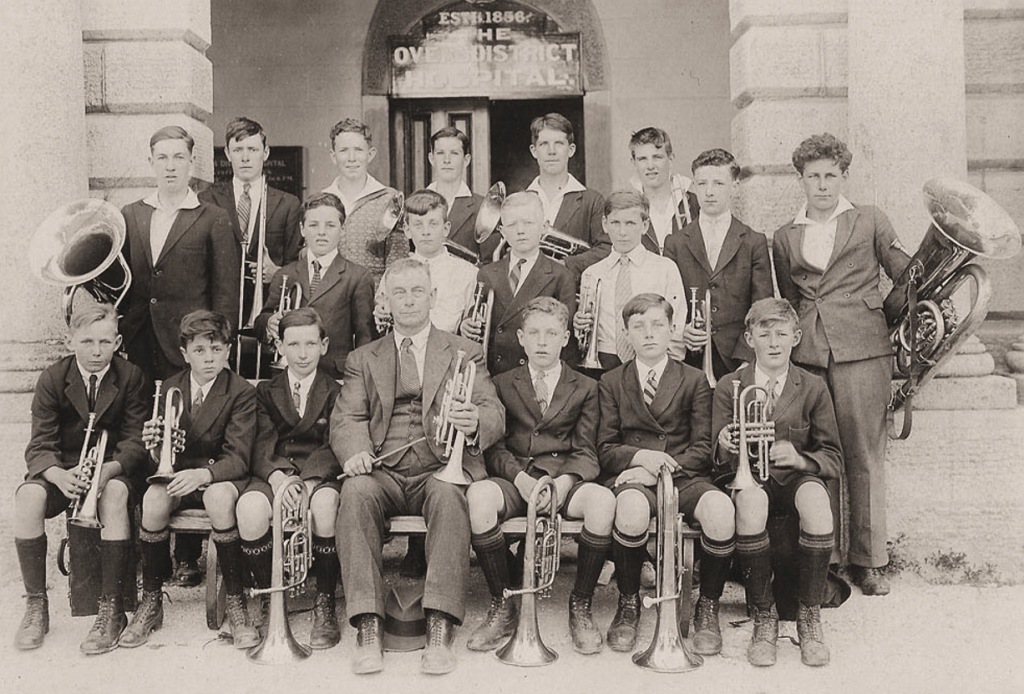
Names and status: the rare National and State bands

Postcard: Australian Silver Band, 1925. (source: Jeremy de Korte Personal Collection)

Introduction:

For the most part, the naming of bands is logical based on location, type, or business association. It stands to reason that if a band was associated with a town, then that would be the town band, however, there were a number of exceptions  – the naming of some of the early private bands comes to mind. Likewise, if a band was in a locality and associated with an industry, a similar naming convention would follow, such as Newcastle Steelworks or South Australian Railways.  This gave the bands identity and a purpose.  Where two bands existed in the same area, there was undoubtedly some disagreements, although not generally over naming but over status and prestige…and performances!  If a band was given an Australian or State name, that lifted their reputations almost immediately, yes?  Possibly, but there were other factors involved.

The focus of this post is to explore a level up from the local bands where we delve into the rare State and National bands.  Granted, there were not many of them.  In fact, in the time period that is being focused on in this post, these types of bands were thin on the ground.  In a previous post, the life of the ABC Military Band was explored, a unique ensemble in its own right and one that included bandsmen from all over Australia.  This was a representative band but different from the more common brass bands in that it included woodwind and percussion.  In this post, we will highlight brass bands.

Admittedly, there was some difficulty finding material on these rare bands due to their short periods of existence.  That being said, there were other bands in Australia aside from the more notable ones and mention will be made of them.  We will also see how a certain State band raised the ire of the governing body of its home State.

There is no doubt that being part of a National or State band was one that bandsmen aspired, and for the National bands, the best bandsmen were picked for a proposed or grand world tour.  The one State band that was set up did so in unusual circumstances and the naming of them as a State band brought them much recognition and pride.  With this in mind, National and State bands did exist and although they were sporadic and formed mainly for tours, they developed reputations in their own right and gave more bandsmen another musical outlet.

Early attempts:

State and National bands were mainly set up by organizations that had the resources to undertake such ventures.  Remembering that this was an older Australia where the distances between places were sometimes very vast, and it was not easy to move people anywhere. Yet in the first instance, we can see that the Salvation Army pulled this off in 1898 with the formation of a Federal Band.  An article which was published in the South Australian Register on the 14th of February 1898 is very informative and details the formation of the band and the tour it had undertaken thus far:

There is now in Adelaide an interesting band of clever musicians picked from the ranks of the Salvation Army.  It is styled “the Salvation Army Federal Band” and has twenty-five playing members, exclusive of Major Taylor (Victoria), who is their director.  The bandmaster is Ensign Cater (New Zealand), who takes up an instrument.  Counting in Major Taylor, the seven colonies of Australia are represented in the following order: – Victoria, eight; South Australia, five; Western Australia; four; New South Wales, three; New Zealand, three; Queensland, two; Tasmania, one; total, twenty-six.

(“SALVATION ARMY FEDERATION.,” 1898)

The Salvation Army had begun planning for this band twelve months in advance, with the aim of the band being “the kind of which should tour the colonies and encourage the members of the Army, and by producing music of a high order raise funds for the work in the different parts of Australasia” (“SALVATION ARMY FEDERATION.,” 1898).  By the time the band had reached Adelaide it had already toured from Melbourne to Western Australia, back to South Australia and from there had been to the Yorke Peninsula and Broken Hill (“SALVATION ARMY FEDERATION.,” 1898).  According to another article published in The Advertiser, the Federal Band was a very fine combination of musicians and presented a wonderful concert (“SALVATION ARMY.,” 1898).  As it is ever thus with Salvation Army bands.

The Sydney Morning Herald, 1/04/1908, p. 8

In 1908 a tiny article was published in The Sydney Morning Herald in which the title is misleading. As you can see in the article (pictured), there is no “Commonwealth Brass Band” that has been formed.  Rather, it is a proposal to secure the services of the Newtown Brass Band to perform at the Anglo-French Exhibition (“COMMONWEALTH BRASS BAND.,” 1908).  By all accounts, the Newtown Brass Band was very famous having won numerous competitions by this time and could have probably served as the Australian band at the exhibition (Greaves & Earl, 2001).  However, the Prime Minister apparently rejected this proposal for reasons unknown.

The Australian Imperial Band:

Postcard: Australian Imperial Band, 1924 (source: Jeremy de Korte personal collection)

In terms of true Australian brass bands, the main one that is spoken about is the ‘Australian Commonwealth Band’ which was conducted by the great Albert H. Baile on two world tours – but more will be talked about this band in the next section (Sharp, 1993).  However, preceding the ‘Australian Commonwealth Band’ was another ensemble which was known as the ‘Australian Imperial Band’ (AIB), formed by Mr. W. M. Partington in 1924 (“AUSTRALIAN IMPERIAL BAND.,” 1924).  Mr. Partington is mentioned in some references –  he did conduct the Ballarat City Band from 1909-1910 and numerous other bands (Pattie, 2010).  That did not stop certain newspapers like the Ballarat Star waxing lyrical about his musical and organisational abilities (“AUSTRALIAN IMPERIAL BAND COMING.,” 1924).  Nevertheless, it is evident that in much later years he managed to form a true National band and while it seems he never took the band to England, he did take it on tour throughout Australia.
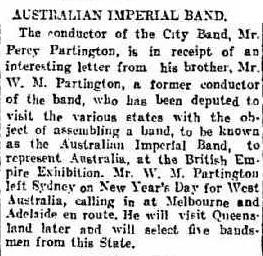
Morning Bulletin, 9/01/1924, p. 8

1924 was an interesting year for Australian bands.  Perhaps the most notable event was the tour of the Newcastle Steelworks Band to England where it achieved astounding success in competition under the baton of Albert H. Baile (Greaves & Earl, 2001).  The AIB had wanted to go to England to compete but were unable to make the trip due to a lack of funds.  The Newcastle Steelworks Band then went in their place (Cameron, 2020). We see in an article from the Daily Telegraph in June 1924 that there was an amount of work going on to try and secure more funds:

In Sydney, the Lord Mayor (Ald. Gilpin) now is issuing an appeal for funds, which should meet with a good response, as it is necessary for each State to provide a proportionate amount of expenses to send the band to Wembley and to compete in the Crystal Palace contests.

(“AUSTRALIAN-IMPERIAL BAND,” 1924)

However, as discussed in a previous post on bands that went on tour, it is a very expensive undertaking and the picture of the AIB (below) published by the Mirror newspaper in Perth is telling.  One could assume that by the time the AIB reached Perth, their general touring money had run out.  Which is probably a reason why there is no mention of the band traveling to England.
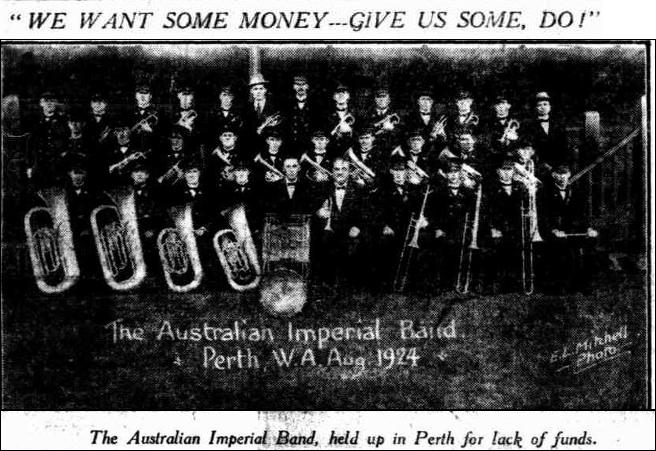
19240809_Mirror_Aust-Imp-Band-Money
Mirror, 9/08/1924, p. 1

The length of time this band was in existence was short however they managed to get themselves together and go on a grand tour of Australia, to some very favorable reviews.  There is not much mention of the personnel of the band but given there were many quality bandsmen in the country at the time, finding gifted musicians was probably not a problem.

The Australian Commonwealth Band:
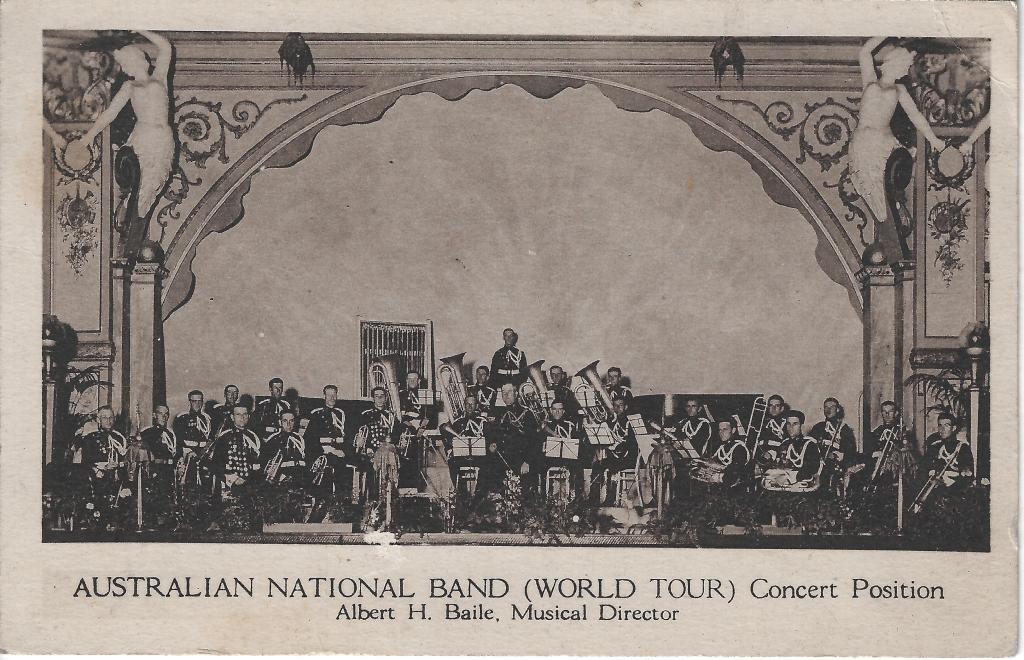
Postcard: Australian National Band – Concert Position, 1926 (source: Jeremy de Korte personal collection)
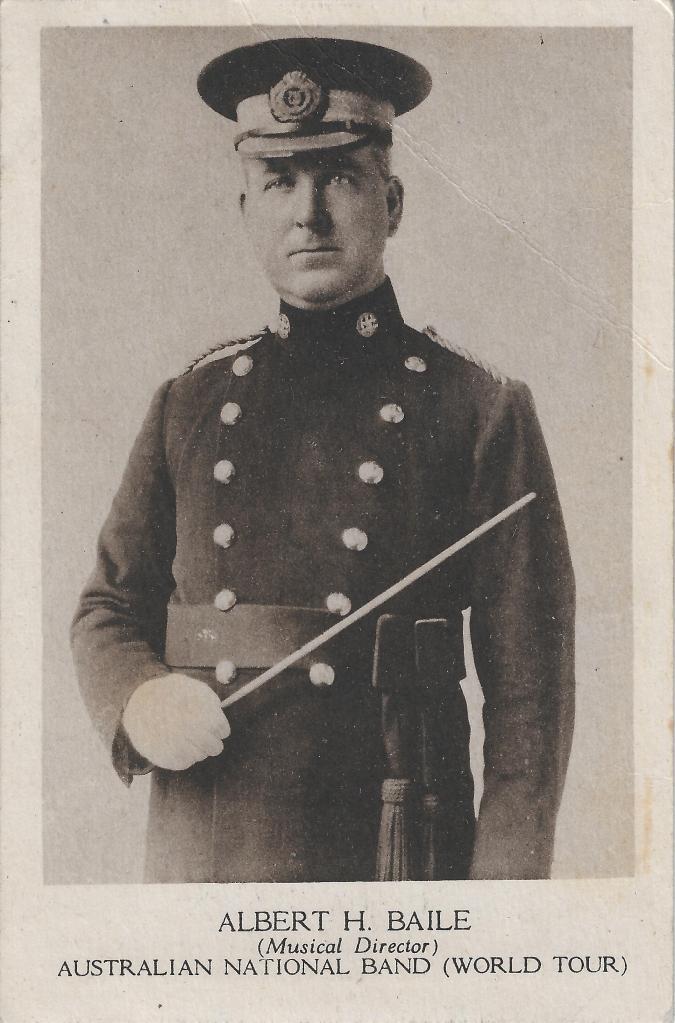
Postcard: Albert H. Baile, 1926 (source: Jeremy de Korte personal collection)

Albert H. Baile was one of the most famous band directors of this time and he had a masterful way of conducting his bands (Greaves & Earl, 2001).  No sooner had Baile returned to Australia in 1925 with his Newcastle Steelworks Band, he made moves to reform the band in Sydney as the Australian Silver Band and apparently included some Queensland bandsmen in the new ensemble (“AUSTRALIAN SILVER BAND.,” 1925).  Including some bandsmen from another State could probably justify the name change an Australian band. However, given the huge reputation of the Newcastle Steelworks Band after their competition wins, the name change stuck and the band proceeded on their first international tour to wide acclaim (“AUSTRALIAN COMMONWEALTH SILVER BAND,” 1926).

The Daily Mail, 29/09/1925, p. 10

The band name seems to have begun evolving into the Australian Commonwealth Band in various media with the dropping of the world ‘Silver’ from it, hence the more recognizable name is etched in history.  We see in the various photos and ephemera included in this post that they were a very smart looking ensemble and that they had a distinctly Australian look with slouch hats.

Aside from the way the name of the band continually evolving in the newspapers, this did not discount the fact that it was an extremely fine ensemble made up of the best brass soloists and led by Baile himself.  Certainly, reviews from Australian newspapers as well as those from overseas, gave high praise to the sound of this band likening it to an “organ” or an “orchestra” (“Australian Silver Band,” 1925; “VISIT OF AUSTRALIAN BAND,” 1926).   The newspaper article published by the Todmorden & District News (UK) in 1926 was very informative as to the concert it gave in their area, attended by 5,000 people, and the quality of the soloists, in particular, the Solo Cornet player, Mr Arthur Stender (“VISIT OF AUSTRALIAN BAND,” 1926).  Below is a list of the band members as published in the book, “Legends in Brass : Australian Brass Band Achievers of the 20thCentury”:

Postcard: Australian National Band, 1926 (source: Jeremy de Korte personal collection)

Front row: Len Ryan, Norm Forbes, Alf Cornish, Fred Myers, Vern Beacroft, Albert Baile, Clarrie Collins, Jack Stokes, Tom Bennett, Ossie Forbes
Middle row: Bob Gibson, Joe Clay, Len Atkinson, George Robertson, Stan Ryan, Albert Ovenden, Bill Murphy, Jack Murphy, Harold Hewson
Back row: Archie Moore, Harold Collins, James “Scott” Armour, Arthur Stender, Alfred Paxton, Joe Hardy

(Greaves & Earl, 2001, p. 51)

The Australian Commonwealth Band undertook two Australian/World tours, the first from 1925-1926 and the next from 1926-1928.  As in their first tour, they received rave reviews during their second tour, of which an article in New Zealand’s Evening Post from February 1927 provides a brief summary (“COMMONWEALTH SILVER BAND,” 1927).  This second tour was not all plain sailing.  While the band was traveling around Australia, the Australian Musicians’ Union was up in arms about a boycott of the Commonwealth Band while it was touring America (“COMMONWEALTH BAND,” 1927).  The Union started lobbying for retaliatory action against musicians visiting from overseas.  It is unclear how this action was resolved however it is interesting that despite the reputation of the Commonwealth Band, there was this hiccup while on tour.
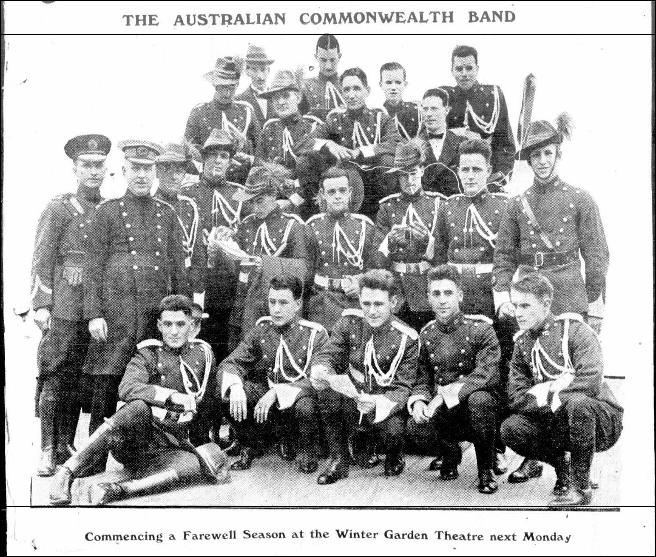
19271203_Figaro_Aust-Comm-Band-Farewell
Queensland Figaro, 3/12/1927, p. 1

The Australian Commonwealth Band was disbanded in Sydney in early 1928 after they had finished their last tour of Australia (Greaves & Earl, 2001).  There is no doubt that this was a truly remarkable ensemble, started from the players of the Newcastle Steelworks Band to become a unique band in its own right. And it certainly boosted the reputation of Australian bands in general.  The legacy of this fine ensemble was felt for years to come.

The Queensland State Band:

In the early 1930s, we see the formation of the one and only State band, the Queensland State Band.  This was formed in unusual, but possibly well-meaning circumstances as the musicians were notionally “unemployed” (“QUEENSLAND STATE BAND.,” 1933b).  The other aim of the band was to try to emulate the success of previous tours by the Newcastle Steelworks Band and the Australian Commonwealth Band by touring overseas and competing in England.  Nevertheless, the band formed in September 1933 and included previous members of the Australian Commonwealth Band (“QUEENSLAND STATE BAND TOUR.,” 1933).
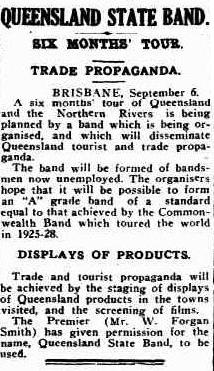
The Northern Herald, 9/09/1933, p. 19

Almost immediately this band raised the ire of the Queensland Band Association (QBA) of which sent an annoyed letter to the Courier Mail published on October 9th, 1933.  In the letter, the QBA Secretary of the time, Mr J. R. Foster made some forceful points about the State band not being “tested for proficiency” under QBA rules, and the fact that the State band was professional yet had excluded some Queenslanders by bringing in bandsmen from Southern States (Foster, 1933).  In addition, apparently, the Lord Mayor of Brisbane had allowed the State band to perform in a park while excluding other Brisbane metropolitan bands (Foster, 1933).  It is fair to say that this letter (and the QBA) failed to have much impact on the operations of this band.

After being brought together, the Queensland State Band commenced a tour of Queensland where they visited many towns and rural centers north of Brisbane. The receptions they received were enthusiastic and many a town newspaper gave them favorable reviews of their playing (“QUEENSLAND STATE BAND.,” 1933a).  Indeed, they also inspired many local town bands and schools, and it is noted that they played for a combined total of 20,000 people over the course of the tour (“STATE BAND DOGGED BY RAIN,” 1933).  After this part of the tour ended, they were supposed to tour through Northern NSW and also raise finances for a trip to England, of which either activity does not appear to have happened.

As mentioned, this is one of the only instances during this time where a State band was formed.  It is unclear why other States did not form their own representative bands.  However, it does indicate that where there is a drive, things will happen even if all the aims are not met.

One more band:

There was only one more band to carry an Australian name during this time period, a band that was very short lived – the ‘Australian Girls’ Brass Band’ which was formed in 1934.  We know how rare female bands were through a previous post, so perhaps this was a tokenistic ensemble.  However, they were formed and presented one concert in Sydney where they were not exactly complimented for playing, but apparently looked very smart in green & gold uniforms (“Australian Girls’ Brass Band,” 1934; “FIRST CONCERT,” 1934).  There is no more record of this band doing anything else beyond this one concert.

Conclusion:

If there is anything showing from the stories of these ensembles it is a distinct similarity between them.  They were all formed basically for the one activity, which was touring.  Except that this aim was obviously dependent on having enough money.  That being said, the Australian Commonwealth Band took things a few steps further by acting on their aims to compete in England and tour around the world, and it was a band that was in existence for the longest time.  Certainly, the fact that the Commonwealth Band undertook two world tours in quick succession is a testament to the organization and prowess of its manager and conductor, no doubt both well-honed from the previous Newcastle tour.

In any case, once again we see that these bands added to the reputation and life of Australian banding and through them, we have seen some interesting histories.  Perhaps there are lessons to be learned and no doubt there are further stories to be unearthed.  We do have a unique history of bands in this country and having bands that carried the Australian name or a State name gained for themselves a distinct historical legacy.

Postcard: Australian National Band – Soloists, 1926 (source: Jeremy de Korte personal collection)

References:

THE AUSTRALIAN COMMONWEALTH BAND. (1927, 03 December). Queensland Figaro (Brisbane, Qld. : 1901 – 1936), 1. http://nla.gov.au/nla.news-article84901454

AUSTRALIAN COMMONWEALTH SILVER BAND. (1926, 02 February). Geelong Advertiser (Vic. : 1859 – 1929), 1. http://nla.gov.au/nla.news-article232244596

Australian Girls’ Brass Band. (1934, 24 January). Sydney Mail (NSW : 1912 – 1938), 19. http://nla.gov.au/nla.news-article166103727

AUSTRALIAN IMPERIAL BAND. (1924, 09 January). Morning Bulletin (Rockhampton, Qld. : 1878 – 1954), 8. http://nla.gov.au/nla.news-article54107997

AUSTRALIAN IMPERIAL BAND COMING. (1924, 03 June). Ballarat Star (Vic. : 1865 – 1924), 2. http://nla.gov.au/nla.news-article214257314

AUSTRALIAN SILVER BAND. (1925, 29 September). Daily Mail (Brisbane, Qld. : 1903 – 1926), 10. http://nla.gov.au/nla.news-article218269176

Australian Silver Band. (1925, 27 November). Te Aroha News. https://paperspast.natlib.govt.nz/newspapers/TAN19251127.2.15.1

AUSTRALIAN-IMPERIAL BAND. (1924, 24 June). Daily Telegraph (Sydney, NSW : 1883 – 1930), 6. http://nla.gov.au/nla.news-article245712884

Cameron, K. (2020, 12 August). Actually the steelworks band benefited from this group’s misfortune. The Newcastle band filled the Wembley exhibition dates that had been… [Comment]. Facebook. Retrieved 12 August 2020 from https://www.facebook.com/groups/1404925869759642/?post_id=2612055202380030&comment_id=2612128729039344&notif_id=1597219322511437&notif_t=group_comment&ref=notif

COMMONWEALTH BAND : Retaliatory Proposals. (1927, 01 November). Western Argus (Kalgoorlie, WA : 1916 – 1938), 13. http://nla.gov.au/nla.news-article34420586

COMMONWEALTH SILVER BAND : What others think. (1927, 09 February). Evening Star. https://paperspast.natlib.govt.nz/newspapers/ESD19270209.2.93

FIRST CONCERT : Girls’ Band in Gold and Green. (1934, 18 January). Daily Telegraph (Sydney, NSW : 1931 – 1954), 10. http://nla.gov.au/nla.news-article248959700

Foster, J. R. (1933, 09 October). QUEENSLAND STATE BAND : To the Editor. Courier-Mail (Brisbane, Qld. : 1933 – 1954), 3. http://nla.gov.au/nla.news-article1128247

Greaves, J., & Earl, C. (2001). Legends in brass : Australian brass band achievers of the 20th century. Muso’s Media.

Minton Witts Studios. (1924). Australian Imperial Band in Sydney (Conducted by: Mr W. M. Partington) [Postcard]. Minton Witts Studios, Sydney, N.S.W.  

Pattie, R. (2010). The history of the City of Ballarat Municipal Brass Band 1900-2010 : one hundred and ten years of music to the citizens of Ballarat (Rev. ed.). City of Ballarat Municipal Brass Band. 

Photogelatine Engraving Company Co. Ltd. (1926a). Albert H. Baile (Musical Director) : Australian National Band (World Tour) [Postcard]. Photogelatine Engraving Company Co. Ltd., Ottawa, Canada. 

Photogelatine Engraving Company Co. Ltd. (1926b). Australian National Band (World Tour) [Postcard]. Photogelatine Engraving Company Co. Ltd., Ottawa, Canada. 

Photogelatine Engraving Company Co. Ltd. (1926c). Australian National Band (World Tour) Concert Position : Albert H. Baile, Musical Director [Postcard]. Photogelatine Engraving Company Co. Ltd., Ottawa, Canada. 

Photogelatine Engraving Company Co. Ltd. (1926d). Australian National Band (World Tour) Soloists [Postcard]. Photogelatine Engraving Company Co. Ltd., Ottawa, Canada. 

QUEENSLAND STATE BAND : Brilliant Conductor. (1933, 28 October). Cairns Post (Qld. : 1909 – 1954), 3. http://nla.gov.au/nla.news-article41230080

QUEENSLAND STATE BAND : Six Months Tour : Trade Propaganda. (1933, 09 September). Northern Herald (Cairns, Qld. : 1913 – 1939), 19. http://nla.gov.au/nla.news-article150003898

QUEENSLAND STATE BAND TOUR. (1933, 29 September). Courier-Mail (Brisbane, Qld. : 1933 – 1954), 20. http://nla.gov.au/nla.news-article1124687

SALVATION ARMY : The Federal Band. (1898, 14 February). Advertiser (Adelaide, SA : 1889 – 1931), 7. http://nla.gov.au/nla.news-article35105401

SALVATION ARMY FEDERATION : A Capital Band. (1898, 14 February). South Australian Register (Adelaide, SA : 1839 – 1900), 6. http://nla.gov.au/nla.news-article54519628

Sharp, A. M. (1993). Baile, Albert Henry (Bert) (1882-1961). In Australian Dictionary of Biography. Retrieved 22 March 2019, from https://adb.anu.edu.au/biography/baile-albert-henry-bert-9402

STATE BAND DOGGED BY RAIN : Northern Tour Ends : Successful Results. (1933, 30 November). Telegraph (Brisbane, Qld. : 1872 – 1947), 6. http://nla.gov.au/nla.news-article181171770

VISIT OF THE AUSTRALIAN BAND : Magnificent playing to big crowds. (1926, 20 August). Todmorden & District News,2. https://www.britishnewspaperarchive.co.uk/viewer/bl/0001940/19260820/182/0002

“WE WANT SOME MONEY-GIVE US SOME, DO!”. (1924, 09 August). Mirror (Perth, WA : 1921 – 1956), 1. http://nla.gov.au/nla.news-article76437154

Bands on Australian islands: unique challenges in unique environments

19320000_phillip-island-bb_phot16005
Phillip Island Brass Band, 1932 (Source: IBEW)

Please note: Aboriginal and Torres Strait Islander people should be aware that this blog post may contain images or descriptions of deceased persons in photographs and (digital) newspaper articles.  In addition, this blog post may contain images or descriptions of deceased persons from former secure health facilities in photographs and (digital) newspaper articles.

Introduction:

When we look at the distribution of brass bands in Australia between 1900 – 1950 we can see that they mushroomed everywhere.  Some towns and localities were lucky to have two or three.  Bands merged, split, started, and ended, and we know that individual bandsmen were great traveler and had various loyalties.  Given the size of Australia, it can be assumed that geography was an early challenge – it took a long time to get anywhere and obtain the fundamentals for running a band.  Yet the early bands did it and several bands survived.

This post is about the brass bands that were located on some of the islands that surround Australia.  In selecting the islands and bands, I took a punt with some and accidentally found some others.  When looking for stories and histories I found that information on these island bands was a bit hit and miss.  In some cases, there were only one or two newspaper articles (that I found) where there was only a mere mention of a band.  Timelines were difficult to establish but we can get a rough guess based on early articles and later articles.  However, the fact that these bands had an existence of sorts only adds to the rich history of bands in this country.

I started this post with a disclaimer.  The reason for this is that two of the bands were located on islands where Aboriginal missions were established, and another band was located on a small island that once housed a facility for isolating people with leprosy.  To delve deeper in the pasts of these missions and this facility uncovered some disturbing facts, as I tried to build a background as to why bands were established in these locations.  All locations had unfortunate pasts which will have to be acknowledged in this post, but we recognize that at the time, bands were created with a similar purpose to those in other locations.

This post will address each location, or groups of locations in turn and we will see that the bands in these places were innovative, dedicated and proud.  We will also see that they were engaged with island life and that being a band on an island had a special meaning.  These bands may not have had the reputation or resources of bigger ensembles, but they did have a certain spirit given to them by their locations.

Kangaroo Island (South Australia):

Kangaroo Island, located off the coast of the Yorke Peninsula in South Australia is nominally Australia’s third largest island behind Tasmania and Melville Island (Sealink Travel Group, 2019).  At 155km in length and up to 55km in wide it is big in area but contains only four main settlements, of which Kingscote is the main town (Sealink Travel Group, 2019).  The Kangaroo Island Pioneers Association has documented history prior to 1836 however most of the recorded history occurs after this date (Kangaroo Island Pioneers Association, 2019).

We first see mention of a brass band on Kangaroo Island in an article published by The Register in 1906 which makes mention of a concert presented by the Kingscote Brass Band (“MUSIC FOR WATCHERS BY THE SEA.,” 1906).  This concert was in aid of an instrument fund and was basically a social evening and dance. However, the article also makes mention of another performance held during a lunch hour where the band, with some innovation, broadcast their performance by telephone!  As written in the article:

Last Tuesday, during the luncheon hour, through the courtesy of the P.M. here (Mr. Lamprey), the Kingscote Brass Band played selections through the telephone to Cape Willoughby and Cape Borda Lighthouses.  The music was much appreciated by the watchers by the sea at either end of the island.  Cape Borda is 70 miles westerly from Kingscote, and Cape Willoughby is about 30 miles easterly.

(“MUSIC FOR WATCHERS BY THE SEA.,” 1906)

To think they did this in 1906 is quite remarkable and inventive.

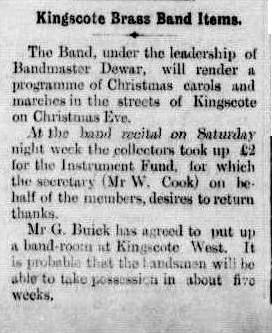
The activities of the Kingscote Brass Band were mentioned in the local newspaper, The Kangaroo Island Courier in late 1907 where they were noted for wanting to present a program of Christmas Carols and marches on Christmas Eve (“Kingscote Brass Band Items.,” 1907).  This is in addition to their fundraising effort for new instruments.  In the middle of 1908, the said newspaper received a letter from a mainlander who had read an article in Australian Bandsman about the travel of Kingscote Brass Band members (“ENTHUSIASTIC INSTRUMENTALISTS.,” 1908).  In his letter he says, “I think the 12-mile man is the bandmaster and he deserves a lot of encouragement for his trouble” and then proceeds to wax lyrically, “…although I don’t suppose he considers it a trouble, as all men who are interested in their particular band never find anything troublesome where the band is concerned.” (“ENTHUSIASTIC INSTRUMENTALISTS.,” 1908).

Kangaroo Island Courier, 21/12/1907, p. 3

We have been told.

There is a further mention of the Kingscote Brass Band giving a performance in 1921 where they were noted for showing improvement in their playing (“THE KINGSCOTE BAND.,” 1921).  The article mentions that they had been tutored by their former conductor who was visiting the island after a 10-year absence (“THE KINGSCOTE BAND.,” 1921).  Unfortunately, due to limited resources, it is unclear how much longer this band survived. However, it is clear from this brief amount of information that they were appreciated when they performed.

King Island (Tasmania):

King Island is located in the middle of Bass Strait off the northern coast of Tasmania.  It is renowned for its produce although it has never had a big population, there are some well-known localities on the island.  It is also known for the ruggedness of its coastline and there are many instances of shipping coming to grief on the rocks. The main center of population is the town of Currie where they still have a community band.

In terms of early brass bands, King Island is unique as there are two brass bands mentioned as having existed in the early 1900s.  Information on this band also comes from an island newspaper, the King Island News and we first see a mention people wanting for form a band in Currie in 1914 (“King Island.”, 1914).  Although two years later the Currie Brass Band has still not been founded and the money that was initially raised has been donated to wounded King Island soldiers returning from World War 1 (“No title,” 1916).

In 1918 the King Island News reported on the formation of another brass band, this time in the mining settlement of Grassy which is located on the eastern side of the Island (“KING ISLAND.,” 1918).  Initially called the Grassy Brass Band, this band was actually set up by the mining company for the recreation of employees at the mine and was known as the King Island Tungsten Brass Band (“KING ISLAND.,” 1918).  This band was called for all over the island and in 1919 was noted for its performances of Christmas music in Currie (“No title,” 1919).

Again, this is another instance where some history is incomplete as we don’t know for certain when this band stopped operations.  While the articles are not listed, the King Island Tungsten Brass Band did numerous engagements on the island and were a valued part of the island community.

Phillip Island (Victoria):

Phillip Island is an island that occupies the southern portion of Westernport Bay in Victoria and is well-connected to the rest of the state by road and ferry.  People might know it because of certain penguins however it has had a long history of settlement and there are several towns on the island with the main town being Cowes.

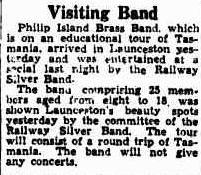
It should be no surprise that a brass band formed on Phillip Island in the township of Cowes.  The Phillip Island Brass Band was much more proactive than any other brass bands on Australian islands and were much more well-traveled.  They were even proactive enough to enter the South Street band contests on two occasions and took themselves on an educational trip around Tasmania (Royal South Street Society, 1932, 1934; “Visiting Band,” 1947).

Examiner, 30/08/1947, p. 3

A proposal to form the Phillip Island Brass Band is mentioned in an informative article from the Frankston and Somerville Standard on the 30thMay, 1923 (“PHILLIP ISLAND BRASS BAND.,” 1923).  They had all the right intentions too, as the article opens with these platitudes:

An effort is being made to form a brass band on Phillip Island.  The advantages of such an institution are many.  Anything that will encourage the practice of music, especially concerted music, is worthy of hearty support, and the metal and moral benefit derived by any young man who gives his mind and time to learning an instrument is great.

(“PHILLIP ISLAND BRASS BAND.,” 1923)

The article goes on to note that the promoters of the band were under no illusions as to what they might need in terms of men willing to join the band, instruments, a hall to play in, and a whole host of other items.  The Island Progress Association, as well as the local council, were behind the project and a band was formed.

19340709_herald_phibb-crop
Herald, 09/07/1934, p. 8

As mentioned, the band was quite proactive in the way they did things, even bordering on the unusual.  For example, to help raise funds for a trip to the South Street contests in 1934, a picture of a bandsman helping with the chicory harvest was published in the Herald newspaper (above) – this was apparently a common activity at the time (“COWES BANDMEN HANDLE CHICORY CROP,” 1934).  They did make it to South Street, twice, once in 1932 where they competed in C and D grades and also in 1934 where they only competed in D grade.  The results of their endeavors are listed in the table below:

Year:Competition:Grade:Section:Points:Place:
1932Victorian Band ChampionshipsCNo. 1 Test Piece124
No. 2 Test Piece120
Quickstep133
DNo. 1 Test PIece1203rd
No. 2 Test PIece1193rd
Quickstep1263rd
1934Victorian Band ChampionshipsDSelection277Equal 3rd
Quickstep1674th
(source of table data: Royal South Street Society, 1932, 1934)

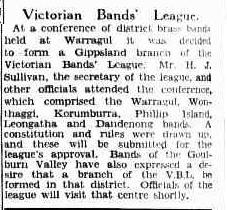
Aside from this, they were well-known and in 1935 they were one of the bands to form a Gippsland Branch of the Victorian Bands’ League with other bands from Warragul, Wonthaggi, Korumburra, Leongatha and Dandenong (“Victorian Bands League.,” 1935).

The Age, 8/10/1935, p. 4

There seems to have been some disquiet after the band returned from Tasmania in 1947.  In January 1953 the State Governor visited Phillip Island and the visit was written up in an article in The Argus newspaper.  As the article says:

Yesterday was an exciting day for Cowes, Phillip Island.  Sir Dallas Brooks, Governor, paid his first official visit to the island and almost everybody, including the town’s brass band, turned out for the occasion.

Until last week the band had been “in recess for four years,” as one member tactfully put it.  But it acquitted itself well.

(“Cowes turned out to meet the Governor,” 1953)

The cause and conclusion of this four-year recess might require further research.

The Trove archive has some limitations as articles fall into copyright from 1955 so we don’t exactly know when the Phillip Island Brass band went defunct.  But they are one of the well-documented bands with further information to be found on the website of the Phillip Island & District Historical Society.

Palm Island and Thursday Island (Queensland):

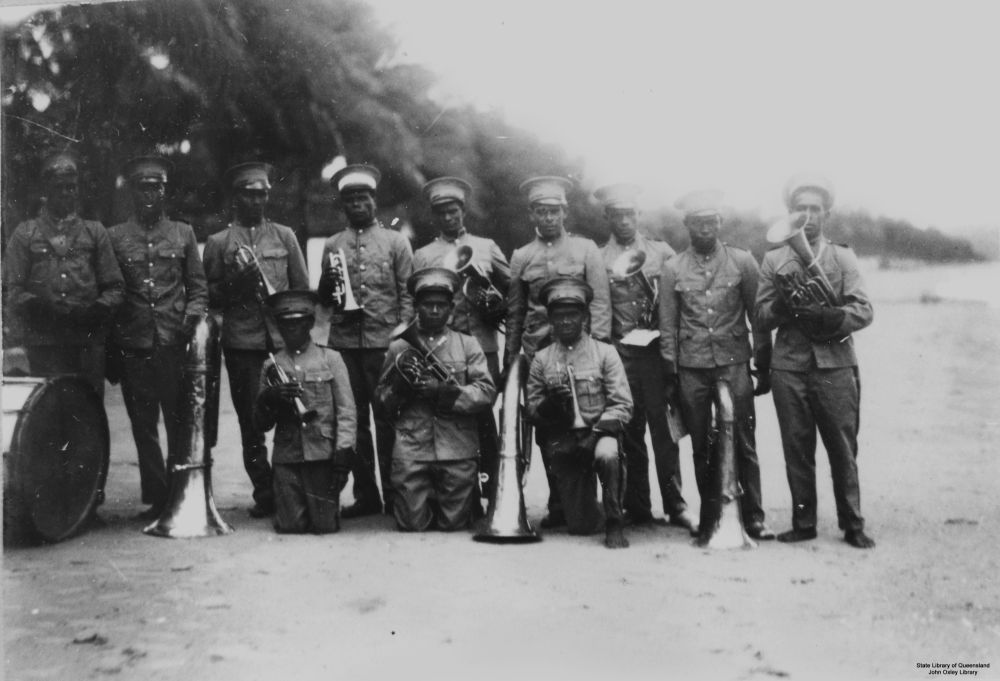
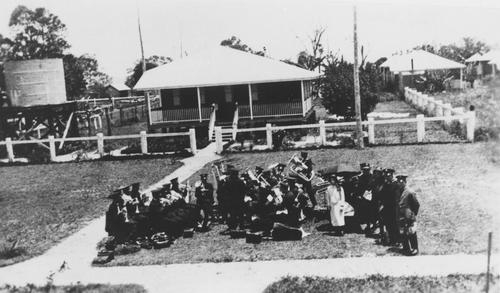
Palm Island Brass Band, Queensland, 1931 (source: State Library of Queensland: 166102)

Palm and Thursday islands are located off the coast of Queensland with Palm Island near the coast at Townsville and Thursday Island in the Torres Strait off the far northern tip of Queensland.  These islands are mentioned because of their unique status as former Indigenous Missions and the fact that both former missions once had brass bands.

This post will not go into the pros and cons of Indigenous missions aside to say that they existed and are part of Australia’s history.  It was a very different time with different attitudes, and we can only assume that the people who once ran these institutions thought they were doing the right thing by Indigenous people.  A brass band was obviously seen as a binding activity and one which other Australians would accept.

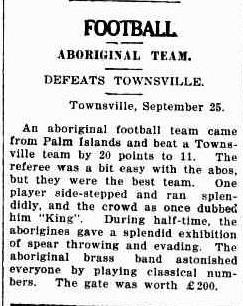
Unfortunately, the language in local newspapers that mentioned the bands were as one would expect from this time.  There was interest in the island bands and we see in an article from 1926 published in The Northern Miner newspaper that the bandmaster of The Towers Concert Band visited the island to assist the Indigenous conductor and was duly thanked in a letter from the Palm Island Band conductor (“PALM ISLAND BAND,” 1926).  By some accounts, the people of the island appreciated the fact that a brass band, as well as a football team and cricket team, had been set up by the Superintendent of the settlement, and certainly, these were seen as worthwhile activities (Watson, 2005).   In 1927 the football team and brass band visited Townsville and apparently “astonished” the crowd – for both football and music (“FOOTBALL,” 1927).

Daily Mercury, 26/09/1927, p. 7

Slightly differently, the Thursday Island Brass Band once included “white and black players” pre-war but was reformed after the war with just aboriginal musicians (“ISLANDERS’ BRASS BAND,” 1952).   Both bands were clearly still in operation in the 1950’s, but clearly the novelty of having Indigenous bands had not changed, despite this cited article providing additional information (“‘Band music provides healthy interest for aborigines’,” 1953).  In 1954 the Palm Island Brass Band was to be included in a mass-gathering of bands in Townsville to greet Queen Elizabeth (“Townsville Band Festival,” 1954).

We can always judge the attitudes of the time as being unfortunate and the language as patronising.  We also know that there are still bands dotted across the Top End and some very good music programs that are helping to reform a culture of Indigenous community bands (Cray, 2013; Sexton-McGrath, 2014).  In some respects, these former Mission bands as well as other mainland mission bands created a legacy that has given new life to new bands.

Peel Island (Queensland) and Norfolk Island:

We come now to Peel Island and Norfolk Island, both very different places yet both have interesting pasts.

Peel Island is located in Moreton Bay, Brisbane and is a former Quarantine Station.  Yet for many years it housed people forcibly removed from home and family for being contracted with Leprosy.  By all accounts, this was harsh, isolated, unforgiving and primitive place and it accommodated people from all backgrounds and races (Brown, 2018).  The churches were the only organisations to try to bring comfort to the inmates and it is noted in 1928 that one Churchman made an appeal for an Eb Bass for a member of the Peel Island Brass Band (“CHURCH NEWS.,” 1928).

This is the first evidence we have that there was a band of sorts on Peel Island and newspaper articles sporadically reported on the various iterations of the band (“SIDE DRUM WANTED FOR PEEL ISLAND’S BAND,” 1945). Likewise, there are also reports of bands visiting the Island to entertain the inmates  – the picture below is of a Salvation Army band visiting Peel Island in 1920 and in 1939 the Brisbane Juvenile Band was part of a concert party (“Concert At Peel Island,” 1939).

19200000_peel-island_salvation-band
Salvation Army brass band visiting Peel Island Lazaret during the 1920s (source: State Library of Queensland: 74802)

Norfolk Island is another place with a very interesting past and the inhabitants are extremely proud of their history (Low, 2012).  Located off the coast of NSW, the inhabitants display a very independent streak, despite their association with Australia.  Which makes it all the more interesting that there is mention of a brass band that once existed on Norfolk Island.  There is not much to indicate the brass band existed apart from rare mentions in Australian newspapers.  We see mentions of a band in 1904, 1905 and 1926 where they are mentioned as being in attendance at official events and for rehearsing every week (Barnes, 1926; “NORFOLK ISLAND.,” 1904; “NORFOLK ISLAND.,” 1905).  It is unclear when the Norfolk Island Band officially started or ended.

Conclusion:

It is quite clear that these early brass bands of our islands had their own unique histories, although one might call them quirks.  While there are many similarities to other bands located on the mainland, the isolation and geography meant they had to be innovative and were also part of their communities.  It is fortunate that we can read about them now and wonder at their existence.  The knowledge that some of them existed in questionable environments is also a wonder but also indicates that they were a sign of the times.

We appreciate that these bands were part of a greater movement and that we can acknowledge the history.

References:

‘Band music provides healthy interest for aborigines’. (1953, 19 January). Courier-Mail (Brisbane, Qld. : 1933 – 1954), 2. http://nla.gov.au/nla.news-article50564060

Barnes, J. (1926, 11 June). UNDER BLUE SKIES : Life on Norfolk Island : No. 4. Cumberland Argus and Fruitgrowers Advocate (Parramatta, NSW : 1888 – 1950), 9. http://nla.gov.au/nla.news-article104960531

Brown, A. (2018, 07 July). Queensland’s last leper colony reveals its secrets. Brisbane Times. https://www.brisbanetimes.com.au/national/queensland/queensland-s-last-leper-colony-reveals-its-secrets-20180704-p4zpd1.html

CHURCH NEWS. (1928, 29 September). Brisbane Courier (Qld. : 1864 – 1933), 7. http://nla.gov.au/nla.news-article21343088

Concert At Peel Island. (1939, 26 March). Sunday Mail (Brisbane, Qld. : 1926 – 1954), 5. http://nla.gov.au/nla.news-article98238889

COWES BANDMEN HANDLE CHICORY CROP. (1934, 09 July). Herald (Melbourne, Vic. : 1861 – 1954), 8. http://nla.gov.au/nla.news-article243161356

Cowes turned out to meet the Governor. (1953, 22 January). Argus (Melbourne, Vic. : 1848 – 1957), 16. http://nla.gov.au/nla.news-article23223484

Cray, S. (2013, 14 August). Brass band babies. ABC Radio National. Retrieved 14 August 2013 from https://www.abc.net.au/radionational/programs/archived/intothemusic/brass-band-babies/4887046

ENTHUSIASTIC INSTRUMENTALISTS. (1908, 11 July). Kangaroo Island Courier (Kingscote, SA : 1907 – 1951), 4. http://nla.gov.au/nla.news-article191629848

FOOTBALL : Aboriginal Team. : Defeats Townsville. (1927, 26 September). Daily Mercury (Mackay, Qld. : 1906 – 1954), 7. http://nla.gov.au/nla.news-article173762864

ISLANDERS’ BRASS BAND. (1952, 31 May). Brisbane Telegraph (Qld. : 1948 – 1954), p. 2. Retrieved from http://nla.gov.au/nla.news-article216499386

Kangaroo Island Pioneers Association. (2019). History. Kangaroo Island Pioneers Association. Retrieved 28 January 2019 from https://www.kipioneers.org/history

KING ISLAND : Grassy News. (1918, 21 May). Examiner (Launceston, Tas. : 1900 – 1954), 6. http://nla.gov.au/nla.news-article50981378

“King Island.” “Fat Stock for Victoria.” “Dear Beef for Launceston.”. (1914, 29 May). King Island News (Currie, King Island : 1912 – 1954), 2. http://nla.gov.au/nla.news-article217035552

THE KINGSCOTE BAND. (1921, 19 March). Kangaroo Island Courier (Kingscote, SA : 1907 – 1951), 2. http://nla.gov.au/nla.news-article191552031

Kingscote Brass Band Items. (1907, 21 December). Kangaroo Island Courier (Kingscote, SA : 1907 – 1951), 3. http://nla.gov.au/nla.news-article191635685

Low, M. K. (2012). Putting down roots : belonging and the politics of settlement on Norfolk Island (Publication Number 9451462) [PhD, University of Western Australia, School of Social Sciences]. University of Western Australia Research Repository. Perth, Western Australia. https://research-repository.uwa.edu.au/en/publications/putting-down-roots-belonging-and-the-politics-of-settlement-on-no

MUSIC FOR WATCHERS BY THE SEA. (1906, 21 November). Register (Adelaide, SA : 1901 – 1929), 7. http://nla.gov.au/nla.news-article56693536

No title. (1916, 17 March). King Island News (Currie, King Island : 1912 – 1954), 2. http://nla.gov.au/nla.news-article212036865

No title. (1919, 08 January). King Island News (Currie, King Island : 1912 – 1954), 2. http://nla.gov.au/nla.news-article212038832

NORFOLK ISLAND. (1904, 22 March). Brisbane Courier (Qld. : 1864 – 1933), 7. http://nla.gov.au/nla.news-article19271611

NORFOLK ISLAND : Empire Celebration. (1905, 26 June). Sydney Morning Herald (NSW : 1842 – 1954), 7. http://nla.gov.au/nla.news-article14687675

PALM ISLAND BAND : An interesting letter. (1926, 13 February). Northern Miner (Charters Towers, Qld. : 1874 – 1954), 5. http://nla.gov.au/nla.news-article80657422

Phillip Island Brass Band, 1932. (1932). [Photograph]. [phot16005]. The Internet Bandsman Everything Within, Vintage Brass Band Pictures : Australia. http://www.ibew.org.uk/vbbp-oz.html

PHILLIP ISLAND BRASS BAND. (1923, 30 May). Frankston and Somerville Standard (Vic. : 1921 – 1939), 6. http://nla.gov.au/nla.news-article75954089

Royal South Street Society. (1932, 29 October). 1932-10-29 Brass Band Contests. Royal South Street Society. Retrieved 28 January 2019 from https://results.royalsouthstreet.com.au/results/1932-10-29-brass-band-contests

Royal South Street Society. (1934, 03 November). 1934-11-03 Brass Band Contests. Royal South Street Society. Retrieved 28 January 2019 from https://results.royalsouthstreet.com.au/results/1934-11-03-brass-band-contests

Sealink Travel Group. (2019). About Kangaroo Island, South Australia. Sealink. Retrieved 28 January 2019 from https://www.sealink.com.au/about-kangaroo-island/

Sexton-McGrath, K. (2014, 09 November). Yarabah Band Festival: Return of the brass band brings thousands out to Indigenous community. ABC News Queensland. Retrieved 31 January 2019 from https://www.abc.net.au/news/2014-11-09/yarrabah-band-festival-brass-band-brings-thousands-to-community/5877834

SIDE DRUM WANTED FOR PEEL ISLAND’S BAND. (1945, 27 June). Courier-Mail (Brisbane, Qld. : 1933 – 1954), 6. http://nla.gov.au/nla.news-article48954474

Townsville Band Festival. (1954, 09 February). Northern Miner (Charters Towers, Qld. : 1874 – 1954), 4. http://nla.gov.au/nla.news-article81658839

Unidentified. (1920). Salvation Army brass band visiting Peel Island Lazaret during 1920s [copy print : b&w]. [74802]. Brisbane John Oxley Library, State Library of Queensland, OneSearch. https://hdl.handle.net/10462/deriv/208680

Unidentified. (1931). Palm Island Brass Band, Queensland [photographic print : black & white , 1931.]. [166102]. Brisbane John Oxley Library, State Library of Queensland, One Search. https://hdl.handle.net/10462/deriv/220300

Victorian Bands League. (1935, 08 October). Age (Melbourne, Vic. : 1854 – 1954), 4. http://nla.gov.au/nla.news-article203851495

Visiting Band. (1947, 30 August). Examiner (Launceston, Tas. : 1900 – 1954), p. 3. Retrieved from http://nla.gov.au/nla.news-article52603726

Early female brass bands in Australia: they were rare but they made their mark

Introduction:

If one were to read various articles or histories of brass bands or view photos from a period from 1900-1950s, they would notice an almost total lack of material relating to women playing brass instruments.  This is not to say that women were not involved in brass banding with the many women’s’ auxiliaries supporting bands.  However, when women did play brass instruments it was reported very differently to male brass bands.  It did not help matters that some articles from newspapers were patronizing in tone and that female brass bands when they were formed, were treated as a novelty – until they started playing!

It was a different time, and in the period from 1900 to the 1950s society was in almost constant upheaval with two world wars and the Great Depression to contend with.  However, people craved things that were familiar to them so in some cases where male brass bands were not available, a female brass band was formed.  The Salvation Army was at the forefront of female brass bands but even their bands were treated as a novelty.  What is evident from the research is that there were pockets where female brass bands were welcomed, but in other quarters attitudes were hard to shake.

This is an aspect of Australian band history that is probably not well known, however, it is important to recognize the fact that while female brass bands were rare, they certainly made their mark and paved the way for more females to join bands in the latter half of the last century.  The story here will cover some of the more notable female brass bands that were formed, and some personalities.  Yes, there was some underlying sexism, and this will be touched on – we wonder at these attitudes today.  These historical pictures and articles tell an amazing story of life and from this, we can see the achievements of female band musicians.

Unfortunately, there appears to be no definitive list of female brass bands in Australia. However, due to the rarity of female brass bands, others have attempted to create a listing and the list by Gavin Holman has included the more notable Australian female bands (Holman, 2018).  Hopefully soon, a more substantial list will be produced.

19330000_Streaky-Bay-Ladies_Brass_PRG-1555-2-1
Photograph of the Streaky Bay Ladies’ Brass Band, 1933 (source: State Library of South Australia: PRG+1555/2/1)

Enter the Salvation Army:

Daily Telegraph, 16/08/1905, p. 8

The Salvation Army has always been well-known for the quality and musical standard of their brass bands, and this reputation has stretched back for many decades.  So it was near the start of the 1900’s that the Salvation Army, having run male brass bands for many years, started a female brass band and it is from this decision that the Daily Telegraph publishes an article in 1905 with a patronizing headline (“AN AMAZON BRASS BAND.,” 1905).  This is but one early example where the formation of a female brass band is treated as a novelty, despite being formed by the Salvation Army.  As can be read in the article, part of it focuses on the uniforms the members will be wearing, but nothing on the women playing instruments.

This band was taken on tour and is used as a demonstration band in various towns and cities.  On the 8th of February 1906, the Barrier Miner newspaper covers the visit of the “Austral Brass Band” to town and the article is a perfect display of attitude giving way to admiration (“THE AUSTRAL BRASS BAND.,” 1906).  As the reporter has written,

Some curiosity has been aroused by the advent in Broken Hill of a ladies’ brass band having for its name “The Austral” and being comprised of 21 lady performers dressed in Salvation Army costume.  As these bandswomen took the tram to the southern suburb last night, many observers speculated on what their bright faces must suffer when puffed up at the end of a bass instrument or when trying to sustain a long passage on the cornet.

From the opening number it was easy to see that the Austral Band is one that is worth listening to.  The bandswomen do not stand when rendering a selection, but are seated in four rows, and seem to exert themselves no more than is absolutely necessary.  The effect of the music in the piano passages is much sweeter and less masculine than a men’s band, while the forte portions of the selections are surprising in their volume of sound.  The attention to time and harmony which was evinced in last night’s performance discloses the long training which the Austral Band must have been through under a good master.”

(“THE AUSTRAL BRASS BAND.,” 1906)

Very much an article of two halves and the language is varied.  Unfortunately, the perception that females should not be playing brass instruments due to the aesthetics of playing is one that is published occasionally, as will be seen in a later article.

19060000_Salvation-Austral-Lasses_Ladies-Brass_phot1877
Salvation Army “Austral Lasses” Band, 1906 (Source: IBEW)

The Salvation Army did not give up in its operation of female brass bands.  The photograph below shows the Melbourne Ladies’ Salvation Army Band in 1945.

Melbourne Ladies’ Salvation Army Band, 1945 (Source: IBEW)

Around the States, but mainly in South Australia:

The formation of female brass bands was not consistent across Australia and it is evident that in some States the idea of female brass bands was not supported.  Nevertheless, it is interesting to note where they formed (and which bands they were).  Holman (2018) has listed these bands as having existed in the time period from 1900-1950:

New South Wales:Queensland:South Australia:
Silver City Ladies’ Brass BandBrisbane Ladies Coronation Brass BandBurra Cheer-up Girls Brass Band
Sydney Ladies Brass BandClare Girls’ Band
Largs Orphanage Girls’ Brass Band
Streaky Bay Ladies’ Brass Band
(p. 71-73)

As can be seen, by this list, South Australia had a number of female brass bands during this time and as Holman has written that this was mainly due to bandsmen enlisting in the armed services for WWI, and the women stepped forward to form bands (Holman, 2018).  Certainly, this was the case for the bands from the towns of Burra and Clare (Sara, 2014).  The Streaky Bay Ladies’ Brass Band was formed in 1919 and built themselves up over many years (“A LADIES’ BRASS BAND.,” 1919).  The Largs Orphanage Girls’ Brass Band is interesting as it was obviously formed in the same manner as other orphanage bands, although by looking at the photo in their article they included woodwinds as well (“WEEK’S PICTURES,” 1923).  The playing from this orphanage band was well regarded and appreciated (“THE BRIGHTON CONTINENTAL.,” 1922).  The photos below attest to the presentation and demeanor of these ensembles.

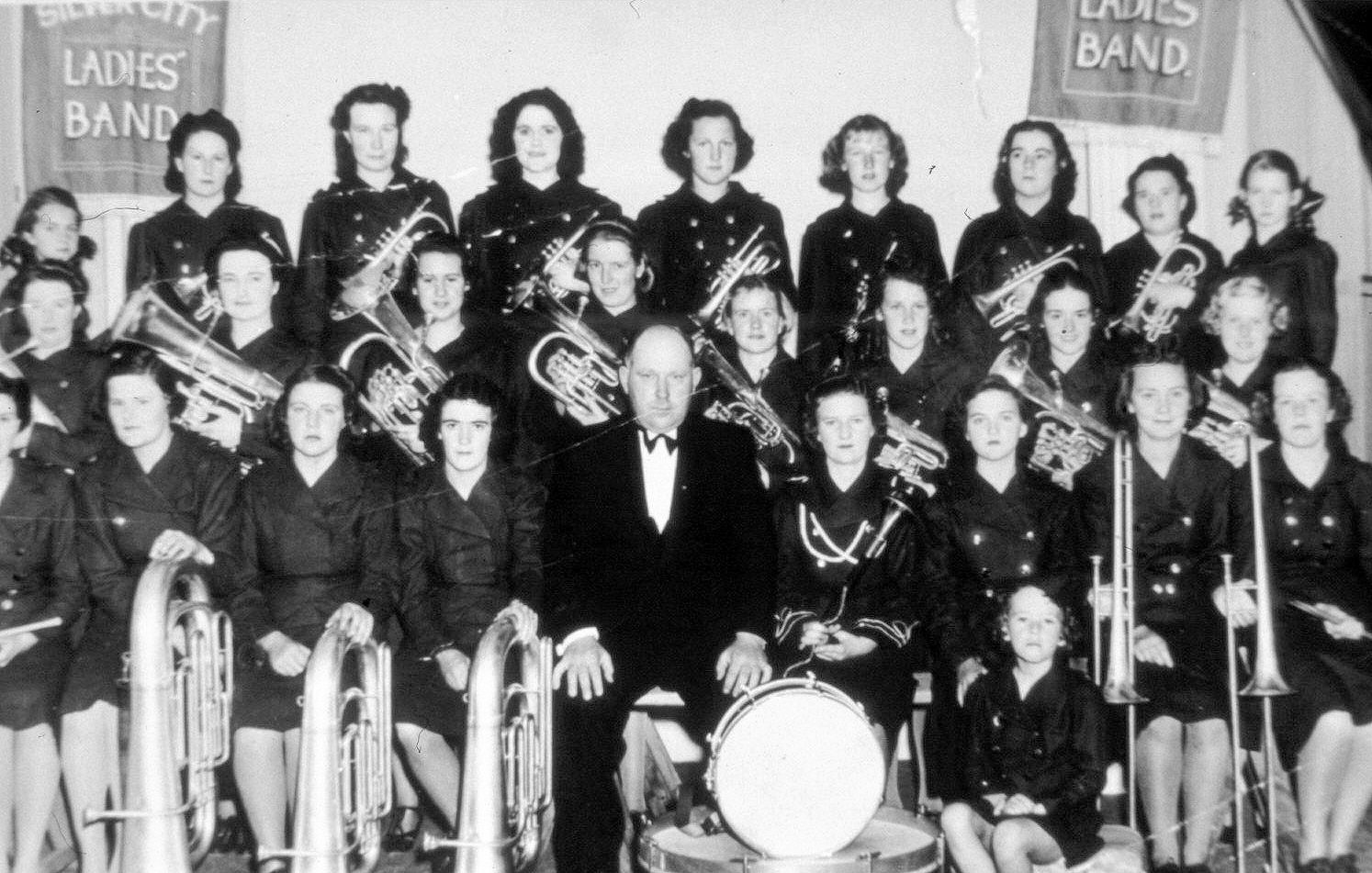
Both New South Wales and Queensland had female bands, but these were formed much later than the bands in South Australia, although obviously, the Salvation Army female band is an exception.  The Silver City Ladies’ Brass Band was formed in Broken Hill in 1940 and the Brisbane Ladies band was formed around the same time (“Concert To Mark Formation Of Women’s Brass Band In City,” 1940; Holman, 2018).  On a side note, it is the idea of a female band forming in Brisbane that brought out another bout of sexist (and instrumentalist?) behavior in the media with the publication of a letter in a local newspaper in 1934 (Incredulous, 1934).  As can be read in the letter, the language says it all and mirrors that of the writing from 1906 – old attitudes don’t seem to go away.  In later years, as mentioned in a previous blog post, a girls’ brass band was started at Balranald High School and a picture of them is in this article from 1949 (de Korte, 2018; “GIRLS and a BRASS BAND,” 1949).

Courier-Mail, 07/03/1934, p. 10

The story of the Sydney Ladies’ Brass band will be brought up later in this post as it has a special story which is interlinked with a story from Victoria.

19140000_Clare-Girls_Brass_phot3428
Clare Girls’ Band, 1914 (Source: IBEW)
19400000_Brisband-Coronation-Ladies_Brass_phot15753
Brisbane Ladies Coronation Brass and Reed Band, 1940 (Source: IBEW)
19400000_Silver-City-Ladies_Brass_phot9302
Silver City ladies’ Band, 1940 (Source: IBEW)

Female bands in Victoria:

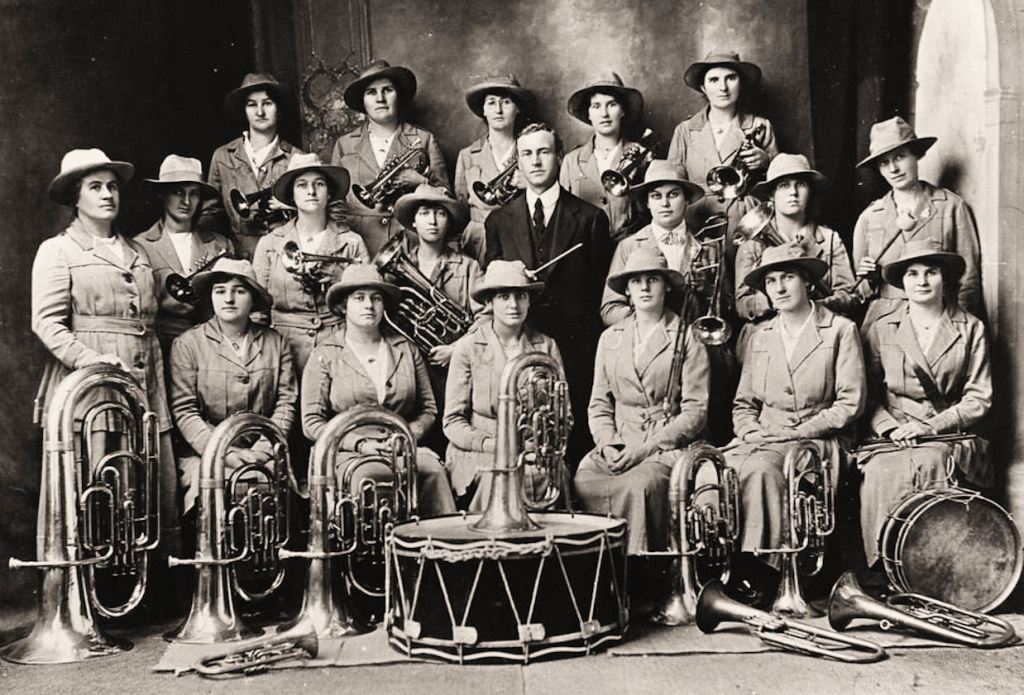
Leader, 31/08/1907, p. 23

Victoria has long been regarded as a centre of bands however when it came to female bands there was a distinct lack numbers.  But all was not lost as it appears that in Victoria, one of the earliest female brass bands in Australia was formed.  Pictured above is the female brass band that was formed for a performance at the 1907 ‘Women at Work’ exhibition (“LITERATURE,” 1907).  This band was made up of female music students who attended the Melbourne Conservatorium and Melba Conservatorium and were believed to be mostly singers and pianists.  Training in the art of playing brass instruments was undertaken over many months (“Ladies’ Brass Band,” 1907).  A further article was published in the Weekly Times newspaper which pictured each musician individually (“THE LADIES BRASS BAND IN CONNECTION WITH THE FORTHCOMING EXHIBITION,” 1907). 

Further research shows that there was a proposal for starting a female brass band in 1937, which is late compared to development of more female brass bands in South Australia (“LADIES’ BAND PROPOSED,” 1937).  One could perhaps view this as bandsmen conservatism.  However, in amongst this came the remarkable story of Hilda Tansey who eventually became Australia’s first recognised female band conductor (Bound for Australia, 2014).  

The cited blog post outlines much of Hilda’s life in brass banding. In summary, Hilda learned brass from her father and traveled with her father around Victoria (Bound for Australia, 2014).  Her father (who was a noted bandsman in his own right) eventually became the bandmaster of the Traralgon Brass Band and it is here where we first see a picture of Hilda with her Tenor Horn sitting in amongst the other band members (see below) (Bound for Australia, 2014).  This was obviously an extreme rarity in Victorian banding to have a young female playing brass in a proper brass band.  Yet soon after this photo was taken, Hilda is listed as a member of the Traralgon soloists that were entered in the A.N.A competition (Melbourne) in 1917 (“Bandsmen to Compete at A.N.A Competitions.,” 1917).  Hilda’s career in bands progressed from this time.

19150000_Traralgon-Band_phot6409
Traralgon Brass Band, 1915? (Source: IBEW)

The Sydney Ladies’ Band:

The Sydney Ladies’ band deserves special mention for being the most well-known of all female brass bands in Australia, and even more so after Hilda was appointed conductor in 1934 (Bound for Australia, 2014; Holman, 2018).  Again, much has been written about the Sydney Ladies’ Band by Holman and the Bound for Australia blog post, so this is a summary of the life of the band.  The band was formed in 1930 but had early financial difficulties however Hilda and other ladies took it over in 1934 and had the debt repaid through member contributions, paid engagements and social functions (Holman, 2018).

The band was quite busy in Sydney and participated in numerous parades and other events (Bound for Australia, 2014).  In 1936 the band broke even more ground by becoming the first female brass band to enter the City of Sydney Interstate Band Contest in the Open D Grade section against eight male brass bands (“WOMEN’S BAND,” 1936).   During the years of WW2 the band was involved in entertaining troops at various camps, however, later in the war years “the R.S.L. refused to let the band march on ANZAC Day 1945, and this was a contributing factor to the members’ decision to disband.” (Holman, 2018, p. 73).  As for Hilda Tansey, she kept up with her brass band activities and is seen in a picture from the 1960s playing with the Randwick District Town Band (Bound for Australia, 2015). A further blog post on the demeanour of brass band members makes mention of the unique behaviour expectations that governed the Sydney Ladies’ Band (de Korte, 2021).

19341006_Sydney-Ladies_Brass_H2009.32:8
Sydney Ladies’ Band, 1934 (Source: State Library Victoria: pi007746)

Family & Soloists:

Postcard: Miss Ruby Correct, 1909 (Source: Jeremy de Korte Collection)

It would be remiss to forget some of our many other female brass musicians from this early era as they too made small contributions to the band movement.  One such musician was Miss Ruby Corrick, a member of the famous “Marvellous Corricks” family entertainment group which consisted of seven siblings and parents of which all were superb musicians (Lewis, 2007).  The Corrick family hailed from New Zealand and travelled widely with their musical shows, including all around Australia.  Miss Ruby played the Cornet and Mellophone and although she never competed in brass band competitions, in some quarters she was regarded as a “champion” of her instrument (“Miss Ruby Corrick,” 1907).  This is not to say she did not have some exposure to brass bands.  In 1906 she appeared in a concert with the Broken Hill A.N.A. brass band as a soloist and in a duet accompanied by the band (“BAND CONCERTS.,” 1906).

Conclusion:

Against some odds, there were female brass bands in Australia and these bands, for the brief time they were in existence, made their mark and gained favorable reputations.  It is unfortunate these bands did not survive; however, it is shown that their legacy lives on.  Who is to say if they were ahead of their time as some bands were started out of a social necessity, whereas other bands were started as recreation and training for women and girls.

We can look back at those times and wonder what it was like and thankfully there are the articles and photos that allow us to do that.  We can also look back and wonder at the attitudes and language from some quarters where they felt that women should not play brass instruments due to aesthetics! Nevertheless, where there was a will, there was a way as Hilda Tansey clearly demonstrated with the Sydney Ladies’ Band.

I hope that the history of female brass bands becomes better known in Australia instead of the patchwork of little histories.  In amongst all the other histories of banding in this country, this is one of the special stories.

19180000_Burra-Cheer-Up-Ladies_Brass_phot16239
Burra Cheer-up Ladies Band, 1918 (Source: IBEW)

References:

AN AMAZON BRASS BAND. (1905, 16 August). Daily Telegraph (Sydney, NSW : 1883 – 1930), 8. http://nla.gov.au/nla.news-article237688608

THE AUSTRAL BRASS BAND. (1906, 08 February). Barrier Miner (Broken Hill, NSW : 1888 – 1954), 3. http://nla.gov.au/nla.news-article44491455

BAND CONCERTS. (1906, 23 July). Barrier Miner (Broken Hill, NSW : 1888 – 1954), 2. http://nla.gov.au/nla.news-article44507135

Bandsmen to Compete at A.N.A Competitions. (1917, 11 December). Gippsland Farmers’ Journal (Traralgon, Vic. : 1893 – 1896; 1914 – 1918), 2. http://nla.gov.au/nla.news-article88813153

Bound for Australia. (2014, 29 November). Hilda and the Sydney Ladies’ Brass Band. Bound for Australia: Stories from the families of those brave ancestors who made the sea voyage to Australia. https://boundforoz.wordpress.com/2014/11/29/1779/

Bound for Australia. (2015, 31 January). Dockside with the Randwick District Town Band. Bound for Australia: Stories from the families of those brave ancestors who made the sea voyage to Australia. https://boundforoz.wordpress.com/2015/01/30/dockside-with-the-randwick-district-town-band/

THE BRIGHTON CONTINENTAL. (1922, 20 January). Southern Cross (Adelaide, SA : 1889 – 1954),1. http://nla.gov.au/nla.news-article167027361

Brisbane Ladies Coronation Brass and Reed Band. (1940). [Photograph]. [phot15753]. The Internet Bandsman Everything Within, Vintage Brass Band Pictures : Australia. http://www.ibew.org.uk/vbbp-oz.html

Burra Cheer-up Ladies Band. (1918). [Photograph]. [phot16239]. The Internet Bandsman Everything Within, Vintage Brass Band Pictures : Australia. http://www.ibew.org.uk/vbbp-oz.html

Clare Girls’ Band. (1914). [Photograph]. [phot3428]. The Internet Bandsman Everything Within, Vintage Brass Band Pictures : Australia. http://www.ibew.org.uk/vbbp-oz.html

Concert To Mark Formation Of Women’s Brass Band In City. (1940, 08 March). Barrier Miner (Broken Hill, NSW : 1888 – 1954), 2. http://nla.gov.au/nla.news-article48343327

de Korte, J. D. (2018, 08 April). Victorian State school brass bands: their legacy lives on. Band Blasts from the Past : Anecdotes, Stories and Personalities. https://bandblastsfromthepast.blog/2018/04/08/victorian-state-school-brass-bands-their-legacy-lives-on/

de Korte, J. D. (2021, 03 November). Earning points: proper deportment of band member’s. Band Blasts from the Past : Anecdotes, Stories and Personalities. https://bandblastsfromthepast.blog/2021/11/03/earning-points-proper-deportment-of-band-members/

Dodgson & Muhling. (1909). Miss Ruby Corrick [Postcard]. [Corrick Entertainers]. Dodgson & Muhling, Print, Perth, W.A. 

GIRLS and a BRASS BAND. (1949, 17 December). Argus (Melbourne, Vic. : 1848 – 1957), 5. http://nla.gov.au/nla.news-article22799163

Holman, G. (2018). Women and Brass: the female brass bands of the 19th and 20th centuries  [eBook]. Academia. https://www.academia.edu/36360090/Women_and_Brass_the_female_brass_bands_of_the_19th_and_20th_centuries 

Incredulous. (1934, 07 March). That Ladies’ Band. Courier-Mail (Brisbane, Qld. : 1933 – 1954), 10. http://nla.gov.au/nla.news-article1177047

THE LADIES BRASS BAND IN CONNECTION WITH THE FORTHCOMING EXHIBITION. (1907, 14 September). Weekly Times (Melbourne, Vic. : 1869 – 1954), 28. http://nla.gov.au/nla.news-article221263851

LADIES’ BAND PROPOSED. (1937, 27 February). Weekly Times (Melbourne, Vic. : 1869 – 1954), 30. http://nla.gov.au/nla.news-article223891110

Ladies’ Brass Band. (1907, 30 August). Herald (Melbourne, Vic. : 1861 – 1954), 5. http://nla.gov.au/nla.news-article243279531

A LADIES’ BRASS BAND : Formed at Streaky Bay. (1919, 31 May). West Coast Sentinel (Streaky Bay, SA : 1912 – 1954), 2. http://nla.gov.au/nla.news-article168197030

Lewis, L. A. (2007). The Corrick Collection: A case study in Asia-Pacific itinerant Film exhibition (1901-1914). Journal of the National Film and Sound Archive, Australia, 2(2), 1-12. https://www.nfsa.gov.au/sites/default/files/09-2020/nfsa_journal_the_corrick_collection.pdf 

LITERATURE : REMINISCENCES CONCERNING EMINENT PEOPLE. (1907, 31 August). Leader (Melbourne, Vic. : 1862 – 1918, 1935), 23. http://nla.gov.au/nla.news-article198103181

Melbourne Ladies’ Salvation Army Band. (1945). [Photograph]. [phot16298]. The Internet Bandsman Everything Within, Vintage Brass Band Pictures : Australia. http://www.ibew.org.uk/vbbp-oz.html

Miss Ruby Corrick : Champion Lady Cornet Soloist, With “The Corricks”. (1907, 16 April). Kalgoorlie Western Argus (WA : 1896 – 1916), 26. http://nla.gov.au/nla.news-article33087937

Salvation Army “Austral Lasses” Band. (1906). [Photograph]. [phot1877]. The Internet Bandsman Everything Within, Vintage Brass Band Pictures : Australia. http://www.ibew.org.uk/vbbp-oz.html

Sara, S. (2014, 25 April). Burra Cheer-Up Ladies Band: Keeping the music alive during war’s dark days. ABC News. Retrieved 18 April 2018 from https://www.abc.net.au/news/2014-04-25/burra-cheer-up-ladies-band/5404654

Silver City Ladies’ Band. (1940). [Photograph]. [phot9302]. The Internet Bandsman Everything Within, Vintage Brass Band Pictures : Australia. http://www.ibew.org.uk/vbbp-oz.html

Sydney Ladies’ Brass Band [picture]. (1934). [1 photographic print on cardboard mount : gelatin silver, hand col. ; 30 x 40 cm.]. [pi007746]. State Library Victoria, Tansey family collection. http://handle.slv.vic.gov.au/10381/336537

Talbot, O. M. (1933). Photograph of the Streaky Bay Ladies’ Brass Band [Photograph (print), black and white]. [PRG+1555/2/1]. State Library of South Australia. https://collections.slsa.sa.gov.au/resource/PRG+1555/2/1

Traralgon Brass Band. (1915?). [Photograph]. [phot6409]. The Internet Bandsman Everything Within, Vintage Brass Band Pictures : Australia. http://www.ibew.org.uk/vbbp-oz.html

WEEK’S PICTURES——IN AND AROUND THE CITY. (1923, 17 March). Mail (Adelaide, SA : 1912 – 1954), 26. http://nla.gov.au/nla.news-article63776526

WOMEN’S BAND : In Interstate Contest. (1936, 18 January). Sydney Morning Herald (NSW : 1842 – 1954), 11. http://nla.gov.au/nla.news-article17222570

Victorian State school brass bands: their legacy lives on

19440000_phot16017_Collingwood-Tech-School
Collingwood Technical School Band, 1944 (Source: IBEW)

Introduction:

The formation of bands in State schools, involving part-reading and real ensemble as distinct from a squad of youngsters all playing the single melodic line, affords the boys – and would also afford the girls – an excellent opportunity for a musical education.  As they advance in their studies the boys are in all probability invited to practise with the senior bands in their districts.  They become bandsmen; they find good occupation in their leisure, their minds are disciplined, and everyone knows that the good bandsman is never a bad citizen.

(“THE EDITOR’S BATON,” 1929, p. 1)

…as stated by the Editor of The Australasian Band and Orchestra News in 1929.  The Editor was undoubtedly writing from his point in time. However, the story of Victorian State school bands starts well-before this time and continued on to form a much greater legacy.  To understand this story will put the Editor’s words into context.  The formation of school brass bands was as much about education as it was about banding and music.

Like their community band counterparts, some Victorian school bands developed remarkable reputations and were involved in occasional controversy.  We can see this not only through the newspaper articles of the day but also writings in books from eminent educationalists.  Perhaps we can also view their formation as ‘being in the right place and the right time’ as there was a bit of good-luck that led to their widespread creation.  Who knows what might have happened if all the pieces of the puzzle had not fallen in place together?

This post will present a brief history of the Victorian State school brass bands as a whole, rather than telling the history of each individual band.  The history will show how some of the greatest brass band personalities of the day were involved in training the young and what banding did for some schools. It can also be shown how the reputation of Victorian school bands spread beyond the State and there are even some interesting stories of school brass bands in other states.  It is important we recognize the contribution of school brass bands within the fabric of brass banding in this country.

19310000_Beechworth_School-Brass
Beechworth School Band, 1931 (Source: IBEW)

The early efforts:

 History can be fickle and to try to pin down a definitive start date of school brass bands is difficult, if not impossible.  It must be recognized that communication was somewhat difficult in the early 20thCentury across Victoria and news of the efforts of one town might not get heard of in another town.  This being said, the schools were not the first institutions to start younger brass bands.  Two Orphanages, St Augustine’s in Geelong and St Vincent de Paul in South Melbourne both started brass bands.  These brass bands were started in the middle to late 1800s and developed fine reputations as well as achieving ongoing competition success – the St Augustine’s Band was already asking for support for a new set of instruments in 1898 (“ST. AUGUSTINE’S ORPHANAGE BAND.,” 1898).  In 1918 a different kind of boys band was started in Richmond and for its short existence became a local, if not very large institution (“Richmond Boys’ Brass Band,” 1918).

The first instances of school brass bands being started come from country areas.  In 1913, a meeting was held in the town of Berringa which is south of Ballarat with the aim of forming a school brass band, which they did using the instruments from the defunct Berringa Brass Band (“BERRINGA.,” 1914; “BERRINGA,” 1913).  A year later another school brass band was started in Bairnsdale in East Gippsland where they made the claim of being the first in Australia (“State School Band.,” 1914).  These were not exactly auspicious starts to school brass bands in Victoria (or Australia) and it wasn’t until the mid-1920’s when a true school brass band movement was started.

The Gillies Bequest:

 In 1925, a bequest to the value of £10,000 was made to the Education Department of Victoria from the estate of the late William Gillies (Hansen, 1932).  This amount of money was to be dedicated to achieving three purposes:

The encouragement of instrumental music in schools, leading, it was hoped, to the increase of village bands and family orchestras.

The encouragement of the art of reading aloud – with special emphasis on reading aloud in the family circle.

The encouragement of nature study, again with the object of making home life, especially in the country, more attractive.

(Hansen, 1932, p. 79; “MUSIC AND READING ALOUD.,” 1925)

The Gillies Bequest, as a perpetual fund, was gratefully received by the Education Department and a plan to implement the will was undertaken with teaching representatives (“MUSIC AND READING.,” 1925).

The bands form up:

19260821_Argus_First-State-School-Band
Argus, 21/08/1926, p. 29

In terms of providing money for instrumental music, the interest arising from the Gillies Bequest was invaluable at the time (and in subsequent years).  It is from this time that the formation of school brass bands (drum & fife bands and school “orchestras”) gathers pace.  A picture of the newly formed Northcote Central State School band appeared in The Argus newspaper in August 1926 – and here we see one of these historical discrepancies as it probably was not the first school band (“FIRST STATE SCHOOL BAND AT PRACTICE.,” 1926).  In 1928 there is even more activity with the formation of the very famous Hyde Street school band, the West Preston School Band and discussions are held regarding the formation of a band for the Prahran Technical School (Hyde Street Youth Band, 2015; “Junior Brass Band for Prahran.,” 1928; “WEST PRESTON SCHOOL BAND.,” 1928).  Unfortunately, it is unclear just how many bands are formed during this initial time.

The formation of school brass bands drew some interest from the wider band movement hence the editorial in The Australasian Band and Orchestra News in 1929.  It is easy to see where the Editor is coming from; he writes as an observer and passionate advocate for brass bands and training the young.  However, the language is opinionated and somewhat inflammatory and, in some cases, he misrepresents the facts.  Part of the opening paragraph is a perfect example:

Signs have not been wanting that the promulgation of the brass bands movement in the State schools of New South Wales, Victoria, and elsewhere in Australia is rather resented by some of the headmasters and passively regarded by many of the others.  Various complaints have come from certain localities in which suggestions for State schools bands, made in zealous good faith by bandmasters willing to do the lion’s share of the work, have been coldly shouldered off by the men who should have been first to welcome them.

(“THE EDITOR’S BATON,” 1929, p. 1)

Probably not the best idea to insult school headmasters if you want them to build band programs in their schools. The Editor goes on in his editorial to wax lyrical about the problems of headmasters – this takes up much of the first page (“THE EDITOR’S BATON,” 1929).  In fact, much of the article is about criticizing the educational ideas and conduct of headmasters, but his concerns about schools finding bandmasters are misplaced. For example, the first bandmaster of the Northcote Central School brass band and the Hyde Street band is none other than Frank “Massa” Johnson, the famous band conductor who was in charge of many other famous bands in Melbourne. (Rasmussen, 2005).  The first conductor of the West Preston school band is the bandmaster of the local Preston band (“WEST PRESTON SCHOOL BAND.,” 1928).  So not only did the school bands form, they were run by the best bandmasters in the business!

The school bands come into their own:

Horsham Times, 10/10/1930, p. 2

In the next decades, the number and reputation of the school bands expanded, and the first competitions were undertaken.  In 1930, the very first competition was held between State school bands in the Exhibition Buildings which involved bands from “Albert Park, Ascot Vale West, Armadale, Coburg East, Coburg West, Footscray, Northcote, Preston West, Princes Hill, and Wonthaggi” (“BAND MUSIC IN SCHOOLS.,” 1930).  The contest was attended by the Minister for Education and Director of Education, Mr M. P. H.ansen (“BAND MUSIC IN SCHOOLS.,” 1930).  In another boost to the status of the school brass bands, the adjudicator at the next South Street Eisteddfod was a very famous bandsman from England, a Dr Cyril Jenkins who was visiting Australia at the time and commented on the quality of the school bands (“JUDGE PRAISES SCHOOL BRASS BAND.,” 1930; see also “NOTED MUSICIAN.,” 1931).

In 1932 a book was published by the then Director of Education, Mr M. P. Hansen titled Thoughts that Breathe.  In this wide-ranging and progressive book (for its time), Mr. Hansen covers all manner of educational theory including advocating for more clubs and associations in schools, of which he devotes a whole chapter to this subject (Hansen, 1932).  More importantly, Mr. Hansen comes across as a strong and measured advocate for school music programs and he details, as a result of the Gillies Bequest, just how far Victorian ensemble programs have grown.  By 1932 in Victorian schools there are, “31 brass bands, 9 orchestras, 13 fife bands and 23 violin classes” (Hansen, 1932, p. 79).  This is quite remarkable growth. By 1937 the number of school brass bands has apparently risen to 50 in Victoria and 20 in New South Wales (“BANDS IN VICTORIA,” 1937).

19360523_AdvertiserSA_Bands-Adelaide
The Advertiser, 23/05/1936, p. 12

The reputation of school bands is also growing during this time and in 1936 the Princes Hill school band goes on a tour to Adelaide (“PRINCES HILL STATE SCHOOL.,” 1936).  The touring band is greeted with much interest and the bandmaster of Princes Hill was invited to speak on the benefits of forming school brass bands, which, Adelaide apparently didn’t have at the time (“SCHOOL BANDS IN ADELAIDE,” 1936).  Reputations are also growing through competition success.  The Hyde Street school band in particular is noted for a runs of multiple competition successes from 1931 – 1966 (“AROUND THE SCHOOLS: THE ARGUS JUNIOR,” 1947; Hyde Street Youth Band, 2015).  The school brass bands had their own association running competitions – the Victorian State Schools Band Association and competitions specific sections for school bands were run at the South Street Eisteddfod in Ballarat (Royal South Street Society, 2017).  In one instance, a competition was run at the Zoo (“SCHOOL BAND CONTEST,” 1939).

School brass band competitions, like those in the senior band world, were not always without controversy and in a noted competition in 1950 a protest was registered by the Hyde Street school band against the band from East Kew alleging that East Kew Victorian Bands’ League registered musicians in their group (“School to lose band award?,” 1950).  Obviously, there was this stigma, and the perception that school-age musicians who also played in VBL bands were of a higher standard.

The musicians of the state school bands progressed on their instruments and many of them joined community bands in their localities.  As detailed in an article from 1937,

The Department of Education is utilising a substantial portion of the income from this bequest for the promotion of school boy bands, and these are already becoming first-class recruiting grounds for senior bands.  Footscray City Band at present includes in its membership 22 former players of the Hyde-street (Footscray) school, which has been champion school band for several years past.  Recently a band has been formed at East Kew (the East Kew Junior Band) to enable boys from the East Kew school band to continue their musical activities after leaving school. It is composed almost wholly of boys from the school band.

(“BANDS IN VICTORIA,” 1937)

Unfortunately, in some areas, the local band ceased to operate, but this sometimes proved a benefit to local schools who were the beneficiaries of their instruments.  Such is the case in Cranbourne where in 1940 where the local band ceased to function and handed all of its instruments to the local school and scout group (“Cranbourne,” 1940).

Where were the girls?

When reading about the school bands in past years, the perception, especially in Victoria, is that the school brass bands were only for boys.  Certainly, there was no written rule stopping girls from joining but it must be assumed that educationally, it was not something that girls should do, or could possibly be interested in.  This was a situation that didn’t change for many years in Victoria. However, over the border in New South Wales, it was very different.  We see in an article in 1949 that the Balranald School Band not only had girls participating, but they were regarded as very good musicians too (“GIRLS and a BRASS BAND,” 1949).  This might be a rare example, but it shows the different attitudes on display at the time. The issue of gender and instruments is an interesting issue to explore – but might be for another post.

The bands in later years:

Things always change and in the world of school brass bands, this was no different.  We know that some school bands survived or evolved.  The Hyde Street school band evolved to become Hyde Street Youth Band and out of all the school bands, this one was the only band to survive as a brass band (Hyde Street Youth Band, 2015).  Other school music programs evolved to set up new ensembles such as concert bands which included woodwind instruments.  It must be assumed that some bands just ceased to exist, and the only memories are from photographs and old school records.  There were so many school bands in the 1930’s and 1940’s – it would be interesting to know what happened to some of them.

Conclusion:

The story and history of school bands is fascinating and could probably be better explored through the research of additional records.  This being said, the newspapers of the day did detail an amount of history and it’s quite fascinating to see what the bands achieved. Certainly, there were a foundation for senior bands in their local areas and local bandmasters were involved. They were a product of their time and their legacy won’t be forgotten.

19370000_Northcote_School
Northcote School Band, 1937 (Source: IBEW)

References:

AROUND THE SCHOOLS : THE ARGUS JUNIOR State School Band Champions. (1947, 23 September). Argus (Melbourne, Vic. : 1848 – 1957), 6. http://nla.gov.au/nla.news-article22509356

BAND MUSIC IN SCHOOLS: First Contest To-day. (1930, 17 May). Argus (Melbourne, Vic. : 1848 – 1957), 27. http://nla.gov.au/nla.news-article4087822

BANDS IN VICTORIA : High Musical Standard : Is Public Appreciating Lacking? (1937, 07 December). Age (Melbourne, Vic. : 1854 – 1954), 10. http://nla.gov.au/nla.news-article205550598http://nla.gov.au/nla.news-article205550598

Beechworth School Brass Band. (1931). [Photograph]. [phot9055]. The Internet Bandsman Everything Within, Vintage Brass Band Pictures : Australia. http://www.ibew.org.uk/vbbp-oz.html

BERRINGA : Boys’ Brass Band. (1914, 27 May). Ballarat Courier (Vic. : 1869 – 1880; 1914 – 1918), 8. http://nla.gov.au/nla.news-article73303543

BERRINGA : School Brass Band. (1913, 05 May). Ballarat Star (Vic. : 1865 – 1924), 6. http://nla.gov.au/nla.news-article219185791

Collingwood Technical School Band. (1944). [Photograph]. [phot16017]. The Internet Bandsman Everything Within, Vintage Brass Band Pictures : Australia. http://www.ibew.org.uk/vbbp-oz.html

Cranbourne : Exit Cranboure’s Brass Band : State School and Scouts benefit from sale of instruments. (1940, 10 July). Dandenong Journal (Vic. : 1927 – 1954), 9. http://nla.gov.au/nla.news-article216062113

THE EDITOR’S BATON: Bringing up the boy to the band. (1929). The Australasian Band and Orchestra News, XXV(2), 1 & 3. 

FIRST STATE SCHOOL BAND AT PRACTICE. (1926, 21 August). Argus (Melbourne, Vic. : 1848 – 1957), 29. http://nla.gov.au/nla.news-article3803920

GIRLS and a BRASS BAND. (1949, 17 December). Argus (Melbourne, Vic. : 1848 – 1957), 5. http://nla.gov.au/nla.news-article22799163

Hansen, M. P. (1932). Thoughts that breathe. Robertson & Mullens. 

Hyde Street Youth Band. (2015). History : Where did we come from? Hyde Street Youth Band : Established 1928. Retrieved 08 April 2018 from https://hsyb.org.au/about/history-2/

JUDGE PRAISES SCHOOL BRASS BAND. (1930, 10 October). Horsham Times (Vic. : 1882 – 1954), 2. http://nla.gov.au/nla.news-article72645899

Junior Brass Band for Prahran. (1928, 27 June). Age (Melbourne, Vic. : 1854 – 1954), 9. http://nla.gov.au/nla.news-article202295373

MUSIC AND READING ALOUD : Object of Large Bequest. (1925, 01 June). Argus (Melbourne, Vic. : 1848 – 1957), 10. http://nla.gov.au/nla.news-article2122525

MUSIC AND READING : Bequest for Encouragement : Department’s Grateful Acceptance. (1925, 02 June). Argus (Melbourne, Vic. : 1848 – 1957), 19. http://nla.gov.au/nla.news-article2122677

Northcote School Band, Melbourne. (1937). [Photograph]. [phot9041]. The Internet Bandsman Everything Within, Vintage Brass Band Pictures : Australia. http://www.ibew.org.uk/vbbp-oz.html

NOTED MUSICIAN : Views on Australian choirs : Dr. Cyril Jenkins’s Visit. (1931, 20 January). Sydney Morning Herald (NSW : 1842 – 1954), 8. http://nla.gov.au/nla.news-article16747310

PRINCES HILL STATE SCHOOL : Band’s Visit to Adelaide. (1936, 22 May). Age (Melbourne, Vic. : 1854 – 1954), 4. http://nla.gov.au/nla.news-article204828552

Rasmussen, C. (2005). Johnston, Francis Charles (Massa) (1880-1953). In Australian Dictionary of Biography. Retrieved 12 October 2017, from https://adb.anu.edu.au/biography/johnston-francis-charles-massa-13009

Richmond Boys’ Brass Band to Make Debut at Racecourse Carnival for Blind Soldiers—Amazing Growth of Notable Movement that will Bring Fame to This District. (1918, 12 January). Richmond Guardian (Vic. : 1917 – 1918), 2. http://nla.gov.au/nla.news-article93811136

Royal South Street Society. (2017). Results. Royal South Street Society (1891-2016). Retrieved 13 October 2017 from https://results.royalsouthstreet.com.au

SCHOOL BAND CONTEST. (1939, 29 August). Argus (Melbourne, Vic. : 1848 – 1957), 4. http://nla.gov.au/nla.news-article11234823

SCHOOL BANDS IN ADELAIDE : Brass Instruments Preferred. (1936, 23 May). Advertiser (Adelaide, SA : 1931 – 1954), 12. http://nla.gov.au/nla.news-article35434199

School to lose band award? (1950, 25 August). Argus (Melbourne, Vic. : 1848 – 1957), 3. http://nla.gov.au/nla.news-article22911796

ST. AUGUSTINE’S ORPHANAGE BAND. (1898, 01 March). Geelong Advertiser (Vic. : 1859 – 1929), 1. http://nla.gov.au/nla.news-article150368016

State School Band. (1914, 26 May). Bairnsdale Advertiser and Tambo and Omeo Chronicle (Vic. : 1882 – 1918), 2. http://nla.gov.au/nla.news-article75096821

WEST PRESTON SCHOOL BAND. (1928, 16 May). Argus (Melbourne, Vic. : 1848 – 1957), 22. http://nla.gov.au/nla.news-article3928715