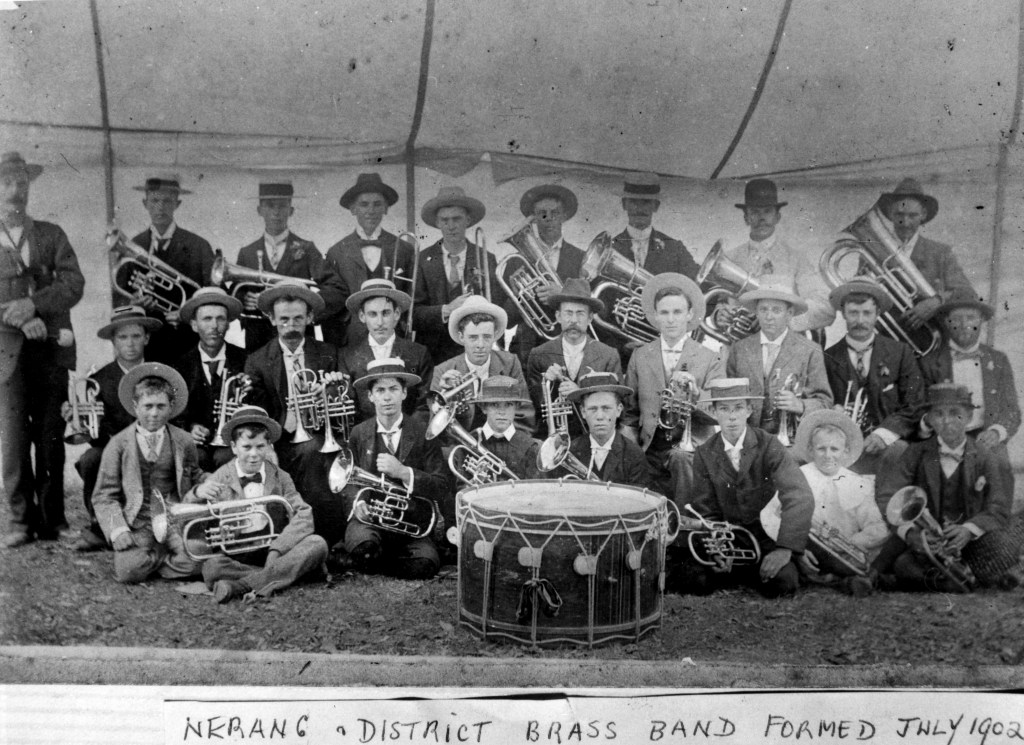
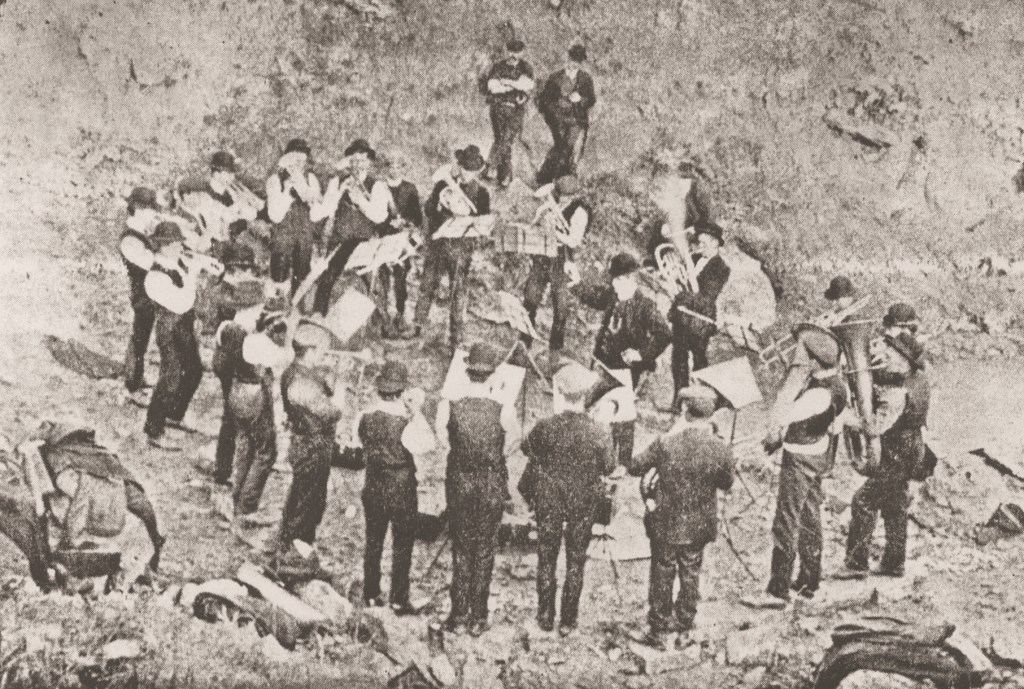
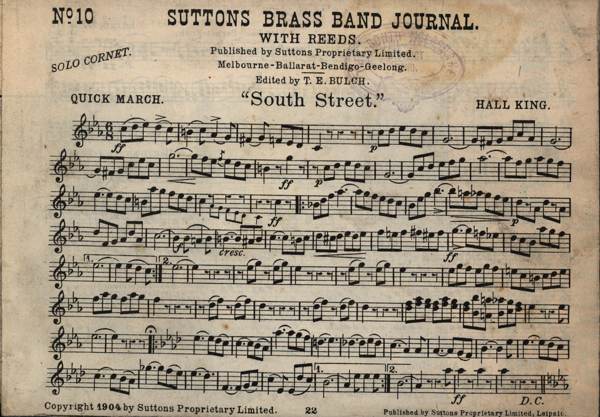
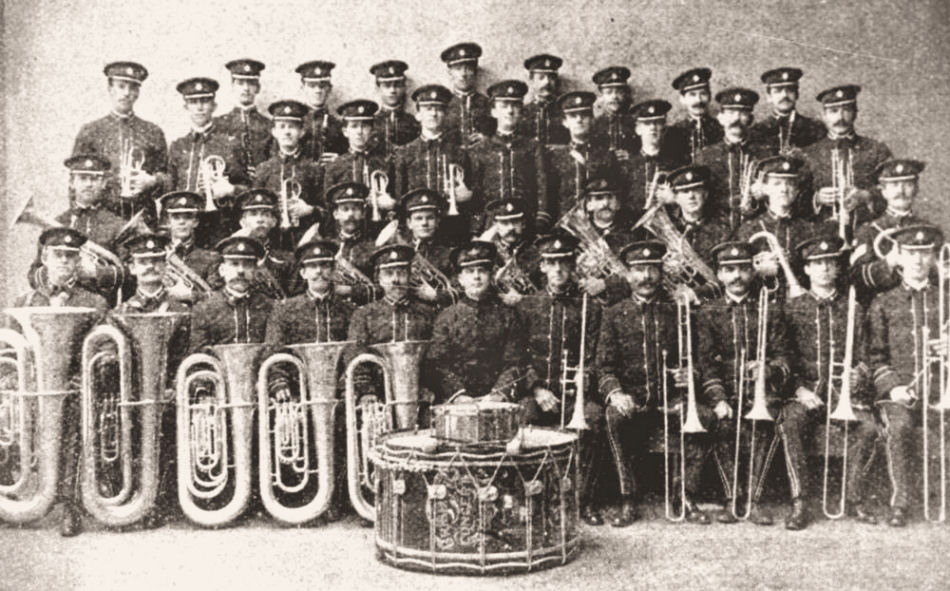
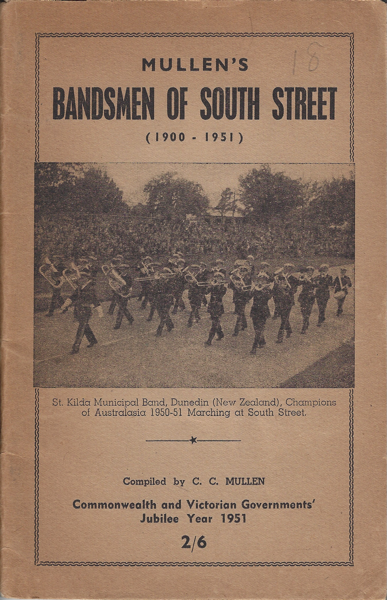
Influences from Britain: James Ord Hume and “The Besses Effect”.

Postcard: Besses o’ th’ Barn Band. (1908) (Source: Jeremy de Korte collection)

Introduction:

The visit of one of the premier bands of Britain to Australia would be an event of great interest, and Mr. Hume, speaking on the matter, said that if the railways would guarantee to grant free passes to the members, he could almost promise that either the Besses o’ th’ Barn Band, of Lancashire or the Black Dyke Band, of Yorkshire, would come out.  That the venture would be a success Mr Hume says he has not the slightest doubt, and he considers that the playing would come as a revelation to Australians.

(“MR. J. ORD HUME.,” 1903)

Australian bands, to put it simply, are an extension of the movement started in Britain and bands are one of Britain’s great cultural exports.  As has been noted in other posts, the influx of people from the British Isles and other places carried their music with them.  It is no surprise that in the early years, bands were established in localities across Australia. 

There was no shortage of enthusiasm for starting a band, and no shortage of budding musicians willing to learn.  However, training them, supporting them and giving them inspiration was at times problematic.  Musical training was sometimes left up to those willing to take the job of bandmaster, whether they had brass band skills or not.  This was the case in some places but not others as some bands became very proficient, very quickly. 

Not that this mattered to some untrained ears.  Many towns and localities were simply glad to have a band (a source of civic pride).  Although the bands that were founded in the late 1800s and early 1900s possibly realised that their playing was not up to English standards.  Bands were willing to learn, it was just a matter of whom to learn from.  It was not until the advent of organised competitions and visits from English bands that the standard of playing was given a critical ear and adjudicators provided bands with helpful comments on how to improve.

This post will examine what was probably the greatest shift in musical standards amongst Australian bands that took place over the period of two to three decades.  This rapid improvement was partly inspired by the visits of the eminent Scottish band adjudicator James Ord Hume and the famous Besses o’ th’ Barn Band from England.  Thankfully, for the purposes of this post, we can see the comments of James Ord Hume over the course of his two visits as he judges the bands.  We will also see that while the tours of Besses were significant in themselves, it is the lasting effect these visits had on Australian bands that deserves attention.  This is a combined story; a story of how British band musicians did their best to inspire and help Australian bands to be the best they could be.

James Ord Hume, 1902-1903:
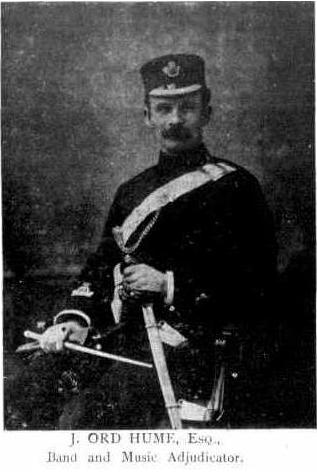
National Advocate, 13/11/1902, p. 5-6

Lieutenant James Ord Hume was an “eminent English and Scottish bandmaster, composer, critic and adjudicator” (Mullen, 1965, p. 40).  A lifetime of musical training in the British Army and civilian bands had provided him with a unique connectedness with all sorts of musicians, and he had utilised his opportunities to the full by learning to play all band instruments and study musical theory (Thirst, 2006).  His reputation as a musician preceded him and he was highly sought after as an adjudicator and clinician.  As Thirst (2006) writes in his bookJames Ord Hume 1864-1932 : a friend to all bandsmen : an account of his life and music’,

He was a popular adjudicator throughout the British Empire, and frequently visited Australia and New Zealand to judge in the famous contest at Ballarat and elsewhere

(p. 47)

This was not an idle statement as many accounts of James Ord Hume show him to be a very forthright person with his adjudications and opinions, and he was appreciated by bandsmen all over Australia and New Zealand (“Bathurst Band Contests.,” 1902).  One might say that with his attitude he was a bit free with his advice.  Nevertheless, Ord Hume acted with the best intentions and sought to bring the standards of Australian bands up to where he thought they should be and provided solutions on how Australian bands might achieve this.  Certainly, his foretelling that Australian bands would view the “playing” of Besses o’ th’ Barn Band as a “revelation” came to fruition some years later (“MR. J. ORD HUME.,” 1903).

When Ord Hume talked, Australian bandsmen listened and there are some notable examples of his advice being applied literally and quickly.  He greatly followed developments in the brass band world, and it is because of him that Australian bands stopped using valve trombones – Ord Hume could not stand them.  The article below published by the Molong Argus newspaper is testament to his comments, and it seems James Ord Hume was quite happy to repeat this mantra to whomever asked him about it (“About Trombones.,” 1902; “Bathurst Band Contests.,” 1902).
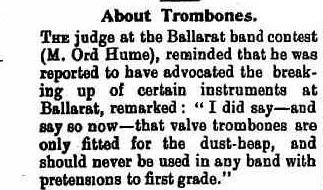
Molong Argus, 28/11/1902, p. 15

James Ord Hume first visited Australia in 1902-1903 where he adjudicated at various eisteddfods around the country, starting with the South Street band sections in Ballarat.  Ord Hume was greatly impressed with the concept of the South Street and before the competitions had even begun, he had given them praise – and also a taste of what to expect.

He said he had always had a desire to visit Australia, and only demurred on receiving the invitation from the South-street Society to adjudicate at this year’s contests because of want of time.  However, the musical people of England wanted to know how they stood with Australia in competitive work, and the mission he entered upon was to give a candid opinion of all that occurred in a general report.  The musical contests of South-street were certainly the greatest in the world.

(“SOUTH-STREET COMPETITION’S,” 1902)

It would be fair to say that, barring some exceptions, he was not overly impressed with what he heard in the band contests and was quite clear about this in his comments (“BALLARAT COMPETITIONS.,” 1902).  His parting comments were a measure of contrast.  Of the good bands he said…

…had given splendid performances which would compare favourably with the best heard at contests in the old country.

(“BALLARAT COMPETITIONS.,” 1902)

And he was scathing about bands at the other end of the scale…

On the other hand some were distinctly bad.  Their principal fault was a lack of tone; the men had not blown out their instruments as they should have done.  If a player just obtained a good loud tone he could easily subdue it without losing breath and character.  In the constant effort to play softly this was all lost.

(“BALLARAT COMPETITIONS.,” 1902)

This being said, he also offered practical advice on how bandsmen could improve.

To obtain tone he advised bandsmen to practise slow scales, and plenty of steady moving psalm tunes.

(“BALLARAT COMPETITIONS.,” 1902)

Timothy Thirst (2006) did note in his book that Ord Hume was “known to be sometimes rather sarcastic and outspoken in his comments.” (p. 55). 

Ord Hume provide similarly forward comments when adjudicating in Bathurst, Sydney and New Zealand for various competitions, such was the hectic schedule of his visit.  However, there are some indications that Australian bands were beginning to pick up their musical standards.  After adjudicating in Sydney at the end of 1902, Ord Hume provided some observations.

He said that since he had been in Australia he had noticed an improvement in the playing of the bands.  He had observed at Ballarat and Bathurst, and now here.  He was about to proceed to Castlemaine (Vic.), and thence to New Zealand, and on his return the results of his observations would be published.

(“CHAMPIONSHIP BAND CONTEST.,” 1902)

When Ord Hume returned to Ballarat in 1903 prior to his travel back to England, he was asked what Australian bands needed to do to achieve a more excellent standard of playing.

“They require tuition” he said.  “In many cases it has come to this, that the men have to come to know as much as the conductor himself, and in such a case the progress made is not very great as you may imagine.  In New Zealand this fact is not so noticeable and it explains the reason why their bands, generally speaking, are much better than those here.  They possess over there many instructors who have come out from the old country, but here it seems to be ‘Australia for the Australians,’ and that will not do in music at any rate.”

(“MR. J. ORD HUME.,” 1903)

As mentioned, Ord Hume was appreciated for his direct commentary and aside from his work adjudicating he was afforded all kinds of civic receptions at the conclusion of events.  Perhaps this is understandable given his status as an eminent musical authority, but it was also for his honesty – what he said, he said with conviction.  Granted, some bandsmen might have been offended.  But in his own way he was trying to educate.  Band Associations were very pleased to have someone of that calibre adjudicate which is why, after the 1902 Ballarat event he was made an Honorary Life Member of the Victorian Bands’ Association (“SOUTH STREET SOCIETY.,” 1902). 

Frank Wright, the great Australian-born bandsman, summed up the first visit of Ord Hume to Australia when he wrote an appreciative article in the June 15th, 1935 edition of British Bandsman after Ord Hume’s passing.

No other event in band history, except, perhaps the tour of the famous Besses o’ th’ Barn Band, can be compared with his visit, as having equal influence in setting the standard for Australian bands.  He encouraged the young ambitious bandsman, and it was this personal interest that endeared him to the Australian people.

(Wright, 1935, p. 4)

If Ord Hume was an instigator of change in the way Australian band did things, the tours of Besses fanned further improvement as they provided a practical example of how an elite band sounded and operated.  The Besses band was no stranger to Ord Hume and it appears there was some mutual admiration and respect.  Ord Hume even arranged a Polka for Besses which can be heard below (Besses o’ th’ Barn Band Channel, 2022).  This radio broadcast recording from 1940, played by the City of Ballarat Municipal Band was provided to the Besses band by the Ballarat Band historian Bob Pattie, and uploaded to YouTube by the historian of the Besses o’ th’ Barn Band, Stephen Hughes – thank you both! (This video was updated in January 2022)

Besses o’ th’ Barn Polka (Cornet Solo: Broadcast 1940). Soloist Jack Allan. Band: Ballarat City

Besses o’ th’ Barn Band, 1907 & 1910:

The welcome parade of the Besses o’ th’ Barn Band to Melbourne. The parade is being led by a combined 22 brass bands under the direction of Edward Code and is turning the corner from Collins St into Swanston St in front of the Melbourne Town Hall. (Source: Manchester Digital Music Archive, 13953)

The tours:

Much of the particulars of the two Besses tours were detailed in a previous post (de Korte, 2018a).  In summary, the famous Besses o’ th’ Barn Band from Lancashire undertook two massive tours in the space of three years which took them all over the globe (Besses o’ th’ Barn Band, 2018).  While in Australia, they were afforded concerts and engagements in towns and cities all over the country and never failed to please audiences – such was their reputation (“BESSES O’ TH’ BARN BAND.,” 1907a; “BESSES O’ TH’ BARN BAND.,” 1907c).  Civic welcomes were par the course and the photo above of the parade turning the corner from Collins Street to Swanston Street at the Melbourne Town Hall is a case in point.  Besses were greeted at Spencer Street Station by a combined twenty-two bands directed by Edward Code which led them in a procession up Collins Street to the Town Hall (“BESSES O’ TH’ BARN BAND.,” 1907e).  It is said that 70,000 people turned out to watch this procession, which would have been an amazing sight to see! (“Besses o’ th’ Barn Band,” 1907).

Herald, 23/10/1920, p. 4

Besses toured Australia again in 1910 and during this tour, lead Cornetist William Ryder left the band to join a local theatre ensemble and then became the first bandmaster of the then Prahran & Malvern Tramways Employees Band in 1911 (de Korte, 2018b; Quickstep, 1920b).  Cornetist Percy Code, son of Mr Edward Code, took his place on the tour (Quickstep, 1920a).  The Herald weekly columnist ‘Quickstep’ provides some insight into this development through separate articles which detail the band lives of William Ryder…

Leaving England as principal cornet soloist with the famous Royal “Besses o’ th’ Barn” Band on their second world tour, Mr Ryder left the band on the completion of its Victorian trip and settled in Melbourne.  He was immediately engaged to play solo cornet in a picture theatre orchestra.

(Quickstep, 1920b)

…and Percy Code.

At the time the famous “Besses o’ th’ Barn” Band was touring Australia and Percy Code was offered an engagement which he accepted.  While he was abroad, his brilliant playing was favourably commented on by British press.  One leading band journal styled him “Percy Code the golden-toned,” also crediting him as one of the finest cornetists in England.  Study in orchestration and composition was undertaken, under the guidance of Mr Alexander Owen, of Manchester, known as the greatest authority on brass band music in the world.

(Quickstep, 1920a)
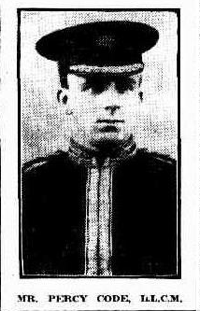
Herald, 11/09/1920, p. 14

Mr Alexander Owen at the time was the conductor of Besses during the first tour and part of the second tour and he was highly regarded in Australia and around the world – newspapers of the day were effusive in their praise, the Evening Telegraph newspaper from Charters Towers being one of them (“Mr. Alexander Owen.,” 1907).  After the tour, the Assistant Conductor of Besses, Mr Christopher Smith accepted a position as conductor of the Adelaide Tramways Band (Seymour, 1994).
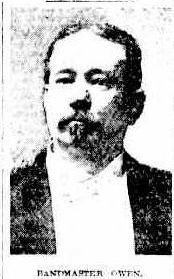
Herald, 25/07/1907, p. 3

By all accounts, the two tours of the Besses band were huge successes and they opened up the ears and eyes of all who heard them. 

The influence:
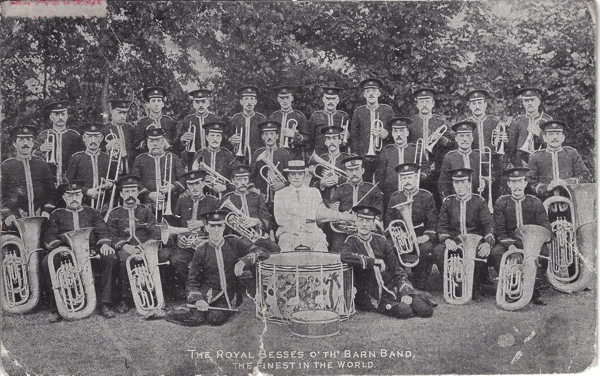
Postcard: The Royal Besses o’ th’ Barn Band. (1907) (Jeremy de Korte collection)

Besses o’ th’ Barn Band made a lasting impression on the Australian band movement.  Notwithstanding their reputation prior to their visits to Australia, they certainly grew in stature on this unique part of their tours.  One hallmark of their visits was the fact they were very much a band full of critical listeners, teachers, advocates and gentlemen who were always willing to offer advice and help.

Hundreds of newspaper articles were published during the two Besses tours, so it is impossible to reference them all.  Buried in these articles are hints of information as to how the visits were perceived by Australian bandsmen, and what they learnt from the visiting band.  In July 1907 the Besses band were giving a concert in Goulburn, New South Wales and after the concert they were entertained by the local Australian Horse Band.  The Mayor of Goulburn was also present at this supper and his comments were noted in an article published by the Goulburn Herald.

He welcomed then not merely as bandsmen from the old country, but as brothers, and hoped their stay here would be a pleasurable one.  He was sure it would be great value from an educational point of view to the bands in Australia.  […] He hoped with all sincerity that the visit of the Besses would be crowned with the success it deserved, and that they would be able to say that the Australians were a loyal and patriotic people – which they were right up to the hilt – and pleased to accord their support to organisations such as the Besses o’ th’ Barn Band, which came so far to educate them.

(“BESSES O’ TH’ BARN BAND.,” 1907a)

It is interesting to note the language here from the Mayor of Goulburn, not so much for the comments on patriotism but the words on education.  Besses were not really touring to educate Australia bands per se however, that was an inadvertent effect of them being in Australia.  Further comments were made by Mr. Cody, Bandmaster of the Australian Horse Band in the same article.

The visit of Besses could have none other than a good effect on band music in Australia.  The various bands would be moved to do greater things than in the past, and they result would be beneficial all round.

(“BESSES O’ TH’ BARN BAND.,” 1907a)

Besses visited Adelaide in August 1907 and comments made in the Register newspaper were equally full of expectation on what the Besses visit would mean for Australian bands.

…the Besses’ performances must unquestionably stimulate band music in the State, which has been the case of every town they have visited on the Australian tour.  The artistic methods employed by Mr. Owen in conducting the Besses in their playing are said to be a revelation in technique and phrasing, and have been described by a leading Sydney bandmaster as being “an entirely new musical language for colonial bands to study”.

(“BESSES O’ TH’ BARN BAND.,” 1907c)

After touring Australia for a couple of months, in September 1907, Besses were in Bendigo and in an article published by the Bendigo Advertiser, perhaps, we can see some real analysis and insight into the benefits the Besses visit would bring to Australian bands.

There are two things which especially distinguish the Besses.  In the first place the high degree of finish that characterises their playing, so that all bandsmen that have heard them have confessed that something new in band music had been revealed to them, possibilities in brass that were previously undreamed of, and in the second place, the courteous and obliging urbanity in which the conductor, Mr. Alexander Owen, and members of his corps, have done whatever they could to help those colonial bands which have appealed to them for advice and instruction.  The present generation of bandsmen will never forget their impression of the Besses, which will more or less in the future influence their aspirations and efforts, and when a young generation of Tubal Cains grow up, whose lips are not yet too tender for the resounding brass, they will hear abundant reminiscences of how this or that passage was taken up by the Besses, until not impossibly, they will wish that at last that the Besses had never toured through Australasia.

(“BESSES O’ TH’ BARN BAND.,” 1907b)

As mentioned, Besses undertook a second world tour and in 1910 they were back in Australia.  Alexander Owen stepped down from his conducting duties during this tour and Mr Christopher Smith took over to no less acclaim from audiences, such was the ability of this ensemble.  Australian bands were also changing, and this had been noticed by various writers, which was attributed by the visit of Besses three years before.  Said a writer in an article published by The Ballarat Star newspaper in June 1910.

It might truthfully be said that the standard of band music underwent an appreciable change for the better as the result of the visit of this celebrated combination.

(“AMUSEMENTS.,” 1910)

Mr. W. Bogle, manager of the Besses band during their second tour provided some interesting comments comparing band movements of the U.K. and Australia in a wide-ranging interview which was published by the Evening News newspaper in August (“THE MUSIC OF THE BAND.,” 1910).  While his interview is too much for this post, the advice he provided was obviously valuable to the Australian band movement.  And again, there were indications that Australian bands were heading the right way.

They had no doubt that the public of Australia would encourage the improvement of brass bands, and it was particularly pleasing to see they were assisted by the municipal bodies.

(“THE MUSIC OF THE BAND.,” 1910)

The legacy:

The influence of the Besses tours should not be viewed as just bands and band members attending their concerts or being instructed, advised and then feeling very much inspired.  It can also be seen in other ways.  William Ryder, Percy Code and Christopher Smith, bandsmen who had all been associated with Besses at high levels brought the Besses influences with them to their own bands, playing and adjudication.  Australian bands began to rapidly improve after the first Besses tour and inspiration from the band itself.  Instruction and adjudication from these men helped carry things further.  Mr Christopher Smith, once a deputy conductor of Besses, gave high praise to certain bands and was in no doubt that Australian bands could compete with the best (“WOULD CAPTURE LONDON,” 1922).  He adjudicated at South Street in 1922 and gave a general comment on the standards that were set.

“The standard was appreciably higher than when I judged bands here two years ago.” He said, “and what is pleasing to me is to find the unsuccessful bands more closely approaching the standard set by the victorious bands in all the grades.”

(“WOULD CAPTURE LONDON,” 1922)

He left his highest praise for the famous Malvern Tramways Band which had just won all the A Grade band sections of the 1922 South Street competition.

Malvern Tramways Band is such a cultured musical combination that it would capture English audiences by its playing.  It would do so by sheer merit.

(“WOULD CAPTURE LONDON,” 1922)

And in a final remark he highlighted advancements of bands in the lower grades.

Mr Smith went on to say that marked advances had been made by the “B” grade and “C” grade bands in their contest pieces.

(“WOULD CAPTURE LONDON,” 1922)

High praise indeed and this provided a good indication of where Australian bands were at, and where they were going just over a decade from the last Besses tour.  The bands were definitely improving!

Interestingly, the tours of Besses were still being talked about in the early 1930s as the legacy of the visits still resounded in the band movement.  The Daily News newspaper in Perth published an article in September 1930, essentially on Mr Hugh McMahon, the genius Cornetist but also mentions the state of brass bands in Western Australia as a whole.  The article also had this to say about the legacy of the Besses tours.

Most memorable had been the visit of the Besses of the Barn Band which had shown what a brass band could do in the way of interpreting certain classes of music.  The visitors had given a revelation of the playing of hymn tunes equal to that of any organ and had set a new view before Australian players.

(“EMPEROR OF CORNET,” 1930)

To finish this section on the Besses tours and the influence they left behind, we have these comments from a person speaking at the annual banquet of the Queensland based Howard and Torbanlea Citizens’ Band in December 1933. 

After a loyal toast, the toast of the Howard and Torbanlea Citizens’ Band was proposed by Mr. G. J. Edmunds who stressed the many advantages of having a band in the community.  Mr. Edmunds declared that the visit of the Besses o’ th’ Barn Band many years ago was the running point in the standard of band throughout the Commonwealth, and today, quite a number of bands had reached that standard.

(“BAND BANQUET,” 1933)

Australian bands had begun to reach the pinnacles set by Besses.  And in the 1920s, with tours to England by the Newcastle Steelworks’ Band and the Australian Commonwealth Band, both conducted by Albert Baile, Australian bands proved they could match the much-vaunted English bands and win their competitions (Zealley & Ord Hume, 1926).

A side note, Mr John Dixon, Agent for Boosey & Co.:

James Ord Hume provided much advice to the Australian band movement on how to improve, and the Besses o’ th’ Barn Band clearly displayed an excellence in musicianship.  One aspect that could be considered is that Australian bands needed the best of instruments and British instrument manufacturers saw opportunities in Australia & New Zealand for additional sales.  Travelling with James Ord Hume in 1902 and on the first Besses tour in 1907 was an agent for the Boosey & Co. instrument manufactures, Mr John Dixon (“MUSIC ADJUDICATOR,” 1929).

Near the end of the 1800s and into the 1900s, Boosey & Co. “was flourishing, supporting a staff of 100 employees” (Howell, 2016, p. 61).  John Dixon was one of their agents and he travelled the world to create find new markets and build contacts, so when James Ord Hume and Besses went on their respective tours it presented an opportunity for John Dixon to go along as well. 

Unfortunately, not much is known about John Dixon’s life, but from brief range of articles we can see that he made extensive contacts in the band world (“An Exhibit of Musical Instruments,” 1906; “MUSIC ADJUDICATOR,” 1929; “Personals,” 1903).  Writing a long letter to Wright & Round’s Brass Band News on February 1st from New Zealand (published in their April 1st issue), he noted of his experiences,

…In Coolgardie I met John Cox, late of Lassodie, now bandmaster Coolgardie City Band.  He has a son a good cornet player.  He asked me about a great many Fifeshire bandsmen, and I was able to tell him something about all.  He asked me specially to remember him to Mr. James Carmichael of Cowdenbeath, Mr. George Peacock of Fauldhouse, Geordie Pemann and all the Penmans, muckle fat Geordie in particular said he, to Archie Carmichael of Glasgow, and many more.  I met an old Bury lad full of the Lancashire love of contesting at Kalgoorlie, where he is bandmaster of the Town Band.  Mr. Richard Weber is his name, and a fine fellow he is.  He sends his best regards to all his old friends in the Bury, Radcliffe, and Besses districts, not forgetting “Trotter,” whom he says is a “corker.” (He must have meant an uncorker.)  At Boulder City I met and heard Mr, Hugh McMahon, the Alex Owen of Australia who took his band 4000 miles to compete at Ballarat and at Bathurst.  He is a wonder on the cornet and deserves his title.  At Adelaide I found the Loco. Band very good and in charge of an enthusiastic viz., Mr. Charles Allison. […] I have had a very successful tour so far in a business sense, and have established a good many agencies.  Give my regards to all old friends and tell them I shall be with them again when the flowers bloom in the spring tra-la.  I leave Auckland on February 25th and travel via., Fiji, Honolulu, Canada, New York, and Glasgow.

(Dixon in “Personals,” 1903, p. 7)

It is clear that John Dixon was good at his job and certainly found lots of band friends throughout Australia.  His comments on the standards of Australian bands and bandsmen were certainly interesting.  It could be debatable whether the sale of Boosey instruments to bands made them any better.  However, Boosey (like numerous other instrument companies), milked the fact that certain bands and bandsmen were using their instruments to win competitions – a strong selling point in those days (Boosey and Co., 1919).  

The Australian Band News, 12(10), 26/06/1919, p. 18

James Ord Hume, 1924:

In January 1924 there was much excitement in the band community as it was revealed that James Ord Hume would be making another visit to Australia to adjudicate, twenty-two years after his last visit in 1902 (“MR. J. ORD HUME,” 1924).  The Ballarat Star newspaper published a long article full of praise for the work of Ord Hume in 1902 with a brief record of what he did in Australia in his first visit, read out by the President of the South Street Society, Mr Scroucher.

…There is no need for me to tell you who Mr J. Ord Hume is, for with the exception of the very young members of the club, all bandsmen will remember him.  He came to Australia some twenty-odd years ago.  He judged the South street contest, asked for more tone, told the bandsmen to throw the valve trombone on the scrap heap, gave the prizes to the right persons, and then skipped across to Bathurst.  In Bathurst he judged all the musical items from piano right through the list, including all instruments, except, possibly, the bagpipes.  He didn’t judge the pipes because there were none to judge.  From Bathurst he went to New Zealand, did a lot of work there, created a breeze and skipped back to Sydney, where he judged a big contest.  He also did other work, and good work too.  Through his criticism and acting on his advice, many bands became better musical organisations.  And now, after all these year he is about to visit us again.

(“MR. J. ORD HUME,” 1924)

Part of the rest of the article comprised of a ditty, which will not be written here for the sake of brevity.  Needless to say, the ditty highlighted the delight in knowing that Ord Hume was coming back to Ballarat.

Frank Wright also eloquently wrote of the second visit in his memorial article for the British Bandsman in June 1935.

But since those early days a new generation of Australian bandsman had sprung up.  A generation to whom the name of J. Ord Hume is no less magical than it was to those enthusiasts of 1901.  It is little wonder then, that his second – and last – visit in 1924-5 was hailed as an even greater event than the first.

(Wright, 1935, p. 4)

Given that Ord Hume visited in 1902 and had provided advice to bands on how to improve, Besses toured in 1907 and 1910 and cast a lasting legacy over Australian bands, the fact that Ord Hume visited again in 1924 provides us with expert assessment on which standard Australian bands had reached.  We need to only look at his words which were published in an Argus article in October 1924 upon his welcome to Ballarat.  This was the only competition Ord Hume was to adjudicate in Australia this year.

Mr. Hume referred to the successes of the Newcastle Band in England, and said that it could rank with the cream of British bands.  Australian bands had improved wonderfully, but he could not say the same of the English bands. […] His object in visiting Ballarat was not only to judge, but also to advise.  If he could do anything to further raise the standard of band music in Australia it would be done.  When in Melbourne on Sunday he had heard the Malvern Tramways Band, and he had been delighted with its excellent tone.  It should always be the aim of a brass band to develop a good tone.

(“AUSTRALIAN BANDS.,” 1924)
Famous Bands of the British Empire‘, 1926, p. 6

Ord Hume was always one to make further comments and in 1926 he teamed up with Canadian Lieut. Alfred Edward Zealley to write a book, ‘Famous Bands of the British Empire’.  This book was essentially a list of the best bands, military and brass, that they perceived to be the finest of the time.  Four Australian bands made the list: New South Wales Lancers band, Malvern Tramways Band, Newcastle Steelworks Band and The Australian Commonwealth Band.  It is in the section detailing the exploits of the Malvern Tramways Band thus far that we can find more of the story on Besses and Ord Hume in Australia.  What is written here is a perfect response to his prophecy from 1903 at the top of this post.

Famous Bands of the British Empire‘, 1926, p. 60

Conclusion:

There is enough evidence to suggest that the visits of James Ord Hume and the Besses band to Australia were the great catalysts in boosting the standards of Australian bands.  It is a fascinating story, and there is much that could have been added as there are always side stories that link into this central theme.  It could be argued that there were other influences that were working on Australian bands.  Certainly, in the early 1900s, there was a crop of highly skilled bands people coming through the ranks that were gaining notice in the band movement.  However, help was provided from these British experts and their legacy, and memory, lives on.

References:

About Trombones. (1902, 28 November). Molong Argus (NSW : 1896 – 1921), 15. http://nla.gov.au/nla.news-article144160543

AMUSEMENTS : BESSES O’ TH’ BARN BAND : THE BALLARAT SEASON : OPENING PERFORMANCES. (1910, 04 June). Ballarat Star (Vic. : 1865 – 1924), 1. http://nla.gov.au/nla.news-article216365174

AUSTRALIAN BANDS : GREATLY IMPROVED : Visiting Adjudicator’s View. (1924, 15 October). Argus (Melbourne, Vic. : 1848 – 1957), 22. http://nla.gov.au/nla.news-article2050652

BALLARAT COMPETITIONS. (1902, 08 November). Adelaide Observer (SA : 1843 – 1904), 36. http://nla.gov.au/nla.news-article161788993

BAND BANQUET : Howard Function : ANNUAL MEETING. (1933, 21 December). Maryborough Chronicle, Wide Bay and Burnett Advertiser (Qld. : 1860 – 1947), 2. http://nla.gov.au/nla.news-article149267526

Bathurst Band Contests : A Warm Sort of Judge : His Remarks at Ballarat. (1902, 06 November). Mudgee Guardian and North-Western Representative (NSW : 1890 – 1954), 18. http://nla.gov.au/nla.news-article157697522

Bathurst Musical and Literary. (1902, 13 November). National Advocate (Bathurst, NSW : 1889 – 1954), 5-6. http://nla.gov.au/nla.news-article157251693

Besses o’ th’ Barn Band Channel. (2022, 02 January). Besses o’ th’ Barn Polka (1940) [Video (1940 Radio Broadcast)]. YouTube. Retrieved 02 January 2022 from https://www.youtube.com/watch?v=PE5vkyi1vIg

BESSES O’ TH’ BARN BAND. (1907a, 24 July). Goulburn Herald (NSW : 1881 – 1907), 2. http://nla.gov.au/nla.news-article100454780

Besses o’ th’ Barn Band. (1907, 09 August). Quiz (Adelaide, SA : 1900 – 1909), 8. http://nla.gov.au/nla.news-article166338966

BESSES O’ TH’ BARN BAND. (1907b, 06 September). Bendigo Advertiser (Vic. : 1855 – 1918), 5. http://nla.gov.au/nla.news-article89858023

BESSES O’ TH’ BARN BAND. (1907c, 10 August). Register (Adelaide, SA : 1901 – 1929), 5. http://nla.gov.au/nla.news-article56528158

Besses o’ th’ Barn Band. (1907). [Photograph]. [13953]. Manchester Digital Music Archive. https://www.mdmarchive.co.uk/artefact/13953/BESSES_O’_TH’_BARN_BAND_PHOTOGRAPH_1907

BESSES O’ TH’ BARN BAND : A NOTABLE CONDUCTOR. (1907d, 25 July). Herald (Melbourne, Vic. : 1861 – 1954), 3. http://nla.gov.au/nla.news-article243298679

BESSES O’ TH’ BARN BAND : WELCOME TO MELBOURNE. (1907e, 29 July). Argus (Melbourne, Vic. : 1848 – 1957), 7. http://nla.gov.au/nla.news-article10125983

Boosey and Co. (1919). A Famous Soloist [Advertisement]. The Australian Band News, 12(10), 18.

CHAMPIONSHIP BAND CONTEST : INTERESTING COMPETITIONS. (1902, 29 December). Sydney Morning Herald (NSW : 1842 – 1954), 3. http://nla.gov.au/nla.news-article14480823

de Korte, J. D. (2018a, 14 October). International band tours of the early 1900’s: bringing music to Australia. Band Blasts from the Past : Anecdotes, Stories and Personalities. https://bandblastsfromthepast.blog/2018/10/14/_international-band-tours-of-the-early-1900s-bringing-music-to-australia/

de Korte, J. D. (2018b, 02 March). William Ryder: The first conductor of the Prahran & Malvern Tramways Employees Band. Band Blasts from the Past : Anecdotes, Stories and Personalities. https://bandblastsfromthepast.blog/2018/03/02/william-ryder-the-first-conductor-of-the-prahran-malvern-tramways-employees-band/

EMPEROR OF CORNET : Some Triumphs of Genius : AUSTRALIA’S BAND MUSIC. (1930, 20 September). Daily News (Perth, WA : 1882 – 1950), 6. http://nla.gov.au/nla.news-article79474044

An Exhibit of Musical Instruments. (1906, 13 October). Star, 7. https://paperspast.natlib.govt.nz/newspapers/TS19061013.2.94.5

Howell, J. (2016). Boosey & Hawkes: The rise and fall of a wind instrument manufacturing empire (Publication Number 16081) [PhD, City University of London, School of Arts, Department of Creative Practice & Enterprise – Centre for Music Studies]. City Research Online. London, UK. http://openaccess.city.ac.uk/id/eprint/16081

Mr. Alexander Owen : THE GREATEST BRASS BAND CONDUCTOR IN THE WORLD. (1907, 01 July). Evening Telegraph (Charters Towers, Qld. : 1901 – 1921), 4. http://nla.gov.au/nla.news-article214932270

MR. J. ORD HUME : AN INTERESTING INTERVIEW : WHAT AUSTRALIAN BANDS LACK. (1903, 25 February). Ballarat Star (Vic. : 1865 – 1924), 3. http://nla.gov.au/nla.news-article208462723

MR. J. ORD HUME : POPULAR WITH BANDSMEN. (1924, 26 January). Ballarat Star (Vic. : 1865 – 1924), 10. http://nla.gov.au/nla.news-article213955763

Mullen, C. C. (1965). Brass bands have played a prominent part in the history of Victoria. The Victorian Historical Magazine, 36(1), 30-47.

MUSIC ADJUDICATOR : Death of Mr. J. Dixon. (1929, 22 July). News (Adelaide, SA : 1923 – 1954), 2. http://nla.gov.au/nla.news-article129174877

THE MUSIC OF THE BAND : AUSTRALIA’S FUTURE : CHAT WITH BRITISH EXPERTS. (1910, 12 August). Evening News (Sydney, NSW : 1869 – 1931), 6. http://nla.gov.au/nla.news-article115252341

Personals. (1903). Wright & Round’s Brass Band News(259), 7. http://usir.salford.ac.uk/id/eprint/45510/

Prestwich, M. (1906). Besses o’ th’ Barn Band [Postcard]. Martin Prestwich, Manchester, United Kingdom.

Quickstep. (1920a, 11 September). Bandsmen’s Gossip : Australia’s Great Soloist. Herald (Melbourne, Vic. : 1861 – 1954), 14. http://nla.gov.au/nla.news-article242308980

Quickstep. (1920b, 23 October). Bandsmen’s Gossip : Celebrated Conductor. Herald (Melbourne, Vic. : 1861 – 1954), 4. http://nla.gov.au/nla.news-article242245731

The Royal Besses O’ Th’ Barn Band : The Finest in the World. (1907). [Postcard]. Besses O’ Th’ Barn Band.

Seymour, C. (1994). Adelaide’s Tramway Band. Trolley Wire, 35(4), 3-10. https://www.sydneytramwaymuseum.com.au/members.old/Trolley_Wire/259%20-%20Trolley%20Wire%20-%20Nov%201994.pdf

SOUTH STREET SOCIETY : A SOCIAL FUNCTION : TO MR J. ORD HUME. (1902, 04 November). Ballarat Star (Vic. : 1865 – 1924), 1. http://nla.gov.au/nla.news-article208361692

SOUTH-STREET COMPETITION’S : Inaugural Concert. (1902, 03 October). Argus (Melbourne, Vic. : 1848 – 1957), 6. http://nla.gov.au/nla.news-article9062176

Thirst, T. (2006). James Ord Hume 1864-1932 : a friend to all bandsmen : an account of his life and music. Timothy Thirst.

WOULD CAPTURE LONDON : Malvern Band Praised : “CONDUCTOR A GENIUS”. (1922, 30 October). Herald (Melbourne, Vic. : 1861 – 1954), 7. http://nla.gov.au/nla.news-article243776990

Wright, F. (1935). The late J. ORD HUME : An Appreciation. British Bandsman, 4-5.

Zealley, A. E., & Ord Hume, J. (1926). Famous Bands of the British Empire : Brief Historical Records of the recognized leading Military Bands and Brass Bands in the Empire. J. P. Hull.
Providing historical context: “thirty” in the life of a band

Introduction:

My favourite period of band life in Australia is between 1900-1950 and the posts on this blog reflect this.  It is a time of rapid development of bands in this country and tied in with major historical events (Wars, a pandemic and the Great Depression), the life of bands was certainly eventful.  It was also a time of great musical achievement in the band scene with many fine bands coming to the fore, competitions gaining national prominence, and individual band members becoming household names.

It would be fair to say that bands create their own history, and we can see early bands come to life again through articles and newspaper reports.  Such is the passage of time; the early bands inform the life of their contemporary iterations.  Modern-day bands can and do look back and wonder.  Yet the modern-day bands celebrate achievement and mark their own yearly history the same way their forebears did.  Each annual general meeting is a testament to this!

The theme of this blog post is around the number thirty.  Forgive the slight indulgence, this also marks the thirtieth blog post of “Band Blasts from the Past”.  The early bands were probably very pleased they had reached a thirty.  It is not just a number, it is the number of members, age of a band, and even a part of local history.

Thirty members:

What is a band without members? Not much.  So, it is no surprise that the bands of old made mention of the numbers of members who had signed up to bands, attended annual general meetings, or played in concerts.  It is worthwhile to read of such numbers as they tell us how the band was travelling over time.  Of course, bands at this time consisted of all manner of numbers from the very small to the very big, but generally based on the ideal of twenty-eight brass musicians and a couple of percussionists – thirty members (not including the band master) (Myers, 2000).

The Herald, 22/08/1913, p. 7

“New Caulfield Brass Band” was the headline of a tiny article that was published in the Herald newspaper on the 22nd of August 1913.  Whoever was starting this new band was proud to say that “Thirty men gave in their names as willing to join” (“New Caulfield Brass Band.,” 1913).  Whether that same thirty continued on this path is another matter.  

Forming boys and school bands was sometimes more successful and the young band members were very enthusiastic. The East State School in Toowoomba, Queensland was one such school that formed a band, an idea which grew to fruition thanks to a committee of teachers, parents and the conductor of the local Toowoomba Musical Union, a Mr. T. Slatyer (“EAST STATE SCHOOL,” 1933).  Thirty boys were part of the initial brass band.  Likewise, a boy’s brass band was proposed in the town of Mooroopna near Shepparton, Victoria.  At the initial meeting, thirty applications were received and those proposing this new band were encouraging but urged some caution.

Mr. N. L. McKean told the boys who attended that patience and hard practice would be needed for success.  His remarks were supported by Mr. P. Harrington, and the bandmaster (Mr. McCaskill) urged the boys to consider the matter very carefully

(“MOOROOPNA NEWS,” 1936)
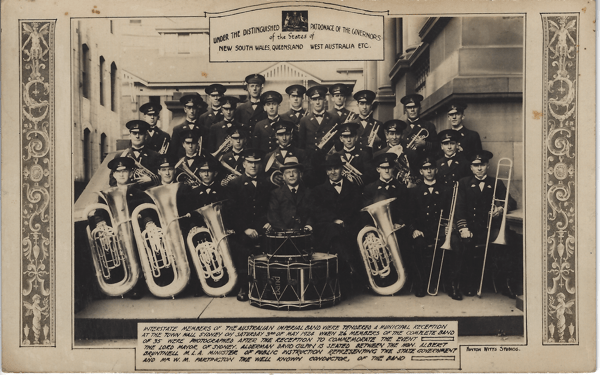
Postcard showing the Australian Imperial Band in Sydney, 1924 (Source: Jeremy de Korte Collection)

Backtracking slightly in time, the Australian Imperial Band was formed in 1924 with the grand intention of travelling around Australia, and then to England to compete against the best of British brass bands.  We know from a previous post what happened to the tour as the band never made it to England due to lack of funds (de Korte, 2019).  However, newspaper articles, such as this one published in the Sunraysia Daily newspaper in January 1924, proudly proclaimed that thirty of Australia’s leading bandsmen were “To be Chosen from All States for Wembley” and that there were “Engagements Assured” (“AUSTRALIAN BRASS BAND,” 1924).  

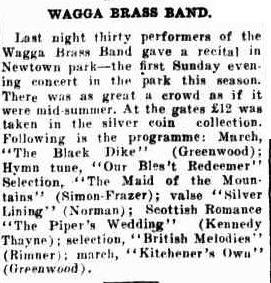
Daily Advertiser, 27/10/1924, p. 2

In October 1924, thirty performers of the Wagga Wagga Brass Band provided a varied recital to an enthusiastic crowd in one of the town parks (“WAGGA BRASS BAND.,” 1924).  The local Daily Advertiser newspaper duly published an account of the evening and even listed all the pieces that were played (as can be seen in the article above).  

Ulverstone Municipal Band, 1948 (Source: IBEW)

Down south in Tasmania, a letter writer with the band-like pseudonym of “Tenor Horn” wrote to the Northern Standard newspaper to proudly proclaim that the thirty members of the Ulverstone Brass Band were “progressing well” under a new bandmaster (Tenor Horn, 1922).  Further north, in 1929 the Windsor Municipal Band of Queensland was also the subject of an article reporting on their progress.

Since the appointment of Mr. P. E. Lindsay as conductor of the Windsor Municipal Band six months ago, the band has made rapid strides.  What was once an ordinary brass band of 11 players has now risen to the number of 30.  A notable aspect is the new silver-plated instruments that have taken the place of the old brass ones, something like £250 having been spent on equipment.

(“Rapid Progress.,” 1929)

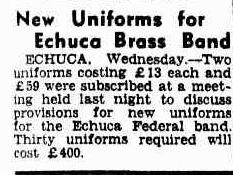
Sometimes, it was not all about how many members signed up to a band, attended a meeting or played at a concert although these are useful numbers.  At times it was also about providing for a band and in 1948 we can see that the Echuca Brass Band did exactly that when they ordered 30 new uniforms costing £400 (“New Uniforms for Echuca Brass Band,” 1948).

The Age, 28/10/1948, p. 3

First Intermission: Thirty shillings:

There is no doubt that some people were passionate about their local band.  Not just passionate but parochial and sometimes felt that they were well-qualified to express their opinions (no matter if it was welcomed or not).  And so, a very long letter by a contributor under the pseudonym of “Interested Citizen” was published in the Wellington Times newspaper in June 1922.  The subject of his letter was a special meeting held by the local Wellington Municipal Band, a band located in the New South Wales Central West, regarding the current state of the band (Interested Citizen, 1922).  In this letter of which a part will be quoted, he levels an amount of criticism however one aspect is the amount of pay given to the conductor.

However, I was indeed pleased to see that an attempt has been made to rally the band and send it along on a properly managed basis.  It is an undeniable fact that of late the band has been going from bad to worse and in all probability would soon have dwindled into oblivion.  But as I have stated an attempt has been made to stem the tide of destruction though in my opinion that attempt is doomed and will fall far short of its mark unless the committee acts promptly and in a business-like manner.  First of all, I noticed that the bandmaster’s salary has been reduced from £2 to £1/10 per week.  This is undoubtedly a step in the wrong direction, as it is ridiculous to expect any man who is not a resident of the town to apply for the position at thirty shillings per week and no guarantee of employment.

(Interested Citizen, 1922)

One can see the train of thought in this letter and also see that it is well-meaning.  Why wouldn’t a local citizen write a seemingly logical letter like this?  The thinking is sound; to build a better band you need the best person to do the job of bandmaster and the band will not attract this person to the town on a lower pay.  After expressing opinions about which conductor in the town might be best qualified, “Interested Citizen” then writes:

I contend that the citizens of Wellington have had quite enough of low grade music and the time is now opportune for something practical to be done.  If Wellington could pay its bandmaster £2 per week in the past, why not pay it in the future.  If we cannot afford £2 for a capable man much less can we afford £1/10 for an incapable man.  Wellington wants good music and we all realise that a first class man cannot be procured for a low grade pay.  Therefore, I say. Keep up the standard, offer a salary that will induce talented musicians to apply and by doing so you will have taken the first step toward making a band that Wellington may well feel proud of.

(Interested Citizen, 1922)

Definitely opinionated, and he does have a valid point over the thirty-shilling difference in pay.

Thirty Years:

Armidale City Band, date unknown (Source: IBEW)

There are some curious aspects to reporting on a bands annual general meeting in various early newspapers.  Some of them report everything verbatim.  Others report what is needed and leave out parts.  One of these was an article published in March 1927 by The Armidale Chronicle newspaper on the annual general meeting of the Armidale City Band.  “Thirty Years Old” proclaims the headline, yet that is the only mention of age in the entire article (“Thirty Years Old.,” 1927).  There is no doubt the band has done well for themselves in the preceding year.  Membership has been solid, the band has appeared in numerous engagements, they are financially stable and possess a good set of instruments (“Thirty Years Old.,” 1927).  Surely the paper would have made more mention of the bands age, but apparently not.  At least though we have an indication in 1927 of how old the band actually is!

More meaningful is the various biographical entries on the famous bandsman, conductor and composer, Alexander Frame Lithgow.  Originally from Scotland, Alex Lithgow spent much of his early life in New Zealand before moving to Tasmania where he conducted various bands in the Launceston area (Firth & Glover, 1986; Rimon, 2006).  Lithgow “dominated Tasmanian band life for thirty years” (Rimon, 2006).  Although, given his fame through his playing and compositions (especially the quick march “Invercargill), it could be argued that he dominated parts of Australian band life, if not parts of global band life as well (Firth & Glover, 1986; Glover, 2006; Rimon, 2006).

In October 1953 the Glen Innes Examiner newspaper published a worthwhile history of the Glen Innes Municipal Band with much of the information provided at the time by band member Mr. Andy Morton (“Municipal Band Has Outstanding Record,” 1953).  This band, which by 1953 had reached an “unbroken sequence of 75 years”, boasted of many fine band members and conductors over time (“Municipal Band Has Outstanding Record,” 1953).  One aspect of this history that stood out was how dedicated conductors were to this band.

Numerous others, also, were got their original training through the local band went on to do big things in music in Australia and elsewhere.

“For the last thirty years the band has been carried on by a bandmaster without pay.” Mr. Morton said.

“The present conductor, Mr. Eric Keating, is doing a wonderful job.”

“He is giving up one night a week for teaching beginners and general practices also take up a lot of his time.”

“Also, the band gives programmes in the park and at the hospital, and is always ready to perform at any function where a brass band is needed in the ceremony.”

(“Municipal Band Has Outstanding Record,” 1953)

Thirty years of commitment, of playing and dedication to community and band is a special milestone that needs to be celebrated.

Second Intermission: Thirty minutes:

Postcard: A.B.C. Military Band – Conductor: Harry Shugg, 1930 (Source: Victorian Collections: Victorian Bands’ League)

As we saw in a previous post, the advent of gramophones and broadcasting led to a profound change in how Australians listened to and consumed music (de Korte, 2020).  And with this new found listening came the inevitable letters to newspapers regarding how much or how little band music was being played over the wireless (de Korte, 2020).  The Australian Broadcasting Commission (A.B.C.) bore the brunt of the letters as they were the major broadcasters of band music at the time– the organisation even had their own A.B.C. Military Band (de Korte, 2018). 

With this in mind, in February 1940 a Mr. J. Grills sent a letter to The ABC Weekly newspaper.

I would like to hear more brass and military band music, and less of the tin-can jazz tripe.  Thirty minutes is not long enough for band programmes.  I would like to hear at least an hour’s session.  Wouldn’t it be possible for The ABC Weekly to publish voting coupons for, say, three months with the features divided up into Classical Music, Talks, Jazz and so on.  The programme compilers would then get an idea of what the listeners really prefer.

(Grills, 1940)

There is no doubting that band music was popular at the time, and certainly the A.B.C. Military Band was played at very regular times over the wireless (“NATIONAL MILITARY BAND SESSIONS,” 1941).  Nevertheless, this letter from Mr. Grills was probably one of many sent to the A.B.C. on the same subject.  It is but one of many opinions expressed during this time regarding bands and the wireless and certainly people had their musical tastes.  Given the time Mr. Grills wrote this letter, it was in the early years of the Second World War and music from bands was inspiring to many (“NATIONAL MILITARY BAND SESSIONS,” 1941).

Thirty Years Ago:

We are all familiar with local newspapers of today publishing articles from many years ago to highlight local history as it is a fascination that has not dwindled over time.  Unsurprisingly, we can find the same kinds of articles in early newspapers where they republished articles from previous editions that are decades old.  Perhaps there was also a nostalgic interest in times past during these early years.  Luckily, we can also find snippets of news regarding the local brass bands in these local history articles.

The year is 1932 and The Shoalhaven Telegraph newspaper was one that reprinted (rewrote) an article from February 1902.  In this article we find all manner of news from 1902 including this small snippet:

Fancy Nowra having to secure a band from Kiama!  Why don’t Shoalhaven people take steps to revive the town band?

(“Thirty Years Ago.,” 1933)

In the early 1900s, town bands came and went depending on circumstance, so it is no wonder that the town of Shoalhaven resented the fact that a band from Kiama was booked for an engagement instead.

In a similar style The Wooroora Producer newspaper from South Australia republished an article from a previous iteration of their newspaper, The Central Advocate.  Their article was from 1903 where a plan was put in place to resurrect a band called the Balaklava Brass Band with instruments be sourced from the previous Federal Band (“Thirty Years Ago.,” 1933).  The article from 1903 had a charming headline of “The Dead to be Raised” (“Thirty Years Ago.,” 1933).

A year later in 1934 we can find an interesting article published in The Catholic Press newspaper regarding events held thirty years earlier.  In this reminiscing from 1904, the article makes mention of the Queanbeyan Brass Band playing at the local railway station to farewell a Priest who was about to take up duties at a Church in Sydney (“Do You Remember?,” 1934).  Apparently the band played “Auld Lang Syne” with “heartfelt sympathy” (“Do You Remember?,” 1934).

A bit further north and in 1939, the Kyogle Examiner newspaper published articles from the same newspaper in 1909. Within this article (from 1909), we can see that the Kyogle Brass Band had held one of their regular meetings where correspondence was discussed and a vacancy on the committee was filled (“KYOGLE THIRTY YEARS AGO,” 1939).  And in 1945, the Nurmurkah Leader newspaper published extracts from their “Leader File” where we find that in 1915, “an effort is being made to resuscitate the Nathalia Brass Band” (“What Hapened Thirty Years Ago,” 1945).  

Newcastle Morning Herald and Miner’s Advocate, 8/6/1946, p. 5

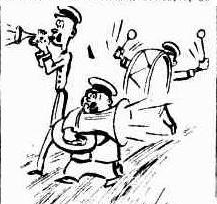
In another nod to local history, an excellent article was penned in the Newcastle Morning Herald and Miner’s Advocate by a Mr Leo Butler in June 1946.  This article is a bit different to those mentioned above as it is not a republished extract from thirty years earlier.  However, Mr Butler gives us a bit of history on the Mereweather Brass Band which was started in 1916 – and the article included cartoons of band events (Butler, 1946).  It is a very entertaining and well-written read. 

Newcastle Morning Herald and Miner’s Advocate, 8/6/1946, p. 5

Conclusion:

Thirty members, thirty years, thirty years ago and some other thirties for good measure!  The bands of the time may not have realised the history they were making when they made mention of these numbers in various iterations.  And we cannot forget that the contribution of local newspapers when they republished articles from times past.  All of this provides a historical context which is centred around a certain number.  

References:

Armidale City Band. (n.d.). [Photograph]. [phot12333]. The Internet Bandsman Everything Within, Vintage Brass Band Pictures : Australia. http://www.ibew.org.uk/vbbp-oz.html

AUSTRALIAN BRASS BAND : To be Chosen from All States for Wembley : ENGAGEMENTS ASSURED. (1924, 10 January). Sunraysia Daily (Mildura, Vic. : 1920 – 1926), 3. http://nla.gov.au/nla.news-article258428082

A.B.C. Military Band – Conductor: Harry Shugg. (1930). [Postcard : L13.8cm – W8.8cm]. [0016]. Victorian Collections, Victorian Bands’ League. https://victoriancollections.net.au/items/5b39988221ea6d0008c461a6

Butler, L. (1946, 08 June). Band Began With “Grasp Of An English Hand”. Newcastle Morning Herald and Miners’ Advocate (NSW : 1876 – 1954), 5. http://nla.gov.au/nla.news-article140620196

de Korte, J. D. (2018, 12 July). The A.B.C. Military Band: an ensemble of the times. Band Blasts from the Past : Anecdotes, Stories and Personalities. https://bandblastsfromthepast.blog/2018/07/12/the-a-b-c-military-band-an-ensemble-of-the-times/

de Korte, J. D. (2019, 24 March). Names and status: the rare National and State bands. Band Blasts from the Past : Anecdotes, Stories and Personalities. https://bandblastsfromthepast.blog/2019/03/24/names-and-status-the-rare-national-and-state-bands/

de Korte, J. D. (2020, 03 August). Australian bands, gramophones and wireless: adapting to new technology. Band Blasts from the Past : Anecdotes, Stories and Personalities. https://bandblastsfromthepast.blog/2020/08/03/australian-bands-gramophones-and-wireless-adapting-to-new-technology/

Do You Remember? : Thirty Years Ago. (1934, 10 May). Catholic Press (Sydney, NSW : 1895 – 1942), 21. http://nla.gov.au/nla.news-article104379129

EAST STATE SCHOOL : BRASS BAND FORMED : Thirty Boys to be Trained : INSTRUMENTS PURCHASED. (1933, 06 October). Toowoomba Chronicle and Darling Downs Gazette (Qld. : 1922 – 1933), 6. http://nla.gov.au/nla.news-article254347346

Firth, J. F., & Glover, M. (1986). Lithgow, Alexander Frame (1870-1929). In Australian Dictionary of Biography. Retrieved 22 March 2019, from http://adb.anu.edu.au/biography/lithgow-alexander-frame-7206

Glover, M. (2006). Alexander Lithgow. In the companion to Tasmanian History. Retrieved 23 October 2020, from https://www.utas.edu.au/library/companion_to_tasmanian_history/L/Lithgow%20A.htm

Grills, J. (1940). More brass bands [Letter]. The ABC Weekly, 2(7), 6. https://nla.gov.au/nla.obj-1267490986/view?partId=nla.obj-1267582001

Interested Citizen. (1922, 26 June). THE MUNICIPAL BAND : (To the Editor). Wellington Times (NSW : 1899 – 1954), 2. http://nla.gov.au/nla.news-article137405659

KYOGLE THIRTY YEARS AGO : From the “Kyogle Examiner,” March 20m 1909. (1939, 21 March). Kyogle Examiner (NSW : 1912; 1914 – 1915; 1917 – 1954), 3. http://nla.gov.au/nla.news-article235563996

Minton Witts Studios. (1924). Australian Imperial Band in Sydney (Conducted by: Mr W. M. Partington) [Postcard]. Minton Witts Studios, Sydney, N.S.W.

MOOROOPNA NEWS : BOYS’ BAND FOR MOOROOPNA : Thirty Applications. (1936, 12 October). Shepparton Advertiser (Vic. : 1914 – 1953), 2. http://nla.gov.au/nla.news-article168153212

Municipal Band Has Outstanding Record. (1953, 21 October 1953). Glen Innes Examiner (NSW : 1908 – 1954), 3. http://nla.gov.au/nla.news-article184214126

Myers, A. (2000). Instruments and Instrumentation of British Brass Bands. In T. Herbert (Ed.), The British brass band : a musical and social history (pp. 155-186). Clarendon Press ; New York : Oxford University Press. 

NATIONAL MILITARY BAND SESSIONS. (1941, 27 January). Shepparton Advertiser (Vic. : 1914 – 1953), 4. http://nla.gov.au/nla.news-article175188421

New Caulfield Brass Band. (1913, 22 August 1913). Herald (Melbourne, Vic. : 1861 – 1954), 7. http://nla.gov.au/nla.news-article241545000

New Uniforms for Echuca Brass Band. (1948, 28 October). Age (Melbourne, Vic. : 1854 – 1954), 3. http://nla.gov.au/nla.news-article205671119

Rapid Progress : WINDSOR MUNICIPAL BAND : THIRTY PLAYERS : SILVER-PLATED INSTRUMENTS. (1929, 03 May). Nambour Chronicle and North Coast Advertiser (Qld. : 1922 – 1954), 10. http://nla.gov.au/nla.news-article76875405

Rimon, W. (2006). Bands. In the companion to Tasmanian History. Retrieved 23 October 2020, from https://www.utas.edu.au/library/companion_to_tasmanian_history/B/Bands.htm

Tenor Horn. (1922, 19 July). ULVERSTONE BRASS BAND : (To the Editor). Northern Standard (Ulverstone, Tas. : 1921 – 1923), 3. http://nla.gov.au/nla.news-article232742518

Thirty Years Ago : (Rewritten from “Shoalhaven Telegraph,” February 12th, 1902). (1932, 17 February). Shoalhaven Telegraph (NSW : 1881 – 1937), 8. http://nla.gov.au/nla.news-article135240081

Thirty Years Ago : The Dead to be Raised. (1933, 23 March). Wooroora Producer (Balaklava, SA : 1909 – 1940), 3. http://nla.gov.au/nla.news-article207142017

Thirty Years Old : ARMIDALE CITY BAND : HOLDS ANNUAL MEETING. (1927, 26 March). Armidale Chronicle (NSW : 1894 – 1929), 3. http://nla.gov.au/nla.news-article188070309

Ulverstone Municipal Band. (1948). [Photograph]. [phot12550]. The Internet Bandsman Everything Within, Vintage Brass Band Pictures : Australia. http://www.ibew.org.uk/vinbbp/phot12550.jpg

WAGGA BRASS BAND. (1924, 27 October). Daily Advertiser (Wagga Wagga, NSW : 1911 – 1954), 2. http://nla.gov.au/nla.news-article143343712

What Hapened Thirty Years Ago : Extracts from “Leader” File – May 7, 1915. (1945, 07 May). Numurkah Leader (Vic. : 1895 – 1948), 2. http://nla.gov.au/nla.news-article186468909

A room to call their own: the space and place for bands

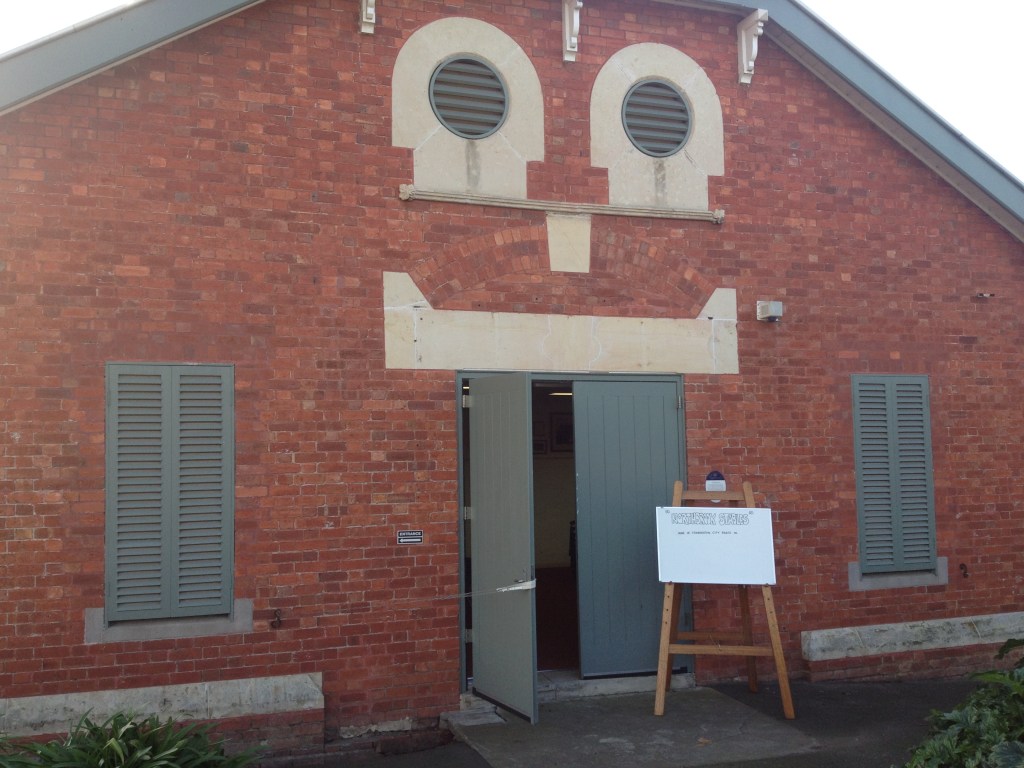
20191019-10.46_Orange_Band-Hall1
The old Orange City Band Hall (Photograph taken by Jeremy de Korte, October 2019)

Introduction:

There is no doubting that bands need material items to help them function as a band, as they do now.  And so, a previous post was written regarding instruments, sheet music and uniforms and how bands obtained such items .  Perhaps it was remiss of that post not to mention band rooms as an added essential item.  However, when researching for this current post, that omission is now justified – there is lots of historical writing on band rooms!

For the early bands, finding a room to practice in was no easy task.  We shall see that some of them were housed in stables, auction rooms, schools, rotundas, and most were subject to the whims and mercies of their local councils.  Several bands had to solicit funds from the general public for a variety of items, rooms included.  For some bands, they were able to build their own band room.  Bands that were attached to an industry were lucky enough to have rooms provided for them.

There is a similarity in the stories from across Australia when it came to bands and their rooms.  No doubt the bands themselves would have shared some of the stories when they met at events and competitions.  Bands, while competitive, are also collegial.

It is regarding band rooms that we see bands being innovative and inventive.  For the early bands, finding their own place and space was an achievement. Here are some of the stories.

Space, place, and memory:

Before this post delves into the practical stories on band rooms, it is important to explore the meaning of a band room to a community, to bands and to people.  The concept of space and place helps to explain this meaning – it is what is termed, “humanistic geography”; “A place can be seen as space that has meaning” (Selten & van der Zandt, 2011).  However, the concept of space and place should not be seen as entirely geographical.  There is social meaning as well.  It is people who provide meaning to a place and within places communities are made.

For a local band, having their own room was of great importance, they needed places to practice.  And having their own room gave them a sense of connectedness to the local community.  As Mackay (2005) writes in his article, “…connection to place is vital to our sense of identity – both personal and communal.” (Mackay, 2005).  To be able to inform a local community that their band was rehearsing in a certain place also gave the band a sense of local identity.  Rooms were a place to call home, where band members could rehearse and were also part of a band’s history.  A room was a source of pride:

The powerful sense of that place – the look of it, the feel of it, the smell of it – will stir all kind of emotions in you, positive and negative, not accessible via mere memory.

(Mackay, 2005)
00000000_Jerilderie-Town-Band_phot6408
Jerilderie Town Band, date unknown. (Source: IBEW)

For some bands people, the room gave them a sense of connectedness with the local community and their fellow band members.  Often, all it takes is a mention of the room to trigger a strong memory.  Mr H. A. McVittie, former bandmaster of the Jerilderie Town Band mentions reading a paragraph published in the Jerilderie Herald and Urana Advertiser newspaper in April 1945 about the destruction of the old band hall by fire (“Jerilderie Shire Council,” 1945).  For Mr. McVittie, this act triggered very strong memories, not only for the band room, but for himself and his fellow band members.  The article published in May 1945 opens:

Mr. H. A. McVittie, writing from Collarenebri, where he conducts the Collarenebri “Gazette,” has had memories of his old home town awakened by a paragraph which appeared in a recent issue of this paper, in which the destruction by fire of the old band room in Eastern Park was recorded.  Says Mac:-

I was given some sort of a pulsation the other day when the “Herald” arrived and I read of the destruction of the old band room in the Eastern Park.  IF there was one place more than another that held for me many happy recollections of my old home town it was the old bandroom.  If I remember correctly it was built there by the one-time Jerilderie Municipal Council and placed at the disposal of the Jerilderie Town Band as a practice room.

(“The Old Bandroom,” 1945)

The remainder of the article is devoted to Mr. McVittie’s memories big and small, and it is wonderful to read these stories.  In the finishing paragraph, he wrote this poignant observation:

Well old towners, I must close down on this somewhat hurried and disjointed sketch.  But I feel that you will excuse me for just a passing memory of the old room that gave to me so many pleasant hours.

(“The Old Bandroom,” 1945)

This is just one example of a strong connection to place that a bands person has.  For Mr. McVittie however, the story does not end with the initial article in May as two months later, he writes to the Jerilderie Herald and Urana Advertiser newspaper again.  One memory triggered many others, and old Jerilderie band people wrote to Mr. McVittie in Collarenebri and detailed their own connections with the band, the room and Jerilderie.

My memories of the old band room, which were recently published in the “Herald,” seem to have stirred the embers of the past and rekindled interest in the good old days – the days when we were young.  Letters have come to me from the most unexpected quarters in which the writers touch on some old Jerilderie theme or other, prompted by my references to the old band room, sketchy and incomplete as they were.

(“OLD MEMORIES NEVER DIE,” 1945)

It would be fair to say that other bands people share similar recollections of their rooms and the social and musical connections that they made while associated with that place.  However, to allow this connectedness to develop, bands had to have their rooms…

Building:

19250201_South-Melbourne-Bandroom-Opening
South Melbourne City Band Grand Opening of Band Room & Rotunda, 01/02/1925 – march card backing. (Source: Victorian Bands’ League Library & Archive)

Building a band room was an option open to many bands – once they had found a suitable site and had raised the funds.  This was a task that was undertaken only by the most committed ensembles as a reliance on their own labour and the goodwill of subscribers was taxing.  Nevertheless, for the most part, it became achievable, and the bands always had a sense of pride when they had a room they had built themselves.

Dealing with local councils and building regulations was the most difficult part as the Warragul Brass Band found in 1906.  They wanted to build a band room on a site that was currently being used by the local tennis and croquet clubs (“WARRAGUL BAND.,” 1906).  Unfortunately, the request was refused due to the incumbency of the said clubs at the site and the council wanting to build a new depot.  However, for the South Melbourne City Band, they had much more success with building a band room and a rotunda in 1925, as the march card backing above indicates.  They built their rotunda with labour provided by the bandsmen and friends for a total cost of £300 and held a grand opening and concert (“Albert Park Improvements.,” 1925).  This rotunda has unfortunately become a victim of change and is no longer in the park.

Then there was the fundraising aspect which either worked or did not work.  It is evident that communities were largely generous when the cause was right and the appeals from local bands were worthwhile.  The Hills Central Brass Band located in Adelaide was one group that laid out the reasons for their fundraising quite clearly in a 1912 article published in the Mount Barker Courier and Onkaparinga and Gumeracha Advertiser newspaper.  They held a concert to help with their building fund and implored the local community to help them:

It has been decided to hold a concert and social in the Mount Barker Institute on August 20 in aid of the Hills Central Brass Band building fund.  This is a most deserving institution and it is hoped that the public will recognise its usefulness and generosity by lending their patronage to this entertainment.  In all cases of distress and in many public festivities the band has volunteered assistance in the past and the least the public can do in return is to support it.

(“HILLS CENTRAL BRASS BAND.,” 1912)
19210000_Collie-Brass-Band_slwa_b3507727_1
Collie Brass Band, winners of B Grade Championship, 1921 (Source: State Library of Western Australia: BA579/138)

Coming into 1918 we find that the Collie Brass Band from Perth was trying to secure land for a band room, and many supportive platitudes were written about the band by the colloquial writer ‘Bandsman’ in the local Collie Mail newspaper, and from this there was council support:

Some of the members are now playing in the leading Australian Military Bands in England and France and messages are continually coming through saying that they are keeping in form for the old band.  What would they say if on their return, they found the old band defunct?  It was within an ace of being so last winter solely through the lack of suitable practice room.

The Collie Council has realised the necessity and have promised to find a suitable block of land, knowing that a Band room will be an asset to the town and will always belong to the citizens as do the instruments and all other property of the band.

(Bandsman, 1918)

Some years later in 1926, the Katanning Brass Band from Western Australia found itself wanting to build their own room and they also called for public support.  In an innovative move, the Katanning Brass Band formed a committee out of representatives from many other community organisations to guide the fundraising and building of a new band room (“Katanning Brass Band.,” 1926).  They were ultimately successful in this strategy.  After a year of work, in January 1927 they opened their new band room:

Monday evening last marked quite an epoch in the history of the Katanning Brass Band, the occasion being the opening their own practise room.  A brass band may be regarded as a sort of semi-public institutions and a public utility.

[…]

They have been very thankful for the use of the fire station and other buildings loaned to them from time to time, but it has not always been convenient for both parties, and thus many drawbacks have been encountered. Then early last year a brilliant idea emanated from somewhere, a scheme to carry out a gala day.  The bandsmen recognised their own inability to put the matter through, and so they invited the assistance and co-operation of the various sports of the village, the ladies, and in fact all who had the welfare of the band at heart, and a willingness to join in.

(“Katanning Brass Band.,” 1927)
19131304_Millicent-Brass-Band_B-57528
Millicent Brass Band, 13/04/1913. (Source: State Library of South Australia: B+57528)

In South Australia, local citizen, benefactor and Patron of the Millicent Brass Band, a Mr. H. F. L. Holzgrefe, J.P., proudly laid the foundation stone of their new band room (“MILLICENT BRASS BAND.,” 1928).  This had been an important project for the Millicent Brass Band and the significance was not lost on Mr. Holzgrefe who made these remarks after laying the stone:

The foundation stone was inscribed :- “This stone was laid by H. F. L. Holzgrefe, J.P., May 19, 1928.”  After it had been declared “well and truly laid,” Mr. Holzgrefe said the bandsmen had acted wisely in building a room for their own use.  It would tend to keep the members united, and make practising easier in many ways.  A band was a very useful institution, and no community should be without one.

[…]

Mr. Tothill warmly thanked Mr. Holzgrefe for his handsome contribution.  He then asked him to accept from the band an inscribed silver trowel as a memento of the occasion.  The president’s remarks were warmly applauded and Mr. Holzgrefe received an ovation when he acknowledged the gift.

(“MILLICENT BRASS BAND.,” 1928)

It was admirable that some bands around Australia managed to get the funds together and build their own band room.  Unfortunately, it is unclear just how many of these band rooms survive.  However, if the picture of the Orange Brass Band Hall at the start of this post is anything to go by, no doubt, there are some around Australia that may have been repurposed. We only must look for them.

Finding:

Short of building their own rooms, finding a suitable space was another option and whether the room was provided for bands by generous people or by councils, it was still a place to practice.  Again, there were instances when requests were mulled over as councils were sometimes very officious.

To start with it is worth exploring the experiences of some industry bands.  They were often luckier than most as they were provided with rooms on or near the sites of their industry.  The Thompson’s Foundry Band gained their first room in 1894 on the site of the Thompson’s Foundry in Castlemaine (“FOUNDRY BAND-ROOM.,” 1894).  As reported in the Mount Alexander Mail newspaper:

The opening of the new Foundry band-room erected in Parker-street, was made the occasion of a social last night tendered by the President, Mr David Thompson.  The room, which is a commodious one for practice, is 25ft long, 10ft wide, and 12ft high.  It is nearly painted green, with a dado of chocolate colour.

(“FOUNDRY BAND-ROOM.,” 1894)

It was also lucky for the Thompson’s Foundry Band that the head of the foundry was a great supporter of the band.  The Thompson’s Foundry Band still rehearse in a building associated with the foundry.

19129496_Advocate_De-La-Salle-Hall
The Advocate, 06/04/1912, p. 22. This building was added to the property of the nearby tram depot in 1930 and extended.

Likewise, the Malvern Tramways Band started out rehearsing in a room within the tram depot and then in 1930 they moved into old school buildings acquired by the tramways for the recreation of their employees (“BAND NEWS,” 1930).  The building, pictured above when it was De La Salle College, was renovated by the tramways to include two more spaces behind the original hall and was mainly used by various tramway employee clubs such as bands (both brass and harmonica) and sporting groups (Heritage Council Victoria, 1999).  It was soon after, in 1931, that the Malvern Tramways Band moved out of this building and into converted stables owned by the Malvern Council behind Northbook House.

20130727_Northbrook-Stables_south-side
(Former) Northbrook House Stables. Now home to Stonnington City Brass (formerly Malvern Tramways Band). (Photo taken by Jeremy de Korte, July 2013)

As mentioned, the local councils had quite an influence on how bands obtained rooms and as early as 1896 we see that disagreements sometimes arose, as was the instance between the Palmerston Brass Band in Darwin and the District Council.  Published among the many news items on the 4th of December1896, we can see this snippet in the Northern Territory Times and Gazette newspaper:

The collision between the Brass Band and the District Council has, we believe, had the effect of raising the charge for the Town Hall to a fixed figure for all societies and clubs using it.  By and bye, when the Masonic Hall is an established fact, the social public will not need to bother the Council, and the revenue of the Town Hall will decrease rather materially.

(“Notes of the Week.,” 1896)

Four years later we find the Palmerston Brass Band is using a room provided for them by a Mr. H. Dwyer, of which he was thanked in an annual general meeting (“Palmerston Brass Band.,” 1900).

The Hawthorn City Council found the plight of the Hawthorn City Band more favourable.  In May 1909 it was reported in the Richmond Guardian newspaper that “the patronage of the Hawthorn City Council has been bestowed upon the above band, and a room had been provided for the band to practice in.” (“Hawthorn City Band.,” 1909).  In 1918 however, the Daylesford Brass Band, wishing to reform, found themselves in differing circumstances.  The Secretary of the Daylesford Brass Band sent a letter to the local Borough Council asking if the council could provide a room where the band could practice, a perfectly reasonable request.  It seems that at the time, the band instruments and music from a former iteration of the band were stored in the Town Hall Lodgeroom, and “could the council supply the bandmaster with a key?” (access was needed every so often) (“BAND PRACTICE ROOM WANTED.,” 1918).  Which, unfortunately, touched off a debate within council on why the instruments were in the Town Hall in the first place – not so much the fact that the band wanted a practice room!  However, it also seems that a number of the instrument were in fact owned by the council so they stayed where they were. (“BAND PRACTICE ROOM WANTED.,” 1918).

Similar stories of councils deciding when and where bands could rehearse make up a large part of stories around rooms.  The Picton Council could find no objection to having the Picton District Brass Band wanting “free use of the supper room on Monday nights for band practice […] providing they pay for the electric light.” (“Picton Brass Band,” 1931).  However, there were other cases when councils could not, or would not help their local bands locate rooms, and a couple of instances in Queensland involving the Warwick City Band and Mackay City Band Association reflect this (“NO LARGER BANDROOM AVAILABLE,” 1945; Scotia, 1941).

Daily Mercury, 27/11/1945, p. 2

There was obviously a delicate balance involved when trying to find rooms and it seems that dealing with councils formed a major part of negotiations, as councils tended to be the judges of where things were put, and they controlled some of the funding.  Nevertheless, for some bands it all paid off and they were able to practice in rooms provided for them.

Using:

19021121_Nerang-District-BB_V1-FL393716
Portrait of the Nerang & District Brass Band, Queensland, formed in July, 1902. (Source: State Library of Queensland: 3612)

Once rooms were found or built, bands were free enough to use them as they saw fit although by today’s standards, some of the locations were a bit unusual.  We can see little stories in the articles above where bands rehearsed in fire stations and the like.  This section will highlight where some of the bands rehearsed and some of the problems that were encountered.  The Nerang & District Town Band for example started out rehearsing in the stables of the Nerang Nestle Milk Factory which cannot have been a wholly comfortable experience (Gold Coast City Brass Band, 2014).  Down south in Victoria, the Horsham Brass Band and the Oakleigh District Brass Band found themselves in rooms provided for them by generous supporters, until they found something else (“BAND ROOM.,” 1908; “Oakleigh District Brass Band.,” 1918).  The Kempsey Brass Band from N.S.W. were pleased to report that they were in slightly more appropriate quarters as they found space in the local School of Arts (“KEMPSEY BRASS BAND.,” 1921).  Whilst the Frankston Brass Band in the southern reaches of Melbourne managed to gain space in the local Mechanics’ Institute (“Frankston Brass Band,” 1924).  Out west the Narembeen Brass Band rehearsed “in the old Westralian Farmers Buildings” (“Narembeen Brass Band.,” 1937).

However, like any building, band rooms were not immune to the problems faced by any other building in towns and cities and there were some unfortunate incidents.  In February 1925 it was reported by the Blue Mountain Echo newspaper that the Katoomba District Band room had been broken into twice since Christmas (“Band-room Vandalism,” 1925).  While the damage was easily fixed, some instruments had been shifted and sheet music was strewn about.  The local police believed children were the perpetrators (“Band-room Vandalism,” 1925).

Much more serious was the threat of fire and two bands in the same year suffered the consequences.  In February 1926, fire consumed the room at the back of the Richmond Town Hall which was being used by the Richmond City Band  and unfortunately all band property was presumed lost, and the room and stock were uninsured (“FIRE AT RICHMOND.,” 1926).  This had a detrimental effect on the band and within four years the band had folded – on a side note, two artefacts survived and are now being held by the Richmond & Burnley Historical Society (Langdon, 2014).  Similarly,  in April 1926, fire broke out in the building used by the City Concert Band in Rockhampton however in this incident, all instruments were saved (“FIRE AT ROCKHAMPTON.,” 1926).

To finish off this section and to backtrack a little bit, we have the case of the Collingwood Citizens’ Band and their wanting of space to rehearse.  In early years, as can be seen in the photo at the end of this post, it is rumoured that they used to rehearse in a quarry due to the lack of a room.  There might be some truth to the rumour however they too had to make applications to council for additional places to rehearse, in this case, wanting a park where they could practice their marching – which raised debate on whether this was appropriate on Sunday mornings (“THE SUNDAY QUESTION.,” 1905).

Moving:

19330615_Northern-Star_Bandroom-Removal
Northern Star, 15/06/1933, pg. 5

Yes, it had to happen every so often of which the early bands did the best they could to adapt.  Although at times, it involved the moving of buildings, as detailed in the article above (“BAND-ROOM REMOVAL,” 1933).  And moving buildings was sometimes a condition set upon bands by local councils, as the Albury Brass Band found out when they wanted to move the old fire station to a new site owned by council (“OLD FIRE STATION AS BANDROOM.,” 1916).

Conclusion:

There is obviously much more that could be written about bands finding their own space and place as band room stories are intertwined with the histories of the bands themselves.  Rooms have their own histories.  How often do we see band rooms displaying the history of bands in the form of trophies, photos, shields and other ephemera?  Perhaps it is time we celebrated the rooms.

19060000_Collingwood-Band-Quarry_phot19034
Collingwood Citizens’ Band rehearsing in a quarry, 1906. (Source: IBEW)

References:

Albert Park Improvements : New Band Stand Opened. (1925, 02 February). Age (Melbourne, Vic. : 1854 – 1954), 8. http://nla.gov.au/nla.news-article155554629

BAND NEWS : Malvern Municipal and Tramways Band. (1930, 07 August). Malvern Standard (Vic. : 1906 – 1931), 8. http://nla.gov.au/nla.news-article66452967

BAND PRACTICE ROOM WANTED. (1918, 18 October). Daylesford Advocate, Yandoit, Glenlyon and Eganstown Chronicle (Vic. : 1914 – 1918), 4. http://nla.gov.au/nla.news-article119561430

BAND ROOM. (1908, 16 June). Horsham Times (Vic. : 1882 – 1954), 2. http://nla.gov.au/nla.news-article72810141

BAND-ROOM REMOVAL : Building for Practices. (1933, 15 June). Northern Star (Lismore, NSW : 1876 – 1954), 5. http://nla.gov.au/nla.news-article94219810

Band-room Vandalism. (1925, 27 February). Blue Mountain Echo (NSW : 1909 – 1928), 9. http://nla.gov.au/nla.news-article108852760

Bandsman. (1918, 28 March). THE COLLIE BAND ROOM. Collie Mail (Perth, WA : 1908 – 1954), 2. http://nla.gov.au/nla.news-article189243021

Collingwood Citizens’ Band rehearsing in a quarry. (1906). [Photograph]. [phot19034]. The Internet Bandsman Everything Within, Vintage Brass Band Pictures : Australia. http://www.ibew.org.uk/vbbp-oz.html

de Korte, J. D. (2013). Malvern, Vic. : Northbrook Stables : South side [Photograph]. [IMG_0413]. Jeremy de Korte, Malvern, Victoria. 

de Korte, J. D. (2018, 08 July). Instruments, sheet music and uniforms: how the bands of old obtained the essentials. Band Blasts from the Past : Anecdotes, Stories and Personalities. https://bandblastsfromthepast.blog/2018/05/13/instruments-sheet-music-and-uniforms-how-the-bands-of-old-obtained-the-essentials/

de Korte, J. D. (2019). Orange, N.S.W. : Old Orange City Band Hall, 1888 [Photograph]. [IMG_4453]. Jeremy de Korte, Sydney, N.S.W. 

De La Salle Brothers’ Boys’ School, MALVERN : Blessed and Opened by the Archbishop : His Grace on the Education Question : Fair Play for Catholic Schools. (1912, 06 April). Advocate (Melbourne, Vic. : 1868 – 1954), 22. http://nla.gov.au/nla.news-article170941033

FIRE AT RICHMOND : Band Hall Destroyed. (1926, 27 February). Age (Melbourne, Vic. : 1854 – 1954), 16. http://nla.gov.au/nla.news-article155771911

FIRE AT ROCKHAMPTON : City Band Instruments Saved. (1926, 13 April). Brisbane Courier (Qld. : 1864 – 1933), 15. http://nla.gov.au/nla.news-article21021996

FOUNDRY BAND-ROOM. (1894, 10 October). Mount Alexander Mail (Vic. : 1854 – 1917), 3. http://nla.gov.au/nla.news-article198243209

Frankston Brass Band : First Practice on Friday, February 18. (1924, 06 February). Frankston and Somerville Standard (Vic. : 1921 – 1939), 2. http://nla.gov.au/nla.news-article73498546

Gold Coast City Brass Band. (2014). History : If it happened on the Gold Coast then the Gold Coast City Brass Band was there to help Celebrate the Occasion. Gold Coast City Brass Band. Retrieved 07 August 2020 from http://www.goldcoastcitybrassband.com/history/

Hawthorn City Band. (1909, 22 May). Richmond Guardian (Vic. : 1907 – 1920), 2. http://nla.gov.au/nla.news-article257211806

Heritage Council Victoria. (1999, 08 September). Malvern Tram Depot : Coldblo Road Armadale, Stonnington City. Heritage Council Victoria. Retrieved 09 August 2020 from https://vhd.heritagecouncil.vic.gov.au/places/2138

HILLS CENTRAL BRASS BAND. (1912, 19 July). Mount Barker Courier and Onkaparinga and Gumeracha Advertiser (SA : 1880 – 1954), 2. http://nla.gov.au/nla.news-article147747963

Jerilderie Shire Council. (1945, 19 April). Jerilderie Herald and Urana Advertiser (NSW : 1898 – 1958), 4. http://nla.gov.au/nla.news-article134629256

Jerilderie Town Band. (n.d.). [Photograph]. [phot6408]. The Internet Bandsman Everything Within, Vintage Brass Band Pictures : Australia. http://www.ibew.org.uk/vbbp-oz.html

Katanning Brass Band : Proposed Band Room. (1926, 13 February). Great Southern Herald (Katanning, WA : 1901 – 1954), 5. http://nla.gov.au/nla.news-article147654428

Katanning Brass Band : Opening of new practice room. (1927, 24 January). Southern Districts Advocate (Katanning, WA : 1913 – 1936), 4. http://nla.gov.au/nla.news-article209839059

KEMPSEY BRASS BAND. (1921, 30 August). Macleay Argus (Kempsey, NSW : 1885 – 1907; 1909 – 1910; 1912 – 1913; 1915 – 1916; 1918 – 1954), 2. http://nla.gov.au/nla.news-article234195704

Langdon, D. (2014). Brass bands [Newsletter article]. Richmond & Burnley Historical Society Newsletter, 31(5), 2 & 4-6. 

Mackay, H. (2005, 15 October). A sense of place. The Age. https://www.theage.com.au/national/a-sense-of-place-20051015-ge11sy.html

Millicent Brass Band. (1913). [Photograph (b&w print)]. [B+57528]. State Library of South Australia, Millicent Collection. https://collections.slsa.sa.gov.au/resource/B+57528

MILLICENT BRASS BAND : Successful Building Appeal : A Generous Patron. (1928, 22 May). Border Watch (Mount Gambier, SA : 1861 – 1954), 1. http://nla.gov.au/nla.news-article77706076

Narembeen Brass Band. (1937, 11 March). Bruce Rock Post and Corrigin and Narembeen Guardian (WA : 1924 – 1948), 3. http://nla.gov.au/nla.news-article211359163

NO LARGER BANDROOM AVAILABLE. (1945, 27 November). Daily Mercury (Mackay, Qld. : 1906 – 1954), 2. http://nla.gov.au/nla.news-article170630099

Notes of the Week. (1896, 04 December). Northern Territory Times and Gazette (Darwin, NT : 1873 – 1927), 2. http://nla.gov.au/nla.news-article3333362

Oakleigh District Brass Band : A Valuable Local Institution. (1918, 16 February). Oakleigh and Caulfield Times Mulgrave and Ferntree Gully Guardian (Vic. : 1914 – 1918), 3. http://nla.gov.au/nla.news-article88808027

The Old Bandroom : Former Bandmaster in reminiscent mood. (1945, 03 May). Jerilderie Herald and Urana Advertiser (NSW : 1898 – 1958), 3. http://nla.gov.au/nla.news-article134632025

OLD FIRE STATION AS BANDROOM : Removal and tenure of occupancy. (1916, 16 September). Border Morning Mail and Riverina Times (Albury, NSW : 1903 – 1920), 3. http://nla.gov.au/nla.news-article109967848

OLD MEMORIES NEVER DIE : Further reflections from Collarenebri. (1945, 05 July). Jerilderie Herald and Urana Advertiser (NSW : 1898 – 1958), 3. http://nla.gov.au/nla.news-article134633491

Palmerston Brass Band. (1900, 23 February). Northern Territory Times and Gazette (Darwin, NT : 1873 – 1927), 3. http://nla.gov.au/nla.news-article4259300

Picton Brass Band : To practice in Town Hall Supper Room. (1931, 14 October). Picton Post (NSW : 1907 – 1954), 2. http://nla.gov.au/nla.news-article112760838

Portrait of Nerang and District Brass Band, Queensland, formed in July, 1902. (1902). [photographic print : black & white]. [3612]. Brisbane John Oxley Library, State Library of Queensland, South Bank Collection. https://hdl.handle.net/10462/deriv/143348

Scotia. (1941, 20 May). CORRESPONDENCE : Band Practice Room : (To the Editor). Warwick Daily News (Qld. : 1919 -1954), 2. http://nla.gov.au/nla.news-article189029180

Selten, M., & van der Zandt, F. (2012, 25 October). Space vs. place. About Geography. Retrieved 20 August 2020 from http://geography.ruhosting.nl/geography/index.php?title=Space_vs._place

South Melbourne City Band. (1925). South Melbourne City Band : Grand Opening [March card backing]. South Melbourne City Band, South Melbourne, Victoria. 

THE SUNDAY QUESTION : Band practice at Collingwood. (1905, 29 August). Age (Melbourne, Vic. : 1854 – 1954), 6. http://nla.gov.au/nla.news-article198599129

WARRAGUL BAND : Request for Bandroom Site. (1906, 12 June). West Gippsland Gazette (Warragul, Vic. : 1898 – 1930), 2. http://nla.gov.au/nla.news-article68669583

Williams, H. W. (1921). Collie Brass Band, winners of B Grade Championship [1 negative : acetate, black and white ; 3 x 4 cm.]. [024861PD]. State Library of Western Australia, Collie Museum collection of photographs. https://encore.slwa.wa.gov.au/iii/encore/record/C__Rb3507727

Legitimate quirks of instrumentation: The inclusion of woodwinds in brass bands

19000000_Malvern-Tradesmen-Military-Band_phot11448
Malvern Town Military Band, approx. 1900. (Source: IBEW)

Introduction:

Cornets, Flugel Horns, Tenor Horns, Baritones, Euphoniums, Trombones, Tubas and Percussion.  This standard of instrumentation for a brass band has been in place for a good number of years.  Yet before this standard was settled upon, there was an amount of time where the range of instruments was less distinguishable, or available.  The brass band as we know it today is the result of years of evolution with the result being a largely homogenous sound across the ranges.  Composers and arrangers also moved with the time, and we can see this in the sheet music.

This post will touch on one of the quirks of instrumentation in earlier brass bands, the use of woodwinds such as Clarinets and Saxophones, and even the odd Piccolo.  For the best part of forty years, some Australian brass bands included woodwind musicians amongst their personnel and allowances were made at some competitions, including the famous South Street.  This did not mean that there was widespread usage or acceptance of woodwinds in the brass bands.  However, there is evidence that some bands used them right up into the 1920s.

Tied into this is the naming of bands.  With the inclusion of woodwinds, some bands were still nominally called brass bands, but others were more inventive with names.  Some bands were sitting on the border of being brass or military in their instrumentation, as we can see with the photo of the Malvern Town Military Band above.

Nowadays the distinction between brass, military, and symphonic bands (concert bands) is much clearer cut.  The earlier times was when the boundaries were pushed.

Names and Instrumentation:

A brass band usually means that it is wholly comprised of brass instruments, and then when it included Clarinets, Saxophones, and Piccolos it was still called a brass band.  Such was the discrepancy in the names of early bands, a discrepancy that would cause confusion in the minds of modern musicians – today, names of bands generally indicate what kind of instrumentation they include.

The inclusion of Clarinets in a brass band was one of those holdovers from English brass bands.  Arnold Myers (2000), writing in a chapter titled Instruments and Instrumentation of British Brass Bands, explains that,

Often clarinets were used in what were otherwise all-brass groups, a usage which continued throughout the nineteenth century and into the twentieth, though not in major contests from the 1870s.  The presence of clarinets did not alter the essential nature of the brass band: they replaced one or more Bb cornets, or were used to provide brightness in the upper register in the role usually played by the soprano cornet.

(p. 156)

In Australia, trends of instrumentation in brass bands tended to start and end much later than in the UK.  We know that brass bands held a prominent part in many towns, communities and industries across Australia.  We also know that various military bands, bands comprised of a more substantial variety of woodwind instruments, brass and percussion, had been a part of musical life since the early days of the colony.  Although, at times, they needed special explanation, as shown in an article published in the Geelong Advertiser in 1911 (Blakiston, 1911).  Mason (2013) in his thesis, tells us that “military bands provided music military and state functions, as well as performing for the general public and servicing as a source of musicians for cities’ orchestras and other ensembles.” (p. 81).  In their own way, the military bands have their own important history.  The early military bands served as a precursor to the many Defence Force Bands, school concert bands, community concert bands and symphonic bands that fill the musical landscape today (Mason, 2013).

Aside from the number of woodwinds, some commentators attempted to call out the brass bands which included clarinets for trying to be something they were not.  One interesting article was published in the Bairnsdale (Vic.) based Every Week newspaper in May 1918.  Titled “Clarinets in the Brass Band”, the writer used the premise that just because some brass bands included Clarinets (or other woodwinds) in their instrumentation, did not automatically make them a military band – and that they should not attempt to play military band music or arrangements.

Bands which have few clarionets or even bands which have a goodly number of clarionets, but no other reed instruments, make a big mistake when they consider themselves “military bands” and aim to play military band arrangements.  They are really brass bands plus clarionets – a thing very far removed from a military band.

(“CLARINETS IN THE BRASS BAND.,” 1918)

Excusing the seemingly blunt language, the writer was correct.  Brass bands that included Clarinets and Saxophones in their line-up were still nominally brass bands, they were not military bands.  Still, the naming of bands is interesting.  Below is a picture of the North Hobart Concert Band taken in 1917.  We can see in the picture that four of the members have Clarinets and one member a Soprano Saxophone.  They also include all of the instruments that comprise a brass band.  If we were to apply the modern name and meaning of a concert band, we would assume it to have a full section of woodwinds.  However, in these early days, this was not the case.  On a side note, we can see that the Bandmaster is one of the members holding a Clarinet.  The Bandmaster in this photo, a Mr. A. W. Caddie, was appointed Bandmaster of the North Hobart Concert Band in 1916 after leading the Zeehan Military Band for a number of years (“NORTH HOBART BAND.,” 1916).  Mr. Caddie was a Clarionetist of some renown and won the Clarionet section at the Royal South Street brass solo competitions in 1912 (Trombone, 1912).

19170000_North-Hobart-Concert-Band_phot3458
North Hobart Concert Band, 1917 (Source: IBEW)

Through this short discussion on instrumentation and naming, it is established that Clarinets and Saxophones existed in brass bands for several years and were accepted as such.  It was up to the music publishers to cater for them as well.

Sheet music:

The other side of including limited woodwinds in brass bands is of course the sheet music.  Brass bands that included limited woodwinds may not have had the instrumentation to play arrangements of military music, but they were able to play brass band music with added Clarinet parts – of which the writer of the article in Every Week pointed out (“CLARINETS IN THE BRASS BAND.,” 1918).  Given that the instruments in brass bands are predominantly keyed in Bb or Eb, it was easy enough to create parts for Clarinets and Saxophones as well.  Piccolos used in bands in those days were mostly keyed in Db or Eb which was different.  Parts were included with some editions of music, but this was not always the case.  It is easier to make a comparison between Clarinet and Cornet parts.

Below are two parts of the 1904 march “South Street” by Hall King (edited by T. E. Bulch).  Here we can see clearly that the Clarinet part neatly doubles the Solo Cornet, in parts up the octave (King, 1904a, 1904b).  The range of the Clarinet obviously makes this easy to do, and musically this would make sense. These Clarinet parts would be taken up by an Eb Soprano Cornet in todays brass bands.

19040000_Suttons_South-Street-CL1
(Source: Victorian Bands’ League Library & Archive)
19040000_Suttons_South-Street-SoloC
(Source: Victorian Bands’ League Library & Archive)

Most of the brass band music that was printed in these times originated from large publishing houses in the form of journals, the parts above being published by Suttons Proprietary Limited.  Here we see that this journal of brass band music included parts for Reeds, so obviously Clarinets, and possibly Saxophones, were catered for.  Suttons was not the only Australian music publishing company that included parts for Clarinets in their journals of music.  The two march cards below of the marches “Artillery” by Alex Lithgow and “Newtown” by T. E. Bulch were published by Allans & Co. (Bulch, 1901; Lithgow, n.d.).

00000000_Allans_Artillery_2CL
(Source: Victorian Bands’ League Library & Archive)
19010000_Allans_Newtown_2CL
(Source: Victorian Bands’ League Library & Archive)

Obviously, the publishing companies found there was a market for Clarinet, Saxophone and Piccolo parts and composers would have been encouraged to include these parts in their compositions – although, given the similarities in keys, maybe this was up to arrangers.  After having some discussion with Dr. Richard Mason on this topic, extra money for publishers and composers to produce Clarinet parts was assumed (Mason, 2020).  Possibly the real reasons cannot be found, however, the production of specific music to cater for extra instruments added some legitimacy to woodwinds being included in brass bands.

Brass bands with woodwinds:

19060000_Wunghnu-Brass-Band_phot14255
Wunghu Brass Band, 1906 (Source: IBEW)

As mentioned in the opening of this post, Clarinets and other woodwinds were part of brass bands in Australia for around forty years.  We can find some evidence of this from early newspaper articles.  It is claimed that Saxophones were added to brass bands in Australia as early as 1890, although, as mentioned in the linked article, this was a matter of conjecture (“The Saxophone,” 1934).  Other bands were more forthcoming over what they had in their band.  In August 1893, an article regarding the early history of the Dandenong Brass Band was published in the South Bourke and Mornington Journal. It seems that when the Dandenong Brass Band was formed in 1885, it comprised of ten members; three Cornets, two Piccolos, two Tenors, one Baritone and one Clarionet (using this unique spelling) (“DANDENONG BRASS BAND.,” 1893).  Likewise, in 1899, a public meeting was held in Tallangatta with the aim of (re)forming a brass band.  Several participants in the meeting spoke in support, one of them was a Mr A. J. Fortescue,

…speaking as a member, observed that the old band had died through want of proper management and lack of public interest.  If formed on proper lines, with a good committee, he thought a band would prosper there.  There were sufficient of the old brass instruments on hand for a start, but there would be some repairs needed.  There would be wanted a piccolo and two drums.  In reply to a question from the chairman, he stated that with a sum of £20 they could make a fairly good start.

(“BRASS BAND FOR TALLANGATTA.,” 1899)

In January 1904 the Linton Brass Band held their annual general meeting, and they were another brass band that boasted a piccolo in their instrumentation.

The band has a stock consisting of one big drum, one side drum, three B flat cornets, two B flat Euphoniums, one E flat bass, one E flat piccolo.

(“LINTON BRASS BAND,” 1904)

These were brass bands in their early years.  Yet twenty years later, as can be seen in the list of musicians in the Wagga Wagga Concert Band (below), a Clarinet was part of the ensemble (“WAGGA CONCERT BAND.,” 1921).  And in 1926 the Gnowangerup District Brass Band from Western Australia was proud to announce that they had added a new Clarionet to the band (“Gnowangerup District Brass Band.,” 1926).

19210303_Young-Witness_Wagga-CB_Clarionet
Young Witness, 03/03/1921, p. 2

There are of course numerous other examples of woodwind instruments appearing in early brass bands of which the above mentioned are a small number of instances.

Competitions:

When in competition, the woodwinds of brass bands were mostly treated the same as any other brass instrument, and they also received the same criticism as well.  There are some examples of woodwinds being mentioned in competition, although this was mainly related to Clarinets and Saxophones.  Even the famous Royal South Street competitions had sections for Clarinets and at times Saxophones over the course of a decade.

The year is 1899 and in September, Northcott’s Bendigo City Brass Band, conducted by Mr. O. Flight, had travelled to Echuca to take part in a small regional competition adjudicated by the famous Mr. E. Code.  The article here details the adjudication of their program and at one point both the Clarinet and Piccolo were mentioned:

Largo – Clarionet and cornets not in tune ; cornet has good taste ; accompaniments too loud ; cornet not clean at bar 17 ; piccolo a little out of tune at bars 18 and 19 ; bass too loud at bar 20.

(“NORTHCOTT’S BENDIGO CITY BRASS BAND.,” 1899)

Regarding South Street, they added another layer of legitimacy by having sections specifically for woodwinds included in the brass solo competitions.  As can be seen in the lists of entries (which can be acccessed from the links), the Clarinet & Saxophone sections attracted musicians from all over Australia.  Below is a list of competitions held over ten years (with some gaps), with the woodwind instruments that were included each year:

(Royal South Street Society, 1906, 1907, 1908, 1910, 1911, 1914, 1915, 1916)

Unfortunately, there are some gaps in the list due to lack of data however, it is known that a brass solo competition was held in 1912 which included a Clarionet section (Trombone, 1912).

As well as the records from Royal South Street, we also have articles in newspapers that provide the adjudication of Clarinettists.  This article published in the Ballarat Star (below) in October 1915 is a prime example of an adjudication.  The adjudicator of this section was the famous Albert Wade (“SOUTH STREET COMPETITIONS.,” 1915).

19151022_Ballarat-Star_Wade-Clarionet
Ballarat Star, 22/10/1915, p. 6

What of the Saxophonists?  It is seen in the Royal South Street lists that Saxophones were only able to compete in sections for four years.  However, other opportunities for them to integrate with bands were limited to military bands.  That does not mean they were completely forgotten.  In a forward thinking move, Saxophones were provided their own section in a “novelty” event at the Interstate Band Contest in Perth, February 1931 (“SAXOPHONE COMPETITION,” 1931).  The reasoning was understandable at the time.

Hitherto the saxophone has not been considered to be a true brass band instrument, and therefore ineligible for registration under the W.A. Band Association contest rules.  The contest committee, however, obtained permission from the association to include the competition in its program, and fourteen entries have been received.  There are a number of capable executants among the entrants, and as the choice of the solo is left to the competitor, a varied range of saxophone music may be reasonably anticipated.

(“SAXOPHONE COMPETITION,” 1931)

The recognition by competition societies that woodwinds had a place in their own sections was well-meaning and forward thinking.  While they were brass band centric, all instruments of the brass band were included, even if they were not strictly brass.

Conclusion:

19100000_Brisbane-Concert-Band_phot8024
Brisbane Concert Band, 1910 (Source: IBEW)

The thought of woodwinds in brass bands would probably raise the eyebrows of many brass band purists. Yet, like many other stories of the brass band world, it is one that is worth exploring, if only for the novelty.  One wonders how these early brass bands would have sounded with limited woodwinds playing similar parts.  The history and sheet music tell us that woodwinds existed in brass bands.  As do some of the pictures, like the Brisbane Concert Band above.

References:

Blakiston, C. (1911, 22 April). A MILITARY BAND : How it is made up. Geelong Advertiser (Vic. : 1859 – 1929), 7. http://nla.gov.au/nla.news-article149205289

BRASS BAND FOR TALLANGATTA. (1899, 18 February). Ovens and Murray Advertiser (Beechworth, Vic. : 1855 – 1918), 9. http://nla.gov.au/nla.news-article199465362

Bulch, T. E. (1901). “Newtown” (2nd Clarionet Bb) : (Dedicated to Thos. Mellor Esq. Bandmaster). [March Card]. Allans & Co. 

CLARINETS IN THE BRASS BAND. (1918, 09 May). Every Week (Bairnsdale, Vic. : 1914 – 1918), 3. http://nla.gov.au/nla.news-article153439388

Colouhoun, J. (1900). Malvern Town Military Band [Photograph]. [phot11448]. The Internet Bandsman Everything Within, Vintage Brass Band Pictures : Australia. http://www.ibew.org.uk/vbbp-oz.html

DANDENONG BRASS BAND. (1893, 02 August). South Bourke and Mornington Journal (Richmond, Vic. : 1877 – 1920; 1926 – 1927), 2. http://nla.gov.au/nla.news-article70015776

Gnowangerup District Brass Band. (1926, 10 July). Gnowangerup Star and Tambellup-Ongerup Gazette (WA : 1915 – 1944), 3. http://nla.gov.au/nla.news-article158909246

King, H. (1904a). “South Street” (1st Clarionet). [March Card]. Suttons Proprietary Limited. 

King, H. (1904b). “South Street” (Solo Cornet). [March Card]. Suttons Proprietary Limited. 

LINTON BRASS BAND. (1904, 13 January). Ballarat Star (Vic. : 1865 – 1924), 4. http://nla.gov.au/nla.news-article210140838

Lithgow, A. F. (n.d.). “Artillery” (2nd Clarionet). [March Card]. Allans & Co. 

Mason, R. W. (2013). The clarinet and its protagonists in the Australian New Music milieu from 1972 to 2007 (Publication Number 38294) [PhD, The University of Melbourne, Faculty of VCA & MCM, Melbourne Conservatorium of Music]. Minerva Access. Melbourne, Victoria. http://hdl.handle.net/11343/38294

Mason, R. W. (2020, 14 June). Phone call with Dr Richard Mason regarding the use of Clarinets in brass bands [Interview]. 

Myers, A. (2000). Instruments and Instrumentation of British Brass Bands. In T. Herbert (Ed.), The British brass band : a musical and social history (pp. 155-186). Clarendon Press ; New York : Oxford University Press. 

NORTH HOBART BAND : New Bandmaster Welcomed. (1916, 05 September). Daily Post (Hobart, Tas. : 1908 – 1918), p. 3. Retrieved from http://nla.gov.au/nla.news-article191143234

NORTH HOBART BAND : New Bandmaster Welcomed. (1916, 05 September). Daily Post (Hobart, Tas. : 1908 – 1918), 3. http://nla.gov.au/nla.news-article191143234

NORTHCOTT’S BENDIGO CITY BRASS BAND : Conductor – Mr O. Flight. (1899, 22 September). Riverine Herald (Echuca, Vic. : Moama, NSW : 1869 – 1954; 1998 – 2002),2. http://nla.gov.au/nla.news-article115017023

Royal South Street Society. (1906, 30 October). 1906-10-30 Brass Solo Contests. Royal South Street Society. Retrieved 26 August 2019 from https://results.royalsouthstreet.com.au/results/1906-10-30-brass-solo-contests

Royal South Street Society. (1907, 22 October). 1907-10-22 Brass Section. Royal South Street Society. Retrieved 11 June 2020 from https://results.royalsouthstreet.com.au/results/1907-10-22-brass-section

Royal South Street Society. (1908, 20 October). 1908-10-20 Brass Solo Contests. Royal South Street Society. Retrieved 11 June 2020 from https://results.royalsouthstreet.com.au/results/1908-10-20-brass-solo-contests

Royal South Street Society. (1910, 18 October). 1910-10-18 Brass Solo Contests. Royal South Street Society. Retrieved 20 July 2019 from https://results.royalsouthstreet.com.au/results/1910-10-18-brass-band-contests

Royal South Street Society. (1911, 24 October). 1911-10-24 Brass Band Solos. Royal South Street Society. Retrieved 11 June 2020 from https://results.royalsouthstreet.com.au/results/1911-10-24-brass-band-solos

Royal South Street Society. (1914, 20 October). 1914-10-20 Brass Solo Contests. Royal South Street Society. Retrieved 11 June 2020 from https://results.royalsouthstreet.com.au/results/1914-10-20-brass-solo-contests

Royal South Street Society. (1915, 21 October). 1915-10-21 Brass Solo Contests. Royal South Street Society. Retrieved 11 June 2020 from https://results.royalsouthstreet.com.au/results/1915-10-21-brass-solo-contests

Royal South Street Society. (1916, 30 October). 1916-10-30 Brass Solo Contests. Royal South Street Society. Retrieved 11 June 2020 from https://results.royalsouthstreet.com.au/results/1916-10-30-brass-solo-contests

The Saxophone : Who Brought it to Australia. (1934, 06 January). Voice (Hobart, Tas. : 1931 – 1953), 2. http://nla.gov.au/nla.news-article218832762

SAXOPHONE COMPETITION : Interstate Band Contest. (1931, 02 January). Daily News (Perth, WA : 1882 – 1950), 4. http://nla.gov.au/nla.news-article83492508

SOUTH STREET COMPETITIONS : Brass Section Continued : Mr A. Wade, Adjudicator : Clarionet Solo. (1915, 22 October). Ballarat Star (Vic. : 1865 – 1924), 6. http://nla.gov.au/nla.news-article154562484

Trombone. (1912, 29 October). BANDS AND BANDSMEN. Daily Post (Hobart, Tas. : 1908 – 1918), 3. http://nla.gov.au/nla.news-article189103747

WAGGA CONCERT BAND. (1921, 03 March). Young Witness (NSW : 1915 – 1923), 2. http://nla.gov.au/nla.news-article113606153

Wunghnu Brass Band. (1906). [Photograph]. [phot14255]. The Internet Bandsman Everything Within, Vintage Brass Band Pictures : Australia. http://www.ibew.org.uk/vbbp-oz.html

The poetry of brass bands

Introduction:

While undertaking research for my blog posts thus far I have come across all manner of writing describing brass bands, their members and competitions.  Much of the writing is very useful in finding the “little stories” behind people, places and events.  Occasionally I have come across some oddities in the mix and this post is going to highlight an aspect of writing; poetry.

In this context of brass band history, penning up a poem about musicians, bands and competitions might seem very colloquial.  And in some respects, it is.  One only has to look at the style of writing and while the poems might not have won any literature awards, they were helpful in bringing to life some little stories in a unique style.

Below are just three of these brass band poems.  I have not been actively searching for these.  However, if while searching for material on other topics and they appeared, I have made a note of them for the novelty.  These are defiantly the needles in haystacks!  Two of the poems were published in local newspapers by writers using pseudonyms while the third poem was composed by brass band writer C. C. Mullen in his rare book, Mullen’s Bandsmen of South Street (1900 – 1951).

I am quite sure there are other brass band poems in other newspaper articles so this post might be expanded in the future.  Please enjoy the language and stories that are being told here and remember that they were for another time.  Perhaps this blend of artforms might be used again one day.

“A Welcome” by ‘Bannerman’ (1918):

Herald, 23/10/1920, p. 4

One of the first blog posts in Band Blasts from The Past was about the famous Cornetist and Conductor William Ryder who travelled to Australia in 1910 with the renowned Besses O’ Th’ Barn Band (de Korte, 2018).  Just eight years later, after stints with bands in Victoria and New South Wales, he arrived in Maryborough, Queensland to take the reins of the Maryborough Naval Band and we found that an enterprising contributor, under the pseudonym of ‘Bannerman’, had penned a poem to welcome him to town.  No doubt this would have been perceived as a very friendly gesture, and it gave the town some insight into the prowess and reputation of Ryder as a musician.  This poem was published in the Maryborough Chronicle, Wide Bay and Burnett Advertiser on Wednesday, 8thMay, 1918.

A WELCOME

Here’s a hearty welcome “Billy”,
To our pleasant country town,
And may Fortune every lead you,
And misfortune never frown.
We are pleased to have you with us,
And we hope you long may stay
To encourage local talent
In the latest style and way.

When you played the “solo cornet”
With the finest in the land,
You were classed as England’s champion
In the famous “Besses Band.”
And here in fair Australia
You can show us all the way
As the Champion of the Champions
From the South to old Wide Bay.

“Because” we all remember
When you played it at New Year,
When the silvery notes were finished
How the crowd did clap and cheer.
May our town and climate suit you,
May your notes prove ever true.
Here’s good-luck to wife and kiddies,
And long life and health to you.

(Bannerman, 1918, p. 6)

“Back to South Street” by Cecil Clarence Mullen (1951):

There is one brass band musician and writer among many who is significant to early Victorian brass band history, Cecil Clarence Mullen (C. C. Mullen).  His writing might be rare and hard to find now, however, being a band journal representative he had a unique insight into the workings of brass bands and was associated with many famous bands, conductors and administrators (Mullen, 1951).

It is in his little book, Mullen’s Bandsmen of South Street (1900 – 1951) that we find his poem, “Back to South Street”. In this piece of writing Mullen has cleverly highlighted the nostalgia of the South Street event while noting many of the famous names of bands and bandsmen.  It is a worthwhile poem to read for the sake of history.

19510000_Mullen
Front Cover Mullen’s Bandsmen of South Street (1900-1951) (Source: Jeremy de Korte Personal Collection)

BACK TO SOUTH STREET

Just let me go back to South Street
For a week with the famous bands,
And take with me others who would compete
In Australia’s Golden City of renown.

Just let me alight at the station
With cornet, trombone and drum,
And meet bandsmen from all over the Nation,
To whom South Street once more come.

Just let me line up in the station yard
And play through Handel’s “Hallelujah Chorus,”
Or “The Heavens Are Telling” by Haydn – just as hard,
As bands played in the days before us.

Just let me march along Sturt Street
With gay crowds lining the way,
With step by step and beat by beat,
Is South Street just the same to-day?

Just let me see who is judging again,
Is it Stead or Bentley with ears for tune?
Short, Beswick, Sutton or Morgan – men of fame,
Or King of them all – J. Ord Hume.

Just let me go through Inspection
As we did when we dressed with much care;
With the gayest uniform in our section,
That made all our rivals stare.

Just let me compete in the solos again
From the grand old Coliseum stage,
With “Adelaide” or “Gipsy’s Warning” – or “Pretty Jane,”
“Zelda” and “Miranda” of a later age.

Just let me mount he platform
And play through “Beethoven’s Works.”
Or any Alexander Owen’s selections
That South Street bands would not shirk.

Just let me play through the Test piece,
Be it “Mercandante.” “Mozart” or “Liszt,”
“Wagner,” “Chopin” of “Meyerbeer,”
The tests that were tests on our lips.

Just let me march in the Quickstep
With Ord Hume’s “B.B. and C.F.”
“The Challenge,” “Cossack” or “Ravenswood”
Or was the “Twentieth Century” the best?

Just let me see the others swing past,
Code’s, Prout’s, Rozelle and Boulder.
Wanganui, Newcastle and Bathurst Brass,
Great names that come dear to the older.

Just let me see those fine Geelong bands,
St. Augustine’s, Municipal and Harbour Trust.
Also Collingwood, Malvern, Richmond, Prahran,
Perth City – all great power among us.

Just let me see Geelong Town again
With Sharpe Brearley at the head of affairs.
They ranked with Prout’s in quickstep fame,
First in marching honours was often theirs.

Just let me see the giants of the baton,
Riley, Code, Bulch and Prout,
McMahon, Barkel, Jones and Hoffman.
Many, alas, have gone out.

Just let me see others again,
Partington, Shugg, Johnston, Bowden.
Men who kept time in South Street’s fame;
Wade and Baile must be among them.

Just let me think if I missed any,
Yes, there was Davison, Niven, Lewins – any more!
Hopkins, Ryder, Billy May among many,
Not forgetting Frank Wright and J. Booth Gore.

Just let me see the best of officials
And critics like Davey, Gartrell and Hellings,
Humphreys and Boyce – Kings of staff and whistle,
May march us again – well, there’s no telling.

So to-day just let me go back to South Street,
Most famous contest in the land,
Where many old timers I will heartily greet,
And yarn over years that were so grand.

(Mullen, 1951, pp. 2-3)

“Dungog Brass Band” by ‘Mad Mick” (1954):

19120000_Dungog-BB_phot16862
Dungog Brass Band, 1912 (Source: IBEW)

Above is a picture of the Dungog Brass Band from around 1912 and unfortunately, this is one of the only pictures I could find of them.  However, some thirty years later this prose was published in the Dungog Chronicle : Dungog and Gloucester Advertiser newspaper by a member of the band writing under the pseudonym of ‘Mad Mick”.  One may wince at some of the language, but this was the 1950s.

From reading the poem it appears that ‘Mick’ is a third cornet player.  This poem is quite good in describing who the band is, what it does and where it goes, but the prose hints at some problems like attendance issues.  We can appreciate that this was a local town band, and this was the way they did things. I think every band has a ‘Mick’ in their midst and we can thank him for highlighting the Dungog Brass Band in the way that he did.

DUNGOG BRASS BAND

I’ve heard it said that Old King Cole was happy, gay and free,
And he liked music sweet and low, played by his fiddlers three,
But in Dungog we’re luckier than King Cole in his day,
We have a band of 25 with band-master, Bob Gray;
And of this band we all feel proud, a mighty job they do,
They play in aid of charities, and spastic kiddies too.
Some Saturdays they entertain at each and every pub,
They finish off the evening playing at the Bowling Club.

Now I would like to tell you all the names of those who play,
And how old Bob the baton waves, and gets them on their way;
Soprano cornet heads the list and that’s I. Kennedy.
That solo cornet it is played by little Johnny Lee;
Keith Kennedy is downstairs for he is baritone,
And forwards, backwards, goes Stan Leayr upon the old trombone;
Now solo tenor horn Barry Schofield plays alone,
Toot! Toot! Toot! Toot! Don Redman goes upon his saxophone.

First tenor horn’s Wal Arnold, third cornet Mick Neilson,
Johnny Schofield’s second cornet, Hector Robson the side drum;
Ken Wade with his euphonium, gets down to bottom D,
While second solo tenor horn is little Barry Lee;
Then there’s E bass Freddy Schofield and Ted Mathews is the same,
And there’s one more solo cornet, Artie Redman is his name;
The secretary is Jack Kerr, he’s also big bass drum,
While tenor horn number three is played by “Butch” Neilson.

There’s only six more instruments and players for to pen,
For to conclude the roll call of Bob and his merry men;
And Bob calls them “some-timers,” they don’t attend a lot,
Sometimes they’re there for practice and sometimes they are not.
There’s the E bass and the B bass, and repiano cornet too,
And they’re played by Tommy Ferris and Keith Lean and Shelton, Blue,
Well now I’ve two trombonists whose attendances are poor
And they are “Sambo” Neilson and offsider Dennis Moore.

Well, those are all the players who go to make this band,
But there are two more people who lend a helping hand;
First of them the Drum Major, he makes them look so fine,
And that of course is Perry, Bill, he sees they march in line.
Then last of all is Paddy with collection box in hand,
You’ll always find him snooping round somewhere behind the band,
He sticks his box beneath your nose and thinks he’s doing right.
No wonder folks have christened him the “great Australian bite!”
P.S. – Sorry folks I missed one out, it’s Ray Monaghan I’m sure,
He plays quite well, but still in all, attendances are poor.

(Mad Mick, 1954, p. 3)

…and something from me:

In concluding this next blog post in Band Blasts From the Past,
Some tales of bands and bands people, but they won’t be the last.
For as we know from history, stories wait until they’re found,
Of the many tales of bands people who were there to make a sound.

References:

Bannerman. (1918, 08 May). A WELCOME. Maryborough Chronicle, Wide Bay and Burnett Advertiser (Qld. : 1860 – 1947), 6. http://nla.gov.au/nla.news-article151083205

de Korte, J. D. (2018, 02 March). William Ryder: The first conductor of the Prahran & Malvern Tramways Employees Band. Band Blasts from the Past : Anecdotes, Stories and Personalities. https://bandblastsfromthepast.blog/2018/03/02/william-ryder-the-first-conductor-of-the-prahran-malvern-tramways-employees-band/

Dungog Brass Band. (1912). [Photograph]. [phot16862]. The Internet Bandsman Everything Within, Vintage Brass Band Pictures : Australia. http://www.ibew.org.uk/vbbp-oz.html

Mad Mick. (1954, 29 September). DUNGOG BRASS BAND (By ‘Mad Mick). Dungog Chronicle : Durham and Gloucester Advertiser (NSW : 1894 – 1954), 3. http://nla.gov.au/nla.news-article140539879

Mullen, C. C. (1951). Mullen’s Bandsmen of South Street (1900-1951). Horticultural Press. 

Quickstep. (1920, 23 October). Bandsmen’s Gossip : Celebrated Conductor. Herald (Melbourne, Vic. : 1861 – 1954), 4. http://nla.gov.au/nla.news-article242245731