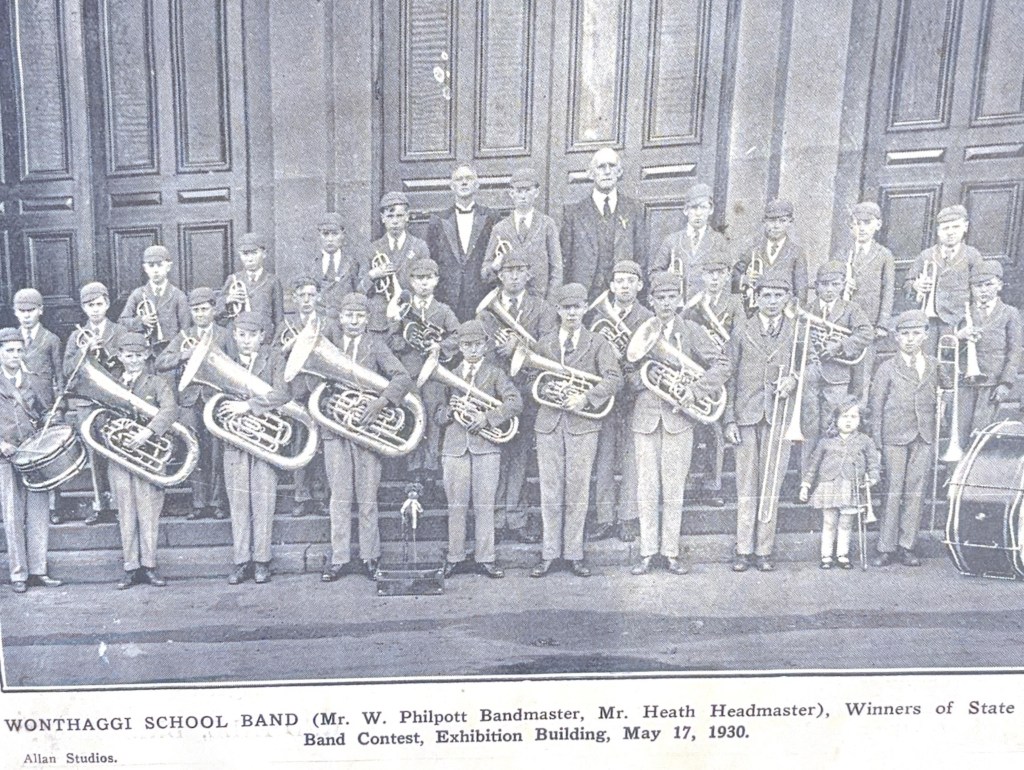
Figure 1: The Australasian Band and Orchestra News, 26/05/1930, Front Cover
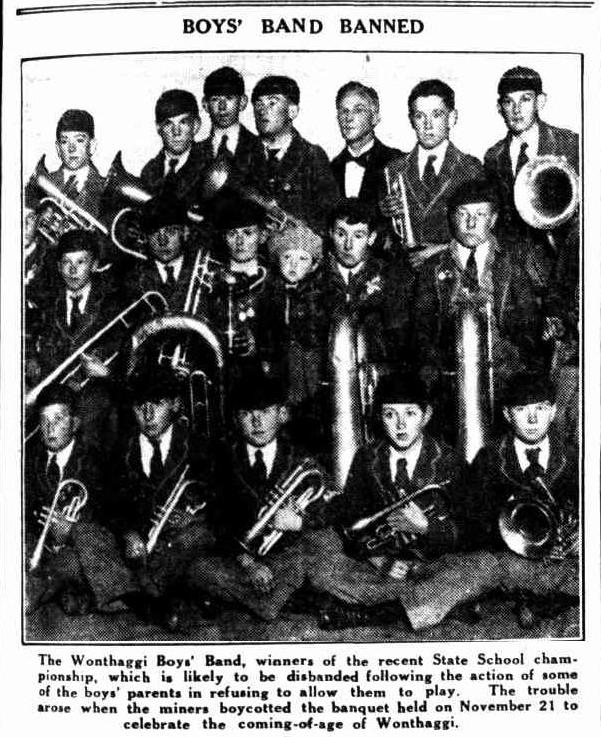
Wonthaggi also has a mascot of whom the boys are very proud. She is little Margaret Philpott aged three years and three months. (“TINY GIRL MASCOT FOR BOYS’ BAND“, 1930)
Introduction:
It is the 17th of May 1930, and the Exhibition Building in Melbourne is a hive of activity as the Victorian State School Band Association holds the first of many annual band contests. Nine state school bands from across Melbourne, and one country representative from Wonthaggi, have come to compete and to show the rapid progress state school bands have made in the past few years from inception.
Wonthaggi State School Band did themselves proud that day by winning this inaugural contest against some other highly fancied school bands. But the back stories before and after this win are many. One of which being the story behind the mascot of the band, three-year-old Margaret Philpott, who is pictured with the band holding a tiny trombone.
The photo above did intrigue me when I first viewed it several years ago and I had been sporadically searching for the name of the small girl with a trombone. Upon finding the name very recently, this made the photo even more special, and it adds a layer of context to the story.
This post is an addendum to a previous post outlining the development and legacy of Victorian state school bands, and many of the parts of this story mirror the earlier post. So, it is interesting to unpick this on a local level as the school band from Wonthaggi is a perfect example of how a school band fared in its early years. It is, perhaps, no accident that the Wonthaggi band was as good as it was due to good fortune and strong leadership – and an inspiring mascot.
Philpott’s and brass bands:
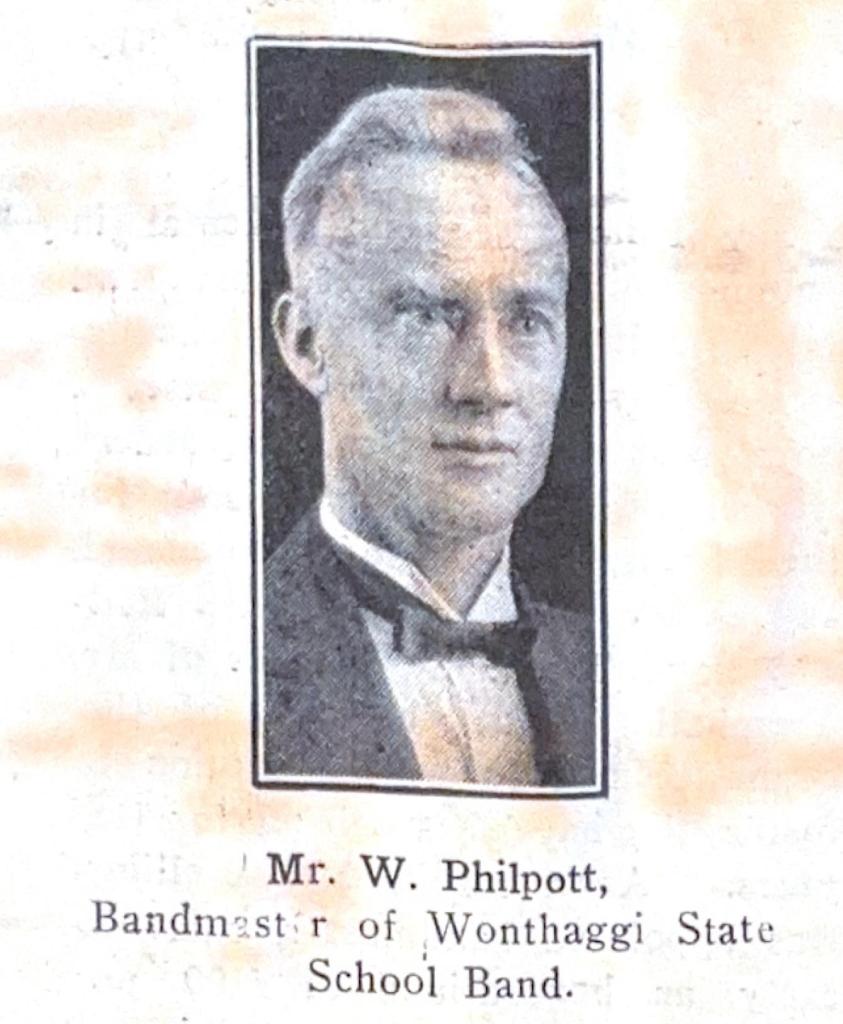
Figure 2: The Australasian Band and Orchestra News, 26/05/1930
The name says it all really. Margaret Philpott may not have realised this at the age of three, but her name carries a legacy of brass band musicianship. Her father and grandfather, both named William, were highly regarded brass musicians and conductors. Her father, William ‘Bill’ Philpott was the ultimate journeyman bandsman. By 1922 W. Philpott had played in or conducted:
1899 Lismore Band (N.S.W.) conducted by his father, William George Philpott
Appointed Bandmaster of the Brighton Town Band (Vic.) which had recently amalgamated with the Elsternwick Band
Solo cornetist with the Prahran City Band under Edward Code and Solo Cornet with the St. Kilda Band
Engaged to play solo cornet for the Wellington Garrison Band (N.Z.)
Appointed bandmaster of the Coraki Band (N.S.W.) in 1908 while playing with the Lismore band
1911 Appointed conductor of the Wagga Wagga Brass Band (N.S.W.)
1918 played Soprano Cornet with the St. Augustine’s Band (Vic.) and Professional Cornet with the Ballarat City Band
1921 Appointed conductor of the Young Brass Band (N.S.W.)
W. Philpott continued on his journeyman ways when he moved to Wonthaggi in 1928 to take up a position of conductor of the Wonthaggi Union Band, and soon after the Wonthaggi State School Band (“THE LOSS OF OUR BANDMASTER.”, 1928; “YOUNG’S BANDMASTER.”, 1928). By all accounts, the bands that William had been associated with by this time were very grateful for his tutelage and his knowledge – and his success in competition – so they were sorry to see him go. Wonthaggi offered much opportunity and under the leadership of William, the Wonthaggi Union Band and later the Wonthaggi State School Band both had success – the school band achieved second place in the 1929 Royal South Street contest (Royal South Street Society, 1929; “SCHOOL BANDS’ CONTESTS.”, 1930).
Of course, William did not stop at Wonthaggi, he still had many years of conducting ahead of him, and his band journey continued:
The Gillies Bequest and the Wonthaggi State School Band:
As previously outlined in the post on school bands in Victoria, the support from the Gillies Bequest was a catalyst for the setting up of school bands across Victoria (de Korte, 2018; “MUSIC AND READING ALOUD.”, 1925). The establishment of school bands was a great success. At the presentation of trophies for the 1930 State School Band Association contest (which Wonthaggi won), Mr. Hansen, then Director of Education, outlined just how many bands there were.
There are now in State schools twenty brass and eight drum-and-fife bands. The recent and rapid growth of them was due largely to the activities of Mr. A. B. Lane, president of the band association. Of the bequest made by the late William Gillies, out of whose love of music and study the contests were inaugurated, £3750 had already been set aside. (“SCHOOL BANDS’ CONTESTS.”, 1930)
At this time, not only were school bands forming at a rapid rate, but the expertise of some very fine conductors was also available. Frank “Massa” Johnston of Melbourne Fire Brigade and Footscray City Band fame conducted the Hyde Street/Footscray School Band and Northcote Central State School Band, Mr. H. Hellings conducted West Preston, and Mr. W. Philpott conducted Wonthaggi (Allan Studio, 1930; “Footscray State School Band”, 1930; “Northcote Central State School Band”, 1928; Stevens, 1930).
With conducting pedigrees like this, and support from school communities and the Gillies Bequest, it is no wonder that school bands began to thrive and succeed. The Wonthaggi school band was very lucky to share Mr. Philpott with the Wonthaggi Union Band.
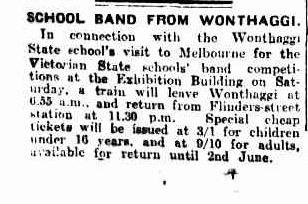
The State School Band Competition was a big day for Wonthaggi, and the other bands of course, not just because of the travel to and from Melbourne. Mr. Philpott, the Headmaster, band, parents and supporters, and little Margaret Philpott, made the journey to the contest at the Exhibition Buildings. Seven days before the contest, Mr. L. Jabara of Wonthaggi gave a gold cup to the Wonthaggi Headmaster, Mr. Heath, “to be presented to the winners of the State school band competition” (“WONTHAGGI.”, 1930a) which was also taken with the group. In the end it was the remarkable success of Wonthaggi that was the story of the day. Comments from adjudicator Mr. Harry Shugg gave high praise to the Wonthaggi Band:
The adjudicator (Mr. Harry Shugg), commenting upon the performances, expressed surprise that the players, whose average age did not exceed 12½ years, had so done so well within such a short period. He thought it especially true of the bass soloists. The Wonthaggi band astounded him, and shamed many of the adult bands in Victoria. (“SCHOOL BANDS’ CONTESTS.“, 1930)
The band deserved all the accolades that were given to them, and the school was very proud of their achievements.
In recognition of winning all the cups and the honor of winning the championship at the State school band contest in Melbourne the teachers of the Wonthaggi State school entertained the members of the band at a dinner. After playing for the sisters of St. Joseph’s and the scholars at St. Joseph’s school the band boys were entertained at afternoon tea. Arrangements have been made by the school master (Mr. H. T. Heath) for the championship State school boys to play at 3LO and 3AR. The band will also play on the M.C.G. ground on Saturday. (“WONTHAGGI.“, 1930b)
The Wonthaggi community was no less appreciative of Mr. Philpott’s dedication to the school band, and in July 1930 presented him with a gift.
In appreciation of his tutoring of the school boys’ band, which won every event at a recent band contest in Melbourne. Mr. W. Philpott was presented with a wallet of notes at the Union Hall on Wednesday night. The band is to take part in another contest in Melbourne on 23rd instant, and will also compete at South-street in October. A school choir, which will also take part in the competitions at South-street has been formed with Mr, Philpott as conductor. (“WONTHAGGI.“, 1930c)
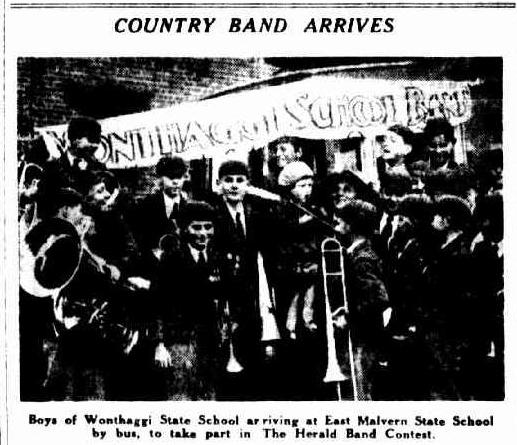
As for little Magaret Philpott, she was as much a part of the band as the bigger boys with their instruments. Not much is said about her, but she is visible in some further photos, such as this one published in The Herald newspaper showing the boys arriving at the East Malvern State School in preparation for another contest. Margaret, sporting a beret, can be seen right in the middle of the photo.
While the Wonthaggi State School band had numerous successes, and many engagements during 1930, they were not immune to events happening around them. Wonthaggi was home to the State Coal Mine which supported the Wonthaggi Union Band, also conducted by Mr. Philpott. Many of the mine workers were parents of children at the school, and in the 1930s there were disputes with the State Government which came to a head when a government delegation was to visit the town. The Union band subsequently refused to play, and banned Mr. Philpott from conducting the school band when the delegation visited (“NO MINERS’ BAND FOR WONTHAGGI VISITORS“, 1930). The caption on the photo below, published in The Weekly Times newspaper, provides some more reasoning.
And again, here is another photo showing Margaret Philpott sitting among the boys of the band.
There are not many other mentions of the Wonthaggi State School Band after 1930 in the newspapers, and due to the transient nature of Mr. Philpott’s band career, he was not there to continue it through, although the political and industrial undercurrents did affect life in town. We can at least, view the successes of the school band for what they were at the time; remarkable and very worthy.
Conclusion:
When William Philpott and family arrived in Wonthaggi in 1928, they could not have known what kind of influence they would eventually have. Through Mr. Philpott, the town and school had musical expertise, with his sons they had solid musicians, and with little Margaret the school band had their own mascot – and she had her own tiny trombone. Who knows what the Wonthaggi school band might have become if circumstances had been different? This was only one Victorian school band among many, and they set the early standards.
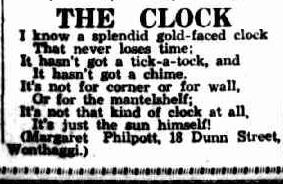
As for Margaret Philpott, she may not have followed her brothers into brass music, but she was a creative type. To finish this post, here is a poem that she wrote that was published in The Sun News-Pictorial newspaper, supplementary section in August 1936. Simply titled ‘The Clock’:
The author would like to thank members of the Young & District Family History Group for assistance in researching the Philpott family during their time in Young, and for providing further reading on the Young Town Band that mentions William J. Philpott.
References:
Allan Studio. (1930). Wonthaggi State School Band (Mr. W. Philpott Bandmaster, Mr. Heath Headmaster). Winners of State School Band Contest. Exhibition Building, May 17, 1930 [Digital scan of front cover photograph]. The Australasian Band and Orchestra News, XXV(9), Front Cover.
APPOINTMENT OF BANDMASTER : Mr. W. J. PHILPOTT SELECTED. : Salary £130 Per Annum. (1940, 19 October). Williamstown Chronicle (Vic. : 1856 – 1954), 8. http://nla.gov.au/nla.news-article70695595
BANDS IN VICTORIA : High Musical Standard : Is Public Appreciating Lacking? (1937, 07 December). Age (Melbourne, Vic. : 1854 – 1954), 10. http://nla.gov.au/nla.news-article205550598
BENALLA’S NEW BANDMASTER : MR. W. J. PHILPOTT OF WONTHAGGI APPOINTED. (1934, 03 August). North Eastern Ensign (Benalla, Vic. : 1872 – 1938), 3. http://nla.gov.au/nla.news-article70790349
Footscray (Vic.) State School Band : Mr. Ellingsen, Headmaster, Mr. F. Johnston, Bandmaster. (1930). [Digital scan of front cover photograph]. The Australasian Band and Orchestra News, XXV(6), Front Cover.
Hansen, M. P. (1932). Thoughts that breathe. Robertson & Mullens.
Lawson-Black, P. (2010). Bold as brass : the story of Stonnington City Brass then and now. Pat Lawson-Black, Stonnington City Brass.
NO MINERS’ BAND FOR WONTHAGGI VISITORS : Quarrel With Ministry : PARLIAMENTARY PARTY THERE TOMORROW. (1930, 20 November). Herald (Melbourne, Vic. : 1861 – 1954), 4. http://nla.gov.au/nla.news-article242933719
Northcote Central State School Band : Mr. J. Bromilow, Head Teacher; Mr. F. Johnston, Bandmaster; Major Trengrove, Secretary. (1928). [Digital scan of front cover photograph]. The Australasian Band and Orchestra News, XXIV(3), Front Cover.
Stevens, C. (1930). Preston West State School Band [Digital scan of front cover photograph]. The Australasian Band and Orchestra News, XXV(11), Front Cover.
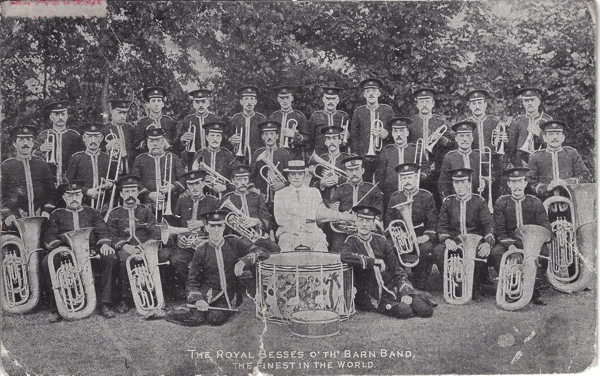
Postcard: Besses o’ th’ Barn Band. (1908) (Source: Jeremy de Korte collection)
Introduction:
The visit of one of the premier bands of Britain to Australia would be an event of great interest, and Mr. Hume, speaking on the matter, said that if the railways would guarantee to grant free passes to the members, he could almost promise that either the Besses o’ th’ Barn Band, of Lancashire or the Black Dyke Band, of Yorkshire, would come out. That the venture would be a success Mr Hume says he has not the slightest doubt, and he considers that the playing would come as a revelation to Australians.
Australian bands, to put it simply, are an extension of the movement started in Britain and bands are one of Britain’s great cultural exports. As has been noted in other posts, the influx of people from the British Isles and other places carried their music with them. It is no surprise that in the early years, bands were established in localities across Australia.
There was no shortage of enthusiasm for starting a band, and no shortage of budding musicians willing to learn. However, training them, supporting them and giving them inspiration was at times problematic. Musical training was sometimes left up to those willing to take the job of bandmaster, whether they had brass band skills or not. This was the case in some places but not others as some bands became very proficient, very quickly.
Not that this mattered to some untrained ears. Many towns and localities were simply glad to have a band (a source of civic pride). Although the bands that were founded in the late 1800s and early 1900s possibly realised that their playing was not up to English standards. Bands were willing to learn, it was just a matter of whom to learn from. It was not until the advent of organised competitions and visits from English bands that the standard of playing was given a critical ear and adjudicators provided bands with helpful comments on how to improve.
This post will examine what was probably the greatest shift in musical standards amongst Australian bands that took place over the period of two to three decades. This rapid improvement was partly inspired by the visits of the eminent Scottish band adjudicator James Ord Hume and the famous Besses o’ th’ Barn Band from England. Thankfully, for the purposes of this post, we can see the comments of James Ord Hume over the course of his two visits as he judges the bands. We will also see that while the tours of Besses were significant in themselves, it is the lasting effect these visits had on Australian bands that deserves attention. This is a combined story; a story of how British band musicians did their best to inspire and help Australian bands to be the best they could be.
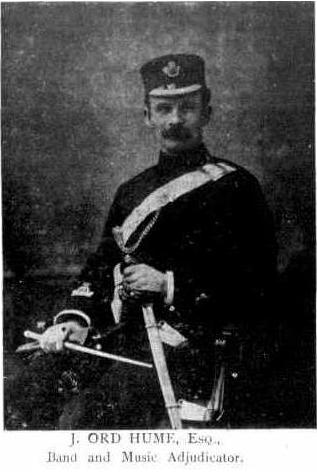
Lieutenant James Ord Hume was an “eminent English and Scottish bandmaster, composer, critic and adjudicator” (Mullen, 1965, p. 40). A lifetime of musical training in the British Army and civilian bands had provided him with a unique connectedness with all sorts of musicians, and he had utilised his opportunities to the full by learning to play all band instruments and study musical theory (Thirst, 2006). His reputation as a musician preceded him and he was highly sought after as an adjudicator and clinician. As Thirst (2006) writes in his book ‘James Ord Hume 1864-1932 : a friend to all bandsmen : an account of his life and music’,
He was a popular adjudicator throughout the British Empire, and frequently visited Australia and New Zealand to judge in the famous contest at Ballarat and elsewhere
(p. 47)
This was not an idle statement as many accounts of James Ord Hume show him to be a very forthright person with his adjudications and opinions, and he was appreciated by bandsmen all over Australia and New Zealand (“Bathurst Band Contests.,” 1902). One might say that with his attitude he was a bit free with his advice. Nevertheless, Ord Hume acted with the best intentions and sought to bring the standards of Australian bands up to where he thought they should be and provided solutions on how Australian bands might achieve this. Certainly, his foretelling that Australian bands would view the “playing” of Besses o’ th’ Barn Band as a “revelation” came to fruition some years later (“MR. J. ORD HUME.,” 1903).
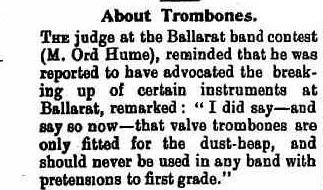
When Ord Hume talked, Australian bandsmen listened and there are some notable examples of his advice being applied literally and quickly. He greatly followed developments in the brass band world, and it is because of him that Australian bands stopped using valve trombones – Ord Hume could not stand them. The article below published by the Molong Argus newspaper is testament to his comments, and it seems James Ord Hume was quite happy to repeat this mantra to whomever asked him about it (“About Trombones.,” 1902; “Bathurst Band Contests.,” 1902).
James Ord Hume first visited Australia in 1902-1903 where he adjudicated at various eisteddfods around the country, starting with the South Street band sections in Ballarat. Ord Hume was greatly impressed with the concept of the South Street and before the competitions had even begun, he had given them praise – and also a taste of what to expect.
He said he had always had a desire to visit Australia, and only demurred on receiving the invitation from the South-street Society to adjudicate at this year’s contests because of want of time. However, the musical people of England wanted to know how they stood with Australia in competitive work, and the mission he entered upon was to give a candid opinion of all that occurred in a general report. The musical contests of South-street were certainly the greatest in the world.
It would be fair to say that, barring some exceptions, he was not overly impressed with what he heard in the band contests and was quite clear about this in his comments (“BALLARAT COMPETITIONS.,” 1902). His parting comments were a measure of contrast. Of the good bands he said…
…had given splendid performances which would compare favourably with the best heard at contests in the old country.
And he was scathing about bands at the other end of the scale…
On the other hand some were distinctly bad. Their principal fault was a lack of tone; the men had not blown out their instruments as they should have done. If a player just obtained a good loud tone he could easily subdue it without losing breath and character. In the constant effort to play softly this was all lost.
Timothy Thirst (2006) did note in his book that Ord Hume was “known to be sometimes rather sarcastic and outspoken in his comments.” (p. 55).
Ord Hume provide similarly forward comments when adjudicating in Bathurst, Sydney and New Zealand for various competitions, such was the hectic schedule of his visit. However, there are some indications that Australian bands were beginning to pick up their musical standards. After adjudicating in Sydney at the end of 1902, Ord Hume provided some observations.
He said that since he had been in Australia he had noticed an improvement in the playing of the bands. He had observed at Ballarat and Bathurst, and now here. He was about to proceed to Castlemaine (Vic.), and thence to New Zealand, and on his return the results of his observations would be published.
When Ord Hume returned to Ballarat in 1903 prior to his travel back to England, he was asked what Australian bands needed to do to achieve a more excellent standard of playing.
“They require tuition” he said. “In many cases it has come to this, that the men have to come to know as much as the conductor himself, and in such a case the progress made is not very great as you may imagine. In New Zealand this fact is not so noticeable and it explains the reason why their bands, generally speaking, are much better than those here. They possess over there many instructors who have come out from the old country, but here it seems to be ‘Australia for the Australians,’ and that will not do in music at any rate.”
As mentioned, Ord Hume was appreciated for his direct commentary and aside from his work adjudicating he was afforded all kinds of civic receptions at the conclusion of events. Perhaps this is understandable given his status as an eminent musical authority, but it was also for his honesty – what he said, he said with conviction. Granted, some bandsmen might have been offended. But in his own way he was trying to educate. Band Associations were very pleased to have someone of that calibre adjudicate which is why, after the 1902 Ballarat event he was made an Honorary Life Member of the Victorian Bands’ Association (“SOUTH STREET SOCIETY.,” 1902).
Frank Wright, the great Australian-born bandsman, summed up the first visit of Ord Hume to Australia when he wrote an appreciative article in the June 15th, 1935 edition of British Bandsman after Ord Hume’s passing.
No other event in band history, except, perhaps the tour of the famous Besses o’ th’ Barn Band, can be compared with his visit, as having equal influence in setting the standard for Australian bands. He encouraged the young ambitious bandsman, and it was this personal interest that endeared him to the Australian people.
(Wright, 1935, p. 4)
If Ord Hume was an instigator of change in the way Australian band did things, the tours of Besses fanned further improvement as they provided a practical example of how an elite band sounded and operated. The Besses band was no stranger to Ord Hume and it appears there was some mutual admiration and respect. Ord Hume even arranged a Polka for Besses which can be heard below (Besses o’ th’ Barn BandChannel, 2022). This radio broadcast recording from 1940, played by the City of Ballarat Municipal Band was provided to the Besses band by the Ballarat Band historian Bob Pattie, and uploaded to YouTube by the historian of the Besses o’ th’ Barn Band, Stephen Hughes – thank you both! (This video was updated in January 2022)
Besses o’ th’ Barn Polka (Cornet Solo: Broadcast 1940). Soloist Jack Allan. Band: Ballarat City
Besses o’ th’ Barn Band, 1907 & 1910:
The welcome parade of the Besses o’ th’ Barn Band to Melbourne. The parade is being led by a combined 22 brass bands under the direction of Edward Code and is turning the corner from Collins St into Swanston St in front of the Melbourne Town Hall. (Source: Manchester Digital Music Archive, 13953)
The tours:
Much of the particulars of the two Besses tours were detailed in a previous post (de Korte, 2018a). In summary, the famous Besses o’ th’ Barn Band from Lancashire undertook two massive tours in the space of three years which took them all over the globe (Besses o’ th’ Barn Band, 2018). While in Australia, they were afforded concerts and engagements in towns and cities all over the country and never failed to please audiences – such was their reputation (“BESSES O’ TH’ BARN BAND.,” 1907a; “BESSES O’ TH’ BARN BAND.,” 1907c). Civic welcomes were par the course and the photo above of the parade turning the corner from Collins Street to Swanston Street at the Melbourne Town Hall is a case in point. Besses were greeted at Spencer Street Station by a combined twenty-two bands directed by Edward Code which led them in a procession up Collins Street to the Town Hall (“BESSES O’ TH’ BARN BAND.,” 1907e). It is said that 70,000 people turned out to watch this procession, which would have been an amazing sight to see! (“Besses o’ th’ Barn Band,” 1907).
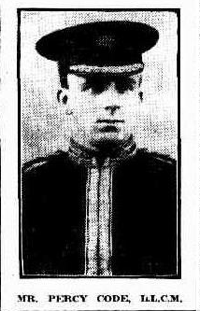
Besses toured Australia again in 1910 and during this tour, lead Cornetist William Ryder left the band to join a local theatre ensemble and then became the first bandmaster of the then Prahran & Malvern Tramways Employees Band in 1911 (de Korte, 2018b; Quickstep, 1920b). Cornetist Percy Code, son of Mr Edward Code, took his place on the tour (Quickstep, 1920a). The Herald weekly columnist ‘Quickstep’ provides some insight into this development through separate articles which detail the band lives of William Ryder…
Leaving England as principal cornet soloist with the famous Royal “Besses o’ th’ Barn” Band on their second world tour, Mr Ryder left the band on the completion of its Victorian trip and settled in Melbourne. He was immediately engaged to play solo cornet in a picture theatre orchestra.
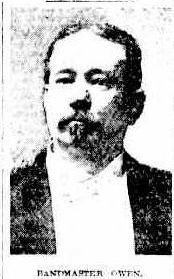
At the time the famous “Besses o’ th’ Barn” Band was touring Australia and Percy Code was offered an engagement which he accepted. While he was abroad, his brilliant playing was favourably commented on by British press. One leading band journal styled him “Percy Code the golden-toned,” also crediting him as one of the finest cornetists in England. Study in orchestration and composition was undertaken, under the guidance of Mr Alexander Owen, of Manchester, known as the greatest authority on brass band music in the world.
Mr Alexander Owen at the time was the conductor of Besses during the first tour and part of the second tour and he was highly regarded in Australia and around the world – newspapers of the day were effusive in their praise, the Evening Telegraph newspaper from Charters Towers being one of them (“Mr. Alexander Owen.,” 1907). After the tour, the Assistant Conductor of Besses, Mr Christopher Smith accepted a position as conductor of the Adelaide Tramways Band (Seymour, 1994).
By all accounts, the two tours of the Besses band were huge successes and they opened up the ears and eyes of all who heard them.
The influence:
Postcard: The Royal Besses o’ th’ Barn Band. (1907) (Jeremy de Korte collection)
Besses o’ th’ Barn Band made a lasting impression on the Australian band movement. Notwithstanding their reputation prior to their visits to Australia, they certainly grew in stature on this unique part of their tours. One hallmark of their visits was the fact they were very much a band full of critical listeners, teachers, advocates and gentlemen who were always willing to offer advice and help.
Hundreds of newspaper articles were published during the two Besses tours, so it is impossible to reference them all. Buried in these articles are hints of information as to how the visits were perceived by Australian bandsmen, and what they learnt from the visiting band. In July 1907 the Besses band were giving a concert in Goulburn, New South Wales and after the concert they were entertained by the local Australian Horse Band. The Mayor of Goulburn was also present at this supper and his comments were noted in an article published by the Goulburn Herald.
He welcomed then not merely as bandsmen from the old country, but as brothers, and hoped their stay here would be a pleasurable one. He was sure it would be great value from an educational point of view to the bands in Australia. […] He hoped with all sincerity that the visit of the Besses would be crowned with the success it deserved, and that they would be able to say that the Australians were a loyal and patriotic people – which they were right up to the hilt – and pleased to accord their support to organisations such as the Besses o’ th’ Barn Band, which came so far to educate them.
It is interesting to note the language here from the Mayor of Goulburn, not so much for the comments on patriotism but the words on education. Besses were not really touring to educate Australia bands per se however, that was an inadvertent effect of them being in Australia. Further comments were made by Mr. Cody, Bandmaster of the Australian Horse Band in the same article.
The visit of Besses could have none other than a good effect on band music in Australia. The various bands would be moved to do greater things than in the past, and they result would be beneficial all round.
Besses visited Adelaide in August 1907 and comments made in the Register newspaper were equally full of expectation on what the Besses visit would mean for Australian bands.
…the Besses’ performances must unquestionably stimulate band music in the State, which has been the case of every town they have visited on the Australian tour. The artistic methods employed by Mr. Owen in conducting the Besses in their playing are said to be a revelation in technique and phrasing, and have been described by a leading Sydney bandmaster as being “an entirely new musical language for colonial bands to study”.
After touring Australia for a couple of months, in September 1907, Besses were in Bendigo and in an article published by the Bendigo Advertiser, perhaps, we can see some real analysis and insight into the benefits the Besses visit would bring to Australian bands.
There are two things which especially distinguish the Besses. In the first place the high degree of finish that characterises their playing, so that all bandsmen that have heard them have confessed that something new in band music had been revealed to them, possibilities in brass that were previously undreamed of, and in the second place, the courteous and obliging urbanity in which the conductor, Mr. Alexander Owen, and members of his corps, have done whatever they could to help those colonial bands which have appealed to them for advice and instruction. The present generation of bandsmen will never forget their impression of the Besses, which will more or less in the future influence their aspirations and efforts, and when a young generation of Tubal Cains grow up, whose lips are not yet too tender for the resounding brass, they will hear abundant reminiscences of how this or that passage was taken up by the Besses, until not impossibly, they will wish that at last that the Besses had never toured through Australasia.
As mentioned, Besses undertook a second world tour and in 1910 they were back in Australia. Alexander Owen stepped down from his conducting duties during this tour and Mr Christopher Smith took over to no less acclaim from audiences, such was the ability of this ensemble. Australian bands were also changing, and this had been noticed by various writers, which was attributed by the visit of Besses three years before. Said a writer in an article published by TheBallarat Star newspaper in June 1910.
It might truthfully be said that the standard of band music underwent an appreciable change for the better as the result of the visit of this celebrated combination.
Mr. W. Bogle, manager of the Besses band during their second tour provided some interesting comments comparing band movements of the U.K. and Australia in a wide-ranging interview which was published by the Evening News newspaper in August (“THE MUSIC OF THE BAND.,” 1910). While his interview is too much for this post, the advice he provided was obviously valuable to the Australian band movement. And again, there were indications that Australian bands were heading the right way.
They had no doubt that the public of Australia would encourage the improvement of brass bands, and it was particularly pleasing to see they were assisted by the municipal bodies.
The influence of the Besses tours should not be viewed as just bands and band members attending their concerts or being instructed, advised and then feeling very much inspired. It can also be seen in other ways. William Ryder, Percy Code and Christopher Smith, bandsmen who had all been associated with Besses at high levels brought the Besses influences with them to their own bands, playing and adjudication. Australian bands began to rapidly improve after the first Besses tour and inspiration from the band itself. Instruction and adjudication from these men helped carry things further. Mr Christopher Smith, once a deputy conductor of Besses, gave high praise to certain bands and was in no doubt that Australian bands could compete with the best (“WOULD CAPTURE LONDON,” 1922). He adjudicated at South Street in 1922 and gave a general comment on the standards that were set.
“The standard was appreciably higher than when I judged bands here two years ago.” He said, “and what is pleasing to me is to find the unsuccessful bands more closely approaching the standard set by the victorious bands in all the grades.”
High praise indeed and this provided a good indication of where Australian bands were at, and where they were going just over a decade from the last Besses tour. The bands were definitely improving!
Interestingly, the tours of Besses were still being talked about in the early 1930s as the legacy of the visits still resounded in the band movement. The Daily News newspaper in Perth published an article in September 1930, essentially on Mr Hugh McMahon, the genius Cornetist but also mentions the state of brass bands in Western Australia as a whole. The article also had this to say about the legacy of the Besses tours.
Most memorable had been the visit of the Besses of the Barn Band which had shown what a brass band could do in the way of interpreting certain classes of music. The visitors had given a revelation of the playing of hymn tunes equal to that of any organ and had set a new view before Australian players.
To finish this section on the Besses tours and the influence they left behind, we have these comments from a person speaking at the annual banquet of the Queensland based Howard and Torbanlea Citizens’ Band in December 1933.
After a loyal toast, the toast of the Howard and Torbanlea Citizens’ Band was proposed by Mr. G. J. Edmunds who stressed the many advantages of having a band in the community. Mr. Edmunds declared that the visit of the Besses o’ th’ Barn Band many years ago was the running point in the standard of band throughout the Commonwealth, and today, quite a number of bands had reached that standard.
Australian bands had begun to reach the pinnacles set by Besses. And in the 1920s, with tours to England by the Newcastle Steelworks’ Band and the Australian Commonwealth Band, both conducted by Albert Baile, Australian bands proved they could match the much-vaunted English bands and win their competitions (Zealley & Ord Hume, 1926).
A side note, Mr John Dixon, Agent for Boosey & Co.:
James Ord Hume provided much advice to the Australian band movement on how to improve, and the Besses o’ th’ Barn Band clearly displayed an excellence in musicianship. One aspect that could be considered is that Australian bands needed the best of instruments and British instrument manufacturers saw opportunities in Australia & New Zealand for additional sales. Travelling with James Ord Hume in 1902 and on the first Besses tour in 1907 was an agent for the Boosey & Co. instrument manufactures, Mr John Dixon (“MUSIC ADJUDICATOR,” 1929).
Near the end of the 1800s and into the 1900s, Boosey & Co. “was flourishing, supporting a staff of 100 employees” (Howell, 2016, p. 61). John Dixon was one of their agents and he travelled the world to create find new markets and build contacts, so when James Ord Hume and Besses went on their respective tours it presented an opportunity for John Dixon to go along as well.
Unfortunately, not much is known about John Dixon’s life, but from brief range of articles we can see that he made extensive contacts in the band world (“An Exhibit of Musical Instruments,” 1906; “MUSIC ADJUDICATOR,” 1929; “Personals,” 1903). Writing a long letter to Wright & Round’s Brass Band News on February 1st from New Zealand (published in their April 1st issue), he noted of his experiences,
…In Coolgardie I met John Cox, late of Lassodie, now bandmaster Coolgardie City Band. He has a son a good cornet player. He asked me about a great many Fifeshire bandsmen, and I was able to tell him something about all. He asked me specially to remember him to Mr. James Carmichael of Cowdenbeath, Mr. George Peacock of Fauldhouse, Geordie Pemann and all the Penmans, muckle fat Geordie in particular said he, to Archie Carmichael of Glasgow, and many more. I met an old Bury lad full of the Lancashire love of contesting at Kalgoorlie, where he is bandmaster of the Town Band. Mr. Richard Weber is his name, and a fine fellow he is. He sends his best regards to all his old friends in the Bury, Radcliffe, and Besses districts, not forgetting “Trotter,” whom he says is a “corker.” (He must have meant an uncorker.) At Boulder City I met and heard Mr, Hugh McMahon, the Alex Owen of Australia who took his band 4000 miles to compete at Ballarat and at Bathurst. He is a wonder on the cornet and deserves his title. At Adelaide I found the Loco. Band very good and in charge of an enthusiastic viz., Mr. Charles Allison. […] I have had a very successful tour so far in a business sense, and have established a good many agencies. Give my regards to all old friends and tell them I shall be with them again when the flowers bloom in the spring tra-la. I leave Auckland on February 25th and travel via., Fiji, Honolulu, Canada, New York, and Glasgow.
It is clear that John Dixon was good at his job and certainly found lots of band friends throughout Australia. His comments on the standards of Australian bands and bandsmen were certainly interesting. It could be debatable whether the sale of Boosey instruments to bands made them any better. However, Boosey (like numerous other instrument companies), milked the fact that certain bands and bandsmen were using their instruments to win competitions – a strong selling point in those days (Boosey and Co., 1919).
The Australian Band News, 12(10), 26/06/1919, p. 18
James Ord Hume, 1924:
In January 1924 there was much excitement in the band community as it was revealed that James Ord Hume would be making another visit to Australia to adjudicate, twenty-two years after his last visit in 1902 (“MR. J. ORD HUME,” 1924). The Ballarat Star newspaper published a long article full of praise for the work of Ord Hume in 1902 with a brief record of what he did in Australia in his first visit, read out by the President of the South Street Society, Mr Scroucher.
…There is no need for me to tell you who Mr J. Ord Hume is, for with the exception of the very young members of the club, all bandsmen will remember him. He came to Australia some twenty-odd years ago. He judged the South street contest, asked for more tone, told the bandsmen to throw the valve trombone on the scrap heap, gave the prizes to the right persons, and then skipped across to Bathurst. In Bathurst he judged all the musical items from piano right through the list, including all instruments, except, possibly, the bagpipes. He didn’t judge the pipes because there were none to judge. From Bathurst he went to New Zealand, did a lot of work there, created a breeze and skipped back to Sydney, where he judged a big contest. He also did other work, and good work too. Through his criticism and acting on his advice, many bands became better musical organisations. And now, after all these year he is about to visit us again.
Part of the rest of the article comprised of a ditty, which will not be written here for the sake of brevity. Needless to say, the ditty highlighted the delight in knowing that Ord Hume was coming back to Ballarat.
Frank Wright also eloquently wrote of the second visit in his memorial article for the British Bandsman in June 1935.
But since those early days a new generation of Australian bandsman had sprung up. A generation to whom the name of J. Ord Hume is no less magical than it was to those enthusiasts of 1901. It is little wonder then, that his second – and last – visit in 1924-5 was hailed as an even greater event than the first.
(Wright, 1935, p. 4)
Given that Ord Hume visited in 1902 and had provided advice to bands on how to improve, Besses toured in 1907 and 1910 and cast a lasting legacy over Australian bands, the fact that Ord Hume visited again in 1924 provides us with expert assessment on which standard Australian bands had reached. We need to only look at his words which were published in an Argus article in October 1924 upon his welcome to Ballarat. This was the only competition Ord Hume was to adjudicate in Australia this year.
Mr. Hume referred to the successes of the Newcastle Band in England, and said that it could rank with the cream of British bands. Australian bands had improved wonderfully, but he could not say the same of the English bands. […] His object in visiting Ballarat was not only to judge, but also to advise. If he could do anything to further raise the standard of band music in Australia it would be done. When in Melbourne on Sunday he had heard the Malvern Tramways Band, and he had been delighted with its excellent tone. It should always be the aim of a brass band to develop a good tone.
Ord Hume was always one to make further comments and in 1926 he teamed up with Canadian Lieut. Alfred Edward Zealley to write a book, ‘Famous Bands of the British Empire’. This book was essentially a list of the best bands, military and brass, that they perceived to be the finest of the time. Four Australian bands made the list: New South Wales Lancers band, Malvern Tramways Band, Newcastle Steelworks Band and The Australian Commonwealth Band. It is in the section detailing the exploits of the Malvern Tramways Band thus far that we can find more of the story on Besses and Ord Hume in Australia. What is written here is a perfect response to his prophecy from 1903 at the top of this post.
‘Famous Bands of the British Empire‘, 1926, p. 60
Conclusion:
There is enough evidence to suggest that the visits of James Ord Hume and the Besses band to Australia were the great catalysts in boosting the standards of Australian bands. It is a fascinating story, and there is much that could have been added as there are always side stories that link into this central theme. It could be argued that there were other influences that were working on Australian bands. Certainly, in the early 1900s, there was a crop of highly skilled bands people coming through the ranks that were gaining notice in the band movement. However, help was provided from these British experts and their legacy, and memory, lives on.
AMUSEMENTS : BESSES O’ TH’ BARN BAND : THE BALLARAT SEASON : OPENING PERFORMANCES. (1910, 04 June). Ballarat Star (Vic. : 1865 – 1924),1. http://nla.gov.au/nla.news-article216365174
BAND BANQUET : Howard Function : ANNUAL MEETING. (1933, 21 December). Maryborough Chronicle, Wide Bay and Burnett Advertiser (Qld. : 1860 – 1947),2. http://nla.gov.au/nla.news-article149267526
Bathurst Band Contests : A Warm Sort of Judge : His Remarks at Ballarat. (1902, 06 November). Mudgee Guardian and North-Western Representative (NSW : 1890 – 1954),18. http://nla.gov.au/nla.news-article157697522
Besses o’ th’ Barn Band Channel. (2022, 02 January). Besses o’ th’ Barn Polka (1940) [Video (1940 Radio Broadcast)]. YouTube. Retrieved 02 January 2022 from https://www.youtube.com/watch?v=PE5vkyi1vIg
EMPEROR OF CORNET : Some Triumphs of Genius : AUSTRALIA’S BAND MUSIC. (1930, 20 September). Daily News (Perth, WA : 1882 – 1950),6. http://nla.gov.au/nla.news-article79474044
Howell, J. (2016). Boosey & Hawkes: The rise and fall of a wind instrument manufacturing empire (Publication Number 16081) [PhD, City University of London, School of Arts, Department of Creative Practice & Enterprise – Centre for Music Studies]. City Research Online. London, UK. http://openaccess.city.ac.uk/id/eprint/16081
Mr. Alexander Owen : THE GREATEST BRASS BAND CONDUCTOR IN THE WORLD. (1907, 01 July). Evening Telegraph (Charters Towers, Qld. : 1901 – 1921),4. http://nla.gov.au/nla.news-article214932270
MR. J. ORD HUME : AN INTERESTING INTERVIEW : WHAT AUSTRALIAN BANDS LACK. (1903, 25 February). Ballarat Star (Vic. : 1865 – 1924),3. http://nla.gov.au/nla.news-article208462723
THE MUSIC OF THE BAND : AUSTRALIA’S FUTURE : CHAT WITH BRITISH EXPERTS. (1910, 12 August). Evening News (Sydney, NSW : 1869 – 1931),6. http://nla.gov.au/nla.news-article115252341
Thirst, T. (2006). James Ord Hume 1864-1932 : a friend to all bandsmen : an account of his life and music. Timothy Thirst.
WOULD CAPTURE LONDON : Malvern Band Praised : “CONDUCTOR A GENIUS”. (1922, 30 October). Herald (Melbourne, Vic. : 1861 – 1954),7. http://nla.gov.au/nla.news-article243776990
Wright, F. (1935). The late J. ORD HUME : An Appreciation. British Bandsman, 4-5.
Zealley, A. E., & Ord Hume, J. (1926). Famous Bands of the British Empire : Brief Historical Records of the recognized leading Military Bands and Brass Bands in the Empire. J. P. Hull.
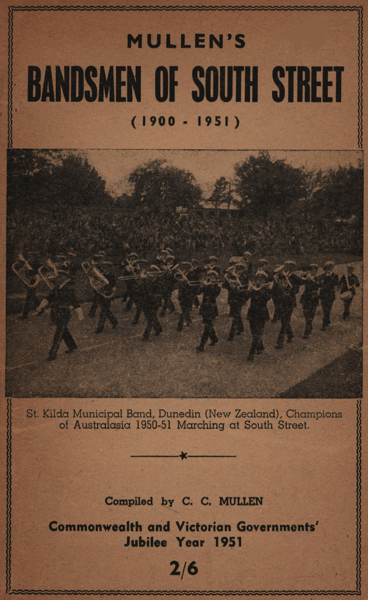
Front Cover, “Mullen’s Bandsmen of South Street (1900-1951)”. (source: Jeremy de Korte’s personal collection)
Introduction:
There has always been an ecosphere of activity surrounding brass bands, then and now ranging from retail to journalism, and people who take a general interest in day-to-day activities. This level of interest varies among people, and especially in the bands of old, there was an amount of engagement in these ensembles. One only has to read past newspapers as a measure of this engagement. Most readers of this blog know I dwell in the Trove archive to find information for these posts; it is through these newspaper articles that the life and atmosphere of these bands can be fully appreciated.
This post is different from previous posts where the focus is not on bands per se, but on a bands person who described himself as very involved in the brass band movement, Cecil Clarence Mullen. I am very thankful to have been gifted one of his rare booklets, Mullen’s Bandsmen of South Street (1900-1951). He wrote another article on the history of Victorian bands in 1965 for The Victorian Historical Magazine. However, there is more to explore in his writing, including some of the opinions on the band movement and the work he did as a brass band statistician.
Mullen had a role to play documenting the band history of Victoria and it is unfortunate that his work is not well known. We will see where Mullen’s work was at its most valuable, but also where some of his work could be questioned – this post will be taking a subjective view of some of his writing and opinions. It must be recognised that at the time, Mullen did not have the information resources at his disposal like we do now. However, what he did do was make an effort to record and compile results in a way that was unique.
C. C. Mullen (1895-1983):
It was difficult to build a full picture of Mullen’s life as some resources were not comprehensive. Through the research of State records (Public Records Office Victoria and Births, Deaths and Marriages Victoria), it is found that he was born in 1895 and initially lived in the Melbourne suburb of Richmond. For much of his further life, he lived in the nearby suburb of Abbotsford and was still residing in that suburb when he died in 1983 at the age of 88 (Mullen, 1983). As for employment, it is listed in some records that he worked as a Clerk at the Argus newspaper and various other local newspapers (Ruddell, 2010)
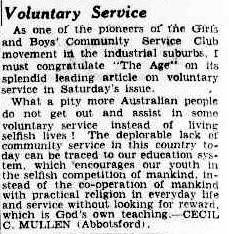
Mullen’s amateur interests were extensive and varied including music, sports, local history and it seems youth and education as well (Ruddell, 2010). He was complimented on his work with local youth groups of which he made every effort to prepare youth for further work and education (“Richmond Boys’ Club,” 1932). It is through further research in the Trove archive that we see a fuller picture of Mullen’s mindset as he was an avid contributor of letters to the newspapers. He wrote on all sorts of topics; youth, education, transport, parks, library opening hours, manners at the opera, sports, politics, etc (Mullen, 1937, 1946, 1947, 1952a). The articles displayed below are only a tiny sample of his letter output.
Regarding his letter writing, it seems he did not write to the papers on one of his favourite topics, brass bands, except for one instance when he requested photos of the Kalgoorlie brass bands for his brass band history collection (Mullen, 1951a). It is also in this letter that we see that Mullen has described himself as a “statistician and historian of brass and military bands” (Mullen, 1951a).
This post will not dwell on Mullen’s interests in other subjects however they do provide some clues as to how Mullen went about doing things, and what his personal attitudes were like. He gives the impression of being an egalitarian person and was a firm advocate for youth groups (Mullen, 1952b). He did not like some of the aspects of competition, taking aim through one of his letters at “the selfish competition of mankind, instead of the co-operation of mankind” (Mullen, 1940). In another one of the newspaper letters he advocates for the abolition of school sports, and in his booklet, he advocates for the abolition of grades in band contests (Mullen, 1937, 1951b). In saying so, Mullen still supported the aims of the Royal South Street Society band competition sections and sponsored trophies for “Best Drummer” in 1958, another trophy in 1959, and a trophy in 1964 for “Bandmaster showing Best Deportment” (Royal South Street Society, 1958, 1959, 1964). As for his historical work, we will examine his band history research in the next sections, however, it should be noted that there is an amount of conjecture over the accuracy of his sports history writing and statistics (Hay, 2010).
An enthusiastic commentator is probably an apt description of Mullen given his penchant for writing on all manner of subjects. His band history work is what provides the most interest (for this post) and we will see a person who clearly enjoyed his statistics.
C. C. Mullen: Historian of Brass & Military Bands:
There is no doubt, through reading his works, that Mullen was an enthusiastic advocate, documenter and historian of brass and military bands. Both his main works on the subject, his booklet and his later article attest to this. This section will review his booklet first, then his article from 1965.
1951: “Mullen’s Bandsmen of South Street (1900-1951)”:
The first impression that is given about the booklet is that he clearly wrote this booklet as an outlet for his interest in brass bands and musicians. The aim of this booklet, as Mullen notes in the preface, was to publish
…for the first time in the history of brass bands in this country, a condensed history of bands and players who have taken part in most important annual band competitions in Australasia – that of South Street, Ballarat, Victoria.
(Mullen, 1951b, p. 1)
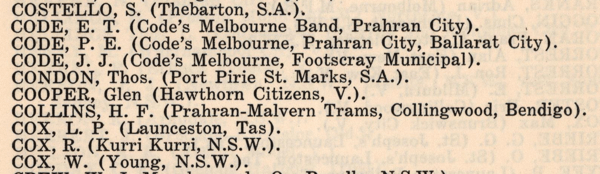
With this aim, he achieved his goal and the book contains the names of musicians, the bands they were associated with, and which instruments they played. Below is small except from one of the lists which makes up many of the pages of this booklet.:
Excerpt from p. 15, “Mullen’s Bandsmen of South Street (1900-1951)”, Bb Cornets. (source: Jeremy de Korte’s personal collection)
In the preface, Mullen outlines his life in the brass band movement. In summary he:
apparently knew all the famous bandmasters of the day,
was embedded in the administration of the early Victorian Bands’ Association, and later the Victorian Bands’ League,
was a contributor of articles to all the famous band magazines (Mullen, 1951b).
He notes that the famous Bandmaster Edward Code was a great influence on his early life and that he felt honoured as a former pupil to have published this booklet (Mullen, 1951b). Interestingly, both Edward Code and Mullen are buried in the same cemetery in Melbourne, the Coburg Pine Ridge Cemetery in Melbourne’s north – although 65 years apart.
Mullen was not afraid of expressing his opinions on bands and the administration of bands. On page four of his booklet is a one-page treatise on the importance of brass bands to the community, with a paragraph (below) on his thoughts of bands in schools (Mullen, 1951b). A previous post has touched on the historical discrepancies with the starting of school bands in Victoria and Mullen adds his own discrepancy when he declares “I had the first band in Victoria composed of schoolboys” (Mullen, 1951b, p. 4). When reading this paragraph, it brings to mind a piece of writing in one of the old brass band magazines where the writer had some choice words for the headmasters of the day about not starting bands (“THE EDITOR’S BATON,” 1929). Perhaps it was Mullen himself who wrote the article in this 1929 issue of The Australasian Band and Orchestra News, but we may never know for sure.
Excerpt from p. 4, “Mullen’s Bandsmen of South Street (1900-1951)”. (source: Jeremy de Korte’s personal collection)
In finishing his one-page treatise on the importance of brass bands, Mullen laments that the State and National controlling bodies have not done enough to promote bands. He states,
It is up to our band controlling bodies and the Australian Band Council to take this matter up seriously and see that more cannot be done to keep the importance of brass bands before the people of Australia.
(Mullen, 1951b, p. 4)
The main aim of this booklet, as mentioned, was to document the prize-winning brass band musicians and bands who had participated in the South Street competitions over a number of years. Two pages of the booklet are devoted to a poem Mullen wrote on South Street. Another section of the book was written by a contributor, “Baton” who wrote a history of the band sections at South Street (Baton, 1951). This contribution is comprehensive and valuable and adds to the existing histories of the band sections at South Street.
Mullen also wrote other small sections in the starting pages and ending pages of the booklet, where, we still see that he is using the booklet to express his own opinions – which is understandable. Some section headings in the starting pages are telling;
“Test Selections need revising” (he felt that operatic works instead of technical works made better test pieces),
“Band grading should be abolished” (he felt the grading system had outgrown its usefulness)
“Bad drumming of class marches” (Apparently Bandmasters were not teaching or paying attention to the drummers about learning their parts properly) (Mullen, 1951b, pp. 6-8)
In the later pages of the booklet, Mullen provides some useful historical information on the South Street competitions, South Street judges, how Britain developed band music in Australia, the Quickstep section and the formation of the Victorian Bands’ League (Mullen, 1951b). Still, he is wanting to express his opinions in these pages and makes comment on how “Grand Opera assists bandsmen” (Mullen, 1951b, p. 61). Mullen, as we’ve seen, is also a great advocate for the young and has used a section to advocate for young band conductors. Also, in another section, while he congratulates young soloists for participating in South Street, he also took aim at their onstage deportment – Mullen obviously did not like young soloists who sat down while playing and he gave a serve to bandmasters “who encourage this sort of thing” (Mullen, 1951b, p. 62).
In one of the final sections of the booklet titled “High Cost of Running Brass Bands” (Mullen, 1951b, p. 62), we read that he is trying to advocate for more monetary support for the brass band movement. He levels criticism at various entities such as the Federal Government on tariffs on musical instruments, the State Government on the money being spent on the upcoming Olympic Games, and the Australian Band Council for not talking to governments on behalf of brass bands (Mullen, 1951b). Mullen takes a singularly myopic viewpoint, well-meaning, but possibly futile. Of course, this is all in relation to his support for young musicians and their access to instruments and the expense of obtaining such instruments. He laments that,
Unfortunately Australia is so “sports minded” that it is a much easier proposition to conduct a boy’s cricket or football team than to form a junior band and give youngsters the chance of a musical education or at least a musical mind.
(Mullen, 1951b, p. 62)
Meaning, that if all things were ideal in Mullen’s viewpoint, money would be better spent on the brass band movement.
Would it not be a good investment for the future education of this country for our Governments to spend something on band music in order to help Australia to have a cultured mind – something she lacks at present.
(Mullen, 1951b, p. 62)
In this section about the monetary challenges faced by brass bands and lack of support, Mullen has managed to draw in his other points of interest in sports, politics/government and education of youth!
In finishing a review of Mullen’s written paragraphs and opinions in this booklet, it is as has been mentioned; he used this booklet to express is many opinions, ideas and advocacy. His writing was well-meaning, but one wonders how much effect it had on the powers that be? I personally feel that the lists of bandsmen, instruments and bands provide much more historical interest and meaning in this booklet.
1965: “Brass Bands have played a prominent part in the History of Victoria”:
In 1965, fourteen years later after publishing his booklet, Mullen published another article in The Victorian Historical Magazine with the above title. Mullen is aged 70 in 1965 and his wealth of historical knowledge about the brass band movement is evident in this article. The richness of historical information about bands, conductors, adjudicators, the South Street competitions and Victorian musical life can be fully appreciated here – possibly more so than his previous booklet which contained a limited range of historical writing (Mullen, 1951b, 1965).
Mullen provides an amount of context in this article. To build the narrative, he starts off with the large and then brings focus. In the opening paragraphs, this means tracing brass instruments from biblical times to the development of bands in England and then to Victoria with a focus on immigration (Mullen, 1965). In this article, Mullen also draws in some historical information about Victorian bands and events, and he has quoted large parts of various band magazines. For example, the next section after the introduction is about bands playing at the Eureka Rebellion of which he used information from “The Australian Bandsman. 26th October 1923” (Mullen, 1965, p. 31). This section on the Eureka Rebellion is useful as it focuses on the band history of Ballarat – which became home to the famous Royal South Street band competitions.
Progressing through the article, we can see that Mullen provides lots of detail throughout various sections while continuing his historical narrative. When reading, there is an impressive list of bands, bandsmen, competitions and little stories to be discovered. He has written a section on the “Famous Band Families” such as “James Scarff, Samuel Lewins and Thomas E. Bulch” and the “Codes” – brothers “Edward, John, Alfred and William” and sons of Edward, “Percy” and brother “Samuel” (Mullen, 1965, pp. 36-39). The South Street band competitions were a subject that had a special interest to Mullen and he devoted another whole section to them, again, listing memorable bands, bandsmen and adjudicators (Mullen, 1965).
In the later writing of this article, there were some notable historical events that Mullen mentions such as the early tours of Besses o’ the’ Barn Band and the Sousa Band, the formation of the Victorian Bands’ League, the impact of the World Wars on local bands, radio broadcasting and in the band world, the activities of the ABC Military Band (Mullen, 1965). The final section of the article gives praise to the Victorian brass bands for maintaining a high standard of playing, although Mullen attributes this to,
…bandmasters setting a fine example in teaching young players a love for classical works of the of the great composers relating to Grand Opera, Ballet, Symphonies, Oratorio, Sacred and Religious works, and good songs that have been set to music.
(Mullen, 1965, p. 46)
In other words, music that was not originally written for brass bands.
Mullen was ever fond of lists (which will be evident further in this post), and in this final section he has listed a number of notable brass band conductors, in addition to others previously named in his article such as “Harry Shugg” (Geelong Harbour Trust, Malvern Tramways & City of Ballarat) (Mullen, 1965, pp. 11, 43). (The list below has been ordered into a bulleted list which is different from how it is presented in the article):
If there is one criticism of this article it is the way that Mullen has finished it, there is no real conclusion. It just…ends. Mullen leaves the article hanging by making mention of the most recent overseas visit of an international military band (prior to the publication of this article) in 1965). The final paragraph reads:
The most recent visit of an overseas musical combination to Victoria was that of Her Majesty’s Scots Guards, under Captain James Howe, in March 1964, when it played at the Moomba Carnival in Melbourne.
(Mullen, 1965, p. 47)
It is admirable that Mullen wrote an article such as this given that lack of historical writing on the band movement in Victoria as a whole. What this article does do is create many links between bands, bandsmen and historical context, which is no doubt due to Mullen’s interests in these subject areas. We should thank Mullen; despite this article being written fifty-five years ago to this date, it is still relevant and serves as a useful guide to much of the band movement history in Victoria.
C. C. Mullen: Statistician:
Returning to Mullen’s publication on brass bands, Mullen’s Bandsmen of South Street (1900-1951), we will see what can be considered to be the real historical value of this booklet, the lists of names and bands. Mullen was meticulous in the way he compiled his lists. No doubt he had access to the names and competition wins through his work at the newspapers, but to compile the lists covering fifty-one years is quite remarkable. All of the bandsmen and bands can be cross-referenced with the Royal South Street results database (Mullen, 1951b; Royal South Street Society, 2020).
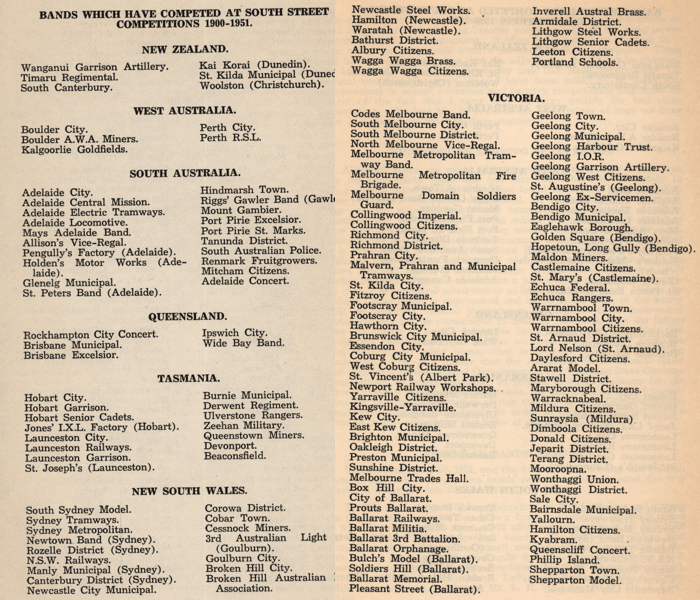
A small excerpt of one of the lists has been displayed earlier in this post. The way Mullen has compiled these lists is quite logical. He has started with all the conductors and then listed all the prize winners for every instrument of a brass band. Interestingly, although South Street never held any solo competitions for Side or Bass Drummers, Mullen lists the bandsmen he considers notable on these instruments. In the closing pages of the statistics, he lists all of the bands from every State and New Zealand that have participated in South Street over the time frame of this booklet (Mullen, 1951b). Below are samples of some of the lists, and they are fairly self-explanatory.
Excerpt from p. 19, “Mullen’s Bandsmen of South Street (1900-1951)”, Bb Cornets. (source: Jeremy de Korte’s personal collection)
Excerpt from p. 15, “Mullen’s Bandsmen of South Street (1900-1951)”, “Bass (G) Trombone”. (source: Jeremy de Korte’s personal collection)
Pages 63-64, “Mullen’s Bandsmen of South Street (1900-1951)”, “Bands which have competed at South Street Competitions 1900-1951”. (source: Jeremy de Korte’s personal collection)
As we can see above, Mullen clearly had an eye for statistical detail. No doubt he felt he was doing the band movement service by publishing all of this, and to some extent he was. This is the only booklet of its kind to emerge from this era. Nowadays we can access all of these results through the South Street results database and find names in the Trove archive. Mullen did not have these electronic means, and even though the lists do not include the competition scores and rankings of bandsmen, the lists are still very informative. Another reason to thank Mullen for his work.
Conclusion:
Mullen has made a great contribution to the history of the band movement in Victoria through his own personal interest, dedication, and knowledge. In the absence of any other work of this nature, both his booklet and later article provide an overall picture of the band movement. Yes, his opinions were controversial when viewed in a new light. However, I feel he meant well, and I also feel that Mullen’s work on the history of the band movement needs to be more widely known.
References:
Baton. (1951). South Street band competitions have achieved world wide fame. In Mullen’s Bandsmen of South Street (1900-1951) (pp. 5-6). Horticultural Press.
THE EDITOR’S BATON: Bringing up the boy to the band. (1929). The Australasian Band and Orchestra News, XXV(2), 1 & 3.
Hay, R. (2010). Cec Mullen, Tom Willis and the search for early Geelong football. The Yorker, Spring(42), 3-5.
Mullen, C. C. (1965). Brass bands have played a prominent part in the history of Victoria. The Victorian Historical Magazine, XXXVI(1), 30-47.
Mullen, C. C. (1983). This is the last will and testament of me…. In Wills and Probates (Vol. VPRS7591/P9 Unit 22). North Melbourne, Victoria: Public Record Office Victoria.












 Band Blasts from the Past