Band contests fit for a Victorian centenary: a Duke, Grenadier Guards, and the brass bands

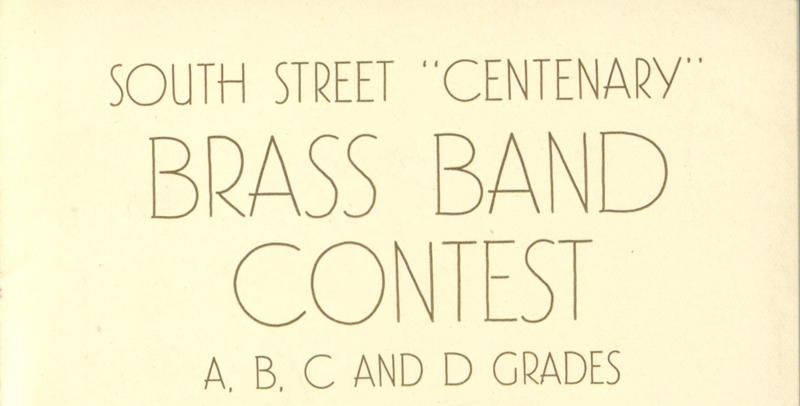
Programme: South Street “Centenary” Brass Band Contest, 1934, part of the front cover.
(Source: Victorian Collections: Victorian Bands’ League Archives)

An international band contest may be a feature of the Centenary celebrations.  An effort will be made to include one in the 1934 Eisteddfod and Band Contest at Ballarat.

The Grand National Eisteddfod of Australasia has promised its enthusiastic support of the celebrations.  Bands contests were resumed last year at the Ballarat competitions after a lapse of eight years, and they proved successful. (“Band Contest For Centenary,” 1933)

Introduction:

The year is 1934 and in Ballarat on the 1st of November, the Royal South Street Eisteddfod band sections are getting underway again.  Except this year is a bit different.  It is the year of the Victorian and Melbourne Centenary and across Victoria, celebrations and other events are in full swing.  The South Street band sections were part of these grand festivities, and all efforts were made to attract bands from across Australia and New Zealand.  In addition, the band contest was honoured by the presence of Prince Henry, Duke of Gloucester and The Band of HM Grenadier Guards.  The Royal South Street Society band contest, while being the most prestigious, attracted the most attention in the wider band movement.  For the bands themselves, there were lots of other events and band contests they were involved in.

Planning for the 1934 Ballarat band contest was extensive and as shown by the quote at the head of this post, the ideas started over eighteen months earlier.  Even if the idealism of the organisers was led astray at times.  They thought big, but had to accept that economic conditions were not the best as Australia was coming out of the Great Depression.  To put on a band contest befitting a visit of royalty was the utmost challenge.  Not to mention the scheduling given the extensive touring of the Grenadier Guards Band and the Duke. 

With the cooperation many different parties, somehow, everything worked out.  This post is mainly about the 1934 South Street band contest, ninety years to the day.

The Centenary:

Officially, the Victorian and Melbourne centenaries marked two historical events; the landing of the Henty family in Portland 1834, and John Batman’s grand pronouncement in 1835 that the Port Philip bay area with the Yarra River at its head would be “the place for a Village” (McCubbin, 2008).  However, like any celebration of this nature, there was some curious disagreement over the dates, especially from interstate commentators.  An article published in The Adelaide Chronicle newspaper in April 1934 questioned the historical accuracy of the centenary.  The article suggested that 1934 was too early as Victoria was officially proclaimed an independent colony in 1851 (“Victoria’s Centenary,” 1934).  Or maybe, as the article also suggested, the centenary was thirty-two years too late as 1802 was the year surveyors from New South Wales first explored the country in the vicinity of Port Phillip Bay (“Victoria’s Centenary,” 1934).  And there were plenty of other historical events connected with Victoria before 1834 that could have been commemorated.  The Victorian Government was probably well aware of these dates and as an article published in The Record newspaper proclaimed:

And now after warring factions have harmonised, the official foundation of Victoria is given as November 19, 1834, when the “Thistle” anchored in Portland Bay: and the centenary of this event is to be taken as the starting point of our Centenary celebrations. (“Victoria’s Centenary.,” 1933)

Nowadays Victoria celebrates an event on the 1st of July each year which marks the day Victoria was officially proclaimed an independent colony from New South Wales (Brown, 2015).  Melbourne Day is also recognized on the 30th of August each year which commemorates “the anniversary of the first European settlement in 1835” (Melbourne Day, 2024).

Confusing, isn’t it…

Prince Henry, Duke of Gloucester:

As early as 1932 if newspaper reports are anything to go by, negotiations were underway to bring a member of the Royal Family to Victoria for the Centenary commemorations in 1934.  The Scrutineer and Berrima District Press newspaper was one of these and they published a tiny article on the 6th of November 1932.

Victoria’s Centenary will probably be celebrated from October, 1934, to February, 1935.  Negotiations are in progress for a Royal visit, and it is almost certain that the British Fleet, which was to have visited Australia in 1933, will postpone the visit to coincide with the celebrations. (“Victoria’s Centenary,” 1932)

By early May 1933, the progress of the negotiations was evident to the extent that it was confirmed a member of the Royal Family would visit in 1934.  But which one?  The Victorian government initiated the negotiations; however, Canberra was also involved and any Royal that visited would be taken to the national capital as well, and to various places in Australia and New Zealand.  Speculation as to which Royal it might be was rife, and as reported by The Herald and several other newspapers, the Royal family member was going to be the Earl of Athlone, the brother of the Queen, or the Duke of Gloucester, the King’s third son (“CENTENARY PLANS TAKE SHAPE,” 1933).

In February 1934, the proposed Royal was mentioned in various newspapers as Prince George and the Royal South Street Society immediately sought to secure a visit to Ballarat by the Prince on the 1st of November so that he could open the famous band sections (“CENTENARY BAND CONTEST,” 1934).  The RSSS was concerned that the Prince, according to a tentative itinerary, might be in New South Wales while the contest was taking place.

The Age, 01/03/1934, p. 10

However, even with the best of plans, circumstances can change overnight, and by May 1934, news broke about a change of Royal, but this did not substantially alter the planning of a Royal visit.

It was announced, in the week-end, that, owing to the strain of the South African tour, Prince George would be unable to fulfil the engagement to come to Australia for the Melbourne Centenary celebrations.  Prince Henry, Duke of Gloucester, is to take his place.

The least robust member of the Royal family, Prince George felt the strain of his South African tour before it was finished.  It was far heavier than had been expected, and his letters home indicated that he was feeling tired, although delighted at the cordiality of his reception everywhere.

It was consequently considered unwise for a young man of Prince George’s temperament, which is rather highly strung, to undertake a second tour, especially as the Australasian programme was longer and more arduous than the African.

[…]

The Duke of Gloucester is the only one of the King’s sons who has not yet toured the Empire.  He fulfilled his duties during his visit to Japan so well that it was felt that he should be given the opportunity to visit Australia, where he would be likely to find so much congenial to his temperament. (“Duke of Gloucester to Come Here for Centenary Celebrations,” 1934)

With a member of a Royal family confirmed, and in all likelihood, the Duke of Gloucester would be in Ballarat on the 1st of November, planning for other parts of the Centenary celebrations and the band contest continued (“CENTENARY BAND CONTEST.,” 1934).

H.R.H. Prince Henry, Duke of Gloucester. Sunraysia Daily, 31/10/1934, p. 21

The Duke arrived in Australia in early October and visited Perth, then Adelaide on his way to Melbourne, travelling aboard H.M.S. Sussex which was escorted by elements of the Australian naval fleet (“DEPARTURE OF H.M.S. SUSSEX.,” 1934).  Prince Henry disembarked in Melbourne on the 18th of October and was afforded all the military and civic pageantry that Victoria could muster at the time. Below is a short film clip of his arrival and speech on the steps of the Victorian Parliament.

The Band of HM Grenadier Guards:

Programme: Front Cover – The Band of His Majesty’s Grenadier Guards : By Special Permission of the King, 1934. (Source: Jeremy de Korte Collection)

If the experiences of bringing a member of the Royal family to Ballarat was anything to go by, then securing a visit by one of the finest military bands in the world (at that time) was no less stressful and speculative.  Given the planning of the Centenary celebrations were well-underway in 1933, this is when newspapers started reporting that an English military band would be visiting as part of the festivities.  The Argus newspaper published a lengthy article in September 1933 that mentioned the Coldstream Guards, and that Victorian band musicians would be eager to hear them play, and be inspired (“COLDSTREAM GUARDS BAND,” 1933).  As mentioned in a previous post about this tour, only the Musicians’ Union raised objections to the tour of an English band, a position that was berated by a letter writer to The Herald newspaper (de Korte, 2018b; Musician, 1933).  In October, The Age newspaper was a little more speculative – given there are multiple guards’ bands, this article mentioned the bands of the Coldstream Guards, Welsh Guards, or Grenadier Guards as possibilities of touring (“GUARDS’ BAND VISIT.,” 1933).

It was quite a bit later, June 1934, that the Grenadier Guards Band was strongly expected to be the English military band visiting for the Centenary, and that their tour, estimated to cost £10,000 pounds, would also take in provincial towns (“FAMOUS BAND EXPECTED,” 1934).  In August, this tour was very much confirmed – one could appreciate the formality of the article published in The Age newspaper.

By special permission of the King, the band of Grenadier Guards is to give a season in Melbourne under the auspices of the Commonwealth and New Zealand Governments and the Centenary Celebrations Council, and Messrs. J. and N. Tait have been entrusted with the management of the tour.  The opening concert will be given in the Town Hall on Saturday, 20th October.  The band is the premier band of the United Kingdom, and negotiations for this visit have been carried through the Commonwealth High Commissioner in London with the British Government.  The band has no fewer than twenty different programmes.  Their uniforms of scarlet, blue and gold, with bearskin busbies, should make a fine spectacle. (“Grenadier Guards’ Band.,” 1934)

The Grenadier Guards band duly arrived in Melbourne on the 20th of October and were given a civic reception at the town hall, and a parade up Collins Street led by the Melbourne Fire Brigade Band (“GRENADIER GUARDS BAND HAS WONDERFUL WELCOME.,” 1934).  The picture below published in The Age newspaper showing the proceedings, and part of the crowd of 100,000, says it all.

The Age, 22/10/1934, p. 15

After their welcome in Melbourne and opening concert, the Band of the Grenadier Guards commenced on a country tour of Victoria, such was the interest in their visit – their first tour concert was in Wangaratta on the 22nd of October (“GRENADIER GUARDS BAND.,” 1934).  By no coincidence at all, many of the places the band visited intersected with visits of the Duke of Gloucester, including Ballarat on the 1st of November.

Of interest is the back cover of the programme used for this visit which advertises Boosey & Hawkes instruments, and the Australian music retailers that sold them – with a picture of H.M.S. Sussex which was transporting Prince Henry to Australia (Kingtson, 1934).


Programme: Back Cover – The Band of His Majesty’s Grenadier Guards : By Special Permission of the King, 1934. (Source: Jeremy de Korte Collection)

Two of the puzzle pieces for the Royal South Street band contest were now in place. But we must not forget the brass bands that were travelling to South Street for the contest.

Attracting the bands:

It would not be a band contest without the bands, and the Royal South Street Society, conscious of the significance of the 1934 contest, wanted to put on a good show.  At the head of this post was the idea that the band contest could be an international contest with the finest bands from around the world travelling to Ballarat to participate (“Band Contest For Centenary,” 1933).  Alas, bringing international bands was not to be.  Australia was just coming out of the Great Depression and economic conditions were not the best and attracting international bands was probably deemed too expensive (de Korte, 2020).  Nevertheless, in June 1933 the Lord Mayor of Melbourne gave his blessing to the band contest in Ballarat, stating,

Ballarat is looked upon as the venue for brass band contests, and I can assure you that during the centenary celebrations it will be recognised as such” said the Lord Mayor of Melbourne (Councillor H. Gengoult Smith) in speaking at a civic welcome at the city hall yesterday.  […] In recognition of what Ballarat, through the South Street Society, had done for the encouragement of brass band music, he would give his assurance that the finals of the centenary band contest would be held in Ballarat. (“CENTENARY BAND CONTEST.,” 1933)

The Mayor of Ballarat, Cr. A. J. Darling expressed confidence in January 1934 that arrangements for the official opening of the Centenary band contest were well-underway, as well as confirmation that a member of the Royal family would be attending (“CENTENARY BAND CONTEST.,” 1934).  With the Royal South Street Society and the newly formed Victorian Bands’ League working on the particulars of the contest, there was no need to think this was not the case.  And in April came the details of the prize money that was on offer, and the announcement that “Mr. Stephen Yorke, conductor of the Australian national military band, will adjudicate.” (“CENTENARY BAND CONTESTS.,” 1934).  On a side note, the A.B.C. Military Band was undertaking its own national tour in 1934 – it was a great year to listen to top bands in Australia (de Korte, 2018a).

Individual bands were also starting to make plans to visit Ballarat for the contest.  We see that in April, the Mildura Municipal Band (also known as the Sunraysia District Brass Band) announced plans to visit Ballarat to listen to the A grade sections, and then proceed to Melbourne to present a concert in conjunction with the Essendon City Band (“CENTENARY BAND CONTESTS,” 1934).  However, their ideas must have changed as they ended up participating in the contest in the C and D grade sections, and achieving equal first prize with the Pleasant Street Boys’ Band in the D grade (Royal South Street Society, 1934c). 

Photograph: Mildura & District Brass Band, 1930s. (Source: IBEW)
Photograph: Pleasant Street School Band, 1933. (Source: IBEW)
Telegraph, 13/10/1933, p. 27

Interest in competing was also expressed by bands in New Zealand as the Woolston Brass Band announced its intention to come to Ballarat for the centenary contest (“NEW ZEALAND BAND TO VISIT MELBOURNE.,” 1933).  An article published in the Dominion newspaper by the writer, ‘Kneller Hall’, speculated that the Port Nicholson Silver Band was preparing to travel to Ballarat to compete, while also confirming that the famous Woolston Brass Band was going to make the trip over the Tasman (Kneller Hall, 1934).  In the end, only one band from New Zealand ended up attending, Woolston, and they were given a civic welcome when they arrived in Ballarat (“BALLARAT AND DISTRICT,” 1934; “PROVINCIAL CITIES AND TOWNS.,” 1934a).

Woolston Brass Band. Dominion, 13/10/1934, p. 13

The South Street “Centenary” Band Contest:

With bands arriving in Ballarat, the Duke of Gloucester travelling down by train from Mildura, and the Band of the Grenadier Guards arriving from Bendigo, all was now in place for the opening of the Royal South Street band sections on the 1st of November (“GRENADIER GUARDS BAND.,” 1934; “Sunraysia, Land of Sunshine Greets The Duke,” 1934).  Twenty-two bands from Victoria, Tasmania, New South Wales, and New Zealand had entered the South Street contests this year and the list of bands and bandmasters in the official souvenir programme can be viewed below (Royal South Street Society, 1934e).

Programme: South Street “Centenary” Brass Band Contest, 1934, p. 4.
(Source: Victorian Collections: Victorian Bands’ League Archives)

To have twenty-two bands enter in 1934 was not bad considering that the early thirties were times of upheaval for the Victorian band movement and society in general.  In 1931, the Victorian Bands’ League was established having superseded the Victorian Bands’ Association, the Australian economy was recovering after the Great Depression, and the band sections at Royal South Street had resumed in 1932 after an eight year hiatus (de Korte, 2018c, 2020; Royal South Street Society, 1979).

However, it would have been pleasing to see bands from a wide variety of areas coming to South Street.  We know that for some bands, like the Phillip Island Brass Band, that they did a considerable amount of fundraising to attend (de Korte, 2019).  The line up for bands for the A Grade section represented the best of A grade bands that Victoria had in the day, and having the Woolston Brass Band from Christchurch, N.Z. made the section even more top notch.
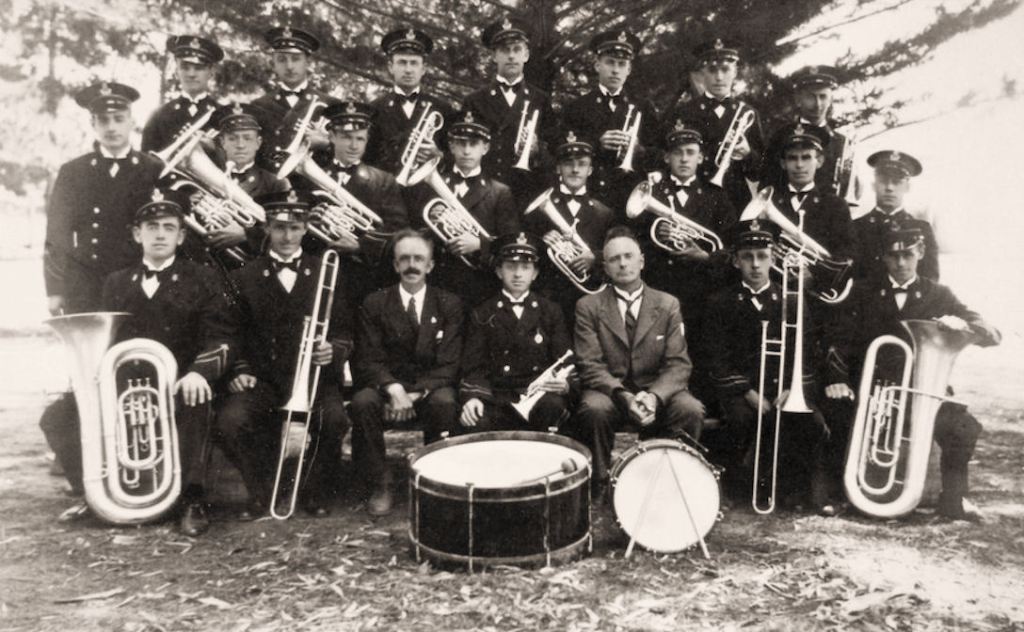
Photograph: Phillip Island Brass Band, 1932. (Source: IBEW)

The opening day of the band contest was a spectacular affair with the Royal South Street Society having programmed all events down to the minute.  According to various newspaper articles, 10,000 people attended the opening day at Ballarat’s City Oval, no doubt drawn to the fact that the Duke of Gloucester would be there to officially open the contest.  The souvenir programme outlined the proceedings of the day as can be seen below.
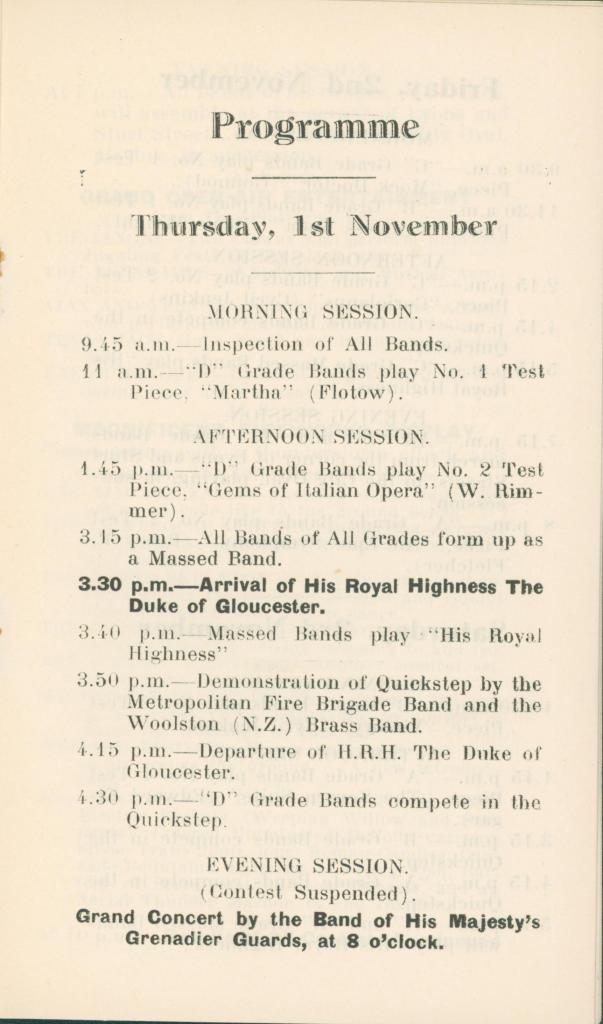
Programme: South Street “Centenary” Brass Band Contest, 1934, p. 6.
(Source: Victorian Collections: Victorian Bands’ League Archives)

In superb weather, everything proceeded to plan, and the bands did their best to produce a ceremony befitting the occasion (“BAND CONTESTS,” 1934).  There was a massed band performance, a demonstration of the quickstep, and the Woolston Brass Band even performed a haka for the Duke after the march past of the bands (“DUKE AT BALLARAT,” 1934).  That night, the Band of HM Grenadier Guards performed in a concert which would have inspired the bandsmen and audience (Royal South Street Society, 1934e). 

Results for the contests were announced on Saturday 3rd of November with another 10,000 people attending to find out the placings.  The full results will not be detailed in this post due to space, but they can be found on the RSSS results database via these links:

The Solo contests were held a day before the band sections on the 31st of October.  The results of these can be found on the RSSS database via the link:

By all accounts, the standard of playing across all sections was brilliant and the adjudicator was very impressed.  The A Grade section in particular was a very hard fought affair, but in the end, the Melbourne Fire Brigade Band won the Besson Shield for the third year in a row (Royal South Street Society, 1934a).  The Woolston Brass Band from N.Z. suffered some misfortune when one of their cornet players became ill – the other A Grade bands offered them a choice of cornet players to help out – however, they decided to proceed down a player and were happy to achieve third place (“BRILLIANT PLAYING,” 1934; “PROVINCIAL CITIES AND TOWNS.,” 1934b). 

The Duke of Gloucester and the Band of the Grenadier Guards did not stay long in Ballarat as they kept up a tight schedule of touring around Victoria and eventually New Zealand.  For the bands themselves there were good stories of their visits to Ballarat.  The Yallourn and District Band from Gippsland was one band that was very proud of their efforts in the B Grade section where they achieved second place behind the City of Ballarat Band (“YALLOURN NEWS,” 1934).  Of interest is that in early 1935, three cornet players from Victorian bands, including cornetist Jack Allan of the City of Ballarat Band, were offered places in the Band of the Grenadier Guards (“Ballarat Bandsman Invited To Join Grenadier Guards,” 1935).  It is unclear whether they took up that offer.

The 1934 South Street contest was no doubt an important part of Victoria’s Centenary celebrations, but it was not the only part.  There were other important events taking place.

Events after South Street:

11th of November, 1934: Dedication of the Shrine of Remembrance, Melbourne:

Postcard: The National War Memorial of Victoria. Aerial View of Dedication Ceremony, 11/11/1934. (Source: Jeremy de Korte Collection)

For the Duke of Gloucester, he kept up a busy schedule around Victoria.  However, his most important engagement was the dedication of Melbourne’s newly completed Shrine of Remembrance.  This was a very special occasion which was attended by thousands of veterans, people, and important dignitaries.  Bands and other musicians also played an important role, and at the dedication, several Australian Army buglers sounded the Last Post standing behind Royal Australian Navy drummers.

Portland Centenary Band Contest:

The town of Portland in the far south-west of Victoria had an important part to play in Victoria’s centenary celebrations.  In turn, they staged their own band contest, albeit on a much smaller scale than the South Street contests which had concluded only two weeks earlier (“BAND CONTESTS.,” 1934).  The Portland contest was only attended by bands from Hamilton, Heywood and Mt. Gambier, and there was a pipe band contest held at the same time.  The Portland contest was won by the band from Mt. Gambier and the adjudicator was Mr. Percy Jones (“Band Contest Won By Mount Gambier,” 1934).

Melbourne Centenary Band Championship, King’s Birthday weekend, June 1935:

The Victorian centenary celebrations stretched into 1935, and a Melbourne Centenary Band Championship was held at the Exhibition Buildings under the auspices of the Victorian Bands’ League.  Like the South Street contests, this was another great event for bands, and twenty-one bands participated, as listed in the article below.
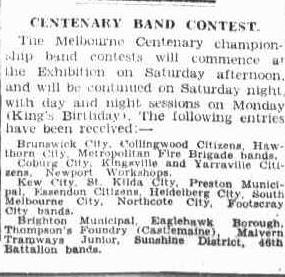
The Age, 28/05/1935, p. 11

The main attraction of this event was a grand parade from Alexandra Avenue to the Exhibition Buildings and quickstep display on the Exhibition oval (“CENTENARY BAND CONTESTS,” 1935).  Again, the A Grade section continued the rivalries between Hawthorn, Melbourne Fire Brigade, Brunswick and Collingwood bands, with Hawthorn taking out the A Grade title (“CENTENARY GALA WEEK.,” 1935).  Another celebrated win was that of the Malvern Junior Tramways Band when they won their third D Grade title in a row.
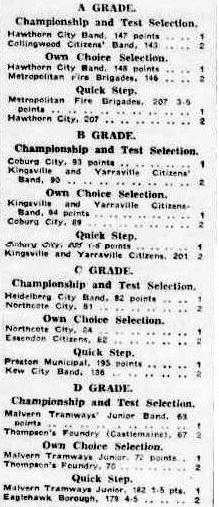
The Age, 04/06/1935, p. 10

Conclusion:

What an intense period of activity for bands!  It is times like these that our bands came to the fore with all the ceremonial and contest activity, as well as local celebrations.  No doubt the communities appreciated the efforts and the entertainment.  Having a visiting band of the calibre of the Band of the Grenadier Guards made the Centenary celebrations even more special, and it was noted at the time that they were inspiring to local musicians.  The prevailing feeling when all was done was one of accomplishment, not just from the cooperation that made this all happen, but from all that understood the significance of the events.  It is not every day that a world-class military band and a Duke visits a band contest.

References:

BALLARAT AND DISTRICT. (1934, 08 June). Argus (Melbourne, Vic. : 1848 – 1957), 3. http://nla.gov.au/nla.news-article10944624

Ballarat Bandsman Invited To Join Grenadier Guards. (1935, 16 January). Sunraysia Daily (Mildura, Vic. : 1920 – 1950), 5. http://nla.gov.au/nla.news-article265838073

Band Contest For Centenary. (1933, 25 February). Sun News-Pictorial (Melbourne, Vic. : 1922 – 1954; 1956), 4. http://nla.gov.au/nla.news-article277163952

Band Contest Won By Mount Gambier : Judge’s Eulogistic Comments. (1934, 22 November). Portland Guardian (Vic. : 1876 – 1953), 4. http://nla.gov.au/nla.news-article64287397

BAND CONTESTS : OPENING AT BALLARAT. (1934, 02 November). Mercury (Hobart, Tas. : 1860 – 1954), 14. http://nla.gov.au/nla.news-article29165635

BAND CONTESTS : Three Bands Competing. (1934, 19 November). Portland Guardian (Vic. : 1876 – 1953), 5. http://nla.gov.au/nla.news-article64287383

BRILLIANT PLAYING : Ballarat Band Contest. (1934, 05 November). Evening Post, 9. https://paperspast.natlib.govt.nz/newspapers/EP19341105.2.61

British Pathé. (2014, 13 April). Melbourne Centenary (1934) [Video (Film Clip)]. YouTube. Retrieved 11 October 2024 from https://www.youtube.com/watch?v=C4DWQpyx4O0

Brown, S. L. (2015, 01 July). Victoria Day: Was secret gold behind 1851 separation from NSW? ABC Radio Melbourne,6584322. https://www.abc.net.au/news/2015-07-01/victoria-day-was-secret-gold-behind-separation/6584322

CENTENARY BAND CONTEST. (1935, 28 May). Age (Melbourne, Vic. : 1854 – 1954), 11. http://nla.gov.au/nla.news-article204361353

CENTENARY BAND CONTEST : Arrangements for Opening. (1934, 18 January). Age (Melbourne, Vic. : 1854 – 1954), 9. http://nla.gov.au/nla.news-article203377704

CENTENARY BAND CONTEST : Finals in Ballarat. (1933, 05 June). Argus (Melbourne, Vic. : 1848 – 1957), 9. http://nla.gov.au/nla.news-article4740383

CENTENARY BAND CONTEST : Proposed Opening by Prince George. (1934, 23 February). Age (Melbourne, Vic. : 1854 – 1954), 10. http://nla.gov.au/nla.news-article203376669

CENTENARY BAND CONTESTS. (1935, 31 May). Sunshine Advocate (Vic. : 1924 – 1954), 3. http://nla.gov.au/nla.news-article74757883

CENTENARY BAND CONTESTS : Mildura Band to Make Trip. (1934, 27 April). Sunraysia Daily (Mildura, Vic. : 1920 – 1950), 4. http://nla.gov.au/nla.news-article265690603

CENTENARY BAND CONTESTS : South-Street Prize Money. (1934, 13 April). Age (Melbourne, Vic. : 1854 – 1954), 7. http://nla.gov.au/nla.news-article203842698

CENTENARY GALA WEEK : BAND CONTESTS DECIDED : HAWTHORN CITY WINS A GRADE CHAMPIONSHIP : Malvern Tramway Juniors’ D Grade Treble. (1935, 04 June). Age (Melbourne, Vic. : 1854 – 1954), 10. http://nla.gov.au/nla.news-article204345548

CENTENARY PLANS TAKE SHAPE : Pageants, Exhibitions And Shrine Dedication : BIG MILITARY TATTOO. (1933, 11 May). Herald (Melbourne, Vic. : 1861 – 1954), 5. http://nla.gov.au/nla.news-article243112151

COLDSTREAM GUARDS BAND : Victorian Bandsmen Eager For Visit. (1933, 01 September). Argus (Melbourne, Vic. : 1848 – 1957), 8. http://nla.gov.au/nla.news-article11688130

de Korte, J. D. (2018a, 12 July). The A.B.C. Military Band: an ensemble of the times. Band Blasts from the Past: Anecdotes, Stories and Personalities. https://bandblastsfromthepast.blog/2018/07/12/the-a-b-c-military-band-an-ensemble-of-the-times/

de Korte, J. D. (2018b, 14 October). International band tours of the early 1900’s: bringing music to Australia. Band Blasts from the Past: Anecdotes, Stories and Personalities. https://bandblastsfromthepast.blog/2018/10/14/_international-band-tours-of-the-early-1900s-bringing-music-to-australia/

de Korte, J. D. (2018c, 15 March). The politics of affiliation: The Victorian Bands’ Association to the Victorian Bands’ League. Band Blasts from the Past: Anecdotes, Stories and Personalities. https://bandblastsfromthepast.blog/2018/03/15/the-politics-of-affiliation-victorian-bands-association-to-the-victorian-bands-league/

de Korte, J. D. (2019, 31 January). Bands on Australian islands: unique challenges in unique environments. Band Blasts from the Past: Anecdotes, Stories and Personalities. https://bandblastsfromthepast.blog/2019/01/31/bands-on-australian-islands-unique-challenges-in-unique-environments/

de Korte, J. D. (2020, 18 October). Testing times: the resilience of Australian bands during the Great Depression. Band Blasts from the Past: Anecdotes, Stories and Personalities. https://bandblastsfromthepast.blog/2020/10/18/testing-times-the-resilience-of-australian-bands-during-the-great-depression/

DEPARTURE OF H.M.S. SUSSEX. (1934, 09 October). West Australian (Perth, WA : 1879 – 1954), 17. http://nla.gov.au/nla.news-article32803514

DUKE AT BALLARAT : AMONG THE BANDS : A WOOLSTON HAKA. (1934, 02 November). Evening Post, 10. https://paperspast.natlib.govt.nz/newspapers/EP19341102.2.102.1

Duke of Gloucester to Come Here for Centenary Celebrations : AFRICAN TOUR TIRED PRINCE GEORGE. (1934, 05 May). Weekly Times (Melbourne, Vic. : 1869 – 1954), 5. http://nla.gov.au/nla.news-article223836381

FAMOUS BAND EXPECTED : Grenadier Guards for Centenary. (1934, 05 June). Herald (Melbourne, Vic. : 1861 – 1954), 1. http://nla.gov.au/nla.news-article243175540

GRENADIER GUARDS BAND. (1934, 25 October). Great Southern Advocate (Korumburra, Vic. : 1889 – 1906, 1914 – 1940), 5. http://nla.gov.au/nla.news-article255918717

GRENADIER GUARDS BAND HAS WONDERFUL WELCOME. (1934, 22 October). Age (Melbourne, Vic. : 1854 – 1954), 15. http://nla.gov.au/nla.news-article205884483

Grenadier Guards’ Band. (1934, 27 August). Age (Melbourne, Vic. : 1854 – 1954), 13. http://nla.gov.au/nla.news-article205524735

GUARDS’ BAND VISIT : Centenary Tour Almost Certain. (1933, 10 October). Age (Melbourne, Vic. : 1854 – 1954), 8. http://nla.gov.au/nla.news-article205104515

Kingtson, C. (Ed.). (1934). Grenadier Guards Band : Australia and New Zealand 1934-5 : By Special Permission of His Majesty the King : Official Souvenir : Tour under the Auspices of the Commonwealth Government and the New Zealand Government : In associaion with the Cenenary Celebrations Council of Victoria  [Printed programme]. Grenadier Guards Band. 

Kneller Hall. (1934, 27 July). THE BANDS : News and Views : WELLINGTON AND BALLARAT. Dominion, 13. https://paperspast.natlib.govt.nz/newspapers/DOM19340727.2.98

McCubbin, M. (2008). Centenary. In eMelbourne: the city past & present (pp. EM00316b). https://www.emelbourne.net.au/biogs/EM00316b.htm: The University of Melbourne, School of Historical & Philosophical Studies.

Melbourne Day. (2024). More marvellous than ever: FAQs: What is Melbourne Day? Melbourne Day: 30th August. Retrieved 26 October 2024 from https://www.melbourneday.com.au/about.html

Mildura & District Band, 1930s. (1930). [Photograph]. [phot6314]. The Internet Bandsman Everything Within, Vintage Brass Band Pictures – Australia. http://www.ibew.org.uk/vbbp-oz.html

Musician. (1933, 11 September). GUARDS’ BAND VISIT. Herald (Melbourne, Vic. : 1861 – 1954), 6. http://nla.gov.au/nla.news-article243423748

NEW ZEALAND BAND TO VISIT MELBOURNE. (1933, 13 October). Telegraph (Brisbane, Qld. : 1872 – 1947), 27. http://nla.gov.au/nla.news-article180593124

Phillip Island Brass Band, 1932. (1932). [Photograph]. [phot16005]. The Internet Bandsman Everything Within, Vintage Brass Band Pictures – Australia. http://www.ibew.org.uk/vbbp-oz.html

Pleasant Street School Band, Ballarat, 1933. (1933). [Photograph]. [phot20817]. The Internet Bandsman Everything Within, Vintage Brass Band Pictures – Australia. http://www.ibew.org.uk/vbbp-oz.html

PROVINCIAL CITIES AND TOWNS : BALLARAT. (1934a, 29 October). Age (Melbourne, Vic. : 1854 – 1954), 13. http://nla.gov.au/nla.news-article205882825

PROVINCIAL CITIES AND TOWNS : BALLARAT. (1934, 05 November). Age (Melbourne, Vic. : 1854 – 1954), 12. http://nla.gov.au/nla.news-article205083970

Royal South Street Society. (1934a). 1934-10-31 Brass Band Solos : Held at the A.N.A. Hall, Camp Street [Eisteddfod Results]. Royal South Street Society Results Database. https://results.royalsouthstreet.com.au/results/1934-10-31-brass-band-solos 

Royal South Street Society. (1934b). 1934-11-01 Brass Band Contests : Held at City Oval : Grand Champion Centenary Band Contests [Eisteddfod Results]. Royal South Street Society Results Database. https://results.royalsouthstreet.com.au/results/1934-11-01-brass-band-contests 

Royal South Street Society. (1934c). 1934-11-02 Brass Band Contests  : Held at City Oval [Eisteddfod Results]. Royal South Street Society Results Database. https://results.royalsouthstreet.com.au/results/1934-11-02-brass-band-contests 

Royal South Street Society. (1934d). 1934-11-03 Brass Band Contests  : Held at City Oval [Eisteddfod Results]. Royal South Street Society Results Database. https://results.royalsouthstreet.com.au/results/1934-11-03-brass-band-contests 

Royal South Street Society. (1934e). [South Street “Centenary” : Brass Band Contest : A, B, C and D Grades]. In S09 – Programs (Printed programme ed., pp. 14). Ballarat, Victoria https://victoriancollections.net.au/items/5d425e0c21ea6b1a84382033: Victorian Bands’ League Archive.

Royal South Street Society. (1979). Royal South Street Society : The First One Hundred Years. Royal South Street Society. 

ShrineMelbourne. (2013, 09 January). The Dedication of the Shrine of Remembrance – Remembrance Day 11 November 1934 [Video (Film Clip)]. YouTube. Retrieved 26 October 2024 from https://www.youtube.com/watch?v=jHcaXEpVdRA

Sunraysia, Land of Sunshine Greets The Duke : Prince Henry Is Our First Royal Guest. (1934, 31 October). Sunraysia Daily (Mildura, Vic. : 1920 – 1950), 21. http://nla.gov.au/nla.news-article265829018

The Shrine of Remembrance Trustees. (1934). The National War Memorial of Victoria : Aerial View of Dedication Ceremony [Postcard]. [No. 3]. The Shrine of Remembrance Trustees, Great Britain. 

To Visit Australia. (1934, 13 October). Dominion, 13. https://paperspast.natlib.govt.nz/newspapers/DOM19341013.2.116.5

Victoria’s Centenary. (1932, 06 November). Scrutineer and Berrima District Press (NSW : 1892 – 1948), 4. http://nla.gov.au/nla.news-article125232791

Victoria’s Centenary. (1933, 04 November). Record (Emerald Hill, Vic. : 1881 – 1954), 2. http://nla.gov.au/nla.news-article164468392

Victoria’s Centenary. (1934, 12 April). Chronicle (Adelaide, SA : 1895 – 1954), 39. http://nla.gov.au/nla.news-article92354462

VISIT TO BALLARAT : Desired for Band Competition. (1934, 01 March). Age (Melbourne, Vic. : 1854 – 1954), 10. http://nla.gov.au/nla.news-article203834255

YALLOURN NEWS : Yallourn Band. (1934, 08 November). Morwell Advertiser (Morwell, Vic. : 1888 – 1954), 9. http://nla.gov.au/nla.news-article71564079

Testing times: the resilience of Australian bands during the Great Depression

165x215mm
A large room of tables stocked with fruit and vegetables with a brass band in the centre of the crowd. (Source: State Library of Western Australia: 8292B/A/6851-1)

Introduction:

From conversations I have had with bandmasters in Australia it would appear that the bands generally have been very hard hit by the depression, but I have been struck by the fine spirit and courage shown generally by them in these passing troubles.  Undoubtedly brighter times are coming, and they will be rewarded for the admirable attitude they have taken right through.

(Adkins, 1934)

The years from 1900-1950 are filled with historical events that caused great upheavals in society across the globe. Australia was similarly affected, and nominally our bands as well.  It was not all doom and gloom for bands as this time is one that I personally regard as a golden period.  However, when society experienced hardship, our bands did as well.  The Great Depression from 1929-1939 is just one of those events that was global, but it was felt right down to the tiniest country town.  As for our bands, numerous articles published in newspapers tell of struggle and hope.  The words from Capt. H. E. Adkins, quoted above, then conductor of the A.B.C. Military Band attest to this.

In a previous post the impact of the “Spanish” Influenza on our bands was examined.  Australian society could not have predicted that a decade later they would again be thrust into convulsions not because of a health crisis, but an economic crisis.  Australian bands that existed at the time relied heavily on local council support and the goodwill of subscriptions from the general public.  The money was necessary to keep them going and keep them supplied.  Yet, as can be seen, there were some bands that were formed during this time.  Music, it seems, was a way in which people could forget their struggles and enjoy some community.

This post will obviously highlight some of the struggles that were experienced by bands and band associations during this time; unfortunately, this is unavoidable.  It is also necessary to provide context.  This post will also highlight the resilience of our bands during this time.  Many survived in the most trying of circumstances.  They also kept up a regular pattern of concerts, parades, contests, and other events and in one instance, they also gave their support to the desperate of society. 

The Great Depression is but one event in history, as is the Coronavirus pandemic of today that is again impacting our many bands.  Resilience is a common term that defines the bands of the time.

The Great Depression in Australia: a brief history:

The headlines on an article published in the Sydney Morning Herald on October 26th, 1929, did not mince words: “Wild Selling. New York Panic. Profits Wiped Out. £80,000,000 Slump.”  – the stock market in New York had crashed on October 24th and this sent the economy into a tailspin (“WILD SELLING,” 1929).  The crash on October 24th, 1929, has been well-documented and for much of the world, this had profound consequences.  However, there had been economic troubles in Australia leading up to this event during the 1920s and this led to a decade of financial hardship for all:

As for many other countries, the 1920s were a decade of mixed blessings for Australia.  State governments continued to borrow to finance important public works projects, but underlying problems remained.  Post-war inflation in 1919 and 1920 was followed by a recession.  Unemployment hovered at around 10 per cent during the 1920s.  Loan funds from London dried up after 1927, limiting debt-financed public works.

(Eklund, 2008)

The early years of the Great Depression were very hard in Australia with major unemployment, collapse of the wool and wheat prices, social unrest, displacement of people and governmental problems (Eklund, 2008; National Museum Australia, 2020).  Williamson (2009) tells us “it was the working classes and those who became unemployed who bore the greatest brunt of the Depression.” and that “Losing a job broke the work and leisure routines of an individual’s life, and the victim further lost the company of workmates.” (from Electronic Article).

From 1930 a form of welfare assistance was given to needy households and was either in the form of “sustenance”, “the dole” or “rations” which was “barely enough to survive” (Hutchens, 2020).  This later evolved into other forms of basic work on designated projects for governments and local councils.  In 1932, 60,000 Australians – men, women and children, were dependent on this scheme and unemployment hit a peak of 32% (National Museum Australia, 2020).  A small song sung by the unemployed and children basically summed up the situation that thousands found themselves in:

“We’re on the Susso now,
We can’t afford a cow.
We pay no rent,
We live in a tent.
We’re on the Susso now.”

(Hutchens, 2020; McAnulty, 2017; National Museum Australia, 2020)

The immediate effect of such large job losses and unemployment led to mainly men wandering the country in searching for work (Eklund, 2008).  As well as this, those that remained in work faced cuts to wages and underemployment, which added to the social problems.  Many who had lived reasonable well in the 1920s found themselves in employment situations that they had not previously encountered (Eklund, 2008). 

By the later parts of the 1930s, economic conditions gradually improved although unemployment was still a major problem (“Australia’s Rise From Depression,” 1936).  Recovery was slow, and then tempered by the advent of the Second World War – the next global period of strife.

Finances and Administration:

How did Australian bands weather this economic storm, and what do the available records tell us?  The Annual General Meetings of individual bands and associations provide snippets of information as to how they fared, and thankfully these meetings were detailed in local newspapers.  The Hills Central Brass Band from South Australia held an Annual General Meeting in March 1930, the early years of the Depression.  In their reports the band said they were faring well and had accrued a small credit.  A paragraph from the article that was published in the Mount Barker Courier and Onkaparinga and Gumeracha Advertiser newspaper provides an insight into their awareness of the economic situation.

The chairman, in moving the adoption of the report and balance sheet referred to the excellence of the report.  Mr. Duffield had made a very capable secretary, and took a keen interest in the band.  The report was the best they had had.  With regard to the financial position of the band the speaker though it was highly satisfactory, considering the present depression.

(“HILLS CENTRAL BRASS BAND.,” 1930)

The Devonport Brass Band from Tasmania took an insular view of the conditions when they held their meeting in March 1931 insofar as the rest of Australia was having problems, but their band was proceeding as best they could.  Their acknowledgement of the present conditions opened the report of the AGM as detailed in an article published by The Advocate newspaper.

The report of the year’s working of the Devonport Brass Band at the annual meeting this evening will reveal that there is little sign of the depression so far as the fortunes of this organisation are concerned.

(“DEVONPORT.,” 1931)
Peterborough Federal Band, 1924 (source: IBEW))

Back to South Australia, at an Annual General Meeting of the Peterborough Federal Band held in July 1931, the financials were outlined, and credit was given to the secretary of the band for his sound management of the finances during the previous year.

The secretary’s annual report disclosed a very active and successful year, whilst the balance sheet showed the Band to be on a sound footing; two years ago the overdraft was in close proximity to £200, last year it had been reduced to £14/6/5, and this year closed with a credit balance of £15/0/3, the receipts being £116/19/1 and the expenditure £87/12/5; this in face of the terrible depression that has existed, is a wonderful achievement, and reflects great credit upon the secretary (Mr. W. H. Kaehne), whose sole aim has been a credit balance, and he is to be highly complimented on reaching his objective.

(“Peterborough Federal Band,” 1931)

In these early years of the depression, it is obvious that bands were well aware of the prevailing economic conditions.  However, it was not just individual bands that were taking notice, the band associations were as well.  In May 1932 the Queensland Band Association held their Annual General Meeting and mention of the depression was made in the annual report.

Fees received for registration for the year totalled £119 18s 6d., as against £106 8s 6d. in the previous year. The 1933 contests would be held at Mackay.  Notwithstanding the prevailing depression the association had held its own financially and closed a successful year with a credit balance of £91 11s 4d. compared with £105 16s 1d. last year.

(“BAND ASSOCIATION,” 1932)

Unfortunately, some bands inevitably ran into trouble during this period and either went into recess or disbanded.  Finances were certainly a factor in this, but loss of members was another – which will be explored in the next section.  In 1932 the Yeppoon Brass Band, located in North Queensland, announced that it would go into recess due to lack of funds and members (“INTO RECESS,” 1932).  However, in a generous move, the band allowed remaining members to keep their instruments while in recess.  The Franklin Harbour Band from the Eyre Peninsula in South Australia lamented its struggles in an article published by the Eyre’s Peninsula Tribune newspaper in November 1936. 

… at present one of the depression periods is being experienced and unless a revival of interest by the young men of the town and district is evinced, there is a possibility of the band after 25 years of continuous existence, sinking into oblivion.

(“FRANKLIN HARBOUR BAND.,” 1936)
Franklin Harbour Brass Band (date unknown) (source: IBEW)

The Gawler Brass Band was another that faced growing troubles and in 1938 announced that it was disbanding due money being owed to the local council – they owed £100 for instruments – and lack of members as they had gone from 24 players to 12 (“Gawler Brass Band May Not Continue,” 1936).

The Mail, 18/07/1936, p, 2

This call for more support was a common one from bands and associations as their finances dwindled and membership became problematic. The then Secretary of the Tasmanian Band Association, a Mr W. H. Gray was one who called for more support in a long letter published in The Mercury newspaper in January 1932 (Gray, 1932).  The letter is interesting given that Mr Gray makes no mention of the Depression while calling for more support for the bands – the subject of the letter is mainly about bands playing in certain parks from which they gain revenue.  However, one cannot help but feel that the impact of the Depression was implied when Mr Gray writes in his letter,

The bands are prepared to carry on provided the necessary public support is forthcoming, but many of them are doomed to early extinction if that support is not more liberal from now on.  The Sunday evening concerts provide a most pleasant hour, and are a wonderful tonic and inspiration for the following week’s worries and cares.

(Gray, 1932)

Of course, there were always some who resented that brass bands were getting any form of support at all, which was perhaps understandable. One person from regional South Australia wrote a pointed letter to the Advertiser and Register newspaper complaining that the Government was not doing enough to help primary producers and instead found some money to fund an Institute in Waikerie and buy instruments for the Waikerie Brass Band (to the value of £350) (Rogers, 1931).

Waikerie Brass Band, 1930s (Source: State Library South Australia: B 34089)

There are still more stories to be found regarding the experiences of bands in the Great Depression and thankfully, some are brought to light through community newspapers.  For example, two stories about the Walcha Brass Band, published in the Walcha News newspaper (Walsh, 2019a, 2019b).  The Walcha Brass Band suffered through the 1930s due to the impacts of the Depression but recovered soon after the cessation of the Second World War and survived until 1969 when it disbanded  (Walsh, 2019b).

If this small sample of AGM’s are to go by it is evident that bands were fully aware of the impacts of the depression.  Which made them all the more pleased to find they were riding the economic impacts as best they could. 

Employ a Bandsman:

Every band wants to retain their members as best they can.  This was no different for the bands during the Depression years where, as it was mentioned, people had to leave their localities to find work elsewhere.  Again, the fact that bands were losing members due to Depression conditions, factors that were really beyond their control, sometimes had a detrimental effect on the bands.  One strategy that bands used was to try to find employment for bandsmen in their own localities and on occasion implored local businesses to help them.  This was not an easy thing for bands to ask.

Freeling Brass Band (date unknown) (source: IBEW)

In 1931 the loss of members from the Freeling Model Brass Band from South Australia was noted as a significant factor affecting the survival of the band.  We can see in an article published in The Bunyip newspaper just how dire the circumstance of the band was in 1931.

The secretary (Mr. E. L. Anders) read the report and balance sheet on the year’s work.  He stated that the Band were in a financial position, but were unfortunate in losing eight playing members during the year; some having left the district through unemployment.  […] He also stressed the point, that little or no interest was shown by the playing members and the support from the public was very scanty.  This let the band down badly, and if not more support was forthcoming, the band would have to go into recess for a short period. […] A lengthy discussion arose, and for a time it was hard to distinguish what was being said.  It was proposed that the band go into recess.  After order was restored, it was proposed and seconded that the band carry on. 

(“FREELING MODEL BRASS BAND.,” 1931)

The Muswellbrook Brass Band, located in the Newcastle area of New South Wales, recognized that they might lose two members due employment issues and they made a request to the public in their March committee meeting.  This request was detailed in the local Muswellbrook Chronicle newspaper.

Employment Sought for Members.

Reference was made to the possibility of losing two valuable members of the Band owing to their inability to obtain employment in the town.  The hope was expressed that this matter would come under the notice of the general public, and that anyone in the position to offer employment would communicate with Mr. Wallace (hon. Secretary). 

(“MUSWELLBROOK BRASS BAND.,” 1935)

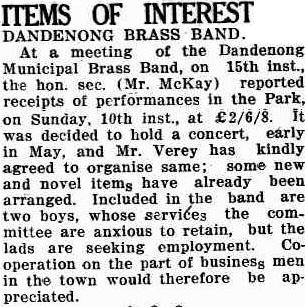
Similarly, in the same year, the Dandenong Brass Band from Victoria (as can be seen in the article below) also put out a plea to try to find employment for two of their members.

Dandenong Journal, 21/03/1935, p. 5

The Waratah Brass Band from Tasmania and the Port Adelaide Municipal Band were other bands that noted the loss of members due to employment issues (“WARATAH.,” 1935; “YOUR LOCAL BAND NEEDS SUPPORT!,” 1938).  It was a circumstance that many bands found themselves in during these years.

Port Adelaide Municipal Band (Source: The Citizen, 30/11/1938, p. 7)

Finding themselves in a slightly different situation, in 1937 a brass band located in Canberra was “disbanded as a protest against the refusal of the Department of Interior to guarantee all members permanent employment.”  (“BAND IS NOT TO PLAY,” 1937).  They were to play at an Armistice Service at Parliament House which forced the Department of Interior to hire a Sydney based band (“BAND IS NOT TO PLAY,” 1937).  However, in trying to defend this decision, the Secretary of the Department, Mr. Carrodus did say…

…that at least half of the members of the band had been given departmental jobs, but because of the stringent observance of the Returned Soldiers’ Preference Act it would be impossible to absorb them all.”

(“BAND IS NOT TO PLAY,” 1937)

It is hard to read of these circumstances and not feel saddened about the state some of these bands.  They were trying to exist in a time of history where outside forces were affecting how they operated; membership and commitment being a major part of those factors. No doubt they were doing the best they could under the circumstances.

The bands played on:

Brass band marching on Anzac Day, Sydney, 1930 (Source: National Library of Australia: 14446)

Music has always been known as a great reliever to troubles and during this time our brass bands rose to the challenge, not only for the good of the band and band members but also for the public and other causes.  In fact, some commentators suggested that there was no need for music making to stop.  In 1931 a Dr A. E. Floyd wrote in an article published in the Australasian newspaper,

The effect of the present financial stringency on every man’s music and musical progress need not be unmitigatedly bad; indeed it may be easily, with a little forethought, be decidedly good. 

(Floyd, 1931)

Admittedly, the context of Dr. Floyd’s article was more on making music in the home environment.  However, there is no doubt that his thoughts were cross-applicable to playing in ensembles outside of the home as well – his encouragement was for people to keep making music no matter the circumstances for health reasons.

For our bands it was a little more difficult as engagements slowed and money was scarce.  The bigger bands, often based in metropolitan centres were luckier than most as they could keep up with a regular pattern of performances, parades and competitions.  Indeed, the Victorian Bands’ League presented some very impressive massed band events during this time including one in 1937 that involved six hundred bandsmen! (“BIG BANDS DISPLAY,” 1937).  In Sydney, a grand competition was held in 1938 which drew together bands from across Australia (Bandsman’s year book, 1938).  While in the regional town of Wellington in New South Wales, their first competition in twenty five years was labelled a “Tremendous and Outstanding Success” by the Wellington Times newspaper (“WELLINGTON BAND CONTEST.,” 1932).

Music for a cause:

The brass bands also did their bit for charitable causes and lent their services to help the needy.  For the bands, this was not a new style of engagement as over time they were regularly engaged in helping raise money for charity – the Victorian Bands’ League massed bands event in 1937 raised money for charity.  However, during the Great Depression this was giving a new meaning and we find the bands involved in some distinct social causes as well.

We can see that bands were an uplifting presence.  In North Queensland the Mirani Brass Band helped to lift spirits during a harvest thanksgiving event and the band was noted for their playing – practices had lifted after harvest when more members were available (“DISTRICT NEWS.,” 1930).  While over in Western Australia, the Merredin Brass Band joined other local organisations in an engagement that raised money for the needy in the district (Branson, 1931).  The Matron of the Clare Hospital located in South Australia wrote an appreciative letter to the Blyth Agriculturist newspaper to thank the “generosity of the general public” and the Clare Brass Band was given a special mention for raising money for a new dressing table in the Isolation section (Pattullo, 1934).

The thanks went both ways.  In April 1930 a letter was published in the Burra Record newspaper co-written by the President, Bandmaster and Secretary of the Spalding Brass Band thanking a Mr. P. Clark of Burra for financing a trip and engaging them to play (Hewish et al., 1930).  No doubt the band was grateful for these kinds of opportunities.

Burra Record, 16/04/1930, p. 3

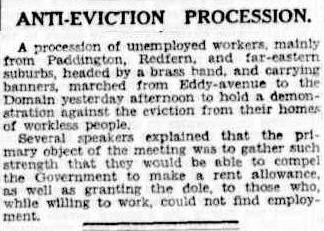
We can also see mentions of brass bands leading marches and demonstrations, which is perhaps understandable.  Many brass bands were supported by industry at this time and no doubt some of the workers were affected by the conditions around them.  Mention was made of a brass band leading an Anti-Eviction procession in Sydney in 1933 and in Newcastle, a brass band headed up 600 unemployed from the “West Wallsend District” who marched on the town hall in 1935 (“ANTI-EVICTION PROCESSION.,” 1933; “UNEMPLOYED,” 1935).

Sydney Morning Herald, 14/08/1933, p. 10

Resilience:

We have already seen that some of the effects of the Great Depression on brass bands led to them going into recess or suffering financial and membership difficulties.  We have also seen that bands kept up their activities as best they could.  They were resilient in the face of adversity.  And if it was one activity that brought people together, it was the brass band.  In this decade, some bands even started up again.

In the township of Leeton, located in the Riverina district of New South Wales, a long letter was published in the Murrumbidgee Irrigator newspaper written by a contributor with the colloquial name of “Has Been”.  In 1932 the Leeton Band resumed practicing and this writer waxed lyrical on how much this band would mean to the town.

Sir,- I notice by your advertising that the Leeton Band is commencing its practices again, which means that we are again to have the pleasure of hearing band music.  This, I am sure, will be very pleasing to quite a number of people in our town and district, for the band is a decided acquisition to any town, no matter how small.

(“Has Been”, 1932)

Of course, there was a trade-off to reforming the band and “Has Been” wrote an appeal to the townsfolk to look for employment opportunities for bandsmen.

Might I add another word to the employers of labour, whether it be shop, farms or factory, when in need of a man, give the band secretary a chance to supply you with a bandsman.  If there is not a man in town suitable for the job, ask the band secretary to see what he can do.  The band secretary, being a life man, would, no doubt insert an advert in the city papers, worded something like this: “Wanted – A mechanic (or whatever the position was that had to be filled), good man only; must be bandsman (cornet player preferred) – Apply Secty Leeton District Band.

(“Has Been”, 1932)

“Has Been” was probably working a bit ahead of himself but the initiative was warranted given the difficult times – and many other bands were trying the same initiative.

The Tully Brass Band from North Queensland was perhaps one of the luckier ensembles as six years prior to 1933, residents of the town subscribed to the band and £400 had been spent on instruments (“TO BE RE-FORMED,” 1933).  When the band was reformed in 1933 those instruments were still available, so the band was able to restart almost immediately.  We can see in the photo below what the band was like in the 1930s.  

Tully Brass Band marching. ca. 1930s (Source: State Library of Queensland: 33123)

To be resilient a band had to be able to handle the circumstances as best they could and gathering public and council support was a chief aim.  When these pieces fell into place, bands could survive reasonably comfortably despite the outside circumstances.  For bands to restart during this time was an additional challenge which some of them managed with success.

Conclusion:

Coming out of the 1920s where the world seemed to be recovering only to plunge into another crisis must have been a major shock.  For bands, this meant a greater focus on administration especially finances, engagements, and membership.  Some aspects were simply out of their control such as the movement of members due to employment – as enjoyable as playing in a band might be, the outside need was to find a job.  It was admirable that many bands sought to find work for their members and themselves become a social service.

No doubt the work the bands were doing was appreciated by their communities either through live performance or over the wireless.  Music is uplifting.  Music could help people forget about their predicaments, if only for a short time.  The bands did their best.

References:

“Has Been”. (1932, 26 February). REFORMING THE BAND : (To the Editor). Murrumbidgee Irrigator (Leeton, NSW : 1915 – 1954), 3. http://nla.gov.au/nla.news-article155893074

Adkins, H. E. (1934, 10 January). Britain’s Big Brass Bands. Courier-Mail (Brisbane, Qld. : 1933 – 1954), 10. http://nla.gov.au/nla.news-article1158876

ANTI-EVICTION PROCESSION. (1933, 14 August). Sydney Morning Herald (NSW : 1842 – 1954), 10. http://nla.gov.au/nla.news-article16998155

Australia’s Rise From Depression : Story Told By Figures. (1936, 15 February). Northern Producer and Morawa and District Advertiser (WA : 1930 – 1947), 4. http://nla.gov.au/nla.news-article257624349

BAND ASSOCIATION : The Annual Report. (1932, 12 May). Telegraph (Brisbane, Qld. : 1872 – 1947), 13. http://nla.gov.au/nla.news-article180704011

BAND IS NOT TO PLAY : Demand Permanent Jobs. (1937, 11 November). Labor Daily (Sydney, NSW : 1924 – 1938), 6. http://nla.gov.au/nla.news-article237760894

The Bandsman’s year book and official programme of the Australian Championship Band Contest. (1938). (Band Association of New South Wales, Ed.). Band Association of New South Wales. 

BIG BANDS DISPLAY : 600 Players. (1937, 25 September). Sporting Globe (Melbourne, Vic. : 1922 – 1954), 7. http://nla.gov.au/nla.news-article180841683

Branson, I. N. (1931, 28 April). The Meldrum Benefit. Wheatbelt Wheatsheaf and Dampier Advocate (Merredin, WA : 1930 – 1939), 1. http://nla.gov.au/nla.news-article251755519

DEVONPORT. (1931, 31 March). Advocate (Burnie, Tas. : 1890 – 1954), 4. http://nla.gov.au/nla.news-article67710241

DISTRICT NEWS : Mirani : (From our Correspondent). (1930, 23 December). Daily Mercury (Mackay, Qld. : 1906 – 1954), 6. http://nla.gov.au/nla.news-article170235248

Eklund, E. (2008). 10 June 1931. In M. Crotty & D. A. Roberts (Eds.), Turning Points in Australian History (pp. 48-61). University of New South Wales Press Ltd. 

Floyd, A. E. (1931, 03 January). MUSIC : Need the Depression Stifle Music? Australasian (Melbourne, Vic. : 1864 – 1946), 15. http://nla.gov.au/nla.news-article141416272

Franklin Harbour Brass Band. (n.d.). [Photograph]. [phot3437]. The Internet Bandsman Everything Within, Vintage Brass Band Pictures : Australia. http://www.ibew.org.uk/vbbp-oz.html

FRANKLIN HARBOUR BAND. (1936, 26 November). Eyre’s Peninsula Tribune (Cowell, SA : 1910 – 1950), 2. http://nla.gov.au/nla.news-article219473615

Freeling Brass Band. (n.d.). [Photograph]. [phot15438]. The Internet Bandsman Everything Within, Vintage Brass Band Pictures : Australia. http://www.ibew.org.uk/vbbp-oz.html

FREELING MODEL BRASS BAND. (1931, 19 June). Bunyip (Gawler, SA : 1863 – 1954), 6. http://nla.gov.au/nla.news-article96642544

Gawler Brass Band May Not Continue. (1936, 18 July). Mail (Adelaide, SA : 1912 – 1954), 2. http://nla.gov.au/nla.news-article55830899

Gray, W. H. (1932, 09 January). BAND CONCERTS : Appeals for More Liberal Support : To the Editor of “The Mercury.”. Mercury (Hobart, Tas. : 1860 – 1954), 9. http://nla.gov.au/nla.news-article29939058

Hewish, P. A., Carlson, A. C., & Mannion, F. J. (1930, 16 April). SPALDING’S BRASS BAND APPRECIATION : (To the Editor). Burra Record (SA : 1878 – 1954), 3. http://nla.gov.au/nla.news-article37488195

HILLS CENTRAL BRASS BAND. (1930, 21 March). Mount Barker Courier and Onkaparinga and Gumeracha Advertiser (SA : 1880 – 1954), 5. http://nla.gov.au/nla.news-article147845925

Hutchens, G. (2020, 29 March). The lessons of our past and our neighbours’ present could guide Australia’s economic response to coronavirus. ABC News. Retrieved 02 October 2020 from https://www.abc.net.au/news/2020-03-29/australias-history-of-economic-support-coronavirus-covid-19/12100194

Illustrations Ltd. (1932). Large group of people in shed near tables full of vegetables and fruit [picture] [1 negative : glass, b&w ; 17 x 22 cm.]. [101841PD]. State Library of Western Australia, Illustrations Ltd collection ; 8292B/A/6851-1. https://encore.slwa.wa.gov.au/iii/encore/record/C__Rb2649568

INTO RECESS : Yeppoon Brass Band. (1932, 26 April). Morning Bulletin (Rockhampton, Qld. : 1878 – 1954), 1. http://nla.gov.au/nla.news-article54737835

ITEMS OF INTEREST : Dandenong Brass Band. (1935, 21 March). Dandenong Journal (Vic. : 1927 – 1954), 5. http://nla.gov.au/nla.news-article213964037

McAnulty, H. (2017, 13 January). History Talking: Surviving life in the dole-drums of the Depression. Central Western Daily. https://www.centralwesterndaily.com.au/story/4403111/history-talking-surviving-life-in-the-dole-drums-of-the-depression/

MUSWELLBROOK BRASS BAND : Committee Meeting. (1935, 01 March). Muswellbrook Chronicle (NSW : 1898 – 1955), 1. http://nla.gov.au/nla.news-article107669487

National Museum Australia. (2020, 15 April ). 1932: Height of the Great Depression, with 32 per cent unemployment. National Museum Australia. Retrieved 26 September 2020 from https://www.nma.gov.au/defining-moments/resources/great-depression

Pattullo, B. (1934, 12 January). THE CLARE AND DISTRICT HOSPITAL : | To the Editor |. Blyth Agriculturist (SA : 1908 – 1954), 2. http://nla.gov.au/nla.news-article217990434

Peterborough Federal Band. (1924). [Photograph]. [phot6378]. The Internet Bandsman Everything Within, Vintage Brass Band Pictures : Australia. http://www.ibew.org.uk/vbbp-oz.html

Peterborough Federal Band : Annual General Meeting. (1931, 17 July). Times and Northern Advertiser, Peterborough, South Australia (SA : 1919 – 1950), 4. http://nla.gov.au/nla.news-article110542695

Pohjanpalo, J. (1930). Brass band marching on Anzac Day, Sydney, 1930 [1 negative : nitrate, black and white]. [nla.obj-15268053]. National Library of Australia, Jorma Pohjanpalo collection of photographs of Sydney and Queensland, 1928-1931. http://nla.gov.au/nla.obj-152628053

Rogers, G. S. (1931, 15 April). POINTS FROM LETTERS : Brass Bands or Primary Production. Advertiser and Register (Adelaide, SA : 1931), 12. http://nla.gov.au/nla.news-article45760607

TO BE RE-FORMED : Tully Brass Band. (1933, 13 May). Cairns Post (Qld. : 1909 – 1954), 6. http://nla.gov.au/nla.news-article41214410

UNEMPLOYED : Meet Shire Council : MANY DEMANDS : 600 March from West Wallsend : Strikers State Their Case. (1935, 12 July). Newcastle Morning Herald and Miners’ Advocate (NSW : 1876 – 1954), 11. http://nla.gov.au/nla.news-article138136031

Unidentified. (1933). Marching brass band, Tully, ca. 1930s [photographic print : black & white , ca. 1930s.]. [33123]. Brisbane John Oxley Library, State Library of Queensland, OneSearch. https://hdl.handle.net/10462/deriv/192004

Waikerie Brass Band. (1930). [Photograph]. State Library South Australia, Waikerie Collection. https://collections.slsa.sa.gov.au/resource/B+34089

Walsh, B. (2019a, 27 February). Walcha History: Band stands and delivers for Premier. Walcha News. https://www.walchanewsonline.com.au/story/5922107/walcha-band-stands-and-delivers-for-premier/

Walsh, B. (2019b, 13 March). Walcha History: Walcha Town Band’s final years. Walcha News. https://www.walchanewsonline.com.au/story/5947106/walcha-town-bands-final-hurrah/

WARATAH : The Band. (1935, 16 November). Advocate (Burnie, Tas. : 1890 – 1954), 10. http://nla.gov.au/nla.news-article86569751

WELLINGTON BAND CONTEST : THE FIRST FOR 25 YEARS : A Tremendous and Outstanding Success. : UNBOUNDED ENTHUSIASM. (1932, 04 January). Wellington Times (NSW : 1899 – 1954), 6. http://nla.gov.au/nla.news-article143246369

WILD SELLING : New York Panic : PROFITS WIPED OUT : £80,000,000 Slump. (1929, 26 October). Sydney Morning Herald (NSW : 1842 – 1954), 17. http://nla.gov.au/nla.news-article16596498

Williamson, A. (2009). The Cud on History — Looking Back on The Great Depression in Australia [Electronic Magazine Article]. The Cud: Entertain a new perspective: chew the cud. Retrieved 26 September 2020, from http://thecud.com.au/live/content/cud-history-—-looking-back-great-depression-australia

YOUR LOCAL BAND NEEDS SUPPORT! : A Short History. (1938, 30 November). Citizen (Port Adelaide, SA : 1938-1940), 7. http://nla.gov.au/nla.news-article236745262