Band contests fit for a Victorian centenary: a Duke, Grenadier Guards, and the brass bands

Programme: South Street “Centenary” Brass Band Contest, 1934, part of the front cover.
(Source: Victorian Collections: Victorian Bands’ League Archives)

An international band contest may be a feature of the Centenary celebrations.  An effort will be made to include one in the 1934 Eisteddfod and Band Contest at Ballarat.

The Grand National Eisteddfod of Australasia has promised its enthusiastic support of the celebrations.  Bands contests were resumed last year at the Ballarat competitions after a lapse of eight years, and they proved successful. (“Band Contest For Centenary,” 1933)

Introduction:

The year is 1934 and in Ballarat on the 1st of November, the Royal South Street Eisteddfod band sections are getting underway again.  Except this year is a bit different.  It is the year of the Victorian and Melbourne Centenary and across Victoria, celebrations and other events are in full swing.  The South Street band sections were part of these grand festivities, and all efforts were made to attract bands from across Australia and New Zealand.  In addition, the band contest was honoured by the presence of Prince Henry, Duke of Gloucester and The Band of HM Grenadier Guards.  The Royal South Street Society band contest, while being the most prestigious, attracted the most attention in the wider band movement.  For the bands themselves, there were lots of other events and band contests they were involved in.

Planning for the 1934 Ballarat band contest was extensive and as shown by the quote at the head of this post, the ideas started over eighteen months earlier.  Even if the idealism of the organisers was led astray at times.  They thought big, but had to accept that economic conditions were not the best as Australia was coming out of the Great Depression.  To put on a band contest befitting a visit of royalty was the utmost challenge.  Not to mention the scheduling given the extensive touring of the Grenadier Guards Band and the Duke. 

With the cooperation many different parties, somehow, everything worked out.  This post is mainly about the 1934 South Street band contest, ninety years to the day.

The Centenary:

Officially, the Victorian and Melbourne centenaries marked two historical events; the landing of the Henty family in Portland 1834, and John Batman’s grand pronouncement in 1835 that the Port Philip bay area with the Yarra River at its head would be “the place for a Village” (McCubbin, 2008).  However, like any celebration of this nature, there was some curious disagreement over the dates, especially from interstate commentators.  An article published in The Adelaide Chronicle newspaper in April 1934 questioned the historical accuracy of the centenary.  The article suggested that 1934 was too early as Victoria was officially proclaimed an independent colony in 1851 (“Victoria’s Centenary,” 1934).  Or maybe, as the article also suggested, the centenary was thirty-two years too late as 1802 was the year surveyors from New South Wales first explored the country in the vicinity of Port Phillip Bay (“Victoria’s Centenary,” 1934).  And there were plenty of other historical events connected with Victoria before 1834 that could have been commemorated.  The Victorian Government was probably well aware of these dates and as an article published in The Record newspaper proclaimed:

And now after warring factions have harmonised, the official foundation of Victoria is given as November 19, 1834, when the “Thistle” anchored in Portland Bay: and the centenary of this event is to be taken as the starting point of our Centenary celebrations. (“Victoria’s Centenary.,” 1933)

Nowadays Victoria celebrates an event on the 1st of July each year which marks the day Victoria was officially proclaimed an independent colony from New South Wales (Brown, 2015).  Melbourne Day is also recognized on the 30th of August each year which commemorates “the anniversary of the first European settlement in 1835” (Melbourne Day, 2024).

Confusing, isn’t it…

Prince Henry, Duke of Gloucester:

As early as 1932 if newspaper reports are anything to go by, negotiations were underway to bring a member of the Royal Family to Victoria for the Centenary commemorations in 1934.  The Scrutineer and Berrima District Press newspaper was one of these and they published a tiny article on the 6th of November 1932.

Victoria’s Centenary will probably be celebrated from October, 1934, to February, 1935.  Negotiations are in progress for a Royal visit, and it is almost certain that the British Fleet, which was to have visited Australia in 1933, will postpone the visit to coincide with the celebrations. (“Victoria’s Centenary,” 1932)

By early May 1933, the progress of the negotiations was evident to the extent that it was confirmed a member of the Royal Family would visit in 1934.  But which one?  The Victorian government initiated the negotiations; however, Canberra was also involved and any Royal that visited would be taken to the national capital as well, and to various places in Australia and New Zealand.  Speculation as to which Royal it might be was rife, and as reported by The Herald and several other newspapers, the Royal family member was going to be the Earl of Athlone, the brother of the Queen, or the Duke of Gloucester, the King’s third son (“CENTENARY PLANS TAKE SHAPE,” 1933).

In February 1934, the proposed Royal was mentioned in various newspapers as Prince George and the Royal South Street Society immediately sought to secure a visit to Ballarat by the Prince on the 1st of November so that he could open the famous band sections (“CENTENARY BAND CONTEST,” 1934).  The RSSS was concerned that the Prince, according to a tentative itinerary, might be in New South Wales while the contest was taking place.

The Age, 01/03/1934, p. 10

However, even with the best of plans, circumstances can change overnight, and by May 1934, news broke about a change of Royal, but this did not substantially alter the planning of a Royal visit.

It was announced, in the week-end, that, owing to the strain of the South African tour, Prince George would be unable to fulfil the engagement to come to Australia for the Melbourne Centenary celebrations.  Prince Henry, Duke of Gloucester, is to take his place.

The least robust member of the Royal family, Prince George felt the strain of his South African tour before it was finished.  It was far heavier than had been expected, and his letters home indicated that he was feeling tired, although delighted at the cordiality of his reception everywhere.

It was consequently considered unwise for a young man of Prince George’s temperament, which is rather highly strung, to undertake a second tour, especially as the Australasian programme was longer and more arduous than the African.

[…]

The Duke of Gloucester is the only one of the King’s sons who has not yet toured the Empire.  He fulfilled his duties during his visit to Japan so well that it was felt that he should be given the opportunity to visit Australia, where he would be likely to find so much congenial to his temperament. (“Duke of Gloucester to Come Here for Centenary Celebrations,” 1934)

With a member of a Royal family confirmed, and in all likelihood, the Duke of Gloucester would be in Ballarat on the 1st of November, planning for other parts of the Centenary celebrations and the band contest continued (“CENTENARY BAND CONTEST.,” 1934).

H.R.H. Prince Henry, Duke of Gloucester. Sunraysia Daily, 31/10/1934, p. 21

The Duke arrived in Australia in early October and visited Perth, then Adelaide on his way to Melbourne, travelling aboard H.M.S. Sussex which was escorted by elements of the Australian naval fleet (“DEPARTURE OF H.M.S. SUSSEX.,” 1934).  Prince Henry disembarked in Melbourne on the 18th of October and was afforded all the military and civic pageantry that Victoria could muster at the time. Below is a short film clip of his arrival and speech on the steps of the Victorian Parliament.

The Band of HM Grenadier Guards:

Programme: Front Cover – The Band of His Majesty’s Grenadier Guards : By Special Permission of the King, 1934. (Source: Jeremy de Korte Collection)

If the experiences of bringing a member of the Royal family to Ballarat was anything to go by, then securing a visit by one of the finest military bands in the world (at that time) was no less stressful and speculative.  Given the planning of the Centenary celebrations were well-underway in 1933, this is when newspapers started reporting that an English military band would be visiting as part of the festivities.  The Argus newspaper published a lengthy article in September 1933 that mentioned the Coldstream Guards, and that Victorian band musicians would be eager to hear them play, and be inspired (“COLDSTREAM GUARDS BAND,” 1933).  As mentioned in a previous post about this tour, only the Musicians’ Union raised objections to the tour of an English band, a position that was berated by a letter writer to The Herald newspaper (de Korte, 2018b; Musician, 1933).  In October, The Age newspaper was a little more speculative – given there are multiple guards’ bands, this article mentioned the bands of the Coldstream Guards, Welsh Guards, or Grenadier Guards as possibilities of touring (“GUARDS’ BAND VISIT.,” 1933).

It was quite a bit later, June 1934, that the Grenadier Guards Band was strongly expected to be the English military band visiting for the Centenary, and that their tour, estimated to cost £10,000 pounds, would also take in provincial towns (“FAMOUS BAND EXPECTED,” 1934).  In August, this tour was very much confirmed – one could appreciate the formality of the article published in The Age newspaper.

By special permission of the King, the band of Grenadier Guards is to give a season in Melbourne under the auspices of the Commonwealth and New Zealand Governments and the Centenary Celebrations Council, and Messrs. J. and N. Tait have been entrusted with the management of the tour.  The opening concert will be given in the Town Hall on Saturday, 20th October.  The band is the premier band of the United Kingdom, and negotiations for this visit have been carried through the Commonwealth High Commissioner in London with the British Government.  The band has no fewer than twenty different programmes.  Their uniforms of scarlet, blue and gold, with bearskin busbies, should make a fine spectacle. (“Grenadier Guards’ Band.,” 1934)

The Grenadier Guards band duly arrived in Melbourne on the 20th of October and were given a civic reception at the town hall, and a parade up Collins Street led by the Melbourne Fire Brigade Band (“GRENADIER GUARDS BAND HAS WONDERFUL WELCOME.,” 1934).  The picture below published in The Age newspaper showing the proceedings, and part of the crowd of 100,000, says it all.

The Age, 22/10/1934, p. 15

After their welcome in Melbourne and opening concert, the Band of the Grenadier Guards commenced on a country tour of Victoria, such was the interest in their visit – their first tour concert was in Wangaratta on the 22nd of October (“GRENADIER GUARDS BAND.,” 1934).  By no coincidence at all, many of the places the band visited intersected with visits of the Duke of Gloucester, including Ballarat on the 1st of November.

Of interest is the back cover of the programme used for this visit which advertises Boosey & Hawkes instruments, and the Australian music retailers that sold them – with a picture of H.M.S. Sussex which was transporting Prince Henry to Australia (Kingtson, 1934).


Programme: Back Cover – The Band of His Majesty’s Grenadier Guards : By Special Permission of the King, 1934. (Source: Jeremy de Korte Collection)

Two of the puzzle pieces for the Royal South Street band contest were now in place. But we must not forget the brass bands that were travelling to South Street for the contest.

Attracting the bands:

It would not be a band contest without the bands, and the Royal South Street Society, conscious of the significance of the 1934 contest, wanted to put on a good show.  At the head of this post was the idea that the band contest could be an international contest with the finest bands from around the world travelling to Ballarat to participate (“Band Contest For Centenary,” 1933).  Alas, bringing international bands was not to be.  Australia was just coming out of the Great Depression and economic conditions were not the best and attracting international bands was probably deemed too expensive (de Korte, 2020).  Nevertheless, in June 1933 the Lord Mayor of Melbourne gave his blessing to the band contest in Ballarat, stating,

Ballarat is looked upon as the venue for brass band contests, and I can assure you that during the centenary celebrations it will be recognised as such” said the Lord Mayor of Melbourne (Councillor H. Gengoult Smith) in speaking at a civic welcome at the city hall yesterday.  […] In recognition of what Ballarat, through the South Street Society, had done for the encouragement of brass band music, he would give his assurance that the finals of the centenary band contest would be held in Ballarat. (“CENTENARY BAND CONTEST.,” 1933)

The Mayor of Ballarat, Cr. A. J. Darling expressed confidence in January 1934 that arrangements for the official opening of the Centenary band contest were well-underway, as well as confirmation that a member of the Royal family would be attending (“CENTENARY BAND CONTEST.,” 1934).  With the Royal South Street Society and the newly formed Victorian Bands’ League working on the particulars of the contest, there was no need to think this was not the case.  And in April came the details of the prize money that was on offer, and the announcement that “Mr. Stephen Yorke, conductor of the Australian national military band, will adjudicate.” (“CENTENARY BAND CONTESTS.,” 1934).  On a side note, the A.B.C. Military Band was undertaking its own national tour in 1934 – it was a great year to listen to top bands in Australia (de Korte, 2018a).

Individual bands were also starting to make plans to visit Ballarat for the contest.  We see that in April, the Mildura Municipal Band (also known as the Sunraysia District Brass Band) announced plans to visit Ballarat to listen to the A grade sections, and then proceed to Melbourne to present a concert in conjunction with the Essendon City Band (“CENTENARY BAND CONTESTS,” 1934).  However, their ideas must have changed as they ended up participating in the contest in the C and D grade sections, and achieving equal first prize with the Pleasant Street Boys’ Band in the D grade (Royal South Street Society, 1934c). 

Photograph: Mildura & District Brass Band, 1930s. (Source: IBEW)
Photograph: Pleasant Street School Band, 1933. (Source: IBEW)
Telegraph, 13/10/1933, p. 27

Interest in competing was also expressed by bands in New Zealand as the Woolston Brass Band announced its intention to come to Ballarat for the centenary contest (“NEW ZEALAND BAND TO VISIT MELBOURNE.,” 1933).  An article published in the Dominion newspaper by the writer, ‘Kneller Hall’, speculated that the Port Nicholson Silver Band was preparing to travel to Ballarat to compete, while also confirming that the famous Woolston Brass Band was going to make the trip over the Tasman (Kneller Hall, 1934).  In the end, only one band from New Zealand ended up attending, Woolston, and they were given a civic welcome when they arrived in Ballarat (“BALLARAT AND DISTRICT,” 1934; “PROVINCIAL CITIES AND TOWNS.,” 1934a).

Woolston Brass Band. Dominion, 13/10/1934, p. 13

The South Street “Centenary” Band Contest:

With bands arriving in Ballarat, the Duke of Gloucester travelling down by train from Mildura, and the Band of the Grenadier Guards arriving from Bendigo, all was now in place for the opening of the Royal South Street band sections on the 1st of November (“GRENADIER GUARDS BAND.,” 1934; “Sunraysia, Land of Sunshine Greets The Duke,” 1934).  Twenty-two bands from Victoria, Tasmania, New South Wales, and New Zealand had entered the South Street contests this year and the list of bands and bandmasters in the official souvenir programme can be viewed below (Royal South Street Society, 1934e).

Programme: South Street “Centenary” Brass Band Contest, 1934, p. 4.
(Source: Victorian Collections: Victorian Bands’ League Archives)

To have twenty-two bands enter in 1934 was not bad considering that the early thirties were times of upheaval for the Victorian band movement and society in general.  In 1931, the Victorian Bands’ League was established having superseded the Victorian Bands’ Association, the Australian economy was recovering after the Great Depression, and the band sections at Royal South Street had resumed in 1932 after an eight year hiatus (de Korte, 2018c, 2020; Royal South Street Society, 1979).

However, it would have been pleasing to see bands from a wide variety of areas coming to South Street.  We know that for some bands, like the Phillip Island Brass Band, that they did a considerable amount of fundraising to attend (de Korte, 2019).  The line up for bands for the A Grade section represented the best of A grade bands that Victoria had in the day, and having the Woolston Brass Band from Christchurch, N.Z. made the section even more top notch.
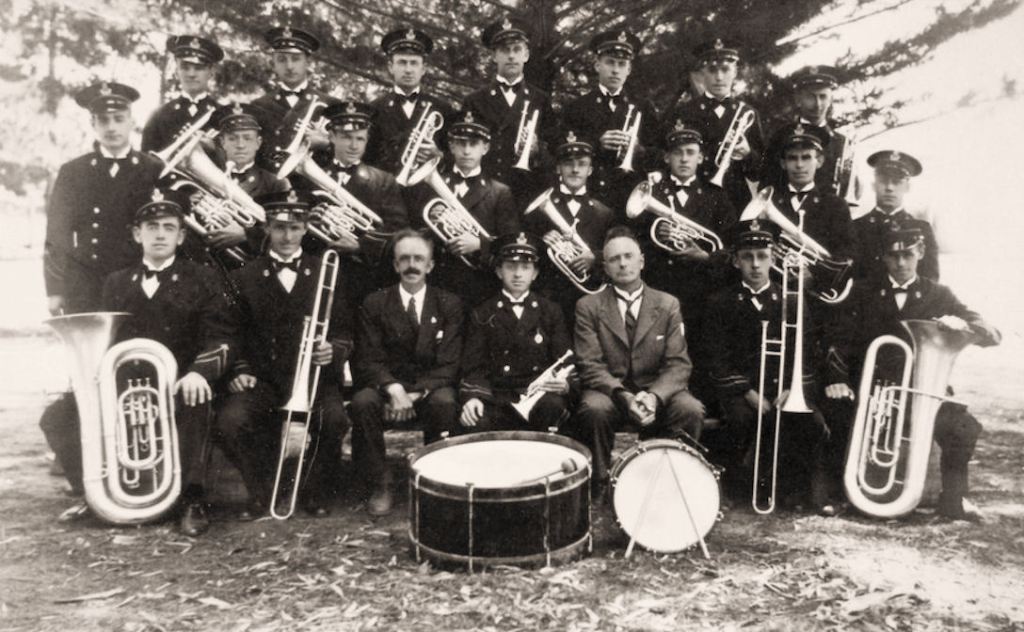
Photograph: Phillip Island Brass Band, 1932. (Source: IBEW)

The opening day of the band contest was a spectacular affair with the Royal South Street Society having programmed all events down to the minute.  According to various newspaper articles, 10,000 people attended the opening day at Ballarat’s City Oval, no doubt drawn to the fact that the Duke of Gloucester would be there to officially open the contest.  The souvenir programme outlined the proceedings of the day as can be seen below.
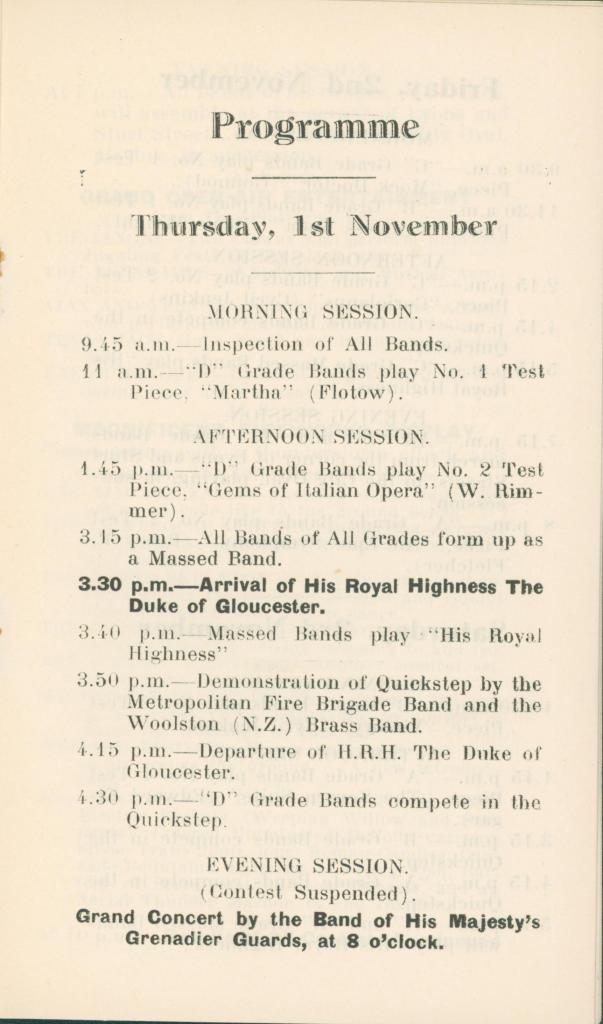
Programme: South Street “Centenary” Brass Band Contest, 1934, p. 6.
(Source: Victorian Collections: Victorian Bands’ League Archives)

In superb weather, everything proceeded to plan, and the bands did their best to produce a ceremony befitting the occasion (“BAND CONTESTS,” 1934).  There was a massed band performance, a demonstration of the quickstep, and the Woolston Brass Band even performed a haka for the Duke after the march past of the bands (“DUKE AT BALLARAT,” 1934).  That night, the Band of HM Grenadier Guards performed in a concert which would have inspired the bandsmen and audience (Royal South Street Society, 1934e). 

Results for the contests were announced on Saturday 3rd of November with another 10,000 people attending to find out the placings.  The full results will not be detailed in this post due to space, but they can be found on the RSSS results database via these links:

The Solo contests were held a day before the band sections on the 31st of October.  The results of these can be found on the RSSS database via the link:

By all accounts, the standard of playing across all sections was brilliant and the adjudicator was very impressed.  The A Grade section in particular was a very hard fought affair, but in the end, the Melbourne Fire Brigade Band won the Besson Shield for the third year in a row (Royal South Street Society, 1934a).  The Woolston Brass Band from N.Z. suffered some misfortune when one of their cornet players became ill – the other A Grade bands offered them a choice of cornet players to help out – however, they decided to proceed down a player and were happy to achieve third place (“BRILLIANT PLAYING,” 1934; “PROVINCIAL CITIES AND TOWNS.,” 1934b). 

The Duke of Gloucester and the Band of the Grenadier Guards did not stay long in Ballarat as they kept up a tight schedule of touring around Victoria and eventually New Zealand.  For the bands themselves there were good stories of their visits to Ballarat.  The Yallourn and District Band from Gippsland was one band that was very proud of their efforts in the B Grade section where they achieved second place behind the City of Ballarat Band (“YALLOURN NEWS,” 1934).  Of interest is that in early 1935, three cornet players from Victorian bands, including cornetist Jack Allan of the City of Ballarat Band, were offered places in the Band of the Grenadier Guards (“Ballarat Bandsman Invited To Join Grenadier Guards,” 1935).  It is unclear whether they took up that offer.

The 1934 South Street contest was no doubt an important part of Victoria’s Centenary celebrations, but it was not the only part.  There were other important events taking place.

Events after South Street:

11th of November, 1934: Dedication of the Shrine of Remembrance, Melbourne:

Postcard: The National War Memorial of Victoria. Aerial View of Dedication Ceremony, 11/11/1934. (Source: Jeremy de Korte Collection)

For the Duke of Gloucester, he kept up a busy schedule around Victoria.  However, his most important engagement was the dedication of Melbourne’s newly completed Shrine of Remembrance.  This was a very special occasion which was attended by thousands of veterans, people, and important dignitaries.  Bands and other musicians also played an important role, and at the dedication, several Australian Army buglers sounded the Last Post standing behind Royal Australian Navy drummers.

Portland Centenary Band Contest:

The town of Portland in the far south-west of Victoria had an important part to play in Victoria’s centenary celebrations.  In turn, they staged their own band contest, albeit on a much smaller scale than the South Street contests which had concluded only two weeks earlier (“BAND CONTESTS.,” 1934).  The Portland contest was only attended by bands from Hamilton, Heywood and Mt. Gambier, and there was a pipe band contest held at the same time.  The Portland contest was won by the band from Mt. Gambier and the adjudicator was Mr. Percy Jones (“Band Contest Won By Mount Gambier,” 1934).

Melbourne Centenary Band Championship, King’s Birthday weekend, June 1935:

The Victorian centenary celebrations stretched into 1935, and a Melbourne Centenary Band Championship was held at the Exhibition Buildings under the auspices of the Victorian Bands’ League.  Like the South Street contests, this was another great event for bands, and twenty-one bands participated, as listed in the article below.
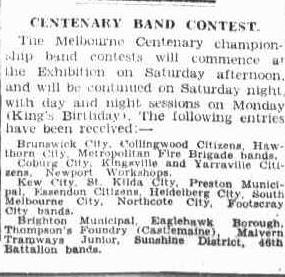
The Age, 28/05/1935, p. 11

The main attraction of this event was a grand parade from Alexandra Avenue to the Exhibition Buildings and quickstep display on the Exhibition oval (“CENTENARY BAND CONTESTS,” 1935).  Again, the A Grade section continued the rivalries between Hawthorn, Melbourne Fire Brigade, Brunswick and Collingwood bands, with Hawthorn taking out the A Grade title (“CENTENARY GALA WEEK.,” 1935).  Another celebrated win was that of the Malvern Junior Tramways Band when they won their third D Grade title in a row.
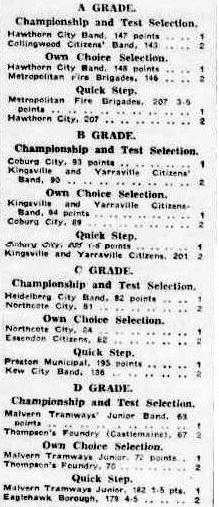
The Age, 04/06/1935, p. 10

Conclusion:

What an intense period of activity for bands!  It is times like these that our bands came to the fore with all the ceremonial and contest activity, as well as local celebrations.  No doubt the communities appreciated the efforts and the entertainment.  Having a visiting band of the calibre of the Band of the Grenadier Guards made the Centenary celebrations even more special, and it was noted at the time that they were inspiring to local musicians.  The prevailing feeling when all was done was one of accomplishment, not just from the cooperation that made this all happen, but from all that understood the significance of the events.  It is not every day that a world-class military band and a Duke visits a band contest.

References:

BALLARAT AND DISTRICT. (1934, 08 June). Argus (Melbourne, Vic. : 1848 – 1957), 3. http://nla.gov.au/nla.news-article10944624

Ballarat Bandsman Invited To Join Grenadier Guards. (1935, 16 January). Sunraysia Daily (Mildura, Vic. : 1920 – 1950), 5. http://nla.gov.au/nla.news-article265838073

Band Contest For Centenary. (1933, 25 February). Sun News-Pictorial (Melbourne, Vic. : 1922 – 1954; 1956), 4. http://nla.gov.au/nla.news-article277163952

Band Contest Won By Mount Gambier : Judge’s Eulogistic Comments. (1934, 22 November). Portland Guardian (Vic. : 1876 – 1953), 4. http://nla.gov.au/nla.news-article64287397

BAND CONTESTS : OPENING AT BALLARAT. (1934, 02 November). Mercury (Hobart, Tas. : 1860 – 1954), 14. http://nla.gov.au/nla.news-article29165635

BAND CONTESTS : Three Bands Competing. (1934, 19 November). Portland Guardian (Vic. : 1876 – 1953), 5. http://nla.gov.au/nla.news-article64287383

BRILLIANT PLAYING : Ballarat Band Contest. (1934, 05 November). Evening Post, 9. https://paperspast.natlib.govt.nz/newspapers/EP19341105.2.61

British Pathé. (2014, 13 April). Melbourne Centenary (1934) [Video (Film Clip)]. YouTube. Retrieved 11 October 2024 from https://www.youtube.com/watch?v=C4DWQpyx4O0

Brown, S. L. (2015, 01 July). Victoria Day: Was secret gold behind 1851 separation from NSW? ABC Radio Melbourne,6584322. https://www.abc.net.au/news/2015-07-01/victoria-day-was-secret-gold-behind-separation/6584322

CENTENARY BAND CONTEST. (1935, 28 May). Age (Melbourne, Vic. : 1854 – 1954), 11. http://nla.gov.au/nla.news-article204361353

CENTENARY BAND CONTEST : Arrangements for Opening. (1934, 18 January). Age (Melbourne, Vic. : 1854 – 1954), 9. http://nla.gov.au/nla.news-article203377704

CENTENARY BAND CONTEST : Finals in Ballarat. (1933, 05 June). Argus (Melbourne, Vic. : 1848 – 1957), 9. http://nla.gov.au/nla.news-article4740383

CENTENARY BAND CONTEST : Proposed Opening by Prince George. (1934, 23 February). Age (Melbourne, Vic. : 1854 – 1954), 10. http://nla.gov.au/nla.news-article203376669

CENTENARY BAND CONTESTS. (1935, 31 May). Sunshine Advocate (Vic. : 1924 – 1954), 3. http://nla.gov.au/nla.news-article74757883

CENTENARY BAND CONTESTS : Mildura Band to Make Trip. (1934, 27 April). Sunraysia Daily (Mildura, Vic. : 1920 – 1950), 4. http://nla.gov.au/nla.news-article265690603

CENTENARY BAND CONTESTS : South-Street Prize Money. (1934, 13 April). Age (Melbourne, Vic. : 1854 – 1954), 7. http://nla.gov.au/nla.news-article203842698

CENTENARY GALA WEEK : BAND CONTESTS DECIDED : HAWTHORN CITY WINS A GRADE CHAMPIONSHIP : Malvern Tramway Juniors’ D Grade Treble. (1935, 04 June). Age (Melbourne, Vic. : 1854 – 1954), 10. http://nla.gov.au/nla.news-article204345548

CENTENARY PLANS TAKE SHAPE : Pageants, Exhibitions And Shrine Dedication : BIG MILITARY TATTOO. (1933, 11 May). Herald (Melbourne, Vic. : 1861 – 1954), 5. http://nla.gov.au/nla.news-article243112151

COLDSTREAM GUARDS BAND : Victorian Bandsmen Eager For Visit. (1933, 01 September). Argus (Melbourne, Vic. : 1848 – 1957), 8. http://nla.gov.au/nla.news-article11688130

de Korte, J. D. (2018a, 12 July). The A.B.C. Military Band: an ensemble of the times. Band Blasts from the Past: Anecdotes, Stories and Personalities. https://bandblastsfromthepast.blog/2018/07/12/the-a-b-c-military-band-an-ensemble-of-the-times/

de Korte, J. D. (2018b, 14 October). International band tours of the early 1900’s: bringing music to Australia. Band Blasts from the Past: Anecdotes, Stories and Personalities. https://bandblastsfromthepast.blog/2018/10/14/_international-band-tours-of-the-early-1900s-bringing-music-to-australia/

de Korte, J. D. (2018c, 15 March). The politics of affiliation: The Victorian Bands’ Association to the Victorian Bands’ League. Band Blasts from the Past: Anecdotes, Stories and Personalities. https://bandblastsfromthepast.blog/2018/03/15/the-politics-of-affiliation-victorian-bands-association-to-the-victorian-bands-league/

de Korte, J. D. (2019, 31 January). Bands on Australian islands: unique challenges in unique environments. Band Blasts from the Past: Anecdotes, Stories and Personalities. https://bandblastsfromthepast.blog/2019/01/31/bands-on-australian-islands-unique-challenges-in-unique-environments/

de Korte, J. D. (2020, 18 October). Testing times: the resilience of Australian bands during the Great Depression. Band Blasts from the Past: Anecdotes, Stories and Personalities. https://bandblastsfromthepast.blog/2020/10/18/testing-times-the-resilience-of-australian-bands-during-the-great-depression/

DEPARTURE OF H.M.S. SUSSEX. (1934, 09 October). West Australian (Perth, WA : 1879 – 1954), 17. http://nla.gov.au/nla.news-article32803514

DUKE AT BALLARAT : AMONG THE BANDS : A WOOLSTON HAKA. (1934, 02 November). Evening Post, 10. https://paperspast.natlib.govt.nz/newspapers/EP19341102.2.102.1

Duke of Gloucester to Come Here for Centenary Celebrations : AFRICAN TOUR TIRED PRINCE GEORGE. (1934, 05 May). Weekly Times (Melbourne, Vic. : 1869 – 1954), 5. http://nla.gov.au/nla.news-article223836381

FAMOUS BAND EXPECTED : Grenadier Guards for Centenary. (1934, 05 June). Herald (Melbourne, Vic. : 1861 – 1954), 1. http://nla.gov.au/nla.news-article243175540

GRENADIER GUARDS BAND. (1934, 25 October). Great Southern Advocate (Korumburra, Vic. : 1889 – 1906, 1914 – 1940), 5. http://nla.gov.au/nla.news-article255918717

GRENADIER GUARDS BAND HAS WONDERFUL WELCOME. (1934, 22 October). Age (Melbourne, Vic. : 1854 – 1954), 15. http://nla.gov.au/nla.news-article205884483

Grenadier Guards’ Band. (1934, 27 August). Age (Melbourne, Vic. : 1854 – 1954), 13. http://nla.gov.au/nla.news-article205524735

GUARDS’ BAND VISIT : Centenary Tour Almost Certain. (1933, 10 October). Age (Melbourne, Vic. : 1854 – 1954), 8. http://nla.gov.au/nla.news-article205104515

Kingtson, C. (Ed.). (1934). Grenadier Guards Band : Australia and New Zealand 1934-5 : By Special Permission of His Majesty the King : Official Souvenir : Tour under the Auspices of the Commonwealth Government and the New Zealand Government : In associaion with the Cenenary Celebrations Council of Victoria  [Printed programme]. Grenadier Guards Band. 

Kneller Hall. (1934, 27 July). THE BANDS : News and Views : WELLINGTON AND BALLARAT. Dominion, 13. https://paperspast.natlib.govt.nz/newspapers/DOM19340727.2.98

McCubbin, M. (2008). Centenary. In eMelbourne: the city past & present (pp. EM00316b). https://www.emelbourne.net.au/biogs/EM00316b.htm: The University of Melbourne, School of Historical & Philosophical Studies.

Melbourne Day. (2024). More marvellous than ever: FAQs: What is Melbourne Day? Melbourne Day: 30th August. Retrieved 26 October 2024 from https://www.melbourneday.com.au/about.html

Mildura & District Band, 1930s. (1930). [Photograph]. [phot6314]. The Internet Bandsman Everything Within, Vintage Brass Band Pictures – Australia. http://www.ibew.org.uk/vbbp-oz.html

Musician. (1933, 11 September). GUARDS’ BAND VISIT. Herald (Melbourne, Vic. : 1861 – 1954), 6. http://nla.gov.au/nla.news-article243423748

NEW ZEALAND BAND TO VISIT MELBOURNE. (1933, 13 October). Telegraph (Brisbane, Qld. : 1872 – 1947), 27. http://nla.gov.au/nla.news-article180593124

Phillip Island Brass Band, 1932. (1932). [Photograph]. [phot16005]. The Internet Bandsman Everything Within, Vintage Brass Band Pictures – Australia. http://www.ibew.org.uk/vbbp-oz.html

Pleasant Street School Band, Ballarat, 1933. (1933). [Photograph]. [phot20817]. The Internet Bandsman Everything Within, Vintage Brass Band Pictures – Australia. http://www.ibew.org.uk/vbbp-oz.html

PROVINCIAL CITIES AND TOWNS : BALLARAT. (1934a, 29 October). Age (Melbourne, Vic. : 1854 – 1954), 13. http://nla.gov.au/nla.news-article205882825

PROVINCIAL CITIES AND TOWNS : BALLARAT. (1934, 05 November). Age (Melbourne, Vic. : 1854 – 1954), 12. http://nla.gov.au/nla.news-article205083970

Royal South Street Society. (1934a). 1934-10-31 Brass Band Solos : Held at the A.N.A. Hall, Camp Street [Eisteddfod Results]. Royal South Street Society Results Database. https://results.royalsouthstreet.com.au/results/1934-10-31-brass-band-solos 

Royal South Street Society. (1934b). 1934-11-01 Brass Band Contests : Held at City Oval : Grand Champion Centenary Band Contests [Eisteddfod Results]. Royal South Street Society Results Database. https://results.royalsouthstreet.com.au/results/1934-11-01-brass-band-contests 

Royal South Street Society. (1934c). 1934-11-02 Brass Band Contests  : Held at City Oval [Eisteddfod Results]. Royal South Street Society Results Database. https://results.royalsouthstreet.com.au/results/1934-11-02-brass-band-contests 

Royal South Street Society. (1934d). 1934-11-03 Brass Band Contests  : Held at City Oval [Eisteddfod Results]. Royal South Street Society Results Database. https://results.royalsouthstreet.com.au/results/1934-11-03-brass-band-contests 

Royal South Street Society. (1934e). [South Street “Centenary” : Brass Band Contest : A, B, C and D Grades]. In S09 – Programs (Printed programme ed., pp. 14). Ballarat, Victoria https://victoriancollections.net.au/items/5d425e0c21ea6b1a84382033: Victorian Bands’ League Archive.

Royal South Street Society. (1979). Royal South Street Society : The First One Hundred Years. Royal South Street Society. 

ShrineMelbourne. (2013, 09 January). The Dedication of the Shrine of Remembrance – Remembrance Day 11 November 1934 [Video (Film Clip)]. YouTube. Retrieved 26 October 2024 from https://www.youtube.com/watch?v=jHcaXEpVdRA

Sunraysia, Land of Sunshine Greets The Duke : Prince Henry Is Our First Royal Guest. (1934, 31 October). Sunraysia Daily (Mildura, Vic. : 1920 – 1950), 21. http://nla.gov.au/nla.news-article265829018

The Shrine of Remembrance Trustees. (1934). The National War Memorial of Victoria : Aerial View of Dedication Ceremony [Postcard]. [No. 3]. The Shrine of Remembrance Trustees, Great Britain. 

To Visit Australia. (1934, 13 October). Dominion, 13. https://paperspast.natlib.govt.nz/newspapers/DOM19341013.2.116.5

Victoria’s Centenary. (1932, 06 November). Scrutineer and Berrima District Press (NSW : 1892 – 1948), 4. http://nla.gov.au/nla.news-article125232791

Victoria’s Centenary. (1933, 04 November). Record (Emerald Hill, Vic. : 1881 – 1954), 2. http://nla.gov.au/nla.news-article164468392

Victoria’s Centenary. (1934, 12 April). Chronicle (Adelaide, SA : 1895 – 1954), 39. http://nla.gov.au/nla.news-article92354462

VISIT TO BALLARAT : Desired for Band Competition. (1934, 01 March). Age (Melbourne, Vic. : 1854 – 1954), 10. http://nla.gov.au/nla.news-article203834255

YALLOURN NEWS : Yallourn Band. (1934, 08 November). Morwell Advertiser (Morwell, Vic. : 1888 – 1954), 9. http://nla.gov.au/nla.news-article71564079
For bands and for community: admire the rotunda

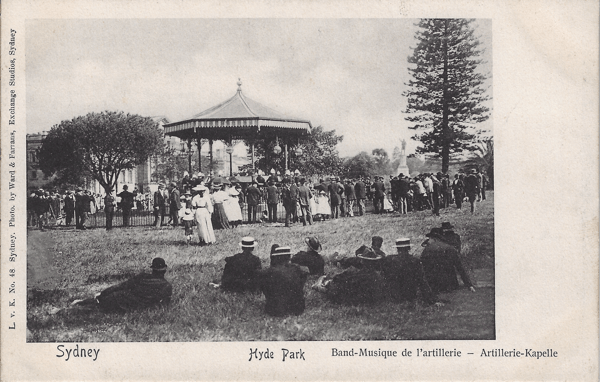
Postcard: Artillery Band playing at the Band Rotunda, Hyde Park, Sydney. (Date unknown) (Source: Jeremy de Korte collection)

Introduction:

They stand in parks and gardens throughout Australia as monuments to public entertainment before the days of broadcasting music through the wireless.  A source of civic pride, they are of a distinct purpose, yet cover a very wide variety of design and architecture.  They were built as memorials to musicians, royalty and service personnel, for bands and bandmasters, and also for the towns.  If there is one structure that provides a perfect linkage between a locality, people and a band it would have to be the band rotunda.

Nowadays, as it was when they were first built, we take pride in their aesthetic appeal.  They may not be used as performance platforms anymore as the bands they once served are no longer in operation.  Nevertheless, they still stand, often painted in heritage colours and with plaques on the sides we can learn of the story a rotunda.  A source of fascination for many.

The band rotundas have been a focus for academic and local studies over time as they can help tell parts of the history of architecture and music in this country.  This post is not seeking to replicate the valuable work that has already been completed in documenting band rotundas.  However, there are numerous little stories that can be told, and this post will seek to complement previous work, as well as display numerous photographs.

At the head of this post is a postcard showing an Artillery Band playing at the Hyde Park band rotunda with people watching around the sides, obviously appreciating the playing.  This idyllic scene could have been repeated anywhere when bands played at the local rotunda.  Suffice to say, with growing preservation and appreciation of these structures, as well as the building of new rotundas, music is being heard once again; the old is back in fashion.

History not forgotten:

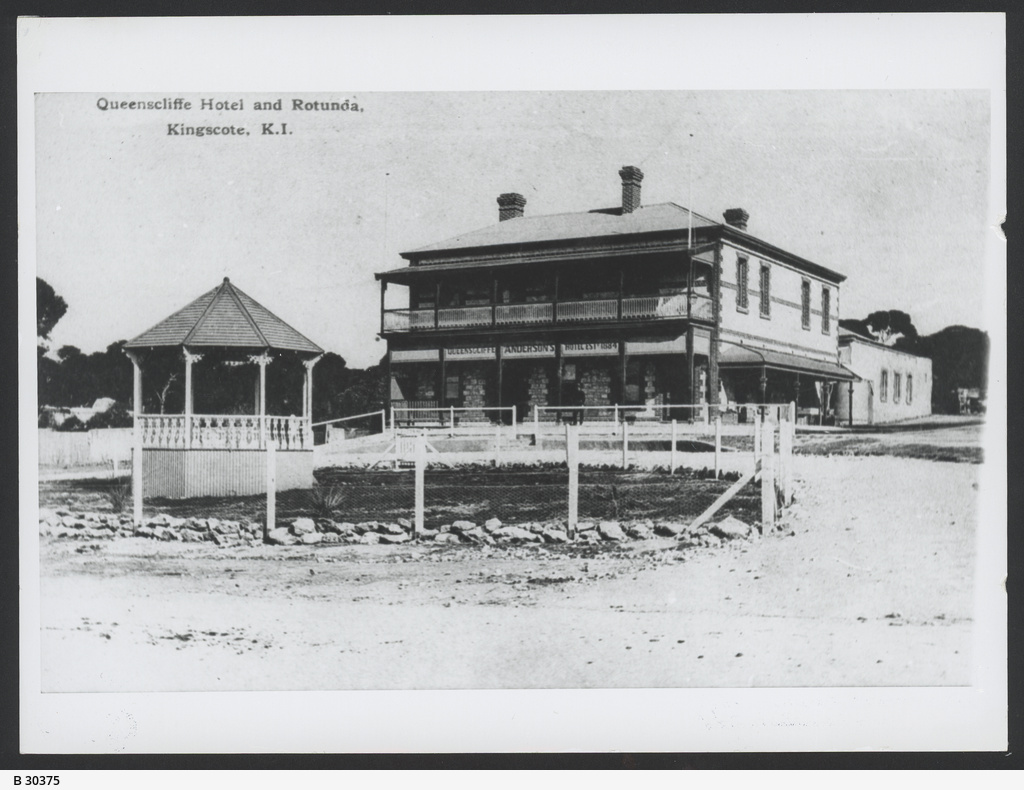
Queenscliffe Hotel and Rotunda, Kingscote, Kangaroo Island (Source: State Library of South Australia: B+30375)

Much has been written and studied about band rotundas in Australia, and all of it is worthwhile information.  The rotundas are the subject of many photos and postcards, and, as mentioned, they have also informed some of the history of architecture.  There are too many rotundas in Australia for this post and other writing to do them all justice, which is unfortunate.  Regarding academic study, Tracy Videon documented the history of rotundas in Victoria for her Master of Arts thesis (Videon, 1996).  This thesis has been cited in other heritage studies by local councils, for example, the Shire of Mount Alexander (Jacobs et al., 2004/2012).  

Interest in the rotundas has also been displayed periodically on social media with the advantage of having other like-minded people post and link their own stories.  In 2017, Michael Mathers posted on Facebook about the rotunda in Kew that he used to play at with the Kew Band and invited responses from other people (Mathers, 2017).  I have also posted on Facebook regarding band rotundas through displaying parts of my historical collection of postcards – one post relating to the postcard of the Artillery Band at Hyde Park, Sydney (de Korte, 2020c).  Through communication with band historians on Facebook, other resources have come to light such as the book, ‘Band Rotundas South Australia’ written by Brenton Brockhouse, historian of the Campbelltown City Band in Adelaide where he documented all the band rotundas in South Australia (Brockhouse, 2016).

Postcard: Main Street Gardens and Band Rotunda, Bairnsdale, Victoria (Date unknown) (Source: Jeremy de Korte collection)

Perhaps the most important resource that has been created about band rotundas in recent years is the book, ‘Pavilions in Parks : Bandstands and Rotundas Around Australia’ by Allison Rose with photographs by Belinda Brown.  This book is very useful as it details the architecture and design of each rotunda and highlights the history and civic pride (Rose, 2017).  It is understandable that Rose could not cover every rotunda in Australia.  However, she does tell us how she made choices by saying that each rotunda in her book was “chosen for architectural, historical or social significance” (Rose, 2017, p. 5).  Importantly she also states that the word “Bandstand” is used to describe its “major function” but is also known as a “rotunda, pavilion or, in earlier times, kiosk or orchestra.” (Rose, 2017, p. 5).  

In terms of the history of this building type, Rose informs us that its history is long and examples can be found in classical Greece, 7th Century Persia and 16th & 17th Century India (Rose, 2017).  The designs of these early structures were replicated in England in the 1800s and from this came the development of bandstands which were used for musical performances (Rose, 2017).  And as Rose (2017) tells us, the location and function of a bandstand was important.

A bandstand in the park had a useful social purpose.  It brought music to many people who would have no other opportunity to hear it, it was a way to meet old friends and for the young to find new friends

(p. 7)

In Australia, the custom of the time was to follow the traditions and architecture of the British homeland and to this end, they proliferated across the country.  As in England, the purpose of these rotundas was the same and they also gave new opportunities for people to hear music.

The concert in the town bandstand was often the only opportunity for people to hear live music as well as to socialise.

(Rose, 2017, p. 12)

Regarding building materials, many rotundas were built using cast iron columns and lacework which later evolved into timber features (Rose, 2017).  They were mainly built up until the First World War and in between wars, the building of bandstands “almost came to a halt” (Rose, 2017, p. 16).

After the Second World War, the building of outdoor performance spaces was dominated by concrete “sound shells” of which some were “well-designed, but others were extremely ugly” (Rose, 2017, p. 16).  Thankfully, Rose details in her history that the appreciation of rotundas was noted in the 1980s and many rotundas were saved from demolition, and in many localities, they have found new uses for them.

Today, there is interest in bandstands for their practical uses as well as their decorative function and towns and suburbs are building new bandstands.  Some are in Federation style, others provide a more contemporary home for today’s musical events…

(Rose, 2017, p. 16)

We are lucky that so many rotundas have been preserved for the current generations to enjoy.

Bands and Rotundas:

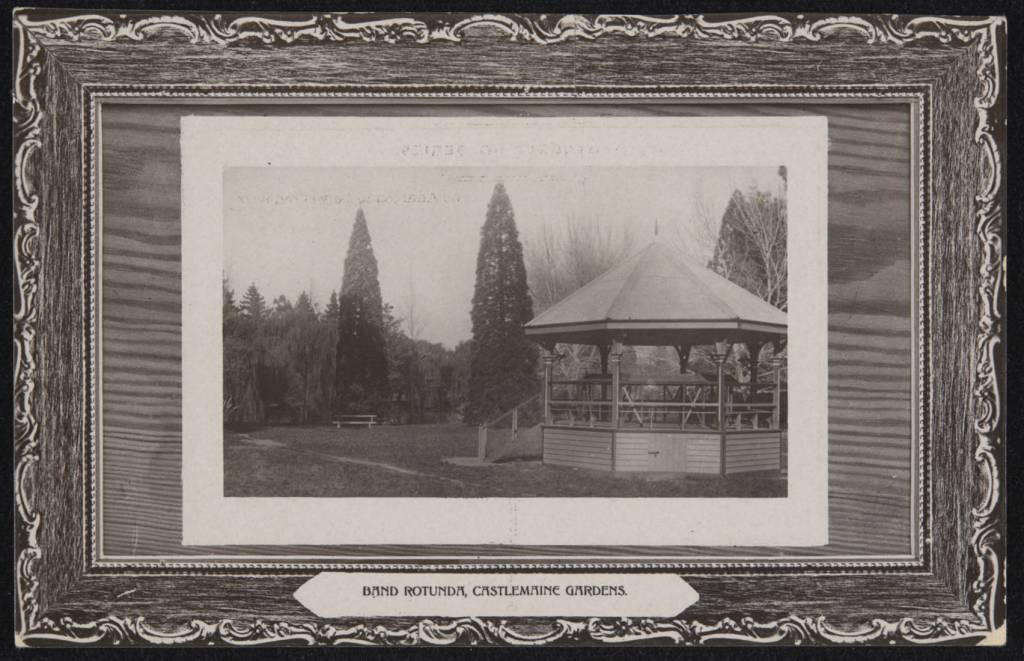
Postcard: Band Rotunda, Castlemaine Gardens (Source: National Museum of Australia: 140044)

There is a synonymous relationship between bands, rotundas and local communities.  A locality expresses pride through a band, but the band needs a place to perform on a regular basis.  A rotunda is then built for the benefit of the town band and the community and the rotunda becomes focal point for the community.  There is more to this of course and with each rotunda that has been built and survives, “each has a story to tell.” (Rose, 2017, p. 5).  

A letter written by a person with a pseudonym “A Lover of Music” was published in the Mount Alexander Mail newspaper on the 23rd of January 1893 to berate the local council over the lack of a permanent rotunda in Castlemaine.  

Sir, – I have often wondered that Castlemaine has been so long without a suitable place for the band to perform in.  I can’t understand why the Council have not sufficient enterprise to erect a “rotunda” in the Botanical Gardens.  Every concert in the Gardens necessitates the erection of a temporary platform.  It has struck me that as our worthy Mayor is a Welshman – and, of course, fond of music – it would be a graceful act on his part to have erected a rotunda worthy of our town and of the band, and to present it to the Council. […] I trust that the Mayor and Councillors will see that very soon our splendid band will have a proper place to perform in.  My main object in mentioning this matter is to show my appreciation of the band.

(A Lover of Music, 1893)

It took another five years, but finally in 1898 a band rotunda was built in the Castlemaine Botanical Gardens where it was opened by the Mayor with a concert presented by the Thompson’s Foundry Band (“CASTLEMAINE.,” 1898).  A rotunda still exists in the gardens to this day.

In 1909, a rotunda that was described as “commodious and ornate” was opened in the town of Nhill in Western Victoria by the Mayor and some local parliamentarians (“NHILL.,” 1909).  The Nhill Town Band was said to be in “high feather” about the new rotunda and during the concert, some bandsmen also demonstrated how civic minded they were by leaving the bandstand to help with a nearby house fire (“NHILL.,” 1909).  The Nhill band rotunda is very much a civic landmark and was refurbished in 2018 by the local council (Hindmarsh Shire Council, 2018).

Some rotundas were not built by the local councils or bands and it is interesting to find an example of a rotunda that was built by a private company for the use of the local band and the town.  The Portland Brass Band from New South Wales was the beneficiary of this investment when the local cement company, which supported the band as well, built a band rotunda in Portland.

The band rotunda, recently erected by the cement company for the use of the band, was officially opened on Saturday night by Dr. A. Scheidel, the managing director.  Mr. J. Saville, the works manager, was also present.  The bandsmen were in uniform, and when all were assembled, the doctor switched on the light and addressed the bandsmen.  He said that the rotunda had been erected by the company as an appreciation of their efforts.  He hoped that they would see that no injury would be done to the building, and looked to the townspeople generally to assist with that object.

(“BAND ROTUNDA FOR PORTLAND.,” 1910)

This article, which was published in the Lithgow Mercury newspaper, also provided an excellent description of this newly built structure.

The bandstand is a very neat structure, octagonal in shape.  It is nicely painted in two shades of green, relieved with white.  It is lit with eleven incandescent electric lights of sixteen candle power each.  Eight of these are arranged round the sides, while a group of three is suspended from the centre of the ceiling.  When lit up, it presented a very brilliant appearance.

(“BAND ROTUNDA FOR PORTLAND.,” 1910)

A photograph of the original rotunda can be found on the Facebook page of the Lithgow & District Family History Society Inc. (2015).  In 2017 a new rotunda was opened in Portland where the local parliamentarian is quoted in an article published by the Lithgow Mercury newspaper.

The rotunda is a reflection of the past, of Portland’s history with the original structure providing a backdrop for many events and occasions when the community came together to enjoy music by the local band.

I have no doubt the new rotunda will provide a great place for the local band to again deliver some fantastic events to the residents of Portland.  It will enhance the landscape of the surrounding park, provide a comfortable place to sit, relax and enjoy music from a band or perhaps even a string quartet.

(Toole in “Portland’s bandstand rotunda is officially opened for all.“, 2017)

These sentiments sound very familiar to those of times past.

Commemorative rotundas:

Sydney Morning Herald, 17/05/1924, p. 13

Often, rotundas were built to serve a commemorative function in addition to their stated purpose.  We can see an example above in this rotunda from Wollongong which was built to commemorate the landing of “Bass and Flinders in 1796” (“MEMORIAL TO NAVIGATORS.,” 1924).  This of course is a commemoration to a very old event; however other rotundas were built to commemorate much more recent events.

In 1917, an article published in the Pinnaroo and Border Times agitated for a rotunda to be built in town which would benefit the town band (“Band Rotunda Wanted.,” 1917).  The writer of this article is very eloquent in his words, and ties in town support for the Pinaroo Brass Band as a key element in wanting a rotunda for them to perform in. 

The town owes a duty to these unselfish bands of musicians who give their services gratis and pay fees for the privilege of doing so.  No complaint emanates from the members on this score, but that they are entitled to practical help – which may be given by a strong roll of honorary membership – cannot be refuted.  An opportunity now presents itself of showing this appreciation by inaugurating a movement for a rotunda which many country towns possess.  Not only would a rotunda facilitate and render more comfortable outdoor playing, but the music could be heard to a greater advantage, and the building, if artistically designed, would be a welcome ornament to the Show ground or any other favourable site. 

(“Band Rotunda Wanted.,” 1917)

The Pinnaroo Band Rotunda was eventually built in 1922 to commemorate people of the district that saw service during World War One  (Virtual War Memorial Australia, n.d.).  In 1935 it was renovated and extensive repainting was undertaken, as well as other sundry repairs in the vicinity (“BAND ROTUNDA RENOVATED,” 1935).  The band rotunda still stands to this day.

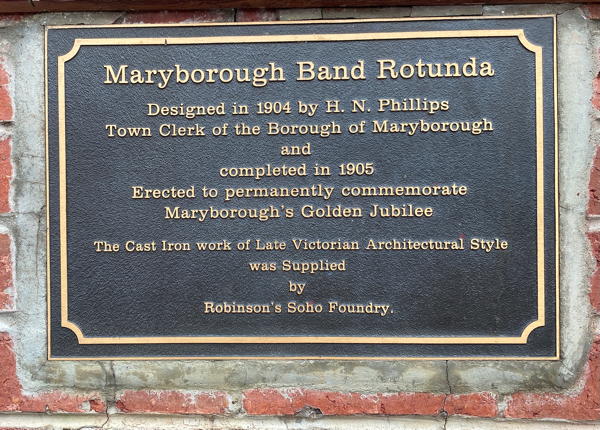
Band rotunda, Maryborough, Victoria. Photograph taken by Jeremy de Korte, September 2020.

The band rotunda at Maryborough in Victoria is another interesting example.  This structure was built in 1904 and as the plaque below reads, this was built to commemorate Maryborough’s Golden Jubilee.  As a band rotunda, this is one of the more ornate examples that exist.

Band rotunda plaque, Maryborough, Victoria. Photograph taken by Jeremy de Korte, September 2020.

In the township of Merbien, a little way west of Mildura in the far North-West of Victoria, a band rotunda was built to commemorate King George V who died in 1936.  The postcard below shows us what it was like in its early days, and the events of when it was opened in 1937 were documented in an article published by the Argus newspaper.

…To-day the third day of the jubilee celebrations was a quiet day for Mildura, but Merbien was the centre of intense activity.  A dense crowd gathered in Kenny Park for the unveiling of the King George V. Memorial by the Postmaster-General Senator McLachlan.

[…]

Senator McLachlan said it was a tribute to the people of Merbien that they had erected such a fine memorial to a King whose influence was for righteousness and peace. 

(“MEMORIAL TO KING GEORGE,” 1937)
Postcard: Band Rotunda, Merbien, Victoria, 1937. (Source: Jeremy de Korte collection)
Bathurst Times, 13/09/1915, p. 2

One of the more famous band rotundas that was built to commemorate an event is the Titanic Memorial Band rotunda in Ballarat.  Allison Rose has documented this rotunda in her book, and this rotunda is the focus of a commemorative event each year.  The opening of this rotunda was noted all over Australia, especially because the costs of erecting this structure was due to bandsmen from all over the country contributing a subscription (“Local and General.,” 1915).  The Evening Echo newspaper from Ballarat described the opening of the memorial in an article published in October 1915.

This memorial has been built to commemorate the heroic bandsmen of the White Star liner Titanic (45,000 tons), which met her doom by striking an iceberg in the Atlantic two years ago.

It is on record that the ships band mustered on deck and played “Nearer My God to Thee,” and then went down with the ship, all of them being lost.  When the news of their sublime courage reached Australia the idea immediately occurred to some one that the bandsmen of Australia should place on permanent record their appreciation and it was suggested that I should take the form of a memorial bandstand.

(“TITANIC MEMORIAL.,” 1915)
Titanic Memorial Bandstand, Ballarat, Victoria. Photograph taken by Jeremy de Korte, June 2019

It is no accident that this memorial bandstand was erected in Ballarat as it was, by this time, regarded as one of the band centres of Australia thanks to the South Street events (Rose, 2017).  Indeed, when this memorial was opened in October 1915, the South Street events were well-underway and there was no shortage of bands in town to combine in a massed band conducted by Albert Wade  (“TITANIC MEMORIAL.,” 1915).  Interestingly, as Rose (2017) tells us, 

It is unique among the bandstands of Australia in being a memorial to the Titanic bandsmen.  The citizens of Broken Hill attempted to build such a bandstand, but they could not raise sufficient funds by public subscription.  With the money raised they had to settle for a broken column memorial that now stands in Sturt Park in Broken Hill.

(p. 80)
Titanic Memorial Bandstand commemorative stone, Ballarat, Victoria. Photograph taken by Jeremy de Korte, June 2019

Proposals, building and public opinion:

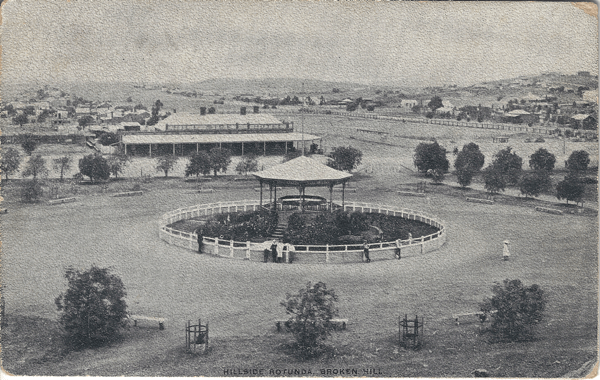
Postcard: Hillside Rotunda, Broken Hill, N.S.W. (Date unknown) (Source: Jeremy de Korte collection)

In the early years when building band rotundas was a fashionable thing to do, many proposals were submitted to local councils, and some were for alterations to existing precincts.   Civic pride accounted for the fact that many proposals were accepted – although there were some who objected.  Finding an objectionable letter to any rotunda was rare.  In 1907 a Mr Angove of Albany, Western Australia expressed surprise that the local council was going ahead with the building of a rotunda in Lawley Park (Angove, 1907).  His letter, published in the Albany Advertiser newspaper, mainly raised the question of expense, of why the council was diverting funds to a rotunda instead of other “urgent works” (Angove, 1907).  An understandable attitude at the time.

Proposals for band rotundas, as has been seen earlier in this post, mainly appealed to the goodwill of councils and the public, and drew in the needs of the local bands as well.  For example, we can see in articles regarding proposals in Dandenong, Victoria, and Wallaroo, South Australia that detail how this kind of appeal was expressed (“A Band Rotunda Proposed.,” 1917; “WALLAROO ROTUNDA.,” 1925).

Input from bandsmen was also noted in the early newspapers, as they had more of a vested interest. “A Bandsman” from Scottsdale, Tasmania, wrote a letter to the North-Eastern Advertiser newspaper in November 1919 to complain about the proposed site of the new rotunda – (in summary) it was going to be too close to other buildings and out of sight – why not place it in a park? (A Bandsman, 1919).  Likewise, “Carbolic” wrote to his local newspaper to congratulate the Glenelg Town Band on their recent performance, but advocated for the moving of the band rotunda to a more suitable location because of acoustics – there were nearby walls that affected the sound projection (Carbolic, 1918).

Maintenance was another issue (and an ongoing issue).  While some were proactive about maintaining rotundas, it seems that some were not so proactive.  In Broken Hill, a Mr H. R. Boyce wrote to the Barrier Miner newspaper to complain about creepers that were growing over the rotunda in the Central reserve (Boyce, 1923).  The rotunda in Healesville faced a different maintenance issue in 1941 when lightning struck the rotunda which shattered a flagpole (“BAND ROTUNDA STRUCK BY LIGHTNING,” 1941).  And in 1950 we find that the Brisbane City Council was unable to maintain rotundas to a satisfactory standard due to a lack of materials and labour (“CAN’T REPAIR BANDSTANDS,” 1950).

The Argus, 16/01/1941, p. 5

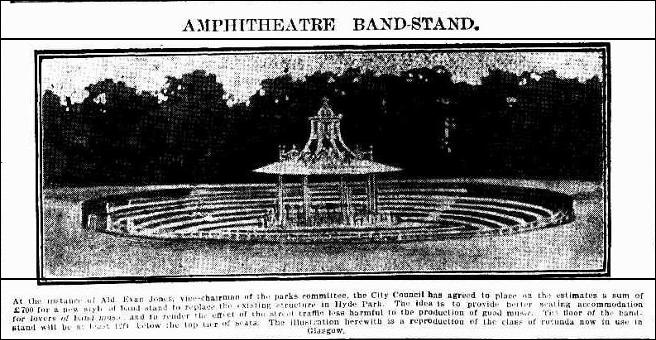
To finish this section, there were two pictures from newspaper articles that caught my attention.  The first is a picture published in the Daily Telegraph newspaper in 1910 that shows a proposal to surround the band rotunda in Hyde Park with an amphitheatre.

Daily Telegraph, 26/11/1910, p. 15

This second picture shows the laying of the foundation stone for a new rotunda in Mount Gambier, no doubt a special occasion.

Border Watch, 26/10/1933, p. 1

Conclusion:

These are special buildings.  They are unique buildings.  And they provide life for so many bands, people and localities.  It is a shame that so many rotundas have been removed, but equally, it is worthwhile to see how many remain and are preserved as icons to a community.  Each rotunda has a story to tell and the stories are interlinked with towns, suburbs and bands across Australia. 

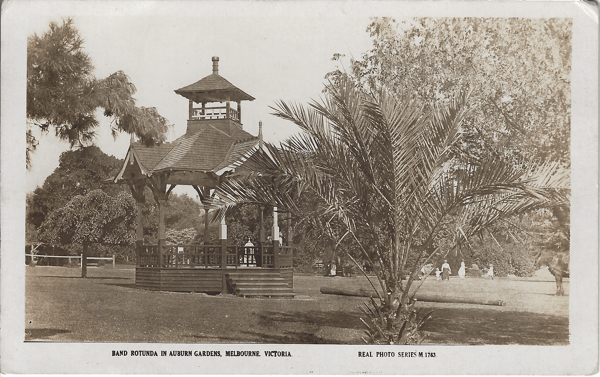
Postcard: Band Rotunda, Auburn Gardens, Victoria (Date unknown) (Source: Jeremy de Korte collection)

References:

A Bandsman. (1919, 11 November). Band Rotunda : (To the Editor.). North-Eastern Advertiser (Scottsdale, Tas. : 1909 – 1954), 3. http://nla.gov.au/nla.news-article151262612

A Lover of Music. (1893, 23 January). CORRESPONDENCE : A BAND ROTUNDA. Mount Alexander Mail (Vic. : 1854 – 1917), 2. http://nla.gov.au/nla.news-article198699429

AMPHITHEATRE BAND-STAND. (1910, 26 November). Daily Telegraph (Sydney, NSW : 1883 – 1930), 15. http://nla.gov.au/nla.news-article238664637

Angove, W. H. (1907, 02 November). Lawley Park Rotunda : [To the Editor.]. Albany Advertiser (WA : 1897 – 1954), 3. http://nla.gov.au/nla.news-article69959867

BAND ROTUNDA FOR PORTLAND. (1910, 24 August). Lithgow Mercury (NSW : 1898 – 1954), 2. http://nla.gov.au/nla.news-article218492203

A Band Rotunda Proposed. (1917, 18 October). South Bourke and Mornington Journal (Richmond, Vic. : 1877 – 1920; 1926 – 1927), 3. http://nla.gov.au/nla.news-article66192904

BAND ROTUNDA RENOVATED. (1935, 17 May). Pinnaroo and Border Times (SA : 1911 – 1954), 1. http://nla.gov.au/nla.news-article189641733

BAND ROTUNDA STRUCK BY LIGHTNING. (1941, 16 January). Argus (Melbourne, Vic. : 1848 – 1957), 5. http://nla.gov.au/nla.news-article8171730

Band Rotunda Wanted. (1917, 10 August). Pinnaroo and Border Times (SA : 1911 – 1954), 2. http://nla.gov.au/nla.news-article188360174

Band Rotunda, Castlemaine Gardens. (n.d.). [Postcard]. [Josef Lebovic Gallery collection no. 1]. Ward, Lock and Co Ltd, London and Melbourne. National Museum of Australia http://collectionsearch.nma.gov.au/object/140044

BANDSTAND BUILDING UNDER WAY AT VANSITTART PARK. (1933, 26 October). Border Watch (Mount Gambier, SA : 1861 – 1954), 1. http://nla.gov.au/nla.news-article77944349

Boyce, H. R. (1923, 31 October). THE ROTUNDA FOLIAGE : To the Editor. Barrier Miner (Broken Hill, NSW : 1888 – 1954), 3. http://nla.gov.au/nla.news-article45624435

Brockhouse, B. (2016). Band Rotundas South Australia. Albumworks. https://my.album.works/2AhNhAf 

Brokenshire, J. (n.d.). Hillside Rotunda, Broken Hill [Postcard]. Joseph Brokenshire, Broken Hill, N.S.W. 

Bulmer, H. D. (n.d.). Main Street Gardens and Band Rotunda, Bairnsdale [Postcard]. Bulmer’s, Bairnsdale, Victoria. 

CAN’T REPAIR BANDSTANDS. (1950, 30 August). Courier-Mail (Brisbane, Qld. : 1933 – 1954), 5. http://nla.gov.au/nla.news-article49731125

Carbolic. (1918, 22 August). BAND AND BANDSTANDS : To the Editor. Glenelg Guardian (SA : 1914 – 1936), 1. http://nla.gov.au/nla.news-article214715457

CASTLEMAINE. (1898, 23 November). Argus (Melbourne, Vic. : 1848 – 1957), 6. http://nla.gov.au/nla.news-article9861653

de Korte, J. D. (2019a). Ballarat Central, Vic. : Titanic Memorial Bandstand – Memorial Stone [Photograph]. Jeremy de Korte, Malvern, Victoria. 

de Korte, J. D. (2019b). Ballarat Central, Vic. : Titanic Memorial Bandstand [Photograph]. Jeremy de Korte, Malvern, Victoria. 

de Korte, J. D. (2020a). Maryborough, Vic. : Princes Park : Band Rotunda [Photograph]. [IMG_5902]. Jeremy de Korte, Redan, Victoria. 

de Korte, J. D. (2020b). Maryborough, Vic. : Princes Park : Band Rotunda – Plaque [Photograph]. [IMG_5903]. Jeremy de Korte, Redan, Victoria. 

de Korte, J. D. (2020c, 12 August). These are the latest additions to the historical band postcard collection that I’ve been putting together. The first one is of a Military Band playing at the bandstand in Hyde Park, Sydney. Unfortunately, the band and year are unknown but the scene it creates could probably be replicated around any bandstand… [Post]. Facebook. Retrieved 29 November 2020 from https://www.facebook.com/groups/145016798904992/permalink/4120772517996047

Hindmarsh Shire Council. (2018). Goldsworthy Park, Nhill [Newsletter]. Monthly Newsletter (October), 3. https://www.hindmarsh.vic.gov.au/content/images/what’s%20on/Monthly%20Newsletter/2018/Monthly%20Newsletter-Hindmarsh%20Shire%20Council-%20October%202018.pdf

Jacobs, W., Taylor, P., Ballinger, R., Johnson, V., & Rowe, D. (2004/2012). Shire of Mount Alexander : Heritage Study of the Shire of Newstead : STAGE 2 : Section 3 : Heritage Citations: Volume 3 : Newstead [Report](6205). (Heritage Studies, Issue. Shire of Mount Alexander. https://www.mountalexander.vic.gov.au/Page/Download.aspx?c=6205

Local and General : Titanic Memorial. (1915, 13 September). Bathurst Times (NSW : 1909 – 1925), 2. http://nla.gov.au/nla.news-article111229166

Mathers, M. (2017, 12 August). Most of us have (or had) a local Band Rotunda. Do you have a photo of it (the older the better) ? This is the one in Kew, Melbourne (a band with which I used to be a player). Upload yours [Post]. Facebook. Retrieved 29 November 2020 from https://www.facebook.com/groups/472757142742103/permalink/1844534445564359

MEMORIAL TO KING GEORGE : Merbein Ceremony. (1937, 11 August). Argus (Melbourne, Vic. : 1848 – 1957), 7. http://nla.gov.au/nla.news-article11116265

MEMORIAL TO NAVIGATORS. (1924, 17 May). Sydney Morning Herald (NSW : 1842 – 1954), 13. http://nla.gov.au/nla.news-article28072947

NHILL : NEW BAND ROTUNDA. (1909, 05 October). Ballarat Star (Vic. : 1865 – 1924), 6. http://nla.gov.au/nla.news-article218793589

Portland’s bandstand rotunda is officially opened for all. (2017, 11 December). Lithgow Mercury . https://www.lithgowmercury.com.au/story/5111856/portlands-bandstand-rotunda-is-officially-opened-for-all/

Queenscliffe Hotel Kingscote. (1900). [Photograph]. [B+30375]. State Library of South Australia, Kingscote Collection. https://collections.slsa.sa.gov.au/resource/B+30375

Rose, A. (2017). Pavilions in parks : bandstands and rotundas around Australia . Halstead Press.

Tellefson. (1937). Band Rotunda Merbein [Postcard]. [Tellefson Series 4]. Tellefson.

TITANIC MEMORIAL. (1915, 22 October). Evening Echo (Ballarat, Vic. : 1914 – 1918), 4. http://nla.gov.au/nla.news-article241689331

Valentine & Sons Publishing Co. Ltd. (1924). Band Rotunda in Auburn Gardens, Melbourne, Victoria [Postcard]. [Real Photo Series M.1763]. Valentine & Sons Publishing Co. Ltd., Melbourne, Sydney & Brisbane. 

Videon, T. (1996). “And the band played on …” band rotundas of Victoria (Publication Number 9924382201751) [MArts, Monash University, Faculty of Arts, Department of History]. Clayton, Victoria. https://monash.hosted.exlibrisgroup.com/MON:au_everything:catau21172148940001751

Virtual War Memorial Australia. (n.d.). Pinaroo Sodiers Memorial Band Rotunda . Virtual War Memorial Australia. Retrieved 30 November 2020 from https://vwma.org.au/explore/memorials/684

WALLAROO ROTUNDA : Proposition by Town Band. (1925, 09 September). Kadina and Wallaroo Times (SA : 1888 – 1954), 2. http://nla.gov.au/nla.news-article124763086

Ward & Farrans. (n.d.). Sydney – Hyde Park (Band-Musique de l’artillerie) (Artillerie-Kapelle) [Postcard]. [L. v. K. No. 48]. Exchange Studios, Sydney, N.S.W. 

Brass bands of the New South Wales Central West: Part 2: Association and competition

18991125_Sydney-Mail_Bathurst-Intercolonial_Massed-Bands
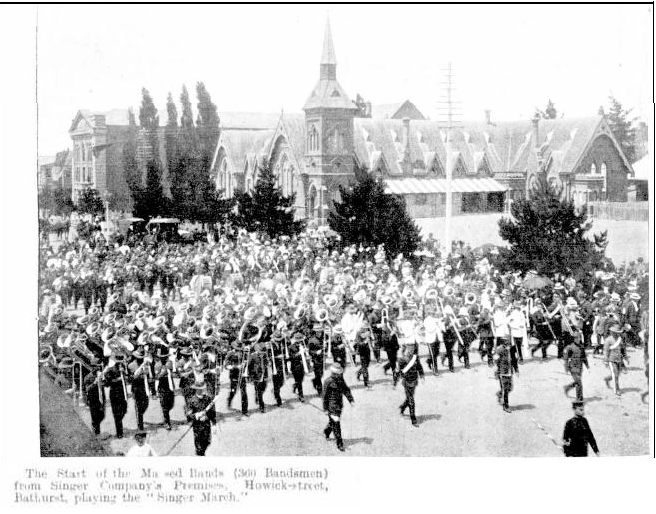
The Start of the Massed Bands. (360 Bandsmen) from Singer Company’s Premises, Howick-street, Bathurst, playing the “Singer March”. Photo by Beavis Bros., Sydney Mail and New South Wales Advertiser, 25/11/1899, p. 1288

Part two:

In part one of this post, we saw stories of the development, running and challenges of bands together with a look at the longevity of one conductor.  However, as we know, the stories of early brass bands are linked together and with the bands of the Central West, they were very united in association and ideals.  In part two of this post, this will be explored further through the creation of the earliest band association in New South Wales and the competitions that were held in various towns.

The Western Band Association:

Like many band associations around Australia, the Western Band Association was formed out of mutual collegiality and location.  The early brass bands of the N.S.W. Central West started what is regarded as the earliest band association in New South Wales and over time, and through various iterations, one of the strongest associations that attracted bands from near and far to various events.  The towns of the Central West also benefitted from this association as they were keen to host competitions.  There was no shortage of events for bands to attend and this post will detail some of them.

We first see a mention of an association in 1893 with the creation of the Western District Brass Band Union.  This Union was established by “Messrs, John Meagher, A. Gartrell, and John Appleby” and the first bands associated with this Union were “District (Bathurst), Independent (Bathurst)” and bands from the towns of “Orange, Wellington, Blayney, Lithgow, and Hartley Vale”  (“Local and General.,” 1893; “Western Brass Band Union.,” 1893).  The Bathurst Free Press and Mining Journal article explained what the Union was hoping to achieve,

The object of the Union is to promote friendly discourse between the different companies by meeting at least once a year in each town represented, and holding contests, comparing notes, and otherwise advancing the cause of music.”

(“Local and General.,” 1893)

On a side note, the Band Association of New South Wales formed in 1895 of which they are the oldest State band association in Australia (Greaves, 1996).  It is unclear whether the Western Band Association recognised or affiliated with B.A.N.S.W. at this early stage.

Geographically, the reach of the Western Band Association extended well-past the Central West region.  We see in an article published in the Western Herald newspaper that the town of Bourke in far north-west of N.S.W. had its own branch of the WBA and in 1896 was given permission to hold a band contest – this was not going to be the first time a band from Bourke participated in the activities of the WBA (“WESTERN BAND ASSOCIATION.,” 1896).

During the early 1900s, there is little to indicate if there was any activity from the WBA, no doubt the later war years intervened. However, in 1925 we see another burst of activity, first through accounts of a meeting in Bathurst and then a meeting a month later in Orange.  In October 1925, a meeting was held at the headquarters of the Bathurst District Band and presided over by Mr Sam Lewins (“WESTERN BAND CONFERENCE,” 1925).  The meeting involved members of the bands located in Bathurst and Orange, but their resolve and ambition were mostly united.  The article that was published in the Bathurst Times proclaimed under the main headline; “An Association Formed : Better Music – More Bands” which seemed to be an initial aim of this preliminary meeting as well as the usual planning on competitions in various towns (“WESTERN BAND CONFERENCE,” 1925).

One cannot be sure if these bandsmen who met in Bathurst experienced some déjà vu, because what they were discussing, and indeed the whole concept of a Western Band Association had all been done before.  It was written in the article,

The chairman, in explaining the conference, said that the primary object was the formation of an association having as its purpose the fostering of band music and the promoting of yearly contests.  Before him on the table were the minutes of a meeting held in Bathurst for a similar purpose just 32 years ago.  From the gathering in 1893 came the Western Band Association, the first Band Association in New South Wales.

The old rules governing the former body were still intact in the minute book.  In the event of another association being formed these rules could well be adopted, as he did not think they could be improved upon.

(“WESTERN BAND CONFERENCE,” 1925)

Letters regarding this project were read out from bands located in “Coonamble, Blayney, Orange, Dubbo and Nyngan” and with this in mind, the meeting resolved to start the Western Band Association on the 1st of January 1926. (“WESTERN BAND CONFERENCE,” 1925).

One delegate, a Mr Harrington from Orange was thinking of a bigger association and he “put in a strong plea that the title of the organisation should be altered to read “The Country Band Association of N.S.W.”” (“WESTERN BAND CONFERENCE,” 1925).  His reasoning was that bands from Cootamundra, Albury, and other towns to the north could join – however the other delegates did not support this suggestion so it was subsequently dropped (“WESTERN BAND CONFERENCE,” 1925).

The relationship with the State Association was part of these discussions as they were officially the body to be dealing with, despite some misgivings from the delegates in Bathurst.  An interesting exchange ensued between the delegates themselves with some choice language,

Mr. Johnson wished to be informed whether the association should affiliate with the head Sydney body.

The chairman : Well if we do we are not going to give them £1 for every band.

Mr. Johnson : We should absolutely shun them and keep to the western district: country players get no benefits from the Sydney Association.

Mr. Lewins : The trouble is a western band might want to play in Sydney at some time, and if we were not affiliated the head body might not allow it to compete.

In the opinion of Mr. Harrington it would be unwise to fall out with the head body.  “At the same time,” he went on, “we could be equally as strong as the N.S.W. Association.  In fact, it is not so very powerful as it is; you could drive a horse and cart through some of its constitutions.  We should place ourselves in a position not to dictate to this body, but to agree with it if possible.”.

(“WESTERN BAND CONFERENCE,” 1925)

The November meeting of the W.B.A. went ahead in Orange, and we have an account published in the Nepean Times newspaper as a representative from the Penrith Band attended the meeting.  While the W.B.A. had decided to confine itself to “districts along the Western Line and branches”, it also decided not to progress “no further east than Penrith township” which is why delegates from Penrith attended this meeting (“Western Band Association,” 1925).  The meeting also had delegates attend from bands in “Bathurst, Portland, Grenfell, Orange, Millthorpe and Penrith, numbering about 23” and correspondence was read out from other Western District bands that wanted to join (“Western Band Association,” 1925).  If the WBA did extend to Penrith, then geographically it encompassed the Blue Mountains as well.  A measure of just how parochial the WBA was about the bandsmen in their region is detailed in the last paragraph of the article,

The object of the Association is to form a working bureau for the purpose of keeping country players in the country instead of allowing them to drift to the City.  The assistance of business people and employing organisations is to the sought in this matter.

(“Western Band Association,” 1925)

In February 1926 a tiny article published in the Lithgow Mercury tells us that the W.B.A. has been reformed and will hold its first contest in Bathurst with a number of bands wanting to participate (“WESTERN BAND ASSOCIATION.,” 1926).

19260222_Lithgow-Mercury_Western-Band-Ass
Lithgow Mercury, 22/02/1926, p. 1

In 1932 we see yet another iteration of the W.B.A. through accounts of a meeting in Wellington.  Through this account published in the Wellington Times, we see a whole range of thoughts from enthusiasm for a new Association to bordering on cynicism – relationships with Sydney being part of the discussions (“MEETING OF BAND DELEGATES.,” 1932).  Generally, the delegates felt that they could form an Association that would be a branch of the N.S.W. Association.  Although a Mr C. Brown from Dubbo had some misgivings by noting,

Something was certainly needed, as no country Band had yet received any benefit from the head association in Sydney.

(“MEETING OF BAND DELEGATES.,” 1932)

Further comments on this matter were provided by other delegates regarding the role and independence of this association,

Mr. Appleby (Bathurst) thought an Association should be formed independent of Sydney, as they need no expect any support from that quarter.

[…]

The contest adjudicator (Mr. F. H. Philpott) was also much in favour of running an association independent of Sydney.  Even the suburban centres, realizing the increased benefits, were endeavouring to form associations of their own.

(“MEETING OF BAND DELEGATES.,” 1932)

These sentiments mirror the ones made in Bathurst in 1925.

The delegates resolved that the headquarters should be in Wellington, but the formation of the Association was also met with pragmatic caution by the delegates from Orange,

Mr. W. Eyles (Orange) reiterated the necessity for an Association of some kind.  They owed it to the younger members.  It was their bounden duty to give them contest experience.

Mr. Howie (Orange) hoped that the matter would not start on a wave of enthusiasm, and then die a natural death.  Everybody would have to get behind the movement.

(“MEETING OF BAND DELEGATES.,” 1932)

Perhaps Mr. Howie was prophetic when he spoke about enthusiasm for an association only to have it die off. No less than three years later, the WBA did exactly that and in 1935 a decision was made to wind the association up with remaining funds being distributed to member bands (“Western Band Association,” 1935).

Post Second World War in 1946, we see the Western Band Group again being reformed.  Except on this occasion, it was being sponsored by the N.S.W. Band Association as they were also supporting similar groups in Newcastle and Wollongong.  A meeting was held in Bathurst and was attended by delegates from “Cowra, Lithgow, Portland, Katoomba, Blayney and Bathurst” with other bands indicating that they would join (“WESTERN BAND GROUP FORMED,” 1946).  This group evidently decided to move some of its focus away from contest and instead started coordinating Band Sunday events in various towns which were well attended by bands and townspeople (“WESTERN BAND GROUP,” 1947).  Unlike previous iterations of the W.B.A., this new group appears to have been stronger and much better organised as they were still in existence in 1964 – the Bourke Shire Band were special guests at a contest in Wellington attended by five other bands (“Bourke Shire Band,” 1964).

19640814_Western-Herald_Bourke-Shire-Band_WBG
Western Herald, 02/08/1964, p. 8

What we have seen here is a perfect example of how enthusiasm comes in waves and there is no doubting that the various bands in these iterations of the Western Band Association meant well but were probably hamstrung at various stages.  No doubt some social conditions and events beyond their control were influences.  However, the fact that there is a long story behind these movements is remarkable.

Towns and contests:

18991125_Sydney-Mail_Bathurst-Intercolonial_Codes
Code’s Melbourne Band, First prize in “Singer March”. Second Prize in Championship. Photo by Beavis Bros., Sydney Mail and New South Wales Advertiser, 25/11/1899, p. 1288

One activity that this region became famous for was the quality, friendliness and hospitality of their band competitions which were held in various towns.  So much so that some contests were written up in the major band newspapers as being the ones to attend.  This part of the post will highlight some of them, and as with everything band related in this region, the competitions started in very early years.

In 1894 we first find a record of a contest held at Orange under the auspicious of the Western Band Association.  Held in conjunction with the fire brigade sports, this was reputedly the first contest held by the Association.  The contest appears to have been well-attended as it involved bands from the towns of Bathurst, Orange, Lithgow, Peak Hill, Wellington, Blayney, Stuart Town and Bourke with the bands competing in either first class or second class grades (“ORANGE BAND CONTEST AND FIRE-MEN’S SPORTS,” 1894).

Five years later, the town of Bathurst was the focus of attention as W.B.A. and the Bathurst Progress Association combined efforts and held an Intercolonial Band Contest which attracted numerous bands comprising of 360 musicians in total – the picture at the head of this post is testament to this!  This contest attracted bands from as far away as Wellington, New Zealand (of which their unfortunate loss of points is detailed in another post), and Code’s Melbourne Band from Victoria (pictured above).  The Sydney Mail and New South Wales Advertiser listed all the bands that participated:

…Wellington Garrison, New South Wales Lancers, Bathurst District, Code’s (Melbourne), Lithgow Model, Armidale City, Hillgrove, Newtown, Bathurst City, Lismore, Nymagee District, Warren Town, Hibernian (Sydney) and Cobar United.

(“INTERCOLONIAL BAND CONTEST AT BATHURST.,” 1899)

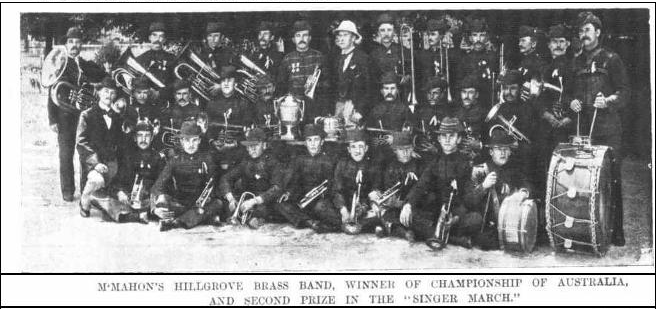
By all accounts the Bathurst contest was a huge success with the townsfolk, the Singer Company and the bands all enjoying themselves.  The band from Hillgrove, which boasted the six McMahon brothers,  won the “Australian Championship” with Code’s achieving second place and Newtown third while the Quickstep section was won by Code’s with Hillgrove gaining second place (“INTERCOLONIAL BAND CONTEST AT BATHURST.,” 1899).

It did not seem to matter which town in the region held a contest, bands were quite happy to travel an amount of distance to participate.  The 1919 Parkes Band contest was a perfect example as it attracted bands from the nearby region and one band from Sydney.  An article published in the Orange Leader newspaper listed the six bands that participated: “Royal Naval Brigade (Sydney), Lithgow Town, Orange Model, Forbes Town, Parkes Town and Parkes Peoples’ Band” (“THE PARKES BAND CONTEST.,” 1919).  The contest was held to benefit the Parkes Hospital fund.

There was one town that held a string of successful contests of which attracted a healthy number of bands each year; the town of Millthorpe which lies to the south of Orange on the Main Western railway line.  In the middle of the 1920s, Millthorpe seemed to be the contest to attend and accounts of the contest were written up in the well-regarded Australasian Band and Orchestral News.  Thankfully, through articles published in two editions of ABON we can see which bands participated in the Millthorpe contest over the years:

  • 1924: Orange, Blayney, Millthorpe
  • 1925: Dubbo, Grenfell, Blayney, Cowra, Millthorpe
  • 1926: Portland, Bathurst City- Model, Cowra, Penrith, Orange, Grenfell, Blayney, Millthorpe
  • 1927: Penrith, Orange, Wellington, Bathurst City-Model
  • 1928: Bathurst City-Model, Orange Town, Millthorpe Town

(“Millthorpe Contest,” 1928, pp. 30-31; “Millthorpe Contests,” 1927, p. 17)

The Millthorpe contests, which were run by a committee, would probably not have happened if a Mr H. H. Power, who was the then bandmaster of the Millthorpe Band had not driven the idea. The contests were always successful as each year they turned a profit.  However, it was also a measure of the contest that bands kept visiting and in 1927 Mr Power was presented with a gold watch in recognition of his services (“Millthorpe Contests,” 1927).

These contests were not the only ones run in the region and through searching the Trove archive we find that other towns also hosted contests – Cowra, Dubbo, Forbes, Grenfell, Mudgee, Portland, and Wellington.  The bands were spoiled for choice, and they made trips to compete on a regular basis.  As mentioned in Part 1 of this post, some bands ventured further afield with the Bathurst Band travelling to Ballarat and other bands competing in major competitions in bigger cities.  One can see how proactive the regional bands and towns were in hosting events.

18991125_Sydney-Mail_Bathurst-Intercolonial_McMahons
McMahon’s Hillgrove Brass Band, Winner of Championship of Australia and second prize in the “Singer March”. Photo by Beavis Bros., Sydney Mail and New South Wales Advertiser, 25/11/1899 p. 1289

Conclusion:

While researching for this series of posts I was struck by just how rich and varied the band life was in this region, and also how the towns embraced their bands.  Parochialism aside, we can also see how bands put aside differences to work together, especially when driven by dedicated individuals.  Yes, the bands had to respond to changes in society and industry. However, this did not stop them from achieving and gaining notice for their playing, especially the Bathurst Band after its visit to Ballarat.  The bands were a credit to themselves and to their towns and they made sure this region was noticed for its music making.

<- Part 1: Bands for every town

References:

Beavis Bros. (1899a, 25 November). CODES MELBOURNE BAND, FIRST PRIZE IN “SINGER MARCH,” SECOND PRIZE IN CHAMPIONSHIP. Sydney Mail and New South Wales Advertiser (NSW : 1871 – 1912), 1288. http://nla.gov.au/nla.news-article163699422

Beavis Bros. (1899b, 25 November). McMAHON’S HILLGROVE BRASS BAND, WINNER OF CHAMPIONSHIP OF AUSTRALIA AND SECOND PRIZE IN THE “SINGER MARCH.”. Sydney Mail and New South Wales Advertiser (NSW : 1871 – 1912), 1289. http://nla.gov.au/nla.news-article163699422

Beavis Bros. (1899c, 25 November). The Start of the Massed Bands (360 Bandsmen) from Singer Company’s Premises, Howick-street, Bathurst, playing the “Singer March.”. Sydney Mail and New South Wales Advertiser (NSW : 1871 – 1912),1288. http://nla.gov.au/nla.news-article163699422

Bourke Shire Band—Guest Band at Western Districts Band Championships, Wellington, on Sunday, August 2nd. (1964, 14 August). Western Herald (Bourke, NSW : 1887 – 1970), 8. http://nla.gov.au/nla.news-article141982006

Greaves, J. (1996). The great bands of Australia [sound recording] [2 sound discs (CD)]. Australia, Sound Heritage Association. 

INTERCOLONIAL BAND CONTEST AT BATHURST : Photos by Beavis Bros., Bathurst. (1899, 25 November). Sydney Mail and New South Wales Advertiser (NSW : 1871 – 1912), 1288-1289. http://nla.gov.au/nla.news-article163699422

Local and General. (1893, 02 November). Bathurst Free Press and Mining Journal (NSW : 1851 – 1904), 2. http://nla.gov.au/nla.news-article62183780

MEETING OF BAND DELEGATES : Progressive Movement. (1932, 04 January). Wellington Times (NSW : 1899 – 1954), 6. http://nla.gov.au/nla.news-article143246371

Millthorpe Contest : Bathurst City-Model Victors. (1928). The Australasian Band and Orchestral News, XXIII(5), 30-31. 

Millthorpe Contests : Four Successful Years. (1927). The Australasian Band and Orchestral News, XXIII(1), 17. 

ORANGE BAND CONTEST AND FIRE-MEN’S SPORTS. (1894, 12 November). Daily Telegraph (Sydney, NSW : 1883 – 1930), 5. http://nla.gov.au/nla.news-article236121302

THE PARKES BAND CONTEST. (1919, 27 August). Leader (Orange, NSW : 1899 – 1945), 1. http://nla.gov.au/nla.news-article117864597

WESTERN BAND ASSOCIATION. (1896, 21 March). Western Herald (Bourke, NSW : 1887 – 1970), 3. http://nla.gov.au/nla.news-article104105388

WESTERN BAND ASSOCIATION. (1926, 22 February). Lithgow Mercury (NSW : 1898 – 1954), 1. http://nla.gov.au/nla.news-article224588875

Western Band Association : Decides to Disband. (1935, 19 July). Western Age (Dubbo, NSW : 1933 – 1936), 1. http://nla.gov.au/nla.news-article137139773

Western Band Association : Penrith Represented. (1925, 28 November). Nepean Times (Penrith, NSW : 1882 – 1962), 6. http://nla.gov.au/nla.news-article108681480

WESTERN BAND CONFERENCE : An Association Formed : Better Music – More Bands. (1925, 19 October). Bathurst Times (NSW : 1909 – 1925), 1. http://nla.gov.au/nla.news-article118043369

WESTERN BAND GROUP. (1947, 05 December). Blue Mountains Advertiser (Katoomba, NSW : 1940 – 1954), 3. http://nla.gov.au/nla.news-article189918471

WESTERN BAND GROUP FORMED. (1946, 05 September). Lithgow Mercury (NSW : 1898 – 1954), 2. http://nla.gov.au/nla.news-article219610497

Western Brass Band Union. (1893, 02 November). National Advocate (Bathurst, NSW : 1889 – 1954), 2. http://nla.gov.au/nla.news-article156684544

Brass bands of the New South Wales Central West: Part 1: Bands for every town

19280000_Orange-District-band
Orange District Band, 1928. (source: Central West Libraries)

Introduction:

Nearly every small town in New South Wales can speak of their own band, and why should a town with the population of Condobolin be so far behind the time?

(Band Enthusiast, 1902)

This question was asked in a letter to the Lachlander and Condobolin and Western Districts Recorder newspaper in January 1902.  The person who wrote the letter under a pseudonym, “Band Enthusiast” asked a worthy question as to why his town had not caught up with the times and started their own band.  Condobolin is a town located in the Central West region of New South Wales and at this time, they were lagging other towns in the region.  By the time 1902 has ticked around, some towns in the Central West have already had bands for the best part of a decade.  Condobolin was feeling left out and wanted a band to boost civic pride and give townsfolk something else to do.

There is always a bigger picture and if we were to examine layers of history, patterns of immigration and the development of towns, agriculture, and industry, we would find that the bands of the Central West were very much products of their location and people – and there were many of them.  For the purposes of this post, the focus will be on a large regional block of New South Wales; Lithgow and Bathurst in the east, Condobolin and Lake Cargelligo in the west, Mudgee, Galong Wellington & Tottenham in the north and Oberon, Blaney, Cowra, Grenfell, and Forbes in the south with many localities big and small in between.  It is just over 400km from Lithgow to Lake Cargelligo and from North to South around 200km.  As you can see from the brief list of towns, there are some famous places, some of which are etched into Australian psyche and history. The middle line of Central West can be drawn through the towns of Lithgow, Bathurst, Orange, Parkes, and Condobolin.  Below this introduction is a Google map of this area.

For the sake of brevity with reading and writing, this blog topic in two parts.  Part 1 focuses on a little history of the N.S.W. Central West and stories of the individual bands.  Part 2 focuses on the various iterations of the Western Band Association and regional competitions.  Given that there were twenty-eight bands that have existed in the Central West, this provides us with a rich history of music-making.  Much like a previous post on the bands surrounding Canberra, this post is a result of a visit to Orange in October 2019 where various resources were accessed thanks to the assistance of the excellent librarians at Orange Library.  They pointed out several features of their own town related to brass bands, and I was naturally curious about the other bands in the region.  The Trove archive has also provided an amount of information.

One might say the development of bands in this region is very typical when compared to other parts of Australia, and to some extents this is correct.  Well-might every town in the Central West have a band or want a band.  They were community groups to be proud of.

The Central West:

To provide some context to the bands in this region, it is important to appreciate the history of the region.  Early settlers travelled various locations, mainly to farm sheep on the vast plains although some towns were originally settlements to house convicts (Blainey, 2001; Kass, 2003).  The main impetus to population growth was the discovery of various minerals across the region namely gold, copper, shale, limestone, and coal and most of the miners originated from Wales and Cornwall (Kass, 2003; Payton, 2005).  With greater migration came town services and recreation as well as transport links – roads and railways.  Kass (2003) wrote of the migration, “These new people left their mark.  Sometimes, particular ethnic practices of skills affected the area” (p. 16).

Naturally, some towns grew bigger than others due to their location on major transport routes, the success of the mines or agriculture.  Some towns like Hill End dwindled due to the exhaustion of mines (“Hill End,” 2004; Hodge, 2013).  Others, like Bathurst, were regional centres in their own right – Bathurst, in particular, is one of the first towns established after the crossing of the Blue Mountains (Blainey, 2001).  European influences on some towns are obvious.  Below are some pictures of two bandstands in Orange located in parks at either end of the town centre.

20191019-9.30_Orange_Robertson-Park-Bandstand1
Robertson Park Bandstand, Orange (Photo taken in October 2019 by Jeremy de Korte)
Robertson Park Bandstand – Plaque (photo taken October 2019 by Jeremy de Korte)
20191020-9.32_Orange_Cook-Park3_Bandstand1
Cook Park Bandstand, Orange (Photo taken in October 2019 by Jeremy de Korte)
Cook Park Bandstand – Plaque (photo taken October 2019 by Jeremy de Korte)

The history of this region is fascinating, and it is through the development of these industries and towns that gives rise to brass bands, an amount of which are still in existence.  These famous towns are historic.  The bands themselves developed reputations that extended far beyond this region.

British Influences:

If we consider that the main immigration of the time was from Britain where brass bands had already taken hold in certain areas, it stands to reason the ethnic practices that Kass mentions would include certain kinds of music-making.  Bythell (2000) tells us that this was no accident,

The successful transplantation of the brass band to the colonies in the late nineteenth century should not surprise us, given the importance of ordinary, wage-earning immigrants from Britain in building-up Australasia’s population and developing its communities and institutions.  The contribution of British-born bandsmen to Australian banding is particularly noticeable in mining areas whose counterparts in ‘the Old Country’ were major centres of the movement.

(p. 227)

More specifically and related to the regional area, Payton (2005) states that “Brass bands were popular among the Cornish at Hill End, Bathurst and elsewhere…” (p. 234).  The link between mining and brass bands cannot be understated, and the names of some of the early bands reflected this origin.  This was very much a transplanting of culture, and the Central West became blessed with several brass bands.

Where bands were formed:

00000000_Parkes-Town-Band_phot6375
Parkes Town Band (Source: IBEW)

In most of the major towns, they could boast one band although some had two or three.  In the smaller towns, they could claim one band.  As is the case with some of these activities, some bands folded or merged.  In 1908 for example, the Parkes Brass Band merged with the nearby Parkesborough Brass Band to become a single entity (“Parkes Brass Band.,” 1908).  Below is a table showing a list of locations where brass bands were mentioned, most of which were in existence in the early 1900s.  Today, a number of bands remain in the major towns and these are highlighted by links – interestingly, some of the bands that exist today in this region are now concert bands.

BathurstBimbiBlayneyCanowindra
CondobolinCowraCudalCumnock
EugowraForbesGrenfellGulgong
Hartley ValeHill EndKandosLithgow
MillthorpeMolongMudgeeOberon
OrangeParkesPeak HillPortland
Stuart TownTullibigealWellingtonYeoval
(source of table data: Trove archive)

There was no doubting the enthusiasm, civic pride and motives of the early townsfolk when it came to starting brass bands.  However, it was not only townsfolk who started bands.  Robert Bartlett (2018) wrote in his book Orange and District: A History in Pictures. 2 that “…a volunteer band attached to the Volunteer Military Corps in Orange was established about 1874” and that “The Orange Town Band was formed in the late 1880s” (p. 48).  Here, this is an example of two bands that had existed in the town in relatively early times.  The Orange Town Band was afflicted with a few stops and starts in its early years, however, it still exists to this day (Bartlett, 2018).

It is interesting to see how local newspapers reported on proposals to start bands or reported on bands already in existence.  For example, a correspondent writing for the Peak Hill Express newspaper in August 1902 says of the newly formed Yeoval band,

One would scarcely think of hard times and drought at the small township of Yeoval, since the local Brass Band has commenced practice.  The Bandmaster, (Mr. Kennerson) came yesterday from Eugowra to give his pupils their first lesson.  I am afraid (although I should be very sorry to dishearten our amateurs), that some time will lapse before the Yeoval Brass Band will appear in a contest or even turn out a few professional players.

(“YEOVAL.,” 1902)

The optimism is admirable given that Yeoval was a small township located inland from the main road linking the major towns of Molong and Wellington.

Expressions of enthusiasm for staring a brass band in the town of Cudal, located on a road from Orange to Forbes was all very well.  But this enthusiasm was tempered by a pragmatic question over instruments, as written in an article from March 1902 in the Leader newspaper,

Cudal boys intend on starting a brass band.  Why not?  Mr. Walter Carter, who has been considerable time in the band at Wellington, and who is settling in town, will act as instructor and also conductor.  The trouble is, where are the instruments coming from?  Perhaps some person who is interested will push the thing ahead.

(“CUDAL.,” 1902)

This is, of course, another aspect of starting a brass band, finding the right people to start them and instruct pupils.  In the town of Cumnock, located near the towns of Yeoval and Molong, they found a person willing to start a band.  A local and popular factor manager, Mr R. E. Higgins pushed an effort to start a band and it seems he was successful (“CUMNOCK.,” 1904).  The Cumnock Brass Band was still in existence in 1927 (“CUMNOCK.,” 1927).

The township of Kandos, located south-east of Mudgee, provides an interesting example of how to start a band properly.  Aside from the fact that got started much later than other towns, an article published in the Lithgow Mercury in March 1918 tells us much.  It seems their town band was going to be supported financially by the N.S.W. Cement Co., so all they really needed from potential musicians was “determination and enthusiasm” (“KANDOS.,” 1918).  And they really wanted a band for the town,

As a town band is a means of pleasurable entertainment, a welcome relaxation from the workers’ daily round and common task that appeals more than any other, the committee confidently look to the citizens of our model township for aid and support, financial and other ways.  Meanwhile, a goodly number of names of intending members with more or less experience has been booked, and quite an encouraging number of names of intending pupils have likewise been handed in.

(“KANDOS.,” 1918)

Nine years later we find that the Kandos Town Band is thriving.  In the September 26th issue of The Australasian Band and Orchestral News, an article about the happenings of brass bands in New South Wales is published and there is a small paragraph on the Kandos Town Band:

Kandos Town Band has emerged from its winter seclusion and rendered a fine programme on Sunday, September 11 under the baton of Bandmaster Julius.  The band has always had strong financial support and its efforts are always appreciated.

(“New South Wales,” 1927, p. 23)

Then, of course, are the times when bands have, for whatever reason, gone into recess and then reformed.  Such was the case of the Oberon Brass Band in 1936 when a tiny article published in the Sydney Morning Herald makes mention of the reformation of this band (“OBERON BAND RE-FORMED.,” 1936).

20191019-10.46_Orange_Band-Hall1
The old Orange City Band Hall (Photo taken in October 2019 by Jeremy de Korte)

Some of the brass bands mentioned above were in smaller towns and faced challenges that did not really affect bands in bigger locations, though that did not stop these towns trying to start them.  We know that bands in some of the bigger centres of “Bathurst, Wellington, Orange, Blaney, and Lithgow” were in existence by the early 1890s (“Western Brass Band Union.,” 1893).  The Orange City Band, as we can see above in the photo, was lucky enough to have its own band hall.   The band in the tiny town of Yeoval might have aspired of entering competitions but for the bands in bigger towns with more resources, this was a reality.  It was seen in an earlier post how the Bathurst District Brass Band travelled all the way to Ballarat to compete in the first South Street band sections in 1900 and gained high praise for their playing (“THE CONTEST.,” 1900; Nedwell & Hill, 1900; “To-Day’s Telegrams.,” 1900).  For many other bands in this region, travel to neighbouring towns or to Sydney for competitions became routine, no doubt helped by the early railways.  The nature of competing and competitions for these bigger bands will be examined in Part 2 of this blog post.

Challenges laid bare:

19230425_Grenfell-Town-District-Band_phot7150
Grenfell Town & District Band, ANZAC Day 1923 (Source: IBEW)

Operating a band was not an easy task.  And the early newspapers show numerous instances of where the local band put out a call for help.  Most of the assistance was to be in the form of small concerts or other events that would provide funds for a band.  In September 1900, a tiny article published in the Wellington Times newspaper asks the townspeople of Stuart Town to support their band,

At a public meeting held at Stuart Town on the 17th instant (Mr. A. G. Coleman in the chair) it was decided to hold a concert and social at Boehme’s Hall, on November 9, for the purpose of putting the funds of the Stuart Town brass band on a sound financial basis.  Tickets for the concert will be 2s and s, and for the social 3s and 2s.  Mr. Howard Warn is the hon. Sec.

(“The Stuart Town Band.,” 1900)

Then there was the distinct challenge of gaining and retaining members of the band which was either overcome…or not. The McPhail and Peak Hill District Band was one ensemble that managed to turn things around with an effective recruitment campaign.  Through an article published in the Peak Hill Express newspaper from December 1905, we see why there was a loss of initial membership and how they are progressing,

For some time past McPhail and Peak Hill District Band has not been heard so frequently as in the past, for the reason that the members being miners, were mostly out of the district.  As a result, the Band has had to recruit, and this being done, with some £30 worth of instruments, the Band is on the up grade again, and during the coming year will be heard to advantage.  The members have some really fine instruments, and everything points to a bright future.

(“McPhail and Peak Hill District Band.,” 1905)

One can sense the inherent frustration of a Mr W. H. Gray, committee member of the Grenfell Town Band through a supplementary report published in the Grenfell Record and Lachlan District Advertiser newspaper in August 1931 regarding some issues surrounding his band.  Firstly, Mr Gray has tried to justify the music library and choices of music for performances by stating,

In the first place the library referred to is an extremely important factor in the make-up of the band, and comprises all the music as used by them, and the same as in a reading library, there are good, band and indifferent pieces, and it requires a great deal of time to look through a quantity of music and make a selection of numbers that will be interesting to players to practice, and which will also please the majority of the listening public. […] Of course, there are numbers that will be uninteresting to the musically uneducated, but if we were to confine ourselves to the class of music that would appeal to that that type of listener we would get nowhere.  And so it is necessary to have an assortment that will appeal to the highbrow as well as the lowbrow, if I may be permitted to use that term.

(Gray in “TOWN BAND,” 1931)

Mr. Gray went on to making other forthright comments in his report of which are quoted here.

Most of them think the instrument has only to be blown into and it will play itself

[…]

A lot of programmes could be much improved if I could get fuller rehearsals.  A lot to poor and bad spots in a performance are caused by members who only come along to rehearsal occasionally, and are not entirely familiar with the programme, and are not competent enough to read at sight, make mistakes which disconcert the rest of the players.

[…]

In a small town like this there is not the same chance or privilege to get a better combination, as there is only a certain percentage or average of all who take up the study of music who ever amount to much, and distance from other places are a bar to attracting other players here.

[…]

I would now like to appeal to the public for support.  We have to be continually adding to our library, instruments have to be kept in repair, and band room rent and lighting to be paid.  The bandsmen give a great deal of their time.  Of course it is looked upon as a recreation, but it is not always so, as duties often interfere with other plans, so that a band call is sometimes a sacrifice to the men.  […] You will now see it takes a certain definite amount of money to run a band, also a certain amount of sacrifice on behalf of the bandsmen, and as I hope the band gives a lot of pleasure to people that in the future better monetary support will be given that will enable us to continue and improve on the work already done.

(Gray in “TOWN BAND,” 1931)

This article was as informative as it was fascinating.  We see here a committee member who has outlined several frustrations yet still asks the public for support, as well as asking his bandsmen to give a greater effort.  The challenge of being in a smaller town without ready access to a pool of musicians and other resources is not unique.  To have laid it all out in a local newspaper to this extent is certainly brave – one wonders the comments he received from his bandsmen who might have read this.

Conductors and bandsmen:

00000000_Bathurst-Town-Band_phot18345
Bathurst Town Band (Source: IBEW)

It has been mentioned at times in this post certain names of people who were influences on their local bands.  Again, this is nothing new when compared to other bands in Australia – this was a time of the journeyman band member who frequently changed towns and bands.  To keep up retention for any length of time was a major challenge.  Yet there were some remarkable stories of longevity, and the lengths towns went to honour their brass band people.

The year is 1920 and, in an article, published in January of that year in the Bathurst Times newspaper, news breaks of a possible transfer of the conductor of the Bathurst District Band, a Mr Samuel Lewins, to somewhere else in N.S.W. because of employment.  This was a conductor who had been at the helm of the band for a considerable length of time,

Mr. Verbrugghen, the conductor of the State Orchestra, has been telling the public that he success of the orchestra is due to its conductor.  By the same line of reasoning the success of the Bathurst District Band is due to its bandmaster.  Is proof wanted?  It can be found in the fact that during the thirty-three years the band has been going it has had hundreds of members, but only one conductor.

(“BRASS BANDS,” 1920)

Rightly, or wrongly, there were fears the band would collapse if the conductor left the band,

Now there is a rift looming.  Bathurst is likely to lose Mr. Lewins, and in losing him the city is in danger of losing the District Band as we now know it.

This is how maters stand.  Mr. Lewins is an officer in the Railway service.  He is reaching the retiring age, and when that time comes (as will be in about two years), he proposes to remove to Sydney or some other centre.  Is Bathurst going to allow him to go without making an effort to keep him?

[…]

What will Bathurst do?  Will it get busy during the two years yet to go, and arrange to keep the District Band and its conductor, or will it sit down and allow matters to drift?  Two years is not a long time.  Some towns have been trying for a dozen years to get a man with the brass band knowledge of Mr. Lewins and with equal worth as a citizen, but have failed.  Bathurst has the musician man and the citizen, and should see that he is kept here.

(“BRASS BANDS,” 1920)

The story of Mr Lewins at the helm of the Bathurst District Band does not end here.  In 1926 we find that he is still conducting and as a measure of appreciation, the townsfolk honour Mr Lewins with a plaque as a testimonial to his now forty years as conductor of the band (“THE LEWINS’ TESTIMONIAL,” 1926; “MR. S. LEWINS’ TESTIMONIAL,” 1925).  Mr Lewins kept conducting the band for another twelve years until 1938.  In 1936 he was further honoured for conducting the band for fifty years with the erecting of commemorative gates at Machattie Park (“LEWINS COMMEMORATIVE GATES,” 1936).  In 1938, having achieved the record as the “oldest bandmaster in the Commonwealth”, is suffering from ill health and has had to retire from leading the Bathurst District Band – by all accounts, this is an astonishing record (“MR. S. LEWINS,” 1938).  Two years after his retirement at the age of 78, Mr Lewins passes away with tributes flowing from band people all around Australia (“MR. SAMUEL LEWINS,” 1940).  For a brief time afterwards, the band is conducted by one of his sons and soon after Mr Harold Walmsley takes over as conductor of this band and the Bathurst Boys’ Band (“BATHURST AND ITS BANDS,” 1941).

Samuel Lewins was but one of many remarkable musicians that have called the Central West their home and the legacy of these musicians lives on.  One must recognize that every musician made a contribution to their bands, and in some cases to Australia as euphonium player and conductor of the Orange Town Band, Herbert Rockliff did in the AIF (Orange City Council, 2015).  To my knowledge, not one band conductor has come close to the Lewins record yet.

Bands of the Central West:

To reiterate a point, the development and running of bands in the Central West were no less compared to other bands around Australia.  In fact, it was fairly typical – challenges were commonplace.  However, to have so many bands in the one region did bring out the best of bandsmen and they did their best to keep bands operating.  Perhaps circumstance was unkind to some of them – they were tied to their towns and if the towns dwindled the bands folded.  But for the most part, at least in some of the bigger towns, their legacy lives on.

19110000_Peak-Hill-Band_phot9371
Peak Hill Band, 1911 (Source: IBEW)

Part 2: Association and competition ->

References:

Band Enthusiast. (1902, 17 January). Brass Band for Condobolin – Views of an Experienced Bandsman. Lachlander and Condobolin and Western Districts Recorder (NSW : 1899 – 1952), 5. http://nla.gov.au/nla.news-article213298751

Bartlett, R. (2018). Orange and district : a history in pictures. 2. Robert Bartlett. 

BATHURST AND ITS BANDS : Mr. Walmsley’s View. (1941, 30 September). National Advocate (Bathurst, NSW : 1889 – 1954), 5. http://nla.gov.au/nla.news-article160522981

Bathurst Town Band. (n.d.). [Photograph]. [phot18345]. The Internet Bandsman Everything Within, Vintage Brass Band Pictures : Australia. http://www.ibew.org.uk/vbbp-oz.html

Blainey, G. (2001). The tyranny of distance : how distance shaped Australia’s history (Rev. ed.). Macmillan. 

BRASS BANDS : The People’s Music. : The District Band Conductor. (1920, 08 January). Bathurst Times (NSW : 1909 – 1925), 2. http://nla.gov.au/nla.news-article111547245

Bythell, D. (2000). The Brass Band in the Antipodes : The Transplantation of British Popular Culture. In T. Herbert (Ed.), The British brass band : a musical and social history (pp. 217-244). Clarendon Press ; New York : Oxford University Press. 

THE CONTEST. (1900, 08 October). Ballarat Star (Vic. : 1865 – 1924), 1. http://nla.gov.au/nla.news-article206978024

CUDAL. (1902, 08 March). Leader (Orange, NSW : 1899 – 1945), 3. http://nla.gov.au/nla.news-article252290799

CUMNOCK. (1904, 13 February). Molong Express and Western District Advertiser (NSW : 1887 – 1954), 7. http://nla.gov.au/nla.news-article139537587

CUMNOCK. (1927, 08 January). Molong Express and Western District Advertiser (NSW : 1887 – 1954), 11. http://nla.gov.au/nla.news-article139984068

de Korte, J. D. (2018, 08 July). The unique position the Canberra City Band holds within the bands of the Southern Tablelands of NSW. Band Blasts from the Past : Anecdotes, Stories and Personalities. https://bandblastsfromthepast.blog/2018/07/01/the-unique-position-the-canberra-city-band-holds-within-the-bands-of-the-southern-tablelands-of-nsw/

de Korte, J. D. (2018, 22 December). The first South Street band contest in October, 1900. Band Blasts from the Past : Anecdotes, Stories and Personalities. https://bandblastsfromthepast.blog/2018/12/22/the-first-south-street-band-contest-in-october-1900/

de Korte, J. D. (2019a). Orange, N.S.W. : Cook Park : Bandstand [Photograph]. [IMG_4472]. Jeremy de Korte, Sydney, N.S.W. 

de Korte, J. D. (2019b). Orange, N.S.W. : Cook Park : Bandstand – Plaque [Photograph]. [IMG_4473]. Jeremy de Korte, Sydney, N.S.W. 

de Korte, J. D. (2019c). Orange, N.S.W. : Old Orange City Band Hall, 1888 [Photograph]. [IMG_4453]. Jeremy de Korte, Sydney, N.S.W. 

de Korte, J. D. (2019d). Orange, N.S.W. : Robertson Park : Bandstand [Photograph]. [IMG_4443]. Jeremy de Korte, Sydney, N.S.W.

de Korte, J. D. (2019). Orange, N.S.W. : Robertson Park : Bandstand – Plaque [Photograph]. [IMG_4444]. Jeremy de Korte, Sydney, N.S.W. 

Grenfell Town & District Band : ANZAC Day 1923. (1923). [Photograph]. [phot7150]. The Internet Bandsman Everything Within, Vintage Brass Band Pictures : Australia. http://www.ibew.org.uk/vbbp-oz.html

Hill End. (2004, 08 February). Sydney Morning Herald. https://www.smh.com.au/lifestyle/hill-end-20040208-gdkq2n.html

Hodge, B. (2013). Hill End & Tamboroora – a brief history. Hill End & Tamboroora Gathering Group. Retrieved 31 October 2019 from https://www.heatgg.org.au/hill-end-story/brief-history/

KANDOS : Brass Band Proposals : (From our Correspondent). (1918, 27 March). Lithgow Mercury (NSW : 1898 – 1954), 1. http://nla.gov.au/nla.news-article218467481

Kass, T. (2003). A thematic history of the Central West : comprising the NSW historical regions of Lachlan and Central Tablelands. NSW Heritage Office. https://www.environment.nsw.gov.au/resources/heritagebranch/heritage/thematichistorycentralwest.pdf 

LEWINS COMMEMORATIVE GATES. (1936, 17 July). National Advocate (Bathurst, NSW : 1889 – 1954), 2. http://nla.gov.au/nla.news-article160530723

THE LEWINS’ TESTIMONIAL. (1926, 09 February). National Advocate (Bathurst, NSW : 1889 – 1954), 2. http://nla.gov.au/nla.news-article161492356

McPhail and Peak Hill District Band. (1905, 15 December). Peak Hill Express (NSW : 1902 – 1952), 9. http://nla.gov.au/nla.news-article107246068

MR. S. LEWINS : Retirement Reported. (1938, 12 August). National Advocate (Bathurst, NSW : 1889 – 1954), 1. http://nla.gov.au/nla.news-article160909451

MR. S. LEWINS’ TESTIMONIAL. (1925, 29 December). National Advocate (Bathurst, NSW : 1889 – 1954), 2. http://nla.gov.au/nla.news-article161496572

MR. SAMUEL LEWINS : Death Yesterday. (1940, 24 May). National Advocate (Bathurst, NSW : 1889 – 1954), 2. http://nla.gov.au/nla.news-article160642933

Nedwell, J. W., & Hill, W. D. (1900, 22 October). CORRESPONDENCE : Soldiers’ Statue Fund at Ballarat. National Advocate (Bathurst, NSW : 1889 – 1954), 2. http://nla.gov.au/nla.news-article156776396

New South Wales. (1927). The Australasian Band and Orchestral News, XXIII(1), 23 & 25. 

OBERON BAND RE-FORMED. (1936, 07 November). Sydney Morning Herald (NSW : 1842 – 1954), 14. http://nla.gov.au/nla.news-article17286874

Orange City Council. (2015, 01 February). Herbert Rockliff. Orange City Council. Retrieved 19 October 2019 from http://www.centenaryww1orange.com.au/service-men-and-women/herbert-rockliff/

Orange District Band. (1928). [Photograph]. Central West Libraries, Orange, N.S.W. 

Parkes Brass Band. (1908, 17 April). Western Champion (Parkes, NSW : 1898 – 1934), 16. http://nla.gov.au/nla.news-article111917460

Parkes Town Band. (n.d.). [Photograph]. [phot6375]. The Internet Bandsman Everything Within, Vintage Brass Band Pictures : Australia. http://www.ibew.org.uk/vbbp-oz.html

Payton, P. (2005). The Cornish overseas : a history of Cornwall’s ‘great emigration’ (Rev. and updated ed.). University of Exeter Press. 

Peak Hill Band. (1911). [Photograph]. [phot9371]. The Internet Bandsman Everything Within, Vintage Brass Band Pictures : Australia. http://www.ibew.org.uk/vbbp-oz.html

The Stuart Town Band. (1900, 20 September). Wellington Times (NSW : 1899 – 1954), 2. http://nla.gov.au/nla.news-article139003931

To-Day’s Telegrams : THE BATHURST BAND IN MELBOURNE. (1900, 04 October). Bathurst Free Press and Mining Journal (NSW : 1851 – 1904), 3. http://nla.gov.au/nla.news-article63874689

TOWN BAND : Grenfell Band. (1931, 17 August). Grenfell Record and Lachlan District Advertiser (NSW : 1876 – 1951), 4. http://nla.gov.au/nla.news-article112830663

Western Brass Band Union. (1893, 02 November). National Advocate (Bathurst, NSW : 1889 – 1954), 2. http://nla.gov.au/nla.news-article156684544

YEOVAL. (1902, 22 August). Peak Hill Express (NSW : 1902 – 1952), 2. http://nla.gov.au/nla.news-article107245170