Brass bands and Christmas cheer: compliments of the season

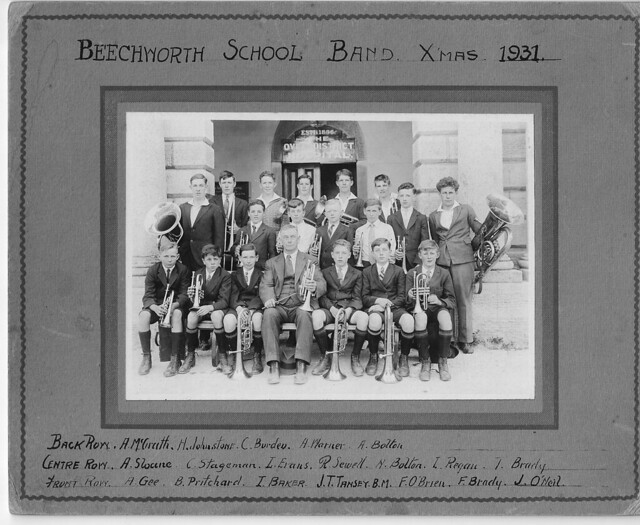
19310000_Beechworth-School-Band_Xmas
Beechworth School Band. Xmas 1931 (Source: HistoryInPhotos)

Introduction:

Bands and Christmas.  There are probably not too many bands people out there who have not participated in several Christmas engagements and will probably do many more in the future. They are one of the staples in the band calendar alongside the usual parades, concerts, ANZAC commemorations, community events, etc.  It is a time where bands can get out and about and present the music of the season to their communities.

Let us go back to times past in the period from 1900-1950 where bands were the entertainment and very much embedded in their local communities.  There are lots of little stories out there.  This post will highlight some of the different stories from around Australia involving bands at Christmas time and no doubt some readers will get a sense of déjà vu.  The times may have changed but the engagements have not!

Gifts and platitudes, carols, charity, concerts and competitions, townsfolk and tourists, and bands and band people.  The compliments of the season from yesteryear.

The days before Christmas:

Christmas Eve and Day are of course the focus of all festivities, however, in the days leading up to Christmas, brass bands were always part of the events.  For some bands, it was an achievement to even get this far, especially in the early years when they battled fluctuating membership and commitment.

In December 1905, the McPhail and Peak Hill District Band, located in the New South Wales Central West was one band that getting ready for some Christmas events.  The band intended on following through on time-honoured tradition of playing Christmas carols to the local town as the brass bands did back in England (Etheridge, 2017; “McPhail and Peak Hill District Band.,” 1905).  In an article published in the Peak Hill Express newspaper, we see a band confident that it would play in the right spirit for the season,

The Band intends, with their many friends, to follow up the old time-honoured custom of playing and singing during Xmas.

[…]

During the week our programme will be mapped out and advertised in next issue of the Express.  Mr. J. S. Christophers assures the writer that the Band, as the old Band on 1903, are of the right mettle, and will not shirk any duty that they may be called upon to perform for the cause of charity.  With a useful lamp, their present needs will be met, and during Xmas week a big effort will be put forth with that end in view. 

(“McPhail and Peak Hill District Band.,” 1905)

Christmas Eve:

Aside from Christmas Day itself, we can see that lots of bands were out and about on Christmas Eve, often at late hours, to add to the festivities of the night…or to entertain late-night shoppers.  A variety of events took place on Christmas Eve in those early years and there are lots of little stories to hear about.  Thankfully, some articles were more detailed than others and we can see what the bands played, where they played and how the public responded.

When reading the old articles, it was evident that sometimes it was not about the band per se, but about the Christmas festivals themselves of which the local band took part.  However, when bands did get a mention in the local papers, their efforts were very much appreciated as they helped to give atmosphere to the festivities.  In the year of 1912, we find that the whole area surrounding Alexandra and Yea, Victoria is attracting a number of tourists who have taken the opportunity to relax in various towns and go fishing in the Goulburn River (“Christmas and New Year’s Eves,” 1913).  The local newspaper reported on the various events in early January and the Alexandra Fire Brigade Band received praise for their playing in the street,

A new and pleasing departure in the Christmas Eve celebrations this year was the appearance of the Fire Brigade Brass Band in the street.  As soon as they could get together, for some of the members detained in the stores till after 11pm, the crowd gathered around them.  From 11 o’clock till midnight the band rendered the following programme :-

Quick march, Ringwood, by J. Sandegren
Valsette, Nada (T. E. Bulch)
Euphonium solo, Asleep in the Deep (W. Petrie)
Schottische, Daphne (Wright and Round)
Selection, Welsh Songs (G. A. Frost)
Quick march, Torchlight Parade (T. E. Bulch)
Cornet solo, Alice, Where Art Thou (J. Ascher)
Fantasia, Christmas Greetings (T. L. Hellings)

Carols after 12pm – Hark the Herald Angels Sing ; Christians Awake ; Sandon ; Adeste Fidelis ; Arizona ; Home Sweet Home ; National Anthem.

The effect was very pleasing, and gave a good finish to a very festive night.

(“Christmas and New Year’s Eves,” 1913)

Some towns were doing it harder than others around Christmas time and in the towns of the Shepparton area of Victoria they were afflicted by drought in 1915.  But in the spirit of the Christmas season, the townsfolk seemed to forget their hardship and came together to celebrate the season.  It is in the town of Rushworth that we find the local brass band has come out to play,

On the closing of the business places at Rushworth the members of the local brass band assembled at the rotunda and, under Bandmaster Williams, rendered a capital programme of music appropriate to the occasion.  Then, later they divided into two parties and set out on their respective rounds of carolling.  The financial result (£22 odd) was excellent, and again was previous records well maintained.”

(“THE XMAS SEASON.,” 1915)
1907 Postcard: Band Rotunda, Rushworth, Victoria (source: Jeremy de Korte Collection)

Likewise, on Christmas Eve in the Victorian township of Coleraine, the streets were full of people, shopkeepers were keeping up a good trade, and the music was provided by the Coleraine Brass band of which the local newspaper diplomatically noted was “showing distinct improvement” (“Coleraine Albion,” 1915).

Brass bands have always been altruistic in Australia and were ready to assist for the sake of charity.  They were also ready to provide good cheer to those in need and in Darwin at Christmas Eve 1920, the Darwin Brass Band went and played at the Darwin Hospital,

On Christmas Eve the Darwin Brass Band under Bandmaster W. Nuttall, paid a surprise visit and rendered a very fine selection of cheery music, which the aged and sick thoroughly enjoyed.  The Matron, in a few well-chosen words on behalf o the staff and patients, thanked them for their kindness and they departed for the town with mutual good wishes and greetings from all sides.

(“XMAS AT THE HOSPITAL.,” 1920)

Far south of Darwin in the South Australian township of Yorketown located on the Yorke Peninsula, the local brass band had announced it was going to present a program of music in the street of town (“CHRISTMAS EVE.,” 1920).  As we can see in the article published in the Pioneer newspaper, their Christmas Eve program was quite long with one session of playing from “8p.m. until 9.30p.m.” and then “At 11pm the Band will visit various residences and render Christmas Carols.” (“CHRISTMAS EVE.,” 1920).  This was also supposed to be a beneficial exercise for the band as well; they were taking up a collection for new instruments.
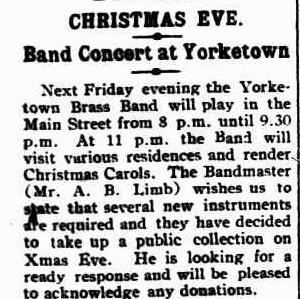
The Pioneer, 18/12/1920, p. 3

Then we have performances from bands on Christmas Even where the performance was their first-ever performance!  In an article published in the Rockhampton Evening News January 1934, we find that the Springsure Brass Band held their first public outing on the night of Christmas Eve, 1933 (“SPRINGSURE BAND DEBUT,” 1934).  Springsure is a township located inland from Rockhampton and Gladstone and we can in the article a fair degree of pride in this new band.  Full congratulation was given to the musicians on the progress made in their playing.

The Evening News, 3/01/1934, p. 5

In 1946 the Port Fairy Brass Band went out and about playing Christmas carols around town on Christmas Eve and earned praise wherever they played (“CHRISTMAS CAROLS.,” 1946).  This was no less remarkable given the year when they played – one year after World War Two ended – and this was noted by the Mayor in the article,

The Mayor said he was pleased to welcome to his house, one of the best institutions in the town.  What surprised him was that in spite of the war, and the number of members who enlisted, the band seemed to be as strong as ever.  He did not know exactly the reason of their success, unless, it was the strong personality of their bandmaster.

(“CHRISTMAS CAROLS.,” 1946)

Christmas Day and Night:

It was an early start for one band on Christmas Day, evidently, it was a very committed ensemble!  So much so that on Christmas Day 1922 in the New South Wales South-West Slopes town of Tumut, the brass band was up and about at 4.30 in the morning,

On Xmas morning at 4.30 the Tumut Brass Band conveyed in Messrs Barker and Son’s motor bus, did a tour, commencing in the main street, and visiting every portion of the town and suburbs where there was any population, completing their self-imposed and laudable undertaking at 8.30.  The music supplied by them was of a particularly enjoyable nature, and Mr Pitcher (bandmaster) and his body of performers numbering about 20 deserve the highest of congratulations for the treat afforded by them.

(“Christmas,” 1922)

While the Tumut Brass Band were out and about in the morning, we can see some bands presented pleasing programs on Christmas night.  The Clare Brass Band was to present a program of old English carols at 8.15pm on Christmas night and it was expected there was going to be a large audience, as there had been the night before when a local choir sang at the local rotunda (“CHRISTMAS CAROLS ON BAIN ROTUNDA.,” 1932).

Then there are the very big Christmas events of which Adelaide staged one on Christmas night in 1935.  Presented in by The Mail newspaper and involving the South Australian Choral Association and the S.A. Bands’ Association, this appeared to be a massive musical undertaking by including a massed choir and a massed brass band.  After many months of rehearsal, this event was to be presented at the Wayville Showgrounds and it is one of the early times where an event like this was conceived of in Australia (““Music in the Air” On Xmas Night,” 1935).

On Christmas Night in 1949, the Bathurst District Band was to present a very big concert involving thirty-five of their band members from both the senior band and their Boys’ Band (“XMAS BAND RECITAL,” 1949).  The program of music for this concert was going to include the obligatory carols and a number of other items.  The band was hoping that an attendance record would be broken (“XMAS BAND RECITAL,” 1949).

Boxing Day:
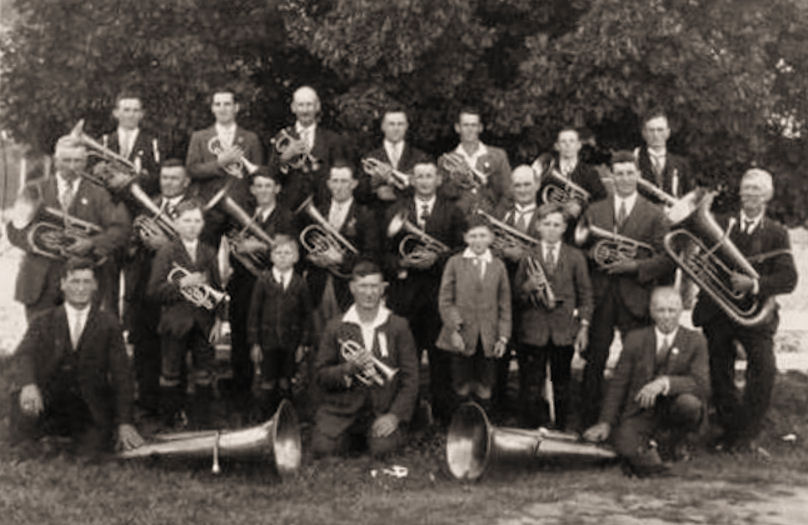
00000000_Wandiligong-BB_phot13253
Wandiligong Brass Band (Source: IBEW)

Not to be left out of the Christmas festivities were the bands that were part of events on Boxing Day.  In an article published by the Myrtleford Mail and Whorouly Witness newspaper, it was reported that the “Bright Xmas Carnival” was the place to be on Boxing Day in 1917,

From early morning buggies and coaches brought big crowds into town, and the special train from Wangaratta was splendidly patronised and also conveyed quite a number of horses and competitors, assuring the social and financial success of the meeting.

(“Bright Xmas Carnival.,” 1917)

The Wandiligong Brass Band was not forgotten and was said to have given “a fine programme of music both on the ground and before the performance at night” (“Bright Xmas Carnival.,” 1917).

Gifts and giving:

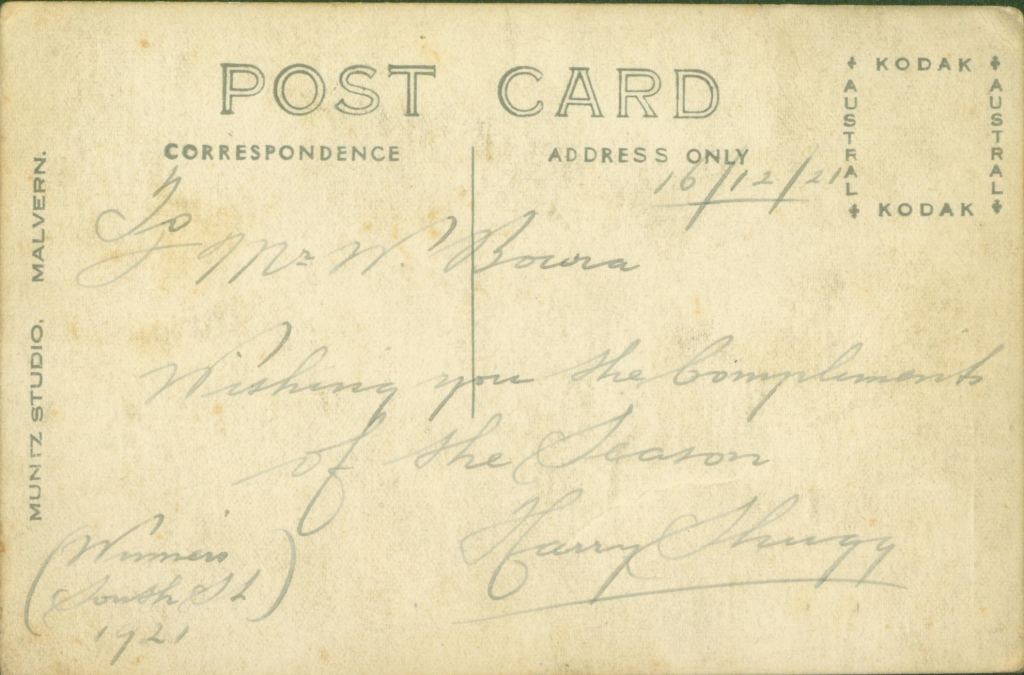
When researching for this post, it was also evident that band-related gifts and platitudes were exchanged of which here are two examples (there were probably more).  On the 16th December 1921 the conductor of the Malvern Tramways Band, Mr Harry Shugg gave a postcard picturing his prize-winning band to a Mr W. Boina with a short message wishing him the “Compliments of the Season” and as can be seen on the back of the postcard below, in brackets, “(Winners South St 1921)” (Muntz Studio, 1921).  No doubt Harry Shugg was very pleased with his band – and rightly so.
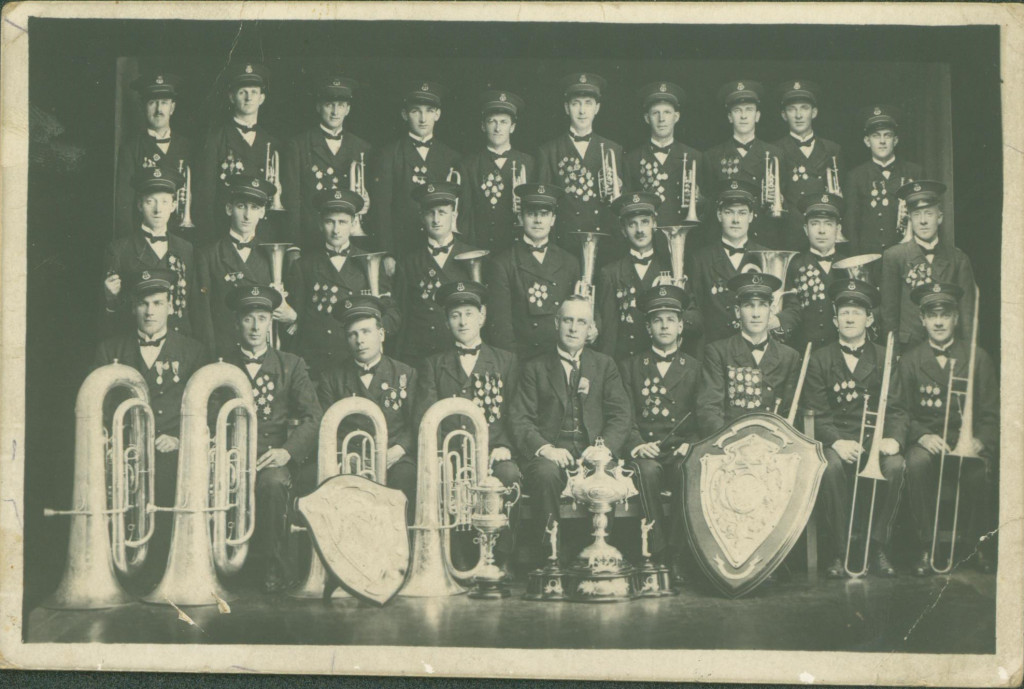
19211216_Malvern-Tramways-Band_Postcard
Postcard, Malvern Tramways Band, 1921 (front) (Source: Victorian Collections: Victorian Bands’ League Library & Archive)
19211216_Malvern-Tramways-Band_Postcard-Back
Postcard, Malvern Tramways Band, 1921. Handwriting by Mr Harry Shugg (back) (Source: Victorian Collections: Victorian Bands’ League Library & Archive)

For Christmas 1927, the members of the Cleve Brass Band gave their conductor, Mr W. Gillings, an aneroid barometer “suitably inscribed” as a gift in thanks for all the work he had done for the band (“Cleve Brass Band.,” 1928).  This was a wonderful token of appreciation and one which the conductor would no doubt have treasured.

Thinking of home at Christmas time:

We know that music can invoke all kinds of emotions and at Christmas time this feeling is no less poignant.  There were some who were away from their hometowns at Christmas in faraway places.  Published in the Carcoar Chronicle on Friday 19th of February 1915 was a letter from a local man, Mr Jack (John) Collyer who had enlisted in the Australian Expeditionary Forces and was then stationed in Egypt.  While he wrote extensively of his Christmas Day experiences in the Army camp, he made special mention of a brass band who reminded him of home,

I woke at 5 a.m. to hear splendid music, a brass band playing Xmas carols, a hundred yards away from my tent.  Talk about thrill – it was glorious.  I lay awake listening to the grand strains of ‘Hark, the Herald Angels Sing,’ and others and my mind wandered to Mudgee”

(“XMAS IN EGYPT.,” 1915)

Conclusion:

Music is synonymous at Christmas time and as we have seen, the many brass bands were in their element by eliciting town pride and enlivening the festivities.  These little stories were some of many, there were too many to list such is the activity of Australian bands at this time of year.  As I said at the beginning of the post, the times may have changed but the engagements have not!

I’d like to thank all the people who have read posts from Band Blasts From the Past over the past year and I hope you have found the posts informative.  I’d like to take this opportunity to wish my readers the compliments of the season, and I hope the coming year, and decade, is a safe, healthy and prosperous one. 

Jeremy de Korte (22/12/2019)

(Updated, 04/12/2023)

References:

BrightBright Xmas Carnival. (1917, 04 January). Myrtleford Mail and Whorouly Witness (Vic. : 1914 – 1918), 3. http://nla.gov.au/nla.news-article138709194

Christmas. (1922, 29 December). Tumut and Adelong Times (NSW : 1864 – 1867; 1899 – 1950), 2. http://nla.gov.au/nla.news-article139029474

Christmas and New Year’s Eves : The Tourists. (1913, 03 January). Alexandra and Yea Standard and Yarck, Gobur, Thornton and Acheron Express (Vic. : 1908 – 1949), 2. http://nla.gov.au/nla.news-article61188518

CHRISTMAS CAROLS. (1946, 28 December). Port Fairy Gazette (Vic. : 1914 – 1918), 2. http://nla.gov.au/nla.news-article88009047

CHRISTMAS CAROLS ON BAIN ROTUNDA : Clare Brass Band to Play Old English Carols on Xmas Night. (1932, 23 December). Northern Argus (Clare, SA : 1869 – 1954), 5. http://nla.gov.au/nla.news-article97616336

CHRISTMAS EVE : Band concert at Yorketown. (1920, 18 December). Pioneer (Yorketown, SA : 1898 – 1954), 3. http://nla.gov.au/nla.news-article199107675

Cleve Brass Band. (1928, 13 January). Eyre’s Peninsula Tribune (Cowell, SA : 1910 – 1950), 3. http://nla.gov.au/nla.news-article219285198

Coleraine Albion. (1915, 30 December). Coleraine Albion and Western Advertiser (Vic. : 1902; 1914 – 1918), 2. http://nla.gov.au/nla.news-article119606385

Colliver Photo. (1907). Band Rotunda, Rushworth, Victoria [Postcard]. [194458]. W. T. Pater, Printers and Stationers, Melbourne, Victoria. 

HistoryInPhotos. (2009, 21 February). The School Band at Beechworth, Vic, in 1931 [Photograph]. flickr. Retrieved 11 November 2019 from https://www.flickr.com/photos/26421213@N08/3295771357

McPhail and Peak Hill District Band. (1905, 15 December). Peak Hill Express (NSW : 1902 – 1952), 9. http://nla.gov.au/nla.news-article107246068

Muntz Studio. (1921). Malvern Tramways Band, 1921 [Postcard : L12.5cm – W8.2cm]. Victorian Bands’ League, Victoria Collections. https://victoriancollections.net.au/items/5b1ccc9521ea69132c023cd5

“Music in the Air” On Xmas Night : Big Wayville Festival. (1935, 14 December). Mail (Adelaide, SA : 1912 – 1954), 10. http://nla.gov.au/nla.news-article55719008

SPRINGSURE BAND DEBUT : Big Event of Xmas. (1934, 03 January). Evening News (Rockhampton, Qld. : 1924 – 1941), 5. http://nla.gov.au/nla.news-article201260331

Wandiligong Brass Band. (n.d.). [Photograph]. [phot13253]. The Internet Bandsman Everything Within, Vintage Brass Band Pictures : Australia. http://www.ibew.org.uk/vbbp-oz.html

XMAS AT THE HOSPITAL. (1920, 28 December). Northern Territory Times and Gazette (Darwin, NT : 1873 – 1927), 3. http://nla.gov.au/nla.news-article3303945

XMAS BAND RECITAL. (1949, 23 December). National Advocate (Bathurst, NSW : 1889 – 1954), 2. http://nla.gov.au/nla.news-article161655263

XMAS IN EGYPT : Some Interesting News. (1915, 19 February). Carcoar Chronicle (NSW : 1878 – 1943), 2. http://nla.gov.au/nla.news-article103560632

THE XMAS SEASON. (1915, 01 January). Murchison Advertiser and Murchison, Toolamba, Mooroopna and Dargalong Express (Vic. : 1914 – 1918), 3. http://nla.gov.au/nla.news-article130086316

The poetry of brass bands

Introduction:

While undertaking research for my blog posts thus far I have come across all manner of writing describing brass bands, their members and competitions.  Much of the writing is very useful in finding the “little stories” behind people, places and events.  Occasionally I have come across some oddities in the mix and this post is going to highlight an aspect of writing; poetry.

In this context of brass band history, penning up a poem about musicians, bands and competitions might seem very colloquial.  And in some respects, it is.  One only has to look at the style of writing and while the poems might not have won any literature awards, they were helpful in bringing to life some little stories in a unique style.

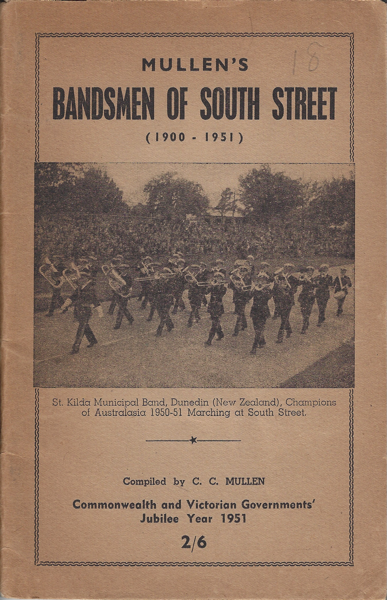
Below are just three of these brass band poems.  I have not been actively searching for these.  However, if while searching for material on other topics and they appeared, I have made a note of them for the novelty.  These are defiantly the needles in haystacks!  Two of the poems were published in local newspapers by writers using pseudonyms while the third poem was composed by brass band writer C. C. Mullen in his rare book, Mullen’s Bandsmen of South Street (1900 – 1951).

I am quite sure there are other brass band poems in other newspaper articles so this post might be expanded in the future.  Please enjoy the language and stories that are being told here and remember that they were for another time.  Perhaps this blend of artforms might be used again one day.

“A Welcome” by ‘Bannerman’ (1918):

Herald, 23/10/1920, p. 4

One of the first blog posts in Band Blasts from The Past was about the famous Cornetist and Conductor William Ryder who travelled to Australia in 1910 with the renowned Besses O’ Th’ Barn Band (de Korte, 2018).  Just eight years later, after stints with bands in Victoria and New South Wales, he arrived in Maryborough, Queensland to take the reins of the Maryborough Naval Band and we found that an enterprising contributor, under the pseudonym of ‘Bannerman’, had penned a poem to welcome him to town.  No doubt this would have been perceived as a very friendly gesture, and it gave the town some insight into the prowess and reputation of Ryder as a musician.  This poem was published in the Maryborough Chronicle, Wide Bay and Burnett Advertiser on Wednesday, 8thMay, 1918.

A WELCOME

Here’s a hearty welcome “Billy”,
To our pleasant country town,
And may Fortune every lead you,
And misfortune never frown.
We are pleased to have you with us,
And we hope you long may stay
To encourage local talent
In the latest style and way.

When you played the “solo cornet”
With the finest in the land,
You were classed as England’s champion
In the famous “Besses Band.”
And here in fair Australia
You can show us all the way
As the Champion of the Champions
From the South to old Wide Bay.

“Because” we all remember
When you played it at New Year,
When the silvery notes were finished
How the crowd did clap and cheer.
May our town and climate suit you,
May your notes prove ever true.
Here’s good-luck to wife and kiddies,
And long life and health to you.

(Bannerman, 1918, p. 6)

“Back to South Street” by Cecil Clarence Mullen (1951):

There is one brass band musician and writer among many who is significant to early Victorian brass band history, Cecil Clarence Mullen (C. C. Mullen).  His writing might be rare and hard to find now, however, being a band journal representative he had a unique insight into the workings of brass bands and was associated with many famous bands, conductors and administrators (Mullen, 1951).

It is in his little book, Mullen’s Bandsmen of South Street (1900 – 1951) that we find his poem, “Back to South Street”. In this piece of writing Mullen has cleverly highlighted the nostalgia of the South Street event while noting many of the famous names of bands and bandsmen.  It is a worthwhile poem to read for the sake of history.

19510000_Mullen
Front Cover Mullen’s Bandsmen of South Street (1900-1951) (Source: Jeremy de Korte Personal Collection)

BACK TO SOUTH STREET

Just let me go back to South Street
For a week with the famous bands,
And take with me others who would compete
In Australia’s Golden City of renown.

Just let me alight at the station
With cornet, trombone and drum,
And meet bandsmen from all over the Nation,
To whom South Street once more come.

Just let me line up in the station yard
And play through Handel’s “Hallelujah Chorus,”
Or “The Heavens Are Telling” by Haydn – just as hard,
As bands played in the days before us.

Just let me march along Sturt Street
With gay crowds lining the way,
With step by step and beat by beat,
Is South Street just the same to-day?

Just let me see who is judging again,
Is it Stead or Bentley with ears for tune?
Short, Beswick, Sutton or Morgan – men of fame,
Or King of them all – J. Ord Hume.

Just let me go through Inspection
As we did when we dressed with much care;
With the gayest uniform in our section,
That made all our rivals stare.

Just let me compete in the solos again
From the grand old Coliseum stage,
With “Adelaide” or “Gipsy’s Warning” – or “Pretty Jane,”
“Zelda” and “Miranda” of a later age.

Just let me mount he platform
And play through “Beethoven’s Works.”
Or any Alexander Owen’s selections
That South Street bands would not shirk.

Just let me play through the Test piece,
Be it “Mercandante.” “Mozart” or “Liszt,”
“Wagner,” “Chopin” of “Meyerbeer,”
The tests that were tests on our lips.

Just let me march in the Quickstep
With Ord Hume’s “B.B. and C.F.”
“The Challenge,” “Cossack” or “Ravenswood”
Or was the “Twentieth Century” the best?

Just let me see the others swing past,
Code’s, Prout’s, Rozelle and Boulder.
Wanganui, Newcastle and Bathurst Brass,
Great names that come dear to the older.

Just let me see those fine Geelong bands,
St. Augustine’s, Municipal and Harbour Trust.
Also Collingwood, Malvern, Richmond, Prahran,
Perth City – all great power among us.

Just let me see Geelong Town again
With Sharpe Brearley at the head of affairs.
They ranked with Prout’s in quickstep fame,
First in marching honours was often theirs.

Just let me see the giants of the baton,
Riley, Code, Bulch and Prout,
McMahon, Barkel, Jones and Hoffman.
Many, alas, have gone out.

Just let me see others again,
Partington, Shugg, Johnston, Bowden.
Men who kept time in South Street’s fame;
Wade and Baile must be among them.

Just let me think if I missed any,
Yes, there was Davison, Niven, Lewins – any more!
Hopkins, Ryder, Billy May among many,
Not forgetting Frank Wright and J. Booth Gore.

Just let me see the best of officials
And critics like Davey, Gartrell and Hellings,
Humphreys and Boyce – Kings of staff and whistle,
May march us again – well, there’s no telling.

So to-day just let me go back to South Street,
Most famous contest in the land,
Where many old timers I will heartily greet,
And yarn over years that were so grand.

(Mullen, 1951, pp. 2-3)

“Dungog Brass Band” by ‘Mad Mick” (1954):

19120000_Dungog-BB_phot16862
Dungog Brass Band, 1912 (Source: IBEW)

Above is a picture of the Dungog Brass Band from around 1912 and unfortunately, this is one of the only pictures I could find of them.  However, some thirty years later this prose was published in the Dungog Chronicle : Dungog and Gloucester Advertiser newspaper by a member of the band writing under the pseudonym of ‘Mad Mick”.  One may wince at some of the language, but this was the 1950s.

From reading the poem it appears that ‘Mick’ is a third cornet player.  This poem is quite good in describing who the band is, what it does and where it goes, but the prose hints at some problems like attendance issues.  We can appreciate that this was a local town band, and this was the way they did things. I think every band has a ‘Mick’ in their midst and we can thank him for highlighting the Dungog Brass Band in the way that he did.

DUNGOG BRASS BAND

I’ve heard it said that Old King Cole was happy, gay and free,
And he liked music sweet and low, played by his fiddlers three,
But in Dungog we’re luckier than King Cole in his day,
We have a band of 25 with band-master, Bob Gray;
And of this band we all feel proud, a mighty job they do,
They play in aid of charities, and spastic kiddies too.
Some Saturdays they entertain at each and every pub,
They finish off the evening playing at the Bowling Club.

Now I would like to tell you all the names of those who play,
And how old Bob the baton waves, and gets them on their way;
Soprano cornet heads the list and that’s I. Kennedy.
That solo cornet it is played by little Johnny Lee;
Keith Kennedy is downstairs for he is baritone,
And forwards, backwards, goes Stan Leayr upon the old trombone;
Now solo tenor horn Barry Schofield plays alone,
Toot! Toot! Toot! Toot! Don Redman goes upon his saxophone.

First tenor horn’s Wal Arnold, third cornet Mick Neilson,
Johnny Schofield’s second cornet, Hector Robson the side drum;
Ken Wade with his euphonium, gets down to bottom D,
While second solo tenor horn is little Barry Lee;
Then there’s E bass Freddy Schofield and Ted Mathews is the same,
And there’s one more solo cornet, Artie Redman is his name;
The secretary is Jack Kerr, he’s also big bass drum,
While tenor horn number three is played by “Butch” Neilson.

There’s only six more instruments and players for to pen,
For to conclude the roll call of Bob and his merry men;
And Bob calls them “some-timers,” they don’t attend a lot,
Sometimes they’re there for practice and sometimes they are not.
There’s the E bass and the B bass, and repiano cornet too,
And they’re played by Tommy Ferris and Keith Lean and Shelton, Blue,
Well now I’ve two trombonists whose attendances are poor
And they are “Sambo” Neilson and offsider Dennis Moore.

Well, those are all the players who go to make this band,
But there are two more people who lend a helping hand;
First of them the Drum Major, he makes them look so fine,
And that of course is Perry, Bill, he sees they march in line.
Then last of all is Paddy with collection box in hand,
You’ll always find him snooping round somewhere behind the band,
He sticks his box beneath your nose and thinks he’s doing right.
No wonder folks have christened him the “great Australian bite!”
P.S. – Sorry folks I missed one out, it’s Ray Monaghan I’m sure,
He plays quite well, but still in all, attendances are poor.

(Mad Mick, 1954, p. 3)

…and something from me:

In concluding this next blog post in Band Blasts From the Past,
Some tales of bands and bands people, but they won’t be the last.
For as we know from history, stories wait until they’re found,
Of the many tales of bands people who were there to make a sound.

References:

Bannerman. (1918, 08 May). A WELCOME. Maryborough Chronicle, Wide Bay and Burnett Advertiser (Qld. : 1860 – 1947), 6. http://nla.gov.au/nla.news-article151083205

de Korte, J. D. (2018, 02 March). William Ryder: The first conductor of the Prahran & Malvern Tramways Employees Band. Band Blasts from the Past : Anecdotes, Stories and Personalities. https://bandblastsfromthepast.blog/2018/03/02/william-ryder-the-first-conductor-of-the-prahran-malvern-tramways-employees-band/

Dungog Brass Band. (1912). [Photograph]. [phot16862]. The Internet Bandsman Everything Within, Vintage Brass Band Pictures : Australia. http://www.ibew.org.uk/vbbp-oz.html

Mad Mick. (1954, 29 September). DUNGOG BRASS BAND (By ‘Mad Mick). Dungog Chronicle : Durham and Gloucester Advertiser (NSW : 1894 – 1954), 3. http://nla.gov.au/nla.news-article140539879

Mullen, C. C. (1951). Mullen’s Bandsmen of South Street (1900-1951). Horticultural Press. 

Quickstep. (1920, 23 October). Bandsmen’s Gossip : Celebrated Conductor. Herald (Melbourne, Vic. : 1861 – 1954), 4. http://nla.gov.au/nla.news-article242245731

Trans-Tasman connections: the lure of competition and performance. Part Two – Australian Bands in New Zealand.

Introduction:

In comparison to the first part of this series of posts, the Australian bands were not quite as proactive as crossing the Tasman as their New Zealand counterparts.  When the Australian bands did go to New Zealand, they tended to do very well in competition and performances gained rave reviews.  This part of the post will detail the trips that four Australian bands made to New Zealand between 1900-1940.

1907: Newcastle City Band – Christchurch International Exhibition Contest:

19070213_New-Zealand-Mail_Newcastle-Picture
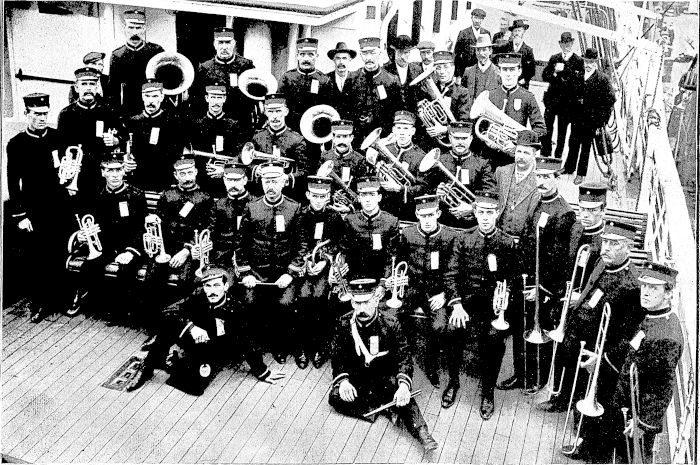
1907, Newcastle City Band visiting New Zealand. New Zealand Mail, 13/02/1907 (Source: PapersPast)

It took a little bit longer for Australian bands to start reciprocal visits to New Zealand and in 1907 the then champion Newcastle City Band traveled to Christchurch via Wellington to participate in the International Exhibition Contest (“NEWCASTLE CITY BAND.,” 1907).  By all accounts, this was a huge event with no less than twenty-nine bands participating (Newcomb, 1980).  Also in attendance at the Exhibition was the world-famous Besses O’ Th’ Barn Band from England who performed to great acclaim (Newcomb, 1980).  Code’s Melbourne band was also intending to take part in the event however they did not end up going due to some of their bandsmen being unable to take time off work (Trombone, 1907).

The Newcastle Band achieved a very credible third placing against some top-ranking New Zealand bands and some of their soloists also achieved good placings (“BAND CONTEST,” 1907).  However, soon after the contest finished, questions were being asked over the judging with Newcastle and others feeling that Newcastle should have been placed higher.  In an article published in the Wanganui Herald newspaper, a Mr. Edgar Nicholas from Ballarat who was visiting was asked about the adjudicating at the contest by Lieutenant Bentley, formerly of England.  Mr. Nicholas said in his interview that,

I have been at all the band contests in Ballarat, where the principal bands in Australia compete.  We had had Messrs Ord-Hume, Wade, and Beard from England, but, speaking generally, Mr. Bentley has given equal satisfaction in Ballarat with these gentlemen”.

(“THE JUDGING AT THE CONTEST,” 1907)

Speaking pragmatically in the interview, Mr. Nicholas noted that an adjudicator sometimes fails to please everyone given that Mr. Bentley had to judge 30 bands.  Also, as Mr. Nicholas suggests, some bands may not have been at their best given the late hours that some of them competed (“THE JUDGING AT THE CONTEST,” 1907).  Mr. Nicholas kept drawing comparisons with the Ballarat South St. Eisteddfod, the first being that that in the case of large sections, Ballarat employed up to three judges and that in Australia there were separate gradings which, at the time, were not used in New Zealand (“THE JUDGING AT THE CONTEST,” 1907).

One Newcastle bandsman was quite firm in his comments which were published in a Newcastle Morning Herald and Miners’ Advocate newspaper article,

When our band-master tells us we played well I am satisfied.  He tells us often enough when we don’t play well; but we never played better than in the competition.”

(“THE CITY BAND.,” 1907).

Aside from this issue over the placings, most accounts note that the Newcastle City Band had an enjoyable trip and were welcomed in various locations.  On the ship home, they played for an appreciative audience and were welcomed home with a civic reception (“THE CITY BAND.,” 1907).

Band:Own Choice:Test:Total:
Wanganui Garrison158147305
Kaikorai Brass158145303
Newcastle City156146302
(source of table data (Newcomb, 1980, p. 40))

1923: Redfern Municipal Band – South Island Brass Band Association Contest, Dunedin:

Some sixteen years after the first Australian band traveled to New Zealand, it took until 1923 for the next Australian band to arrive.  The Redfern Municipal Band, conducted by Mr. W. Partington, was a formidable band at the time and they undertook a short tour through the South Island of New Zealand on their way from Wellington to Dunedin.  Upon arriving in Wellington, along with a contingent of N.S.W. Bowlers, they were given a large civic reception by the Mayor (“BOWLERS AND BANDSMEN,” 1923).  The arrival of Redfern had generated an amount of excitement throughout New Zealand, suffice to say that their conductor Mr. W. Partington had conducted one of their own champion bands, The Wanganui Garrison Band for a while (“ENTERPRISING BAND,” 1923; Newcomb, 1980) – the band from Redfern was not unknown in New Zealand.

Redfern Municipal was ultimately triumphant in Dunedin by winning the A Grade section and Aggregate.  This was no easy feat given that a number of New Zealand’s A grade bands were in the section, including Mr. Partington’s former band, Wanganui.  Newcomb (1980) wrote of Redfern and the A Grade contest,

In Dunedin, it competed against seven of New Zealand’s top A grade bands.  After a week of intensive rehearsal in the “Edinburgh of the South” Redfern was rewarded for its painstaking efforts when it took out the A grade title 12 points ahead of Invercargill’s Hiberian Band. The 1st Canterbury Mounted Regiment Band was third.

The talking point of the contest was the poor performance of the Wanganui Garrison Band, under Mr. J. Crichton.  The veteran Wanganui conductor’s ambition was to thrash the Redferners…”

(p. 44)

Of course the triumph was noted in Australian and New Zealand newspapers, and rightly so, it was a great win for the Redfern band (“BAND CONTEST,” 1923; “REDFERN BAND,” 1923).  However, the backstory of the two conductors was intriguing and written up as part of an article published by the NZ Truth newspaper:

There is an interesting story (perhaps) behind the crossing of the Redferners.  Bandmaster Partington was over here for a while, and had charge of the Wanganui Band.  Within a very short period of training under his baton he made champions of them, winning the N.Z. honors last year.  Then there arose a controversy between Partington, of Aussieland and Jim Crichton, of Wanganui, the ex-bootshopman who knocked off trade to become a musician, undergoing a special course of study in London for the purpose of pursuing his brass-bound hobby.  He told P. that if he (C.) had the Woolston Band under his baton for a month he could beat anything that P. could bring against it.  There was such a heated argument that it was leading to something like a £1000 wager.  But P. left for Aussieland again, and took charge of the Redferners.  Now the question is: Did he bring the Sydneysiders over to compete against anything that Jim Crichton had under his wing? Well, Jim took the Wanganui cracks down to Dunedin to play against their old leader – and Wanganui was nowhere in the final!

(“Brass Bands and Bandsmen,” 1923)

When returning to Australia, there was a snippet of thought that the Redfern Band might head to England to compete (“REDFERN BAND,” 1923).  However, this evidently did not eventuate.  Their conductor, Mr. Partington, went on to other activities and formed a representative band that travelled Australia with the aim of heading to England.  But as detailed in a previous post, that tour ended up running out of money upon arrival in Perth.

1925: Malvern Tramways Band – New Zealand National Band Championship, Auckland:

19250305_Auckland-Weekly-News_MalvernTB_
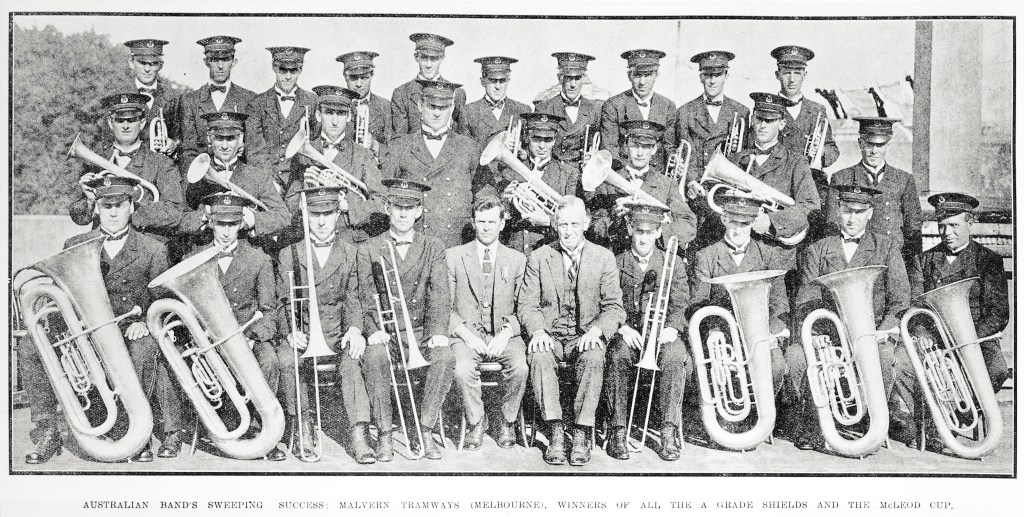
Malvern Tramways Band, Auckland. Auckland Weekly News, 2/03/1925, p. 46. (Source: Auckland Libraries Heritage Collections: AWNS-19250305-46-1)

Just two years later, another crack Australian band made the trip to New Zealand to compete.  The Malvern Tramways Band was renowned throughout Australia as one of the elite bands of the Commonwealth having won numerous competitions by this time.  So much so that the Malvern Band, like many others, tried to get to England however they too were unable to raise sufficient funds.  To compensate, they did arrive in New Zealand early in 1925 to commence a six-week tour culminating in the championships in Auckland (“Malvern Tramways Band,” 1925d).

The reputation of Malvern preceded them to New Zealand and all manner of hospitality was afforded for the band including, special observation cars on trains, reduced rail fares and free travel on New Zealand trams! (“MALVERN TRAMWAYS BAND,” 1925b).  They sailed from Melbourne to Invercargill and from there travelled up to Auckland giving concerts in all the major towns on the way (“MALVERN TRAMWAYS BAND,” 1925a).  By late February they had reached Auckland and commenced competing in the band sections and solo sections.  In competition, the Malvern Tramways band was formidable and they won just about every section except for the Quickstep where they achieved third place (“MALVERN TRAMWAYS BAND.,” 1925b; “MALVERN WINS A GRADE TEST,” 1925).  Newcomb (1980) wrote of the contest:

After many years of bickering, common sense prevailed when the North and South Island associations joined forces to stage the 1925 national contest in Auckland.

It was made doubly interesting by the presence of the Malvern Tramways Band from Australia under the conductorship of Mr. Harry Shugg.

New Zealand’s top A grade bands proved no match for the highly fancied Australian combination which won both tests, the hymn and the championship aggregate.

(p. 45)

After this astounding success in New Zealand, the Malvern Tramways Band sailed for Sydney where they performed their competition repertoire in concert to rave reviews (“MALVERN TRAMWAYS BAND,” 1925c).  Traveling back to Melbourne, the success of their New Zealand venture was written up a couple of months later by the local Prahran Telegraph newspaper (“MALVERN TRAMWAYS BAND.,” 1925a).

1936: Cairns Citizens’ Band – New Zealand National Band Championships, New Plymouth:

19351123_Evening-Post_Cairns-Band
Cairns Citizens’ (31st Battalion) Band. Evening Post, 23/11/1935. (Source: PapersPast)

In October 1935, the Cairns Post newspaper published the news that the Cairns Citizens’ (31st Battalion) Band would compete at the 1936 New Zealand Band Championships in New Plymouth (“MAKING HISTORY.,” 1935).  Conducted by James Crompton, a person that was not unfamiliar to the New Zealand brass bands, the band was nominally the first band from Queensland to compete in New Zealand and the first from Australian Military Forces (“MAKING HISTORY.,” 1935).

The Cairns Citizens’ Band won the New Zealand Championship that year, although they did not win the Test selection.  However, their aggregate points were enough that they could win the championship (“Cairns Band.,” 1936; Newcomb, 1980).  The New Zealand press was also impressed by the standards set in New Plymouth and an article published in the Evening Post newspaper praised the marching – the Cairns Citizens’ Band achieved 2nd place in the marching section (“GOOD MARCHING,” 1936).

Conclusion:

There was a similarity of experiences for bands crossing to either side of the Tasman; with civic receptions, a very interested and informed public and commentary from the newspapers.  The excitement generated by viewing a visiting band was also interesting to note – and there were plenty of other articles that were written about bands (but too many to list in these posts)!  It was interesting to note just how close the Australian and New Zealand brass band movements were in terms of standards and rules, so much so that any band crossing the Tasman could expect near similar conditions of competition.  The best bands of each country could match the other and in the spirit of competition, this was plain to see.

It is the collegial nature of band movements that enabled these visits to happen and to this day, the friendly rivalries remain, and visits continue to take place.  Kudos to the bands that made these early trips as they set a foundation for other bands to build on.

<- Part One – New Zealand Bands in Australia

References:

Auckland Weekly News. (1925). AUSTRALIAN BAND’S SWEEPING SUCCESS : MALVERN TRAMWYS (MELBOURNE), WINNERS OF ALL THE A GRADE SHIELDS AND THE McLED CUP. In Auckland Weekly News (AWNS-19250305-46-01 ed., pp. 46). Auckland, N.Z. https://kura.aucklandlibraries.govt.nz/digital/collection/photos/id/244635/rec/1 Ngā Pātaka Kōrero o Tâmaki Makaurau / Auckland Libraries Heritage Collections.

AUSTRALIAN BAND FOR NEW ZEALAND CONTEST. (1935, 23 November). Evening Post. https://paperspast.natlib.govt.nz/newspapers/EP19351123.2.26.1

BAND CONTEST : Redfern Win The Aggregate : Wellington Watersiders Third. (1923, 24 February). Evening Post. https://paperspast.natlib.govt.nz/newspapers/EP19230224.2.68

BAND CONTEST : Winners of Competitions. (1907, 16 February). New Zealand Times. https://paperspast.natlib.govt.nz/newspapers/NZTIM19070216.2.61

BOWLERS AND BANDSMEN. (1923, 08 February). Evening Post. https://paperspast.natlib.govt.nz/newspapers/EP19230208.2.25

Brass Bands and Bandsmen. (1923, 03 March). NZ Truth. https://paperspast.natlib.govt.nz/newspapers/NZTR19230303.2.2.4

Cairns Band : Wins Championship. (1936, 02 March). Daily Mercury (Mackay, Qld. : 1906 – 1954), 6. http://nla.gov.au/nla.news-article172909750

THE CITY BAND. (1907, 27 February). Newcastle Morning Herald and Miners’ Advocate (NSW : 1876 – 1954), 5. http://nla.gov.au/nla.news-article136605589

ENTERPRISING BAND : Sydney Competition Band Likely to Visit Wanganui. (1923, 12 January). Hawera & Normanby Star. https://paperspast.natlib.govt.nz/newspapers/HNS19230112.2.17

GOOD MARCHING : Port Nicholson Band : Recent National Contest. (1936, 09 March). Evening Post. https://paperspast.natlib.govt.nz/newspapers/EP19360309.2.25

THE JUDGING AT THE CONTEST. (1907, 15 February). Wanganui Herald. https://paperspast.natlib.govt.nz/newspapers/WH19070215.2.32

MAKING HISTORY : Band For New Zealand : Cairns to Cross Tasman. (1935, 02 October). Cairns Post (Qld. : 1909 – 1954), 5. http://nla.gov.au/nla.news-article41708070

MALVERN TRAMWAYS BAND. (1925a, 20 February). New Zealand Herald. https://paperspast.natlib.govt.nz/newspapers/NZH19250220.2.132

MALVERN TRAMWAYS BAND. (1925b, 20 January). Herald (Melbourne, Vic. : 1861 – 1954), 16. http://nla.gov.au/nla.news-article243874312

MALVERN TRAMWAYS BAND. (1925c, 10 March). Sydney Morning Herald (NSW : 1842 – 1954), 10. http://nla.gov.au/nla.news-article16207234

Malvern Tramways Band : Leaves for New Zealand. (1925d, 13 February). Prahran Telegraph (Vic. : 1889 – 1930), 8. http://nla.gov.au/nla.news-article165132427

MALVERN TRAMWAYS BAND : Recent New Zealand Tour : Success in Competitions. (1925a, 22 May). Prahran Telegraph (Vic. : 1889 – 1930), 6. http://nla.gov.au/nla.news-article165141099

MALVERN TRAMWAYS BAND : Wins Championship of New Zealand. (1925b, 06 March). Prahran Telegraph (Vic. : 1889 – 1930), 7. http://nla.gov.au/nla.news-article165137387

MALVERN WIN A GRADE TEST. (1925, 27 February). Evening Post. https://paperspast.natlib.govt.nz/newspapers/EP19250227.2.83.1

New Zealand International Exhibition. (1907, 12 February). Star, 3. https://paperspast.natlib.govt.nz/newspapers/TS19070212.2.57.2

The Newcastle (N.S.W.) City Brass Band; Champion Band of Australia, At Present Visiting New Zealand. (1907, 13 February). New Zealand Mail. https://paperspast.natlib.govt.nz/newspapers/NZMAIL19070213.2.235.6

NEWCASTLE CITY BAND : Going to New Zealand. (1907, 29 January). Newcastle Morning Herald and Miners’ Advocate (NSW : 1876 – 1954), 5. http://nla.gov.au/nla.news-article136608558

Newcomb, S. P. (1980). Challenging brass : 100 years of brass band contests in New Zealand, 1880-1980. Powerbrass Music for the Brass Band Association of New Zealand. 

REDFERN BAND : New Zealand Triumph. (1923, 09 March). Evening News (Sydney, NSW : 1869 – 1931) ,8. http://nla.gov.au/nla.news-article118834570

Trombone. (1907, 09 February). The Exhibition : The Band Contests. Lyttelton Times. https://paperspast.natlib.govt.nz/newspapers/LT19070209.2.71

Names and status: the rare National and State bands

Postcard: Australian Silver Band, 1925. (source: Jeremy de Korte Personal Collection)

Introduction:

For the most part, the naming of bands is logical based on location, type, or business association. It stands to reason that if a band was associated with a town, then that would be the town band, however, there were a number of exceptions  – the naming of some of the early private bands comes to mind. Likewise, if a band was in a locality and associated with an industry, a similar naming convention would follow, such as Newcastle Steelworks or South Australian Railways.  This gave the bands identity and a purpose.  Where two bands existed in the same area, there was undoubtedly some disagreements, although not generally over naming but over status and prestige…and performances!  If a band was given an Australian or State name, that lifted their reputations almost immediately, yes?  Possibly, but there were other factors involved.

The focus of this post is to explore a level up from the local bands where we delve into the rare State and National bands.  Granted, there were not many of them.  In fact, in the time period that is being focused on in this post, these types of bands were thin on the ground.  In a previous post, the life of the ABC Military Band was explored, a unique ensemble in its own right and one that included bandsmen from all over Australia.  This was a representative band but different from the more common brass bands in that it included woodwind and percussion.  In this post, we will highlight brass bands.

Admittedly, there was some difficulty finding material on these rare bands due to their short periods of existence.  That being said, there were other bands in Australia aside from the more notable ones and mention will be made of them.  We will also see how a certain State band raised the ire of the governing body of its home State.

There is no doubt that being part of a National or State band was one that bandsmen aspired, and for the National bands, the best bandsmen were picked for a proposed or grand world tour.  The one State band that was set up did so in unusual circumstances and the naming of them as a State band brought them much recognition and pride.  With this in mind, National and State bands did exist and although they were sporadic and formed mainly for tours, they developed reputations in their own right and gave more bandsmen another musical outlet.

Early attempts:

State and National bands were mainly set up by organizations that had the resources to undertake such ventures.  Remembering that this was an older Australia where the distances between places were sometimes very vast, and it was not easy to move people anywhere. Yet in the first instance, we can see that the Salvation Army pulled this off in 1898 with the formation of a Federal Band.  An article which was published in the South Australian Register on the 14th of February 1898 is very informative and details the formation of the band and the tour it had undertaken thus far:

There is now in Adelaide an interesting band of clever musicians picked from the ranks of the Salvation Army.  It is styled “the Salvation Army Federal Band” and has twenty-five playing members, exclusive of Major Taylor (Victoria), who is their director.  The bandmaster is Ensign Cater (New Zealand), who takes up an instrument.  Counting in Major Taylor, the seven colonies of Australia are represented in the following order: – Victoria, eight; South Australia, five; Western Australia; four; New South Wales, three; New Zealand, three; Queensland, two; Tasmania, one; total, twenty-six.

(“SALVATION ARMY FEDERATION.,” 1898)

The Salvation Army had begun planning for this band twelve months in advance, with the aim of the band being “the kind of which should tour the colonies and encourage the members of the Army, and by producing music of a high order raise funds for the work in the different parts of Australasia” (“SALVATION ARMY FEDERATION.,” 1898).  By the time the band had reached Adelaide it had already toured from Melbourne to Western Australia, back to South Australia and from there had been to the Yorke Peninsula and Broken Hill (“SALVATION ARMY FEDERATION.,” 1898).  According to another article published in The Advertiser, the Federal Band was a very fine combination of musicians and presented a wonderful concert (“SALVATION ARMY.,” 1898).  As it is ever thus with Salvation Army bands.

The Sydney Morning Herald, 1/04/1908, p. 8

In 1908 a tiny article was published in The Sydney Morning Herald in which the title is misleading. As you can see in the article (pictured), there is no “Commonwealth Brass Band” that has been formed.  Rather, it is a proposal to secure the services of the Newtown Brass Band to perform at the Anglo-French Exhibition (“COMMONWEALTH BRASS BAND.,” 1908).  By all accounts, the Newtown Brass Band was very famous having won numerous competitions by this time and could have probably served as the Australian band at the exhibition (Greaves & Earl, 2001).  However, the Prime Minister apparently rejected this proposal for reasons unknown.

The Australian Imperial Band:

Postcard: Australian Imperial Band, 1924 (source: Jeremy de Korte personal collection)

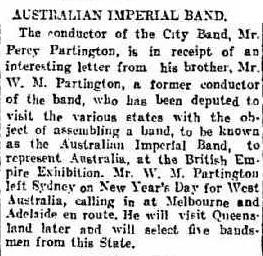
In terms of true Australian brass bands, the main one that is spoken about is the ‘Australian Commonwealth Band’ which was conducted by the great Albert H. Baile on two world tours – but more will be talked about this band in the next section (Sharp, 1993).  However, preceding the ‘Australian Commonwealth Band’ was another ensemble which was known as the ‘Australian Imperial Band’ (AIB), formed by Mr. W. M. Partington in 1924 (“AUSTRALIAN IMPERIAL BAND.,” 1924).  Mr. Partington is mentioned in some references –  he did conduct the Ballarat City Band from 1909-1910 and numerous other bands (Pattie, 2010).  That did not stop certain newspapers like the Ballarat Star waxing lyrical about his musical and organisational abilities (“AUSTRALIAN IMPERIAL BAND COMING.,” 1924).  Nevertheless, it is evident that in much later years he managed to form a true National band and while it seems he never took the band to England, he did take it on tour throughout Australia.

Morning Bulletin, 9/01/1924, p. 8

1924 was an interesting year for Australian bands.  Perhaps the most notable event was the tour of the Newcastle Steelworks Band to England where it achieved astounding success in competition under the baton of Albert H. Baile (Greaves & Earl, 2001).  The AIB had wanted to go to England to compete but were unable to make the trip due to a lack of funds.  The Newcastle Steelworks Band then went in their place (Cameron, 2020). We see in an article from the Daily Telegraph in June 1924 that there was an amount of work going on to try and secure more funds:

In Sydney, the Lord Mayor (Ald. Gilpin) now is issuing an appeal for funds, which should meet with a good response, as it is necessary for each State to provide a proportionate amount of expenses to send the band to Wembley and to compete in the Crystal Palace contests.

(“AUSTRALIAN-IMPERIAL BAND,” 1924)

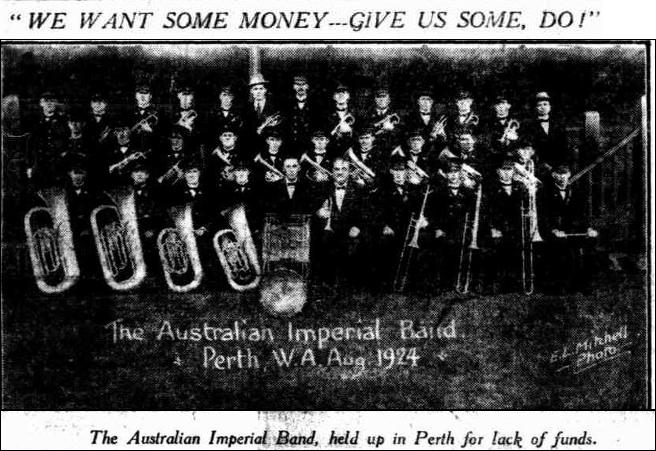
However, as discussed in a previous post on bands that went on tour, it is a very expensive undertaking and the picture of the AIB (below) published by the Mirror newspaper in Perth is telling.  One could assume that by the time the AIB reached Perth, their general touring money had run out.  Which is probably a reason why there is no mention of the band traveling to England.

19240809_Mirror_Aust-Imp-Band-Money
Mirror, 9/08/1924, p. 1

The length of time this band was in existence was short however they managed to get themselves together and go on a grand tour of Australia, to some very favorable reviews.  There is not much mention of the personnel of the band but given there were many quality bandsmen in the country at the time, finding gifted musicians was probably not a problem.

The Australian Commonwealth Band:

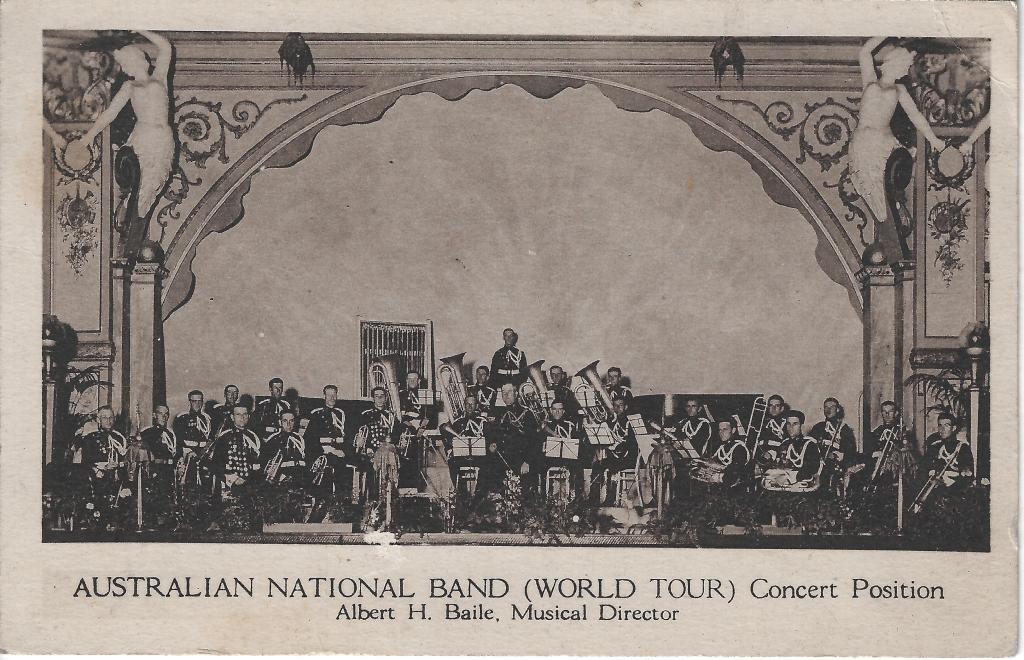
Postcard: Australian National Band – Concert Position, 1926 (source: Jeremy de Korte personal collection)
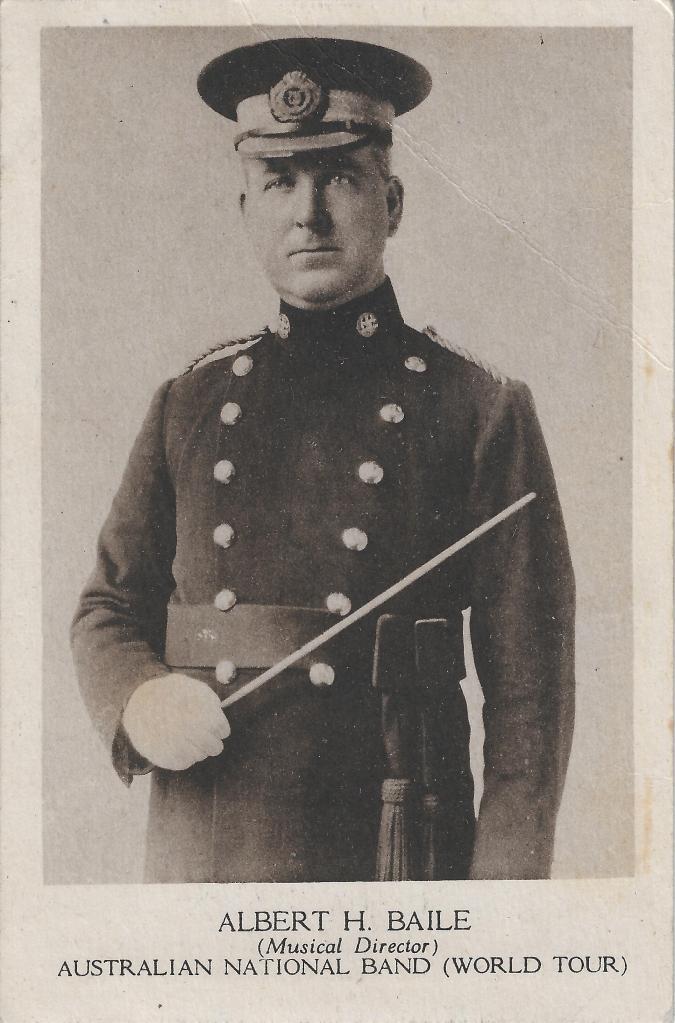
Postcard: Albert H. Baile, 1926 (source: Jeremy de Korte personal collection)

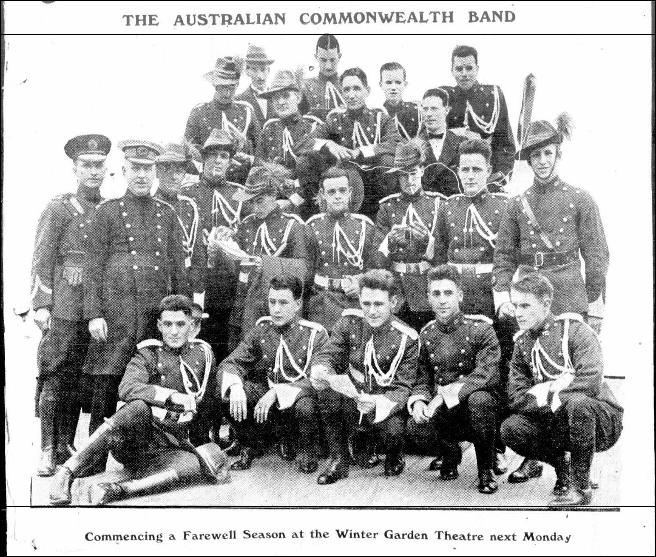
Albert H. Baile was one of the most famous band directors of this time and he had a masterful way of conducting his bands (Greaves & Earl, 2001).  No sooner had Baile returned to Australia in 1925 with his Newcastle Steelworks Band, he made moves to reform the band in Sydney as the Australian Silver Band and apparently included some Queensland bandsmen in the new ensemble (“AUSTRALIAN SILVER BAND.,” 1925).  Including some bandsmen from another State could probably justify the name change an Australian band. However, given the huge reputation of the Newcastle Steelworks Band after their competition wins, the name change stuck and the band proceeded on their first international tour to wide acclaim (“AUSTRALIAN COMMONWEALTH SILVER BAND,” 1926).

The Daily Mail, 29/09/1925, p. 10

The band name seems to have begun evolving into the Australian Commonwealth Band in various media with the dropping of the world ‘Silver’ from it, hence the more recognizable name is etched in history.  We see in the various photos and ephemera included in this post that they were a very smart looking ensemble and that they had a distinctly Australian look with slouch hats.

Aside from the way the name of the band continually evolving in the newspapers, this did not discount the fact that it was an extremely fine ensemble made up of the best brass soloists and led by Baile himself.  Certainly, reviews from Australian newspapers as well as those from overseas, gave high praise to the sound of this band likening it to an “organ” or an “orchestra” (“Australian Silver Band,” 1925; “VISIT OF AUSTRALIAN BAND,” 1926).   The newspaper article published by the Todmorden & District News (UK) in 1926 was very informative as to the concert it gave in their area, attended by 5,000 people, and the quality of the soloists, in particular, the Solo Cornet player, Mr Arthur Stender (“VISIT OF AUSTRALIAN BAND,” 1926).  Below is a list of the band members as published in the book, “Legends in Brass : Australian Brass Band Achievers of the 20thCentury”:

Postcard: Australian National Band, 1926 (source: Jeremy de Korte personal collection)

Front row: Len Ryan, Norm Forbes, Alf Cornish, Fred Myers, Vern Beacroft, Albert Baile, Clarrie Collins, Jack Stokes, Tom Bennett, Ossie Forbes
Middle row: Bob Gibson, Joe Clay, Len Atkinson, George Robertson, Stan Ryan, Albert Ovenden, Bill Murphy, Jack Murphy, Harold Hewson
Back row: Archie Moore, Harold Collins, James “Scott” Armour, Arthur Stender, Alfred Paxton, Joe Hardy

(Greaves & Earl, 2001, p. 51)

The Australian Commonwealth Band undertook two Australian/World tours, the first from 1925-1926 and the next from 1926-1928.  As in their first tour, they received rave reviews during their second tour, of which an article in New Zealand’s Evening Post from February 1927 provides a brief summary (“COMMONWEALTH SILVER BAND,” 1927).  This second tour was not all plain sailing.  While the band was traveling around Australia, the Australian Musicians’ Union was up in arms about a boycott of the Commonwealth Band while it was touring America (“COMMONWEALTH BAND,” 1927).  The Union started lobbying for retaliatory action against musicians visiting from overseas.  It is unclear how this action was resolved however it is interesting that despite the reputation of the Commonwealth Band, there was this hiccup while on tour.

19271203_Figaro_Aust-Comm-Band-Farewell
Queensland Figaro, 3/12/1927, p. 1

The Australian Commonwealth Band was disbanded in Sydney in early 1928 after they had finished their last tour of Australia (Greaves & Earl, 2001).  There is no doubt that this was a truly remarkable ensemble, started from the players of the Newcastle Steelworks Band to become a unique band in its own right. And it certainly boosted the reputation of Australian bands in general.  The legacy of this fine ensemble was felt for years to come.

The Queensland State Band:

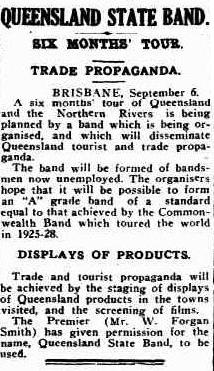
In the early 1930s, we see the formation of the one and only State band, the Queensland State Band.  This was formed in unusual, but possibly well-meaning circumstances as the musicians were notionally “unemployed” (“QUEENSLAND STATE BAND.,” 1933b).  The other aim of the band was to try to emulate the success of previous tours by the Newcastle Steelworks Band and the Australian Commonwealth Band by touring overseas and competing in England.  Nevertheless, the band formed in September 1933 and included previous members of the Australian Commonwealth Band (“QUEENSLAND STATE BAND TOUR.,” 1933).

The Northern Herald, 9/09/1933, p. 19

Almost immediately this band raised the ire of the Queensland Band Association (QBA) of which sent an annoyed letter to the Courier Mail published on October 9th, 1933.  In the letter, the QBA Secretary of the time, Mr J. R. Foster made some forceful points about the State band not being “tested for proficiency” under QBA rules, and the fact that the State band was professional yet had excluded some Queenslanders by bringing in bandsmen from Southern States (Foster, 1933).  In addition, apparently, the Lord Mayor of Brisbane had allowed the State band to perform in a park while excluding other Brisbane metropolitan bands (Foster, 1933).  It is fair to say that this letter (and the QBA) failed to have much impact on the operations of this band.

After being brought together, the Queensland State Band commenced a tour of Queensland where they visited many towns and rural centers north of Brisbane. The receptions they received were enthusiastic and many a town newspaper gave them favorable reviews of their playing (“QUEENSLAND STATE BAND.,” 1933a).  Indeed, they also inspired many local town bands and schools, and it is noted that they played for a combined total of 20,000 people over the course of the tour (“STATE BAND DOGGED BY RAIN,” 1933).  After this part of the tour ended, they were supposed to tour through Northern NSW and also raise finances for a trip to England, of which either activity does not appear to have happened.

As mentioned, this is one of the only instances during this time where a State band was formed.  It is unclear why other States did not form their own representative bands.  However, it does indicate that where there is a drive, things will happen even if all the aims are not met.

One more band:

There was only one more band to carry an Australian name during this time period, a band that was very short lived – the ‘Australian Girls’ Brass Band’ which was formed in 1934.  We know how rare female bands were through a previous post, so perhaps this was a tokenistic ensemble.  However, they were formed and presented one concert in Sydney where they were not exactly complimented for playing, but apparently looked very smart in green & gold uniforms (“Australian Girls’ Brass Band,” 1934; “FIRST CONCERT,” 1934).  There is no more record of this band doing anything else beyond this one concert.

Conclusion:

If there is anything showing from the stories of these ensembles it is a distinct similarity between them.  They were all formed basically for the one activity, which was touring.  Except that this aim was obviously dependent on having enough money.  That being said, the Australian Commonwealth Band took things a few steps further by acting on their aims to compete in England and tour around the world, and it was a band that was in existence for the longest time.  Certainly, the fact that the Commonwealth Band undertook two world tours in quick succession is a testament to the organization and prowess of its manager and conductor, no doubt both well-honed from the previous Newcastle tour.

In any case, once again we see that these bands added to the reputation and life of Australian banding and through them, we have seen some interesting histories.  Perhaps there are lessons to be learned and no doubt there are further stories to be unearthed.  We do have a unique history of bands in this country and having bands that carried the Australian name or a State name gained for themselves a distinct historical legacy.

Postcard: Australian National Band – Soloists, 1926 (source: Jeremy de Korte personal collection)

References:

THE AUSTRALIAN COMMONWEALTH BAND. (1927, 03 December). Queensland Figaro (Brisbane, Qld. : 1901 – 1936), 1. http://nla.gov.au/nla.news-article84901454

AUSTRALIAN COMMONWEALTH SILVER BAND. (1926, 02 February). Geelong Advertiser (Vic. : 1859 – 1929), 1. http://nla.gov.au/nla.news-article232244596

Australian Girls’ Brass Band. (1934, 24 January). Sydney Mail (NSW : 1912 – 1938), 19. http://nla.gov.au/nla.news-article166103727

AUSTRALIAN IMPERIAL BAND. (1924, 09 January). Morning Bulletin (Rockhampton, Qld. : 1878 – 1954), 8. http://nla.gov.au/nla.news-article54107997

AUSTRALIAN IMPERIAL BAND COMING. (1924, 03 June). Ballarat Star (Vic. : 1865 – 1924), 2. http://nla.gov.au/nla.news-article214257314

AUSTRALIAN SILVER BAND. (1925, 29 September). Daily Mail (Brisbane, Qld. : 1903 – 1926), 10. http://nla.gov.au/nla.news-article218269176

Australian Silver Band. (1925, 27 November). Te Aroha News. https://paperspast.natlib.govt.nz/newspapers/TAN19251127.2.15.1

AUSTRALIAN-IMPERIAL BAND. (1924, 24 June). Daily Telegraph (Sydney, NSW : 1883 – 1930), 6. http://nla.gov.au/nla.news-article245712884

Cameron, K. (2020, 12 August). Actually the steelworks band benefited from this group’s misfortune. The Newcastle band filled the Wembley exhibition dates that had been… [Comment]. Facebook. Retrieved 12 August 2020 from https://www.facebook.com/groups/1404925869759642/?post_id=2612055202380030&comment_id=2612128729039344&notif_id=1597219322511437&notif_t=group_comment&ref=notif

COMMONWEALTH BAND : Retaliatory Proposals. (1927, 01 November). Western Argus (Kalgoorlie, WA : 1916 – 1938), 13. http://nla.gov.au/nla.news-article34420586

COMMONWEALTH SILVER BAND : What others think. (1927, 09 February). Evening Star. https://paperspast.natlib.govt.nz/newspapers/ESD19270209.2.93

FIRST CONCERT : Girls’ Band in Gold and Green. (1934, 18 January). Daily Telegraph (Sydney, NSW : 1931 – 1954), 10. http://nla.gov.au/nla.news-article248959700

Foster, J. R. (1933, 09 October). QUEENSLAND STATE BAND : To the Editor. Courier-Mail (Brisbane, Qld. : 1933 – 1954), 3. http://nla.gov.au/nla.news-article1128247

Greaves, J., & Earl, C. (2001). Legends in brass : Australian brass band achievers of the 20th century. Muso’s Media.

Minton Witts Studios. (1924). Australian Imperial Band in Sydney (Conducted by: Mr W. M. Partington) [Postcard]. Minton Witts Studios, Sydney, N.S.W.  

Pattie, R. (2010). The history of the City of Ballarat Municipal Brass Band 1900-2010 : one hundred and ten years of music to the citizens of Ballarat (Rev. ed.). City of Ballarat Municipal Brass Band. 

Photogelatine Engraving Company Co. Ltd. (1926a). Albert H. Baile (Musical Director) : Australian National Band (World Tour) [Postcard]. Photogelatine Engraving Company Co. Ltd., Ottawa, Canada. 

Photogelatine Engraving Company Co. Ltd. (1926b). Australian National Band (World Tour) [Postcard]. Photogelatine Engraving Company Co. Ltd., Ottawa, Canada. 

Photogelatine Engraving Company Co. Ltd. (1926c). Australian National Band (World Tour) Concert Position : Albert H. Baile, Musical Director [Postcard]. Photogelatine Engraving Company Co. Ltd., Ottawa, Canada. 

Photogelatine Engraving Company Co. Ltd. (1926d). Australian National Band (World Tour) Soloists [Postcard]. Photogelatine Engraving Company Co. Ltd., Ottawa, Canada. 

QUEENSLAND STATE BAND : Brilliant Conductor. (1933, 28 October). Cairns Post (Qld. : 1909 – 1954), 3. http://nla.gov.au/nla.news-article41230080

QUEENSLAND STATE BAND : Six Months Tour : Trade Propaganda. (1933, 09 September). Northern Herald (Cairns, Qld. : 1913 – 1939), 19. http://nla.gov.au/nla.news-article150003898

QUEENSLAND STATE BAND TOUR. (1933, 29 September). Courier-Mail (Brisbane, Qld. : 1933 – 1954), 20. http://nla.gov.au/nla.news-article1124687

SALVATION ARMY : The Federal Band. (1898, 14 February). Advertiser (Adelaide, SA : 1889 – 1931), 7. http://nla.gov.au/nla.news-article35105401

SALVATION ARMY FEDERATION : A Capital Band. (1898, 14 February). South Australian Register (Adelaide, SA : 1839 – 1900), 6. http://nla.gov.au/nla.news-article54519628

Sharp, A. M. (1993). Baile, Albert Henry (Bert) (1882-1961). In Australian Dictionary of Biography. Retrieved 22 March 2019, from https://adb.anu.edu.au/biography/baile-albert-henry-bert-9402

STATE BAND DOGGED BY RAIN : Northern Tour Ends : Successful Results. (1933, 30 November). Telegraph (Brisbane, Qld. : 1872 – 1947), 6. http://nla.gov.au/nla.news-article181171770

VISIT OF THE AUSTRALIAN BAND : Magnificent playing to big crowds. (1926, 20 August). Todmorden & District News,2. https://www.britishnewspaperarchive.co.uk/viewer/bl/0001940/19260820/182/0002

“WE WANT SOME MONEY-GIVE US SOME, DO!”. (1924, 09 August). Mirror (Perth, WA : 1921 – 1956), 1. http://nla.gov.au/nla.news-article76437154

Bands on Australian islands: unique challenges in unique environments

19320000_phillip-island-bb_phot16005
Phillip Island Brass Band, 1932 (Source: IBEW)

Please note: Aboriginal and Torres Strait Islander people should be aware that this blog post may contain images or descriptions of deceased persons in photographs and (digital) newspaper articles.  In addition, this blog post may contain images or descriptions of deceased persons from former secure health facilities in photographs and (digital) newspaper articles.

Introduction:

When we look at the distribution of brass bands in Australia between 1900 – 1950 we can see that they mushroomed everywhere.  Some towns and localities were lucky to have two or three.  Bands merged, split, started, and ended, and we know that individual bandsmen were great traveler and had various loyalties.  Given the size of Australia, it can be assumed that geography was an early challenge – it took a long time to get anywhere and obtain the fundamentals for running a band.  Yet the early bands did it and several bands survived.

This post is about the brass bands that were located on some of the islands that surround Australia.  In selecting the islands and bands, I took a punt with some and accidentally found some others.  When looking for stories and histories I found that information on these island bands was a bit hit and miss.  In some cases, there were only one or two newspaper articles (that I found) where there was only a mere mention of a band.  Timelines were difficult to establish but we can get a rough guess based on early articles and later articles.  However, the fact that these bands had an existence of sorts only adds to the rich history of bands in this country.

I started this post with a disclaimer.  The reason for this is that two of the bands were located on islands where Aboriginal missions were established, and another band was located on a small island that once housed a facility for isolating people with leprosy.  To delve deeper in the pasts of these missions and this facility uncovered some disturbing facts, as I tried to build a background as to why bands were established in these locations.  All locations had unfortunate pasts which will have to be acknowledged in this post, but we recognize that at the time, bands were created with a similar purpose to those in other locations.

This post will address each location, or groups of locations in turn and we will see that the bands in these places were innovative, dedicated and proud.  We will also see that they were engaged with island life and that being a band on an island had a special meaning.  These bands may not have had the reputation or resources of bigger ensembles, but they did have a certain spirit given to them by their locations.

Kangaroo Island (South Australia):

Kangaroo Island, located off the coast of the Yorke Peninsula in South Australia is nominally Australia’s third largest island behind Tasmania and Melville Island (Sealink Travel Group, 2019).  At 155km in length and up to 55km in wide it is big in area but contains only four main settlements, of which Kingscote is the main town (Sealink Travel Group, 2019).  The Kangaroo Island Pioneers Association has documented history prior to 1836 however most of the recorded history occurs after this date (Kangaroo Island Pioneers Association, 2019).

We first see mention of a brass band on Kangaroo Island in an article published by The Register in 1906 which makes mention of a concert presented by the Kingscote Brass Band (“MUSIC FOR WATCHERS BY THE SEA.,” 1906).  This concert was in aid of an instrument fund and was basically a social evening and dance. However, the article also makes mention of another performance held during a lunch hour where the band, with some innovation, broadcast their performance by telephone!  As written in the article:

Last Tuesday, during the luncheon hour, through the courtesy of the P.M. here (Mr. Lamprey), the Kingscote Brass Band played selections through the telephone to Cape Willoughby and Cape Borda Lighthouses.  The music was much appreciated by the watchers by the sea at either end of the island.  Cape Borda is 70 miles westerly from Kingscote, and Cape Willoughby is about 30 miles easterly.

(“MUSIC FOR WATCHERS BY THE SEA.,” 1906)

To think they did this in 1906 is quite remarkable and inventive.

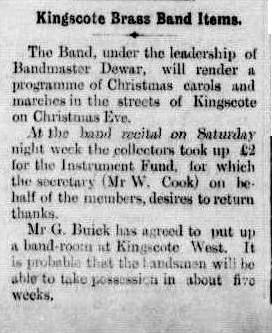
The activities of the Kingscote Brass Band were mentioned in the local newspaper, The Kangaroo Island Courier in late 1907 where they were noted for wanting to present a program of Christmas Carols and marches on Christmas Eve (“Kingscote Brass Band Items.,” 1907).  This is in addition to their fundraising effort for new instruments.  In the middle of 1908, the said newspaper received a letter from a mainlander who had read an article in Australian Bandsman about the travel of Kingscote Brass Band members (“ENTHUSIASTIC INSTRUMENTALISTS.,” 1908).  In his letter he says, “I think the 12-mile man is the bandmaster and he deserves a lot of encouragement for his trouble” and then proceeds to wax lyrically, “…although I don’t suppose he considers it a trouble, as all men who are interested in their particular band never find anything troublesome where the band is concerned.” (“ENTHUSIASTIC INSTRUMENTALISTS.,” 1908).

Kangaroo Island Courier, 21/12/1907, p. 3

We have been told.

There is a further mention of the Kingscote Brass Band giving a performance in 1921 where they were noted for showing improvement in their playing (“THE KINGSCOTE BAND.,” 1921).  The article mentions that they had been tutored by their former conductor who was visiting the island after a 10-year absence (“THE KINGSCOTE BAND.,” 1921).  Unfortunately, due to limited resources, it is unclear how much longer this band survived. However, it is clear from this brief amount of information that they were appreciated when they performed.

King Island (Tasmania):

King Island is located in the middle of Bass Strait off the northern coast of Tasmania.  It is renowned for its produce although it has never had a big population, there are some well-known localities on the island.  It is also known for the ruggedness of its coastline and there are many instances of shipping coming to grief on the rocks. The main center of population is the town of Currie where they still have a community band.

In terms of early brass bands, King Island is unique as there are two brass bands mentioned as having existed in the early 1900s.  Information on this band also comes from an island newspaper, the King Island News and we first see a mention people wanting for form a band in Currie in 1914 (“King Island.”, 1914).  Although two years later the Currie Brass Band has still not been founded and the money that was initially raised has been donated to wounded King Island soldiers returning from World War 1 (“No title,” 1916).

In 1918 the King Island News reported on the formation of another brass band, this time in the mining settlement of Grassy which is located on the eastern side of the Island (“KING ISLAND.,” 1918).  Initially called the Grassy Brass Band, this band was actually set up by the mining company for the recreation of employees at the mine and was known as the King Island Tungsten Brass Band (“KING ISLAND.,” 1918).  This band was called for all over the island and in 1919 was noted for its performances of Christmas music in Currie (“No title,” 1919).

Again, this is another instance where some history is incomplete as we don’t know for certain when this band stopped operations.  While the articles are not listed, the King Island Tungsten Brass Band did numerous engagements on the island and were a valued part of the island community.

Phillip Island (Victoria):

Phillip Island is an island that occupies the southern portion of Westernport Bay in Victoria and is well-connected to the rest of the state by road and ferry.  People might know it because of certain penguins however it has had a long history of settlement and there are several towns on the island with the main town being Cowes.

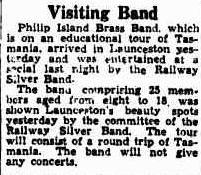
It should be no surprise that a brass band formed on Phillip Island in the township of Cowes.  The Phillip Island Brass Band was much more proactive than any other brass bands on Australian islands and were much more well-traveled.  They were even proactive enough to enter the South Street band contests on two occasions and took themselves on an educational trip around Tasmania (Royal South Street Society, 1932, 1934; “Visiting Band,” 1947).

Examiner, 30/08/1947, p. 3

A proposal to form the Phillip Island Brass Band is mentioned in an informative article from the Frankston and Somerville Standard on the 30thMay, 1923 (“PHILLIP ISLAND BRASS BAND.,” 1923).  They had all the right intentions too, as the article opens with these platitudes:

An effort is being made to form a brass band on Phillip Island.  The advantages of such an institution are many.  Anything that will encourage the practice of music, especially concerted music, is worthy of hearty support, and the metal and moral benefit derived by any young man who gives his mind and time to learning an instrument is great.

(“PHILLIP ISLAND BRASS BAND.,” 1923)

The article goes on to note that the promoters of the band were under no illusions as to what they might need in terms of men willing to join the band, instruments, a hall to play in, and a whole host of other items.  The Island Progress Association, as well as the local council, were behind the project and a band was formed.

19340709_herald_phibb-crop
Herald, 09/07/1934, p. 8

As mentioned, the band was quite proactive in the way they did things, even bordering on the unusual.  For example, to help raise funds for a trip to the South Street contests in 1934, a picture of a bandsman helping with the chicory harvest was published in the Herald newspaper (above) – this was apparently a common activity at the time (“COWES BANDMEN HANDLE CHICORY CROP,” 1934).  They did make it to South Street, twice, once in 1932 where they competed in C and D grades and also in 1934 where they only competed in D grade.  The results of their endeavors are listed in the table below:

Year:Competition:Grade:Section:Points:Place:
1932Victorian Band ChampionshipsCNo. 1 Test Piece124
No. 2 Test Piece120
Quickstep133
DNo. 1 Test PIece1203rd
No. 2 Test PIece1193rd
Quickstep1263rd
1934Victorian Band ChampionshipsDSelection277Equal 3rd
Quickstep1674th
(source of table data: Royal South Street Society, 1932, 1934)

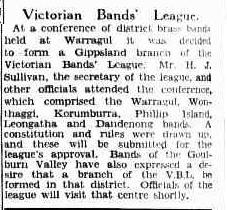
Aside from this, they were well-known and in 1935 they were one of the bands to form a Gippsland Branch of the Victorian Bands’ League with other bands from Warragul, Wonthaggi, Korumburra, Leongatha and Dandenong (“Victorian Bands League.,” 1935).

The Age, 8/10/1935, p. 4

There seems to have been some disquiet after the band returned from Tasmania in 1947.  In January 1953 the State Governor visited Phillip Island and the visit was written up in an article in The Argus newspaper.  As the article says:

Yesterday was an exciting day for Cowes, Phillip Island.  Sir Dallas Brooks, Governor, paid his first official visit to the island and almost everybody, including the town’s brass band, turned out for the occasion.

Until last week the band had been “in recess for four years,” as one member tactfully put it.  But it acquitted itself well.

(“Cowes turned out to meet the Governor,” 1953)

The cause and conclusion of this four-year recess might require further research.

The Trove archive has some limitations as articles fall into copyright from 1955 so we don’t exactly know when the Phillip Island Brass band went defunct.  But they are one of the well-documented bands with further information to be found on the website of the Phillip Island & District Historical Society.

Palm Island and Thursday Island (Queensland):

Palm Island Brass Band, Queensland, 1931 (source: State Library of Queensland: 166102)

Palm and Thursday islands are located off the coast of Queensland with Palm Island near the coast at Townsville and Thursday Island in the Torres Strait off the far northern tip of Queensland.  These islands are mentioned because of their unique status as former Indigenous Missions and the fact that both former missions once had brass bands.

This post will not go into the pros and cons of Indigenous missions aside to say that they existed and are part of Australia’s history.  It was a very different time with different attitudes, and we can only assume that the people who once ran these institutions thought they were doing the right thing by Indigenous people.  A brass band was obviously seen as a binding activity and one which other Australians would accept.

Unfortunately, the language in local newspapers that mentioned the bands were as one would expect from this time.  There was interest in the island bands and we see in an article from 1926 published in The Northern Miner newspaper that the bandmaster of The Towers Concert Band visited the island to assist the Indigenous conductor and was duly thanked in a letter from the Palm Island Band conductor (“PALM ISLAND BAND,” 1926).  By some accounts, the people of the island appreciated the fact that a brass band, as well as a football team and cricket team, had been set up by the Superintendent of the settlement, and certainly, these were seen as worthwhile activities (Watson, 2005).   In 1927 the football team and brass band visited Townsville and apparently “astonished” the crowd – for both football and music (“FOOTBALL,” 1927).

Daily Mercury, 26/09/1927, p. 7

Slightly differently, the Thursday Island Brass Band once included “white and black players” pre-war but was reformed after the war with just aboriginal musicians (“ISLANDERS’ BRASS BAND,” 1952).   Both bands were clearly still in operation in the 1950’s, but clearly the novelty of having Indigenous bands had not changed, despite this cited article providing additional information (“‘Band music provides healthy interest for aborigines’,” 1953).  In 1954 the Palm Island Brass Band was to be included in a mass-gathering of bands in Townsville to greet Queen Elizabeth (“Townsville Band Festival,” 1954).

We can always judge the attitudes of the time as being unfortunate and the language as patronising.  We also know that there are still bands dotted across the Top End and some very good music programs that are helping to reform a culture of Indigenous community bands (Cray, 2013; Sexton-McGrath, 2014).  In some respects, these former Mission bands as well as other mainland mission bands created a legacy that has given new life to new bands.

Peel Island (Queensland) and Norfolk Island:

We come now to Peel Island and Norfolk Island, both very different places yet both have interesting pasts.

Peel Island is located in Moreton Bay, Brisbane and is a former Quarantine Station.  Yet for many years it housed people forcibly removed from home and family for being contracted with Leprosy.  By all accounts, this was harsh, isolated, unforgiving and primitive place and it accommodated people from all backgrounds and races (Brown, 2018).  The churches were the only organisations to try to bring comfort to the inmates and it is noted in 1928 that one Churchman made an appeal for an Eb Bass for a member of the Peel Island Brass Band (“CHURCH NEWS.,” 1928).

This is the first evidence we have that there was a band of sorts on Peel Island and newspaper articles sporadically reported on the various iterations of the band (“SIDE DRUM WANTED FOR PEEL ISLAND’S BAND,” 1945). Likewise, there are also reports of bands visiting the Island to entertain the inmates  – the picture below is of a Salvation Army band visiting Peel Island in 1920 and in 1939 the Brisbane Juvenile Band was part of a concert party (“Concert At Peel Island,” 1939).

19200000_peel-island_salvation-band
Salvation Army brass band visiting Peel Island Lazaret during the 1920s (source: State Library of Queensland: 74802)

Norfolk Island is another place with a very interesting past and the inhabitants are extremely proud of their history (Low, 2012).  Located off the coast of NSW, the inhabitants display a very independent streak, despite their association with Australia.  Which makes it all the more interesting that there is mention of a brass band that once existed on Norfolk Island.  There is not much to indicate the brass band existed apart from rare mentions in Australian newspapers.  We see mentions of a band in 1904, 1905 and 1926 where they are mentioned as being in attendance at official events and for rehearsing every week (Barnes, 1926; “NORFOLK ISLAND.,” 1904; “NORFOLK ISLAND.,” 1905).  It is unclear when the Norfolk Island Band officially started or ended.

Conclusion:

It is quite clear that these early brass bands of our islands had their own unique histories, although one might call them quirks.  While there are many similarities to other bands located on the mainland, the isolation and geography meant they had to be innovative and were also part of their communities.  It is fortunate that we can read about them now and wonder at their existence.  The knowledge that some of them existed in questionable environments is also a wonder but also indicates that they were a sign of the times.

We appreciate that these bands were part of a greater movement and that we can acknowledge the history.

References:

‘Band music provides healthy interest for aborigines’. (1953, 19 January). Courier-Mail (Brisbane, Qld. : 1933 – 1954), 2. http://nla.gov.au/nla.news-article50564060

Barnes, J. (1926, 11 June). UNDER BLUE SKIES : Life on Norfolk Island : No. 4. Cumberland Argus and Fruitgrowers Advocate (Parramatta, NSW : 1888 – 1950), 9. http://nla.gov.au/nla.news-article104960531

Brown, A. (2018, 07 July). Queensland’s last leper colony reveals its secrets. Brisbane Times. https://www.brisbanetimes.com.au/national/queensland/queensland-s-last-leper-colony-reveals-its-secrets-20180704-p4zpd1.html

CHURCH NEWS. (1928, 29 September). Brisbane Courier (Qld. : 1864 – 1933), 7. http://nla.gov.au/nla.news-article21343088

Concert At Peel Island. (1939, 26 March). Sunday Mail (Brisbane, Qld. : 1926 – 1954), 5. http://nla.gov.au/nla.news-article98238889

COWES BANDMEN HANDLE CHICORY CROP. (1934, 09 July). Herald (Melbourne, Vic. : 1861 – 1954), 8. http://nla.gov.au/nla.news-article243161356

Cowes turned out to meet the Governor. (1953, 22 January). Argus (Melbourne, Vic. : 1848 – 1957), 16. http://nla.gov.au/nla.news-article23223484

Cray, S. (2013, 14 August). Brass band babies. ABC Radio National. Retrieved 14 August 2013 from https://www.abc.net.au/radionational/programs/archived/intothemusic/brass-band-babies/4887046

ENTHUSIASTIC INSTRUMENTALISTS. (1908, 11 July). Kangaroo Island Courier (Kingscote, SA : 1907 – 1951), 4. http://nla.gov.au/nla.news-article191629848

FOOTBALL : Aboriginal Team. : Defeats Townsville. (1927, 26 September). Daily Mercury (Mackay, Qld. : 1906 – 1954), 7. http://nla.gov.au/nla.news-article173762864

ISLANDERS’ BRASS BAND. (1952, 31 May). Brisbane Telegraph (Qld. : 1948 – 1954), p. 2. Retrieved from http://nla.gov.au/nla.news-article216499386

Kangaroo Island Pioneers Association. (2019). History. Kangaroo Island Pioneers Association. Retrieved 28 January 2019 from https://www.kipioneers.org/history

KING ISLAND : Grassy News. (1918, 21 May). Examiner (Launceston, Tas. : 1900 – 1954), 6. http://nla.gov.au/nla.news-article50981378

“King Island.” “Fat Stock for Victoria.” “Dear Beef for Launceston.”. (1914, 29 May). King Island News (Currie, King Island : 1912 – 1954), 2. http://nla.gov.au/nla.news-article217035552

THE KINGSCOTE BAND. (1921, 19 March). Kangaroo Island Courier (Kingscote, SA : 1907 – 1951), 2. http://nla.gov.au/nla.news-article191552031

Kingscote Brass Band Items. (1907, 21 December). Kangaroo Island Courier (Kingscote, SA : 1907 – 1951), 3. http://nla.gov.au/nla.news-article191635685

Low, M. K. (2012). Putting down roots : belonging and the politics of settlement on Norfolk Island (Publication Number 9451462) [PhD, University of Western Australia, School of Social Sciences]. University of Western Australia Research Repository. Perth, Western Australia. https://research-repository.uwa.edu.au/en/publications/putting-down-roots-belonging-and-the-politics-of-settlement-on-no

MUSIC FOR WATCHERS BY THE SEA. (1906, 21 November). Register (Adelaide, SA : 1901 – 1929), 7. http://nla.gov.au/nla.news-article56693536

No title. (1916, 17 March). King Island News (Currie, King Island : 1912 – 1954), 2. http://nla.gov.au/nla.news-article212036865

No title. (1919, 08 January). King Island News (Currie, King Island : 1912 – 1954), 2. http://nla.gov.au/nla.news-article212038832

NORFOLK ISLAND. (1904, 22 March). Brisbane Courier (Qld. : 1864 – 1933), 7. http://nla.gov.au/nla.news-article19271611

NORFOLK ISLAND : Empire Celebration. (1905, 26 June). Sydney Morning Herald (NSW : 1842 – 1954), 7. http://nla.gov.au/nla.news-article14687675

PALM ISLAND BAND : An interesting letter. (1926, 13 February). Northern Miner (Charters Towers, Qld. : 1874 – 1954), 5. http://nla.gov.au/nla.news-article80657422

Phillip Island Brass Band, 1932. (1932). [Photograph]. [phot16005]. The Internet Bandsman Everything Within, Vintage Brass Band Pictures : Australia. http://www.ibew.org.uk/vbbp-oz.html

PHILLIP ISLAND BRASS BAND. (1923, 30 May). Frankston and Somerville Standard (Vic. : 1921 – 1939), 6. http://nla.gov.au/nla.news-article75954089

Royal South Street Society. (1932, 29 October). 1932-10-29 Brass Band Contests. Royal South Street Society. Retrieved 28 January 2019 from https://results.royalsouthstreet.com.au/results/1932-10-29-brass-band-contests

Royal South Street Society. (1934, 03 November). 1934-11-03 Brass Band Contests. Royal South Street Society. Retrieved 28 January 2019 from https://results.royalsouthstreet.com.au/results/1934-11-03-brass-band-contests

Sealink Travel Group. (2019). About Kangaroo Island, South Australia. Sealink. Retrieved 28 January 2019 from https://www.sealink.com.au/about-kangaroo-island/

Sexton-McGrath, K. (2014, 09 November). Yarabah Band Festival: Return of the brass band brings thousands out to Indigenous community. ABC News Queensland. Retrieved 31 January 2019 from https://www.abc.net.au/news/2014-11-09/yarrabah-band-festival-brass-band-brings-thousands-to-community/5877834

SIDE DRUM WANTED FOR PEEL ISLAND’S BAND. (1945, 27 June). Courier-Mail (Brisbane, Qld. : 1933 – 1954), 6. http://nla.gov.au/nla.news-article48954474

Townsville Band Festival. (1954, 09 February). Northern Miner (Charters Towers, Qld. : 1874 – 1954), 4. http://nla.gov.au/nla.news-article81658839

Unidentified. (1920). Salvation Army brass band visiting Peel Island Lazaret during 1920s [copy print : b&w]. [74802]. Brisbane John Oxley Library, State Library of Queensland, OneSearch. https://hdl.handle.net/10462/deriv/208680

Unidentified. (1931). Palm Island Brass Band, Queensland [photographic print : black & white , 1931.]. [166102]. Brisbane John Oxley Library, State Library of Queensland, One Search. https://hdl.handle.net/10462/deriv/220300

Victorian Bands League. (1935, 08 October). Age (Melbourne, Vic. : 1854 – 1954), 4. http://nla.gov.au/nla.news-article203851495

Visiting Band. (1947, 30 August). Examiner (Launceston, Tas. : 1900 – 1954), p. 3. Retrieved from http://nla.gov.au/nla.news-article52603726