Band performances and the historical curiosities of formations: squares, circles, and everything in between 

Collingwood Citizens’ Band rehearsing in a quarry, 1906 (Source: IBEW: phot19034)

Introduction:

The Prahran City Band, under the veteran conductor, E. T. Code, next took the stand.  This band showed a wise departure in abandoning the old-fashioned circle and forming in a half-moon, and consequently, every man was facing his leader, and no one was nearer the judge than his neighbour.  This method is an improvement and should be adopted by all bandsmen, and a better balance of tone will be accomplished. (“BRASS BAND CONTESTS.,” 1911)

So said a knowledgeable observer from Bendigo who was visiting the Ballarat and listening to the 1911 Royal South Street Eisteddfod band sections.  Obviously, he noticed a distinct difference in the sound of the Prahran City Band as opposed to bands that mounted the platform and stood in a circle with the conductor in the middle.  Granted, this was in 1911, so the wording is interesting.  Bands standing in circles for certain performances was the status quo then. Old fashioned? Possibly.  However, as with anything in the band movement, any significant change took time, and Australian bands generally followed developments from England. Is it ironic that the status quo was shaken up by an Australian brass band visiting England? There is more to that story.

Playing within the confines of band rotundas and on the elevated platforms used at band contests meant that bands performed in all sorts of shapes – circles, squares, the half-moon (thanks to Prahran City Band), and other formations.  As a historical curiosity in the band movement, these formations bring the question of why because even though some unusual formations are necessary in modern times, in general, brass bands now perform in a generic formation wherever possible.

This post is about band formations mainly in outdoor settings, although some might say this applies to indoor performances as well.  Unfortunately, there is a lack of written information about the specifics of early brass band formations for performances – no one has written a manual (apart from marching).  Much of what can be discussed comes from the anecdotal evidence of photographs and the odd review of contests.  The assumption then can be made that when bands formed up on elevated platforms and in band rotundas, formations were dictated by the platform’s shape and the conductor’s discretion.

Elevation:

One common element that has stood the test of time is the elevation of a musical ensemble for performances.  A stage or platform tends to mean that bands (and orchestras, choirs, etc.) are better heard and seen by the audience.  The Kalgoorlie Miner newspaper noted as such when reviewing a performance by the A.W.A. Brass Band in September 1903 prior to this band making the long journey to compete in Ballarat.

The advantages of an elevated position for band performers in submitting their programmes to the judgement of the public was made abundantly manifest at the Boulder Recreation Reserve last night when the various items in the bill were given from a temporary rotunda or covered-in platform, erected by the Boulder Orchestral society, to facilitate the object of the gathering last evening, and also for use when the members of that particular organisation take up the running in the absence of local bands at the Ballarat competitions.  The players were not hemmed in and incommoded by spectators, and the music was conveyed with better effect. (“THE A.W.A. BRASS BAND.,” 1903)

Bands had also noted the advantages of band rotundas and bandstands, and the visit of the Besses o’ th’ Barn Band to Victoria was a catalyst for further work (de Korte, 2021).  According to an article published in The Age newspaper in October 1907, Code’s Brass Band lamented the lack of facilities for performances.

It was mentioned that the great enthusiasm aroused by the playing of the Besses o’ th’ Barn Band should have the effect of showing the authorities that good band music is appreciated by the general public, and drawing their attention to the lack of facilities in Melbourne for bands to give open air performances.  What is badly needed is the erection of suitable rotundas or band stands in public parks and reserves.  At present when a band gives an open air performance, an unsightly temporary stand must be erected, or they must play standing on the grass, a proceeding not at all satisfactory either to the musicians or their audiences. (“CODE’S BRASS BAND.,” 1907)

Band Rotundas:

Band rotundas, by nature of design, were largely elevated structures, some more than others.  Rotundas are also a classic example of where the structure somewhat dictated how a band was arranged.  Older band rotundas in Australia were often designed in an octagon with the central performance area occupied with a ring of music stands and space for the conductor in the middle.  Whenever a rotunda was opened in a locality, it was a special occasion as it meant the local band had a proper performance space, as this article published in The Daily Telegraph newspaper about the new structure constructed by the Newtown Brass Band shows.

A desire having been expressed that it should give more frequent public performances, arrangements have been made for it to play every week in one of the local parks – Victoria Park, Marrickville, and Erskineville.  Hitherto the band has suffered under a great disadvantage when playing in the open by not having a proper stand.  The result was that the players were liable to be encroached upon by the crowd, causing much inconvenience, whilst the music was not heard at its best. The attempts to get a stand provided for them having failed, the members, who included several tradesmen, set about constructing one of their own.  They did all the work themselves, the only cost being that of the materials.  They have succeeded in producing a structure admirably adapted for its purpose.  It is octagonal in shape and will accommodate about 40 performers.  It can be taken to pieces without much trouble, and removed on one day, the work of fixing it up occupying only about a quarter of an hour.  There is an outer platform, on which the players will stand, uprights carrying supports for the music, whilst the conductor, from a smaller stand in the centre, has everything under his control. (“NEWTOWN BRASS BAND.,” 1904)

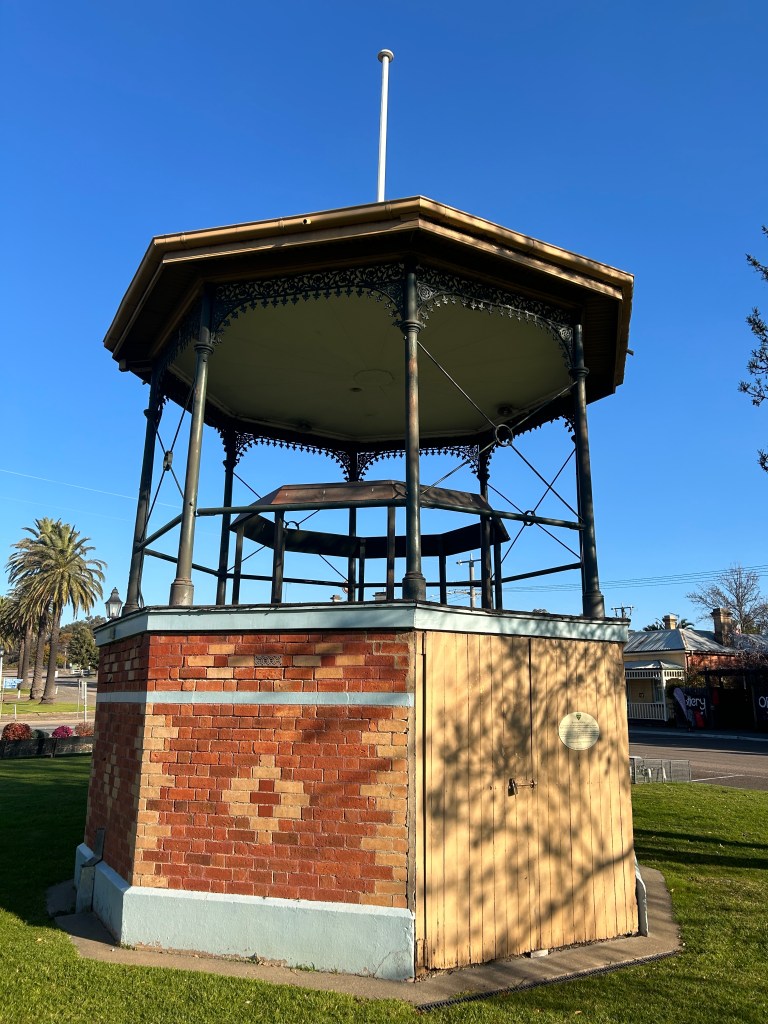
The band rotunda at Rushworth in northern Victoria is an example of this style of design.  Below is a postcard dating from 1907 and a later photograph of the rotunda – thankfully, the ring of music stands has not been removed over a century later (de Korte, 2024c).
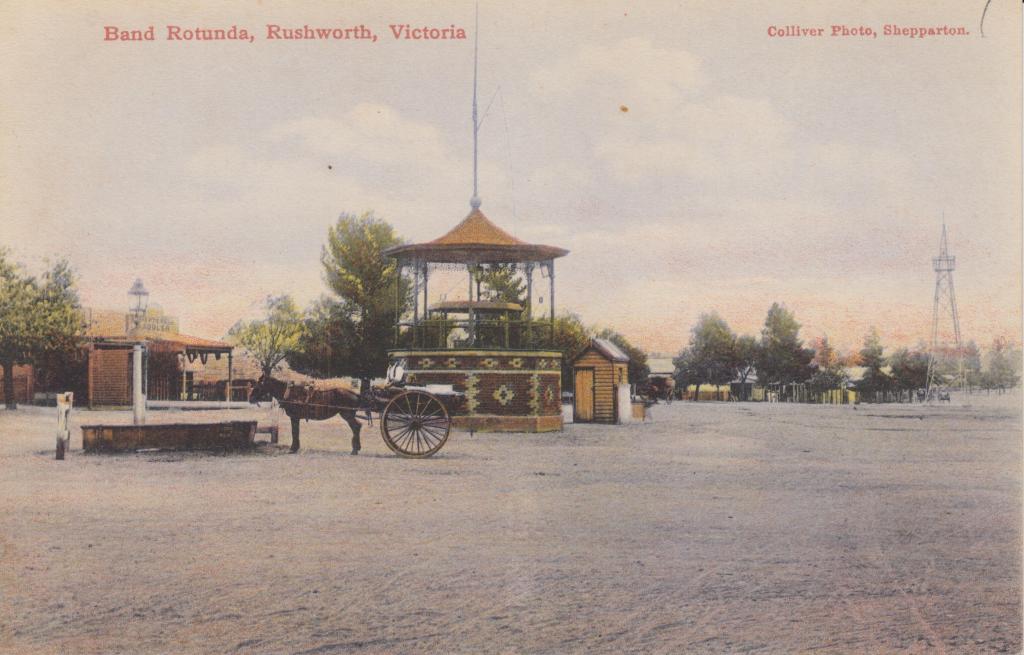
Postcard: Band Rotunda, Rushworth, Victoria, 1907. (Source: Jeremy de Korte Collection)
Photograph: Queen Jubilee Band Rotunda.
(The photograph was taken by Jeremy de Korte, 26/05/2024)

It can be seen that this particular rotunda is a bit on the small size, and when visiting the town, this author was told by townspeople that the current Rushworth and District Concert Band does not play up on this rotunda at present due to space constraints.  As with any structure of this type, they are of all different sizes and designs.  Images of band rotundas from all over Australia can be viewed on the companion blog, Australian Band Stands: Iconic structures in towns and cities.

What a band might have experienced when playing on a rotunda like this can be viewed below where we can see the New South Wales Artillery Band playing at the Hyde Park Rotunda.  The band members can just be seen standing around the edges of the rotunda facing inwards towards the conductor.
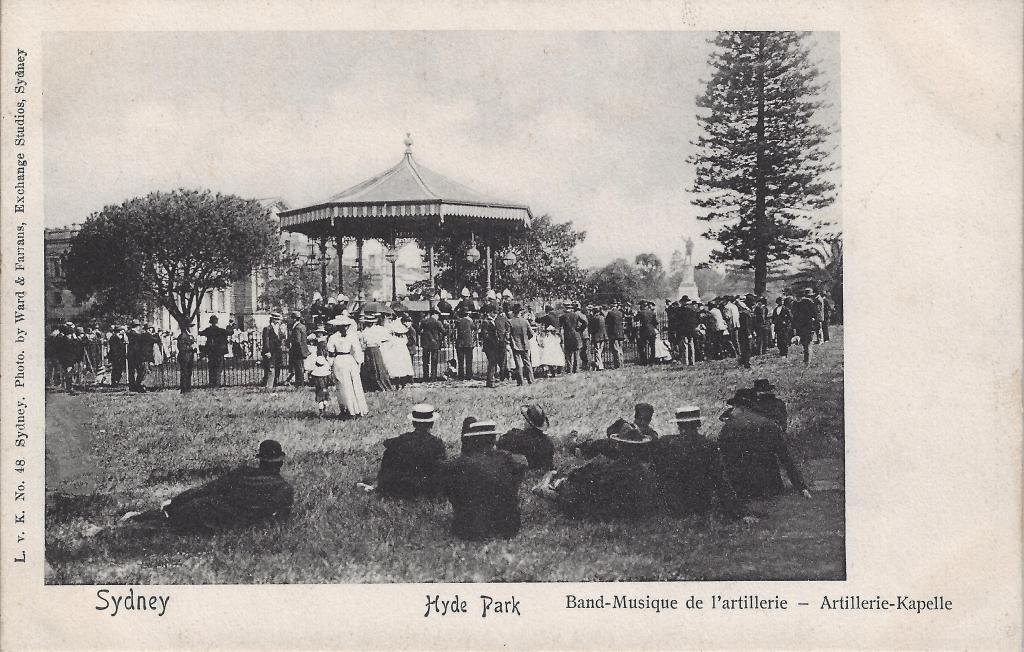
Postcard: Sydney : Hyde Park : Band-Musique de l’artillerie – Artillerie-Kapelle, (date unknown). (Source: Jeremy de Korte Collection)

Platforms:

Bands playing on temporary platforms was quite common, and again, still is to a certain extent.  Like playing on rotundas, platforms tended to dictate the shape in which a band performed.  Circles and rectangles tended to be the norm, but as the Prahan City Band demonstrated, other formations were used (“BRASS BAND CONTESTS.,” 1911).  Perhaps the Collingwood Citizens’ Band, seen in the photograph at the head of this post, was rehearsing in a circle in preparation for a contest.

Thankfully, there are some newspaper articles and photographs that show bands performing on an elevated platform at a contest.  The series of photographs below taken at the Inverell (N.S.W.) Musical Festival in 1907 and published in The Sydney Mail and New South Wales Advertiser newspaper is a perfect example. As we can see, the bands are on the platform formed up in a circle.  The temporary platform is in full view, and when each band is getting their photograph taken, the next band is taking their turn on the platform.  The photographs are displayed here separately, and the photograph of the massed bands has also been included.
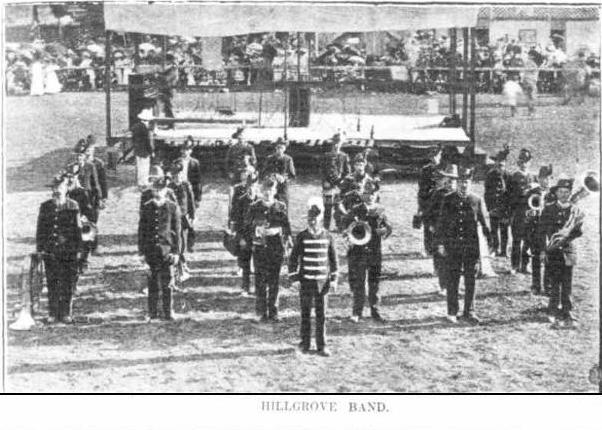
Hillgrove Brass Band – Inverell Musical Festival.
The Sydney Mail and New South Wales Advertiser, 10/04/1907, p. 925
Narrabri Enterprise Band – Inverell Musical Festival.
The Sydney Mail and New South Wales Advertiser, 10/04/1907, p. 925
Emmaville Miners’ Brass Band – Inverell Musical Festival.
The Sydney Mail and New South Wales Advertiser, 10/04/1907, p. 925
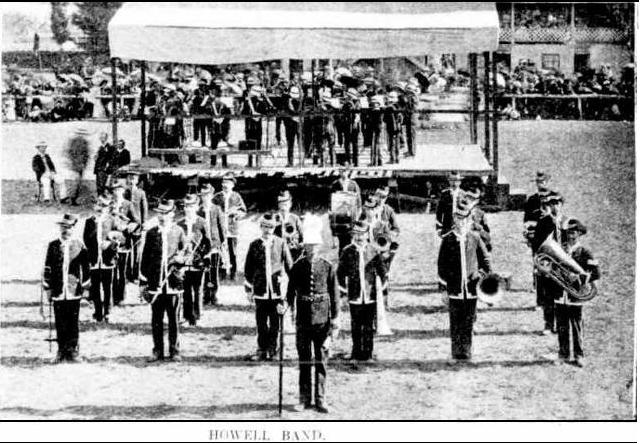
Howell Brass Band – Inverell Musical Festival.
The Sydney Mail and New South Wales Advertiser, 10/04/1907, p. 925
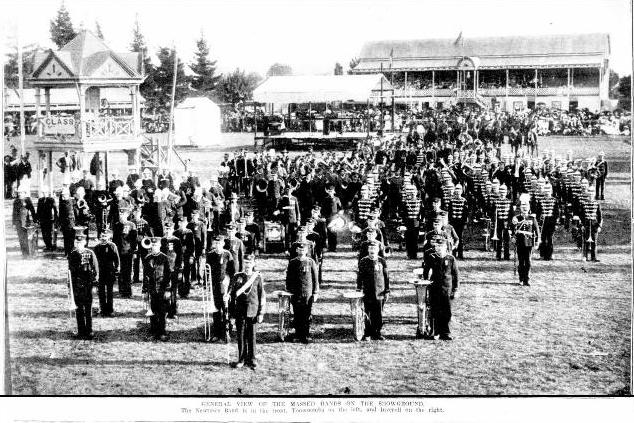
Massed Bands – Toowoomba Australis (left), Newtown Brass Band (front), Inverell Austral Band (right)  – Inverell Musical Festival.
The Sydney Mail and New South Wales Advertiser, 10/04/1907, p. 925

Likewise, the 1911 Kalgoorlie Brass Band Competitions and Eisteddfod was well-documented by photographer Mr. R. Vere Scott, and his photos were published in the Kalgoorlie Western Argus newspaper (Scott, 1911b).  On a side note, this contest was notable as it not only included some Western Australian bands but also the Broken Hill Band, which made the long journey to Kalgoorlie, as can be read about in a previous post (de Korte, 2019).  One of the photographs that Mr. Scott took was of the Boulder City Band taking their turn on the contest platform on the main oval (Scott, 1911a).  From looking at this photograph, one wonders how much the audience heard as the band members were all facing the conductor in the middle, and only some of the band members were likely to be pointing their instruments at the audience in the stands.

Boulder City Band – Kalgoorlie Brass Band Competitions and Eisteddfod.  Kalgoorlie Western Argus, 10/10/1911, p. 21

Elevating an ensemble was important enough for the musicians and the audience.  Yet there was the issue of sound production as well.  It could be assumed that it was possibly easier to hear a band playing on rotunda due to the roof reflecting sound outwards.  But what about a band playing in a shape on a platform?  How much of that was heard? Would it be better for a whole band to project outwards, generally in one direction?

1924, the year formations changed:

Band competing at Crystal Palace National Contest 1902.
(Source: IBEW – the History of Brass Bands blog)

Much happened in 1924.  The Malvern Tramways Band did not travel to the United Kingdom to compete in the famous English band competitions, as they were widely expected to do (de Korte, 2024a).  However, the Newcastle Steel Works Band did travel to England and caused a stir when they got there, mainly for the fact that they won two of the major championships and came third in another major championship (Greaves, 2005).  This was in addition to the numerous concerts and other events the band played at to earn some money during the tour – the trip was very expensive (Bythell, 1994; Helme, 2017).

While the Newcastle band astonished the English band aficionados with their playing, they did something else that changed the band world forever; they went on stage at the Belle Vue contest in Manchester – their second contest of the tour – and sat in a concert formation (Greaves, 1996).

Now, admittedly, the band had sat in concert formations at previous concerts in England, but this was the first time the band had sat in this formation at a contest.

Although they had already sat in formation at previous contests, the audience at the King’s Hall were still taken aback when the Newcastle Steel Works players arrived on stage – each carrying a wooden chair.  They then proceeded to sit in the now ‘traditional’ formation before Albert Baile took the stage. (Mutum, 2024)

The Australian band historian Jack Greaves (1996) provides us with a more detailed description of the event and the implications of what Newcastle set in motion.

The year 1924 also saw the introduction by the Australian visitors of a new innovation at the Belle Vue contest.  Up till then, it was customary for bandsmen to stand in a circle on the contest platform during the entire rendition of the test selection.  Tradition was broken by the visitors, however, for when their turn to play came, each man carried on to the platform his own chair and the band then arranged itself into a horseshoe formation.  As they were the second last band to play, it meant that each bandsman had the responsibility of retaining possession of his own chair for most of the day, which also meant carrying it about with him wherever he went.  From then on, all bands at Belle Vue have played seated.” (pp. 49-50)

There is no record as to which Newcastle band member thought up the new formation, although one would suspect that Conductor Albert Baile was the instigator.  Various accounts, however, do mention the band being coached by conductors James Ord Hume and William Rimmer prior to the Belle Vue contest – did they also have an influence? (Bythell, 1994; Greaves, 2005).  Interestingly, the hall at the time was one of those arenas where the audience could watch the band from all four sides, so having a band perform on chairs in a concert formation must have been a novelty for them (Helme, 2017).  One of the reasons (nominally the weakest reason) the English commentators used to justify Newcastle’s win was the different seating formation (Bythell, 1994). 

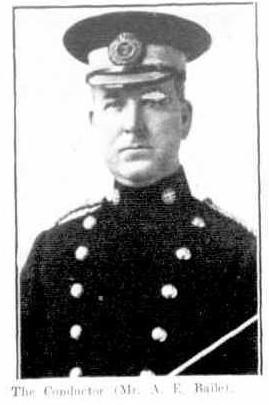
So yes, it did take an Australian band visiting England to change the seating formation of brass bands.  Below are photographs of the Newcastle Steel Works Band and their conductor Albert Baile upon their return to Australia in 1925 as published by The Observer newspaper.

Newcastle Steel Works Band. Observer, 10/01/1925, p. 34
Albert Baile. Observer, 10/01/1925, p. 34

Conclusion:

What is evident from this little story is that evolution in the band world takes time and can happen quite suddenly.  This was not a movement that did not copy developments in the orchestral world where orchestras had been sitting in a concert formation for centuries.  As can be seen in the photographs from England and Australia, playing on an elevated platform was part of the performance practice.  Playing in a shape with the conductor in the middle, which was a part of contests for the best part of three decades was something that could have been changed quite easily.  However, for some reason, it was accepted musical practice for the benefit of the conductor, and possibly an adjudicator, but not for an audience sitting at a distance.

We can thank the innovations of the Newcastle Steelworks Band a century ago for changing the playing formations.  What they did went from novelty to accepted practice very quickly. 

References:

Band Contest, Yallourn. (n.d.). [Photograph]. [phot8000]. The Internet Bandsman Everything Within, Vintage Brass Band Pictures – Australia. http://www.ibew.org.uk/vbbp-oz.html

BRASS BAND CONTESTS : THE BALLARAT COMPETITIONS : A BENDIGONIAN’S IMPRESSIONS. (1911, 31 October). Bendigo Independent (Vic. : 1891 – 1918), 3. http://nla.gov.au/nla.news-article226819795

Bythell, D. (1994). Class, community, and culture: The case of the brass band in Newcastle. Labour History(67), 144-155. http://www.jstor.org/stable/27509281 

CODE’S BRASS BAND. (1907, 11 October). Age (Melbourne, Vic. : 1854 – 1954), 9. http://nla.gov.au/nla.news-article204997427

Collingwood Citizens’ Band rehearsing in a quarry. (1906). [Photograph]. [phot19034]. The Internet Bandsman Everything Within, Vintage Brass Band Pictures – Australia. http://www.ibew.org.uk/vbbp-oz.html

Colliver Photo. (1907). Band Rotunda, Rushworth, Victoria [Postcard]. [194458]. W. T. Pater, Printers and Stationers, Shepparton, Victoria; Melbourne, Victoria. 

de Korte, J. D. (2019, 06 September). Trans-continental connections: the brass bands of Broken Hill and Kalgoorlie. Band Blasts from the Past: Anecdotes, Stories and Personalities. https://bandblastsfromthepast.blog/2019/09/06/trans-continental-connections-the-brass-bands-of-broken-hill-and-kalgoorlie/

de Korte, J. D. (2021, 16 February). Influences from Britain: James Ord Hume and “The Besses Effect”. Band Blasts from the Past: Anecdotes, Stories and Personalities. https://bandblastsfromthepast.blog/2021/02/16/influences-from-britain-james-ord-hume-and-the-besses-effect/

de Korte, J. D. (2024a, 28 February). Hype versus reality: why the Malvern Tramways Band never travelled to the United Kingdom. Band Blasts from the Past: Anecdotes, Stories and Personalities. https://bandblastsfromthepast.blog/2024/02/28/hype-versus-reality-why-the-malvern-tramways-band-never-travelled-to-the-united-kingdom/

de Korte, J. D. (2024b). Rushworth, Vic. : Queen Victoria Jubilee Band Rotunda [Photograph]. [IMG_9916]. Jeremy de Korte, Newington, Victoria. 

de Korte, J. D. (2024c, 11 April). Rushworth, Victoria – Queen Victoria Jubilee Band Rotunda. Australian Band Stands: Iconic structures in towns and cities. https://australianbandstands.blog/2024/04/11/rushworth-victoria-band-rotunda/

Greaves, J. (1996). The Great Bands of Australia [booklet] [2 sound discs (CD) : digital ; 4 3/4 in. + 1 booklet]. Sydney, N.S.W., Sound Heritage Association Ltd. https://catalogue.nla.gov.au/catalog/2372005

Greaves, J. (2005). A musical mission of Empire : the story of the Australian Newcastle Steelworks Band. Peters 4 Printing. https://catalogue.nla.gov.au/catalog/3640204 

Helme, C. (2017, 23 September). The Newcastle Steelworks Band from Australia and its 1924 visit to the UK. Chris Helme : Sunday Bandstand, 229. http://www.chrishelme-brighouse.org.uk/index.php/sunday-bandstand/bandstand-memories/item/229-the-newcastle-steelworks-band-from-australia-and-its-1924-visit-to-the-uk

Holman, G. (2020, 15 April). The Crystal Palace and bands. IBEW – the History of Brass Bands. https://ibewbrass.wordpress.com/2020/04/15/the-crystal-palace-and-bands/

MUSICAL FESTIVAL AT INVERELL. (1907, 10 April). Sydney Mail and New South Wales Advertiser (NSW : 1871 – 1912), 925. http://nla.gov.au/nla.news-article165387808

Mutum, T. (2024, 30 August). The day the Open changed forever. 4barsrest, 2067. https://4barsrest.com/articles/2024/2067.asp

NEWTOWN BRASS BAND : OPENING OF A NEW BAND STAND. (1904, 22 April). Daily Telegraph (Sydney, NSW : 1883 – 1930), 3. http://nla.gov.au/nla.news-article237811793

RETURN OF THE CHAMPION NEWCASTLE STEEL WORKS BAND. (1925, 10 January). Observer (Adelaide, SA : 1905 – 1931), 34. http://nla.gov.au/nla.news-article166315185

Scott, R. V. (1911a, 10 October). BOULDER CITY BAND. Kalgoorlie Western Argus (WA : 1896 – 1916), 21. http://nla.gov.au/nla.news-article33398332

Scott, R. V. (1911b, 10 October). KALGOORLIE BRASS BAND COMPETITIONS AND EISTEDDFOD. Kalgoorlie Western Argus (WA : 1896 – 1916), 21. http://nla.gov.au/nla.news-article33398332

THE A.W.A. BRASS BAND. (1903, 28 September). Kalgoorlie Miner (WA : 1895 – 1954), 6. http://nla.gov.au/nla.news-article88873523

Ward & Farrans Exchange Studios. (n.d.). Sydney : Hyde Park : Band-Musique de l’artillerie – Artillerie-Kapelle [Postcard]. [No. 48]. L. v. K., Sydney, N.S.W. 

Australian bands, gramophones and wireless: adapting to new technology

19290722_Argus_Wireless-Broadcast
The Argus, 22/07/1929, p. 18

Introduction:

The Old Town Band
(Written for “The Land”)

The band was the life of the old town
The zest of its great events
When the great Pooh-Bah himself came down,
Or the prize merinos brought renown
Or the circus raised its tents.

There was music in the trombone
A martial note in the drum
And the boom of the bass was on its own
In the days before the gramophone
Ere the wireless craze had come.

Those were the day when the township band
Filled a place in pioneer life:
Cheered the struggle with virgin land
And gave the old battlers a helping hand
When droughts or plagues were rife.

Today the baton is laid aside
And the bandsmen rest in their graves:
They played their way o’er the great divide,
And are bandsmen now on the other side
In paradisian naves

And o’er the earth in tones forlorn
The saxophone raises its call.
The engines start their shrieks at dawn
The gramophone laughs the band to scorn,
And the wireless mocks them all.

(Excerpts from “The Old Town Band”, James, 1929)

So wrote Mr. A. A. James in 1929 for The Land newspaper in response to an article published in the Riverine Grazier which lamented the fact that the town of Hay in Southern New South Wales had lost its town band.  His prose was published in several other country newspapers at the time, as many town bands faced the same challenges.  Mr James singles out the gramophones and wireless as contributing factors, but was he right in suggesting so?  Was this new technology which proliferated during the early 1900s detrimental to our bands? It depends on the perception of the history at the time.  And thankfully, there is much history to examine.

In this post, the effects of new broadcasting technology on Australian bands will be looked at.  The early 1900s were a period of rapid technological change and our bands were nominally affected by these changes.  Throughout this early time from 1900 – 1950, and Mr James’s poem sits roughly in the middle, a new life of music and entertainment was brought into the homes of Australians – enthusiastically so.  With this adoption of gramophones and wireless sets came the start of commentary and opinions from citizens which were written up in the newspapers.  Radio program notes published in newspapers became essential reading.

Through this all we find the relationships between audience and bands being rapidly changed.  Perhaps this is the deeper meaning of Mr James’s poem – he identified that people were more enamoured with sounds coming out of a box of wires than live instruments and musicians.  Both sides of this issue will be explored as some bands took advantage of the radio and found new audiences, while other bands could not compete.

Early transmissions:

Live performance was very much the norm of Australian brass bands in the early 1900s and engagement with audience was centred around this type of performing.   As well as this, the popularity of brass bands was obvious through their music and the crowds that they attracted.  Reports of 70,000 people cramming the streets of Melbourne to see the famous Besses o’ th’ Barn Band in a parade and 20,000-30,000 people watching the South Street marching sections were not uncommon (“Besses o’ th’ Barn Band,” 1907; Greaves, 1996).  Later in the 1920s there are stories about 5,000 people attending community song nights in local gardens, as was the case at Central Park in Malvern where the Malvern Tramways performed every week (Young, 1923).

In amongst the many accounts on live performances are a couple of unique stories.  In an earlier post regarding bands on Australian islands, the remarkable story of a performance by the Kingscote Brass Band (Kangaroo Island) was highlighted.  On the 20th of November 1906, the band performed a lunchtime concert which was transmitted via telephone to lighthouses at either end of Kangaroo Island – one seventy miles to the West of Kingscote and the other thirty miles to the East (“MUSIC FOR WATCHERS BY THE SEA.,” 1906).  According to the article in the Register, the concert was “very much appreciated” by both lighthouse keepers (“MUSIC FOR WATCHERS BY THE SEA.,” 1906).

However, this was not the first brass band concert broadcast via telephone in Australia.  According to an article published in the Rockhampton Morning Bulletin, this took place in the preceding century, although the exact date is unclear.

A band conducted by Mr Edward Brown was practising at the old fire brigade station […] when the late Messrs Harry Batchelor and W. Pummell, compositors of the “Morning Bulletin” suggested that the playing be put “over the phone”.  Mr Rosenads, then in charge of the Rockhampton Telephone Exchange, agreed to the proposal.  There was a function at the School of Arts that night and the band was heard there “by quite a few who took turns at the earphone”.  Later the band was playing outside the Oddfellows Hall in Denham Street and by means of a “link-up” was heard at Mount Morgan.  “And very well, too” said Mr Brown.

(“Band Music “Broadcast” Here Last Century,” 1945)

No doubt transmitting a performance via telephone would have seemed innovative and inventive, especially in these early times.  However, these were extremely rare and were not substitutes for live performances, they were mainly done out of opportunity – a way to see whether it could be done.  The major changes that were taking place were the recordings of bands on gramophone records, and the beginnings of radio broadcasts.

The band movement is cautious:

In Australia, the pace of change from predominantly live music to a mix of live music, recorded music and broadcast music took place within the space of a couple of decades.  There were many commentators at the time who saw fit to try to warn of a decline of community bands and one or two had their voices repeated through many regional newspapers.  One of them was a Mr Will Lewis formerly of the Toowoomba Municipal Band who expressed a pessimistic attitude:

He was of the opinion that the day of the amateur brass band was waning, and gave as a reason the fact that the gramophone, by which one could hear the world’s greatest bands and orchestras – jazz and otherwise, was creating serious inroads upon the brass band, and further, that the advent of the radio was also having much to do with the decline of brass band popularity.  Even band contests were becoming less popular every year – at least with the general public – and the wireless and the gramophone were the two disturbing elements.  Bandsmen, naturally, would be the last persons to recognize this serious fact.”

(““DAY OF AMATEUR BRASS BANDS WANING.”,” 1927)

Some might consider Mr Lewis to be alarmist, he could not predict the future, but he was commentating on the present.  For the brass bands it was a time of upheaval and some of them were rightfully concerned.  It could be said that many bands went defunct at this time due to the technological change however it is hard to document this at this time of writing.

The worry of band people was not helped by this small snippet of news in 1930 about the Royal Melbourne Show dropping the brass bands in favour of recorded music being played through loud speakers – and saving £140.00 (“MELBOURNE SHOW.,” 1930).

19300409_Brisbane-Courier_Melb-Show
The Brisbane Courier, 09/04/1930, p. 24

In 1938 a passionate call to old times was made by the Committee of the Sunshine Brass Band, based in western Melbourne.  While the crux of the article published in the Sunshine Advocate was to solicit funds and support, they also lamented the fact that times had changed, and that local brass bands were victims of change.  Below are some excerpts from the article:

Most old-established customs and usages have felt the influence of modern times, and not the least of these are district brass bands, which have had to fight against canned music retailed hourly over the wireless.  Gramophone recordings of the world’s best bands are sandwiched in between talks and appeals to buy somebody’s pills to improve health.

[…]

The older generation was a music loving people.  The possession of a piano was a hall-mark of respectability, and the education of the children was not considered complete unless music was included in the curriculum.

[…]

To hear a local band in the gardens on a Sunday afternoon and a warm evening were events that were looked forward to by the older generation.  They were delightful times, and people held communion with one another to the strains of pleasant and beautiful music, which acted as a tonic to their nervous system.

The Sunshine band committee realises that a return to the customs of other days is due, and propose to play near the railway station on warm Sunday evenings.

(“Sunshine Band Needs More Public Support,” 1938)

This article was interesting in its sentiment and information.  We have here a brass band from the Melbourne environs trying to bring back former times through playing quality live music in a local place.  By this time however, music broadcasts were well and truly accepted so their words might have struck some memories amongst parts of the population. They were telling it as they saw it.

A similar sentiment to Mr. Lewis and Mr. James was also expressed in 1938 in an article published in the Sydney Mail by a contributor with the initials of W. P. T.  This article was more of a reminiscence of times gone by and he mentions several brass bands.  The opening of his article reads:

The brass band of the small country towns plays a very important part in the social life of the country, although such bands are not nearly as common as they were before the days of radio.

(W. P. T., 1938)

It is an interesting observation to make and clearly some connection had been made in the minds of people that radios were somewhat to blame for the demise of smaller bands.

The other side to these views is that several bands had begun exploring what the new technology could do for them from the very beginning.

The band movement adapts:

In 1996, noted band historian Jack Greaves assisted in the compilation of several old recordings into a two-CD set titled “The Great Bands of Australia” (Greaves, 1996).  This CD set is remarkable not only for the breadth of recorded music from full band works, marches and solo items, performed by a large selection of famous Australian bands.  From reading a catalogue entry of this work (linked), we can see that the recordings date back to 1912.  Some of the music can still be heard thanks to the work of the National Library of Australia and the National Film and Sound Archive (NFSA).  Below is a link to one recording which is on the NFSA website:

The Newcastle Steelworks Band (1924) playing the “Honest Toil March” by William Rimmer

The gramophone meant that people could acquire recordings of music groups and play them in their own homes at a time of their choosing.  They did not have to go out to concerts or community events, or the band competitions.  It was one cause of alarm for the band movement, but some bands obviously saw fit to record their work and bring their playing to new audiences.  Recordings by many of the top bands of the day still exist and enthusiasts have made digital copies of old recordings.

Aside from the gramophone, the utilisation of the radio probably brought about the greatest change to society and to the band movement.  Referred to early as the wireless, Australia followed developments out of America and the United Kingdom and set up its own network of stations.  It is in the early 1920s when this was happening.

19230800_Box-Hill-Band_Radio-Studio
Newspaper unknown at the time of writing (Source: Box Hill Historical Society)

The year is 1923 and in the Melbourne suburb of Box Hill the first transmission of a live brass band over the wireless took place on the 1st of August (Elsum, 1924).  The picture above is reputed to be the Box Hill Brass Band sitting in the home of Mr H. Beattie, a wireless enthusiast who resided in Box Hill.  However, in some newspapers the band that participated in the first transmission was named as the Nunawading District Brass Band (“NUNAWADING BRASS BAND,” 1923).  This conjecture can be easily explained as Nunawading and Box Hill are near neighbouring suburbs and the then Parish of Nunawading encompassed Box Hill.  (The Box Hill Historical Society shares my confusion as the newspapers were not forthcoming as to the true identity of the band that was actually broadcast (Harris, 2020)).  Despite the confusion in the newspapers, the fact remains that a brass band of the local area had their music transmitted via wireless.

This first transmission was actually a modulation test and the band was heard over all of Melbourne, parts of Victoria, and even interstate!  Much of the article published in the local Reporter newspaper listed the locations where the transmission was heard and the praise that was given:

For the next few days letters arrived from all points of the compass congratulating Mr Beattie and the Band, and expressing appreciation also of a speech by Cr. W. Young.  From Footscray to Armadale, from Sandringham to Camberwell, Essendon, Hawksburn, and wherever else in the metropolitan district, receiving stations listened in, the unanimous opinion expressed that it “was the best music ever heard by wireless”.  Wonthaggi sent a tribute, and the amateurs of Ararat wrote “Encore, we want more”, while far away Terang announced that the enthusiastic listeners in there were delighted.  The most interesting letter came from Strathfield, Sydney, 592 miles from the spot the Band played, stating that a number of visitors sat around a three-valve set with a loud speaker, and heard the performance from start to finish, announcing the strength and modulation to be perfect, and stating that after the Band had concluded with the National Anthem, local transmitters around Sydney could be heard enthusiastically discussing the test.

(“NUNAWADING BRASS BAND,” 1923)

An achievement indeed!  Although this achievement had to be defended.  In early 1924, the Vice-President of the Nunawading District Brass Band, a Mr. W. M. R. Elsum wrote a letter to the Argus newspaper disputing that the Newcastle Steelworks Band was the first full band to have broadcasted a concert via wireless (Elsum, 1924).

Once people in Australia realised that music of this nature could be transmitted successfully, there was no stopping the progress – it is to say, in colloquial terms, the horse had well and truly bolted!  Radio stations and transmitters were set up all over the country and within years, much of the population could listen to a variety of programs (““Listening In”,” 1923).  The Queensland Government for example, started setting up a State based broadcasting service in 1925 (“STATE RADIO.,” 1925).  In New South Wales, innovation in programming was highlighted with the organising of a Radio Eisteddfod by the New South Wales Broadcasting Company which involved a section for brass bands (“RADIO EISTEDDFOD.,” 1928).  Although, the articles of the day were not clear as to who competed and if brass bands made it to the finals.

For the brass bands, radio stations seized upon them as a ready-made musical item and for some of the bands it led to new popularity – some, because radio stations were tending to use the same top-quality brass bands over and over again.  Additionally, as explored in a previous post, in 1930 the A.B.C. Military Band was established (“MILITARY BAND AT 3LO.,” 1930).  Initially conducted by Harry Shugg, it was further strengthened in 1933 and quickly became a stalwart of A.B.C. radio programming alongside the brass bands (“A BRASS BAND RECITAL.,” 1940; “Radio Programmes,” 1939).

S6.2_20180609_19310000_ABC-Military-Band_Postcard
1930 Postcard of the A.B.C. Military Band in a studio, conducted by Mr Harry Shugg. (Source: Victorian Collections: Victorian Bands’ League)

The Advertiser newspaper in Adelaide noted that “Brass band concerts have been remarkably popular” and one of the brass bands that station 5CL presented was “Holden’s Silver Band” (“5CL FEATURES,” 1930).  A highlight in Victoria of station 3LO’s programming was the “State Schools’ Brass Band contest, which was won by Wonthaggi.”  (Armadale came second and Princess Hill was third with Northcote awarded an honourable mention) – a contest which was adjudicated by the famous Percy Code (“RADIO SHOW.,” 1930).

Of course, like the concerts mentioned earlier in the post that were broadcast via telephone, there were other broadcasts that could be classed as novelty events.  In November 1932, thirty members of the Young Australia League band were taken up in the “Southern Cross” aircraft flown by Charles Kingsford-Smith where they were to “broadcast music at a height of 5000ft” (“MUSIC IN THE AIR,” 1932).

Now that radio broadcasting was fully entrenched and brass bands were a seemingly popular item, there were times when radio through it would be in the best interest of the band movement to have their events transmitted to the world.  The Victorian Centenary celebrations of 1934 were a case in point.  The Herald newspaper took aim at the Victorian Bands’ League for not being ambitious enough with their proposed event:

From the point of view of broadcasting, it is regrettable that the Victorian Bands’ League does not see its way to conduct at the Centenary celebration its proposed international brass band championship.  This would have been an event of exceptional interest, extending to distant peoples who know little of Australia and its progress.  More than that, good band music will be an influence joyous and vital.  If an international contest cannot be arranged it should be possible to provide an Imperial one.

(“Broadcasting And Brass Bands,” 1933)

Through better technology and transmission, Australia was also exposed to performances from around the world.   Perhaps one of the more unusual concerts that was received was in 1935 when the Imperial Ethiopian Brass Band was heard via short-wave radio in Brisbane (“IMPERIAL ETHIOPIAN BRASS BAND,” 1935).  The transmission was reported to have been heard with “remarkable clarity” (“IMPERIAL ETHIOPIAN BRASS BAND,” 1935).  Over in Western Australia, the Kalgoorlie Brass Band conducted by Mr. Ted McMahon made history in 1937 when it was broadcast and relayed nationally through stations 6GF, 6WF and 6WA as part of a program to highlight local artists (“Kalgoorlie Band For National Broadcast,” 1937).

These formative years of radio shaped the way Australians heard and digested music.  Clearly the brass bands were a useful addition to radio programs, and they presented some quality music.  Obviously, some bands, namely country bands, had been left out of this success.  What were the feelings of the listeners?

Too many bands or not enough bands?:

As mentioned, the first wireless transmission of a brass band took place in 1923 so another part of this story is the opinions of listeners, and there were many opinions.  Most accounts were diplomatic about the popularity of brass bands, but some listeners and commentators asked whether there were too many bands, or could the broadcasters play more bands.  Opinions were divided; Australians clearly had their choices.

As early as 1925 letters were seen in newspapers criticising the musical choices of radio stations.  Some of the language was blunt as this letter signed by “Condensor” and published in the Herald shows:

Sir,  – We quite agree with your correspondent “Radio” who complains of the number of brass bands broadcast from 3LG.  Night after night we have to put our phones down, sick and tired of brass.  Surely one night a week is enough to satisfy anyone.

(Condensor, 1925)

Interestingly we also see opinions from commentators.  A Mr Robert McCall, writing for the Australian Women’s Weekly column, “Music Radio” asks a question at the head of one his columns, “Band Music On the Air Will it be Overdone?” (McCall, 1933).  He asked the question because of a decision by the A.B.C.:

Is the Australian Broadcasting Commission overdoing band programmes?  Next week there will be bands on the air on six nights – one night the popular brass ensemble from the Malvern Tramways and on five the newly-formed A.B.C. Military Band.

(McCall, 1933)

He went on to write:

Bands, both brass and military, always have been popular in Australia and the commission will find a vast and most receptive audience for its several months season by the band conducted by Captain Adkins from Kneller Hall.

[…]

The bands’ programmes are sure to stimulate the already widespread interest in band work, but I feel that their greatest service should lie in lifting the usual band repertoire out of the ruck of the commonplace.  It is about time that such hardy perennials as “Zampa,” “Poet and Peasant,” “Light Cavalry,” and those ill-sounding selections from grand and light operas were given a rest.

[…]

At the same time it should not be forgotten that in recent years some of the most important composers of the day have been seized with the possibilities of bands.  Men such as Holst and Elgar have written compositions specially for them.  Nor are these works complex and unlistenable.

Band music gives pleasure to thousands.  It can still do so, and yet be artistic and original.

(McCall, 1933)

McCall provides an interesting opinion.  It seems he was not against the idea of bands being programmed six nights in a row.  Rather, he was taking the view of a music critic and expressing concern that the usual repertoire played by bands per se was not palatable to the ordinary listener.

To counter some of the detractors, there were always people who liked the regularity of brass and military bands on the radio.  The target of their letter writing was the radio stations themselves and certain listeners scolded the A.B.C. in particular for altering the programming of regular band programs (Breynard, 1934; Mounsey, 1939).  One of the stronger responses came from Mr J. L. C. White, then Secretary of the Victorian Bands’ League of which his words were quoted in an article published in The Argus newspaper in March 1951:

Victoria’s 3,500 registered brass bandsmen and their fans were receiving no encouragement from the A.B.C. or commercial broadcasting stations, Mr. J. L. C. white said yesterday.

[…]

He was commenting on a letter to The Argus pointing out that packed houses for the Black Watch band had proved that good bands were still popular.

The letter asked why radio listeners were not given more band music.

Mr. White said: “A poll would show that 90% of radio listeners enjoy band music.”

“More bands than ever are being formed now, and their music is as popular as ever.”

(“He wants more band music broadcast,” 1951)

It is of course some months after this article was published that the A.B.C. Military Band was made redundant in October 1951 (“A.B.C. Band’s Farewell,” 1951).

After these formative times, the status quo of brass bands had changed.  Live performances continued, but radio and recording also occupied the bands.  Some bands found a new market by producing small recordings of marches for use in schools and marching groups of with three such recordings are cited with details of the recordings linked here (Malvern Municipal Band, 1958, 1970; Preston Municipal Brass Band, 1956).

Conclusion:

In the course of these years it is possible to follow divergent streams of opinion.  Firstly, there were the bands who were concerned by the impact of new technology and were worried about the erosion of their traditional ways of doing things.  Then there were the bands that embraced recording and broadcasting.  And of course, the second divergent opinion was evident regarding the content of radio programs and programming.  It was not exactly win-win situations for everyone.  Strength of feeling in the band movement was strong.

It is doubtful to see whether the same debate would take place nowadays regarding new technology.  There was a time past in the early days of the internet when community bands could not see the use of a website or email.  It would seem that history keeps repeating itself whenever there is a new technological development.

To finish this post, it would be remiss not to end with another old recording.  Here is a YouTube with the Newcastle Steelworks Band of 1924 playing the piece “Zelda” by Percy Code with famous Cornetist Arthur Stender as the soloist (Vintage Sounds & Code, 2019).

References:

5CL FEATURES : Brass Band Concert. (1930, 23 August). Advertiser (Adelaide, SA : 1889 – 1931), 9. http://nla.gov.au/nla.news-article30503444

A.B.C. Band’s Farewell. (1951, 15 October). Age (Melbourne, Vic. : 1854 – 1954), 3. http://nla.gov.au/nla.news-article205334832

A.B.C. Military Band – Conductor: Harry Shugg. (1930). [Postcard : L13.8cm – W8.8cm]. [0016]. Victorian Collections, Victorian Bands’ League. https://victoriancollections.net.au/items/5b39988221ea6d0008c461a6

Band Music “Broadcast” Here Last Century. (1945, 16 October). Morning Bulletin (Rockhampton, Qld. : 1878 – 1954), 5. http://nla.gov.au/nla.news-article56391096

Besses o’ th’ Barn Band. (1907, 09 August). Quiz (Adelaide, SA : 1900 – 1909), 8. http://nla.gov.au/nla.news-article166338966

A BRASS BAND RECITAL. (1940, 28 May). Macleay Argus (Kempsey, NSW : 1885 – 1907; 1909 – 1910; 1912 – 1913; 1915 – 1916; 1918 – 1954), 6. http://nla.gov.au/nla.news-article234489582

Breynard, S. (1934, 10 August). RADIO SERVICES : Brass Band Music : To the Editor. Advertiser (Adelaide, SA : 1931 – 1954), 24. http://nla.gov.au/nla.news-article74106904

Broadcasting And Brass Bands. (1933, 21 February). Herald (Melbourne, Vic. : 1861 – 1954), 6. http://nla.gov.au/nla.news-article243056460

Condensor. (1925, 27 August). TOO MUCH BRASS. Herald (Melbourne, Vic. : 1861 – 1954), 8. http://nla.gov.au/nla.news-article243624609

“DAY OF AMATEUR BRASS BANDS WANING.”. (1927, 14 September). Casino and Kyogle Courier and North Coast Advertiser (NSW : 1904 – 1932), 2. http://nla.gov.au/nla.news-article233826047

Elsum, W. M. H. (1924, 23 February). BROADCASTING BY WIRELESS : To the Editor of the Argus. Argus (Melbourne, Vic. : 1848 – 1957), 20. http://nla.gov.au/nla.news-article1934742

Greaves, J. (1996). The great bands of Australia [sound recording] [2 sound discs (CD)]. Australia, Sound Heritage Association. 

Harris, H. (2020). Re: Brass band 1st radio broadcast. In J. D. de Korte (Ed.).

He wants more band music broadcast. (1951, 13 March). Argus (Melbourne, Vic. : 1848 – 1957), 9. http://nla.gov.au/nla.news-article23036508

IMPERIAL ETHIOPIAN BRASS BAND : Heard by Short Wave Wireless. (1935, 29 November). Courier-Mail (Brisbane, Qld. : 1933 – 1954), 14. http://nla.gov.au/nla.news-article35923328

James, A. A. (1929, 25 January). The Old Town Band : (Written for “The Land”). Land (Sydney, NSW : 1911 – 1954), 2. http://nla.gov.au/nla.news-article117237132

Kalgoorlie Band For National Broadcast. (1937, 16 July). Kalgoorlie Miner (WA : 1895 – 1954), 4. http://nla.gov.au/nla.news-article87578534

“Listening In” : The Wonders of Wireless. (1923, 04 September). Horsham Times (Vic. : 1882 – 1954), 8. http://nla.gov.au/nla.news-article72734927

Malvern Municipal Band. (1958). On One Fine Day [Vinyl, LP, 10”]. W & G Distributing Co. Pty. Ltd. https://www.discogs.com/Malvern-Municipal-Band-Under-The-Direction-Of-Bandmaster-WJ-Philpott-One-Fine-Day/release/8933573 

Malvern Municipal Band. (1970). On Marching with Malvern [Vinyl, LP, Album]. W & G Distributing Co. Pty. Ltd. https://www.discogs.com/Malvern-Municipal-Band-Marching-With-Malvern/release/11048679 

McCall, R. (1933, 23 December). MUSIC RADIO : Band Music on the Air : Will it be Overdone? Australian Women’s Weekly (1933 – 1982), 16. http://nla.gov.au/nla.news-article51189093

MELBOURNE SHOW : Brass Bands to be Superseded. (1930, 09 April). Brisbane Courier (Qld. : 1864 – 1933), 24. http://nla.gov.au/nla.news-article21518117

MILITARY BAND AT 3LO. (1930, 29 October). Argus (Melbourne, Vic. : 1848 – 1957), 15. http://nla.gov.au/nla.news-article4214065

Mounsey, T. B. (1939, 20 December). Brass Band Broadcasting. Age (Melbourne, Vic. : 1854 – 1954), 10. http://nla.gov.au/nla.news-article205593992

MUSIC FOR WATCHERS BY THE SEA. (1906, 21 November). Register (Adelaide, SA : 1901 – 1929), 7. http://nla.gov.au/nla.news-article56693536

MUSIC IN THE AIR : Y.A.L. Band at 5000ft. Will Broadcast. (1932, 19 November). Sun (Sydney, NSW : 1910 – 1954), 3. http://nla.gov.au/nla.news-article230575146

Newcastle Steelworks Band. (1924). Honest Toil March [This 1924 gramophone recording of W Rimmer’s ‘Honest Toil March’ is performed by the Australian Newcastle Steelworks Band.]. Aeolian Company. https://aso.gov.au/titles/music/honest-toil-march/clip1/

NUNAWADING BRASS BAND : Unique Wireless Demonstration. (1923, 10 August). Reporter (Box Hill, Vic. : 1889 – 1925), 5. http://nla.gov.au/nla.news-article257201010

Preston Municipal Brass Band. (1956). On Under the Baton [Vinyl, LP, 10”, Album]. Cyril Stevens Recording Studios Pty. Ltd. https://www.discogs.com/Preston-Municipal-Brass-Band-Conducted-By-Charles-Smith-Under-The-Baton/release/4595545 

RADIO EISTEDDFOD. (1928, 05 October). Macleay Argus (Kempsey, NSW : 1885 – 1907; 1909 – 1910; 1912 – 1913; 1915 – 1916; 1918 – 1954), 9. http://nla.gov.au/nla.news-article234464548

Radio Programmes : A.B.C. Highlights for Next Week : Brass Band Recitals. (1939, 03 February). Nambucca and Bellinger News (NSW : 1911 – 1945), 4. http://nla.gov.au/nla.news-article214648292

RADIO SHOW : Schools’ Band Competition. (1930, 25 July). Age (Melbourne, Vic. : 1854 – 1954), 11. http://nla.gov.au/nla.news-article202468625

STATE RADIO : World Range : Erecting the Station. (1925, 21 January). Townsville Daily Bulletin (Qld. : 1907 – 1954), 12. http://nla.gov.au/nla.news-article61570872

Sunshine Band Needs More Public Support : Committee’s Plan to Stimulate Interest. (1938, 21 January). Sunshine Advocate (Vic. : 1924 – 1954), 4. http://nla.gov.au/nla.news-article75199111

Vintage Sounds. (2019, 25 October). Australian Newcastle Steelworks Band – Zelda (Percy Code) (1924) [Video (Recording)]. YouTube. Retrieved 27 April 2020 from https://www.youtube.com/watch?v=6Fn8VgZK9Yc

W. P. T. (1938, 28 December). Brass Bands of the Bush. Sydney Mail (NSW : 1912 – 1938), 2. http://nla.gov.au/nla.news-article166525297

WIRELESS BROADCASTING : New Service Begins. (1929, 22 July). Argus (Melbourne, Vic. : 1848 – 1957), 18. http://nla.gov.au/nla.news-article4023301

Young, G. (1923). The Malvern Tramways Band : An Appreciation. In Community singing : St. Kilda Esplanade every Wednesday evening : words of songs & program (pp. 24). Malvern Tramways Band.