Band contests fit for a Victorian centenary: a Duke, Grenadier Guards, and the brass bands

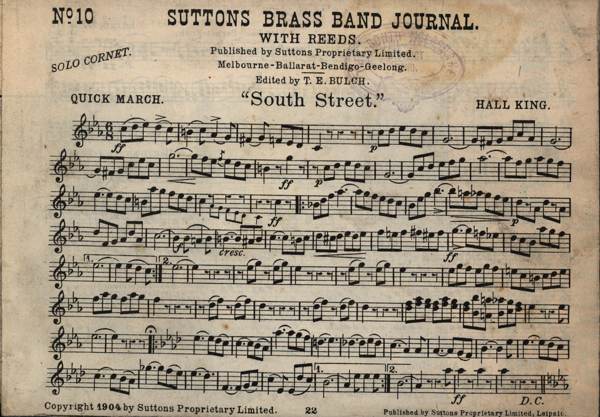
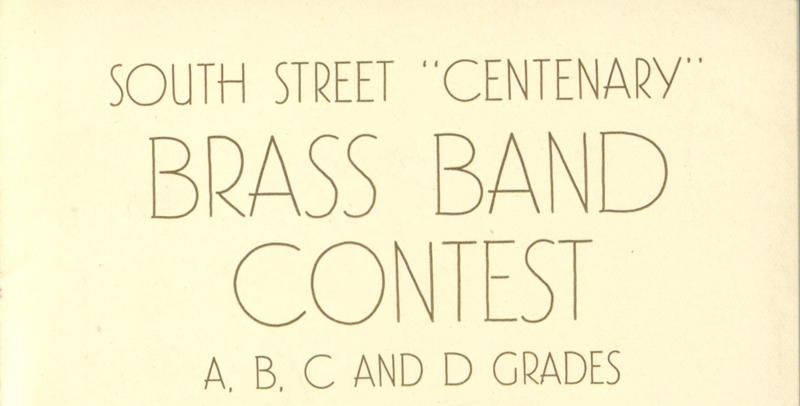
Programme: South Street “Centenary” Brass Band Contest, 1934, part of the front cover.
(Source: Victorian Collections: Victorian Bands’ League Archives)

An international band contest may be a feature of the Centenary celebrations.  An effort will be made to include one in the 1934 Eisteddfod and Band Contest at Ballarat.

The Grand National Eisteddfod of Australasia has promised its enthusiastic support of the celebrations.  Bands contests were resumed last year at the Ballarat competitions after a lapse of eight years, and they proved successful. (“Band Contest For Centenary,” 1933)

Introduction:

The year is 1934 and in Ballarat on the 1st of November, the Royal South Street Eisteddfod band sections are getting underway again.  Except this year is a bit different.  It is the year of the Victorian and Melbourne Centenary and across Victoria, celebrations and other events are in full swing.  The South Street band sections were part of these grand festivities, and all efforts were made to attract bands from across Australia and New Zealand.  In addition, the band contest was honoured by the presence of Prince Henry, Duke of Gloucester and The Band of HM Grenadier Guards.  The Royal South Street Society band contest, while being the most prestigious, attracted the most attention in the wider band movement.  For the bands themselves, there were lots of other events and band contests they were involved in.

Planning for the 1934 Ballarat band contest was extensive and as shown by the quote at the head of this post, the ideas started over eighteen months earlier.  Even if the idealism of the organisers was led astray at times.  They thought big, but had to accept that economic conditions were not the best as Australia was coming out of the Great Depression.  To put on a band contest befitting a visit of royalty was the utmost challenge.  Not to mention the scheduling given the extensive touring of the Grenadier Guards Band and the Duke. 

With the cooperation many different parties, somehow, everything worked out.  This post is mainly about the 1934 South Street band contest, ninety years to the day.

The Centenary:

Officially, the Victorian and Melbourne centenaries marked two historical events; the landing of the Henty family in Portland 1834, and John Batman’s grand pronouncement in 1835 that the Port Philip bay area with the Yarra River at its head would be “the place for a Village” (McCubbin, 2008).  However, like any celebration of this nature, there was some curious disagreement over the dates, especially from interstate commentators.  An article published in The Adelaide Chronicle newspaper in April 1934 questioned the historical accuracy of the centenary.  The article suggested that 1934 was too early as Victoria was officially proclaimed an independent colony in 1851 (“Victoria’s Centenary,” 1934).  Or maybe, as the article also suggested, the centenary was thirty-two years too late as 1802 was the year surveyors from New South Wales first explored the country in the vicinity of Port Phillip Bay (“Victoria’s Centenary,” 1934).  And there were plenty of other historical events connected with Victoria before 1834 that could have been commemorated.  The Victorian Government was probably well aware of these dates and as an article published in The Record newspaper proclaimed:

And now after warring factions have harmonised, the official foundation of Victoria is given as November 19, 1834, when the “Thistle” anchored in Portland Bay: and the centenary of this event is to be taken as the starting point of our Centenary celebrations. (“Victoria’s Centenary.,” 1933)

Nowadays Victoria celebrates an event on the 1st of July each year which marks the day Victoria was officially proclaimed an independent colony from New South Wales (Brown, 2015).  Melbourne Day is also recognized on the 30th of August each year which commemorates “the anniversary of the first European settlement in 1835” (Melbourne Day, 2024).

Confusing, isn’t it…

Prince Henry, Duke of Gloucester:

As early as 1932 if newspaper reports are anything to go by, negotiations were underway to bring a member of the Royal Family to Victoria for the Centenary commemorations in 1934.  The Scrutineer and Berrima District Press newspaper was one of these and they published a tiny article on the 6th of November 1932.

Victoria’s Centenary will probably be celebrated from October, 1934, to February, 1935.  Negotiations are in progress for a Royal visit, and it is almost certain that the British Fleet, which was to have visited Australia in 1933, will postpone the visit to coincide with the celebrations. (“Victoria’s Centenary,” 1932)

By early May 1933, the progress of the negotiations was evident to the extent that it was confirmed a member of the Royal Family would visit in 1934.  But which one?  The Victorian government initiated the negotiations; however, Canberra was also involved and any Royal that visited would be taken to the national capital as well, and to various places in Australia and New Zealand.  Speculation as to which Royal it might be was rife, and as reported by The Herald and several other newspapers, the Royal family member was going to be the Earl of Athlone, the brother of the Queen, or the Duke of Gloucester, the King’s third son (“CENTENARY PLANS TAKE SHAPE,” 1933).

In February 1934, the proposed Royal was mentioned in various newspapers as Prince George and the Royal South Street Society immediately sought to secure a visit to Ballarat by the Prince on the 1st of November so that he could open the famous band sections (“CENTENARY BAND CONTEST,” 1934).  The RSSS was concerned that the Prince, according to a tentative itinerary, might be in New South Wales while the contest was taking place.

The Age, 01/03/1934, p. 10

However, even with the best of plans, circumstances can change overnight, and by May 1934, news broke about a change of Royal, but this did not substantially alter the planning of a Royal visit.

It was announced, in the week-end, that, owing to the strain of the South African tour, Prince George would be unable to fulfil the engagement to come to Australia for the Melbourne Centenary celebrations.  Prince Henry, Duke of Gloucester, is to take his place.

The least robust member of the Royal family, Prince George felt the strain of his South African tour before it was finished.  It was far heavier than had been expected, and his letters home indicated that he was feeling tired, although delighted at the cordiality of his reception everywhere.

It was consequently considered unwise for a young man of Prince George’s temperament, which is rather highly strung, to undertake a second tour, especially as the Australasian programme was longer and more arduous than the African.

[…]

The Duke of Gloucester is the only one of the King’s sons who has not yet toured the Empire.  He fulfilled his duties during his visit to Japan so well that it was felt that he should be given the opportunity to visit Australia, where he would be likely to find so much congenial to his temperament. (“Duke of Gloucester to Come Here for Centenary Celebrations,” 1934)

With a member of a Royal family confirmed, and in all likelihood, the Duke of Gloucester would be in Ballarat on the 1st of November, planning for other parts of the Centenary celebrations and the band contest continued (“CENTENARY BAND CONTEST.,” 1934).

H.R.H. Prince Henry, Duke of Gloucester. Sunraysia Daily, 31/10/1934, p. 21

The Duke arrived in Australia in early October and visited Perth, then Adelaide on his way to Melbourne, travelling aboard H.M.S. Sussex which was escorted by elements of the Australian naval fleet (“DEPARTURE OF H.M.S. SUSSEX.,” 1934).  Prince Henry disembarked in Melbourne on the 18th of October and was afforded all the military and civic pageantry that Victoria could muster at the time. Below is a short film clip of his arrival and speech on the steps of the Victorian Parliament.

The Band of HM Grenadier Guards:

Programme: Front Cover – The Band of His Majesty’s Grenadier Guards : By Special Permission of the King, 1934. (Source: Jeremy de Korte Collection)

If the experiences of bringing a member of the Royal family to Ballarat was anything to go by, then securing a visit by one of the finest military bands in the world (at that time) was no less stressful and speculative.  Given the planning of the Centenary celebrations were well-underway in 1933, this is when newspapers started reporting that an English military band would be visiting as part of the festivities.  The Argus newspaper published a lengthy article in September 1933 that mentioned the Coldstream Guards, and that Victorian band musicians would be eager to hear them play, and be inspired (“COLDSTREAM GUARDS BAND,” 1933).  As mentioned in a previous post about this tour, only the Musicians’ Union raised objections to the tour of an English band, a position that was berated by a letter writer to The Herald newspaper (de Korte, 2018b; Musician, 1933).  In October, The Age newspaper was a little more speculative – given there are multiple guards’ bands, this article mentioned the bands of the Coldstream Guards, Welsh Guards, or Grenadier Guards as possibilities of touring (“GUARDS’ BAND VISIT.,” 1933).

It was quite a bit later, June 1934, that the Grenadier Guards Band was strongly expected to be the English military band visiting for the Centenary, and that their tour, estimated to cost £10,000 pounds, would also take in provincial towns (“FAMOUS BAND EXPECTED,” 1934).  In August, this tour was very much confirmed – one could appreciate the formality of the article published in The Age newspaper.

By special permission of the King, the band of Grenadier Guards is to give a season in Melbourne under the auspices of the Commonwealth and New Zealand Governments and the Centenary Celebrations Council, and Messrs. J. and N. Tait have been entrusted with the management of the tour.  The opening concert will be given in the Town Hall on Saturday, 20th October.  The band is the premier band of the United Kingdom, and negotiations for this visit have been carried through the Commonwealth High Commissioner in London with the British Government.  The band has no fewer than twenty different programmes.  Their uniforms of scarlet, blue and gold, with bearskin busbies, should make a fine spectacle. (“Grenadier Guards’ Band.,” 1934)

The Grenadier Guards band duly arrived in Melbourne on the 20th of October and were given a civic reception at the town hall, and a parade up Collins Street led by the Melbourne Fire Brigade Band (“GRENADIER GUARDS BAND HAS WONDERFUL WELCOME.,” 1934).  The picture below published in The Age newspaper showing the proceedings, and part of the crowd of 100,000, says it all.

The Age, 22/10/1934, p. 15

After their welcome in Melbourne and opening concert, the Band of the Grenadier Guards commenced on a country tour of Victoria, such was the interest in their visit – their first tour concert was in Wangaratta on the 22nd of October (“GRENADIER GUARDS BAND.,” 1934).  By no coincidence at all, many of the places the band visited intersected with visits of the Duke of Gloucester, including Ballarat on the 1st of November.

Of interest is the back cover of the programme used for this visit which advertises Boosey & Hawkes instruments, and the Australian music retailers that sold them – with a picture of H.M.S. Sussex which was transporting Prince Henry to Australia (Kingtson, 1934).


Programme: Back Cover – The Band of His Majesty’s Grenadier Guards : By Special Permission of the King, 1934. (Source: Jeremy de Korte Collection)

Two of the puzzle pieces for the Royal South Street band contest were now in place. But we must not forget the brass bands that were travelling to South Street for the contest.

Attracting the bands:

It would not be a band contest without the bands, and the Royal South Street Society, conscious of the significance of the 1934 contest, wanted to put on a good show.  At the head of this post was the idea that the band contest could be an international contest with the finest bands from around the world travelling to Ballarat to participate (“Band Contest For Centenary,” 1933).  Alas, bringing international bands was not to be.  Australia was just coming out of the Great Depression and economic conditions were not the best and attracting international bands was probably deemed too expensive (de Korte, 2020).  Nevertheless, in June 1933 the Lord Mayor of Melbourne gave his blessing to the band contest in Ballarat, stating,

Ballarat is looked upon as the venue for brass band contests, and I can assure you that during the centenary celebrations it will be recognised as such” said the Lord Mayor of Melbourne (Councillor H. Gengoult Smith) in speaking at a civic welcome at the city hall yesterday.  […] In recognition of what Ballarat, through the South Street Society, had done for the encouragement of brass band music, he would give his assurance that the finals of the centenary band contest would be held in Ballarat. (“CENTENARY BAND CONTEST.,” 1933)

The Mayor of Ballarat, Cr. A. J. Darling expressed confidence in January 1934 that arrangements for the official opening of the Centenary band contest were well-underway, as well as confirmation that a member of the Royal family would be attending (“CENTENARY BAND CONTEST.,” 1934).  With the Royal South Street Society and the newly formed Victorian Bands’ League working on the particulars of the contest, there was no need to think this was not the case.  And in April came the details of the prize money that was on offer, and the announcement that “Mr. Stephen Yorke, conductor of the Australian national military band, will adjudicate.” (“CENTENARY BAND CONTESTS.,” 1934).  On a side note, the A.B.C. Military Band was undertaking its own national tour in 1934 – it was a great year to listen to top bands in Australia (de Korte, 2018a).

Individual bands were also starting to make plans to visit Ballarat for the contest.  We see that in April, the Mildura Municipal Band (also known as the Sunraysia District Brass Band) announced plans to visit Ballarat to listen to the A grade sections, and then proceed to Melbourne to present a concert in conjunction with the Essendon City Band (“CENTENARY BAND CONTESTS,” 1934).  However, their ideas must have changed as they ended up participating in the contest in the C and D grade sections, and achieving equal first prize with the Pleasant Street Boys’ Band in the D grade (Royal South Street Society, 1934c). 

Photograph: Mildura & District Brass Band, 1930s. (Source: IBEW)
Photograph: Pleasant Street School Band, 1933. (Source: IBEW)
Telegraph, 13/10/1933, p. 27

Interest in competing was also expressed by bands in New Zealand as the Woolston Brass Band announced its intention to come to Ballarat for the centenary contest (“NEW ZEALAND BAND TO VISIT MELBOURNE.,” 1933).  An article published in the Dominion newspaper by the writer, ‘Kneller Hall’, speculated that the Port Nicholson Silver Band was preparing to travel to Ballarat to compete, while also confirming that the famous Woolston Brass Band was going to make the trip over the Tasman (Kneller Hall, 1934).  In the end, only one band from New Zealand ended up attending, Woolston, and they were given a civic welcome when they arrived in Ballarat (“BALLARAT AND DISTRICT,” 1934; “PROVINCIAL CITIES AND TOWNS.,” 1934a).

Woolston Brass Band. Dominion, 13/10/1934, p. 13

The South Street “Centenary” Band Contest:

With bands arriving in Ballarat, the Duke of Gloucester travelling down by train from Mildura, and the Band of the Grenadier Guards arriving from Bendigo, all was now in place for the opening of the Royal South Street band sections on the 1st of November (“GRENADIER GUARDS BAND.,” 1934; “Sunraysia, Land of Sunshine Greets The Duke,” 1934).  Twenty-two bands from Victoria, Tasmania, New South Wales, and New Zealand had entered the South Street contests this year and the list of bands and bandmasters in the official souvenir programme can be viewed below (Royal South Street Society, 1934e).

Programme: South Street “Centenary” Brass Band Contest, 1934, p. 4.
(Source: Victorian Collections: Victorian Bands’ League Archives)

To have twenty-two bands enter in 1934 was not bad considering that the early thirties were times of upheaval for the Victorian band movement and society in general.  In 1931, the Victorian Bands’ League was established having superseded the Victorian Bands’ Association, the Australian economy was recovering after the Great Depression, and the band sections at Royal South Street had resumed in 1932 after an eight year hiatus (de Korte, 2018c, 2020; Royal South Street Society, 1979).

However, it would have been pleasing to see bands from a wide variety of areas coming to South Street.  We know that for some bands, like the Phillip Island Brass Band, that they did a considerable amount of fundraising to attend (de Korte, 2019).  The line up for bands for the A Grade section represented the best of A grade bands that Victoria had in the day, and having the Woolston Brass Band from Christchurch, N.Z. made the section even more top notch.
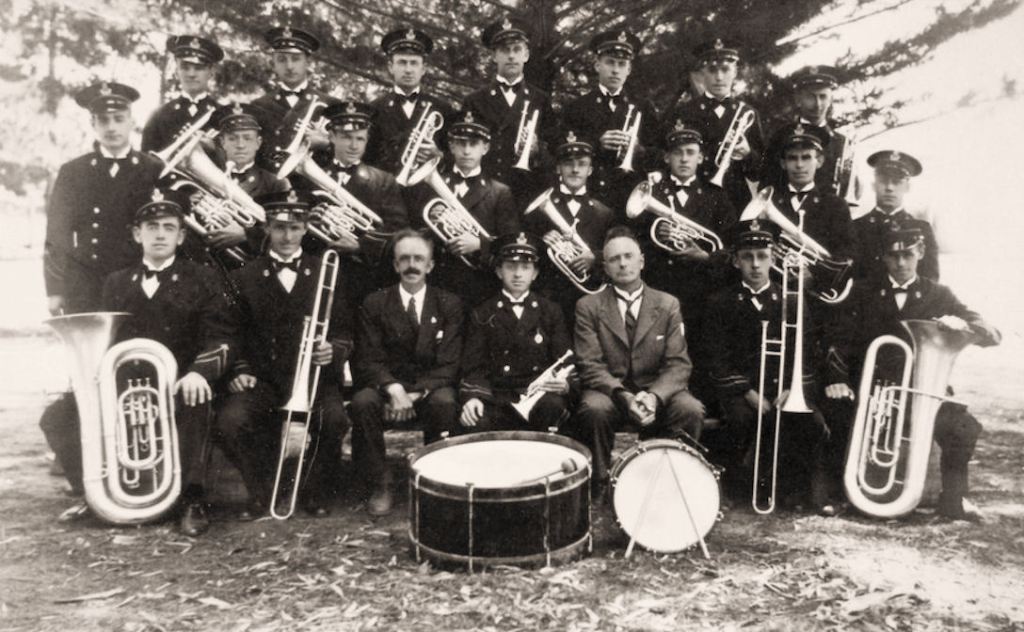
Photograph: Phillip Island Brass Band, 1932. (Source: IBEW)

The opening day of the band contest was a spectacular affair with the Royal South Street Society having programmed all events down to the minute.  According to various newspaper articles, 10,000 people attended the opening day at Ballarat’s City Oval, no doubt drawn to the fact that the Duke of Gloucester would be there to officially open the contest.  The souvenir programme outlined the proceedings of the day as can be seen below.
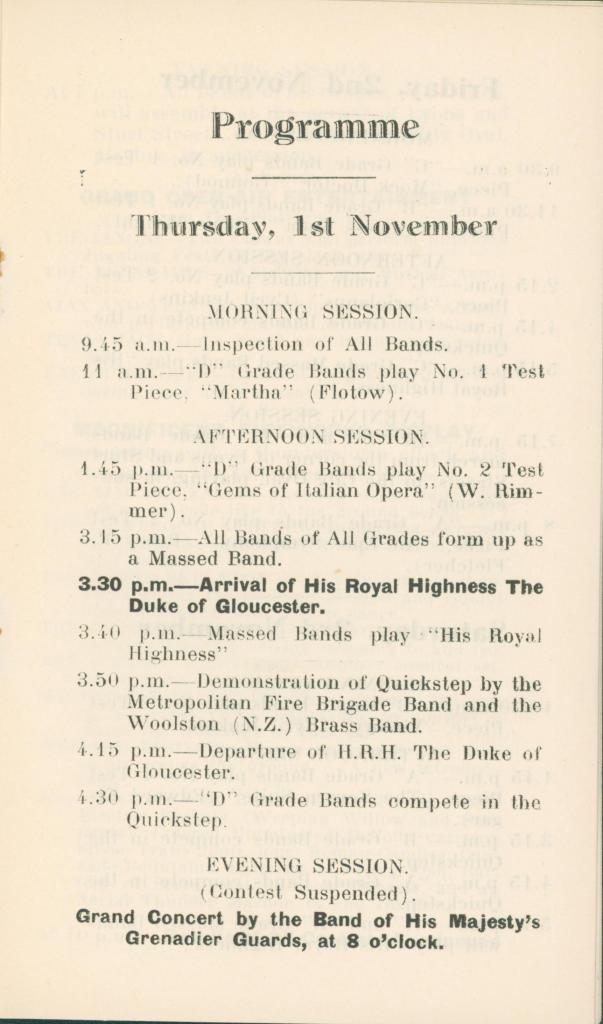
Programme: South Street “Centenary” Brass Band Contest, 1934, p. 6.
(Source: Victorian Collections: Victorian Bands’ League Archives)

In superb weather, everything proceeded to plan, and the bands did their best to produce a ceremony befitting the occasion (“BAND CONTESTS,” 1934).  There was a massed band performance, a demonstration of the quickstep, and the Woolston Brass Band even performed a haka for the Duke after the march past of the bands (“DUKE AT BALLARAT,” 1934).  That night, the Band of HM Grenadier Guards performed in a concert which would have inspired the bandsmen and audience (Royal South Street Society, 1934e). 

Results for the contests were announced on Saturday 3rd of November with another 10,000 people attending to find out the placings.  The full results will not be detailed in this post due to space, but they can be found on the RSSS results database via these links:

The Solo contests were held a day before the band sections on the 31st of October.  The results of these can be found on the RSSS database via the link:

By all accounts, the standard of playing across all sections was brilliant and the adjudicator was very impressed.  The A Grade section in particular was a very hard fought affair, but in the end, the Melbourne Fire Brigade Band won the Besson Shield for the third year in a row (Royal South Street Society, 1934a).  The Woolston Brass Band from N.Z. suffered some misfortune when one of their cornet players became ill – the other A Grade bands offered them a choice of cornet players to help out – however, they decided to proceed down a player and were happy to achieve third place (“BRILLIANT PLAYING,” 1934; “PROVINCIAL CITIES AND TOWNS.,” 1934b). 

The Duke of Gloucester and the Band of the Grenadier Guards did not stay long in Ballarat as they kept up a tight schedule of touring around Victoria and eventually New Zealand.  For the bands themselves there were good stories of their visits to Ballarat.  The Yallourn and District Band from Gippsland was one band that was very proud of their efforts in the B Grade section where they achieved second place behind the City of Ballarat Band (“YALLOURN NEWS,” 1934).  Of interest is that in early 1935, three cornet players from Victorian bands, including cornetist Jack Allan of the City of Ballarat Band, were offered places in the Band of the Grenadier Guards (“Ballarat Bandsman Invited To Join Grenadier Guards,” 1935).  It is unclear whether they took up that offer.

The 1934 South Street contest was no doubt an important part of Victoria’s Centenary celebrations, but it was not the only part.  There were other important events taking place.

Events after South Street:

11th of November, 1934: Dedication of the Shrine of Remembrance, Melbourne:

Postcard: The National War Memorial of Victoria. Aerial View of Dedication Ceremony, 11/11/1934. (Source: Jeremy de Korte Collection)

For the Duke of Gloucester, he kept up a busy schedule around Victoria.  However, his most important engagement was the dedication of Melbourne’s newly completed Shrine of Remembrance.  This was a very special occasion which was attended by thousands of veterans, people, and important dignitaries.  Bands and other musicians also played an important role, and at the dedication, several Australian Army buglers sounded the Last Post standing behind Royal Australian Navy drummers.

Portland Centenary Band Contest:

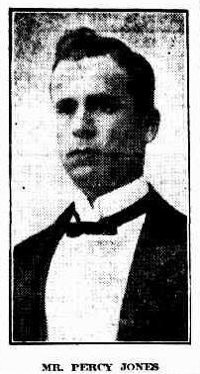
The town of Portland in the far south-west of Victoria had an important part to play in Victoria’s centenary celebrations.  In turn, they staged their own band contest, albeit on a much smaller scale than the South Street contests which had concluded only two weeks earlier (“BAND CONTESTS.,” 1934).  The Portland contest was only attended by bands from Hamilton, Heywood and Mt. Gambier, and there was a pipe band contest held at the same time.  The Portland contest was won by the band from Mt. Gambier and the adjudicator was Mr. Percy Jones (“Band Contest Won By Mount Gambier,” 1934).

Melbourne Centenary Band Championship, King’s Birthday weekend, June 1935:

The Victorian centenary celebrations stretched into 1935, and a Melbourne Centenary Band Championship was held at the Exhibition Buildings under the auspices of the Victorian Bands’ League.  Like the South Street contests, this was another great event for bands, and twenty-one bands participated, as listed in the article below.
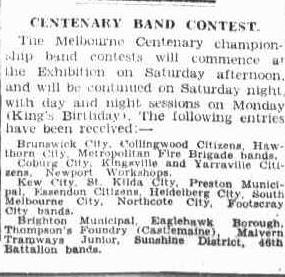
The Age, 28/05/1935, p. 11

The main attraction of this event was a grand parade from Alexandra Avenue to the Exhibition Buildings and quickstep display on the Exhibition oval (“CENTENARY BAND CONTESTS,” 1935).  Again, the A Grade section continued the rivalries between Hawthorn, Melbourne Fire Brigade, Brunswick and Collingwood bands, with Hawthorn taking out the A Grade title (“CENTENARY GALA WEEK.,” 1935).  Another celebrated win was that of the Malvern Junior Tramways Band when they won their third D Grade title in a row.
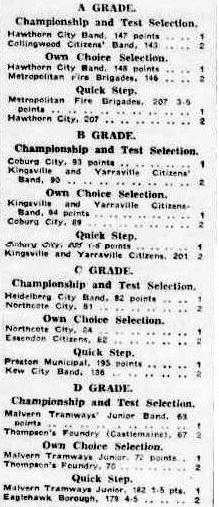
The Age, 04/06/1935, p. 10

Conclusion:

What an intense period of activity for bands!  It is times like these that our bands came to the fore with all the ceremonial and contest activity, as well as local celebrations.  No doubt the communities appreciated the efforts and the entertainment.  Having a visiting band of the calibre of the Band of the Grenadier Guards made the Centenary celebrations even more special, and it was noted at the time that they were inspiring to local musicians.  The prevailing feeling when all was done was one of accomplishment, not just from the cooperation that made this all happen, but from all that understood the significance of the events.  It is not every day that a world-class military band and a Duke visits a band contest.

References:

BALLARAT AND DISTRICT. (1934, 08 June). Argus (Melbourne, Vic. : 1848 – 1957), 3. http://nla.gov.au/nla.news-article10944624

Ballarat Bandsman Invited To Join Grenadier Guards. (1935, 16 January). Sunraysia Daily (Mildura, Vic. : 1920 – 1950), 5. http://nla.gov.au/nla.news-article265838073

Band Contest For Centenary. (1933, 25 February). Sun News-Pictorial (Melbourne, Vic. : 1922 – 1954; 1956), 4. http://nla.gov.au/nla.news-article277163952

Band Contest Won By Mount Gambier : Judge’s Eulogistic Comments. (1934, 22 November). Portland Guardian (Vic. : 1876 – 1953), 4. http://nla.gov.au/nla.news-article64287397

BAND CONTESTS : OPENING AT BALLARAT. (1934, 02 November). Mercury (Hobart, Tas. : 1860 – 1954), 14. http://nla.gov.au/nla.news-article29165635

BAND CONTESTS : Three Bands Competing. (1934, 19 November). Portland Guardian (Vic. : 1876 – 1953), 5. http://nla.gov.au/nla.news-article64287383

BRILLIANT PLAYING : Ballarat Band Contest. (1934, 05 November). Evening Post, 9. https://paperspast.natlib.govt.nz/newspapers/EP19341105.2.61

British Pathé. (2014, 13 April). Melbourne Centenary (1934) [Video (Film Clip)]. YouTube. Retrieved 11 October 2024 from https://www.youtube.com/watch?v=C4DWQpyx4O0

Brown, S. L. (2015, 01 July). Victoria Day: Was secret gold behind 1851 separation from NSW? ABC Radio Melbourne,6584322. https://www.abc.net.au/news/2015-07-01/victoria-day-was-secret-gold-behind-separation/6584322

CENTENARY BAND CONTEST. (1935, 28 May). Age (Melbourne, Vic. : 1854 – 1954), 11. http://nla.gov.au/nla.news-article204361353

CENTENARY BAND CONTEST : Arrangements for Opening. (1934, 18 January). Age (Melbourne, Vic. : 1854 – 1954), 9. http://nla.gov.au/nla.news-article203377704

CENTENARY BAND CONTEST : Finals in Ballarat. (1933, 05 June). Argus (Melbourne, Vic. : 1848 – 1957), 9. http://nla.gov.au/nla.news-article4740383

CENTENARY BAND CONTEST : Proposed Opening by Prince George. (1934, 23 February). Age (Melbourne, Vic. : 1854 – 1954), 10. http://nla.gov.au/nla.news-article203376669

CENTENARY BAND CONTESTS. (1935, 31 May). Sunshine Advocate (Vic. : 1924 – 1954), 3. http://nla.gov.au/nla.news-article74757883

CENTENARY BAND CONTESTS : Mildura Band to Make Trip. (1934, 27 April). Sunraysia Daily (Mildura, Vic. : 1920 – 1950), 4. http://nla.gov.au/nla.news-article265690603

CENTENARY BAND CONTESTS : South-Street Prize Money. (1934, 13 April). Age (Melbourne, Vic. : 1854 – 1954), 7. http://nla.gov.au/nla.news-article203842698

CENTENARY GALA WEEK : BAND CONTESTS DECIDED : HAWTHORN CITY WINS A GRADE CHAMPIONSHIP : Malvern Tramway Juniors’ D Grade Treble. (1935, 04 June). Age (Melbourne, Vic. : 1854 – 1954), 10. http://nla.gov.au/nla.news-article204345548

CENTENARY PLANS TAKE SHAPE : Pageants, Exhibitions And Shrine Dedication : BIG MILITARY TATTOO. (1933, 11 May). Herald (Melbourne, Vic. : 1861 – 1954), 5. http://nla.gov.au/nla.news-article243112151

COLDSTREAM GUARDS BAND : Victorian Bandsmen Eager For Visit. (1933, 01 September). Argus (Melbourne, Vic. : 1848 – 1957), 8. http://nla.gov.au/nla.news-article11688130

de Korte, J. D. (2018a, 12 July). The A.B.C. Military Band: an ensemble of the times. Band Blasts from the Past: Anecdotes, Stories and Personalities. https://bandblastsfromthepast.blog/2018/07/12/the-a-b-c-military-band-an-ensemble-of-the-times/

de Korte, J. D. (2018b, 14 October). International band tours of the early 1900’s: bringing music to Australia. Band Blasts from the Past: Anecdotes, Stories and Personalities. https://bandblastsfromthepast.blog/2018/10/14/_international-band-tours-of-the-early-1900s-bringing-music-to-australia/

de Korte, J. D. (2018c, 15 March). The politics of affiliation: The Victorian Bands’ Association to the Victorian Bands’ League. Band Blasts from the Past: Anecdotes, Stories and Personalities. https://bandblastsfromthepast.blog/2018/03/15/the-politics-of-affiliation-victorian-bands-association-to-the-victorian-bands-league/

de Korte, J. D. (2019, 31 January). Bands on Australian islands: unique challenges in unique environments. Band Blasts from the Past: Anecdotes, Stories and Personalities. https://bandblastsfromthepast.blog/2019/01/31/bands-on-australian-islands-unique-challenges-in-unique-environments/

de Korte, J. D. (2020, 18 October). Testing times: the resilience of Australian bands during the Great Depression. Band Blasts from the Past: Anecdotes, Stories and Personalities. https://bandblastsfromthepast.blog/2020/10/18/testing-times-the-resilience-of-australian-bands-during-the-great-depression/

DEPARTURE OF H.M.S. SUSSEX. (1934, 09 October). West Australian (Perth, WA : 1879 – 1954), 17. http://nla.gov.au/nla.news-article32803514

DUKE AT BALLARAT : AMONG THE BANDS : A WOOLSTON HAKA. (1934, 02 November). Evening Post, 10. https://paperspast.natlib.govt.nz/newspapers/EP19341102.2.102.1

Duke of Gloucester to Come Here for Centenary Celebrations : AFRICAN TOUR TIRED PRINCE GEORGE. (1934, 05 May). Weekly Times (Melbourne, Vic. : 1869 – 1954), 5. http://nla.gov.au/nla.news-article223836381

FAMOUS BAND EXPECTED : Grenadier Guards for Centenary. (1934, 05 June). Herald (Melbourne, Vic. : 1861 – 1954), 1. http://nla.gov.au/nla.news-article243175540

GRENADIER GUARDS BAND. (1934, 25 October). Great Southern Advocate (Korumburra, Vic. : 1889 – 1906, 1914 – 1940), 5. http://nla.gov.au/nla.news-article255918717

GRENADIER GUARDS BAND HAS WONDERFUL WELCOME. (1934, 22 October). Age (Melbourne, Vic. : 1854 – 1954), 15. http://nla.gov.au/nla.news-article205884483

Grenadier Guards’ Band. (1934, 27 August). Age (Melbourne, Vic. : 1854 – 1954), 13. http://nla.gov.au/nla.news-article205524735

GUARDS’ BAND VISIT : Centenary Tour Almost Certain. (1933, 10 October). Age (Melbourne, Vic. : 1854 – 1954), 8. http://nla.gov.au/nla.news-article205104515

Kingtson, C. (Ed.). (1934). Grenadier Guards Band : Australia and New Zealand 1934-5 : By Special Permission of His Majesty the King : Official Souvenir : Tour under the Auspices of the Commonwealth Government and the New Zealand Government : In associaion with the Cenenary Celebrations Council of Victoria  [Printed programme]. Grenadier Guards Band. 

Kneller Hall. (1934, 27 July). THE BANDS : News and Views : WELLINGTON AND BALLARAT. Dominion, 13. https://paperspast.natlib.govt.nz/newspapers/DOM19340727.2.98

McCubbin, M. (2008). Centenary. In eMelbourne: the city past & present (pp. EM00316b). https://www.emelbourne.net.au/biogs/EM00316b.htm: The University of Melbourne, School of Historical & Philosophical Studies.

Melbourne Day. (2024). More marvellous than ever: FAQs: What is Melbourne Day? Melbourne Day: 30th August. Retrieved 26 October 2024 from https://www.melbourneday.com.au/about.html

Mildura & District Band, 1930s. (1930). [Photograph]. [phot6314]. The Internet Bandsman Everything Within, Vintage Brass Band Pictures – Australia. http://www.ibew.org.uk/vbbp-oz.html

Musician. (1933, 11 September). GUARDS’ BAND VISIT. Herald (Melbourne, Vic. : 1861 – 1954), 6. http://nla.gov.au/nla.news-article243423748

NEW ZEALAND BAND TO VISIT MELBOURNE. (1933, 13 October). Telegraph (Brisbane, Qld. : 1872 – 1947), 27. http://nla.gov.au/nla.news-article180593124

Phillip Island Brass Band, 1932. (1932). [Photograph]. [phot16005]. The Internet Bandsman Everything Within, Vintage Brass Band Pictures – Australia. http://www.ibew.org.uk/vbbp-oz.html

Pleasant Street School Band, Ballarat, 1933. (1933). [Photograph]. [phot20817]. The Internet Bandsman Everything Within, Vintage Brass Band Pictures – Australia. http://www.ibew.org.uk/vbbp-oz.html

PROVINCIAL CITIES AND TOWNS : BALLARAT. (1934a, 29 October). Age (Melbourne, Vic. : 1854 – 1954), 13. http://nla.gov.au/nla.news-article205882825

PROVINCIAL CITIES AND TOWNS : BALLARAT. (1934, 05 November). Age (Melbourne, Vic. : 1854 – 1954), 12. http://nla.gov.au/nla.news-article205083970

Royal South Street Society. (1934a). 1934-10-31 Brass Band Solos : Held at the A.N.A. Hall, Camp Street [Eisteddfod Results]. Royal South Street Society Results Database. https://results.royalsouthstreet.com.au/results/1934-10-31-brass-band-solos 

Royal South Street Society. (1934b). 1934-11-01 Brass Band Contests : Held at City Oval : Grand Champion Centenary Band Contests [Eisteddfod Results]. Royal South Street Society Results Database. https://results.royalsouthstreet.com.au/results/1934-11-01-brass-band-contests 

Royal South Street Society. (1934c). 1934-11-02 Brass Band Contests  : Held at City Oval [Eisteddfod Results]. Royal South Street Society Results Database. https://results.royalsouthstreet.com.au/results/1934-11-02-brass-band-contests 

Royal South Street Society. (1934d). 1934-11-03 Brass Band Contests  : Held at City Oval [Eisteddfod Results]. Royal South Street Society Results Database. https://results.royalsouthstreet.com.au/results/1934-11-03-brass-band-contests 

Royal South Street Society. (1934e). [South Street “Centenary” : Brass Band Contest : A, B, C and D Grades]. In S09 – Programs (Printed programme ed., pp. 14). Ballarat, Victoria https://victoriancollections.net.au/items/5d425e0c21ea6b1a84382033: Victorian Bands’ League Archive.

Royal South Street Society. (1979). Royal South Street Society : The First One Hundred Years. Royal South Street Society. 

ShrineMelbourne. (2013, 09 January). The Dedication of the Shrine of Remembrance – Remembrance Day 11 November 1934 [Video (Film Clip)]. YouTube. Retrieved 26 October 2024 from https://www.youtube.com/watch?v=jHcaXEpVdRA

Sunraysia, Land of Sunshine Greets The Duke : Prince Henry Is Our First Royal Guest. (1934, 31 October). Sunraysia Daily (Mildura, Vic. : 1920 – 1950), 21. http://nla.gov.au/nla.news-article265829018

The Shrine of Remembrance Trustees. (1934). The National War Memorial of Victoria : Aerial View of Dedication Ceremony [Postcard]. [No. 3]. The Shrine of Remembrance Trustees, Great Britain. 

To Visit Australia. (1934, 13 October). Dominion, 13. https://paperspast.natlib.govt.nz/newspapers/DOM19341013.2.116.5

Victoria’s Centenary. (1932, 06 November). Scrutineer and Berrima District Press (NSW : 1892 – 1948), 4. http://nla.gov.au/nla.news-article125232791

Victoria’s Centenary. (1933, 04 November). Record (Emerald Hill, Vic. : 1881 – 1954), 2. http://nla.gov.au/nla.news-article164468392

Victoria’s Centenary. (1934, 12 April). Chronicle (Adelaide, SA : 1895 – 1954), 39. http://nla.gov.au/nla.news-article92354462

VISIT TO BALLARAT : Desired for Band Competition. (1934, 01 March). Age (Melbourne, Vic. : 1854 – 1954), 10. http://nla.gov.au/nla.news-article203834255

YALLOURN NEWS : Yallourn Band. (1934, 08 November). Morwell Advertiser (Morwell, Vic. : 1888 – 1954), 9. http://nla.gov.au/nla.news-article71564079
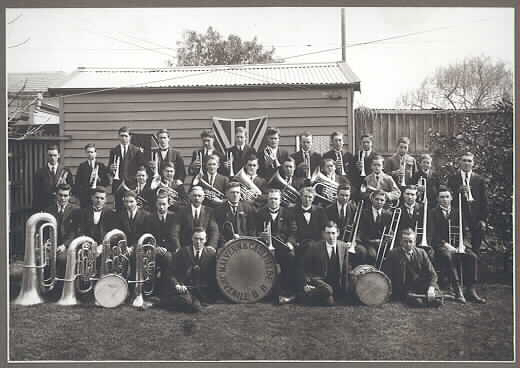
A band, a council, correspondence, and financial records: a case study of the Malvern City Band

The Malvern & Caulfield East Juvenile Band, 1922. (Source: IBEW)

Introduction:

If there is one aspect that defines the band movement of yesteryear, it is the relationships they formed through the course of their existence.  Some of these relationships were beneficial, others were not. Maintaining these relationships was sometimes difficult as issues needed to be ironed out.  On occasions, some issues became insurmountable, and there was never any proper resolution.

When we look at a typical brass band from the era of the early to middle 1900s there were several stakeholders who were involved with the band – certainly the musicians and bandmaster, but also the ladies’ auxiliary, the local council, and supporters.  It is probably the relationship with local councils that was most important to a band as the council allocated some funding, sometimes helped with a band hall, and gave permission for bands to use parks and bandstands.  However, councils and some bands had their own way of doing things.

This post is essentially a case study and is different to other posts on this blog that have focused on the linked stories of many bands.  The band in question is the Malvern City Band, a band that was only in operation from 1922-1939, but it is a band that offers an inordinate amount of information on how it worked, or did not work.  It was a band that was started with the best of intentions but was forever living under shadows of other bands and its way of operating was questionable.  The Malvern City Band drew an amount of controversy which played out through letters in the local papers.  Thus, it presents an almost perfect case study on relationships with various stakeholders, including the powerful Malvern City Council.

We will see in this post several sides to the Malvern City Band.  Firstly, there will be a brief history of the band including its initial desire to be recognized as an independent entity, difficult as that was when the other band in the municipality was the Malvern Tramways Band.  From the outset the MCB had a difficult relationship with the Malvern City Council, and this will be explored from both sides of the disputes – and there were a few.  The role of the local newspaper was interesting at the time and an examination of this role is very useful – their actions were very much like the social media of today.  To conclude, a question will be asked as to who benefited during these years, the council, or the band? 

The Malvern City Band:

Let us just say from the outset that it cannot have been easy for the Malvern City Band when it started in 1922 given that the resounding success of the Australian band movement at the time, and the band held up high by Malvern City Council, was the Malvern Tramways Band – a band that still survives to this day as the Stonnington City Brass.

Punch, 2/5/1901, p. 22

They were not the first band in Malvern to hold this name.  In 1899 another band started called the Malvern Tradesmen’s Military Band, soon to become the Malvern Town Military Band in 1901 (“Malvern,” 1901).  This band stopped and started over the years.  In 1907 it restarted as the Malvern Town Band and in 1911, it changed its name to Malvern City Band in line with the newly proclaimed City of Malvern (“Malvern Town Band.,” 1907; “MODERN MALVERN.,” 1911).  The Malvern Town Band lasted another two years and was last seen in public on a parade in 1913 (Baritone, 1913).

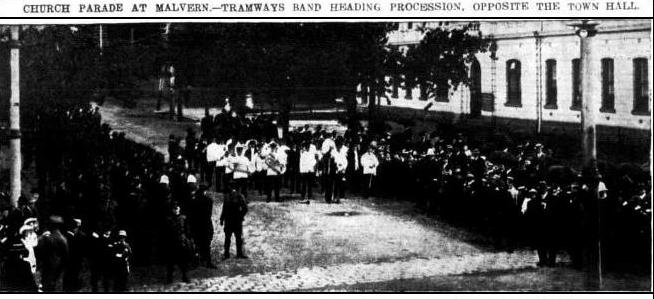
In other band news from this time, the Malvern Tramways Band, originally known as the Prahran & Malvern Tramways Trust Band, started in November 1911 (Lawson-Black, 2010).

Punch, 19/12/1912, p. 53

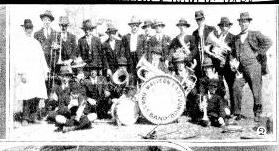
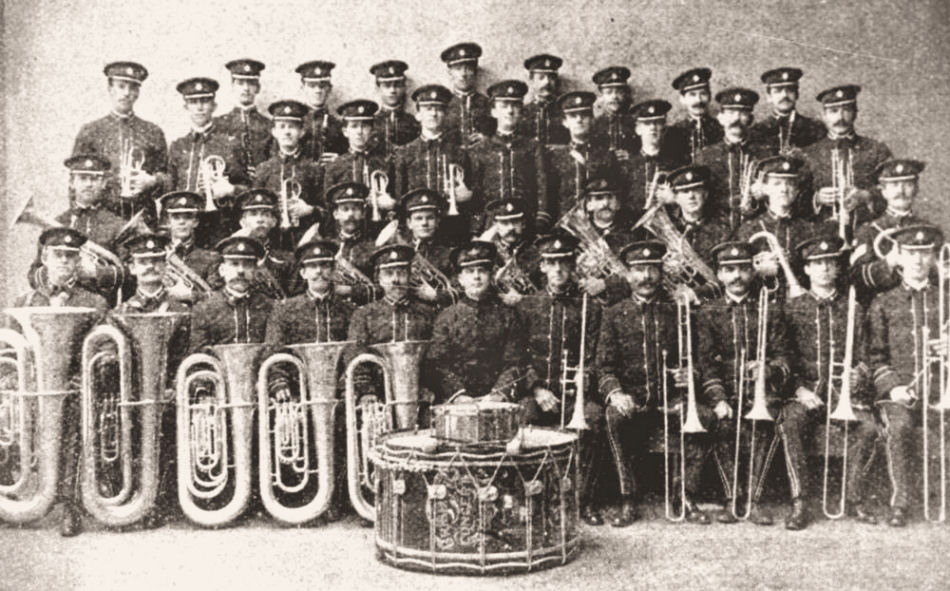
Coming into 1922, with the Malvern Tramways Band now well-established and having a highly regarded reputation in band competitions, the Malvern & Caulfield East Juvenile Band was started by Malvern East (Manning Road) resident, Benjamin Long.  This band was started with the best intentions.  It was a band that was all for training youth in brass bands, and as evident by the picture at the head of this post, it succeeded in raising a full band (Malvern & Caulfield East Juvenile Brass Band, 1922).  A call went out in the Prahran Telegraph newspaper in August 1922 for more boys to join up as the band already had “twenty players” (“MALVERN JUVENILE BAND.,” 1922).  The band was initially conducted by Mr. W. F. King, a bandsman who had been associated with the Rupanyup Brass Band for a short stint in 1914-15, and had taken twelve months leave from the South Richmond Brass Band in 1921 to take on the bandmaster position with this new Malvern band (“Rupanyup Brass Band,” 1914; “South Richmond Brass Band.,” 1921). 

Weekly Times, 8/3/1924, p. 40

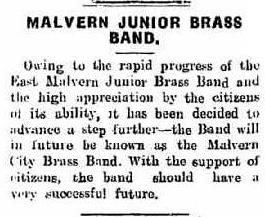
The band changed their name to the East Malvern Junior Band in 1923 and early newspaper reports indicate they were playing at some engagements, and received praise for their efforts (“EAST MALVERN JUNIOR BAND.,” 1923).  However, in early 1924, they changed their name again to the Malvern City Band as it was felt they were making “rapid progress” and there was “high appreciation of their ability” (“MALVERN JUNIOR BRASS BAND.,” 1924).  This latest name change could be viewed as naive as “Malvern City”, which the band argued was reflective of the geographic area, made it look like they were somehow associated with Malvern City Council.  There was one problem though, during the lifetime of this band, it was never recognised as the official band of Malvern (“COUNCIL OBJECTS TO BAND’S NAME,” 1933).  That honour went to the Malvern Tramways Band.  More on this will be examined further in the post.

Prahran Telegraph, 1/2/1924, p. 5

Nevertheless, the Malvern City Band continued to try to make a name for themselves, and according to an archival advertising flyer held by the Stonnington History Centre, they entered in the 1924 C Grade section at the Royal South Street Eisteddfod (Malvern City Brass Band, 1924).  They even held a two-day bazaar to fundraise for their trip, of which the money was to be used for new uniforms (“MALVERN BAND.,” 1924; “MALVERN CITY BRASS BAND.,” 1924).  The MCB were certainly listed as one of six entrants to this section as late as October 23rd, 1924, but according to the official results on October 25th, the day of competition, they never played – only five bands were listed in the results for C Grade, and Malvern City Band was not one of them (“BAND CONTESTS,” 1924; Royal South Street Society, 1924).  The Victorian Bands’ Association records in the newspapers show that the Malvern City Band affiliated with the then VBA from 1924 – 1927 (de Korte, 2020). 

The advertising flyer lists various charities and events the Malvern City Band played for, and it was true, the band did go out on many occasions to entertain, and continued to do so during their lifetime (Malvern City Brass Band, 1924).  Trips to Mont Park hospital and Queenscliff would have been big adventures (“EAST MALVERN JUNIOR BAND.,” 1923; “THE MALVERN CITY BAND.,” 1927).  For the most part, the MCB kept up a regular program of engagements at hospitals, parks and even some commemorations as they played at the 1926 Anzac Day in front of Parliament House (“THE PROGRAMME.,” 1926).  In 1929, they were pictured leading a parade of Scouts (“Scout Display at Exhibition,” 1929).  So, it would seem the MCB appeared as a normal, suburban brass band that got out and about, and played well when they did.

Table Talk, 3/10/1929, p. 9

One aspect of their existence that they made much of was connections to the high offices of the land, namely two Governors of Victoria.  At the time, the Victorian Government House  was located at Stonnington Mansion, a grand house on Glenferrie Road just north of the intersection with Malvern Road (Heritage Council Victoria, 2022).  In the early 1920s, the Victorian Governor was the Third Earl of Stradbroke who departed Victoria in April 1926 – the band played at a “welcome home” event in 1923 (Gardiner, 2006; “THE NEWS OF THE WEEK,” 1923).  The next Governor of Victoria was Arthur Herbert Tenyson Somers who took up residence at Stonnington Mansion soon after, and in July of that year, he agreed to become a patron of the Malvern City Band (Gregory, 2006; “ITEMS OF INTEREST.,” 1926).   Benjamin Long was ever fond of reminding people of these connections, as will be seen in the next sections regarding letters sent to the newspapers. 

It is hard to find out about the official fate of this band, but if the newspaper reports are anything to go by, after 1939 there is no mention of them (“FRANKSTON AGRICULTURAL ASSN.,” 1939).  Perhaps they simply folded, and the band members went separate ways.  Of interest, however, is a subtle change of name in their counterparts, the Malvern Tramways Band.  In newspaper reports from around this time, they are referred to as the Malvern Municipal and Tramways Band which could be interpreted as the band having less members who were tramway workers, and more that were members of the public.  It is quite possible, although no-one may know for sure, that some members of the former MCB went and joined other bands including the Malvern Tramways Band.  

The views of Malvern City Council:

Almost as soon as the band was started, it made applications to the Malvern City Council for financial assistance in the form of a subsidy, and to use collectors in parks when they were playing.  Now this was a perfectly reasonable request, however, the council did not see it that way and while they refused to give any subsidy to the band, collectors were allowed. (“BAND COLLECTIONS.,” 1922).  Councillors Mathews and Sylvester outlined in their feelings on the matter.

Cr. Mathews said that the Committee went thoroughly into the question.  It was felt that the council could not subsidise the band, as that course would create an undesirable precedent.  He would like to move that permission be granted to the band to take up collections and every alternate Sunday.

Cr. Sylvester said that every councillor’s sympathy went out to the band, which was composed of boys anxious to do something for the city.  At the same time the councillors were the custodians of the public money, and to grant the band a subsidy would be creating a dangerous precedent.  Other bands might be formed in Malvern and come along to the council and urge the same thing.

(“BAND COLLECTIONS.,” 1922)

This is not to say there were some other opinions.

Cr. Wilmot said the motion had his hearty support.  A gentleman had spent £300 in financing the band.

Cr. Wilson expressed his surprise at the action of the council in allowing collections to be taken upon Sundays in the Malvern parks and gardens for the funds of a band.

The motion was carried

(“BAND COLLECTIONS.,” 1922)

By 1924 the council’s position had changed somewhat and after a meeting in February 1924, a decision was made to refuse the Malvern City Band’s application to play every alternate Sunday in the Malvern gardens and take up a collection.  Again, there were some discussions published in the Prahran Telegraph newspaper.

Cr. Sylvester, in opposing the application, said that the public was already well-catered for in the matter of bands on Sunday afternoons.  The Malvern Gardens were comparatively small, and if the request were granted it would mean that considerable damage might be done to the plants and shrubs by children.

Cr. Love suggested that the band thought more of taking up a collection than providing music.

It was decided that the request be not granted

(“BAND CONCERTS, MALVERN.,” 1924)

One might get the impression that the Malvern City Band did not have its finances completely under control, and maybe this was a result of having been refused permission to play in parks and gardens, and not have its collectors out and about.  In 1925 an interesting snippet published in the Prahran Telegraph newspaper suggests that the MCB was still desperate to become the council’s band.  The council adopted a report from the Parks and Gardens committee which made this recommendation (amongst others).

That the Council take no action in connection with the request of the Malvern City Brass Band, that the Council should take over the Band and its liabilities.

(“Malvern Parks and Gardens.,” 1925)

The issue of collectors comes up frequently in the band news of this time, not only for Malvern City Band, but for every band.  Basically, bands sent out people around their local suburbs and towns with identifiable labels and uniforms to solicit money to help with the running of the band.  Under normal circumstances, this practice did not cause any problems and there seemed to be some unwritten rules like not intruding on other bands ‘territory’. Unfortunately, some disagreements did arise, like an example from Richmond in 1917 where their collector switched from the Richmond City Contest Band to the Richmond Boys’ Band – the RCCB sent out a circular to residents informing them of this change (Admans et al., 1917).

(Source: Victorian Bands’ League Archives)

The Malvern City Band did not seem to understand how their collectors were to be used, identified, or which localities they should have stayed in or out of.  Faced with various restrictions and refusals from Malvern City Council about collections at their performances in parks, the MCB sent their collectors into other suburbs, which was looked upon very unfavourably by neighbouring bands, individuals, and councils.  There were a couple of instances in 1927 where collectors from the MCB were caught out in South Caulfield and Preston.  The Secretary of the South Caulfield Brass Band, Mr. G. H. Wells,  wrote a letter to Caulfield Council who admitted they were “powerless to act” against outside band collectors (“OUTSIDE BAND COLLECTORS IN CAULFIELD.,” 1927).

Cr. Patton: Our street is regularly canvassed on behalf of the Malvern City Band.  Have we not the power to stop that?

Cr. Hall: Mr. Wells seems to think we have.

Cr. Page: The same thing cropped up during the time I was Mayor.  The then Mayor of Malvern (Cr. Sylvester) said the Malvern band subsidy would be stopped if the band continued to send collectors into Caulfield.  It had been a source of annoyance to him.

(“OUTSIDE BAND COLLECTORS IN CAULFIELD.,” 1927)

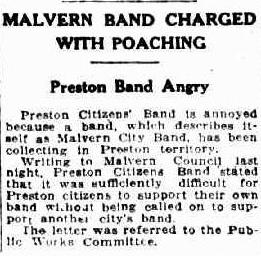
The Preston Citizens’ Band was no less angry with the MCB Collectors and in an article published in The Herald newspaper they clearly outlined their feelings on the matter as can be seen in the article here (“MALVERN BAND CHARGED WITH POACHING,” 1927).

The Herald, 18/10/1927, p. 13

The Malvern Council was put in a difficult position by October of 1927 and its patience with the MCB was wearing thin. A week before the Preston Band outlined their feelings, Malvern City Council placed further restrictions on the MCB by adopting a recommendation from their Parks and Gardens committee.

4. That permission previously given to the Malvern City Brass Band to play in High street gardens and Ardrie Park be withdrawn.

 (“MALVERN PARKS AND GARDENS.,” 1927)

Despite this, complaints from other bands, individuals, and councils continued, with Malvern City Council writing to Kew Council in January 1928 disclaiming any connection with the Malvern City Band (“COLLECTIONS FOR BAND.,” 1928; M., 1928).

Over the next decade, due to the continuing poor business practices of the Malvern City Band and actions of its collectors, the Malvern City Council was forced to repeatedly state that the MCB had nothing to do with the Council – statements and letters published in the newspapers from Malvern Council were quite common.

The Mayor of Malvern (Cr. C. J. Waters) states that the Malvern City Brass Band, on behalf of which collectors have visited many city and country homes, is not recognised or subsidised by the council.  The band is not connected with the Malvern Municipal and Tramways Band.

(“LOITERED NEAR CARS,” 1931)

Mayor Waters also backed up these articles with letters to the newspapers (Waters, 1931).

Clearly the Malvern City Council were unhappy with the MCB, but what else could they do?  The band simply did not respond in good faith.  The MCB’s need for funds overrode any other respects it had for other bands and councils.  The MCB had gone rogue.

If the year 1937 was anything to go by, Malvern City Council had had enough of the MCB, and they took the extraordinary step of writing a letter to every municipality in the State of Victoria.  The letters were sent out in April 1937 and part of the letters had a simple but direct message for the other municipalities.

…that the Malvern City Brass Band is in no way connected with the council, and is not recognised or subsidised by the council in any way.

(“Dandenong Shire Council,” 1937)

These letters were received and noted by councils across Victoria over April and May 1937 – as there were too many articles of council records from late April and May 1937 to cite here, these have been included in the reference list below.

As mentioned in the previous section, after 1939, nothing was to be heard about the Malvern City Band.

The Malvern City Council’s position was understandable, and they had a right to insist on proper business and ethical practice.  Their view that the Malvern Tramways Band was Malvern’s Band was undeniable, and there was no other room for contenders against that view, and obviously no funding.  One might think however, that the Council could have handled things differently.  Other municipalities had multiple bands in their area which they managed to subsidize and handle issues like collectors, but the Malvern Council did not see it that way.  And the fact should be noted that the Malvern Tramways Band did not really need outside collectors as they were funded and supported by the Tramways.

A local newspaper: fuelling the controversy:

On the 21st of January 1927 a letter penned by the Honorary Organiser of the Malvern City Band, Mr. Benjamin Long, was published in the Prahran Telegraph newspaper which took aim at a financial statement released by the Malvern City Council a week beforehand (Long, 1927h).  What he, and the Prahran Telegraph newspaper did not realise at the time, was that this letter would be the first of twenty-four letters sent to this newspaper, plus some to other newspapers, all focused on the dispute between the Council and the band.  It is worthwhile to note that much of the disagreement over the previous years the band had been in operation was conducted privately.  In 1927 from January to May it was all aired to the public with various opinions thrown into the mix.  Out of the twenty-four letters sent to the Prahran Telegraph, Benjamin Long was responsible for writing six of them because he was the kind of person that had to defend his position and that of the MCB (Long, 1927c, 1927d, 1927e, 1927f, 1927g, 1927h).

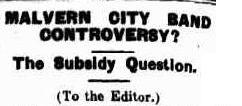
At the time, the Prahran Telegraph newspaper was published weekly with papers being sent out every Thursday.  Which is why the whole thread of these letters span this time frame.  We could equate this with the social media of today, except, instead of discussions being responded to in minutes, hours or days, these letters had replies that appeared a week later.  Some weeks had more letters than others.  The Prahran Telegraph did not really help matters as due to the influx of letters surrounding the band, they started branding them under their own headline so that everyone knew what was being talked about.  The headline, “Malvern City Band Controversy” was first used at the start of a letter penned by ‘Malvern Ratepayer’ on the 18th of February (Malvern Ratepayer, 1927).

Prahran Telegraph, 18/2/1927, p. 4

It has been quite clear through some of this post that the Malvern City Council had problems with the operations of the band, and vice versa.  In part of the first letter written by Mr. Long on the 21st of January, he states,

Now, Sir, there are only two bands in this garden city of the South namely, the Malvern Tramways and our own (the Malvern City), and I wish it to be distinctly understood that we did not receive one penny of the £100 donated by the Council according to its balance sheet; and, further, I would like to state that it is over three years since we received anything from them, when they donated the sum of £25.

(Long, 1927h)

He did, however, make a good point towards the end of the letter comparing levels of support from different Councils.

Why, I see that in last week’s paper, where the Caulfield Council have voted three bands who play in their district (two of which have not even a uniform) sums that amount to nearly £300.  Surely if Malvern is to uphold its name as the Garden City the Malvern Council should take a leaf out of the Caulfield Council’s book and give the Malvern City Band at least a small grain of encouragement.

(Long, 1927h)

This letter sparked several replies and one official response which were published a week later in the 28th of January issue of the newspaper, all under pseudonyms.  Letters from ‘Disgusted’, ‘Mother of Five’ and ‘Old Timer’ were in support of the band while a letter from ‘South Caulfield’ questioned the motives of collectors who were out and about in Caufield supposedly collecting for the MCB (Disgusted, 1927; Mother of Five, 1927; Old Timer, 1927; South Caulfield, 1927).  Buried in amongst these letters was an article which could be assumed was submitted by someone attached to Malvern Council and which refuted many of the claims put forward by Mr. Long.  

The source of the trouble seems to be in a nutshell.  The band, it is understood, finds its main financial support per medium of house to house collections.  It is likewise stated that some time ago, when the band applied to the council for a subsidy, the council expressed a desire to be supplied with a balance-sheet.  The band promised that this would be forthcoming, but so far no balance-sheet has come to hand.  Therefore, the council remains fixed in its determination not to consider the question of granting a subsidy to the band until a balance-sheet comes to light. […] Surely Mr. Long will not deny that the council is entitled to a balance-sheet.  This is generally recognised as standard practice in matters of this kind.

(“The Official View.,” 1927)

Benjamin Long could not let this go without a response and he wrote a very long letter to the Prahran Telegraph newspaper which was published on the 4th of February (Long, 1927c).  In the same issue, another letter written by ‘Caulfield Resident’, claiming to be a member of the MCB, was published in reply to the letter written by ‘South Caulfield’ a week before (Caulfield Resident, 1927).  When responding to the article which stated an ‘official view’, Mr. Long included a letter written to the MCB in 1925 by Mr. B. Crosbie Goold, the then Town Clerk.

Dear Sir,-I have to acknowledge yours of the 23rd inst., forwarding statement of receipts and expenditure for twelve months ended 14th December, 1924, but note that same has not been audited.  I am returning it here with for the auditor’s formal certificate, and would be also glad if you would let me have a list of the office-bearers of the Band, so that same may be submitted to the Committee.

(Crosbie Goold (1925) in Long, 1927c)

As these things often do, the series of letters spiralled out into a series of sub-issues encompassing the operations of the band, financial records, collectors, and some slurs and jealousy dished out to the Malvern Tramways Band.  Not to mention a fair bit of who said whatwhen, and where.  For example, six letters published over March and April were simply replies and rebuttals between two letter writers, Mr. Long and ‘Another Malvern Ratepayer’ (Another Malvern Ratepayer, 1927a, 1927b, 1927c; Long, 1927d, 1927e, 1927f).  And there were still letters being sent in by supporters of the MCB, with one published on the 1st of April being unusual – this person sent it in under his real name (Johnston, 1927).

Additionally, Mr. Long sent three identical letters to The ArgusThe Age, and The Herald newspapers in early April in an attempt to inform the public about the nature and conduct of their collectors, with a snide reference to the Malvern Tramways Band (Long, 1927a, 1927b, 1927i).  The letter that was published in The Argus newspaper can be viewed below.

The Argus, 4/4/1927, p. 21

The Malvern Council could not remain silent for ever on these issues and sought to set the record straight.   Since Mr. Long disputed the official view (published on the 28th of January), it was not until April that Councillor James D. Evans wrote the first of two letters which reinforced and reiterated the view of the Council.

Sir.- Apparently there are still some persons who do not know why the Council refuses to donate to the Malvern City Band.  The official reason was given in your issue of 24-1-27, i.e that the grant had been held back owing to the non-production of an audited balance sheet.

[…]

Mr. Long states that he gave Cr. Francis the books; what really happened was this.  A parcel containing only a number of docket butts was left at his house, and this was afterwards laid on the Council table and opened in the presence of myself and other councillors.  Imagine a bank asking a firm for an audited balance sheet, and receiving a bundle of receipt buts instead.

[…]

I am not so much concerned with the controversy between the Malvern City junior band and the premier band of Australia, but I feel constrained to let the public know facts why the subsidy is withheld.” 

(Evans, 1927a)

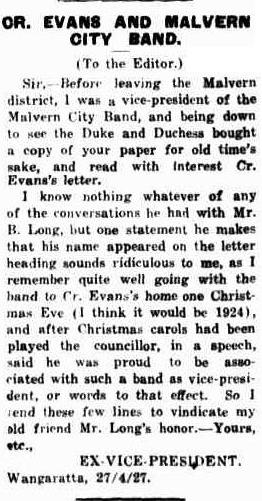
Of course, Mr. Long could not let this letter lie and wrote again to the Prahran Telegraph newspaper on the 29th of April to refute Mr. Evans (Long, 1927g).  Interestingly, Mr. Long’s position was backed up by another letter writer from Wangaratta on the 29th of April who was under the pseudonym of ‘Ex-Vice President’ – and he claimed to have held that position in the MCB (Ex. Vice-President, 1927).  Mr. Evans wrote his second letter on the 6th of May to restate the Council’s and his views on the matter (Evans, 1927b).

Prahran Telegraph, 29/04/1927, p. 5

The last letter of this sorry saga was published on the 13th of May by the MCB Secretary Mr. Joseph Leech, and this was an answer to the last letter from Mr. Evans from the 6th of May (Evans, 1927b; Leech, 1927).  In this letter, Mr. Leech also included a rebuttal to another letter writer from the week before from ‘Above Board’ who had contributed another opinion (Above Board, 1927).  The last part of Mr. Leech’s letter stated that,

In regard to our balance sheet, which is always open for inspection by our supporters, we are preparing another one shortly, which we shall ask you, Mr. Editor, to be good enough to publish in your paper.

(Leech, 1927)

However, at the end of this letter, as was sometimes the case, the Editor of the Prahran Telegraph newspaper added in a small paragraph.

(We shall be pleased to publish an audited balance-sheet.  The whole correspondence has centred round the question of the production of an audited balance-sheet.  With the above letter the correspondence now closes.)

(Prahran Telegraph Editor in Leech, 1927)

So, in effect, the Prahran Telegraph newspaper seemingly ended this “controversy” as they originally called it in the belief that the MCB would supply them with the information that everyone wanted – which never ended up happening.  We see the same thing sometimes in social media when threads are locked.

There was one voice that was conspicuously absent during this exchange of letters, that of the Malvern Tramways Band. One would have thought that they would write to defend their own positions, given that the Malvern City Band was trying to smear their name with a few falsehoods.  The MTB did eventually raise their voice, but not through the local newspaper, and not directly addressing the previous topics of the letters.  In July 1927, Mr. Harry Shugg, then conductor of the MTB wrote a small letter to the Geelong Advertiser newspaper with a basic message for the people of Geelong.

Sir.-I understand that a uniformed collector has been collecting in Geelong during this week on behalf of the Malvern City Band.  I desire to notify the public personally that this collector has no connection with the Malvern Tramways Band of which I am conductor.

(Shugg, 1927)

This was another measure in which the Malvern Tramways Band sought to distance themselves from the activities of the Malvern City Band.  Just over a year later, another letter appeared in the Prahran Telegraph newspaper written by Mr. Charles Snelling, then Honorary Secretary of the Malvern Tramways Band.  He was far more pointed in his language when addressing the fact that there were two bands in Malvern.

Sir.-For the benefit of your readers, and the Councillors of Prahran, I would thank you to allow me to state that there are two bands in the City of Malvern.  People confuse another band with the Malvern Municipal and Tramways Band.  We have no collectors at all, but other collectors are credited to our band.  We frequently are blamed for these people calling on residents of the suburbs and even the country districts.

(Snelling, 1928)

We saw where this was coming from previously in this post given the number of complaints sent to Malvern City Council and the extraordinary steps the Council took in 1937 with their own letter writing to all parts of Victoria.  Mr. Snelling went on in his letter to make some interesting statements, including one that indicates just how favourable the MTB was to the Council.

The Malvern City Council have always treated my band splendidly, and we have no complaints whatever to make.  Hoping that the Prahran residents will not confuse these collectors with my band, and thanking you.

(Snelling, 1928)

Malvern City Council would have no doubt been pleased to read this letter from Mr. Snelling.  The MTB brought prestige upon the name of Malvern through their many successes, and the Council sought to capitalise on that.

Maybe the Malvern City Band did not understand the relationships bands had with each other and the etiquette that was needed.  They certainly did not understand the quid pro quo with Council.  It was a band that did things their way and really, they should have known better.  Yes, other bands in Australia had disagreements with their home councils over funding, halls, performances, and other such issues but for the most part these were resolved amicably and with little loss of respect for each other.  Twenty-four letters to the local newspaper over the space of five months is unprecedented and without comparison.

Conclusion:

It would be fair to say that neither the Malvern City Band, Malvern City Council, or even the Prahran Telegraph newspaper exhibited very good practice through these years.  In short, it was a big mess.  And then there is the question of who to believe, which information is the most correct?  All we must go on is a whole host newspaper articles and correspondence.  When the band was performing, the articles were largely positive.  However, letters to the editor suggested that something was amiss in the way the band did things, especially letters received in Malvern from other municipalities.  So, while the band did its best to present a side that suggested it was supportive of charitable causes, the business practices it engaged in were very questionable when compared to other bands that were operating at the time.  And of course, its jealousy of the Malvern Tramways Band was unwarranted.  The MTB was a very different ensemble and much more established.  Perhaps there was room for two bands in Malvern, but the MCB made life much more difficult for itself.

Malvern City Council was put in a difficult position by the MCB.  However, when compared to the operations of other councils who supported multiple bands in their council areas, one would have thought the Council could have offered much more support than they did beyond permission to play in parks and gardens, and for a band to take collections.  MCB had every right to ask the Council for support, the Council had every right not to give the band money unless the band opened its books.  The year 1927 was a perfect example of when both parties failed in their best practice.  And in the year 1937 when the Malvern council wrote to every other council in Victoria, this was a prudent measure but very heavy handed – although we could argue that the MCB brought that response upon themselves.

It should be seen that the Prahran Telegraph newspaper sought to capitalise on the situation in 1927 and deliberately inflamed tensions.  When receiving letters all on the same topic, branding them under their own headline with the word “Controversy” immediately invited some confrontation, which the newspaper duly received in those letters.  The local media then controlled some of the narrative, and the letter writers and the public were caught up in this.  The Malvern Tramways Band was wise to stay out of this despite being on the receiving end of slurs and false information.  

This case study of the Malvern City Band shows us many aspects about the operations and thoughts of the band, council, and local newspapers.  It is fascinating, but when compared to the histories of other bands, many of which have been explored in other posts, this sorry tale need not have happened in the way it did.  We cannot feel sorry for any of the parties, but we wish it could have been very different for the band and the council.

References:

Above Board. (1927, 06 May). MALVERN CITY BAND CONTROVERSY : RE BALANCE SHEET. : (To the Editor.). Prahran Telegraph (Vic. : 1889 – 1930), 5. http://nla.gov.au/nla.news-article165181080

Admans, G. R., Bowden, J., Davidson, J., & Hall, B. (1917). RICHMOND CITY CONTEST BAND : To the Citizens of Richmond. In Victorian Bands’ League Archive (Ed.), S04 – Letters, Documents & Books (Vol. S4.1 – Letters). Richmond, Victoria.

Alexandra Shire Council. (1937, 21 May). Alexandra and Yea Standard and Yarck, Gobur, Thornton and Acheron Express (Vic. : 1908 – 1949), 2. http://nla.gov.au/nla.news-article64735733

Another Malvern Ratepayer. (1927a, 01 April). MALVERN CITY BAND CONTROVERSY : (To the Editor). Prahran Telegraph (Vic. : 1889 – 1930), 6. http://nla.gov.au/nla.news-article165186163

Another Malvern Ratepayer. (1927b, 04 March). MALVERN CITY BAND CONTROVERSY : (To the Editor). Prahran Telegraph (Vic. : 1889 – 1930), 5. http://nla.gov.au/nla.news-article165178951

Another Malvern Ratepayer. (1927c, 18 March). MALVERN CITY BAND CONTROVERSY : Reply to Mr. Long : (To the Editor). Prahran Telegraph (Vic. : 1889 – 1930), 5. http://nla.gov.au/nla.news-article165179586

AVON SHIRE COUNCIL : MONDAY, MAY 3. (1937, 06 May). Gippsland Times (Vic. : 1861 – 1954), 4. http://nla.gov.au/nla.news-article63017974

BACCHUS MARSH COUNCIL. (1937, 15 May). Bacchus Marsh Express (Vic. : 1866 – 1943), 4. http://nla.gov.au/nla.news-article262571933

BAND COLLECTIONS : Discussion at Malvern : On Sunday Concerts. (1922, 22 December). Prahran Telegraph (Vic. : 1889 – 1930), 7. http://nla.gov.au/nla.news-article165128099

BAND CONCERTS, MALVERN : Sundays not Suitable : Decision in Council. (1924, 22 February). Prahran Telegraph (Vic. : 1889 – 1930), 5. http://nla.gov.au/nla.news-article165094826

BAND CONTESTS : Last Phase of South Street. (1924, 23 October). Herald (Melbourne, Vic. : 1861 – 1954), 26. http://nla.gov.au/nla.news-article244852735

Baritone. (1913). Malvern Tramway Band. The State Band News, 4(7), 14.

Bass Shire Council. (1937, 13 May). Great Southern Advocate (Korumburra, Vic. : 1889 – 1906, 1914 – 1919, 1921 – 1940), 3. http://nla.gov.au/nla.news-article257233935

BENALLA SHIRE COUNCIL : MONTHLY MEETING. (1937, 14 May). North Eastern Ensign (Benalla, Vic. : 1872 – 1938), 4. http://nla.gov.au/nla.news-article70776837

BOGUS COLLECTORS ARE ABOUT : For “Malvern City Band”. (1937, 08 May). Record (Emerald Hill, Vic. : 1881 – 1954), 1. http://nla.gov.au/nla.news-article164480715

Caulfield Resident. (1927, 04 February). BAND COLLECTION’S IN SOUTH CAULFIELD : (To the Editor). Prahran Telegraph (Vic. : 1889 – 1930), 5. http://nla.gov.au/nla.news-article165186978

COLLECTIONS FOR BAND. (1928, 26 January). Argus (Melbourne, Vic. : 1848 – 1957), 10. http://nla.gov.au/nla.news-article3906330

COUNCIL OBJECTS TO BAND’S NAME : Malvern’s Attitude. (1933, 19 October). Herald (Melbourne, Vic. : 1861 – 1954), 22. http://nla.gov.au/nla.news-article243192870

Dandenong Shire Council. (1937, 29 April). Dandenong Journal (Vic. : 1927 – 1954), 3. http://nla.gov.au/nla.news-article200679919

de Korte, J. D. (2020, 21 May). Choosing music and grading bands: The unenviable tasks of band associations and their music advisory boards. Band Blasts from the Past : Anecdotes, Stories and Personalities. https://bandblastsfromthepast.blog/2020/05/21/choosing-music-and-grading-bands-the-unenviable-tasks-of-band-associations-and-their-music-advisory-boards/

Disgusted. (1927, 28 January). MALVERN CITY BRASS BAND : Question of Council Support. : To the Editor. Prahran Telegraph (Vic. : 1889 – 1930), 5. http://nla.gov.au/nla.news-article165187999

EAST MALVERN JUNIOR BAND : Successful Sunday Recital. (1923, 07 September). Prahran Telegraph (Vic. : 1889 – 1930), 7. http://nla.gov.au/nla.news-article165097358

Evans, J. D. (1927a, 14 April). MALVERN CITY BAND CONTROVERSY : Question of Council’s Subsidy. : Cr. Evans Explains : (To the Editor). Prahran Telegraph (Vic. : 1889 – 1930), 5. http://nla.gov.au/nla.news-article165179150

Evans, J. D. (1927b, 06 May). MALVERN CITY BAND CONTROVERSY : RE BALANCE SHEET. : (To the Editor.). Prahran Telegraph (Vic. : 1889 – 1930), 5. http://nla.gov.au/nla.news-article165181093

Ex. Vice-President. (1927, 29 April). MALVERN CITY BAND CONTROVERSY : CR. EVANS AND MALVERN CITY BAND : (To the Editor). Prahran Telegraph (Vic. : 1889 – 1930), 5. http://nla.gov.au/nla.news-article165179381

FRANKSTON AGRICULTURAL ASSN : GYMKHANA POSTPONED. (1939, 20 January). Frankston and Somerville Standard (Vic. : 1921 – 1939), 8. http://nla.gov.au/nla.news-article75009158

FUNDS FOR A PUBLIC PARK. (1924, 08 March). Weekly Times (Melbourne, Vic. : 1869 – 1954), 40. http://nla.gov.au/nla.news-article223860577

Gardiner, L. R. (2006). Stradbroke, third Earl of (1862-1947. In Australian Dictionary of Biography. Retrieved 16 July 2022, from https://adb.anu.edu.au/biography/stradbroke-third-earl-of-8693

Gregory, A. (2006). Somers, Arthur, Herbert, Tenyson (1887-1944). In Australian Dictionary of Biography. Retrieved 16 July 2022, from https://adb.anu.edu.au/biography/somers-arthur-herbert-tennyson-8578

Healesville Shire Council : MONTHLY MEETING. (1937, 01 May). Healesville and Yarra Glen Guardian (Vic. : 1900 – 1942), 1. http://nla.gov.au/nla.news-article60455094

Heritage Council Victoria. (2022). Stonnington (679) Victorian Heritage Database. https://vhd.heritagecouncil.vic.gov.au/places/679

ITEMS OF INTEREST. (1926, 21 July). Argus (Melbourne, Vic. : 1848 – 1957), 15. http://nla.gov.au/nla.news-article3796939 

Johnston, B. L. (1927, 01 April). MALVERN CITY BAND CONTROVERSY : (To the Editor). Prahran Telegraph (Vic. : 1889 – 1930), 6. http://nla.gov.au/nla.news-article165186163

Lawson-Black, P. (2010). Bold as brass : the story of Stonnington City Brass then and now. Pat Lawson Black, Stonnington City Brass. 

Leech, J. (1927, 13 May). MALVERN CITY BAND CONTROVERSY : Secretary Leech’s Views. : (To the Editor). Prahran Telegraph (Vic. : 1889 – 1930), 5. http://nla.gov.au/nla.news-article165179688

Livingstone Muntz, D. (1912, 19 December). CHURCH PARADE AT MALVERN.—TRAMWAYS BAND HEADING PROCESSION. OPPOSITE THE TOWN HALL. Punch (Melbourne, Vic. : 1900 – 1918; 1925), 53. http://nla.gov.au/nla.news-article175804920

LOITERED NEAR CARS : Three Men Imprisoned. (1931, 03 August). Herald (Melbourne, Vic. : 1861 – 1954), 13. http://nla.gov.au/nla.news-article242968024

Long, B. (1927a, 07 April). BAND COLLECTORS. Herald (Melbourne, Vic. : 1861 – 1954), 8. http://nla.gov.au/nla.news-article243921359

Long, B. (1927b, 04 April). MALVERN BAND COLLECTORS : TO THE EDITOR OF THE ARGUS. Argus (Melbourne, Vic. : 1848 – 1957), 21. http://nla.gov.au/nla.news-article3847236

Long, B. (1927c, 04 February). MALVERN CITY BAND : Question of Council’s Subsidy : Mr. Long and Bands’ Balance Sheet. : (To the Editor). Prahran Telegraph (Vic. : 1889 – 1930), 5. http://nla.gov.au/nla.news-article165186979

Long, B. (1927d, 25 March). MALVERN CITY BAND CONTROVERSY : Mr. Long Continues the Battle : (To the Editor.). Prahran Telegraph (Vic. : 1889 – 1930), 5. http://nla.gov.au/nla.news-article165178512

Long, B. (1927e, 08 April). MALVERN CITY BAND CONTROVERSY : Mr. Long Hits Out Again : (To the Editor). Prahran Telegraph (Vic. : 1889 – 1930), 4. http://nla.gov.au/nla.news-article165181527

Long, B. (1927f, 11 March). MALVERN CITY BAND CONTROVERSY : Mr. Long Returns to the Charge. : (To the Editor.). Prahran Telegraph (Vic. : 1889 – 1930), 3. http://nla.gov.au/nla.news-article165186626

Long, B. (1927g, 29 April). MALVERN CITY BAND CONTROVERSY : The Allegations by Cr. Evans. : Emphatic Denials by Mr. Benjamin Long : (To the Editor). Prahran Telegraph (Vic. : 1889 – 1930), 5. http://nla.gov.au/nla.news-article165179380

Long, B. (1927h, 21 January). MALVERN CITY BRASS BAND : Question of Council Support : (To the Editor). Prahran Telegraph (Vic. : 1889 – 1930), 5. http://nla.gov.au/nla.news-article165187301

Long, B. (1927i, 06 April). RE MALVERN BAND COLLECTORS : TO THE EDITOR OF THE AGE. Age (Melbourne, Vic. : 1854 – 1954), 15. http://nla.gov.au/nla.news-article205807873

M., H. (1928, 14 April). COLLECTORS FOR BAND : TO THE EDITOR OF THE ARGUS. Argus (Melbourne, Vic. : 1848 – 1957), 24. http://nla.gov.au/nla.news-article3924852

Malvern : Proclaimed a Town By the Lieut.-Govenor Sir John Madden : WEDNESDAY, 24th APRIL, 1901. (1901, 02 May). Punch (Melbourne, Vic. : 1900 – 1918; 1925), 22. http://nla.gov.au/nla.news-article175386859

Malvern & Caulfield East Juvenile Brass Band. (1922). [Photograph]. [phot11449]. The Internet Bandsman Everything Within, Vintage Brass Band Pictures – Australia. http://www.ibew.org.uk/vbbp-oz.html

MALVERN BAND. (1924, 19 September). Prahran Telegraph (Vic. : 1889 – 1930), 3. http://nla.gov.au/nla.news-article165096639

MALVERN BAND CHARGED WITH POACHING : Preston Band Angry. (1927, 18 October). Herald (Melbourne, Vic. : 1861 – 1954), 13. http://nla.gov.au/nla.news-article243936496

MALVERN CITY BAND : NOT A MUNICIPAL BODY. (1937, 21 May). Frankston and Somerville Standard (Vic. : 1921 – 1939), 4. http://nla.gov.au/nla.news-article75003337

THE MALVERN CITY BAND : Sunday Trip to Queenscliff. (1927, 25 March). Prahran Telegraph (Vic. : 1889 – 1930), 5. http://nla.gov.au/nla.news-article165178520

Malvern City Brass Band. (1924). The Malvern City Brass Band Monster Bazaar. In Malvern Collections (Textual material; Graphic materials ed., Vol. MP571701). Malvern, Victoria: Stonnington Library + Information Service: Stonnington History Centre.

MALVERN CITY BRASS BAND : A Two-Days’ Bazaar. (1924, 10 October). Prahran Telegraph (Vic. : 1889 – 1930), 2. http://nla.gov.au/nla.news-article165094429

MALVERN JUNIOR BRASS BAND. (1924, 01 February). Prahran Telegraph (Vic. : 1889 – 1930), 5. http://nla.gov.au/nla.news-article165095540

MALVERN JUVENILE BAND : Players’ Opportunity. (1922, 18 August). Prahran Telegraph (Vic. : 1889 – 1930), 3. http://nla.gov.au/nla.news-article165125247

MALVERN PARKS AND GARDENS. (1927, 07 October). Prahran Telegraph (Vic. : 1889 – 1930), 5. http://nla.gov.au/nla.news-article165185006

Malvern Parks and Gardens : COMMITTEE’S REPORT. (1925, 13 February). Prahran Telegraph (Vic. : 1889 – 1930), 5. http://nla.gov.au/nla.news-article165132417

Malvern Ratepayer. (1927, 18 February). MALVERN CITY BAND CONTROVERSY? : The Subsidy Question. : (To the Editor). Prahran Telegraph (Vic. : 1889 – 1930), 4. http://nla.gov.au/nla.news-article165180131

Malvern Town Band : Inaugural Meeting. (1907, 09 February). Malvern Standard (Vic. : 1906 – 1931), 3. http://nla.gov.au/nla.news-article66379770

MELTON SHIRE COUNCIL. (1937, 01 May). Melton Express (Vic. : 1915 – 1943), 4. http://nla.gov.au/nla.news-article254746402

MODERN MALVERN : Proclamation as a City : Two Days’ Rejoicing. (1911, 27 May). Prahran Telegraph (Vic. : 1889 – 1930), 5. http://nla.gov.au/nla.news-article165104223

Mother of Five. (1927, 28 January). MALVERN CITY BRASS BAND : Question of Council Support. : To the Editor. Prahran Telegraph (Vic. : 1889 – 1930), 5. http://nla.gov.au/nla.news-article165187998

Mulgrave Council : THURSDAY, APRIL 29. (1937, 06 May). Dandenong Journal (Vic. : 1927 – 1954), 8. http://nla.gov.au/nla.news-article200680019

NARRACAN SHIRE COUNCIL. (1937, 14 May). Narracan Shire Advocate and Yallourn Brown Coal Mine, Walhalla and Thorpdale Lines Echo (Moe, Vic. : 1923 – 1943), 1. http://nla.gov.au/nla.news-article264532371

THE NEWS OF THE WEEK : RETURN OF VICTORIA’S GOVENOR : WELCOME TO LORD AND LADY STRADBROKE. (1923, 27 October). Weekly Times (Melbourne, Vic. : 1869 – 1954), 5. http://nla.gov.au/nla.news-article223834954

Not Malvern City’s Brass Band. (1937, 07 April). Herald (Melbourne, Vic. : 1861 – 1954), 14. http://nla.gov.au/nla.news-article244642861

The Official View. (1927, 28 January). Prahran Telegraph (Vic. : 1889 – 1930), 5. http://nla.gov.au/nla.news-article165188000

Old Timer. (1927, 28 January). MALVERN CITY BRASS BAND : Question of Council Support. : To the Editor. Prahran Telegraph (Vic. : 1889 – 1930), 5. http://nla.gov.au/nla.news-article165187957

OUTSIDE BAND COLLECTORS IN CAULFIELD : Council Powerless to Act. (1927, 19 August). Prahran Telegraph (Vic. : 1889 – 1930), 5. http://nla.gov.au/nla.news-article165184889

Portland Shire Council. (1937, 17 May). Portland Guardian (Vic. : 1876 – 1953), 3. http://nla.gov.au/nla.news-article64275813

THE PROGRAMME : TO-MORROW’S PLANS : PROCESSION AND SERVICE. (1926, 24 April). Age (Melbourne, Vic. : 1854 – 1954), 15. http://nla.gov.au/nla.news-article201640199

Royal South Street Society. (1924). 1924-10-25 Brass Band Contests : Held at City Oval [Eisteddfod Results]. Royal South Street Society Results Database. https://results.royalsouthstreet.com.au/results/1924-10-25-brass-band-contests 

Rupanyup Brass Band. (1914, 09 July). Rupanyup Spectator and Lubeck, Banyena, Rich Avon and Lallat Advertiser (Vic. : 1914 – 1918), 5. http://nla.gov.au/nla.news-article121056539

Scout Display at Exhibition. (1929, 03 October). Table Talk (Melbourne, Vic. : 1885 – 1939), 9. http://nla.gov.au/nla.news-article146713600

Shire Council Promptly Despatches Business : Walpeup Councillors Make Important Decisions : HELP FOR OUYEN BATHS AND RECREATION OVAL SCHEMES : . (1937, 12 May). Ouyen Mail (Vic. : 1915 – 1918, 1931 – 1941), 6. http://nla.gov.au/nla.news-article255689463

Shugg, H. (1927, 27 July). LETTERS TO THE EDITOR : TWO MALVERN BANDS. Geelong Advertiser (Vic. : 1859 – 1929), 8. http://nla.gov.au/nla.news-article232396710

Snelling, C. (1928, 24 August). MALVERN TRAMWAYS BAND : A Reminder. (To the Editor.). Prahran Telegraph (Vic. : 1889 – 1930), 7. http://nla.gov.au/nla.news-article165010626

South Caulfield. (1927, 28 January). BRASS BANDS’ BLARE : To the Editor. Prahran Telegraph (Vic. : 1889 – 1930), 5. http://nla.gov.au/nla.news-article165188001

South Richmond Brass Band. (1921, 04 June). Richmond Guardian (Vic. : 1884 – 1885; 1894 – 1895; 1902 – 1928), 2. http://nla.gov.au/nla.news-article264270060

“THE TIMES.” : THURSDAY, APRIL 22, 1937. (1937, 22 April). Gippsland Times (Vic. : 1861 – 1954), 8. http://nla.gov.au/nla.news-article63017711

‘WARE OUTSIDE BAND COLLECTORS. (1937, 07 May). Sunshine Advocate (Vic. : 1924 – 1954), 2. http://nla.gov.au/nla.news-article75197039

Waters, C. J. (1931, 31 July). BAND COLLECTIONS. Argus (Melbourne, Vic. : 1848 – 1957), 5. http://nla.gov.au/nla.news-article4404518

Werribee Shire Council : THURSDAY, 13th MAY, 1937. (1937, 20 May). Werribee Shire Banner (Vic. : 1911 – 1952), 1. http://nla.gov.au/nla.news-article74713584

Legitimate quirks of instrumentation: The inclusion of woodwinds in brass bands

19000000_Malvern-Tradesmen-Military-Band_phot11448
Malvern Town Military Band, approx. 1900. (Source: IBEW)

Introduction:

Cornets, Flugel Horns, Tenor Horns, Baritones, Euphoniums, Trombones, Tubas and Percussion.  This standard of instrumentation for a brass band has been in place for a good number of years.  Yet before this standard was settled upon, there was an amount of time where the range of instruments was less distinguishable, or available.  The brass band as we know it today is the result of years of evolution with the result being a largely homogenous sound across the ranges.  Composers and arrangers also moved with the time, and we can see this in the sheet music.

This post will touch on one of the quirks of instrumentation in earlier brass bands, the use of woodwinds such as Clarinets and Saxophones, and even the odd Piccolo.  For the best part of forty years, some Australian brass bands included woodwind musicians amongst their personnel and allowances were made at some competitions, including the famous South Street.  This did not mean that there was widespread usage or acceptance of woodwinds in the brass bands.  However, there is evidence that some bands used them right up into the 1920s.

Tied into this is the naming of bands.  With the inclusion of woodwinds, some bands were still nominally called brass bands, but others were more inventive with names.  Some bands were sitting on the border of being brass or military in their instrumentation, as we can see with the photo of the Malvern Town Military Band above.

Nowadays the distinction between brass, military, and symphonic bands (concert bands) is much clearer cut.  The earlier times was when the boundaries were pushed.

Names and Instrumentation:

A brass band usually means that it is wholly comprised of brass instruments, and then when it included Clarinets, Saxophones, and Piccolos it was still called a brass band.  Such was the discrepancy in the names of early bands, a discrepancy that would cause confusion in the minds of modern musicians – today, names of bands generally indicate what kind of instrumentation they include.

The inclusion of Clarinets in a brass band was one of those holdovers from English brass bands.  Arnold Myers (2000), writing in a chapter titled Instruments and Instrumentation of British Brass Bands, explains that,

Often clarinets were used in what were otherwise all-brass groups, a usage which continued throughout the nineteenth century and into the twentieth, though not in major contests from the 1870s.  The presence of clarinets did not alter the essential nature of the brass band: they replaced one or more Bb cornets, or were used to provide brightness in the upper register in the role usually played by the soprano cornet.

(p. 156)

In Australia, trends of instrumentation in brass bands tended to start and end much later than in the UK.  We know that brass bands held a prominent part in many towns, communities and industries across Australia.  We also know that various military bands, bands comprised of a more substantial variety of woodwind instruments, brass and percussion, had been a part of musical life since the early days of the colony.  Although, at times, they needed special explanation, as shown in an article published in the Geelong Advertiser in 1911 (Blakiston, 1911).  Mason (2013) in his thesis, tells us that “military bands provided music military and state functions, as well as performing for the general public and servicing as a source of musicians for cities’ orchestras and other ensembles.” (p. 81).  In their own way, the military bands have their own important history.  The early military bands served as a precursor to the many Defence Force Bands, school concert bands, community concert bands and symphonic bands that fill the musical landscape today (Mason, 2013).

Aside from the number of woodwinds, some commentators attempted to call out the brass bands which included clarinets for trying to be something they were not.  One interesting article was published in the Bairnsdale (Vic.) based Every Week newspaper in May 1918.  Titled “Clarinets in the Brass Band”, the writer used the premise that just because some brass bands included Clarinets (or other woodwinds) in their instrumentation, did not automatically make them a military band – and that they should not attempt to play military band music or arrangements.

Bands which have few clarionets or even bands which have a goodly number of clarionets, but no other reed instruments, make a big mistake when they consider themselves “military bands” and aim to play military band arrangements.  They are really brass bands plus clarionets – a thing very far removed from a military band.

(“CLARINETS IN THE BRASS BAND.,” 1918)

Excusing the seemingly blunt language, the writer was correct.  Brass bands that included Clarinets and Saxophones in their line-up were still nominally brass bands, they were not military bands.  Still, the naming of bands is interesting.  Below is a picture of the North Hobart Concert Band taken in 1917.  We can see in the picture that four of the members have Clarinets and one member a Soprano Saxophone.  They also include all of the instruments that comprise a brass band.  If we were to apply the modern name and meaning of a concert band, we would assume it to have a full section of woodwinds.  However, in these early days, this was not the case.  On a side note, we can see that the Bandmaster is one of the members holding a Clarinet.  The Bandmaster in this photo, a Mr. A. W. Caddie, was appointed Bandmaster of the North Hobart Concert Band in 1916 after leading the Zeehan Military Band for a number of years (“NORTH HOBART BAND.,” 1916).  Mr. Caddie was a Clarionetist of some renown and won the Clarionet section at the Royal South Street brass solo competitions in 1912 (Trombone, 1912).

19170000_North-Hobart-Concert-Band_phot3458
North Hobart Concert Band, 1917 (Source: IBEW)

Through this short discussion on instrumentation and naming, it is established that Clarinets and Saxophones existed in brass bands for several years and were accepted as such.  It was up to the music publishers to cater for them as well.

Sheet music:

The other side of including limited woodwinds in brass bands is of course the sheet music.  Brass bands that included limited woodwinds may not have had the instrumentation to play arrangements of military music, but they were able to play brass band music with added Clarinet parts – of which the writer of the article in Every Week pointed out (“CLARINETS IN THE BRASS BAND.,” 1918).  Given that the instruments in brass bands are predominantly keyed in Bb or Eb, it was easy enough to create parts for Clarinets and Saxophones as well.  Piccolos used in bands in those days were mostly keyed in Db or Eb which was different.  Parts were included with some editions of music, but this was not always the case.  It is easier to make a comparison between Clarinet and Cornet parts.

Below are two parts of the 1904 march “South Street” by Hall King (edited by T. E. Bulch).  Here we can see clearly that the Clarinet part neatly doubles the Solo Cornet, in parts up the octave (King, 1904a, 1904b).  The range of the Clarinet obviously makes this easy to do, and musically this would make sense. These Clarinet parts would be taken up by an Eb Soprano Cornet in todays brass bands.

19040000_Suttons_South-Street-CL1
(Source: Victorian Bands’ League Library & Archive)
19040000_Suttons_South-Street-SoloC
(Source: Victorian Bands’ League Library & Archive)

Most of the brass band music that was printed in these times originated from large publishing houses in the form of journals, the parts above being published by Suttons Proprietary Limited.  Here we see that this journal of brass band music included parts for Reeds, so obviously Clarinets, and possibly Saxophones, were catered for.  Suttons was not the only Australian music publishing company that included parts for Clarinets in their journals of music.  The two march cards below of the marches “Artillery” by Alex Lithgow and “Newtown” by T. E. Bulch were published by Allans & Co. (Bulch, 1901; Lithgow, n.d.).

00000000_Allans_Artillery_2CL
(Source: Victorian Bands’ League Library & Archive)
19010000_Allans_Newtown_2CL
(Source: Victorian Bands’ League Library & Archive)

Obviously, the publishing companies found there was a market for Clarinet, Saxophone and Piccolo parts and composers would have been encouraged to include these parts in their compositions – although, given the similarities in keys, maybe this was up to arrangers.  After having some discussion with Dr. Richard Mason on this topic, extra money for publishers and composers to produce Clarinet parts was assumed (Mason, 2020).  Possibly the real reasons cannot be found, however, the production of specific music to cater for extra instruments added some legitimacy to woodwinds being included in brass bands.

Brass bands with woodwinds:

19060000_Wunghnu-Brass-Band_phot14255
Wunghu Brass Band, 1906 (Source: IBEW)

As mentioned in the opening of this post, Clarinets and other woodwinds were part of brass bands in Australia for around forty years.  We can find some evidence of this from early newspaper articles.  It is claimed that Saxophones were added to brass bands in Australia as early as 1890, although, as mentioned in the linked article, this was a matter of conjecture (“The Saxophone,” 1934).  Other bands were more forthcoming over what they had in their band.  In August 1893, an article regarding the early history of the Dandenong Brass Band was published in the South Bourke and Mornington Journal. It seems that when the Dandenong Brass Band was formed in 1885, it comprised of ten members; three Cornets, two Piccolos, two Tenors, one Baritone and one Clarionet (using this unique spelling) (“DANDENONG BRASS BAND.,” 1893).  Likewise, in 1899, a public meeting was held in Tallangatta with the aim of (re)forming a brass band.  Several participants in the meeting spoke in support, one of them was a Mr A. J. Fortescue,

…speaking as a member, observed that the old band had died through want of proper management and lack of public interest.  If formed on proper lines, with a good committee, he thought a band would prosper there.  There were sufficient of the old brass instruments on hand for a start, but there would be some repairs needed.  There would be wanted a piccolo and two drums.  In reply to a question from the chairman, he stated that with a sum of £20 they could make a fairly good start.

(“BRASS BAND FOR TALLANGATTA.,” 1899)

In January 1904 the Linton Brass Band held their annual general meeting, and they were another brass band that boasted a piccolo in their instrumentation.

The band has a stock consisting of one big drum, one side drum, three B flat cornets, two B flat Euphoniums, one E flat bass, one E flat piccolo.

(“LINTON BRASS BAND,” 1904)

These were brass bands in their early years.  Yet twenty years later, as can be seen in the list of musicians in the Wagga Wagga Concert Band (below), a Clarinet was part of the ensemble (“WAGGA CONCERT BAND.,” 1921).  And in 1926 the Gnowangerup District Brass Band from Western Australia was proud to announce that they had added a new Clarionet to the band (“Gnowangerup District Brass Band.,” 1926).

19210303_Young-Witness_Wagga-CB_Clarionet
Young Witness, 03/03/1921, p. 2

There are of course numerous other examples of woodwind instruments appearing in early brass bands of which the above mentioned are a small number of instances.

Competitions:

When in competition, the woodwinds of brass bands were mostly treated the same as any other brass instrument, and they also received the same criticism as well.  There are some examples of woodwinds being mentioned in competition, although this was mainly related to Clarinets and Saxophones.  Even the famous Royal South Street competitions had sections for Clarinets and at times Saxophones over the course of a decade.

The year is 1899 and in September, Northcott’s Bendigo City Brass Band, conducted by Mr. O. Flight, had travelled to Echuca to take part in a small regional competition adjudicated by the famous Mr. E. Code.  The article here details the adjudication of their program and at one point both the Clarinet and Piccolo were mentioned:

Largo – Clarionet and cornets not in tune ; cornet has good taste ; accompaniments too loud ; cornet not clean at bar 17 ; piccolo a little out of tune at bars 18 and 19 ; bass too loud at bar 20.

(“NORTHCOTT’S BENDIGO CITY BRASS BAND.,” 1899)

Regarding South Street, they added another layer of legitimacy by having sections specifically for woodwinds included in the brass solo competitions.  As can be seen in the lists of entries (which can be acccessed from the links), the Clarinet & Saxophone sections attracted musicians from all over Australia.  Below is a list of competitions held over ten years (with some gaps), with the woodwind instruments that were included each year:

(Royal South Street Society, 1906, 1907, 1908, 1910, 1911, 1914, 1915, 1916)

Unfortunately, there are some gaps in the list due to lack of data however, it is known that a brass solo competition was held in 1912 which included a Clarionet section (Trombone, 1912).

As well as the records from Royal South Street, we also have articles in newspapers that provide the adjudication of Clarinettists.  This article published in the Ballarat Star (below) in October 1915 is a prime example of an adjudication.  The adjudicator of this section was the famous Albert Wade (“SOUTH STREET COMPETITIONS.,” 1915).

19151022_Ballarat-Star_Wade-Clarionet
Ballarat Star, 22/10/1915, p. 6

What of the Saxophonists?  It is seen in the Royal South Street lists that Saxophones were only able to compete in sections for four years.  However, other opportunities for them to integrate with bands were limited to military bands.  That does not mean they were completely forgotten.  In a forward thinking move, Saxophones were provided their own section in a “novelty” event at the Interstate Band Contest in Perth, February 1931 (“SAXOPHONE COMPETITION,” 1931).  The reasoning was understandable at the time.

Hitherto the saxophone has not been considered to be a true brass band instrument, and therefore ineligible for registration under the W.A. Band Association contest rules.  The contest committee, however, obtained permission from the association to include the competition in its program, and fourteen entries have been received.  There are a number of capable executants among the entrants, and as the choice of the solo is left to the competitor, a varied range of saxophone music may be reasonably anticipated.

(“SAXOPHONE COMPETITION,” 1931)

The recognition by competition societies that woodwinds had a place in their own sections was well-meaning and forward thinking.  While they were brass band centric, all instruments of the brass band were included, even if they were not strictly brass.

Conclusion:

19100000_Brisbane-Concert-Band_phot8024
Brisbane Concert Band, 1910 (Source: IBEW)

The thought of woodwinds in brass bands would probably raise the eyebrows of many brass band purists. Yet, like many other stories of the brass band world, it is one that is worth exploring, if only for the novelty.  One wonders how these early brass bands would have sounded with limited woodwinds playing similar parts.  The history and sheet music tell us that woodwinds existed in brass bands.  As do some of the pictures, like the Brisbane Concert Band above.

References:

Blakiston, C. (1911, 22 April). A MILITARY BAND : How it is made up. Geelong Advertiser (Vic. : 1859 – 1929), 7. http://nla.gov.au/nla.news-article149205289

BRASS BAND FOR TALLANGATTA. (1899, 18 February). Ovens and Murray Advertiser (Beechworth, Vic. : 1855 – 1918), 9. http://nla.gov.au/nla.news-article199465362

Bulch, T. E. (1901). “Newtown” (2nd Clarionet Bb) : (Dedicated to Thos. Mellor Esq. Bandmaster). [March Card]. Allans & Co. 

CLARINETS IN THE BRASS BAND. (1918, 09 May). Every Week (Bairnsdale, Vic. : 1914 – 1918), 3. http://nla.gov.au/nla.news-article153439388

Colouhoun, J. (1900). Malvern Town Military Band [Photograph]. [phot11448]. The Internet Bandsman Everything Within, Vintage Brass Band Pictures : Australia. http://www.ibew.org.uk/vbbp-oz.html

DANDENONG BRASS BAND. (1893, 02 August). South Bourke and Mornington Journal (Richmond, Vic. : 1877 – 1920; 1926 – 1927), 2. http://nla.gov.au/nla.news-article70015776

Gnowangerup District Brass Band. (1926, 10 July). Gnowangerup Star and Tambellup-Ongerup Gazette (WA : 1915 – 1944), 3. http://nla.gov.au/nla.news-article158909246

King, H. (1904a). “South Street” (1st Clarionet). [March Card]. Suttons Proprietary Limited. 

King, H. (1904b). “South Street” (Solo Cornet). [March Card]. Suttons Proprietary Limited. 

LINTON BRASS BAND. (1904, 13 January). Ballarat Star (Vic. : 1865 – 1924), 4. http://nla.gov.au/nla.news-article210140838

Lithgow, A. F. (n.d.). “Artillery” (2nd Clarionet). [March Card]. Allans & Co. 

Mason, R. W. (2013). The clarinet and its protagonists in the Australian New Music milieu from 1972 to 2007 (Publication Number 38294) [PhD, The University of Melbourne, Faculty of VCA & MCM, Melbourne Conservatorium of Music]. Minerva Access. Melbourne, Victoria. http://hdl.handle.net/11343/38294

Mason, R. W. (2020, 14 June). Phone call with Dr Richard Mason regarding the use of Clarinets in brass bands [Interview]. 

Myers, A. (2000). Instruments and Instrumentation of British Brass Bands. In T. Herbert (Ed.), The British brass band : a musical and social history (pp. 155-186). Clarendon Press ; New York : Oxford University Press. 

NORTH HOBART BAND : New Bandmaster Welcomed. (1916, 05 September). Daily Post (Hobart, Tas. : 1908 – 1918), p. 3. Retrieved from http://nla.gov.au/nla.news-article191143234

NORTH HOBART BAND : New Bandmaster Welcomed. (1916, 05 September). Daily Post (Hobart, Tas. : 1908 – 1918), 3. http://nla.gov.au/nla.news-article191143234

NORTHCOTT’S BENDIGO CITY BRASS BAND : Conductor – Mr O. Flight. (1899, 22 September). Riverine Herald (Echuca, Vic. : Moama, NSW : 1869 – 1954; 1998 – 2002),2. http://nla.gov.au/nla.news-article115017023

Royal South Street Society. (1906, 30 October). 1906-10-30 Brass Solo Contests. Royal South Street Society. Retrieved 26 August 2019 from https://results.royalsouthstreet.com.au/results/1906-10-30-brass-solo-contests

Royal South Street Society. (1907, 22 October). 1907-10-22 Brass Section. Royal South Street Society. Retrieved 11 June 2020 from https://results.royalsouthstreet.com.au/results/1907-10-22-brass-section

Royal South Street Society. (1908, 20 October). 1908-10-20 Brass Solo Contests. Royal South Street Society. Retrieved 11 June 2020 from https://results.royalsouthstreet.com.au/results/1908-10-20-brass-solo-contests

Royal South Street Society. (1910, 18 October). 1910-10-18 Brass Solo Contests. Royal South Street Society. Retrieved 20 July 2019 from https://results.royalsouthstreet.com.au/results/1910-10-18-brass-band-contests

Royal South Street Society. (1911, 24 October). 1911-10-24 Brass Band Solos. Royal South Street Society. Retrieved 11 June 2020 from https://results.royalsouthstreet.com.au/results/1911-10-24-brass-band-solos

Royal South Street Society. (1914, 20 October). 1914-10-20 Brass Solo Contests. Royal South Street Society. Retrieved 11 June 2020 from https://results.royalsouthstreet.com.au/results/1914-10-20-brass-solo-contests

Royal South Street Society. (1915, 21 October). 1915-10-21 Brass Solo Contests. Royal South Street Society. Retrieved 11 June 2020 from https://results.royalsouthstreet.com.au/results/1915-10-21-brass-solo-contests

Royal South Street Society. (1916, 30 October). 1916-10-30 Brass Solo Contests. Royal South Street Society. Retrieved 11 June 2020 from https://results.royalsouthstreet.com.au/results/1916-10-30-brass-solo-contests

The Saxophone : Who Brought it to Australia. (1934, 06 January). Voice (Hobart, Tas. : 1931 – 1953), 2. http://nla.gov.au/nla.news-article218832762

SAXOPHONE COMPETITION : Interstate Band Contest. (1931, 02 January). Daily News (Perth, WA : 1882 – 1950), 4. http://nla.gov.au/nla.news-article83492508

SOUTH STREET COMPETITIONS : Brass Section Continued : Mr A. Wade, Adjudicator : Clarionet Solo. (1915, 22 October). Ballarat Star (Vic. : 1865 – 1924), 6. http://nla.gov.au/nla.news-article154562484

Trombone. (1912, 29 October). BANDS AND BANDSMEN. Daily Post (Hobart, Tas. : 1908 – 1918), 3. http://nla.gov.au/nla.news-article189103747

WAGGA CONCERT BAND. (1921, 03 March). Young Witness (NSW : 1915 – 1923), 2. http://nla.gov.au/nla.news-article113606153

Wunghnu Brass Band. (1906). [Photograph]. [phot14255]. The Internet Bandsman Everything Within, Vintage Brass Band Pictures : Australia. http://www.ibew.org.uk/vbbp-oz.html

Choosing music and grading bands: The unenviable tasks of band associations and their music advisory boards

Introduction:

Administering band associations was, and is even now, never an easy task.  Granted, the first focus of early band associations was managing the affiliations of member bands, forming rules and running competitions.  These tasks aside, there was little else they did.  In this arcane and insular world of administration, decisions that the early band associations made were at times difficult to understand and criticism was rife.  It can be seen in previous posts on the history of the National Band Council of Australia and the experiences of bands in South Street just how peculiar some administrative decisions could be.  In their defence however, we can also see that the associations were acting on the information that they had available at the time, and that some questionable decisions can simply be attributed to a lack of communication.

This post is focusing on aspects of band administration where the difficult decisions of band grading and choices of music were made by sub-committees known as Music Advisory Boards.  These noted groups of bands people, often adjudicators and conductors, made recommendations to band associations.  While some records are not as informative as they could be, the Trove archive gives us some clues as to how they operated.

It is an interesting portion of band history where some bands people desired more of a focus on the music but recognized the value of association.  Balancing these two ideals was a challenge!

Music Advisory Boards and Choosing music:

19330706-(19330714)_VBL-AGM-P1
A section of the Victorian Bands’ League Annual Report 1933, p. 1 ( Source: Victorian Collections: Victorian Bands’ League)
19200814_Herald_J-Booth-Gore
Herald, 14/08/1920, p. 16

Above is part of the first page of an annual report presented by the Victorian Bands’ League at their second Annual General Meeting on 14th July 1933.  Prominently displayed on this first page are all the officers of the League; Delegates, Administrators, Conductors and Adjudicators, representing country, regional and metropolitan areas.  A good mix of people at the time to run the fledging League!  There is one group of musicians listed on this page that warrants special mention and is nominally the focus of this post – the Music Advisory Board.

It was not always possible to discern why the Music Advisory Boards existed in the first place.  Through research in the Trove archives, it was mentioned that they did exist, but their exact purpose in assisting the Associations was harder to find – however their contemporary counterparts operate in much the same way so we can apply this knowledge back over the years.

This post is not trying to dismiss the operations of other State band associations and their MAB’s.  However, the Victorian Bands’ Association and Victorian Bands’ League provided the most information through newspaper articles as to who was included in their MAB’s over the years.  Which means it presents a perfect case study of how the personnel changed (or did not change) over the years.  Below is a table detailing the members of the Victorian MAB over a time period of thirteen years.  Knowing Victorian band history, we can see that these musicians were all eminent conductors/adjudicators who displayed an extensive knowledge of brass band repertoire.  And they were all conductors of Victorian A Grade bands.

1920 – VBL1922 – VBA1927 – VBA1933 – VBL
P. CodeJ. Booth-GoreP. CodeJ. Bowden
P. JonesL. HoffmanF. C. JohnstonJ. Booth-Gore
H. R. ShuggF. C. JohnstonP. JonesF. C. Johnston
 P. JonesR. McCaskillA. H. Paxton
 H. NivenH. R. ShuggH. R. Shugg
 H. R. Shugg  
(Source of table data: “BAND ADJUDICATOR,” 1920; “BRASS BANDS REGRADED.,” 1927; Drummer Boy, 1922; “VICTORIAN BAND ASSOCIATION,” 1920; Victorian Bands’ League, 1933)
19200807_Herald_J-Bowden
Herald, 7/08/1920, p. 17

What is obvious here is the consistency of some of the appointments namely Percy Code, Percy Jones, Frank “Massa” Johnston, and Harry Shugg.  Some pictures of these bandsmen are on the side of this post.  We could assume that with the passage of time, if the same people were well-regarded in that role then they would continue to serve.  The interesting fact about the Victorian MAB members is that they carried through the changeover from the VBA to the VBL.  On a side note, given that many of these conductors were working with metropolitan bands at the time they would have been the instigators of the VBL in the early 1930s.

There were some occasions regarding band competitions where MAB’s were not involved in choosing music.  We can see articles published in the Advocate newspaper in 1921 and 1927 that Percy Jones was the adjudicator of the popular New Year’s Day Burnie carnival band competition (“BURNIE.,” 1927; “BURNIE CARNIVAL.,” 1921).   However, it is in the 1927 article where we can see that Percy Jones himself made recommendations to the Burnie Athletics Club on the choice of music for the next carnival band competition:

Last year’s band adjudicator, Mr. Percy Jones, wrote recommending that “Gournod (Rimmer)” and “A Garland of Classics (Rimmer)” be chosen as test pieces for the B and C grade contests respectively, at the next carnival.  The recommendation was adopted, on the motion of Messers Southwell and Trethewey.  It was also decided to continue negotiations with a view to obtaining an adjudicator from New South Wales for the next carnival.  Last year’s rule that the own choice selection be made from National Airs was again adopted.”

(“BURNIE.,” 1927)

One notable criticism of the music choices made by MAB’s came from Cecil Clarence Mullen in his booklet, Mullen’s Bandsmen of South Street (1900-1951).  We know from a previous post that Mullen was very opinionated, and it is not clear how much influence he wielded through his writings, especially his booklet.  He wrote:

Some years ago the Advisory Board of selectors introduced a new type of Test Selection for South Street band contests.  These are mostly technical works and appreciated by bandmasters and players, the musicianship point of view has only been taken into consideration.  Our contests promoters and managers have been overlooked the fact that one party – the public who pay to attend contests – have been left out.  Statistics show clearly that all the largest crowds at the South Street competitions were in the years from 1900 to 1924, when the operatic brass band arrangements were chosen for Test Selections. […] Technical works are all very well for those of us who understand them, but they are cold and colourless to the general listener as he cannot follow them and does not know what they are all about.

(Mullen, 1951, p. 6)
19200911_Herald_P-Code
Herald, 11/09/1920, p. 14

Now while Mullen might be right about the years when the largest crowds attended the brass band competitions at South Street, it must be recognized that he was merely expressing his opinion and it might be a short stretch to link crowd numbers with choices of music.  He went on further in this section of the booklet to explain his reasons for wanting more operatic arrangements in the band competitions with the implied belief that they were far more musical than what current brass band composers were providing, and that they were more pleasing to the ears of the audience (Mullen, 1951).  He was especially taken with the operatic arrangements of Alexander Owen and he also wanted a sight-reading section to be introduced (Mullen, 1951).  This was not the first time Mullen wrote with favour on operatic works being played by bands.  In a later article he attributed the fine playing of bands in the early years to their playing of operatic works (Mullen, 1965).

Aside from Mullen, there appears to be a distinct lack of criticism in early newspapers regarding the choices of music made by the MAB’s.  Which contrasts with the criticisms levelled at State Band Associations and MAB’s regarding grading of bands.  Grading was a vexed issue, and this will be explored in the next section.

Music Advisory Boards, State band Associations and Grading:

To understand why grading does or does not work, it’s important to know a little history on how Associations applied grading to bands.  The first competition that included grading of some sort was in New South Wales at the 1896 Intercolonial Band Contest held in Sydney in November where bands were grouped into “first division” or “second division” (Greaves, 1996, p. 23).  In Victoria, the first five years of South Street from 1900-1905 were ungraded and, Mullen (1951) has provided some history as to how grading developed from 1905.

In 1905 the first “B” grade contest was arranged owing to some bands having progressed so much from the experience and tuition of former English bandmasters that it was thought younger combinations and country bands would have a better chance in a second class contest.  So fast did the better class bands progress, however, that it was thought that with many new bands starting that a “C” grade was held in 1909.

(p. 7)

Having only three grades was the status quo in Victoria until, according to available resources, a D grade was introduced in 1922 (“Victorian Bands’ Association,” 1922).

19210108_Herald_L-Hoffman
Herald, 8/01/1921, p. 11

Let us take a look at how bands moved up or down grades over some years.  Below are links to files that show the grades in certain years from Victoria, Queensland and Western Australia.  The Victorian dataset is more condensed as they show the grades in the years 1920, 1922, 1923, 1924, 1926 & 1927.  For Queensland, the dataset is more spread due to limited information and the files are based on information from the years 1913, 1919 & 1937.  Included is an example of grading presented by the Western Australian Band Association in 1932, which is very limited, however there’s an interesting discussion from the WABA meeting that took place that year.  All band lists were obtained from newspaper articles held in the Trove archive and can be accessed from the links in the citations.  The grade files will appear as PDF’s and can be downloaded.

Victorian Grades – 1920-1927:

(Source of Victorian grade data: “BAND ASSOCIATION,” 1923; “BRASS BANDS REGRADED.,” 1927; “CLASSIFICATION OF BANDS.,” 1926; “VICTORIAN BAND ASSOCIATION,” 1924; “VICTORIAN BAND ASSOCIATION,” 1920; “Victorian Bands’ Association,” 1922)

Queensland Grades – 1913, 1919 & 1937:

(Source of Queensland grade data: “Band Association.,” 1919; “GRADING THE BANDS.,” 1913; “NEW GRADING LIST,” 1937)

Western Australian Grades – 1932:

(Source of Western Australian grade data: Delegate, 1932)

19200828_Herald_P-Jones
Herald, 28/08/1920, pg. 19

The Victorian context is possibly a better example of grade history given the range of years.  Here we see a bulge– a smaller number of bands in A Grade and D Grade while B Grade is larger and C Grade having the most numerous amount of bands  Taking a look at the C Grade in particular, while the D Grade was introduced in 1922, in 1924 there is large expansion of bands in C Grade.  Whether this is down to the number of bands that affiliated that year, or general musical standard is open to interpretation.  1924 was certainly a golden year of bands, except for perhaps the A Grade where there were only three bands.  Regarding the A Grade, once the top bands were placed in that grade, they tended not to leave.  In 1926 and 1927 we see a jump in that number due to bands moving up from B Grade.

In Queensland it is a little more difficult to interpret the grading history given the lack of information, so a reliance on the available years is necessary.  However, there are some similarities with Victoria, especially in the middle grades.  In 1919 there is a large expansion in the number of bands in C Grade.  We also see some innovation on the part of the Queensland Band Association in 1937 where there is a D Grade, but there are also grades to cater bands that are from specific locations or age groups.  Here we see a “Sub D Grade (Country)” and a “Boy’s Band (Under 15 years)” (“NEW GRADING LIST,” 1937) which no doubt helped more bands participate in events.

The example from Western Australia is obviously small, but the list originates from an article published in the Sunday Times regarding a wide-ranging meeting held by WABA.  The regrading of bands was included in the discussion as an agenda item:

The matter of regrading the bands affiliated with the association was then proceeded with.  There are 17 in all, and prior to the 1931 contest these were graded as B or C.  This grading has since remained unaltered officially, but for the purpose of giving the 1931 contest a high “tone”, the grades were officially announced as A and B.  The question raised on Wednesday evening was whether to create a D grade from the smaller C grade bands or raise the status generally and make them A, B or C.  The latter course was eventually decided upon and each band was, after submission to the meeting, graded by a majority vote.  A suggestion that they should be graded according to the points awarded them by the adjudicator at the last contest was not accepted, though the idea found a good deal of support.

(Delegate, 1932)

Victoria offers more information on the roles of the MAB in the regrading process as the Queensland Band Association seems to have undertook this role themselves (there is no mention of a Queensland MAB).  The role of the MAB’s in advising on regrading is evident although it seems, at least in the early stages, that the V.B.A. undertook the regrading process with their MAB offering limited advice.  We see in 1920 that,

A report was submitted from the executive of the association dealing with the regrading of bands.  It contained replies from Messrs H. Shugg and P. Code, two of the advisory committee who both concurred in the proposed regarding as submitted by the executive…

(“VICTORIAN BAND ASSOCIATION,” 1920)

However, in 1922, the Victorian MAB was responsible for the regrading process:

The advisory board of the Victorian Bands’ Association, the headquarters of which are at Ballarat, has regraded bands for the ensuring year as follows…

(“Victorian Bands’ Association,” 1922)

And mention of the role of the MAB in regrading bands is again mentioned in articles from 1926 and 1927 (“BRASS BANDS REGRADED.,” 1927; “CLASSIFICATION OF BANDS.,” 1926).

This is not to say grading was always a smooth process and there were always levels of criticism from various parties, as well as disagreements between States – the rules were never fully unified.  As early as 1914 we can see letters in the papers regarding the grading of bands.  One letter from Mr S. E. Hambleton, then Secretary of the Collingwood Citizens’ Band stood out for its candidness.  Part of his letter was criticism while contributing his own ideas:

The band of which I am secretary has not won a cash prize for five years, and although I have made applications to be re-classified (claimed on two years’ rules), I am told that the Victorian Band Association would not listen to it as we are an A Grade band.  The other bands know this, and, of course, will not enter for the higher grade, with the promise, perhaps of a life sentence hanging over them.

Our band of 24 could be divided into three parts and absorbed by B Grade bands and allowed to play in B Grade.  Why not classify the individual players and thus stop good players in A Grade bands from becoming members of a lower grade through better inducements.  Collingwood and Prahran are the only two bands classed as A Grade, although there are four or five others advanced enough to compete in this grade.

Bands that have won C or B Grade contests should be placed in the class higher up and stay there for the stated time.  If they fail to secure a cash prize, allow them to go to the next grade down again.  Bands will not enter for a higher grade than they are classed in, for fear of winning a cash prize in it, being thereby debarred from competing in the grade that they had been classed in.

(Hambleton, 1914)

Again in 1914, a letter was published in Brisbane’s Daily Standard newspaper lamenting the grading process carried out by the Queensland Band Association after the Maryborough contests.  The writer, Mr W. Jackson, a Delegate of the Childers band, was obviously annoyed at the whole process and made this quite clear in his letter.  He wrote (in part),

…We were promised that the matter of grading the bands would be thoroughly gone into at an early date by the Q.B. Association.  What is the result?  Here we are three months before the August contest, and still in the same sorry plight.  Is it encouragement for the small country bands to go to Brisbane to contest against bands from the large cities as at Maryborough when the “C” grade championships was won by a band that probably should have been graded “B” at least?  I am afraid the same thing will occur again.  What I contend is that the “C” grade should be open for bands from the small country towns only, thus giving them some encouragement for them to fight on to better class music.

(Jackson, 1914)

It would be fair to say that both Mr Hambleton and Mr Jackson made some fair points re grading problems in their respective states.  They both knew their bands and how the administration worked.  We could assume that the State associations were trying their best in trying to please everyone but in some respects, it was never a perfect process.  Perhaps this was the reason MAB’s were formed to advise on grading.

As mentioned above, at times the rules and administration of different State associations came into conflict with each other regarding registration and grading.  One notable example was highlighted in Tasmania after another one of the contests in Burnie.  At a meeting of the Tasmanian Band Association in 1930, this was raised as an agenda item:

Very grave concern was expressed by the committee relating to the methods of grading and the registering of members of mainland bands which compete at the Burnie contests.  It was discovered by the delegates at the recent Burnie contests that one of the competing bands from the mainland had been able, only a few days before the closing date of registrations, to register no less than nine prominent players of other bands, and perhaps of a higher grade.  The regrading of bands on the registration for every contest might overcome the somewhat unfair aspect of this matter, but what is more desirable is uniform contests rules for all the States.  The T.B.A. is approaching the State association concerned on this occasion, with a view to a general tightening up of grading and registrations.

(“BAND ASSOCIATION,” 1930)
19210219_Herald_H-Niven
Herald, 19/02/1921, p. 16

…which is fine in theory but as discovered in the history of the National Band Council of Australia, unification of rules was an ideal that never really reached fruition despite the best intentions of State associations.

What we have seen in this small history are situations where the grading process was fraught with difficulty, did not please everyone and criticism was rife.  And it was a thankless task as the reputations of the early bands hinged on success in competition and the decisions of the State associations.  Most of the time it was done correctly.  On occasion there were problems.  With the influx of bands starting up and wanting to participate in events, grading them was a necessity that called upon the State associations to try to find solutions.  When this went wrong, the administration was generally found to be lacking.

Conclusion:

For the MAB’s involved in the processes of choosing music and advising on band regrading, generally they did the right thing and all they could really do was offer advice.  Thankfully, the reputations of the MAB members carried them through some of the decisions made by State associations.  Evidently the fact that many of the Victorian members held their positions for many years is a testament to their authority as prominent bandsmen.

We should thank these early members of the MAB’s for the foundations that they laid as the members of the modern MAB’s carry out their tasks in much the same way as they did back then.

19200724_Herald_H-Shugg
Herald, 24/07/1920, p. 11

References:

BAND ADJUDICATOR : For Newcastle Contest : Mr. Percy Jone’s Career. (1920, 04 December). Newcastle Sun (NSW : 1918 – 1954), 2. http://nla.gov.au/nla.news-article162621130

BAND ASSOCIATION : Deciding Championship. (1923, 21 August). Ballarat Star (Vic. : 1865 – 1924), 2. http://nla.gov.au/nla.news-article213824101

Band Association : Grading for the Contest. (1919, 20 November). Telegraph (Brisbane, Qld. : 1872 – 1947), 8. http://nla.gov.au/nla.news-article176840373

BAND ASSOCIATION : Registering and Grading. (1930, 24 January). Mercury (Hobart, Tas. : 1860 – 1954), 3. http://nla.gov.au/nla.news-article29151289

BRASS BANDS REGRADED. (1927, 18 October). Argus (Melbourne, Vic. : 1848 – 1957), 13. http://nla.gov.au/nla.news-article3885887

BURNIE. (1927, 17 June). Advocate (Burnie, Tas. : 1890 – 1954), 4. http://nla.gov.au/nla.news-article68241846

BURNIE CARNIVAL : New Years Day : Bright Prospects. (1921, 16 November). Advocate (Burnie, Tas. : 1890 – 1954), 4. http://nla.gov.au/nla.news-article69316043

CLASSIFICATION OF BANDS. (1926, 18 May). Argus (Melbourne, Vic. : 1848 – 1957), 8. http://nla.gov.au/nla.news-article3782670

Delegate. (1932, 21 August). BRASS BANDS : W.A. Association News : And General Notes. Sunday Times (Perth, WA : 1902 – 1954), 6. http://nla.gov.au/nla.news-article58669392

Drummer Boy. (1922, 21 October). BANDS AND BANDSMEN. Northern Star (Lismore, NSW : 1876 – 1954), 11. http://nla.gov.au/nla.news-article93411340

GRADING THE BANDS. (1913, 27 October). Queensland Times (Ipswich, Qld. : 1909 – 1954), 4. http://nla.gov.au/nla.news-article118654062

Greaves, J. (1996). The great bands of Australia [sound recording] [2 sound discs (CD)]. Australia, Sound Heritage Association. 

Hambleton, S. E. (1914, 13 January). EFFECT OF GRADING. Herald (Melbourne, Vic. : 1861 – 1954), 5. http://nla.gov.au/nla.news-article241657411

Jackson, W. (1914, 08 May). BAND GRADING : (To The Editor). Daily Standard (Brisbane, Qld. : 1912 – 1936), 3. http://nla.gov.au/nla.news-article178879778

Mullen, C. C. (1951). Mullen’s Bandsmen of South Street (1900-1951). Horticultural Press. 

Mullen, C. C. (1965). Brass bands have played a prominent part in the history of Victoria. The Victorian Historical Magazine, XXXVI(1), 30-47. 

NEW GRADING LIST ISSUED BY QUEENSLAND BAND ASSOCIATION. (1937, 12 November). Telegraph (Brisbane, Qld. : 1872 – 1947), 13. http://nla.gov.au/nla.news-article183521534

Quickstep. (1920a, 28 August). Bandsmen’s Gossip : A Knight of the Baton. Herald (Melbourne, Vic. : 1861 – 1954), 19. http://nla.gov.au/nla.news-article242311544

Quickstep. (1920b, 14 August). Bandsmen’s Gossip : A Meritorious Career. Herald (Melbourne, Vic. : 1861 – 1954), 16. http://nla.gov.au/nla.news-article242305795

Quickstep. (1920c, 07 August). Bandsmen’s Gossip : An Enthusiastic Conductor. Herald (Melbourne, Vic. : 1861 – 1954), 17. http://nla.gov.au/nla.news-article242306287

Quickstep. (1920d, 11 September). Bandsmen’s Gossip : Australia’s Great Soloist. Herald (Melbourne, Vic. : 1861 – 1954), 14. http://nla.gov.au/nla.news-article242308980

Quickstep. (1920e, 24 July). Bandsmen’s Gossip : Leader of Two Famous Bands. Herald (Melbourne, Vic. : 1861 – 1954), 11. http://nla.gov.au/nla.news-article242308343

Quickstep. (1921a, 19 February). Bandsmen’s Gossip : Noted Musical Qualities. Herald (Melbourne, Vic. : 1861 – 1954), 16. http://nla.gov.au/nla.news-article242256082

Quickstep. (1921b, 08 January). Bandsmen’s Gossip : St Vincent’s Bandmaster. Herald (Melbourne, Vic. : 1861 – 1954), 11. http://nla.gov.au/nla.news-article242259553

VICTORIAN BAND ASSOCIATION : Classification of Bands. (1924, 19 August). Ballarat Star (Vic. : 1865 – 1924), 1. http://nla.gov.au/nla.news-article213535974

VICTORIAN BAND ASSOCIATION : Special and General Meeting. (1920, 18 May). Ballarat Star (Vic. : 1865 – 1924), 2. http://nla.gov.au/nla.news-article211906214

Victorian Bands’ Association : Grading for the Year. (1922, 24 August). Age (Melbourne, Vic. : 1854 – 1954), 14. http://nla.gov.au/nla.news-article205773169

Victorian Bands’ League. (1933). Victorian Bands’ League : Annual General Meeting : Annual Report [Annual Report]. Victorian Bands’ League. https://victoriancollections.net.au/items/5b6a740621ea691478e4b482

Drummers and drums: perceptions of percussion in early Australian bands

19280000_Concord-Citizens_phot16030
Concord Citizens’ Band 1928 (Source: IBEW)

Introduction:

It ain’t the blaring cornets,
Nor the fussy old bassoon
(Though of course I’m always willin’
To admit they helps the toon.)
Nor yet it ain’t the piccolo what makes your heart go thumpin’
Nor yet it ain’t the croonin’ flutes what sets your pulse a jumpin’:-
It’s the drums!
It’s the drums what makes the band

(Dean in Quickstep, 1921)

When reading and researching material related to old bands, it would be fair to say most of it relates to brass playing musicians in bands.  Of which some have been explored in previous posts on this blog.  However, what of the other musicians in the band, the percussionists and the instruments that they used?  It was a matter of how many mentions could be found.  To adapt an analogy; stories on brass bands are haystacks, stories on band percussionists are definitely needles.

It is very rare to find a photo of an old brass band that does not have the drums of the band featured prominently in the formation.  The photo above of the Concord Citizens’ Band from 1928 shows as much with the drums “posed” and the band crest visible on the bass drum.  The photo was picked at random.  The information it conveys is very typical of band photos in general (especially in the early years).  Photos aside, the sound of a band on parade, then and now, is very much defined by the beat of a bass drum and the patterns of a snare.  Mr Dean in his little ditty above alludes to this!

This post will examine three aspects of percussion in early Australian brass bands starting with some writing on percussion in general.  There are some articles on the drums themselves which was interesting to find, and included is a story on one of the many famous band drummers.  Admittedly there is a vested interest in this topic as I am a percussionist in a local brass band and a community concert band.  This post is dedicated to all those musicians who have made the percussion section their home.

Drumming:

We can see from early photos that percussion in Australian brass bands was limited to a side drum or two, and a bass drum.  This is no fault of the band; rather, it is the limit of the music that was written and what percussion was called for.  Bands did not see fit to expand the percussion section until music called for those instruments and it is only in later years that the range of percussion in a band was expanded to include more orchestral percussion instruments.

It was interesting then to read various mentions of side drums and bass drums (and drummers) in relation to brass bands. The main source of commentary comes from adjudicator comments in band competitions.  Thankfully, the newspapers of the day generally published full adjudicator comments so we can build a picture of their thinking.  Drums had a role to play in band music and some adjudicators comments were specifically directed to that role.

This being said, the number of comments on the drums varied.  Some adjudicators made a point of mentioning the drums in every section, others were more reserved and only mentioned them when they felt they needed to mention them.  One example of a reserved comment comes from the adjudicator of the 1928 Queensland Brass Band Championship Contests which was held over Easter in Townsville.  The article in the Townsville Daily Bulletin summarised the comments, but buried in this we find a succinct mention about the drums of the Brisbane Federal Band when performing their A Grade Oval March, “Red Gauntlett”:

The winning band, Brisbane Federal, made a fine, smart opening, cornets and drums being good.

(“THE BAND CONTEST.,” 1928)

That’s basically all that was said about the drums, which is perhaps understandable. If the adjudicator felt there was something notable, he probably would have said so.

As a complete contrast, we have the comments from Captain Harry Shugg at the 1936 Renmark Centenary Bands Contests where he gave a remark on the drums for every band.  And even when a band was unfortunate enough not to have a side drum like the Loxton Brass Band as these excerpts from the comments show:

(Selection): Tempo di Marcia: No side drum.  Third cornet does not balance.  Side drum much missed.

[…]

(Quickstep): MUSIC – “Victoria”.  No side drum.

(“Bands Contests Adjudicators’ Comment,” 1936, p. 4)

The selection that all bands played was “Songs of Homeland”.

For the most part, Capt. Shugg was firm, but encouraging to all bands as it was a D Grade contest, and this included remarks on the drumming.  For the seven bands that competed, of which came from the towns of Renmark, Moonta, Loxton, Nuriootpa, Waikerie, Mildura and Berri, all of them received some comment on the drums, especially in the Quickstep sections.  Capt. Shugg knew that drums help set the mood of the march so phrases like, “Good beat off by drums” and “Good drums; band begins with smart and crisp style” (“Bands Contests Adjudicators’ Comment,” 1936) were given to two of the bands.  However, if something was very wrong, Capt. Shugg made a mention of it, of which the Berri Brass Band found out in their playing of the march “The Australasian”,

Poor toned bass drum.  Tone of the band a little noisy, cornet’s in particular; side drum much too heavy in P. passages; does not vary tone at all

(“Bands Contests Adjudicators’ Comment,” 1936, p. 4)

Harry Shugg was a perfectionist, he was conductor of the Malvern Tramways Band at the time!

Perhaps the most interesting comments on drums in bands came from a Mr R. S. Kitson who adjudicated the 1933 Adelaide Royal Show Contest.  On a night that was notable for the pouring rain which affected many performances, a comment was made on the use of the bass drum in one of the sections:

Referring to the use of drums in operatic selections, Mr. Kitson said, “The use of the bass drum in operatic selections, especially in ‘lento’ passages, and on such a night, is not advisable.  Brass band arrangements are principally made from orchestral scores, and the kettle drum part is allotted to the bass drum in brass bands.  The bass drum cannot be tuned as a kettle drum, and therefore, except in martial movements, is quite of place.

(Allegro, 1933)

Then we have the writing of Cecil Clarence Mullen, of whom his work was reviewed in a previous post.  In a section of his booklet, Mullen’s Bandsmen of South Street (1900-1951) he took aim at bandmasters for not training their bass drummers properly (Mullen, 1951).  We know from the analysis of his work that Mullen was opinionated and a commentator.  In summary, Mullen was of the opinion that some bass drummers did not know how to read their parts properly, that some conductors did not teach the drum parts properly (or did not care enough), and that some bass drummers used “two sticks on the march” (Mullen, 1951, p. 8) – that is a questionable opinion!

It was not just bandmasters that drew the ire of Mullen, he had criticism for adjudicators as well,

Adjudicators are also open to criticism in not pointing out these faults to bands when doing the quickstep.  The average judge is quick to rush in with his “Out of tune at bar 20” but how many band judges have we known who have written in their notes that “Bass drummer is not playing his part correctly”.

(Mullen, 1951, p. 8)

The opinions of Mullen aside, we can see that the playing of drums was noted in aspects of competition, and performances in general.  To finish this section, here is an excerpt from the first paragraph of a 1914 article published by the Cootamundra Herald regarding the newly formed Stockinbingal Brass Band:

The music loving people of Stockinbingal decided that an up-to-date and progressive town like theirs should not be without its town band; and last Sunday morning late slumberous were aroused by the blast and blare of brass to the accompaniment of the thunderous boom of a drum.

(“STOCKINBINGAL BRASS BAND,” 1914)

The drums are always noted on these occasions!

Drums:

Regarding the instruments themselves, they were a source of pride to a band, and also triggered memories as well.  Often featuring prominently in photos, the drums were sometimes centred, sometimes at the side, sometimes used as a table for trophies.  And it is easy enough to spot the drummers of the band as they would be holding their sticks (and not holding brass instruments!).

Above is a picture of the Kew City Band taken in approximately 1915 when the band was on tour to Northern Tasmania.  While the band is not sitting down in a formation, they have made an effort to place their bass drum and side drum. The band crest is clearly visible on the bass drum where, despite the photo being in black and white, there is a clear distinction in some of the colours.  Fortunately, in a very rare newspaper article from 1910, there is a full description of how the bass drum was painted and what colours were originally used.

The amplification of the arms of the borough of Kew on the shell of the band’s bass drum is an artistic painting from the brush of a local artist Mr. W. D. Wentworth.  […] Two blues have, for many years, been the sporting colours of Kew and royal blue was accordingly adopted as the grounding colour, with linings of light blue.  The arms of the borough of Kew consist of a shield containing six wheat sheaves, and surrounded by the royal arms.  In a scroll at the bottom of the shield is contained the motto of the municipality, “Cresco”.  The body of the shield is in light blue, with gold outline, artistically shaded, and the artistic representation of the golden corn is richly effective.  The artists has discarded any assistance from transfers, and the whole production, with the royal arms in minutest detail, are in brushwork.  Notwithstanding that winter time is, as a rule, a dull period with bands, the Kew organisation keeps in symphony with the borough motto, ‘To Grow’.

(“Kew Brass Band.,” 1910)

This was a very detailed description and there is much to suggest that the bass drum in the picture is the same one that is described here.  The band would have been very proud to parade with this drum.

Not all music involved drums and we can find examples where drummers displayed not only a talent for playing their instruments but also making them.  In 1914, the drummer of the Australian Light Horse Band, a Mr E. Fowler, constructed his own set of tubular bells out of “brass piping cut to various lengths, suspended within an oak encasement, and tuned to concert pitch” (“A DRUMMER’S INGENUITY,” 1914).  The article displayed below from the Goulburn Evening Penny Post also tells us how the said drummer practises on his instrument and that it will be “a most useful addition to the band’s equipment” (“A DRUMMER’S INGENUITY,” 1914).

19140214_Goulburn-Penny-Post_Drummer
Goulburn Evening Penny Post, 14/02/1914, p. 2

We know that bands come and go over the years and in 1937 it was the discovery of the old side drum of the Diamond Creek Brass Band at the local school that triggered some memories.

Memories of the times when Diamond Creek echoed to the lilting strains of its own uniformed brass band marching along the streets were revived this week when it became known that the original side-drum of many years ago is now being used at the school.

For years, the drum and a ‘cello have lain in dust at the school.  Other instruments are to be found stacked away in the hall.  The school committee had a new skin fitted to the drum.

(“DIAMOND CREEK BRASS BAND,” 1937)

Drums and percussion are like many instruments, they provide meaning to organisations and people – they become a part of the musical family.  It is fortunate that we have these windows on the details and memories of these instruments here.

Drummers:

He could become personal, although never malicious.  To a drummer: “I love every hair on your bald head, but when I say roll on the drums — roll!!!

(Cleve Martin detailing the words of Major Adkins to a drummer of the A.B.C. Military Band during rehearsal in “STARS OF THE RADIO,” 1941)

There were many individual drummers who were recognized over the early years for their talent and as such, took up regular engagements with brass bands.  This section will highlight one of these drummers who was renowned throughout Victoria at the time, and also show where drummers were similarly recognized.  To end this section will be some lists reproduced from Mullen’s booklet listing famous side and bass drummers.

19121214_Malvern-Standard_Brassey-Allen-Scott
Malvern Standard, 14/12/1912, p. 4

When researching for this post, there was a drummer who kept standing out, Harold Brassey Allen (“A Famous Drummer Boy,” 1912; Quickstep, 1921).  In his later years, he was famous enough to be written about in one of the weekly Herald columns penned by the colloquial, ‘Quickstep’.  In summary, Brassey Allen was recognized for his talent very early in his musical career.  In the picture here we see him in his early years, dressed in full Scottish regalia, with side drum.  Brassey was no ordinary drummer and displayed a versatility that saw him perform with pipe bands, drum & fife bands, and brass bands (Quickstep, 1921).

Brassey had already been playing side drum for a number of years with the Armadale State School Cadet unit when he joined the South Melbourne District Band in 1910 (Quickstep, 1921).  Upon leaving the South Melbourne District Band a few years later, he joined the Prahran City Band under Mr E. T. Code and five years later joined the Malvern Tramways Band of which his talent was brought to the fore through his xylophone solos and drumming (Quickstep, 1921).  He was also recognized early at the South Street contests for his talent, winning his first prizes at the age of 13 although South Street never had any formal competitions for drummers.  Brassey, and his brothers, were all superb musicians Brassey and his brother Arthur are listed in the Mullen pages below (Mullen, 1951; Quickstep, 1921).

19210917_Herald_Quickstep-Brassey-Allen
Herald, 17/09/1921, p. 5

Drummers were recognized for other reasons as we see in this bold move, for 1941, the Warracknabeal Brass Band admitted two female side-drummers into the band, Misses Bette Clark and Margaret Vaughan (“WOMEN DRUMMERS IN WARRACKNABEAL BAND.,” 1941).  As we can see, The Horsham Times certainly gave the information in the headline, but most of the article was not about their ability as drummers.  Rather, it was about the fundraising for their uniforms and what kinds of uniforms they were going to wear!  No doubt the inclusion of two female side-drummers in a rural brass band was due to the Second World War which was raging at the time.

The Horsham Times, 18/02/1941, p. 2

Below are Mullen’s lists of famous side-drummers and bass drummers who have appeared with bands competing at the South Street competitions.  Given that Mullen’s lists only go to 1951, there were likely to be several more famous drummers after this time.  However, once again we can thank Mullen for his effort in compiling these lists of names.

19510000_Mullens-South-Street_p53-54-BD
Excerpts from pp. 53-54, “Mullen’s Bandsmen of South Street (1900-1951), Noted Bass Drummers. (Source: Jeremy de Korte’s Personal Collection)
19510000_Mullens-South-Street_p54-56-SD
Excerpts from pp. 54-56, “Mullen’s Bandsmen of South Street (1900-1951), Side Drummers and Kettle Drums. (Source: Jeremy de Korte’s Personal Collection)

Conclusion:

The early bands clearly valued their drummers and drums and people took notice of them.  We have seen how bands were marked up or down for the quality of the drumming in their playing, and where bandmasters were criticised for not teaching their drummers the correct parts.  We have seen where the instruments themselves had meaning to bands and also where the drummers developed their own substantial reputations.

The percussion section of a band is always a special place to be and no doubt the early drummers thrived in the band environments.  We say thank you to these drummers for their work which set the scene for future percussionists in community bands.

References:

Allegro. (1933, 21 September). BANDS AND BANDSMEN : Show Contest Marred by Heavy Rain. Advertiser (Adelaide, SA : 1931 – 1954), 8. http://nla.gov.au/nla.news-article47003081

THE BAND CONTEST : Adjudicator’s Comments. (1928, 11 April). Townsville Daily Bulletin (Qld. : 1907 – 1954), 11. http://nla.gov.au/nla.news-article61026813

Bands Contests Adjudicators’ Comments : COMPLIMENTARY REFERENCES TO PLAYING THROUGHOUT : Decidedly High for D Grade, Says Capt. Shugg. (1936, 29 October). Murray Pioneer and Australian River Record (Renmark, SA : 1913 – 1942), 4-5. http://nla.gov.au/nla.news-article109291574

Concord Citizens’ Band. (1928). [Photograph]. [phot16030]. The Internet Bandsman Everything Within, Vintage Brass Band Pictures : Australia. http://www.ibew.org.uk/vbbp-oz.html

DIAMOND CREEK BRASS BAND : School Drum Revives Memories. (1937, 12 November). Advertiser (Hurstbridge, Vic. : 1922 – 1939), 9. http://nla.gov.au/nla.news-article56846146

A DRUMMER’S INGENUITY. (1914, 14 February). Goulburn Evening Penny Post (NSW : 1881 – 1940), 2. http://nla.gov.au/nla.news-article98833598

A Famous Drummer Boy—Master Harold Brassey Allen. (1912, 14 December). Malvern Standard (Vic. : 1906 – 1931), 4. http://nla.gov.au/nla.news-article66391732

Kew Brass Band. (1910, 22 July). Reporter (Box Hill, Vic. : 1889 – 1925), 4. http://nla.gov.au/nla.news-article89698715

Mullen, C. C. (1951). Mullen’s Bandsmen of South Street (1900-1951). Horticultural Press. 

Osborne, B. (1915?). Kew Band [Photograph mounted on card of the Kew Band while on tour in Tasmania]. [2016.0088]. Victorian Collections, Kew Historical Society Inc. https://victoriancollections.net.au/items/58269a46d0cdd11284b9d7ac

Quickstep. (1921, 17 September). BANDSMEN’S GOSSIP : The Art of Drumming. Herald (Melbourne, Vic. : 1861 – 1954), 5. http://nla.gov.au/nla.news-article242423372

STARS OF THE RADIO : Founder of the National Military Band : Picturesque Major Adkins. (1941, 27 November). Portland Guardian (Vic. : 1876 – 1953), 1. http://nla.gov.au/nla.news-article64402540

STOCKINBINGAL BRASS BAND. (1914, 09 January). Cootamundra Herald (NSW : 1877 – 1954), 5. http://nla.gov.au/nla.news-article139522962

WOMEN DRUMMERS IN WARRACKNABEAL BAND. (1941, 18 February). Horsham Times (Vic. : 1882 – 1954), 2. http://nla.gov.au/nla.news-article72689341