Choosing music and grading bands: The unenviable tasks of band associations and their music advisory boards

Introduction:

Administering band associations was, and is even now, never an easy task.  Granted, the first focus of early band associations was managing the affiliations of member bands, forming rules and running competitions.  These tasks aside, there was little else they did.  In this arcane and insular world of administration, decisions that the early band associations made were at times difficult to understand and criticism was rife.  It can be seen in previous posts on the history of the National Band Council of Australia and the experiences of bands in South Street just how peculiar some administrative decisions could be.  In their defence however, we can also see that the associations were acting on the information that they had available at the time, and that some questionable decisions can simply be attributed to a lack of communication.

This post is focusing on aspects of band administration where the difficult decisions of band grading and choices of music were made by sub-committees known as Music Advisory Boards.  These noted groups of bands people, often adjudicators and conductors, made recommendations to band associations.  While some records are not as informative as they could be, the Trove archive gives us some clues as to how they operated.

It is an interesting portion of band history where some bands people desired more of a focus on the music but recognized the value of association.  Balancing these two ideals was a challenge!

Music Advisory Boards and Choosing music:

19330706-(19330714)_VBL-AGM-P1
A section of the Victorian Bands’ League Annual Report 1933, p. 1 ( Source: Victorian Collections: Victorian Bands’ League)
19200814_Herald_J-Booth-Gore
Herald, 14/08/1920, p. 16

Above is part of the first page of an annual report presented by the Victorian Bands’ League at their second Annual General Meeting on 14th July 1933.  Prominently displayed on this first page are all the officers of the League; Delegates, Administrators, Conductors and Adjudicators, representing country, regional and metropolitan areas.  A good mix of people at the time to run the fledging League!  There is one group of musicians listed on this page that warrants special mention and is nominally the focus of this post – the Music Advisory Board.

It was not always possible to discern why the Music Advisory Boards existed in the first place.  Through research in the Trove archives, it was mentioned that they did exist, but their exact purpose in assisting the Associations was harder to find – however their contemporary counterparts operate in much the same way so we can apply this knowledge back over the years.

This post is not trying to dismiss the operations of other State band associations and their MAB’s.  However, the Victorian Bands’ Association and Victorian Bands’ League provided the most information through newspaper articles as to who was included in their MAB’s over the years.  Which means it presents a perfect case study of how the personnel changed (or did not change) over the years.  Below is a table detailing the members of the Victorian MAB over a time period of thirteen years.  Knowing Victorian band history, we can see that these musicians were all eminent conductors/adjudicators who displayed an extensive knowledge of brass band repertoire.  And they were all conductors of Victorian A Grade bands.

1920 – VBL1922 – VBA1927 – VBA1933 – VBL
P. CodeJ. Booth-GoreP. CodeJ. Bowden
P. JonesL. HoffmanF. C. JohnstonJ. Booth-Gore
H. R. ShuggF. C. JohnstonP. JonesF. C. Johnston
 P. JonesR. McCaskillA. H. Paxton
 H. NivenH. R. ShuggH. R. Shugg
 H. R. Shugg  
(Source of table data: “BAND ADJUDICATOR,” 1920; “BRASS BANDS REGRADED.,” 1927; Drummer Boy, 1922; “VICTORIAN BAND ASSOCIATION,” 1920; Victorian Bands’ League, 1933)
19200807_Herald_J-Bowden
Herald, 7/08/1920, p. 17

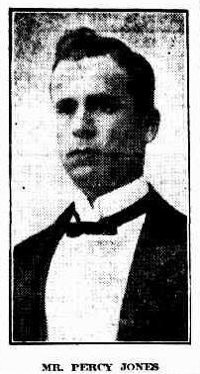
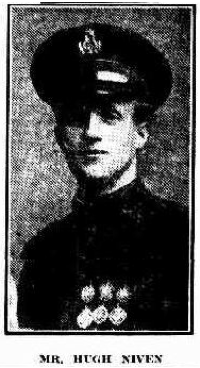
What is obvious here is the consistency of some of the appointments namely Percy Code, Percy Jones, Frank “Massa” Johnston, and Harry Shugg.  Some pictures of these bandsmen are on the side of this post.  We could assume that with the passage of time, if the same people were well-regarded in that role then they would continue to serve.  The interesting fact about the Victorian MAB members is that they carried through the changeover from the VBA to the VBL.  On a side note, given that many of these conductors were working with metropolitan bands at the time they would have been the instigators of the VBL in the early 1930s.

There were some occasions regarding band competitions where MAB’s were not involved in choosing music.  We can see articles published in the Advocate newspaper in 1921 and 1927 that Percy Jones was the adjudicator of the popular New Year’s Day Burnie carnival band competition (“BURNIE.,” 1927; “BURNIE CARNIVAL.,” 1921).   However, it is in the 1927 article where we can see that Percy Jones himself made recommendations to the Burnie Athletics Club on the choice of music for the next carnival band competition:

Last year’s band adjudicator, Mr. Percy Jones, wrote recommending that “Gournod (Rimmer)” and “A Garland of Classics (Rimmer)” be chosen as test pieces for the B and C grade contests respectively, at the next carnival.  The recommendation was adopted, on the motion of Messers Southwell and Trethewey.  It was also decided to continue negotiations with a view to obtaining an adjudicator from New South Wales for the next carnival.  Last year’s rule that the own choice selection be made from National Airs was again adopted.”

(“BURNIE.,” 1927)

One notable criticism of the music choices made by MAB’s came from Cecil Clarence Mullen in his booklet, Mullen’s Bandsmen of South Street (1900-1951).  We know from a previous post that Mullen was very opinionated, and it is not clear how much influence he wielded through his writings, especially his booklet.  He wrote:

Some years ago the Advisory Board of selectors introduced a new type of Test Selection for South Street band contests.  These are mostly technical works and appreciated by bandmasters and players, the musicianship point of view has only been taken into consideration.  Our contests promoters and managers have been overlooked the fact that one party – the public who pay to attend contests – have been left out.  Statistics show clearly that all the largest crowds at the South Street competitions were in the years from 1900 to 1924, when the operatic brass band arrangements were chosen for Test Selections. […] Technical works are all very well for those of us who understand them, but they are cold and colourless to the general listener as he cannot follow them and does not know what they are all about.

(Mullen, 1951, p. 6)
19200911_Herald_P-Code
Herald, 11/09/1920, p. 14

Now while Mullen might be right about the years when the largest crowds attended the brass band competitions at South Street, it must be recognized that he was merely expressing his opinion and it might be a short stretch to link crowd numbers with choices of music.  He went on further in this section of the booklet to explain his reasons for wanting more operatic arrangements in the band competitions with the implied belief that they were far more musical than what current brass band composers were providing, and that they were more pleasing to the ears of the audience (Mullen, 1951).  He was especially taken with the operatic arrangements of Alexander Owen and he also wanted a sight-reading section to be introduced (Mullen, 1951).  This was not the first time Mullen wrote with favour on operatic works being played by bands.  In a later article he attributed the fine playing of bands in the early years to their playing of operatic works (Mullen, 1965).

Aside from Mullen, there appears to be a distinct lack of criticism in early newspapers regarding the choices of music made by the MAB’s.  Which contrasts with the criticisms levelled at State Band Associations and MAB’s regarding grading of bands.  Grading was a vexed issue, and this will be explored in the next section.

Music Advisory Boards, State band Associations and Grading:

To understand why grading does or does not work, it’s important to know a little history on how Associations applied grading to bands.  The first competition that included grading of some sort was in New South Wales at the 1896 Intercolonial Band Contest held in Sydney in November where bands were grouped into “first division” or “second division” (Greaves, 1996, p. 23).  In Victoria, the first five years of South Street from 1900-1905 were ungraded and, Mullen (1951) has provided some history as to how grading developed from 1905.

In 1905 the first “B” grade contest was arranged owing to some bands having progressed so much from the experience and tuition of former English bandmasters that it was thought younger combinations and country bands would have a better chance in a second class contest.  So fast did the better class bands progress, however, that it was thought that with many new bands starting that a “C” grade was held in 1909.

(p. 7)

Having only three grades was the status quo in Victoria until, according to available resources, a D grade was introduced in 1922 (“Victorian Bands’ Association,” 1922).

19210108_Herald_L-Hoffman
Herald, 8/01/1921, p. 11

Let us take a look at how bands moved up or down grades over some years.  Below are links to files that show the grades in certain years from Victoria, Queensland and Western Australia.  The Victorian dataset is more condensed as they show the grades in the years 1920, 1922, 1923, 1924, 1926 & 1927.  For Queensland, the dataset is more spread due to limited information and the files are based on information from the years 1913, 1919 & 1937.  Included is an example of grading presented by the Western Australian Band Association in 1932, which is very limited, however there’s an interesting discussion from the WABA meeting that took place that year.  All band lists were obtained from newspaper articles held in the Trove archive and can be accessed from the links in the citations.  The grade files will appear as PDF’s and can be downloaded.

Victorian Grades – 1920-1927:

(Source of Victorian grade data: “BAND ASSOCIATION,” 1923; “BRASS BANDS REGRADED.,” 1927; “CLASSIFICATION OF BANDS.,” 1926; “VICTORIAN BAND ASSOCIATION,” 1924; “VICTORIAN BAND ASSOCIATION,” 1920; “Victorian Bands’ Association,” 1922)

Queensland Grades – 1913, 1919 & 1937:

(Source of Queensland grade data: “Band Association.,” 1919; “GRADING THE BANDS.,” 1913; “NEW GRADING LIST,” 1937)

Western Australian Grades – 1932:

(Source of Western Australian grade data: Delegate, 1932)
19200828_Herald_P-Jones
Herald, 28/08/1920, pg. 19

The Victorian context is possibly a better example of grade history given the range of years.  Here we see a bulge– a smaller number of bands in A Grade and D Grade while B Grade is larger and C Grade having the most numerous amount of bands  Taking a look at the C Grade in particular, while the D Grade was introduced in 1922, in 1924 there is large expansion of bands in C Grade.  Whether this is down to the number of bands that affiliated that year, or general musical standard is open to interpretation.  1924 was certainly a golden year of bands, except for perhaps the A Grade where there were only three bands.  Regarding the A Grade, once the top bands were placed in that grade, they tended not to leave.  In 1926 and 1927 we see a jump in that number due to bands moving up from B Grade.

In Queensland it is a little more difficult to interpret the grading history given the lack of information, so a reliance on the available years is necessary.  However, there are some similarities with Victoria, especially in the middle grades.  In 1919 there is a large expansion in the number of bands in C Grade.  We also see some innovation on the part of the Queensland Band Association in 1937 where there is a D Grade, but there are also grades to cater bands that are from specific locations or age groups.  Here we see a “Sub D Grade (Country)” and a “Boy’s Band (Under 15 years)” (“NEW GRADING LIST,” 1937) which no doubt helped more bands participate in events.

The example from Western Australia is obviously small, but the list originates from an article published in the Sunday Times regarding a wide-ranging meeting held by WABA.  The regrading of bands was included in the discussion as an agenda item:

The matter of regrading the bands affiliated with the association was then proceeded with.  There are 17 in all, and prior to the 1931 contest these were graded as B or C.  This grading has since remained unaltered officially, but for the purpose of giving the 1931 contest a high “tone”, the grades were officially announced as A and B.  The question raised on Wednesday evening was whether to create a D grade from the smaller C grade bands or raise the status generally and make them A, B or C.  The latter course was eventually decided upon and each band was, after submission to the meeting, graded by a majority vote.  A suggestion that they should be graded according to the points awarded them by the adjudicator at the last contest was not accepted, though the idea found a good deal of support.

(Delegate, 1932)

Victoria offers more information on the roles of the MAB in the regrading process as the Queensland Band Association seems to have undertook this role themselves (there is no mention of a Queensland MAB).  The role of the MAB’s in advising on regrading is evident although it seems, at least in the early stages, that the V.B.A. undertook the regrading process with their MAB offering limited advice.  We see in 1920 that,

A report was submitted from the executive of the association dealing with the regrading of bands.  It contained replies from Messrs H. Shugg and P. Code, two of the advisory committee who both concurred in the proposed regarding as submitted by the executive…

(“VICTORIAN BAND ASSOCIATION,” 1920)

However, in 1922, the Victorian MAB was responsible for the regrading process:

The advisory board of the Victorian Bands’ Association, the headquarters of which are at Ballarat, has regraded bands for the ensuring year as follows…

(“Victorian Bands’ Association,” 1922)

And mention of the role of the MAB in regrading bands is again mentioned in articles from 1926 and 1927 (“BRASS BANDS REGRADED.,” 1927; “CLASSIFICATION OF BANDS.,” 1926).

This is not to say grading was always a smooth process and there were always levels of criticism from various parties, as well as disagreements between States – the rules were never fully unified.  As early as 1914 we can see letters in the papers regarding the grading of bands.  One letter from Mr S. E. Hambleton, then Secretary of the Collingwood Citizens’ Band stood out for its candidness.  Part of his letter was criticism while contributing his own ideas:

The band of which I am secretary has not won a cash prize for five years, and although I have made applications to be re-classified (claimed on two years’ rules), I am told that the Victorian Band Association would not listen to it as we are an A Grade band.  The other bands know this, and, of course, will not enter for the higher grade, with the promise, perhaps of a life sentence hanging over them.

Our band of 24 could be divided into three parts and absorbed by B Grade bands and allowed to play in B Grade.  Why not classify the individual players and thus stop good players in A Grade bands from becoming members of a lower grade through better inducements.  Collingwood and Prahran are the only two bands classed as A Grade, although there are four or five others advanced enough to compete in this grade.

Bands that have won C or B Grade contests should be placed in the class higher up and stay there for the stated time.  If they fail to secure a cash prize, allow them to go to the next grade down again.  Bands will not enter for a higher grade than they are classed in, for fear of winning a cash prize in it, being thereby debarred from competing in the grade that they had been classed in.

(Hambleton, 1914)

Again in 1914, a letter was published in Brisbane’s Daily Standard newspaper lamenting the grading process carried out by the Queensland Band Association after the Maryborough contests.  The writer, Mr W. Jackson, a Delegate of the Childers band, was obviously annoyed at the whole process and made this quite clear in his letter.  He wrote (in part),

…We were promised that the matter of grading the bands would be thoroughly gone into at an early date by the Q.B. Association.  What is the result?  Here we are three months before the August contest, and still in the same sorry plight.  Is it encouragement for the small country bands to go to Brisbane to contest against bands from the large cities as at Maryborough when the “C” grade championships was won by a band that probably should have been graded “B” at least?  I am afraid the same thing will occur again.  What I contend is that the “C” grade should be open for bands from the small country towns only, thus giving them some encouragement for them to fight on to better class music.

(Jackson, 1914)

It would be fair to say that both Mr Hambleton and Mr Jackson made some fair points re grading problems in their respective states.  They both knew their bands and how the administration worked.  We could assume that the State associations were trying their best in trying to please everyone but in some respects, it was never a perfect process.  Perhaps this was the reason MAB’s were formed to advise on grading.

As mentioned above, at times the rules and administration of different State associations came into conflict with each other regarding registration and grading.  One notable example was highlighted in Tasmania after another one of the contests in Burnie.  At a meeting of the Tasmanian Band Association in 1930, this was raised as an agenda item:

Very grave concern was expressed by the committee relating to the methods of grading and the registering of members of mainland bands which compete at the Burnie contests.  It was discovered by the delegates at the recent Burnie contests that one of the competing bands from the mainland had been able, only a few days before the closing date of registrations, to register no less than nine prominent players of other bands, and perhaps of a higher grade.  The regrading of bands on the registration for every contest might overcome the somewhat unfair aspect of this matter, but what is more desirable is uniform contests rules for all the States.  The T.B.A. is approaching the State association concerned on this occasion, with a view to a general tightening up of grading and registrations.

(“BAND ASSOCIATION,” 1930)
19210219_Herald_H-Niven
Herald, 19/02/1921, p. 16

…which is fine in theory but as discovered in the history of the National Band Council of Australia, unification of rules was an ideal that never really reached fruition despite the best intentions of State associations.

What we have seen in this small history are situations where the grading process was fraught with difficulty, did not please everyone and criticism was rife.  And it was a thankless task as the reputations of the early bands hinged on success in competition and the decisions of the State associations.  Most of the time it was done correctly.  On occasion there were problems.  With the influx of bands starting up and wanting to participate in events, grading them was a necessity that called upon the State associations to try to find solutions.  When this went wrong, the administration was generally found to be lacking.

Conclusion:

For the MAB’s involved in the processes of choosing music and advising on band regrading, generally they did the right thing and all they could really do was offer advice.  Thankfully, the reputations of the MAB members carried them through some of the decisions made by State associations.  Evidently the fact that many of the Victorian members held their positions for many years is a testament to their authority as prominent bandsmen.

We should thank these early members of the MAB’s for the foundations that they laid as the members of the modern MAB’s carry out their tasks in much the same way as they did back then.

19200724_Herald_H-Shugg
Herald, 24/07/1920, p. 11

References:

BAND ADJUDICATOR : For Newcastle Contest : Mr. Percy Jone’s Career. (1920, 04 December). Newcastle Sun (NSW : 1918 – 1954), 2. http://nla.gov.au/nla.news-article162621130

BAND ASSOCIATION : Deciding Championship. (1923, 21 August). Ballarat Star (Vic. : 1865 – 1924), 2. http://nla.gov.au/nla.news-article213824101

Band Association : Grading for the Contest. (1919, 20 November). Telegraph (Brisbane, Qld. : 1872 – 1947), 8. http://nla.gov.au/nla.news-article176840373

BAND ASSOCIATION : Registering and Grading. (1930, 24 January). Mercury (Hobart, Tas. : 1860 – 1954), 3. http://nla.gov.au/nla.news-article29151289

BRASS BANDS REGRADED. (1927, 18 October). Argus (Melbourne, Vic. : 1848 – 1957), 13. http://nla.gov.au/nla.news-article3885887

BURNIE. (1927, 17 June). Advocate (Burnie, Tas. : 1890 – 1954), 4. http://nla.gov.au/nla.news-article68241846

BURNIE CARNIVAL : New Years Day : Bright Prospects. (1921, 16 November). Advocate (Burnie, Tas. : 1890 – 1954), 4. http://nla.gov.au/nla.news-article69316043

CLASSIFICATION OF BANDS. (1926, 18 May). Argus (Melbourne, Vic. : 1848 – 1957), 8. http://nla.gov.au/nla.news-article3782670

Delegate. (1932, 21 August). BRASS BANDS : W.A. Association News : And General Notes. Sunday Times (Perth, WA : 1902 – 1954), 6. http://nla.gov.au/nla.news-article58669392

Drummer Boy. (1922, 21 October). BANDS AND BANDSMEN. Northern Star (Lismore, NSW : 1876 – 1954), 11. http://nla.gov.au/nla.news-article93411340

GRADING THE BANDS. (1913, 27 October). Queensland Times (Ipswich, Qld. : 1909 – 1954), 4. http://nla.gov.au/nla.news-article118654062

Greaves, J. (1996). The great bands of Australia [sound recording] [2 sound discs (CD)]. Australia, Sound Heritage Association. 

Hambleton, S. E. (1914, 13 January). EFFECT OF GRADING. Herald (Melbourne, Vic. : 1861 – 1954), 5. http://nla.gov.au/nla.news-article241657411

Jackson, W. (1914, 08 May). BAND GRADING : (To The Editor). Daily Standard (Brisbane, Qld. : 1912 – 1936), 3. http://nla.gov.au/nla.news-article178879778

Mullen, C. C. (1951). Mullen’s Bandsmen of South Street (1900-1951). Horticultural Press. 

Mullen, C. C. (1965). Brass bands have played a prominent part in the history of Victoria. The Victorian Historical Magazine, XXXVI(1), 30-47. 

NEW GRADING LIST ISSUED BY QUEENSLAND BAND ASSOCIATION. (1937, 12 November). Telegraph (Brisbane, Qld. : 1872 – 1947), 13. http://nla.gov.au/nla.news-article183521534

Quickstep. (1920a, 28 August). Bandsmen’s Gossip : A Knight of the Baton. Herald (Melbourne, Vic. : 1861 – 1954), 19. http://nla.gov.au/nla.news-article242311544

Quickstep. (1920b, 14 August). Bandsmen’s Gossip : A Meritorious Career. Herald (Melbourne, Vic. : 1861 – 1954), 16. http://nla.gov.au/nla.news-article242305795

Quickstep. (1920c, 07 August). Bandsmen’s Gossip : An Enthusiastic Conductor. Herald (Melbourne, Vic. : 1861 – 1954), 17. http://nla.gov.au/nla.news-article242306287

Quickstep. (1920d, 11 September). Bandsmen’s Gossip : Australia’s Great Soloist. Herald (Melbourne, Vic. : 1861 – 1954), 14. http://nla.gov.au/nla.news-article242308980

Quickstep. (1920e, 24 July). Bandsmen’s Gossip : Leader of Two Famous Bands. Herald (Melbourne, Vic. : 1861 – 1954), 11. http://nla.gov.au/nla.news-article242308343

Quickstep. (1921a, 19 February). Bandsmen’s Gossip : Noted Musical Qualities. Herald (Melbourne, Vic. : 1861 – 1954), 16. http://nla.gov.au/nla.news-article242256082

Quickstep. (1921b, 08 January). Bandsmen’s Gossip : St Vincent’s Bandmaster. Herald (Melbourne, Vic. : 1861 – 1954), 11. http://nla.gov.au/nla.news-article242259553

VICTORIAN BAND ASSOCIATION : Classification of Bands. (1924, 19 August). Ballarat Star (Vic. : 1865 – 1924), 1. http://nla.gov.au/nla.news-article213535974

VICTORIAN BAND ASSOCIATION : Special and General Meeting. (1920, 18 May). Ballarat Star (Vic. : 1865 – 1924), 2. http://nla.gov.au/nla.news-article211906214

Victorian Bands’ Association : Grading for the Year. (1922, 24 August). Age (Melbourne, Vic. : 1854 – 1954), 14. http://nla.gov.au/nla.news-article205773169

Victorian Bands’ League. (1933). Victorian Bands’ League : Annual General Meeting : Annual Report [Annual Report]. Victorian Bands’ League. https://victoriancollections.net.au/items/5b6a740621ea691478e4b482
Cecil Clarence Mullen: Enthusiastic commentator, historian and statistician of brass and military bands

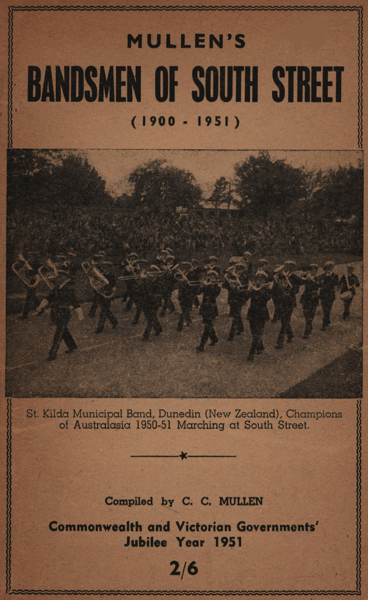
19510000_Mullens-South-Street_p0-FC
Front Cover, Mullen’s Bandsmen of South Street (1900-1951)”. (source: Jeremy de Korte’s personal collection)

Introduction:

There has always been an ecosphere of activity surrounding brass bands, then and now ranging from retail to journalism, and people who take a general interest in day-to-day activities.  This level of interest varies among people, and especially in the bands of old, there was an amount of engagement in these ensembles.  One only has to read past newspapers as a measure of this engagement.  Most readers of this blog know I dwell in the Trove archive to find information for these posts; it is through these newspaper articles that the life and atmosphere of these bands can be fully appreciated.

This post is different from previous posts where the focus is not on bands per se, but on a bands person who described himself as very involved in the brass band movement, Cecil Clarence Mullen.  I am very thankful to have been gifted one of his rare booklets, Mullen’s Bandsmen of South Street (1900-1951).  He wrote another article on the history of Victorian bands in 1965 for The Victorian Historical Magazine.  However, there is more to explore in his writing, including some of the opinions on the band movement and the work he did as a brass band statistician.

Mullen had a role to play documenting the band history of Victoria and it is unfortunate that his work is not well known.  We will see where Mullen’s work was at its most valuable, but also where some of his work could be questioned – this post will be taking a subjective view of some of his writing and opinions.  It must be recognised that at the time, Mullen did not have the information resources at his disposal like we do now.  However, what he did do was make an effort to record and compile results in a way that was unique.

C. C. Mullen (1895-1983):

It was difficult to build a full picture of Mullen’s life as some resources were not comprehensive.  Through the research of State records (Public Records Office Victoria and Births, Deaths and Marriages Victoria), it is found that he was born in 1895 and initially lived in the Melbourne suburb of Richmond.  For much of his further life, he lived in the nearby suburb of Abbotsford and was still residing in that suburb when he died in 1983 at the age of 88 (Mullen, 1983).  As for employment, it is listed in some records that he worked as a Clerk at the Argus newspaper and various other local newspapers (Ruddell, 2010)

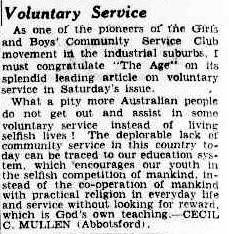
Mullen’s amateur interests were extensive and varied including music, sports, local history and it seems youth and education as well (Ruddell, 2010).  He was complimented on his work with local youth groups of which he made every effort to prepare youth for further work and education (“Richmond Boys’ Club,” 1932).  It is through further research in the Trove archive that we see a fuller picture of Mullen’s mindset as he was an avid contributor of letters to the newspapers.  He wrote on all sorts of topics; youth, education, transport, parks, library opening hours, manners at the opera, sports, politics, etc (Mullen, 1937, 1946, 1947, 1952a).  The articles displayed below are only a tiny sample of his letter output.

19371217_Argus_Mullen-Sport-Schools
Argus, 17/12/1937, p. 10
19401607_TheAge_Mullen_Volunteers
The Age, 10/07/1940, p. 6
19471218_Herald_Mullen-School-Holidays
Herald, 18/12/1947, p. 15
19520103_Argus_Mullen-Letter
Argus, 03/01/1952, p. 6

Regarding his letter writing, it seems he did not write to the papers on one of his favourite topics, brass bands, except for one instance when he requested photos of the Kalgoorlie brass bands for his brass band history collection (Mullen, 1951a).  It is also in this letter that we see that Mullen has described himself as a “statistician and historian of brass and military bands” (Mullen, 1951a).

19510113_Kalgoorlie-Miner_Mullen-Letter
Kalgoorlie Miner, 13/01/1951, p. 2

This post will not dwell on Mullen’s interests in other subjects however they do provide some clues as to how Mullen went about doing things, and what his personal attitudes were like.  He gives the impression of being an egalitarian person and was a firm advocate for youth groups (Mullen, 1952b).  He did not like some of the aspects of competition, taking aim through one of his letters at “the selfish competition of mankind, instead of the co-operation of mankind” (Mullen, 1940).  In another one of the newspaper letters he advocates for the abolition of school sports, and in his booklet, he advocates for the abolition of grades in band contests (Mullen, 1937, 1951b).  In saying so, Mullen still supported the aims of the Royal South Street Society band competition sections and sponsored trophies for “Best Drummer” in 1958, another trophy in 1959, and a trophy in 1964 for “Bandmaster showing Best Deportment” (Royal South Street Society, 1958, 1959, 1964).   As for his historical work, we will examine his band history research in the next sections, however, it should be noted that there is an amount of conjecture over the accuracy of his sports history writing and statistics (Hay, 2010).

An enthusiastic commentator is probably an apt description of Mullen given his penchant for writing on all manner of subjects.  His band history work is what provides the most interest (for this post) and we will see a person who clearly enjoyed his statistics.

C. C. Mullen: Historian of Brass & Military Bands:

There is no doubt, through reading his works, that Mullen was an enthusiastic advocate, documenter and historian of brass and military bands.   Both his main works on the subject, his booklet and his later article attest to this.  This section will review his booklet first, then his article from 1965.

1951: “Mullen’s Bandsmen of South Street (1900-1951)”:

The first impression that is given about the booklet is that he clearly wrote this booklet as an outlet for his interest in brass bands and musicians. The aim of this booklet, as Mullen notes in the preface, was to publish

…for the first time in the history of brass bands in this country, a condensed history of bands and players who have taken part in most important annual band competitions in Australasia – that of South Street, Ballarat, Victoria.

(Mullen, 1951b, p. 1)

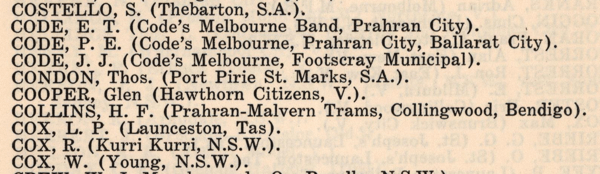
With this aim, he achieved his goal and the book contains the names of musicians, the bands they were associated with, and which instruments they played.  Below is small except from one of the lists which makes up many of the pages of this booklet.:

19510000_Mullens-South-Street_p15
Excerpt from p. 15, Mullen’s Bandsmen of South Street (1900-1951)”, Bb Cornets. (source: Jeremy de Korte’s personal collection)

In the preface, Mullen outlines his life in the brass band movement.  In summary he:

  • was a pupil of Edward Code,
  • apparently knew all the famous bandmasters of the day,
  • was embedded in the administration of the early Victorian Bands’ Association, and later the Victorian Bands’ League,
  • was a contributor of articles to all the famous band magazines (Mullen, 1951b).

He notes that the famous Bandmaster Edward Code was a great influence on his early life and that he felt honoured as a former pupil to have published this booklet (Mullen, 1951b).  Interestingly, both Edward Code and Mullen are buried in the same cemetery in Melbourne, the Coburg Pine Ridge Cemetery in Melbourne’s north – although 65 years apart.

Mullen was not afraid of expressing his opinions on bands and the administration of bands.  On page four of his booklet is a one-page treatise on the importance of brass bands to the community, with a paragraph (below) on his thoughts of bands in schools (Mullen, 1951b).  A previous post has touched on the historical discrepancies with the starting of school bands in Victoria and Mullen adds his own discrepancy when he declares “I had the first band in Victoria composed of schoolboys” (Mullen, 1951b, p. 4).  When reading this paragraph, it brings to mind a piece of writing in one of the old brass band magazines where the writer had some choice words for the headmasters of the day about not starting bands (“THE EDITOR’S BATON,” 1929).  Perhaps it was Mullen himself who wrote the article in this 1929 issue of The Australasian Band and Orchestra News, but we may never know for sure.

19510000_Mullens-South-Street_p4
Excerpt from p. 4, Mullen’s Bandsmen of South Street (1900-1951)”. (source: Jeremy de Korte’s personal collection)

In finishing his one-page treatise on the importance of brass bands, Mullen laments that the State and National controlling bodies have not done enough to promote bands.  He states,

It is up to our band controlling bodies and the Australian Band Council to take this matter up seriously and see that more cannot be done to keep the importance of brass bands before the people of Australia.

(Mullen, 1951b, p. 4)

The main aim of this booklet, as mentioned, was to document the prize-winning brass band musicians and bands who had participated in the South Street competitions over a number of years.  Two pages of the booklet are devoted to a poem Mullen wrote on South Street.  Another section of the book was written by a contributor, “Baton” who wrote a history of the band sections at South Street (Baton, 1951).  This contribution is comprehensive and valuable and adds to the existing histories of the band sections at South Street.

Mullen also wrote other small sections in the starting pages and ending pages of the booklet, where, we still see that he is using the booklet to express his own opinions – which is understandable.  Some section headings in the starting pages are telling;

  • “Test Selections need revising” (he felt that operatic works instead of technical works made better test pieces),
  • “Band grading should be abolished” (he felt the grading system had outgrown its usefulness)
  • “Bad drumming of class marches” (Apparently Bandmasters were not teaching or paying attention to the drummers about learning their parts properly) (Mullen, 1951b, pp. 6-8)

In the later pages of the booklet, Mullen provides some useful historical information on the South Street competitions, South Street judges, how Britain developed band music in Australia,  the Quickstep section and the formation of the Victorian Bands’ League (Mullen, 1951b).  Still, he is wanting to express his opinions in these pages and makes comment on how “Grand Opera assists bandsmen” (Mullen, 1951b, p. 61).  Mullen, as we’ve seen, is also a great advocate for the young and has used a section to advocate for young band conductors.  Also, in another section, while he congratulates young soloists for participating in South Street, he also took aim at their onstage deportment – Mullen obviously did not like young soloists who sat down while playing and he gave a serve to bandmasters “who encourage this sort of thing” (Mullen, 1951b, p. 62).

In one of the final sections of the booklet titled “High Cost of Running Brass Bands” (Mullen, 1951b, p. 62), we read that he is trying to advocate for more monetary support for the brass band movement.  He levels criticism at various entities such as the Federal Government on tariffs on musical instruments, the State Government on the money being spent on the upcoming Olympic Games, and the Australian Band Council for not talking to governments on behalf of brass bands (Mullen, 1951b).  Mullen takes a singularly myopic viewpoint, well-meaning, but possibly futile.  Of course, this is all in relation to his support for young musicians and their access to instruments and the expense of obtaining such instruments.  He laments that,

Unfortunately Australia is so “sports minded” that it is a much easier proposition to conduct a boy’s cricket or football team than to form a junior band and give youngsters the chance of a musical education or at least a musical mind.

(Mullen, 1951b, p. 62)

Meaning, that if all things were ideal in Mullen’s viewpoint, money would be better spent on the brass band movement.

Would it not be a good investment for the future education of this country for our Governments to spend something on band music in order to help Australia to have a cultured mind – something she lacks at present.

(Mullen, 1951b, p. 62)

In this section about the monetary challenges faced by brass bands and lack of support, Mullen has managed to draw in his other points of interest in sports, politics/government and education of youth!

In finishing a review of Mullen’s written paragraphs and opinions in this booklet, it is as has been mentioned; he used this booklet to express is many opinions, ideas and advocacy. His writing was well-meaning, but one wonders how much effect it had on the powers that be?  I personally feel that the lists of bandsmen, instruments and bands provide much more historical interest and meaning in this booklet.

1965: “Brass Bands have played a prominent part in the History of Victoria”:

In 1965, fourteen years later after publishing his booklet, Mullen published another article in The Victorian Historical Magazine with the above title.  Mullen is aged 70 in 1965 and his wealth of historical knowledge about the brass band movement is evident in this article.  The richness of historical information about bands, conductors, adjudicators, the South Street competitions and Victorian musical life can be fully appreciated here – possibly more so than his previous booklet which contained a limited range of historical writing (Mullen, 1951b, 1965).

Mullen provides an amount of context in this article.  To build the narrative, he starts off with the large and then brings focus.  In the opening paragraphs, this means tracing brass instruments from biblical times to the development of bands in England and then to Victoria with a focus on immigration (Mullen, 1965).  In this article, Mullen also draws in some historical information about Victorian bands and events, and he has quoted large parts of various band magazines.  For example, the next section after the introduction is about bands playing at the Eureka Rebellion of which he used information from “The Australian Bandsman.  26th October 1923” (Mullen, 1965, p. 31).  This section on the Eureka Rebellion is useful as it focuses on the band history of Ballarat – which became home to the famous Royal South Street band competitions.

Progressing through the article, we can see that Mullen provides lots of detail throughout various sections while continuing his historical narrative.  When reading, there is an impressive list of bands, bandsmen, competitions and little stories to be discovered.  He has written a section on the “Famous Band Families” such as “James Scarff, Samuel Lewins and Thomas E. Bulch” and the “Codes” – brothers “Edward, John, Alfred and William” and sons of Edward, “Percy” and brother “Samuel” (Mullen, 1965, pp. 36-39).  The South Street band competitions were a subject that had a special interest to Mullen and he devoted another whole section to them, again, listing memorable bands, bandsmen and adjudicators (Mullen, 1965).

In the later writing of this article, there were some notable historical events that Mullen mentions such as the early tours of Besses o’ the’ Barn Band and the Sousa Band, the formation of the Victorian Bands’ League, the impact of the World Wars on local bands, radio broadcasting and in the band world, the activities of the ABC Military Band (Mullen, 1965).  The final section of the article gives praise to the Victorian brass bands for maintaining a high standard of playing, although Mullen attributes this to,

…bandmasters setting a fine example in teaching young players a love for classical works of the of the great composers relating to Grand Opera, Ballet, Symphonies, Oratorio, Sacred and Religious works, and good songs that have been set to music.

(Mullen, 1965, p. 46)

In other words, music that was not originally written for brass bands.

Mullen was ever fond of lists (which will be evident further in this post), and in this final section he has listed a number of notable brass band conductors, in addition to others previously named in his article such as “Harry Shugg” (Geelong Harbour Trust, Malvern Tramways & City of Ballarat) (Mullen, 1965, pp. 11, 43).  (The list below has been ordered into a bulleted list which is different from how it is presented in the article):

(Mullen, 1965, pp. 9-11, 47)

If there is one criticism of this article it is the way that Mullen has finished it, there is no real conclusion.  It just…ends.  Mullen leaves the article hanging by making mention of the most recent overseas visit of an international military band (prior to the publication of this article) in 1965).  The final paragraph reads:

The most recent visit of an overseas musical combination to Victoria was that of Her Majesty’s Scots Guards, under Captain James Howe, in March 1964, when it played at the Moomba Carnival in Melbourne.

(Mullen, 1965, p. 47)

It is admirable that Mullen wrote an article such as this given that lack of historical writing on the band movement in Victoria as a whole.  What this article does do is create many links between bands, bandsmen and historical context, which is no doubt due to Mullen’s interests in these subject areas.  We should thank Mullen; despite this article being written fifty-five years ago to this date, it is still relevant and serves as a useful guide to much of the band movement history in Victoria.

C. C. Mullen: Statistician:

Returning to Mullen’s publication on brass bands, Mullen’s Bandsmen of South Street (1900-1951), we will see what can be considered to be the real historical value of this booklet, the lists of names and bands.  Mullen was meticulous in the way he compiled his lists.  No doubt he had access to the names and competition wins through his work at the newspapers, but to compile the lists covering fifty-one years is quite remarkable.  All of the bandsmen and bands can be cross-referenced with the Royal South Street results database (Mullen, 1951b; Royal South Street Society, 2020).

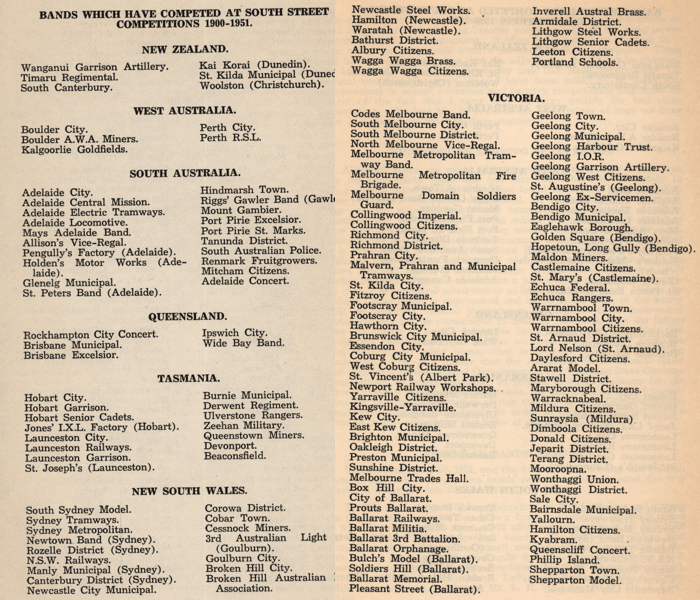
A small excerpt of one of the lists has been displayed earlier in this post.  The way Mullen has compiled these lists is quite logical.  He has started with all the conductors and then listed all the prize winners for every instrument of a brass band.  Interestingly, although South Street never held any solo competitions for Side or Bass Drummers, Mullen lists the bandsmen he considers notable on these instruments.  In the closing pages of the statistics, he lists all of the bands from every State and New Zealand that have participated in South Street over the time frame of this booklet (Mullen, 1951b).  Below are samples of some of the lists, and they are fairly self-explanatory.

19510000_Mullens-South-Street_p19
Excerpt from p. 19, Mullen’s Bandsmen of South Street (1900-1951)”, Bb Cornets. (source: Jeremy de Korte’s personal collection)
19510000_Mullens-South-Street_p41
Excerpt from p. 15, Mullen’s Bandsmen of South Street (1900-1951)”, “Bass (G) Trombone”. (source: Jeremy de Korte’s personal collection)
19510000_Mullens-South-Street_p63-64
Pages 63-64, Mullen’s Bandsmen of South Street (1900-1951)”, “Bands which have competed at South Street Competitions 1900-1951”. (source: Jeremy de Korte’s personal collection)

As we can see above, Mullen clearly had an eye for statistical detail.  No doubt he felt he was doing the band movement service by publishing all of this, and to some extent he was.  This is the only booklet of its kind to emerge from this era.  Nowadays we can access all of these results through the South Street results database and find names in the Trove archive.  Mullen did not have these electronic means, and even though the lists do not include the competition scores and rankings of bandsmen, the lists are still very informative.  Another reason to thank Mullen for his work.

Conclusion:

Mullen has made a great contribution to the history of the band movement in Victoria through his own personal interest, dedication, and knowledge.  In the absence of any other work of this nature, both his booklet and later article provide an overall picture of the band movement.  Yes, his opinions were controversial when viewed in a new light.  However, I feel he meant well, and I also feel that Mullen’s work on the history of the band movement needs to be more widely known.

References:

Baton. (1951). South Street band competitions have achieved world wide fame. In Mullen’s Bandsmen of South Street (1900-1951) (pp. 5-6). Horticultural Press. 

THE EDITOR’S BATON: Bringing up the boy to the band. (1929). The Australasian Band and Orchestra News, XXV(2), 1 & 3.

Hay, R. (2010). Cec Mullen, Tom Willis and the search for early Geelong football. The Yorker, Spring(42), 3-5. 

Mullen, C. C. (1937, 17 December). Sport in Schools. Argus (Melbourne, Vic. : 1848 – 1957), 10. http://nla.gov.au/nla.news-article11133645

Mullen, C. C. (1940, 16 July). Voluntary Service. Age (Melbourne, Vic. : 1854 – 1954), 6. http://nla.gov.au/nla.news-article204409992

Mullen, C. C. (1946, 08 January). NORTHERN TRAMWAY ROUTES. Argus (Melbourne, Vic. : 1848 – 1957), 5. http://nla.gov.au/nla.news-article22221100

Mullen, C. C. (1947, 18 December). School Holidays. Herald (Melbourne, Vic. : 1861 – 1954), 15. http://nla.gov.au/nla.news-article243844022

Mullen, C. C. (1951a, 13 January). Goldfields Brass Bands : To the Editor. Kalgoorlie Miner (WA : 1895 – 1954), 2. http://nla.gov.au/nla.news-article256809482

Mullen, C. C. (1951b). Mullen’s Bandsmen of South Street (1900-1951). Horticultural Press. 

Mullen, C. C. (1952a, 03 January). LETTERS (in a nutshell) : Too old. Argus (Melbourne, Vic. : 1848 – 1957), 6. http://nla.gov.au/nla.news-article23155399

Mullen, C. C. (1952b, 03 January). Youth in the Wrong Jobs. Age (Melbourne, Vic. : 1854 – 1954), 2. http://nla.gov.au/nla.news-article204978021

Mullen, C. C. (1965). Brass bands have played a prominent part in the history of Victoria. The Victorian Historical Magazine, XXXVI(1), 30-47. 

Mullen, C. C. (1983). This is the last will and testament of me…. In Wills and Probates (Vol. VPRS7591/P9 Unit 22). North Melbourne, Victoria: Public Record Office Victoria.

Richmond Boys’ Club : Fine Work by C. C. Mullen. (1932, 17 December). Sporting Globe (Melbourne, Vic. : 1922 – 1954), 4. http://nla.gov.au/nla.news-article189122433

Royal South Street Society. (1958, 25 October). 1958-10-25 Brass Band Contests. Royal South Street Society. Retrieved 27 January 2020 from https://results.royalsouthstreet.com.au/results/1958-10-25-brass-band-contests

Royal South Street Society. (1959, 23 October). 1959-10-23 Brass Band Contests. Royal South Street Society. Retrieved 27 January 2020 from https://results.royalsouthstreet.com.au/results/1959-10-23-brass-band-contests

Royal South Street Society. (1964, 24 October). 1964-10-24 Victorian Brass Band Championship. Royal South Street Society. Retrieved 27 January 2020 from https://results.royalsouthstreet.com.au/results/1964-10-24-victorian-brass-band-championship

Royal South Street Society. (2017). Results. Royal South Street Society (1891-2016). Retrieved 13 October 2017 from https://results.royalsouthstreet.com.au

Ruddell, T. (2010). Introducing Cec Mullen: pioneer sports historian. The Yorker, Spring(42), 2. 

Finding National consensus: how State band associations started working with each other

19230205_Daily-Mail_Aus-Band-Committee
Daily Mail, 5/02/1923, p. 3

Introduction:

For nearly as long as we have had formal brass bands in Australia, we have had band associations.  These early groupings were either large or small where affiliated bands worked with each other.  Except for perhaps in Victoria where, as we found in a previous post, they experienced some major upheaval just thirty years after the first band association came into being.  However, the collegial atmosphere brass bands led to associations that tried to foster common aims and ideals.

One core function of a band association was the formulation of rules of competition and association.  It would be fair to say that some of these rules were contentious back then (even as they are sometimes now).  This being said, the function of competition rules was to make sure that every competing ensemble was on a level playing field with other bands. There were the odd protests, of course, this goes without saying.  Generally, the judgment of State associations held when questioned. However, with all States creating rules of competition, when it came to bands wanting to compete in other States, this undoubtedly caused problems at times.  The States then tried to start working with one another to bring some uniformity in rules for competitions that attracted interstate entrants.

Hence the subject of this post. This is an examination of how the State band associations tried to put aside their differences and work with each other.  This post is not a synthesis of the different State competition rules.  As will be seen, uniformity was not an easy process and some iterations of a National Council did not last long.  Undoubtedly the War years intervened in the activities of bands, so a working National Council was further fragmented and delayed.  When reading this post, people might get a sense of déjà vu, however, this will be open to individual interpretation.  This is just another of those fascinating stories that add further history to the activities of Australian bands and bandsmen.

The early years, 1900 – 1930:

The current iteration of our ‘National Band Council of Australia” (N.B.C.A.) dates back to 1930s and their competition result archive and history reflects this (National Band Council of Australia, 2024a, 2024b).  However, efforts by the State associations to work together and hold National competitions predate this by at least three decades. 

The first State band association to form in Australia was the Band Association of New South Wales (B.A.N.S.W.) in 1895 and they staged their first interstate band competition in Sydney, 1896 (Greaves, 1996).  This was followed by the Victorian Bands’ Association (V.B.A.) in 1901 with other State association forming soon after (Greaves, 1996).  With each State association now assuming responsibility for running competitions, there were a number of rule differences for bands to negotiate, especially if they competed in interstate events.

In October 1903, prior to the Royal South Street band competitions, the Victorian Bands’ Association (V.B.A.) held their 2nd Annual General Meeting, and it is within the report presented by President Mr. Frederick Sutton and Secretary Mr. W. H. Betters that we see the first indications of State band associations wanting to work together to hold Australian band championships (“VICTORIAN BAND ASSOCIATION,” 1903).  The relevant parts of this report read as follows:

In connection with contest work your executive devised a scheme whereby the vexed question of the band championships of Australia have been determined upon conditions that should be satisfactory to all.  The basis of the championships, as you are already aware, was placed before the Band Association of New South Wales and met with its approval, so that the first and second-class Australian band championships are now strictly under the joint control of the two associations.  An agreement was effected with the New South Wales Association whereby our association, being the founders of the project, should have the right to introduce the first-class championship contest of Australia this year (1903).  The promoters of the South street contests, Ballarat, applied for the privilege of holding, for determination at their competitions, the first-class championship for this year, and your delegates granted the application.

[…]

It was satisfactory to notice that the New South Wales and Victorian Associations had mutually agreed upon a championship being established on a legislative and businesslike basis, a matter in which the Victorian Association had taken the initiative.

(Sutton and Betters in “VICTORIAN BAND ASSOCIATION,” 1903)

A report of the 1903 Royal South Street Band Sections published by The Argus newspaper confirms that this championship was the first given the status of an Australian championship.

By arrangement of the Victorian and New South Wales Band Associations, the first-prize taker in the principal event at this gathering will secure the championship of the Commonwealth.

 (“SOUTH-STREET COMPETITIONS.,” 1903)

The Newcastle City Band from New South Wales was the winner of the Royal South Street competition in 1903. (Royal South Street Society, 1903)

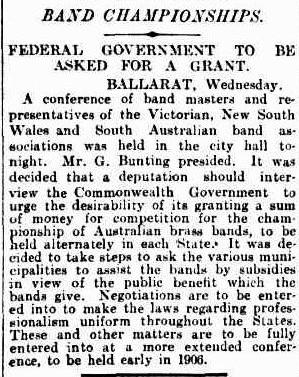
Of course, this initiative did not end here.  During the 1905 South Street contests, another conference of band representatives took place.  However, this time, they included representatives from South Australia.  As can be seen in the article below, the aim of this conference was to approach the Commonwealth Government for a grant to hold Australian championships alternating between various States, and to bring about uniformity in rules (“BAND CHAMPIONSHIPS.,” 1905).  These early conferences, while well-meaning, did become a repetitive process with no real resolutions.

The Age, 26/10/1905, p. 6

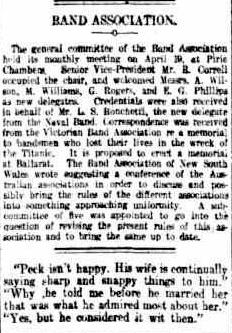
In general, these State band associations affiliated with each other and recognized each other’s rules and processes.  And it was not uncommon for letters and other correspondence from State associations to be presented at various meetings.  A decade on from the 1903 competitions in Ballarat, and eight years on from the 1905 conference in Ballarat, the South Australian Band Association (S.A.B.A.) received a letter from B.A.N.S.W. “suggesting a conference of the Australian associations in order to discuss and possibly bring the rules of the different associations into something approaching uniformity.” (“BAND ASSOCIATION.,” 1913).

The Register, 24/04/1913, p. 4

Notwithstanding the disruption of the First World War on Australian society in general, once this had finished the associations carried on with their activities.  It is in the year of 1921 where we see the next mention of a National Council being formed through an article published in the The Argus newspaper reporting on a conference held in Ballarat.  A summary of the article tells us that:

  • An Australian Band Council has been formed
  • “Only one association from each state is to be recognized.”
  • An order of States has been decided as to who will host the next championships.

(“INTERSTATE BAND CONFERENCE.,” 1921)

Slightly more detail on this 1921 Ballarat conference was provided by the Northern Star newspaper brass band correspondent, ‘Drummer Boy’ where he has noted that, in addition to only one association being recognized in each State, “only players of bands affiliated with that association will be permitted to play in contests in other States.” (Drummer Boy, 1921).  There was also another discussion on how many professional musicians could play in each band, with the recognition that brass bands were essentially amateur groups. The next conference was to be held in Brisbane (Drummer Boy, 1921).

There may or may not be a connection, but a picture of an “Australian Band Committee” was published by the Daily Mail in 1923 (pictured at the head of this post) (“AUSTRALIAN BAND COMMITTEE.,” 1923).  Perhaps this is a result of the aforementioned Brisbane conference although, at this stage, the connection is unclear.

Toowoomba Chronicle and Darling Downs Gazette, 28/05/1925, p. 4

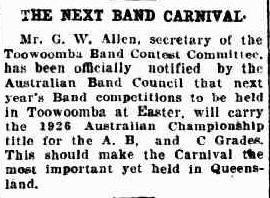
While there had been championships held in various States billed as interstate band contests, they were essentially conducted by the respective State association under their own rules. However, the formation of an Australian Band Council meant that championships could now be held under National rules and patronage.  In 1925 we see how this is affected through a tiny article published in the Toowoomba Chronicle where the 1926 Toowoomba competitions “at Easter will carry the 1926 Australian Championship title for the A, B, and C Grades” (“THE NEXT BAND CARNIVAL.,” 1925).  This is an important step in banding competitions as it is now evident that the States had actually agreed on common rules and a national committee had given patronage to a competition.  This recognition was not forgotten by local brass bands.  In 1927, the Victorian Band Association (V.B.A.) upheld a protest brought about by one band, which was written up in an article published by The Age newspaper:

Malvern Tramways Band complained that two other bands in Melbourne were claiming themselves to be Australian champions, and a ruling was sought.  It was set out that the title of the Australian championship was legitimately held to belong to Malvern Tramways Band by reason of its success in winning the Australian championship contest at Toowoomba, Q. last Easter. The association secretary (Mr. W. Martin) stated that he had replied that the Queensland Band Association had the right to grant the championship in 1926, and by its success at the Toowoomba contest Malvern Tramways Band was thereby the possessor of the title.  The matter was one in which the band itself could take what action it considered advisable.”

(“Victorian Band Association.,” 1927)

On a side note and somewhat related, this was a perfect case of when a State association proved to be effective on one ruling but failed to uphold another ruling.  The two other bands that Malvern Tramways was referring to in their protest were their two main crosstown rivals: Brunswick City Municipal Band and Collingwood Citizens’ Band. In the latter part of 1927, these two bands held a “challenge contest’ at the Exhibition Building with adjudicators “P. Jones, P. Code & R. McAnally” presiding (“CHALLENGE BAND CONTEST.,” 1927).  Interestingly, the presenters of this contest declared that “This contest…will decide which is the best brass band in Australia” (“CHALLENGE BAND CONTEST.,” 1927).  Needless to say the Victorian Bands’ Association was not pleased about this contest and they tried to disqualify both Brunswick and Collingwood – which brought about a response from Brunswick accusing the V.B.A. of over-stepping itself as the current VBA rules “do not provide for a challenge contest” (“BEST BAND DISCORD,” 1927).  The challenge contest still went ahead with Collingwood winning by two points (Greaves, 1996).

The 1930’s:

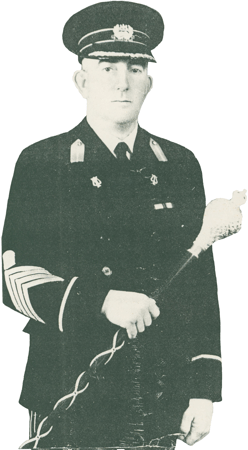
1937. Lieut. K. G. Kennedy. The well-known Drum-Major and Adjudicator, also President of the Australian Bands’ Council. (Source: Victorian Bands’ League Archives)

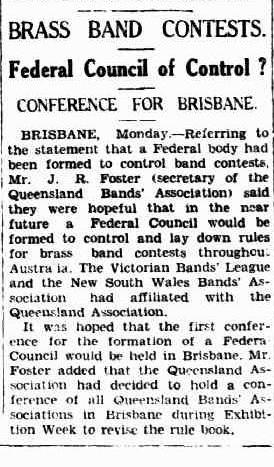
If the preceding two decades could be regarded as tentative, the next two decades where the National Council was reformed could be regarded as consolidation.  In 1931 a new Victorian Bands’ League was formed by a large group of Melbourne metropolitan bands and every other band in the State rapidly affiliated.  This led to the demise of the VBA and we see in a Herald article from 1933, the other State associations recognized the VBL as the single association for bands in Victoria and they sent through their affiliations with the new league (“BAND UNITY MOVE,” 1933).  In the same article, Mr. H. G. Sullivan, Secretary of the VBL “said he wanted to see the formation of an Australian Band Council to unify band contests throughout Australia” (“BAND UNITY MOVE,” 1933).  This move was also welcomed in other States.  The Secretary of the Queensland Band Association (Q.B.A.) Mr. J. R. Foster, “said they were hopeful that in the near future a Federal Council would be formed to control and lay down rules for brass band contests throughout Australia.” (“BRASS BAND CONTESTS.,” 1933).

19330627_Toowoomba-Chronicle_Band-Council-Control
Toowoomba Chronicle and Darling Downs Gazette, 27/06/1933, p. 4

A clue as to why the National Council was resurrected at this time lies in a long newspaper article from 1934 published in the Central Queensland Herald newspaper in which Mr. Foster, was interviewed.  He provided some enlightening history:

“Years ago the whole of the State Band Associations throughout Australia were controlled by a Central Australian Band Conference, but since 1918 this body has not functioned although several attempts were made to revive the Council” said Mr. Foster yesterday.

“Last year, through the efforts of the Q.B.A., negotiations were made between New South Wales and the Victorian Bands’ League to hold a conference representing all States to endeavour to formulate a set of rules applicable to band contests throughout the Commonwealth.”

“The conference, which will be held in Sydney, will commence on April 9 and all States except Western Australia have expressed their intention of being represented.”

“Included in the agenda will be a suggestion from Queensland that every effort will be made to establish an Australian school for band music on the same lines as Knellar Hall in England.”

“If this could be achieved it would be of inestimable help to building band-masters to study the theory of music and up to date band training methods”

“At present time all State Associations are affiliated, but it is felt that the establishment of a uniform set of contesting conditions will further cement the co-operation already existing amongst the State Associations.”

(“HALL OF BAND MUSIC,” 1934)

The history of the current NBCA notes that its official formation was on the 13th of April 1934 which correlates with these events. (National Band Council of Australia, 2024b).  A small publication comprising of a constitution, contest rules and quickstep & marching regulations was also published for the Australian Band Council at this time (Australian Band Council, 1934)

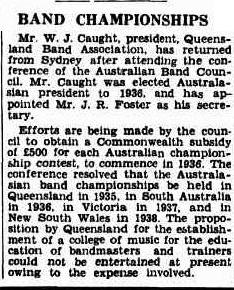
No doubt this is an interesting set of developments and hopeful proposals.  Evidently, the State associations were quite collegial in the way they were now operating.  It seems, however, that “The proposition by Queensland for the establishment for a college of music for the education of bandmasters and trainers could not be entertained at present owing to the expense involved.” (“BAND CHAMPIONSHIPS,” 1934).  This being said, an order of National championships was decided – “Queensland in 1935, in South Australia in 1936, in Victoria in 1937, and in New South Wales in 1938.” (“BAND CHAMPIONSHIPS,” 1934).

Courier-Mail, 23/0

We also see evidence from this conference on just how difficult it was to achieve unity in rules.  Mr. Dall, then Secretary of S.A.B.A. and the South Australian representative at the conference, was quoted in an article published in the Advertiser newspaper on the 30thof April:

“If such conferences are continued they will be of tremendous benefit to contesting bands in Australia.  We found it difficult to frame rules owing to the different conditions operating in the various States.  In framing a set of rules to apply to all States without seriously affecting any State’s present rules, we found it necessary to compromise on several items so that they would be applicable to all States.”

“If the conferences can be continued there is no doubt that in the near future a set of rules will be framed that will be entirely satisfactory to all bands throughout the Commonwealth.  With this object in view we framed a set of rules for two years trial.”

(“BAND CHAMPIONSHIPS HERE IN 1936,” 1934)

The next biennial conference of the Australian Band Council was held in Brisbane during May 1936.  The Courier-Mail reported on some resolutions which included making Melbourne the national headquarters in future and that all future conferences would be held in Melbourne (“AUSTRALIAN BAND COUNCIL,” 1936).  “Mr. H. J. Sullivan, secretary of the Victorian Bands’ League, who is the Victoria delegate to the council, was appointed permanent Federal secretary of the council.” (“AUSTRALIAN BAND COUNCIL,” 1936).

Courier-Mail, 1/05/1936, p. 18

Evidently, a new President of the Australian Band Council was elected as seen by the picture which was published by the Australasian Bandsman newspaper in 1937 (“Lieut. K. G. Kennedy,” 1937).

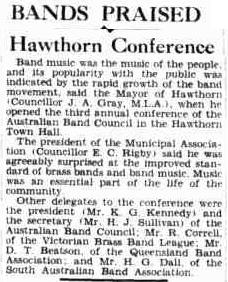
Numerous rule changes were reported on before the commencement of the 1938 conference in Melbourne by the brass band correspondent to the Advertiser newspaper, colloquially known as ‘Baton’. He wrote a very detailed overview of the rule proposals which, unfortunately, cannot be listed here due to brevity.  However, the rule proposals covered areas such as registration, marching and the quickstep competition (Baton, 1938).  The conference, held at Hawthorn Town Hall in suburban Melbourne was a success and the Mayor of Hawthorn gave the conference, and brass bands full praise (“BANDS PRAISED,” 1938).

The Argus, 1/08/1938, p. 2

In 1939 the National Championships were held in Bundaberg, QLD over Easter and we see some reporting of new rules that were decided upon at the Melbourne conference.  The Cairns Post, while highlighting the local brass band that was to take part, also reported that:

Rule nine of the Contest Rules governing all future championship contests now reads:- “(a) The Australian championship shall be competed for annually at a time and place to be decided by the Council, and shall be for “A” grade only”

“(b) State championships shall be held at such time and place as may be decided by the governing body.”

(“BAND CHAMPIONSHIP.,” 1939)
Badge: 1939 Australian Championship Band Contest, Bundaberg
(Source: Jeremy de Korte Collection)

Such are the vagaries of the rules. It was at this time however when the world was again plunged into War and there was a suspension of a majority of band contests.  We next see articles relating to the National band council appear again in the middle to late 1940s.

The 1940s & 1950s:

It appears that the Australian Band Council was quiet during the Second World War years, which was understandable and certainly there is not much evidence to suggest that National competitions took place.  This is not to say there were not local and State competitions during this time, at least in Victoria (Victorian Bands’ League, 1939).  However, as shown by these same records, a competition was held in Frankston, Vic. in late 1945 and early 1946 which was called an “Australian Championship” (Victorian Bands’ League, 1939, p. 34).  While it was called as such, the only bands that participated came from Victoria.

Coming into the 1950s we again see the ideals of the Australian Band Council being reiterated in local newspapers. Published in 1952, an article in the Mudgee Guardian tries to explain what the A.B.C. actually is and what it does:

“While the N.S.W. Band Association controls Band matters within that State, the Australian Band Council is the governing body for Band matters throughout the Commonwealth, and has jurisdiction within each State.

The objects of the A.B.C. are similar to the N.S.W.B.A. that is to say: To ensure that Band contests, solo and part competitions shall be conducted throughout Australia under a uniform set of rules: to deal with any appeals which may be made to the Council by any affiliated State governing body in respect of any action taken under any rule of the Council: to promote a general love and knowledge of Band music and good fellowship amongst Bandsmen: and to promote and assist in the promotion of, and to control Band contests.”

(“BAND SERIES No. 6.,” 1952)

The article then proceeded to highlight other aims and ideals.

Unfortunately, the exact date of a name change to the National Band Council of Australia is unclear.  However, as mentioned, the N.B.C.A. website has published National results dating back 1935 (National Band Council of Australia, 2024a).

19550113_Central-QLD-Herald_ABC-President
Central Queensland Herald, 13/01/1955, p. 17

Conclusion:

The history of the National Council is unique as there were a special set of circumstances needed to make sure it formed and succeeded.  The various starts had similar aims and ideals with the uniformity of rules being first and foremost.  Collegiality was emphasized despite the difficulty in creating a uniform set of rules and procedures.  The interactions between different State associations are clearly highlighted in this regard.  It seems that the State associations tried to make this work with the best of intentions and that is something to be admired.  Certainly, the legacy is still seen today with the continued existence of a National Band Council of Australia and the National band championships which are held each year in a different State.

References:

AUSTRALIAN BAND COMMITTEE. (1923, 05 February). Daily Mail (Brisbane, Qld. : 1903 – 1926), 3. http://nla.gov.au/nla.news-article218974562

Australian Band Council. (1934). Australian Band Council : Constitution : Contest Rules : Quickstep Regulations and Instructions  [Constitution]. Oxford Press. 

AUSTRALIAN BAND COUNCIL : Future Conferences in Melbourne. (1936, 01 May). Courier-Mail (Brisbane, Qld. : 1933 – 1954), 18. http://nla.gov.au/nla.news-article38467409

BAND ASSOCIATION. (1913, 24 April). Register (Adelaide, SA : 1901 – 1929), 4. http://nla.gov.au/nla.news-article59254032

BAND CHAMPIONSHIP : For Australian Title : Cairns Participation. (1939, 25 February). Cairns Post (Qld. : 1909 – 1954), 8. http://nla.gov.au/nla.news-article42169758

BAND CHAMPIONSHIPS. (1934, 23 April). Courier-Mail (Brisbane, Qld. : 1933 – 1954), 16. http://nla.gov.au/nla.news-article1192269

BAND CHAMPIONSHIPS : FEDERAL GOVERNMENT TO BE ASKED FOR GRANT. (1905, 26 October). Age (Melbourne, Vic. : 1854 – 1954), 6. http://nla.gov.au/nla.news-article199409235

BAND CHAMPIONSHIPS HERE IN 1936 : Conference Frames Rules for Two Years’ Trial. (1934, 30 April). Advertiser (Adelaide, SA : 1931 – 1954), 12. http://nla.gov.au/nla.news-article74095881

Band President. (1955, 13 January). Central Queensland Herald (Rockhampton, Qld. : 1930 – 1956), 17. http://nla.gov.au/nla.news-article75434128

BAND SERIES No. 6 : Band Council. (1952, 13 October). Mudgee Guardian and North-Western Representative (NSW : 1890 – 1954), 7. http://nla.gov.au/nla.news-article156439664

BAND UNITY MOVE : States Link With Victorian League. (1933, 29 May). Herald (Melbourne, Vic. : 1861 – 1954), 10. http://nla.gov.au/nla.news-article243112744

BANDS PRAISED : Hawthorn Conference. (1938, 01 August). Argus (Melbourne, Vic. : 1848 – 1957), 2. http://nla.gov.au/nla.news-article12454503

Baton. (1938, 14 July). BANDS AND BANDSMEN : Plans for Band Council Conference. Advertiser (Adelaide, SA : 1931 – 1954), 11. http://nla.gov.au/nla.news-article35597004

BEST BAND DISCORD : Brunswick-Collingwood Contest to Go On. (1927, 23 June). Herald (Melbourne, Vic. : 1861 – 1954), 23. http://nla.gov.au/nla.news-article243967808

BRASS BAND CONTESTS : Federal Council of Control? : Conference for Brisbane. (1933, 27 June). Toowoomba Chronicle and Darling Downs Gazette (Qld. : 1922 – 1933), 4. http://nla.gov.au/nla.news-article254338919

CHALLENGE BAND CONTEST. (1927, 02 August). Corowa Free Press (NSW : 1875 – 1954), 3. http://nla.gov.au/nla.news-article236067765

de Korte, J. D. (2018, 15 March). The politics of affiliation: The Victorian Bands’ Association to the Victorian Bands’ League. Band Blasts from the Past : Anecdotes, Stories and Personalities. https://bandblastsfromthepast.blog/2018/03/15/the-politics-of-affiliation-victorian-bands-association-to-the-victorian-bands-league/

de Korte, J. D. (2022). Newington, Vic. : 1939 Australian Championship Band Contest – Bundaberg [Photograph of tin badge]. [IMG_8028]. Jeremy de Korte, Newington, Victoria. 

Drummer Boy. (1921, 05 November). BANDS AND BANDSMEN. Northern Star (Lismore, NSW : 1876 – 1954), 9. http://nla.gov.au/nla.news-article93081749

Greaves, J. (1996). The great bands of Australia [sound recording] [2 sound discs (CD)]. Australia, Sound Heritage Association. 

HALL OF BAND MUSIC : Australian Proposal. (1934, 05 April). Central Queensland Herald (Rockhampton, Qld. : 1930 – 1956), 8. http://nla.gov.au/nla.news-article70310251

INTERSTATE BAND CONFERENCE. (1921, 27 October). Argus (Melbourne, Vic. : 1848 – 1957), 4. http://nla.gov.au/nla.news-article4629185

Lieut. K. G. Kennedy. (1937, 26 June). Australasian Bandsman

National Band Council of Australia. (2024a). Contest Results: Results from the Australian National Band Championships, 1935 to present. National Band Council of Australia. Retrieved 13 April 2024 from https://nbca.asn.au/archives/results

National Band Council of Australia. (2024b). History of the NBCA. National Band Council of Australia. Retrieved 13 April 2024 from https://nbca.asn.au/about/history

THE NEXT BAND CARNIVAL. (1925, 28 May). Toowoomba Chronicle and Darling Downs Gazette (Qld. : 1922 – 1933), 4. http://nla.gov.au/nla.news-article253924392

Royal South Street Society. (1903). 1903-10-31 Brass Band Contests : Held at City Oval [Eisteddfod Results]. Royal South Street Society Results Database. https://results.royalsouthstreet.com.au/results/1903-10-31-brass-band-contests

SOUTH-STREET COMPETITIONS : CHAMPIONSHIP BRASS BAND CONTESTS. (1903, 30 October). Argus (Melbourne, Vic. : 1848 – 1957), 8. http://nla.gov.au/nla.news-article10579779 

Victorian Band Association : Claim to Australian Championship. (1927, 22 February). Age (Melbourne, Vic. : 1854 – 1954), 9. http://nla.gov.au/nla.news-article204193668

VICTORIAN BAND ASSOCIATION : SECOND ANNUAL MEETING. (1903, 20 October). Ballarat Star (Vic. : 1865 – 1924), 6. http://nla.gov.au/nla.news-article208159835

Victorian Bands’ League. (1939). Notebook – Victorian Bands’ League Contest Records (1939 – 1950)  [Notebook]. Victorian Collections. https://victoriancollections.net.au/items/5b7ce49921ea6916bcdba41c 

Bands on Australian islands: unique challenges in unique environments

19320000_phillip-island-bb_phot16005
Phillip Island Brass Band, 1932 (Source: IBEW)

Please note: Aboriginal and Torres Strait Islander people should be aware that this blog post may contain images or descriptions of deceased persons in photographs and (digital) newspaper articles.  In addition, this blog post may contain images or descriptions of deceased persons from former secure health facilities in photographs and (digital) newspaper articles.

Introduction:

When we look at the distribution of brass bands in Australia between 1900 – 1950 we can see that they mushroomed everywhere.  Some towns and localities were lucky to have two or three.  Bands merged, split, started, and ended, and we know that individual bandsmen were great traveler and had various loyalties.  Given the size of Australia, it can be assumed that geography was an early challenge – it took a long time to get anywhere and obtain the fundamentals for running a band.  Yet the early bands did it and several bands survived.

This post is about the brass bands that were located on some of the islands that surround Australia.  In selecting the islands and bands, I took a punt with some and accidentally found some others.  When looking for stories and histories I found that information on these island bands was a bit hit and miss.  In some cases, there were only one or two newspaper articles (that I found) where there was only a mere mention of a band.  Timelines were difficult to establish but we can get a rough guess based on early articles and later articles.  However, the fact that these bands had an existence of sorts only adds to the rich history of bands in this country.

I started this post with a disclaimer.  The reason for this is that two of the bands were located on islands where Aboriginal missions were established, and another band was located on a small island that once housed a facility for isolating people with leprosy.  To delve deeper in the pasts of these missions and this facility uncovered some disturbing facts, as I tried to build a background as to why bands were established in these locations.  All locations had unfortunate pasts which will have to be acknowledged in this post, but we recognize that at the time, bands were created with a similar purpose to those in other locations.

This post will address each location, or groups of locations in turn and we will see that the bands in these places were innovative, dedicated and proud.  We will also see that they were engaged with island life and that being a band on an island had a special meaning.  These bands may not have had the reputation or resources of bigger ensembles, but they did have a certain spirit given to them by their locations.

Kangaroo Island (South Australia):

Kangaroo Island, located off the coast of the Yorke Peninsula in South Australia is nominally Australia’s third largest island behind Tasmania and Melville Island (Sealink Travel Group, 2019).  At 155km in length and up to 55km in wide it is big in area but contains only four main settlements, of which Kingscote is the main town (Sealink Travel Group, 2019).  The Kangaroo Island Pioneers Association has documented history prior to 1836 however most of the recorded history occurs after this date (Kangaroo Island Pioneers Association, 2019).

We first see mention of a brass band on Kangaroo Island in an article published by The Register in 1906 which makes mention of a concert presented by the Kingscote Brass Band (“MUSIC FOR WATCHERS BY THE SEA.,” 1906).  This concert was in aid of an instrument fund and was basically a social evening and dance. However, the article also makes mention of another performance held during a lunch hour where the band, with some innovation, broadcast their performance by telephone!  As written in the article:

Last Tuesday, during the luncheon hour, through the courtesy of the P.M. here (Mr. Lamprey), the Kingscote Brass Band played selections through the telephone to Cape Willoughby and Cape Borda Lighthouses.  The music was much appreciated by the watchers by the sea at either end of the island.  Cape Borda is 70 miles westerly from Kingscote, and Cape Willoughby is about 30 miles easterly.

(“MUSIC FOR WATCHERS BY THE SEA.,” 1906)

To think they did this in 1906 is quite remarkable and inventive.

The activities of the Kingscote Brass Band were mentioned in the local newspaper, The Kangaroo Island Courier in late 1907 where they were noted for wanting to present a program of Christmas Carols and marches on Christmas Eve (“Kingscote Brass Band Items.,” 1907).  This is in addition to their fundraising effort for new instruments.  In the middle of 1908, the said newspaper received a letter from a mainlander who had read an article in Australian Bandsman about the travel of Kingscote Brass Band members (“ENTHUSIASTIC INSTRUMENTALISTS.,” 1908).  In his letter he says, “I think the 12-mile man is the bandmaster and he deserves a lot of encouragement for his trouble” and then proceeds to wax lyrically, “…although I don’t suppose he considers it a trouble, as all men who are interested in their particular band never find anything troublesome where the band is concerned.” (“ENTHUSIASTIC INSTRUMENTALISTS.,” 1908).

Kangaroo Island Courier, 21/12/1907, p. 3

We have been told.

There is a further mention of the Kingscote Brass Band giving a performance in 1921 where they were noted for showing improvement in their playing (“THE KINGSCOTE BAND.,” 1921).  The article mentions that they had been tutored by their former conductor who was visiting the island after a 10-year absence (“THE KINGSCOTE BAND.,” 1921).  Unfortunately, due to limited resources, it is unclear how much longer this band survived. However, it is clear from this brief amount of information that they were appreciated when they performed.

King Island (Tasmania):

King Island is located in the middle of Bass Strait off the northern coast of Tasmania.  It is renowned for its produce although it has never had a big population, there are some well-known localities on the island.  It is also known for the ruggedness of its coastline and there are many instances of shipping coming to grief on the rocks. The main center of population is the town of Currie where they still have a community band.

In terms of early brass bands, King Island is unique as there are two brass bands mentioned as having existed in the early 1900s.  Information on this band also comes from an island newspaper, the King Island News and we first see a mention people wanting for form a band in Currie in 1914 (“King Island.”, 1914).  Although two years later the Currie Brass Band has still not been founded and the money that was initially raised has been donated to wounded King Island soldiers returning from World War 1 (“No title,” 1916).

In 1918 the King Island News reported on the formation of another brass band, this time in the mining settlement of Grassy which is located on the eastern side of the Island (“KING ISLAND.,” 1918).  Initially called the Grassy Brass Band, this band was actually set up by the mining company for the recreation of employees at the mine and was known as the King Island Tungsten Brass Band (“KING ISLAND.,” 1918).  This band was called for all over the island and in 1919 was noted for its performances of Christmas music in Currie (“No title,” 1919).

Again, this is another instance where some history is incomplete as we don’t know for certain when this band stopped operations.  While the articles are not listed, the King Island Tungsten Brass Band did numerous engagements on the island and were a valued part of the island community.

Phillip Island (Victoria):

Phillip Island is an island that occupies the southern portion of Westernport Bay in Victoria and is well-connected to the rest of the state by road and ferry.  People might know it because of certain penguins however it has had a long history of settlement and there are several towns on the island with the main town being Cowes.

It should be no surprise that a brass band formed on Phillip Island in the township of Cowes.  The Phillip Island Brass Band was much more proactive than any other brass bands on Australian islands and were much more well-traveled.  They were even proactive enough to enter the South Street band contests on two occasions and took themselves on an educational trip around Tasmania (Royal South Street Society, 1932, 1934; “Visiting Band,” 1947).

Examiner, 30/08/1947, p. 3

A proposal to form the Phillip Island Brass Band is mentioned in an informative article from the Frankston and Somerville Standard on the 30thMay, 1923 (“PHILLIP ISLAND BRASS BAND.,” 1923).  They had all the right intentions too, as the article opens with these platitudes:

An effort is being made to form a brass band on Phillip Island.  The advantages of such an institution are many.  Anything that will encourage the practice of music, especially concerted music, is worthy of hearty support, and the metal and moral benefit derived by any young man who gives his mind and time to learning an instrument is great.

(“PHILLIP ISLAND BRASS BAND.,” 1923)

The article goes on to note that the promoters of the band were under no illusions as to what they might need in terms of men willing to join the band, instruments, a hall to play in, and a whole host of other items.  The Island Progress Association, as well as the local council, were behind the project and a band was formed.

19340709_herald_phibb-crop
Herald, 09/07/1934, p. 8

As mentioned, the band was quite proactive in the way they did things, even bordering on the unusual.  For example, to help raise funds for a trip to the South Street contests in 1934, a picture of a bandsman helping with the chicory harvest was published in the Herald newspaper (above) – this was apparently a common activity at the time (“COWES BANDMEN HANDLE CHICORY CROP,” 1934).  They did make it to South Street, twice, once in 1932 where they competed in C and D grades and also in 1934 where they only competed in D grade.  The results of their endeavors are listed in the table below:

Year:Competition:Grade:Section:Points:Place:
1932Victorian Band ChampionshipsCNo. 1 Test Piece124
No. 2 Test Piece120
Quickstep133
DNo. 1 Test PIece1203rd
No. 2 Test PIece1193rd
Quickstep1263rd
1934Victorian Band ChampionshipsDSelection277Equal 3rd
Quickstep1674th
(source of table data: Royal South Street Society, 1932, 1934)

Aside from this, they were well-known and in 1935 they were one of the bands to form a Gippsland Branch of the Victorian Bands’ League with other bands from Warragul, Wonthaggi, Korumburra, Leongatha and Dandenong (“Victorian Bands League.,” 1935).

The Age, 8/10/1935, p. 4

There seems to have been some disquiet after the band returned from Tasmania in 1947.  In January 1953 the State Governor visited Phillip Island and the visit was written up in an article in The Argus newspaper.  As the article says:

Yesterday was an exciting day for Cowes, Phillip Island.  Sir Dallas Brooks, Governor, paid his first official visit to the island and almost everybody, including the town’s brass band, turned out for the occasion.

Until last week the band had been “in recess for four years,” as one member tactfully put it.  But it acquitted itself well.

(“Cowes turned out to meet the Governor,” 1953)

The cause and conclusion of this four-year recess might require further research.

The Trove archive has some limitations as articles fall into copyright from 1955 so we don’t exactly know when the Phillip Island Brass band went defunct.  But they are one of the well-documented bands with further information to be found on the website of the Phillip Island & District Historical Society.

Palm Island and Thursday Island (Queensland):

Palm Island Brass Band, Queensland, 1931 (source: State Library of Queensland: 166102)

Palm and Thursday islands are located off the coast of Queensland with Palm Island near the coast at Townsville and Thursday Island in the Torres Strait off the far northern tip of Queensland.  These islands are mentioned because of their unique status as former Indigenous Missions and the fact that both former missions once had brass bands.

This post will not go into the pros and cons of Indigenous missions aside to say that they existed and are part of Australia’s history.  It was a very different time with different attitudes, and we can only assume that the people who once ran these institutions thought they were doing the right thing by Indigenous people.  A brass band was obviously seen as a binding activity and one which other Australians would accept.

Unfortunately, the language in local newspapers that mentioned the bands were as one would expect from this time.  There was interest in the island bands and we see in an article from 1926 published in The Northern Miner newspaper that the bandmaster of The Towers Concert Band visited the island to assist the Indigenous conductor and was duly thanked in a letter from the Palm Island Band conductor (“PALM ISLAND BAND,” 1926).  By some accounts, the people of the island appreciated the fact that a brass band, as well as a football team and cricket team, had been set up by the Superintendent of the settlement, and certainly, these were seen as worthwhile activities (Watson, 2005).   In 1927 the football team and brass band visited Townsville and apparently “astonished” the crowd – for both football and music (“FOOTBALL,” 1927).

Daily Mercury, 26/09/1927, p. 7

Slightly differently, the Thursday Island Brass Band once included “white and black players” pre-war but was reformed after the war with just aboriginal musicians (“ISLANDERS’ BRASS BAND,” 1952).   Both bands were clearly still in operation in the 1950’s, but clearly the novelty of having Indigenous bands had not changed, despite this cited article providing additional information (“‘Band music provides healthy interest for aborigines’,” 1953).  In 1954 the Palm Island Brass Band was to be included in a mass-gathering of bands in Townsville to greet Queen Elizabeth (“Townsville Band Festival,” 1954).

We can always judge the attitudes of the time as being unfortunate and the language as patronising.  We also know that there are still bands dotted across the Top End and some very good music programs that are helping to reform a culture of Indigenous community bands (Cray, 2013; Sexton-McGrath, 2014).  In some respects, these former Mission bands as well as other mainland mission bands created a legacy that has given new life to new bands.

Peel Island (Queensland) and Norfolk Island:

We come now to Peel Island and Norfolk Island, both very different places yet both have interesting pasts.

Peel Island is located in Moreton Bay, Brisbane and is a former Quarantine Station.  Yet for many years it housed people forcibly removed from home and family for being contracted with Leprosy.  By all accounts, this was harsh, isolated, unforgiving and primitive place and it accommodated people from all backgrounds and races (Brown, 2018).  The churches were the only organisations to try to bring comfort to the inmates and it is noted in 1928 that one Churchman made an appeal for an Eb Bass for a member of the Peel Island Brass Band (“CHURCH NEWS.,” 1928).

This is the first evidence we have that there was a band of sorts on Peel Island and newspaper articles sporadically reported on the various iterations of the band (“SIDE DRUM WANTED FOR PEEL ISLAND’S BAND,” 1945). Likewise, there are also reports of bands visiting the Island to entertain the inmates  – the picture below is of a Salvation Army band visiting Peel Island in 1920 and in 1939 the Brisbane Juvenile Band was part of a concert party (“Concert At Peel Island,” 1939).

19200000_peel-island_salvation-band
Salvation Army brass band visiting Peel Island Lazaret during the 1920s (source: State Library of Queensland: 74802)

Norfolk Island is another place with a very interesting past and the inhabitants are extremely proud of their history (Low, 2012).  Located off the coast of NSW, the inhabitants display a very independent streak, despite their association with Australia.  Which makes it all the more interesting that there is mention of a brass band that once existed on Norfolk Island.  There is not much to indicate the brass band existed apart from rare mentions in Australian newspapers.  We see mentions of a band in 1904, 1905 and 1926 where they are mentioned as being in attendance at official events and for rehearsing every week (Barnes, 1926; “NORFOLK ISLAND.,” 1904; “NORFOLK ISLAND.,” 1905).  It is unclear when the Norfolk Island Band officially started or ended.

Conclusion:

It is quite clear that these early brass bands of our islands had their own unique histories, although one might call them quirks.  While there are many similarities to other bands located on the mainland, the isolation and geography meant they had to be innovative and were also part of their communities.  It is fortunate that we can read about them now and wonder at their existence.  The knowledge that some of them existed in questionable environments is also a wonder but also indicates that they were a sign of the times.

We appreciate that these bands were part of a greater movement and that we can acknowledge the history.

References:

‘Band music provides healthy interest for aborigines’. (1953, 19 January). Courier-Mail (Brisbane, Qld. : 1933 – 1954), 2. http://nla.gov.au/nla.news-article50564060

Barnes, J. (1926, 11 June). UNDER BLUE SKIES : Life on Norfolk Island : No. 4. Cumberland Argus and Fruitgrowers Advocate (Parramatta, NSW : 1888 – 1950), 9. http://nla.gov.au/nla.news-article104960531

Brown, A. (2018, 07 July). Queensland’s last leper colony reveals its secrets. Brisbane Times. https://www.brisbanetimes.com.au/national/queensland/queensland-s-last-leper-colony-reveals-its-secrets-20180704-p4zpd1.html

CHURCH NEWS. (1928, 29 September). Brisbane Courier (Qld. : 1864 – 1933), 7. http://nla.gov.au/nla.news-article21343088

Concert At Peel Island. (1939, 26 March). Sunday Mail (Brisbane, Qld. : 1926 – 1954), 5. http://nla.gov.au/nla.news-article98238889

COWES BANDMEN HANDLE CHICORY CROP. (1934, 09 July). Herald (Melbourne, Vic. : 1861 – 1954), 8. http://nla.gov.au/nla.news-article243161356

Cowes turned out to meet the Governor. (1953, 22 January). Argus (Melbourne, Vic. : 1848 – 1957), 16. http://nla.gov.au/nla.news-article23223484

Cray, S. (2013, 14 August). Brass band babies. ABC Radio National. Retrieved 14 August 2013 from https://www.abc.net.au/radionational/programs/archived/intothemusic/brass-band-babies/4887046

ENTHUSIASTIC INSTRUMENTALISTS. (1908, 11 July). Kangaroo Island Courier (Kingscote, SA : 1907 – 1951), 4. http://nla.gov.au/nla.news-article191629848

FOOTBALL : Aboriginal Team. : Defeats Townsville. (1927, 26 September). Daily Mercury (Mackay, Qld. : 1906 – 1954), 7. http://nla.gov.au/nla.news-article173762864

ISLANDERS’ BRASS BAND. (1952, 31 May). Brisbane Telegraph (Qld. : 1948 – 1954), p. 2. Retrieved from http://nla.gov.au/nla.news-article216499386

Kangaroo Island Pioneers Association. (2019). History. Kangaroo Island Pioneers Association. Retrieved 28 January 2019 from https://www.kipioneers.org/history

KING ISLAND : Grassy News. (1918, 21 May). Examiner (Launceston, Tas. : 1900 – 1954), 6. http://nla.gov.au/nla.news-article50981378

“King Island.” “Fat Stock for Victoria.” “Dear Beef for Launceston.”. (1914, 29 May). King Island News (Currie, King Island : 1912 – 1954), 2. http://nla.gov.au/nla.news-article217035552

THE KINGSCOTE BAND. (1921, 19 March). Kangaroo Island Courier (Kingscote, SA : 1907 – 1951), 2. http://nla.gov.au/nla.news-article191552031

Kingscote Brass Band Items. (1907, 21 December). Kangaroo Island Courier (Kingscote, SA : 1907 – 1951), 3. http://nla.gov.au/nla.news-article191635685

Low, M. K. (2012). Putting down roots : belonging and the politics of settlement on Norfolk Island (Publication Number 9451462) [PhD, University of Western Australia, School of Social Sciences]. University of Western Australia Research Repository. Perth, Western Australia. https://research-repository.uwa.edu.au/en/publications/putting-down-roots-belonging-and-the-politics-of-settlement-on-no

MUSIC FOR WATCHERS BY THE SEA. (1906, 21 November). Register (Adelaide, SA : 1901 – 1929), 7. http://nla.gov.au/nla.news-article56693536

No title. (1916, 17 March). King Island News (Currie, King Island : 1912 – 1954), 2. http://nla.gov.au/nla.news-article212036865

No title. (1919, 08 January). King Island News (Currie, King Island : 1912 – 1954), 2. http://nla.gov.au/nla.news-article212038832

NORFOLK ISLAND. (1904, 22 March). Brisbane Courier (Qld. : 1864 – 1933), 7. http://nla.gov.au/nla.news-article19271611

NORFOLK ISLAND : Empire Celebration. (1905, 26 June). Sydney Morning Herald (NSW : 1842 – 1954), 7. http://nla.gov.au/nla.news-article14687675

PALM ISLAND BAND : An interesting letter. (1926, 13 February). Northern Miner (Charters Towers, Qld. : 1874 – 1954), 5. http://nla.gov.au/nla.news-article80657422

Phillip Island Brass Band, 1932. (1932). [Photograph]. [phot16005]. The Internet Bandsman Everything Within, Vintage Brass Band Pictures : Australia. http://www.ibew.org.uk/vbbp-oz.html

PHILLIP ISLAND BRASS BAND. (1923, 30 May). Frankston and Somerville Standard (Vic. : 1921 – 1939), 6. http://nla.gov.au/nla.news-article75954089

Royal South Street Society. (1932, 29 October). 1932-10-29 Brass Band Contests. Royal South Street Society. Retrieved 28 January 2019 from https://results.royalsouthstreet.com.au/results/1932-10-29-brass-band-contests

Royal South Street Society. (1934, 03 November). 1934-11-03 Brass Band Contests. Royal South Street Society. Retrieved 28 January 2019 from https://results.royalsouthstreet.com.au/results/1934-11-03-brass-band-contests

Sealink Travel Group. (2019). About Kangaroo Island, South Australia. Sealink. Retrieved 28 January 2019 from https://www.sealink.com.au/about-kangaroo-island/

Sexton-McGrath, K. (2014, 09 November). Yarabah Band Festival: Return of the brass band brings thousands out to Indigenous community. ABC News Queensland. Retrieved 31 January 2019 from https://www.abc.net.au/news/2014-11-09/yarrabah-band-festival-brass-band-brings-thousands-to-community/5877834

SIDE DRUM WANTED FOR PEEL ISLAND’S BAND. (1945, 27 June). Courier-Mail (Brisbane, Qld. : 1933 – 1954), 6. http://nla.gov.au/nla.news-article48954474

Townsville Band Festival. (1954, 09 February). Northern Miner (Charters Towers, Qld. : 1874 – 1954), 4. http://nla.gov.au/nla.news-article81658839

Unidentified. (1920). Salvation Army brass band visiting Peel Island Lazaret during 1920s [copy print : b&w]. [74802]. Brisbane John Oxley Library, State Library of Queensland, OneSearch. https://hdl.handle.net/10462/deriv/208680

Unidentified. (1931). Palm Island Brass Band, Queensland [photographic print : black & white , 1931.]. [166102]. Brisbane John Oxley Library, State Library of Queensland, One Search. https://hdl.handle.net/10462/deriv/220300

Victorian Bands League. (1935, 08 October). Age (Melbourne, Vic. : 1854 – 1954), 4. http://nla.gov.au/nla.news-article203851495

Visiting Band. (1947, 30 August). Examiner (Launceston, Tas. : 1900 – 1954), p. 3. Retrieved from http://nla.gov.au/nla.news-article52603726

The A.B.C. Military Band: an ensemble of the times

S6.2_20180609_19310000_ABC-Military-Band_Postcard
Postcard of the A.B.C Military Band. Possibly in 1930 or 1931 (Source: Victorian Collections : Victorian Bands’ League Archives)

Introduction:

To view the early history of bands in this country would be to see a history that is based around brass bands.  This was no accident as much of the brass band culture was imported into the Antipodes by early settlers from the United Kingdom (Bythell, 2000).  However, in amongst this brass band culture, there were a few oddities in the form of military bands – bands that included woodwinds.  They were a rarity, but they certainly existed.  One of the most famous groups was the A.B.C. Military Band which was only in operation from 1930 – 1951.  This ensemble built an enviable reputation for their playing, sound, and demeanor.

Military bands were not new ensembles in Australia, certainly not in name.  But the A.B.C. Military Band accomplished much more than previous ensembles, no doubt partly due to the broadcasting resources of the A.B.C.’s radio network.  Also, it provided many musicians with a unique employment opportunity, guidance by the best wind band conductors that could be found, and a large following through Australia.

This post will delve into the short history of the band with material mainly found through the Trove archive and will highlight some of the more interesting stories of this ensemble.  Depending on which history is read, most will say the band started in 1933 however this isn’t the case as it essentially started in 1930.  There are only limited photos of the band that seem to exist which are displayed with this post.

Unfortunately, the band is no longer part of the musical landscape, so we have only articles and photos that preserve the memory.  And as will be seen, in the end, the ensemble was closed due to reasons that are only too familiar today.

1930-1933: Starting a band:

To start this small history, we need to see what the A.B.C. was doing regarding the running and broadcasting of its own ensembles.  From using the Trove archive, we can find that in-house ensembles were barely getting started if they existed at all.  Interestingly there was one that stood out.  In 1929 the Table Talk newspaper published an article on the famous conductor Percy Code, who was an eminent bandsman and composer (Gibbney, 1981).  Percy, in amongst his other musical activities, was the conductor of the 3LO Orchestra which was labeled as being the “National Broadcasting Orchestra” – the A.B.C., at the insistence of the Government, had taken over several radio services and when taking over 3LO had gained an orchestra as well! (Bradish, 1929).  Unfortunately, this article is the only mention of such an orchestra although 3LO broadcast many forms of music during this time, including brass bands (“3LO.,” 1929).

Argus, 29/10/1930, p. 15

Articles first started appearing mentioning a newly formed A.B.C Military Band in 1930.  And interestingly at the time, there appears to have been two A.B.C. Military Bands that were formed – one in Melbourne and one in Sydney (Ariel, 1933).  Although, just about all of the articles only provided details on when the band could be heard on the radio (“MILITARY BAND AT 3LO.,” 1930).  What we do know is that the great Harry Shugg who was the famed conductor of the Malvern Tramways Band, was the first conductor of the A.B.C. (Melbourne) Military Band and Jack Pheloung, who was the renowned conductor of the Manly Municipal Band was the first conductor of the A.B.C. (Sydney) Military Band (Ariel, 1933; “CONDUCTOR AT 18.,” 1931).  Both conductors of their respective A.B.C. Bands held their positions until 1933 which is when a single A.B.C. Military Band was reformed with different priorities and a new conductor.  The postcard at the start of this post shows Harry Shugg in front of the A.B.C. (Melbourne) Military Band in what looks like a recording studio.

19340000_ABC-Mil-Band-Perth
ABC Military Band on Tour, Possibly in 1934 (Source: Western Australia Television History)

1933 – 1934: Guest Conductor, Capt. Adkins:

This time period was perhaps the most interesting for the A.B.C. Military Band with superb guest conductors, a new focus on musicality and National tours (Ken, 2012).  In November 1933 the A.B.C. assembled 40 musicians from around Australia to form a new Military Band, which, according to the article, was only supposed to be engaged for 10 weeks (“A.B.C. MILITARY BAND.,” 1933).  They were initially conducted by their deputy conductor, Mr. R. McAnally (another prominent bandsman), until the guest conductor Capt. H. E. Adkins, the then Director of the Royal Military School of Music, Kneller Hall, commenced his position (“A.B.C. MILITARY BAND.,” 1933).

19340303_WeeklyTimes_Adkins
Weekly Times, 03/03/1934, p. 8

Capt. Adkins arrived in Australia in December 1933 and immediately started conducting the band.  He apparently had trepidations over what he was about to do but was quickly won over after his first rehearsal with the ensemble (“A.B.C. BAND,” 1933).  When speaking at a club in Sydney about his initial experiences with the band, he said that while on his way out from England, “I had a feeling of anxiety, but it disappeared after our first practice yesterday.  I was very agreeably surprised, and in a few months’ time the band will be the equal of any in the world” (“A.B.C. BAND,” 1933).  The band commenced touring around Australia and the choice of Capt. Adkins as Guest Conductor won praise in many places.  The Evening News from Rockhampton was one newspaper that published an enthusiastic article by stating at one point that Capt. Adkins , “…is recognized as the world’s greatest authority on woodwind instruments” (“A.B.C. National Military Band.,” 1934).  Likewise, a reporter with the pseudonym of “G.K.M.” writing for the Weekly Times newspaper congratulated the A.B.C. and noted that Capt. Adkins “…is setting a new standard for Australian bandsmen.” (G.K.M., 1934).  A month later the Weekly Times published a picture of Capt. Adkins at his farewell from Australia (“The Adkins Way,” 1934).

A later article from 1941, published in the Portland Guardian after Capt. Adkins had left the band (and Australia), followed through on some of memories and anecdotes of his tenure in front of the band.  We see a bandsman who was brought out to bring an ensemble up to a very fine standard of playing – and that’s exactly what he did!

Cleve Martin, now deputy-conductor, and E Flat clarinetist under Adkins, is one who remembers the swaggering, lovable, downright English band-leader.

“Take this so-and-so stand away, I never use the thing”

That first remark from Captain Adkins was typical of his downright ‘take no nonsense’ style,” says Cleve Martin. It was a blitz beginning with the Empire’s No. 1 bandsman, but the players soon became used to his roars and worked hard to give him the precision that he sought.

“The musical monologue is my method of conducting,” Adkins explained to the boys.  “I’ll talk to you all the time during rehearsal and in public performances.

(“STARS OF THE RADIO,” 1941)

There was much more that Adkins did for the band and much more on how he acted in front of band members and audience. Firm, but fair would probably be an accurate way to describe his mannerisms, without being too over the top:

He could become personal, although never malicious.  To a drummer : “I love every hair on your bald head, but when I say roll on the drums – roll!!!”

(“STARS OF THE RADIO,” 1941)

He was truly loyal to this band, so much so that he could not say goodbye to them in person when it was time to go.

His comradeship with the National Military Band was staunch.  Beneath the brusque sergeant-major manner was a soft nature.  He demanded the best possible playing, but also worked himself, and was deeply appreciative of the band’s response.  He expressed his attitude in a farewell wire to the band : “Sorry I failed to see you off.  At the last moment I realised I could not face it.”  At the hotel that night, someone noticed that he was on the verge of tears.

(“STARS OF THE RADIO,” 1941)

Having finished his guest appointment, Capt. Adkins returned home to England and Stephen Yorke resumed his direction of the band.

19410000_Hood_ABC-Mil-Band
ABC Military Band playing with ABC commentator on a vessel. (Source: flickr : Australian National Maritime Museum)

1934 – 1951: Concerts, the War and the final years:

As with any organization of its size, the A.B.C. was not immune to industrial trouble and in the middle part of 1934, there was a court case over the rate of pay for the Military Band musicians (“IN THE LAW COURTS,” 1934).  Stephen Yorke had taken over as conductor by this time and was asked to give evidence in court.  The crux of the issue was over which players in the band deserved extra remuneration as the court had decided that the band was like an orchestra with actual principal players.  Mr. Yorke apparently stated that any player in the band could be considered a principal player as they all played some kind of solo part – but he didn’t have knowledge of the industrial award that distinguished between “leaders” and “principals” (“IN THE LAW COURTS,” 1934).  Whereas the Musicians’ Union countered that the principal players should be the first player of any class of instrument, and any single players of an instrument (“IN THE LAW COURTS,” 1934).  Capt. Adkins in his treatise had said that “the oboe was essentially a solo and color instrument.  Therefore an oboe player must be called upon at times to perform work comparable to that of a principal.” (“IN THE LAW COURTS,” 1934).  The final decision was that the commission followed the argument put forward by the Musicians’ Union where the principal players were the first players of a group of instruments and any player of single instruments were considered to be the principals (“IN THE LAW COURTS,” 1934).

In the year of 1936, we see the band, under the baton of Stephen Yorke, continue their series of broadcasts, concerts and other engagements around Australia.  Under Mr. Yorke, the reviews indicate that the quality and standard have not diminished, and they are receiving rave reviews (“A.B.C. Military Band.,” 1936).  Unfortunately, the A.B.C. raised the ire of some listeners who wanted more brass band music to be played, and berated the A.B.C. for putting on the wrong kind of music –they expressed support for regular performances of the military band as well (“A.B.C. Neglects the Bands.,” 1938).

The Second World War started in 1939 and the A.B.C. Military Band was there to lift the spirits of Australians over the radio with patriotic music  As can be seen in the article here published by the Shepparton Advertiser, it enthusiastically endorses the music played by the band on the radio (“NATIONAL MILITARY BAND SESSIONS,” 1941).

19410127_SheppartonAdv_ABC-Mil-Band-Sessions
Shepparton Advertiser, 27/01/1941, p. 4

As with most other organizations war hit home with the sad passing of an ex-member of the band at Tobruk.  The Smith’s Weekly newspaper in October 1941 published an obituary for Clarinetist John Smith, and highlighted his musical excellence:

A brilliant young musician, he took two scholarships at the Sydney Conservatorium for clarinet playing, and was considered one of the finest artists on that instrument in Australia.

Graduating from the Conservatorium, he went straight into the A.B.C. Military Band.  At the time of his enlistment he was a member of a leading Sydney theatre orchestra.

About 12 months ago he went overseas with a battalion of Pioneers, and served throughout the Middle East.

He wrote to a friend in the A.B.C. Military Band:

“My work in field stretcher-bearing which is the fate of all good bandsmen. It has proved quite interesting, though sometimes hard to take.  It has given me the opportunity of witnessing some examples of sheer braver and doggedness that other chaps probably never see.”

(“Ex-A.B.C. Musician Killed At Tobruk,” 1941)

Sadly, it was through doing this job that Smith lost his life.

After the conclusion of hostilities, we see the band resume its normal activities of performances and broadcasts which continued through the rest of the 1940’s (“A.B.C. BAND CONCERT,” 1946; “A.B.C. BAND RECITAL,” 1948).  Stephen Yorke was still the conductor of the band.

As another measure of the quality of musicians that were associated with the band, one of them was Tuba player Cliff Goodchild.  Cliff’s first real musical position was with the A.B.C. Military Band and after the band ended he gained a position with the Sydney Symphony, a position he held for 36 years (Veitch, 2008).  He was also a consummate bandsman and over his lifetime held positions as “Secretary of the National Band Council of Australia, President of the Band Association of NSW, founder and co-organiser of the NSW School Bands Festival and formed a number of bands, including the Waverly Bondi Beach Brass Band and the Sydney Brass” (Veitch, 2008).

Funding cuts brought about by Australian Federal Government in 1951 leave the A.B.C. no choice but to close the band  (“A.B.C. Band’s Farewell,” 1951).  This was a bitter end to a no doubt special period in Australian ensembles where we had a band that was excellent in its playing and revered throughout Australia. At the final concert in Sydney, conductor Stephen Yorke thanked the band and the audiences for their appreciation of the ensemble (“A.B.C. Band’s Farewell,” 1951).

19511015_TheAge_ABC-Mil-Band-Farewell
The Age, 15/10/1951, p. 3

Conclusion:

By all accounts this was a truly remarkable band; the finest musicians from all over Australia brought together under various conductors and being boosted to higher and higher levels.  A band that all Australians supported and were proud of. We see the high praise given to the conductors and musicians and with the broadcasting resources of the A.B.C., the sound of the band is heard Australia-wide.  From reading the articles of the time, we just have to wonder why they would cut such a fine ensemble?  But as we know, governments change and priorities change.  Who knows what the band could have become had the Federal government of the day not enforced funding cuts?

References:

3LO : St. Augustine’s Band. (1929, 05 October). Advertiser (Adelaide, SA : 1889 – 1931), 10. http://nla.gov.au/nla.news-article29626577

The Adkins Way. (1934, 03 March). Weekly Times (Melbourne, Vic. : 1869 – 1954), 8. http://nla.gov.au/nla.news-article223202315

Ariel. (1933, 01 September). FROM The LIGHTER-SIDE LAYER. Sun (Sydney, NSW : 1910 – 1954), 11. http://nla.gov.au/nla.news-article229153763

A.B.C. BAND : Visiting Conductor’s Praise. (1933, 16 December). Argus (Melbourne, Vic. : 1848 – 1957), 12. http://nla.gov.au/nla.news-article11721475

A.B.C. BAND CONCERT. (1946, 02 June). Sun (Sydney, NSW : 1910 – 1954), 5. http://nla.gov.au/nla.news-article229456055

A.B.C. BAND RECITAL. (1948, 30 May). Truth (Sydney, NSW : 1894 – 1954), 7. http://nla.gov.au/nla.news-article169373651

A.B.C. Band’s Farewell. (1951, 15 October). Age (Melbourne, Vic. : 1854 – 1954), 3. http://nla.gov.au/nla.news-article205334832

A.B.C. Military Band. (1936, 17 August). Age (Melbourne, Vic. : 1854 – 1954), p. 10. Retrieved from http://nla.gov.au/nla.news-article204916718

A.B.C. Military Band – Conductor: Harry Shugg. (1930?). [Postcard : L13.8cm – W8.8cm]. [0016]. Victorian Collections, Victorian Bands’ League. https://victoriancollections.net.au/items/5b39988221ea6d0008c461a6

A.B.C. MILITARY BAND : Forty Players Selected. (1933, 14 November). Age (Melbourne, Vic. : 1854 – 1954), 12. http://nla.gov.au/nla.news-article203351163

A.B.C. National Military Band. (1934, 16 January 1934). Evening News (Rockhampton, Qld. : 1924 – 1941), 9. http://nla.gov.au/nla.news-article201261855

A.B.C. Neglects the Bands. (1938, 02 May). Age (Melbourne, Vic. : 1854 – 1954), 10. http://nla.gov.au/nla.news-article206948874

Australian National Maritime Museum. (2006, 29 August). ABC Military Band playing with ABC commentator on a vessel, 1933-1951 [Photograph ]. flickr. Retrieved 08 July 2018 from https://www.flickr.com/photos/anmm_thecommons/8525965007/

Bradish, C. R. (1929, 05 September). Prominent Personalities : PERCY CODE | CONDUCTOR OF NATIONAL BROADCASTING ORCHESTRA. Table Talk (Melbourne, Vic. : 1885 – 1939), 13. http://nla.gov.au/nla.news-article146712994

Bythell, D. (2000). The Brass Band in the Antipodes : The Transplantation of British Popular Culture. In T. Herbert (Ed.), The British brass band : a musical and social history (pp. 217-244). Clarendon Press ; New York : Oxford University Press. 

CONDUCTOR AT 18 : Harry Shugg’s Career. : PROMINENT BANDSMAN. (1931, 01 January). Advocate (Burnie, Tas. : 1890 – 1954), 6. http://nla.gov.au/nla.news-article67694778

Ex-A.B.C. Musician Killed At Tobruk. (1941, 11 October). Smith’s Weekly (Sydney, NSW : 1919 – 1950), 2. http://nla.gov.au/nla.news-article234602068

G.K.M. (1934, 17 February). New Standard in Band Music. Weekly Times (Melbourne, Vic. : 1869 – 1954), 22. http://nla.gov.au/nla.news-article223199691

Gibbney, H. J. (1981). Code, Edward Percival (1888-1953). National Centre of Biography, Australian National University. Retrieved 5707 from https://adb.anu.edu.au/biography/code-edward-percival-5707

IN THE LAW COURTS : A.B.C. Military Band : Extra Pay for Principals. : Court Decides Who They Are. (1934, 11 July). Age (Melbourne, Vic. : 1854 – 1954), 12. http://nla.gov.au/nla.news-article205536311

Ken. (2012, 20 August). The 6WF Story – Part 2 of 3 : The Australian Broadcasting Commission. Western Australian Television History (WA TV History). http://watvhistory.com/2012/08/the-6wf-story-part-2-of-3/

MILITARY BAND AT 3LO. (1930, 29 October). Argus (Melbourne, Vic. : 1848 – 1957), 15. http://nla.gov.au/nla.news-article4214065

NATIONAL MILITARY BAND SESSIONS. (1941, 27 January). Shepparton Advertiser (Vic. : 1914 – 1953), 4. http://nla.gov.au/nla.news-article175188421

STARS OF THE RADIO : Founder of the National Military Band : Picturesque Major Adkins. (1941, 27 November). Portland Guardian (Vic. : 1876 – 1953), 1. http://nla.gov.au/nla.news-article64402540

Veitch, H. (2008, 02 August). Bold as brass in pushing the bands : Cliff Goodchild, 1926-2008. The Sydney Morning Herald. https://www.smh.com.au/national/bold-as-brass-in-pushing-the-bands-20080802-gdsoq6.html