Collingwood Citizens’ Band rehearsing in a quarry, 1906 (Source: IBEW: phot19034)
Introduction:
The Prahran City Band, under the veteran conductor, E. T. Code, next took the stand. This band showed a wise departure in abandoning the old-fashioned circle and forming in a half-moon, and consequently, every man was facing his leader, and no one was nearer the judge than his neighbour. This method is an improvement and should be adopted by all bandsmen, and a better balance of tone will be accomplished. (“BRASS BAND CONTESTS.,” 1911)
So said a knowledgeable observer from Bendigo who was visiting the Ballarat and listening to the 1911 Royal South Street Eisteddfod band sections. Obviously, he noticed a distinct difference in the sound of the Prahran City Band as opposed to bands that mounted the platform and stood in a circle with the conductor in the middle. Granted, this was in 1911, so the wording is interesting. Bands standing in circles for certain performances was the status quo then. Old fashioned? Possibly. However, as with anything in the band movement, any significant change took time, and Australian bands generally followed developments from England. Is it ironic that the status quo was shaken up by an Australian brass band visiting England? There is more to that story.
Playing within the confines of band rotundas and on the elevated platforms used at band contests meant that bands performed in all sorts of shapes – circles, squares, the half-moon (thanks to Prahran City Band), and other formations. As a historical curiosity in the band movement, these formations bring the question of why because even though some unusual formations are necessary in modern times, in general, brass bands now perform in a generic formation wherever possible.
This post is about band formations mainly in outdoor settings, although some might say this applies to indoor performances as well. Unfortunately, there is a lack of written information about the specifics of early brass band formations for performances – no one has written a manual (apart from marching). Much of what can be discussed comes from the anecdotal evidence of photographs and the odd review of contests. The assumption then can be made that when bands formed up on elevated platforms and in band rotundas, formations were dictated by the platform’s shape and the conductor’s discretion.
Elevation:
One common element that has stood the test of time is the elevation of a musical ensemble for performances. A stage or platform tends to mean that bands (and orchestras, choirs, etc.) are better heard and seen by the audience. The Kalgoorlie Miner newspaper noted as such when reviewing a performance by the A.W.A. Brass Band in September 1903 prior to this band making the long journey to compete in Ballarat.
The advantages of an elevated position for band performers in submitting their programmes to the judgement of the public was made abundantly manifest at the Boulder Recreation Reserve last night when the various items in the bill were given from a temporary rotunda or covered-in platform, erected by the Boulder Orchestral society, to facilitate the object of the gathering last evening, and also for use when the members of that particular organisation take up the running in the absence of local bands at the Ballarat competitions. The players were not hemmed in and incommoded by spectators, and the music was conveyed with better effect. (“THE A.W.A. BRASS BAND.,” 1903)
Bands had also noted the advantages of band rotundas and bandstands, and the visit of the Besses o’ th’ Barn Band to Victoria was a catalyst for further work (de Korte, 2021). According to an article published in The Age newspaper in October 1907, Code’s Brass Band lamented the lack of facilities for performances.
It was mentioned that the great enthusiasm aroused by the playing of the Besses o’ th’ Barn Band should have the effect of showing the authorities that good band music is appreciated by the general public, and drawing their attention to the lack of facilities in Melbourne for bands to give open air performances. What is badly needed is the erection of suitable rotundas or band stands in public parks and reserves. At present when a band gives an open air performance, an unsightly temporary stand must be erected, or they must play standing on the grass, a proceeding not at all satisfactory either to the musicians or their audiences. (“CODE’S BRASS BAND.,” 1907)
Band Rotundas:
Band rotundas, by nature of design, were largely elevated structures, some more than others. Rotundas are also a classic example of where the structure somewhat dictated how a band was arranged. Older band rotundas in Australia were often designed in an octagon with the central performance area occupied with a ring of music stands and space for the conductor in the middle. Whenever a rotunda was opened in a locality, it was a special occasion as it meant the local band had a proper performance space, as this article published in The Daily Telegraph newspaper about the new structure constructed by the Newtown Brass Band shows.
A desire having been expressed that it should give more frequent public performances, arrangements have been made for it to play every week in one of the local parks – Victoria Park, Marrickville, and Erskineville. Hitherto the band has suffered under a great disadvantage when playing in the open by not having a proper stand. The result was that the players were liable to be encroached upon by the crowd, causing much inconvenience, whilst the music was not heard at its best. The attempts to get a stand provided for them having failed, the members, who included several tradesmen, set about constructing one of their own. They did all the work themselves, the only cost being that of the materials. They have succeeded in producing a structure admirably adapted for its purpose. It is octagonal in shape and will accommodate about 40 performers. It can be taken to pieces without much trouble, and removed on one day, the work of fixing it up occupying only about a quarter of an hour. There is an outer platform, on which the players will stand, uprights carrying supports for the music, whilst the conductor, from a smaller stand in the centre, has everything under his control. (“NEWTOWN BRASS BAND.,” 1904)
The band rotunda at Rushworth in northern Victoria is an example of this style of design. Below is a postcard dating from 1907 and a later photograph of the rotunda – thankfully, the ring of music stands has not been removed over a century later (de Korte, 2024c).
Postcard: Band Rotunda, Rushworth, Victoria, 1907. (Source: Jeremy de Korte Collection)
Photograph: Queen Jubilee Band Rotunda. (The photograph was taken by Jeremy de Korte, 26/05/2024)
It can be seen that this particular rotunda is a bit on the small size, and when visiting the town, this author was told by townspeople that the current Rushworth and District Concert Band does not play up on this rotunda at present due to space constraints. As with any structure of this type, they are of all different sizes and designs. Images of band rotundas from all over Australia can be viewed on the companion blog, Australian Band Stands: Iconic structures in towns and cities.
What a band might have experienced when playing on a rotunda like this can be viewed below where we can see the New South Wales Artillery Band playing at the Hyde Park Rotunda. The band members can just be seen standing around the edges of the rotunda facing inwards towards the conductor.
Postcard: Sydney : Hyde Park : Band-Musique de l’artillerie – Artillerie-Kapelle, (date unknown). (Source: Jeremy de Korte Collection)
Platforms:
Bands playing on temporary platforms was quite common, and again, still is to a certain extent. Like playing on rotundas, platforms tended to dictate the shape in which a band performed. Circles and rectangles tended to be the norm, but as the Prahan City Band demonstrated, other formations were used (“BRASS BAND CONTESTS.,” 1911). Perhaps the Collingwood Citizens’ Band, seen in the photograph at the head of this post, was rehearsing in a circle in preparation for a contest.
Thankfully, there are some newspaper articles and photographs that show bands performing on an elevated platform at a contest. The series of photographs below taken at the Inverell (N.S.W.) Musical Festival in 1907 and published in The Sydney Mail and New South Wales Advertiser newspaper is a perfect example. As we can see, the bands are on the platform formed up in a circle. The temporary platform is in full view, and when each band is getting their photograph taken, the next band is taking their turn on the platform. The photographs are displayed here separately, and the photograph of the massed bands has also been included.
Hillgrove Brass Band – Inverell Musical Festival. The Sydney Mail and New South Wales Advertiser, 10/04/1907, p. 925
Narrabri Enterprise Band – Inverell Musical Festival. The Sydney Mail and New South Wales Advertiser, 10/04/1907, p. 925
Emmaville Miners’ Brass Band – Inverell Musical Festival. The Sydney Mail and New South Wales Advertiser, 10/04/1907, p. 925
Howell Brass Band – Inverell Musical Festival. The Sydney Mail and New South Wales Advertiser, 10/04/1907, p. 925
Massed Bands – Toowoomba Australis (left), Newtown Brass Band (front), Inverell Austral Band (right) – Inverell Musical Festival. The Sydney Mail and New South Wales Advertiser, 10/04/1907, p. 925
Likewise, the 1911 Kalgoorlie Brass Band Competitions and Eisteddfod was well-documented by photographer Mr. R. Vere Scott, and his photos were published in the Kalgoorlie Western Argus newspaper (Scott, 1911b). On a side note, this contest was notable as it not only included some Western Australian bands but also the Broken Hill Band, which made the long journey to Kalgoorlie, as can be read about in a previous post (de Korte, 2019). One of the photographs that Mr. Scott took was of the Boulder City Band taking their turn on the contest platform on the main oval (Scott, 1911a). From looking at this photograph, one wonders how much the audience heard as the band members were all facing the conductor in the middle, and only some of the band members were likely to be pointing their instruments at the audience in the stands.
Boulder City Band – Kalgoorlie Brass Band Competitions and Eisteddfod. Kalgoorlie Western Argus, 10/10/1911, p. 21
Elevating an ensemble was important enough for the musicians and the audience. Yet there was the issue of sound production as well. It could be assumed that it was possibly easier to hear a band playing on rotunda due to the roof reflecting sound outwards. But what about a band playing in a shape on a platform? How much of that was heard? Would it be better for a whole band to project outwards, generally in one direction?
Much happened in 1924. The Malvern Tramways Band did not travel to the United Kingdom to compete in the famous English band competitions, as they were widely expected to do (de Korte, 2024a). However, the Newcastle Steel Works Band did travel to England and caused a stir when they got there, mainly for the fact that they won two of the major championships and came third in another major championship (Greaves, 2005). This was in addition to the numerous concerts and other events the band played at to earn some money during the tour – the trip was very expensive (Bythell, 1994; Helme, 2017).
While the Newcastle band astonished the English band aficionados with their playing, they did something else that changed the band world forever; they went on stage at the Belle Vue contest in Manchester – their second contest of the tour – and sat in a concert formation (Greaves, 1996).
Now, admittedly, the band had sat in concert formations at previous concerts in England, but this was the first time the band had sat in this formation at a contest.
Although they had already sat in formation at previous contests, the audience at the King’s Hall were still taken aback when the Newcastle Steel Works players arrived on stage – each carrying a wooden chair. They then proceeded to sit in the now ‘traditional’ formation before Albert Baile took the stage. (Mutum, 2024)
The Australian band historian Jack Greaves (1996) provides us with a more detailed description of the event and the implications of what Newcastle set in motion.
The year 1924 also saw the introduction by the Australian visitors of a new innovation at the Belle Vue contest. Up till then, it was customary for bandsmen to stand in a circle on the contest platform during the entire rendition of the test selection. Tradition was broken by the visitors, however, for when their turn to play came, each man carried on to the platform his own chair and the band then arranged itself into a horseshoe formation. As they were the second last band to play, it meant that each bandsman had the responsibility of retaining possession of his own chair for most of the day, which also meant carrying it about with him wherever he went. From then on, all bands at Belle Vue have played seated.” (pp. 49-50)
There is no record as to which Newcastle band member thought up the new formation, although one would suspect that Conductor Albert Baile was the instigator. Various accounts, however, do mention the band being coached by conductors James Ord Hume and William Rimmer prior to the Belle Vue contest – did they also have an influence? (Bythell, 1994; Greaves, 2005). Interestingly, the hall at the time was one of those arenas where the audience could watch the band from all four sides, so having a band perform on chairs in a concert formation must have been a novelty for them (Helme, 2017). One of the reasons (nominally the weakest reason) the English commentators used to justify Newcastle’s win was the different seating formation (Bythell, 1994).
So yes, it did take an Australian band visiting England to change the seating formation of brass bands. Below are photographs of the Newcastle Steel Works Band and their conductor Albert Baile upon their return to Australia in 1925 as published by The Observer newspaper.
Newcastle Steel Works Band. Observer, 10/01/1925, p. 34
What is evident from this little story is that evolution in the band world takes time and can happen quite suddenly. This was not a movement that did not copy developments in the orchestral world where orchestras had been sitting in a concert formation for centuries. As can be seen in the photographs from England and Australia, playing on an elevated platform was part of the performance practice. Playing in a shape with the conductor in the middle, which was a part of contests for the best part of three decades was something that could have been changed quite easily. However, for some reason, it was accepted musical practice for the benefit of the conductor, and possibly an adjudicator, but not for an audience sitting at a distance.
We can thank the innovations of the Newcastle Steelworks Band a century ago for changing the playing formations. What they did went from novelty to accepted practice very quickly.
References:
Band Contest, Yallourn. (n.d.). [Photograph]. [phot8000]. The Internet Bandsman Everything Within, Vintage Brass Band Pictures – Australia. http://www.ibew.org.uk/vbbp-oz.html
BRASS BAND CONTESTS : THE BALLARAT COMPETITIONS : A BENDIGONIAN’S IMPRESSIONS. (1911, 31 October). Bendigo Independent (Vic. : 1891 – 1918), 3. http://nla.gov.au/nla.news-article226819795
Bythell, D. (1994). Class, community, and culture: The case of the brass band in Newcastle. Labour History(67), 144-155. http://www.jstor.org/stable/27509281
Collingwood Citizens’ Band rehearsing in a quarry. (1906). [Photograph]. [phot19034]. The Internet Bandsman Everything Within, Vintage Brass Band Pictures – Australia. http://www.ibew.org.uk/vbbp-oz.html
Colliver Photo. (1907). Band Rotunda, Rushworth, Victoria [Postcard]. [194458]. W. T. Pater, Printers and Stationers, Shepparton, Victoria; Melbourne, Victoria.
Greaves, J. (1996). The Great Bands of Australia [booklet] [2 sound discs (CD) : digital ; 4 3/4 in. + 1 booklet]. Sydney, N.S.W., Sound Heritage Association Ltd. https://catalogue.nla.gov.au/catalog/2372005
Scott, R. V. (1911b, 10 October). KALGOORLIE BRASS BAND COMPETITIONS AND EISTEDDFOD. Kalgoorlie Western Argus (WA : 1896 – 1916), 21. http://nla.gov.au/nla.news-article33398332
Ward & Farrans Exchange Studios. (n.d.). Sydney : Hyde Park : Band-Musique de l’artillerie – Artillerie-Kapelle [Postcard]. [No. 48]. L. v. K., Sydney, N.S.W.
Postcard: Malvern Tramways Band World Tour 1924 (Source: Jeremy de Korte Collection)
Sir. I desire to bring under the notice of our authorities and your readers the splendid status of the Malvern Tramways Band, and that public interest may be awakened with a view to sending the Australia’s champion band to contest against England’s best at the famous Crystal Palace brass band contest in London. Our soldiers and sailors, actors and singers, riflemen, footballers and politicians have won fame for Australia, and I feel confident our bandsmen can add fresh lustre to our laurels, and at the same time advertise our resources. The time is opportune to show the mettle of our pasture on the English contest platform, where the best in the world compete. In Malvern band we have the men, and in Mr. Harry Shugg we have the man. Yours, etc., J. STURT ANDERSON
This letter by Mr. Anderson was published in the Prahran Telegraph newspaper on the 6th of November 1920, two weeks after the afore mentioned Malvern Tramways Band won the A Grade Section at the Royal South Street contests. His letter is telling for many reasons, namely, for the high-praise language that he used, and because he advocates for the band to travel to the United Kingdom (U.K.). This is for a band that in 1920 is only nine years old, yet up to this point, had a contesting record which was enviable in the Australian band movement. What Mr. Anderson probably foresaw, but could not have known at the time, was that Malvern Tramways Band was going to get better in the very near future…and they did.
As will be seen throughout this post, there is an ongoing tussle between hype and reality, and expectation could probably be mixed into this as well. On one hand, we have a highly regarded brass band that is lauded at every opportunity for their playing. With this reputation, commentators and others talk up the prospect of sending the MTB to the U.K. compete and try to predict how well they will do when they get there. This is the hype. One reality, as we will find, was that the MTB was that good. However, the other reality is that travel overseas for any ensemble was expensive, as we saw in a previous post.
This is the story of why the MTB never travelled the U.K. within a time frame that spans the best part of a decade from 1920-1927. In this post we will unpick the reputation of the MTB in the 1910s and 1920s, their contesting record, and the inter-related stories of other bands that were also trying to travel. We will also see where the travel plans took them and the talk about the personalities that were involved. This is a band that gained an amount of support for their endeavours and plans. Alas that it never came to be.
The Malvern Tramways Band: building a reputation:
Postcard: Malvern Tramways Band World Tour 1924 : Contesting Record. (Source: Jeremy de Korte Collection)
Above is the contesting record of the Malvern Tramways Band up to 1922 which was printed on the back of a souvenir postcard published in 1924. This record established the reputation of the MTB as one of the finest brass bands in Australia at the time. When considering the range of measures the MTB had in their favour during these years, including fine musicians and conductors, as well as a very active committee and the industry that supported the band, the advantages immediately become obvious.
Just looking at the conductors by themselves up to 1922, the MTB had the very best. From their inception in 1911 to 1914, they were conducted by Mr. William Ryder of Besses o’ th’ Barn Band fame, a musician who was detailed in a previous post (de Korte, 2018b). He led the band to its first contest win in 1912 in C grade after only thirteen practices where they surprised everyone – the Victorian Bands’ Association promptly promoted the band to B grade (Zealley & Ord Hume, 1926).
The second conductor of the MTB was the great Mr. Robert McAnally who took over for a short stint up until 1915 when Mr. Harry Shugg started a very long association with the band that lasted thirty-one years (Lawson-Black, 2010). These three famous musicians provided a foundation of musicianship and conducting for the band that set the MTB on a path to greatness in the early years of the band. By the time Mr. Shugg started at Malvern, he had already several successes at South Street with the Geelong Harbour Trust Band (Quickstep, 1920). Out of the three of these men it was Mr. Shugg that had the greatest impact and it is during his tenure that the MTB was primed to travel to the U.K.
Thanks to visits from some of the top bands in the world at the time, namely the Besses o’ th’ Barn Band and adjudicators from the U.K. from the early 1900s and beyond, the Australian band movement underwent a rapid rise in standards (de Korte, 2021). The Malvern Tramways Band, although having started during this rise, was also a beneficiary with the mentioned conductors doing their part to take Malvern to new heights. In addition, the South Street band sections, having been added to the eisteddfod programme in 1900, were regarded as the premier band competitions in Australia (Greaves, 1996).
If we drill down into the MTB contest results a bit deeper, it is the last three on the postcard that provide the most interest, a hattrick of wins at the Ballarat South Street Eisteddfod in 1920, 1921, & 1922 (Royal South Street Society, 1920, 1921, 1922). Of course, their earlier contest results were important in the development of the band. However, in terms of context, the MTB achieved a string of results that cemented their status, and prompted the speculation and commentary of when, not if, they would travel to the U.K.
The MTB was not only renowned for their contest successes. They were an extremely hardworking band that endeared themselves to the local community through their charity work, community singing events, performances, and parades (Lawson-Black, 2010). And while they were nominally a band strongly supported by the Malvern tram depot, they also were strongly supported by the Malvern City Council who considered them as the council band (de Korte, 2022).
Rivalry:
By 1922, there was no shortage of bands trying to bump Malvern off its status as the champion band of Australia. As Zealley & Ord Hume (1926) noted in the chapter on Malvern Tramways in their book ‘Famous Bands of the British Empire : Brief Historical Records of the recognized leading Military Bands and Brass Bands in the Empire’,
There have been 7 A grade contests in Victoria since Malvern has been an A grade Band (1915-1921) : Malvern was eligible to enter five of these and received 1st place on each occasion.”
(p. 60)
There were some Victorian A grade bands that were considered the main rivals of Malvern in competition namely Collingwood Citizens’ – they drew with Malvern at the 1915 South Street Eisteddfod – Hawthorn City, City of Ballarat, and St. Augustine’s Orphanage Band (Royal South Street Society, 1915, 1920, 1921, 1922). And then there were some interstate rivals including Newtown, South Sydney, Ipswich, and perhaps it’s greatest rival of the time, the Newcastle Steel Works Band (Greaves, 2005; Royal South Street Society, 1920, 1921, 1922). Although the Newcastle Steel Works Band only entered the South Street contests twice in these years, 1921 & 1922, they came second to Malvern both times (Greaves, 2005). However, unlike Malvern, the Newcastle Steel Works Band, then conducted by the great Albert Baile, did end up travelling to the U.K. in 1924, and won or placed in every contest that they entered (Greaves, 2005; Greaves & Earl, 2001).
What if the MTB had made it to the U.K. and competed in their famed brass band contests? Some commentators felt they were a much better band than Newcastle…
The first attempt: “To Seek Fresh Fame in England”:
Do not believe the hype. But no one told the newspapers and other commentators of the day. After each of the three wins at South Street, the legendary status of the MTB only grew bigger. So did the garnering of support to send the band to the U.K.
The letter from Mr. J. Stuart Anderson at the head of this post could be considered the start of the commentary and hype. Sure enough, by early 1921, an announcement was made by the MTB that they would seek to go to the U.K. in 1924, news that surprised no one and was announced in newspapers up and down the country. The article below published by the Northern Star newspaper of Lismore, N.S.W. in February 1921 being one example.
In October 1922 the MTB achieved the hattrick at South Street and once again carried off the Boosey Shield (Royal South Street Society, 1922). The MTB and its conductor Mr. Harry Shugg drew widespread praise for their win and the adjudicator, Mr. Christopher Smith, from Adelaide and a former conductor of the Besses o’ th’ Barn Band had this to say about the MTB. Two Victorian newspapers, The Herald and The Prahran Telegraph, published his comments on the band and the musical genius of Mr. Shugg.
Malvern Tramways Band is such a cultured musical combination that it would capture English audiences by its playing. It would do so by sheer merit.
[…]
The successful conductor is a puzzle. To me he is only a boy, and I wonder where he gets such beautiful effects. He is a genius in the middle of a band, seeming to be ever striving after the unattainable, and getting nearer to it all the time. Let Melbourne send the boy and his band to London, and Londoners will take them to its collective bosom, and perhaps never allow them to leave.
The articles from the newspapers, while helpful, could only promote so much news about the band from their own correspondents. From the MTB’s perspective, driven as they were to get to the U.K. by 1924, they needed someone who was a networker and promoter, as well as being a musician, to help them manage the tour arrangements. That person was Mr. Gibson Young, and he got stuck straight into the job as tour manager.
Mr. Gibson Young, musical influencer:
The MTB won the 1922 South Street A Grade section in October of that year, by December, an announcement was made that Mr. Gibson Young would be the “business manager and organiser of the world tour” (“A BAND ABROAD,” 1922). In Mr. Young, the MTB could not have made a better choice of tour manager.
Mr. Young was not unknown to the musical circles of Melbourne. He mainly known as an accomplished singer and music critic, and claimed to have been the first person to introduce community singing events to Melbourne in 1919 – events that soon attracted huge numbers of people (“GIBSON YOUNG,” 1936). His ability to promote and network, and his eloquent writing, was evident as Mr. Young sought to talk up the proposed tour of the MTB to the U.K. His description of a MTB rehearsal which opens an article published by The Herald newspaper on the 4th of December 1922, shows readers the inner workings of this band.
High up near the roof, and overlooking a sea of tramcars, is an employee lunch room at the Malvern Tramway sheds. Here a human dynamo induces into one circuit, or magnetic field of action, 30 players who make up the personnel of the Malvern Tramways Band – the champion brass band of Australia.
Having introduced the band, Mr. Young goes on to write about the influence of Mr. Harry Shugg and how he shapes the sounds in rehearsal. However, in the last paragraph of the article, attention turns to the upcoming tour and the feelings of the band members. It is obvious that Mr. Young has possibly attended his first real rehearsal of the MTB and is astute in his observations. He may not understand the band yet, but he does understand musical finesse and can see what the MTB is striving to achieve.
And then these coatless musicians become a round table of smokers, discussing the all-absorbing topic – the band’s world tour to begin in March 1924. For 12 years the members of this band have given unsparingly, and without reward, the energy of enthusiasm which is said to be able to move mountains, and at least it seems as though this self-sacrifice is to be rewarded. No need to remind these men that they must compete with the world’s best, and that an Australian band may not necessarily be successful at Manchester or the Crystal Palace. For the next 15 months the men will have little else in their minds, and Harry Shugg will leave nothing to chance. The moral of this band is good now, Mr. Shugg expects it to be almost perfect in March, 1924.
Up until September 1923, Mr. Young worked ceaselessly to promote the band and the tour by regularly penning articles and letters in newspapers, networking with politicians and community members, visiting various other states, and trying to secure more funding. Interestingly, he also uses his prowess in promoting community singing as a funding source for the band by having the band provide the accompanying music for community singing events (“MALVERN BAND CONCERTS,” 1923). This initiative started in January 1923 and collections were taken at each concert in Malvern and St. Kilda to benefit the touring fund.
There is no doubting the combination of community singing with the band was hugely successful. Mr. Young writes in a letter to The Herald newspaper on the 17th of January that 8,000 people had attended the most recent event at the Malvern Cricket Ground (Young, 1923h). Booklets of the songs were also produced and sold to attendees as another form of funding for the tour (Malvern Tramways Band, 1923). One page of this booklet is devoted to a letter written by Mr. Young inviting interested parties to a public meeting in May and subscribing to shares in a company set up to fund the tour (Young, 1923b). Mr. Young is quite honest in this letter as he suggests up to “£20,000” will be needed to fund the tour (Young, 1923b, p. 24). But he also tries to talk up the potential earnings of “£40,000” from the tour which he expects will be earned from 200 concerts across Australia, New Zealand, Great Britain, and other countries (Young, 1923b, p. 24).
Booklet (front cover): Community singing : St. Kilda Esplanade every Wednesday evening : words of songs & program, 1923 (Source: National Library Australia: nla.obj-52777212)
Mr. Young worked to solicit money from other sources while promoting the tour. In early April 1923 he was adjudicating in Launceston, Tasmania, and being the opportunist organises a concert with the Launceston City Band accompanying a community singing event with the money going towards the MTB tour (“MALVERN TRAMWAY BAND,” 1923). In May of 1923 we see that Mr. Young has approached the Federal Government for funding (“AN ENGLISH TOUR.,” 1923).
In some ways, Mr. Young provides the best commentary of all as he draws everyone into the potential of this tour. Occasionally, and perhaps naively, he invites controversy in his articles and letters. One article written in February 1923 where he takes aim at the Redfern Band of Sydney is an example of this (Young, 1923f). Later that year in May, Mr. Young pens another letter where he outlines a conversation he had with Mr. W. Partington, then conductor of the South Sydney Band of Redfern about the touring plans of the MTB (Young, 1923g). At the time, Mr. Partington is trying to raise his own all-Australian band, the Australian Imperial Band (AIB), to go to the U.K. in 1924 (de Korte, 2019a).
Three more letters were written to The Age, The Argus, and The Prahran Telegraph newspapers in April 1923 by Mr. Young as he seeks to dispel a rumour that the bandsmen are taking their wives using the band funding (Young, 1923c, 1923d, 1923e). One of Mr. Young’s more interesting letters was written in June 1923, just before the public meeting on June 14th where he addressed the composition of the touring party. Basically, he points out that some of the other attempts at touring parties were bands made up of bandmasters, unlike the MTB which has one band conductor and a band made up of very fine musicians (Young, 1923a). He is firm, but polite in this letter, especially in the first paragraph.
Sir. – Your correspondent, Mr Herbert Eden, is apparently acquainted with the full history of the attempts which have been made to send an all-Australian band abroad. He also realises how essential it is that any band that leaves Australia should have official status as a winner of championships, and that it should not merely be a combination of bandmasters filled with the wanderlust.
This is where Mr. Young leaves this story as he was busy organising the public meeting, but he will be back as this story is not quite done with him yet.
By June 1923 the organising of the tour was well-underway with Mr. Young at the helm of the business side of things, along with the president and committee of the MTB. There was some money coming in, and important figures had been engaged to lend support. Now, it was time to form the company to handle the touring money and for the public to buy into the tour.
On the 14th of June the MTB held a public meeting at the Malvern Town Hall where interested parties were invited to buy shares in the band company. By all accounts it was a grand affair with many councillors, dignitaries, members of the public, and three other metropolitan brass bands, Brunswick, Caulfield, and Hawthorn who teamed up with Malvern to present a recital on the front steps of the hall before proceedings commenced (“TOUR-SCHEME LAUNCHED,” 1923).
The challenge from the English band authorities had been accepted (“MALVERN BAND,” 1923a). To the keen observer, however, reality was obviously beginning to hit. The meeting was only attended by two-hundred interested parties and by the end of the night, only £2,000 had been raised (“TOUR-SCHEME LAUNCHED,” 1923). When Malvern Councillor Wettenhall “said that it was estimated that £10,000 would need to be subscribed before the band commenced the tour” (“MALVERN BAND,” 1923a), he was highlighting a certain reality of the situation.
By the end of September 1923, reports that the Malvern Tramways Band had abandoned their tour began surfacing, as the article above shows (“MALVERN BAND,” 1923b). By early October, it had been confirmed. Disappointment was an understatement as it was realised that many factors were against raising more funds. The band said that it was not due to the administration being faulty, and one could readily believe that given the management of the MTB and nous of Mr. Gibson Young (“MALVERN BAND,” 1923b). The decision to abandon the tour was mainly due to an almost complete lack of funds at a time when they needed them most. As part of an article published in the Geelong Advertiser lamented,
The paltry response by the public generally shows how little even a great musical combination like the Malvern Band, with its brilliant record of successes, counts within the public when it comes to a practical point.
It was probably fortunate the band abandoned the tour when it did considering the futility of trying to raise around £7,500 in such a short time frame (“WORLD TOUR DROPPED,” 1923). Also, there were factors overseas that were against them, mainly economic conditions (“MALVERN BAND WORLD TOUR.,” 1923).
The aftermath:
From viewing the newspaper articles of the day, perhaps the Prahran Telegraph newspaper offered the most pragmatic response to the abandonment of the tour, laced with a bit of local self-interest.
That the Malvern Tramway Band would have gained world laurels those most competent to judge have little or no doubt about it. The world’s loss is our district’s gain, and not a few, who made it a habit to attend the Malvern Band recitals, will be pleased to know that they will be still able to listen this summer to the exquisite playing of the Malvern Tramways Band
Oddly, perhaps the MTB still felt there was some kind of chance to go to the U.K. to compete, even though the tour had been officially abandoned, perhaps in administration but not in mind. In early April 1924, letters were published in all the major Victorian newspapers written by Mr. Frank Garson, then President of the MTB. It seems the MTB were a bit put out at the thought that the Australian Imperial Band might make it to the U.K. instead of the MTB.
Sir, – I am instructed by the committee of the Malvern Tramways Band to ask, through this column of your valuable paper, for the public support to send this band to compete at Belview Manchester, for the brass band championship of the British Exhibition in 1924. This band endeavoured to raise funds for a company, but was unable to get the necessary capital. I notice that the Lord Mayor of Melbourne (Cr. W. Brunton) has convened a meeting of citizens, to be held in the Melbourne Town Hall on Thursday, April 3, to consider the sending of an Australasian Imperial Band to the Empire Exhibition.
After outlining the credentials of the MTB (which most people were probably aware of), Mr. Garson did not ask for that much!
We have a complete set of uniforms and instruments, and can leave in a month’s time. All that will be necessary if for 150 residents of Victorian to contribute £50 each. Any surplus will be returned to the contributors. In the event of the band not going all money will be returned. Trusting this appeal will meet with success. – Yours, etc.
There is no indication that this appeal for late money was in any way successful.
Postcard: Australian Imperial Band, 1924. (Source: Jeremy de Korte Collection)
For the rest of the Australian band movement, the desire to go to the U.K. and compete still resonated in a couple of bands, and the hole left by Malvern’s absence was to be filled by another Australian band. The two bands in the running were the Australian Imperial Band conducted by Mr. W. Partington and the Newcastle Steel Works Band conducted by Mr. Albert Baile.
Briefly, the Australian Imperial Band was an ensemble made up of many fine brass musicians from around Australia and they proceeded to go on a grand tour around Australia to raise funds, and which no doubt cost them money. However, when they reached Perth and were just about to sail to the U.K, the funds had run out – they needed more funds, but the money was not forthcoming (Mitchell, 1924). This is one band that had not heeded the lesson from the MTB’s failed attempt at travelling to the U.K.
Then there were the exploits of the Newcastle Steel Works Band, which has previously been mentioned in this post. They had been quietly preparing for their own tour and when the chance to go came up, they took it (Greaves, 2005).
As for Mr. Gibson Young, his appointment with the MTB ended with the abandonment of the tour, so was free to do as he wanted, but did not let his experiences with a brass band go to waste. Ever the musician, he had kept up numerous activities while associated with the MTB. And as we found in a previous post, one of these appointments was directing the brass band and community singing at Pentridge Prison, which he left at the end of September to travel to the U.K. (de Korte, 2023; “GAOL MUSIC,” 1923). He was spotted in Perth in November before sailing for the U.K., where his photo and article published by the Sunday Times newspaper mentioned his new appointment.
In January 1924 it was announced that Mr. Gibson Young had contracted an Imperial Band from Australia to play at the Wembley Exhibition for eight weeks (“VICTORIAN BAND,” 1924). It was not hard to work out which band had been contracted (and it was not Victorian), but we know what happened to the AIB and its plans for this tour. He also put on his other hat as a music critic early in his next stay in the U.K. and wrote a very useful critique of the 1924 contest at Crystal Palace where the Newcastle Steel Works Band came third. In this article published by The News newspaper in Adelaide in November 1924, he observed some distinct differences between South Street and the U.K. contests.
Unlike South street, the adjudicators allot no marks and make no remarks. Presumably they judge by a combined process of impression and elimination, in my opinion, a difficult, dangerous, and unsatisfactory method. Too much strain is placed on the judge’s psychology, and too much depends on the playing position of the winning band in the draw.
And interestingly, he had this to say about final adjudication.
Out of the 17 competing bands, not more than ten appealed to me as essentially A grade. There are at least four Australian bands, not counting the Australian Imperial, which I have not heard, which could have defeated all the starters save one, the winner – St. Hilda’s Colliery Band. In my opinion and judging by the type of performance favoured by the judges, brilliant tone and a technically flawless performance, the Malvern Tramways Band would have won the contest given equal rehearsal opportunities with St. Hilda’s. The first three bands were St. Hilda’s, Black Dyke, and Newcastle (New South Wales) Steel Works in that order.
[…]
Some members of the Newcastle Band created mild amusement and some criticism by calmly and nonchalantly stripping off their tunics on the stage and playing in their shirtsleeves. This was not a gesture of defiance, but a natural desire to be comfortable.”
Postcard: St. Hilda Colliery Band, 1924. (Source: Jeremy de Korte Collection)
After a long absence from Australia, Mr. Young came back from England in April 1936 but by November he had sadly passed away at the relatively young middle-age of 48 (“GIBSON YOUNG,” 1936; “Mr. ERNEST GIBSON YOUNG.,” 1936).
This ends the story of the first tour plan with all the hype, and reality that led up to the tour being abandoned. But the Malvern Tramways Band did not rest, there were other things to do, and dreams do not always fade.
A side note: the 1925 consolation tour of New Zealand:
If there was one lesson that the MTB learned from their failed attempt to get to the U.K., it was to have a proactive and varied fundraising strategy if they were to go on international trips. With this in mind, in August 1924, the MTB made the decision to go to New Zealand in February 1925 to compete at the New Zealand National Band Championships, a trip that would probably be cheaper than a jaunt to England (“MALVERN TRAMWAYS BAND,” 1924). At this time, the band sections of the South Street Eisteddfod were not run from 1924-1932 and this left a gap in the competition calendar. While they could enter, and did enter, many other competitions around Australia during this time, the New Zealand trip offered them a different opportunity Once again, aspects of this tour have been documented in a previous post so the details of the fundraising effort have been noted here (de Korte, 2019b).
One cannot fault the MTB for their innovative and impressive fundraising efforts to get the band to New Zealand, and in November 1924, this fundraising effort was on full show. There were two major events in November that the MTB organised. The first event was a Massed Bands recital at the Melbourne Cricket Ground (M.C.G.) which was held in front of a crowd of 15,000 people (“MASSED BANDS PLAYED,” 1924). All members of the crowd were admitted by silver coin, and the MTB invited another eleven suburban bands to help them – as with any band event at the M.C.G., bands marched from Princes Bridge to the ground (“MASSED BANDS PLAYED,” 1924).
From the various suburbs 11 bands rallied, assembling at Prince’s Bridge and marching to the ground.
This was quite the line-up of bands, including some that would not normally get to participate in this kind of event. For some, like the Burnley Brass Band, it was a very special experience and the fact that the great MTB invited them made it even more special (“Burnley Brass Band.,” 1924).
Two weeks later the MTB held a carnival at the Malvern Cricket Ground and it was not a small affair It comprised of a sports carnival involving thirty athletic clubs, a Highland Dancing competition, and a dance at the Malvern Town hall (“MALVERN BAND CARNIVAL.,” 1924). And just to top things off, for the musical entertainment there were five brass bands and three highland bands (“MALVERN BAND CARNIVAL.,” 1924).
Gaining all the funding that they needed, the MTB started their six week tour of New Zealand on the 4th of February by sailing for Invercargill on the South Island (“MALVERN TRAMWAYS BAND,” 1925a). And as they were nominally a tramways band, the NZ authorities gave them free travel on all NZ trams and reduced fares on the trains as the travelled up from Invercargill to Auckland, playing recitals in every locality that they visited (“MALVERN TRAMWAYS BAND,” 1925a; “MALVERN TRAMWAYS BAND,” 1925b).
Perhaps the end results of the competition were a foregone conclusion as the MTB dominated proceedings in Auckland. The New Zealand bands were no match for the MTB and the championship points reflected this – ten points separated the MTB from the next band in the A Grade test section (“MALVERN WIN A GRADE TEST,” 1925; Newcomb, 1980).
Obviously, the win in New Zealand was impressive and only served to boost the reputation of the MTB. However, later in 1925, hype started building again and speculation grew that the MTB might again try to get to the U.K. to compete.
1926: The year they tried again:
There are several very fine bands in Australia, and I have heard some of the best of them, including the Malvern Tramways Band,” says Mr J Ord Hume, the well-known band adjudicator, in an interview published in the English Band News on his return to England from his visit to Ballarat.
“Melbourne has the finest all-round bands. There are also some very find bands in New South Wales and Western Australia,…Again, in my opinion, there are several much better bands than the Newcastle Steel Works Band (which won important contest in England), and the only thing required by all Australian bands in better and more finished tuition.”
James Ord Hume was not the only eminent band personage to have added his thoughts about the MTB, there were lots of others. What set these comments, and others apart, was the thoughts that the MTB was an infinitely better band than Newcastle Steel Works (“MALVERN TRAMWAYS BAND.,” 1926a). A flurry of articles was published in newspapers throughout April and May 1926 that reported on another planned trip by Malvern to compete in the U.K. in 1927. Much was made of the fact that the MTB was made up of working men and that the band needed more support from the public, as Mr. R. T. Patterson, President of the Management Committee explained in an interview.
We play all day on Sunday, practicing in the morning, performing at the Wattletree road park in the afternoon, and at the Central Gardens in Malvern, in the evening. The Tramways Board gives us a small subsidy for the afternoon performance, and the Malvern Council this year gave us £100 for playing at Central Gardens. But, although we often have 2000 people at these performances, collections yield very little.
However, a headline in an article published in April 1926 by The Sun News-Pictorial newspaper might as well have been the most realistic about this latest effort, as can be viewed in the article below.
At a special performance by the MTB and assisted by the Geelong Municipal Band at Central Park, Malvern, the Mayor of Malvern officially launched the campaign to send the MTB abroad (“MALVERN TRAMWAYS BAND.,” 1926b). One of the dignitaries was a Mr. J. Venn of London who was representing the brass bands of the U.K.
Mr. Venn, speaking on behalf of the bands of Great Britain, said the British bandsmen would welcome the Malvern Tramways Band with open arms. They preferred a regular band much before a composite band drawn from all parts of a State.
But as could be predicted, this second attempt by the MTB to get to the U.K. also came to nought, and the reasons why would probably be financial. Although, unlike the first tour when the abandonment was widely reported on, there was almost nothing in the papers in this instance. The last we hear of this tour is an article from April 1927 published in the Geelong Advertiser newspaper where, according to sources, the bandsmen of New Zealand give their best wishes to Malvern on their tour.” (“The Malvern Band,” 1927).
A tour which did not happen.
Conclusion:
The Malvern Tramways Band tried their best to answer the hype and expectations thrust upon them by an eager community who wanted the MTB to take their playing to the U.K., and win. There was no doubting that the MTB deserved all the accolades during these years as they were that good. There was probably no doubt that they would do very well in the U.K., as the commentators and adjudicators suggested. However, the pervasive reality around finances and funding was always going to surround their two attempts. As for an overseas trip, New Zealand would have to do.
The rhetorical what if question as to how well the MTB would do in the U.K. will probably be debated for as long as the history lasts. The MTB are legends in the Australian band movement, but in this year, a full century after they should have gone to the U.K., the debate still comes up. Band historians can continue this discussion when time allows.
Hype versus reality. An age-old tussle that never goes away.
References:
Anderson, J. S. (1920, 06 November). AUSTRALIA’S CHAMPION BAND : Malvern Tramways Band. Prahran Telegraph (Vic. : 1889 – 1930), 5. http://nla.gov.au/nla.news-article165153504
Auckland Weekly News. (1925). Australian band’s sweeping success : Malvern Tramways (Melbourne), Winners of all the A Grade Shields and the McLeod Cup. In Auckland Weekly News (AWNS-19250305-46-01 ed., pp. 46). Auckland, N.Z. https://kura.aucklandlibraries.govt.nz/digital/collection/photos/id/244635/rec/1: Ngā Pātaka Kōrero o Tâmaki Makaurau / Auckland Libraries Heritage Collections.
GIBSON YOUNG : Pioneer of Community Singing : Returns After Absence of 13 Years. (1936, 28 April). Telegraph (Brisbane, Qld. : 1872 – 1947), 6. http://nla.gov.au/nla.news-article183389164
Greaves, J. (1996). The Great Bands of Australia [booklet] [2 sound discs (CD) : digital ; 4 3/4 in. + 1 booklet]. Sydney, N.S.W., Sound Heritage Association Ltd. https://catalogue.nla.gov.au/catalog/2372005
Greaves, J., & Earl, C. (2001). Albert Baile : August 10 1882 – March 14 1961. In Legends in brass : Australian brass band achievers of the 20th century (pp. 11-12). Muso’s Media. https://catalogue.nla.gov.au/catalog/1522216
MALVERN BAND : Proposed World Tour : May be Abandoned. (1923, 28 September). Sun News-Pictorial (Melbourne, Vic. : 1922 – 1954; 1956), 8. http://nla.gov.au/nla.news-article274210227
Malvern Tramways Band. (1923). Community singing : St. Kilda Esplanade every Wednesday evening : words of songs & program. Malvern Tramways Band. http://nla.gov.au/nla.obj-52777212
Muntz, D. L. (1924). Malvern Tramways Band World Tour 1924 [Postcard]. Muntz Studio Pty. Ltd., Malvern, Victoria.
Muntz Studio. (1922, 28 September). TO SEEK FRESH FAME IN ENGLAND : Malvern Tramways Band and its Young Conductor. Herald (Melbourne, Vic. : 1861 – 1954), 15. http://nla.gov.au/nla.news-article243779263
Newcastle Steel Works Band. (1922). [Photograph]. [phot20975]. The Internet Bandsman Everything Within, Vintage Brass Band Pictures – Australia. http://www.ibew.org.uk/vbbp-oz.html
Warren, W. H. (1924). The Famous St. Hilda Colliery Band : World Champions : 1912 – 1920 – 1921 – 1924 [Postcard]. [Formal]. W. H. Warren, South Shields, U.K.
WORLD TOUR DROPPED : Malvern Band Disappointed : LACK OF FUNDS. (1923, 28 September). Geelong Advertiser (Vic. : 1859 – 1929), 3. http://nla.gov.au/nla.news-article166022301
Young, G. (1922, 04 December). MUSICAL DYNAMOS : Malvern Band at Practice : Preparing for World Tour. Herald (Melbourne, Vic. : 1861 – 1954), 9. http://nla.gov.au/nla.news-article246671641
Young, G. (1923b). The Malvern Tramways Band : An Appreciation. In Community singing : St. Kilda Esplanade every Wednesday evening : words of songs & program (pp. 24). Malvern Tramways Band. http://nla.gov.au/nla.obj-52777212
Young, G. (1923c, 23 April). MALVERN TRAMWAYS BAND TOUR : To The Editor of the Argus. Argus (Melbourne, Vic. : 1848 – 1957), 3. http://nla.gov.au/nla.news-article1892296
Young, G. (1923e, 25 April). MALVERN TRAMWAYS BAND WORLD TOUR : TO THE EDITOR OF THE AGE. Age (Melbourne, Vic. : 1854 – 1954), 12. http://nla.gov.au/nla.news-article204072904
Young, G. (1923f, 10 February). MUSICAL RIVALRY : Malvern Band Superior to Sydney Players. Herald (Melbourne, Vic. : 1861 – 1954), 7. http://nla.gov.au/nla.news-article243800219
Zealley, A. E., & Ord Hume, J. (1926). Famous Bands of the British Empire : Brief Historical Records of the recognized leading Military Bands and Brass Bands in the Empire. J. P. Hull. https://catalogue.nla.gov.au/catalog/4808576
The Victorian Bandmasters’ Association, approx. 1931 (Source: Victorian Bands’ League Archives)
Introduction:
There is no doubting that any band requires leadership and that the leaders of bands, whether they be musical – conductors/bandmasters, and Drum Majors – or in administration, require a set of qualities that are different from other band members. This has been the case in our band movement from almost the beginning and many musicians have aspired to be in such leadership roles. Often, they have succeeded. At times, the needs of the band have not been met. There is no doubting that these roles require lots of hard work and skill, not only as a leader but also as a musician.
We will see some criticisms from the great British band adjudicators who nearly always had plenty to say. Of course, we know that many Australian band conductors of the past were very highly regarded, but that fact was sometimes ignored by our British counterparts. However, given this post will touch on some controversial histories of Australia’s band movement, we will probably end up with more questions than answers.
Whatever we do in the band movement has some basis in history and tradition. There are three aspects to this post that will provide some context and history. Firstly, we will see some of the problems that existed in bands regarding musical leadership, mainly seen through the eyes of eminent band personalities. The second part of this post will talk about the interesting status quo of recruiting conductors who just happened to be Cornet players as well. In the third part of this post there will be an examination of possible solutions to musical training and knowledge, which was the cause of much hand wringing for many decades – good intentions were expressed, except many of these good intentions failed to come to fruition.
The problems at hand:
In 1902/03, Scottish band conductor and adjudicator James Ord Hume visited Australia and New Zealand to adjudicate at many Eisteddfods, and through this visit he imparted his knowledge and opinions whenever he had an opportunity. This visit, and his subsequent visit in 1924 were detailed in a previous post (de Korte, 2021). The influence he had on Australian bands, in conjunction with the tours by the Besses o’ th’ Barn Band, was profound and he noted as much when he visited again in 1924. In deference to the topic of this post however, his early impression of Australian bands was that they lacked “tuition”, and this he put down to the knowledge of the conductor – “…here it seems to be ‘Australia for the Australians,’ and that will not do in music at any rate” (“MR. J. ORD HUME.,” 1903). James Ord Hume was noted for the forthright nature of his comments (Thirst, 2006).
Did James Ord Hume have a valid point? He provided comment in 1902/03 when the Australian band movement was essentially at the start of rapid development. Perhaps he was laying a foundation for Australian bands to build on, rather than direct criticism. However, we cannot treat this as a purely isolated observation as other band identities, some of them visitors from the United Kingdom, made similar comments over time. In a wide-ranging interview published in the Australian Star newspaper in 1908, “Mr William Short, chief trumpeter in the private band of King Edward” had plenty to say regarding Australian bands and what conductors should be focusing on (“AUSTRALIAN BANDS,” 1908).
Your bands are badly in need of good tuition. Bands should play like one man. They should be taught by men who have a practical knowledge of the various instruments and a large experience. […] The bands in Australia want polishing up. One or two are really good and the others are mediocre. Teaching is everything. The conductor should insist on having complete charge of the band. He should not let anything slip. Some of the bands I have heard have very much the appearance of being under divided control.
Autograph of William Short, L.R.A.M., found in the autograph book belonging to Charles McKenzie Walker, 1908. (Source: Lockie Cresswell, grand nephew of William Short)
Now, perhaps this was a little unfair given the times, but again, like the comments from James Ord Hume, not unwarranted and it reflects the leadership situation in the Australian band movement at the time.
It must be noted that the tuition of bandsmen and bandmasters was a pet topic for Mr. Ord Hume and in 1909, an article written for the British Bandsmen magazine was reprinted in The Cairns Post newspaper (Ord Hume, 1909). For the sake of brevity, his words on tuition will not be directly quoted however there are some aspects of his article that are pertinent to the next section – the article can be accessed by the link on the citation.
When James Ord Hume visited Adelaide in October 1924 during his travels across Australia from Ballarat to Western Australia (and then back to England), he was interviewed by The Advertiser newspaper where he made some interesting observations. Generally, he was in praise of the rise in standards. However, he tempered this with some other pointed remarks about bands and conductors.
The chief fault in Australia in the lower sections he found was the lack of proper tuition. However enthusiastic a bandmaster might be, the lack of that particular tuition was keenly felt. Some of the bands in that section he had heard had no interpretative ability whatever. They were very enthusiastic, but were led by bandmasters who themselves should have had better tuition. That was a fault which should be remedied by the associations, which, to the best of his knowledge, did not permit others than bandmasters to train or conduct the bands. […] One band in particular played so poorly that he felt sorry for the bandsmen, who, in his opinion, were led like lost sheep. He felt inclined to go up and ask the bandmaster if he might be permitted to conduct those selections again, even without a rehearsal, to show what the bandsmen could really do. They lacked tuition, and that was the whole trouble.
(Foote) The News, 01/04/1925, p. 1. (Madge) The News, 23/01/1925, p. 10. (Levy) The News, 09/04/1925, p. 1.
Evidently, after James Ord Hume arrived back in England, he made some further remarks in relation to Australian bands, which touched off a war of words, most notably between several South Australian band identities. First was Mr. William Foote, then bandmaster of the Adelaide Tramways Band where he quoted some of Mr. Ord Hume’s words in an article published by The News newspaper in early June 1925. Mr. Foote stated,
It is the truth. In saying that the bands are more advanced than the bandmasters he has put his finger on the root of the trouble.” said Mr. W. H. Foote, A.R.C.M. speaking of the criticism against Australian bands by Lieut. J. Ord Hume.
[…]
“We have the musicians, but we lack the men to direct them.” Mr. Foote concluded. “The ‘painfully correct’ playing of which Lieut. Ord Hume complains is the direct result of the bandmasters’ want of artistry and skill.”
Mr. Foote was an ex-military bandsman from England with a high degree of orchestral training and he was brought out to work with the Adelaide Conservatorium and the Adelaide Orchestra. He was appointed conductor of the Adelaide Tramways Band in 1922 upon the resignation of Mr. Christopher Smith (“AN ENTHUSIASTIC MUSICIAN,” 1921; “NEW DIRECTOR FOR TRAMWAYS BAND.,” 1922).
In the same article that quoted Mr. Foote, Mr. W. Levy, then President of the South Australian Band Association (SABA), also supported Mr. Ord Hume’s remarks.
He is correct so far as the conductors are concerned,” he said, “and through there are some fine bandmasters, here there are many who can only bring a band up to a certain standard. […] Lieut. Ord Hume is one of the leading authorities on bands in the world, and his remarks should be treated with respect.
Almost immediately there was reaction from another member of the South Australian band community. Two days later, a letter was sent to The News newspaper by Mr. C. J. Madge, bandmaster of the Unley Municipal Band where he was very critical of the attitudes of Mr. Ord Hume, Mr. Foote, and Mr. Levy.
…the latest statement of Mr. Foote, in which he criticises the ability of our present conductors, is an insult to the intelligence of a body of men who are freely giving of their best in the interests of bands in Australia. The painfully correct playing of which Mr. Ord Hume and Mr. Foote complain was the playing that carried the Newcastle Steelworks Band ahead of the best bands that Britain and her conductors could produce. But Mr. Hume went farther, and stated that that there were even better bands in Australian than that at Newcastle. These better bands are conducted by Australian conductors whom Mr. Foote characterises as leading bands which only muddle along.
The remarks of Mr. W. Levy (president of the Bands Association) also call for comment. It is hard to credit that the president of the bands criticises the men who work for practically no or little remuneration. Certainly the conductors can improve, and from what we say of Mr. Ord Hume, while in Adelaide he, too, is not infallible, but it was hardly expected that our president would criticise bandmasters, and thus probably sow the first seeds of dissatisfaction in the bands he professes to cherish.
The colloquially titled letter writer, ‘Dulcet’ chimed in with a smaller letter published on the same day as Mr. Madge’s letter which suggested that Mr. Ord Hume “adapted his criticisms to suit various audiences” (Dulcet, 1925) – Mr. Ord Hume apparently said one thing in Australia and then upon returning to England he contradicted previous words – which may or may not be true – people had their opinions.
A day later after Mr. Madge’s letter had been published, Mr. W. Levy, wrote his own letter to clarify his previous comments and refute Mr. Madge.
It is not my intention to enter on a newspaper controversy, but I cannot allow to pass unnoticed the comment of Mr. C. J. Madge in regard to myself. When I expressed my opinion respecting Mr. Ord Hume’s remarks on bands and conductors in Australia my intention was not to criticise “the men who work for practically no or little remuneration.” I simply stated a fact as it presents itself to me, and shall indeed be sorry if the opinion expressed “sows the first seed of dissatisfaction in the bands I profess to cherish.
Unfortunately, the truth is hurtful at times, but one must sometimes be “cruel to be kind.” No one more than myself holds conductors and bandsmen in higher regard, or recognizes to the full the amount of hard work and sacrifices entailed by these men. Yet I cannot hide the fact that there are bandmasters who, unfortunately, for the bands concerned, have their limitations. They work hard and conscientiously unto their limit.
It was all very well and good for Mr. Levy to make these comments in his letter, and to try to clarify his attitudes towards band conductors. There is no doubting that he was trying to do the best he could for the band community. Certainly, Mr. Ord. Hume was a highly respected band authority. Maybe his remarks were taken out of context and misinterpreted by Mr. Foote and Mr. Levy…?
Some days later, another letter from Mr. A. B. Michell, Honorary Secretary of The Mitcham Band was published in The News newspaper where he took apart Mr. Ord Hume’s remarks.
Lieut. J. Ord Hume states that “Australian bands are ahead of their bandmasters,” but he does not say in what particular. Then he declares that “professional conductors are a necessity for the improvement of Australian bands.” This seems ridiculous when the population of Australia is compared to that of Britain. And you can count on ten fingers all the first-class all the first-class English bandmasters.
…and muddying the waters even more, Mr. Michell wrote,
I was surprised to learn of Mr. Foote supporting the statements of Mr. Hume because on one occasion when I spoke to him of Mr. Ord Hume, Mr. Foote said that he did not know of him in the musical world at home.
One wonders what the public thought of these exchanges.
In concluding this section, we can see some valid points come across. Firstly, the opinions of renowned bandsmen did not truly reflect or understand the Australian context. No doubt these visiting bandsmen meant well and tried to support the local band movement as best they could, however, their opinions did cause some controversy. Secondly, Australian bandmasters needed proper training to become bandmasters. The bandmasters needed to know more than just conducting, they needed to be musicians and teachers, and this will be partly explored in the next section. Thirdly, it was all very well saying tuition was the key, and the people that said this were probably correct. If tuition is the key, then the solution of setting up training programs is obvious, and it was. Except, as we will see in the third section of this post, that was easier said than done.
WANTED, CONTEST BANDMASTER. Cornet-Player preferred. Boulder City Band. Salary £5 per week. We have a good Band, 26 members, full instrumentation. Apply early. JAS. HARRIS, Sec., Box 19, Boulder, W.A.
If we were to read the many articles surrounding the bandmasters of old, we would see some common threads. One thread is that for the smaller bands and mainly country bands, the bandmaster they gained was most often a local music teacher who possibly had some knowledge of brass instruments. Mr. E. H. McKee, newly appointed bandmaster of the Port Macquarie Band in 1919 was a prime example. He was reputed to be able to play almost all instruments and was essentially a teacher of “violin, piano, banjo” (no mention of his brass playing credentials) – however, he was certified from Trinity College London (“New Bandmaster.,” 1919). There were many others like Mr. McKee.
The other common thread was that the bandmaster was a highly credentialed and trained Cornet player that had climbed the ranks of the brass band movement and was then encouraged or assumed the role of bandmaster. Some of them were legendary musicians. One can see by the photo of the Victorian Bandmasters’ Association at the top of this post that these musicians were the very pinnacle of bandsmen. They were also very fine conductors and adjudicators (de Korte, 2020a). So, within the band movement at the time, when it came to the appointing of new bandmasters, the preference was to gain a person who was also a Cornet player – the advertisements of the time which can be viewed through this section attest to this practice.
However, this was problematic, and it drew criticism. In 1908 an article was published in The Age newspaper outlining what it would take to improve band music. The author touched on many aspects, but one that stood out was tuition of bandsmen and bandmasters. There were some quite pointed words.
Our bandsmen, save in some isolated instances, seldom achieve real mastery, not because they lack ability or the necessary perseverance, but because they get too little tuition. What is more hampering, the tuition is not always of the best. Most of it is done by the bandmasters, and these, putting aside one or two who can be credited with good work, are mostly unequal to the task. They are as a rule cornet players, and their proficiency in this respect is supposed to give them the wherewithal to train recruits in the use of the saxhorn, the euphonium, the trombone, and what not.
This may have been a very Australian way of doing things (and we can draw from Mr. Ord Hume’s remarks in 1902/03 about just how the Australian band movement tended to have its own way of operating). As mentioned, James Ord Hume wrote a long article for The British Bandsmen in 1909 and the Cairns Post newspaper reprinted this article. It was not specifically directed at Australian bands. Although, we can see in his writing some indirect criticisms that would be applicable to Australian bands as evidently, some English bands were also appointing bandmasters who were Cornet players.
One of the members generally one who can blow a cornet, is the lucky choice as the bandmaster, regardless of his experiences or capability as a teacher, as long as he is good hard blower of the cornet.
[…]
No man appreciates the artistic cornet playing teacher better than I do. I consider that an artiste upon his instrument is the very best instructor. It is not to this class of cornet player I refer to but to the band that is continually advertising for a bandmaster – “cornet player preferred.” Why does this band not advertise honestly for a cornet player and have done with it? It is in such matters as this that ruination gradually comes in. The best instrumentalists are not necessarily the best teachers, and more than the best teachers should be also artists and instrumentalists.
He wrote further in this article on the problems of tuition (it was one of his favourite topics after all) and there is much to be taken from this article. But this did not end the criticism of the Australian band movement when it came to employing bandmasters. Many years later in 1932, a Mr. Frederick J. Nott, teacher of “organ trumpet, harmony, counterpoint and composition” at the Melbourne Conservatorium was interviewed by The Mercury newspaper when he was holidaying in Hobart in 1932 (“MUSIC AND MUSICIANS,” 1932). He was not a stranger to bands having played in A.I.F. bands and he understood the band movements in Britain and Australia. He had a bit to say about the training and qualifications of Australian band conductors.
Reacting to the suggestion that more musicianly conductors would make a vast different to bands, Mr. Nott said: “Yes, the mistake is often made of appointing a man as bandmaster because he is a good cornet-player. The proper place of such a man is as solo-performer, not as conductor. The ideal conductor is a thoroughly trained musician, and, let me add, he should, if possible, have a practical knowledge of every instrument in the band. A trained musician will not allow those crudities of interpretation to pass that are often heard from bands under the beat of solo-cornetists. […] In Australia on the other hand, a man who can play his cornet with a good tone and fair execution, without being able to explain the simplest problems in theoretical music, is considered a fit person to train and conduct a band. This, of course, is all wrong. It would be far better to get a trained musician as conductor, even if he could not play, as long as he understood the principles and the technique of the instruments.
We can see the pattern of what Mr. Nott was describing simply through the many advertisements, so it is no surprise that he was criticising the fact that many band conductors in Australia had gained their position because they were Cornet players who just happened to be bandmasters as well, or vice versa. Bearing in mind that this was some years after the comments from Mr. Ord Hume which is telling; it means that Australian bands were still hidebound by a practice of employing Cornetist-Bandmasters who may or may not have been good musicians. Again, it signifies that training specifically designed for bandmasters was not available at the time, there was no Australian Band & Orchestra Director’s Association for example, nor were there the courses (ABODA Victoria, 2018). So, in a sense, it wasn’t the fault of the Australian band movement that they kept to the status quo for so many years – there was no alternative.
Regarding the points made about the musical knowledge of conductors at the time, there were some interesting stories about conductors who prided themselves and were very confident about their abilities as conductors. Once instance was in 1914 when the then conductor of the Wagga Town Band, Mr. W. G. Philpott took umbrage to malicious rumours that had been circulating about him – “Old Philpott and his mob” (and other rumours about drinking) – so he issued a challenge to Mr. A. Long, conductor of the Junee Municipal Band which was republished in various regional newspapers (“Bandmaster’s Challenge.,” 1914).
I, the undersigned, hereby challenge Mr. A. Long bandmaster, or prospective bandmaster of the Junee Municipal Band, to compete against me for a knowledge of the science of music, from the most elementary rudiments to the highest branches of theory, harmony, counterpoint, and fugue composition, and instrumentation; […] I also challenge Mr. Long to compete against me as a bandmaster for a knowledge of the acoustic properties of all brass band instruments and scientific tuning, band training and conducting.
There was more to this challenge including getting the bands to face off against each other. It is interesting that the very facets of musical knowledge that Mr. Philpott is using as a challenge are the streams of knowledge that Mr. Ord Hume and others are saying that several Australian bandmasters lack. Perhaps they were right, and Mr. Philpott was an exception. Further to this little story, this was all there was in the papers about this. The challenge was issued but it appears there were no further developments.
The Longreach Town Band marching band in a procession to the Railway Station, leaving for Townsville to compete in the band contests at Easter, 1928. (Source: State Library of Queensland: 167364)
Bandmasters came to bands with a range of experiences and qualifications. So what were bands after, aside from the seemingly obligatory cornetist? Let us look to the Longreach Town Band where in 1928 they undertook a search for a new bandmaster. They presented a rationale for this decision which was at the head of a long article published in The Longreach Leader newspaper in June 1928.
At a meeting of the committee of the Longreach Town Band on Monday the terms under which the present Bandmaster (Mr. F. Affoo) was employed were fully discussed, and it was eventually decided that he could not be re-engaged under his terms, and applications are to be called through the Press for a new Bandmaster.
The experience of the Longreach Town Band is actually a very useful case study as a month later, another article was published in The Longreach Leader newspaper which detailed some of the discussion of the committee and it detailed the qualifications and experience of all fifteen applicants. There were some interesting points of view from the committee.
Mr. Cullimore contended that the first point to consider was the musical ability of the man they wanted and then the finance unless they got a good man it was certain they would not get the public support.
Mr. J. Coates did not agree; he thought the first and vital point to consider was finance, with musical ability next. The Band was not in the fortunate position of the Longreach Football League who received big gates for their matches. The Band had to depend upon money from concerts.
Mr. Browne disagreed with Mr. Coates. For a little extra money that might be involved a good man would be far more satisfactory to the Band and the public; the public would support the band for a fist class man but not for a conductor that was no good.
From looking through the applications of the fifteen bandsmen who applied for the Bandmaster position at Longreach, we can see some patterns emerge.
Twelve out the fifteen were already conductors of bands with two of them having the additional experience of having conducted an orchestra and a choir. The other three had no conducting experience with one of those three a Mr. Alf Cereso of Red Hill, Brisbane only stating that he had “wide experience in concert work.”
Eight of the applicants were Cornet players, some of whom listed their competition successes, others who just listed that they had fulfilled the role of Solo or Soprano Cornetists with various bands. Five did not list which instrument they played. Unusually for an application to become a bandmaster, Mr. A. E. Gallagher from Wallsend, N.S.W. proudly noted that he had been the Solo Euphonium and Baritone of the Newcastle Steelworks Band on their tour to England – but he had no conducting experience.
Another interesting pattern can be observed from these applications. Several of the bandsmen who applied listed that they had been part of many bands in the past, either as a player or conductor. We might call these bandsmen, ‘Journeyman Bandsmen’. In a measure of where these bandsmen had been, eleven had experiences in multiple bands. Out of those eleven, four had experiences with bands in other countries – two of them in New Zealand and two in England. And out of those eleven, most had experience from interstate bands with Victoria and New South Wales being most prominent. Some of the bands from interstate were impressive – Mr. V. Braddock (Warragul, Victoria) had played Cornet with the Malvern Tramways Band on their tour to New Zealand, Mr. F. A. Nicholls (Nundah) had once played professional cornet with the Geelong Harbour Trust Recreation Band Club, and it has been mentioned re Mr. A. E. Gallagher who had played Euphonium and Baritone with the Newcastle Steelworks Band. And some of these applicants claimed military band experience as well.
The band had to make a choice, and this was detailed near the end of the article.
After considerable discussion it was decided that Arthur J. Rees’ application should be accepted (terms £2/10/ weekly, with position, or £5 a week until a position could be secured for him.)
Mr. Fred Wedd, Innisfail was second choice, and Mr. Geo. B. Shakespeare (Longreach) was third choice.
The application from Mr. Rees had been quite detailed.
Over 40 years of age, with more than 20 years experience as player and conductor of contesting bands at Home (England), and also several years experience as conductor of male choirs; in Australia six months: at present conductor of Parkes Band, which position he secured out of 17 applications; but was desirous of leaving because employment could not be found for him; started a band of learners at Parkes (19 strong), and about September or October next expected his two sons (17 and 19 respectively) from England, who were good solo cornetists at present playing for T. J. Rees, the well-known conductor of South Wales; these boys would be brought to Longreach if positions could be found for them later on; he was receiving £2/10/ – at Parkes.
Employment outside of the band was a contributing, and necessary factor in these times. A previous post about Australian bands during the Great Depression touched on the issues regarding bandsmen being employed in and around where bands were located (de Korte, 2020b).
There is much we can take from this section regarding the qualifications and experience of bandmasters, and the fact that bands wanted bandmasters who were skilled Cornet players. Clearly, some disagreed with this practice, and they had their reasons. While some Bandmasters were very experienced, it could be argued bandmasters on a whole needed some real training specific to their position. This will be detailed in the next section.
To conclude, bandmasters were revered by many. In October 1908, an impassioned letter was published in The Ballarat Star newspaper asking municipal authorities to do what they could so that Mr. Albert Wade, then conductor of the Ballarat City Band, might stay in Ballarat. The letter was countersigned by many of the leading musical figures in Ballarat led by Mr. Fred Sutton (Sutton et al., 1908).
This section will examine the crux of the issues outlined in the first two sections, that of actual training for bandmasters. Over the course of fifty years, many plans were put forward to provide training to bandmasters as it was perceived, and in some cases demonstrated, that bandmasters lacked proper training which was applicable to their positions. However, this was where band associations and conservatoriums could have been more proactive. The evidence shows that many plans were put forward to train bandmasters. The evidence also shows that none of these plans came to be. This is not to say that some of the training bandmasters were receiving through their experiences in bands was wholly bad as there were some legendary conductors coming through. But overall, it could have been much better.
It must be recognized that many Australian bandmasters did not have the support of their local towns to send them overseas for more musical training, Percy Jones being a prime example as the city of Geelong paid for him to go to Europe to study (“BANDMASTER PERCY JONES.,” 1907). An Australian system had to be found.
In the second section, an article on improving band music published in The Age newspaper was quoted with the author making some pertinent points. The author also suggested some solutions regarding training.
England has its Kneller Hall, where bandsmen are trained in all that appertains to their work; other countries have similar institutions. Why not Australia? Here, if following the English model, bandsmen – training as professionals – could be taught music on the best academic lines, and these would be the men who would act the standard of band cultures throughout the country. No very large amount would be required, and if the band associations move in the matter there seems no reason why a workable scheme should not take shape.
There are a few things to unpack out of this paragraph that provide some context. One is the issue of tuition for bandmasters. Fair enough, they probably should have more knowledge to do their jobs and a school for bandmasters would probably be useful. But setting up an institution like the famed Kneller Hall in Australia purely for the training of largely amateur bandmasters was probably a bit too much. It was not the first time Kneller Hall would be mentioned in connection with these plans.
Mr. Henri Verbrugghen was a superb Belgian violinist and down-to-earth musician who was chosen to become the foundation head of the new N.S.W. Conservatorium of Music in 1915 (Carmody, 2006). By all accounts, he was a truly great teacher and administrator, and he recognized that musical training should be open to all. He also knew that there were many genres of music that people participated in, and he wanted to offer courses at the Conservatorium that would cater for all kinds of musicians, including those who were part of the brass band movement.
To this end special provision is to be made for the formation of a school of brass and military band instrumentation in the Conservatorium. Classes for the teaching of all a well-equipped bandmaster ought to know will be formed, and those who direct or intend to direct bands will be given every opportunity for perfecting themselves in the art of conducting. […] The scheme will take a little time to perfect, but the director is confident that if sufficient brass and reed students present themselves there will be no difficulty in finding the instructors among our local professional ranks.
This was very forward thinking by Mr. Verbrugghen, especially when considering the local conditions at the time. What is not apparent is whether these classes were fully introduced – it would have been transformative if they had gone ahead. In saying so, he respected the band movement. He adjudicated at the South Street Eisteddfod in 1921 where he was very impressed with the playing of the brass bands (“HENRI VERBRUGGHEN ON BRASS BANDS.,” 1921). So much so, that after South Street had concluded, he invited the Malvern Tramways Band to perform with his own orchestra, a fine compliment paid to this band (“MUSIC.,” 1921).
Postcard: Conservatorium of Music, Sydney N.S.W. (Source: Jeremy de Korte personal collection)
In the 1930s, a flurry of articles was published in Tasmania and Queensland newspapers advocating for institutions to be set up specifically for the training of bandsmen and band conductors. Again, had these plans been carried beyond the talking stage then they would have made a difference. Unfortunately, none of them did. We see that in 1933 that comments were made by music critic Mr. F. Bonavia where he thought that conducting classes at music festivals might be a good idea, however, he acknowledged that a few weeks of teaching would not be long enough (“Amateur Conductors.,” 1933).
1934 saw the official launch of the Australian Band Council. This was covered in a previous post, but one item that was mentioned was the setting up of a “school of band music, on lines similar to the Knellar Hall in England.” (de Korte, 2019; “HALL OF BAND MUSIC,” 1934). A fine idea, but it was an idea that was subsequently dropped due to expense (“BAND CHAMPIONSHIPS,” 1934).
The Mercury newspaper published an interesting article in 1934 where, again, the need for training conductors was highlighted, especially in the band movement. This was the year that Capt. Adkins was taking the A.B.C. Military Band on tour around the country, and he was interviewed by various newspaper around the country. The Mercury quoted and summarised Mr. Thorold Waters who had penned an article in the Australian Musical News.
Mr. Waters adds that as far as anyone seems to be aware there is not in the whole Commonwealth any place or man to whom the student might turn for lesson in conducting. He stresses the urgent need to founding a school for conductors – not necessarily an institution as complete as Kneller Hall – but one where the bad fashions of conducting rife in Australia could be altered at small cost.
This is probably the most useful statement on setting up a conducting school as it clearly says that a school is necessary, but it did not have to be like Kneller Hall of which so many writers and other administrators thought was needed for Australian bandmasters.
In a final word from these fifty years of plans and ideas, Mr. D. T. Beston, Secretary of the Australian Bands’ Council, suggested that “Tasmania should open up new fields for training bandsmen” – whatever this means (“TRAINING FOR BANDSMEN,” 1949).
Fifty years of plans with nothing much to show for it. Thankfully, in recent times, the training of conductors has become fully ingrained with the Conservatoriums and we have professional associations like ABODA to provide specific courses (ABODA Victoria, 2018).
Conclusion:
There is no doubting that these three intertwined issues surrounding the training and qualifications of Australian bandmasters were complex, opinionated, fractured and not very forthcoming. And history has not been kind. Why would it be? The Australian band movement faced an amount of criticism by those who did not really understand the Australian context or needs of Australian bands and bandmasters. It was not the fault of the Australian band movement that some conditions, like the employment of Cornetist-Bandmasters was kept up for so many years in the face of no other option. These ‘critics’ ignored the significant achievements of Australian bands at home and abroad.
Certainly, if the band associations and conservatoriums had worked to provide more training for bandmasters, a difference could have been made. The musical leaders of the time probably felt let down. But they persevered, and many of our bands survived. The Australian band conductors of the past, present and future should be congratulated for their work.
AUSTRALIAN BANDS : Lack Good Conductors : SAYS THE KING’S TRUMPETER. (1908, 13 November). Australian Star (Sydney, NSW : 1887 – 1909), 2. http://nla.gov.au/nla.news-article229091651
CROTCHETS AND QUAVERS : CONSERVATORIUM PROGRESS : MILITARY BAND SCHOOL : THE MELBOURNE RECITAL. (1915, 17 October). Sun (Sydney, NSW : 1910 – 1954), 22. http://nla.gov.au/nla.news-article221915763
A GREAT BANDMASTER : LIETENANT J. ORD HUME IN ADELAIDE : AUSTRALIAN BANDSMEN PRAISED. (1924, 30 October). Advertiser (Adelaide, SA : 1889 – 1931), 10. http://nla.gov.au/nla.news-article73434557
LONGREACH TOWN BAND : FULL DISCUSSION ON BANDMASTER’S POSITION : APPLICATIONS TO BE CALLED FOR BANDMASTER. (1928, 15 June). Longreach Leader (Qld. : 1923 – 1954), 12. http://nla.gov.au/nla.news-article37342371
MR. J. ORD HUME : AN INTERESTING INTERVIEW : WHAT AUSTRALIAN BANDS LACK. (1903, 25 February). Ballarat Star (Vic. : 1865 – 1924), 3. http://nla.gov.au/nla.news-article208462723
Musical band procession in Longreach, 1928. (1928). [photographic print : black & white]. [167364]. Brisbane John Oxley Library, State Library of Queensland, Queensland. https://hdl.handle.net/10462/deriv/132618
The Newly Formed Victorian Bandmasters’ Association. (1931). In S6.3.1 – Album Projects (Photocopies) (Photocopies of printed photographs ed., Vol. Album 3). Victoria: Victorian Bands’ League Archive.
Ord Hume, J. (1909, 04 November). Training a Bandsman : THE AFTER EFFECTS OF POOR TUITION : (By Mr. J. Ord Hume, in “The British Bandsman.”). Cairns Post (Qld. : 1909 – 1954), 7. http://nla.gov.au/nla.news-article39381330
Sutton, F., Gude, W., Opie, T., West, H., Mooney, J. T., Eyres, C., Bailey, J. C., Boustead, W. M., Hautrie West, W., & Herbert, G. (1908, 27 October). CORRESPONDENCE : THE CITY BANDMASTER : To The Editor of ‘The Star’. Ballarat Star (Vic. : 1865 – 1924), 1. http://nla.gov.au/nla.news-article218563934
Thirst, T. (2006). James Ord Hume 1864-1932 : a friend to all bandsmen : an account of his life and music. Timothy Thirst.
Postcard: Australian Silver Band, 1925. (source: Jeremy de Korte Personal Collection)
Introduction:
For the most part, the naming of bands is logical based on location, type, or business association. It stands to reason that if a band was associated with a town, then that would be the town band, however, there were a number of exceptions – the naming of some of the early private bands comes to mind. Likewise, if a band was in a locality and associated with an industry, a similar naming convention would follow, such as Newcastle Steelworks or South Australian Railways. This gave the bands identity and a purpose. Where two bands existed in the same area, there was undoubtedly some disagreements, although not generally over naming but over status and prestige…and performances! If a band was given an Australian or State name, that lifted their reputations almost immediately, yes? Possibly, but there were other factors involved.
The focus of this post is to explore a level up from the local bands where we delve into the rare State and National bands. Granted, there were not many of them. In fact, in the time period that is being focused on in this post, these types of bands were thin on the ground. In a previous post, the life of the ABC Military Band was explored, a unique ensemble in its own right and one that included bandsmen from all over Australia. This was a representative band but different from the more common brass bands in that it included woodwind and percussion. In this post, we will highlight brass bands.
Admittedly, there was some difficulty finding material on these rare bands due to their short periods of existence. That being said, there were other bands in Australia aside from the more notable ones and mention will be made of them. We will also see how a certain State band raised the ire of the governing body of its home State.
There is no doubt that being part of a National or State band was one that bandsmen aspired, and for the National bands, the best bandsmen were picked for a proposed or grand world tour. The one State band that was set up did so in unusual circumstances and the naming of them as a State band brought them much recognition and pride. With this in mind, National and State bands did exist and although they were sporadic and formed mainly for tours, they developed reputations in their own right and gave more bandsmen another musical outlet.
Early attempts:
State and National bands were mainly set up by organizations that had the resources to undertake such ventures. Remembering that this was an older Australia where the distances between places were sometimes very vast, and it was not easy to move people anywhere. Yet in the first instance, we can see that the Salvation Army pulled this off in 1898 with the formation of a Federal Band. An article which was published in the South Australian Register on the 14th of February 1898 is very informative and details the formation of the band and the tour it had undertaken thus far:
There is now in Adelaide an interesting band of clever musicians picked from the ranks of the Salvation Army. It is styled “the Salvation Army Federal Band” and has twenty-five playing members, exclusive of Major Taylor (Victoria), who is their director. The bandmaster is Ensign Cater (New Zealand), who takes up an instrument. Counting in Major Taylor, the seven colonies of Australia are represented in the following order: – Victoria, eight; South Australia, five; Western Australia; four; New South Wales, three; New Zealand, three; Queensland, two; Tasmania, one; total, twenty-six.
The Salvation Army had begun planning for this band twelve months in advance, with the aim of the band being “the kind of which should tour the colonies and encourage the members of the Army, and by producing music of a high order raise funds for the work in the different parts of Australasia” (“SALVATION ARMY FEDERATION.,” 1898). By the time the band had reached Adelaide it had already toured from Melbourne to Western Australia, back to South Australia and from there had been to the Yorke Peninsula and Broken Hill (“SALVATION ARMY FEDERATION.,” 1898). According to another article published in The Advertiser, the Federal Band was a very fine combination of musicians and presented a wonderful concert (“SALVATION ARMY.,” 1898). As it is ever thus with Salvation Army bands.
In 1908 a tiny article was published in The Sydney Morning Herald in which the title is misleading. As you can see in the article (pictured), there is no “Commonwealth Brass Band” that has been formed. Rather, it is a proposal to secure the services of the Newtown Brass Band to perform at the Anglo-French Exhibition (“COMMONWEALTH BRASS BAND.,” 1908). By all accounts, the Newtown Brass Band was very famous having won numerous competitions by this time and could have probably served as the Australian band at the exhibition (Greaves & Earl, 2001). However, the Prime Minister apparently rejected this proposal for reasons unknown.
The Australian Imperial Band:
Postcard: Australian Imperial Band, 1924 (source: Jeremy de Korte personal collection)
In terms of true Australian brass bands, the main one that is spoken about is the ‘Australian Commonwealth Band’ which was conducted by the great Albert H. Baile on two world tours – but more will be talked about this band in the next section (Sharp, 1993). However, preceding the ‘Australian Commonwealth Band’ was another ensemble which was known as the ‘Australian Imperial Band’ (AIB), formed by Mr. W. M. Partington in 1924 (“AUSTRALIAN IMPERIAL BAND.,” 1924). Mr. Partington is mentioned in some references – he did conduct the Ballarat City Band from 1909-1910 and numerous other bands (Pattie, 2010). That did not stop certain newspapers like the Ballarat Star waxing lyrical about his musical and organisational abilities (“AUSTRALIAN IMPERIAL BAND COMING.,” 1924). Nevertheless, it is evident that in much later years he managed to form a true National band and while it seems he never took the band to England, he did take it on tour throughout Australia.
1924 was an interesting year for Australian bands. Perhaps the most notable event was the tour of the Newcastle Steelworks Band to England where it achieved astounding success in competition under the baton of Albert H. Baile (Greaves & Earl, 2001). The AIB had wanted to go to England to compete but were unable to make the trip due to a lack of funds. The Newcastle Steelworks Band then went in their place (Cameron, 2020). We see in an article from the Daily Telegraph in June 1924 that there was an amount of work going on to try and secure more funds:
In Sydney, the Lord Mayor (Ald. Gilpin) now is issuing an appeal for funds, which should meet with a good response, as it is necessary for each State to provide a proportionate amount of expenses to send the band to Wembley and to compete in the Crystal Palace contests.
However, as discussed in a previous post on bands that went on tour, it is a very expensive undertaking and the picture of the AIB (below) published by the Mirror newspaper in Perth is telling. One could assume that by the time the AIB reached Perth, their general touring money had run out. Which is probably a reason why there is no mention of the band traveling to England.
The length of time this band was in existence was short however they managed to get themselves together and go on a grand tour of Australia, to some very favorable reviews. There is not much mention of the personnel of the band but given there were many quality bandsmen in the country at the time, finding gifted musicians was probably not a problem.
The Australian Commonwealth Band:
Postcard: Australian National Band – Concert Position, 1926 (source: Jeremy de Korte personal collection)
Postcard: Albert H. Baile, 1926 (source: Jeremy de Korte personal collection)
Albert H. Baile was one of the most famous band directors of this time and he had a masterful way of conducting his bands (Greaves & Earl, 2001). No sooner had Baile returned to Australia in 1925 with his Newcastle Steelworks Band, he made moves to reform the band in Sydney as the Australian Silver Band and apparently included some Queensland bandsmen in the new ensemble (“AUSTRALIAN SILVER BAND.,” 1925). Including some bandsmen from another State could probably justify the name change an Australian band. However, given the huge reputation of the Newcastle Steelworks Band after their competition wins, the name change stuck and the band proceeded on their first international tour to wide acclaim (“AUSTRALIAN COMMONWEALTH SILVER BAND,” 1926).
The band name seems to have begun evolving into the Australian Commonwealth Band in various media with the dropping of the world ‘Silver’ from it, hence the more recognizable name is etched in history. We see in the various photos and ephemera included in this post that they were a very smart looking ensemble and that they had a distinctly Australian look with slouch hats.
Aside from the way the name of the band continually evolving in the newspapers, this did not discount the fact that it was an extremely fine ensemble made up of the best brass soloists and led by Baile himself. Certainly, reviews from Australian newspapers as well as those from overseas, gave high praise to the sound of this band likening it to an “organ” or an “orchestra” (“Australian Silver Band,” 1925; “VISIT OF AUSTRALIAN BAND,” 1926). The newspaper article published by the Todmorden & District News (UK) in 1926 was very informative as to the concert it gave in their area, attended by 5,000 people, and the quality of the soloists, in particular, the Solo Cornet player, Mr Arthur Stender (“VISIT OF AUSTRALIAN BAND,” 1926). Below is a list of the band members as published in the book, “Legends in Brass : Australian Brass Band Achievers of the 20thCentury”:
Postcard: Australian National Band, 1926 (source: Jeremy de Korte personal collection)
Front row: Len Ryan, Norm Forbes, Alf Cornish, Fred Myers, Vern Beacroft, Albert Baile, Clarrie Collins, Jack Stokes, Tom Bennett, Ossie Forbes Middle row: Bob Gibson, Joe Clay, Len Atkinson, George Robertson, Stan Ryan, Albert Ovenden, Bill Murphy, Jack Murphy, Harold Hewson Back row: Archie Moore, Harold Collins, James “Scott” Armour, Arthur Stender, Alfred Paxton, Joe Hardy
(Greaves & Earl, 2001, p. 51)
The Australian Commonwealth Band undertook two Australian/World tours, the first from 1925-1926 and the next from 1926-1928. As in their first tour, they received rave reviews during their second tour, of which an article in New Zealand’s Evening Post from February 1927 provides a brief summary (“COMMONWEALTH SILVER BAND,” 1927). This second tour was not all plain sailing. While the band was traveling around Australia, the Australian Musicians’ Union was up in arms about a boycott of the Commonwealth Band while it was touring America (“COMMONWEALTH BAND,” 1927). The Union started lobbying for retaliatory action against musicians visiting from overseas. It is unclear how this action was resolved however it is interesting that despite the reputation of the Commonwealth Band, there was this hiccup while on tour.
The Australian Commonwealth Band was disbanded in Sydney in early 1928 after they had finished their last tour of Australia (Greaves & Earl, 2001). There is no doubt that this was a truly remarkable ensemble, started from the players of the Newcastle Steelworks Band to become a unique band in its own right. And it certainly boosted the reputation of Australian bands in general. The legacy of this fine ensemble was felt for years to come.
The Queensland State Band:
In the early 1930s, we see the formation of the one and only State band, the Queensland State Band. This was formed in unusual, but possibly well-meaning circumstances as the musicians were notionally “unemployed” (“QUEENSLAND STATE BAND.,” 1933b). The other aim of the band was to try to emulate the success of previous tours by the Newcastle Steelworks Band and the Australian Commonwealth Band by touring overseas and competing in England. Nevertheless, the band formed in September 1933 and included previous members of the Australian Commonwealth Band (“QUEENSLAND STATE BAND TOUR.,” 1933).
Almost immediately this band raised the ire of the Queensland Band Association (QBA) of which sent an annoyed letter to the Courier Mail published on October 9th, 1933. In the letter, the QBA Secretary of the time, Mr J. R. Foster made some forceful points about the State band not being “tested for proficiency” under QBA rules, and the fact that the State band was professional yet had excluded some Queenslanders by bringing in bandsmen from Southern States (Foster, 1933). In addition, apparently, the Lord Mayor of Brisbane had allowed the State band to perform in a park while excluding other Brisbane metropolitan bands (Foster, 1933). It is fair to say that this letter (and the QBA) failed to have much impact on the operations of this band.
After being brought together, the Queensland State Band commenced a tour of Queensland where they visited many towns and rural centers north of Brisbane. The receptions they received were enthusiastic and many a town newspaper gave them favorable reviews of their playing (“QUEENSLAND STATE BAND.,” 1933a). Indeed, they also inspired many local town bands and schools, and it is noted that they played for a combined total of 20,000 people over the course of the tour (“STATE BAND DOGGED BY RAIN,” 1933). After this part of the tour ended, they were supposed to tour through Northern NSW and also raise finances for a trip to England, of which either activity does not appear to have happened.
As mentioned, this is one of the only instances during this time where a State band was formed. It is unclear why other States did not form their own representative bands. However, it does indicate that where there is a drive, things will happen even if all the aims are not met.
One more band:
There was only one more band to carry an Australian name during this time period, a band that was very short lived – the ‘Australian Girls’ Brass Band’ which was formed in 1934. We know how rare female bands were through a previous post, so perhaps this was a tokenistic ensemble. However, they were formed and presented one concert in Sydney where they were not exactly complimented for playing, but apparently looked very smart in green & gold uniforms (“Australian Girls’ Brass Band,” 1934; “FIRST CONCERT,” 1934). There is no more record of this band doing anything else beyond this one concert.
Conclusion:
If there is anything showing from the stories of these ensembles it is a distinct similarity between them. They were all formed basically for the one activity, which was touring. Except that this aim was obviously dependent on having enough money. That being said, the Australian Commonwealth Band took things a few steps further by acting on their aims to compete in England and tour around the world, and it was a band that was in existence for the longest time. Certainly, the fact that the Commonwealth Band undertook two world tours in quick succession is a testament to the organization and prowess of its manager and conductor, no doubt both well-honed from the previous Newcastle tour.
In any case, once again we see that these bands added to the reputation and life of Australian banding and through them, we have seen some interesting histories. Perhaps there are lessons to be learned and no doubt there are further stories to be unearthed. We do have a unique history of bands in this country and having bands that carried the Australian name or a State name gained for themselves a distinct historical legacy.
Postcard: Australian National Band – Soloists, 1926 (source: Jeremy de Korte personal collection)
Greaves, J., & Earl, C. (2001). Legends in brass : Australian brass band achievers of the 20th century. Muso’s Media.
Minton Witts Studios. (1924). Australian Imperial Band in Sydney (Conducted by: Mr W. M. Partington) [Postcard]. Minton Witts Studios, Sydney, N.S.W.
Pattie, R. (2010). The history of the City of Ballarat Municipal Brass Band 1900-2010 : one hundred and ten years of music to the citizens of Ballarat (Rev. ed.). City of Ballarat Municipal Brass Band.
Photogelatine Engraving Company Co. Ltd. (1926a). Albert H. Baile (Musical Director) : Australian National Band (World Tour) [Postcard]. Photogelatine Engraving Company Co. Ltd., Ottawa, Canada.
Photogelatine Engraving Company Co. Ltd. (1926b). Australian National Band (World Tour) [Postcard]. Photogelatine Engraving Company Co. Ltd., Ottawa, Canada.
Photogelatine Engraving Company Co. Ltd. (1926c). Australian National Band (World Tour) Concert Position : Albert H. Baile, Musical Director [Postcard]. Photogelatine Engraving Company Co. Ltd., Ottawa, Canada.
Photogelatine Engraving Company Co. Ltd. (1926d). Australian National Band (World Tour) Soloists [Postcard]. Photogelatine Engraving Company Co. Ltd., Ottawa, Canada.
It is a massive undertaking to take any musical group on tour which stands true even today. But let’s examine these undertakings from another time. When we look back at the grand tours of brass and military bands in the early 1900s, we can only marvel at the schedules they set for themselves, the places they visited, and the effect they had on local populations. Australians it seemed had an insatiable appetite for viewing the best in the business and visiting bands were not disappointed when they toured here.
Visiting bands did not come all the way to Australia just to return home again. Often, Australia was just one stop on a world tour. From reading the Trove archive we can see that the movements of the bands in foreign countries was eagerly reported on because Australians knew they were next to see them. And when the bands did arrive in Australia, each concert was widely advertised.
This was a great age of band movements in Australia and around the World. It must have been quite a sight too when each band was alighting from ships and trains which were eagerly awaited on by an adoring crowd. Parades of massed bands, dinners, receptions, concerts, photographs, articles and other events all greeted visiting bands when they stepped upon our shores. Thankfully our libraries hold some ephemera and newspaper articles from those tours, so we can imagine just what it would have been like.
This post will highlight some of the visiting band tours and will see that some bands had vast reputations which preceded them. However, the famous bands were not the only groups to visit. This post will not cover all tours or bands. Undoubtedly there might have been other bands that visited that are buried in time (more stories to uncover). However, for the bands that did visit, their tours last in memories, and even in some of the local bands that were beneficiaries of the expertise of visiting bandsmen. There are some fascinating stories that surround these tours.
Besses o’ th’ Barn Band travels around the world, twice:
Postcard: Besses o’ th’ Barn Band, 1907 (Source: National Library of Australia: David Elliot theatrical postcard collection: nla.obj-145704095)
The reputation of this unique brass band is well-deserved. Besses o’ the’ Barn Band from the Manchester area, England is one of the oldest brass bands in the world and has been an ensemble of excellence since its establishment in 1818 (Besses o’ th’ Barn Band, 2018a). So it was with a great deal of excitement the world over (and from the band itself) when Besses commenced its first world tour in 1906 (Besses o’ th’ Barn Band, 2018b). This first tour took them to “North America, Canada, Hawaii, Fiji, South Africa, New Zealand, and Australia.” (Besses o’ th’ Barn Band, 2018b). For each performance they attracted vast audiences and it is written in their history that their visit to Melbourne was most notable with no less than “twenty-two of Australia’s finest brass bands” (Besses o’ th’ Barn Band, 2018b) preceding them in a parade along Collins St. This must have been quite the spectacle and sound! Before they arrived in Melbourne they had been in Sydney and an article from The Sydney Morning Herald in 1907 gave an enthusiastic review of their performances (“BESSES O’ THE BARN” BAND,” 1907). In July 1907 the Argus newspaper published an article which gives us an amount of detail about the parade and the massed bands that led it:
Immediately they alighted from the Sydney express the visiting bandsmen stepped across the platform into the railway yard and as they did twenty-two bands, under the conductorship of Mr. E. T. Code, commenced to play an inspiring march. Each man in those twenty-two bands contributed his full share to the volume of sound the like of which has rarely been heard in Melbourne. […] A procession was formed and heralded by the twenty-two local bands, the Besses o’ th’ Barn Band were drive up Collins Street in two drags. The street was crowded with citizens whose curiosity had prompted them to see the famous bandsmen at first opportunity.
[…]
The bands which took part in the ceremony of welcome were as follows: St Kilda City, Prahran City, Code’s Melbourne Band, South Richmond Citizens, Collingwood Citizens’, Richmond City, Malvern City, Williamstown Premier, Footscray City, Stender’s, Doncaster, South Melbourne City, Brighton City, Brunswick City, Warneeke’s, Bootmakers, Camberwell, Box Hill, Fitzroy Military, Clifton Hill, Fitzroy Citizen’s, Kyneton City, St Vincent de Paul Orphanage, St. Arnaud, Castlemaine, Maryborough, and Ballarat bands were also represented.
Regarding the huge crowds, an 1907 article in the Quiz newspaper from Adelaide which reported on the progress of the Besses tour thus far, noted that 70,000 people lined the parade route in Melbourne, which is a staggering amount of people for this kind of event (“Besses o’ th’ Barn Band,” 1907). Such was the popularity and reputation of this ensemble.
Besses o’ th’ Barn Band welcoming parade turning from Collins Street to Swanston Street, Melbourne, July 1907. The massed bands are led by Edward Code. (Source: Manchester Digital Music Archive: 13953)
However, Besses did not finish touring after this first monumental effort. Not one year after they had arrived back in England, the band embarked on another world tour (“BESSES O’ TH’ BARN BAND,” 1909). As noted in their band history (2018b), “Both trips lasted an incredible eighteen months.” (Besses o’ th’ Barn Band) which was a very long time for bandsmen to be away from home. Needless to say, Besses had not lost any popularity on their next world tour and again drew large crowds wherever they went.
Interestingly it was on their second tour where there were some changes in the Besses personnel due to one bandsman staying on in one city, and another bandsman joining them on their tour. In a previous post, we can read the story of Besses Lead Cornetist William Ryder who absconded from the tour in Melbourne and joined the Wests Theatre Company before becoming the first conductor of the Prahran & Malvern Tramways Employees Band in 1911 (de Korte, 2018; Stonnington City Brass, 2018). This being done, it appears that Besses invited one of our most famous bandsmen, Percy Code to join them on the rest of the tour (Bradish, 1929; Gibbney, 1981). The conductor of Besses during this world tour was Mr. Christopher Smith and after the tour ended he was secured by the Adelaide Tramways Band for his services in 1911 (Seymour, 1994).
Postcard: Besses o’ th’ Barn Band, 1906 (Source: Jeremy de Korte personal collection)
There is no doubt that Besses left their mark on Australian banding and were adored by audiences. Certainly, in the succeeding years, many fine Australian bands dominated the landscape and as we saw some ex-Besses musicians now called Australia home. Besses was one of the first bands to include Australia in their tour, but they were not the last. Next to tour was the famous Sousa Band from the USA!
Sousa heads South:
Postcard: Australia welcoming the Sousa Band (Source: National Library of Australia: David Elliot theatrical postcard collection: nla.obj-145695597)
The band of John Phillip Sousa was no less famous than the Besses band, although much bigger with sixty musicians and some additional soloists in their touring party. They toured Australia and New Zealand from May 12th to August 23rd, 1911 and like the Besses band generated huge excitement wherever they went (Lovrien, 2012). In fact, the excitement had started brewing before they had even arrived with newspapers reporting expected arrival dates and schedules (“SOUSA’S BAND.,” 1911). As with the Besses tour that had just finished, the Sousa band was feted with ceremony, functions, awards, parades and large audiences – upon arriving in Sydney there was a grand parade featuring twenty NSW brass bands (“SOUSA AND HIS BAND,” 1911).
Inevitably, given the timing of the Sousa tour to the previous Besses tour, questions were asked as to which the finer band was. In an article from May 1911, the World’s News newspaper sought to answer this question from a reader (“Sousa’s Band,” 1911). The article reported on the differences between both bands and diplomatically opens the article by declaring that: “Comparisons are odious in connection with bands, as well as with politics” (“Sousa’s Band,” 1911). However, it came down to the fact that one was a brass band as opposed to a military-style band and one band was much bigger than the other. Musically, they were both very fine ensembles.
The Sousa band was a very different ensemble and they enthralled Australian audiences. However, there is no real indication that the Sousa band had an influence on Australian bandsmen, and if they did, it was not reported. One could assume the reason was that Australian bands, which were mostly brass at the time, were very much tied to the band tradition of England, not the USA.
Postcard: Sousa Band at the Glacarium, Melbourne, 1911 (Source: Jeremy de Korte personal collection)
From Australia, the Sousa Band traveled to New Zealand where they again delighted audiences and received rave reviews (White, 2018). And after this swing through the Southern Hemisphere, they returned to the mainland USA via a visit to Hawaii (Lovrien, 2012).
The Sousa tour, despite the number of places that they visited and the largeness of the audiences, did not generate a huge financial windfall and it was very expensive to take the band around the world (Lovrien, 2012). However, in 1913 a court case was heard regarding the profits from the Australian leg of the Sousa tour. From the brief flurry of newspaper articles that were written at the time, it appears that a series of contracts were entered into by the promoter of the tour, Mr. Branscombe with a Mr. Quinlan, and later a Mr. Singer over £30,000 in profits (“SOUSA’S BAND IN AUSTRALIA,” 1913). It is interesting that this case was heard two years after the tour had finished, and that these profits were not intended for the Sousa band itself.
Bythell (2000), writing on the band tours and exchanges between countries during this time says that “…the logistics and high costs or international tours and exchanges made them exceptional” (p. 229). Certainly, it was noted in the New Zealand article on the Sousa visit that the tour (through Aus. & NZ) was costing “over £2,000 per week” (White, 2018). Given the logistics of moving a sixty-piece band plus soloists around Australia and New Zealand, this figure is hardly surprising.
Despite this, the Sousa tour appears to have been a success for the band and audiences as Sousa was a renowned conductor and composer. The time frame between this tour and the previous Besses tour had not dimmed the enthusiasm of the Australian public in wanting to see these kinds of entertainments. The Sousa band did not disappoint.
The visit of a Belgian Band during the First World War:
Postcard: Belgian National Band, 1915 (Source: Jeremy de Korte personal collection)
The Besses and Sousa bands were undoubtedly famous, but that did not stop other promoters searching for bands that might tour, which is exactly what happened during the early stages of the First World War. In 1915, a band from Belgium visited the country and apparently went on tour through Australia and New Zealand. (“MUSIC.,” 1915). A paragraph in a Leader newspaper article from May 1915 provides some detail on this band, but the band had no name – they were simply known as the Belgian Band:
A Belgian Band comprising some of the finest instrumentalists in Belgium, has been engaged by J. and N. Tait for a tour of Australia and New Zealand, commencing in June. […] After considerable trouble, many cables and much correspondence, the band has at last been got together, and will prove on its arrival one of the finest aggregations of talent that have yet visited Australia. The band comprises of 28 instrumentalists, recruited from the foremost bands of Brussels, Antwerp and Ostend, and augmented by half a dozen English players, and will be conducted by the brilliant M. Phillipe Meny, a remarkable musician, whose reputation is not only Belgian, but European.
The reaction of the Australian press to this visit was understandable. A number of articles expressed admiration that the musicians had actually left Belgium, while also expressing sympathy and solidarity with the Belgian people under German occupation. An example of this kind of article was from the Daily News in Perth (“THE BELGIAN BAND.,” 1915). Notwithstanding the circumstances of this visit, the band drew the interest of an Australian public and received good reviews for their performances (“Visit of Belgian Band,” 1915). In an act of decency, the band promoters donated all profits to “…the Belgian Relief Fund and the Wounded Soldiers Fund” (“BELGIAN BAND VISITS AUSTRALIA.,” 1915).
First came the Royal Marines, then came the Guards:
After the war, visits from overseas bands resumed quite early on with a visit from the Royal Marine Band, H.M.S. “Renown”. This band was brought to Australia by J. and N. Tait, the same promoters who engaged the Belgian Band in 1915 (“RENOWN BAND.,” 1920). The Royal Marines actually visited twice; their first visit was in 1920 and they followed up with another visit in 1927. The concerts of 1920 received some very favorable reviews with one article printed in the Argus praising the sound and playing of this ensemble, and making a comparison of conducting styles with the great Sousa (“Concert by Renown Band.,” 1920). On the second tour, a concert in Melbourne was presented as a massed bands concert in combination with the “Returned Sailors and Soldiers Memorial Band” and the “Victorian Railways Military Band” with the Lord Mayor’s Hospital Appeal Fund the beneficiary of the proceeds from the concert (“FOR MAYOR’S FUND,” 1927).
Programme (front cover), featuring: Royal Marines Band H.M.S. “Renown”, Victorian Returned Sailors and Soldiers Memorial Band & Victorian Railways Military Band. (Source: Victorian Collections : Victorian Bands’ League)
In 1934 the Band of the Grenadier Guards visited Melbourne as part of the Centenary of Victoria celebrations, with a subsequent tour of Australia as well. There was some initial confusion as to which Guards band was going to visit with the Grenadier Guards, Coldstream Guards and Welsh Guards being mentioned in some press (“GUARDS’ BAND VISIT.,” 1933). It seems there was also some objection to the tour on the part of the Musicians’ Union. A letter to The Herald in September 1933 berated the Union for their stance with the writer stating that “Their visit will be education and beneficial to our unemployed musicians.” (Musician, 1933). A visit to Australia by a band of this caliber was beneficial to all who witnessed them (not just unemployed musicians). The band made a special appearance at the South Street competition of 1934 with a concert presented to an appreciative audience which included the Duke of Gloucester who was also visiting Australia (“South-street Band Contests.,” 1934).
These two British military bands were highly regarded, and it appears that their tours were more genuine with concerts in combination with Australian ensembles and presenting inspirational performances. There was no comparison with the previous tours of Besses and Sousa as these were again, very different groups. However, Australians were no less enthusiastic about the visits of these bands and made them feel very welcome.
Conclusion:
What we have seen here is only a small sample of the bands that visited Australia within a shorter time frame. Each group was very different, yet they elicited an amount of excitement from the Australian audiences, bandsmen and public authorities. Yes, they were expensive undertakings. But musically they were invaluable. This truly was a great age of banding.
References:
Australia extends the glad hand of welcome to Sousa and his band. (1910). [1 postcard : col. ; 9.6 x 13.9 cm.]. [nla.obj-145695597]. National Library of Australia, David Elliott theatrical postcard collection. https://nla.gov.au/nla.obj-145695597/view
Besses o’ th’ Barn Band. (1907). [Postcard]. [nla.obj-145704095]. National Library of Australia, David Elliott theatrical postcard collection. https://nla.gov.au/nla.obj-145704095/view
Bradish, C. R. (1929, 05 September). Prominent Personalities : PERCY CODE | CONDUCTOR OF NATIONAL BROADCASTING ORCHESTRA. Table Talk (Melbourne, Vic. : 1885 – 1939), 13. http://nla.gov.au/nla.news-article146712994
Bythell, D. (2000). The Brass Band in the Antipodes : The Transplantation of British Popular Culture. In T. Herbert (Ed.), The British brass band : a musical and social history (pp. 217-244). Clarendon Press ; New York : Oxford University Press.


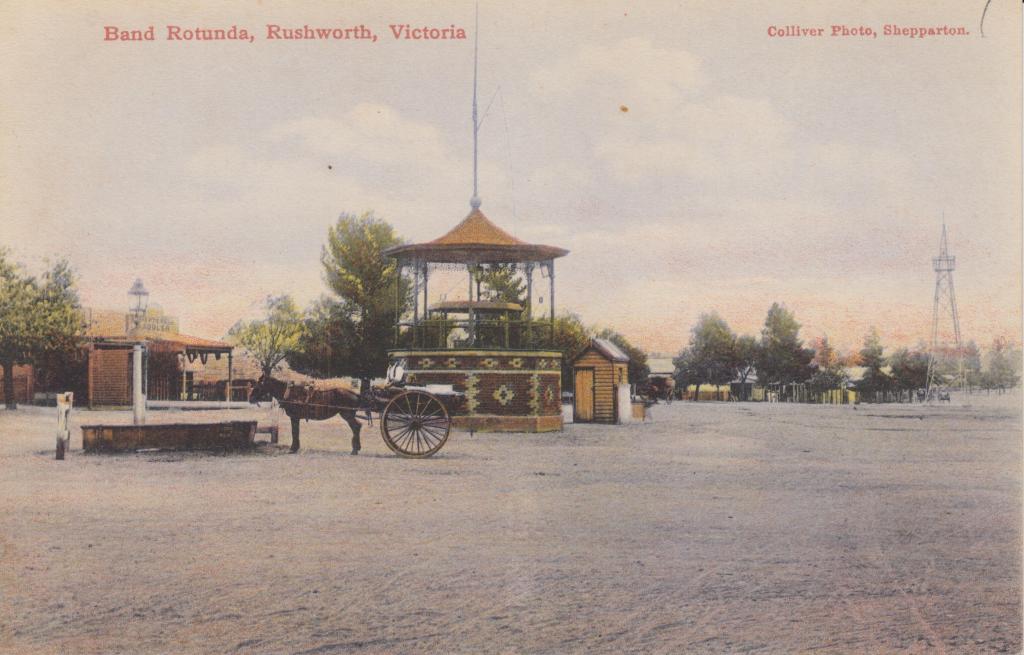
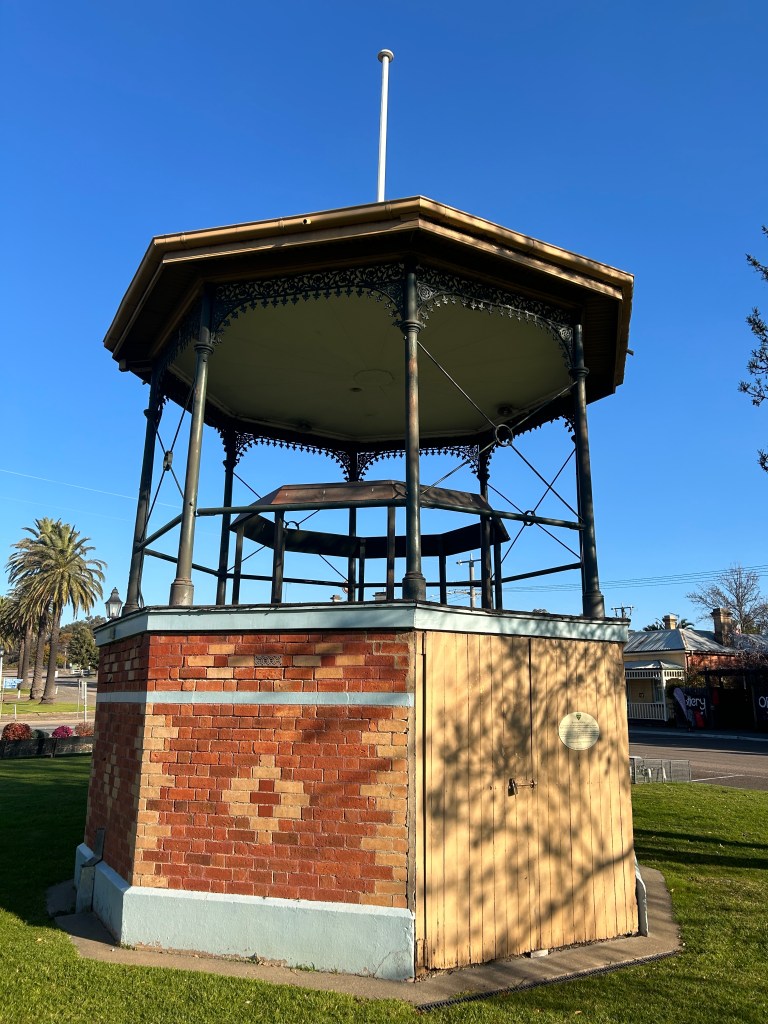
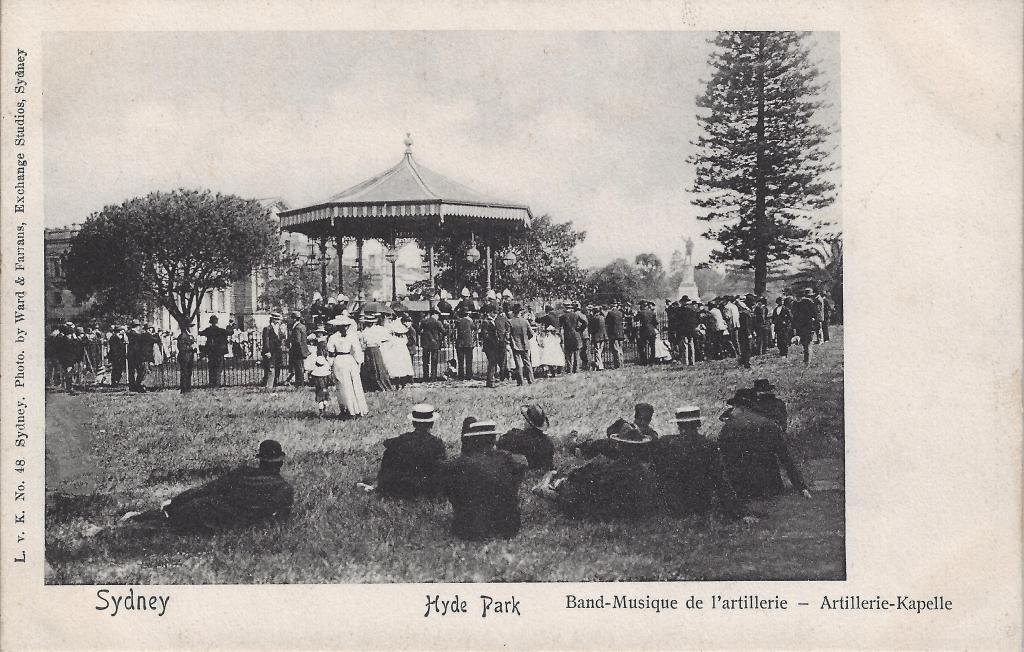
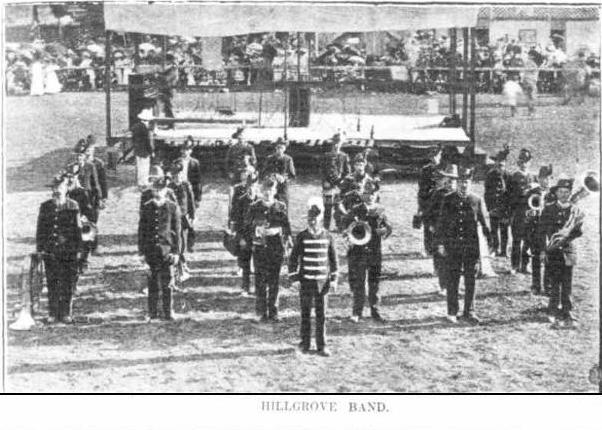


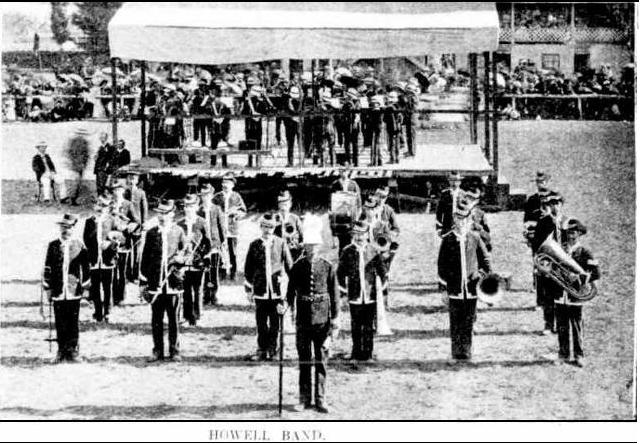
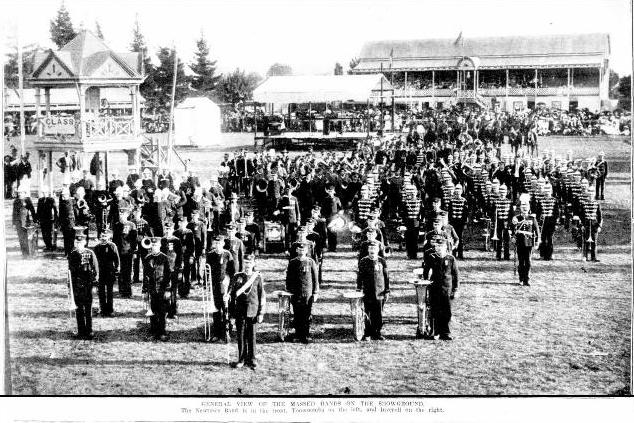


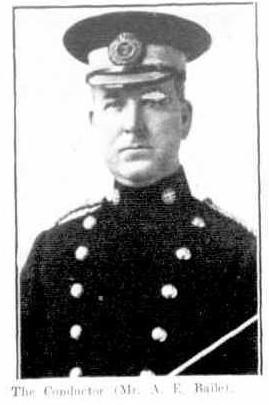
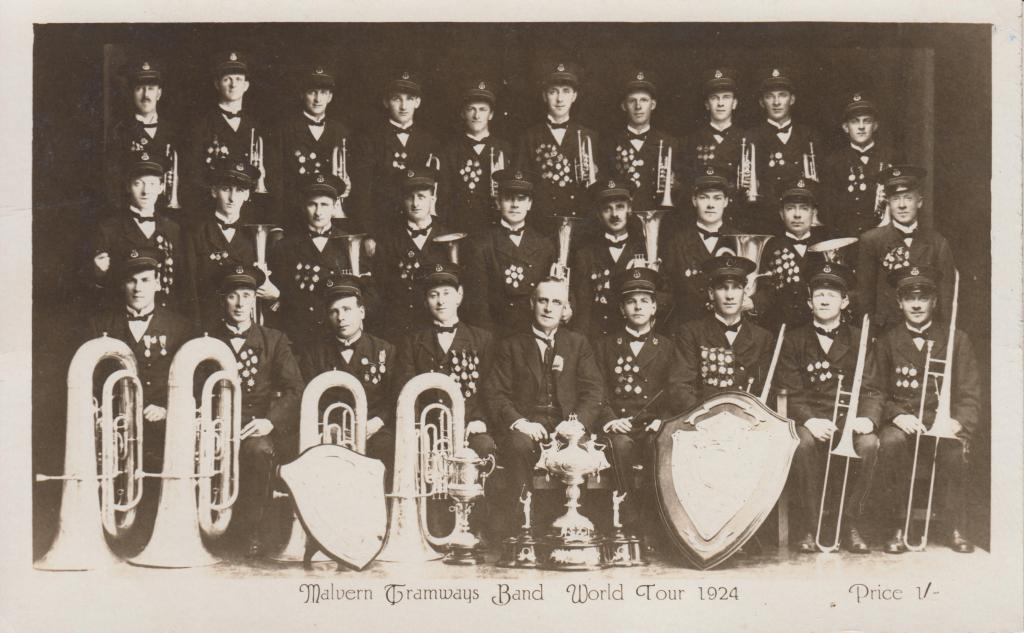


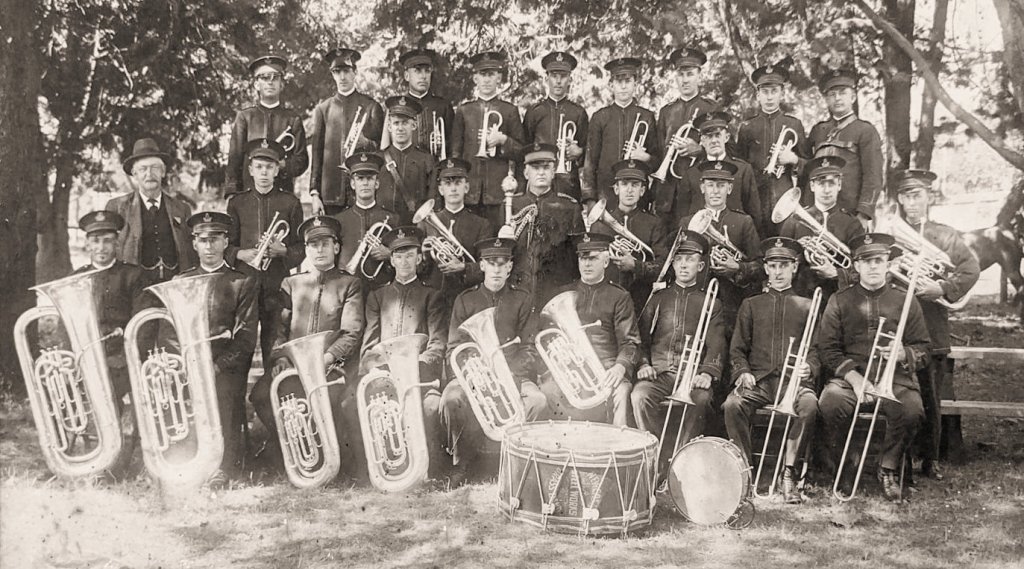
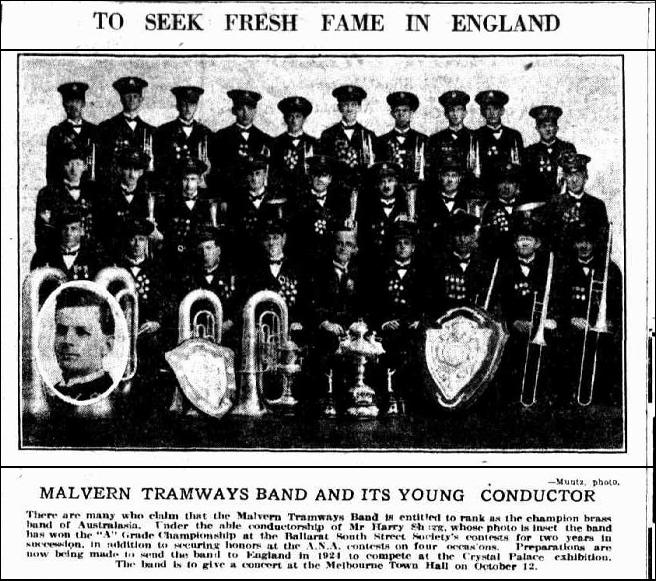
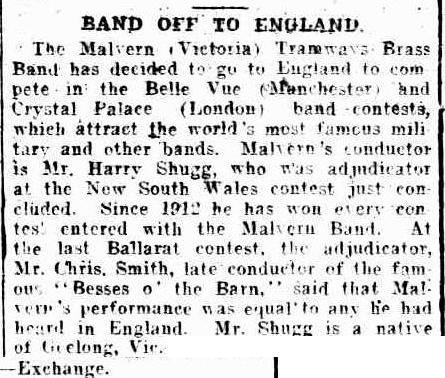


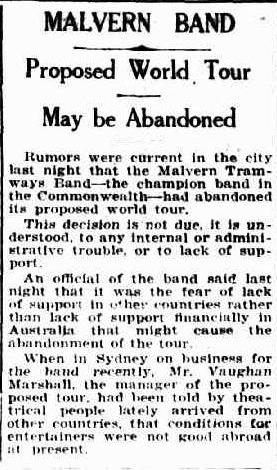
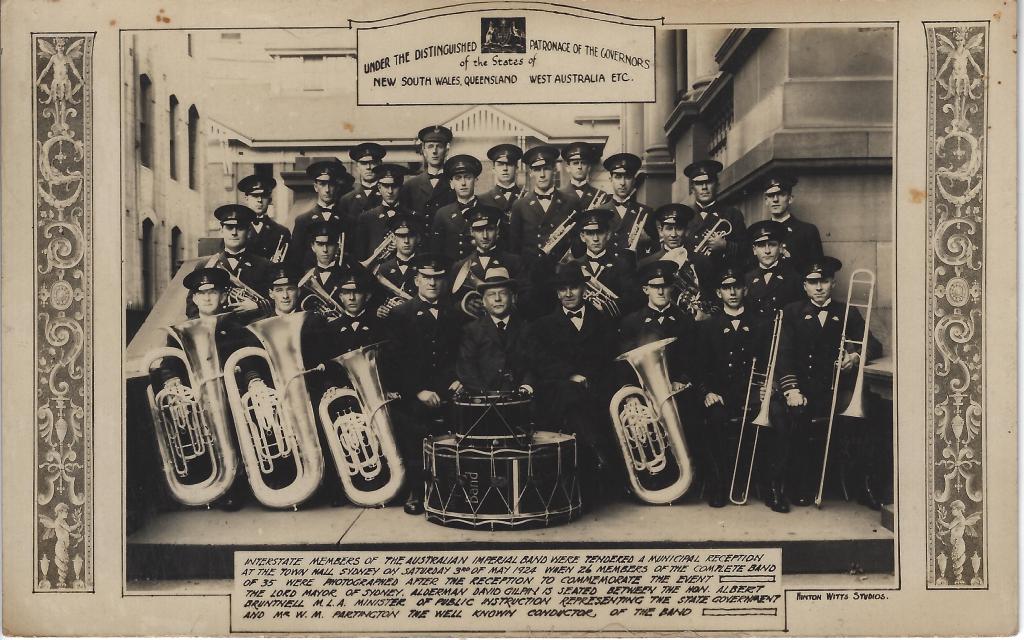


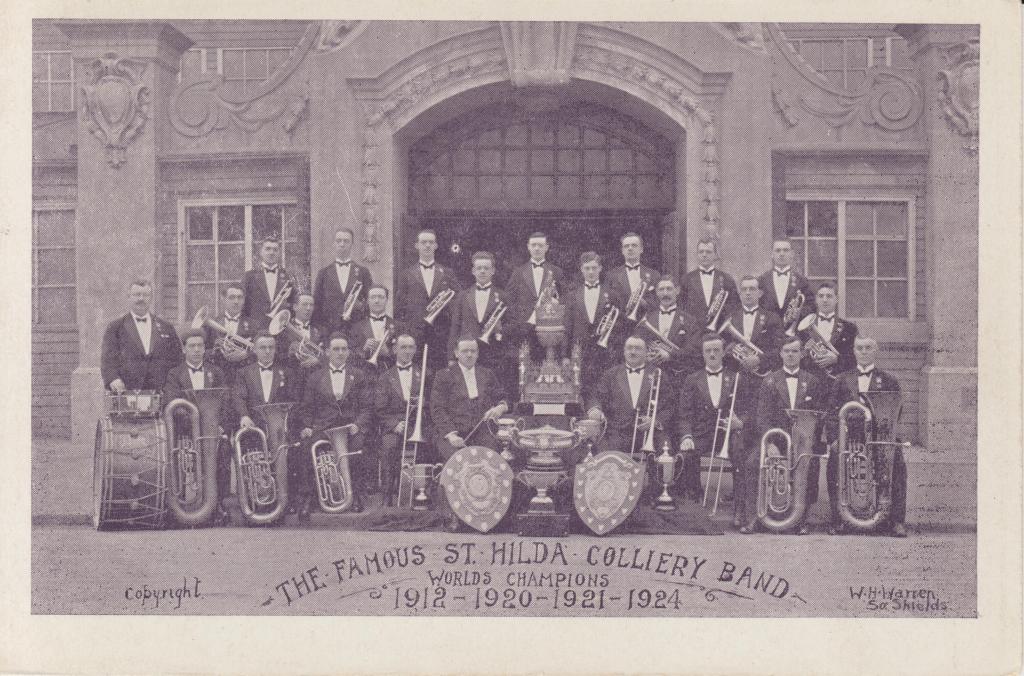
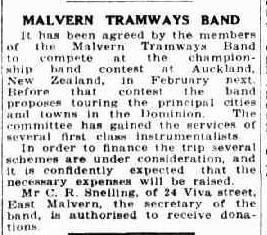

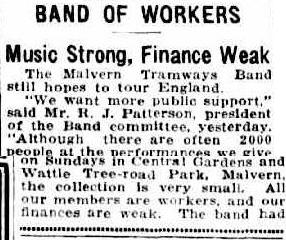


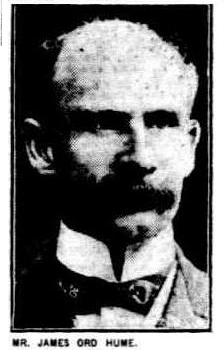

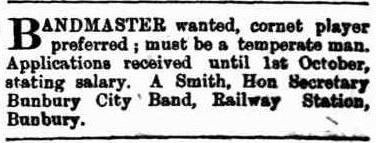
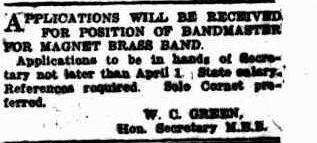
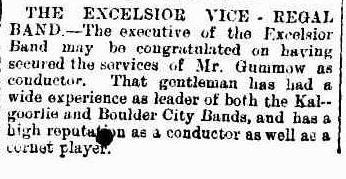


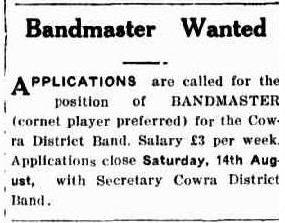
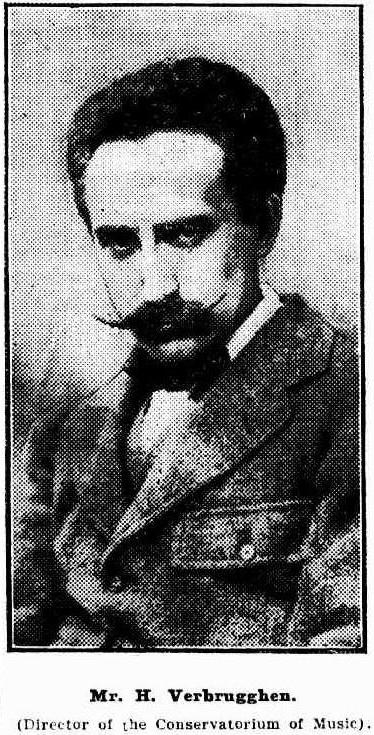


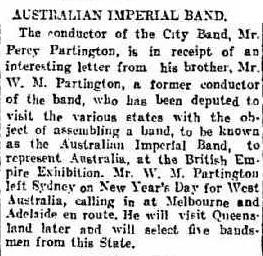
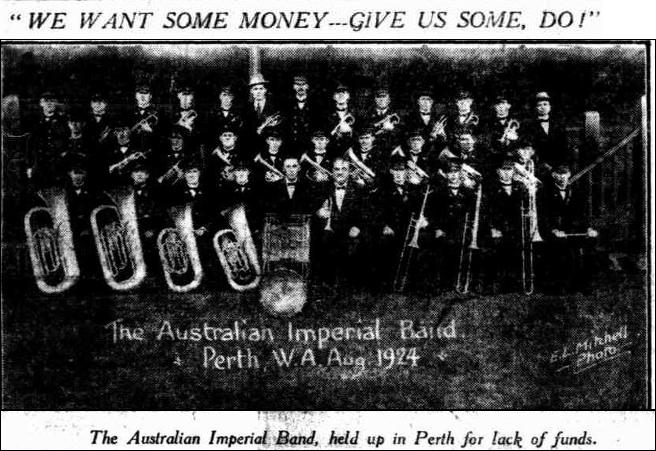
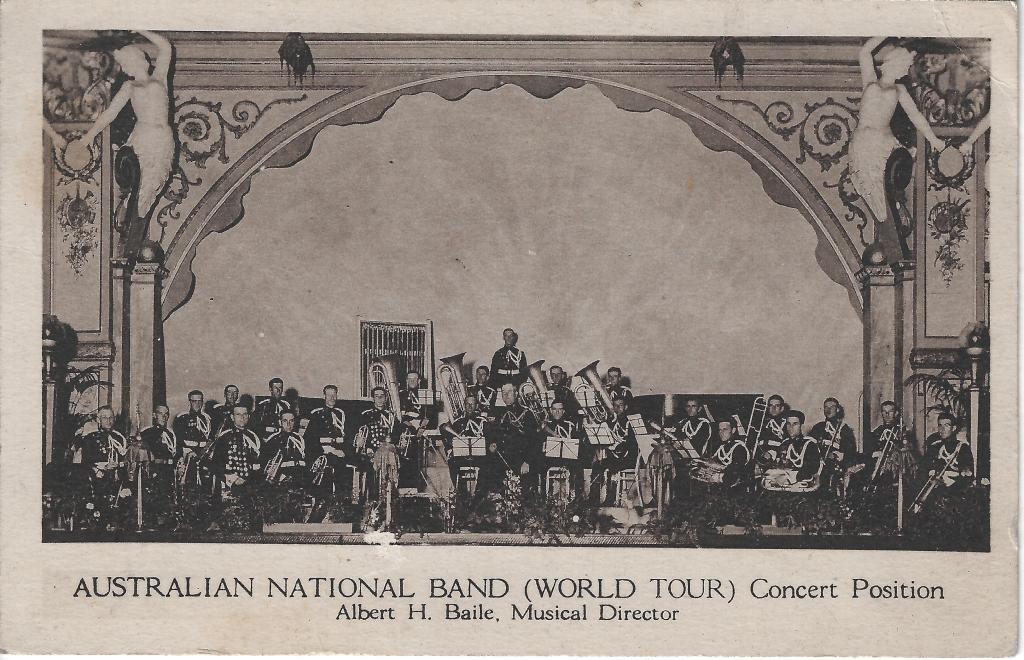
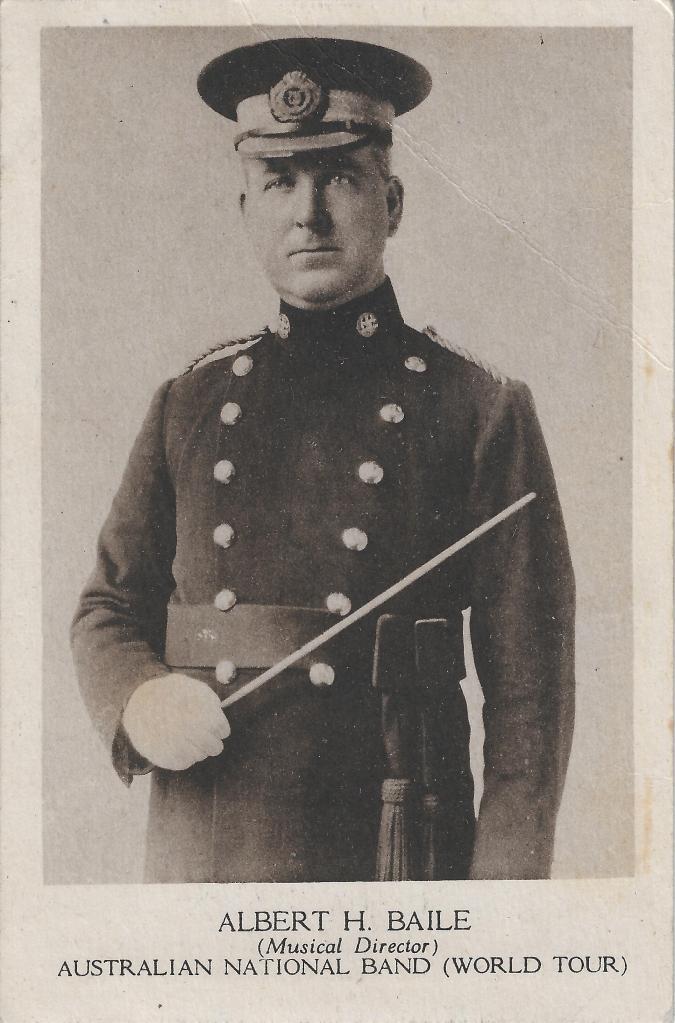


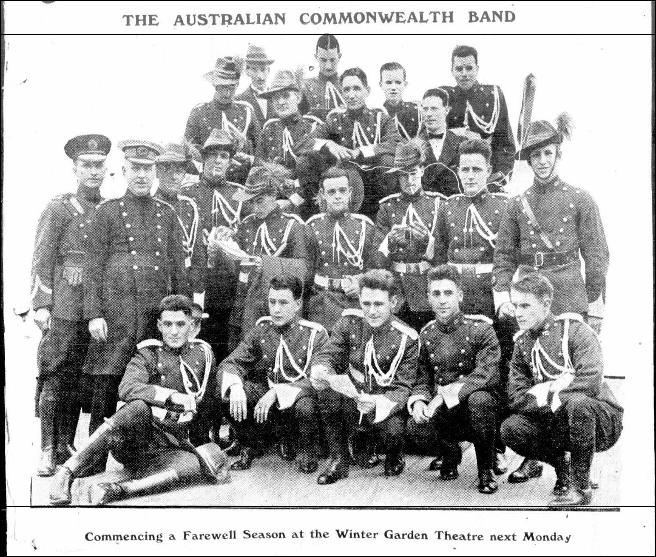
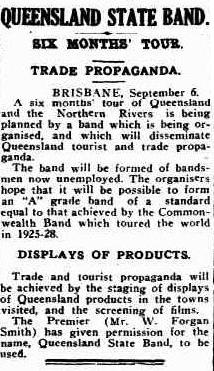

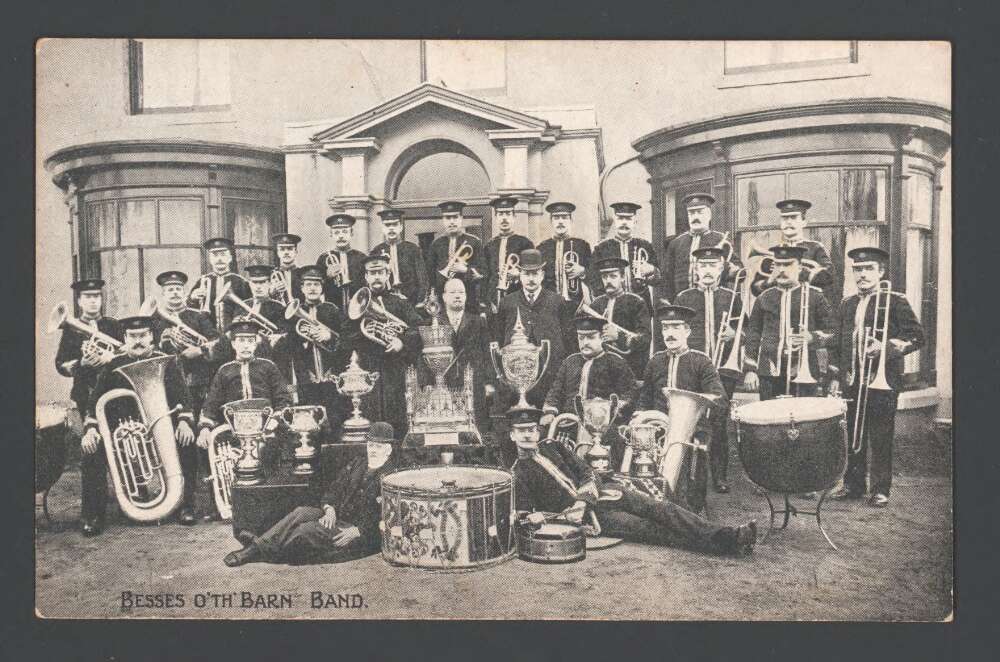


 Band Blasts from the Past