Band contests fit for a Victorian centenary: a Duke, Grenadier Guards, and the brass bands

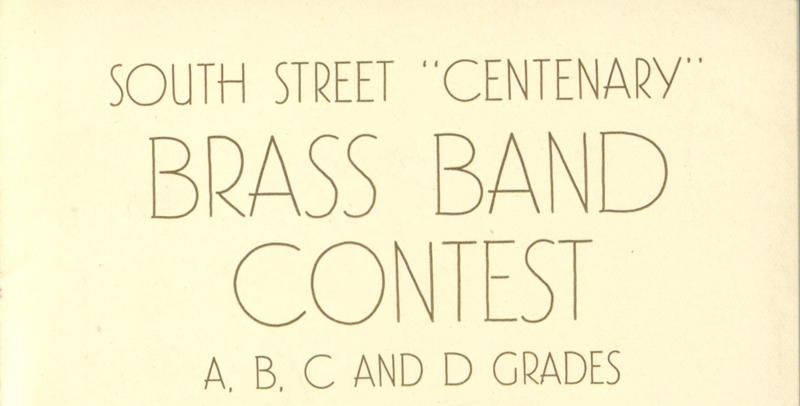
Programme: South Street “Centenary” Brass Band Contest, 1934, part of the front cover.
(Source: Victorian Collections: Victorian Bands’ League Archives)

An international band contest may be a feature of the Centenary celebrations.  An effort will be made to include one in the 1934 Eisteddfod and Band Contest at Ballarat.

The Grand National Eisteddfod of Australasia has promised its enthusiastic support of the celebrations.  Bands contests were resumed last year at the Ballarat competitions after a lapse of eight years, and they proved successful. (“Band Contest For Centenary,” 1933)

Introduction:

The year is 1934 and in Ballarat on the 1st of November, the Royal South Street Eisteddfod band sections are getting underway again.  Except this year is a bit different.  It is the year of the Victorian and Melbourne Centenary and across Victoria, celebrations and other events are in full swing.  The South Street band sections were part of these grand festivities, and all efforts were made to attract bands from across Australia and New Zealand.  In addition, the band contest was honoured by the presence of Prince Henry, Duke of Gloucester and The Band of HM Grenadier Guards.  The Royal South Street Society band contest, while being the most prestigious, attracted the most attention in the wider band movement.  For the bands themselves, there were lots of other events and band contests they were involved in.

Planning for the 1934 Ballarat band contest was extensive and as shown by the quote at the head of this post, the ideas started over eighteen months earlier.  Even if the idealism of the organisers was led astray at times.  They thought big, but had to accept that economic conditions were not the best as Australia was coming out of the Great Depression.  To put on a band contest befitting a visit of royalty was the utmost challenge.  Not to mention the scheduling given the extensive touring of the Grenadier Guards Band and the Duke. 

With the cooperation many different parties, somehow, everything worked out.  This post is mainly about the 1934 South Street band contest, ninety years to the day.

The Centenary:

Officially, the Victorian and Melbourne centenaries marked two historical events; the landing of the Henty family in Portland 1834, and John Batman’s grand pronouncement in 1835 that the Port Philip bay area with the Yarra River at its head would be “the place for a Village” (McCubbin, 2008).  However, like any celebration of this nature, there was some curious disagreement over the dates, especially from interstate commentators.  An article published in The Adelaide Chronicle newspaper in April 1934 questioned the historical accuracy of the centenary.  The article suggested that 1934 was too early as Victoria was officially proclaimed an independent colony in 1851 (“Victoria’s Centenary,” 1934).  Or maybe, as the article also suggested, the centenary was thirty-two years too late as 1802 was the year surveyors from New South Wales first explored the country in the vicinity of Port Phillip Bay (“Victoria’s Centenary,” 1934).  And there were plenty of other historical events connected with Victoria before 1834 that could have been commemorated.  The Victorian Government was probably well aware of these dates and as an article published in The Record newspaper proclaimed:

And now after warring factions have harmonised, the official foundation of Victoria is given as November 19, 1834, when the “Thistle” anchored in Portland Bay: and the centenary of this event is to be taken as the starting point of our Centenary celebrations. (“Victoria’s Centenary.,” 1933)

Nowadays Victoria celebrates an event on the 1st of July each year which marks the day Victoria was officially proclaimed an independent colony from New South Wales (Brown, 2015).  Melbourne Day is also recognized on the 30th of August each year which commemorates “the anniversary of the first European settlement in 1835” (Melbourne Day, 2024).

Confusing, isn’t it…

Prince Henry, Duke of Gloucester:

As early as 1932 if newspaper reports are anything to go by, negotiations were underway to bring a member of the Royal Family to Victoria for the Centenary commemorations in 1934.  The Scrutineer and Berrima District Press newspaper was one of these and they published a tiny article on the 6th of November 1932.

Victoria’s Centenary will probably be celebrated from October, 1934, to February, 1935.  Negotiations are in progress for a Royal visit, and it is almost certain that the British Fleet, which was to have visited Australia in 1933, will postpone the visit to coincide with the celebrations. (“Victoria’s Centenary,” 1932)

By early May 1933, the progress of the negotiations was evident to the extent that it was confirmed a member of the Royal Family would visit in 1934.  But which one?  The Victorian government initiated the negotiations; however, Canberra was also involved and any Royal that visited would be taken to the national capital as well, and to various places in Australia and New Zealand.  Speculation as to which Royal it might be was rife, and as reported by The Herald and several other newspapers, the Royal family member was going to be the Earl of Athlone, the brother of the Queen, or the Duke of Gloucester, the King’s third son (“CENTENARY PLANS TAKE SHAPE,” 1933).

In February 1934, the proposed Royal was mentioned in various newspapers as Prince George and the Royal South Street Society immediately sought to secure a visit to Ballarat by the Prince on the 1st of November so that he could open the famous band sections (“CENTENARY BAND CONTEST,” 1934).  The RSSS was concerned that the Prince, according to a tentative itinerary, might be in New South Wales while the contest was taking place.

The Age, 01/03/1934, p. 10

However, even with the best of plans, circumstances can change overnight, and by May 1934, news broke about a change of Royal, but this did not substantially alter the planning of a Royal visit.

It was announced, in the week-end, that, owing to the strain of the South African tour, Prince George would be unable to fulfil the engagement to come to Australia for the Melbourne Centenary celebrations.  Prince Henry, Duke of Gloucester, is to take his place.

The least robust member of the Royal family, Prince George felt the strain of his South African tour before it was finished.  It was far heavier than had been expected, and his letters home indicated that he was feeling tired, although delighted at the cordiality of his reception everywhere.

It was consequently considered unwise for a young man of Prince George’s temperament, which is rather highly strung, to undertake a second tour, especially as the Australasian programme was longer and more arduous than the African.

[…]

The Duke of Gloucester is the only one of the King’s sons who has not yet toured the Empire.  He fulfilled his duties during his visit to Japan so well that it was felt that he should be given the opportunity to visit Australia, where he would be likely to find so much congenial to his temperament. (“Duke of Gloucester to Come Here for Centenary Celebrations,” 1934)

With a member of a Royal family confirmed, and in all likelihood, the Duke of Gloucester would be in Ballarat on the 1st of November, planning for other parts of the Centenary celebrations and the band contest continued (“CENTENARY BAND CONTEST.,” 1934).

H.R.H. Prince Henry, Duke of Gloucester. Sunraysia Daily, 31/10/1934, p. 21

The Duke arrived in Australia in early October and visited Perth, then Adelaide on his way to Melbourne, travelling aboard H.M.S. Sussex which was escorted by elements of the Australian naval fleet (“DEPARTURE OF H.M.S. SUSSEX.,” 1934).  Prince Henry disembarked in Melbourne on the 18th of October and was afforded all the military and civic pageantry that Victoria could muster at the time. Below is a short film clip of his arrival and speech on the steps of the Victorian Parliament.

The Band of HM Grenadier Guards:

Programme: Front Cover – The Band of His Majesty’s Grenadier Guards : By Special Permission of the King, 1934. (Source: Jeremy de Korte Collection)

If the experiences of bringing a member of the Royal family to Ballarat was anything to go by, then securing a visit by one of the finest military bands in the world (at that time) was no less stressful and speculative.  Given the planning of the Centenary celebrations were well-underway in 1933, this is when newspapers started reporting that an English military band would be visiting as part of the festivities.  The Argus newspaper published a lengthy article in September 1933 that mentioned the Coldstream Guards, and that Victorian band musicians would be eager to hear them play, and be inspired (“COLDSTREAM GUARDS BAND,” 1933).  As mentioned in a previous post about this tour, only the Musicians’ Union raised objections to the tour of an English band, a position that was berated by a letter writer to The Herald newspaper (de Korte, 2018b; Musician, 1933).  In October, The Age newspaper was a little more speculative – given there are multiple guards’ bands, this article mentioned the bands of the Coldstream Guards, Welsh Guards, or Grenadier Guards as possibilities of touring (“GUARDS’ BAND VISIT.,” 1933).

It was quite a bit later, June 1934, that the Grenadier Guards Band was strongly expected to be the English military band visiting for the Centenary, and that their tour, estimated to cost £10,000 pounds, would also take in provincial towns (“FAMOUS BAND EXPECTED,” 1934).  In August, this tour was very much confirmed – one could appreciate the formality of the article published in The Age newspaper.

By special permission of the King, the band of Grenadier Guards is to give a season in Melbourne under the auspices of the Commonwealth and New Zealand Governments and the Centenary Celebrations Council, and Messrs. J. and N. Tait have been entrusted with the management of the tour.  The opening concert will be given in the Town Hall on Saturday, 20th October.  The band is the premier band of the United Kingdom, and negotiations for this visit have been carried through the Commonwealth High Commissioner in London with the British Government.  The band has no fewer than twenty different programmes.  Their uniforms of scarlet, blue and gold, with bearskin busbies, should make a fine spectacle. (“Grenadier Guards’ Band.,” 1934)

The Grenadier Guards band duly arrived in Melbourne on the 20th of October and were given a civic reception at the town hall, and a parade up Collins Street led by the Melbourne Fire Brigade Band (“GRENADIER GUARDS BAND HAS WONDERFUL WELCOME.,” 1934).  The picture below published in The Age newspaper showing the proceedings, and part of the crowd of 100,000, says it all.

The Age, 22/10/1934, p. 15

After their welcome in Melbourne and opening concert, the Band of the Grenadier Guards commenced on a country tour of Victoria, such was the interest in their visit – their first tour concert was in Wangaratta on the 22nd of October (“GRENADIER GUARDS BAND.,” 1934).  By no coincidence at all, many of the places the band visited intersected with visits of the Duke of Gloucester, including Ballarat on the 1st of November.

Of interest is the back cover of the programme used for this visit which advertises Boosey & Hawkes instruments, and the Australian music retailers that sold them – with a picture of H.M.S. Sussex which was transporting Prince Henry to Australia (Kingtson, 1934).


Programme: Back Cover – The Band of His Majesty’s Grenadier Guards : By Special Permission of the King, 1934. (Source: Jeremy de Korte Collection)

Two of the puzzle pieces for the Royal South Street band contest were now in place. But we must not forget the brass bands that were travelling to South Street for the contest.

Attracting the bands:

It would not be a band contest without the bands, and the Royal South Street Society, conscious of the significance of the 1934 contest, wanted to put on a good show.  At the head of this post was the idea that the band contest could be an international contest with the finest bands from around the world travelling to Ballarat to participate (“Band Contest For Centenary,” 1933).  Alas, bringing international bands was not to be.  Australia was just coming out of the Great Depression and economic conditions were not the best and attracting international bands was probably deemed too expensive (de Korte, 2020).  Nevertheless, in June 1933 the Lord Mayor of Melbourne gave his blessing to the band contest in Ballarat, stating,

Ballarat is looked upon as the venue for brass band contests, and I can assure you that during the centenary celebrations it will be recognised as such” said the Lord Mayor of Melbourne (Councillor H. Gengoult Smith) in speaking at a civic welcome at the city hall yesterday.  […] In recognition of what Ballarat, through the South Street Society, had done for the encouragement of brass band music, he would give his assurance that the finals of the centenary band contest would be held in Ballarat. (“CENTENARY BAND CONTEST.,” 1933)

The Mayor of Ballarat, Cr. A. J. Darling expressed confidence in January 1934 that arrangements for the official opening of the Centenary band contest were well-underway, as well as confirmation that a member of the Royal family would be attending (“CENTENARY BAND CONTEST.,” 1934).  With the Royal South Street Society and the newly formed Victorian Bands’ League working on the particulars of the contest, there was no need to think this was not the case.  And in April came the details of the prize money that was on offer, and the announcement that “Mr. Stephen Yorke, conductor of the Australian national military band, will adjudicate.” (“CENTENARY BAND CONTESTS.,” 1934).  On a side note, the A.B.C. Military Band was undertaking its own national tour in 1934 – it was a great year to listen to top bands in Australia (de Korte, 2018a).

Individual bands were also starting to make plans to visit Ballarat for the contest.  We see that in April, the Mildura Municipal Band (also known as the Sunraysia District Brass Band) announced plans to visit Ballarat to listen to the A grade sections, and then proceed to Melbourne to present a concert in conjunction with the Essendon City Band (“CENTENARY BAND CONTESTS,” 1934).  However, their ideas must have changed as they ended up participating in the contest in the C and D grade sections, and achieving equal first prize with the Pleasant Street Boys’ Band in the D grade (Royal South Street Society, 1934c). 

Photograph: Mildura & District Brass Band, 1930s. (Source: IBEW)
Photograph: Pleasant Street School Band, 1933. (Source: IBEW)
Telegraph, 13/10/1933, p. 27

Interest in competing was also expressed by bands in New Zealand as the Woolston Brass Band announced its intention to come to Ballarat for the centenary contest (“NEW ZEALAND BAND TO VISIT MELBOURNE.,” 1933).  An article published in the Dominion newspaper by the writer, ‘Kneller Hall’, speculated that the Port Nicholson Silver Band was preparing to travel to Ballarat to compete, while also confirming that the famous Woolston Brass Band was going to make the trip over the Tasman (Kneller Hall, 1934).  In the end, only one band from New Zealand ended up attending, Woolston, and they were given a civic welcome when they arrived in Ballarat (“BALLARAT AND DISTRICT,” 1934; “PROVINCIAL CITIES AND TOWNS.,” 1934a).

Woolston Brass Band. Dominion, 13/10/1934, p. 13

The South Street “Centenary” Band Contest:

With bands arriving in Ballarat, the Duke of Gloucester travelling down by train from Mildura, and the Band of the Grenadier Guards arriving from Bendigo, all was now in place for the opening of the Royal South Street band sections on the 1st of November (“GRENADIER GUARDS BAND.,” 1934; “Sunraysia, Land of Sunshine Greets The Duke,” 1934).  Twenty-two bands from Victoria, Tasmania, New South Wales, and New Zealand had entered the South Street contests this year and the list of bands and bandmasters in the official souvenir programme can be viewed below (Royal South Street Society, 1934e).

Programme: South Street “Centenary” Brass Band Contest, 1934, p. 4.
(Source: Victorian Collections: Victorian Bands’ League Archives)

To have twenty-two bands enter in 1934 was not bad considering that the early thirties were times of upheaval for the Victorian band movement and society in general.  In 1931, the Victorian Bands’ League was established having superseded the Victorian Bands’ Association, the Australian economy was recovering after the Great Depression, and the band sections at Royal South Street had resumed in 1932 after an eight year hiatus (de Korte, 2018c, 2020; Royal South Street Society, 1979).

However, it would have been pleasing to see bands from a wide variety of areas coming to South Street.  We know that for some bands, like the Phillip Island Brass Band, that they did a considerable amount of fundraising to attend (de Korte, 2019).  The line up for bands for the A Grade section represented the best of A grade bands that Victoria had in the day, and having the Woolston Brass Band from Christchurch, N.Z. made the section even more top notch.
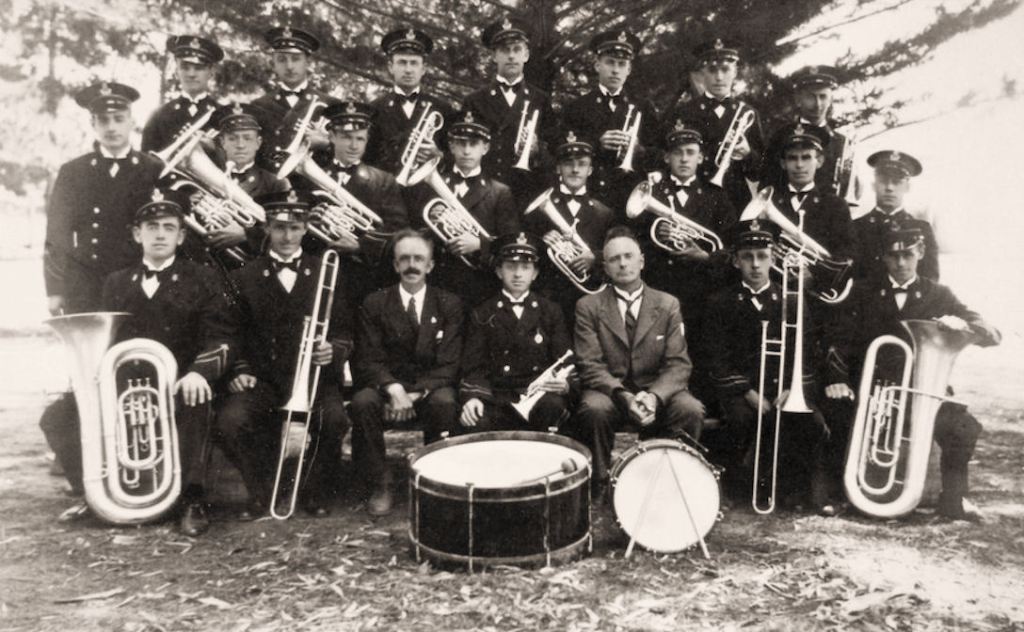
Photograph: Phillip Island Brass Band, 1932. (Source: IBEW)

The opening day of the band contest was a spectacular affair with the Royal South Street Society having programmed all events down to the minute.  According to various newspaper articles, 10,000 people attended the opening day at Ballarat’s City Oval, no doubt drawn to the fact that the Duke of Gloucester would be there to officially open the contest.  The souvenir programme outlined the proceedings of the day as can be seen below.
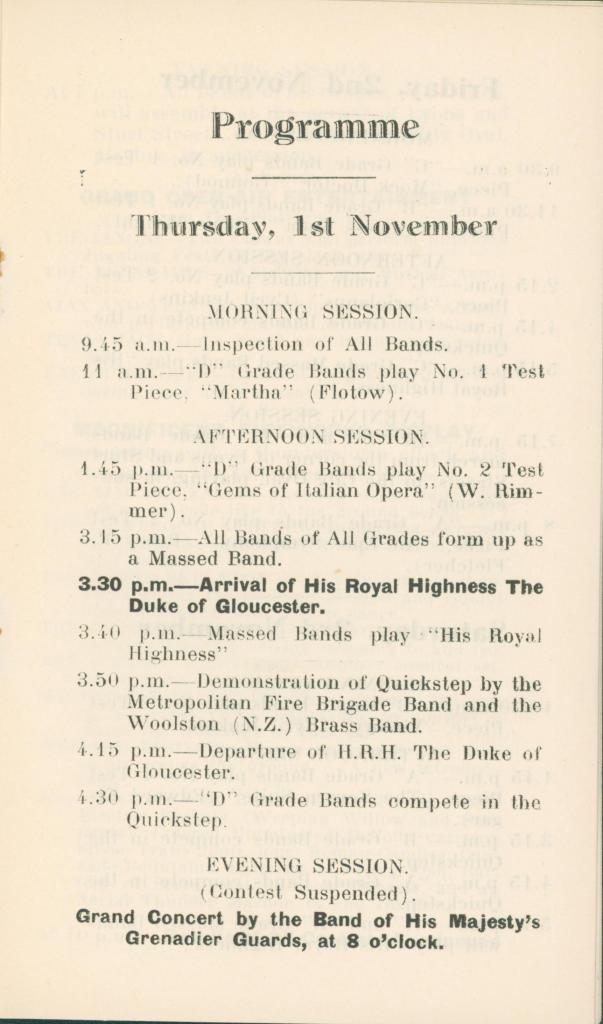
Programme: South Street “Centenary” Brass Band Contest, 1934, p. 6.
(Source: Victorian Collections: Victorian Bands’ League Archives)

In superb weather, everything proceeded to plan, and the bands did their best to produce a ceremony befitting the occasion (“BAND CONTESTS,” 1934).  There was a massed band performance, a demonstration of the quickstep, and the Woolston Brass Band even performed a haka for the Duke after the march past of the bands (“DUKE AT BALLARAT,” 1934).  That night, the Band of HM Grenadier Guards performed in a concert which would have inspired the bandsmen and audience (Royal South Street Society, 1934e). 

Results for the contests were announced on Saturday 3rd of November with another 10,000 people attending to find out the placings.  The full results will not be detailed in this post due to space, but they can be found on the RSSS results database via these links:

The Solo contests were held a day before the band sections on the 31st of October.  The results of these can be found on the RSSS database via the link:

By all accounts, the standard of playing across all sections was brilliant and the adjudicator was very impressed.  The A Grade section in particular was a very hard fought affair, but in the end, the Melbourne Fire Brigade Band won the Besson Shield for the third year in a row (Royal South Street Society, 1934a).  The Woolston Brass Band from N.Z. suffered some misfortune when one of their cornet players became ill – the other A Grade bands offered them a choice of cornet players to help out – however, they decided to proceed down a player and were happy to achieve third place (“BRILLIANT PLAYING,” 1934; “PROVINCIAL CITIES AND TOWNS.,” 1934b). 

The Duke of Gloucester and the Band of the Grenadier Guards did not stay long in Ballarat as they kept up a tight schedule of touring around Victoria and eventually New Zealand.  For the bands themselves there were good stories of their visits to Ballarat.  The Yallourn and District Band from Gippsland was one band that was very proud of their efforts in the B Grade section where they achieved second place behind the City of Ballarat Band (“YALLOURN NEWS,” 1934).  Of interest is that in early 1935, three cornet players from Victorian bands, including cornetist Jack Allan of the City of Ballarat Band, were offered places in the Band of the Grenadier Guards (“Ballarat Bandsman Invited To Join Grenadier Guards,” 1935).  It is unclear whether they took up that offer.

The 1934 South Street contest was no doubt an important part of Victoria’s Centenary celebrations, but it was not the only part.  There were other important events taking place.

Events after South Street:

11th of November, 1934: Dedication of the Shrine of Remembrance, Melbourne:

Postcard: The National War Memorial of Victoria. Aerial View of Dedication Ceremony, 11/11/1934. (Source: Jeremy de Korte Collection)

For the Duke of Gloucester, he kept up a busy schedule around Victoria.  However, his most important engagement was the dedication of Melbourne’s newly completed Shrine of Remembrance.  This was a very special occasion which was attended by thousands of veterans, people, and important dignitaries.  Bands and other musicians also played an important role, and at the dedication, several Australian Army buglers sounded the Last Post standing behind Royal Australian Navy drummers.

Portland Centenary Band Contest:

The town of Portland in the far south-west of Victoria had an important part to play in Victoria’s centenary celebrations.  In turn, they staged their own band contest, albeit on a much smaller scale than the South Street contests which had concluded only two weeks earlier (“BAND CONTESTS.,” 1934).  The Portland contest was only attended by bands from Hamilton, Heywood and Mt. Gambier, and there was a pipe band contest held at the same time.  The Portland contest was won by the band from Mt. Gambier and the adjudicator was Mr. Percy Jones (“Band Contest Won By Mount Gambier,” 1934).

Melbourne Centenary Band Championship, King’s Birthday weekend, June 1935:

The Victorian centenary celebrations stretched into 1935, and a Melbourne Centenary Band Championship was held at the Exhibition Buildings under the auspices of the Victorian Bands’ League.  Like the South Street contests, this was another great event for bands, and twenty-one bands participated, as listed in the article below.
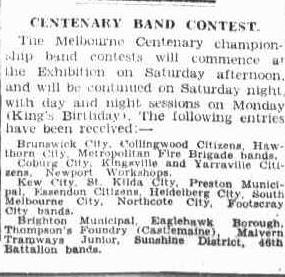
The Age, 28/05/1935, p. 11

The main attraction of this event was a grand parade from Alexandra Avenue to the Exhibition Buildings and quickstep display on the Exhibition oval (“CENTENARY BAND CONTESTS,” 1935).  Again, the A Grade section continued the rivalries between Hawthorn, Melbourne Fire Brigade, Brunswick and Collingwood bands, with Hawthorn taking out the A Grade title (“CENTENARY GALA WEEK.,” 1935).  Another celebrated win was that of the Malvern Junior Tramways Band when they won their third D Grade title in a row.
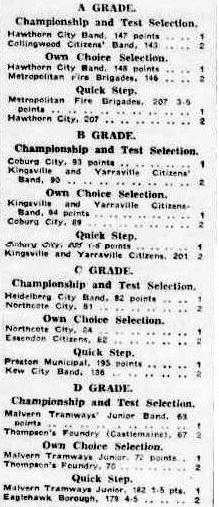
The Age, 04/06/1935, p. 10

Conclusion:

What an intense period of activity for bands!  It is times like these that our bands came to the fore with all the ceremonial and contest activity, as well as local celebrations.  No doubt the communities appreciated the efforts and the entertainment.  Having a visiting band of the calibre of the Band of the Grenadier Guards made the Centenary celebrations even more special, and it was noted at the time that they were inspiring to local musicians.  The prevailing feeling when all was done was one of accomplishment, not just from the cooperation that made this all happen, but from all that understood the significance of the events.  It is not every day that a world-class military band and a Duke visits a band contest.

References:

BALLARAT AND DISTRICT. (1934, 08 June). Argus (Melbourne, Vic. : 1848 – 1957), 3. http://nla.gov.au/nla.news-article10944624

Ballarat Bandsman Invited To Join Grenadier Guards. (1935, 16 January). Sunraysia Daily (Mildura, Vic. : 1920 – 1950), 5. http://nla.gov.au/nla.news-article265838073

Band Contest For Centenary. (1933, 25 February). Sun News-Pictorial (Melbourne, Vic. : 1922 – 1954; 1956), 4. http://nla.gov.au/nla.news-article277163952

Band Contest Won By Mount Gambier : Judge’s Eulogistic Comments. (1934, 22 November). Portland Guardian (Vic. : 1876 – 1953), 4. http://nla.gov.au/nla.news-article64287397

BAND CONTESTS : OPENING AT BALLARAT. (1934, 02 November). Mercury (Hobart, Tas. : 1860 – 1954), 14. http://nla.gov.au/nla.news-article29165635

BAND CONTESTS : Three Bands Competing. (1934, 19 November). Portland Guardian (Vic. : 1876 – 1953), 5. http://nla.gov.au/nla.news-article64287383

BRILLIANT PLAYING : Ballarat Band Contest. (1934, 05 November). Evening Post, 9. https://paperspast.natlib.govt.nz/newspapers/EP19341105.2.61

British Pathé. (2014, 13 April). Melbourne Centenary (1934) [Video (Film Clip)]. YouTube. Retrieved 11 October 2024 from https://www.youtube.com/watch?v=C4DWQpyx4O0

Brown, S. L. (2015, 01 July). Victoria Day: Was secret gold behind 1851 separation from NSW? ABC Radio Melbourne,6584322. https://www.abc.net.au/news/2015-07-01/victoria-day-was-secret-gold-behind-separation/6584322

CENTENARY BAND CONTEST. (1935, 28 May). Age (Melbourne, Vic. : 1854 – 1954), 11. http://nla.gov.au/nla.news-article204361353

CENTENARY BAND CONTEST : Arrangements for Opening. (1934, 18 January). Age (Melbourne, Vic. : 1854 – 1954), 9. http://nla.gov.au/nla.news-article203377704

CENTENARY BAND CONTEST : Finals in Ballarat. (1933, 05 June). Argus (Melbourne, Vic. : 1848 – 1957), 9. http://nla.gov.au/nla.news-article4740383

CENTENARY BAND CONTEST : Proposed Opening by Prince George. (1934, 23 February). Age (Melbourne, Vic. : 1854 – 1954), 10. http://nla.gov.au/nla.news-article203376669

CENTENARY BAND CONTESTS. (1935, 31 May). Sunshine Advocate (Vic. : 1924 – 1954), 3. http://nla.gov.au/nla.news-article74757883

CENTENARY BAND CONTESTS : Mildura Band to Make Trip. (1934, 27 April). Sunraysia Daily (Mildura, Vic. : 1920 – 1950), 4. http://nla.gov.au/nla.news-article265690603

CENTENARY BAND CONTESTS : South-Street Prize Money. (1934, 13 April). Age (Melbourne, Vic. : 1854 – 1954), 7. http://nla.gov.au/nla.news-article203842698

CENTENARY GALA WEEK : BAND CONTESTS DECIDED : HAWTHORN CITY WINS A GRADE CHAMPIONSHIP : Malvern Tramway Juniors’ D Grade Treble. (1935, 04 June). Age (Melbourne, Vic. : 1854 – 1954), 10. http://nla.gov.au/nla.news-article204345548

CENTENARY PLANS TAKE SHAPE : Pageants, Exhibitions And Shrine Dedication : BIG MILITARY TATTOO. (1933, 11 May). Herald (Melbourne, Vic. : 1861 – 1954), 5. http://nla.gov.au/nla.news-article243112151

COLDSTREAM GUARDS BAND : Victorian Bandsmen Eager For Visit. (1933, 01 September). Argus (Melbourne, Vic. : 1848 – 1957), 8. http://nla.gov.au/nla.news-article11688130

de Korte, J. D. (2018a, 12 July). The A.B.C. Military Band: an ensemble of the times. Band Blasts from the Past: Anecdotes, Stories and Personalities. https://bandblastsfromthepast.blog/2018/07/12/the-a-b-c-military-band-an-ensemble-of-the-times/

de Korte, J. D. (2018b, 14 October). International band tours of the early 1900’s: bringing music to Australia. Band Blasts from the Past: Anecdotes, Stories and Personalities. https://bandblastsfromthepast.blog/2018/10/14/_international-band-tours-of-the-early-1900s-bringing-music-to-australia/

de Korte, J. D. (2018c, 15 March). The politics of affiliation: The Victorian Bands’ Association to the Victorian Bands’ League. Band Blasts from the Past: Anecdotes, Stories and Personalities. https://bandblastsfromthepast.blog/2018/03/15/the-politics-of-affiliation-victorian-bands-association-to-the-victorian-bands-league/

de Korte, J. D. (2019, 31 January). Bands on Australian islands: unique challenges in unique environments. Band Blasts from the Past: Anecdotes, Stories and Personalities. https://bandblastsfromthepast.blog/2019/01/31/bands-on-australian-islands-unique-challenges-in-unique-environments/

de Korte, J. D. (2020, 18 October). Testing times: the resilience of Australian bands during the Great Depression. Band Blasts from the Past: Anecdotes, Stories and Personalities. https://bandblastsfromthepast.blog/2020/10/18/testing-times-the-resilience-of-australian-bands-during-the-great-depression/

DEPARTURE OF H.M.S. SUSSEX. (1934, 09 October). West Australian (Perth, WA : 1879 – 1954), 17. http://nla.gov.au/nla.news-article32803514

DUKE AT BALLARAT : AMONG THE BANDS : A WOOLSTON HAKA. (1934, 02 November). Evening Post, 10. https://paperspast.natlib.govt.nz/newspapers/EP19341102.2.102.1

Duke of Gloucester to Come Here for Centenary Celebrations : AFRICAN TOUR TIRED PRINCE GEORGE. (1934, 05 May). Weekly Times (Melbourne, Vic. : 1869 – 1954), 5. http://nla.gov.au/nla.news-article223836381

FAMOUS BAND EXPECTED : Grenadier Guards for Centenary. (1934, 05 June). Herald (Melbourne, Vic. : 1861 – 1954), 1. http://nla.gov.au/nla.news-article243175540

GRENADIER GUARDS BAND. (1934, 25 October). Great Southern Advocate (Korumburra, Vic. : 1889 – 1906, 1914 – 1940), 5. http://nla.gov.au/nla.news-article255918717

GRENADIER GUARDS BAND HAS WONDERFUL WELCOME. (1934, 22 October). Age (Melbourne, Vic. : 1854 – 1954), 15. http://nla.gov.au/nla.news-article205884483

Grenadier Guards’ Band. (1934, 27 August). Age (Melbourne, Vic. : 1854 – 1954), 13. http://nla.gov.au/nla.news-article205524735

GUARDS’ BAND VISIT : Centenary Tour Almost Certain. (1933, 10 October). Age (Melbourne, Vic. : 1854 – 1954), 8. http://nla.gov.au/nla.news-article205104515

Kingtson, C. (Ed.). (1934). Grenadier Guards Band : Australia and New Zealand 1934-5 : By Special Permission of His Majesty the King : Official Souvenir : Tour under the Auspices of the Commonwealth Government and the New Zealand Government : In associaion with the Cenenary Celebrations Council of Victoria  [Printed programme]. Grenadier Guards Band. 

Kneller Hall. (1934, 27 July). THE BANDS : News and Views : WELLINGTON AND BALLARAT. Dominion, 13. https://paperspast.natlib.govt.nz/newspapers/DOM19340727.2.98

McCubbin, M. (2008). Centenary. In eMelbourne: the city past & present (pp. EM00316b). https://www.emelbourne.net.au/biogs/EM00316b.htm: The University of Melbourne, School of Historical & Philosophical Studies.

Melbourne Day. (2024). More marvellous than ever: FAQs: What is Melbourne Day? Melbourne Day: 30th August. Retrieved 26 October 2024 from https://www.melbourneday.com.au/about.html

Mildura & District Band, 1930s. (1930). [Photograph]. [phot6314]. The Internet Bandsman Everything Within, Vintage Brass Band Pictures – Australia. http://www.ibew.org.uk/vbbp-oz.html

Musician. (1933, 11 September). GUARDS’ BAND VISIT. Herald (Melbourne, Vic. : 1861 – 1954), 6. http://nla.gov.au/nla.news-article243423748

NEW ZEALAND BAND TO VISIT MELBOURNE. (1933, 13 October). Telegraph (Brisbane, Qld. : 1872 – 1947), 27. http://nla.gov.au/nla.news-article180593124

Phillip Island Brass Band, 1932. (1932). [Photograph]. [phot16005]. The Internet Bandsman Everything Within, Vintage Brass Band Pictures – Australia. http://www.ibew.org.uk/vbbp-oz.html

Pleasant Street School Band, Ballarat, 1933. (1933). [Photograph]. [phot20817]. The Internet Bandsman Everything Within, Vintage Brass Band Pictures – Australia. http://www.ibew.org.uk/vbbp-oz.html

PROVINCIAL CITIES AND TOWNS : BALLARAT. (1934a, 29 October). Age (Melbourne, Vic. : 1854 – 1954), 13. http://nla.gov.au/nla.news-article205882825

PROVINCIAL CITIES AND TOWNS : BALLARAT. (1934, 05 November). Age (Melbourne, Vic. : 1854 – 1954), 12. http://nla.gov.au/nla.news-article205083970

Royal South Street Society. (1934a). 1934-10-31 Brass Band Solos : Held at the A.N.A. Hall, Camp Street [Eisteddfod Results]. Royal South Street Society Results Database. https://results.royalsouthstreet.com.au/results/1934-10-31-brass-band-solos 

Royal South Street Society. (1934b). 1934-11-01 Brass Band Contests : Held at City Oval : Grand Champion Centenary Band Contests [Eisteddfod Results]. Royal South Street Society Results Database. https://results.royalsouthstreet.com.au/results/1934-11-01-brass-band-contests 

Royal South Street Society. (1934c). 1934-11-02 Brass Band Contests  : Held at City Oval [Eisteddfod Results]. Royal South Street Society Results Database. https://results.royalsouthstreet.com.au/results/1934-11-02-brass-band-contests 

Royal South Street Society. (1934d). 1934-11-03 Brass Band Contests  : Held at City Oval [Eisteddfod Results]. Royal South Street Society Results Database. https://results.royalsouthstreet.com.au/results/1934-11-03-brass-band-contests 

Royal South Street Society. (1934e). [South Street “Centenary” : Brass Band Contest : A, B, C and D Grades]. In S09 – Programs (Printed programme ed., pp. 14). Ballarat, Victoria https://victoriancollections.net.au/items/5d425e0c21ea6b1a84382033: Victorian Bands’ League Archive.

Royal South Street Society. (1979). Royal South Street Society : The First One Hundred Years. Royal South Street Society. 

ShrineMelbourne. (2013, 09 January). The Dedication of the Shrine of Remembrance – Remembrance Day 11 November 1934 [Video (Film Clip)]. YouTube. Retrieved 26 October 2024 from https://www.youtube.com/watch?v=jHcaXEpVdRA

Sunraysia, Land of Sunshine Greets The Duke : Prince Henry Is Our First Royal Guest. (1934, 31 October). Sunraysia Daily (Mildura, Vic. : 1920 – 1950), 21. http://nla.gov.au/nla.news-article265829018

The Shrine of Remembrance Trustees. (1934). The National War Memorial of Victoria : Aerial View of Dedication Ceremony [Postcard]. [No. 3]. The Shrine of Remembrance Trustees, Great Britain. 

To Visit Australia. (1934, 13 October). Dominion, 13. https://paperspast.natlib.govt.nz/newspapers/DOM19341013.2.116.5

Victoria’s Centenary. (1932, 06 November). Scrutineer and Berrima District Press (NSW : 1892 – 1948), 4. http://nla.gov.au/nla.news-article125232791

Victoria’s Centenary. (1933, 04 November). Record (Emerald Hill, Vic. : 1881 – 1954), 2. http://nla.gov.au/nla.news-article164468392

Victoria’s Centenary. (1934, 12 April). Chronicle (Adelaide, SA : 1895 – 1954), 39. http://nla.gov.au/nla.news-article92354462

VISIT TO BALLARAT : Desired for Band Competition. (1934, 01 March). Age (Melbourne, Vic. : 1854 – 1954), 10. http://nla.gov.au/nla.news-article203834255

YALLOURN NEWS : Yallourn Band. (1934, 08 November). Morwell Advertiser (Morwell, Vic. : 1888 – 1954), 9. http://nla.gov.au/nla.news-article71564079

A pastime with a purpose: band music in our institutions and the fourth prison band in the world.

Royal Victorian Institute for the Blind Band. ca. 1890. (source: State Library Victoria: cr001189)

Please note: This blog post has drawn upon information from photographic and print resources whereby the names of managers and deceased persons from former orphanages, secure health institutions, and penal institutions may have been mentioned.  Also, there are depictions of the recreational activities of such institutions described in this blog post. 

Introduction:

…undoubtedly music had a fundamental relationship to humanity.  It softened and soothed the hardness and harshness of life.

(Hotson in “Sunday Night Meeting AT THE SOCIALIST HALL,” 1920)

If there is one aspect of our band movement that has stood the test of time it is a willingness to play for all and encourage participation in music making.  One might say it goes with the territory.  However, our bands are special groups, and at times, they have performed for people who are in life situations where they are separated from general society.  It was judged at the time, rightly or wrongly, that this was necessitated, but it is not for this post to comment on the why.  It is the purpose of this post to highlight where band music has made a difference to the lives of the people within various institutions.

Let us turn back time to the early 1900s where we will find that the description, function, and language of these institutions is very different to what we know now.  It was not uncommon to read early newspapers and reports which mention Prisons and Orphanages, but also Lunatic Asylums, Benevolent Asylums, and Colonies.  It was also not uncommon in the newspapers to label anyone who was resident at these institutes as inmates – even hospitals.  The language of this post will draw upon the language of the time with its early usage and naming conventions, even if we are uncomfortable with this language in our own time.

Music had a role to play in such institutes, not only for listening but also for making and participating.  In the early 1900s, much thinking was being given to the humane way in which the people in the institutes could be treated and kept occupied, and music was a key activity.  We can view this as early forms of music therapy and there were some very forward-thinking people who made sure that music, partly through bands, became a staple part of the institutional routines.

At the start of this post is an early photograph of the (R.V.I.B.) Royal Victorian Institute for the Blind Brass Band from approximately 1890 which clearly displays how a meaningful activity such as a band was accessible.  This post will firstly show how bands made a difference through performances as many different institutions invited bands to come and play for their residents.  The next sections will highlight bands that were set up in institutes such as Orphanages, special institutes, and prisons.  This post will not be able to cover all forms of music making.  However, it will show how pervasive our band music was and how music was a pastime with a purpose.

Listening to music:

The institutions:

Several bands including the State Public Service Band, the Essendon and Moonee Ponds Salvation Army Band, and several other concert parties have kindly given concerts during this year.  These entertainments are very much appreciated and do much towards relieving the monotony of the patients’ lives. 

(Adey in Victoria. Lunacy Department, 1927b, p. 19)

There was no shortage of thanks given to bands for the work they did in these years, this mention by Mr. John K. Adey, then Medical Superintendent of the Hospital for the Insane, Sunbury being just one of them.  Aside from the two bands that are mentioned above, several other bands gave their services to the various Victorian Lunacy Department institutions including the Victorian Police Band, the Northcote Band (who visited the Hospital for the Insane, Ararat in 1925), the Beechworth Town Band, and the Essendon City Band (Victoria. Lunacy Department, 1914, 1927a, 1928).

Victorian Public Service Military Band. Herald, 06/06/1940, p. 7

This is just one series of examples noting bands visiting asylums, but why were they there? Firstly, these asylums were not pleasant places to be in, and too often we dwell on the negativity surrounding them, articles in the modern media being a prime example of focusing of the negativity of old asylums (Kamm, 2018; Pike, 2015).  This perception of negativity is a holdover from the early part of last century where the public knew very little about what went on inside these asylums because they were, essentially isolated. As Ann Hardy (2019) notes in her blog post about perceptions and lost voices of the asylum,

Asylums were considered as having unsuitable management, and not providing adequate care, and being isolated only fuelled negative ideas about them and further pushed institutions and inmates out of societies view. 

(Hardy, 2019)

Research by Dolly MacKinnon, however, shows that some social practices permeated the operations of asylums.  In a journal article about musical concerts in Queensland asylums, she wrote,

The insane were kept out of the public eye, yet the social and cultural values and practices of the times provided the filter through which appropriate musical recreation and employment were determined.” 

(MacKinnon, 2000, p. 43)

In a later article she challenges the perceptions of the asylum.

Stereotypical views of asylums or mental hospitals do not conjure up images of recreation and entertainment, but rather places of isolation, gendered confinement, and boredom.  Yet within the surviving Australian institutional records (from 1860 to 1945) it is clear that medical and lay staff, patients, and volunteers went to great lengths to provide entertainment and recreation of asylum inmates.

(MacKinnon, 2009, p. 128)

She further writes that,

…between the 1860s and circa 1945 the provision of recreation for Australian psychiatric inmates came from three main sources; paid professional groups, volunteers (from both inside and outside the asylum), and the asylum band.  Asylums made continuous and strenuous efforts to include the community in many of these activities.  Those that did volunteer were publicly thanked in their efforts by the medical staff.

[…]

Recreation was one of the few asylum activities that attempted, albeit in a highly regulated way, to encourage patients to respond and interact in appropriate ways in a social, physical, as well as an emotional sense.” 

(MacKinnon, 2009, p. 134 & 145)

The presence and performances of bands in these kinds of institutions was very important to the well-being of patients and staff.

The bands:

Herald, 05/02/1917, p. 6

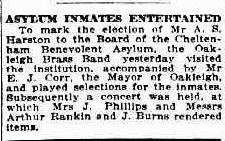
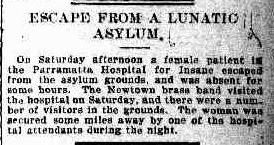
It was not uncommon for bands of this time to go and support these institutions either through their playing at the institution or by raising money through other means.  We can see this through articles published in the newspapers of the day and the reports that were submitted to the government of the day.  An article published in an August 1904 issue of the Daily Telegraph newspaper from Sydney tells us that the Newtown Brass Band played at the Parramatta Hospital for the Insane and there were a number of visitors in the grounds to listen to them  – although one the inmates escaped during the performance.  (“ESCAPE FROM A LUNATIC ASYLUM.,” 1904).  The Oakleigh Brass Band from Melbourne were quite active in this area of performance and the Talbot Colony for Epileptics and the Cheltenham Benevolent Asylum were two of the beneficiaries of their visits (“ASYLUM INMATES ENTERTAINED,” 1917; “Talbot Colony for Epileptics,” 1914).

Daily Telegraph, 15/08/1904, p. 7

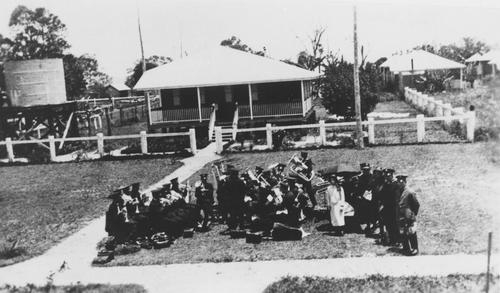
General Hospitals also hosted performances of brass bands as they sought to bring some music and entertainment before their patients and staff.  The Lakes Creek Brass Band (pictured below) was booked to play at the Rockhampton General Hospital at various times during 1914 (“THE LAKE’S CHEEK BRASS BAND.,” 1914).  Likewise, the Darwin Brass Band paid a surprise visit to the Darwin Hospital to play a selection of music at Christmas time, a performance that was very much appreciated by the audience and communicated to the band by the Matron in charge (“XMAS AT THE HOSPITAL.,” 1920).

The Lakes Creek Brass Band, 1909. (source: IBEW)

As well as boasting their own significant music program which once included a brass band, the Royal Victorian Institute for the Blind also hosted performances by various musical groups.  The employees of the Melbourne and Metropolitan Tramways Board generously gave their time to provide some entertainment for the Institute and part of this entertainment included items played by the Malvern Tramways Band (“TRAMWAYS ENTERTAIN BLIND FOLK.,” 1925).  Likewise, in later years, the bands of the Victoria Police (pipe and brass) also gave their time to play for the R.V.I.B. (“Police help for Blind Institute,” 1947).

Of course, the band movement in Australia was not alone in the way they provided music for these institutions.  The band movement in Aotearoa New Zealand was similarly engaged in doing the same kinds of performances.  For example, in the Te Waipounamu South Island city of Christchurch, on the Sunday before Christmas each year all the bands in the city would turn out to perform at various institutions and hospitals (“BANDS’ VISITING DAY,” 1938).

Press, 19/12/1939, p. 13

And as mentioned, the bands turned out for charitable events to aid in the care of the infirm.  In one instance, the newly-formed Richmond Boys’ Band was featured in an article published by the Richmond Guardian newspaper when they assisted at an event to provide support for the Blind Soldiers’ Fund (“Richmond Boys’ Brass Band,” 1918).

The work of the Salvation Army bands should also be noted as they were also very active in this area of performance. Below is a photo of a Salvation Army Band visiting the Peel Island Lazaret which was a facility to house Queensland sufferers of Leprosy.

Salvation Army Brass Band visiting Peel Island Lazaret (Qld.) during 1920s. (source: State Library of Queensland: 74802)

There was no doubt that the bands were busy in this area of performance, and full credit to the work that they did. 

Music-making:

Postcard: St. Augustine’s Orphanage Band. Champions of Australia, 1906 (source: Jeremy de Korte Collection)

While the workings of the Lunatic Asylums were virtually unknown to the public at the time, the same could not be said for other institutions such as the Blind Institutes and the Orphanages.  And both mentioned types of institutions promoted their musical activities to the extent that the bands attached to them had excellent reputations.  The musicians that both programs produced were very good and in Victoria for example, while some former R.V.I.B. musicians did display their talents outside the Institute, the Orphanages were better known for producing some of Australia’s finest brass musicians.  This section will briefly examine the music-making at both forms of institutions.

The Royal Victorian Institute for the Blind:

Lantern Slide: Royal Victorian Institute for the Blind Orchestra, 1900. (source: Museum Victoria Collections: MM 95962)

Music-making at the R.V.I.B. was an activity that was immersed in the daily routines of the students, and this involved singing, piano, organ, a string orchestra, and a brass band.  A first mention of a brass band at the R.V.I.B. is made in an article published by The Age newspaper as far back as 1874 where they played “The Standard Bearer March with excellent precision and time” (“DEAF AND DUMB INSTITUTE AND BLIND ASYLUM.,” 1874).

It appears that the Institute’s musicians were sent out to tour and raise funds as soon as they could do so.  Judith Buckrich, in her book on the history of the R.V.I.B, details some of the tours of the musicians, and even in the earlier years, the touring was quite extensive.  From an Institution that started in 1866, to have musical groups sent to various places in Victoria by 1877 was a remarkable achievement.

The Asylum’s musicians and singers were often on the road.  In 1877, the choir gave concerts in Taradale, Kyneton, Castlemaine, Sandhurst, Eaglehawk, Echuca, Maryborough, Chinaman’s Flat, Stawell, Ararat, Beaufort, Learmonth and Ballarat.  The band performed in Emerald Hill, Eltham, Dandenong, Footscray, Berwick and other places.  They earned £827 for the Asylum.

(Buckrich, 2004, p. 36)

Reflecting on music-making at the Institute as a whole, some writers asserted that the musicians at the R.V.I.B were performing at a higher standard than amateurs. A writer under the pseudonym of ‘Assistant Needlewoman’ wrote an expansive article for the Argus newspaper in June 1886 in which she meticulously detailed the workings of the Institute (Assistant Needlewoman, 1886).  She offered this considered opinion of the musical skills of the students.

While the musical world of Melbourne is divided as to whether there shall be a chair of music, a conservatoire, or whether, as would be best, we should be content for the present with a grand orchestra, the material for which is almost ready to hand, the claims of this well-known and deserving institutions are entirely overlooked.  With one conscientious and painstaking music teacher, upon whom is laid the Herculean task of giving instruction in piano, organ, and solo-singing, the pupils of the Blind Asylum have already done enough to show that they are worthy of the best professional training to be had.

(Assistant Needlewoman, 1886)

The article by ‘Assistant Needlewoman’ correlates with the history detailed by Buckrich as in 1888, there are some detailed accounts of how many students are involved in music-making.

Members of the choir and band numbered twenty-nine, and some students were members of both.  Eighteen students were being taught the piano and two, the organ.  Many concerts have been given during the year and this activity had earned the institution the tidy sum of £480 after expenses.  It seems that the choir and band now enjoyed free travel on the railways.

(Buckrich, 2004, p. 50)

Four years after the article penned by ‘Assistant Needlewoman’, a writer with the pseudonym of ‘Benvolio’ visited the R.V.I.B. and was most impressed with what he saw during his visit – “All will agree that the Victorian Asylum and School for the Blind is one of the most humane establishments in the colony…” (Benvolio, 1890).  He wrote an article for the Illustrated Sydney News newspaper which was just as detailed as the article written by four years earlier.  Benvolio’s remarks on the music program provide us with some additional insight.

…in most cases, they find outside employment, either at their trades or in teaching music, for which most of them display a wonderful aptitude, one of the former pupils being a very successful teacher in one of the suburbs, and at present bandmaster of the Asylum, which boasts a very efficient brass band and string band, besides a senior and junior choir, and several very capable solo vocalists and pianists, to say nothing of the more advanced pupils referred to, whose performances on the organ are astonishing.

(Benvolio, 1890)

As mentioned, musical groups such as the choir and string orchestra frequently went on tour and we can see that in some Victorian and Tasmanian towns, the visits were precluded by letters in the local newspapers explaining the charitable situation of the Institute (Hogarth, 1897; Winkelman, 1897).  The R.V.I.B. was always in need of funds and “one sources of funding that remained reliable was the concerts given by its various bands, orchestras and choirs.” (Buckrich, 2004, p. 58).  While the R.V.I.B. groups were in the towns, they were assisted by many of the town’s folk – and the local bands.  In two instances, the Ulverston Brass Band and the Rutherglen Brass Band were thanked for their help (Hogarth, 1900; “Victorian Institute for the Blind.,” 1893).

In the early 1890s we can see that the list of engagements for the band was not so much in towns and tours, but for specific events.  The “Royal Agricultural Society Annual Show”, “Roman Catholic Bazzaar, Albert Park”, “Miss Turner Grammar School Sports”, and the “Caulfield Grammar School Sports” are just some of the engagements the band performed at during 1892 (Buckrich, 2004, pp. 58-59).

The work of the R.V.I.B. was expanded during the First World War to help returned soldiers who had become vision impaired and blind, and the choir and band “gave several concerts at the Base Hospital, as well as the Soldiers’ Lounge in St Kilda, to assist the Red Cross with funds” (Buckrich, 2004, p. 82).  It is unclear as to the official status of the band in future years after the early 1900s.  However, the music department is still an integral part of the Institute.

Seventy-three students received instruction in music during 1922 – mainly in pianoforte, violin. Class and solo singing, flute, cornet and other band instruments, harmony, counterpoint, and the art of teaching.

(Buckrich, 2004, p. 95)

The Orphanages:

The Largs Bay Orphanage Band. The Chronicle, 11/11/1922, p. 29

Admittedly, there is so much material on the exploits of the many Orphanage bands that they warrant a whole post just to unravel the fine work they did with their bands.  And unfortunately, this post will gloss over most of the achievements of these groups.  However, they do fit into this context of this post as the bands were set up to provide a musical activity to the routines of Orphanage boys and girls.  The newspaper photo above of the Largs Bay Orphanage Band shows an Orphanage band that was unique in Australia as all the band members were female – this band was also mentioned in a previous post (de Korte, 2018).

Orphanage bands in Australia were a copy of practices in England where the teaching of music in boys’ institutions was commonplace (Sheldon, 2009).  There was, however, a major difference to the outcomes of this musical education between the two countries.  Boys who were trained as musicians in English institutions readily found themselves recruited into the bands of the British Army and Navy (Sheldon, 2009).  Whereas the musicians that graduated from the Orphanage bands in Australia found themselves positions in the wider band movement.   Sheldon (2009) identified some benefits to music education in British institutions which were applicable to Australian Orphanages.

The evidence from the boys’ letters shows that they valued the intrinsic benefits of belonging to the band and learning an instrument.  For some poor boys, musical education offered a relief from the rigours of institutional care in circumstances where there were few pleasures on offer.

(p. 747)

We know that Orphanage bands in Australia have had a long and distinguished history, as well as enviable reputations.  The St. Augustine’s Band from Geelong is probably the most famous of them all, and it is mentioned that by 1898 they were already putting the call out for a new set of instruments (“ST. AUGUSTINE’S ORPHANAGE BAND.,” 1898).  St. Augustine’s went on to win many competitions at South Street in Ballarat and toured extensively – in one instance, in 1906 they won the A Grade Championships at South Street (Royal South Street Society, 1906).  The band at St. Vincent’s de Paul in Melbourne was no less famous than their counterpart in Geelong and in 1921 they gained the services of Mr. Leslie Hoffman, a graduate of the St. Augustine’s Band, as their conductor (“St. Vincent’s Bandmaster,” 1921).  The Minton Boys’ Home Band in Frankston gained the services of another champion Geelong bandsman, Mr. Harry Shugg, when he became their instructor in 1928 (“BOYS’ BAND.,” 1928; Davies, 2005).  In Ballarat the boys at St. Joseph’s Orphanage Band were conducted by the very famous Frank Wright (pictured below) (St Joseph’s Orphanage Brass Band, 1924, 1924).

Frankston and Somerville Standard, 20/04/1928, p. 4
St. Joseph’s Orphanage Brass Band, 1924. (source: Victorian Collections: Federation University Historical Collection: 11049)

With so much talent from the Australian band movement involved in the music education areas of the Orphanages, it is no wonder that the bands did as well as they did.  As well as being an activity to occupy the minds of the Orphanage boys and girls, it also gave them a sense of purpose and achievement.

Westmead Orphanage Boys’ Band. Southern Cross, 30/10/1936, p. 10

The fourth prison band in the world:

The clock in the prison tower strikes the hour of midday. The prison brass band – a dozen trained prisoners – has fallen in on the grass plot in the central quadrangle.  At a signal from the official in charge it bursts into an inspiring rendition of Off to Glory march.  There may be dilletante criticism of the music’s aesthetic quality.  There can be no doubt of its volume and its lilting spirit.

(“A NEW PENTRIDGE.,” 1923)

Pentridge Prison really needs no introduction as an institution as innumerable stories have sprung from its bluestone walls.  It was not a place that immediately springs to mind as a place for music-making. Yet that is exactly what happened in the early 1920s.  Pentridge Prison became the institution that hosted the fourth prison band in the world.

Up until the early 1920s, Pentridge Prison was operated like many other prisons in Victoria under the governance of the Penal and Gaols Department.  Reports on the on Victorian prisons from this time were not very informative and focused mainly on statistics – the reports of 1922 and 1923 being prime examples (Penal and Gaols Department, 1923, 1924).  Conditions for the Victorian prisoners were hardly humane as prisons “had been designed to ensure prisoner separation” (Paterson, 1997, p. 134).  However, as Paterson (1997) and Wilson (2014) identified in their respective research papers into the history of Victoria’s prison system, it is in the early 1920s when the Penal and Gaol Department, and Pentridge Prison, underwent a series of reforms.  The key to these reforms was prisoner education and music-making was a strong part of this.

Efforts by people such as Mr. Gibson Young, an eminent Melbourne musician with strong managerial skills and an association with the brass band movement, sought to bring music into Pentridge through community singing.  In 1921 he had the full intention of running community singing in the gaols. 

Now that the Music Week organisation has been placed on a more or less permanent basis, my executive committee is anxious to do all in its power to bring the good tidings of music into every department of civic life, and realises that no better opportunity for upliftment exists than among the prisoners in our gaols.

(Young, 1921)

While community singing was useful as an ad hoc form of recreation and a break in the prison routine, the new governor of the Pentridge in 1922, Major Walter Condor, had bigger ideas and he wanted to form a brass band.  His plans were outlined at the Tattersalls Club in Melbourne where he was trying to solicit donations for three pianos at Pentridge (“PIANO FOR PENTRIDGE,” 1922).  Major Condor, having previously overseen the A.I.F. camp at Langwarrin, had very firm ideas about making Pentridge a much more humane place for the prisoners and introducing educational reforms.

To the strains of “home, Sweet Home,” Victorian criminals may yet be welcomed back to the prisons after new convictions.  The provision of music for prisoners is one of the ideals of the governor of Pentridge Major Condor, and he hopes for much from such an experiment in the reclamation of the State’s “Bad Hats.”

[…]

Major Condor said that one of the most humanising things was work, and next to that was music.

 (“PIANO FOR PENTRIDGE,” 1922)

Ten days later, Major Condor gained further support for a brass band at a conference of the National Federation at Ballarat where some delegates thought it was a very good idea.  A Dr. Booth thought his “idea was a good one” and that “It was essential that the prisoners should not only have plenty of work to do, but the mind should be occupied after working hours.” (“A PRISONERS’ BAND.,” 1922).  And so, the brass band at Pentridge was created.

At first it was conducted by Mr. Gibson Young, and he had obviously used his contacts in the brass band movement to get the instruments and music that were needed – the Coburg Brass Band and Malvern Tramways Band were two bands that are mentioned as having donated these items (Cremona, 1923).  Mr. Young, who was associated with the Malvern Tramways Band, had apparently “remarked that Major Condor might try to inveigle members of the Malvern Tramways Band into Pentridge to strengthen the personal of his band” (Cremona, 1923).  One wonders what Mr. Harry Shugg, then conductor of the MTB, might have thought of this remark (if he knew about it).

An article published in The Herald newspaper in February 1923 gives us some insight into the way music has begun to transform life at Pentridge.

There are already 15 men in the band.  Some of them have had experience in regimental bands, some of have been connected with various bands that are not known in Pentridge.  Others have just “taken to music” as the best means of whiling away the time until they can know again outside of the walls.

 (“PRISON DE LUXE,” 1923)

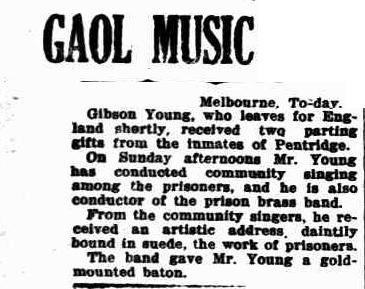
By April 1923, the work that was taking place at Pentridge was noticed by the Chief Secretary, a Mr. Baird who was most impressed with what he saw in the music-making and the effect it had on prisoners (“IMPROVEMENTS AT PENTRIDGE,” 1923).  And some months later, Pentridge was a prison that was well on the way to reformation, all under the watch of Major Condor (“A NEW PENTRIDGE.,” 1923).  Mr. Gibson Young, the bandmaster of the prison band and conductor of the community singing, left his position (and Australia) in September 1923 and was presented with a gold-mounted baton by the band (“GAOL MUSIC,” 1923).  

Mirror, 22/09/1923, p. 2

Major Condor left the prison in November 1923 to try a new career radio broadcasting (Thomas, 2006).  While he had only been governor at Pentridge for eighteen months, he had overseen substantial reforms that benefited the prisoner population and facilities.  

He gave the prisoners more healthful surroundings, brightened their quarters, permitted slight decorations of the cells, and with a colour scheme has banished gloom from the long corridors.  He gave them a brass band, Saturday and Sunday concerts, taught them games, improved their methods of working at trades by installing electric machinery in the shops, and increased their self-respect.

 (“MR. CONDER.,” 1923)
Herald, 06/02/1926, p. 17

On a slightly humorous note, a letter was published in the Labor Call newspaper apparently from a prisoner at Pentridge.  In this letter, he provides his ‘opinion’ on the band.

Our brass (very brass) band keeps a fellow from getting the “blues,” except when they play “Home, sweet home.” We are going to petition against the tune, as it only applies to the “Gov.” himself – he has a good home here.” 

(No. —, 1924)

The band at Pentridge prison kept going from strength to strength at from these early years and were noted by all that saw them perform.  They were, or course, part of a bigger picture of reform at the prison, and Pentridge was no longer seen as a dull institution (“AN HOUR IN PRISON.,” 1927).  The band had established themselves quite a bit over the subsequent years, to the extent that the Governor of Pentridge at the time, Mr. J. Brown, thought that the prisoners at Pentridge led all other prisoners in Australia in their musical abilities – he wanted them to go up in musical competition with the prisoners at Goulburn prison.  (“GAOL MUSIC DERBY,” 1935).

Literally there is music in the air at Pentridge every day.  An accomplished brass band of 26 instruments, led by Warder George Williams, plays marches and waltzes as the gangs go to and from their labours at the lunch hour.

(“GAOL MUSIC DERBY,” 1935)

On a side note, when researching this post, this author learned that the Cornet used by Warder George Williams was donated to the Coburg Historical Society in 1978. 

Herald, 17/01/1938, p. 11

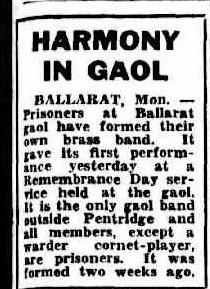
The Pentridge Brass Band lost the services of bandmaster Warder Williams in 1938 when he moved to Geelong to become an attendance officer for the Education Department (“FAREWELL TO PRISON BAND CONDUCTOR,” 1938).  Depending on which source is accessed, he was the conductor of the band for seven to ten years.  Evidently, the band was still in operation in the early 1950s as they were mentioned in an article published by The Herald newspaper about the new prison brass band which had been established in the Ballarat Gaol (“HARMONY IN GAOL,” 1951).  In 1954, the State Government spent £1,000 for a whole new set of instruments for the Pentridge Brass Band (“News of the Day,” 1954).

Herald, 12/11/1951, p. 5

It is unclear what happened to the Pentridge Prison Brass Band after the 1950s due to a scarcity of available records, and unfortunately, this author was unable to locate a picture of the band.  However, it is evident that the band had a very positive effect on the prisoners and staff, and that it fitted into the reforms that swept over the Victorian prison system.  

Conclusion:

There were many different types of music-making in these institutions, some which was kept hidden and others that were very much out in the open.  However, whatever the type of institution, the singular aim was to improve the mind with wholesome activities.  Music was the perfect activity, and bands were the outcome.  This was music therapy at its best.

References:

Assistant Needlewoman. (1886, 26 June). AMONG THE BLIND: THE VICTORIAN ASYLUM AND SCHOOL. Argus (Melbourne, Vic. : 1848 – 1957), 4. http://nla.gov.au/nla.news-article6099966

ASYLUM INMATES ENTERTAINED. (1917, 05 February). Herald (Melbourne, Vic. : 1861 – 1954), 6. http://nla.gov.au/nla.news-article242459034

BANDS’ VISITING DAY. (1938, 19 December). Press,13. https://paperspast.natlib.govt.nz/newspapers/CHP19381219.2.115

Benvolio. (1890, 02 August). MELBOURNE INSTITUTIONS: THE VICTORIAN ASYLUM AND SCHOOL FOR THE BLIND. Illustrated Sydney News (NSW : 1881 – 1894), 9. http://nla.gov.au/nla.news-article63615405

BOYS’ BAND. (1928, 20 April 1928). Frankston and Somerville Standard (Vic. : 1921 – 1939), 4. http://nla.gov.au/nla.news-article74994629

Buckrich, J. R. (2004). Lighthouse on the boulevard : a history of the Royal Victorian Institute for the Blind, 1866-2004. Australian Scholarly Publishing. 

CONCERT BY WESTMEAD ORPHANAGE BOYS’ BAND. (1936, 30 October). Southern Cross (Adelaide, SA : 1889 – 1954), 10. http://nla.gov.au/nla.news-article167081032

Conder, W. T. (1926, 06 February). One Year of Broadcasting. Herald (Melbourne, Vic. : 1861 – 1954), 17. http://nla.gov.au/nla.news-article244058874

Cremona. (1923, 02 April). MUSIC AND MUSICIANS : CURRENT GOSSIP. Herald (Melbourne, Vic. : 1861 – 1954), 6. http://nla.gov.au/nla.news-article243801873

Davies, S. A. (2005). One thousand white onions : a history of caring for children from 1865. Menzies. 

de Korte, J. D. (2018, 22 April). Early female brass bands in Australia: they were rare but they made their mark. Band Blasts from the Past : Anecdotes, Stories and Personalities. https://bandblastsfromthepast.blog/2018/04/22/early-female-brass-bands-in-australia-they-were-rare-but-they-made-their-mark/

DEAF AND DUMB INSTITUTE AND BLIND ASYLUM. (1874, 18 December). Age (Melbourne, Vic. : 1854 – 1954), 3. http://nla.gov.au/nla.news-article201534539

ESCAPE FROM A LUNATIC ASYLUM. (1904, 15 August). Daily Telegraph (Sydney, NSW : 1883 – 1930), 7. http://nla.gov.au/nla.news-article236885955

FAREWELL TO PRISON BAND CONDUCTOR. (1938, 17 January). Herald (Melbourne, Vic. : 1861 – 1954), 11. http://nla.gov.au/nla.news-article244947562

GAOL MUSIC. (1923, 22 September). Mirror (Perth, WA : 1921 – 1956), 2. http://nla.gov.au/nla.news-article77760324

GAOL MUSIC DERBY. (1935, 20 June). Telegraph (Brisbane, Qld. : 1872 – 1947), 15. http://nla.gov.au/nla.news-article182259204

Group of men wearing band uniforms and holding their brass instruments, R.V.I.B. [picture]. (1890). [negative : glass 16.3 x 21.4 cm. (full plate)]. [cr001189]. State Library Victoria, RVIB collection of glass negatives. http://handle.slv.vic.gov.au/10381/32332

Hardy, A. (2019). “Islands of the Insane” – our records, perceptions and the lost voices from the ‘asylum’. Hunter Living Histories : University of Newcastle. https://hunterlivinghistories.com/2019/10/16/islands-insane/

HARMONY IN GAOL. (1951, 12 November). Herald (Melbourne, Vic. : 1861 – 1954), 5. http://nla.gov.au/nla.news-article247850691

Hogarth, J. T. (1897, 05 April). ROYAL VICTORIAN INSTITUTE FOR THE BLIND : To the Editor. Ballarat Star (Vic. : 1865 – 1924), 1. http://nla.gov.au/nla.news-article210364264

Hogarth, J. T. (1900, 22 May). ROYAL VICTORIAN INSTITUTE FOR THE BLIND : To the Editor. Rutherglen Sun and Chiltern Valley Advertiser (Vic. : 1886 – 1957), 3. http://nla.gov.au/nla.news-article268489459

AN HOUR IN PRISON : VISIT TO PENTRIDGE. : Where Gloom is Dispelled. (1927, 14 December). Recorder (Port Pirie, SA : 1919 – 1954), 1. http://nla.gov.au/nla.news-article96058047

IMPROVEMENTS AT PENTRIDGE : FOURTH PRISON BAND IN WORLD. (1923, 23 April). Ballarat Star (Vic. : 1865 – 1924), 8. http://nla.gov.au/nla.news-article213810752

Kamm, R. (2018, 28 February). Life inside Victoria’s 19th-Century ‘Lunatic’ asylums. Vice Media Group. Retrieved 13 September 2020 from https://www.vice.com/en_au/article/vbpqwj/life-inside-victorias-19th-century-lunatic-asylums

THE LAKE’S CHEEK BRASS BAND. (1914, 27 February). Morning Bulletin (Rockhampton, Qld. : 1878 – 1954), 6. http://nla.gov.au/nla.news-article53319792

Lake’s Creek Brass Band, Rockhampton. (1909). [Photograph]. [phot20842]. The Internet Bandsman Everything Within, Vintage Brass Band Pictures – Australia. http://www.ibew.org.uk/vbbp-oz.html

MacKinnon, D. (2000). ‘A captive audience:’ Musical concerts in Queensland mental instituions c.1870-c.1930. Context: A Journal of Music Reseach, Spring(19), 43-56. https://cpb-ap-se2.wpmucdn.com/blogs.unimelb.edu.au/dist/6/184/files/2017/01/19-5-A-captive-audience-172c2wo.pdf

MacKinnon, D. (2009). Divine Service, Music, Sport, and Recreation as Medicinal in Australian Asylums 1860s-1945. Health and History, 11(1), 128-148. https://www.jstor.org/stable/20534507

MR. CONDER : CONTROL OF PENTRIDGE GAOL : FAREWELL BY PRISONERS. (1923, 07 November). Northern Star (Lismore, NSW : 1876 – 1954), 3. http://nla.gov.au/nla.news-article93506230

MUSIC AID TO RECRUITING. (1940, 06 June). Herald (Melbourne, Vic. : 1861 – 1954), 7. http://nla.gov.au/nla.news-article243225676

A NEW PENTRIDGE. (1923, 02 August). Age (Melbourne, Vic. : 1854 – 1954), 14. http://nla.gov.au/nla.news-article203628053

News of the Day. (1954, 11 December). Age (Melbourne, Vic. : 1854 – 1954), 2. http://nla.gov.au/nla.news-article205727521

No. —. (1924, 24 December). LIFE IN GAOL. Labor Call (Melbourne, Vic. : 1906 – 1953), 11. http://nla.gov.au/nla.news-article250083988

Paterson, W. C. (1997). Victoria’s prison policy 1851-1992: from hulks to unit management (Publication Number 21156) [PhD, University of Tasmania – School of Government]. Hobart, Tasmania. https://eprints.utas.edu.au/21156/

Penal and Gaols Department. (1923). Penal Establishments, Gaols, and Reformatory Prisons : Report and Statistical Tables for the year 1922 [Parliamentary Report](No. 25. – [1s] – 16851). Parliament of Victoria. https://www.parliament.vic.gov.au/papers/govpub/VPARL1923-24No25.pdf

Penal and Gaols Department. (1924). Penal Establishments, Gaols, and Reformatory Prisons : Report and Statistical Tables for the year 1923 [Parliamentary Report](No. 26 — [9D.] — 15596). Parliament of Victoria. https://www.parliament.vic.gov.au/papers/govpub/VPARL1924No26.pdf

PIANO FOR PENTRIDGE : PRISON CHIEF WANTS BAND ALSO. (1922, 05 September). Recorder (Port Pirie, SA : 1919 – 1954), 3. http://nla.gov.au/nla.news-article102724367

Pike, B. (2015, 03 March). Sydney’s shameful asylums: The silent houses of pain where inmates were chained and sadists regned. The Daily Telegraph. https://www.dailytelegraph.com.au/news/sydneys-shameful-asylums-the-silent-houses-of-pain-where-inmates-were-chained-and-sadists-reigned/news-story/b4205dc9a17e8ee0763711d93d720d04

Police help for Blind Institute. (1947, 13 September). Argus (Melbourne, Vic. : 1848 – 1957), 7. http://nla.gov.au/nla.news-article22507332

PRISON DE LUXE : PENTRIDGE MADE PLEASANT : Band Music, Electric Light. (1923, 27 February). Herald (Melbourne, Vic. : 1861 – 1954), 12. http://nla.gov.au/nla.news-article243791944

A PRISONERS’ BAND. (1922, 15 September). Daily Mail (Brisbane, Qld. : 1903; 1916 – 1926), 8. http://nla.gov.au/nla.news-article213217073

Richmond Boys’ Brass Band to Make Debut at Racecourse Carnival for Blind Soldiers—Amazing Growth of Notable Movement that will Bring Fame to This District. (1918, 12 January). Richmond Guardian (Vic. : 1917 – 1918), 2. http://nla.gov.au/nla.news-article93811136

Royal South Street Society. (1906). 1906-11-04 Band Contests : Held at the City Oval Royal South Street Society Results Database. https://results.royalsouthstreet.com.au/results/1906-11-04-band-contests

Royal Victorian Institute for the Blind. (1900). Lantern Slide – School Orchestra, Royal Victorian Institute for the Blind, circa 1900 [Lantern Slide, Standard (3¼ in. x 3¼ in.), Black & White]. [MM 95962]. Museum Victoria Collections, Royal Victorian Institute for the Blind Collection. https://collections.museumsvictoria.com.au/items/1390549 

Salvation Army brass band visiting Peel Island Lazaret during 1920s. (2007). [copy print : b&w]. [74802]. John Oxley Library, State Library of Queensland, Brisbane, Queensland. https://hdl.handle.net/10462/deriv/208680

Sheldon, N. (2009). The musical careers of the poor: the role of music as a vocational training for boys in British care institutions 1870–1918. History of Education, 38(6), 747-759. https://doi.org/10.1080/00467600903305590

St Joseph’s Orphanage Brass Band, 1924. (1924). [Photograph]. [11049]. Federation University Australia Historical Collection, Victorian Collections. https://victoriancollections.net.au/items/502db00e2162ef0f4c4ac157

ST. AUGUSTINE’S ORPHANAGE BAND. (1898, 01 March). Geelong Advertiser (Vic. : 1859 – 1929), 1. http://nla.gov.au/nla.news-article150368016

St. Augustine’s Orphanage Band : Champions of Australia. (1907). [Postcard]. Geelong, Victoria. 

St. Vincent’s Bandmaster : Mr. Hoffman Returns to Melbourne. (1921, 13 January). Advocate (Melbourne, Vic. : 1868 – 1954), 11. http://nla.gov.au/nla.news-article171054534 

Sunday Night Meeting AT THE SOCIALIST HALL : MUSICAL DEMONSTRATION : LECTURETTE BY MISS KATHLEEN HOTSON : PENTRIDGE JAIL METHODS CONDEMNED. (1920, 18 November). Socialist (Melbourne, Vic. : 1906 – 1923), 1. http://nla.gov.au/nla.news-article240692618

Talbot Colony for Epileptics : Visit by Oakleigh Brass Band. (1914, 24 January). Oakleigh and Caulfield Times Mulgrave and Ferntree Gully Guardian (Vic. : 1914 – 1918), 4. http://nla.gov.au/nla.news-article88807177

Thomas, A. (2006). Conder, Walter Tasman (1888-1974) [published first in hardcopy 1981]. In Australian Dictionary of Biography. Retrieved 27 October 2022, from https://adb.anu.edu.au/biography/conder-walter-tasman-5747

TRAMWAYS ENTERTAIN BLIND FOLK. (1925, 29 May). Prahran Telegraph (Vic. : 1889 – 1930), 3. http://nla.gov.au/nla.news-article165137965

Victoria. Lunacy Department. (1914). Hospitals for the insane : report of the Inspector-General of the Insane for the year ended 31st December 1913 [Parliamentary Report](25). Parliament of Victoria. https://pov.ent.sirsidynix.net.au/client/en_GB/parl_paper/search/detailnonmodal/ent:$002f$002fSD_ILS$002f0$002fSD_ILS:25004/one

Victoria. Lunacy Department. (1927a). Hospitals for the insane : report of the Inspector-General of the Insane for the year ended 31st December 1925 [Parliamentary Report](11). Parliament of Victoria. https://pov.ent.sirsidynix.net.au/client/en_GB/parl_paper/search/detailnonmodal/ent:$002f$002fSD_ILS$002f0$002fSD_ILS:25149/one

Victoria. Lunacy Department. (1927b). Hospitals for the insane : report of the Inspector-General of the Insane for the year ended 31st December 1926 [Parliamentary Report](37). Parliament of Victoria. https://pov.ent.sirsidynix.net.au/client/en_GB/parl_paper/search/detailnonmodal/ent:$002f$002fSD_ILS$002f0$002fSD_ILS:25005/one

Victoria. Lunacy Department. (1928). Hospitals for the insane : report of the Inspector-General of the Insane for the year ended 31st December 1927 [Parliamentary Report](41). Parliament of Victoria. https://pov.ent.sirsidynix.net.au/client/en_GB/parl_paper/search/detailnonmodal/ent:$002f$002fSD_ILS$002f0$002fSD_ILS:28338/one

Victorian Institute for the Blind. (1893, 27 January). Coastal News and North Western Advertiser (Ulverstone, Tas. : 1890 – 1893), 3. http://nla.gov.au/nla.news-article216216052

Wilson, R. (2014). Joseph Akeroyd: rediscovering a prison reformer (Publication Number 9921863848301341) [PhD, RMIT University – School of Management – College of Business]. Melbourne, Victoria. https://researchrepository.rmit.edu.au/esploro/outputs/doctoral/Joseph-Akeroyd-rediscovering-a-prison-reformer/9921863848301341

Winkelman, H. G. A. (1897, 25 November). THE VICTORIAN INSTITUTE FOR THE BLIND—VISIT OF THE BAND AND CHOIR. Bairnsdale Advertiser and Tambo and Omeo Chronicle (Vic. : 1882 – 1918), 3. http://nla.gov.au/nla.news-article86326868

XMAS AT THE HOSPITAL. (1920, 28 December). Northern Territory Times and Gazette (Darwin, NT : 1873 – 1927), 3. http://nla.gov.au/nla.news-article3303945

Young, G. (1921, 25 November). Pentridge Music. Herald (Melbourne, Vic. : 1861 – 1954), 8. http://nla.gov.au/nla.news-article242631362

YOUNG MUSICIANS. (1922, 11 November). Chronicle (Adelaide, SA : 1895 – 1954), 29. http://nla.gov.au/nla.news-article87519427

Earning points: proper deportment of band member’s

Inspection of the B Grade Bands at the South Street Eisteddfod, 1949. (photograph of The Courier photograph taken by Jeremy de Korte on 30/09/2021)

Introduction:

The secretary will arrange for supply of Brasso etc. for polishing all instruments on the journey and the management committee will inspect the instruments from time to time.  Members are asked to note that it is imperative to have hair cut very short (back and sides) and all wearing black shoes laced alike – with no tags showing.

(“Rules and Itinerary,” 1937)

If the above directive from the conductor and management of the Longreach Town Band seems a bit onerous, one could say it was a sign of the times.  Except, this was not a sign of the times.  It reflects the efforts that the band associations and individual bands went to ensure that all band members upheld the reputation of the movement.  Which could be summarised as looking sharp and behaving properly according to a defined set of rules.  Deportment of a band and band members was taken very seriously.  Contemporary band members will relate to these concepts even now.

Deportment was regarded seriously enough that points were won and lost in various contests if there was any infraction of the contest rules.  Inspection before the Quickstep section of a contest was part and parcel of the event, although some judges took it to extremes.  Rules was generally standard and enforced by band associations.  When a contest came down to mere points, the deportment of an individual mattered greatly.

In this post we will be exploring deportment in relation to the band movement and by default, the process of inspection and the governing rules.  While we may not see exactly where these rules on deportment eventuated (or why) this aspect of the band movement is interesting.  For a movement that prides itself on tradition, this is one tradition that holds true today.

Expectations:

Brisbane Courier, 02/04/1923, p. 6

Deportment can be literally defined as a “the way a person behaves” or “manner of bearing” (Cambridge English Dictionary, 2021).  For a band member, their deportment was judged by everyone who looked at them, with perception of their behaviour judged by others.  Throughout the newspaper articles that mention band competitions, or from some bands themselves, we can find references to deportment and the expectations that band associations and bands held for their members.  Were band members expected to model higher standards of behaviour and dress than that of other people?  If one were to believe the newspaper articles, then yes, they were seemingly held to higher standards.  Hence, lists of competition rules were created that band members were expected to adhere to – these will be examined later in the post.  Harking back to the expectations and standards the Longreach Town Band set for themselves, we find in the second-last paragraph of the article,

Win or lose, remember we are representing the far central west.  Impress people with your good conduct.  Be on the alert always to gain a point.  No arguments, no bad feeling, plenty of rest, and the good comradeship element will go towards successes in this ambitious effort.

(“Rules and Itinerary,” 1937)

This is but one example of expectations that a band held for their members.  Generally speaking, bands and band members were extremely well-behaved and dressed, and compliance with the many rules governing behaviour and dress were followed rigorously.  However, that was not to say that there were other problems; bandsmen were people too. Digging deeper we find an article from 1911 where the Band Association New South Wales (BANSW) scolded the behaviour of bandsmen in a general way.  This article published in the Daily Advertiser newspaper let everyone know that bandsmen were on notice – the start and end of the article are quoted here. 

It is probably that the New South Wales Bands’ Association will take some action at an early date in the direction of impressing on bandsmen when visiting contests the advisability of being as circumspect in their deportment and behaviour as the average citizen is expected to be.  On the march and when engage in the contest work, bandsmen as a rule are role models of discipline and behaviour. 

[…]

It should be unnecessary for the Bands’ Association to have to prescribe a standard of conduct for bandsmen, but unfortunately the utter disregard for the feelings of others displayed by some few of the members of the numerous bands appears to render that course desirable.” 

(“BANDMEN’S BEHAVIOR“, 1911)

This was not the first time and last time that the behavioural expectations of band members would be mentioned in print. The other side of this was a reminder to the public that band members were models of good behaviour, a way to promote bands as a very wholesome activity.  Writing about the setting up of school bands in a 1929 issue of The Australasian Band and Orchestra News magazine, the Editor wrote,

As they advance in their studies, the boys are in all probability invited to practise with the senior bands in their districts.  They become bandsmen, they find good occupation in their leisure, their minds are disciplined, and everyone knows that the good bandsman is never a bad citizen.

(“THE EDITOR’S BATON,” 1929)

A further reminder on deportment, this time to do with uniforms and dress, was issued by the Queensland Band Association in April 1930 when Mr. J. R. Foster (Secretary) was quoted in The Evening News newspaper, of which the article can be seen below. 

Evening News, 17/04/1930, p. 2

Many of the issues surrounding deportment was seemingly applied to male band members.  What of our female bands?  We know that from a previous post there were very few of them around Australia, and when we do see mention of them, there is some indication that they also took the behaviour of their members quite seriously (de Korte, 2018a).  The famous Sydney Ladies’ Band prided themselves on their behaviour and attitude.  An article published by the Australian Women’s Weekly in 1938 detailed some of the behaviours that were frowned upon.

Boy-friends are not encouraged by the Band, because they would occupy valuable time that should be otherwise allotted to practice.

Married women are not accepted as members because their home ties distract them and they must ask their husbands’ permission to travel to country or interstate engagements. 

(“SPINSTERS ONLY is the SLOGAN of the BAND,” 1938)

Hilda Tansey, the conductor of the Sydney Ladies’ Band outlined some other expectations, and it appears, she had a very dim view of ladies who transgressed.

Occasionally we get ‘passengers’ in the band – girls who join just to show off to their boy friends in our smart green uniform.  But within a fortnight we discover them and we tell them in no uncertain terms that they have played their finale.

(Tansey in “SPINSTERS ONLY is the SLOGAN of the BAND,” 1938)

This photograph below of the Sydney Ladies’ Band from 1934 shows the members in the said uniform. 

Sydney Ladies’ Band, 1934 (source: State Library Victoria: pi007746)

The deportment of band members was an issue that held the attention of some band commentators, to the extent they even sponsored prizes in major competitions, for example, Cecil Clarence Mullen  (Royal South Street Society, 1959, 1964).  We saw in an earlier post that Mullen had much to say about the band movement, and deportment on the stage while playing and conducting was one of those issues he took to heart (de Korte, 2020; Mullen, 1951).  To refresh, Mullen was most displeased with “boys between 11 and 18 years in many cases taking a chair and sitting down to play their solo” (Mullen, 1951, p. 61).  He also took issue with bandmasters who let this happen in the first place.  Mullen was ever the commentator to let his opinions be known and although I cannot find any record of him adjudicating, he finished the little section on deportment in his book with these words,

On several occasions in recent years I have been called upon to judge solo competitions in school, suburban and country competitions and make no secret of the fact that I rang boys off very quickly for bad stage deportment.  The late Mr. E. T. Code, the best trainer of boys we have ever had, was very strict in these matters.

(Mullen, 1951, p. 62)

Mullen had reason to criticise the deportment of younger band members, especially while playing, and he was possibly right in saying that they should not be sitting down as it affected their breathing (Mullen, 1951).

Negotiating the issues surrounding the deportment of band members were complex and time consuming.  However, as we will see in the next section, some areas of deportment, namely looking smart, were easier to manage.  And for bands, being very much in the visual space as well as a musical space was important – cleanliness of uniforms was taken as seriously as behaviour.

Looking smart:

Issues about the supply and funding of uniforms were touched on in a previous post about supplying the essentials for bands (de Korte, 2018c).  Bands wanted to look smart on parade and expected their members to wear their uniforms with pride.  They also expected their members to look after their uniforms.  On occasions though, uniforms were the issue.  In an earlier post on the first band sections at South Street Ballarat, we found that the conductor of the Launceston Garrison Band lamented that his band lost points because of “the stained and worn-out state of the Government uniforms” which were “severely condemned by the military judge” (de Korte, 2018b; “THE INTERCOLONIAL BAND CONTEST.,” 1900).

Uniforms were a much commented on part of bands in the media, even if the language of old newspaper might make us wince at times.  The word ‘smart’ was a common descriptor linked to deportment regarding dress.  In an article published by the Toowoomba Chronicle and Darling Downs Gazette in 1924, each band that participated in the Toowoomba contest that year received some sort of comment regarding their appearance, bearing, colours of uniform, and cleanliness of instruments (“INSPECTION OF BANDS,” 1924).

The two pictures below from The Sun and Daily News newspapers showing the Sydney Ladies’ Band and the East Kew Junior Brass Band provide perfect examples of this language being used.  Although, in the caption for the Sydney Ladies’ Band, the word ‘pretty’ was also used to describe the members.  Nevertheless, a band that was dressed smartly attracted attention.  It spoke of a band that took pride in their appearance and demeanour.  And especially when participating in contests and other events where the band was on show, a proper uniform was a must.

The Sun, 14/10/1934, p. 3
Daily News, 28/03/1936, p. 3

The Quickstep and Inspection:

Unsteadiness in Ranks1 point for each offender
Untrimmed hair1 point for each offender
Unshaven1 point for each offender
Irregularities of Dress1 point for each offender
Irregularities of Footwear1 point for each offender
Incorrect Dressing1 point for each offender
Incorrect Intervals1 point for each offender
Dirty Instruments1 point for each offender
Talking in the Ranks1 point for each offender
(Australian Band Council, 1934, p. 17)

The band movement in Australia and New Zealand can be based on holdovers from the United Kingdom, with some key differences that become apparent in band contests.  Unlike their counterparts in the U.K., a feature of the band movements and contests in Australia and New Zealand was the Quickstep sections and the preceding military-style Inspection.  This post will provide a brief overview of the Quickstep and then focus on the Inspection, which is an aspect directly related to the topic of this post.

The Quickstep:

The Quickstep section that featured in Australian and New Zealand band contests for over one hundred years semes to be an invention by the band movements of both countries.  Accounts are sketchy as to how it started, however, an article published in the Kalgoorlie Miner newspaper 1911 provides a little history.

The origin of the quickstep first came prominently before the Australian public at contests held in connection with the Druids’ Gala at Melbourne about 11 years ago.  On that occasion the drill performed was very much the nature of cavalry section drill, but it was subsequently modified to conform to the infantry manual.

(“BRASS BAND CONTESTS.,” 1911)

Based on this account and history, this would mean that quickstep sections first appeared in Australian band contests around the late 1890s, and we can find evidence of this in an account of the Druids’ Gala published by The Age newspaper on Monday 11th April 1898.

The marching and deportment of the men will be taken into consideration by the judge, Mr. F. Lyon, in awarding the prizes of £50, £20 and £10 offered for the military drill contest, the principal features of which were enacted at the gardens.  Each band fell in for inspection separately, and marched 100 yards in 120 paces within a minute, to a quickstep, following up this performance by wheeling and countermarching manœuvres to appropriate music.

(“THE EASTER HOLIDAYS.,” 1898)

Some British judges who were brought out to adjudicate the contests had never seen anything like it and commented favorably on the section and what it represented.  In 1902 James Ord Hume adjudicated at the famous South Street Eisteddfod and had this to say about the Quickstep section.

I thoroughly endorse the idea of this quickstep contests, as I am of opinion that brass bands, when marching, should always be spirited and also neat and uniform in the ranks.  The music should be always of a bright and military nature and, indeed, the band should always prove by its marching in public, its standard of excellence.

(James Ord Hume in “THE INTER-STATE BAND CONTEST.,” 1902)

Three years later the South Street contest was adjudicated by Mr. Albert Wade from Wales, and he also was impressed with the Quickstep section.

But the marching was of the best and Mr. Wade found in the military style of the civilian bandsmen an example for the straggling Britishers who compose the village band in the old country.

(“BIG BAND BATTLES.,” 1905)

Unfortunately, there seems to be no films of early Quickstep contests in Australia.  However, New Zealand’s Ngã Taonga Sound & Vision has in their resources a short film dating back to 1912 of the Dunedin Brass Band contests, Quickstep section (Gore, 1912).  The link below will show a short film of this Quickstep section where the military judges can clearly be seen pacing the bands and taking notes.

Dunedin Brass Band Contest, Quickstep (F9933)

The Inspection:

Newcastle Morning Herald and Miners’ Advocate, 18/12/1938, p. 8

This part of the post started with a list of rules governing the Inspection published by the newly formed Australian Band Council in 1934.  Every aspect of appearance and behaviour were detailed in various rules, and Duncan Bythell (2000) notes that “The rules for marching contests achieved a terrifying complexity, with the marks for being awarded for smart appearance and successful drilling than for musicianship.” (p. 236).  Some bands bore the brunt of these rules with band members being penalised on numerous occasions at contests.  The Wellington Garrison Band travelled to the Bathurst contests in 1899 from New Zealand and found themselves on the receiving end of the rules when nine bandsmen were penalised because they were unshaven – the band apparently “forgot” the regulations (“Bathurst Band Contest.,” 1899; “UNSHAVEN BANDSMEN,” 1899).

The research by Bythell can be corroborated by the band journals of the day as controversy surrounding the inspection was never hard to find.  Accounts of an A.N.A contest in Melbourne were penned by many commentators in the January 1913 issue of The State Band News with a writer colloquially titled ‘Clarion’ detailing the inspection in his article, of which excerpts are quoted here.

For length of time occupied and the keen inspection each man received a “record” was easily established.

Some wags, who were getting impatient, struck up with great enthusiasm the “Midnight National Anthem”.”

The principal comment was – A contest does not consist of inspection.

Many bandsmen complained that points were taken off for marks on the slides of instruments – the said marks being put there for tuning purposes.

Beyond the general essentials of clean instruments, uniforms, haircuts, etc., no one seemed to know if any hard and fast rules were laid down for an inspection of this kind – evidently, it is left to the discretion of the drill judge.

The fact that Color Sergeant Humphries is the author of the official drill book used in connection with Quickstep Contests, no doubt is accountable for the very rigours inspection. 

(Clarion, 1913, p. 5)

The writer of the opening article in the mentioned issue of The State Band News pointedly recommended that the Victorian Bands’ Association (V.B.A.) limit the inspection process to “5 minutes per band.” (“Band Chat,” 1913, p. 2).

As in the Quickstep, the whole theatre and process of the Inspection was a measure of comparison between contests in Australia and the United Kingdom.  In 1907, Mr D. J. Montague, a musician from Ballarat, returned from an eight month tour of England, Scotland and Wales where he was fortunate enough to view many of the great band contests and compare them to the South Street Eisteddfod (“BRITISH VERSUS AUSTRALIAN BAND MUSIC.,” 1907).  His interview with the Ballarat Star newspaper was wide-ranging and provided an interesting account comparing the band movements in both countries.  Here in this article, we can see his thoughts on why the Inspection was a beneficial part of Australian and New Zealand contests.

He remarked that one difference between the contests in Great Britain and those in Australia was that here time is not so much account as in the old land.  For instance, the great Crystal Palace and Belle Vue contests last only one day.  The bands travel all night from far distant parts of England and Scotland to reach London early in the morning, and numbers of bandsmen are playing in various parts of the day.  After the contest is over they hurry back by the night trains for home.  He found that the bandsmen were very careless over their instruments, which were nearly always dirty and unpolished, and he took occasion to introduce to the directors’ notice the inspection and drill system obtaining at South Street, which resulted in smart looking bandsmen and clean instruments.

(“BRITISH VERSUS AUSTRALIAN BAND MUSIC.,” 1907)

While it was evident that many band members were very responsible when it came to keeping clean and tidy, there are accounts of the supporters of a band helping when needed.  Maureen French, a local writer from Clunes in Victoria, wrote a book on the history of bands in Creswick titled ‘Following the bands : a journey down the years with the brass bands of Creswick’.  She wrote a section on the Creswick and District Band experiences in the Quickstep and Inspection and details this little anecdote about how the band tidied themselves up.

But the greatest contribution was made by the small army of womenfolk who accompanied the band at competitions.

Points could be lost for dirty shoes, missing buttons, untidy hair, etc.  With that in mind, once the players had assembled on parade, these good ladies would swarm over them, armed with clothes brushes, spit-and-polish, and all accoutrements required to remove a miniscule of fluff that could tarnish the image of their charges.  All this of course, was a labour of love.

(French, 2013, p. 64)

As mentioned, the Inspection could either win or lose a band points.  If we were to look at some of the accounts of contests where comments of judges were recorded, they are telling.  Below is an excerpt from an article published by the Shepparton News newspaper in February 1914 detailing the judges’ comments on the contest that was held in town.  These comments directly relate to the Inspection and the four bands that participated were the Shepparton Town Band, Rochester Brass Band, Benalla Brass Band and Shepparton Model Band (“INSPECTION.,” 1914).

Shepparton News, 16/02/1914, p. 3

Likewise, at a contest being administered by the Queensland Band Association in 1929, they left no doubt as to what would be taking place during the Inspection part of the contest (and every other event that was being undertaken during the day).

At the commencement each band is moved onto the grounds, and then marched to the oval and inspected by military judges, points being allocated for military deportment, appearance, smartness in the ranks, cleanliness of instruments and uniform.

(“TO-DAY’S PROGRAMME,” 1929)

Interesting that the expectation of the bands is that they display a military-like bearing, despite the bands (it is assumed) to be civilian.

No doubt the regulations on deportment were quite clear and it was up to the bands to adhere to them.  As a measure of how points were deducted, we can read what happened to the Mackay Concert Band during a contest in Rockhampton in 1934.

The discipline of the band on parade was somewhat lacking, inasmuch as points were lost for detail in dress, deportment, and drill.  For untidiness the band lost four points – two for untrimmed hair and two for unshaven faces, and for bad movements in drill four points were lost, making a deduction of 8 points from the maximum of 40, leaving the band with 32.

(“Concert Band.,” 1934)

One must not disregard all opinion of the Inspection process.  While it was an important part of contest proceedings (and still is to some extent), every so often bands people advocated for change.  One of them was Frank “Massa” Johnston, the famous band conductor from Melbourne who in 1939 was the conductor of the Melbourne Fire Brigade Band.  He made some comments after coaching the Maryborough Federal Band at the 1939 Bundaberg contest which were detailed in an article published by the Central Queensland Herald newspaper (“BAND JUDGING IN QUEENSLAND,” 1939).  One of his suggestions to the Q.B.A. was the Inspection of bands be eliminated as a separate part of the contest and instead “be incorporated with the diagram march with additional  points for drill and appearance” (“BAND JUDGING IN QUEENSLAND,” 1939).

While diagram marching has fallen out of favour at band contests, street marching, and the inspection remain a part to this day, especially at the Australian National Band Championships.  It is interesting to occasionally read commentary on the ubiquitous social media – modern bands people can be known to be passionate about rules and regulations.  Bearing in mind that much of what we do as bands and band members has some grounding in history.

Conclusion:

There is much we can still learn about how bands of old handled the rules and regulations on deportment, and how they managed expectations.  Pride in appearance and behaviour was one aspect, but there was also the public perception.  Perhaps if we were to take a critical view, maybe the Inspection was over-policed by band associations.  However, the Inspection, and the visual display of the Quickstep, were pointed differences between the band movements of Australia & New Zealand, and the band movement in the United Kingdom.  There was pride in doing something differently and doing it well.

References:

Australian Band Council. (1934). Australian Band Council : Constitution : Contest Rules : Quickstep Regulations and Instructions  [Constitution]. Oxford Press. 

Band Chat. (1913). The State Band News, 4(6), 2 & 4. 

BAND JUDGING IN QUEENSLAND. (1939, 20 April). Central Queensland Herald (Rockhampton, Qld. : 1930 – 1956), 59. http://nla.gov.au/nla.news-article70844529

BANDMEN’S BEHAVIOR. (1911, 26 May). Daily Advertiser (Wagga Wagga, NSW : 1911 – 1954), 2. http://nla.gov.au/nla.news-article143079764

BANDSMEN ON PARADE. (1939, 18 December). Newcastle Morning Herald and Miners’ Advocate (NSW : 1876 – 1954), 8. http://nla.gov.au/nla.news-article135450896

Bandsmen, Please Note! (1930, 17 April). Evening News (Rockhampton, Qld. : 1924 – 1941), 2. http://nla.gov.au/nla.news-article202494392

Bathurst Band Contest : Complaints from New Zealand. (1899, 17 November). Bathurst Free Press and Mining Journal (NSW : 1851 – 1904), 2. http://nla.gov.au/nla.news-article63910068

BIG BAND BATTLES : IN CITY OF STATUES : MEN FROM BOULDER CITY : ARE AUSTRALIA’S CHAMPIONS. : (From our special representative). (1905, 07 November). Evening News (Sydney, NSW : 1869 – 1931), 7. http://nla.gov.au/nla.news-article113288815

BRASS BAND CONTESTS : The Quickstep. (1911, 30 August). Kalgoorlie Miner (WA : 1895 – 1950), 2. http://nla.gov.au/nla.news-article91325368

BRITISH VERSUS AUSTRALIAN BAND MUSIC : INTERVIEW WITH MR D. J. MONTAGUE. (1907, 08 January). Ballarat Star (Vic. : 1865 – 1924), 5. http://nla.gov.au/nla.news-article210885760

Bythell, D. (2000). The Brass Band in the Antipodes : The Transplantation of British Popular Culture. In T. Herbert (Ed.), The British brass band : a musical and social history (pp. 217-244). Clarendon Press ; New York : Oxford University Press. 

Cambridge English Dictionary. (2021). Deportment. In Cambridge English Dictionary. Retrieved 16 October 2021, from https://dictionary.cambridge.org/dictionary/english/deportment

Clarion. (1913). A.N.A. Contests. : Contest Side-Lights. The State Band News, 4(6), 4-8. 

Concert Band : CONTEST ADJUDICATOR’S COMMENTS. (1934, 05 April). Daily Mercury (Mackay, Qld. : 1906 – 1954), 3. http://nla.gov.au/nla.news-article173312584

de Korte, J. D. (2018a, 22 April). Early female brass bands in Australia: they were rare but they made their mark. Band Blasts from the Past : Anecdotes, Stories and Personalities. https://bandblastsfromthepast.blog/2018/04/22/early-female-brass-bands-in-australia-they-were-rare-but-they-made-their-mark/

de Korte, J. D. (2018b, 22 December). The first South Street band contest in October, 1900. Band Blasts from the Past : Anecdotes, Stories and Personalities. https://bandblastsfromthepast.blog/2018/12/22/the-first-south-street-band-contest-in-october-1900/

de Korte, J. D. (2018c, 08 July). Instruments, sheet music and uniforms: how the bands of old obtained the essentials. Band Blasts from the Past : Anecdotes, Stories and Personalities. https://bandblastsfromthepast.blog/2018/05/13/instruments-sheet-music-and-uniforms-how-the-bands-of-old-obtained-the-essentials/

de Korte, J. D. (2020, 06 March). Cecil Clarence Mullen: Enthusiastic commentator, historian and statistician of brass and military bands. Band Blasts from the Past : Anecdotes, Stories and Personalities. https://bandblastsfromthepast.blog/2020/03/06/cecil-clarence-mullen-enthusiastic-commentator-historian-and-statistician-of-brass-and-military-bands/

de Korte, J. D. (2021). Lake Wendouree, Vic. : The Courier (Newspaper) : 1949 Royal South Street Band competitions – City Oval : B Grade Bands – Inspection [Photograph (Newspaper photograph)]. [IMG_6741]. Jeremy de Korte, Newington, Victoria. 

THE EASTER HOLIDAYS. : DRUIDS’ GALA. : OPENING DAY. : A GREAT ATTENDANCE. (1898, 11 April). Age (Melbourne, Vic. : 1854 – 1954), 6. http://nla.gov.au/nla.news-article191489906

THE EDITOR’S BATON: Bringing up the boy to the band. (1929). The Australasian Band and Orchestra News, XXV(2), 1 & 3. 

French, M. E. C. (2013). Following the bands : a journey down the years with the brass bands of Creswick. Maureen E. C. French. 

Gore, H. C. (1912). Dunedin Brass Band Contest, Quickstep [Moving Image]. New Zealand / Aotearoa, New Queens Theatre, Dunedin. https://ngataonga.org.nz/collections/catalogue/catalogue-item?record_id=67764

INSPECTION. (1914, 16 February). Shepparton News (Vic. : 1914 – 1918), 3. http://nla.gov.au/nla.news-article129652799

INSPECTION OF BANDS. (1924, 19 April). Toowoomba Chronicle and Darling Downs Gazette (Qld. : 1922 – 1933), 6. http://nla.gov.au/nla.news-article253775325

THE INTER-STATE BAND CONTEST : MR. J. ORD HUME’S CRITICISMS : WHAT HE SAYS ABOUT TASMANIAN BANDS : DETAILS OF RESULTS : (“Ballarat Star”). (1902, 06 November). Mercury (Hobart, Tas. : 1860 – 1954), 2. http://nla.gov.au/nla.news-article9590543

THE INTERCOLONIAL BAND CONTEST : Return of the Second Battalion Band. (1900, 11 October). Daily Telegraph (Launceston, Tas. : 1883 – 1928), 3. http://nla.gov.au/nla.news-article153769022

Mullen, C. C. (1951). Mullen’s Bandsmen of South Street (1900-1951). Horticultural Press. 

Regent Studio. (1923, 02 April). A GRADE TEST SELECTION. Brisbane Courier (Qld. : 1864 – 1933), 5-6. http://nla.gov.au/nla.news-article20611772

Royal South Street Society. (1959). 1959-10-23 Brass Band Contests [Eisteddfod Results]. Royal South Street Society Results Database. https://results.royalsouthstreet.com.au/results/1959-10-23-brass-band-contests

Royal South Street Society. (1964). 1964-10-24 Victorian Brass Band Championship [Eisteddfod Results]. Royal South Street Society Results Database. https://results.royalsouthstreet.com.au/results/1964-10-24-victorian-brass-band-championship 

Rules and Itinerary : CORONATION BAND CONTEST : EASTER 1937 : LONGREACH TOWN BAND. (1937, 13 March). Longreach Leader (Qld. : 1923 – 1954), 5. http://nla.gov.au/nla.news-article37363142

SPINSTERS ONLY is the SLOGAN of the BAND : Musical Girls who Have Little Time for Cupid. (1938, 19 February). Australian Women’s Weekly (1933 – 1982), 40. http://nla.gov.au/nla.news-article51590948

Sydney Ladies’ Brass Band [picture]. (1934). [1 photographic print on cardboard mount : gelatin silver, hand col. ; 30 x 40 cm.]. [pi007746]. State Library Victoria, Tansey family collection. http://handle.slv.vic.gov.au/10381/336537

TO-DAY’S PROGRAMME. (1929, 18 August). Sunday Mail (Brisbane, Qld. : 1926 – 1954), 3. http://nla.gov.au/nla.news-article97690827

UNSHAVEN BANDSMEN. (1899, 10 November). Hawke’s Bay Herald. https://paperspast.natlib.govt.nz/newspapers/HBH18991110.2.22.1

Influences from Britain: James Ord Hume and “The Besses Effect”.

Postcard: Besses o’ th’ Barn Band. (1908) (Source: Jeremy de Korte collection)

Introduction:

The visit of one of the premier bands of Britain to Australia would be an event of great interest, and Mr. Hume, speaking on the matter, said that if the railways would guarantee to grant free passes to the members, he could almost promise that either the Besses o’ th’ Barn Band, of Lancashire or the Black Dyke Band, of Yorkshire, would come out.  That the venture would be a success Mr Hume says he has not the slightest doubt, and he considers that the playing would come as a revelation to Australians.

(“MR. J. ORD HUME.,” 1903)

Australian bands, to put it simply, are an extension of the movement started in Britain and bands are one of Britain’s great cultural exports.  As has been noted in other posts, the influx of people from the British Isles and other places carried their music with them.  It is no surprise that in the early years, bands were established in localities across Australia. 

There was no shortage of enthusiasm for starting a band, and no shortage of budding musicians willing to learn.  However, training them, supporting them and giving them inspiration was at times problematic.  Musical training was sometimes left up to those willing to take the job of bandmaster, whether they had brass band skills or not.  This was the case in some places but not others as some bands became very proficient, very quickly. 

Not that this mattered to some untrained ears.  Many towns and localities were simply glad to have a band (a source of civic pride).  Although the bands that were founded in the late 1800s and early 1900s possibly realised that their playing was not up to English standards.  Bands were willing to learn, it was just a matter of whom to learn from.  It was not until the advent of organised competitions and visits from English bands that the standard of playing was given a critical ear and adjudicators provided bands with helpful comments on how to improve.

This post will examine what was probably the greatest shift in musical standards amongst Australian bands that took place over the period of two to three decades.  This rapid improvement was partly inspired by the visits of the eminent Scottish band adjudicator James Ord Hume and the famous Besses o’ th’ Barn Band from England.  Thankfully, for the purposes of this post, we can see the comments of James Ord Hume over the course of his two visits as he judges the bands.  We will also see that while the tours of Besses were significant in themselves, it is the lasting effect these visits had on Australian bands that deserves attention.  This is a combined story; a story of how British band musicians did their best to inspire and help Australian bands to be the best they could be.

James Ord Hume, 1902-1903:

National Advocate, 13/11/1902, p. 5-6

Lieutenant James Ord Hume was an “eminent English and Scottish bandmaster, composer, critic and adjudicator” (Mullen, 1965, p. 40).  A lifetime of musical training in the British Army and civilian bands had provided him with a unique connectedness with all sorts of musicians, and he had utilised his opportunities to the full by learning to play all band instruments and study musical theory (Thirst, 2006).  His reputation as a musician preceded him and he was highly sought after as an adjudicator and clinician.  As Thirst (2006) writes in his bookJames Ord Hume 1864-1932 : a friend to all bandsmen : an account of his life and music’,

He was a popular adjudicator throughout the British Empire, and frequently visited Australia and New Zealand to judge in the famous contest at Ballarat and elsewhere

(p. 47)

This was not an idle statement as many accounts of James Ord Hume show him to be a very forthright person with his adjudications and opinions, and he was appreciated by bandsmen all over Australia and New Zealand (“Bathurst Band Contests.,” 1902).  One might say that with his attitude he was a bit free with his advice.  Nevertheless, Ord Hume acted with the best intentions and sought to bring the standards of Australian bands up to where he thought they should be and provided solutions on how Australian bands might achieve this.  Certainly, his foretelling that Australian bands would view the “playing” of Besses o’ th’ Barn Band as a “revelation” came to fruition some years later (“MR. J. ORD HUME.,” 1903).

When Ord Hume talked, Australian bandsmen listened and there are some notable examples of his advice being applied literally and quickly.  He greatly followed developments in the brass band world, and it is because of him that Australian bands stopped using valve trombones – Ord Hume could not stand them.  The article below published by the Molong Argus newspaper is testament to his comments, and it seems James Ord Hume was quite happy to repeat this mantra to whomever asked him about it (“About Trombones.,” 1902; “Bathurst Band Contests.,” 1902).

Molong Argus, 28/11/1902, p. 15

James Ord Hume first visited Australia in 1902-1903 where he adjudicated at various eisteddfods around the country, starting with the South Street band sections in Ballarat.  Ord Hume was greatly impressed with the concept of the South Street and before the competitions had even begun, he had given them praise – and also a taste of what to expect.

He said he had always had a desire to visit Australia, and only demurred on receiving the invitation from the South-street Society to adjudicate at this year’s contests because of want of time.  However, the musical people of England wanted to know how they stood with Australia in competitive work, and the mission he entered upon was to give a candid opinion of all that occurred in a general report.  The musical contests of South-street were certainly the greatest in the world.

(“SOUTH-STREET COMPETITION’S,” 1902)

It would be fair to say that, barring some exceptions, he was not overly impressed with what he heard in the band contests and was quite clear about this in his comments (“BALLARAT COMPETITIONS.,” 1902).  His parting comments were a measure of contrast.  Of the good bands he said…

…had given splendid performances which would compare favourably with the best heard at contests in the old country.

(“BALLARAT COMPETITIONS.,” 1902)

And he was scathing about bands at the other end of the scale…

On the other hand some were distinctly bad.  Their principal fault was a lack of tone; the men had not blown out their instruments as they should have done.  If a player just obtained a good loud tone he could easily subdue it without losing breath and character.  In the constant effort to play softly this was all lost.

(“BALLARAT COMPETITIONS.,” 1902)

This being said, he also offered practical advice on how bandsmen could improve.

To obtain tone he advised bandsmen to practise slow scales, and plenty of steady moving psalm tunes.

(“BALLARAT COMPETITIONS.,” 1902)

Timothy Thirst (2006) did note in his book that Ord Hume was “known to be sometimes rather sarcastic and outspoken in his comments.” (p. 55). 

Ord Hume provide similarly forward comments when adjudicating in Bathurst, Sydney and New Zealand for various competitions, such was the hectic schedule of his visit.  However, there are some indications that Australian bands were beginning to pick up their musical standards.  After adjudicating in Sydney at the end of 1902, Ord Hume provided some observations.

He said that since he had been in Australia he had noticed an improvement in the playing of the bands.  He had observed at Ballarat and Bathurst, and now here.  He was about to proceed to Castlemaine (Vic.), and thence to New Zealand, and on his return the results of his observations would be published.

(“CHAMPIONSHIP BAND CONTEST.,” 1902)

When Ord Hume returned to Ballarat in 1903 prior to his travel back to England, he was asked what Australian bands needed to do to achieve a more excellent standard of playing.

“They require tuition” he said.  “In many cases it has come to this, that the men have to come to know as much as the conductor himself, and in such a case the progress made is not very great as you may imagine.  In New Zealand this fact is not so noticeable and it explains the reason why their bands, generally speaking, are much better than those here.  They possess over there many instructors who have come out from the old country, but here it seems to be ‘Australia for the Australians,’ and that will not do in music at any rate.”

(“MR. J. ORD HUME.,” 1903)

As mentioned, Ord Hume was appreciated for his direct commentary and aside from his work adjudicating he was afforded all kinds of civic receptions at the conclusion of events.  Perhaps this is understandable given his status as an eminent musical authority, but it was also for his honesty – what he said, he said with conviction.  Granted, some bandsmen might have been offended.  But in his own way he was trying to educate.  Band Associations were very pleased to have someone of that calibre adjudicate which is why, after the 1902 Ballarat event he was made an Honorary Life Member of the Victorian Bands’ Association (“SOUTH STREET SOCIETY.,” 1902). 

Frank Wright, the great Australian-born bandsman, summed up the first visit of Ord Hume to Australia when he wrote an appreciative article in the June 15th, 1935 edition of British Bandsman after Ord Hume’s passing.

No other event in band history, except, perhaps the tour of the famous Besses o’ th’ Barn Band, can be compared with his visit, as having equal influence in setting the standard for Australian bands.  He encouraged the young ambitious bandsman, and it was this personal interest that endeared him to the Australian people.

(Wright, 1935, p. 4)

If Ord Hume was an instigator of change in the way Australian band did things, the tours of Besses fanned further improvement as they provided a practical example of how an elite band sounded and operated.  The Besses band was no stranger to Ord Hume and it appears there was some mutual admiration and respect.  Ord Hume even arranged a Polka for Besses which can be heard below (Besses o’ th’ Barn Band Channel, 2022).  This radio broadcast recording from 1940, played by the City of Ballarat Municipal Band was provided to the Besses band by the Ballarat Band historian Bob Pattie, and uploaded to YouTube by the historian of the Besses o’ th’ Barn Band, Stephen Hughes – thank you both! (This video was updated in January 2022)

Besses o’ th’ Barn Polka (Cornet Solo: Broadcast 1940). Soloist Jack Allan. Band: Ballarat City

Besses o’ th’ Barn Band, 1907 & 1910:

The welcome parade of the Besses o’ th’ Barn Band to Melbourne. The parade is being led by a combined 22 brass bands under the direction of Edward Code and is turning the corner from Collins St into Swanston St in front of the Melbourne Town Hall. (Source: Manchester Digital Music Archive, 13953)

The tours:

Much of the particulars of the two Besses tours were detailed in a previous post (de Korte, 2018a).  In summary, the famous Besses o’ th’ Barn Band from Lancashire undertook two massive tours in the space of three years which took them all over the globe (Besses o’ th’ Barn Band, 2018).  While in Australia, they were afforded concerts and engagements in towns and cities all over the country and never failed to please audiences – such was their reputation (“BESSES O’ TH’ BARN BAND.,” 1907a; “BESSES O’ TH’ BARN BAND.,” 1907c).  Civic welcomes were par the course and the photo above of the parade turning the corner from Collins Street to Swanston Street at the Melbourne Town Hall is a case in point.  Besses were greeted at Spencer Street Station by a combined twenty-two bands directed by Edward Code which led them in a procession up Collins Street to the Town Hall (“BESSES O’ TH’ BARN BAND.,” 1907e).  It is said that 70,000 people turned out to watch this procession, which would have been an amazing sight to see! (“Besses o’ th’ Barn Band,” 1907).

Herald, 23/10/1920, p. 4

Besses toured Australia again in 1910 and during this tour, lead Cornetist William Ryder left the band to join a local theatre ensemble and then became the first bandmaster of the then Prahran & Malvern Tramways Employees Band in 1911 (de Korte, 2018b; Quickstep, 1920b).  Cornetist Percy Code, son of Mr Edward Code, took his place on the tour (Quickstep, 1920a).  The Herald weekly columnist ‘Quickstep’ provides some insight into this development through separate articles which detail the band lives of William Ryder…

Leaving England as principal cornet soloist with the famous Royal “Besses o’ th’ Barn” Band on their second world tour, Mr Ryder left the band on the completion of its Victorian trip and settled in Melbourne.  He was immediately engaged to play solo cornet in a picture theatre orchestra.

(Quickstep, 1920b)

…and Percy Code.

At the time the famous “Besses o’ th’ Barn” Band was touring Australia and Percy Code was offered an engagement which he accepted.  While he was abroad, his brilliant playing was favourably commented on by British press.  One leading band journal styled him “Percy Code the golden-toned,” also crediting him as one of the finest cornetists in England.  Study in orchestration and composition was undertaken, under the guidance of Mr Alexander Owen, of Manchester, known as the greatest authority on brass band music in the world.

(Quickstep, 1920a)
Herald, 11/09/1920, p. 14

Mr Alexander Owen at the time was the conductor of Besses during the first tour and part of the second tour and he was highly regarded in Australia and around the world – newspapers of the day were effusive in their praise, the Evening Telegraph newspaper from Charters Towers being one of them (“Mr. Alexander Owen.,” 1907).  After the tour, the Assistant Conductor of Besses, Mr Christopher Smith accepted a position as conductor of the Adelaide Tramways Band (Seymour, 1994).

Herald, 25/07/1907, p. 3

By all accounts, the two tours of the Besses band were huge successes and they opened up the ears and eyes of all who heard them. 

The influence:

Postcard: The Royal Besses o’ th’ Barn Band. (1907) (Jeremy de Korte collection)

Besses o’ th’ Barn Band made a lasting impression on the Australian band movement.  Notwithstanding their reputation prior to their visits to Australia, they certainly grew in stature on this unique part of their tours.  One hallmark of their visits was the fact they were very much a band full of critical listeners, teachers, advocates and gentlemen who were always willing to offer advice and help.

Hundreds of newspaper articles were published during the two Besses tours, so it is impossible to reference them all.  Buried in these articles are hints of information as to how the visits were perceived by Australian bandsmen, and what they learnt from the visiting band.  In July 1907 the Besses band were giving a concert in Goulburn, New South Wales and after the concert they were entertained by the local Australian Horse Band.  The Mayor of Goulburn was also present at this supper and his comments were noted in an article published by the Goulburn Herald.

He welcomed then not merely as bandsmen from the old country, but as brothers, and hoped their stay here would be a pleasurable one.  He was sure it would be great value from an educational point of view to the bands in Australia.  […] He hoped with all sincerity that the visit of the Besses would be crowned with the success it deserved, and that they would be able to say that the Australians were a loyal and patriotic people – which they were right up to the hilt – and pleased to accord their support to organisations such as the Besses o’ th’ Barn Band, which came so far to educate them.

(“BESSES O’ TH’ BARN BAND.,” 1907a)

It is interesting to note the language here from the Mayor of Goulburn, not so much for the comments on patriotism but the words on education.  Besses were not really touring to educate Australia bands per se however, that was an inadvertent effect of them being in Australia.  Further comments were made by Mr. Cody, Bandmaster of the Australian Horse Band in the same article.

The visit of Besses could have none other than a good effect on band music in Australia.  The various bands would be moved to do greater things than in the past, and they result would be beneficial all round.

(“BESSES O’ TH’ BARN BAND.,” 1907a)

Besses visited Adelaide in August 1907 and comments made in the Register newspaper were equally full of expectation on what the Besses visit would mean for Australian bands.

…the Besses’ performances must unquestionably stimulate band music in the State, which has been the case of every town they have visited on the Australian tour.  The artistic methods employed by Mr. Owen in conducting the Besses in their playing are said to be a revelation in technique and phrasing, and have been described by a leading Sydney bandmaster as being “an entirely new musical language for colonial bands to study”.

(“BESSES O’ TH’ BARN BAND.,” 1907c)

After touring Australia for a couple of months, in September 1907, Besses were in Bendigo and in an article published by the Bendigo Advertiser, perhaps, we can see some real analysis and insight into the benefits the Besses visit would bring to Australian bands.

There are two things which especially distinguish the Besses.  In the first place the high degree of finish that characterises their playing, so that all bandsmen that have heard them have confessed that something new in band music had been revealed to them, possibilities in brass that were previously undreamed of, and in the second place, the courteous and obliging urbanity in which the conductor, Mr. Alexander Owen, and members of his corps, have done whatever they could to help those colonial bands which have appealed to them for advice and instruction.  The present generation of bandsmen will never forget their impression of the Besses, which will more or less in the future influence their aspirations and efforts, and when a young generation of Tubal Cains grow up, whose lips are not yet too tender for the resounding brass, they will hear abundant reminiscences of how this or that passage was taken up by the Besses, until not impossibly, they will wish that at last that the Besses had never toured through Australasia.

(“BESSES O’ TH’ BARN BAND.,” 1907b)

As mentioned, Besses undertook a second world tour and in 1910 they were back in Australia.  Alexander Owen stepped down from his conducting duties during this tour and Mr Christopher Smith took over to no less acclaim from audiences, such was the ability of this ensemble.  Australian bands were also changing, and this had been noticed by various writers, which was attributed by the visit of Besses three years before.  Said a writer in an article published by The Ballarat Star newspaper in June 1910.

It might truthfully be said that the standard of band music underwent an appreciable change for the better as the result of the visit of this celebrated combination.

(“AMUSEMENTS.,” 1910)

Mr. W. Bogle, manager of the Besses band during their second tour provided some interesting comments comparing band movements of the U.K. and Australia in a wide-ranging interview which was published by the Evening News newspaper in August (“THE MUSIC OF THE BAND.,” 1910).  While his interview is too much for this post, the advice he provided was obviously valuable to the Australian band movement.  And again, there were indications that Australian bands were heading the right way.

They had no doubt that the public of Australia would encourage the improvement of brass bands, and it was particularly pleasing to see they were assisted by the municipal bodies.

(“THE MUSIC OF THE BAND.,” 1910)

The legacy:

The influence of the Besses tours should not be viewed as just bands and band members attending their concerts or being instructed, advised and then feeling very much inspired.  It can also be seen in other ways.  William Ryder, Percy Code and Christopher Smith, bandsmen who had all been associated with Besses at high levels brought the Besses influences with them to their own bands, playing and adjudication.  Australian bands began to rapidly improve after the first Besses tour and inspiration from the band itself.  Instruction and adjudication from these men helped carry things further.  Mr Christopher Smith, once a deputy conductor of Besses, gave high praise to certain bands and was in no doubt that Australian bands could compete with the best (“WOULD CAPTURE LONDON,” 1922).  He adjudicated at South Street in 1922 and gave a general comment on the standards that were set.

“The standard was appreciably higher than when I judged bands here two years ago.” He said, “and what is pleasing to me is to find the unsuccessful bands more closely approaching the standard set by the victorious bands in all the grades.”

(“WOULD CAPTURE LONDON,” 1922)

He left his highest praise for the famous Malvern Tramways Band which had just won all the A Grade band sections of the 1922 South Street competition.

Malvern Tramways Band is such a cultured musical combination that it would capture English audiences by its playing.  It would do so by sheer merit.

(“WOULD CAPTURE LONDON,” 1922)

And in a final remark he highlighted advancements of bands in the lower grades.

Mr Smith went on to say that marked advances had been made by the “B” grade and “C” grade bands in their contest pieces.

(“WOULD CAPTURE LONDON,” 1922)

High praise indeed and this provided a good indication of where Australian bands were at, and where they were going just over a decade from the last Besses tour.  The bands were definitely improving!

Interestingly, the tours of Besses were still being talked about in the early 1930s as the legacy of the visits still resounded in the band movement.  The Daily News newspaper in Perth published an article in September 1930, essentially on Mr Hugh McMahon, the genius Cornetist but also mentions the state of brass bands in Western Australia as a whole.  The article also had this to say about the legacy of the Besses tours.

Most memorable had been the visit of the Besses of the Barn Band which had shown what a brass band could do in the way of interpreting certain classes of music.  The visitors had given a revelation of the playing of hymn tunes equal to that of any organ and had set a new view before Australian players.

(“EMPEROR OF CORNET,” 1930)

To finish this section on the Besses tours and the influence they left behind, we have these comments from a person speaking at the annual banquet of the Queensland based Howard and Torbanlea Citizens’ Band in December 1933. 

After a loyal toast, the toast of the Howard and Torbanlea Citizens’ Band was proposed by Mr. G. J. Edmunds who stressed the many advantages of having a band in the community.  Mr. Edmunds declared that the visit of the Besses o’ th’ Barn Band many years ago was the running point in the standard of band throughout the Commonwealth, and today, quite a number of bands had reached that standard.

(“BAND BANQUET,” 1933)

Australian bands had begun to reach the pinnacles set by Besses.  And in the 1920s, with tours to England by the Newcastle Steelworks’ Band and the Australian Commonwealth Band, both conducted by Albert Baile, Australian bands proved they could match the much-vaunted English bands and win their competitions (Zealley & Ord Hume, 1926).

A side note, Mr John Dixon, Agent for Boosey & Co.:

James Ord Hume provided much advice to the Australian band movement on how to improve, and the Besses o’ th’ Barn Band clearly displayed an excellence in musicianship.  One aspect that could be considered is that Australian bands needed the best of instruments and British instrument manufacturers saw opportunities in Australia & New Zealand for additional sales.  Travelling with James Ord Hume in 1902 and on the first Besses tour in 1907 was an agent for the Boosey & Co. instrument manufactures, Mr John Dixon (“MUSIC ADJUDICATOR,” 1929).

Near the end of the 1800s and into the 1900s, Boosey & Co. “was flourishing, supporting a staff of 100 employees” (Howell, 2016, p. 61).  John Dixon was one of their agents and he travelled the world to create find new markets and build contacts, so when James Ord Hume and Besses went on their respective tours it presented an opportunity for John Dixon to go along as well. 

Unfortunately, not much is known about John Dixon’s life, but from brief range of articles we can see that he made extensive contacts in the band world (“An Exhibit of Musical Instruments,” 1906; “MUSIC ADJUDICATOR,” 1929; “Personals,” 1903).  Writing a long letter to Wright & Round’s Brass Band News on February 1st from New Zealand (published in their April 1st issue), he noted of his experiences,

…In Coolgardie I met John Cox, late of Lassodie, now bandmaster Coolgardie City Band.  He has a son a good cornet player.  He asked me about a great many Fifeshire bandsmen, and I was able to tell him something about all.  He asked me specially to remember him to Mr. James Carmichael of Cowdenbeath, Mr. George Peacock of Fauldhouse, Geordie Pemann and all the Penmans, muckle fat Geordie in particular said he, to Archie Carmichael of Glasgow, and many more.  I met an old Bury lad full of the Lancashire love of contesting at Kalgoorlie, where he is bandmaster of the Town Band.  Mr. Richard Weber is his name, and a fine fellow he is.  He sends his best regards to all his old friends in the Bury, Radcliffe, and Besses districts, not forgetting “Trotter,” whom he says is a “corker.” (He must have meant an uncorker.)  At Boulder City I met and heard Mr, Hugh McMahon, the Alex Owen of Australia who took his band 4000 miles to compete at Ballarat and at Bathurst.  He is a wonder on the cornet and deserves his title.  At Adelaide I found the Loco. Band very good and in charge of an enthusiastic viz., Mr. Charles Allison. […] I have had a very successful tour so far in a business sense, and have established a good many agencies.  Give my regards to all old friends and tell them I shall be with them again when the flowers bloom in the spring tra-la.  I leave Auckland on February 25th and travel via., Fiji, Honolulu, Canada, New York, and Glasgow.

(Dixon in “Personals,” 1903, p. 7)

It is clear that John Dixon was good at his job and certainly found lots of band friends throughout Australia.  His comments on the standards of Australian bands and bandsmen were certainly interesting.  It could be debatable whether the sale of Boosey instruments to bands made them any better.  However, Boosey (like numerous other instrument companies), milked the fact that certain bands and bandsmen were using their instruments to win competitions – a strong selling point in those days (Boosey and Co., 1919).  

The Australian Band News, 12(10), 26/06/1919, p. 18

James Ord Hume, 1924:

In January 1924 there was much excitement in the band community as it was revealed that James Ord Hume would be making another visit to Australia to adjudicate, twenty-two years after his last visit in 1902 (“MR. J. ORD HUME,” 1924).  The Ballarat Star newspaper published a long article full of praise for the work of Ord Hume in 1902 with a brief record of what he did in Australia in his first visit, read out by the President of the South Street Society, Mr Scroucher.

…There is no need for me to tell you who Mr J. Ord Hume is, for with the exception of the very young members of the club, all bandsmen will remember him.  He came to Australia some twenty-odd years ago.  He judged the South street contest, asked for more tone, told the bandsmen to throw the valve trombone on the scrap heap, gave the prizes to the right persons, and then skipped across to Bathurst.  In Bathurst he judged all the musical items from piano right through the list, including all instruments, except, possibly, the bagpipes.  He didn’t judge the pipes because there were none to judge.  From Bathurst he went to New Zealand, did a lot of work there, created a breeze and skipped back to Sydney, where he judged a big contest.  He also did other work, and good work too.  Through his criticism and acting on his advice, many bands became better musical organisations.  And now, after all these year he is about to visit us again.

(“MR. J. ORD HUME,” 1924)

Part of the rest of the article comprised of a ditty, which will not be written here for the sake of brevity.  Needless to say, the ditty highlighted the delight in knowing that Ord Hume was coming back to Ballarat.

Frank Wright also eloquently wrote of the second visit in his memorial article for the British Bandsman in June 1935.

But since those early days a new generation of Australian bandsman had sprung up.  A generation to whom the name of J. Ord Hume is no less magical than it was to those enthusiasts of 1901.  It is little wonder then, that his second – and last – visit in 1924-5 was hailed as an even greater event than the first.

(Wright, 1935, p. 4)

Given that Ord Hume visited in 1902 and had provided advice to bands on how to improve, Besses toured in 1907 and 1910 and cast a lasting legacy over Australian bands, the fact that Ord Hume visited again in 1924 provides us with expert assessment on which standard Australian bands had reached.  We need to only look at his words which were published in an Argus article in October 1924 upon his welcome to Ballarat.  This was the only competition Ord Hume was to adjudicate in Australia this year.

Mr. Hume referred to the successes of the Newcastle Band in England, and said that it could rank with the cream of British bands.  Australian bands had improved wonderfully, but he could not say the same of the English bands. […] His object in visiting Ballarat was not only to judge, but also to advise.  If he could do anything to further raise the standard of band music in Australia it would be done.  When in Melbourne on Sunday he had heard the Malvern Tramways Band, and he had been delighted with its excellent tone.  It should always be the aim of a brass band to develop a good tone.

(“AUSTRALIAN BANDS.,” 1924)
Famous Bands of the British Empire‘, 1926, p. 6

Ord Hume was always one to make further comments and in 1926 he teamed up with Canadian Lieut. Alfred Edward Zealley to write a book, ‘Famous Bands of the British Empire’.  This book was essentially a list of the best bands, military and brass, that they perceived to be the finest of the time.  Four Australian bands made the list: New South Wales Lancers band, Malvern Tramways Band, Newcastle Steelworks Band and The Australian Commonwealth Band.  It is in the section detailing the exploits of the Malvern Tramways Band thus far that we can find more of the story on Besses and Ord Hume in Australia.  What is written here is a perfect response to his prophecy from 1903 at the top of this post.

Famous Bands of the British Empire‘, 1926, p. 60

Conclusion:

There is enough evidence to suggest that the visits of James Ord Hume and the Besses band to Australia were the great catalysts in boosting the standards of Australian bands.  It is a fascinating story, and there is much that could have been added as there are always side stories that link into this central theme.  It could be argued that there were other influences that were working on Australian bands.  Certainly, in the early 1900s, there was a crop of highly skilled bands people coming through the ranks that were gaining notice in the band movement.  However, help was provided from these British experts and their legacy, and memory, lives on.

References:

About Trombones. (1902, 28 November). Molong Argus (NSW : 1896 – 1921), 15. http://nla.gov.au/nla.news-article144160543

AMUSEMENTS : BESSES O’ TH’ BARN BAND : THE BALLARAT SEASON : OPENING PERFORMANCES. (1910, 04 June). Ballarat Star (Vic. : 1865 – 1924), 1. http://nla.gov.au/nla.news-article216365174

AUSTRALIAN BANDS : GREATLY IMPROVED : Visiting Adjudicator’s View. (1924, 15 October). Argus (Melbourne, Vic. : 1848 – 1957), 22. http://nla.gov.au/nla.news-article2050652

BALLARAT COMPETITIONS. (1902, 08 November). Adelaide Observer (SA : 1843 – 1904), 36. http://nla.gov.au/nla.news-article161788993

BAND BANQUET : Howard Function : ANNUAL MEETING. (1933, 21 December). Maryborough Chronicle, Wide Bay and Burnett Advertiser (Qld. : 1860 – 1947), 2. http://nla.gov.au/nla.news-article149267526

Bathurst Band Contests : A Warm Sort of Judge : His Remarks at Ballarat. (1902, 06 November). Mudgee Guardian and North-Western Representative (NSW : 1890 – 1954), 18. http://nla.gov.au/nla.news-article157697522

Bathurst Musical and Literary. (1902, 13 November). National Advocate (Bathurst, NSW : 1889 – 1954), 5-6. http://nla.gov.au/nla.news-article157251693

Besses o’ th’ Barn Band Channel. (2022, 02 January). Besses o’ th’ Barn Polka (1940) [Video (1940 Radio Broadcast)]. YouTube. Retrieved 02 January 2022 from https://www.youtube.com/watch?v=PE5vkyi1vIg

BESSES O’ TH’ BARN BAND. (1907a, 24 July). Goulburn Herald (NSW : 1881 – 1907), 2. http://nla.gov.au/nla.news-article100454780

Besses o’ th’ Barn Band. (1907, 09 August). Quiz (Adelaide, SA : 1900 – 1909), 8. http://nla.gov.au/nla.news-article166338966

BESSES O’ TH’ BARN BAND. (1907b, 06 September). Bendigo Advertiser (Vic. : 1855 – 1918), 5. http://nla.gov.au/nla.news-article89858023

BESSES O’ TH’ BARN BAND. (1907c, 10 August). Register (Adelaide, SA : 1901 – 1929), 5. http://nla.gov.au/nla.news-article56528158

Besses o’ th’ Barn Band. (1907). [Photograph]. [13953]. Manchester Digital Music Archive. https://www.mdmarchive.co.uk/artefact/13953/BESSES_O’_TH’_BARN_BAND_PHOTOGRAPH_1907

BESSES O’ TH’ BARN BAND : A NOTABLE CONDUCTOR. (1907d, 25 July). Herald (Melbourne, Vic. : 1861 – 1954), 3. http://nla.gov.au/nla.news-article243298679
BESSES O’ TH’ BARN BAND : WELCOME TO MELBOURNE. (1907e, 29 July). Argus (Melbourne, Vic. : 1848 – 1957), 7. http://nla.gov.au/nla.news-article10125983

Boosey and Co. (1919). A Famous Soloist [Advertisement]. The Australian Band News, 12(10), 18.

CHAMPIONSHIP BAND CONTEST : INTERESTING COMPETITIONS. (1902, 29 December). Sydney Morning Herald (NSW : 1842 – 1954), 3. http://nla.gov.au/nla.news-article14480823

de Korte, J. D. (2018a, 14 October). International band tours of the early 1900’s: bringing music to Australia. Band Blasts from the Past : Anecdotes, Stories and Personalities. https://bandblastsfromthepast.blog/2018/10/14/_international-band-tours-of-the-early-1900s-bringing-music-to-australia/

de Korte, J. D. (2018b, 02 March). William Ryder: The first conductor of the Prahran & Malvern Tramways Employees Band. Band Blasts from the Past : Anecdotes, Stories and Personalities. https://bandblastsfromthepast.blog/2018/03/02/william-ryder-the-first-conductor-of-the-prahran-malvern-tramways-employees-band/

EMPEROR OF CORNET : Some Triumphs of Genius : AUSTRALIA’S BAND MUSIC. (1930, 20 September). Daily News (Perth, WA : 1882 – 1950), 6. http://nla.gov.au/nla.news-article79474044

An Exhibit of Musical Instruments. (1906, 13 October). Star, 7. https://paperspast.natlib.govt.nz/newspapers/TS19061013.2.94.5

Howell, J. (2016). Boosey & Hawkes: The rise and fall of a wind instrument manufacturing empire (Publication Number 16081) [PhD, City University of London, School of Arts, Department of Creative Practice & Enterprise – Centre for Music Studies]. City Research Online. London, UK. http://openaccess.city.ac.uk/id/eprint/16081

Mr. Alexander Owen : THE GREATEST BRASS BAND CONDUCTOR IN THE WORLD. (1907, 01 July). Evening Telegraph (Charters Towers, Qld. : 1901 – 1921), 4. http://nla.gov.au/nla.news-article214932270

MR. J. ORD HUME : AN INTERESTING INTERVIEW : WHAT AUSTRALIAN BANDS LACK. (1903, 25 February). Ballarat Star (Vic. : 1865 – 1924), 3. http://nla.gov.au/nla.news-article208462723

MR. J. ORD HUME : POPULAR WITH BANDSMEN. (1924, 26 January). Ballarat Star (Vic. : 1865 – 1924), 10. http://nla.gov.au/nla.news-article213955763

Mullen, C. C. (1965). Brass bands have played a prominent part in the history of Victoria. The Victorian Historical Magazine, 36(1), 30-47.

MUSIC ADJUDICATOR : Death of Mr. J. Dixon. (1929, 22 July). News (Adelaide, SA : 1923 – 1954), 2. http://nla.gov.au/nla.news-article129174877

THE MUSIC OF THE BAND : AUSTRALIA’S FUTURE : CHAT WITH BRITISH EXPERTS. (1910, 12 August). Evening News (Sydney, NSW : 1869 – 1931), 6. http://nla.gov.au/nla.news-article115252341

Personals. (1903). Wright & Round’s Brass Band News(259), 7. http://usir.salford.ac.uk/id/eprint/45510/

Prestwich, M. (1906). Besses o’ th’ Barn Band [Postcard]. Martin Prestwich, Manchester, United Kingdom.

Quickstep. (1920a, 11 September). Bandsmen’s Gossip : Australia’s Great Soloist. Herald (Melbourne, Vic. : 1861 – 1954), 14. http://nla.gov.au/nla.news-article242308980

Quickstep. (1920b, 23 October). Bandsmen’s Gossip : Celebrated Conductor. Herald (Melbourne, Vic. : 1861 – 1954), 4. http://nla.gov.au/nla.news-article242245731

The Royal Besses O’ Th’ Barn Band : The Finest in the World. (1907). [Postcard]. Besses O’ Th’ Barn Band.

Seymour, C. (1994). Adelaide’s Tramway Band. Trolley Wire, 35(4), 3-10. https://www.sydneytramwaymuseum.com.au/members.old/Trolley_Wire/259%20-%20Trolley%20Wire%20-%20Nov%201994.pdf

SOUTH STREET SOCIETY : A SOCIAL FUNCTION : TO MR J. ORD HUME. (1902, 04 November). Ballarat Star (Vic. : 1865 – 1924), 1. http://nla.gov.au/nla.news-article208361692

SOUTH-STREET COMPETITION’S : Inaugural Concert. (1902, 03 October). Argus (Melbourne, Vic. : 1848 – 1957), 6. http://nla.gov.au/nla.news-article9062176

Thirst, T. (2006). James Ord Hume 1864-1932 : a friend to all bandsmen : an account of his life and music. Timothy Thirst.

WOULD CAPTURE LONDON : Malvern Band Praised : “CONDUCTOR A GENIUS”. (1922, 30 October). Herald (Melbourne, Vic. : 1861 – 1954), 7. http://nla.gov.au/nla.news-article243776990

Wright, F. (1935). The late J. ORD HUME : An Appreciation. British Bandsman, 4-5.

Zealley, A. E., & Ord Hume, J. (1926). Famous Bands of the British Empire : Brief Historical Records of the recognized leading Military Bands and Brass Bands in the Empire. J. P. Hull.

For bands and for community: admire the rotunda

Postcard: Artillery Band playing at the Band Rotunda, Hyde Park, Sydney. (Date unknown) (Source: Jeremy de Korte collection)

Introduction:

They stand in parks and gardens throughout Australia as monuments to public entertainment before the days of broadcasting music through the wireless.  A source of civic pride, they are of a distinct purpose, yet cover a very wide variety of design and architecture.  They were built as memorials to musicians, royalty and service personnel, for bands and bandmasters, and also for the towns.  If there is one structure that provides a perfect linkage between a locality, people and a band it would have to be the band rotunda.

Nowadays, as it was when they were first built, we take pride in their aesthetic appeal.  They may not be used as performance platforms anymore as the bands they once served are no longer in operation.  Nevertheless, they still stand, often painted in heritage colours and with plaques on the sides we can learn of the story a rotunda.  A source of fascination for many.

The band rotundas have been a focus for academic and local studies over time as they can help tell parts of the history of architecture and music in this country.  This post is not seeking to replicate the valuable work that has already been completed in documenting band rotundas.  However, there are numerous little stories that can be told, and this post will seek to complement previous work, as well as display numerous photographs.

At the head of this post is a postcard showing an Artillery Band playing at the Hyde Park band rotunda with people watching around the sides, obviously appreciating the playing.  This idyllic scene could have been repeated anywhere when bands played at the local rotunda.  Suffice to say, with growing preservation and appreciation of these structures, as well as the building of new rotundas, music is being heard once again; the old is back in fashion.

History not forgotten:

Queenscliffe Hotel and Rotunda, Kingscote, Kangaroo Island (Source: State Library of South Australia: B+30375)

Much has been written and studied about band rotundas in Australia, and all of it is worthwhile information.  The rotundas are the subject of many photos and postcards, and, as mentioned, they have also informed some of the history of architecture.  There are too many rotundas in Australia for this post and other writing to do them all justice, which is unfortunate.  Regarding academic study, Tracy Videon documented the history of rotundas in Victoria for her Master of Arts thesis (Videon, 1996).  This thesis has been cited in other heritage studies by local councils, for example, the Shire of Mount Alexander (Jacobs et al., 2004/2012).  

Interest in the rotundas has also been displayed periodically on social media with the advantage of having other like-minded people post and link their own stories.  In 2017, Michael Mathers posted on Facebook about the rotunda in Kew that he used to play at with the Kew Band and invited responses from other people (Mathers, 2017).  I have also posted on Facebook regarding band rotundas through displaying parts of my historical collection of postcards – one post relating to the postcard of the Artillery Band at Hyde Park, Sydney (de Korte, 2020c).  Through communication with band historians on Facebook, other resources have come to light such as the book, ‘Band Rotundas South Australia’ written by Brenton Brockhouse, historian of the Campbelltown City Band in Adelaide where he documented all the band rotundas in South Australia (Brockhouse, 2016).

Postcard: Main Street Gardens and Band Rotunda, Bairnsdale, Victoria (Date unknown) (Source: Jeremy de Korte collection)

Perhaps the most important resource that has been created about band rotundas in recent years is the book, ‘Pavilions in Parks : Bandstands and Rotundas Around Australia’ by Allison Rose with photographs by Belinda Brown.  This book is very useful as it details the architecture and design of each rotunda and highlights the history and civic pride (Rose, 2017).  It is understandable that Rose could not cover every rotunda in Australia.  However, she does tell us how she made choices by saying that each rotunda in her book was “chosen for architectural, historical or social significance” (Rose, 2017, p. 5).  Importantly she also states that the word “Bandstand” is used to describe its “major function” but is also known as a “rotunda, pavilion or, in earlier times, kiosk or orchestra.” (Rose, 2017, p. 5).  

In terms of the history of this building type, Rose informs us that its history is long and examples can be found in classical Greece, 7th Century Persia and 16th & 17th Century India (Rose, 2017).  The designs of these early structures were replicated in England in the 1800s and from this came the development of bandstands which were used for musical performances (Rose, 2017).  And as Rose (2017) tells us, the location and function of a bandstand was important.

A bandstand in the park had a useful social purpose.  It brought music to many people who would have no other opportunity to hear it, it was a way to meet old friends and for the young to find new friends

(p. 7)

In Australia, the custom of the time was to follow the traditions and architecture of the British homeland and to this end, they proliferated across the country.  As in England, the purpose of these rotundas was the same and they also gave new opportunities for people to hear music.

The concert in the town bandstand was often the only opportunity for people to hear live music as well as to socialise.

(Rose, 2017, p. 12)

Regarding building materials, many rotundas were built using cast iron columns and lacework which later evolved into timber features (Rose, 2017).  They were mainly built up until the First World War and in between wars, the building of bandstands “almost came to a halt” (Rose, 2017, p. 16).

After the Second World War, the building of outdoor performance spaces was dominated by concrete “sound shells” of which some were “well-designed, but others were extremely ugly” (Rose, 2017, p. 16).  Thankfully, Rose details in her history that the appreciation of rotundas was noted in the 1980s and many rotundas were saved from demolition, and in many localities, they have found new uses for them.

Today, there is interest in bandstands for their practical uses as well as their decorative function and towns and suburbs are building new bandstands.  Some are in Federation style, others provide a more contemporary home for today’s musical events…

(Rose, 2017, p. 16)

We are lucky that so many rotundas have been preserved for the current generations to enjoy.

Bands and Rotundas:

Postcard: Band Rotunda, Castlemaine Gardens (Source: National Museum of Australia: 140044)

There is a synonymous relationship between bands, rotundas and local communities.  A locality expresses pride through a band, but the band needs a place to perform on a regular basis.  A rotunda is then built for the benefit of the town band and the community and the rotunda becomes focal point for the community.  There is more to this of course and with each rotunda that has been built and survives, “each has a story to tell.” (Rose, 2017, p. 5).  

A letter written by a person with a pseudonym “A Lover of Music” was published in the Mount Alexander Mail newspaper on the 23rd of January 1893 to berate the local council over the lack of a permanent rotunda in Castlemaine.  

Sir, – I have often wondered that Castlemaine has been so long without a suitable place for the band to perform in.  I can’t understand why the Council have not sufficient enterprise to erect a “rotunda” in the Botanical Gardens.  Every concert in the Gardens necessitates the erection of a temporary platform.  It has struck me that as our worthy Mayor is a Welshman – and, of course, fond of music – it would be a graceful act on his part to have erected a rotunda worthy of our town and of the band, and to present it to the Council. […] I trust that the Mayor and Councillors will see that very soon our splendid band will have a proper place to perform in.  My main object in mentioning this matter is to show my appreciation of the band.

(A Lover of Music, 1893)

It took another five years, but finally in 1898 a band rotunda was built in the Castlemaine Botanical Gardens where it was opened by the Mayor with a concert presented by the Thompson’s Foundry Band (“CASTLEMAINE.,” 1898).  A rotunda still exists in the gardens to this day.

In 1909, a rotunda that was described as “commodious and ornate” was opened in the town of Nhill in Western Victoria by the Mayor and some local parliamentarians (“NHILL.,” 1909).  The Nhill Town Band was said to be in “high feather” about the new rotunda and during the concert, some bandsmen also demonstrated how civic minded they were by leaving the bandstand to help with a nearby house fire (“NHILL.,” 1909).  The Nhill band rotunda is very much a civic landmark and was refurbished in 2018 by the local council (Hindmarsh Shire Council, 2018).

Some rotundas were not built by the local councils or bands and it is interesting to find an example of a rotunda that was built by a private company for the use of the local band and the town.  The Portland Brass Band from New South Wales was the beneficiary of this investment when the local cement company, which supported the band as well, built a band rotunda in Portland.

The band rotunda, recently erected by the cement company for the use of the band, was officially opened on Saturday night by Dr. A. Scheidel, the managing director.  Mr. J. Saville, the works manager, was also present.  The bandsmen were in uniform, and when all were assembled, the doctor switched on the light and addressed the bandsmen.  He said that the rotunda had been erected by the company as an appreciation of their efforts.  He hoped that they would see that no injury would be done to the building, and looked to the townspeople generally to assist with that object.

(“BAND ROTUNDA FOR PORTLAND.,” 1910)

This article, which was published in the Lithgow Mercury newspaper, also provided an excellent description of this newly built structure.

The bandstand is a very neat structure, octagonal in shape.  It is nicely painted in two shades of green, relieved with white.  It is lit with eleven incandescent electric lights of sixteen candle power each.  Eight of these are arranged round the sides, while a group of three is suspended from the centre of the ceiling.  When lit up, it presented a very brilliant appearance.

(“BAND ROTUNDA FOR PORTLAND.,” 1910)

A photograph of the original rotunda can be found on the Facebook page of the Lithgow & District Family History Society Inc. (2015).  In 2017 a new rotunda was opened in Portland where the local parliamentarian is quoted in an article published by the Lithgow Mercury newspaper.

The rotunda is a reflection of the past, of Portland’s history with the original structure providing a backdrop for many events and occasions when the community came together to enjoy music by the local band.

I have no doubt the new rotunda will provide a great place for the local band to again deliver some fantastic events to the residents of Portland.  It will enhance the landscape of the surrounding park, provide a comfortable place to sit, relax and enjoy music from a band or perhaps even a string quartet.

(Toole in “Portland’s bandstand rotunda is officially opened for all.“, 2017)

These sentiments sound very familiar to those of times past.

Commemorative rotundas:

Sydney Morning Herald, 17/05/1924, p. 13

Often, rotundas were built to serve a commemorative function in addition to their stated purpose.  We can see an example above in this rotunda from Wollongong which was built to commemorate the landing of “Bass and Flinders in 1796” (“MEMORIAL TO NAVIGATORS.,” 1924).  This of course is a commemoration to a very old event; however other rotundas were built to commemorate much more recent events.

In 1917, an article published in the Pinnaroo and Border Times agitated for a rotunda to be built in town which would benefit the town band (“Band Rotunda Wanted.,” 1917).  The writer of this article is very eloquent in his words, and ties in town support for the Pinaroo Brass Band as a key element in wanting a rotunda for them to perform in. 

The town owes a duty to these unselfish bands of musicians who give their services gratis and pay fees for the privilege of doing so.  No complaint emanates from the members on this score, but that they are entitled to practical help – which may be given by a strong roll of honorary membership – cannot be refuted.  An opportunity now presents itself of showing this appreciation by inaugurating a movement for a rotunda which many country towns possess.  Not only would a rotunda facilitate and render more comfortable outdoor playing, but the music could be heard to a greater advantage, and the building, if artistically designed, would be a welcome ornament to the Show ground or any other favourable site. 

(“Band Rotunda Wanted.,” 1917)

The Pinnaroo Band Rotunda was eventually built in 1922 to commemorate people of the district that saw service during World War One  (Virtual War Memorial Australia, n.d.).  In 1935 it was renovated and extensive repainting was undertaken, as well as other sundry repairs in the vicinity (“BAND ROTUNDA RENOVATED,” 1935).  The band rotunda still stands to this day.

Band rotunda, Maryborough, Victoria. Photograph taken by Jeremy de Korte, September 2020.

The band rotunda at Maryborough in Victoria is another interesting example.  This structure was built in 1904 and as the plaque below reads, this was built to commemorate Maryborough’s Golden Jubilee.  As a band rotunda, this is one of the more ornate examples that exist.

Band rotunda plaque, Maryborough, Victoria. Photograph taken by Jeremy de Korte, September 2020.

In the township of Merbien, a little way west of Mildura in the far North-West of Victoria, a band rotunda was built to commemorate King George V who died in 1936.  The postcard below shows us what it was like in its early days, and the events of when it was opened in 1937 were documented in an article published by the Argus newspaper.

…To-day the third day of the jubilee celebrations was a quiet day for Mildura, but Merbien was the centre of intense activity.  A dense crowd gathered in Kenny Park for the unveiling of the King George V. Memorial by the Postmaster-General Senator McLachlan.

[…]

Senator McLachlan said it was a tribute to the people of Merbien that they had erected such a fine memorial to a King whose influence was for righteousness and peace. 

(“MEMORIAL TO KING GEORGE,” 1937)
Postcard: Band Rotunda, Merbien, Victoria, 1937. (Source: Jeremy de Korte collection)
Bathurst Times, 13/09/1915, p. 2

One of the more famous band rotundas that was built to commemorate an event is the Titanic Memorial Band rotunda in Ballarat.  Allison Rose has documented this rotunda in her book, and this rotunda is the focus of a commemorative event each year.  The opening of this rotunda was noted all over Australia, especially because the costs of erecting this structure was due to bandsmen from all over the country contributing a subscription (“Local and General.,” 1915).  The Evening Echo newspaper from Ballarat described the opening of the memorial in an article published in October 1915.

This memorial has been built to commemorate the heroic bandsmen of the White Star liner Titanic (45,000 tons), which met her doom by striking an iceberg in the Atlantic two years ago.

It is on record that the ships band mustered on deck and played “Nearer My God to Thee,” and then went down with the ship, all of them being lost.  When the news of their sublime courage reached Australia the idea immediately occurred to some one that the bandsmen of Australia should place on permanent record their appreciation and it was suggested that I should take the form of a memorial bandstand.

(“TITANIC MEMORIAL.,” 1915)
Titanic Memorial Bandstand, Ballarat, Victoria. Photograph taken by Jeremy de Korte, June 2019

It is no accident that this memorial bandstand was erected in Ballarat as it was, by this time, regarded as one of the band centres of Australia thanks to the South Street events (Rose, 2017).  Indeed, when this memorial was opened in October 1915, the South Street events were well-underway and there was no shortage of bands in town to combine in a massed band conducted by Albert Wade  (“TITANIC MEMORIAL.,” 1915).  Interestingly, as Rose (2017) tells us, 

It is unique among the bandstands of Australia in being a memorial to the Titanic bandsmen.  The citizens of Broken Hill attempted to build such a bandstand, but they could not raise sufficient funds by public subscription.  With the money raised they had to settle for a broken column memorial that now stands in Sturt Park in Broken Hill.

(p. 80)
Titanic Memorial Bandstand commemorative stone, Ballarat, Victoria. Photograph taken by Jeremy de Korte, June 2019

Proposals, building and public opinion:

Postcard: Hillside Rotunda, Broken Hill, N.S.W. (Date unknown) (Source: Jeremy de Korte collection)

In the early years when building band rotundas was a fashionable thing to do, many proposals were submitted to local councils, and some were for alterations to existing precincts.   Civic pride accounted for the fact that many proposals were accepted – although there were some who objected.  Finding an objectionable letter to any rotunda was rare.  In 1907 a Mr Angove of Albany, Western Australia expressed surprise that the local council was going ahead with the building of a rotunda in Lawley Park (Angove, 1907).  His letter, published in the Albany Advertiser newspaper, mainly raised the question of expense, of why the council was diverting funds to a rotunda instead of other “urgent works” (Angove, 1907).  An understandable attitude at the time.

Proposals for band rotundas, as has been seen earlier in this post, mainly appealed to the goodwill of councils and the public, and drew in the needs of the local bands as well.  For example, we can see in articles regarding proposals in Dandenong, Victoria, and Wallaroo, South Australia that detail how this kind of appeal was expressed (“A Band Rotunda Proposed.,” 1917; “WALLAROO ROTUNDA.,” 1925).

Input from bandsmen was also noted in the early newspapers, as they had more of a vested interest. “A Bandsman” from Scottsdale, Tasmania, wrote a letter to the North-Eastern Advertiser newspaper in November 1919 to complain about the proposed site of the new rotunda – (in summary) it was going to be too close to other buildings and out of sight – why not place it in a park? (A Bandsman, 1919).  Likewise, “Carbolic” wrote to his local newspaper to congratulate the Glenelg Town Band on their recent performance, but advocated for the moving of the band rotunda to a more suitable location because of acoustics – there were nearby walls that affected the sound projection (Carbolic, 1918).

Maintenance was another issue (and an ongoing issue).  While some were proactive about maintaining rotundas, it seems that some were not so proactive.  In Broken Hill, a Mr H. R. Boyce wrote to the Barrier Miner newspaper to complain about creepers that were growing over the rotunda in the Central reserve (Boyce, 1923).  The rotunda in Healesville faced a different maintenance issue in 1941 when lightning struck the rotunda which shattered a flagpole (“BAND ROTUNDA STRUCK BY LIGHTNING,” 1941).  And in 1950 we find that the Brisbane City Council was unable to maintain rotundas to a satisfactory standard due to a lack of materials and labour (“CAN’T REPAIR BANDSTANDS,” 1950).

The Argus, 16/01/1941, p. 5

To finish this section, there were two pictures from newspaper articles that caught my attention.  The first is a picture published in the Daily Telegraph newspaper in 1910 that shows a proposal to surround the band rotunda in Hyde Park with an amphitheatre.

Daily Telegraph, 26/11/1910, p. 15

This second picture shows the laying of the foundation stone for a new rotunda in Mount Gambier, no doubt a special occasion.

Border Watch, 26/10/1933, p. 1

Conclusion:

These are special buildings.  They are unique buildings.  And they provide life for so many bands, people and localities.  It is a shame that so many rotundas have been removed, but equally, it is worthwhile to see how many remain and are preserved as icons to a community.  Each rotunda has a story to tell and the stories are interlinked with towns, suburbs and bands across Australia. 

Postcard: Band Rotunda, Auburn Gardens, Victoria (Date unknown) (Source: Jeremy de Korte collection)

References:

A Bandsman. (1919, 11 November). Band Rotunda : (To the Editor.). North-Eastern Advertiser (Scottsdale, Tas. : 1909 – 1954), 3. http://nla.gov.au/nla.news-article151262612

A Lover of Music. (1893, 23 January). CORRESPONDENCE : A BAND ROTUNDA. Mount Alexander Mail (Vic. : 1854 – 1917), 2. http://nla.gov.au/nla.news-article198699429

AMPHITHEATRE BAND-STAND. (1910, 26 November). Daily Telegraph (Sydney, NSW : 1883 – 1930), 15. http://nla.gov.au/nla.news-article238664637

Angove, W. H. (1907, 02 November). Lawley Park Rotunda : [To the Editor.]. Albany Advertiser (WA : 1897 – 1954), 3. http://nla.gov.au/nla.news-article69959867

BAND ROTUNDA FOR PORTLAND. (1910, 24 August). Lithgow Mercury (NSW : 1898 – 1954), 2. http://nla.gov.au/nla.news-article218492203

A Band Rotunda Proposed. (1917, 18 October). South Bourke and Mornington Journal (Richmond, Vic. : 1877 – 1920; 1926 – 1927), 3. http://nla.gov.au/nla.news-article66192904

BAND ROTUNDA RENOVATED. (1935, 17 May). Pinnaroo and Border Times (SA : 1911 – 1954), 1. http://nla.gov.au/nla.news-article189641733

BAND ROTUNDA STRUCK BY LIGHTNING. (1941, 16 January). Argus (Melbourne, Vic. : 1848 – 1957), 5. http://nla.gov.au/nla.news-article8171730

Band Rotunda Wanted. (1917, 10 August). Pinnaroo and Border Times (SA : 1911 – 1954), 2. http://nla.gov.au/nla.news-article188360174

Band Rotunda, Castlemaine Gardens. (n.d.). [Postcard]. [Josef Lebovic Gallery collection no. 1]. Ward, Lock and Co Ltd, London and Melbourne. National Museum of Australia http://collectionsearch.nma.gov.au/object/140044

BANDSTAND BUILDING UNDER WAY AT VANSITTART PARK. (1933, 26 October). Border Watch (Mount Gambier, SA : 1861 – 1954), 1. http://nla.gov.au/nla.news-article77944349

Boyce, H. R. (1923, 31 October). THE ROTUNDA FOLIAGE : To the Editor. Barrier Miner (Broken Hill, NSW : 1888 – 1954), 3. http://nla.gov.au/nla.news-article45624435

Brockhouse, B. (2016). Band Rotundas South Australia. Albumworks. https://my.album.works/2AhNhAf 

Brokenshire, J. (n.d.). Hillside Rotunda, Broken Hill [Postcard]. Joseph Brokenshire, Broken Hill, N.S.W. 

Bulmer, H. D. (n.d.). Main Street Gardens and Band Rotunda, Bairnsdale [Postcard]. Bulmer’s, Bairnsdale, Victoria. 

CAN’T REPAIR BANDSTANDS. (1950, 30 August). Courier-Mail (Brisbane, Qld. : 1933 – 1954), 5. http://nla.gov.au/nla.news-article49731125

Carbolic. (1918, 22 August). BAND AND BANDSTANDS : To the Editor. Glenelg Guardian (SA : 1914 – 1936), 1. http://nla.gov.au/nla.news-article214715457

CASTLEMAINE. (1898, 23 November). Argus (Melbourne, Vic. : 1848 – 1957), 6. http://nla.gov.au/nla.news-article9861653

de Korte, J. D. (2019a). Ballarat Central, Vic. : Titanic Memorial Bandstand – Memorial Stone [Photograph]. Jeremy de Korte, Malvern, Victoria. 

de Korte, J. D. (2019b). Ballarat Central, Vic. : Titanic Memorial Bandstand [Photograph]. Jeremy de Korte, Malvern, Victoria. 

de Korte, J. D. (2020a). Maryborough, Vic. : Princes Park : Band Rotunda [Photograph]. [IMG_5902]. Jeremy de Korte, Redan, Victoria. 

de Korte, J. D. (2020b). Maryborough, Vic. : Princes Park : Band Rotunda – Plaque [Photograph]. [IMG_5903]. Jeremy de Korte, Redan, Victoria. 

de Korte, J. D. (2020c, 12 August). These are the latest additions to the historical band postcard collection that I’ve been putting together. The first one is of a Military Band playing at the bandstand in Hyde Park, Sydney. Unfortunately, the band and year are unknown but the scene it creates could probably be replicated around any bandstand… [Post]. Facebook. Retrieved 29 November 2020 from https://www.facebook.com/groups/145016798904992/permalink/4120772517996047

Hindmarsh Shire Council. (2018). Goldsworthy Park, Nhill [Newsletter]. Monthly Newsletter (October), 3. https://www.hindmarsh.vic.gov.au/content/images/what’s%20on/Monthly%20Newsletter/2018/Monthly%20Newsletter-Hindmarsh%20Shire%20Council-%20October%202018.pdf

Jacobs, W., Taylor, P., Ballinger, R., Johnson, V., & Rowe, D. (2004/2012). Shire of Mount Alexander : Heritage Study of the Shire of Newstead : STAGE 2 : Section 3 : Heritage Citations: Volume 3 : Newstead [Report](6205). (Heritage Studies, Issue. Shire of Mount Alexander. https://www.mountalexander.vic.gov.au/Page/Download.aspx?c=6205

Local and General : Titanic Memorial. (1915, 13 September). Bathurst Times (NSW : 1909 – 1925), 2. http://nla.gov.au/nla.news-article111229166

Mathers, M. (2017, 12 August). Most of us have (or had) a local Band Rotunda. Do you have a photo of it (the older the better) ? This is the one in Kew, Melbourne (a band with which I used to be a player). Upload yours [Post]. Facebook. Retrieved 29 November 2020 from https://www.facebook.com/groups/472757142742103/permalink/1844534445564359

MEMORIAL TO KING GEORGE : Merbein Ceremony. (1937, 11 August). Argus (Melbourne, Vic. : 1848 – 1957), 7. http://nla.gov.au/nla.news-article11116265

MEMORIAL TO NAVIGATORS. (1924, 17 May). Sydney Morning Herald (NSW : 1842 – 1954), 13. http://nla.gov.au/nla.news-article28072947

NHILL : NEW BAND ROTUNDA. (1909, 05 October). Ballarat Star (Vic. : 1865 – 1924), 6. http://nla.gov.au/nla.news-article218793589

Portland’s bandstand rotunda is officially opened for all. (2017, 11 December). Lithgow Mercury . https://www.lithgowmercury.com.au/story/5111856/portlands-bandstand-rotunda-is-officially-opened-for-all/

Queenscliffe Hotel Kingscote. (1900). [Photograph]. [B+30375]. State Library of South Australia, Kingscote Collection. https://collections.slsa.sa.gov.au/resource/B+30375

Rose, A. (2017). Pavilions in parks : bandstands and rotundas around Australia . Halstead Press.

Tellefson. (1937). Band Rotunda Merbein [Postcard]. [Tellefson Series 4]. Tellefson.

TITANIC MEMORIAL. (1915, 22 October). Evening Echo (Ballarat, Vic. : 1914 – 1918), 4. http://nla.gov.au/nla.news-article241689331

Valentine & Sons Publishing Co. Ltd. (1924). Band Rotunda in Auburn Gardens, Melbourne, Victoria [Postcard]. [Real Photo Series M.1763]. Valentine & Sons Publishing Co. Ltd., Melbourne, Sydney & Brisbane. 

Videon, T. (1996). “And the band played on …” band rotundas of Victoria (Publication Number 9924382201751) [MArts, Monash University, Faculty of Arts, Department of History]. Clayton, Victoria. https://monash.hosted.exlibrisgroup.com/MON:au_everything:catau21172148940001751

Virtual War Memorial Australia. (n.d.). Pinaroo Sodiers Memorial Band Rotunda . Virtual War Memorial Australia. Retrieved 30 November 2020 from https://vwma.org.au/explore/memorials/684

WALLAROO ROTUNDA : Proposition by Town Band. (1925, 09 September). Kadina and Wallaroo Times (SA : 1888 – 1954), 2. http://nla.gov.au/nla.news-article124763086

Ward & Farrans. (n.d.). Sydney – Hyde Park (Band-Musique de l’artillerie) (Artillerie-Kapelle) [Postcard]. [L. v. K. No. 48]. Exchange Studios, Sydney, N.S.W.